Categories
Editorial

Where have All the People Gone?

Courtesy: Creative Commons

Can humankind ever stop warring and find peace?

Perhaps, most sceptics will say it is against human nature to stop fighting and fanning differences. The first recorded war was fought more than 13,000 years ago in what is now a desert but was green long ago. Nature changed its face. Continents altered over time. And now again, we are faced with strange shifts in climate that could redefine not just the dimensions of the surface area available to humankind but also our very physical existence. Can we absorb these changes as a species when we cannot change our nature to self-destruct for concepts that with a little redefining could move towards a world without wars leading to famines, starvation, destruction of beautiful edifices of nature and those built by humankind? That we could feed all of humans — a theory that won economist Abhijit Banerjee his Nobel Prize in 2019 so coveted by all humanity — almost seems to have taken a backseat. This confuses — as lemmings self-destruct…do humans too? I would have thought that all humanity would have moved towards resolving hunger and facing the climate crises post-2019 and post-pandemic, instead of killing each other for retaining constructs created by powerbrokers.

In the timeless lyrics of ‘Imagine’, John Lennon found peace by suggesting we do away with manmade constructs which breed war, anger and divisions and share the world as one. Wilfred Owen and many writers involved in the World Wars wrote to showcase the desolation and the heartfelt darkness that is brought on by such acts. Nazrul also created a story based on his experience in the First World War, ‘Hena’, translated for us by Sohana Manzoor. Showcasing the downside of another kind of conflict, a struggle to survive, is a story with a distinctive and yet light touch from S Ramakrishnan translated from Tamil by B Chandramouli. And yet in a conflict-ridden world, humans still yearn to survive, as is evident from Tagore’s poem Pran or ‘Life’. Reflecting it is the conditioning that we go through from our birth that makes us act as we do are translations by Professor Fakrul Alam of Masud Khan’s poetry and from Korean by Ihlwha Choi.

A figure who questioned his own conditioning and founded a new path towards survival; propounded living by need, and not greed; renounced violence and founded a creed that has survived more than 2500 years, is the man who rose to be the Buddha. Born as Prince Siddhartha, he redefined the norms with messages of love and peace. Reiterating the story of this legendary human is debutante author, Advait Kottary with his compelling Siddhartha: The Boy Who Became the Buddha, a book that has been featured in our excerpts too. In an interview, Kottary tells us more of what went into the making of the book which perhaps is the best survivor’s guide for humanity — not that we need to all become Buddhas but more that we need to relook at our own beliefs, choices and ways of life.

Another thinker-cum-film maker interviewed in this edition is Vinta Nanda for her film Shout, which highlights and seeks resolutions for another kind of crisis faced by one half of the world population today. She has been interviewed and her documentary reviewed by Shantanu Ray Chaudhuri. Chaudhuri has also given us an essay on a bookshop called Kunzum which continues to expand and go against the belief we have of shrinking hardcopy markets.

The bookshop has set out to redefine norms as have some of the books featured in our reviews this time, such as Rhys Hughes’ latest The Wistful Wanderings of Perceval Pitthelm. The reviewed by Rakhi Dalal contends that the subtitle is especially relevant as it explores what it says — “The Absurdity of Existence and The Futility of Human Desire” to arrive at what a person really needs. Prerna Gill’s Meanwhile reviewed by Basudhara Roy and poetry excerpted from Greening the Earth: A Global Anthology of Poetry, edited by K. Satchidanandan and Nishi Chawla, also make for relooking at the world through different lenses. Somdatta Mandal has written about Behind Latticed Marble: Inner Worlds of Women by Jyotirmoyee Devi Sen, translated by Apala G. Egan and Bhaskar Parichha has taken us on a gastronomic tour with Zac O’Yeah’s Digesting India: A Travel Writer’s Sub-Continental Adventures with the Tummy (A Memoir À La Carte).

Gastronomical adventures seem to be another concurrent theme in this edition. Rhys Hughes has written of the Indian sweets with gulab jamun as the ultimate life saver from Yetis while trekking in the Himalayas! A musing on lemon pickle by Raka Banerjee and Ravi Shankar’s quest for the ultimate dosa around the world — from India, to Malaysia, to Aruba, Nepal and more… tickle our palate and make us wonder at the role of food in our lives as does the story about biryani battles by Anagaha Narasimha.

Talk of war, perhaps, conjures up gastronomic dreams as often scarcity of food and resources, even potable water and electricity is a reality of war or conflict. Michael Burch brings to us poignant poetry about war as Ramesh Karthik Nayak has a poem on a weapon used in wars. Ryan Quinn Flanagan has brought another kind of ongoing conflict to our focus with his poetry centring on the National Day (May 5th) in Canada for Vigils for Missing and Murdered Indigenous Women by hanging red clothes from trees, an issue that perhaps has echoes of Vinta Nanda’s Shout and Suzanne Kamata’s poetry for her friend who went missing decades ago as opposed to Rachel Jayen’s defiant poetry where she asserts her womanhood. Ron Pickett, George Freek and Sayantan Sur have given us introspective perspectives in verse. We have more poetry asking for a relook at societal norms with tongue-in -cheek humour by Jason Ryberg and of course, Rhys Hughes with his heartfelt poem on raiders in deserts.

The piece that really brought a smile to the lips this time was Farouk Gulsara’s ‘Humbled by a Pig’, a humorous recount of man’s struggles with nature after he has disrupted it. Keith Lyons has taken a look at the concept of bucket lists, another strange construct, in a light vein. Devraj Singh Kalsi has given a poignant and empathetic piece about trees with a self-reflective and ironic twist. We have narratives from around the world with Suzanne Kamata taking us to Osaka Comic Convention, Meredith Stephens to Sierra Nevada and Shivani Shrivastav to Ladakh. Paul Mirabile has travelled to the subterranean world with his fiction, in the footsteps perhaps of Jules Verne but not quite.

We are grateful to all our wonderful contributors some of whom have not been mentioned here but their works were selected because they truly enriched our June edition. Do visit our contents page to meet and greet all our wonderful authors. I would like to thank the team at Borderless without whose efforts and encouragement our journal would not exist and Sohana Manzoor especially for her fantastic artwork as well. Thank you all.

Wish you another lovely month of interesting reads!

Mitali Chakravarty

borderlessjournal.com

.

READ THE LATEST UPDATES ON THE FIRST BORDERLESS ANTHOLOGY, MONALISA NO LONGER SMILES, BY CLICKING ON THIS LINK.
Categories
Editorial

Dancing in May?

Courtesy: Creative Commons
“May is pretty, May is mild,
Dances like a happy child…”

Annette Wynne (Early twentieth century)

Each month is expressed in a different form by nature in various parts of the world. In the tropics, May is sweltering and hot — peak summer. In the Southern hemisphere, it is cold. However, with climate change setting in, the patterns are changing, and the temperatures are swinging to extremes. Sometimes, one wonders if this is a reflection of human minds, which seem to swing like pendulums to create dissensions and conflicts in the current world. Nothing seems constant and the winds of change have taken on a menacing appearance. If we go by Nazrul’s outlook, destruction is a part of creating a new way of life as he contends in his poem, ‘Ring Bells of Victory’ — “Why fear destruction? It’s the gateway to creation!” Is this how we will move towards ‘dancing like a happy child’?

Mitra Phukan addresses this need for change in her novel, What Will People Say — not with intensity of Nazrul nor in poetry but with a light feathery wand, more in the tradition of Jane Austen. Her narrative reflects on change at various levels to explore the destruction of old customs giving way to new that are more accepting and kinder to inclusivity, addressing issues like widow remarriage in conservative Hindu frameworks, female fellowship and ageing as Phukan tells us in her interview. Upcoming voice, Prerna Gill, lauded by names like Arundhathi Subramaniam and Chitra Divakaruni, has also been in conversation with Shantanu Ray Choudhuri on her book of verses, Meanwhile. She has refreshing perspectives on life and literature.

Poetry in Borderless means variety and diaspora. Peter Cashorali’s poem addresses changes that quite literally upend the sky and the Earth! Michael Burch reflects on a change that continues to evolve – climate change. Ryan Quinn Flanagan explores societal irritants with irony. Seasons are explored by KV Raghupathi and Ashok Suri. Wilda Morris brings in humour with universal truths. William Miller explores crime and punishment. Lakshmi Kannan and Shahriyer Hossain Shetu weave words around mythical lore. We have passionate poetry from Md Mujib Ullah and Urmi Chakravorty. It is difficult to go into each poem with their diverse colours but Rhys Hughes has brought in wry humour with his long poem on eighteen goblins… or is the count nineteen? In his column, Hughes has dwelt on tall tales he heard about India during his childhood in a light tone, stories that sound truly fantastic…

Devraj Singh Kalsi has written a nostalgic piece that hovers between irony and perhaps, a reformatory urge… I am not quite sure, but it is as enjoyable and compelling as Meredith Stephen’s narrative on her conservation efforts in Kangaroo Island in the Southern hemisphere and fantastic animals she meets, livened further by her photography. Ravi Shankar talks of his night hikes in the Northern hemisphere, more accurately, in the Himalayas. While trekking at night seems a risky task, trying to recreate dishes from the past is no less daunting, as Suzanne Kamata tells us in her Notes from Japan.

May hosts the birthday of a number of greats, including Tagore and Satyajit Ray. Ratnottama Sengupta’s piece on Ray’s birth anniversary celebrations with actress Jaya Bachchan recounting her experience while working for Ray in Mahanagar (Big City), a film that has been restored and was part of celebrations for the filmmaker’s 102nd Birth anniversary captures the nostalgia of a famous actress on the greatest filmmakers of our times. She has also given us an essay on Tagore and cinema in memory of the great soul, who was just sixty years older to Ray and impacted the filmmaker too. Ray had a year-long sojourn in Santiniketan during his youth.

Eulogising Rabindrasangeet and its lyrics is an essay by Professor Fakrul Alam on Tagore. Professor Alam has translated number of his songs for the essay as he has, a powerful poem from Bengali by Masud Khan. A transcreation of Tagore’s first birthday poem , a wonderful translation of Balochi poetry by Fazal Baloch of Munir Momin’s verses, another one from Korean by Ihlwha Choi rounds up the translated poetry in this edition. Stories that reach out with their poignant telling include Nadir Ali’s narrative, translated from Punjabi by his daughter, Amna Ali, and Aruna Chakravarti’s translation of a short story by Tagore. We have more stories from around the world with Julian Gallo exploring addiction, Abdullah Rayhan with a poignant narrative from Bangladesh, Sreelekha Chatterjee with a short funny tale and Paul Mirabile exploring the supernatural and horror, a sequel to ‘The Book Hunter‘, published in the April issue.

All the genres we host seem to be topped with a sprinkling of pieces on Tagore as this is his birth month. A book excerpt from Chakravarti’s Daughters of Jorasanko narrates her well-researched version of Tagore’s last birthday celebration and carries her translation of the last birthday song by the giant of Bengali literature. The other book excerpt is from Bhubaneswar@75 – Perspectives, edited by Bhaskar Parichha/ Charudutta Panigrahi. Parichha has also reviewed Journey After Midnight – A Punjabi Life: From India to Canada by Ujjal Dosanjh, a book that starts in pre-independent India and travels with the writer to Canada via UK. Again to commemorate the maestro’s birth anniversary, Meenakshi Malhotra has revisited Radha Chakravarty’s translation of Tagore’s Farewell Song. Somdatta Mandal has critiqued KR Meera’s Jezebeltranslated from Malayalam by Abhirami Girija Sriram and K. S. Bijukuma. Lakshmi Kannan has introduced to us Jaydeep Sarangi’s collection of poems, letters in lower case.

There are pieces that still reach out to be mentioned. Do visit our content page for May. I would like to thank Sohana Manzoor for her fantastic artwork and continued editorial support for the Tagore translations and the whole team for helping me put together this issue. Thank you. A huge thanks to our loyal readers and contributors who continue to bring in vibrant content, photography and artwork. Without you all, we would not be where we are today.

Wish you a lovely month.

Mitali Chakravarty

borderlessjournal.com

Categories
Editorial

Can Love Change the World?

The night has nearly come to an end.
The old year is almost past.
Under this dust, it will lay down
Its worn-out life at last.
Whether friend or foe,      wherever you go,
Old wrongs cast
Away. On this auspicious day,
Old grievances shed as the old year parts.

— Nobo Borshe or on New Year by Tagore

Art by Sohana Manzoor

Mid-April, Thailand celebrates Songkran and Cambodia, Thingyan — water festivals like Holi. These coincide with the celebration of multiple New Years across Asia. Sikhs celebrate Baisakhi. Kerala celebrates Bishu and Tamil Nadu, Puthandu. Nepal celebrates Nava Varsha and Bengal Nobo Borsho or Poila Boisakh. A translation of Tagore’s poem on the Bengali New Year in spirit asks us to dispense with our past angst and open our hearts to the new day — perhaps an attitude that might bring in changes that are so needed in a world torn with conflicts, hatred and anger. The poet goes on to say, “I want to tie all lives with love” but do we do that in our lives? Can we? Masud Khan’s poems on love translated by Professor Fakrul Alam explore this from a modern context. From Korea, Ihlwha Choi tells us in his translation, “Loving birds is like loving stars”. But the translation that really dwells on love bringing in changes is Nabendu Ghosh’s ‘Gandhiji’, translated by Ratnottama Sengupta, his daughter. The short story by Ghosh highlights the transformation of a murderous villain to a defender of a victim of communal violence, towering above divides drawn by politics of religion.

Another daughter who has been translating her father’s works is Amna Ali, daughter of award-winning Punjabi writer, Nadir Ali. In ‘Khaira, the Blind‘, the father-daughter duo have brought to Anglophone readers a lighter narrative highlighting the erasure of divides and inclusivity. A folktale from Balochistan, translated by Fazal Baloch, echoes in the footsteps of ‘Emperor’s New Clothes’ — a story that can found in the Andersen’s Fairy Tales published in the nineteenth century. I wonder which narrative had come first? And how did it cross cultures retaining the original ideas and yet giving it a local colour? Was it with traders or immigrants?

That such narratives or thoughts are a global phenomenon is brought to the fore by a conversation between Keith Lyons and Asian Australian poet Adam Aitken. Aitken has discussed his cross-cultural identity, the challenges of travel, writing, and belonging. Belonging is perhaps also associated with acceptance. How much do we accept a person, a writer or his works? How much do we empathise with it — is that what makes for popularity?

Cross cultural interactions are always interesting as Rhys Hughes tells us in his essay titled ‘My Love for RK Narayan’. He writes: “Narayan is able to do two contradictory things simultaneously, namely (1) show that we are all the same throughout the world, and (2) show how cultures and people around the world differ from each other.” The underlying emotions that tie us together in a bond of empathy and commonality are compassion and love, something that many great writers have found it necessary to emphasise.

Mitra Phukan’s What Will People say?: A Novel is built around such feelings of love, compassion and patience that can gently change narrow norms which draw terrifying borders of hate and unacceptance. We carry an excerpt this time from her ‘Prologue’. Somdatta Mandal has reviewed Chitra Banerjee Divakurni’s latest , Independence. Starting from around the time of the Indian Independence too is Song of the Golden Sparrow – A Novel History of Free India by Nilanjan P. Choudhary, which has been discussed by Rakhi Dalal. The Partition seems to colour narratives often as does the Holocaust. Sometimes, one wonders if humanity will ever get over the negative emotions set into play in the last century.

Closer to our times, when mingling of diverse cultures is becoming more acceptable in arts, Basudhara Roy introduces us to Bina Sarkar Ellias’s Ukiyo-e Days…Haiku Moments, a book that links poetry to a Japanese art-form. While a non-fiction that highlights the suffering of workers by enforcing unacceptable work ethics, Japanese Management, Indian Resistance: The Struggles of the Maruti Suzuki Workers by Anjali Deshpande and Nandita Haksar has been reviewed by Bhaskar Parichha. The narrative, he writes, “tells the story of the biggest car manufacturer in India through the voices of the workers, interviewed over three years. They give us an understanding that the Maruti Suzuki revolution wasn’t the unmitigated success it was touted to be when they tell us about their resistance to being turned into robots by uncompromising management.” That lack of human touch creates distress in people’s hearts, even if we have an efficient system of management and mass production is well elucidated in the review.

To lighten the mood, we have humour in verses from Rhys Hughes and Richard Stevenson’s tongue-in-cheek dino poems. Michael Burch’s poetry explores nuances of love and, yet, changes wrought in love has become the subject of poetry by Malachi Edwin Vethamani and Anasuya Bhar with more wistful lines by George Freek highlighting evanescence.  Sutputra Radheye and Jim Landwehr bring darker nuances into poetry while Scott Thomas Outlar mingles nature with philosophical meanderings. We have more poetry by Ryan Quinn Flanagan, Abdul Jamil Urfi and many more exploring various facets of changes in our lives.

These changes are reflected in our musings too. Sengupta has written on how change is wrought on a murderous villain by the charisma of Gandhi in her father’s fiction, as well as this world leader’s impact on Ghosh and her. Devraj Singh Kalsi addresses food fads with a pinch of sarcasm. From Japan, Suzanne Kamata has written of a little island with Greek influences, a result of cultural ties brought in by the emperor Hirohito. Ravi Shankar takes us to Pokhara, Nepal, and Meredith Stephen expresses surprise on meeting a shipload of people from Colorado in the far reaches of the Southern Hemisphere while on her sailing adventures with beautiful photographs. Stories by moderns reflect diverse nuances depicting change. While Brindley Hallam Dennis writes of the passing of an era, PG Thomas integrates the past into the present to reflect how they have a symbiotic structure in the scheme of creating or recreating natural movements through changes wrought over time in his story. Paul Mirabile explores the darker recesses of the human existence in his fiction. As if in continuation, the excerpt from Rhys Hughes’ The Wistful Wanderings of Perceval Pitthelm seems to step out of darker facets of humanity with a soupçon of wit at its best.

To create a world that endures, one looks for values that create inclusivity as reflected in these lines from Charles Chaplin’s My Autobiography, “Mother illuminated to me the kindliest light this world has ever known, which has endowed literature and the theatre with their greatest themes: love, pity and humanity.” This quote starts off a wonderful essay from film-buff Nirupama Kotru. Her narrative carries the tenor of Chaplin’s ‘themes’ to highlight not only her visit to the actor’s last home in Switzerland but also glances at his philosophy and his contributions to cinema across borders.

Our issue rotates around changes and the need for love and compassion to rise in a choral crescendo whirling with the voices of Tagore, Charles Chaplin as well as that of twenty-first century writers. Perhaps this new year, we can move towards a world – at least an imagined world — where love will wipe away weapons and war, where love will take us towards a future filled with the acceptance of myriad colours, where events like the Partition and the Holocaust will be history, just like dinosaurs.

Huge thanks to all our readers and contributors, some of whom may not have been mentioned here but are an integral and necessary part of the issue. Do pause by our April edition. I would also like to give my thanks to our indefatigable team whose efforts breathe life into our journal every month. Sohana Manzoor needs a special mention for her lovely artwork.

Thank you all and wish you a wonderful April.

Mitali Chakravarty

borderlessjournal.com

.

Read reviews and learn more about Monalisa No Longer Smiles: An Anthology of Writings from across the World by clicking here

Categories
Editorial

Imagine…

Art by Pragya Bajpai

Imagine a world without wars, without divisions, where art forms flow into each other and we live by the African concept of Ubuntu — I am because you are’ — sounds idyllic. But this is the month of March, of poetry, of getting in touch with the Dionysian elements in ourselves. And as we have said earlier in the introduction of Monalisa No Longer Smiles: An Anthology of Writings from across the World, what could be a better spot to let loose this insanity of utopian dreams than Borderless Journal!

Having completed three years of our Earthly existence on the 14th of March, we celebrate this month with poetry and writing that crosses boundaries — about films, literature and more. This month in the Festival of Letters or Sahityaotsav 2023, organised by the Sahitya Akademi, films were discussed in conjunction with literature. Ratnottama Sengupta, who attended and participated in a number of these sessions, has given us an essay to show how deep run the lyrics of Bollywood films, where her father, Nabendu Ghosh, scripted legends. It is Ghosh’s birth month too and we carry a translation from his Bengali autobiography which reflects how businessmen drew borders on what sells… After reading the excerpt from Nabendu’s narrative translated by Dipankar Ghosh and post-scripted by Sengupta, one wonders if such lines should ever have been drawn?

Questioning borders of a different kind, we have another piece of a real-life narrative on a Japanese Soldier, Uehara. Written by an Assamese writer called Kamaleswar Barua, it has been translated and introduced by Bikash K. Bhattacharya. The story focusses on a soldier’s narrative at his death bed in an alien land. We are left wondering how his need for love and a home is any different from that of any one of ours? Who are the enemies — the soldiers who die away from their homes? What are wars about? Can people live in peace? They seemed to do so in Kurigram, a land that has faded as suggests the poem by Masud Khan, brought to us in translation from Bangla by Professor Fakrul Alam, though in reality, the area exists. Perhaps, it has changed… as does wood exposed to a bonfire, which has been the subject of a self-translated Korean poem by Ihlwha Choi. Tagore’s poem, Borondala translated as ‘Basket of Offerings’, has the last say: “Just as the stars glimmer / With light in the dark night, / A spark awakens within/ My body. / This luminosity illuminates / All my work.” And perhaps, it is this luminosity that will also help us find our ideal world and move towards it, at least with words.

This is the poetry month, and we celebrate poetry in different ways. We have an interview with poet Heidi North by Keith Lyons.  She has shared a poem that as Bijan Najdi said makes one “feel a burning sensation in …[the]… fingertips without touching the fire”. It flows with some home truths put forward with poignancy. We have poetry by Michael R Burch, Kirpal Singh, Luis Cuauhtémoc Berriozábal, Amit Parmessur, Ryan Quinn Flanagan, George Freek, Sanket Mhatre, Asad Latif and Rhys Hughes. While Burch celebrates spring in his poetry, Parmessur explores history and Hughes evokes laughter as usual which spills into his column on Indian Pale Ale. Devraj Singh Kalsi has written of simian surprises he has had — and, sadly for him, our reaction is to laugh at his woes. Meredith Stephens takes us on a sailing adventure to Nouméa and Ravi Shankar explores Aruba with photographs and words. Suzanne Kamata shows how Japanese curry can actually be a multicultural binder. Prithvijeet Sinha links the legends of artist MF Hussain and Mother Teresa while Paul Mirabile explores the stylistic marvels of James Joyce in his A Portrait of the Artist as a Young Man, a very literary piece.

We have a book review by Aruna Chakravarti of Bornali Datta’s In A Better Place: A Doctor’s Journey, a book that is set amidst immigrants and takes up certain social issues. Baba Padmanji’s Yamuna’s Journey, translated from Marathi by Deepra Dandekar, one of the oldest Indian novels has been discussed by Somdatta Mandal.  Bhaskar Parichha has told us about S.Irfan Habib’s Maulana Azad – A Life. Basudhara Roy has brought out the simplicity and elegance of Robin Ngangom’s My Invented Land: New and Selected Poems. He writes in the title poem that his home “has no boundaries. / At cockcrow one day it found itself/ inside a country to its west,/ (on rainy days it dreams looking east/ when its seditionists fight to liberate it from truth.)”. We also carry an excerpt from his book. Stories by Jessie Michael, Brindley Hallam Dennis, Sangeetha G and Shubhangi bring flavours of diversity in this issue.

Our journey has been a short one — three years is a short span. But, with goodwill from all our readers and contributors, we are starting to crawl towards adulthood. I thank you all as caregivers of Borderless Journal as I do my fabulous team and the artists who leave me astounded at their ability to paint and write — Sohana Manzoor, Gita Vishwanath and Pragya Bajpai.

Thank you all.

Looking forward to the next year, I invite you to savour Borderless Journal, March 2023, where more than the treasures mentioned here lie concealed.

Mitali Chakravarty

borderlessjournal.com

Click here to access the Borderless anthology, Monalisa No Longer Smiles

Click here to access Monalisa No Longer Smiles on Kindle Amazon International

Categories
Editorial

Its Only Hope…

Painting by Sybil Pretious

New year, like a newborn, starts with hope.

The next year will do the same – we will all celebrate with Auld Lang Syne and look forward to a resolution of conflicts that reared a frightening face in 2022 and 2021. Perhaps, this time, if we have learnt from history, there will not be any annihilation but only a movement towards resolution. We have more or less tackled the pandemic and are regaining health despite the setbacks and disputes. There could be more outbreaks but unlike in the past, this time we are geared for it. That a third World War did not break out despite provocation and varied opinions, makes me feel we have really learnt from history.

That sounds almost like the voice of hope. This year was a landmark for Borderless Journal. As an online journal, we found a footing in the hardcopy world with our own anthology, Monalisa No Longer Smiles: Writings from Across the World, which had a wonderful e-launch hosted by our very well-established and supportive publisher, Om Books International. And now, it is in Om Book Shops across all of India. It will soon be on Amazon International. We also look forward to more anthologies that will create a dialogue on our values through different themes and maybe, just maybe, some more will agree with the need for a world that unites in clouds of ideas to take us forward to a future filled with love, hope and tolerance.

One of the themes of our journal has been reaching out for voices that speak for people. The eminent film critic and editor, Shantanu Ray Chaudhuri , has shared a conversation with such a person, the famed Gajra Kottary, a well-known writer of Indian TV series, novels and stories. The other conversation is with Nirmal Kanti Bhattajarchee, the translator of Samaresh Bose’s In Search of a Pitcher of Nectar, a book describing the Kumbh-mela, that in 2017 was declared to be an Intangible Cultural Heritage of Humanity by UNESCO. Bhattacharjee tells us how the festival has grown and improved in organisation from the time the author described a stampede that concluded the festivities. Life only gets better moving forward in time, despite events that terrorise with darkness. Facing fear and overcoming it does give a great sense of achievement.

Perhaps, that is what Freny Manecksha felt when she came up with a non-fiction called Flaming Forest, Wounded Valley: Stories from Bastar and Kashmir, which has been reviewed by Rakhi Dalal. Basudhara Roy has also tuned in with a voice that struggled to be heard as she discusses Manoranjan Byapari’s How I Became a Writer: An Autobiography of a Dalit. Somdatta Mandal has reviewed The Shaping of Modern Calcutta: The Lottery Committee Years, 1817 – 1830 by Ranabir Ray Chaudhury, a book that explores how a lottery was used by the colonials to develop the city. Bhaskar Parichha has poured a healing balm on dissensions with his exploration of Rana Safvi’s In Search of the Divine: Living Histories of Sufism in India as he concludes: “Weaving together facts and popular legends, ancient histories and living traditions, this unique treatise running into more than four hundred pages examines core Sufi beliefs and uncovers why they might offer hope for the future.”

In keeping with the festive season is our book excerpt from Rhys Hughes’ funny stories in his Christmas collection, Yule Do Nicely. Radha Chakravarty who brings many greats from Bengal to Anglophone readers shared an excerpt – a discussion on love — from her translation of Tagore’s novel, Farewell Song.

Love for words becomes the subject of Paul Mirabile’s essay on James Joyce’s Stephen Dedalus, where he touches on both A Portrait of the Artist as a young Man and  Ulysees, a novel that completed a century this year. Love for animals, especially orangutans, colours Christina Yin’s essay on conservation efforts in Borneo while Keith Lyons finds peace and an overwhelming sense of well-being during a hike in New Zealand. Ravi Shankar takes us to the historical town of Taiping in Malaysia as Meredith Stephens shares more sailing adventures in the Southern hemisphere, where it is summer. Saeed Ibrahim instils the seasonal goodwill with native Indian lores from Canada and Suzanne Kamata tells us how the Japanese usher in the New Year with a semi-humorous undertone.

Humour in non-fiction is brought in by Devraj Singh Kalsi’s ‘Of Mice and Men’ and in poetry by Santosh Bakaya. Laughter is stretched further by the inimitable Rhys Hughes in his poetry and column, where he reflects on his experiences in India and Wales. We have exquisite poetry by Jared Carter, Sukrita Paul Kumar, Asad Latif, Luis Cuauhtémoc Berriozábal, Michael R Burch, Sutputra Radheye, George Freek, Jonathan Chan and many more. Short stories by Lakshmi Kannan, Devraj Singh Kalsi, Tulip Chowdhury and Sushma R Doshi lace narratives with love, humour and a wry look at life as it is. The most amazing story comes from Kajal who pours out the story of her own battle in ‘Vikalangta or Disability‘ in Pandies’ Corner, translated from Hindustani by Janees.

Also touching and yet almost embracing the school of Absurd is PF Mathew’s story, ‘Mercy‘, translated from Malayalam by Ram Anantharaman. Fazal Baloch has brought us a Balochi folktale and Ihlwha Choi has translated his own poem from Korean to English. One of Tagore’s last poems, Prothom Diner Shurjo, translated as ‘The Sun on the First Day’ is short but philosophical and gives us a glimpse into his inner world. Professor Fakrul Alam shares with us the lyrics of a Nazrul song which is deeply spiritual by translating it into English from Bengali.

A huge thanks to all our contributors and readers, to the fabulous Borderless team without who the journal would be lost. Sohana Manzoor’s wonderful artwork continues to capture the mood of the season. Thanks to Sybil Pretious for her lovely painting. Please pause by our contents’ page to find what has not been covered in this note.

We wish you all a wonderful festive season.

Season’s Greetings from all of us at Borderless Journal.

Cheers!

Mitali Chakravarty

borderlessjournal.com

.

Click here to access the Borderless anthology, Monalisa No Longer Smiles

Categories
Editorial

We Did It!

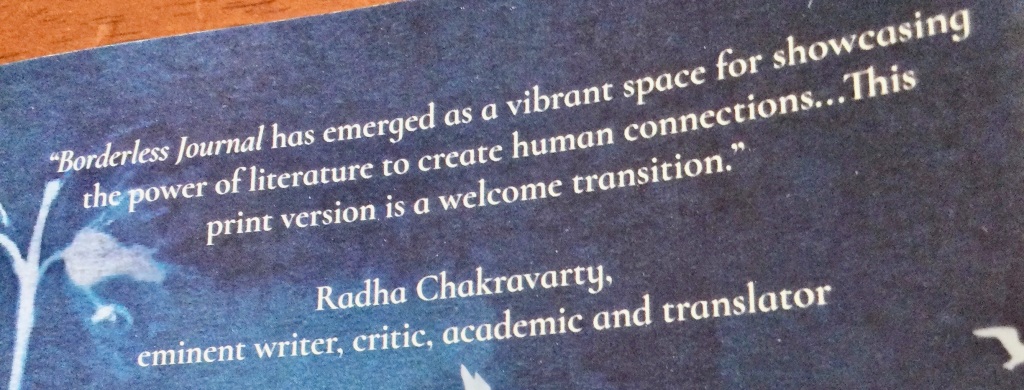
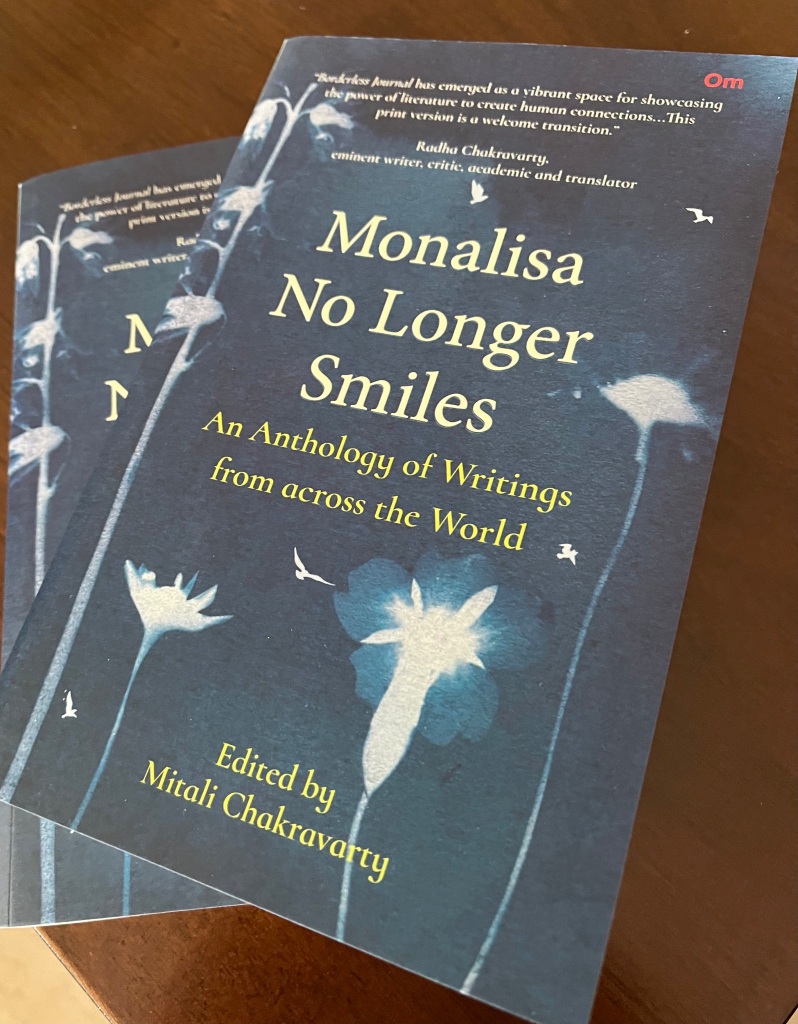
That good things happen despite darkness, despite prognostications of doom, that light glimmers hope if you strive to focus on your strength in hard times is borne true both in fiction and in life. Perhaps, we cannot get back the old ways (but is that what we want?) but new paths emerge. Old gives way to new. And while trying to gather pearls of human excellence — borne not of awards or degrees but of bringing out the best, the kindest, the most loving in human hearts — we managed to create with a team an outstanding anthology. Woven with the writings of old and new — we created a tapestry together that the editor in chief of our publishing house said was “classy, literary, engaging and international”. That one of the oldest and most reputed publishing houses in India with bookshops countrywide took it on was also an unusual event! We are truly grateful to Om Books International, Shantanu Ray Chaudhuri and Jyotsna Mehta along with all our writers and readers who made our anthology a reality, and to Radha Chakravarty and Fakrul Alam for the kind words they bestowed on our effort.

Click here to access the Borderless anthology, Monalisa No Longer Smiles

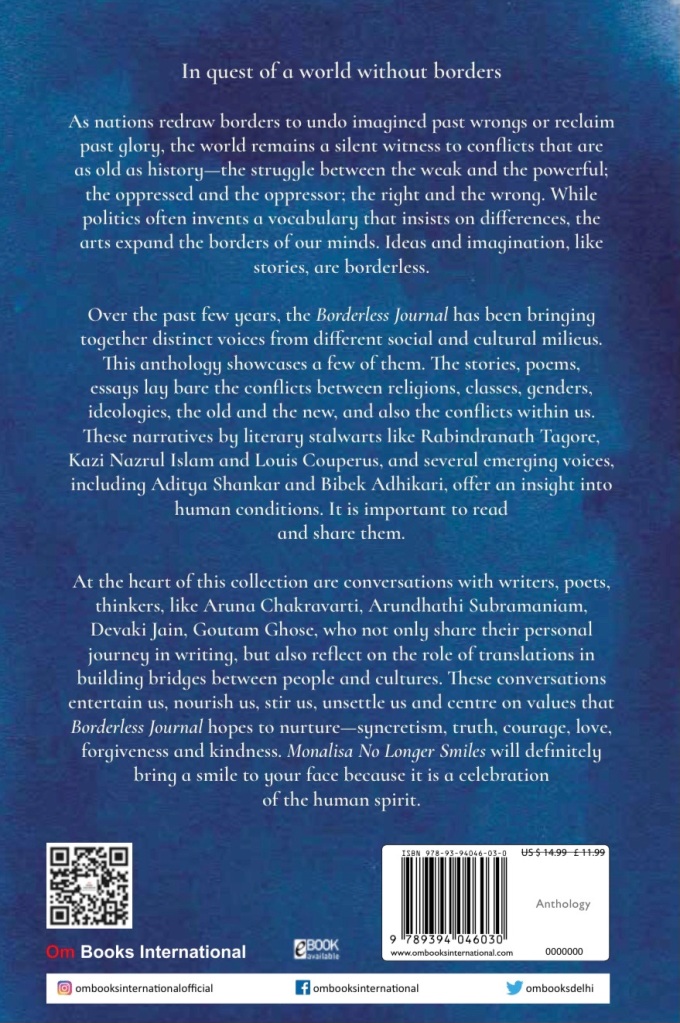
Please greet our first anthology, Monalisa No Longer Smiles, with love and friendship. It could be the perfect Christmas gift in the spirit of the season! And as the blurb says, “it will definitely bring a smile to your face because it is a celebration of the human spirit.”

The anthology is different from our journal in as much as it has a sample of an eclectic collection that has been honed with further editing and has some new features. Most of the writing is from our first year and showcases our ethos, except for Lesya’s poetry and interview. Lesya Bakun from Ukraine is still on the run, looking for a refuge — she cannot return home like you or I can. Her family is scattered across number of countries. Her cousin, who was guarding the factory at Azovstal, was taken prisoner. We included her story in the anthology hoping to create global empathy for refugees as the numbers will increase not only due to war but also due to climate change.

The reason we felt a hardcopy anthology was a good idea was because nothing beats the joy of having a bunch of interesting reads in the warmth of your hands (especially where internet cannot reach or is unavailable). In any case, books with the feel of paper, the rustling whispers which carry voices of leaves can never be replaced as Goutam Ghose had also said in his interview which is now part of our anthology.

And that is why we celebrate more books… this time we feature Singaporean prima donna of literature, Suchen Christine Lim, with her new book Dearest Intimate, a novel that spans more than hundred years including the harrowing Japanese invasion during World War II. She shared sound advice with writers: “Suffering is good for the writer. It will deepen lived experience and expand the heart’s empathy.” And perhaps that is what is echoed through the experiences of the other writer interviewed on our pages by Keith Lyons. This is a writer who not only brought out his own books but was a regular contributor of travel pieces for Frommer’s and National Geographic traveling to unexplored destinations — Christopher Winnan. Another writer Lyon had interviewed recently, Steve Carr, has passed on. We would like to convey our heartfelt condolences to his family and friends.

We have a number of books that have been reviewed. Reba Som reviewed Aruna Chakravarti’s Through the Looking Glass: Stories that span eras spread across time. Somdatta Mandal has reviewed Shehan Karunatilaka’s The Birth Lottery and Other Surprises and Bhaskar Parichha, Rahul Ramagundam’s The Life and Times of George Fernandes. Basudhara Roy has written of Afsar Mohammad’s Evening with a Sufi: Selected Poems, translated from Telugu by the poet and Shamala Gallagher, verses that again transcend borders and divides. We have an excerpt from the same book and another from Manoranjan Byapari’s How I Became a Writer: An Autobiography of a Dalit, translated from Bengali by Anurima Chanda.

More translations from Bengali, Balochi and Korean enrich our November edition. Fazal Baloch has translated a story by Haneef Shareef and Rituparna Mukherjee by Shankhadeep Bhattacharya. We have the translation of an inspirational Tagore poem helping us find courage (Shonkho Dhulaye Pore or ‘the conch lies in the dust’). Another such poem by Nazrul has been rendered in English from Bengali by Professor Fakrul Alam. He has also shared an autobiographical musing on how he started translating Tagore’s Gitabitan, which also happens to be his favourite book. More discussion on the literary persona of TS Eliot and the relevance of his hundred year old poem — ‘The Waste Land’ by Dan Meloche adds variety to our essay section.

Evoking the genius of another outstanding artiste, Kishore Kumar, who happened to pen thought provoking dialogues in some films, is Shantanu Ray Chaudhuri’s essay, review of a recent book on the legendary actor-singer and an interview with the authors. Infringing the boundaries of literary with popular culture and art and integrating all forms into a wholistic bundle has been part of our ethos. In that spirit we have a musing by Prithvijeet Sinha on Edvard Munch’s famous painting called Scream. We have non-fiction from Australia spanning Meredith Stephens’s recent brush with Covid, Mike Smith visits a Scottish beach in the footsteps of a novelist, Ravi Shankar has given us a poignant piece for a late friend and Candice Lousia Daquin talks of the existence of bi-racial biases. In contrast, Suzanne Kamata sent a narrative that bridges divides showcasing a German wife of a Japanese scientist that draws us to conclude that biases erode over time to create an acceptance of bi-racial people. Devraj Singh Kalsi brings in humour with his funny narrative about a guitarist. Rhys Hughes writes in a lighter vein on Indian cuisine in his column and spouts more funny poetry bordering on the absurd.

Jared Carter has shared beautiful poetry on murmuration in birds and we have touching verses from Asad Latif for a little girl he met on a train — reminiscent of Tagore’s poem Hide and Seek (Lukochuri). Michael R Burch has given us poems setting sombre but beautiful notes for the season. We host more poetry by Luis Cuauhtémoc Berriozábal, Quratulain Qureshi, Jim Bellamy, Gayatri Majumdar, Ryan Quinn Flanagan, Alpana, Jonathan Chan, Saranyan BV, George Freek and many more. We have stories from around the world: India, France and Bangladesh.

Gathering all of your thoughts in strings of words from all corners of the world, we present to you the bumper November issue of Borderless Journal . Thank you all for sharing your thoughts with us. Thanks to Sohana Manzoor for her fantastic painting and more thanks to the whole Borderless team for seeing this issue through. We would not have been able to do the anthology or these issues without each one of you — writers and readers.

Thank you all from the bottom of my heart.

There is always hope for a new tomorrow!

Mitali Chakravarty

borderlessjournal.com

Click here to access the Borderless anthology, Monalisa No Longer Smiles

Categories
Editorial

The Sky

The sky is, was and will be.

It stretches without borders, without interruptions, without contentions, unifying all under its life-giving ambience. We live nurtured by the sky, the water and the Earth. If we think back to times before humans made constructs and built walls to guard their own, to times when their ancestors roamed the Earth and moved to meet their needs, the population was not huge, and resources were abundant. Our species lived in consonance with nature. People revered natural forces and found trends that evolved into traditions and constructs which eventually made their progeny forget that the sky, water and Earth did not belong to them. These belong or perhaps exist for some reason that we do not comprehend despite the explanations given by science and religions. Being merely transient passers-by through these, humanity, unlike dinosaurs, has an urge to survive and be like the sky — with a past, present and future and a sense of the eternal. Though we all have short lives compared to the sky, Earth or universe, we continue to find ourselves in a homo centric world that considers all else to be made to meet their aspirations. But there was a time, when humans lacked this arrogance. They just tried to survive. And move with shifting rivers in an unbordered world.

Exploring such times, is Anthony Sattin’s profound book, Nomads: The Wanderers Who Shaped our World. He converses to reinforce reviving the concept of asabiyya or bonding between humans so that they find it in their hearts to move forward with necessary changes to avoid following in the footsteps of mammoths. A change maker who redefined constructs for humankind, a devdasi’s[1] daughter who rose to become a pioneering doctor and activist a hundred years ago, is Dr Muthulakshmi Reddy. We have an interview with her recent biographer, R Devika, who authored Muthulakshmi Reddy: A Trailblazer in Surgery and Women’s Rights.

The books reviewed this time include one featuring the writings by the greatest change maker in cinema — Satyajit Ray. Bhaskar Parichha has reviewed Satyajit Ray Miscellany: On Life, Cinema, People & Much More while Professor Somdatta Mandal has given us a candid opinion on BM Zuhara’s The Dreams of a Mappila Girl: A Memoir, translated from Malayalam by Fehmida Zakir. Taranath Tantrik and Other Tales from the  Supernatural by Bibhutibhushan, translated from Bengali by Devalina Mookerjee brings unexplored dark mysterious forces into play and has been reviewed by Basudhara Roy. We have an excerpt from the titular stories of Tarantath Tantrik. Bibhutibhushan Bandopadhyay(1894-1950) was a legendary writer from Bengal. He wrote stories and novels, some of which were immortalised in cinema, such as the Apu triology by Satyajit Ray. The other book excerpt is from a translation from Kannada by an upcoming voice that needs to be heard, Maithreyi Karnoor. She has brought to the anglophone world Shrinivas Vaidya’s Handful of Sesame.

In our section on translations, we are privileged to carry voices that remain relevant to date, Tagore and Nazrul. Nazrul’s poem on poverty, Daridro, has been translated by Professor Fakrul Alam and we have a transcreation of Tagore’s inspiring lyrics (Aalo Amar Aalo) to energise one’s life with the refulgence of light. Rosy Gallace’s poetry has been translated from Italian by Albanian writer, Irma Kurti. Korean poet, Ihlwha Choi, has translated his own poem on peace for us. And a Tamil short story by S Ramakrishnan, has been rendered into English by B Chandramouli. It is an interesting potpourri as is our poetry section, which even features poetry from Iraq by Ahmad Al-Khatat. We also feature poems by Michael Burch, Kirpal Singh, Ryan Quinn Flanagan, Jonathan Chan, Ron Pickett, George Freek, Gayatri Majumdar, Vandana Kumar, Mike Smith and many more along with the inimitable witty ditties of Rhys Hughes which not only make us laugh but also wonder…

Evoking humour is not easy, but we do have a few such writers who manage it very well. Hughes has given us a tongue-in-cheek piece on the dateline, which has more than humour. And Devraj Singh Kalsi has shared his discovery that laughter is the best medicine to shrug off a dentist’s drill. He has also visited the colours of Durga Puja which, with its spirit of inclusivity, transported visitors in one marquee near Kolkata to the iconic Malaysian Twin Towers. Thus, bringing festivals in October into our purview. Candice Lousia Daquin has actually explored why we celebrate festivals and the God gene… Did you know we have a biological need for spirituality?

Suzanne Kamata has introduced us to Mount Bizan, which houses a writer by the surname of Moraes – Wenceslau José de Souza de Moraes, an expat writer who lived in Japan at the turn of the twentieth century. Wonder if he could have been related to the Anglo Indian writer, Dom Moraes? Aditi Yadav has also given us an essay on the Japanese philosophy of Wabi-sabi with its world view centred on imperfections and transience. Ravi Shankar has suggested walks for all of us, sharing his experiences in the Himalayas, the Caribbean island of Aruba and in many more places. Meredith Stephens has written of sailing to Tasmania.

The essay that brought back a flavour of home for me is one by Asad Latif, now a journalist in Singapore but long ago, he was an icon in India. We are very privileged to have his writing on what borders do for us… a piece exploring the idea on which we base our journal, also perhaps with a touch of Anthony Sattin’ s asabiyya. ‘Pandies’ Corner‘ starts another run, showcasing women’s tryst for freedom. Amreen’s ‘Moh-Reen’, her own story, translated from Hindustani by Janees, is a brave start to the series. The voices ring out asking for a change, to heal social norms to accommodate love and kindness with the backing of Shaktishalini and Pandies as does the unsupported solo voice of an older woman from Balochistan, Ganji Baloch, brought to our notice by Ali Jaan Maqsood.

We have fiction from Sohana Manzoor – again bringing to fore strange stories of women rebelling against social norms. Paul Mirabile explores death and the sea in a horrific story. Sunil Sharma’s fiction explores madness and ideators, making a social comment on recent happenings. As the sky stretches out to accommodate all kinds of writings, all creatures great and small, we try our best to give voice to a fair cross section from around the world as we have done this time too.

There are as usual pieces that we have not mentioned in this note but they are all worth a read. Do drop in to check out our contents in this October issue. We are truly grateful to our contributors who continue to connect with words and thoughts that waft along with clouds. We would like to thank Sohana Manzoor especially for her wonderful artwork. The journal would not be a possibility without the support of the whole team and our valuable readers who make writing worth the effort. It is lovely to be read and remembered for the words we write.

Wish you all a wonderful October.

Mitali Chakravarty

borderlessjournal.com


[1] A woman ‘married’ to Gods and forced to live as a mistress to mortal men.

Categories
Editorial

When Autumn Leaves Start to Fall…

                     “Where are the songs of Spring? Ay, where are they?
                      Think not of them, thou hast thy music too…”

                                 — John Keats (1795-1851), To Autumn
Art by Sybil Pretious

For long writers have associated autumn with “mellow wistfulness”. That loss of spring, or loss of youth is not bleak or regretful has been captured not just by Keats but also been borne out by historical facts. Anthropocene existence only get better as the human race evolves … If we view our world as moving towards an autumn, we perhaps, as Keats suggests, need to find the new “music” for it. A music that is ripe and matures with the passage of time to the point that it moves more towards perfection. Though sometimes lives fade away after autumn gives way to winter as did those of  Queen Elizabeth II (April 21st 1926 – September 8th 2022) after a reign of seventy historic years and Mikhail Gorbachev (2nd March 1931 – 30thAugust 2022) with his admirable efforts to bridge divides. Both of them have left footprints that could be eternalised if voices echo in harmony. Thoughts which create bonds never die – they live on in your hearts and mine.

Imagine… ten thousand years ago, were we better off? Recorded history shows that the first war had already been fought 13,000 years ago. And they have continued to rage – but, at least, unlike the indomitable Gauls in Asterix[1] comics – not all jumped into the fray. They did during the last World Wars — which also led to attempts towards institutionalising humanitarian concerns and non-alignment. Yes, we have not had a perfect world as yet but as we age, the earth matures and we will, hopefully, move towards better times as we evolve. Climate change had happened earlier too. At a point, Sahara was green. Continental shifts split Pangaea  into seven continents – that was even earlier. That might have driven the dinosaurs to extinction. But I am sure mankind will find a way out of the terror of climate change and wars over a period of time, as long as we believe in deciphering the sounds of autumn as did Keats in his poem.

Tagore had also sung of the joys of autumn which happens to be a time for festivities. Professor Fakrul Alam has translated three such songs, reflecting the  joie de vivre of the season, The translation of a small poem, Eshecche Sarat[2], brings the beauty of the season in Bengal to the fore. We have a celebration of youth and romance in a Balochi folksong, an anti-thesis to autumn and aging, translated for us by Fazal Baloch and also, poetic prose in quest of God and justice by Haneef Sharif, translated from Balochi by Mashreen Hameed. Lost romance recapitulated makes interesting poetry is borne out by Ihlwha Choi’s translation of his own poem from Korean. But the topping in our translation section is a story called ‘Nagmati[3]’ by eminent Bengali writer, Prafulla Roy, translated by no less than a Sahitya Akademi winning translator – Aruna Chakravarti. This story illustrates how terrifying youthful follies can lead to the end of many young lives, a powerful narrative about the snake worshipping community of Bedeynis that highlights destruction due to youthful lusts and an inability to accept diverse cultures.  

When this cultural acceptance becomes a part of our being, it creates bonds which transcend manmade borders as did the films of Satyajit Ray. His mingling was so effective that his work made it to the zenith of an international cinematic scenario so much so that Audrey Hepburn, while receiving the Oscar on his behalf, said: “Dear Satyajit Ray. I am proud and privileged to have been allowed to represent our industry in paying tribute to you as an artist and as a man. For everything you represent I send you my gratitude and love.”

This and more has been revealed to us in a book, Satyajit Ray: The Man Who Knew Too Much, authored by a protagonist from Ray’s film, Barun Chanda. This book brought out by Om Books International reflects not just Ray as a person but also how he knitted the world together with his films and took the Indian film industry to an international level. Barun Chanda has been interviewed with a focus on Satyajit Ray. Keith Lyons has also interviewed a man who has defied all norms and, in the autumn of his life, continues his journey while weaving together cultures across, China, India and Thailand by his ethnographic studies on tribes, Jim Goodman. Goodman says he left America when speaking for a war-free world became a cause for censorship. This makes one wonder if war is a game played for supporting a small minority of people who rule the roost?  Or are these ramblings of a Coleridge writing ‘Kubla Khan’ under the influence of narcotics?

Poetry also brings the season into our pages with an autumnal interpretation of life from Michael Burch. More poetry from Sunil Sharma, Ryan Quinn Flanagan, Gayatri Majumdar, George Freek, Ron Pickett, Sutputra Radheye, Marianne Tefft brings a wide range of concerns to our pages – from climate to the vagaries of human nature. Poetry by an Albanian writer, Irma Kurti, and photographs by her Italian spouse, Biagio Fortini, blend together the colours of humanity. Rhys Hughes as usual, makes it to the realm of absurd – perhaps voicing much in his poetry, especially about the environment and human nature, though he talks of woodpeckers on Noah’s ark (were there any?) and of cows, yetis, monkeys and cakes… He has also given us a hilarious cat narrative for his column. Can that be called magic realism too? Or are the edges too abstract?

A book excerpt from Hughes’ Comfy Rascals Short Fiction and a review of it by Rakhi Dalal makes us wonder with the reviewer if he is a fan of Kafka or Baudelaire and is his creation a tongue-in-cheek comment on conventions? A book review by Hema Ravi of Mrutyunjay Sarangi’s A Train to Kolkata and Other Stories and another by Bhaskar Parichha of Netaji Subhash Chandra Bose’s Life, Struggle and Politics, authored by Netaji’s nephew’s wife, Krishna Bose, translated and edited by her son, Sumantra Bose, unveils the narratives around his life and death.

A leader who quested for freedom and roamed the world after being passed over by the Congress in favour of Nehru, Netaji raised an army of women who were trained in Singapore – not a small feat in the first half of the twentieth century anywhere in the world. His death in an air crash remained an unsolved mystery — another one of those controversies which raged through the century like the Bhawal case. In his review, Parichha spells out: “Aiming to bring an end to the controversies and conspiracy theories surrounding the freedom fighter, the over 300-page book gives a detailed and evidence-based account of his death in one of its chapters.”

Our book excerpts in this edition both feature writers of humour with the other being the inimitable Ruskin Bond. We have an excerpt of Bond’s nostalgia from Between Heaven and Earth: Writings on the Indian Hillsedited by Ruskin Bond and Bulbul Sharma.

Our non-fiction also hosts humour from Devraj Singh Kalsi about his interactions with birds and, on the other hand, a very poignant poetic-prose by Mike Smith reflecting on the vagaries of autumn. From Japan, Suzanne Kamata takes us to the Rabbit Island – and murmurings of war and weapons. We have the strangest story about a set of people who are happy to be ruled by foreign settlers – we would term them colonials – from Meredith Stephens. G Venkatesh delights with a story of love and discovery in Korea, where he had gone in pre-pandemic times. Paul Mirabile travels to Turkey to rediscover a writer, Sait Faik Abasiyanik (1906-1954). And Ravi Shankar gives us an emotional story about his trek in the Himalayas in Nepal with a friend who has passed on. Candice Louisa Daquin has written of the possibilities towards integrating those who are seen as minorities and marginalised into the mainstream.

The edition this time is like Autumn – multi-coloured. Though I am not able to do justice to all our contributors by mentioning them here, my heartfelt thanks to each as every piece only enriches our journal. I urge you to take a look at the September edition.

I would like to give huge thanks to our readers and our team too, especially Sohana Manzoor and Sybil Pretious for their artwork. We could not have come this far without support from all of you.

Thank you.

Happy Reading!

Mitali Chakravarty

borderlessjournal.com


[1] The men in the indomitable Gaulish village (which the Romans failed to conquer) in times of Julius Caesar loved to jump into a fight for no reason…Asterix was the protagonist of the comics along with his fat friend Obelix

[2] Arrival of Autumn

[3] Snake Maiden

Categories
Editorial

We are All Going on a Summer Holiday…

Yes! It is vacation time, and we are all able to travel at last. Though the pandemic which had closed borders for us seems to be evolving as an endemic, another huge human crisis, a war which cannot be justified in any way, stares us in the face. Loss of lives, homes, towns, cities and threats of global recession follow in the footsteps of refugees wandering into our lives. Lesya Bakun, the Ukrainian refugee whose story we have been following, told me four of her relatives’ homes in Mariupol have been erased out of existence and her extended family has scattered where they found safety as her cousin continues a prisoner of war, captured while defending the iron and steel factory at Azovstal. While majority of the world expresses solidarity with the Ukrainians, another set of refugees remain in shadows. They have completely lost their country in which they had lived from ancient times. I am referring to the Rohingya of Arakan. CNN world states:

“The Rohingya are a stateless Muslim minority in Myanmar’s Rakhine State, thought to number about 1 million people.

“Myanmar does not recognize them as citizens or one of the 135 recognized ethnic groups in the country.”

 We are privileged to host a powerful poignant translation by Arifa Ghani Rahman of Shaheen Akhtar’s short story about such a voiceless Rohingya child in a refugee camp. Though this is a fiction inspired by Akhtar’s visits to such shelters, we hope at some point these children will be able to build new lives to create a world free of violence, intolerance, hatred and greed.

One of the questions that springs to one’s mind, watching such atrocities destroy innocent lives is that should one accept bullies and give in to their pressure tactics? Bullies can be found among world leaders as well as perpetrators of decadent societal norms which are often critiqued by satires. Somdatta Mandal has translated one such satirical playlet where social conventions are targeted in a lighter vein by Tagore. In the same spirit, the maestro’s iconic poem about a palmyra tree called Taal Gaachh has been transcreated to bring the joy of innocent wanderings back into the narrative, creating an island of healing thoughts. We continue with our translations of Jibananada Das by Professor Fakrul Alam, a Korean poem by Ihlwha Choi and a magical Balochi folktale by Fazal Baloch. Let us read such translations to connect with varied cultures so that compassion and acceptance of diverse perspectives end horrors like wars, starvation and hunger.  

Tagore’s writings translated to English by Mandal in Gleanings of the Road, a collection covering the maestro’s travel to the West, is part one of our book excerpts and highlights Rabindranath’s perspectives on the need to connect with the larger world. The other book excerpt, from Waiting, poetry by Suzanne Kamata, takes up the theme of victimisation, crime and murder. Dwelling on no less horrific narratives, though justified as non-criminal, is a review by Meenakshi Malhotra of Harsh Mander’s Locking down the Poor: The Pandemic and India’s Moral Centre. Gracy Samjetsabam’s assessment of Half-Blood by Pronoti Datta informs about the greyer areas of a whole community in Mumbai. Indrashish Banerjee reviewed Keki Daruwalla’s stories on human relationships anthologised in a collection called Going: Stories of Kinship while Bhaskar Parichha has acquainted us with Deepti Priya Mehrotra’s Her Stories –Indian Women Down the Ages — Thinkers, Workers, Rebels, Queens, a non-fiction that visits inspiring women.

Inspiration can also be drawn from Rinki Roy Bhattacharya’s and Maithili Rao’s The Oldest Love Story, featuring a medley of men and women writing on the theme of motherhood along with some narratives about their mothers or on the experience of being one. The medley includes well-known names from films and literature like Shabana Azmi, Saeed Mirza, Shashi Deshpande, Nabanita Dev Sen and more. We interviewed Roy Bhattacharya to find out more about this impactful book. Achingliu Kamei, an academic and writer, has conversed with Naga writer, Veio Pou, whose award-winning book, Waiting for the Dust to Settle, was reviewed earlier — a book that gives a glimpse of conflicts in the Northeast of India.

Taking on the theme of conflicts at a personal level, Atreyo Chowdhury’s and Banerjee’s stories create a sense of disquiet as Paul Mirabile’s explores crime, madness and its impact on humans. G Thomas takes a relook at heroism and bravery as a concept. His story set in Kerala shakes our complacency, upending traditional concepts of heroism and bravery just as Candice Louisa Daquin has upended the cult of positivity in her essay. Notes of discord and accord seem to ring through this edition and the undertones of greys spread out towards an exploration of life and death. We have multiple ghost stories this time, even from the Nithari column written by Kiran Mishra, a youngster who got over the trauma of violence in the community and discovered her place as a bilingual writer and educator.

Our poetry section is honoured to host Walt Whitman Award winner, Jared Carter, again with his poetry on a Japanese artefact as George Freek’s continues to be inspired by the style of Song dynasty poets. Michael Burch writes beautiful love poems. We have a vibrant poetry section with Daquin, Sutputra Radheye, Ryan Quinn Flanagan, Antara Mukherjee, Rhys Hughes, who has also revisited ‘The Penguin Café Orchestra‘. This band started a new kind of musical trend with nothing but passion and conviction. Hughes of course cannot escape the bonds of his tongue-in-cheek style, also adopted by Devraj Singh Kalsi while he pretends to be an ant.

Keith Lyons has got the bug of tongue-in-cheek too as he gives us a piece on his travels in Varanasi that well captures the dichotomies we find in India. Dwelling on social dichotomies also is Ratnottama Sengupta’s powerful tribute to Swatilekha Sengupta, a film and theatre doyenne who brought to life Tagore’s novel, Ghare Baire (Home and the World, 1985). An essay by Mozid Mahmud exploring both the syncretic elements in Tagore’s and Kabir’s works, the medieval poet’s impact on the Nobel laureate and a dispute over Rabindranath’s own translation blends with the tone of greys in this edition.

Travel narratives and photographs by Meredith Stephens sailing the seas in Tasmania and Ravi Shankar trekking on the slopes of the Himalayas to get a view of Mt Everest make for perfect holiday adventures. From Japan, Kamata has given us a narrative set in the pandemic. And environmentalist Kenny Peavy dwells on reconnecting with nature in Mission Earth.

We have a fair deal from across the globe in the June issue. But, as usual, some of the treats in the content have not been mentioned though they are wonderful pieces of writing too. We look forward to your continued support as you delve into our treasure trove of gems from across the oceans. A huge thanks to our fabulous team, to the contributors and readers. I especially want to thank Sohana Manzoor for sharing her lovely artwork and wish you all a wonderful read!

I hope you have a fabulous summer.

Thank you.

Mitali Chakravarty

borderlessjournal.com

Categories
Editorial

Catch a Falling Star…

Art by Sohana Manzoor
For when your troubles starting multiplying
And they just might
It's easy to forget them without trying
With just a pocketful of starlight

Catch a falling star and put it in your pocket
Never let it fade away (never let it fade away)
Catch a falling star and put it in your pocket
Save it for a rainy day

'Catch a Falling Star' by Paul Vance and Lee Pockriss

Perhaps, it is time to find that fallen star popularised by pop singer Perry Como is 1957. Optimism glimmers faintly, sometimes even conceals itself, in a world passing through a dark phase in history. For instance, few of us would know that we might find more answers to tackle  climate change as dinosaur fossils (from the time an asteroid hit the planet) have been unearthed recently. That sounds like solutions can be had to what was perceived as inevitable doom.

Another bit of news that perhaps will cheer some is the first anthology of Borderless Journal will soon be available in market. It has been accepted by a publisher, an old, trusted and reputed name from India, Om Books International. They have bookshops splattered all over — should make it easy for buyers to access the book. Hopefully, you can target the anthology for your Diwali or Christmas gift hampers. Om Books has one of the most iconic editors-in chief, Shantanu Ray Chaudhuri. A multiple award-winning editor, he has worked in Penguin and Harper Collins and is currently churning out wonderful books from Om with a fabulous production team, working with whom has been a pleasure. Ray Chaudhuri is an outstanding film writer and poet. He is part of a group that is creating a film archive online. To know more about him or his views on publishing, you can read our online conversation with him.

The energy one gets from optimism like starlight from a fallen star, lightens the darker shadows that create gloom with the war leading to rise in prices and threats of recession in a post pandemic scenario. Lesya Bakun, the refugee from Ukraine whose story we carried last month, finds her starlight by sharing updates of her story.  She added to her narrative with the news that her cousin has been taken as a prisoner of war by Russia from the besieged factory in Ukraine. Though sharing does not alleviate suffering, Bakun’s ability to cling to hope and imagine a future where she gets her dream highlights the strength of her convictions. The other thing that is revealed by her narrative and media coverage is exclusivity and boxes of ideology split humankind, erase families, cities, countries, lives and sanity. The war can appease only the lust of warlords. Against this desolation caused by the devastation, what could be the starlight that would lead to a happier future?

Laughter. Unleashing the ability to laugh at oneself is as potent as laughter that generates relief and lightens our mood, so that we can view differences as whimsical, treat them with tolerance and compassion and not destroy the diversities that add colours to the world. Perhaps, that is why Tagore took to humour too. Somdatta Mandal has translated a series of humorous skits by Tagore. We are featuring one of these called the ‘Ordeal of Fame’. Yet another translation or transcreation of a poem called ‘Lukochuri’ or ‘Hide and Seek’ reflects the playful in Tagore’s oeuvre. These, along with Rhys Hughes humour on the pandemic in poetry and prose, bring good cheer into our journal. Hughes has also used his column to tell us why he curated a new humorous anthology of verses by seventeen poets called Wuxing Lyrical. I wonder if he is serious or joking!

We were fortunate to have a tongue-in-cheek online discussion with an academic with a witty sense of humour who started a book based on his PhD research with a limerick, Amit Ranjan, author of John Lang the Wanderer of Hindoostan, Slanderer in Hindoostan, Lawyer for the Ranee. While Ranjan brought to us a narrative of an Australian who challenged the colonial mindset, went to court representing the Rani of Jhansi, wrote for Charles Dickens in Household Words and moved around the world just like one of us, hopping jobs and looking for a life, we have diverse cultural streams woven into the journal with translations of a Balochi folktale from Fazal Baloch, a Korean poem by Ihlwha Choi and Professor Fakrul Alam’s translation of Jibananda’s poetry, an ongoing project in Borderless.

The Nithari column has yielded us a story that was written in a mix of Hindi and English by Yogesh Uniyal and translated fully to English by Nirbhay Bhogal. We have strange stories this time. Nileena Sunil’s short narrative and Paul Mirabile’s longer one set in Madrid explore the unusual. More stories delve into the intricacies of the human mind.

As we trot around the globe, Suzanne Kamata tells us about a Monet museum in Japan where she ate madeleines made with the artist’s recipe! Meredith Stephens sails to Tasmania with her camera and gives us a glimpse of nature’s plenty. Ravi Shankar relates his trekking adventures among the Himalayas in Nepal, with awesome photographs of these mountains, while Kenny Peavy who lives in Indonesia dwells on the value of falling down and getting up in a light humorous vein against the backdrop of nature – though metaphorically perhaps the world needs to do that. We have G Venkatesh’s story about his stay in Johannesburg where he discovers that skin tones do not matter.

Ratnottama Sengupta makes the whole world look like a home with the story of a legendary screenwriter, Jean Claude Carriere, who wrote the script of Mahabharata for Peter Brook’s play (1985) of the same name and the subsequent film (1989) — with characters drawn from all over the world. Candice gives us an overview of the pandemic, with more focus on US where she lives.

Mike Smith travels back to another time when an ailment called World War II raged and has revived a writer from the past, HE Bates (1905-1974). We have another essay by Dan Meloche on a legendary book which turned 100 this year — Herman Hesse’s Siddhartha. Rakhi Dalal revisits more than a century old translation by Devabrata Mukherjee of Tagore’s The Post Office which bears relevance to the present day as it shows how the human spirit endures over even the darkness of death.

Bhaskar Parichha has reviewed Radhika Gupta’s Limitless: The Power of Unlocking Your True Potential, by his assessment a book that inspires youngsters to take charge of their future. On the other hand, there are books that explore the darkest in humans. Basudhara Roy has reviewed a collection short stories by Sunil Sharma called Burn the Library & Other Fiction. Indrashish Banerjee reviews Upamanyu Chatterjee’s latest novel based on modern day crimes, Villainy, from which we are carrying a book excerpt too. The other excerpt is from a narrative written from a refugee’s perspective, Ramy Al-Asheq’s Ever Since I Did Not Die, translated by Isis Nusair from Arabic. Born in a refugee camp in Damascus, this Syrian-Palestinian poet defies all genres to touch hearts with brutal honesty. No less sincere is Michael Burch’s poetry on summer that ushers in the season as much as Sohana’s beautiful painting that we are using as our cover photo. We have poetry from not just Shantanu Ray Chaudhuri but also by George Freek, S. Srinivas, Tohm Bakelas, Abin Chakraborty, Marianne Tefft and many more. As usual, I have not mentioned all the treats in store for you. Delve into our contents page and browse to find out more.

Before winding up, I would want to extend my thanks not only to our team and contributors, but also to our publisher who is willing to republish our content with some tweaking. Thanks to our readers who, I hope, will be excited to have selected content between their palms as a hardcopy anthology with 49 of our most iconic pieces. We have more than a thousand published works. This anthology will be an iconic sample that you can carry anywhere with you even if there is no internet – that would include Mars and Moon!

I wish you happy reading, happy dreaming and hope… plenty of it.

Best wishes,

Mitali Chakravarty

borderlessjournal.com