Categories
Editorial

‘I wondered should I go or should I stay…’

I flow and fly
with the wind further
still; through time
and newborn worlds…

--‘Limits’ by Luis Cuauhtémoc Berriozábal

In winters, birds migrate. They face no barriers. The sun also shines across fences without any hindrance. Long ago, the late Nirendranath Chakraborty (1924-2018) wrote about a boy, Amalkanti, who wanted to be sunshine. The real world held him back and he became a worker in a dark printing press. Dreams sometimes can come to nought for humanity has enough walls to keep out those who they feel do not ‘belong’ to their way of life or thought. Some even war, kill and violate to secure an exclusive existence. Despite the perpetuation of these fences, people are now forced to emigrate not only to find shelter from the violences of wars but also to find a refuge from climate disasters. These people — the refuge seekers— are referred to as refugees[1]. And yet, there are a few who find it in themselves to waft to new worlds, create with their ideas and redefine norms… for no reason except that they feel a sense of belonging to a culture to which they were not born. These people are often referred to as migrants.

At the close of this year, Keith Lyons brings us one such persona who has found a firm footing in New Zealand. Setting new trends and inspiring others is a writer called Harry Ricketts[2]. He has even shared a poem from his latest collection, Bonfires on the Ice. Ricketts’ poem moves from the personal to the universal as does the poetry of another migrant, Luis Cuauhtémoc Berriozábal, aspiring to a new, more accepting world. While Tulip Chowdhury — who also moved across oceans — prays for peace in a war torn, weather-worn world:

I plant new seeds of dreams
for a peaceful world of tomorrow.

--‘Hopes and Dreams’ by Tulip Chowdhury

We have more poems this month that while showcasing the vibrancy of thoughts bind with the commonality of felt emotions on a variety of issues from Laila Brahmbhatt, John Grey, Saba Zahoor, Diane Webster, Gautham Pradeep, Daniel Gene Barlekamp, Annwesa Abhipsa Pani, Cal Freeman, Smitha Vishwanath, John Swain, Nziku Ann and Anne Whitehouse. Ramzi Albert Rihani makes us sit up by inverting norms while Ryan Quinn Flangan with his distinctive style raises larger questions on the need for attitudinal changes while talking of car parks. Rhys Hughes sprinkles ‘Hughesque’ humour into poetry with traffic jams as he does with his funny spooky narrative around Christmas.

Fiction in this issue reverberates across the world with Marc Rosenberg bringing us a poignant telling centred around childhood, innocence and abuse. Sayan Sarkar gives a witty, captivating, climate-friendly narrative centred around trees. Naramsetti Umamaheswararao weaves a fable set in Southern India.

A story by Nasir Rahim Sohrabi from the dusty landscapes of Balochistan has found its way into our translations too with Fazal Baloch rendering it into English from Balochi. Isa Kamari translates his own Malay poems which echo themes of his powerful novels, A Song of the Wind (2007) and Tweet(2017), both centred around the making of Singapore. Snehaprava Das introduces Odia poems by Satrughna Pandab in English. While Professor Fakrul Alam renders one of Nazrul’s best-loved songs from Bengali to English, Tagore’s translated poem Jatri (Passenger) welcomes prospectives onboard a boat —almost an anti-thesis of his earlier poem ‘Sonar Tori’ (The Golden Boat) where the ferry woman rows off robbing her client.

In reviews, we also have a poetry collection, This Could Be a Love Poem for You by Ranu Uniyal discussed by Gazala Khan. Bhaskar Parichha introduces a book that dwells on aging and mental health issues, Indira Das’s Last Song before Home, translated from Bengali by Bina Biswas. Rakhi Dalal has reviewed Anuradha Kumar’s Love and Crime in the Time of Plague:A Bombay Mystery, a historical mystery novel set in the Bombay of yore, a sequel to her earlier The Kidnapping of Mark Twain. Andreas Giesbert has woven in supernatural lore into this section by introducing Ariel Slick’s The Devil Take the Blues: A Southern Gothic Novel. In our excerpts too, we have ghostly lore with an extract from Ghosted: Delhi’s Haunted Monuments by Eric Chopra. The other excerpt is from Marzia Pasini’s Leonie’s Leap, a YA novel showcasing resilience.

We have plenty of non-fiction this time starting with a tribute to Jane Austen (1775-1817) by Meenakshi Malhotra. Austen turns 250 this year and continues relevant with remakes in not only films but also reimagined with books around her novels — especially Pride and Prejudice (which has even a zombie version). Bhaskar Parichha pays a tribute to writer Bibhuti Patnaik. Ravi Varmman K Kanniappan explores ancient Sangam Literature from Tamil Nadu and Ratnottama Sengupta revisits an art exhibition that draws bridges across time… an exploration she herself curated.

Suzanne Kamata takes us on a train journey through historical Japan and Meredith Stephens finds joy in visiting friends and living in a two-hundred-year-old house from the Edo period[3]. Mohul Bhowmick introduces a syncretic and cosmopolitan Bombay (now Mumbai). Gower Bhat gives his opinion on examination systems in Kashmir, which echoes issues faced across the world while Jun A. Alindogan raises concerns over Filipino norms.

Farouk Gulsara — with his dry humour — critiques the growing dependence on artificial intelligence (or the lack of it). Devraj Singh Kalsi again shares a spooky adventure in a funny vein while Malachi Edwin Vethamani woos us with syncretic colours of Christmas during his childhood in Brickfields, Malaysia — a narrative woven with his own poems and nostalgia.

We have a spray of colours from across almost all the continents in our pages this time. A bumper issue again — for which all of the contributors have our heartfelt thanks. Huge thanks to our fabulous team who pitch in to make a vibrant issue for all of us. A special thanks to Sohana Manzoor for the fabulous artwork. And as our readers continue to grow in numbers by leap and bounds, I would want to thank you all for visiting our content! Introduce your friends too if you like what you find and do remember to pause by this issue’s contents page.

Wish all of you happy reading through the holiday season!

Best wishes,

Mitali Chakravarty

borderlessjournal.com

CLICK HERE TO ACCESS THE CONTENTS FOR THE DECEMBER 2025 ISSUE.

[1] UNHCR Refugees

[2] Harry Ricketts born and educated in  England moved to New Zealand.

[3] Edo period in Japan (1603-1868)

.

READ THE LATEST UPDATES ON THE FIRST BORDERLESS ANTHOLOGY, MONALISA NO LONGER SMILES, BY CLICKING ON THIS LINK.

Categories
World Environment Day

This is Our Home…

Our home is our planet with it’s unique combinations which have made life possible. These evolve and mutate with human intervention and the passage of time. The changes affect the flora and the fauna — of which we are a part — of this beautiful green planet. The World Environment Day is a UN initiative to protect the environment and to create an awareness about the changes wrought on it and how it could impact us as a species. Writers from yore have written of the beauty and the inspiration invoked by nature as have the moderns. Today, we share with you vintage writings as well as modern writing in prose on the world around us, showcasing the concerns of a century ago and the reality today.

Vintage Prose

One Small Ancient Tale: Rabindranath Tagore’s Ekti Khudro Puraton Golpo (One Small Ancient Tale) has been translated by Nishat Atiya. Click here to read.

 Bolai: Story of nature and a child translated by Chaitali Sengupta. Click here to read.

Baraf Pora (Snowfall) : This narrative gives a glimpse of Tagore’s first experience of snowfall in Brighton and published in the Tagore family journal, Balak (Children), has been translated by Somdatta Mandal . Click here to read.

The Day of Annihilation, an essay on climate change by Kazi Nazrul Islam, has been translated from Bengali by Radha Chakravarty. Click here to read.

Modern Prose

The Gift Rebecca Klassen shares a sensitive fiction about a child and an oak tree. Click here to read.

A Penguin’s StorySreelekha Chatterjee writes a fiction from a penguin’s perspective. Click here to read.

Navigational ErrorLuke P.G. Draper explores the impact of pollution with a short compelling narrative. Click here to read.

Pigeons & People : In his fiction, Srinivasan R explores human nature and imagines impact on our fauna. Click here to read

The Theft of a RiverKoushiki Dasgupta Chaudhuri reveals a poignant truth about how a river is moving towards disappearance due to human intervention. Click here to read.

Better Relations Through Weed-pullingSuzanne Kamata introduces us to an annual custom in Japan. Click here to read.

The Toughness of Kangaroo Island Vela Noble draws solace and lessons from nature around her with her art and narrative. Click here to read.

Potable Water Crisis & the SunderbansCamellia Biswas, a visitor to Sunderbans during the cyclone Alia, turns environmentalist and writes about the potable water issue faced by locals. Click here to read.

The Malodorous Mountain: A Contemporary FolkloreSayantan Sur looks into environmental hazards due to shoddy garbage disposal. Click here to read.

Four Seasons and an Indian SummerKeith Lyons talks of his experiences of seasons in different places, including Antarctica. Click here to read.

Tsunami 2004: After 18 yearsSarpreet Kaur travels back to take a relook at the tsunami in 2004 from Andaman and Nicobar Islands. Click here to read.

A discussion on managing cyclones, managing the aftermath and resilience with Bhaksar Parichha, author of Cyclones in Odisha: Landfall, Wreckage, and Resilience. Click here to read.

Categories
Editorial

“Imagine all the people/Living life in peace”

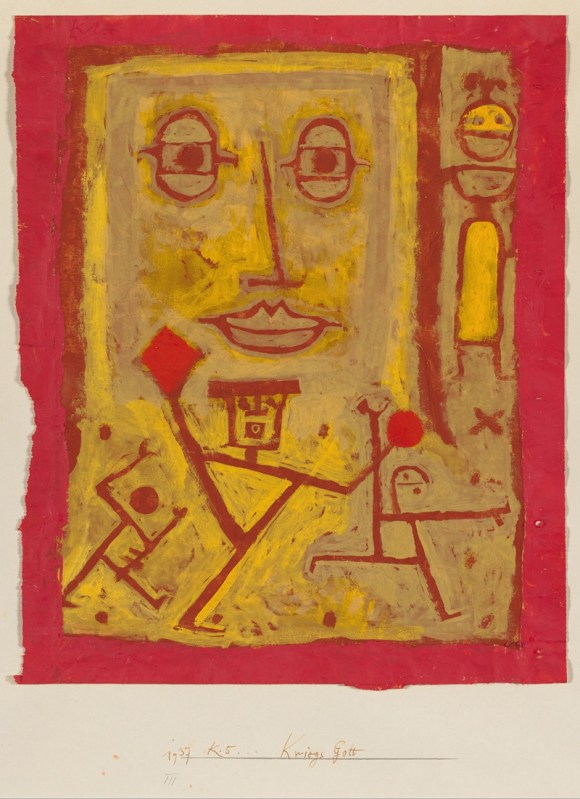
God of War by Paul Klee (1879-1940)
The sky weeps blood, the earth cannot contain
The sorrow of the young ones we've slain.
How now do dead kids laugh while stricken by red rain?

— from Stricken by Red Rain: Poems by Jim Bellamy

When there is war
And peace is gone
Where is their home?
Where do they belong?

— from Poems on Migrants by Kajoli Krishnan

Poetry, prose — all art forms — gather our emotions into concentrates that distil perhaps the finest in human emotions. They touch hearts across borders and gather us all with the commonality of feelings. We no longer care for borders drawn by divisive human constructs but find ourselves connecting despite distances. Strangers or enemies can feel the same emotions. Enemies are mostly created to guard walls made by those who want to keep us in boxes, making it easier to manage the masses. It is from these mass of civilians that soldiers are drawn, and from the same crowds, we can find the victims who die in bomb blasts. And yet, we — the masses — fight. For whom, for what and why? A hundred or more years ago, we had poets writing against wars and violence…they still do. Have we learnt nothing from the past, nothing from history — except to repeat ourselves in cycles? By now, war should have become redundant and deadly weapons out of date artefacts instead of threats that are still used to annihilate cities, humans, homes and ravage the Earth. Our major concerns should have evolved to working on social equity, peace, human welfare and climate change.

One of the people who had expressed deep concern for social equity and peace through his films and writings was Satyajit Ray. This issue has an essay that reflects how he used art to concretise his ideas by Dolly Narang, a gallery owner who brought Ray’s handiworks to limelight. The essay includes the maestro’s note in which he admits he considered himself a filmmaker and a writer but never an artist. But Ray had even invented typefaces! Artist Paritosh Sen’s introduction to Ray’s art has been included to add to the impact of Narang’s essay. Another person who consolidates photography and films to do pathbreaking work and tell stories on compelling issues like climate change and helping the differently-abled is Vijay S Jodha. Ratnottama Sengupta has interviewed this upcoming artiste.

Reflecting the themes of welfare and conflict, Prithvijeet Sinha’s essay takes us to a monument in Lucknow that had been built for love but fell victim to war. Some conflicts are personal like the ones of Odbayar Dorj who finds acceptance not in her hometown in Mongolia but in the city, she calls home now. Jun A. Alindogan from Manila explores social media in action whereas Eshana Sarah Singh takes us to her home in Jakarta to celebrate the Chinese New Year! Farouk Gulsara looks into the likely impact of genetic engineering in a world already ripped by violence and Devraj Singh Kalsi muses on his source of inspiration, his writing desk. Meredith Stephens tells the touching story of a mother’s concern for her child in Australia and Suzanne Kamata exhibits the same concern as she travels to Happy Village in Japan to meet her differently-abled daughter and her friends.

As these real-life narratives weave commonalities of human emotions, so do fictive stories. Some reflect the need for change. Fiona Sinclair writes a layered story set in London on how lived experiences define differences in human perspectives while Parnika Shirwaikar explores the need to learn to accept changes set in her part of the universe. Spandan Upadhyay explores the spirit of the city of Kolkata as a migrant with a focus on social equity. Both Paul Mirabile and Naramsetti Umamaheswararao write stories around childhood, one set in Europe and the other in Asia.

As prose weaves humanity together, so does poetry. We have poems from Jim Bellamy and Kajoli Krishnan both reflecting the impact of war and senseless violence on common humanity. Ryan Quinn Flanagan introduces us to Canadian bears in his poetry while Snigdha Agrawal makes us laugh with her lines about dogs and hatching Easter eggs! We have a wide range of poems from Snehprava Das, George Freek, Niranjan Aditya, Christine Belandres, Ajeeti S, Ron Pickett, Stuart McFarlane, Arthur Neong and Elizabeth Anne Pereira. Rhys Hughes concludes his series of photo poems with the one in this issue — especially showcasing how far a vivid imagination can twist reality with a British postman ‘carrying’ sweets from India! His column, laced with humour too, showcases in verse Lafcadio Hearn, a bridge between the East and West from more than a hundred years ago, a man who was born in Greece, worked in America and moved to Japan to even adopt a Japanese name.

Just as Hearn bridged cultures, translations help us discover how similarly all of us think despite distances in time and space. Radha Chakravarty’s translation of Kazi Nazrul Islam’s concerns about climate change and melting icecaps does just that! Professor Fakrul Alam’s translation of Nazrul’s lyrics from Bengali on women and on the commonality of human faith also make us wonder if ideas froze despite time moving on. Tagore’s poem titled Asha (hope) tends to make us introspect on the very idea of hope – just as we do now. At a more personal level, a contemporary poem reflecting on the concept of identity by Munir Momin has been translated from Balochi by Fazal Baloch. From Korean, Ihlwah Choi translates his own poem about losing the self in a crowd. We start a new column on translated Odia poetry from this month. The first one features the exquisite poetry of Bipin Nayak translated by Snehprava Das. Huge thanks to Bhaskar Parichha for bringing this whole project to fruition.

Parichha has also drawn bridges in reviews by bringing to us the memoirs of a man of mixed heritage, A Stranger in Three Worlds: The Memoirs of Aubrey Menen. Andreas Giesbert from Germany has reviewed Rhys Hughes’ The Devil’s Halo and Somdatta Mandal has discussed Arundhathi Nath’s translation, The Phantom’s Howl: Classic Tales of Ghosts and Hauntings from Bengal. Our book excerpts this time feature Devabrata Das’s One More Story About Climbing a Hill: Stories from Assam, translated by multiple translators from Assamese and Ryan Quinn Flangan’s new book, Ghosting My Way into the Afterlife, definitely poems worth mulling over with a toss of humour.

Do pause by our contents page for this issue and enjoy the reads. We are ever grateful to our ever-growing evergreen readership some of whom have started sharing their fabulous narratives with us. Thanks to all our readers and contributors. Huge thanks to our wonderful team without whose efforts we could not have curated such valuable content and thanks specially to Sohana Manzoor for her art. Thank you all for making a whiff of an idea a reality!

Let’s hope for peace, love and sanity!

Best wishes,

Mitali Chakravarty

borderlessjournal.com

Click here to access the contents page for the May 2025 Issue

READ THE LATEST UPDATES ON THE FIRST BORDERLESS ANTHOLOGY, MONALISA NO LONGER SMILES, BY CLICKING ON THIS LINK.

Categories
Editorial

Seasons Out of Time

...the horror of dark red sky – the gates of hell opened wide so they say that even atheists prayed to save the souls of the dead...

— Lizzie Packer, 'Hot Dry Summers'

The description in ‘Hot Dry Summers’ is not of hell but what is perceived as happening on certain parts of Earth due to global warming or climate change. Forest fires. Nearer the equator, the storms have become harsher with lightning strikes that seem to connect the Earth to the sky. Trees get uprooted as the soil is softened from excessive rain. Sometimes, they fall on passers-by killing or injuring them. There is no rain in some places, forest fires or flooding in others… The highest temperatures touched 55 degrees Celsius this year. Instead of worrying about losing our homes lodged on land masses to the oceans that continue to rise, becoming dark heat absorbers due to loss of white ice cover, we persistently fight wars, egged on by differences highlighting divisive constructs. It feels strange that we are witness to these changes which seem to be apocalyptic to doomsday sayers. Are they right? Our flora, fauna and food will also be impacted by global climate change. How will we survive these? Will we outlive these as a species?

Keeping the myriad nuances of living on this planet in mind, we have writings from more than a dozen countries showcased in this issue, with a few highlighting climate change and wars — especially in poetry. Michael Burch has given us poetry on weather. John Grey has celebrated nature. Other than Lizzie Packer, Mitra Samal has a subtle poem on climate change. Stuart McFarlane and David Mellor bring the disaster of war to our doorstep. Jared Carter, Kirpal Singh, Ryan Quinn Flanagan, Averi Saha, Shamik Banerjee, David Francis, George Freek, Rakhi Dalal and more have reflected on the varied nuances of life. Rhys Hughes has brought in humour and a comment on our perspectives, with his poem ‘Devil’s Bridge to Istanbul’… Can a shortcut be found across continents with the magic of a signboard?

Poetry in our translations’ section travels to Balochistan, from where a Hafeez Rauf translated from Balochi by Fazal Baloch, talks of burning tyres, again conflicts. It takes on a deeper hue as Ihlwha Choi translates his poignant poem from Korean, reflecting on the death of his mother. We have a translation of Tagore’s less popular poem, Mrityu[1], reflecting on the same theme. His reflections on his wife’s death too have been translated by Professor Fakrul Alam who has also shared a song of Nazrul, written and composed on the death of Tagore. Another lesser-known poet but brilliant nonetheless, Nirendranath Chakraborty, has been translated for us by Debali Mookerjea-Leonard. And what a tremendous poem it is when the person called Amalkanti wanted to be sunshine! We have a story too — ‘Speech Matters’ by Naramsetti Umamaheswararao translated by Johny Takkedasila.

Our stories as usual travel around the world — from Holland (by Paul Mirabile) to Hyderabad (by Mohul Bhowmick) and with a quick pause at Bangalore (by Anagha Narasimha). Travels in the real world are part of our non-fiction. Sai Abhinay Penna takes to a the second largest mangrove forest in the world and Ravi Shankar to Colombo. Madhuri Bhattachrya gives us a glimpse of an Indian summer and Snigdha Aggrawal explores the impact of climate change in her part of the world. Farouk Gulsara actually writes his reflections at a traffic junction. And it reads droll…

We have an in memoriam by Keith Lyons on Morgan Spurlock, the documentary maker who ate McDonald fare for a month and then made a film on it. We have two tributes to two legends across time. Wayne F Burke has given a brief piece on the iconic illustrator, Norman Rockwell. And Aruna Chakravarti, the queen of historic fiction who brought the Tagore family alive for us in her two very well researched novels, Jorasanko and Daughters of Jorasanko, has given us a fabulous tribute to Tagore on the not-so common aspects of him.

We have excerpts from another historical novel set in Bengal of Tagore’s time, Dan Morrison’s The Prince and the Poisoner: The Murder that Rocked the British Raj and Hughes’ The Sunset Suite, a set of absurd tall tales that make you smile, squirm or wonder…  Reviews of Salman Rushdie’s Knife: Meditations After an Attempted Murder by Somdatta Mandal and of Arundhathi Subramaniam’s Wild Women: Seekers, Protagonists and Goddesses in Sacred Indian Poetry by Basudhara Roy bring two latest books to our readers. Navleen Multani reflects on Mapping the Mind, Minding the Map, edited by Basudhara Roy and Jaydeep Sarangi. And Bhaskar Parichha tells us about a group of men called Pundits during British Raj, “In the closed files of the government of British India, however, they were given their true designation as spies…” in his review of Derek Waller’s The Pundits: British Exploration of Tibet and Central Asia.

Suzanne Kamata, the novelist who does a column from Japan for us normally, has spoken to us about her new novel, Cinnamon Beach, which overrides multiple manmade constructs. It’s an interesting read from someone who lives her life across multiple cultures and transcends many boundaries.

This is a bumper issue, and it is difficult to convey the vibrant hues of words that colour this edition. Please do pause by our contents page for a more comprehensive look.

This issue would not have been possible without all our fabulous contributors and a wonderful, dedicated team. We are delighted that Rakhi Dalal — who has done many reviews and shares her poetry with us in this issue — has agreed to be a writer-in-residence with us. A huge thanks to all of you, and especially Sohana Manzoor for her artwork. I am truly grateful to our readers for popularising our efforts to put together an online space with free and vibrant reads.

I would like to end with a few lines that gives me hope despite climate change, wars and doomsday predictions.

There’s more to life,
he says to me,
than what you choose to see.

— George Freek, 'The Imponderables'

Enjoy the reads.

Mitali Chakravarty

borderlessjournal.com

[1] Death

Click here to access the content’s page for the July 2024 Issue.

.

READ THE LATEST UPDATES ON THE FIRST BORDERLESS ANTHOLOGY, MONALISA NO LONGER SMILES, BY CLICKING ON THIS LINK.

Categories
Editorial

Other Echoes in the Garden…

“Other echoes
Inhabit the garden. Shall we follow?
Quick, said the bird, find them, find them…”

— TS Eliot, ‘Four Quartets: Burnt Norton’(1936)

Humans have always been dreamers, ideators and adventurers.

Otherwise, could we have come this far? From trees to caves to complex countries and now perhaps, an attempt to reach out towards outer space for an alternative biome as exploring water, in light of the recent disaster of the Titan, is likely to be tougher than we imagined. In our attempt to survive, to live well by creating imagined constructs, some fabrications backfired. Possibly because, as George Orwell observed with such precision in Animal Farm, some perceived themselves as “more equal”. Of course, his was an animal allegory and we are humans. How different are we from our brethren species on this beautiful planet, which can survive even without us? But can humanity survive without Earth? In science fiction, we have even explored that possibility and found home among stars with the Earth becoming uninhabitable for man. However, humanity as it stands of now, continues to need Earth. To live amicably on the planet in harmony with nature and all the species, including our own, we need to reimagine certain constructs which worked for us in the past but seem to have become divisive and destructive at this point.

Ujjal Dosanjh, former Minister in the Canadian cabinet and former Premier of British Columbia, in his autobiography, Journey After Midnight – A Punjabi Life: From India to Canada, talks of regionalism as an alternative to narrow divisive constructs that terrorise and hurt others. He writes in his book: “If humanity isn’t going to drown in the chaos of its own creation, the leading nations of the world will have to create a new world order, which may involve fewer international boundaries.” We have a candid conversation with him about his beliefs and also a powerful excerpt from his autobiography.

An interview with Professor Fakrul Alam takes us into Tagore’s imagined world. He discussed his new book of Tagore translations, Gitabitan: Selected Song-Lyrics of Rabindranath Tagore. He has brought out a collection of 300 songs translated to English. In a bid to emphasise an inclusive world, we also have a translation of Tagore’s ‘Musalmanir Galpa’ (A Muslim Woman’s Story) by Aruna Chakravarti. A transcreation of his poem, called ‘Proshno or Questions’ poses difficult challenges for humanity to move towards a more inclusive world. Our translation by Ihlwha Choi of his own Korean poem to English also touches on his visit to the polymath’s construct in the real world, Santiniketan. All of these centring around Tagore go to commemorate the month in which he breathed his last, August. Professor Alam has also translated a poem from Bengali by Masud Khan that has futuristic overtones and builds on our imagined constructs. From Fazal Baloch we have a Balochi translation of a beautiful, almost a surrealistic poem by Munir Momin.

The poetry selections start with a poem on ‘Wyvern’, an imagined dragon, by Jared Carter. And moves on to the plight of refugees by Michael Burch, A Jessie Michael, and on migrants by Malachi Edwin Vethamani. Ryan Quinn Flanagan has poetry that suggests the plight of refugees at a metaphorical level. Vibrant sprays of colours are brought into this section by Luis Cuauhtémoc Berriozábal, Saranyan BV, Jahnavi Gogoi, George Freek and many more. Rhys Hughes brings in a spot of humour with his mountainous poetry (literally) and a lot of laughter with his or rather Google’s attempt at automatic translation of a poem. Devraj Singh Kalsi has shared a tongue in cheek story about an ‘amateur professional’ — rather a dichotomy.

We travel to Andaman with Mohul Bhowmick and further into Sierra with Meredith Stephens. Ravi Shankar travels back in nostalgia to his hostel and Kathleen Burkinshaw dives into the past — discussing and responding to the media presentation of an event that left her family scarred for life, the atomic holocaust of 1945 in Japan. This was a global event more than seven decades ago that created refugees among the survivors whose homes had been permanently destroyed. Perhaps, their stories are horrific, and heart wrenching like the ones told by those who suffered from the Partition of India and Pakistan, a divide that is celebrated by Independence Days for the two nations based on a legacy of rifts created by the colonials and perpetrated to this day by powerbrokers. Aysha Baqir has written of the wounds suffered by the people with the governance gone awry. Some of the people she writes of would have been refugees and migrants too.

A poignant narrative about refugees who flock to the Greek island of Lesbos by Timothy Jay Smith with photographs by Michael Honegger, both of whom served at the shelters homing the displaced persons, cries out to halt wars and conflicts that displace them. We have multiple narratives of migrants in this issue, with powerful autobiographical stories told by Asad Latif and Suzanne Kamata. Paul Mirabile touches on how humans have adopted islands by borrowing them from seas… rather an unusual approach to migrations. We have an essay on Jane Austen by Deepa Onkar and a centenary tribute to Chittaranjan Das by Bhaskar Parichha.

The theme of migrants is echoed in stories by Farouk Gulsara and Shivani Shrivastav. Young Nandani has given an autobiographical story, translated from Hindustani to English by Janees, in which a migration out of various homes has shredded her family to bits — a narrative tucked in Pandies Corner.  Strange twists of the supernatural are woven into fiction by Khayma Balakrishnan and Reeti Jamil.

In reviews, Parichha has explored Arunava Sinha’s The Greatest Indian Stories Ever Told: Fifty Masterpieces from the Nineteenth Century to the Present. Somdatta Mandal’s review of Amitav Ghosh’s Smoke and Ashes: A Writer’s Journey Through Opium’s Hidden Histories seems to be an expose on how historical facts can be rewritten to suit different perceptions and Basudhara Roy has discussed the Greening the Earth: A Global Anthology of Poetry, edited by K. Satchidanandan and Nishi Chawla.

There is more wonderful content. Pop by our August’s bumper edition to take a look.

I would like to give my grateful thanks to our wonderful team at Borderless, especially to Sohana Manzoor for her fabulous artwork. Huge thanks to all our gifted contributors and our loyal readers. Borderless exists today because of all of you are making an attempt to bringing narratives that build bridges, bringing to mind Lennon’s visionary lyrics:

You may say I'm a dreamer
But I'm not the only one
I hope someday you'll join us
And the world will live as one

Thank you for joining us at Borderless Journal.

Have a wonderful month!

Mitali Chakravarty

borderlessjournal.com

.

Visit the August edition’s content page by clicking here

READ THE LATEST UPDATES ON THE FIRST BORDERLESS ANTHOLOGY, MONALISA NO LONGER SMILES, BY CLICKING ON THIS LINK.

Categories
Editorial

Its Only Hope…

Painting by Sybil Pretious

New year, like a newborn, starts with hope.

The next year will do the same – we will all celebrate with Auld Lang Syne and look forward to a resolution of conflicts that reared a frightening face in 2022 and 2021. Perhaps, this time, if we have learnt from history, there will not be any annihilation but only a movement towards resolution. We have more or less tackled the pandemic and are regaining health despite the setbacks and disputes. There could be more outbreaks but unlike in the past, this time we are geared for it. That a third World War did not break out despite provocation and varied opinions, makes me feel we have really learnt from history.

That sounds almost like the voice of hope. This year was a landmark for Borderless Journal. As an online journal, we found a footing in the hardcopy world with our own anthology, Monalisa No Longer Smiles: Writings from Across the World, which had a wonderful e-launch hosted by our very well-established and supportive publisher, Om Books International. And now, it is in Om Book Shops across all of India. It will soon be on Amazon International. We also look forward to more anthologies that will create a dialogue on our values through different themes and maybe, just maybe, some more will agree with the need for a world that unites in clouds of ideas to take us forward to a future filled with love, hope and tolerance.

One of the themes of our journal has been reaching out for voices that speak for people. The eminent film critic and editor, Shantanu Ray Chaudhuri , has shared a conversation with such a person, the famed Gajra Kottary, a well-known writer of Indian TV series, novels and stories. The other conversation is with Nirmal Kanti Bhattajarchee, the translator of Samaresh Bose’s In Search of a Pitcher of Nectar, a book describing the Kumbh-mela, that in 2017 was declared to be an Intangible Cultural Heritage of Humanity by UNESCO. Bhattacharjee tells us how the festival has grown and improved in organisation from the time the author described a stampede that concluded the festivities. Life only gets better moving forward in time, despite events that terrorise with darkness. Facing fear and overcoming it does give a great sense of achievement.

Perhaps, that is what Freny Manecksha felt when she came up with a non-fiction called Flaming Forest, Wounded Valley: Stories from Bastar and Kashmir, which has been reviewed by Rakhi Dalal. Basudhara Roy has also tuned in with a voice that struggled to be heard as she discusses Manoranjan Byapari’s How I Became a Writer: An Autobiography of a Dalit. Somdatta Mandal has reviewed The Shaping of Modern Calcutta: The Lottery Committee Years, 1817 – 1830 by Ranabir Ray Chaudhury, a book that explores how a lottery was used by the colonials to develop the city. Bhaskar Parichha has poured a healing balm on dissensions with his exploration of Rana Safvi’s In Search of the Divine: Living Histories of Sufism in India as he concludes: “Weaving together facts and popular legends, ancient histories and living traditions, this unique treatise running into more than four hundred pages examines core Sufi beliefs and uncovers why they might offer hope for the future.”

In keeping with the festive season is our book excerpt from Rhys Hughes’ funny stories in his Christmas collection, Yule Do Nicely. Radha Chakravarty who brings many greats from Bengal to Anglophone readers shared an excerpt – a discussion on love — from her translation of Tagore’s novel, Farewell Song.

Love for words becomes the subject of Paul Mirabile’s essay on James Joyce’s Stephen Dedalus, where he touches on both A Portrait of the Artist as a young Man and  Ulysees, a novel that completed a century this year. Love for animals, especially orangutans, colours Christina Yin’s essay on conservation efforts in Borneo while Keith Lyons finds peace and an overwhelming sense of well-being during a hike in New Zealand. Ravi Shankar takes us to the historical town of Taiping in Malaysia as Meredith Stephens shares more sailing adventures in the Southern hemisphere, where it is summer. Saeed Ibrahim instils the seasonal goodwill with native Indian lores from Canada and Suzanne Kamata tells us how the Japanese usher in the New Year with a semi-humorous undertone.

Humour in non-fiction is brought in by Devraj Singh Kalsi’s ‘Of Mice and Men’ and in poetry by Santosh Bakaya. Laughter is stretched further by the inimitable Rhys Hughes in his poetry and column, where he reflects on his experiences in India and Wales. We have exquisite poetry by Jared Carter, Sukrita Paul Kumar, Asad Latif, Luis Cuauhtémoc Berriozábal, Michael R Burch, Sutputra Radheye, George Freek, Jonathan Chan and many more. Short stories by Lakshmi Kannan, Devraj Singh Kalsi, Tulip Chowdhury and Sushma R Doshi lace narratives with love, humour and a wry look at life as it is. The most amazing story comes from Kajal who pours out the story of her own battle in ‘Vikalangta or Disability‘ in Pandies’ Corner, translated from Hindustani by Janees.

Also touching and yet almost embracing the school of Absurd is PF Mathew’s story, ‘Mercy‘, translated from Malayalam by Ram Anantharaman. Fazal Baloch has brought us a Balochi folktale and Ihlwha Choi has translated his own poem from Korean to English. One of Tagore’s last poems, Prothom Diner Shurjo, translated as ‘The Sun on the First Day’ is short but philosophical and gives us a glimpse into his inner world. Professor Fakrul Alam shares with us the lyrics of a Nazrul song which is deeply spiritual by translating it into English from Bengali.

A huge thanks to all our contributors and readers, to the fabulous Borderless team without who the journal would be lost. Sohana Manzoor’s wonderful artwork continues to capture the mood of the season. Thanks to Sybil Pretious for her lovely painting. Please pause by our contents’ page to find what has not been covered in this note.

We wish you all a wonderful festive season.

Season’s Greetings from all of us at Borderless Journal.

Cheers!

Mitali Chakravarty

borderlessjournal.com

.

Click here to access the Borderless anthology, Monalisa No Longer Smiles

Categories
Contents

Borderless, June 2022

Art by Sohana Manzoor

Editorial

We are All Going on a Summer HolidayClick here to read.

Interviews

In Conversation with Rinki Roy (daughter of legendary director Bimal Roy) about The Oldest Love Story, an anthology on motherhood, edited and curated by journalist and authors, Rinki Roy and Maithili Rao. Click here to read.

Achingliu Kamei in conversation with Veio Pou, author of Waiting for the Dust to Settle, a novel based on the ongoing conflicts in North-east India. Click here to read.

Translations

The Funeral, a satirical skit by Tagore, translated by Somdatta Mandal. Click here to read.

Three Shorter Poems of Jibananda Das have been translated from Bengali by Professor Fakrul Alam. Click here to read.

The Magic Staff , a poignant short story about a Rohingya child by Shaheen Akhtar, translated from Bengali by Arifa Ghani Rahman. Click here to read.

Fakir Khizmil & the Missing Princess, a Balochi Folktale has been translated by Fazal Baloch. Click here to read.

Pie in the Sky is a poem written and translated from Korean by Ihlwha Choi. Click here to read.

Taal Gaachh or The Palmyra Tree, a lilting light poem by Tagore, has been translated from Bengali by Mitali Chakravarty. Click here to read.

Pandies’ Corner

This narrative is written by a youngster from the Nithari village who transcended childhood trauma and deprivation. Dhaani has been written in Hindi and translated to English by Kiran Mishra. Click here to read.

Poetry

Click on the names to read

Jared Carter, Sutputra Radheye, Ryan Quinn Flanagan, Antara Mukherjee, David Francis, Alpana, George Freek, Prashanti Chunduri, John Grey, Ashok Suri, Heather Sager, G Venkatesh, Candice Louisa Daquin, Elizabeth Ip, Rhys Hughes, Michael R Burch

Poets, Poetry & Rhys Hughes

In From a Kafkaesque Dream to the Penguin Cafe Orchestra, Rhys Hughes brings out a new strain of tunes that grew out of Jeff Simon’s unusual journey and it continues to persist beyond his life. Click here to read.

Stories

Oliver’s Soul

Paul Mirabile weaves a story of murder and madness in Madrid of 1970s. Click here to read.

The Wallet

Atreyo Chowdhury spins a tale set in Kolkata. Click here to read.

Flowers on the Doorstep

Shivani Shrivastav writes of an encounter with a mysterious child in Almora. Click here to read.

A Riverine Healing 

PG Thomas’s narrative set in Kerala, explores a leader’s old age. Click here to read.

Pagol Daries

Indrashish Banerjee creates a humanoid scenario where robots take on human roles. Click here to read.

Musings/ Slices from Life

In Memoriam: Star of the Stage Shines on Screen

Ratnottama Sengupta pays a tribute to famed actress, Swatilekha Sengupta (May 1950- June 2021). Click here to read.

Pizzas En Route to Paradise

Keith Lyons discovers the import and export of desires in Varanasi, one of the oldest cities in the world, beside one of the most revered rivers. Click here to read.

Notes from Japan

In Marathon Blues, Suzanne Kamata talks of pandemic outcomes in Japan in a lighter tone. Click here to read.

Musings of a Copywriter

In Journey of an Ant, Devraj Singh Kalsi explores life from an insect’s perspective. Click here to read.

Mission Earth

In Tuning in to Nature, Kenny Peavy tells us how to interact with nature. Click here to read.

Essays

Kabir & His Impact on Tagore

Mozid Mahmud explores Kabir and his impact on Tagore, which ultimately led to a translation of the great medieval poet. Click here to read.

A view of Mt Everest

Ravi Shankar travels in the freezing cold of Himalayan splendour and shares magnificent photographs of Mt Everest. Click here to read.

The Good, the Bad, and the Benign: Back across Bass Strait

Meredith Stephens shares a photographic and narrative treat from Tasmania. Click here to read.

The Observant Immigrant

In Season’s in the Sun, Candice Louisa Daquin explores what intense positivity can do to people. Click here to read.

Book Excerpts

Excerpt from Tagore’s Gleanings of the Road, translated by Somdatta Mandal. Click here to read.

Excerpt from Waiting by Suzanne Kamata. Click here to read.

Book Reviews

Meenakshi Malhotra revisits Harsh Mander’s Locking down the Poor: The Pandemic and India’s Moral Centre. Click here to read.

Indrashish Banerjee reviews Keki N Daruwalla’s Going:Stories of Kinship. Click here to read.

Gracy Samjetsabam reviews Pronoti Datta’s Half-Blood. Click here to read.

Bhaskar Parichha reviews Deepti Priya Mehrotra’s Her Stories –Indian Women Down the Ages — Thinkers, Workers, Rebels, Queens. Click here to read.

Categories
Contents

Borderless January, 2022

Painting by Sohana Manzoor

Editorial

Elephants & Laughter… Click here to read.

Interviews

Keith Lyons introduces us to Kenny Peavy, an author, adventurer, educator and wilderness first-aider who has travelled far and wide and wishes everyone could connect with the natural world right outside their door. Click here to read.

In Rhys Hughes Unbounded, Hughes, an author and adventurer, tells us about his inclination for comedies. Click here to read

Translations

Professor Fakrul Alam translates If Life were Eternal by Jibananada Das from Bengali. Click here to read.

Ratnottama Sengupta translates Bengali poet Michael Madhusudan Dutt’s Bijoya Doushami. Click here to read.

Korean poet Ihlwha Choi translates his own poem, Sometimes Losing is Winning, from Korean. Click here to read.

Give Me A Rag, Please:A short story by Nabendu Ghosh, translated by Ratnottama Sengupta, set in the 1943 Bengal Famine, which reflects on man’s basic needs. Click here to read.

On This Auspicious Day is a translation of a Tagore’s song, Aaji Shubhodine Pitaar Bhabone, from Bengali by Mitali Chakravarty. Click here to read.

Poetry

Click on the names to read

Rhys Hughes, Ryan Quinn Flanagan, Anasuya Bhar, Jay Nicholls, Anuradha Vijayakrishnan, Vernon Daim, Mathangi Sunderrajan, William Miller, Syam Sudhakar, Mike Smith, Pramod Rastogi, Ivan Peledov, Subzar Ahmed, Michael R Burch

Nature’s Musings

In Best Friends, Penny Wilkes takes us for a photographic treat. Click here to read.

Poets, Poetry & Rhys Hughes

In Making Something of Nothing…, Rhys Hughes explores sources of inspirations with a dollop of humour. Click here to read.

Musings/Slices from Life

Wooing Children to School

Munaj Gul writes of how volunteers are engaged in wooing children from poverty stricken backgrounds to school in Turbat, Balochistan. Click here to read.

Historical Accuracy

Ravibala Shenoy ponders over various interpretations of the past in media and through social media. Click here to read.

The Ocean & Me

Meredith Stephens writes of her sailing adventures in South Australia. Click here to read.

Crotons

Kavya RK finds her fascination for plants flourish in the pandemic. Click here to read.

The Great Freeze

P Ravi Shankar trots through winters in different parts of the globe. Click here to read.

Two Birds

Ratnottama Sengupta muses as she translates a Tagore’s song. Click here to read.

Musings of a Copywriter

In The New Year’s Boon, Devraj Singh gives a glimpse into the projection of a new normal created by God. Click here to read.

Essays

Dramatising an Evolving Consciousness: Theatre with Nithari’s Children

Sanjay Kumar gives us a glimpse of how theatre has been used to transcend trauma and create bridges. Click here to read.

Potable Water Crisis & the Sunderbans

Camellia Biswas, a visitor to Sunderbans during the cyclone Alia, turns environmentalist and writes about the potable water issue faced by locals. Click here to read.

The Malodorous Mountain: A Contemporary Folklore

Sayantan Sur looks into environmental hazards due to shoddy garbage disposal. Click here to read.

Where Sands Drift Back in Time…

Shernaz Wadia explores Western Australia. Click here to read.

The Observant Immigrant

In The Changing Faces of the Family, Candice Louisa Daquin explores the trends in what is seen as a family now. Click here to read.

Bhaskar’s Corner

In Fakir Mohan: A Tribute, Bhaskar Parichha introduces us to Fakir Mohan Senapati, the writer he considers the greatest in Odia literature. Click here to read.

Stories

Folklore from Balochistan: The Pearl

Balochi folktales woven into a story and reinvented by Fazal Baloch highlighting the wisdom of a woman. Click here to read.

The American Wonder

Steve Ogah takes us to a village in Nigeria. Click here to read.

The Boy

Neilay Khasnabish shares a story on migrant labours with a twist. Click here to read.

Stranger than Fiction

Sushant Thapa writes of real life in Nepal, which at times is stranger than fiction. Click here to read.

The Solace

Candice Louisa Daquin takes us on a poignant story of longing. Click here to read.

The Doll

Sohana Manzoor tells a story around the awakening of a young woman. Click here to read.

Among Our PeopleDevraj Singh Kalsi gives a fictitious account of a common man’s quest for security in a country that is one of the world’s largest democracy. Click here to read.

Book Excerpts

An excerpt from Shazi Zaman’s Akbar: A Novel of History detailing his interactions with Surdas and Braj. Click here to read.

Excerpts from A Glimpse Into My Country, An Anthology of International Short Stories edited by Andrée Roby & Dr Sangita Swechcha. Click here to read.

Book Reviews

Meenakshi Malhotra reviews Somdatta Mandal’s translation of A Bengali Lady in England by Krishnabhabini Das (1885). Click here to read.

Gracy Samjetsabam reviews Anuradha Kumar’s The Hottest Summer in Years. Click here to read.

Rakhi Dalal reviews Selma Carvalho’s Sisterhood of Swans. Click here to read.

Bhaskar Parichha reviews Amit Ranjan’s John Lang; Wanderer of Hindoostan; Slanderer in Hindoostanee; Lawyer for the Ranee. Click here to read.

Categories
Contents

Borderless, April, 2021

Greetings from Borderless Journal for all Asian New Years! Click here to read our message along with the video and a translation of a Tagore song written to greet the new year, with lyrics that not only inspire but ask the fledgling to heal mankind from deadly diseases.

Editorial

New Beginnings

A walk through our content and our plans for the future. Click here to read.

Interviews

In Conversation with Arundhathi Subramaniam: An online interview with this year’s Sahitya Akademi winner, Arundhathi Subramaniam. Click here to read.

Sumana Roy & Trees: An online interview with Sumana Roy, a writer and academic. Click here to read.

Poetry

(Click on the names to read)

Arundhathi Subramaniam, Jared Carter, Matthew James Friday, Michael R Burch, Aparna Ajith, Jenny Middleton, Rhys Hughes, Jay Nicholls, Achingliu Kamei, Vatsala Radhakeesoon, Ihlwha Choi, Smitha Vishwanath, Sekhar Banerjee, Sumana Roy

Photo-poetry by Penny Wilkes

Poets, Poetry & Rhys Hughes

With an introduction to Blood and Water by Rebecca Lowe, Rhys Hughes debuts with his column on poets and poetry. Click here to read.

Translations

The Word by Akbar Barakzai

Fazal Baloch translates the eminent Balochi poet, Akbar Barakzai. Click here to read.

Malayalam poetry in Translation

Aditya Shankar translates a poem by Shylan from Malayalam to English. Click here to read.

Tagore Songs in Translation

To commemorate Tagore’s birth anniversary, we translated five of his songs from Bengali to English. Click here to read, listen and savour.

Tagore Translations: One Small Ancient Tale

Rabindranath Tagore’s Ekti Khudro Puraton Golpo (One Small Ancient Tale) from his collection Golpo Guchcho ( literally, a bunch of stories) has been translated by Nishat Atiya. Click here to read.

Musings/Slice of Life

Pohela Boisakh: A Cultural Fiesta

Sohana Manzoor shares the Bengali New Year celebrations in Bangladesh with colourful photographs and interesting history and traditions that mingle beyond the borders. Click here to read.

Gliding along the Silk Route

Ratnottama Sengupta, a well-known senior journalist and film critic lives through her past to make an interesting discovery at the end of recapping about the silk route. Click here to read and find out more.

The Source

Mike Smith drifts into nostalgia about mid-twentieth century while exploring a box of old postcards. What are the stories they tell? Click here to read.

Lost in the Forest

John Drew, a retired professor, cogitates over a tapestry of the Ras lila. Click here to read.

Tied to Technology

Naomi Nair reflects on life infiltrated by technology, by Siri and Alexa with a tinge of humour. Click here to read.

Adventures of a Backpacking Granny

In Inspiriting SiberiaSybil Pretious takes us with her to Lake Baikal and further. Click here to read.

Musings of a Copywriter

In Tributes & AttributesDevraj Singh Kalsi pays tribute to his late mother. Click here to read.

Essays

Reflecting the Madness and Chaos Within

Over 150 Authors and Artists from five continents have written on mental illness in an anthology called Through the Looking Glass. Candice Louisa Daquin, a psychotherapist and writer and editor, tells us why this is important for healing. Click here to read.

At Home in the World: Tagore, Gandhi and the Quest for Alternative Masculinities

Meenakshi Malhotra explores the role of masculinity in Nationalism prescribed by Tagore, his niece Sarala Debi, Gandhi and Colonials. Click here to read.

A Tale of Devotion and Sacrifice as Opposed to Jealousy and Tyranny

Sohana Manzoor explores the social relevance of a dance drama by Tagore, Natir puja. We carry this to commemorate Tagore’s birth anniversary. Click here to read

Photo Essay: In the Midst of Colours

Nishi Pulugurtha explores the campus of a famed university with her camera and words and shares with us her experiences. Click here to read.

Bhaskar’s Corner

Oh, That lovely Title: Politics

A short piece by Bhaskar Parichha that makes for a witty comment on the forthcoming Indian elections. Click here to read.

Stories

Pothos

Rakhi Pande gives us a story about a woman and her inner journey embroiled in the vines of money plant. Click here to read.

Elusive

A sensitive short story by Sohana Manzoor that makes one wonder if neglect and lack of love can be termed as an abuse? Click here to read

Ghumi Stories: Grandfather & the Rickshaw

Nabanita Sengupta takes us on an adventure on the rickshaw with Raya’s grandfather. Click here to read

Flash Fiction: The Husband on the Roof

Carl Scharwath gives us a story with a strange twist. Click here to read

Flash Fiction: Flight of the Falcon

Livneet Shergill gives us a story in empathy with man and nature. Click here to read

The Literary Fictionist

A playlet by Sunil Sharma set in Badaun, The Dryad and I: A Confession and a Forecast, is a short fiction about trees and humans. Click here to read.

Book reviews

Bhaskar Parichha reviews Reconciling Differences by Rudolf C Heredia, a book that explores hate and violence. Click here to read.

Nivedita Sen reviews Nomad’s Land by Paro Anand, a fiction set among migrant children of a culture borne of displaced Rohingyas, Syrian refugees, Tibetans and more. Click here to read

Candice Louisa Daquin reviews The First Cell and the Human Costs of Pursuing Cancer to the last by Azra Raza. Click here to read.

Book Excerpt

Excerpted from Raising a Humanist: Conscious Parenting in an Increasingly Fragmented World by Manisha Pathak-Shelat and Kiran Vinod Bhatia, the focus is on media and its impact. Click here to read.

Sara’s Selection, April 2021

A selection of young person’s writings from Bookosmia. Click here to read.

Categories
Review

Tales of conflict along the MacMahon Line

Book review by Bhaskar Parichha

Title: Gone Away — An Indian Journal

Author: Dom Moraes

Publisher: Speaking Tiger, 2020

When a travelogue resurfaces sixty years after it was first printed, that ought to be meaningful. “Gone Away – An Indian Journal” by Dom Moraes was originally published in the UK by William Heinemann. Republished as a paperback edition by Speaking Tiger Books (New Delhi) in 2020, the travelogue carries the same magic for the reader as it was then.

Dom Moraes, a poet, novelist and columnist, is perceived to be a foundational figure in Indian English Literature who published thirty books in his lifetime. In 1958, at the age of twenty, he won the prestigious Hawthornden Prize for poetry. Winner of the Sahitya Akademi Award for English in 1994, Moraes passed away in 2004.

Son of the Editor of the Times of India, Dom had grown up in well-off and generous circumstances. After traveling with his father through Australia to New Zealand and Malaya to the borders of Red China, he watched and wrote poetry. Moraes met Stephen Spender in India, showed him his poems and had some published in “Encounter.” The combined efforts of Spender and his father had gained him admission to Jesus College, Oxford.

Reads the blurb: “One of the most unconventional travelogues ever written, Gone Away covers three months of Dom Moraes’ life spent in the subcontinent at the time of the Chinese incursions on the Tibetan border in 1959. In that short time, a remarkable number of memorable things happened to him, some of them the sort of fantastic situations that could only enmesh a poet, perhaps only a young poet – a visit to a speak-easy in Bombay; an interview with Nehru and an hour spent closeted with the Dalai Lama in Delhi; and a meeting with the great Nepalese poet, Devkota, whom he found already laid out to die by the side of the holy river Basumati.”

After a short stay in Calcutta, where he tried, with limited success, to investigate the lives of prostitutes, he went up to Sikkim, the north-eastern border state into which no visiting writer had been allowed for almost a year. Having made his way by jeep right up to the frontier, he ran into a Chinese detachment and was shot at, but escaped to safety.


Full of comicality, felicity of phrase and oddity of behavior, Gone Away communicates the special excitement of the traveler on every page. Example: Unforgettably funny is the account of the Sikkimese soccer match played in an impenetrable mist and involving the loss of several footballs kicked over an adjoining cliff. Though wit and impertinence prevail through the pages, this is a book which catches and holds the mood of modern India and illuminates as much as it amuses.

This is both a political and a personal voyage of discovery, told simply. Moraes’ travelogue is also significant because it gives us the poet’s eye view: providing details from the Indian cityscape and draws our attention to the zeitgeist of the early decades after Independence.

This memoir is a delightful read and is both modest and polished. Moraes’ account of India’s friction with China and India’s relationship with Nepal at the end of 1950s is convincing, especially in the context of the new tensions on the borders. Recording public disquiet over China’s infractions in 1959, Moraes mentions that General Thimayya had asked that the Indian troops on the NEFA border should be supplied with automatic weapons, as they were inadequately armed in case of Chinese attacks. Krishna Menon is said to have refused the request. Then came Longju, when inadequately equipped and outnumbered Indians were put to flight by the Chinese. Indian foot soldiers, caught in the cross locks of war, continue to be ill equipped, even to date.

There are many more accounts in the book of Dom Moraes meeting prominent diplomats, politicians, writers and artists such as Malcolm MacDonald, Jayaprakash Narayan, Han Suyin, M F Hussain, Nirad Chaudhuri, Kishen Khanna, Buddhadeva Bose, Jamini Roy and many more. Moraes also managed to reach Sikkim when the Chinese were closing in on the border. There is so much of the subcontinent’s socio-cultural history to exude. The historical incidents and famous people are easily recalled from textbooks but reading this firsthand experience is something exceptional.

Moraes travels continue to Calcutta, Gangtok and Sikkim, where the Chinese army’s presence is strongly indicated and the Indian state does not provide enough information. Reporting a readable narrative about independent India’s first decade, Moraes’ love for India anticipates his eventual homecoming.

He captures the occasion with candour, his narrative provides a perspective that tells the whole truth, with little sentimentality or precision, and is peppered with humor that is situational and occasionally self-deprecatory.

With an introduction by Jerry Pinto, “Gone Away” is part of the trilogy of autobiographies written by Moraes. It is a fabulous testimony to India and many of its rarities.

.

Bhaskar Parichha is a journalist and author of No Strings Attached: Writings on Odisha and Biju Patnaik – A Political Biography. He lives in Bhubaneswar and writes bilingually. Besides writing for newspapers, he also reviews books on various media platforms.

.

.

PLEASE NOTE: ARTICLES CAN ONLY BE REPRODUCED IN OTHER SITES WITH DUE ACKNOWLEDGEMENT TO BORDERLESS JOURNAL