Chapter 2of Isa Kamari’s novel, The Throne,has been translated by the author from Malay. We will be running the whole novel as serial through the year. Click hereto read.
A Tiny Piece of Homeland, an autobiographical narrative by Kallol Lahiri in Bengali, has been translated by V. Ramaswamy. Click here to read.
Walking Together, a poem, has been written and translated from Korean by Ihlwha Choi. Click hereto read.
Swopno (Dream), a poem by Tagore, has been translated from Bengali by Mitali Chakravarty. Click hereto read.
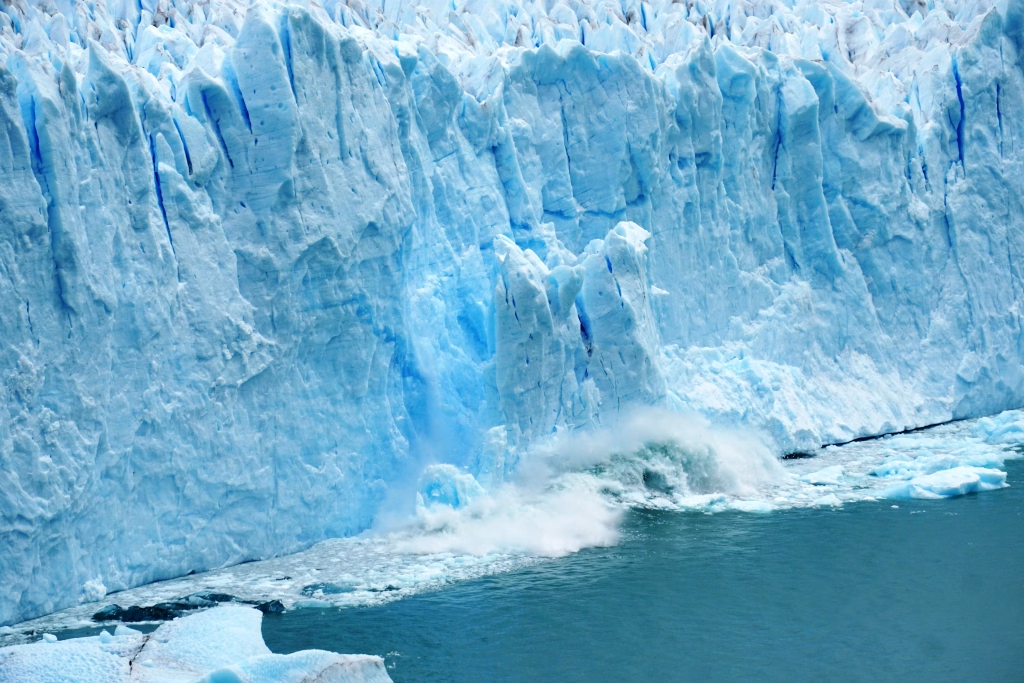
We have started feeling the impact of climate change with a bevy of natural disasters this August. Glacial ice melts, peat fires, haze, rising seas, more storms, warmer climes and fires wiping out greenery are just a few that come to the mind. But, long ago, our ancestors — without the support of technology — survived climate events. Göbekli Tepe (Turkey), an ancient human settlement, more than 11,000 years ago was lush and green. People moved as it turned arid. Humankind was nomadic then. They moved with shifting riverbeds. In Europe, humans survived the last glacial age, about 20,000 years ago. Then, now when we are faced with the reality of climate change, why is it we tremble with trepidation? We even have technology in hand. Ideators and writers like Asimov found solutions. In Caves of Steel (1954), Isaac Asimov had humanity move underground to survive unfriendly surface conditions. He created a huge city underground for humanity while some moved into other planets. Perhaps, the time has come for us to think out of the box. And that is what we hope all of you will join to do in Borderless.
September has thrown up varied content. We have non-fiction which reflects on how changes are a part of human lore and how diverse cultures can co-exist to enrich each other. Shantanu Ray Chaudhuri dwells on this idea while talking of Nazrul’s approach to the Persian Ghazal. He writes, the poet through his adaptation of this form “showed how a culture can absorb another culture without losing itself, and how, in the process, both cultures can become something larger than they were before.” And perhaps from that largeness of thought will emerge a one-world community — that Yatish Kumar S espouses. Maybe from people who think beyond borders, we will find the solution to tackling and adapting to climate change. We have an essay from Charudutta Panigrahi where he attempts to arouse the survival instinct in humans. Young Shruti Keskar writes of how she finds a new lease to life by accepting and adapting to changes while Farouk Guslara philosophises on living and possessions. We have Meredith Stephens adding to the vivacity of non-fiction with a recount of her sailing adventures with wonderful photographs by Alan Noble. And Devraj Singh Kalsi brings in sardonic humour with his piece on art and artists.
A story-poem by Tagore, Swopno (Dream), has also been brought to us in English. An interesting memoir by Kallol Lahiri centring around his childhood in Bengal has been translated by V Ramaswamy. Translations offer fiction from Isa Kamari. He has transcribed in English the second chapter of his Malay novel, The Throne. The novel focussing on psychological torment is being serialised in Borderless.
Bhaskar Parichha has reviewed a rare book-centric memoir by Shanta Gokhale. He tells us, “Of Ancestors and Friends: A Life with Booksis an unusual kind of literary memoir. It is neither a conventional autobiography nor a conventional work of criticism. Instead, it occupies an intimate space between the two, tracing a life’s intellectual and emotional history through books.” Meenakshi Malhotra has discussed the renowned historian Romila Thapar’s memoir, Just Being, a book that reflects not only her own journey but the freedom and outreach that privilege and capability can bestow on women in South Asia. On the other hand, Mudassar Javed Baryar refers to the plight of birongonas, war time widows during the 1971 conflict that birthed Bangladesh, while discussing Saima Begum’s The First Jasmines. He reflects: “Begum’s profound innovation is to turn the narrative back not just to these women’s trauma but to their ‘humanity, resilience and heart’, depicting them as ‘architects of family and community’.” Somdatta Mandal has praised Omair Ahmad’s novel, Homecoming.
We have also featured Kanuprya Dhingra, who has written a book on a unique book bazaar. In a candid exchange, she tells us her non-fiction, The Sunday Book Bazaar: Delhi’s Book Street and the Making of a Reading Public, “is for the reader in Singapore, or Mumbai, or London, or Lahore who has their own version of this informal, unruly, necessary space and sees it reflected here. It is a book about books, the people who read them, and the people who make that possible…the book is for everyone.” It’s an interesting read almost inviting you to stroll into the serendipitous democratic reading space full of local colour and stories.
We would like to thank not only Dhingra but all our contributors for their wonderful work. Huge thanks to the fabulous Borderless team for their input and to Sohana Manzoor for her artwork. Thank you all — without all of you and our wonderful readers, it would be difficult to have a journal. In the spirit of ubuntu, heartfelt thanks.
Do pause by our September content’s page. And let’s look forward to the hope for happier climes and times.
“Let’s go for a camel ride when we are in Broome!” Alex suggested.
The voyage from Darwin to Broome along the remote Kimberley Coast had felt interminable. Twenty-one days with no other sailing boats in sight until we neared Broome. Even shore visits had been tense, with the prospect of meeting a crocodile or stepping on toxic jellyfish in the shallows. Unlike Alex, I was not a natural sailor, although I assisted where I could. I was adept at operating the winch when he was adjusting the sails, throwing out the fenders before arrival at a dock, and hooking the mooring with the boat hook. However, I was really there because I liked his company, and this overruled my aversion to risky adventure. Alex knew this, and he also knew how much I would love to ride a camel.
Astride a camelBroome Camel SafariPhoto Courtesy: Alan Noble
The camels loped towards us at the meeting point at the far end of the beach. The earlier ride departed soon after we arrived, so we had to wait. We found refuge in the shade of the official camel tour vehicle. I removed my shoes, sat down, and ploughed my bare feet into the sand. Forty minutes later the earlier ride was finished, and the camels lined up again. Alex and I were to share a camel. The lighter person had to hop on the front and the heavier on the back. All of the personnel were young European working holidaymakers, and invariably cheerful, like all of the other working holidaymakers we had met in Western Australia working in hospitality. Their job included caring for the camels. They would arrive at the farm late morning, groom the camels, and walk them for an hour to get to the beach. Apparently one of the camels had been rescued and so we were instructed not to pat her, but others enjoyed being patted. We mounted our female camel, Silky. Her long neck stretched in front of me. She had curly hair on her neck and long eyelashes.
Because our tour was late, we could enjoy it just before sunset. We had wanted to take the sunset tour, but it had been booked out.
“Are you enjoying it?” Alex asked me.
“This is absolutely worth it!” I confirmed, allowing myself to be gently rocked in the saddle in a motion which mimicked the ocean swell.
After the hardships of violent seas, a torn sail, and extreme isolation, I could relax on this gentle creature with Alex sitting behind me, gazing at the changing colours over the horizon. At the end of the tour, the tourists spontaneously erupted in applause. If this had been horses, they would have been startled, but the camels remained calm.
Camels are not native to Australia, having been introduced from the Middle East, North Africa and the Indian Subcontinent in the nineteenth century. In fact, the railroad that runs south to north across the Australian continent was named the “Ghan” in honour of the Afghan cameleers that the railway replaced. Camels were released into the wild in the early twentieth century when modern forms of transport were introduced. Their descendants compete with native marsupials for resources, and so they are considered invasive. But it is not their fault that they are invasive.
Camels in 1925 Australia. Photo Courtesy Lance Mugford circa 1925
They are the descendants of camels that were brought here well over a hundred years ago. It so happens that they are well-adapted to the harsh conditions of the Australian outback. Sometimes wild invasive animals are culled because of the havoc they wreak on native fauna and flora. But I have a soft spot for these magnificent desert creatures and hope that they can be treated with dignity and kindness.
Anchored in sunset. Photo Courtesy: Alan Noble
.
Meredith Stephens is an applied linguist from South Australia. Her recent work has appeared in Syncopation Literary Journal, Continue the Voice, Micking Owl Roost blog, The Font – A Literary Journal for Language Teachers, and Mind, Brain & Education Think Tank. In 2024, her story Safari was chosen as the Editor’s Choice for the June edition of All Your Stories.
PLEASE NOTE: ARTICLES CAN ONLY BE REPRODUCED IN OTHER SITES WITH DUE ACKNOWLEDGEMENT TO BORDERLESS JOURNAL
Robihara 2 (Sunless 2) by Nazrul has been translated from Bengali by Professor Fakrul Alam. Click here to read.
Chapter 1 of Isa Kamari’s novel, The Throne,has been translated by the author from Malay. We will be running the whole novel as serial through the year. Click here to read.
An excerpt from Aslam Dostain‘s novel, Sótkál, has been translated from Balochi by Fazal Baloch. Click hereto read.
A Sudden Shower has been written and translated from Korean by Ihlwha Choi. Clickhere to read.
Jhor or Storm, a poem by Tagore, has been translated from Bengali by Mitali Chakravarty. Click here to read.
Rain, Steam, and Speed – The Great Western Railway, 1844, Painting by Joseph Mallord William Turner
Perhaps, the only constant that makes a difference in this ever-transforming world is how we react to changes around us. How do we interact with not just humans but our whole planet with its climate, contours, its plethora of flora and fauna? Will that impact our survival in the long run? And yet with our focus on legacies, traditions, beliefs, we tend to ignore the call to adapt to the new that might help us move towards an unpredictable future. We forget perhaps that these systems had all been made by our ancestors to ensure survival. Somewhere along the way, these have become like fences caging us into small subsets. The strange thing is we continue to allow that to happen and create enclosures which we fight to maintain. The future that we face now seems even more tumultuous with climate change, rising sea levels and global warming taking a front seat while influx of refugees from war and natural disasters have already started making themselves felt. Add to that the shortages of resources that we have taken for granted for centuries. How would we survive these?
Is it by redefining the constructs we have created or just meeting in corners and finding commonalities as suggested by Ryan Quinn Flanagan in his poem ‘Corners’?
Corners are a meeting place,
they hold a room together
Our poetry section often reflects what we experience, feel or see around us. We have poems on how nature overrides human constructs by Khayelihle Benghu. In ‘Passport for the Rain‘, she writes:
If rain possessed a passport, it would read:
Citizen of every place that drinks.
We also have poetry in our translations with Ihlwha Choi giving us a glimpse of Korean life. Professor Fakrul Alam has brought to us in English a Bengali poem by Nazrul written on the death of Tagore, a poem that was read out in Calcutta radio by the poet himself in 1941. Tagore’s poem, Storm, has been translated in keeping with the heavy downpours in Asia this season. Fazal Baloch has shared an excerpt in English, which reads like a short story, from Aslam Dostain’s Balochi novel, Sótkál, giving us a flavour of the hard life in their region, where self-reliance is a felt need for survival. We have mental heath issues woven into this section with Isa Kamari’s translation of his own Malay novel into English, The Throne. We will be running a chapter every month from this novel.
Book excerpts also has a translation this time with Ramananda Bharati’s Bengali travelogue, The Forest of Snow, brought to us in English by Somdatta Mandal. Aruna Chakravarti has reviewed this non-fiction for us. The other excerpt is from Hughes’ The Biscuit Thief, a book that reflects his distinct brand of absurd humour. Keith Lyons’ interview this time features an excerpt from interviewee Jayanthi Sankar’s short story set in Singapore. Mandal has written on yet another translation from Assamese by Ranjita Biswas of Arupa Patangia Kalita’s The Moonlight Saga. Bhaskar Parichha has discussed Rabindranath Tagore: The Myriad-Minded Man, co-authored by Krishna Dutta and Andrew Robinson. He claims that this book is “is indispensable reading for anyone interested in literature, intellectual history, cultural modernity, or the life of a man whose vision of humanity continues to speak powerfully to an increasingly interconnected world.”
This month’s non-fiction section has trotted around the globe. We have Ravi Varmman K Kanniappan’s essay discussing how to redefine norms. His take is a bit different from Flanagan’s. He tells us, using Huck Finn, Terminator and Sangam Literature, people need to ask not, “What is right?” but “How did I come to believe this is right?” Rengin Uçkan’s writes on the need for framing rules that are compassionate for refugees. And Farouk Gulsara with his inevitable gruff humour talks of climate change while stating things as it is: “Climate change not only shrinks our summer beachwear but also makes outdoor living impossible. Additionally, it’s proving to be more expensive to consume anything…” Jun A. Alindogan narrates how typhoons have increased in number in Philippines and how it affects them while Jeena R. Papaadi reflects on her literary journey. Meredith Stephens shares her sailing adventures in Australia with stunning photographs by Alan Noble. And Suzanne Kamata has brought us a flavour of the unique Zine Fest in Kobe, where both groceries and books find a place!
Devraj Singh Kalsi hovers between fact and fiction. He has a musing which seems like a hash of dark fiction but based on his experiences. He has also shared a story that is purely fictional. Yi-jung Chen brings to us a quirky love story set in Taiwan across time and space while Brindley Hallam Dennis tells a tale about a dog who sits at a table and sips drinks with a straw! Jay Samanta gives a narrative about a modern relationship based on social media output. Naramsetti Umamaheswararao has shared a fable that talks of freeing nature. The issue is, can we really?
In Borderless Journal, we hope to create a space which will help reflect not just the times but also look forward to ideas that can move us towards surviving in a happier world, built on the basis of accepting differences, filled with love, kindness and compassion. While this may sound clichéd and repetitive, given the current climes, these values cannot be emphasised often enough and perhaps our content to an extent does reflect that, sometimes with a soupçon of humour. Do pause by our contents page for this August and tell us what you think.
Winding up this issue, we would like to thank our all contributors for their wonderful writings and photographs. Huge thanks to the Borderless team without who this issue would not have been as vibrant. Special thanks to Sohana Manzoor for her fabulous artwork. Thank you all. All of you together make this journal come alive.
Narrative by Meredith Stephens & Photographs by Alan Noble
“Oh no! The sail is torn!”
I looked outside and the tall black sail, known as the reacher, was billowing above with a one-meter gash. The boat bumped along in the wind and the tide. My hat blew behind me, held by the cord around my neck, and my matted salt-encrusted hair scattered in all directions.
“Can you fix it?”
“Well, I have some sail tape as a temporary solution, but I can’t do the repair while we’re underway. It means we won’t be able to get to our destination tonight. The reacher was giving us a good speed in this wind, and without it we won’t make it all the way to the Horizontal Falls. We can only approach it when the tide is flooding. The only problem is that there are no anchorages listed in the cruising guide between here and the falls. I’ll have to choose an unlisted spot to anchor before it gets dark,” Alex explained.
Horizontal Falls in the Talbot Harbour is a destination often advertised in Australia by cruise ship companies. The advertisements feature glamorous retired couples enjoying luxurious service on deck, often sipping Champagne. I confess to feeling a tad envious looking at those couples with clean and coiffed hair wearing freshly laundered clothes, with constant access to hot water. Fresh water is a luxury on a sailboat, and hot water even more so. But we like travelling on our own terms, creating our own timetable. Plus, Alex likes the adventure. His expression starts to relax once he is at the helm heading out to sea.
Horizontal Falls is so named because it features rapidly moving water that ebbs and floods between narrow cliff faces. Unlike a normal waterfall, which flows vertically, the water flows horizontally. Alex and I were heading there in a very unconventional way. Rather than taking a cruise ship, we were sailing there in our own boat. We witnessed multiple cruise ships on our voyage but no other sail boats. Guests on the cruise ships would see the falls from sea planes or helicopters because the falls were best observed from above. We would be observing it from surface level.
“How long is the afterglow? Can’t we try to make it there this evening?” I persevered.
“It’s not a good idea. Sailing in the dark and fighting a tide in these remote waters is tricky. Let’s try that cove over there.”
The cove looked well sheltered and would hopefully give us a good night’s sleep.
“The main hurdle is that the tide is nine metres, so we have to anchor in at least three metres at low tide. We also have to avoid coral and rocks that might be lurking beneath the surface.”
We circled a few times, trying to conserve what little power remained in the battery. Eventually Alex settled on a spot and lowered the anchor. We had been sailing for two weeks, and our rations were starting to run out. We did have half a packet of blue brie and some crackers, so we contented ourselves with that. The sun slipped beneath the horizon and framed the seascape in burnt orange.
“Hooray!” I said as I did every evening when the sun set. Finally, I could escape from the sun. During the day I actually wore two hats when I was outside, but only one when I was inside and the light was streaming through the windows on all four sides of the saloon. The sun would sear into my eyes and turn my pasty skin a shade of watermelon after even a couple of minutes of exposure.
Meredith CoveAlex adjusting the mainsail
Alex then announced: “I’m going to name this place Meredith Cove when I add a listing to Zulu Waterways.” Zulu Waterways was Alex’s favourite online cruising guide, which he used wherever he sailed, whether Japan, Indonesia or Australia.
Alex prepared Nasi Goreng, having been recently inspired by his delivery voyage through Indonesia. He used up cooked rice and leftover vegetables from the fridge. We were to indulge in our evening pleasure of streaming a British crime show, but the pitch darkness of the seascape sent us into a deep sleep, and we never did rouse to watch the show. There were no other vessels anchored nearby, but the occasional cruise ship passed us in the distance.
Around 2am, the anchor alarm sounded. This was not a listed anchorage, so there was a possibility that something could go wrong. The tide had come in, and it was too deep for the anchor. We needed to avoid drifting into the cliffs. Alex went to the stern.
“Can you hold the tiller? Keep the boat facing towards the compass on the screen.”
This was too much responsibility for me. I couldn’t see the cliffs because it was pitch dark.
“Can’t I raise the anchor instead?”
“No. I don’t want you going up there.”
I was secretly relieved. In this pitch darkness I didn’t trust myself walking to the bow to raise the anchor. What if I fell into these crocodile and shark-infested waters with the massive tide movement? How would Alex save me?
In the end he managed to stabilize the boat without entrusting the tiller to me. He ran to the bow and soon I could hear the chugging and grunting of the anchor chain. I kept my eyes on the screen, willing the boat to continue pointing in the right direction. Thankfully it did, and soon Alex was back at the stern. Soon the tide would fall, and it would get shallower. Alex was confident the anchor would hold.
The next morning was a late start because we had to wait for the Talbot Harbour to flood so that we would be going with the tide and not fighting it. It was a two-hour voyage to reach Horizontal Falls. As we entered the Talbot Harbour, we saw cruise ships. Closer to the falls, seaplanes and helicopters circled overhead. After the isolation of two weeks sailing with nary another vessel in sight, it suddenly felt like we had arrived at a marine Grand Central Station or Clapham Junction. (Or should I say Shibuya Crossing since both of us had spent so many years in Japan?)
Sea plane near the Horizontal Falls
We anchored outside the falls, a few hundred metres from the floating hotel. Tenders were departing from a cruise ship anchored closer to the falls. A power boat was taking guests in from the floating hotel.
“Shall we take the tender to the falls?” Alex asked me.
“What do they advise?” I asked him.
“They say to exercise caution,” he responded. “It’s a flood tide, which will tend to suck us in unless we’re careful.”
I was a bit worried we would be swept into the falls, but they must be worth looking at, given the number of seaplanes and helicopters circling overhead.
“We have come all this way. We had better do it,” I said somewhat fearfully.
We covered as much exposed skin as possible to protect ourselves from the sun and donned our lifejackets. We stepped off the back of the boat onto the tender, and Alex took it towards the falls. The tenders from the cruise ship went to the outskirts of the falls, whereas the power boat from the floating hotel went all the way in. We took our cue from the other tenders and stopped outside the falls. Alex tethered the tender to a tree, and we faced the direction of the falls, hearing its roar, and enjoying the shade of the cliff. From our vantage point, we could only discern a thin ribbon of whitewater.
“Let’s go back, Alex!” I urged, afraid of getting swept into the falls.
He untethered the tender from the tree and we headed back to the boat. We had to wait for the ebbing of the tide before heading back out of the Talbot Harbour to the open sea. Alex donned his swimmers and snorkel and performed an underwater adjustment to the rudder. I stood above him scanning the water for crocodiles and bull sharks. Then he started making bolognaise for dinner, so it would be ready once we had stopped at our next anchorage that evening. As he was performing these chores, I heard a helicopter engine and saw a helicopter make a careful and delicate landing onto the helipad on the cruise ship. This clever manoeuvre made me want to applaud. The guests disembarked, more guests boarded and the helicopter took off again, swirling over the hills in the direction of the falls. Sea planes took it in turns to depart from the floating hotel to take their guests on aerial tours.
The author’s view of Horizontal Falls
The Horizontal Falls had been the purpose of our voyage, but other tourists were part of organised tours and so they had been escorted up close to see the falls. As private tourists we didn’t feel it safe to go into the falls too deeply, in case we got swept away. Although the falls were beautiful, it was somewhat of an anti-climax, viewing them from the same level rather than above. However, it was worth the visit. The sight of the helicopter heading to the cruise ship and making a precise landing on the ship’s helipad was a spectacle indeed. It was all the more impressive because we suddenly went from the extreme isolation of nature to bustling human activity. I felt a deep sense of satisfaction that we had persevered with all of the sailing hardships to witness this spectacle. Sometimes you don’t find what you are looking for, but you find something unexpected that is equally satisfying.
Helicopter landing near the falls
.
Meredith Stephens is an applied linguist from South Australia. Her recent work has appeared in Syncopation Literary Journal, Continue the Voice, Micking Owl Roost blog, The Font – A Literary Journal for Language Teachers, and Mind, Brain & Education Think Tank. In 2024, her story Safari was chosen as the Editor’s Choice for the June edition of All Your Stories.
PLEASE NOTE: ARTICLES CAN ONLY BE REPRODUCED IN OTHER SITES WITH DUE ACKNOWLEDGEMENT TO BORDERLESS JOURNAL
Charudutta Panigrahi introduces us to to the eighteenth century literary giant, Upendra Bhanja, who gave up his crown for the love of words. Click here to read.
Ravi Varmman K Kanniappan highlights the contemporariness of Sangam Literature with discussion about a narrative based on trust and power politics. Click hereto read.
Art by Joseph Mallord William Turner (1775–1851). From Public Domain
Floods, heatwave, hurricanes and storms — wild weather rips parts of the earth. While experts attribute these to El Niño and climate change, one wonders if peace and lifestyle choices could have any impact to reverse the changes on our home planet. Do wars add to our deep distress? We lose people, homes, what we nurtured and loved, the beautiful cities and structures we built, even forests, fields and rivers. The nuclear holocausts, the killing fields of the World Wars, the mined fields of Cambodia and Vietnam which continue to maim farmers… all these should have taught us to avoid wars but now when the television throws up images of war-torn zones, one wonders if those are worse than climate disasters?
In climate disasters we lose lives, homes and cities too — but people can step in to help and rebuild after the disaster. In a war setting, rescue workers are at a risk as bombs mow down terrain and destroys the tenor of daily lives. The disasters born of climate change too can be irreversible — especially with rising water levels, depleting shorelines and warmer climes ripped by storms. Which is worse — wars or climate disasters? What do you think? Could we go back to a pollution free world and reverse the darker impacts of climate change?
Just as history accepted wars and moved on, perhaps the time has come when climate change has to be accepted as a part of the new reality, and we have to find new ways of life. Exploring such stories is a book by Rajat Chaudhuri,The Climate Crossroads: Literature’s Encounter with a Planet on Fire. It has been reviewed by Bhaskar Parichha who tells us: “It reminds us that the climate crisis is not solely a scientific or political problem but also a crisis of imagination. Rajat Chaudhuri demonstrates with remarkable insight that stories are among humanity’s most powerful tools for understanding uncertainty, confronting ecological loss, and envisioning more just futures.” Somdatta Mandal, on the other hand, has brought in more on environment with her discussion of Siddharth Kak’s A Fire over Mount Everest. Andreas Geisbert adds colour to this section with his exploration of Angel Ramon’s Requiem of a Lost Nation. Satya Narayan Misra has reflected on Bhaskar Parichha’s Icons of Odisha – Lives that Shaped a State, a non-fiction whose excerpt tells us much about the journey of the author to bring to us community builders in various streams of life. We also have a bit from Kanupriya Dhingra’s non-fiction about a book bazaar that flourishes despite bookshops finding it hard to survive, The Sunday Book Bazaar: Daryaganj and the Making of a Reading Public in Delhi.
Our interviews this month touch upon environmental issues with Keith Lyons conversing with Helen Townsend, environmental entrepreneur and plant enthusiast who is high on sustainability and earth friendly solutions while Suzanne Kamata has interviewed Lily West who has travelled to all the countries in the world and has put it all down in her memoir, West goes East. Like Kamata, she teaches in Japan now. Kamata has also given us a humorous piece on remote controls. Humour is a sentiment that has also been wrought into our nonfiction with a flourish byDevraj Singh Kalsi too. He writes of his wedding sherwanialmost with a passion like the Dickensian Ms Havisham[1] exhibited for her crumbling wedding gown, except it has a different tone — that of wry tongue-in-cheek irony. Farouk Gulsara has a similar twinge of sarcasm as he muses on uncertainties in the future. Ian C Smith brings in a bit of the weather as he muses on a rainy day while Subramaniam Cheemalapati muses on the star-studded sky, dwelling on his anecdotal childhood experiences. Gowher Bhat introduces us to an aid worker who helps war victims. Meredith Stephens continues on her sailing adventures in Western Australia with photographs by her husband, Alan Noble. The photograph of the pink jellyfish is awesome. Do check it out!
Translations have brought in a shower of poetry with Tagore’s poem on a rainy-day hinting at shared confidences. Professor Fakrul Alam has translated Bengali lyrics Nazrul wrote for his friend and mentor, Rabindranath Tagore. Ihlwha Choi has brought to us a whiff of the Korean summer with his verses and Fazal Baloch has brought to us soulful poems from Balochi by Mohammad Hussain Anqa. Isa Kamari’s translations carry a flavour of Malay life in Singapore, and this set of verses bring to a close his book, The Lost Mantras. We are very privileged to have his entire book translated solely in our pages. Isa Kamari is an eminent literary voice of the Malay Singaporean community.
We have news about our hardcopy poetry anthology. We have had six media coverages in less than three months. Professor Malashri Lal deems: “For those of us who still believe in principles of care and compassion, humanism and amity, Wild Winds is a lifeline to keep afloat…It is especially commendable for wrapping global concerns in the fine tissue of hope.” And Mandal tells us: “Reading through these one hundred poems is indeed a pleasurable experience even for readers with a more prosaic temperament.” We are delighted that the book has had a warm welcome. Huge thanks to our publishers for giving us a hardcopy platform.
Thanks to all our contributors, readers and the fabulous team that make borderlessjournal.com come alive each month with a vibrant soul. Huge thanks to Sohana Manzoor for her fabulous artwork. Do pause by our contents page for the July 2026 issue.
Narrative by Meredith Stephens & Photographs by Alan Noble of their sailing adventures in the Southern Hemisphere
East Falls, King George River, Western Australia
“Shall we bother going to the East Falls?” Alex asked me.
“I’m a bit worried about crocodiles, not to mention jellyfish,” I replied.
Jellyfishes in King George River
I looked overboard and saw tens of large pale pink jellyfish. We had spotted a crocodile the day before on the banks of the King George River. I felt safe from the height of the boat, but would we be safe in the tender? I was tempted to decline and head back to the ocean. After all, the previous day we had taken the boat all the way along the river to see the Twin Falls. It had been in the late afternoon and the sun was punishing. I had walked around the boat trying to seek out shade. The heat alone had exhausted me. After having seen the Twin Falls perhaps we didn’t need to see the East Falls, but my curiosity prevailed.
Twin Falls
“Let’s do it! We’ve come this far,” I relented.
We donned our lifejackets. Alex lowered the tender into the water. He held it with a rope while I gingerly hopped into the centre. Then he stepped in behind me and started the outboard motor. It was still early morning and the sun was low. Our bodyclocks were not adjusted to the standard Western Australian time but were rather in synchrony with the sunrise and sunset. The gorge walls provided shade, and we motored to the waterfall in an exquisite coolness. We were alone at the waterfall apart from a small fishing boat. Mist from the waterfall enveloped our bodies and my toes started tingling. It was that hallowed feeling that reminded me of Salisbury Cathedral, when you enter into a higher plane and dissociate yourself from both the outside world and daily life. The hardships we had endured to get here, the seemingly endless crossing of Joseph Bonaparte Gulf, the fierce sunshine, and the stress of having to retrieve furling and fishing lines that had become entangled in the propeller, were worth it.
“Let’s stay here, Alex!”
“Sadly, we have to head back to the sea while the tides are still in our favour,” he explained.
We motored back to the boat and climbed back in. He raised the tender and we set off down the river towards the ocean. Tens of tenders loaded with tourists headed towards us. They must have come from a cruise ship. Because we had anchored at a mid-point at the East Arm anchorage in the river, and had risen early, we had had the waterfall to ourselves. We kept the rudder half-raised to manage the shallow waters of the river enclosed by gorge walls and once at sea, witnessed a large and a small cruise ship. This confirmed that we had chosen the right destination.
Next, we were to sail to several locations that were the site of ancient rock art. We obtained permission and paid the requisite fee to the traditional owners, the Wunambal Gaambera people, and spent a day sailing west to each of the locations. All the while I was terrified of bumping into a crocodile. The first of the locations was Jar Island. We anchored and took the tender to the beach.
The tender on Jar Island
“Is that a rock or a croc?” I asked Alex.
The dark object protruding from the water looked to me like a crocodile.
“They’re just rocks,” Alex reassured me.
Then as the water splashed over them, he moved closer to observe them more closely and confirmed that they were indeed rocks.
I carried the boat hook with me to defend myself, as we carefully walked the path and clambered over rocks to reach the ancient art. This was to be repeated at the next two locations. We would anchor at a safe depth, calculating the change in tides during the time we were ashore, and then take the tender to the island, monitor the shore for crocs, and locate the rock art.
Crocodile, King George River
The second site of rock art was Swift Bay. We anchored a long way from the shore and hopped in the tender. Alex motored towards where the co-ordinates had indicated the art.
“The map is wrong! The inlet on the map doesn’t exist. Let’s go to the other side of the bay. Maybe it’s over there.”
We turned towards the other side of the bay. The tender skipped over the rough waters, and I was drenched in sea-water. I could taste the salt entering my mouth. Finally, we arrived at the beach. I kept my shoes on as I clambered out of the tender for fear of stepping on a jelly fish barefoot. We hauled the tender to a higher place on the shore and tethered it to a rock. Then Alex checked the co-ordinates on his phone map.
“It’s over there, about two kilometres away!’
We walked along the beach, over rocks and rock pools. There was no sign of human habitation on the shore, nor was there any rubbish. I kept scouring the shore for crocs, holding my trusty boat hook. Alex consulted his map again.
“It’s over that rocky hill! The tide has receded and the inlet on the map has appeared. It’s better to go back to the tender and head to the newly revealed inlet.”
“I’m too tired!” I whinged. “Can’t you go and get the tender and pick me up here?”
“Yes. It’ll take me about half an hour.”
Then I thought it might be scary to wait by myself. How would I defend myself against a crocodile?
“I’ll come with you. We should stay together.”
He grabbed my hand, and we hurried back to the tender. Light was falling. Just as well I had got drenched in the previous tender ride because my damp clothes were keeping me cool. We untethered the tender from the rock and dragged it into the water. I hopped in first and Alex pulled it to a suitable depth. Then he boarded and we motored to the inlet.
Once at the inlet we disembarked with our shoes and socks on, as usual, and dragged the tender across the sand to a rock.
“Not far now,” Alex reassured me, following the map.
After walking through bushes and climbing rocks we deduced that there must be a better way to get to the ancient art. We retraced our steps and found a well-trodden path. We just had time to view the rock art in the sunset. We couldn’t afford to linger though. We needed to return to the boat before nightfall. I kept nagging Alex to take photos of the sunset, but he urged me to hurry. What if it were too dark to take the tender back to the boat and we were stuck here with little food and water, and the fear of crocodiles?
By now the tide had turned, and the tender, which we had beached earlier, was floating. We untethered it, pulled it into the sea and I hopped in. Alex pulled it further and hopped in behind me. The tide was strong and it turned the tender around to head back to the shore. Alex pointed it back out to sea, turned on the engine, and headed towards the boat. The tender bounced along the water, and I was again splashed with sea-spray. The boat was a small object in the distance. Would we make it? As darkness progressed, we could just make out the anchor light at the top of the mast. The boat grew larger and larger. Alex turned off the motor, and I grabbed the rail at the stern. I pulled myself up and received the dry bag from Alex. After securing the tender Alex boarded, fixed some snacks, and we sat at the stern, savouring the relief from the sun, the solitude, and the purple and orange lights flickering on the water in the sunset.
The third location was Wary Bay on Bigge Island. By now I had had enough of the heightened tension that came from being vigilant for crocodiles. Maybe it was just me. I decided to do a search for the dangers of crocodiles in the Kimberleys, and my fears were confirmed.
“Maybe we should just enjoy Wary Bay on board?” I suggested.
“Don’t you want to see the rock art?” he countered.
‘Will you protect me from the crocodiles?”
“Of course.”
First, we had to anchor. Our chosen anchorage turned out to be too shallow. Alex raised the anchor and headed for deeper water. We repeated the process of heading ashore in the tender. This time it was a short ride, as was the walk to the caves. We congratulated ourselves on the ease of achieving our aim. We managed to return to the boat way before sunset. As the afternoon and evening progressed, we noticed a coral reef between the beach and us emerge from the water. The tide receded, and the reef grew more and more imposing. If we hadn’t anchored at a greater depth, our boat would have become grounded on the reef. If we had lingered in the caves, the reef would have blocked our route back to the boat in the tender. Instead, we would have been stranded on shore until the next high tide, scanning the water for crocs, or looking at rocks.
.
Meredith Stephens is an applied linguist from South Australia. Her recent work has appeared in Syncopation Literary Journal, Continue the Voice, Micking Owl Roost blog, The Font – A Literary Journal for Language Teachers, and Mind, Brain & Education Think Tank. In 2024, her story Safari was chosen as the Editor’s Choice for the June edition of All Your Stories.
PLEASE NOTE: ARTICLES CAN ONLY BE REPRODUCED IN OTHER SITES WITH DUE ACKNOWLEDGEMENT TO BORDERLESS JOURNAL
Nazrul’slyrics ofMor Ghumogore Elo Monohor (In my Sleep, Came the Enchanting One) has been translated from Bengali by Professor Fakrul Alam. Click here to read.
Four of his ownMalay poems have been translated by Isa Kamari. Click here to read.
The Heartless, a Balochi story by AbdulQayum Sarbazi, has been translated by Fazal Baloch. Click here to read.
Dragonfly 2 has been composed and translated from Korean by Ihlwha Choi. Click here to read.
Tagore’s poem, Amra Choli Somukhpane(We Look Forward and March), has been translated from Bengali by Mitali Chakravarty. Clickhere to read.
Pandies Corner
Songs of Freedom: Pink Dreams is an autobiographical narrative by Priyanka, written and compiled by Deeksha Vats. These stories highlight the ongoing struggle against debilitating rigid boundaries drawn by societal norms, with the support from organisations like Shaktishalini and Pandies. Clickhere to read.
Larry S Su, who migrated from a mud cave in Shaanxi province to America, shares his story of the changes he sees during three visits to his home and muses on the gaps he has observed between these two places. Clickhere to read.