Earth jasmine, sky jasmine
String of jasmine encircles the heart
Jasmine poured with water from the hills
Jasmine sprinkled by a pinch of compost
Seven rivers, seven clouds
Rain pelts onto forlorn petals
Beauty is to the form, beauty to the eyes
Beauty is the hand that tends to the soil
Beauty is the fingers that caress the leaves
Beauty is the cut on the arms of the gardener
The scorching sun, the shade from the foliage
Bountiful is the soul of the tree that delivers
Witness to a life devoted to hard work
With laws of nature as the axis
Strong roots clench the earth
Shoots look up high to the sky
Feet stand firmly, the soul sings
Blossoms waft fragrant dreams
Earth jasmine, sky jasmine
Jasmine blooms in the early morning
Say your prayers, introduce yourself
“Can you relate your brother’s childhood?”
“What do you want to know, doctor?”
“Everything. Just tell me earnestly.”
I looked at the doctor’s face cynically. I knew his intentions. He was trying to trace my brother’s past to detect the crucial point at which he changed to what he has become at present.
The doctor smiled. Perhaps he can read what is in my heart. He nodded gently, his eyes were clear. He held my arm gently:
We lived in a barrack. There were ten doors at the front and ten more at the back. Each house had a living room and bedroom. The walls were of wooden planks. At the top of the wall a wire mesh was affixed to enable air to flow between the houses. It was not only air that was exchanged. All gossips and secrets of each family were also heard by neighbours. The ceiling was of asbestos sheets nailed to a wooden frame. The roof sheets were also of corrugated asbestos.
Just imagine there were eight of us living in a house that was only about thirty-five metres square. He was the fifth child of six children.
A row of small kitchens was located at the side of the barrack, with the common bath-house next to it. The common latrine was located near the municipal drain behind a grove of succulent banana shrubs. There were several poultry coops at the fringe of the barrack.
I still remembered the days when Mother took him and my other siblings to a plant nursery at Malcolm Road. I did not follow them as I was in the morning session at school. The plot of land was leased by the government to a Chinese towkay[1]. They went there very early in the morning to earn some money by picking jasmine blossoms. For each plastic packet of jasmine blossoms, they would receive ten cents. These packets were sold by the towkay to hawkers at Tekka Market for the consumption by mainly Indians, who seemed to have a penchant for it.
At about ten in the morning they walked home for about one kilometre. Altogether they would earn about two dollars. They would go there almost every day except over the weekends or when it rained heavilu. They feared lightning strikes. My siblings would then go to school in the afternoon. I know they were rather bored with the routine. I felt they were disappointed because they could not play with their kampong[2] friends in the morning.
But I knew that it was one of the many ways that Mother employed to earn additional income to support the family. Upon returning home, Mother would prepare meals for her children. From the money earned picking jasmine blossoms, all of us had some pocket money for school.
Father worked as a gardener in a condominium at Pandan Gardens. He cycled to work and returned home after dusk. It was only at night that we gathered as a family. Most of us were rather exhausted by then.
But everything changed when our family moved to a flat at Ang Mo Kio. From his own savings Father paid seventeen thousand dollars in cash for the flat. We were delightfully surprised. All along he had been very frugal and saved money for the well-being of the family. We moved to a more comfortable home. However, it posed challenges which were just as grave and testing to our souls.
(An earlier version was published in 2021 by Kitaab International)
About the Novel: The Throne is an unflinching exploration of schizophrenia set against the backdrop of modern Singapore. At once realistic and allegorical, it charts a man’s descent into alienation from his turbulent youth to his fractured adulthood. Blurring the boundaries between poetry and prose, the narrative becomes both intimate confession and universal parable.
More than a story of illness, The Throne meditates on the fragile yet fertile nexus of madness, creativity, and spirituality. Within this tension lies the possibility of healing—a reconciliation born of suffering, sacrifice, and an enduring search for meaning.
Isa Kamari has written 12 novels, 3 collections of poetry, a collection of short stories, a book of essays on Singapore Malay poetry, a collection of theatre scripts and lyrics of 3 music albums, all in Malay. His novels have been translated into English, Turkish, Urdu, Arabic, Indonesian, Jawi, Russian, French, Spanish, Korean, Azerbaijan and Mandarin. Several of his essays and selected poems have been translated into English. Isa was conferred the S.E.A Write Award from Thailand (2006), the Singapore Cultural Medallion (2007), the Anugerah Tun Seri Lanang (2009) from the Singapore Malay Language Council, and the Mastera Literary Award (2018) from Brunei Darussalam.
He obtained a BArch (Hons) from the National University of Singapore in 1989, an MPhil (Malay Letters) from Universiti Kebangsaan Malaysia in 2008 and is currently pursuing a PhD programme at the Academy of Islamic Studies, Univeristi Malaya. His area of research is on the problem of alienation and the practice of firasat (spiritual intuition) in selected Singapore Malay novels.
PLEASE NOTE: ARTICLES CAN ONLY BE REPRODUCED IN OTHER SITES WITH DUE ACKNOWLEDGEMENT TO BORDERLESS JOURNAL
The title of Romila Thapar’s memoirs is deceptive and deceptively simple. It is not ‘just being’ but that being Romila Thapar is also a story of becoming, of mapping out borders and boundaries of what a woman from a liberal, progressive and well to do family could achieve in newly independent India. Her achievements are many and varied and her persona redoubtable. There is tremendous breadth of scholarship and Thapar’s is undoubtedly a remarkable journey which details the trajectory of her growing up years-family, background, physical and social location.
As a historian, Thapar is acutely aware and interested in the way memory works and it is this abiding interest which is perhaps reflected in her use of the following lines: “Times present and time past/Are both perhaps present in time future/And time future contained in time past”, lines from “Four Quartets” by TS Eliot.
This encapsulation of time reminds us of a common feature of autobiography — memoirs and autobiographies measure the gap between two temporal loci — the time of a past event and the time of its narration. In this case, the beginning of the story goes back nine decades. Prof Thapar regales us with stories of growing up in pre-Independence India. Born in Lucknow, she grew up in the North Western Frontier Provinces, moving from place to place as her father was a doctor in the Army.
In a way, the seeds of autonomy and independent thinking were sown very early in her life in myriad ways. She was influenced by her maternal grandmother and her mother. The latter was a graduate in the India of the 1920s, creditable for a woman since it was at a time when women’s education received mixed responses. She was competent in reading and writing three languages — Hindi, Urdu and English. Thapar narrates that “my maternal grandmother had insisted on two conditions before the marriage: that my mother never be asked to observe purdah– take the veil — when there were men around: and that she never be asked to cook meals for the family. These conditions were met.”
One finds it surprising even from the vantage point of the present time where entrenched patriarchal attitudes completely normalise the double burden carried by women and mythify cooking not only as part of women’s household duties and responsibilities, but as an act of maternal care and a labour of love. Many such instances stand out which provide a glimpse of a progressive, educated and liberal family, among whom are to be found many intellectuals who played their role in public life.
Underlying this memoir is a certain imagination of India. Thapar stands in the vanguard of those invoking, protecting and saving the idea of an India which is secular, multilingual, diverse and heterogenous. Thapar’s narrative warns us time and again of the dangers of a single narrative , a single story. Thus, she calls out the crises of democracy both during the Emergency[1] and in the present time. Is the failure of democracy attributable to the pervasive atmosphere of fear where citizens were/are cowed into silence? Or is it the failure of the education system within capitalism which has oriented individuals to fulfilling privatised desires rather than their duties as citizens? Or is it a comment on our civilisational failure that we have been reduced to acting as echo chambers for ruling elites?
In Just Being, historian par excellence Romila Thapar reflects on a rich, variegated, path-breaking life ― along with the people, relationships, ideas and journeys that made her who she is. In this compelling memoir, she invites us into her illustrious world ― a rich, testimony from a scholar who has profoundly shaped and moulded our understanding of India’s past and present. From her childhood growing up in British India, through her years of education in London, her extensive travels to archaeological sites across Asia and beyond, and her trailblazing role in shaping the Centre for Historical Studies at Jawaharlal Nehru University, Thapar reflects on a life lived in the service of education and research. Written over the past few years, Just Being is ample proof of Thapar’s ability to view herself within the larger flow of history, and to give a splendid account of it with a scholar’s depth, a storyteller’s sensitivity and an artist’s luminosity. It reveals not only an extraordinary, boundary-defying life but courage, integrity and a profound conviction that understanding our past in the light of undeniable evidence is essential to understanding the present and shaping a more thoughtful future.
She completed her doctorate in 1958 and was offered a temporary job at School of Oriental and African Studies to teach a course in ancient history in London. Thapar’s father had set aside funds – it could be used for either marriage or education. She chose the latter and proceeded to educate herself in myriad ways. From attending the lectures of Eric Hobsbawm on European political thought, reading Ismat Chughtai, Simone de Beauvoir, enrolling herself in evening courses on Chinese art (she did Chinese landscape painting) and archaeology, learning italic calligraphy, playing table tennis with monks, holding the stepladder for friends in libraries while the other reached for books in upper shelves, her discovery of Africa, to making posters and going for marches at Trafalgar Square and Hyde Park, hers is a rich and variegated life.
One is enthralled by her narratives of the people she met, the places she visited, illumined by the rays of her razor-sharp wit and comprehensive intelligence. What also dazzles is her knowledge of jazz, her cosmopolitanism and her capacity to engage with politics and culture, art and music. She narrates about her experiences in both white and coloured jazz bars, among musicians across the racial divide, in the immediate aftermath of Martin Luther King’s assassination in January 1968. She writes about her meeting with the writer Nelson Algren, who had previously shared an intense relationship with Simone Beauvoir and featured in her work, both fictional and non-fictional. Undoubtedly and confidently cosmopolitan, she is able to make a place for herself and earn respect in widely varying contexts, including many international fora and platforms.
Professor Thapar’s feistiness is evident throughout this absorbing memoir. So is her impeccable scholarship. In the chapters on “History Rocks” and “Textbooks in the Fray,” she calls out the ideologically motivated peddlers of popular histories prevalent on Whatsapp groups and contrasts them with professional historians and historiographers. She is a stickler for honing the historian’s craft through the discipline of method and process and sharply critiques the ideologically motivated peddling of history at the cost of professionalism. Two points are made very clearly by her: first that history is and should be based on scientific evidence and there should be no mixing up or conflation of mythology and history. “Mythology is the other kind of literature that is often quoted in public discussion and confused with history.’’ Another distinction is made with equal precision: following a Weberian or Marxist methodology is not necessarily a sign of ideological persuasion as much as a methodological preference for a certain rational process of historical analysis.
Thapar is one of the world’s foremost authorities on ancient Indian history, celebrated for transforming how ancient Indian history is studied. Rather than treating history as a sequence of kings and battles, her structural, sociological, and text-critical approach shifts focus on social formations, economic shifts, and the evolution of cultural identities. Her definitive research has fundamentally challenged both nineteenth-century colonial stereotypes and reductive nationalist narratives.
Her contribution to Indian history is immeasurable.She meticulously dismantled the Eurocentric colonial claim that ancient Indians lacked a “sense of history”. In works like The Past Before Us, she showed how early Indian society embedded its historical memory through distinct traditions — such as the Itihasa-Purana literature, Buddhist/Jain monastic chronicles, and royal biographies (charitas).
Her chapter “Textbooks in the Fray” traces the ideological warfare being waged over school textbooks, some of which she had written along with other well-known historians. Her interrogation and contestation of monolithic and singular identities pave the way for a layered reading of history.
Thapar argues that modern conceptions of a singular, monolithic “Hindu” or “Muslim” community are modern constructs. Her study of the historical narratives surrounding the Somnath Temple in Dwarka illustrated how a single historical event was interpreted in profoundly different, multifaceted ways by varying social groups over centuries. Similarly, her study of Sakuntala’s contrasting depictions in the famous Indian epic Mahabharata (around 4th century BC) and Kalidas’s play “Abhijnanashakuntalam” (4th-5th century AD) point out different conceptualisations and representation of women from a chronological perspective.
Prof Romila Thapar’s skills as a memoirist are perhaps comparable to her skill as a historian. Her endeavours have both decolonised history as well as given the discipline the status of a social science. The book gives an insight into her life, her beliefs and reflects on our times with an unbiased perspective of an adroit historian. It is a prized and rare read.
[1] 1975-77: Period of curtailment of civil liberties in India due to internal unrest.
Meenakshi Malhotra is Professor of English Literature at Hansraj College, University of Delhi, and has been involved in teaching and curriculum development in several universities. She has edited two books on Women and Lifewriting, Representing the Self and Claiming the I, in addition to numerous published articles on gender, literature and feminist theory. Her most recent publication is The Gendered Body: Negotiation, Resistance, Struggle.
.
PLEASE NOTE: ARTICLES CAN ONLY BE REPRODUCED IN OTHER SITES WITH DUE ACKNOWLEDGEMENT TO BORDERLESS JOURNAL
A physician by profession, Aslam Dostain is widely regarded as one of the prominent contemporary Balochi fiction writers. Although he has also written short stories, he is best known for his novels. To date, two of his novels have been published. The flexibility, fluency, and natural flow of language are among the most distinctive features of his novels. The passage under discussion is taken from his first novel, Sotkaal, which was first published in 2008 by Gaam Publications, Gwadar.
An excerpt from Aslam Dostan’s novel, Sótkál, been translated from Balochi by Fazal Baloch
Whenever Asumi spoke of Noddranzán, his words seemed to brim with longing. He was often found talking about the coast of Noddranzán.
Asumi was my cousin, and we were the same age. In the beginning, he was a shepherd like me, but later he began travelling with camel caravans and took up trading. He spoke so admiringly of the coast simply to tempt me and stir my curiosity.
As far back as I can remember, I had never been beyond Sótkál, except once. I have only a faint memory of it. My grandfather had taken me with him down to the coastal region to offer condolences. After that, my entire world was Sótkál. There was hardly anything in Sótkál that escaped my eyes. I knew where water could be found, where the trees and the shades rustled, where the ravines and gorges lay, and which areas were infested with ferocious wild beasts.
Grandfather used to say: “A shepherd who does not know his flock, its ways, and its temperament can never truly be a shepherd. And here, in rain and storms, to be unfamiliar with the temperament of the river that comes surging from the far reaches of Sótkál is to invite your own destruction.”
Grandfather had another story to tell. Once, a group of the British came here determined to find the source of the Sótkál River. Starting from here, they travelled northward, covering some eighteen manzil[1], but eventually grew exhausted and turned back. They said they had done everything they could, but they could not find its source. That is why only those who live along its banks truly understand the temperament of this river, and that, indeed, is the truth.
For as long as I can remember, my entire universe has been these sheep and goats. Grandfather said only this to me: “Ghulamuk, my son! This flock is yours now. You know what to do with it.”
I had no other work besides this. From dawn until I went to bed at night, I was occupied with the flock. Grandfather had, with great wisdom, kept me busy. It took me many years to understand that there could hardly be a greater calling than this.
Whether it was the scorching sun, the freezing winter rains and storms, or the hot, blistering winds of summer, I could find no rest. I was forever responsible for guarding and tending the flock: making sure that no goat fell into a ravine and broke its bones, that none wandered off and got lost, that no beast of prey carried one away, and that no goat drank all of its own milk.
By virtue of being a shepherd, I came to know every corner of the wilderness. Sometimes I would take the flock to the ravine of Kachól, sometimes to the Basshám Pass. At times I could be seen wandering with them through the desert of Mojén Dém, and at others in Masháni. But there was still one place in Sótkál that I had never taken the flock: Jinnani Jomp—The Mounds of the Jinns.”
Grandfather had strictly forbidden me from going there. “Ghulamuk, my child! You may go wherever you please in every corner of Sótkál, but never, ever turn towards the Mounds of the Jinns.”
We were allowed neither questions nor arguments. Whenever such a thing seemed about to arise, Grandfather would stop us before we could even finish speaking.We were always under his watchful eye.
“Don’t put your hands on your head, boy!”
“Don’t stand on the threshold. It is the time of sunset.”
“Straighten your slippers. They’re lying upside down.”
We always carried within us the fear that whatever we did, Grandfather would see it.
Except for one occasion, he had never actually beaten us. But threats, scolding, and warning us with nothing more than a look were part of his everyday manner.
God knows whether we had a guest that day or what the occasion was, but that day Grandfather slaughtered the hen with black-and-white feathers and had it cooked for lunch. We all sat down together for the meal. Everyone began to eat, but Asumi kept his hands to himself.
“What’s the matter, boy? Why aren’t you eating?” Grandfather asked.
“Grandpa, I don’t eat chicken,” Asumi replied.
“You don’t eat chicken? Why not?”
“I don’t eat chicken because chickens eat lizards.”
A look of disgust passed over everyone’s face, but no one said a word.
“So, chickens have only just started eating lizards, have they? They were eating lizards before you were born, and they’ll go on eating them long after you’re dead. Come on, start eating, and don’t talk such nonsense.”
“No, Grandpa. I don’t eat chickens that…”
Asumi had not even finished the sentence when a slap landed just below his ear. Everyone was startled, but no one dared say anything.
“You think you’re clever enough to make arguments? Eat, and be done with it. Didn’t I tell you never to find fault with the food?”
Without uttering another word, Asumi lowered his head and began to eat.
From that day onward, Asumi stopped finding fault with things. I am certain that no sage, mullah, or learned man could have cured him of that habit so swiftly. Yet one hard slap from Grandfather set him right in a moment.
Grandfather would always say, “Don’t be in a hurry. With time, you will ripen into wisdom.”
No one ever sat us down to advise or teach us the ways of the world. With the passing of time, we learned and gathered our share of experience.
How right Grandfather had been!
***
One scorching day, one of the straps of my sawás[2] snapped. I tried as hard as I could to mend it, but everything I did couldn’t fix it. The earth was burning like an oven, with waves of heat rising from it, while the goats of my flock had scattered in every direction.
Reluctantly, I set out across the scorching ground and gathered the flock. When I finally returned and sat down beneath a tree, I looked at my bare feet and felt tears welling up in my eyes. They were covered in blisters, some as large as lemons.
At dusk, I drove the flock home. By then, I could hardly put my blistered feet to the ground. The moment I reached home, I went straight to Grandfather.
“Look at my feet. Just look at how badly they’re blistered! This broken strap has caused me so much trouble. Please make me a new pair of sawás, whatever it takes.”
When Grandfather saw my blistered feet, he replied with a touch of sarcasm: “All right, son. Go and soak the dwarf-palm leaves in water. After dinner, I’ll make you a new pair”.
I did exactly as Grandfather had told me. After dinner, Grandfather sat talking with the family for a while. Then he lay down and soon drifted off to sleep. I thought to myself that perhaps he would make them for me early the next morning.
The next morning, I saw Grandfather heading towards the fields, a shovel slung over his shoulder.
“Grandpa, what about my sawás?” I called out.
“Oh, damn! I completely forgot,” he said with a laugh. “Never mind. You go on. I’ll ask a man named Nakam to make you a pair.”
I took my flock, tucked the dwarf-palm leaves under my arm, and set off towards the jungle, hoping to find Nakam there.
I waited for him for a long time, but there was no sign of him anywhere. My feet were still covered in the blisters I had got the day before, and I had no strength left to walk under the blazing sun.
There was no sign of Nakam.
“What am I supposed to do now, O God?” I wondered.
To hell with him. Let him come or stay away. Why should he care? It’s my feet that are covered in blisters. With that thought, I set about making the sawás myself. I had watched people make them before, so I knew more or less what to do. They might not have been perfect, but somehow, I managed to make myself a new pair.
I was overjoyed. At last, I thought, my feet would no longer have to suffer the burning ground. When I returned home, Grandfather looked at me and, as usual, asked with a teasing smile: “So, my son, did Nakam ever show up?”
“Grandpa, why did you make me believe that a man named Nakam would come and make me a pair of sawás? I waited for him for ages, but he never came,” I replied, a little irritated.
“My son, the truth is, there is no man named Nakam in the whole hamlet. I told you about him because you are a shepherd, and you must learn to fend for yourself. If I make your sawás for you today, what will you do tomorrow?”
Then he added: “Ghulamok, my son, learn to take care of your own needs. Do not sit around waiting for someone named Nakam, because there is no such man in the entire hamlet.”
[1]Manzil: A Day-long journey equivalent to forty-eight mile
[2]Sawás*: Traditional handcrafted Balochi slippers made of dwarf-palm leaves.
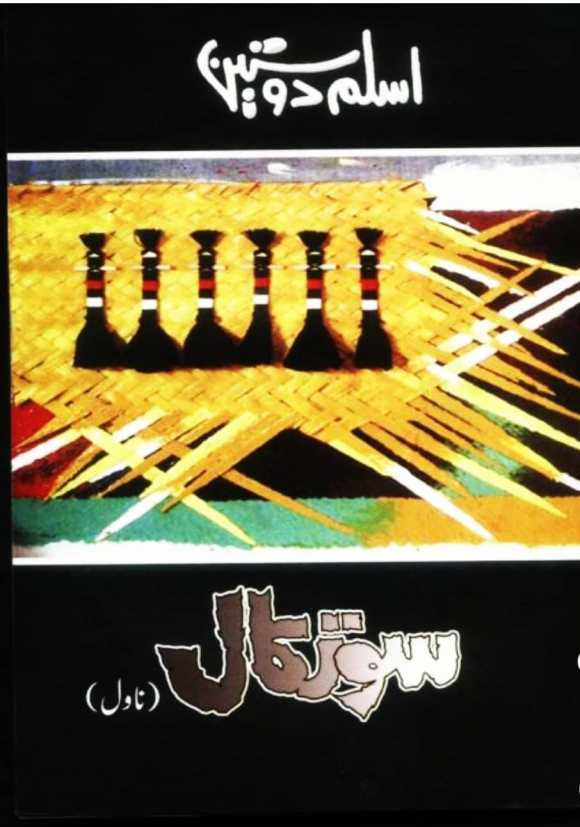
Front cover images of the first and second edition of Sótkál
Fazal Baloch is a Balochi writer and translator. He has translated many Balochi poems and short stories into English. His translations have been featured in Pakistani Literature published by Pakistan Academy of Letters and in the form of books and anthologies. He has the translation rights of this novel.
PLEASE NOTE: ARTICLES CAN ONLY BE REPRODUCED IN OTHER SITES WITH DUE ACKNOWLEDGEMENT TO BORDERLESS JOURNAL
The author at her stall in the Zine Fest. Photo provided by the author.
As an American writer in Japan, who writes and publishes in English, I tend to meet a lot of fellow expatriate writers. I know a few Japanese writers and poets who write in English, and of course, I am familiar with many Japanese authors through their works which have been translated into English. However, although I had read about the burgeoning Japanese zine scene, I had never actually witnessed it. As a professor of Japanese students who seem to hate reading and writing (at least in English), I could hardly imagine a hall full of self-published writers marketing their wares.
When an ad for a Zine Fest in Kobe popped up in my Instagram feed, I decided to sign up. The invitation was for creators and vendors of all kinds, including handicrafts, books, clothing, and yes, zines. I invited my artistic daughter to join me, thinking that she could sell postcards of some of her illustrations, but she had already made plans for that weekend.
I boarded a bus in Tokushima with a small suitcase full of books taken from the stash in a futon closet in my house. The bus went across Awaji Island, then onto the bridge that led into Kobe. I got off on the bridge and took an elevator down to ground level and found my way to the nearest train station. Although it was hot and humid, navigating my way to the venue, an old-style community center with dark wooden floors, gave me a sense of satisfaction.
I paid the modest participation fee and made my way to my designated spot in a room down the hall, a small table right at the entrance, with just enough space for all of the books that I had brought to display. My boothmate was a student from a college in Kyoto, majoring in political science, who was selling a chapbook about her job-hunting experiences. I bought a copy for my son, who was about to finish his graduate degree in history, and would soon have to start job-hunting himself.
The Zine Fest was happening on three floors of the building. We were on the first floor. I looked around the room and saw a wide range of handmade goods on display – jewelry, postcards, board games, and even food. As far as I could tell, I was the only foreign vendor and the only person selling materials in English. (I would later discover that this was not true.)
My boothmate had decorated her half of the table with small stuffed animals – characters from the Bam and Kero picture book series. She had come up with this idea after her first zine festival experience. It was a good conversation starter. Every now and then, she got up to reposition the figures.
In the first hour, a few foreigners sauntered through. Most pointedly ignored me, but I managed to sell one book to a cheerful young American woman in a dress appliqued with lesser pandas. I had known from the beginning that it would be difficult to sell English-language books at a Japanese event. It was almost impossible for me to convince the English majors at our university to read books in English. Nevertheless, I tried. I chatted up my books in Japanese to a few other people, to no avail: “This one is easy!” “This one has pictures!”
I saw that a vendor at another table was nodding off. One was crocheting. I thought it would be okay to eat the rice balls my husband had made for me while sitting at the table. After my lunch, I took a break and looked around. I went upstairs to what appeared to be the main room. I bought a graphic novel from a Polish publisher, and a fantasy story featuring a dragon from a Japanese creator, both in English. I was tempted by the quirky travel journals on interesting places, like Yemen, of another. For the time being, I picked up her business card so that I could follow her on social media. In another booth, a guy was selling fresh vegetables. The attendees were eclectic as well: a woman with pink hair and tattoos, men in skirts.
I perused some sample zines that had been set out on a table, then I went back to my booth. My boothmate told me that a few people had stopped by and looked at my books while I was gone. I found this heartening.
One guy picked up my book Waiting, which is a story in poems. He flipped through it, paused on certain pages, and asked a lot of questions. It seemed as if we talked for about five minutes, and I was sure that he would buy a copy. But then he asked, “What does RIP mean?” and after I explained, he said, “Dark!” He put the book down and made his escape. Maybe I wasn’t so good at hyping my books in Japanese.
Even so, I managed to sell a few more copies, and so did my boothmate. We clapped for each other every time one of us sold a book. At the end of the session, I packed up my remaining stock and went to meet my son for dinner. I gave him the chapbook, which he later read and said was depressing. Job-hunting is hard, and my boothmate suffered many setbacks. But spoiler-alert: she eventually found a job, and now I am following her on social media.
At the Zine Fest: Photos provided by the author
Suzanne Kamatawas born and raised in Grand Haven, Michigan. She now lives in Japan with her husband and two children. Her short stories, essays, articles and book reviews have appeared in over 100 publications. Her work has been nominated for the Pushcart Prize five times, and received a Special Mention in 2006. She is also a two-time winner of the All Nippon Airways/Wingspan Fiction Contest, winner of the Paris Book Festival, and winner of a SCBWI Magazine Merit Award.
PLEASE NOTE: ARTICLES CAN ONLY BE REPRODUCED IN OTHER SITES WITH DUE ACKNOWLEDGEMENT TO BORDERLESS JOURNAL
I bear the torment of your sadness In the embrace of my sleep May it transform into Glad tidings For the days of your people This exploration is To find your throne Which has disappeared From our hearts
For my love to you King
It was undeniable that he acted like a king. All his commands were to be obeyed, although he never asked for it directly, he hurt others and disrupted the peace in our family. He knew how to toy around with the opinions and feelings of others. He was not stupid, but smart and cunning.
And here I was bowing to him again. This was not the first time. I had come to pay homage to him on numerous occasions. That day was no different.
I waited for the van at Hougang interchange. It would be sent by the government to take guests to the ‘palace’, just as in the past horse carriages were sent to welcome dignitaries. But I was not of any importance — just an ordinary person with a little heart.
The van arrived at 1pm. Several commuters alighted. Almost all of them look depressed. A few smiled or smirked and waved their hands without any perceptible reason. I realised they resided at the ‘palace’ and had been given permission to return home or wander for a prescribed period. Clothed in dark blue shorts and T-shirts, they could take care of themselves but were still under close supervision.
I boarded the van and sat in the back row. Others, including two maids in the ‘palace’ uniform, boarded it too. All the passengers looked pensive. I began to think that the ‘palace’ had the ability to spread an air of melancholy as had been rumoured. I shivered and began to feel restless and out of sorts.
The van moved and turned right at the traffic junction, then turned right again and passed by a polyclinic and stadium next to a large canal. During the journey through the housing estate, I chanced upon the realisation that moderation in hopes and actions could be the key to a stable and peaceful life. Perhaps.
From far, I saw the ‘palace’ complex situated on a knoll covered in greenery. There was no ornamental gate at the entrance, but the complex looked neat and tidy — surely as a result of efficient operation and maintenance.
The van climbed the slope, turned left and then right twice before arriving at the main lobby of the institute of mental health with the corporate name of Buangkok Green Medical Park, which is the ‘palace’ for patients with mental disorder. It was called the infamous Woodbridge hospital before.
I stood still for a moment after I got off from the van. My eyes scanned the surroundings. Several inhabitants and visitors roamed freely in the concourse. I saw a brown marble statue with yellow spots beside a spiral staircase. It depicted a bent figure that supported another firmly and earnestly.
I was uncertain whether I could be like the statue for I felt really tired attending to his endless whims and fancies. I do not know when he could take care of himself sufficiently and with ease. There were always problems that emerged in his life. If these were limited to him, perhaps it would not matter. But it was not uncommon that the predicaments he faced dragged the entire family into turmoil. Undoubtedly, he acted like a cruel king who tortured us although he may not have realised it himself.
There were several stalls at the side of the lobby selling handicrafts of the residents of this ‘palace’. The institution attempted to paint a picture that there is still hope for them to return to normal life. I smiled cynically. What could be sold to reach that state, I wondered?
I was almost certain that it’s just an empty wish, specifically for the king who I am seeking audience with. Honestly, I was beginning to lose hope. I was there to fulfil a moral duty towards a person who shares our parents’ blood. Blood is thicker than water, they say. But if it is sullied blood or water keeps on flowing, I would have to divert it so as not to destroy the peace and harmony of our lives. But it has not reached that critical state yet. We are still praying.
I reached the lobby of block 4 after walking through several meandering walkways. I took the lift to the third storey of the palace. I was not allowed to enter the visiting hall after I registered myself with the palace guard at the counter. They were no gongs, drums and flutes to welcome me. There were no performances. I was shocked by the new experience.
I was confused and nervous haunted by the wild cries, wailing and chanting from a group of inhabitants in the adjoining room. They were prancing and swaying their bodies without care. Were they zombies, clowns or buskers who are having fun?
God forgive me. My chest palpitated heavily. I took a deep breath. I did not know what to expect next. I left it to the one and only King.
(An earlier version was published in 2021 by Kitaab International)
Isa Kamari has written 12 novels, 3 collections of poetry, a collection of short stories, a book of essays on Singapore Malay poetry, a collection of theatre scripts and lyrics of 3 music albums, all in Malay. His novels have been translated into English, Turkish, Urdu, Arabic, Indonesian, Jawi, Russian, French, Spanish, Korean, Azerbaijan and Mandarin. Several of his essays and selected poems have been translated into English. Isa was conferred the S.E.A Write Award from Thailand (2006), the Singapore Cultural Medallion (2007), the Anugerah Tun Seri Lanang (2009) from the Singapore Malay Language Council, and the Mastera Literary Award (2018) from Brunei Darussalam.
He obtained a BArch (Hons) from the National University of Singapore in 1989, an MPhil (Malay Letters) from Universiti Kebangsaan Malaysia in 2008 and is currently pursuing a PhD programme at the Academy of Islamic Studies, Univeristi Malaya. His area of research is on the problem of alienation and the practice of firasat (spiritual intuition) in selected Singapore Malay novels.
About the Novel: The Throne is an unflinching exploration of schizophrenia set against the backdrop of modern Singapore. At once realistic and allegorical, it charts a man’s descent into alienation from his turbulent youth to his fractured adulthood. Blurring the boundaries between poetry and prose, the narrative becomes both intimate confession and universal parable.
More than a story of illness, The Throne meditates on the fragile yet fertile nexus of madness, creativity, and spirituality. Within this tension lies the possibility of healing—a reconciliation born of suffering, sacrifice, and an enduring search for meaning.
PLEASE NOTE: ARTICLES CAN ONLY BE REPRODUCED IN OTHER SITES WITH DUE ACKNOWLEDGEMENT TO BORDERLESS JOURNAL
“Speedy Gas” was a small, two-pump, single-bay gas station tucked into a forgotten corner of San Francisco. It was not the kind of station visited by those chasing the lowest price per gallon or making a hurried dash into a minimart, but to its old customers and to those who still valued personal service, Speedy Gas was a relic of a slower, more intimate relationship between driver, car, and service station operator, resembling a visit to a trusted family doctor.
Rita kept the Speedy Gas rituals: windshield wiped clean, hood lifted, fluids checked, tires tapped and filled. Rita approached quickly with the tools of her trade; window spray, clean rag, tire pressure gauge, and welcoming smile.
Below in the grease pit, Daniel lay beneath an aging sedan, his hands blackened with oil as he tightened the final bolts. The scent of motor oil, grease and cement walls of the pit surrounded him like family and was his sanctuary.
Rita stepped carefully toward the edge of the pit and looked down at him.
“Mister M, you’ve been working on that old car all day without a lunch break, and it’s nearing six o’clock.
“Can’t it wait until tomorrow?”
“This car is more than transportation to its owner.
“Joan Hobson’s long life is wrapped up inside it this old car and driving it to Christmas to be with family will make her feel at home just like this pit and garage makes me feel at home. When I’m done, I want you to run the car over to Maxi Waxi’s and pay for ‘The Deluxe’ service wash.”
“I look at the invoices and know you’re undercharging your customers. You’re a generous man, Mister M.”
“Rita, I’m four times your age. I own this place free and clear and live comfortably inside my shoddy apartment behind the garage. My ‘generosity’ is paying it forward for my long life. I’ve survived. What matters is we’re serving the people who depend on us.”
“The grease pit is too dangerous for a man your age.”
“I may be one hundred and two years old, but I can still lubricate a chassis.”
“It hurts me to see you down there and living behind the garage in a cramped apartment alone. Spend Christmas with my family.”
“I celebrate eight days and nights with candles which is enough celebration for me but thank you. I’m a lonely old man who finds solace working here. My son worked alongside me after school, weekends, and summers at this garage. Ben was a natural born mechanic just like you.”
“I know you miss them dearly, Mister M.”
“I never had a chance to say goodbye to Ben. His jet was taking off from Naval Air Station Alameda to join the carrier USS Constellation at sea. I was busy replacing a radiator hose for an old customer, so I sent Helen off and told her I’d join her after the repair. She called me from the air station and said I missed Ben taking off to join the squadron. Helen said Ben appeared disappointed by not seeing me saying, ‘Tell pop’s I love him.’ She mentioned a look in his eyes as if he knew…
“I lost my only child, Ben, when his F-4 Phantom jet was shot down over Vietnam. He’s still listed as ‘MIA’, but we know Ben didn’t survive and buried him posthumously at the San Francisco National Cemetery. When Helen died peacefully at home twenty years ago, I sold our home including all its happy and painful memories to live and work here where I can keep my mind on work and cherish memories of working together with my son. I’ll be here opening and closing for our customers every day including holidays until the day I die and join Helen and Ben.”
The grease gun slipped in his hand and Daniel fell holding his chest.
“Are you okay, Mister M?”
“I’m having a heart attack!”
The last thing Daniel remembered was a mask placed over his face and Rita holding his hand.
*
Lieutenant Daniel Mercer was flying straight and level through a gray morning over the Atlantic. Suddenly, the cockpit filled with the bitter smell of burning oil and hot metal. The instrument panel flickered, the engine sputtered and fell silent. He knew his P-51 Mustang was hit by a lucky shot from a fallen Messerschmitt.
“Blue Jay Two, you hit?”
“Still flying but no engine and falling fast.”
The engine temperature needle swung hard into the red. Smoke curled backward across the wing. Daniel tightened his grip on the yoke. Below him, the ocean was choppy and cold.
A bullet had passed through his upper flank, grazing the ribs and tearing muscles. He adjusted the trim and remembered home, San Francisco. He thought of the cable cars on California Street, the ringing bell and the slow climb toward Nob Hill. His father’s garage was on California Street, and he would inherit it and forever live his life in the “City by the Bay”.
War had changed his career plans, and the aircraft was descending quickly. He could see England now, and the white cliffs of Dover emerged slowly rising out of the sea with welcoming smiles.
“I’ve got Dover in sight, Blue Jay Lead!”
“Take it straight into any field you see and may God be with you, Blue Jay Two!”
*
He opened his eyes. The air smelled of starched sheets, chlorine, antiseptic, and pain. A woman stood beside him. She wore a white neatly pressed nurse uniform, her posture was erect, and her expression composed. Her hair was pinned neatly beneath her cap. One hand rested lightly against his wrist, fingers counting the rhythm of his pulse.
“Where am I?”
“You’re in a British Army hospital.
“I’m Lieutenant Nurse Stephanie Hall.”
“Let me out of here!”
“You’re wounded and require proper medical care.”
“Where are my clothes?”
“Sir, if we must strap you to the bed to ensure you receive proper care, we shall do so.”
“I can see you are going to be a difficult patient. Most of you Yanks are.”
“I need to get back to my unit.”
“Where is your unit, Lieutenant?”
“My squadron is the ‘United States Army Eight Airforce’ based in East Anglia, England.”
“A ‘Mighty Eight’, lad. We’re grateful for your service to Britain. How old are you?”
“My birthdate is on my dog tag.”
“I see a very brave, defiant, man-boy of no more than nineteen, correct?”
“I guess the truth no longer matters because the war is over for me. I lied about my age when I enlisted. I serviced the Packard Custom Eight Clipper at my pop’s garage owned by a Brigadier General who pulled strings for me. They rushed me through flight school in time to see action before the war ends. I’ll be twenty years old on Christmas Eve.”
“Your mother was very fortunate to receive a gift of a beautiful baby boy the night before Christmas. I expect you to write home and tell her and your ‘pop’s’ you’re receiving the best of care and will be home soon.”
He studied her face and saw beauty, confidence, and something else, buried deeper. He did not yet know what it was.
*
The hospital ward was filled with wounded men. At night, the air filled with murmured prayers, delirious whispers, and sometimes screaming. Nurse Lieutenant Stephanie Hall adjusted bandages, administered morphine, and checked pulses. Her presence was precise, efficient, and compassionate.
She rarely spoke more than necessary but he watched the way she leaned closely when listening, the faint crease that appeared between her brows when she concentrated, and how beautifully her figure filled out the uniform. He found himself waiting for her. He learned she worked the late shift ending at midnight.
*
He woke to find her sitting on the edge of his bed.
“I’m off duty. Care to chat?”
“Only if you move in closer; the crash made me hard of hearing.”
“Nonsense, but brilliant try. What’s it like where you’re from?”
“San Francisco is a slice of heaven. The fog rolls in low, like it owns the city. You hear the cable cars before you see them.”
“Cable cars?”
“The San Francisco cable car system hurdles up the hills. You hear the bell and their steel grip biting into the tracks. It’s a good sound. It means people are going somewhere. Going to work. Going home where I want to be. My father has a garage on California Street with one bay and two pumps out front. Before the war, I spent my days in a grease pit underneath a car or truck with oil dripping down upon me and grease under my fingernails that never quite washed out.”
“That sounds dreadful but delightfully masculine. You have long slender beautiful fingers resembling those of a pianist which contradict your profession.”
“Slide in closer and I’ll let you read my palms, too.”
“Just a few inches, Lieutenant but I warn you my scream will awaken this ward.”
“You’re bluffing, you’re a compassionate nurse and wouldn’t risk waking these poor wounded bastards.”
“I remind you that you’re also ‘wounded’ and an irreverent ‘bastard’.”
“Find me sexy?”
“Possibly, Lieutenant and you’re sex appeal may likely increase after talking more about the garage.”
“I enjoy repairing cars. A customer say’s he can’t get to work or his wife’s expecting soon and he needs it ready. You find what’s wrong, set it right, and witness the beautiful sound of the engine turning over again. I helped him and it made me feel like I mattered.”
“Your work is like that of a surgeon, Lieutenant.”
“Yeah, call me a car doctor! Ah, I made you chuckle…Your hands are soft and beautiful and don’t look accustomed to hard labour.”
“Before the war, I was an appendage to a man of position. That sort of vital national service.”
“I don’t understand a damn word you’re saying. Spell it out.”
“After graduation from boarding school, I was placed into an arranged marriage with a man I didn’t know. He was the first man I came to know. I didn’t love him and there was no romance. His family sorely desired a male heir to carry on his family line. We tried and failed repeatedly to have a baby. I was blamed for being infertile despite his private admission of impotence. I remained a dutiful wife standing beside her husband instead of close to him in the same bed. Now, I find myself helping broken men stand again. Helping them return to their lives. Just like the cars you made whole and sent them on their way.”
“Where’s home?”
She chose not to answer, knowing nothing she could say would translate across the caste and privilege gulf between them. Her world was a life he had never imagined, just as she could never truly appreciate the grease-stained certainty of his.
“Home is wherever I am needed.”
They remained there in the dim light, studying each other with the quiet curiosity of two travelers who had met at the crossing point of two lives. He saw refinement that both fascinated and intimidated him. She saw competence that steadied her, a man whose worth was measured not in title but in usefulness. She saw a man she ached for and dreamed about.
*
Night after night, they spoke. Their formality softened. He called her Steph and she called him Daniel. They recognised the war they shared brought them closer and freed them from needing to understand dissimilar worlds.
*
A distant chime signaled midnight awakening Daniel. Steph was no longer wearing her cap, and her long flowing blond locks fell softly around her face. She saw his eyes open and he smiled.
“I have a surprise for you, Daniel. But you must keep it a secret. I’m breaking hospital regulations.”
She handed him a paper bag. He opened it and found a bottle of Coca-Cola, a Hershey bar, and a pack of American cigarettes with a matchbook.
“What made you do this at your peril?”
“I wanted you to feel some small semblance of home.”
“You’re a wonderful woman, Steph. I wish I had met you under such different circumstances. Steph, what can I do for you?”
“Daniel, just be my friend and listen to me. I have no one else to speak to about these matters.”
“What do you have to tell me, Steph?”
“My husband Bernard was a pilot. I spent two years waiting for him to come home until notice arrived; he was shot down and killed.”
“I’m sorry for you, Steph.”
“I’m lonely, Daniel. I find meaning and purpose working here but I think I would like to find the passion and yearning absent in my marriage with you, Daniel. I also wish we met under different circumstances.”
*
The deceased were removed in the very early hours of the morning so as not to alarm the dying. Their beds were filled by morning. A priest came by each bed at dawn, whispered a prayer, and waved his hands in the form of the cross. He never spoke but Daniel muttered, “I guess one prayer is as good as another.”
*
Stephanie arrived just after midnight on a clear cold night. The moon’s light cast a faint but warm glow across the ward. She drew the privacy drape around his bed. She stood beside him, her hands trembling faintly, and they devoured each other with their eyes.
“Do I smell ‘Chanel No. 5’ perfume?”
“I chose a scent you might recognise from San Francisco and used so little only you would notice.”
“Why the perfume?”
“Because after midnight, near to you, I’d rather be a woman than a nurse, darling.”
She climbed onto the bed beside him; her movements deliberate, urgent, tender, raw, vulnerable, and filled decades of neglect, culminating in a glorious culmination of emotions. He held her close but neither spoke. The world beyond the drape ceased to exist.
*
Rain traced soft lines down the tall English windows. He lay awake, staring at the ceiling, his shoulder wrapped in stiff white bandages. Daniel noticed fewer beds were being filled, which meant the war was ending.
The curtain providing intimacy at midnight opened without haste. It was Nurse Captain Melinda Richardson. She carried herself like an officer accustomed to command. Her uniform was immaculate, her posture erect, and expression firm but not unkind. She pulled a chair close to him to speak quietly.
“I have come to speak with you about Nurse Lieutenant Stephanie Hall.”
“Yes, Captain.”
“It has come to my attention that the two of you have spoken intimately on more than one occasion. She has attended to you personally, even when such attention could have been delegated. I do not interfere lightly in the private lives of my nurses, but I am responsible for their well-being, particularly in matters where misunderstandings may arise. You are an American and come from a nation where distinctions of class are less formal and permanent. That is not the case in England. Nurse Lieutenant Stephanie Hall was married to the son of Lord Hall. She returned to his family estate a widow before she had truly become a wife. She is the daughter of a distinguished family, and her father holds influence at the highest levels of government. She could have spent the war in comfort and safety. Instead, she chose to serve Britain by becoming a nurse and entering the army. She will one day return to the family estate. Her father is ill and mother deceased. She is the last of her line.”
“In other words, she’s out of my league.”
“You’re blunt but on point.”
“I’m from San Francisco, Captain. My father owns a garage. I suppose that’s all there is to say.”
“You became an officer and crossed an ocean to defend a country not your own. That speaks highly of you. But there are worlds, Lieutenant, that do not easily join. Not because of character but because of obligation and history. Bluntly, Stephanie Hall’s Anglicanism and your Jewish faith present barriers to a union between you both. The fact that you have won her heart is not a trivial thing.”
“Steph never brought up religion although the letter ‘H’ for Hebrew was stamped on my ‘dog tag’.”
“I ask you to understand what it all means and what it may never be permitted to become.”
He looked past her, toward the dark window where the rain pelted reminding him of the bullets fired to kill him and this time, hitting his heart.
“I understand, Captain. Requesting your leave to process all of this.”
“I wish you the best of everything and a long life, Lieutenant.”
Captain Richardson left him, but he knew that survival, however miraculous, did not free a man from the boundaries of the world dividing people. War should have taught him that lesson, but for a moment in time, a beautiful woman from a stately manor and mechanic-turned-pilot fell in love.
*
The day came when he could stand, walk, and be discharged. They did not speak of it until the morning it arrived. He stood beside his bed, wearing his uniform again. Steph stood before him.
“You’re returning to your unit and then home?”
“Yes, to the life I had lived before the war.”
“I will miss you, Daniel.”
He attempted to pull her tight to him, but she resisted.
“You cared for me and I took you into my heart, Steph. I want to say more but there are no words which will suffice except a kiss which you’ll permit me, please.”
She entered his embrace and released the pent-up desire raging through her until Captain Richardson approached with his discharge papers. Nurse Lieutenant Stephanie Hall watched Daniel leave forever but knowing he left behind a permanent memento.
*
Their son was born in the spring and she named him Bernard. Steph raised him alone. She never wrote to Daniel and never spoke his name, but she was reminded of him in every feature of their beautiful son.
*
Daniel returned to San Francisco, resumed his life working inside his father’s garage and married. The war became memory. Years and decades passed. His garage on California Street was built with his hands and discipline learned in the cockpit, and watching the dedicated nurses complete their rounds with compassion which he shared with each of his customers.
*
Daniel awoke and found himself alone inside an ICU not resembling the hospital ward he recalled from the war. The war defining his youth was more than eighty years behind him and losing his son and wife faded into memory.
Rita was cautioned by the cardiologist,
“Say your goodbyes before it’s too late. His birthday is tomorrow. We didn’t think a birthday celebration was appropriate for a dying man. Nobody in this ICU can recall a birth and death on the same day particularly Christmas Eve.”
“Mister Mercer never shared his birthday with me even though I’m the closest thing to family.”
Rita held Daniel’s frail hand in one hand and a faded sealed envelope with foreign postage stamps in the other hand. Daniel’s eyes were hollow, but he recognised the aged envelope.
“I searched your office for somebody to contact and came across this envelope from England addressed to you many decades ago and never opened.
“Would you like me to open it?”
Daniel remembered his decision not to revisit the past by opening the envelope because he put the past behind him, but the memories and mourning were about to end, and he motioned for Rita to open the envelope.
Rita removed a photograph of a handsome young Royal Air Force aviator. She turned over the photo revealing a handwritten note suggesting a woman’s soft touch with a fountain pen which she read softly:
Dearest Daniel,
Please meet our son, Bernard Mercer Hall.
Bernard was told his father was an aviator killed in the war.
 The night our son was conceived inside the darkness of the ward remains a blessed, romantic memory and a warm togetherness two young people shared inside the cold of war.
After graduation from Cambridge, he darted off to the RAF to become an aviator like his father.
I’m mailing this photograph and note in the final days of my life. I knew you as a sensitive young lad and you may be reticent to open it fearing to relieve the past which I fully understand.
Life was kind permitting our union during times of mutual need but also cruel in keeping the three of us apart.
I hope our beautiful son will bring you happiness and remove any grief life may have dealt you.
Goodbye, my love.
Daniel’s American son followed him into the sky and lost to it but here was another son; a son born of survival and two lovers from different worlds. Although Bernard walked beneath ancient, privileged towers, he, too, flew inside the same sky that had both spared and punished three pilots; a husband, and a father and son. Daniel was gifted with a second son, and his grief was replaced with pride in two heroic sons born from two magnificent mothers.
Rita held Daniel’s hand which gripped tightly and suddenly let go. A sound from the heart monitor resembling the bells of the cable cars Daniel warmly spoke about signalling his long journey ended. Daniel’s cable car reached the top of California Street and waited for him to climb aboard with a nonstop flight to a grand reunion of loved ones; a beautiful extended family all with eyes towards the sky.
From Public Domain
Jonathan Ferrini has published nearly one hundred short fiction stories and poems. He is the host and writer of the weekly “The Razor’s Ink Podcast” where he discusses movies, television, and music.
PLEASE NOTE: ARTICLES CAN ONLY BE REPRODUCED IN OTHER SITES WITH DUE ACKNOWLEDGEMENT TO BORDERLESS JOURNAL
Mohammad Hussain Anqa (1907–1977) was a poet, historian, journalist, and political activist. He spent a significant portion of his life in prison because of his dissenting political views, an experience that is reflected throughout his poetry. Anqa’s most important contribution to Balochi literature was the introduction of a modern aesthetic sensibility into the Balochi ghazal. The selected fragments are drawn from various couplets in his ghazals, collected in Roken Poll (The Glowing Flower), a volume of his poetry published by the Balochi Academy in 2007.
(1)

Drop by drop, celestial honey flows into my ears—
In midnight hours, when the chime of your bangles fills the air,
I wonder whence the angels brought you this grace and modesty;
No moon glows so purely, no blossom blooms so fair.

(2)

Whenever, in prayer, I lifted my hands, they were scorched.
Like ember smouldering beneath ash was the sky.
Tyranny's flames sear the earth like a griddle.
I seek to rest a little while, but tell me, how could I?

(3)

If it bears not the fragrance of her perfumed tresses,
Let this callous breeze fall dead — I do not care.
In quest of my heart, I seek you — but you’re nowhere,
My heart—may it lie tangled in a knot of your hair.

(4)

If you have seized my forbearance, along with your grace,
The joy of love and longing will fade, you must know.
At dawn, Anqa whispered to the nightingale in the cage:
“Most of my captive days are gone, just a few left to go.”

(5)

The cloud burst forth and showed you —
Ask your tresses how blessings are bestowed.
A home is where the heart finds peace,
Cots and couches alone make no abode.

(6)

I know not by what mysterious fashion, the Creator shaped this world—
The shepherd dreads the wolf; the wolf fears the shepherd’s wrath.
Anqa! I spilled my blood so blossoms might grace every garden in the land;
Yet never once did I dive for pearls beneath the ocean’s path.

(7)

They crushed the only blossom I called my own
May every garden wither, far and nigh.
They show me not the path unto her abode
May God rend every star out of the sky.

(8)

He rends the garment, only to mend it whole again.
How artful this madness proves itself to be.
Why does autumn fall to me, while spring blossoms for you,
If from the selfsame clay are fashioned both you and me?

(9)

Like a night flower's fragrance adrift through the eerie darkness,
O butterfly of my love, when will you come to me silently?
Beside my pillow, there shimmered your outstretched hand.
I reached to steal a kiss, but the sword cut through me.
.
Fazal Baloch is a Balochi writer and translator. He has translated many Balochi poems and short stories into English. His translations have been featured in Pakistani Literature published by Pakistan Academy of Letters and in the form of books and anthologies.
PLEASE NOTE: ARTICLES CAN ONLY BE REPRODUCED IN OTHER SITES WITH DUE ACKNOWLEDGEMENT TO BORDERLESS JOURNAL
Fresh with the caress of dew, Fragrant with the scent of rose, Joyous with the chirping of birds, Invigorating with a hearty breakfast, Captivating with a painted sunrise,
Cheery with a calm soul, Solid with a clear mind, Clear with the demands of responsibility, Firm with steps to work, Blessed with the dedication to make a living, Earnest with the utterance of In the Name of God, Dependent on the destiny of efforts, Submitted in consistent devotion, Echoed with His Beautiful Names,
God is Beauty and loves the beautiful, Reveals the face of His Benevolence, Expresses the layers of His Majesty, So, everything returns as beautiful things, To His Beneficence and Mercy.
Alone
Life is lonesome In cold nights like this, when family could not understand, I no longer cry while reading the Qur'an. The Original Mantra
The original mantra came down from heaven, Following the sin of having a will, Bestowed with freedom of choice, Taught the Word and Names of everything. The ordained natural mould Does not change.
We are Adam, venerated, To whom the angels bow. We are Adam, vile, Befriended by the Devil till the end of Time, Who destroys the earth With hands that have wants, With souls that are free to act, Betray and rebel, Self-sufficient and disobedient.
The original and revered Word and Names We sully with despicable acts, We taint with wild thoughts. The natural mould handed down from prophets We smash in arrogance.
Alas, the original mantra from Adam Is conditioned by political and social norms To suit its locale, The abode of each people, That is perfected and purified by The Mercy of the Worlds.
The spring that flows from heaven, Has freedom to worship as its undercurrent, Envied by the angels. The ultimate pleasure is to Return the freedom to The Owner of the Eternal Mantra.
O Believers! Do not die Except in a state of total submission.
Prostration
Dirtied hands feel the heat, Palms on the earth Next to the forehead. My heart is grounded, Asking for mercy. The cool pouring of Love and forgiveness.
Intimacy
I pick up grains of sand On my journey home, No longer unfamiliar, Though dirtied and bitter. I wash with prayer and zikr, The last accompaniment To brighten the impending grave-pit. Descending from the peak, Wishing for a clear spring At the foot of the hill, To submerge My entire soul in You.
*zikr—remembrance
Gift
I realise: The palpitations in my chest Are not the flow of my breath, But a gust of Your mercy. The stirrings of love Do not arise from my soul, But from Your grace. My complete surrender is Just Your Embrace.
Mirror of Revelation
O my soul breeze, I want to gaze at Your face By the mirror of revelation.
Your whispers Stir the base of my heart in tenderness. Longing for the original song— Without rhythm and melody, Only silent whispers,
One in ecstasy, Longing sustains existence: Existence in perpetual longing. The self is broken to pieces by doubt.
O my soul breezes To return to One, Obliterate in Light.
Isa Kamari has written 12 novels, 3 collections of poetry, a collection of short stories, a book of essays on Singapore Malay poetry, a collection of theatre scripts and lyrics of 3 music albums, all in Malay. His novels have been translated into English, Turkish, Urdu, Arabic, Indonesian, Jawi, Russian, French, Spanish, Korean, Azerbaijan and Mandarin. Several of his essays and selected poems have been translated into English. Isa was conferred the S.E.A Write Award from Thailand (2006), the Singapore Cultural Medallion (2007), the Anugerah Tun Seri Lanang (2009) from the Singapore Malay Language Council, and the Mastera Literary Award (2018) from Brunei Darussalam.
He obtained a BArch (Hons) from the National University of Singapore in 1989, an MPhil (Malay Letters) from Universiti Kebangsaan Malaysia in 2008 and is currently pursuing a PhD programme at the Academy of Islamic Studies, Univeristi Malaya. His area of research is on the problem of alienation and the practice of firasat (spiritual intuition) in selected Singapore Malay novels.
The Lost Mantras is a collection that blends spirituality, Malay cultural heritage, and universal human experience. First published as part of Menyap Cinta (Love Greetings, 2022, Nuha Books KL), these poems are like a bridge between mysticism and everyday life, where traditional images (betel, jasmine, kris[1], oil lamps, setanjak[2]) are woven with Qur’anic echoes, prayers, and existential questioning. The collection carries a Sufi resonance—always circling back to longing, humility, surrender, and beauty as signs of God. The poems are not only lyrical but also function as cultural memory: they preserve Malay traditions, communal practices, and village life, while situating them in a cosmic framework of faith, sin, and redemption. The use of Malay customs, rituals, and objects is powerful: it asserts that spirituality is not abstract but embedded in heritage. This makes the collection uniquely Southeast Asian despite its universal in appeal.
Summer, Dune in Zeeland by Piet Mondrain (1872 – 1944)
Time present and time past
Are both perhaps present in time future,
And time future contained in time past.

‘Burnt Norton’, Four Quartets (1941) by TS Eliot
If we look back in time, we have a better life than that of our ancestors. Though conflicts rage and climate change is a reality that we all dread, it can safely be said, we have progressed beyond the imagination of those who lived a hundred years ago. The fact that some books from the past still reverberate with echoes of what the present holds says much for the outliers or authors who could think out of the box. Despite this complex intermingling of ideas and times, perhaps the world will change more now than before. We do not know anything for sure though experts are always predicting a future that for most of us remains unknown. What we can present is our own estimate of what can be and a definite assertion of what is. Truth as such is a matter of perception. That complicates it further. However, one of the changes that is definitely here to stay is climate change and our changing environment. Given that this is the month that homes World Environment Day, we have a smattering of writings that revolve around nature and also the human spirit that defies age.
We have featured a writer who revels in nature and is an ageless voice that bridges multiple cultures, Ruskin Bond. As he turned ninety-two last month, he published multiple new books. We have an excerpt from one of them, Scenes from the Magic Mountain: Five Seasons in the Mussoorie Hills and Beyond, a brilliant collection of snapshots of his interactions with nature over time — be it frogs, snakes or just trees. Some of the vignettes are humorous and some, as all classics are, thought provoking. Bond puts into words how he chose to work in Landour (a small town in Himalayas) and continued to write from there for sixty years. He talks of the spell the mountains cast on him, “I like to think that I have become a part of this Magic Mountain; that by living here for so long, I can claim a relationship with the trees, wild flowers, even the rocks that are an integral part of this landscape.” The other book excerpt is a contrast to Bond’s, a non-fiction called Burnout Highway by Anmol Diddan. It explores the collective suffering of stress at work where achievements distance humans from nature and a fulfilling life and urges readers to be open to changes.
In keeping with the theme of environment, Bhaskar Parichha has reviewed Stephen Alter’s The Fragrance of Rain: A Brief History of the Monsoon. He tells us: “The Fragrance of Rain is much more than a history of weather. It is a meditation on nature, culture, memory, and belonging… Like the season it celebrates, the book is refreshing, nourishing, and lingering in its impact…” While Rakhi Dalal expresses her delight with Shyam Manohar’s The Cold War of Sadanand Borse, a novella translated from Marathi by Jerry Pinto, Meenakshi Malhotra revels in Giti Chandra’s debut book of poems, Setting Traps for Light.
In translations, Professor Fakrul Alam has captured the flavours of Nazrul’s Bengali lyrics, which also echo of the rainy season or monsoons. Isa Kamari brings to us more of his Malay poems in English and Ihlwha Choi shares a rendering of his Korean poem, ‘Dragonfly 2’, into English. One of Tagore’s poems from Balaka (Flight of the Cranes, 1916) has found its way into this issue after being translated. We also have a touching Balochi story around social gaps from the late Abdul Qayum Sarbazi, brought to us in English by Fazal Baloch.
Hughes has continued sharing his short fables, which are absurd but also, comical! A sensitive story about the natural world mingled with Maori concepts by Keiran Martin seems so much in sync with the oceans while Jeena R Papaadi has woven a strange narrative located in a land that only one man could visit. Plamen Vasilev shares a human-interest story set in Europe and Rabiya Rehman takes us to Lahore in quest of a missing destination! Naramsetti Umamaheswararao’s narrative takes us back to a village that opted for trees, thus enriching the environmental lore in this issue.
We have a real life heart rending story from a young girl in our Pandies Corner, written and related by Deeksha Vats, based on the story told by a victim of familial violations and violence.
Our non-fiction section homes Larry Su’s essay on how his life took him from a rural mud cave in Shaanxi province to the glamour of Chicago. Reflecting on the changes he has experienced on his rare visits to his original homeland, Su muses on the cultural and socio-economic gaps he has observed between the two places. Charudutta Panigrahi – as if in direct opposition — shares similarities between two diverse geographies.
Suzanne Kamata explores a custom which may not be that eco-friendly in her column from Japan. Jun A. Alindogan brings home the impact of climate disasters while dwelling on blessings with his narrative about a narrow escape from the Typhoon Ondoy (2009). While Meredith Stephen writes of sailing to Timor Sea with photographs by Alan Noble, Farouk Gulsara takes us on a cycling adventure around the mountains of Titiwangsa. In another musing, he also explores the idea of good and evil in a sardonic tone while Sai Abhinay Penna dwells on the grandeur and vastness of the universe over his morning jog. Gowher Bhat writes of a man for whom age seems to be just a number as he publishes his debut book at 93! One wonders at the frequency of such occurrences — we have writings about two authors above ninety in the June issue. In contrast, Devraj Singh Kalsi brings in mortal fears while writing of visiting doctors with a soupçon of humour – some of it directed at himself.
Perhaps, laughter is really the best medicine to keep well! Ruskin Bond makes us laugh and writes of nature in a way that touches hearts and makes us forget the contrasting glitzy world, where we suffer stress and burnout. Our environment makes a difference, doesn’t it?
With that we wrap up our June issue. Huge thanks to our fabulous team, especially Sohana Manzoor for her wonderful artwork. To all our contributors, heartfelt thanks — we are because you are. And gratitude to our readers who make it worth our while to write and publish here.
We will next meet you during the monsoon months of South Asia though, near the equator, it rains almost every day and, in the Southern Hemisphere, it will be peak winter!
Story by Abdul Qayum Sarbazi: translated from Balochi Fazal Baloch
AbdulQayum Sarbazi (d. 2022) was a Karachi-based fiction writer who began his literary career in the mid-1980s. Deeply influenced by the tradition of social realism, his stories illuminate the struggles, inequalities, and everyday realities of ordinary people. The story translated here first appeared in Monthly Balochi (a magazine in the public domain) in May 1988 under its original title, Bey Maarag.
The doctor checked the unconscious child’s pulse and said, “You have almost killed the child before bringing him to the hospital.”
He lifted the child’s eyelids and examined his mouth and throat. Then he placed a thermometer in his mouth and rolled up his shirt slightly. Looking at the child’s hollow stomach and protruding ribs, the doctor began critiquing the parents in a stern tone. “He is suffering more from starvation than illness. If you cannot take care of your children, why do you bring them into the world?”
The doctor removed the thermometer from the child’s mouth and blinked arrogantly before continuing to scold the father. “May God guide you. Such a high fever. He is standing at the edge of death. Why didn’t you bring him here earlier? Though I know people like you are not entirely to blame. This is what happens when people have too many children and assume they will somehow grow up on their own. Such children do not become responsible human beings; they become a burden on society. But what do you care? For the sake of ‘momentary pleasure’, you bring children into the world only for others to carry their burden.”
The boy’s father lowered his pale face and listened silently to the doctor’s taunts. It was nothing new to him. He had long grown used to harsh words from the police, the coast guard, and the dealer. Rubbing one palm against the other, he let out a weary sigh and looked helplessly at the doctor. His eyes drifted toward the swollen veins in his hands and feet before he sank into a dark cloud of worry.
The doctor cleared his throat, washed his hands with soap, dried them on the hanging towel, and resumed his sermon. “The way you treated this child… not even do we treat our worst enemy so harshly. Anyhow, I will give him two vitamin injections. He also needs glucose. There is barely any sign of life left in him, but I will do whatever I can within my capacity. The rest depends on the boy’s fate.”
The boy’s father lowered his head even further as darkness clouded his already blurred vision. In that moment, a terrible wish rose in his heart: that the earth would split open, the four-storey hospital building would collapse, and everything would be buried beneath the rubble.
After wallowing in helplessness and grief for a short while, he slowly regained control of his breathing and looked again toward the doctor. His eyes faced the merciless man like those of a beggar pleading for mercy. The doctor ran his tongue across his lips as though sharpening a blade on stone and continued coldly: “This is not how a child should be raised. Children require care, sacrifice, and hardship. For breakfast, they should be given half-fried eggs, milk, butter, and bread. At lunch, boiled beans and minced meat. In the evening, fresh fruits and salad. For dinner, meat, chicken soup, and rice. And before going to bed, a glass of milk.”
The boy’s father’s already pale face darkened with despair. He shifted slightly, crushed beneath hardship and helplessness. The doctor glanced at his wristwatch and continued his barrage of words. “At this moment, the child is still not out of danger. Deposit five hundred rupees at the counter in advance for emergency medicines and treatment. The final bill can be settled later.”
The father felt as though he had been stung by a scorpion. His senses were already numb, and whatever strength remained in him now seemed to disappear completely.
For the first time, he spoke. Looking at the doctor with helpless eyes, he said softly, “I do not have five hundred rupees.”
The doctor struck him again with his words. “This hospital is not for the poor and needy. You see all these people working here? They have to be paid. Medicines come from companies, and they demand payment immediately. Do whatever you think is best, but let me make one thing clear: your child will not survive without medicine. If he dies, his blood will be on your hands.”
Then, lowering his voice slightly, the doctor added, “I took pity on your condition and asked for only five hundred rupees. Otherwise, we charge one thousand.”
The father’s dry lips trembled beneath tears that came too early and too painfully. Even the violent tides of the sea seemed less cruel than the doctor’s words. To him, the doctor appeared like a disciple of the Angel of Death, hardened by the complete loss of compassion. Closing his eyes, the father fell at the doctor’s feet and pleaded in a voice heavy with pain: “All I have is two hundred rupees. I do not know whether such a small amount means anything to you, but it is the cry of a helpless father’s soul.”
The doctor’s face darkened with anger. His arrogance swelled again as he replied coldly: “If your money is so dear to you, then take the boy’s dead body home. Perhaps you do not believe my words, but do whatever suits you.”
The boy’s mother stood silently in a corner, numb like a statue. Ever since they arrived at the hospital, she had not uttered a single word. Life had shown her only one face: hunger, poverty, humiliation, and endless helplessness. So she remained quiet.
The boy’s father was not very old, yet he looked far older than his years. He had spent his entire life in patience and endurance. And it was all the poor could afford. But sometimes humiliation becomes heavier than patience itself. Once again, he saw the bitter truth before him. A doctor, whose hands were meant to heal like those blessed by God, had turned his noble profession into a business. To the poor, such men seemed no different from heartless merchants or cruel officials.
Yet the father felt it wiser, perhaps easier, to fall at the feet of this “angel of death” if it might save his child’s life. Swallowing the anger rising inside him, he spoke softly:
“My helplessness lies before you as clearly as an open road. I listened carefully to all your words and hold them with respect. You said that people like us bring children into the world for ‘momentary pleasure’. I have only two children. One lies before you, struggling at the mercy of death, while the other plays in the dirt back at home. Luxury and comfort are sweet words, doctor, but I have never truly known them. The land has nothing to offer us. It is the sea that feeds our children. The old days were much better for people like us, but as time passed, the chains of circumstance tightened around our lives”.
He continued, “I returned home today after spending twelve days at sea battling rough tides. We managed to catch some fish, but the coast guard took their share as if it were their right. Some were taken by the police and customs officers, and whatever remained was bought by the dealers at miserable prices. In the end, my share came to only two hundred rupees. When I reached home, everything was in chaos. My wife was almost unconscious. One child lay unconscious with fever while the other cried from hunger. My wife told me the boy had been burning with fever for a week, but she could not take him to a doctor because she had no money.”
After revealing the bitter truth of his life, he placed the crumpled two hundred-rupee notes on the doctor’s table and said: “I leave both the money and the boy with you. If he survives, he will find his way home. And if he dies, bury him with a handful of dust, because I do not even have enough money for his funeral.”
With these words, he walked away.
The doctor stood silent, staring at his own reflection in the mirror.
.
Fazal Baloch is a Balochi writer and translator. He has translated many Balochi poems and short stories into English. His translations have been featured in Pakistani Literature published by Pakistan Academy of Letters and in the form of books and anthologies.
PLEASE NOTE: ARTICLES CAN ONLY BE REPRODUCED IN OTHER SITES WITH DUE ACKNOWLEDGEMENT TO BORDERLESS JOURNAL