Narrative by Meredith Stephens: Photographs by Alan Noble
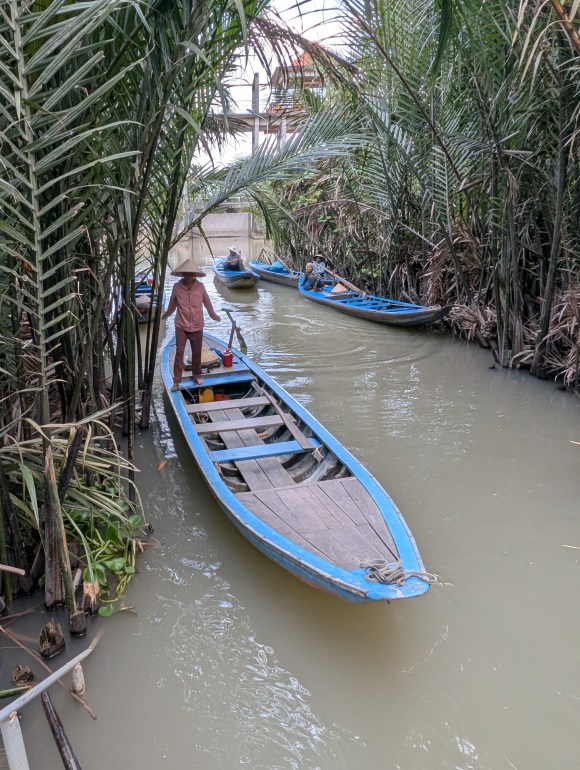
We alighted from the ferry and disembarked at a small island in the Mekong Delta. Our Vietnamese guide had promised us that we could witness how local people lived. After walking along a trail, we were ushered into a small boat with a local lady at the rear who would row us down the river. We stepped into the back of the boat and another couple stepped into the front.
“Would you mind taking a photo of us?” asked a woman with a bright smile and an energetic voice. I could hear she was English. Then the four of us started bantering and I detected that her partner was English too.
Next, we hopped off the boat and were treated to the chance to hold a cobra, sample local delicacies, and listen to the villagers’ musical performance. The next day we were taken to a restaurant where you could make your own seafood pancakes. Just before lunch, we were given the opportunity to cycle along a nearby path. Those of our group who wished to cycle selected a bicycle. I chose one and headed to the path. Then I looked ahead of me and realised that the English woman’s bike was the wrong size for her.
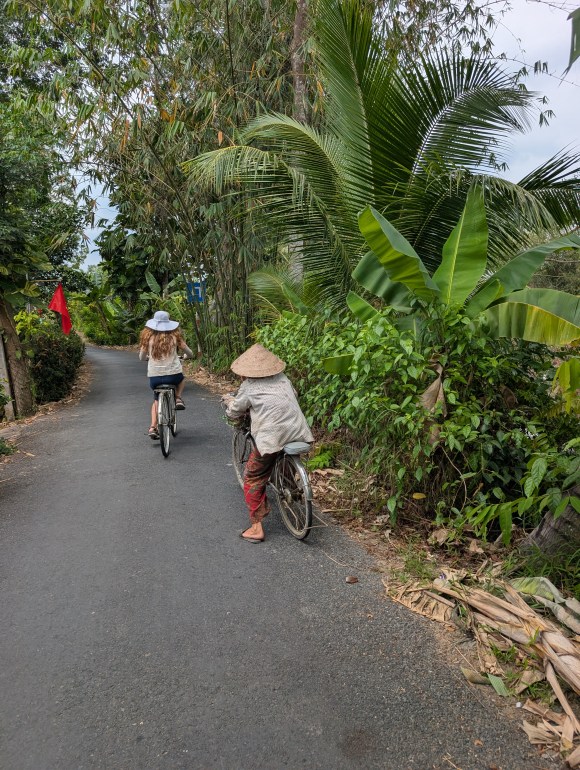
“Would you like to swap bicycles? Mine is too large and yours seems to be too small.”
She nodded. We swapped bicycles and seemed to find the perfect match. Our tour guide gave the signal and off we went. After a few kilometres, he signaled to stop so the group would stay together. I found myself at the front of the group and turned around to see the English woman immediately behind.
“I commuted to work by bike for twenty years,” I explained, surprised to be the one who had to stop so the others could catch up.
“I was in Japan. Japan is much friendlier to cyclists. The traffic is slower, and the roads narrower. It’s easier than driving, at least for short distances.”
She nodded. “They cycle a lot in Amsterdam. Also in Cambridge, where I lived for three years.”
I didn’t want to ask too many personal questions of this woman I had only just met, but I was curious. I wondered if she had studied at Cambridge University. Instead of being nosy, I added a few comments about Cambridge.
“We visited there recently. We stayed on the outskirts, and walked in. We had to walk through a park where there were cows grazing with bells around their necks. I much prefer Cambridge to Oxford.”
“Yes, it’s smaller. But Oxford is pretty good too!” she added.
By then the other cyclists had caught up. We continued along the path and then returned for lunch. We resumed the tour and were dropped off back in Ho Chi Minh City.
“Where can we store our luggage?” Alex asked her.
“Here at the tourist agency. We’ll leave ours there while we pop into the markets to get Ian a new backpack. His is broken.”
“Thanks for the tip. By the way, do you have an email address so we can exchange photos?”
“Sure. Where are you heading next?” she asked.
“Hoi An,” she replied.
“Oh! We are going there too. We are doing a cooking class. Would you like to join us?” offered Alex.
“Sure! Send us the link.”
We parted ways.
“See you in Hoi An,” I said, hoping that we could meet again.
The English woman was so easy to talk to, so quick to respond, and pick up on any nuance. I’d already decided that she must be a therapist. I had been trained since early adulthood not to ask people what they did for a living. It wasn’t fair to allow your knowledge of their career success to determine your assessment of them. But I admit to being curious. If she had studied at Cambridge, what career had followed?
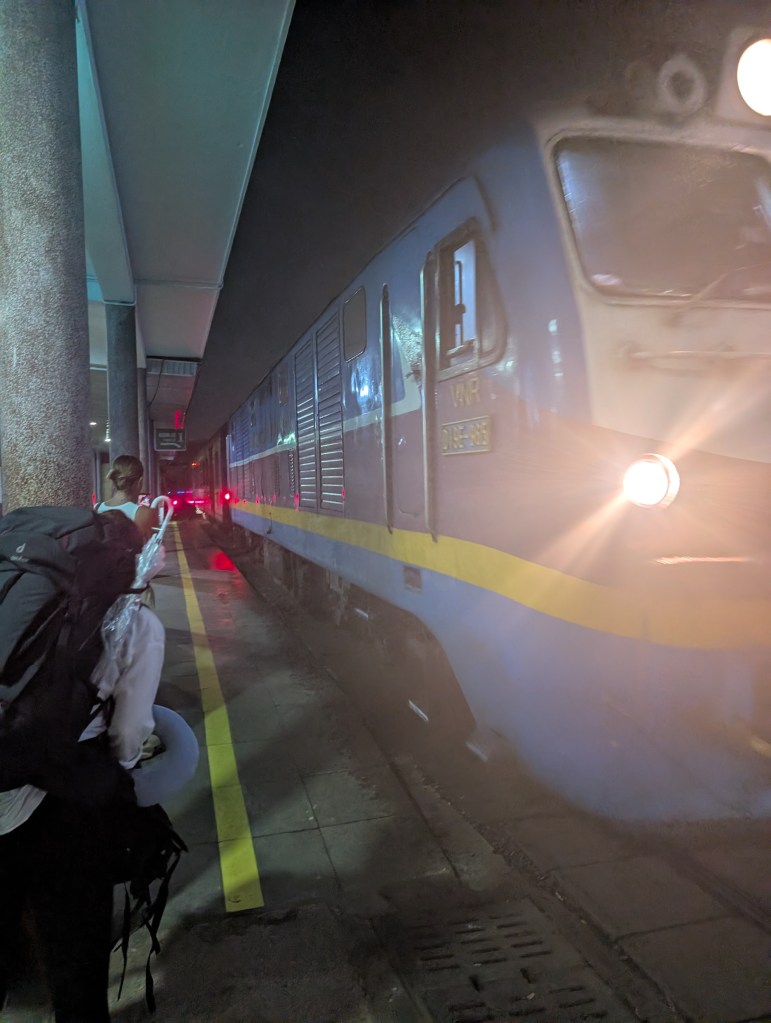
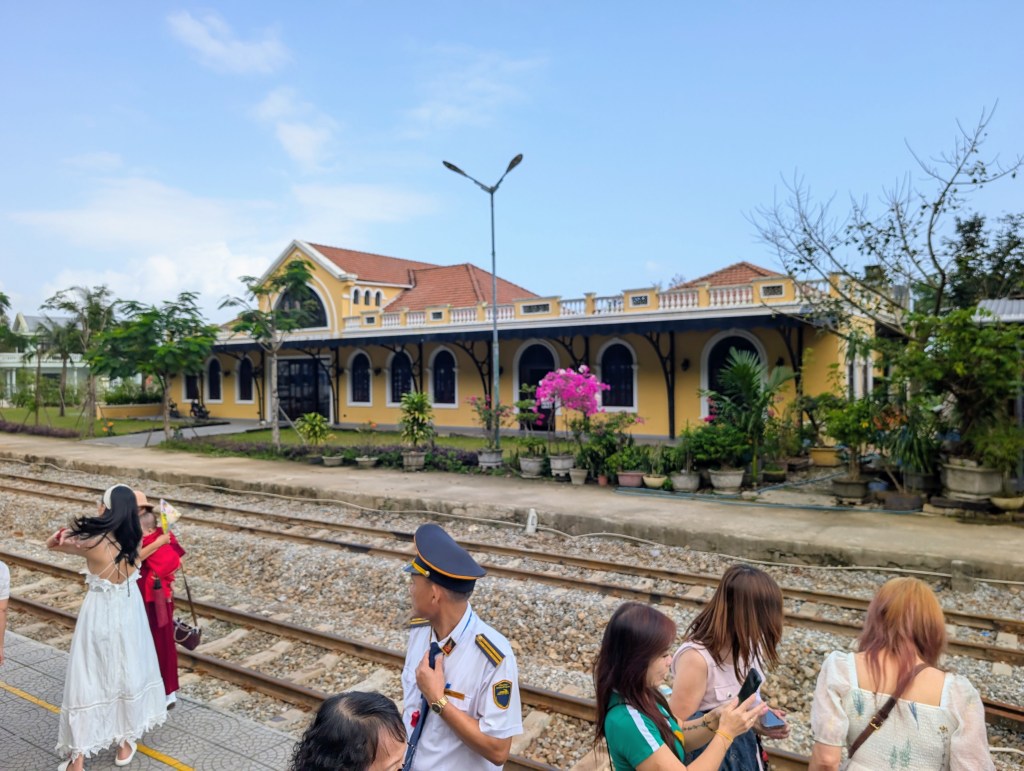
Alex and I caught a sleeper train to Hoi An. There we found generously proportioned historic buildings. However, there were too many tourists in Hoi An, people like us. We walked around the town and felt overwhelmed. We could barely move down the street without bumping into other tourists.
The next day Alex texted the English woman. He must have been just as eager to meet the couple again as I was.
“Sorry, your cooking class was full. We booked another one. How about drinks this evening?” she replied.
Alex accepted. That evening we made our way to the bar she had suggested. They stood up and hugged us.
“I’m Jill* by the way. And this is Ian*.”
“I’m Alex, and this is Merri.”
We ordered a gin and tonic. They were drinking beer.
“Since we were meeting you today, we thought we’d better order a gin and tonic,” I explained. This drink brought back memories of England.
After we had sipped our drinks, Alex broached the question that was on my mind.
“So, what do you do when you’re not touring in Vietnam?” he asked.
“I write historical fiction. Ian has retired. When the children were younger, he supported me, but now it’s my turn to support him.”
I was beside myself with excitement. If you asked me which profession intrigued me most, I would have said a writer. I have little inclination to meet actors, politicians, astronauts, rocket scientists, or billionaires, but I certainly would like to meet writers (not to mention musicians). For the next couple of hours, Jill shared her experience of writing, and Alex and I shared our experiences of sailing. I was so excited that I lost my appetite and only nibbled a few snacks at the end of the evening. They told us that they lived in a nearly three-hundred-year-old house in Somerset*, one of my favourite places in the UK.
“Just a warning. We will visit,” Alex added.
“Certainly!” replied Jill.
“And please come sailing with us when our boat is ready!” I urged.
We parted company, and I floated all the way back to the hotel. I looked up her many books online and resolved to read her latest one as soon as I could.
A day later, Alex and I caught another sleeper to Hanoi. It was so pleasant rolling along the tracks that I was lulled to sleep as soon as I lay down. I informed Alex that when we returned to Adelaide, I needed a sleep machine that mimicked the motion of rolling along the tracks and provided the accompanying background noise.
When we exited the station a throng of taxi drivers approached us to offer us rides. We had been advised that it is more secure and economical to use the local ride called Grab[1]. I shielded Alex from one driver that persisted in following him around too closely. I positioned myself between Alex and the driver with my back to the driver. Then we looked over and saw a couple laden with suitcases and eyes glued to their phones. The husband made eye contact with me and gave an exaggerated Gallic shrug and I immediately knew they were French. They looked desperate, and I knew I had to put my rusty French to practice. Years of study at the Alliance Francaise did not equip me to use my French in context. French speakers tended to switch to English as soon as I made my opening gambit in French. This was either because my English accent was too strong, or the French speakers wanted to practice their English. However, this time, the urgency of the situation prompted me to use my French.
“Have you tried to use Grab? It’s less expensive,” I informed them.
“We couldn’t install it. We’re trying to contact the hotel. They were meant to pick us up.”
Her husband was persevering on the phone.
“We’re meant to be going home tomorrow,” the wife informed me. “But our flight has been cancelled.”
“Because of the…,” I offered, unable to quickly find the words for ‘Middle East conflict’.
“Because of the…,” she confirmed. She knew what I meant.
“We were here for our anniversaire,” she explained.
I knew that ‘birthday’ is ‘anniversaire’ in French, but as I was scrambling to communicate, I temporarily assumed that it meant its false friend, anniversary.
“How many years?” I asked.
“69 and 64,” she explained.
Whoops! She must have meant birthday. I pointed to Alex. “He’s ten weeks older than me,” I added.
She laughed and then switched to English.
‘Where are you from?” she asked.
She must have known we were anglophones, but not which anglophone country we came from.
“Australia,” I replied.
She was very surprised to hear this. I continued to scramble to make meaningful conversation, sacrificing precision for getting the words out quickly.
“We come from a town that no-one has heard of,” I added in exaggeration, reverting to French. “Our city Adelaide often gets left out when visiting performers and VIPs come to Australia.”
She laughed again. Then Alex saw on his phone that our Grab ride had arrived. We picked up our bags and exited the station.
Alex decided to join in in French.
“Bonne chance,” he said, hoping they would soon find their transport.
“Bon voyage,” she replied.
“Bon voyage,” I echoed.
I felt sorry and guilty as we boarded our Grab outside the station.
The third serendipitous encounter was on our boat tour in Lan Ha Bay. After spending the night on a small cruise ship, we boarded a dinghy to take us to the rowing boats which were to take us to the caves.
Our tour consisted of two Indian couples, two Danish girls, three Russian couples, and a young Australian family of four from the east coast. Each rowing boat seated eight. As Alex and I were lining up to board we were directed to the boat with the three glamorous young Russian couples. I was a bit concerned about how we would converse in the boat. Sitting in silence would be awkward. The only Russian I knew were those words from the media in the ‘80s, perestroika and glasnost. They wouldn’t get us far because these Russians would be too young to remember the times when these words were used. Alex and I averted our gaze, and the tour guide gave up trying to persuade us to board the boat. We turned around and saw the young Australian family lining up behind us. We smiled at them.
“Aussies!” I exclaimed. We had been deprived of conversation with our compatriots for quite a few days.
The six of us hopped in the rowing boat and were taken inside the stunning Lan Ha Bay. I am not sure that our conversation with our compatriots amounted to much, but it was animated and fun, and I hardly had the time to take in the wonderful bay.
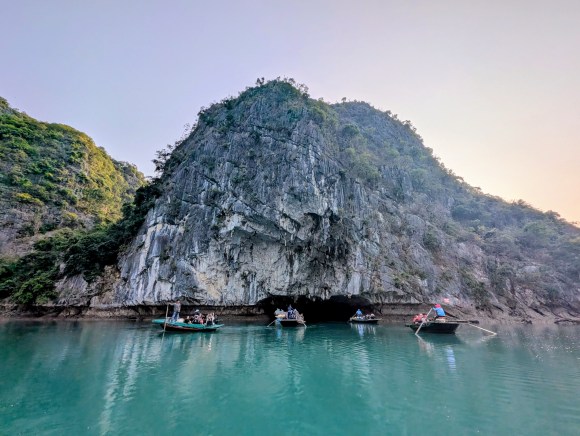
Seeing the sights in other countries is both a privilege and an enormous treat. What is just as exciting is meeting locals, and the random, sometimes fleeting, and yet meaningful encounters with fellow tourists. We may meet Jill and Ian again. We will never meet the French couple again and don’t even know their names. We just hope they made it to their hotel and then safely back to France. We probably won’t meet the young Australian family again either. The east coast is just too far away. Nonetheless, we have been enriched by the knowledge shared by our kind, enthusiastic and energetic Vietnamese tour guides, and the unexpected encounters with fellow tourists trying to navigate this unique culture together.
* Some names have been changed.
[1] A Singaporean company that caters all over Southeast Asia
.
Meredith Stephens is an applied linguist from South Australia. Her recent work has appeared in Syncopation Literary Journal, Continue the Voice, Micking Owl Roost blog, The Font – A Literary Journal for Language Teachers, and Mind, Brain & Education Think Tank. In 2024, her story Safari was chosen as the Editor’s Choice for the June edition of All Your Stories.
PLEASE NOTE: ARTICLES CAN ONLY BE REPRODUCED IN OTHER SITES WITH DUE ACKNOWLEDGEMENT TO BORDERLESS JOURNAL
Click here to access the Borderless anthology, Monalisa No Longer Smiles
Click here to access Monalisa No Longer Smiles on Amazon International
 Borderless