In conversation with Teresa Rehmanwith focus on her non-fiction, Bulletproof: A Journalist’s Notebook on Reporting Conflict and a brief introduction to her book. Click here to read.
Translations
Robihara(Sunless)by Kazi Nazrul Islam has been translated by Professor Fakrul Alam from Bengali. Clickhere to read.
Four of his ownMalay poems have been translated by Isa Kamari. Click here to read.
In a world torn by conflict, why would one mention hope or compassion? In an age of dystopian scenarios, why would we dream of utopias?
Perhaps it’s wishful musings, but at some level what people need to survive is probably something to look forward to — a speck of light — a wishful idea called hope. Hope builds resilience. Utopias are built on hope, on love and compassion. Dystopias are built on desperation and despair. They take fear or horror to the extreme and play on people’s vulnerabilities. They might induce a cathartic effect and one might say— we are better off as we are in the present or we must act so that this never happens. Is that something we can really say in a world where wars are disrupting peace and lives of all humanity, where violence against civilians is becoming an accepted norm, where shortages could also be a reality for most of us? Utopias, on the other hand, build on the element of an ideal, a dream towards which we can move on the bleakest day of our existence. They could be used to stir hope and envision a reality devoid of violence. And perhaps, some of it would congeal into a real-world scenario with smaller doses of the bad and ugly. In a conflict-ridden world, which almost feels like a reenactment of George Orwell’s 1984 (only about four and a half decades after his predicted date) what would touch your heart, give you a sense of relief— hope for a better future or dwelling on doomsday predictions? What would you want for your progeny?
Just before the pandemic changed our lives, a book was published where while questing for their own utopia, a group of young people became part of a dystopian reality. They were known as the ULFA rebels[1] and their story was told in Bulletproof:A Journalist’s Notebook on Reporting Conflict by Teresa Rehman. The current relevance of this book cannot be undermined because not only does it humanise the insurgents perspective, but it also shows how a centrist set up can neglect the needs of particular fringe communities. In addition, Rehman’s heartrending stories of poachers and people who live unaccepted in the margins only strengthen the need for an unboxed world where tolerance and compassion would transcend these artificially created fences that divide and lead to violence. This issue features Rehman’s book and an online discussion with her which stretches beyond the confines of pages.
We have more poetry in our translations, some sombre and some funny. A Bengali poem written as a tribute by Nazrul on the death of his older friend, Rabindranath Tagore, has been rendered into English by Professor Fakrul Alam. To add a lighter touch, we have translated a fun-filled poem by Tagore. Isa Kamari continues to translate his own Malay poems to bring in flavours of the culture. This time his poems seem to urge a need to transcend age-old stratifications. We also have a Balochi human-interest story by Younus Hussain brought to us in English by Fazal Baloch.
Hughes’ column too has fiction. His humorous and absurdist fables continue to urge re-evaluation of the world as well as genres. We also have a poignant narrative built around a Vietnamese migrant family by Mario Fenech. Sayan Sarkar shares a tale upending norms set in Kolkata while Naramsetti Umamaheswararao narrates a story about a young boy overcoming his fears. Abhik Ganguly gives us a strange fiction set in the future in a different galaxy, where Earth is seen as the original planet of human evolution.
C Christine Fair, who is an established translator, has surprised us — like Lyons — this time with a personal memoir which dwells on the deeply annihilating impact of norms that define gender roles. Upending the idea of an immutable ruler who can overpower us, is an essay by Ravi Varmman K Kanniappan with its roots in the ruins Rameses II — known as Ozymandias too — and Shelley’s poem of the same name.
We have had an overflow of writing about the unusual and redefining norms in our non-fiction section. Odbayar Dorj weaves an unusual narrative and shares photographs from a village of scarecrows in Japan that has a population of 27 humans and 370 scarecrows. She tells us: “In a place where people and scarecrows live side by side, I began to understand something simple but profound: sometimes, when human presence fades, we find our own ways to fill the silence with memories, imagination, and love.” Humanity never ceases to hope. Filling in silences are narratives by Arathi Devandran and Mubida Rohman on how they deal with the quietness left by departed loved ones.
We have more from Meredith Stephens with photographs by Alan Noble on their trip to Vietnam — as they travel to places that are less touristy while Gower Bhat explores the Sunday Book Bazaar at Old Delhi. Farouk Gulsara travels back to Penang where he spent his childhood and reflects on changes. Are they always for the best?
Suzanne Kamata takes up changes with a soupçon of humour as she writes of how the AI finally conceded to her husband, “Your wife is not wrong…” while Jun A. Alindogan writes of how social media can create mayhem if misused to spread fake news. Devraj Singh Kalsi resorts to sardonic humour of a darker hue as he explores ways to make a living.
Gulsara has also explored Sam Dalrymple’s Shattered Lands: Five Partitions and the Making of Modern Asiawhich starts with the extent of the British Empire with its western-most point at Aden and stretching in the east to Burma. There was a period from 1839 to 1867, when it stretched from Aden to Singapore[2], which was a part of Malaya, leaving out Siam or Thailand which never succumbed to colonial rule. The book starts at a later date — 1928 — and talks of the piecing of the British Empire, with questionable stances taken by historically heroic figures, thus urging a critical relook at our own past — just over the last hundred years.
Our reviews include Rakhi Dalal’s take on Maithreyi Karnoor’s rather unusual stories fromGooday Nagar.Bhaskar Parichhahas wandered back to non-fiction with the late Kaukub Talat Quder Sajjad Ali Meerza’s Wajid Ali Shah: A Cultural and Literary Legacy, translated from Urdu by Talat Fatima, a history that makes us reassess views on the last of the Awadhi nawabs. Somdatta Mandal has also shares a discussion on Sushila Takbhaure’s My Shackled Life, translated from Hindi by Deeba Zafir and Preeti Dewan, a narrative that showcases the resilience of the author.
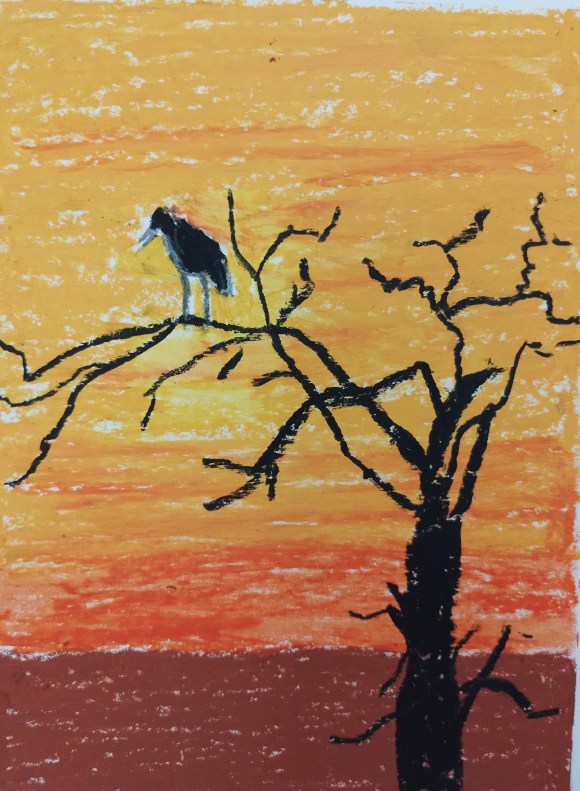
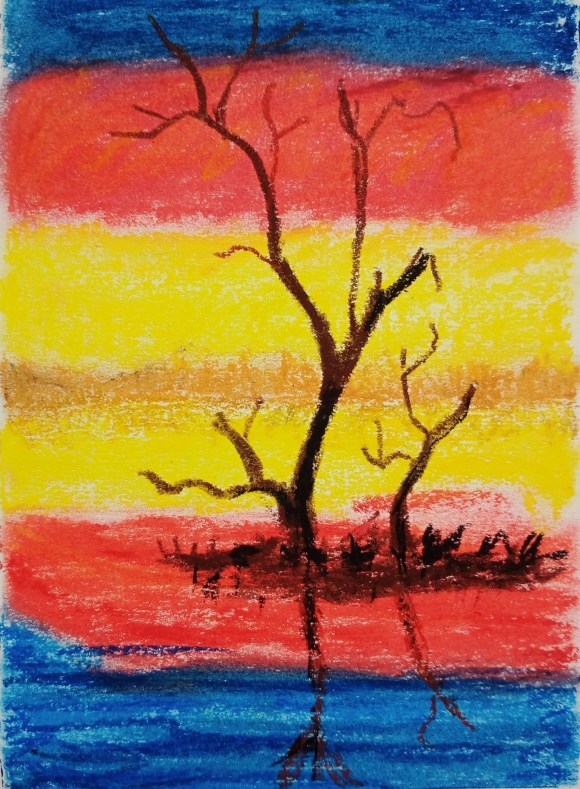
This issue could not have been put together without all our wonderful contributors. Heartfelt thanks for sharing your gems with us. Huge thanks to the Borderless team too who continue to support bringing in variety, colour and reinforcing our values. Much thanks to Sohana Manzoor for the fabulous cover art and to all those who share vibrant visuals with their writing. Many thanks to our readers too who make our efforts worthwhile. Do write in with your comments.
Look forward to greeting you all again next month!
Balochi Story by Younus Hussain; Translated by Fazal Baloch
Younus Hussain
The moment the story ended, I closed the book and tucked it beneath the pillow. It was one of the most fascinating stories I had ever encountered. Perhaps that is because the eyes of my mind are fixed on one place while yours are drawn to another. In the end, it is the eyes that measure the worth of what they behold. Just as my imagination began to shape the tale of those eyes, I felt as though the story, once finished, was beginning again from the very beginning. Soon, the tale seemed to whisper through the blazing winds that swept across the towering sand dunes of the Arabian desert. Most of the people in that hamlet belonged to the Al-Baj tribe, whose ancestors had migrated from Baghdad.
Among them was a young man renowned for the extraordinary power of his eyes. He could see far beyond the reach of ordinary sight, and even in the darkness of night, he saw as clearly as one does in broad daylight. The entire hamlet placed unwavering trust in his vision. More than once, he had warned the villagers of approaching storms and heavy rains before they arrived. The young man, barely twenty-years-old, was held in great esteem by the villagers, who respectfully called him Mullah. Yet despite their admiration, his faith remained humble and deeply devoted to God. While the rest of the village slept, he often stayed awake through the long nights.
Days and nights passed in this manner until, one day, as he lay in deep sleep, a dreadful plague swept through the hamlet.
“Mullah, wake up…”
“Mullah, while you sleep, calamity has fallen upon the village. Three people have suddenly gone mad. Even Abu Abbas has lost his mind!”
At the mention of Abu Abbas’s name, Mullah was stunned. He quickly slipped on his shoes and rushed outside. Abu Abbas lay upon his father’s cot, his eyes fixed lifelessly on the ceiling. Mullah stood frozen in shock as he gazed into those vacant, numbed eyes. A dark spirit had taken possession of him, and Mullah realised that he could hear the spirit’s voice.
Quietly, under his breath, Mullah began to recite prayers and sacred incantations. The spirit writhed in agony, and as it departed from Abu Abbas’s body, it spoke to Mullah: “I am leaving, but tomorrow evening this man will leave you all.”
Turning to the people around, Mullah said, “Only God knows His divine will, but by tomorrow evening, Abu Abbas will no longer be among us.”
His words proved true. By the following evening, the villagers were already digging Abu Abbas’s grave. The other two afflicted men also died within the very time Mullah had foretold.
Stories of Mullah’s extraordinary eyes spread far beyond the village. People from distant lands began bringing their insane relatives to him, hoping for healing and relief. With each passing day, the number of his followers and devotees continued to grow. Yet deep within, Mullah was troubled. Every few days, more people in the hamlet seemed to fall victim to evil spirits. Though he could foresee their fate and drive the spirits away, he felt powerless to stop the suffering itself. Each time one of his prophecies came true, he would spend the night in anguish and self-reproach, praying before God: “I am worthless. Among all these people, You granted this power to me, yet in doing so I have become an intruder upon Your divine will. Never once have You proven me wrong. You are greater and more powerful than these evil spirits. I am only Your sinful servant, while You alone are the Almighty. Protect our land from these evil forces.”
One day, there came a knock at his door.
“Is this the house of Saeed bin Hashim?”
Hearing his name, Mullah turned to his disciples and said, “This man seems to be in great haste. I will see him myself.”
Outside stood a man holding the reins of a camel.
“Sardar Aqrash of Al-Sawabi sends his greetings,” the man said. “He requests that you come at once. There is a patient in need of your help.”
Mullah asked, “Are their eyes fixed upon something?”
The man replied, “I do not know, for I have not seen them myself.”
The people of Al-Sawabi were of a different persuasion, yet Mullah, being a healer who understood the duty of his calling, agreed to go with them.
After traveling for half a day, they arrived at Aqrash’s settlement. Aqrash welcomed him warmly, then drew him aside and spoke in a low voice: “If the patient is possessed by an evil spirit, do not speak of it before others. Inform me privately. And if anyone asks, tell them nothing is wrong. I swear upon you by the holy prophets.”
The door to the room was locked from the outside. An elderly woman stepped forward, unlocked it, and silently withdrew into a corner. The moment Mullah entered, the heavy scent of burning incense and herbs told him that the patient had not yet received proper treatment. Upon the bed sat a young woman with disheveled hair falling across her face. Her head rested against the wall as she stared into silence, lost in distant thoughts. At once, Mullah understood that she was not yet possessed.
Something within him whispered, Your work here is done, you may leave now. Yet, he did not know what it was he found in the woman that had nailed his feet to the ground. Just as he turned to leave, a soft and melodious voice called out to him: “O man, come closer… Let me see those eyes of yours, the ones spoken of with such wonder.”
With his back turned to her, he stood deep in thought, struggling with his decision. Somewhere within, he sensed the coming of a storm. Then, in the stillness, he heard the soft chime of anklets halt just behind him.
“Saeed bin Hashim… is that your name?”
He turned.
Before him stood a vision of beauty and grace.
“Answer me,” she said softly. “Are you Saeed bin Hashim?”
“Yes,” he replied.
“Then tell me… what illness do I suffer from?”
“You suffer from none.”
“I swear to you, I am mad.”
She looked into his eyes as though searching for something hidden within them. Yet, she seemed to find nothing.
“You swear without reason,” he said quietly. “You are perfectly well.”
“If only you knew,” she whispered, “that I am mad for your eyes.”
“You have seen them now,” he replied. “Did they bring you any peace?”
“I count myself fortunate,” she said, “for only a few days ago, I wished to see them.”
Then, gently taking his hand, she said, “Sit with me. I wish to ask your eyes something.”
Her delicate touch sent a strange calm through his entire being. In that moment, forgetting his role and purpose, he found himself unwilling to leave her presence.
“My name is Rabia,” she said softly. “I am Sardar Aqrash’s third wife. He adores me because I am still young. Tell me… what do your much-praised eyes say about my beauty?”
He looked at her from head to toe, as though seeing her beneath an entirely new light. A quiet fear stirred within him, for he sensed that his eyes might reveal more than his words ever could. As his gaze lingered upon her, Rabia seemed unable to endure its intensity. She drew her knees close to her chest and lowered her eyes.
“My delicate body cannot bear the heat of your gaze,” she whispered. “Do not look at me in this way. It feels as though I am melting from within.”
Without replying, he turned to leave.
“You may go today,” she said behind him, “but I will send for you again. I have faith in my beauty. One day, you will wait for my messenger with longing.”
A faint smile crossed his lips as he opened the door.
Outside, every eye turned toward him. “The patient is perfectly well,” he announced. “There is no cause for concern.”
Standing apart from the others, Aqrash waited anxiously for the truth. Mullah quietly shook his head, and relief immediately spread across Aqrash’s face. He stepped forward, embraced Mullah, and thanked him repeatedly. Moments earlier, his lips had trembled with fear, but Mullah’s words arrived like a cool wind, drying the beads of sweat upon his forehead.
Mullah departed for his hamlet. Though he returned home, his thoughts remained at Rabia’s doorstep. Her enchanting presence lingered within him. Her delicate nose, her dark cascading hair, her graceful fingers, and her heavy, drowsy eyes haunted his mind so much that he found himself waiting for the arrival of Rabia’s messenger.
.
On one side, Mullah remained occupied with driving out evil spirits; on the other, he was consumed by a restless longing to see Rabia again. The spirits feared his gaze, for he alone could truly see them. Whenever they fled the village, they would glance back at him with hesitation, and Mullah knew they were disciples of the Devil destined to return again and again.
One day, Rabia’s messenger came for him. From that time onward, he visited her every week, and with each meeting their bond grew deeper. Then suddenly, an entire month passed without a single message from her. Mullah became deeply troubled. During the day, his eyes remained fixed upon the road leading to her village. At night, when he lay awake in longing, the people mistook his sleeplessness for devotion and worship. Then, one day, Aqrash himself arrived.
“I came personally because we have already troubled you more than once,” he said. “After you left, she recovered completely and lived happily with her family for more than a month. But last night, her condition worsened again. Even the old healer of our village spoke your name. If you would come once more, I would remain forever grateful to you.”
But Mullah needed no persuasion. For days, he had already been waiting anxiously for even the smallest word from Rabia. That night, Rabia adorned herself like a bride, as though she had just been led into the wedding chamber.
“You were right,” he whispered. “Without you, I am incomplete.”
“Did you wait for my messenger every day?”
“The road to your village bears witness,” he replied.
“And I waited for you each day as well,” she said softly. “Ask the mirror.”
They drew so close to one another that no distance remained between them.
“Do you love me?” she asked.
“Do you wish to test me?”
Rabia’s lips trembled faintly. The beads of sweat upon her cheeks only deepened the radiance of her beauty. In a quivering voice, she said:
“If I ask something of you, will you grant it?”
“Ask it. And if my tongue refuses, I shall cut it out and lay it before you.”
“I cannot bring myself to say it.”
“Swear upon my life and tell me.”
“I will ask for something without which you yourself will remain incomplete.”
“Only do not ask me to live apart from you,” he said. “Without you, I would be nothing.”
Rabia lowered her gaze before whispering:
“Can you give me your eyes?”
“My life is dearer to me than even my eyes,” he replied, “yet if you asked for my life as well, I would place it before you. As for these eyes, I have long since laid them upon the path of your messenger.”
“I feel,” she said softly, “as though my beauty is incomplete without your eyes.”
Mullah slowly raised his hands toward the sky, “O my Almighty God…”
Yet in that moment, a strange feeling overcame him. It seemed as though his tongue no longer wished to bow in humility before any power greater than itself. The moonlit beauty of Rabia’s face stirred something within him, and his tongue began to speak like that of a plaintiff before destiny.
“O my Lord! Whatever You will, comes to pass. Life and death rest in Your hands alone. Nothing can happen without Your permission. Even the longing that arose within my heart was placed there by You. It is said in Alborz that a single bowl of water is worth a hundred years of loyalty. I, too, have pledged my loyalty. Do not look upon me as of different faiths. Look instead upon our love. O my Creator, grant us honor. Let the tale of our bond become known throughout the world, so that lovers may one day swear oaths in our names. O God, fulfill her innocent wish. Do not let me be humiliated before my Rabia.”
Then he fell silent. Tears of defeat slipped from his eyes, and in the depths of his sorrow, he whispered: “O God… if You refuse me this, then I shall go to Egypt and seek out magicians to fulfill my beloved’s wish…”
He continued mumbling in broken desperation until, suddenly, he felt his vision begin to fade. Darkness slowly gathered before his eyes, and just before the last trace of light vanished, he saw Rabia overcome with joy.
The moment he saw his eyes upon Rabia’s flower-like face, he fell into prostration and wept.
Rabia’s laughter rang through the room. Delighted by the new world before her, she gazed at her fingers in wonder, then gathered her hair into her palms and admired it. She lifted the edge of her scarf before her eyes, marveling at the beauty of her clothes. Everything around her seemed transformed, as though creation itself had been born anew.
“Go,” Mullah said proudly, “look at yourself in the mirror. If you were amazed merely by these eyes, then any desire to reverse this decision would only dishonor our love.”
She stood before him and looked into the empty sockets that had once held the eyes now belonging to her.
“Tell me, my beloved,” he asked softly, “what do you see within your eyes?”
“From what I can understand,” she replied, “they are filled with fear.”
“Good,” he said quietly. “What else do you see?”
“I see that your heart is trembling.”
“And why do you think that is?”
“My heart… afraid?”
“Perhaps it is.”
“Perhaps,” she whispered, “it regrets the choice it has made.”
“My heart would never commit such disloyalty,” he replied.
“And if it did?”
“Then I would tear it from my chest and lay it at your feet this very moment. My poor heart rejoices only because your wish has been fulfilled. It is these eyes that are afraid… afraid that, in your delight with this new vision, you may forget them and cast them out from the world of beauty.”
“Tell them they are a gift from you, a token of your love. They should take pride in belonging to someone as brave as you.”
“I swear,” he replied, “fear shall never find a place within your eyes. But as for waiting… I can promise nothing. Do not make me suffer any longer.”
“I will send my messenger soon,” she said softly. “And if he delays, then curse both him and me.”
“This tongue prays only for your well-being,” he answered. “How could it ever curse you?”
“I am fortunate that you love me.”
“And now, let me go. I will return to you.”
“Do not leave me.”
“I must travel far away. My world… grant me permission.”
As he departed, he said: “My prayer is that your beauty, along with your eyes, becomes renowned throughout the world. May the praise of your eyes travel as far as China.”
He left. In a sorrowful voice, Rabia called after him: “Rest assured, the moment you reach home, my messenger will arrive.”
But days passed.
A few days later, people found Mullah wandering in delirium and brought him back home. His followers said he had neither eaten nor drunk anything for an entire month. Now he sat against a wall, his sightless face turned endlessly toward the threshold, waiting for the messenger who would bring word from Rabia.
The endless waiting had robbed him of sleep. His followers and the villagers grieved for him, believing that his eyes had fallen beneath some terrible curse. The evil spirits, meanwhile, rejoiced. Physicians were summoned from distant places, yet none could heal him. His suffering became a source of anguish for the entire village.
One day, someone said: “I have heard of an old woman whose eyes can see deep into the soul of the afflicted.”
Preparations were immediately made to bring her. When the old woman finally arrived, she looked upon Mullah and spoke in a trembling voice: “The Lord is greatest… but your Mullah has only one day left to live.”
Tears filled the eyes of everyone present. A few doubted her words, but Mullah himself became convinced that it was his own eyes that had dared to pronounce such a fate.
“May God protect them,” he thought.
Nearby, two men whispered quietly: “She speaks the truth.”
“She is an experienced woman. It is said she once deceived Sardar Aqrash’s wife and stole her eyes.”
At those words, Mullah became certain that the old woman’s prophecy could not be false. For one brief moment, he longed to see his own eyes again. Yet he feared looking into the prison where they now lived. And in the silence of his heart, he whispered: “Rabia, do not blame me. It is your own innocence and foolishness that allowed fear to enter your eyes.”
After the old woman departed, Mullah stretched out his legs and slowly forgot the threshold he had watched for so long. Gradually, his eyes began to close.
Far away, he could hear the soft voice of a shepherd singing a lonely raga while guiding his flock.
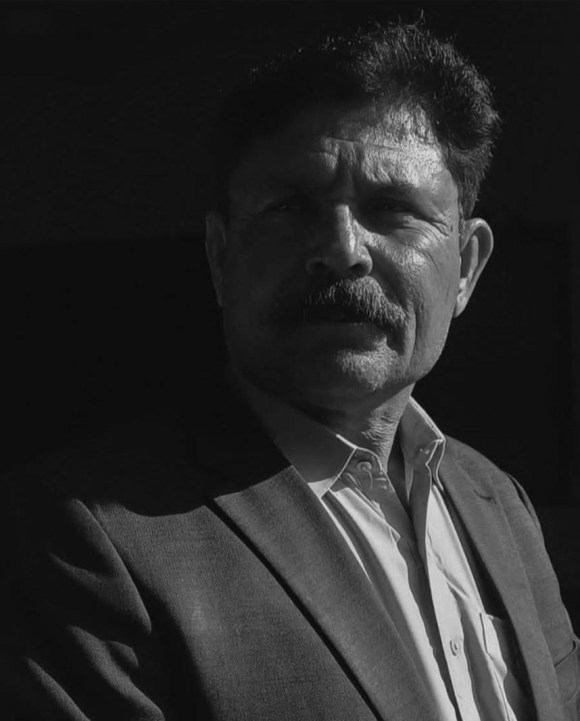
Younus Hussain is widely regarded as one of the foremost contemporary short story writers in Balochi language. He is known for enriching the landscape of Balochi fiction with compelling narratives and literary depth. His stories are often cited in most discussions of Balochi literature on account of their artistic merit and narrative power. A hallmark of Younus’ writing is his exploration of individuals grappling with the tension between cultural expectations and the personal inner conflict. Most of his stories capture these recurring themes with clarity and emotional resonance, offering a vivid portrait of the human condition shaped by tradition and transformation.The translated story is taken from his first anthology “Be Dasten Sareechk” (The Armless Scarecrow) published by Balochistan Academy Turbat in 2025. Fazal Baloch has the translation rights to this story.
Fazal Baloch is a Balochi writer and translator. He has translated many Balochi poems and short stories into English. His translations have been featured in Pakistani Literature published by Pakistan Academy of Letters and in the form of books and anthologies.
PLEASE NOTE: ARTICLES CAN ONLY BE REPRODUCED IN OTHER SITES WITH DUE ACKNOWLEDGEMENT TO BORDERLESS JOURNAL
 Borderless