A Tamil story by S Ramakrishnan, translated by B.Chandramouli
From Public Domain
That town had fewer than a hundred homes. Children playing in the street looked at them curiously when they alighted from the car. Kandasamy called one boy and asked him where Venangulam was. That boy asked him mockingly, “Do you want to do a penance in the Venangulam pond?” and pointed him towards the south.
His wife, their only daughter, and the astrologer who had brought them to perform the penance got out of the car. The astrologer tightened his loose dhoti and said, “This is a powerful pond, Sir; all your ‘dosha[1]’s would wash away.”
Kandasamy nodded and started walking towards the south.
Kandasamy had been suffering for over ten years with a skin disease; he had suffered an unexpected loss in his business. There were problems in his daughter’s in-laws home as well. As if these were not enough, he lost an old lawsuit he had been fighting in court. He felt as though the snake in the Snakes and Ladders game had brought him down. He visited many temples, performed pujas[2] and penances; nothing had worked. Only then did an astrologer tell him about Venangulam and the story of the king of Venangulam himself, who had dipped in that pond to get rid of his doshas. Kandasamy felt a sense of hope and agreed to visit Venangulam.
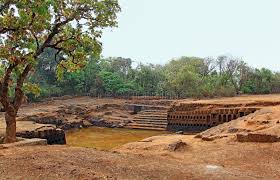
It was a small village with red tile roofs and somewhat broad streets. However, the people had nearly deserted it; some houses were locked up. When they went to Venangulam, they found it to be dry; the steps were dusty. There were four idols on the four sides of the pond.
Doubtful if that was Venangulam, he asked a person splitting logs nearby, “Is this the pond for penance?” That person nodded yes and continued his work.
Kandasamy stood on the dried-up pond’s steps and waited for his wife and daughter.
He wondered if they had come there not knowing that the pond had dried up; he felt angry thinking, “Didn’t the astrologer inquire about this even?”
The astrologer, Kandasamy’s wife and daughter, came near Venangulam.
The pond was full of torn clothes, dried leaves, and plastic waste. Kandasamy said to the astrologer, “There’s no water in this pond.”
The astrologer said,” It had been dry for several years. You get down, imagine that there is water, and sprinkle water on your head.”
“How can I bathe without water?” asked Kandasamy angrily.
“Can you see the sins you have committed with your eyes? But doesn’t the mind feel them? Similar to that, this pond contains invisible water; if you feel that and have a bath, your sins will wash away. Belief is everything, isn’t it?”
Kandasamy descended the steps of the dry pond. Though the pond appeared to have only ten or twenty steps, as he descended, the steps seemed to keep going down forever. Kandasamy kept on descending the steps alone. He did not know how long he had been descending, but when he looked up, it appeared as though he had descended into an abyss. He had not yet reached the bottom of the pond. The steps still kept descending.
He got confused, thinking, “What kind of magic is this? How did this small pond become so huge?” Various thoughts crowded his mind. He thought of how he had deceived his elder brother when they ran a joint business, and how he had cheated money entrusted to him. All these past sins returned as memories.
How can a person who deceived his own brother not fail in life? Suddenly, his elder brother’s face flashed in his mind. In that minute, the thought that until then, he had been pretending as though he had committed no mistakes bothered him. Kandasamy felt that one’s mistakes become weightless when hidden, but once you start realising them, they feel heavy.
Kandasamy realised he was descending the steps of his conscience.
He felt that to relieve himself of his sin, he must return the money he had cheated from his elder brother to his brother’s family. No sooner had this thought occurred to him than he felt a sudden wetness on his feet. The step beneath him seemed to be underwater. He pretended to bend down and sprinkle the water from the pond onto his head.
When his wife asked him loudly, “What are you thinking, standing on the steps?” he came to his senses.
Thinking, “Have I not gone to the depth of the pond? Was it all in my imagination?” He looked closely at the pond. He saw only dried steps and a pond without water.
He realised that the pond awakened the conscience and made you understand the crimes you have committed. It was indeed a magical pond.
He pretended as though he had had a bath and came out of the pond.
The astrologer said, “Think of something in your mind and throw coins into the pond.”
He took coins from his pocket and threw them into the pond, thinking that he would pay back the amount due to the family of his elder brother.
The idols’ eyes in the pond seemed to smile at him mockingly.
S. Ramakrishnan is a writer from Tamil Nadu, India. He is a full-time writer who has been active over the last 27 years in diverse areas of Tamil literature like short stories, novels, plays, children’s literature and translations. He has written and published 9 novels, 20 collections of short stories, 3 plays, 21 books for children, 3 books of translation, 24 collections of articles, 10 books on world cinema, 16 books on world literature including seven of his lectures, 3 books on Indian history, 3 on painting and 4 edited volumes including a Reader on his own works. He also has 2 collections of interviews to his credit. He was awarded the Sahitya Akademi Award in 2018 in the Tamil language category for his novel Sanjaaram.
Dr.B. Chandramouli is a retired Physician. He has published several translations. He has translted Jack Londen’s novel, White Fang and Somerset Maugham’s Razor’s edge (2024) to English and various English translations of Tamil fiction and non-fiction.
PLEASE NOTE: ARTICLES CAN ONLY BE REPRODUCED IN OTHER SITES WITH DUE ACKNOWLEDGEMENT TO BORDERLESS JOURNAL
Tumi Kon Kanoner Phulby Tagore andAnjali Loho Morby Nazrul, love songs by the two greats, have been translated from Bengali by Professor Fakrul Alam. Click hereto read.
One Life, One Love, 300 Children : Keith Lyons writes of Tendol Gyalzur, a COVID 19 victim, a refugee and an orphan who found new lives for many other orphans with love and an ability to connect. Click here to read.
When West Meets East & Greatness Blooms: Debraj Mookerjee reflects on how syncretism impacts greats like Tagore,Tolstoy, Emerson, Martin Luther King Jr, Gandhi and many more. Click here to read.
Dilip Kumar: Kohinoor-e-Hind: In a tribute to Bollywood legend Dileep Kumar, Ratnottama Sengupta, one of India’s most iconic arts journalists, recollects the days the great actor sprinted about on the sets of Bombay’s studios …spiced up with fragments from the autobiography of Sengupta’s father, Nabendu Ghosh. Click here to read.
Are Some of Us More Human than Others ?: Meenakshi Malhotra ponders at the exclusivity that reinforces divisions, margins and borders that continue to plague humankind, against the backdrop of the Women’s Month, March. Click here to read.
Reminiscences from a Gallery: MF Husain: Dolly Narang recounts how she started a gallery more than four decades ago and talks of her encounter with world renowned artist, MF Husain. Click hereto read.
Baraf Pora (Snowfall) by Rabindranath Tagore,gives a glimpse of his first experience of snowfall in Brighton and published in the Tagore family journal, Balak (Children), has been translated from Bengali by Somdatta Mandal. Clickhere to read.
Cherry Blossom Forecast: Suzanne Kamata brings the Japanese ritual of cherry blossom viewing to our pages with her camera and words. Clickhere to read.
Two Pizza Fantasies, Rhys Hughes recounts myths around the pizza in prose, fiction and poetry, Click here to read.
An Alien on the Altar!: Snigdha Agrawal writes of how a dog and lizard add zest to festivities with a dollop of humour. Click here to read.
Where it all Began: Sybil Pretious recounts her first adventure, an ascent on Mt Kilimanjaro at the age of sixty. Clickhere to read.
Conversations
Rabindranath Tagore: A Universal Bard.: This conversation between Aruna Chakravarti and Sunil Gangopadhyay that took place at a Tagore Conference organised by the Sahitya Akademi in Kochy in 2011. Click here to read.
Sriniketan: Tagore’s “Life Work”: In Conversation with Professor Uma Das Gupta, Tagore scholar, author of A History of Sriniketan, where can be glimpsed what Tagore considered his ‘life’s work’ as an NGO smoothening divides between villagers and the educated. Click here to read. (Review & Interview).
In conversation with the late Akbar Barakzai, a Balochi poet in exile who rejected an award from Pakistan Academy of Letters for his principles. Click here to read.
Jim Goodman, an American traveler, author, ethnologist and photographer who has spent the last half-century in Asia, converses with Keith Lyons. Click here to read.
InBridge over Troubled Waters, the late Sanjay Kumar tells us about Pandies, an activist theatre group founded by him that educates, bridging gaps between the divides of university educated and the less fortunate who people slums or terror zones. Click here to read.
In Lessons Old and New from a Stray Japanese Cat, Keith Lyons talks with the author of The Cat with Three Passports, CJ Fentiman who likes the anonymity loaned by resettling in new places & enjoys creating a space for herself away from her birthplace. Click hereto read.
Fiction
Aparichitaby Tagore: This short story has been translated as The Stranger by Aruna Chakravarti. Click hereto read.
Hena by Nazrul has been translated from Bengali by Sohana Manzoor. Click here to read.
Playlets byRabindranath Tagore: Two skits that reveal the lighter side of the poet. They have been translated from Bengali by Somdatta Mandal. Click here to read.
Abhagi’s Heaven, a poignant story by Saratchandra Chattopadhyay translated by Aruna Chakravarti. Click here to read.
An Eternal Void, a Balochi story by Munir Ahmed Badini translated by Fazal Baloch. Click hereto read.
The Witch, a short story by renowned Bengali writer Tarasankar Bandopadhyay (1898 to 1971), translated by Aruna Chakravarti. Clickhere to read.
I Grew into a Flute: Balochi Folktale involving magic retold by Fazal Baloch. Click here to read.
Give Me A Rag, Please:A short story by Nabendu Ghosh, translated by Ratnottama Sengupta, set in the 1943 Bengal Famine, which reflects on man’s basic needs. Click here to read
Rakhamaninov’s Sonata: A short story by Sherzod Artikov, translated from Uzbeki by Nigora Mukhammad. Click hereto read.
The Magic Staff , a poignant short story about a Rohingya child by Shaheen Akhtar, translated from Bengali by Arifa Ghani Rahman. Click here to read.
Khaira, the Blind, a story by Nadir Ali, has been translated from Punjabi by Amna Ali. Click here to read.
The Browless Dolls by S.Ramakrishnan, has been translated from Tamil by B Chandramouli. Click hereto read.
No Man’s Land: Sohana Manzoor gives us surrealistic story reflecting on after-life. Click hereto read.
The Protests Outside: Steve Ogah talks of trauma faced by riot victims in Nigeria. Click here to read.
Flash Fiction: Turret: Niles M Reddick relates a haunting tale of ghosts and more. Click here to read.
Henrik’s Journey: Farah Ghuznavi follows a conglomerate of people on board a flight to address issues ranging from Rohingyas to race bias. Click hereto read.
Does this Make Me a Psychic?; Erwin Coombs tells a suspenseful, funny, poignant and sad story, based on his real life experiences. Click here to read.
Phôs and Ombra: Paul Mirabile weaves a dark tale about two people lost in a void. Click here to read.
A Queen is Crowned: Farhanaz Rabbani traces the awakening of self worth. Click here to read.
It’s again that time of the year when we have fun spooking each other with stories of ghosts and haunting. While festivals of light1 and darkness vie with each other for a spot on the same date, observances to pay our respects to our forefathers follow at their heels, some before and some after.
In this selection, we bring to you narratives that could be dark, strange or funny or all of these … a selection of poetry, fiction and non-fiction from around the world. Enjoy the reads!
The Ghosts of Hogshead: Paul Mirabile wanders into the realm of the supernatural dating back to the Potato Famine of Ireland in the 1800s. Clickhere to read.
Nagmati: Prafulla Roy’s long story based on strange folk beliefs has been translated from Bengali as Snake Maiden by Aruna Chakravarti. Click here to read.
From Public Domain
.
Deepavali or festival of lights is on October 31st this year along with Kali Puja and Halloween. October 30th is Bhooth Chaturdashi, or Indian Festival of Ghosts while All Saints’ Day and all Souls’ Day are observed at the start of November. Early October hosted Pitri Paksha, observances for apeasing forefathers in India. ↩︎
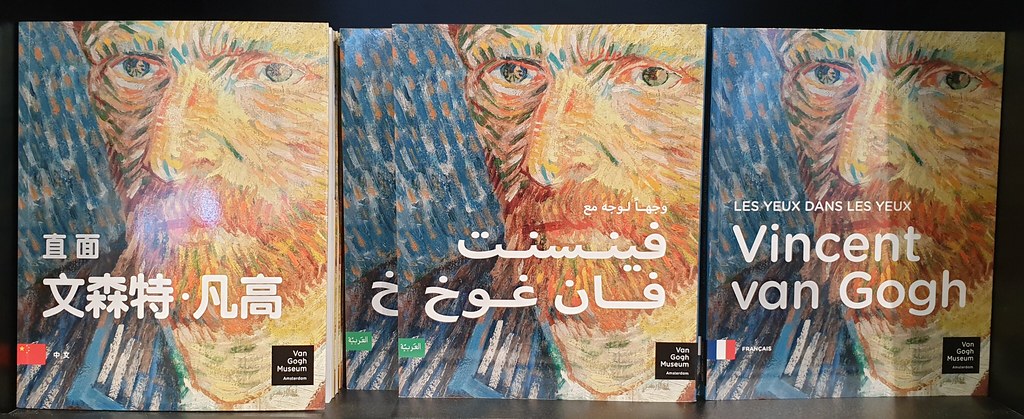
Vincent Van Gogh written is different scripts. Courtesy:Creative Commons
The whole world opens up in the realm of ideas that have existed wafting and bridging across time and space. Sometimes they find conduits to come to the fore, even though they find expression in different languages, under varied cultural milieus. One way of connecting these ideas is to translate them into a single language. And that is what many have started to do. Celebrating writers and translators who have connected us with these ideas across boundaries of time and place, we bring to you translated writings in English from twenty eight languages on the International Translation Day, from some of the most iconic thinkers as well as from contemporary voices.
Prose
Tagore’s short story, Aparichita, has been translated from Bengali as The Stranger by Aruna Chakravarti. Click hereto read.
Nadir Ali’s The Kabbadi Player has been translated from Punjabi by Amna Ali. Click here to read.
Kamaleswar Barua’s Uehara by has been translated from Assamese and introduced by Bikash K. Bhattacharya. Click here to read.
S Ramakrishnan’s Muhammad Ali’s Singnature has been S. Ramakrishnan, translated from Tamil by Dr B. Chandramouli. Click here to read.
PF Mathews’Mercy, has been translated from Malayalam by Ram Anantharaman. Click here to read.
Road to Nowhere, an unusual story about a man who heads for suicide, translated from Odiya by the author, Satya Misra. Click here to read.
An excerpt from A Handful of Sesame by Shrinivas Vaidya, translated from Kannada by Maithreyi Karnoor. Click hereto read.
Writings from Pandies’ Cornerhighlight the ongoing struggle against debilitating rigid boundaries drawn by societal norms. Each piece is written in Hindustani and then translated by a volunteer from Pandies’ in English. Clickhere to read.
Rakhamaninov’s Sonata, a short story by Sherzod Artikov, translated from Uzbeki by Nigora Mukhammad. Click hereto read.
Of Days and Seasons, a parable by the eminent Dutch writer, Louis Couperus (1863-1923), translated by Chaitali Sengupta. Click here to read.
The Faithful Wife, a folktale translated from Balochi by Fazal Baloch. Click hereto read.
An excerpt from Ramy Al-Asheq’sEver Since I Did Not Die, translated from Arabic by Isis Nusair, edited by Levi Thompson. The author was born in a refugee camp. Click here to read.
Poetry
Two songs byTagore written originally in Brajabuli, a literary language developed essentially for poetry in the sixteenth century, has been translated by Radha Chakravarty. Click here to read.
Rebel or ‘Bidrohi’, Nazrul’s signature poem, ‘Bidrohi‘, translated from Bengali by Professor Fakrul Alam. Click here to read.
Banlata Sen, Jibananada Das’s iconic poem, translated from Bengali by Professor Fakrul Alam. Click here to read.
Shadows, a poem in Korean, has been translated by the poet himself, Ihlwha Choi. Click hereto read.
Pranor Lifeby Tagore has been translated from Bengali by Mitali Chakravarty. Click hereto read.
Conversations
Shantanu Ray Chaudhuri converses withVinta Nanda about the Shout, a documentary by Vinta Nanda that documents the position of women in Indian society against the backdrop of the #MeToo movement and centuries of oppression and injustice. Click here to read.
Perhaps, most sceptics will say it is against human nature to stop fighting and fanning differences. The first recorded war was fought more than 13,000 years ago in what is now a desert but was green long ago. Nature changed its face. Continents altered over time. And now again, we are faced with strange shifts in climate that could redefine not just the dimensions of the surface area available to humankind but also our very physical existence. Can we absorb these changes as a species when we cannot change our nature to self-destruct for concepts that with a little redefining could move towards a world without wars leading to famines, starvation, destruction of beautiful edifices of nature and those built by humankind? That we could feed all of humans — a theory that won economist Abhijit Banerjee his Nobel Prize in 2019 so coveted by all humanity — almost seems to have taken a backseat. This confuses — as lemmings self-destruct…do humans too? I would have thought that all humanity would have moved towards resolving hunger and facing the climate crises post-2019 and post-pandemic, instead of killing each other for retaining constructs created by powerbrokers.
In the timeless lyrics of ‘Imagine’, John Lennon found peace by suggesting we do away with manmade constructs which breed war, anger and divisions and share the world as one. Wilfred Owen and many writers involved in the World Wars wrote to showcase the desolation and the heartfelt darkness that is brought on by such acts. Nazrul also created a story based on his experience in the First World War, ‘Hena’, translated for us by Sohana Manzoor. Showcasing the downside of another kind of conflict, a struggle to survive, is a story with a distinctive and yet light touch from S Ramakrishnan translated from Tamil by B Chandramouli. And yet in a conflict-ridden world, humans still yearn to survive, as is evident from Tagore’s poem Pran or ‘Life’. Reflecting it is the conditioning that we go through from our birth that makes us act as we do are translations by Professor Fakrul Alam of Masud Khan’s poetry and from Korean by Ihlwha Choi.
A figure who questioned his own conditioning and founded a new path towards survival; propounded living by need, and not greed; renounced violence and founded a creed that has survived more than 2500 years, is the man who rose to be the Buddha. Born as Prince Siddhartha, he redefined the norms with messages of love and peace. Reiterating the story of this legendary human is debutante author, Advait Kottary with his compelling Siddhartha:The Boy Who Became the Buddha, a book that has been featured in our excerpts too. In an interview, Kottary tells us more of what went into the making of the book which perhaps is the best survivor’s guide for humanity — not that we need to all become Buddhas but more that we need to relook at our own beliefs, choices and ways of life.
Another thinker-cum-film maker interviewed in this edition is Vinta Nanda for her film Shout, which highlights and seeks resolutions for another kind of crisis faced by one half of the world population today. She has been interviewed and her documentary reviewed by Shantanu Ray Chaudhuri. Chaudhuri has also given us an essay on a bookshop called Kunzum which continues to expand and go against the belief we have of shrinking hardcopy markets.
Gastronomical adventures seem to be another concurrent theme in this edition. Rhys Hughes has written of the Indian sweets with gulab jamun as the ultimate life saver from Yetis while trekking in the Himalayas! A musing on lemon pickle by Raka Banerjee and Ravi Shankar’s quest for the ultimate dosaaround the world — from India, to Malaysia, to Aruba, Nepal and more… tickle our palate and make us wonder at the role of food in our lives as does the story about biryani battles by Anagaha Narasimha.
Talk of war, perhaps, conjures up gastronomic dreams as often scarcity of food and resources, even potable water and electricity is a reality of war or conflict. Michael Burch brings to us poignant poetry about war as Ramesh Karthik Nayak has a poem on a weapon used in wars. Ryan Quinn Flanagan has brought another kind of ongoing conflict to our focus with his poetry centring on the National Day (May 5th) in Canada for Vigils for Missing and Murdered Indigenous Women by hanging red clothes from trees, an issue that perhaps has echoes of Vinta Nanda’s Shout and Suzanne Kamata’s poetry for her friend who went missing decades ago as opposed to Rachel Jayen’s defiant poetry where she asserts her womanhood. Ron Pickett, George Freek and Sayantan Sur have given us introspective perspectives in verse. We have more poetry asking for a relook at societal norms with tongue-in -cheek humour by Jason Ryberg and of course, Rhys Hughes with his heartfelt poem on raiders in deserts.
The piece that really brought a smile to the lips this time was Farouk Gulsara’s ‘Humbled by a Pig’, a humorous recount of man’s struggles with nature after he has disrupted it. Keith Lyons has taken a look at the concept of bucket lists, another strange construct, in a light vein. Devraj Singh Kalsi has given a poignant and empathetic piece about trees with a self-reflective and ironic twist. We have narratives from around the world with Suzanne Kamata taking us to Osaka Comic Convention, Meredith Stephens to Sierra Nevada and Shivani Shrivastav to Ladakh. Paul Mirabile has travelled to the subterranean world with his fiction, in the footsteps perhaps of Jules Verne but not quite.
We are grateful to all our wonderful contributors some of whom have not been mentioned here but their works were selected because they truly enriched our June edition. Do visit our contents page to meet and greet all our wonderful authors. I would like to thank the team at Borderless without whose efforts and encouragement our journal would not exist and Sohana Manzoor especially for her fantastic artwork as well. Thank you all.
Wish you another lovely month of interesting reads!
By S. Ramakrishnan, translated from Tamil by Dr B. Chandramouli
The man was around 30. He had sleepless eyes, unkempt hair, and pale lips. He had on a grey half sleeve shirt and blue pants which did not match. Wearing rubber slippers with frayed edges, he was carrying a cloth bag, which he guarded closely on his lap, as if it contained a rare object. Because persons like him were a common sight at the taluka[1] office, no one paid him any attention. He had the hesitant look of someone about to request a loan. He was sitting in a slanted position leaning on his right leg.
The taluka office assumes a relaxed atmosphere during lunchtime. Losing its stiffness, it becomes more like a public library. Workers smile; you can talk to them easily. Maybe he was waiting for that stretch of time. They had built this new office with three floors on a side street near the end of the overhead bridge. When you think of a taluka office, you get the picture of a dusty neem tree, dirty steps and semi-dark rooms; this building was not like that. But there was a jeep blocking the entrance and abandoned bikes that reminded of the old office.
Most government offices did not have lifts; even if they did, they did not work. This office also had only a big staircase. While climbing the stairs, you could see a big government poster pasted on the opposite wall. The office had big windows, like in wedding halls. One worker who did not like too much light had opened only half of the window near his seat. During lunchtime, there was big traffic of vendors: Bagyathammal who sells hot murukku in a silver bucket; Muthu, who sells sweets and snacks; Kasim, who sells towels and lungis, and Kalaivani, who sells nighties and cotton sarees. The workers at the office were their favourite customers.
They continued to visit, even though the office had moved. Especially, Kesavan who sells the hot coconut sweet ‘boli’, had a free run of this office; he would enter regardless of who was there. He will place two bolis wrapped in newspaper on the Tahsildar’s table.
Bagyathammal could climb the stairs slowly only because she was overweight and also had a corn on her foot. They would know of her arrival just by the noise the silver bucket made on the steps. Many workers would be satiated only after munching on her murukku after lunch. They had a water cooler for cold water, which the old office did not have. Kasim would always fill his green bottle with the cold water. He would relish drinking that cold water with a unique expression of bliss on his face. Except for the boy from the tea stall opposite, and Subbiah from the xerox store, most people who came to the office were there to get certificates for caste, income, residency or land ownership. You could easily identify them by their looks. Being nervous, they would drop and scatter their certificates; some could not even answer the questions. Though all the wooden tables were similar, only the table where the officer received the petitions would appear huge to them. Even the leaders in the pictures hung on the wall were unsmiling.
After lunch, many of the workers would not return to their tables immediately. Some would go downstairs to smoke. Raghavan, who was going downstairs, noticed the man sitting aslant.
“What do you want?” he asked while passing.
When the man hesitantly said, “You see.., I.. well,…”
Raghavan told him, “Go inside and ask.”
Some workers had returned after the lunch break. Jayanthi was keeping her washed tiffin box near the window. The man stood in front of Sabapathy’s table and called out — “Sir…”
.
Sabapathy was searching for a pin to use as a toothpick. Thinking that the man was selling some snacks, he asked, “What did you bring?”
The man produced an old photograph from his bag and said. “Muhammad Ali’s photo.”
Startled and uncomprehending, Sabapathy asked, “What is that?”
“Muhammad Ali Sir, the world famous boxer. My father is the one standing nearby; see here, it has Muhammad Ali’s signature at the bottom.”
“OK, but why are you showing it to me?” asked Sabapathy, not understanding.
“They took it when Muhammad Ali came to Madras.”
“That is all fine. Are you here to give some petition?”
“I came to sell Muhammad Ali’s signature, Sir,” he said hesitantly.
Sabapathy did not understand what he said.
“Selling a signature?… But what can I do with it?” asked sarcastically.
The man hung his head and said, “It is a very valuable signature, Sir. I have money problems at home; that is why I came to sell.”
Sabapathy smiled sarcastically, as if he has found the right person to pass the time with and said, “I know nothing about boxing. See Sekhar in the corner seat? Show it to him.”
Sekhar was the one who can get a loan for anybody in the office. Nobody knew where he got the money from. But he would get a commission of Rs50 for every Rs1000.He had loaned many of his colleagues money during contingencies. He would strictly collect his share on payday.
The man went to Sekhar and showed him the old photograph.
Sekhar looked up at it and asked thoughtfully, “Do you want a death certificate?”
“No, Sir; this is Muhammad Ali.”
“Muhammad Ali means?” Sekhar asked, confused.
“Famous boxing champion; he came to Madras in 1980. He boxed with Jimmy Ellis in front of MGR. My dad was a big boxer in those days; he lost one eye in boxing, but could still fight very well. Muhammad Ali himself had congratulated him. They took this photo when Muhammad Ali was staying in Connemara hotel. There was a huge crowd to see him. My dad was waiting to get his signature on this photo. Muhammad Ali himself took him to his room and signed it for him. My father was thrilled.” he was narrating it like a story.
“Just tell me what you want now,” said Sekhar.
“Please buy this signature. All I want is Rs 500.”
Sekhar did not expect this.
“What am I going to do with this — clean my tongue?” Sekhar asked angrily.
“Do not say that Sir. Muhammad Ali’s signature has value.”
“Let us see how many people in this office know who Muhammad Ali is.” As if taking up a great challenge, Sekhar grabbed the photo from the man and gathered all the office staff in front of him.
Sekhar said in a mocking tone,
“If anyone can correctly identify the man in this photo, I will give the person Rs100.”
One lady asked, “An actor?”
“There is a tailor in my street who looks just like him; his ears are exactly like his,” said Jayanthi.
“Isn’t he the football champion?” asked Mani.
Rangachari was the one who correctly said.
“That is Muhammad Ali, World heavyweight boxing champion. He was born Cassius Clay; he later changed his name to Muhammad Ali.”
“Correct Sir; and it is his signature. At least you can buy this.”
“I do not even have enough time to box with my wife; what am I going to do this? If it was a foreign stamp, at least I could give it to my daughter,” said Rangachari in a mocking voice.
“Do not say that, Sir. I can cut off my father’s picture. Please give me Rs 500,” the man pleaded.
“Five hundred rupees is too much for a signature,” said Rangachari.
“You people demand like that too,” he thought. But he swallowed the thought and said, “If my dad were alive, he would not sell this.”
“It is alright if you want to sell, but where did you come to the taluka office?” asked Rangachari mockingly.
“You are all educated people. I thought you would know the value of this.”
“Forget the signature; you see, even if Muhammad Ali himself comes here, there is no value.” Rangachari laughed automatically, as if he has cracked a joke.
Meanwhile, hearing some footsteps on the stair, peon Munusamy announced that the Tahsildar[2] has arrived.
The safari suit clad Tahsildar Rathinasamy must have noticed the man as he went to his room. He rang the bell as soon as he sat down.
Peon Munusamy hurried into the room.
“Who is that guy standing outside? Is he selling perfume? I told you not to let people like that.”
Munusamy said, “He is not selling perfume, Sir; he came to sell some photo.”
“Ask him to come in,” the Tahsildar said angrily.
The peon told the man who was standing helplessly that the Tahsildar wanted to see him.
The man entered the room slowly.
The Tahsildar asked him with a stern face, “What is this, a marketplace where anyone can walk in and sell stuff? Who are you and why did you come here?”
The man was scared at his anger and hesitantly said, “Muhammad Ali’s signature…photo”
“Ask S1 to come in,” said the Tahsildar angrily.
Sabapathy came.
“Is this a government office or an exhibition? How did you let this man in?”
“We thought he came to give some petition. But he is spinning a yarn about a photograph.”
The Tahsildar said loudly “We should not leave it like this; you call the police. If we grab someone like this, the next one will be afraid to come.”
The man said with a troubled face, “Sorry, sir. I will leave,” he turned to walk out.
“What do you have in your hand? Show it to me.” the Tahsildar asked with the same anger.
The man showed him the photo with Muhammad Ali and his father.
“Did you come to get a donation?”
“No Sir; I came to sell Muhammad Ali’s signature,” he said in a weak voice.
“Don’t you have some other place for that?” the Tahsildar threw the photograph on the table carelessly.
“It is alright sir; just give me the photo; I will leave”
By this time, Rangachari had entered the room and described about Muhammad Ali in fluent English; the Tahsildar listened, only half understanding.
“Who will buy this?”
“There are collectors for this. You can get for 5000, or 10,000 rupees for that.”
“Is that right?”
“Severe money problems at home; that is why I came to sell.” the man repeated.
“What am I going to do if I buy this? I do not even have a place to hang my picture at my home.” the Tahsildar expressed his sense of humour with that statement.
At his juncture, Sekhar came to the office and said, “It is a new type of fraud, Sir. They print a picture off the internet and try to sell it.”
“No Sir. This is my father.”
“Do you have any certificate to prove it?” asked Sekhar.
“Why should I deceive you, Sir,” the man asked pitifully.
“Sekhar is correct. Nowadays, it is difficult to trust anyone; we should be cautious,” said Rangachari.
“Get rid of him and post a notice saying no outside persons are allowed here.” said Tahsildar.
The man took the photograph from the table and placed it in his bag, and walked downstairs.
An old man waiting to submit some petition asked him if the Tahsildar has arrived. He answered yes and left.
It was after three. He felt like fainting because of extreme hunger. The street was hot in the scorching sun. There was no breeze. He walked towards the bus stand to catch a bus to his suburban home.
Suddenly the bag in his hand felt heavy. It sounded as though someone was laughing.
Was that Muhammad Ali laughing?
It was as if his arm was being dragged down by the heavy bag.
He took out the photo and looked at it. His father’s face standing near Muhammad Ali had a unique smile.
He was wondering what he is going to do by taking the photo back to his home.
There was a tar drum standing under the tamarind tree; it was leaking tar. He took out the photo and stuck it on the tar. Muhammad Ali was looking at the street baking in the scorching sun from the photograph stuck to the tar tin.
As if to express his anger, he shrugged off his slippers and started walking barefoot at a fast pace.
The road stretched like the tongue of a strange beast.
S. Ramakrishnanis an eminent Tamil writer who has won the Sahitya Akademi Award in the Tamil Language category in 2018. He has published 10 novels, 20 collections of short stories, 75 collections of essays, 15 books for children, 3 books of translation and 9 plays. He also has a collection of interviews to his credit. His short stories are noted for their modern story-telling style in Tamil and have been translated and published in English, Malayalam, Hindi, Bengali, Telugu, Kannada and French.
Dr.Chandramouli is a retired physician.. He is fluent in English and Tamil. He has done several English to Tamil, and Tamil to English. He has published some of them.
.
PLEASE NOTE: ARTICLES CAN ONLY BE REPRODUCED IN OTHER SITES WITH DUE ACKNOWLEDGEMENT TO BORDERLESS JOURNAL
Anthony Sattin, an award winning journalist and travel writer in conversation about Nomads: The Wanderers Who Shaped our World, his recent book published by Hachette, India. Click hereto read.
VR Devika talks of the dynamic Muthulakshmi Reddy, the first woman in the world to preside over a Legislative Assembly who sought justice for Devadsis and prostitutes and discusses her book, Muthulakshmi Reddy: A Trailblazer in Surgery and Women’s Rights published by Niyogi Books. Click hereto read.
Translations
Daridro or Poverty by Nazrul has been translated from Bengali by Professor Fakrul Alam. Click here to read.
The Browless Dolls by S.Ramakrishnan, has been translated from Tamil by B Chandramouli. Click hereto read.
Two poems from Italy by Rosy Gallace have been translated from Italian by Irma Kurti. Click hereto read.
Aalo Amar Aalo (Light, My Light) a song by Tagore, has been translated by Mitali Chakravarty from Bengali. Click hereto read.
Pandies Corner
Songs of Freedom: Moh-Reenis an autobiographical story by Amreen, translated from Hindustani by Janees. These stories highlight the ongoing struggle against debilitating rigid boundaries drawn by societal norms, with the support from organisations like Shaktishalini and Pandies. Click hereto read.
Ravi Shankar recommends walking as a panacea to multiple issues, health and climate change and takes us on a tour of walks around the world. Click here to read.
Ali Jan Maqsood introduces us to a strong matriarch from a Balochi village. Click here to read.
Musings of a Copywriter
In Drill, Fill, Just Chill, Devraj Singh Kalsi gives us humour while under a dentist’s drill. Click here to read.
Notes from Japan
Suzanne Kamata writes of herA Ramble on Bizan, focussing on a writer, also by the surname of Moraes, who lived on Mount Bizan more than century ago, moving to Japan from Portugal having fallen violently in love. Click hereto read.
Sriniketan: Tagore’s “Life Work”: In Conversation with Professor Uma Das Gupta, Tagore scholar, author of A History of Sriniketan, where can be glimpsed what Tagore considered his ‘life’s work’ as an NGO smoothening divides between villagers and the educated. Click here to read.
Akbar: The Man who was King: In conversation with eminent journalist and author, Shazi Zaman, author of Akbar, A Novel of History. Click here to read.
Translations
One Day in the Fog, written by Jibananda Das and translated from Bengali by Professor Fakrul Alam. Click here to read.
Mahnu, a poem by Atta Shad, translated from Balochi by Fazal Baloch. Click hereto read.
Eyes of the Python, a short story by S.Ramakrishnan, translated from Tamil by Dr.B.Chandramouli. Click here to read.
Raatri Eshe Jethay Meshe by Tagore has been translated from Bengali as Where the Night comes to Mingleby Mitali Chakravarty. Click hereto read.
Pandies’ Corner
These stories are written by youngsters from the Nithari village who transcended childhood trauma and deprivation. The column starts with a story, Stranger than Fiction from Sharad Kumar in Hindustani, translated to English by Grace M Sukanya. Click here to read.
Ratnottama Sengupta sings her own paean in which a chorus of voices across the world join her to pay a tribute to a legend called LataMangeshkar. Click here to read.
P Ravi Shankar takes us through a breakfast feast around the world. Click here to read.
Musings of a Copywriter
In Life without a Pet, Devraj Singh Kalsi gives a humorous take on why he does not keep a pet. Clickhere to read.
Notes from Japan
In Bridging Cultures through Music, author Suzanne Kamata introduces us to Masaki Nakagawa, a YouTuber who loves Lativia and has made it big, playing for the President of Lativia at the Japanese coronation. Click here to read.
A tribute by Keith Lyons to the first New Zealand Booker Prize winner, Keri Hulme, recalling his non-literary encounters with the sequestered author. Click here to read.
Ratnottama Sengupta writes of a time a palace called Bardhaman House became the centre of a unique tryst against cultural hegemony. The Language Movement of 1952 that started in Dhaka led to the birth of Bangladesh in 1971. In 1999, UNESCO recognised February 21 as the Mother Language Day. Click here to read.
The Observant Immigrant
In To Be or Not to Be, Candice Louisa Daquin takes a close look at death and suicide. Click here to read.
‘Why does education in love not feature in today’s curriculum?’
— Mahasweta Devi, Our Santiniketan(Translated by Radha Chakravarty, 2022, Seagull Books)
As the world celebrates Valentine’s Day, one pauses to think how far commercialisation has seeped in over time that the very concept of a tender emotion was questioned by Tina Turner in a song called, “What’s love got to do with it” nearly four decades ago.
This was written even before Mahasweta Devi (1926-2016) published a nostalgic memoir of 1930’s Santiniketan in Bengali in 2001. She raised her pen to ask the very pertinent question that is quoted above. Why is education in love not a part of our curriculum anymore? She was reminiscing about her days in Santiniketan where children were brought up with rigorous academics while discipline was coloured with love and affection. They nurtured a love for nature in students too. This has become a rarity for many and perhaps needs to be revived as the Earth struggles to continue habitable for humankind. In the process of educating students to love and give, Santiniketan threw up many greats like the writer herself. We are delighted to host an excerpt from the start of Our Santiniketan translated beautifully by Radha Chakravarty.
Santiniketan was only the very visible part of a huge project taken on by Tagore (1861-1941). The other part now united with Santiniketan under the banner of Visva Bharati University is Sriniketan, a group of villages where Tagore experimented with raising consciousness and standards of villagers to integrate them into a larger world. He brought in new techniques in agriculture and crafts into the villages under this programme involving many prominent scientists, artists and humanists. And the project has blossomed. Did you know Tagore thought of himself as an NGO and his ‘life work’ he felt was developing villages (Sriniketan) and educating young minds to build a world where borders of knowledge, poverty and ignorance could be smoothened?
He wrote: “I alone cannot take responsibility for the whole of India. But even if two or three villages can be freed from the shackles of helplessness and ignorance, an ideal for the whole of India would be established.
“Fulfill this ideal in a few villages only, and I will say that these few villages are my India. And only if that is done, will India be truly ours.”
All this can be found in a book called A History of Sriniketan (Niyogi Books), written by Uma Das Gupta, a major authority on Tagore who moved from Oxford to Santiniketan and made Tagore’s work in these two institutions her own life’s work. We have featured her and her book in our interview/review section.
Raised out of such ashes of poverty that Tagore sought to dispel, are youngsters from the village of Nithari, where ceaseless efforts by volunteers of organisations like Saksham and pandies’ has given a new lease for life to those who have been exposed to violations, violence, divides, poverty and deprivation. One of them, Sharad Kumar, now studying to be an engineer, kicks off our new section called Pandies’ Corner with his story in Hindustani translated by a volunteer, Grace M Sukanya. His story learns from history and shows rather than tells.
A similar approach to view the present through lenses focussed on the past at a much grander scale has been taken by Shazi Zaman, an author and journalist, who has stepped into the Anglophone world with the transcreation of his own novel from Hindi to English, Akbar, A Novel of History (Speaking Tiger Books). He has brought to the fore how in days when sectarian violence based on religions killed, Akbar (1542-1605) tried to create a new path that would lead to peace so that he could rule over an empire united by administration and not broken by contentious religious animosities which often led to wars. In his interview, he tells us of the relevance of the Great Mughal in a period of history that was torn by divides, divisions so deep that they continue to smoulder to this day and date. That history repeats itself is evident though our living standards seem to improve over time. Bhaskar Parichha’s review of Growing up Jewish in India: Synagogues, Customs, and Communities from the Bene Israel to the Art of Siona Benjamin, edited by Ori Z. Soltes, also reinforces these divides and amalgamations in the modern context. The other books that have been reviewed include The Best of Travel Writing of Dom Moraes: Under Something of a Cloudby Indrashish Banerjee, and Gracy Samjetsabam has introduced us to an intriguing murder mystery in Masala and Murder by Patrick Lyons.
Translations have thrown up interesting colours this time with a Tamil story by a Sahitya Akademi winning writer, S Ramakrishnan, translated on our pages by B Chandramouli, one from Korean by Ihlwha Choi and of course a transcreation of Tagore’s songs where he sings of the meeting of horizons. A beautiful poem by eminent Balochi poet Atta Shad (1939-1997) has been translated by Fazal Baloch. We are again privileged to host an original translation of Jibananda Das(1899-1954) by Professor Fakrul Alam. We also managed to get permission to share some of Professor Alam’s fabulous translations of Jibananada Das from UPL (United Press Limited) and are starting it out by excerpting two of his poems on Banalata Sen, which were till now restricted to readership who only had access to the hardcopy. Rakibul Hasan Khan has given us an essay on these translations. An interesting essay on Satyajit Ray (1921-1992) by Rebanata Gupta and personalised tribute to the first Booker Prize winner from New Zealand, Keri Hulme (1947-2021), by Keith Lyons, who had many non-literary encounters with the sequestered author, add to the richness of our oeuvre.
Ratnottama Sengupta has also paid a moving tribute to the music legend, Lata Mangeshkar, who died at the age of 92 on 6th February, 2022. The choral symphony of multiple voices that hums through the paean recreating the larger than life presence of Lata reinforces that her lilting voice will stay embedded in many hearts and lives forever. Her perfect honing of musical skills delivered with the right emotions make her an epitome of human excellence. She gave the best of herself to the world.
Wrapped in more dry humour is Devraj Singh Kalsinarrative on why he does not want pets. Meredith Stephens, on the contrary loves pets and sails the seas of West Australia with her camera, words, seals and dolphins. Luke PG Draper also speaks for animals — for the intrusion of pollutants that harm creatures like whales in his short story. Hop all over the world with Ravi Shankar breaking nightly fasts with food from different cultures. More colour is brought in by Suzanne Kamata who starts a new column, Notes from Japan — introducing us to Japanese sensation, Masaki Nakagawa, who has sung his way to hearts with Lativian songs that he loves, so much so that he got to perform at the Japanese coronation and has pictures with the Latvian President.
The time has come to let you discover the mysterious pieces that have not been mentioned here in the February edition — and there are many.
Before I wind up till the next month, I would like to thank our fabulous team who make this journal possible. Keith Lyons has now become part of that team and has graciously joined our editorial board. Sohana Manzoor and Sybil Pretious deserve a special kudos for their fabulous artwork. Our grateful, heartfelt thanks to all our wonderful contributors and readers who keep the journal alive.






 Borderless