Categories
Editorial

Dancing in May?

Courtesy: Creative Commons
“May is pretty, May is mild,
Dances like a happy child…”

Annette Wynne (Early twentieth century)

Each month is expressed in a different form by nature in various parts of the world. In the tropics, May is sweltering and hot — peak summer. In the Southern hemisphere, it is cold. However, with climate change setting in, the patterns are changing, and the temperatures are swinging to extremes. Sometimes, one wonders if this is a reflection of human minds, which seem to swing like pendulums to create dissensions and conflicts in the current world. Nothing seems constant and the winds of change have taken on a menacing appearance. If we go by Nazrul’s outlook, destruction is a part of creating a new way of life as he contends in his poem, ‘Ring Bells of Victory’ — “Why fear destruction? It’s the gateway to creation!” Is this how we will move towards ‘dancing like a happy child’?

Mitra Phukan addresses this need for change in her novel, What Will People Say — not with intensity of Nazrul nor in poetry but with a light feathery wand, more in the tradition of Jane Austen. Her narrative reflects on change at various levels to explore the destruction of old customs giving way to new that are more accepting and kinder to inclusivity, addressing issues like widow remarriage in conservative Hindu frameworks, female fellowship and ageing as Phukan tells us in her interview. Upcoming voice, Prerna Gill, lauded by names like Arundhathi Subramaniam and Chitra Divakaruni, has also been in conversation with Shantanu Ray Choudhuri on her book of verses, Meanwhile. She has refreshing perspectives on life and literature.

Poetry in Borderless means variety and diaspora. Peter Cashorali’s poem addresses changes that quite literally upend the sky and the Earth! Michael Burch reflects on a change that continues to evolve – climate change. Ryan Quinn Flanagan explores societal irritants with irony. Seasons are explored by KV Raghupathi and Ashok Suri. Wilda Morris brings in humour with universal truths. William Miller explores crime and punishment. Lakshmi Kannan and Shahriyer Hossain Shetu weave words around mythical lore. We have passionate poetry from Md Mujib Ullah and Urmi Chakravorty. It is difficult to go into each poem with their diverse colours but Rhys Hughes has brought in wry humour with his long poem on eighteen goblins… or is the count nineteen? In his column, Hughes has dwelt on tall tales he heard about India during his childhood in a light tone, stories that sound truly fantastic…

Devraj Singh Kalsi has written a nostalgic piece that hovers between irony and perhaps, a reformatory urge… I am not quite sure, but it is as enjoyable and compelling as Meredith Stephen’s narrative on her conservation efforts in Kangaroo Island in the Southern hemisphere and fantastic animals she meets, livened further by her photography. Ravi Shankar talks of his night hikes in the Northern hemisphere, more accurately, in the Himalayas. While trekking at night seems a risky task, trying to recreate dishes from the past is no less daunting, as Suzanne Kamata tells us in her Notes from Japan.

May hosts the birthday of a number of greats, including Tagore and Satyajit Ray. Ratnottama Sengupta’s piece on Ray’s birth anniversary celebrations with actress Jaya Bachchan recounting her experience while working for Ray in Mahanagar (Big City), a film that has been restored and was part of celebrations for the filmmaker’s 102nd Birth anniversary captures the nostalgia of a famous actress on the greatest filmmakers of our times. She has also given us an essay on Tagore and cinema in memory of the great soul, who was just sixty years older to Ray and impacted the filmmaker too. Ray had a year-long sojourn in Santiniketan during his youth.

Eulogising Rabindrasangeet and its lyrics is an essay by Professor Fakrul Alam on Tagore. Professor Alam has translated number of his songs for the essay as he has, a powerful poem from Bengali by Masud Khan. A transcreation of Tagore’s first birthday poem , a wonderful translation of Balochi poetry by Fazal Baloch of Munir Momin’s verses, another one from Korean by Ihlwha Choi rounds up the translated poetry in this edition. Stories that reach out with their poignant telling include Nadir Ali’s narrative, translated from Punjabi by his daughter, Amna Ali, and Aruna Chakravarti’s translation of a short story by Tagore. We have more stories from around the world with Julian Gallo exploring addiction, Abdullah Rayhan with a poignant narrative from Bangladesh, Sreelekha Chatterjee with a short funny tale and Paul Mirabile exploring the supernatural and horror, a sequel to ‘The Book Hunter‘, published in the April issue.

All the genres we host seem to be topped with a sprinkling of pieces on Tagore as this is his birth month. A book excerpt from Chakravarti’s Daughters of Jorasanko narrates her well-researched version of Tagore’s last birthday celebration and carries her translation of the last birthday song by the giant of Bengali literature. The other book excerpt is from Bhubaneswar@75 – Perspectives, edited by Bhaskar Parichha/ Charudutta Panigrahi. Parichha has also reviewed Journey After Midnight – A Punjabi Life: From India to Canada by Ujjal Dosanjh, a book that starts in pre-independent India and travels with the writer to Canada via UK. Again to commemorate the maestro’s birth anniversary, Meenakshi Malhotra has revisited Radha Chakravarty’s translation of Tagore’s Farewell Song. Somdatta Mandal has critiqued KR Meera’s Jezebeltranslated from Malayalam by Abhirami Girija Sriram and K. S. Bijukuma. Lakshmi Kannan has introduced to us Jaydeep Sarangi’s collection of poems, letters in lower case.

There are pieces that still reach out to be mentioned. Do visit our content page for May. I would like to thank Sohana Manzoor for her fantastic artwork and continued editorial support for the Tagore translations and the whole team for helping me put together this issue. Thank you. A huge thanks to our loyal readers and contributors who continue to bring in vibrant content, photography and artwork. Without you all, we would not be where we are today.

Wish you a lovely month.

Mitali Chakravarty

borderlessjournal.com

Categories
Poetry

Desolation: A Poem by Munir Momin

Translated from Balochi by Fazal Baloch

Courtesy: Creative Commons
Why didn’t you bring along the fire, 
embers of pain or snow clouds?
Perched on the green meadow,
I wonder if it’s a bird or its silhouette,
looking all alone at the city 
of its solitude 
like a handful of breeze 
someone held frozen in his hand.
If you move a few steps westward,
you’ll see life is a flock of birds
in a playful flight above
the surface of water.

Today, the eventide yielded 
my exhausted soul as
an empty vessel of melodies
and a wound inflicted by stillness
wrapped in a melancholy haze.
Today there lingers nothing
between the heaven and earth, 
neither a gaze, nor a scene, 
nor even I --
no call, no gimmick
to thrive in solitude.

Ages after
the wind seemed to have come to life again,
so did the statue of solitude.
It raised its eyes 
and saw the wind carry an epistle as
the cloud melted in its crystalline eyes.

O, pigeon!
If a tyrant monarch
forces upon me 
his quietude, pain and solitude
I, in that very moment will
join the ranks of a fierce legion
and mark for myself a grave
in the battlefield.

Munir Momin is a contemporary Balochi poet widely cherished for his sublime art of poetry. Meticulously crafted images, linguistic finesse and profound aesthetic sense have earned him a distinguished place in Balochi literature. His poetry speaks through images, more than words. Momin’s poetry flows far beyond the reach of any ideology or socio-political movement. Nevertheless, he is not ignorant of the stark realities of life. The immenseness of his imagination and his mastery over the language rescues his poetry from becoming the part of any mundane narrative. So far Munir has published seven collections of his poetry and an anthology of short stories. His poetry has been translated into Urdu, English and Persian.  He also edits a literary journal called Gidár.

Fazal Baloch is a Balochi writer and translator. He has translated many Balochi poems and short stories into English. His translations have been featured in Pakistani Literature published by Pakistan Academy of Letters and in the form of books and anthologies.

.

PLEASE NOTE: ARTICLES CAN ONLY BE REPRODUCED IN OTHER SITES WITH DUE ACKNOWLEDGEMENT TO BORDERLESS JOURNAL

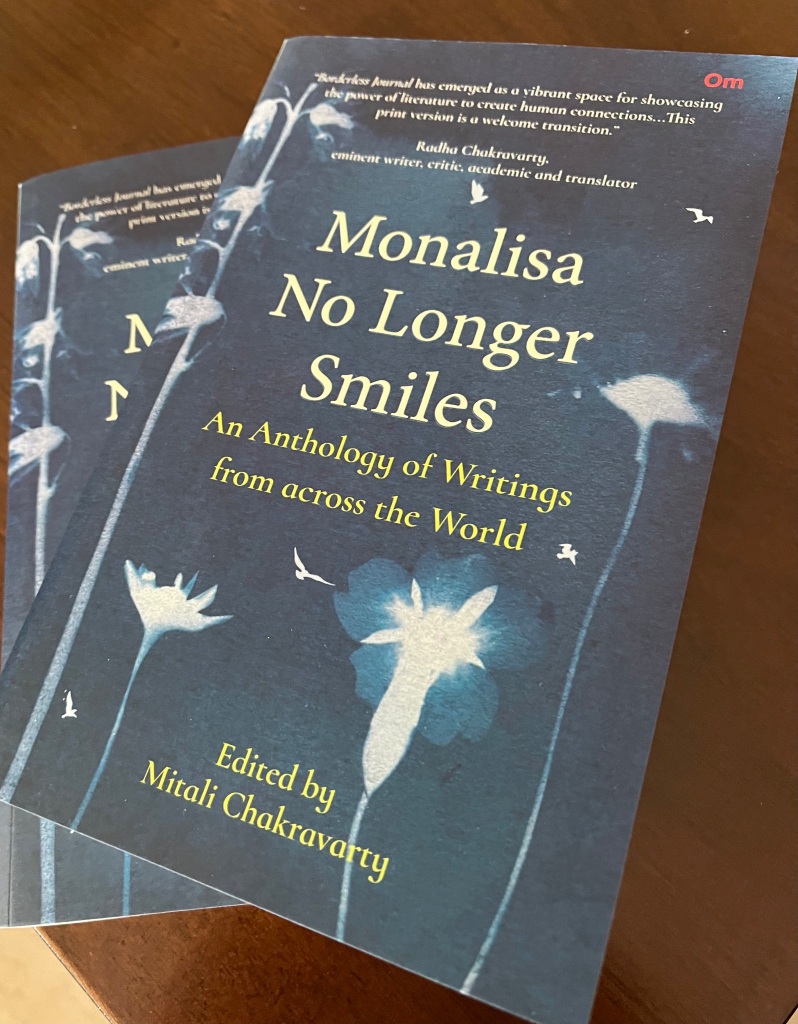
Click here to access the Borderless anthology, Monalisa No Longer Smiles

Click here to access Monalisa No Longer Smiles on Kindle Amazon International

Categories
Contents

Borderless, April 2023

Painting by Sohana Manzoor

Editorial

Can Love Change the World?… Click here to read.

Conversation

Keith Lyons interviews Asian Australian poet Adam Aitken about cross-cultural identity, and the challenges of travel, writing, and belonging. Click here to read.

Translations

Gandhiji, a short story by Nabendu Ghosh, has been translated from Bengali by Ratnottama Sengupta. Click here to read.

Khaira, the Blind, a story by Nadir Ali, has been translated from Punjabi by Amna Ali. Click here to read.

Clothes of Spirits, a folktale, has been translated from Balochi by Fazal Baloch. Click here to read.

Many Splendored Love, four poems by Masud Khan, have been translated from Bengali by Fakrul Alam. Click here to read.

Birds are Alive, has been written and translated from Korean by Ihlwha Choi. Click here to read.

Nobo Borshe or on New Year, Tagore’s poem on the Bengali New Year, has been translated from Bengali by Mitali Chakravarty for the occasion this April. Click here to read.

Poetry

Click on the names to read the poems

Michael R Burch, Vipanjeet Kaur, William Miller, Sutputra Radheye, Jim Landwehr, Namrata Varadharajan, Phil Wood, Akshada Shrotryia, Richard Stevenson, Abdul Jamil Urfi, Scott Thomas Outlar, Anasuya Bhar, George Freek, Malachi Edwin Vethamani, Ryan Quinn Flanagan, Rhys Hughes

Poets, Poetry & Rhys Hughes

In My Love for RK Narayan, Rhys Hughes discusses the novels by ths legendary writer from India. Click here to read.

Musings/Slices from Life

Magic of the Mahatma & Nabendu

Ratnottama Sengupta shows the impact of Gandhi and his call for non-violence on Nabendu Ghosh as she continues to emote over his message of Ahimsa and call for peace amidst rioting. Click here to read.

Kindred Spirits

Anjali V Raj writes of an endearing friendship. Click here to read.

Colorado comes to Eden

Meredith Stephens sails to meet more people in Eden. Click here to read.

Us vs Them

Shivani Agarwal talks of sharing the planet with all creatures great and small. Click here to read.

Musings of a Copywriter

In To Be or Not to Be, Devraj Singh Kalsi muses on food fads. Click here to read.

Notes from Japan

In Olives and Art in the Inland Sea, Suzanne Kamata explores the island of Sodoshima. Click here to read.

Essays

Charlie and I: My Visit to Corsier-sur-Vevey

Nirupama Kotru talks of her trip to Charlie Chaplin’s home and writes about the legendary actor. Click here to read.

The Wonderland of Pokhara

Ravi Shankar explores, Pokhara, a scenic town in Nepal. Click here to read.

Stories

Sparks

Brindley Hallam Dennis captures the passing of an era. Click here to read.

The Moulting

PG Thomas brings us a glimpse of Kerala — the past merging to create a new present. Click here to read.

The Book Hunter

Paul Mirabile gives a tale about a strange obsession. Click here to read.

Book Excerpts

An excerpt from What Will People Say?: A Novel by Mitra Phukan. Click here to read.

An excerpt from The Wistful Wanderings of Perceval Pitthelm by Rhys Hughes. Click here to read.

Book Reviews

Somdatta Mandal reviews Chitra Banerjee Divakaruni’s Independence. Click here to read.

Rakhi Dalal reviews Song of the Golden Sparrow – A Novel History of Free India by Nilanjan P. Choudhary. Click here to read.

Basudhara Roy reviews Ukiyo-e Days… Haiku Moments by Bina Sarkar Ellias. Click here to read.

Bhaskar Parichha reviews Japanese Management, Indian Resistance: The Struggles of the Maruti Suzuki Workers by Anjali Deshpande and Nandita Haksar. Click here to read.

.

.

Click here to access the Borderless anthology, Monalisa No Longer Smiles

Click here to access Monalisa No Longer Smiles on Kindle Amazon International

Click here to learn more about our first anthology, Monalisa No Longer Smiles

Categories
Stories

Clothes of Spirits

A Balochi Folktale translated by Fazal Baloch

Balochistan. Courtesy: Creative Commons

Once upon a time there was a certain kingdom somewhere on the earth. The moment night set in, thieves and robbers would let lose all across the kingdom. Despite all efforts from the king, the robbers were not contained. One day, the king, his emirs and viziers all put their heads together to devise an effective plan. At last, one of the viziers floated the following idea:

“Let’s us call the day the night, and the night the day. It is the only way to protect our people”.

The king liked the idea very much and immediately he issued the decree asking the people to start their day after the sunset and mark the sunrise as the beginning of the night. Initially, many people violated king’s decree and they were subsequently hanged. In due time, the unusual routine ensued in the kingdom. People slept during the day and resumed activities at night.

One day two strangers arrived in the city at midday. They went to a shop. The shopkeeper was asleep. They were looking around the shop, when the shopkeeper woke up and caught saw them. He instantly presumed they were thieves and accused them of shoplifting.

“We are no thieves. We have come to get some merchandise,” said one of the strangers.

“Why did you come so late in the night?” asked the shopkeeper.

Confounded by shopkeeper’s remarks he quipped: “Night? It is not night! Rather it is midday”.

The shopkeeper accused them of violating king’s decree and subsequently dragged them to the king’s court. The king told them that he would investigate their case in the daytime. Meanwhile, they were locked in a room. They were astounded by the strange behaviour of the king and his subjects. At night – the time they took to be the day — the king summoned the two strangers and asked them the purpose of their visit to the city.

“We are no ordinary folks. Rather we are royal tailors from the neighboring kingdom. We sew clothes for spirits”.

The king said: “How do these kinds of clothes look?”

“Only the legitimate sons of their fathers can see these clothes,” the man replied.

The king provided them with a sewing machine and asked them to sew the clothes. Later on, he asked his vizier to see if the clothes were ready. The vizier walked over to the room allotted to the strangers. They were absorbed with the sewing machine. The vizier drew nearer to the men and asked them about the progress in their work.

“The shirt is all done. We are half way through the trousers.  Isn’t it visible to you?” Surprisingly asked one of the men.

The vizier was quite confused. He couldn’t find any clothes there but he reckoned any negative answer would mean he was not his father’s legitimate son.

Hence, he said: “Of course, it is. It looks beautiful”. Then he cleverly asked them: “Where is the shirt?”

“It’s there in the box. See it for yourself.”

The vizier opened the box. It seemed empty, but he exclaimed: “What an exceedingly beautiful shirt!”

Then the vizier walked over to the king and told him that the clothes looked wonderful. Then the king strolled into the room. The vizier asked him to try the clothes on. The king opened the box. Lo, it was empty! He knew any remarks about the invisible clothes would call the legitimacy of his own birth into question. Thereupon, he peeled off his clothes and pretended to wear the clothes of spirits. He was naked but the vizier asked the people to clap and praise him new clothes. The king made a detour around the city. Everybody clapped and admired him being clad in the spiritual clothes.

The next day he issued another proclamation asking his subjects to wear the clothes of spirits. A few days later, the king invited the king of a neighbouring kingdom which was the home of the two strangers. When the king arrived there, he was astonished to see that nobody had a thread on their body and they slept during the day and worked at night. Then the two strangers whispered the entire story into his ear. The king said: “Let’s hurry off; otherwise they will force us to wear the clothes of spirits.”

This folktale has been translated from a retelling by Ghulam Jan Nawab in “Cher Andaren Neki” (The Hidden Virtue), a collection compiled by Ghulam Jan Nawab and published by Chammag Chap o Shing in 2021.

Fazal Baloch is a Balochi writer and translator. He has translated many Balochi poems and short stories into English. His translations have been featured in Pakistani Literature published by Pakistan Academy of Letters and in the form of books and anthologies. Fazal Baloch has the translation rights from the publisher.

PLEASE NOTE: ARTICLES CAN ONLY BE REPRODUCED IN OTHER SITES WITH DUE ACKNOWLEDGEMENT TO BORDERLESS JOURNAL

Click here to access the Borderless anthology, Monalisa No Longer Smiles

Click here to access Monalisa No Longer Smiles on Kindle Amazon International

Categories
Editorial

And Wilderness is Paradise Enow…

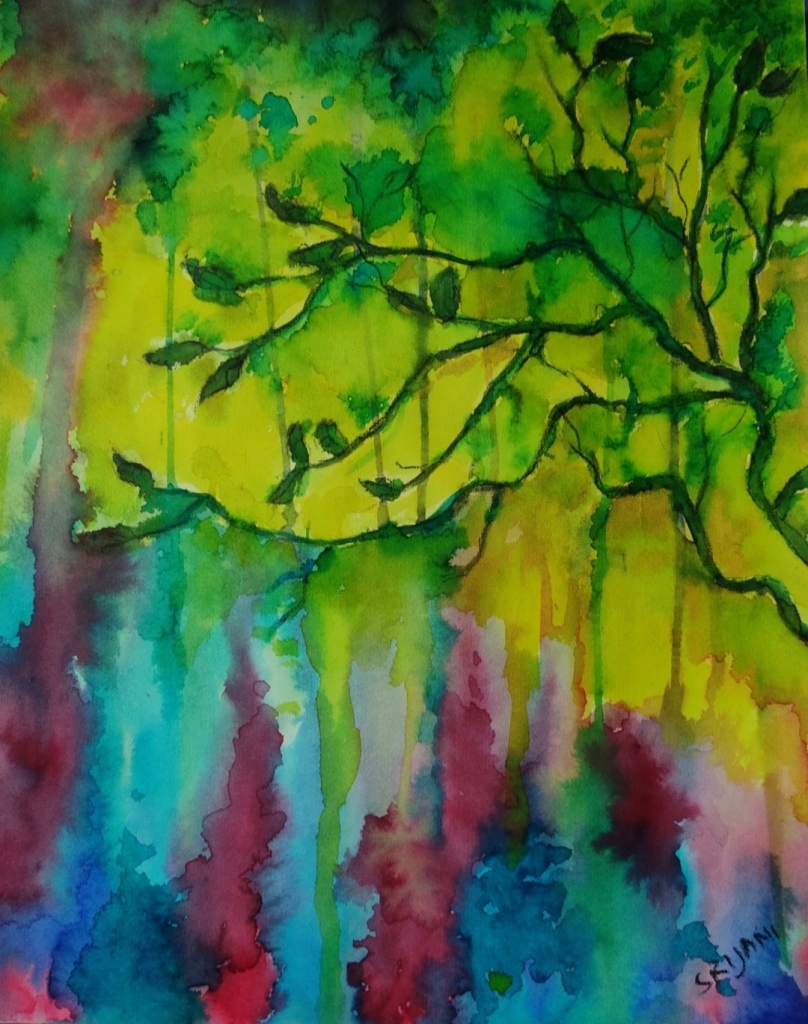
Hope in Winter(2020) by Srijani Dutta
“Here with a Loaf of Bread beneath the Bough,
A Flask of Wine, a Book of Verse -- and Thou
Beside me singing in the Wilderness --
And Wilderness is Paradise enow.”

― Omar Khayyám (1048-1131); translation from Persian by Edward Fitzgerald (Rubaiyat, 1859)

I wonder why Khayyam wrote these lines — was it to redefine paradise or just to woo his beloved? I like to imagine it was a bit of both. The need not to look for a paradise after death but to create one on Earth might well make an impact on humankind. Maybe, they would stop warring over an invisible force that they call God or by some other given name, some ‘ism’. Other than tens of thousands dying in natural disasters like the recent earthquake at the border of Turkiye and Syria, many have been killed by wars that continue to perpetrate divides created by human constructs. This month houses the second anniversary of the military junta rule in Myanmar and the first anniversary of the Ukrainian-Russian war that continues to decimate people, towns, natural reserves, humanity, economics relentlessly, polluting the environment with weapons of mass destruction, be it bombs or missiles. The more weapons we use, the more we destroy the environment of our own home planet. 

Sometimes, the world cries for a change. It asks to be upended.

We rethink, reinvent to move forward as a species or a single race. We relook at concepts like life and death and the way we run our lives. Redefining paradise or finding paradise on Earth, redefining ‘isms’ we have been living with for the past few hundred years — ‘isms’ that are being used to hurt others of our own species, to create exclusivity and divisions where none should exist — might well be a requisite for the continuance of our race.

Voices of change-pleaders rang out in the last century with visionaries like Tagore, Gandhi, Nazrul, Satyajit Ray urging for a more accepting and less war-bound world. This month, Ratnottama Sengupta has written on Ray’s legendary 1969 film, Goopy Gyne, Bagha Byne: “The message he sent out loud and with laughter: ‘When people have palatable food to fill their belly and music to fill their soul, the world will bid goodbye to wars.’” Shantanu Ray Chaudhuri has given an essay on one of the greatest pacifists, Gandhi, and his attitudes to films as well as his depiction in movies. What was amazing is Gandhi condemned films and never saw their worth as a mass media influencer! The other interesting thing is his repeated depiction as an ethereal spirit in recent movies which ask for changes in modern day perceptions and reforms. In fact, both these essays deal with ghosts who come back from the past to urge for changes towards a better future.

Delving deeper into the supernatural is our interviewee, Abhirup Dhar, an upcoming writer whose ghost stories are being adapted by Bollywood. While he does investigative stories linked to supernatural lore, our other interviewee, Andrew Quilty, a renowned journalist who has won encomiums for his coverage on Afghanistan where he spent eight years, shows in his book, August in Kabul: America’s Last Days in Afghanistan and the Return of the Taliban, what clinging to past lores can do to a people, especially women. Where does one strike the balance? We also have an excerpt from his book to give a flavour of his exclusive journalistic coverage on the plight of Afghans as an eyewitness who flew back to the country not only to report but to be with his friends — Afghans and foreigners — as others fled out of Kabul on August 14 th 2021. While culturally, Afghans should have been closer to Khayyam, does their repressive outlook really embrace the past, especially with the Taliban dating back to about only three decades?

The books in our review section have a focus on the past and history too. Meenakshi Malhotra’s review of Priyadarshini Thakur Khayal’s Padmini of Malwa: The Autobiography of Rani Rupmati, again focusses on how the author resurrects a medieval queen through visitations in a dream (could it be her spirit that visited him?). Somdatta Mandal writes of a book of history too — but this time the past and the people are resurrected through objects in Sudeshna Guha’s A history of India through 75 Objects. Bhaskar Parichha has also reviewed a history book by culinary writer-turned-historian Colleen Taylor Sen, Ashoka and The Maurya Dynasty: The History and Legacy of Ancient India’s Greatest Empire.

This intermingling of life and death and the past is brought to life in our fiction section by Sreelekha Chatterjee and Anjana Krishnan. Aditi Yadav creates a link between the past and our need to travel in her musing, which is reminiscent of Anthony Sattin’s description of asabiyya, a concept of brotherhood that thrived in medieval times. In consonance with wanderlust expressed in Yadav’s essay, we have a number of stories that explore travel highlighting various issues. Meredith Stephens travels to explore the need to have nature undisturbed by external interferences in pockets like Kangaroo Island in a semi-humorous undertone. While Ravi Shankar travels to the land’s end of India to voice candid concerns on conditions within Kerala, a place that both Keith Lyons and Rhys Hughes had written on with love and a sense of fun. It is interesting to see the contrasting perspectives on Southern India.

Hughes of course brings in dollops of humour with his travel to Adam’s Peak in Sri Lanka as does Devraj Singh Kalsi who writes about camel rides in Chandigarh, a place I known for its gardens, town planning and verdure. Suzanne Kamata colours Japan with humour as she writes of how candies can save the day there! Sengupta continues to travel to the past delving into the history of the last century.

Poetry that evokes laughter is rare but none the less the forte of Hughes as pensive but beautiful heartfelt poetry is that of Asad Latif. This February, the edition features poetry by Ryan Quinn Flanagan that borders on wry humour and on poignancy by George Freek. More poems by Pragya Bajpai, Sanjukta Dasgupta, Chad Norman, John Grey, Amit Parmessur, Sister Lou Ella Hickman, Saranyan BV and many more bring in varied emotions collected and honed to convey varieties that flavour our world.

Professor Fakrul Alam has also translated poetry where a contemporary Bengali writer, Masud Khan, cogitates on history while Ihlwha Choi has translated his own poem from Korean. A translation of Tagore’s poem on the ocean tries to capture the vastness and the eternal restlessness that can be interpreted as whispers carried through eons of history. Fazal Baloch has also shared a poem by one of the most revered modern Balochi voices, that of Atta Shad. Our pièce de resistance is a translation of Premchand’s Balak or the Child by Anurag Sharma.

This vibrant edition would not have been possible without all the wonderful translators, writers, photographers and artists who trust us with their work. My heartfelt thanks to all of you, especially, Srijani Dutta for her beautiful painting, ‘Hope in Winter’, and Sohana for her amazing artwork. My heartfelt thanks to the team at Borderless Journal, to our loyal readers some of whom have evolved into fabulous contributors. Thank you.

Do write in telling us what you think of the journal. We look forward to feedback from all of you as we head for the completion of our third year this March.

Best wishes,

Mitali Chakravarty

borderlessjournal.com

Click here to access the Borderless anthology, Monalisa No Longer Smiles

Categories
Poetry

Today’s Child by Atta Shad

Translated from Balochi by Fazal Baloch

Courtesy: Creative Commons
Today’s child,
Tomorrow’s father,
A star of hope for the days ahead,
May you forever glow like moonlight!
 
From the ocean of the sky,
Countless stars sprinkle pearls of light.
Yet the dark night
Spreads out its tattered cloak.
Howsoever, it remains bright
Night is but night.
 
The moon is alone --
But it's a beacon of light,
The spirit of tomorrow’s hopes,
The soul of the night nibbled, glows
A harbinger of dawn,
A gift of the morn.
 
Countless are the stars
The moon is alone.
But absolute is its light.
 
Today’s child,
Tomorrow’s father,
Your little world --
Whether you drag it into a dark night,
Or illuminate it with moonlight.
 
Today’s child,
Tomorrow’s father,
A star of hope,
May you glow like the moonlight!
 

Atta Shad (1939-1997) is the most revered and cherished modern Balochi poet. He instilled a new spirit in the moribund body of modern Balochi poetry in the early 1950s when the latter was drastically paralysed by the influence of Persian and Urdu poetry. Atta Shad gave a new orientation to modern Balochi poetry by giving a formidable ground to the free verse, which also brought in its wake a chain of new themes and mode of expression hitherto untouched by Balochi poets. Apart from the popular motifs of love and romance, subjugation and suffering, freedom and liberty, life and its absurdities are a few recurrent themes which appear in Shad’s poetry. What sets Shad apart from the rest of Balochi poets is his subtle, metaphoric and symbolic approach while versifying socio-political themes. He seemed more concerned about the aesthetic sense of art than anything else.

Shad’s poetry anthologies include Roch Ger and Shap Sahaar Andem, which were later collected in a single anthology under the title Gulzameen, posthumously published by the Balochi Academy Quetta in 2015. The translated poem is from Gulzameen.

Fazal Baloch is a Balochi writer and translator. He has translated many Balochi poems and short stories into English. His translations have been featured in Pakistani Literature published by Pakistan Academy of Letters and in the form of books and anthologies. Fazal Baloch has the translation rights of Atta Shad from the publisher.

PLEASE NOTE: ARTICLES CAN ONLY BE REPRODUCED IN OTHER SITES WITH DUE ACKNOWLEDGEMENT TO BORDERLESS JOURNAL

Click here to access the Borderless anthology, Monalisa No Longer Smiles

Categories
Editorial

Its Only Hope…

Painting by Sybil Pretious

New year, like a newborn, starts with hope.

The next year will do the same – we will all celebrate with Auld Lang Syne and look forward to a resolution of conflicts that reared a frightening face in 2022 and 2021. Perhaps, this time, if we have learnt from history, there will not be any annihilation but only a movement towards resolution. We have more or less tackled the pandemic and are regaining health despite the setbacks and disputes. There could be more outbreaks but unlike in the past, this time we are geared for it. That a third World War did not break out despite provocation and varied opinions, makes me feel we have really learnt from history.

That sounds almost like the voice of hope. This year was a landmark for Borderless Journal. As an online journal, we found a footing in the hardcopy world with our own anthology, Monalisa No Longer Smiles: Writings from Across the World, which had a wonderful e-launch hosted by our very well-established and supportive publisher, Om Books International. And now, it is in Om Book Shops across all of India. It will soon be on Amazon International. We also look forward to more anthologies that will create a dialogue on our values through different themes and maybe, just maybe, some more will agree with the need for a world that unites in clouds of ideas to take us forward to a future filled with love, hope and tolerance.

One of the themes of our journal has been reaching out for voices that speak for people. The eminent film critic and editor, Shantanu Ray Chaudhuri , has shared a conversation with such a person, the famed Gajra Kottary, a well-known writer of Indian TV series, novels and stories. The other conversation is with Nirmal Kanti Bhattajarchee, the translator of Samaresh Bose’s In Search of a Pitcher of Nectar, a book describing the Kumbh-mela, that in 2017 was declared to be an Intangible Cultural Heritage of Humanity by UNESCO. Bhattacharjee tells us how the festival has grown and improved in organisation from the time the author described a stampede that concluded the festivities. Life only gets better moving forward in time, despite events that terrorise with darkness. Facing fear and overcoming it does give a great sense of achievement.

Perhaps, that is what Freny Manecksha felt when she came up with a non-fiction called Flaming Forest, Wounded Valley: Stories from Bastar and Kashmir, which has been reviewed by Rakhi Dalal. Basudhara Roy has also tuned in with a voice that struggled to be heard as she discusses Manoranjan Byapari’s How I Became a Writer: An Autobiography of a Dalit. Somdatta Mandal has reviewed The Shaping of Modern Calcutta: The Lottery Committee Years, 1817 – 1830 by Ranabir Ray Chaudhury, a book that explores how a lottery was used by the colonials to develop the city. Bhaskar Parichha has poured a healing balm on dissensions with his exploration of Rana Safvi’s In Search of the Divine: Living Histories of Sufism in India as he concludes: “Weaving together facts and popular legends, ancient histories and living traditions, this unique treatise running into more than four hundred pages examines core Sufi beliefs and uncovers why they might offer hope for the future.”

In keeping with the festive season is our book excerpt from Rhys Hughes’ funny stories in his Christmas collection, Yule Do Nicely. Radha Chakravarty who brings many greats from Bengal to Anglophone readers shared an excerpt – a discussion on love — from her translation of Tagore’s novel, Farewell Song.

Love for words becomes the subject of Paul Mirabile’s essay on James Joyce’s Stephen Dedalus, where he touches on both A Portrait of the Artist as a young Man and  Ulysees, a novel that completed a century this year. Love for animals, especially orangutans, colours Christina Yin’s essay on conservation efforts in Borneo while Keith Lyons finds peace and an overwhelming sense of well-being during a hike in New Zealand. Ravi Shankar takes us to the historical town of Taiping in Malaysia as Meredith Stephens shares more sailing adventures in the Southern hemisphere, where it is summer. Saeed Ibrahim instils the seasonal goodwill with native Indian lores from Canada and Suzanne Kamata tells us how the Japanese usher in the New Year with a semi-humorous undertone.

Humour in non-fiction is brought in by Devraj Singh Kalsi’s ‘Of Mice and Men’ and in poetry by Santosh Bakaya. Laughter is stretched further by the inimitable Rhys Hughes in his poetry and column, where he reflects on his experiences in India and Wales. We have exquisite poetry by Jared Carter, Sukrita Paul Kumar, Asad Latif, Luis Cuauhtémoc Berriozábal, Michael R Burch, Sutputra Radheye, George Freek, Jonathan Chan and many more. Short stories by Lakshmi Kannan, Devraj Singh Kalsi, Tulip Chowdhury and Sushma R Doshi lace narratives with love, humour and a wry look at life as it is. The most amazing story comes from Kajal who pours out the story of her own battle in ‘Vikalangta or Disability‘ in Pandies’ Corner, translated from Hindustani by Janees.

Also touching and yet almost embracing the school of Absurd is PF Mathew’s story, ‘Mercy‘, translated from Malayalam by Ram Anantharaman. Fazal Baloch has brought us a Balochi folktale and Ihlwha Choi has translated his own poem from Korean to English. One of Tagore’s last poems, Prothom Diner Shurjo, translated as ‘The Sun on the First Day’ is short but philosophical and gives us a glimpse into his inner world. Professor Fakrul Alam shares with us the lyrics of a Nazrul song which is deeply spiritual by translating it into English from Bengali.

A huge thanks to all our contributors and readers, to the fabulous Borderless team without who the journal would be lost. Sohana Manzoor’s wonderful artwork continues to capture the mood of the season. Thanks to Sybil Pretious for her lovely painting. Please pause by our contents’ page to find what has not been covered in this note.

We wish you all a wonderful festive season.

Season’s Greetings from all of us at Borderless Journal.

Cheers!

Mitali Chakravarty

borderlessjournal.com

.

Click here to access the Borderless anthology, Monalisa No Longer Smiles

Categories
Stories

Even A Simurgh Cannot Change Destiny

Balochi folktale translated by Fazal Baloch

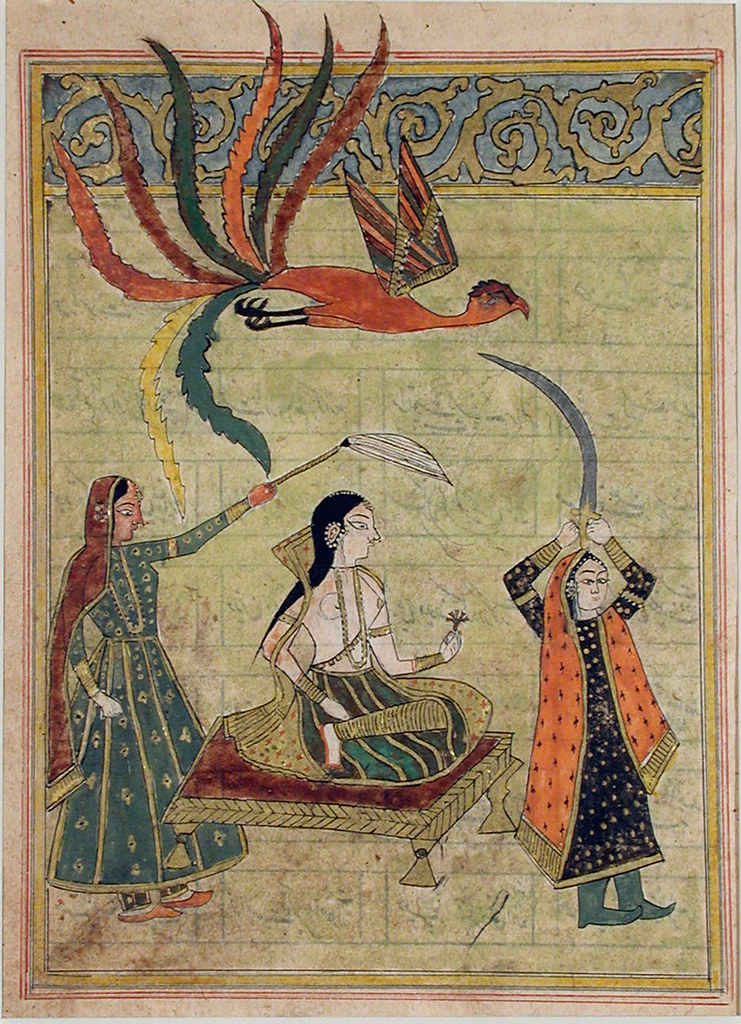
A simurgh flies over a princess. Courtesy: Creative Commons

Once there lived a king who had a daughter who no one wanted to marry. The king summoned all soothsayers, palmists, astrologers and fortune-tellers of the land to determine the fate of his daughter. They all came to the conclusion that the child who was in his brother’s wife’s womb would marry his daughter. The king however was hostile to his sister-in-law and did not like her at all. Moreover, by then his daughter was twenty. He also felt by the time his nephew would grow old enough to marry, his daughter would have passed the marriageable age. The king had asked his brother to divorce his wife many times, but he brusquely refused.

One day when his brother went on a hunting expedition, the king summoned his men and commanded them to take his brother’s wife to a forest and rip her belly open. The servants did exactly what the king directed them and hurried back to the palace. In the meantime, a shepherd walking nearby noticed the woman lying dead with a baby wriggled in her womb.

Ironically, the shepherd did not have any child. He extracted the baby out of mother’s womb, and carried it to a midwife to get his umbilical cord cut. The shepherd and his wife were so happy that they could barely sleep that night.

Time passed. The boy grew into a handsome youth. One day, the king set out on a hunting trip. Wandering about the jungle, thirst overwhelmed the king’s party. They went to a hamlet in search of water. The king, leading the caravan made it to the nearest wigwam which coincidently belonged to the shepherd who was out then. The shepherd’s son, who actually was king’s nephew, brought water to the members of the royal caravan. The king was stunned by appearance of the boy. He was very handsome.

He asked the young man, “Whose son are you, boy?”

The boy said, “I am the son of the shepherd.”

But the king did not believe him. He called for shepherd’s wife and inquired of her: “Who are the parents of this boy? I’ve heard you don’t have any child.”

The shepherd’s wife retorted, “O Sovereign! The boy first belongs to the Almighty Allah, and then he is my son”.

In the meantime, the shepherd arrived and noticed the king looked angry. He had barely exchanged greetings with the gathering when the king bluntly asked him, “Hey shepherd! Whose son is the boy?”

He humbly answered, “Your Majesty! He is my son”.

The king looked askance at him and said, “The boy does not resemble any of you. How come you say he is your son?” King’s anger peaked. He threatened the couple,

“Tell me the truth otherwise I will cut the boy into two halves”.

The helpless shepherd admitted: “O Honorable king! Let the lie be separated from the truth. He is not my blood but I’ve brought him up. Many years ago, I went to pasture to tend my cattle herd, I saw a woman lying on the ground with her belly ripped open and the baby was in her womb. I took the baby home. The handsome young man who is now standing before you, is the very baby whom we brought up”.

The king knew the woman was his brother’s wife and the baby was the child who the soothsayers had declared a groom for his daughter. The desire to kill the boy sprang in king’s heart in that very instant.

The king immediately wrote a letter to his vizier addressing him: “The moment this boy delivers the letter, kill him. Carry his dead body to the graveyard with great pomp and show. I will join you there”.

He gave the letter to the boy and instructed him to deliver it to the vizier. The boy set out on his mission. He reached his destination by midday. It was summertime and everyone was asleep. The young man tucked the letter in the fold of his turban and paused by the king’s palace to beat out the heat and eventually drifted off to sleep.

Heaven knows at what moment a maidservant noticed a handsome young man was lying asleep at the door. She rushed to the princess and informed. The princess followed her out of the palace. When princess’ eyes fell on the boy, she almost stunned. When she drew a little close to him, she noticed a piece of paper tucked in the fold of his turban. She gently extracted the letter and read it. She figured out her father’s handwriting and became aware of his intentions. Thus, she hurried back to the palace and addressed a new letter to the vizier. She wrote: “The moment this young man delivers you the letter, solemnize his marriage with my daughter amid great celebration before my arrival.” She scrawled her father’s signature at the bottom of the letter and tucked it back in the fold of young man’s turban.

In the evening the boy got up and walked over to the vizier and hand delivered him the letter. The vizier after having gone through the letter gazed at the handsome boy and was convinced that at last the king had found a young man who deserved to be the husband of the princess. The vizier sent for a mullah to solemnise the marriage.

Later in the day when the king leading his caravan reached the graveyard, there was nobody there. The sound of drumbeat was coming from the palace. The king sent a servant to his vizier and asked him if he had performed the task he had been told of. The vizier replied in affirmative and asked the servant to tell the king to come and see with his own eyes.

When the king arrived, he was furious. He asked the vizier for the corpse of the young man. The vizier was taken aback. He asked the king, “Whose corpse?” The king said that he had written asking him to kill the young man bearing the letter. He had further instructed he wait with his dead body at the graveyard for his return. The vizier was confounded. He went and brought the letter he had received and presented it to the king. When the king read the letter, he too was surprised to see his signature scrawled at the bottom of the letter but there was not a word about young man’s murder.

Thus, he was convinced that “Even a simurgh[1] cannot change one’s destiny”. His daughter was destined to marry with his nephew. And what is written in the destiny cannot be changed by one’s desire.

(This folktale was originally published in Gidar-12 January  2021 retold by Sadiq Saba. Fazal Baloch has the translation rights.)

[1] The simurgh is a mythical bird. It is believed that whosoever has this bird will have whatever they desire for.

Fazal Baloch is a Balochi writer and translator. He has translated many Balochi poems and short stories into English. His translations have been featured in Pakistani Literature published by Pakistan Academy of Letters and in the form of books and anthologies.

.

PLEASE NOTE: ARTICLES CAN ONLY BE REPRODUCED IN OTHER SITES WITH DUE ACKNOWLEDGEMENT TO BORDERLESS JOURNAL. 

Click here to access the Borderless anthology, Monalisa No Longer Smiles

Categories
Contents

Borderless, November 2022

Art by Sohana Manzoor

Editorial

We did it! … Announcing our first anthology … Monalisa No Longer Smiles… Click here to read.

Conversations

Suchen Christine Lim, an iconic writer from Singapore in conversation about her latest book, Dearest Intimate. Click here to read.

Blazing trails, as well as retracing the footsteps of great explorers, Christopher Winnan, a travel writer, delves into the past, and gazes into the future while conversing with Keith Lyons. Click here to read.

Translations

Rows of Betelnut Trees by My Window by Nazrul has been translated from Bengali by Professor Fakrul Alam. Click here to read.

A Day in the Life of the Pink Man is a story by Shankhadeep Bhattacharya, translated from Bengali by Rituparna Mukherjee. Click here to read.

The Clay Toys and The Two Boys is a story by Haneef Shareef, translated from Balochi by Fazal Baloch. Click here to read.

Saturday Afternoon is a poem by Ihlwha Choi, translated from Korean by the poet himself. Click here to read.

Tagore’s poem, Tomar Shonkho Dhulay Porey (your conch lies in the dust), has been translated from Bengali by Mitali Chakravarty as The Conch Calls. Click here to read.

Poetry

Click on the names to read

Jared Carter, Asad Latif, Rhys Hughes, Alpana, Mimi Bordeaux, Saranyan BV, Luis Cuauhtémoc Berriozábal, Quratulain Qureshi, Jim Bellamy, Sourav Sengupta, Ron Pickett, Davis Varghese, Ryan Quinn Flanagan, Jonathan Chan, Terry Trowbridge, Amrita Sharma, George Freek, Gayatri Majumdar, Michael R Burch

Poets, Poetry and Rhys Hughes

In Infinite Tiffin, Rhys Hughes gives an unusual short story centring around food and hunger. Click here to read.

Musings/Slices from Life

The Scream & Me

Prithvijeet Sinha writes of how Edvard Munch’s painting, The Scream, impacts him. Click here to read.

A Fine Sunset

Mike Smith travels with a book to a Scottish beach and walks in the footsteps of a well-know novelist. Click here to read.

The Death of a Doctor

Ravi Shankar mourns the loss of a friend and muses on mortality in his experience. Click here to read.

My Contagious Birthday Party

Meredith Stephens writes of her experience of Covid. Click here to read.

Dim Memories of the Festival of Lights

Farouk Gulsara takes a nostalgic trip to Deepavali celebrations in Malaysia. Click here to read.

Musings of a Copywriter

In Strumming Me Softly with His Guitar…, Devraj Singh Kalsi talks of his friends’s adventure with the guitar. Click here to read.

Notes from Japan

In Therese Schumacher and Nagayoshi Nagai: A Love Story, Suzanne Kamata introduces us to one of the first German women married to a Japanese scientist and their love story. Click here to read.

Essays

My Favourite Book by Fakrul Alam

The essay is a journey into Fakrul Alam’s evolution as a translator. Click here to read.

The Ultimate Genius of Kishore Kumar

Shantanu Ray Chaudhuri, an eminent film critic, writes on the legend of Kishore Kumar. Click here to read.

T.S Eliot’s The Waste Land: Finding Hope in Darkness

Dan Meloche muses on the century-old poem and its current relevance. Click here to read.

The Observant Immigrant

In Piano Board Keys, Candice Louisa Daquin talks of biracial issues. Click here to read.

Stories

The Funeral Attendee

Ravi Prakash shares the story of the life of a migrant in rural India. Click here to read.

A Letter I can Never Post

Monisha Raman unravels the past in a short narrative using the epistolary technique. Click here to read.

Red Moss at the Abbey of Saint Pons

Paul Mirabile takes us to St Pons Abbey in France in the fifteenth century. Click here to read.

You have lost your son!

Farhanaz Rabbani gives a light story with a twist that shuttles between Dhaka and Noakhali. Click here to read.

Book Excerpts

An Excerpt from Manoranjan Byapari’s How I Became a Writer: An Autobiography of a Dalit, translated from Bengali by Anurima Chanda. Click here to read.

An excerpt from Evening with a Sufi: Selected Poems by Afsar Mohammad, translated from Telugu by Afsar Mohammad & Shamala Gallagher. Click here to read.

Book Reviews

Reba Som has reviewed Aruna Chakravarti’s Through the Looking Glass: Stories. Click here to read.

Somdatta Mandal has reviewed Shehan Karunatilaka’s The Birth Lottery and Other Surprises. Click here to read.

Basudhara Roy has reviewed Afsar Mohammad’s Evening with a Sufi: Selected Poems, translated from Telugu by Afsar Mohammad and Shamala Gallagher. Click here to read.

Bhaskar Parichha has reviewed Rahul Ramagundam’s The Life and Times of George Fernandes. Click here to read.

Borderless Journal Anthology

Click here to access the Borderless anthology, Monalisa No Longer Smiles

Categories
Editorial

We Did It!

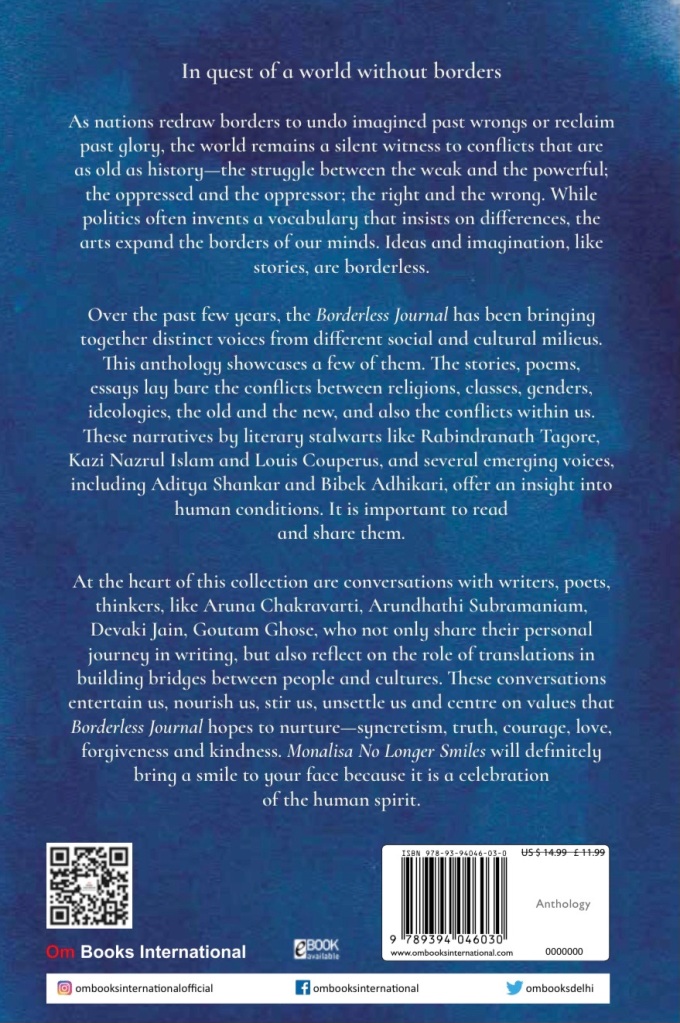
That good things happen despite darkness, despite prognostications of doom, that light glimmers hope if you strive to focus on your strength in hard times is borne true both in fiction and in life. Perhaps, we cannot get back the old ways (but is that what we want?) but new paths emerge. Old gives way to new. And while trying to gather pearls of human excellence — borne not of awards or degrees but of bringing out the best, the kindest, the most loving in human hearts — we managed to create with a team an outstanding anthology. Woven with the writings of old and new — we created a tapestry together that the editor in chief of our publishing house said was “classy, literary, engaging and international”. That one of the oldest and most reputed publishing houses in India with bookshops countrywide took it on was also an unusual event! We are truly grateful to Om Books International, Shantanu Ray Chaudhuri and Jyotsna Mehta along with all our writers and readers who made our anthology a reality, and to Radha Chakravarty and Fakrul Alam for the kind words they bestowed on our effort.

Click here to access the Borderless anthology, Monalisa No Longer Smiles

Please greet our first anthology, Monalisa No Longer Smiles, with love and friendship. It could be the perfect Christmas gift in the spirit of the season! And as the blurb says, “it will definitely bring a smile to your face because it is a celebration of the human spirit.”

The anthology is different from our journal in as much as it has a sample of an eclectic collection that has been honed with further editing and has some new features. Most of the writing is from our first year and showcases our ethos, except for Lesya’s poetry and interview. Lesya Bakun from Ukraine is still on the run, looking for a refuge — she cannot return home like you or I can. Her family is scattered across number of countries. Her cousin, who was guarding the factory at Azovstal, was taken prisoner. We included her story in the anthology hoping to create global empathy for refugees as the numbers will increase not only due to war but also due to climate change.

The reason we felt a hardcopy anthology was a good idea was because nothing beats the joy of having a bunch of interesting reads in the warmth of your hands (especially where internet cannot reach or is unavailable). In any case, books with the feel of paper, the rustling whispers which carry voices of leaves can never be replaced as Goutam Ghose had also said in his interview which is now part of our anthology.

And that is why we celebrate more books… this time we feature Singaporean prima donna of literature, Suchen Christine Lim, with her new book Dearest Intimate, a novel that spans more than hundred years including the harrowing Japanese invasion during World War II. She shared sound advice with writers: “Suffering is good for the writer. It will deepen lived experience and expand the heart’s empathy.” And perhaps that is what is echoed through the experiences of the other writer interviewed on our pages by Keith Lyons. This is a writer who not only brought out his own books but was a regular contributor of travel pieces for Frommer’s and National Geographic traveling to unexplored destinations — Christopher Winnan. Another writer Lyon had interviewed recently, Steve Carr, has passed on. We would like to convey our heartfelt condolences to his family and friends.

We have a number of books that have been reviewed. Reba Som reviewed Aruna Chakravarti’s Through the Looking Glass: Stories that span eras spread across time. Somdatta Mandal has reviewed Shehan Karunatilaka’s The Birth Lottery and Other Surprises and Bhaskar Parichha, Rahul Ramagundam’s The Life and Times of George Fernandes. Basudhara Roy has written of Afsar Mohammad’s Evening with a Sufi: Selected Poems, translated from Telugu by the poet and Shamala Gallagher, verses that again transcend borders and divides. We have an excerpt from the same book and another from Manoranjan Byapari’s How I Became a Writer: An Autobiography of a Dalit, translated from Bengali by Anurima Chanda.

More translations from Bengali, Balochi and Korean enrich our November edition. Fazal Baloch has translated a story by Haneef Shareef and Rituparna Mukherjee by Shankhadeep Bhattacharya. We have the translation of an inspirational Tagore poem helping us find courage (Shonkho Dhulaye Pore or ‘the conch lies in the dust’). Another such poem by Nazrul has been rendered in English from Bengali by Professor Fakrul Alam. He has also shared an autobiographical musing on how he started translating Tagore’s Gitabitan, which also happens to be his favourite book. More discussion on the literary persona of TS Eliot and the relevance of his hundred year old poem — ‘The Waste Land’ by Dan Meloche adds variety to our essay section.

Evoking the genius of another outstanding artiste, Kishore Kumar, who happened to pen thought provoking dialogues in some films, is Shantanu Ray Chaudhuri’s essay, review of a recent book on the legendary actor-singer and an interview with the authors. Infringing the boundaries of literary with popular culture and art and integrating all forms into a wholistic bundle has been part of our ethos. In that spirit we have a musing by Prithvijeet Sinha on Edvard Munch’s famous painting called Scream. We have non-fiction from Australia spanning Meredith Stephens’s recent brush with Covid, Mike Smith visits a Scottish beach in the footsteps of a novelist, Ravi Shankar has given us a poignant piece for a late friend and Candice Lousia Daquin talks of the existence of bi-racial biases. In contrast, Suzanne Kamata sent a narrative that bridges divides showcasing a German wife of a Japanese scientist that draws us to conclude that biases erode over time to create an acceptance of bi-racial people. Devraj Singh Kalsi brings in humour with his funny narrative about a guitarist. Rhys Hughes writes in a lighter vein on Indian cuisine in his column and spouts more funny poetry bordering on the absurd.

Jared Carter has shared beautiful poetry on murmuration in birds and we have touching verses from Asad Latif for a little girl he met on a train — reminiscent of Tagore’s poem Hide and Seek (Lukochuri). Michael R Burch has given us poems setting sombre but beautiful notes for the season. We host more poetry by Luis Cuauhtémoc Berriozábal, Quratulain Qureshi, Jim Bellamy, Gayatri Majumdar, Ryan Quinn Flanagan, Alpana, Jonathan Chan, Saranyan BV, George Freek and many more. We have stories from around the world: India, France and Bangladesh.

Gathering all of your thoughts in strings of words from all corners of the world, we present to you the bumper November issue of Borderless Journal . Thank you all for sharing your thoughts with us. Thanks to Sohana Manzoor for her fantastic painting and more thanks to the whole Borderless team for seeing this issue through. We would not have been able to do the anthology or these issues without each one of you — writers and readers.

Thank you all from the bottom of my heart.

There is always hope for a new tomorrow!

Mitali Chakravarty

borderlessjournal.com

Click here to access the Borderless anthology, Monalisa No Longer Smiles