Naramsetti Umamaheswararao makes up a new fable. Click here to read.
Feature
A review of Jaladhar Sen’s The Travels of a Sadhu in the Himalayas, translated from Bengali by Somdatta Mandal, and an online interview with the translator. Click here to read.
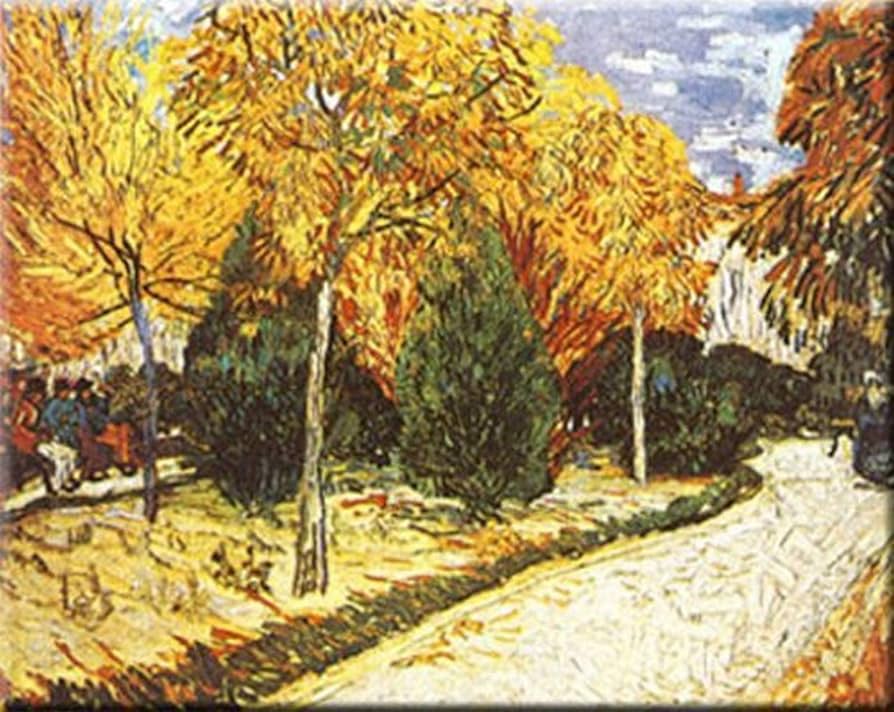
Autumn Garden by Vincent Van Gogh (1853-1890). From Public Domain
September heralds the start of year-end festivities around the world. It’s autumn in one part and spring in another – both seasons that herald change. While our planet celebrates changes, dichotomies, opposites and inclusively gazes with wonder at the endless universe in all its splendour, do we? Festivals are times of good cheer and fun with our loved ones. And yet, a large part of the world seems to be in disarray with manmade disasters wrought by our own species on its own home planet. Despite the sufferings experienced by victims of climate and war-related calamities, the majority will continue to observe rituals out of habit while subscribing to exclusivity and shun change in any form. Occasionally, there are those who break all rules to create a new norm.
One such group of people are the bauls or mendicants from Bengal. Aruna Chakravarti has shared an essay about these people who have created a syncretic lore with music and nature, defying the borders that divide humanity into exclusive groups. As if to complement this syncretic flow, we have Professor Fakrul Alam’s piece on a human construct, literary clubs spanning different cultures spread over centuries – no less an area in which we find norms redefined for, the literary, often, are the harbingers of change.
Mandal, herself, has a brilliant translation featured in this issue. We have a review of her book, an interview with her, and an excerpt from the translation of Jaladhar Sen’s The Travels of a Sadhu in the Himalayas. Written and first published in the Tagore family journal, Bharati, the narrative is an outstanding cultural bridge which even translates Bengali humour for an Anglophone readership. That Sen had a strictly secular perspective in the nineteenth century when blind devotion was often a norm is showcased in Mandal’s translation as well as the stupendous descriptions of the Himalayas that haunt with elegant simplicity.
Our fiction this month seems largely focussed on women’s stories from around the world. While Fiona Sinclair and Erin Jamieson reflect on mother-daughter relationships, Anandita Dey looks into a woman’s dilemma as she tries to adjust to the accepted norm of an ‘arranged’ marriage. Rashida Murphy explores deep rooted social biases that create issues faced by a woman with a light touch. Naramsetti Umamaheswararao brings in variety with a fable – a story that reflects human traits transcending gender disparity.
The September issue would not have been possible without contributions of words and photographs by many of you. Huge thanks to all of you, to the fabulous team and to Sohana Manzoor, whose art has become synonymous with our journal. And our heartfelt thanks to our wonderful readers, without who the effort of putting together this journal would be pointless. Thank you all.
Aruna Chakravarti writes of the Bauls (wandering minstrels) of Bengal and the impact their syncretic thought, music and life had on Tagore
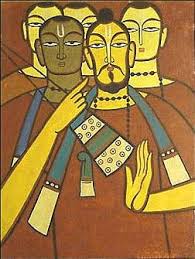
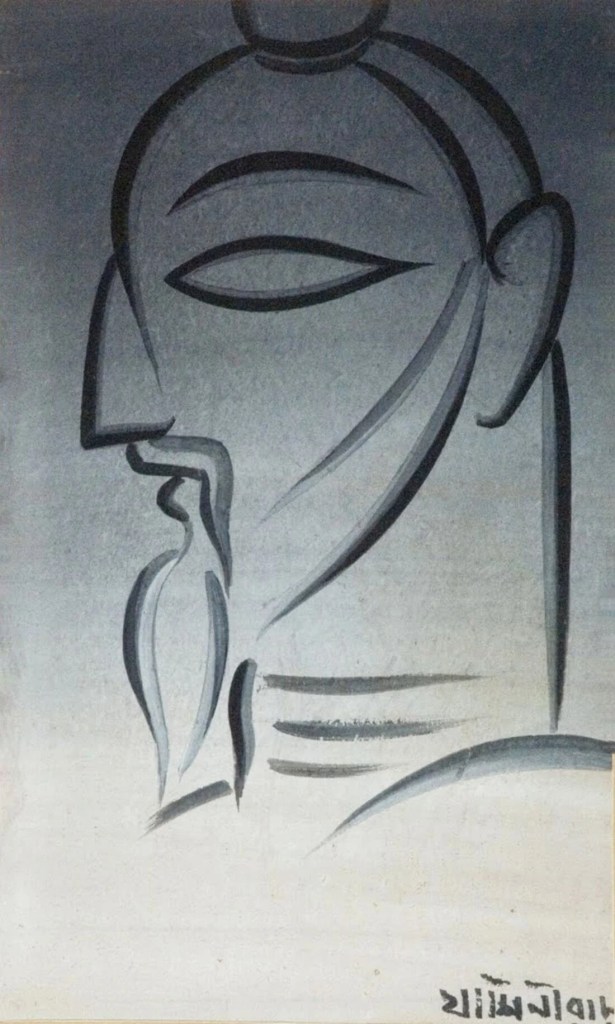
Bauls by Jamini RoyBaul Singer by Jamini Roy Paintings by Jamini Roy (1887-1972). From Public Domain
Religious movements such as Bhakti and Sufi have spanned time and territory and entered Bengal, in successive waves, creating a syncretic culture in which music and poetry are amalgamated. One of the forms in which these movements find creative expression is Baul Gaan —the singing of itinerant minstrels.
Universally recognised as foremost among the oralities of Bengal, the Baul Sampradai is a community for whom singing is synonymous with worship. The Baul expounds a philosophy of humanism which rejects religious orthodoxies and stresses human equality irrespective of caste, class, religion and gender. The Baul sets himself on a spiritual journey, lasting a lifetime, towards discovering his moner manush (man within the heart) thereby alienating the notion of seeking the Divine in external forms such as mosques, temples, images and sculptures. Since God is believed to reside within man, the human body is viewed as the site of the ultimate truth –that which encompasses the entire universe. This tenet of Baul philosophy is known as deha tatwabad—the belief that the soul being pure the body that houses it, together with all its functions, is pure and holy.
Concentrated mostly in Kushthia, Shilaidaha and Sajadpur in East Bengal (now Bangladesh) and Murshidabad and Birbhum in West Bengal, the Baul tradition, though drawing elements from Tantra, Shakta and Sahajiya[1], stems from two main sources — Muslim Sufi and Hindu Vaishnav. Hence the simultaneous presence of Hindu and Muslim bauls in the villages of Bengal and great composers from both streams—Lalon Fakir, Duddu Shah, Madan Baul, Gagan Harkara and Fakirchand. Rejecting religious codes such as Shariat and Shastras, caste differences, social conventions and taboos, which they see as barriers to a true union with God, they sing of harmony between man and man. “Temples and mosques obstruct my path,” the Baul sings, “and I can’t hear your voice when teachers and priests crowd around me.”
Refusing to conform to the conventions of religion and caste ridden Bengali society, Bauls (the word is sourced from the middle eastern bawal meaning mad or possessed) are wandering minstrels who sing and dance on their way to an inner vision. Essentially nomadic in nature walking, for them, is a way of life. “No baul should live under the same tree for more than three days” — the saying seems to stem from the Sufi doctrine of walking an endless path (manzil) in quest of the land where the Beloved (the Divine) might be glimpsed. Bauls live on alms which people give readily. In return the Baul sings strumming his ektara[2] with dancing movements. The songs are rich with symbolism, on the one hand, and full of ready wit and rustic humour on the other. The Baul rails against the hypocrisy of religion and caste and takes sharp digs at the clergy but totally without rancour.
Many of the composite forms found in an older culture of Bengal have become sadly obscured in the present scenario of identity politics. But the one that has not only survived but is gaining in recognition day by day, is the Baul tradition. This is, in no small measure, owing to the intervention and interest taken by Rabindranath Tagore. In his Religion of Man Rabindranath tells us that, being the son of the founder of the Adi Brahmo Samaj, he had followed a monotheistic ideal from childhood but, on gaining maturity, had sensed within himself a disconnect from the organised belief he had inherited. Gradually the feeling that he was using a mask to hide the fact that he had mentally severed his connection with the Brahmo Samaj began tormenting him. And while in this frame of mind, travelling through the family estates in rural Bengal, he heard a Baul sing. The singer was a postal runner by the name of Gagan Harkara and the song was “Ami kothai paabo tare/ amaar moner manush je re[3].”
“What struck me in this simple song,” Rabindranath goes on to say, “was a religious expression that was neither grossly concrete, full of crude details, nor metaphysical in its rarefied transcendentalism… Since then, I’ve often tried to meet these people and sought to understand them through their songs which are their only form of worship.” In his Preface to Haramoni[4], Rabindranath makes another reference to this song. Quoting some lines from the Upanishads— Know him whom you need to know/ else suffer the pangs of death— he goes on to say, “What I heard from the mouth of a peasant in rustic language and a primary tune was the same. I heard, in his voice, the loss and bewilderment of a child separated from its mother. The Upanishads speak of the one who dwells deep within the heart antartama hridayatma[5]and the Baul sings of the moner manush. They seem to me to be one and the same and the thought fills me with wonder.”
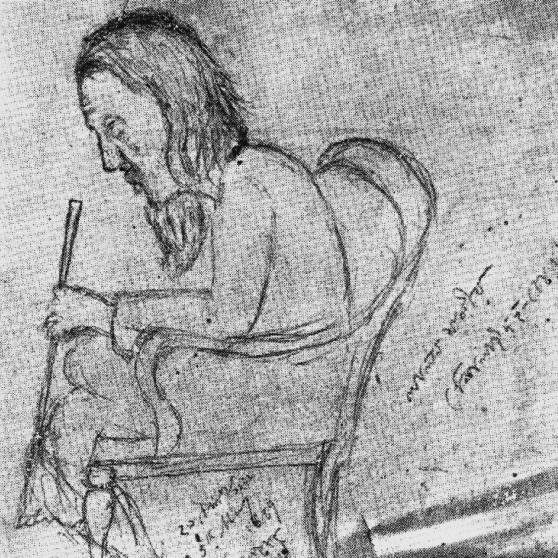
A Portrait of Lalon Fakir sketched by Jyotindranath Tagore(1849-1925)
Lalon Fakir’s commune was located in the village of Chheurhia which fell within Rabindranath’s father’s estates. Though there is no authentic record of a meeting between the two, it is a fact that the poet was the first to recognise Lalon’s merit which had the quality of a rough diamond. His inspiration was powerful and spontaneous but, lacking in clarity of expression, lay buried in obscurity till Rabindranath brought it out into the open. Publishing some of the songs in some of the major journals of the time, Rabindranath took them to the doors of the educated elite. Not only that. They gained in popularity from the fact that he, himself, often used Baul thought and melody in his own work. “In some songs,” he tells us in his Manush er Dharma[6], “the primary tunes got mixed up with other raags – raaginis which prove that the Baul idiom entered my sub conscious fairly early in life. The man of my heart, moner manush, is the true Devata[7]. To the extent that I’m honest and true to my knowledge, action and thought — to that extent will I find the man of my heart. When there is distortion within, I lose sight of him. Man’s tendency is to look two ways — within and without. When we seek him without — in wealth, fame and self- gratification — we lose him within.”
But it wasn’t only in his compositions that Rabindranath disseminated Baul ideology. It went deeper than that. The primitive simplicity and freedom of Baul thought and living charmed him so completely that he started imbibing them in his own lifestyle. He grew his hair long, kept a flowing beard and wore loose robes. He created Baul like characters in his plays and dance dramas and enacted the roles himself. And, as he grew older, a restlessness; an inability to stay in one place took hold of him. Leaving the ancestral mansion of Jorasanko he relocated to Santiniketan but even there he could not stay in the same house for more than two months. In the last two and half decades of his life, a tremendous wanderlust seized him. He travelled extensively both within the country and without, earning for himself the sobriquet of ‘roving ambassador for India’.
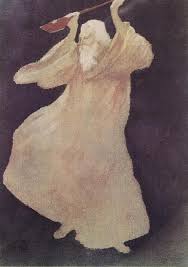
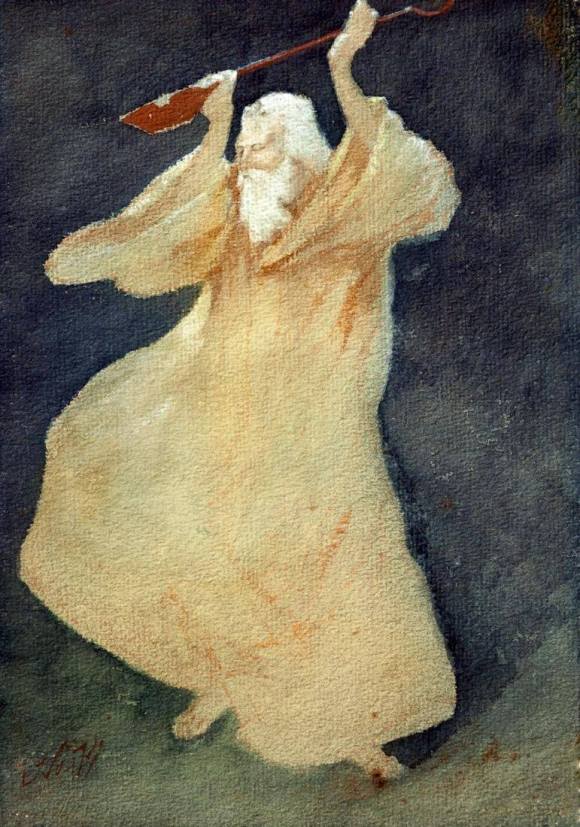
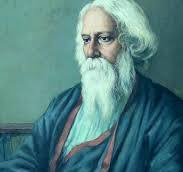
Perhaps, the most powerful testimony of the evolution of Rabindranath from a princely scion of the Tagores of Jorasanko to the man he finally became is found in Abanindranath’s portrait of his uncle. It depicts an old man with flowing white locks and beard, wearing a loose robe and holding an ektara high above his head. The limbs are fluid in an ecstatic dance movement. It is a significant fact that the painting is titled Robi Baul.
Robi Baul (1916): Painting by Abanindranath Tagore (1871-1951). From Public Domain
[1] Different schools of philosophy and religion. The Sahajiya is a philosophy that embrace nature and the natural way of life.
[3] Translates from Bengali to: “Where will I find Him — He who dwells within my heart”
[4] The Haramoni (Lost Jewels) is 13-volume collection of Baul songs compiled by Mansooruddin to which Tagore wrote the preface for the first volume published in 1931
[5] Translates to ‘innermost part of the heart and soul’
[6] Collection of Lectures by Tagore in Bengali, published in 1932
Aruna Chakravarti has been the principal of a prestigious women’s college of Delhi University for ten years. She is also a well-known academic, creative writer and translator. Her novels, Jorasanko, Daughters of Jorasanko, The Inheritors, Suralakshmi Villa and The Mendicant Prince have sold widely and received rave reviews. She has two collections of short stories and many translations, the latest being Rising from the Dust. She has also received awards such as the Vaitalik Award, Sahitya Akademi Award and Sarat Puraskar for her translations.
.
PLEASE NOTE: ARTICLES CAN ONLY BE REPRODUCED IN OTHER SITES WITH DUE ACKNOWLEDGEMENT TO BORDERLESS JOURNAL
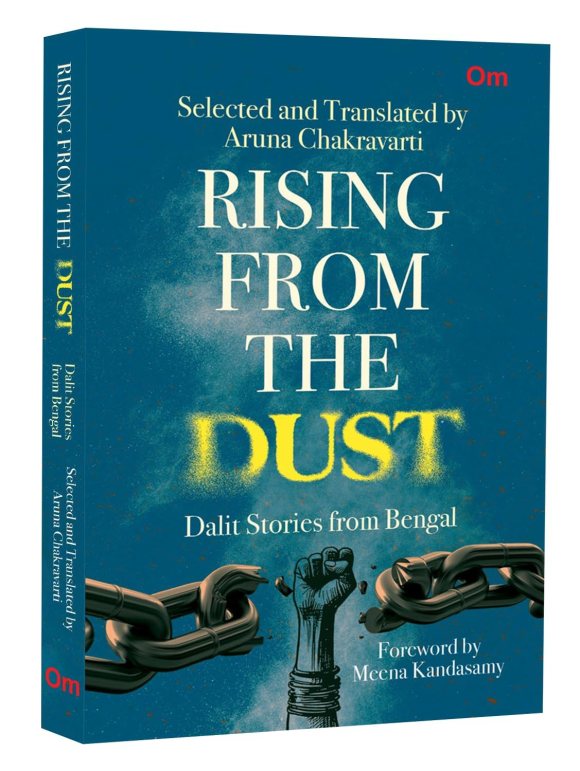
Title: Rising From the Dust: Dalit Stories from Bengal
Selected and Translated by Aruna Charavarti
Publisher: Om Books International
Though Bengali Dalit writing is comparatively newer compared to Dalit writing in Marathi and other Dravidian languages, nevertheless it has already carved a niche for itself in a significant way. The main difference between the Dalit writing emanating from other regions of India and that of Bengal is that whereas the thrust area elsewhere is primarily on the untouchables, the downtrodden and the way the Dalits have been marginalised in society for a long time, in Bengal the problem is further complicated by caste and class issues which is not so significant elsewhere. This collection of twelve Dalit short stories from Bengal, carefully selected and translated by Aruna Chakravarti, spans a long period and what distinguishes it is the gendered lens that explores the Dalit woman’s cause and holds it up to the light.
There is a difference in the style of narrating the Dalit experience from writer to writer and accordingly it can be divided into two groups. In the first category are writers who themselves belong to the Dalit community and their writing stem out of experiential feelings. The second group of writers belong to the upper castes, and their writing stems from a feeling of empathy for the marginalized and the downtrodden. Spanning a long period of almost a century, Aruna Chakravarti has decided to blend both these categories and has meticulously translated the dozen stories from well-known writers to those a little lesser known. While literary stalwarts like Mahasweta Devi, Saratchandra Chattopadhyay, Tarashankar Bandopadhyay and Prafulla Roy share their profound understanding of the Dalit woman’s fears and traumas, hopes, dreams and aspirations, contemporary voices from the Dalit community itself like Manoranjan Byapari, Bimalendu Haldar, Manohar Mouli Biswas, Kalyani Thakur Charal, Anil Ghorai and Nakul Mallik explore aspects of survival and social ostracisation with both sensitivity and angst. On the one hand we have centuries of oppression being still carried upon these subaltern people, and even within that restricted space, we also often find protest and upheaval that the doubly marginalized womenfolk attempt to revolt against.
In the opening story titled “Fortress” by Manoranjan Byapari, we find Nakul’s widow Sarama, unwillingly forced to sell her body to oppressive menfolk everyday finds her unique way of protest by deliberately copulating with her ex-husband Ratan who is inflicted with venereal disease, thereby driving out all her fear and henceforth would ‘welcome every touch’ and ‘would wait outside her door in delicious anticipation.’ In Bimalendu Haldar’s “Salt” we are shown how a fisherman Madhai who works for his employer Nishay Ghosh, goes missing and his wife Chintay, collecting three other suffering women registers their protest in a unique way. In “Shonkhomala” Manohar Mouli Biswas tells us a relatively contemporary and true story relating to the grabbing of agricultural land in the fertile Singur area by the government for setting up of the Tata Motor Factory. It tells us of how Shonkhomala Dom, a Dalit woman, changes her name to Tapashi Malik and is gangraped and murdered because she was unwilling to give up her land and organized a protest march instead. Incidentally, till date, the court case for identifying the murderer and the rapists of Tapashi Malik is unresolved.
Another very touching story “Illegal Immigrant” by Nakul Mallick brings in the plight of refugees from erstwhile East Bengal coming to India after the partition. It tells us of the plight of an extremely poor jhalmuri seller called Madhav who, along with his wife Shefali, lives in a slum beside the train track and somehow manages to eke out a decent living. When Madhav is picked up as an illegal Bangladeshi immigrant and thrown out of the country, his wife’s life goes haywire as she goes to the Petrapole border looking for her husband in vain. Kalyani Thakur Charal deliberately adds the word ‘Charal’ meaning ‘Chandal’ or ‘untouchable’ to her name in order to take pride of her Dalit identity. In “Motho’s Daughter” she tells the story of one Nishikanta who wants to get his children educated first and foremost and is frustrated in the end because his stray son gets married to a woman who doesn’t encourage education. Anil Ghorai, another powerful Dalit writer, tells an interesting story about Larani, belonging to the tanner caste, her relationship with Hola Burho, a dhol[1] repairer and his son Pabna. The main thrust of the story “The Insect Festival” is of course the attack of locusts in the village and how the majority of the illiterate villagers take resort to superstitious rituals in order to ward off the menace instead of confronting the situation in a scientific manner.
As mentioned earlier, each story by the four empathetic writers goes on emphasizing the pressures of caste and class upon the lower classes of people in different situations. In “The True Life Story of Uli-Buli’s Mother” Mahasweta Devi tells us the story of a helpless woman who becomes a destitute after being thrown away for having four daughters. She lives under the delusion that someone has stolen her young twins Uli and Buli. Again in “Nalini’s Story” she draws a beautiful pen picture of Nalini, who after being abandoned by her husband, lives with her grandson and ekes out her living by working as a maid. Years later, her estranged son along with his wife and her landlord Gobindo all desire to take possession of her house by arranging an elaborate shraddha ceremony for her estranged husband. Nalini understands their ploy and, in the end, she puts her foot down, unwilling to be in eternal debt for the extravagant rituals proposed by them.
Prafulla Kumar Roy’s “Snake Maiden” gives us an inside story of the gypsies or nomads who are known as ‘bedyes’ and who deal with snakes and charms. Here Shankhini is the mistress of a band of bedeys who come and settle in Sonai Bibir Bil for the season and accidentally meets her ex-lover Raja saheb. She is in a quandary because he wants her to renounce the bedeni’s life and settle down in one place and turn into a farmer’s wife. The tug between domesticity and the age-old tradition of this nomadic gypsy tribe’s rituals and customs is elaborated through the rest of this interesting story. The powerful storyteller Tarashankar Bandyopadhyay gives us two stories with totally different locales and characters. In “The Witch” he elaborates upon the idea of a woman who is defined as a witch and is ostracised by society because she is said to cast an evil eye upon everything she sees. She dies an agonising death in the end as her dark and unholy blood oozes out from her veins. Incidentally, even to this day the idea of identifying certain low caste woman as witches and even burning them to death persists in several villages in rural Bengal and such superstitions are not overcome at all.
In the second story “Raikamal”, Tarashankar gives us an in-depth picture of a Vaishnav community, their rituals and their manner of living. The protagonist Kamalini had to abandon her crush on Ranjan because he belongs to another caste, weds Rasik who consumes poison in the end out of jealousy and ultimately Kamalini has to live all alone. Sarat Chandra Chattopadhyay’s eponymous story “Abhagi’s Heaven” is once again a depiction of Bengali society strictly divided according to caste lines. In this story, Kangali’s mother Abhagi, an untouchable, a ‘duley’ by caste, watches the funeral pyre of a Brahmin lady and imagines her going to heaven in a golden chariot. She nourishes the desire to be cremated in a similar fashion when she dies, but after her actual death she is denied the privilege of being burnt and has to be buried near the riverside as per societal norms.
The stories in this collection capture the essence of a way of life marked by the enduring defiant spirit of the dispossessed and the marginalised. This is a must-read not only for literary enthusiasts, but also for students and scholars of Dalit and caste studies, development studies, Indian literature in translation and gender studies. In her foreword, Meena Kandasamy categorically states that “every short story in this collection holds together a precious, precarious universe – the old order continues with its oppression, the new is struggling to be born; everyday life is a struggle and yet, struggle itself is the terrain, where life, liveliness, and being alive come into their full glory.” This translated volume is therefore strongly recommended for non-Bengali readers who are not aware of the nuances of Bengali Dalit writing at all and it will dispel the notion that all kinds of Dalit writing cannot be brought together under a single umbrella. Kudos to Aruna Chakravarti for her excellent selection and meticulous translation of these one dozen stories.
[1] Musical instrument akin to a drum but hung from the neck
.
Somdatta Mandal, critic and translator, is a former Professor of English at Visva Bharati, Santiniketan.
PLEASE NOTE: ARTICLES CAN ONLY BE REPRODUCED IN OTHER SITES WITH DUE ACKNOWLEDGEMENT TO BORDERLESS JOURNAL
Rabindranath Tagore (1861-1941) in the role of the blind singer in his play, Falguni (published in 1917). Art by Abanindranath Tagore. From Public Domain
On May 7th 1861, or Pochishe Boisakh of the Bengali year 1268, Rabindranth Tagore was born in Jorsanko, Calcutta. That time, there was one subcontinent. Borders were fluid though the concept of countries had already started making inroads with the onset of colonials more than a couple of centuries ago. Rabindranath Tagore — a man who rejected the academia and earned no degrees — set the world aflame with his words and ideals. Many of his works hope to inspire people out of miseries by getting them in touch with their own strength. He created Santiniketan and Sriniketan to train young minds, to close social and economic gaps, to override the stigma of walls that continue to box and divide humanity to this date. Subsequently, his works, especially his writings, have become subjects of much academic discourse as well as part of popular cultural lore.
Tagore celebrated his own birthdays with poetry on Pochishe Boishakh. Pochishe Boisakh falls between 7-9 May on the Gregorian calendar. We start our celebrations with translations of his birthday songs and poems. The song translated by Aruna Chakravarti was the last he wrote, and based on a long poem he had written in 1922, also featured here. We also have the first birthday song he composed in 1899. In prose, we bring to you works that showcase his call for change and reform. Fakrul Alam has translated a powerful play by him, Red Oleanders, which strongly seems to reflect the machinations of the current world and ends on a note of hope. We can only carry an excerpt from this long play but it will be a powerful read when published in full. Somdatta Mandal shares a translations of an essay in which Tagore airs his views on the need for change in social norms — the strange thing is it would still seem relevant today. And Himadri Lahiri rendered an essay from Bengali to English on his views about the British Raj. We also have a story about a woman who changed social norms and her religion, translated by Chakravarti.
Birthday Poems & Lyrics
Hey Nutan or Oh ever new has been translated by Aruna Chakravarti inDaughters of Jorasanko. This was the last birthday song he wrote in 1941, a few months before he died. It was based on the long birthday poem he had written in 1922. Click here to read.
Pochishe Boisakh Cholechhe(The twenty fifth of Boisakh draws close…), a birthday poem written in 1935, seems to be a sad reminder of mortality and dreams left unfinished. Click hereto read.
Pochishe Boisakh(25th of Baisakh) is a birthday poem Tagore wrote in 1922 and the poem from which he derived the lyrics of his last birthday song written in 1941. Click here to read.
Jonmodiner Gaan or Birthday Song by Tagore was written in 1899 and later sung as Bhoye Hote Tobo Abhayemajhe ( Amidst Fears, May Fearlessness). Click hereto read the translation.
Prose
An excerpt from Tagore’s long play, Roktokorobi or Red Oleanders, has been translated by Professor Fakrul Alam. Click here to read.
Tumi Kon Kanoner Phulby Tagore andAnjali Loho Morby Nazrul, love songs by the two greats, have been translated from Bengali by Professor Fakrul Alam. Click hereto read.
One Life, One Love, 300 Children : Keith Lyons writes of Tendol Gyalzur, a COVID 19 victim, a refugee and an orphan who found new lives for many other orphans with love and an ability to connect. Click here to read.
When West Meets East & Greatness Blooms: Debraj Mookerjee reflects on how syncretism impacts greats like Tagore,Tolstoy, Emerson, Martin Luther King Jr, Gandhi and many more. Click here to read.
Dilip Kumar: Kohinoor-e-Hind: In a tribute to Bollywood legend Dileep Kumar, Ratnottama Sengupta, one of India’s most iconic arts journalists, recollects the days the great actor sprinted about on the sets of Bombay’s studios …spiced up with fragments from the autobiography of Sengupta’s father, Nabendu Ghosh. Click here to read.
Are Some of Us More Human than Others ?: Meenakshi Malhotra ponders at the exclusivity that reinforces divisions, margins and borders that continue to plague humankind, against the backdrop of the Women’s Month, March. Click here to read.
Reminiscences from a Gallery: MF Husain: Dolly Narang recounts how she started a gallery more than four decades ago and talks of her encounter with world renowned artist, MF Husain. Click hereto read.
Baraf Pora (Snowfall) by Rabindranath Tagore,gives a glimpse of his first experience of snowfall in Brighton and published in the Tagore family journal, Balak (Children), has been translated from Bengali by Somdatta Mandal. Clickhere to read.
Cherry Blossom Forecast: Suzanne Kamata brings the Japanese ritual of cherry blossom viewing to our pages with her camera and words. Clickhere to read.
Two Pizza Fantasies, Rhys Hughes recounts myths around the pizza in prose, fiction and poetry, Click here to read.
An Alien on the Altar!: Snigdha Agrawal writes of how a dog and lizard add zest to festivities with a dollop of humour. Click here to read.
Where it all Began: Sybil Pretious recounts her first adventure, an ascent on Mt Kilimanjaro at the age of sixty. Clickhere to read.
Conversations
Rabindranath Tagore: A Universal Bard.: This conversation between Aruna Chakravarti and Sunil Gangopadhyay that took place at a Tagore Conference organised by the Sahitya Akademi in Kochy in 2011. Click here to read.
Sriniketan: Tagore’s “Life Work”: In Conversation with Professor Uma Das Gupta, Tagore scholar, author of A History of Sriniketan, where can be glimpsed what Tagore considered his ‘life’s work’ as an NGO smoothening divides between villagers and the educated. Click here to read. (Review & Interview).
In conversation with the late Akbar Barakzai, a Balochi poet in exile who rejected an award from Pakistan Academy of Letters for his principles. Click here to read.
Jim Goodman, an American traveler, author, ethnologist and photographer who has spent the last half-century in Asia, converses with Keith Lyons. Click here to read.
InBridge over Troubled Waters, the late Sanjay Kumar tells us about Pandies, an activist theatre group founded by him that educates, bridging gaps between the divides of university educated and the less fortunate who people slums or terror zones. Click here to read.
In Lessons Old and New from a Stray Japanese Cat, Keith Lyons talks with the author of The Cat with Three Passports, CJ Fentiman who likes the anonymity loaned by resettling in new places & enjoys creating a space for herself away from her birthplace. Click hereto read.
Fiction
Aparichitaby Tagore: This short story has been translated as The Stranger by Aruna Chakravarti. Click hereto read.
Hena by Nazrul has been translated from Bengali by Sohana Manzoor. Click here to read.
Playlets byRabindranath Tagore: Two skits that reveal the lighter side of the poet. They have been translated from Bengali by Somdatta Mandal. Click here to read.
Abhagi’s Heaven, a poignant story by Saratchandra Chattopadhyay translated by Aruna Chakravarti. Click here to read.
An Eternal Void, a Balochi story by Munir Ahmed Badini translated by Fazal Baloch. Click hereto read.
The Witch, a short story by renowned Bengali writer Tarasankar Bandopadhyay (1898 to 1971), translated by Aruna Chakravarti. Clickhere to read.
I Grew into a Flute: Balochi Folktale involving magic retold by Fazal Baloch. Click here to read.
Give Me A Rag, Please:A short story by Nabendu Ghosh, translated by Ratnottama Sengupta, set in the 1943 Bengal Famine, which reflects on man’s basic needs. Click here to read
Rakhamaninov’s Sonata: A short story by Sherzod Artikov, translated from Uzbeki by Nigora Mukhammad. Click hereto read.
The Magic Staff , a poignant short story about a Rohingya child by Shaheen Akhtar, translated from Bengali by Arifa Ghani Rahman. Click here to read.
Khaira, the Blind, a story by Nadir Ali, has been translated from Punjabi by Amna Ali. Click here to read.
The Browless Dolls by S.Ramakrishnan, has been translated from Tamil by B Chandramouli. Click hereto read.
No Man’s Land: Sohana Manzoor gives us surrealistic story reflecting on after-life. Click hereto read.
The Protests Outside: Steve Ogah talks of trauma faced by riot victims in Nigeria. Click here to read.
Flash Fiction: Turret: Niles M Reddick relates a haunting tale of ghosts and more. Click here to read.
Henrik’s Journey: Farah Ghuznavi follows a conglomerate of people on board a flight to address issues ranging from Rohingyas to race bias. Click hereto read.
Does this Make Me a Psychic?; Erwin Coombs tells a suspenseful, funny, poignant and sad story, based on his real life experiences. Click here to read.
Phôs and Ombra: Paul Mirabile weaves a dark tale about two people lost in a void. Click here to read.
A Queen is Crowned: Farhanaz Rabbani traces the awakening of self worth. Click here to read.
Art by Sohana ManzoorCourtesy: Suzanne Kamata Some of our visuals in 2024
As we wait for the new year to unfold, we glance back at the year that just swept past us. Here, gathered together are glimpses of the writings we found on our pages in 2024 that herald a world of compassion and kindness…writings filled with hope and, dare I say, even goodwill…and sometimes filled with the tears of poetic souls who hope for a world in peace and harmony. Disasters caused by humans starting with the January 2024 in Japan, nature and climate change, essays that invite you to recall the past with a hope to learn from it, non-fiction that is just fun or a tribute to ideas, both past and present — it’s all there. Innovative genres started by writers to meet the needs of the times — be it solar punk or weird western — give a sense of movement towards the new. What we do see in these writings is resilience which healed us out of multiple issues and will continue to help us move towards a better future.
A hundred years ago, we did not have the technology to share our views and writings, to connect and make friends with the like-minded across continents. I wonder what surprises hundred years later will hold for us…Maybe, war will have been outlawed by then, as have been malpractices and violences against individuals in the current world. The laws that rule a single man will hopefully apply to larger groups too…
Courtesy: Ratnottama Sengupta Courtesy: Farouk GulsaraSome of our visuals in 2024
Amalkantiby Nirendranath Chakraborty has been translated from Bengali by Debali Mookerjea-Leonard. Click hereto read.
The Mirror by Mubarak Qazi has been translated from Balochi by Fazal Baloch. Click hereto read.
Homecoming, a poem by Ihlwha Choi on his return from Santiniketan, has been translated from Korean by the poet himself. Click here to read.
Pochishe Boisakh(25th of Baisakh) by Tagore (1922), has been translated from Bengali by Mitali Chakravarty. Click here to read.
Nazrul’sGhumaite Dao Shranto Robi Re(Let Robi Sleep in Peace) has been translated from Bengali by Professor Fakrul Alam. Click hereto read.
Jibananada Das’sAndhar Dekhecche, Tobu Ache (I have seen the dark and yet there is another) has been translated from Bengali by Professor Fakrul Alam. Click here to read.
Tagore’sShotabdir Surjo Aji( The Century’s Sun today) has been translated from Bengali by Mitali Chakravarty. Clickhereto read.
A narrative by Rabindranath Tagore thatgives a glimpse of his first experience of snowfall in Brighton and published in the Tagore family journal, Balak (Children), has been translated from Bengali by Somdatta Mandal. Clickhere to read.
Suzanne Kamata discusses the peace initiatives following the terrors of the 1994 Rwandan Genocide while traveling within the country with her university colleague and students. Click here to read.
A story by Sharaf Shad, has been translated from Balochi by Fazal Baloch. Click here to read.
Conversations
Ratnottama Sengupta talks to Ruchira Gupta, activist for global fight against human trafficking, about her work and introduces her novel, I Kick and I Fly. Click here to read.
A conversation with eminent Singaporean poet and academic, Kirpal Singh, about how his family migrated to Malaya and subsequently Singapore more than 120 years ago. Click hereto read.
It’s again that time of the year when we have fun spooking each other with stories of ghosts and haunting. While festivals of light1 and darkness vie with each other for a spot on the same date, observances to pay our respects to our forefathers follow at their heels, some before and some after.
In this selection, we bring to you narratives that could be dark, strange or funny or all of these … a selection of poetry, fiction and non-fiction from around the world. Enjoy the reads!
The Ghosts of Hogshead: Paul Mirabile wanders into the realm of the supernatural dating back to the Potato Famine of Ireland in the 1800s. Clickhere to read.
Nagmati: Prafulla Roy’s long story based on strange folk beliefs has been translated from Bengali as Snake Maiden by Aruna Chakravarti. Click here to read.
From Public Domain
.
Deepavali or festival of lights is on October 31st this year along with Kali Puja and Halloween. October 30th is Bhooth Chaturdashi, or Indian Festival of Ghosts while All Saints’ Day and all Souls’ Day are observed at the start of November. Early October hosted Pitri Paksha, observances for apeasing forefathers in India. ↩︎
October spins a series of celebrations that carry on to herald a glorious start of a new year and beyond. From the Chinese Festival of the Nine Emperor Gods which happens to coincide with Navratri to Christmas and beyond — festivals bring joy into our lives. Majority of these human constructs ring in happiness and hope while reflecting the victory of what we consider good over evils. Often these celebrations are syncretic, roping in people from all cultures and religious creeds, creating a sense of oneness in a way that only a stream of contentment can.
In I Went to Kerala, Rhys Hughes treads a humorous path bringing to us a mixed narrative of Christmas on bicycles . Click here to read.
Hold the roast turkey please Santa Celebrating the festive season off-season with Keith Lyons from New Zealand, where summer solstice and Christmas fall around the same time. Click here to read.
Translations are like bridges. Three years ago, we decided to start a bridge between Tagore’s ideas and the world that was unfamiliar with his language, Bengali. He has of course written a few pieces in Brajbuli too. We started our journey into the territory of Tagore translations with Aruna Chakravarti’s Songs of Tagore. Now we have expanded hugely this section of our translations with many prose pieces and more translations of his lyrics and poetry by writers like Aruna Chakravarti, Fakrul Alam, Radha Chakravarty, Somdatta Mandal, Himadri Lahiri, Ratnottama Sengupta, Chaitali Sengupta and Nishat Atiya other than our team’s efforts. To all these translators our heartfelt thanks. We share with you their work celebrating one of the greatest ideators of the world.
Prose
Stories
.Aparichitaby Tagore :This short story has been translated as The Stranger by Aruna Chakravarti. Click hereto read.
Musalmanir Galpa(A Muslim Woman’s Story): This short story has been translated by Aruna Chakravarti. Clickhere to read.
One Small Ancient Tale: Rabindranath Tagore’s Ekti Khudro Puraton Golpo (One Small Ancient Tale) from his collection Golpo Guchcho ( literally, a bunch of stories) has been translated by Nishat Atiya. Click hereto read.
Bolai: Story of nature and a child translated by Chaitali Sengupta. Click hereto read.
Baraf Pora (Snowfall) : This narrative gives a glimpse of Tagore’s first experience of snowfall in Brighton and published in the Tagore family journal, Balak (Children), has been translated by Somdatta Mandal . Clickhere to read.
Himalaya Jatra( A trip to Himalayas) :This narrative about Tagore’s first trip to Himalayas and beyond with his father, has been translated from his Jibon Smriti (1911, Reminiscenses) by Somdatta Mandal. Click here to read.
Library: A part of Bichitro Probondho(Strange Essays) by Rabindranath Tagore, this essay was written in 1885, translated by Chaitali Sengupta. Click hereto read.
Book Excerpts
The Parrot’s Tale: Excerpted from Rabindranth Tagore. The Land of Cards: Stories, Poems and Plays for Children, translated by Radha Chakravarty, with a foreword from Mahasweta Devi. Clickhere to read
Rabindranath Tagore Four Chapters: An excerpt from a brilliant new translation by Radha Chakravarty of Tagore’s controversial last novel Char Adhyay. Click here to read.
Farewell Song :An excerpt from Radha Chakravarty’s translation of Tagore’s novel. Click hereto read.
Oikotan(Harmonising) has been translated by Professor Fakrul Alam and published specially to commemorate Tagore’s Birth Anniversary. Click hereto read.
Monomor Megher O Shongi (or The Cloud, My friend) has been translated by Professor Fakrul Alam. Click here to read.
Professor Fakrul Alam has translated Tomra Ja Bolo Tai Bolo, Hridoy Chheele Jege and Himer Raate — three songs around autumn from Clickhere to read.
Tagore’sAchhe Dukhu, Achhe Mrityu, (Sorrow Exists, Death Exists) has been translated from Bengali by Fakrul Alam. Click hereto read.
Tagore’s long poem, Dushomoy (translated as Journey of Hope though literally the poem means bad times). Click here to read the poem in English and listen to Tagore’s voice recite his poem in Bengali. We also have a sample of the page of his diary where he first wrote the poem as ‘Swarga Pathhe'(On the Path to Heaven).
Deliverance by Tagore: ‘Tran’by Tagore, a prayer for awakening of the subjugated. Click here to read the translation.
Abhisar byTagore: A story poem about a Buddhist monk by Rabindranath Tagore in Bengali. Click here to read the translation.
Amaar Nayano Bhulano Eledescribes early autumn when the festival of Durga Puja is celebrated. Click here to read the translation from Bengali.
Morichika or Mirage by Tagoreis an early poem of the maestro that asks the elites to infringe class divides and mingle. Click here to read the translation from Bengali.
Pochishe Boisakh(25th of Baisakh) is a birthday poem Tagore wrote in 1922 and from he derived the lyrics of his last birthday song written in 1941. Click here to read.
Chhora or Rhymes, a poem describing the creative process, it was written in 1941. Click here to read.
Okale or Out of Syncgives a glimpse of how out of sync situations are also part of our flow. Click here to read.
Mrityu or Death dwells on Tagore’s ability to accept death as a reality. Clickhere to read.
Songs of Tagore: Seven songs translated by Aruna Chakravarti from a collection that started her on her litrary journey and also our Tagore translation section. Click here to read.






 Borderless