A conversation with the author,Afsar Mohammed, and a brief introduction to his latest book, Remaking History: 1948 Police Action and the Muslims of Hyderabad. Click hereto read.
A conversation with Meenakshi Malhotra over The Gendered Body: Negotiation, Resistance, Struggle, edited by Meenakshi Malhotra, Krishna Menon and Rachana Johri and a brief introduction to the book. Click hereto read.
In His Unstable Shape, Rhys Hughes explores the narratives around a favourite nursery rhyme character with a pinch of pedantic(?) humour. Click here to read.
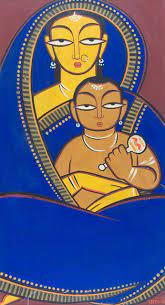
Mother & Child by Jamini Roy (1887-1972)Mother and Child by Picasso (1881-1973)
‘Victory to Man, the newborn, the ever-living.’ They kneel down, the king and the beggar, the saint and the sinner, the wise and the fool, and cry: ‘Victory to Man, the newborn, the ever-living.’
This is the month— the last of a conflict-ridden year— when we celebrate the birth of a messiah who spoke of divine love, kindness, forgiveness and values that make for a better world. The child, Jesus, has even been celebrated by Tagore in one of his rarer poems in English. While we all gather amidst our loved ones to celebrate the joy generated by the divine birth, perhaps, we will pause to shed a tear over the children who lost their lives in wars this year. Reportedly, it’s a larger number than ever before. And the wars don’t end. Nor the killing. Children who survive in war-torn zones lose their homes or families or both. For all the countries at war, refugees escape to look for refuge in lands that are often hostile to foreigners. And yet, this is the season of loving and giving, of helping one’s neighbours, of sharing goodwill, love and peace. On Christmas this year, will the wars cease? Will there be a respite from bombardments and annihilation?
We dedicate this bumper year-end issue to children around the world. We start with special tributes to love and peace with an excerpt from Tagore’s long poem, ‘The Child‘, written originally in English in 1930 and a rendition of the life of the philosopher and change-maker, Vivekananda, by none other than well-known historical fiction writer, Aruna Chakravarti. The poem has been excerpted from Indian Christmas: Essays, Memoirs, Hymns, an anthology edited by Jerry Pinto and Madhulika Liddle, a book that has been reviewed by Somdatta Mandal and praised for its portrayal of the myriad colours and flavours of Christmas in India. Christ suffered for the sins of humankind and then was resurrected, goes the legend. Healing is a part of our humanness. Suffering and healing from trauma has been brought to the fore by Christopher Marks’ perspective on Veronica Eley’s The Blue Dragonfly: healing through poetry. Basudhara Roy has also written about healing in her take of Kuhu Joshi’s My Body Didn’t Come Before Me.Bhaskar Parichha has reviewed a book that talks of healing a larger issue — the crises that humanity is facing now, Permacrisis: A Plan to Fix a Fractured World, by ex-British Prime Minister Gordon Brown, Nobel Laureate Michael Spence, Mohamed El-Erian and Reid Lidow. Parichha tells us that it suggests solutions to resolve the chaos the world is facing — perhaps a book that the world leadership would do well to read. After all, the authors are of their ilk! Our book excerpts from Dr Ratna Magotra’s Whispers of the Heart – Not Just A Surgeon: An Autobiographyand Manjima Misra’s The Ocean is Her Titleare tinged with healing and growth too, though in a different sense.
The theme of the need for acceptance, love and synchronicity flows into our conversations with Afsar Mohammad, who has recently authored Remaking History: 1948 Police Action and the Muslims of Hyderabad. He shows us that Hyderabadi tehzeeb or culture ascends the narrow bounds set by caged concepts of faith and nationalism, reaffirming his premise with voices of common people through extensive interviews. In search of a better world, Meenakshi Malhotra talks to us about how feminism in its recent manifestation includes masculinities and gender studies while discussing The Gendered Body: Negotiation, Resistance, Struggle, edited by her, Krishna Menon and Rachana Johri. Here too, one sees a trend to blend academia with non-academic writers to bring focus on the commonalities of suffering and healing while transcending national boundaries to cover more of South Asia.
That like Hyderabadi tehzeeb, Bengali culture in the times of Tagore and Nazrul dwelled in commonality of lore is brought to the fore when in response to the Nobel laureate’s futuristic ‘1400 Saal’ (‘The year 1993’), his younger friend responds with a poem that bears not only the same title but acknowledges the older man as an “emperor” among versifiers. Professor Fakrul Alam has not only translated Nazrul’s response, named ‘1400Saal’ aswell, but also brought to us the voice of another modern poet, Quazi Johirul Islam. We have a self-translation of a poem by Ihlwha Choi from Korean and a short story by S Ramakrishnan in Tamil translated by T Santhanam.
Our short stories travel with migrant lore by Farouk Gulsara to Malaysia, from UK to Thailand with Paul Mirabile while chasing an errant son into the mysterious reaches of wilderness, with Neeman Sobhan to Rome, UK and Bangladesh, reflecting on the Birangonas (rape victims) of the 1971 Bangladesh Liberation war, an issue that has been taken up in Malhotra’s book too. Sobhan’s story is set against the backdrop of a war which was fought against linguistic hegemony and from which we see victims heal. Sohana Manzoor this time has not only given us fabulous artwork but also a fantasy hovering between light and dark, life and death — an imaginative fiction that makes a compelling read and questions the concept of paradise, a construct that perhaps needs to be found on Earth, rather than after death.
The unusual paradigms of life and choices made by all of us is brought into play in an interesting non-fiction by Nitya Amlean, a young Sri Lankan who lives in UK. We travel to Kyoto with Suzanne Kamata, to Beijing with Keith Lyons, to Wayanad with Mohul Bhowmick and to Langkawi with Ravi Shankar. Wendy Jones Nakanishi argues in favour of borders with benevolent leadership. Tongue-in-cheek humour is exuded by Devraj Singh Kalsi as he writes of his attempts at using visiting cards as it is by Rhys Hughes in his exploration of the truth about the origins of the creature called Humpty Dumpty of nursery rhyme fame.
Poetry again has humour from Hughes. A migrant himself, Jee Leong Koh, brings in migrant stories from Singaporeans in US. We have poems of myriad colours from Ryan Quinn Flanagan, Patricia Walsh, John Grey, Kumar Bhatt, Ron Pickett, Prithvijeet Sinha, Sutputra Radheye, George Freek and many more. Papia Sengupta ends her poem with lines that look for laughter among children and a ‘life without borders’ drawn by human constructs in contrast to Jones Nakanishi’s need for walls with sound leadership. The conversation and dialogues continue as we look for a way forward, perhaps with Gordon Brown’s visionary book or with Tagore’s world view of lighting the inner flame in each human. We can hope that a way will be found. Is it that tough to influence the world using words? We can wish — may there be no need for any more Greta Thunbergs to rise in protest for a world fragmented and destroyed by greed and lack of vision. We hope for peace and love that will create a better world for our children.
As usual, we have more content than mentioned here. All our pieces can be accessed on the contents’ page. Do pause by and take a look. This bumper issue would not have been possible without the contribution of all the writers and our fabulous team from Borderless. Huge thanks to them all and to our wonderful readers who continue to encourage us with their comments and input.
Here’s wishing you all wonderful new adventures in the New Year that will be born as this month ends!
UNTITLED

(i)

the bird keeps coming back
to the tree that is dying

why is it so hard
to leave what you once called home?


(ii)

how many ghazals died
trying to teach you to love?

quite a few—
some were from kashmir
some were from gaza
some were from karachi
some were from delhi

yet you chose to repeat
the words dipped in hatred
again and again
every night
Sutputra Radheyeis a young poet from India. He has published two poetry collections — Worshipping Bodies(Notion Press) and Inqalaab on the Walls (Delhi Poetry Slam). His works are reflective of the society he lives in and tries to capture the marginalised side of the story.
.
PLEASE NOTE: ARTICLES CAN ONLY BE REPRODUCED IN OTHER SITES WITH DUE ACKNOWLEDGEMENT TO BORDERLESS JOURNAL
Keith Lyons interviews Asian Australian poet Adam Aitken about cross-cultural identity, and the challenges of travel, writing, and belonging. Click here to read.
Translations
Gandhiji, a short story by Nabendu Ghosh, has been translated from Bengali by Ratnottama Sengupta. Click here to read.
Khaira, the Blind, a story by Nadir Ali, has been translated from Punjabi by Amna Ali. Click here to read.
Clothes of Spirits, a folktale, has been translated from Balochi by Fazal Baloch. Click here to read.
Many Splendored Love, four poems by Masud Khan, have been translated from Bengali by Fakrul Alam. Click hereto read.
Birds are Alive, has been written and translated from Korean by Ihlwha Choi. Clickhere to read.
Nobo Borshe or on New Year, Tagore’s poem on the Bengali New Year, has been translated from Bengali by Mitali Chakravarty for the occasion this April. Click here to read.
Ratnottama Sengupta shows the impact of Gandhi and his call for non-violence on Nabendu Ghosh as she continues to emote over his message of Ahimsa and call for peace amidst rioting. Click here to read.
The night has nearly come to an end.
The old year is almost past.
Under this dust, it will lay down
Its worn-out life at last.
Whether friend or foe,      wherever you go,
Old wrongs cast
Away. On this auspicious day,
Old grievances shed as the old year parts.

— Nobo Borshe or on New Year by Tagore
Art by Sohana Manzoor
Mid-April, Thailand celebrates Songkran and Cambodia, Thingyan — water festivals like Holi. These coincide with the celebration of multiple New Years across Asia. Sikhs celebrate Baisakhi. Kerala celebrates Bishu and Tamil Nadu, Puthandu. Nepal celebrates Nava Varsha and Bengal Nobo Borsho or Poila Boisakh. A translation of Tagore’s poem on the Bengali New Year in spirit asks us to dispense with our past angst and open our hearts to the new day — perhaps an attitude that might bring in changes that are so needed in a world torn with conflicts, hatred and anger. The poet goes on to say, “I want to tie all lives with love” but do we do that in our lives? Can we? Masud Khan’s poems on love translated by Professor Fakrul Alam explore this from a modern context. From Korea, Ihlwha Choi tells us in his translation, “Loving birds is like loving stars”. But the translation that really dwells on love bringing in changes is Nabendu Ghosh’s ‘Gandhiji’, translated by Ratnottama Sengupta, his daughter. The short story by Ghosh highlights the transformation of a murderous villain to a defender of a victim of communal violence, towering above divides drawn by politics of religion.
Another daughter who has been translating her father’s works is Amna Ali, daughter of award-winning Punjabi writer, Nadir Ali. In ‘Khaira, the Blind‘, the father-daughter duo have brought to Anglophone readers a lighter narrative highlighting the erasure of divides and inclusivity. A folktale from Balochistan, translated by Fazal Baloch, echoes in the footsteps of ‘Emperor’s New Clothes’ — a story that can found in the Andersen’s Fairy Tales published in the nineteenth century. I wonder which narrative had come first? And how did it cross cultures retaining the original ideas and yet giving it a local colour? Was it with traders or immigrants?
That such narratives or thoughts are a global phenomenon is brought to the fore by a conversation between Keith Lyons and Asian Australian poet Adam Aitken. Aitken has discussed his cross-cultural identity, the challenges of travel, writing, and belonging. Belonging is perhaps also associated with acceptance. How much do we accept a person, a writer or his works? How much do we empathise with it — is that what makes for popularity?
Cross cultural interactions are always interesting as Rhys Hughes tells us in his essay titled ‘My Love for RK Narayan’. He writes: “Narayan is able to do two contradictory things simultaneously, namely (1) show that we are all the same throughout the world, and (2) show how cultures and people around the world differ from each other.” The underlying emotions that tie us together in a bond of empathy and commonality are compassion and love, something that many great writers have found it necessary to emphasise.
Mitra Phukan’sWhat Will People say?: A Novel is built around such feelings of love, compassion and patience that can gently change narrow norms which draw terrifying borders of hate and unacceptance. We carry an excerpt this time from her ‘Prologue’. Somdatta Mandal has reviewed Chitra Banerjee Divakurni’s latest , Independence. Starting from around the time of the Indian Independence too is Song of the Golden Sparrow – A Novel History of Free India by Nilanjan P. Choudhary, which has been discussed by Rakhi Dalal. The Partition seems to colour narratives often as does the Holocaust. Sometimes, one wonders if humanity will ever get over the negative emotions set into play in the last century.
Closer to our times, when mingling of diverse cultures is becoming more acceptable in arts, Basudhara Roy introduces us to Bina Sarkar Ellias’s Ukiyo-e Days…Haiku Moments, a book that links poetry to a Japanese art-form. While a non-fiction that highlights the suffering of workers by enforcing unacceptable work ethics, Japanese Management, Indian Resistance: The Struggles of the Maruti Suzuki Workersby Anjali Deshpande and Nandita Haksar has been reviewed by Bhaskar Parichha. The narrative, he writes, “tells the story of the biggest car manufacturer in India through the voices of the workers, interviewed over three years. They give us an understanding that the Maruti Suzuki revolution wasn’t the unmitigated success it was touted to be when they tell us about their resistance to being turned into robots by uncompromising management.” That lack of human touch creates distress in people’s hearts, even if we have an efficient system of management and mass production is well elucidated in the review.
These changes are reflected in our musings too. Sengupta has written on how change is wrought on a murderous villain by the charisma of Gandhi in her father’s fiction, as well as this world leader’s impact on Ghosh and her. Devraj Singh Kalsi addresses food fads with a pinch of sarcasm. From Japan, Suzanne Kamata has written of a little island with Greek influences, a result of cultural ties brought in by the emperor Hirohito. Ravi Shankar takes us to Pokhara, Nepal, and Meredith Stephen expresses surprise on meeting a shipload of people from Colorado in the far reaches of the Southern Hemisphere while on her sailing adventures with beautiful photographs. Stories by moderns reflect diverse nuances depicting change. While Brindley Hallam Dennis writes of the passing of an era, PG Thomas integrates the past into the present to reflect how they have a symbiotic structure in the scheme of creating or recreating natural movements through changes wrought over time in his story. Paul Mirabile explores the darker recesses of the human existence in his fiction. As if in continuation, the excerpt from Rhys Hughes’ The Wistful Wanderings of Perceval Pitthelmseems to step out of darker facets of humanity with a soupçon of wit at its best.
To create a world that endures, one looks for values that create inclusivity as reflected in these lines from Charles Chaplin’s My Autobiography, “Mother illuminated to me the kindliest light this world has ever known, which has endowed literature and the theatre with their greatest themes: love, pity and humanity.” This quote starts off a wonderful essay from film-buff Nirupama Kotru. Her narrative carries the tenor of Chaplin’s ‘themes’ to highlight not only her visit to the actor’s last home in Switzerland but also glances at his philosophy and his contributions to cinema across borders.
Our issue rotates around changes and the need for love and compassion to rise in a choral crescendo whirling with the voices of Tagore, Charles Chaplin as well as that of twenty-first century writers. Perhaps this new year, we can move towards a world – at least an imagined world — where love will wipe away weapons and war, where love will take us towards a future filled with the acceptance of myriad colours, where events like the Partition and the Holocaust will be history, just like dinosaurs.
Huge thanks to all our readers and contributors, some of whom may not have been mentioned here but are an integral and necessary part of the issue. Do pause by our April edition. I would also like to give my thanks to our indefatigable team whose efforts breathe life into our journal every month. Sohana Manzoor needs a special mention for her lovely artwork.
There is a poem that begins abruptly
like the destruction caused by bombs
being thrown from the planes hovering
over the sky in a formation of a triangle

the poem makes its place in the society
word by word like an immigrant family
through the voracity of their cheap labour
and silence while working under exploitation

the poem starts reaching its prime after years
like a person crossing a teenage river
to fall in love, to experience the carnal touch
to reproduce echoes of its own voice

the poem is often misunderstood and ignored
as a utopian dream of equality as it is
thought to be irrational and stupid to waste time
imagining a world where leaves are green for all

the poem dies in a clumsy alley, homeless
starving, its body becomes home of wounds
where microbes live, eating its flesh and bone

there is no one who writes an elegy for a poem
Sutputra Radheyeis a young poet from India. He has published two poetry collections — Worshipping Bodies(Notion Press) and Inqalaab on the Walls (Delhi Poetry Slam). His works are reflective of the society he lives in and tries to capture the marginalised side of the story.
.
PLEASE NOTE: ARTICLES CAN ONLY BE REPRODUCED IN OTHER SITES WITH DUE ACKNOWLEDGEMENT TO BORDERLESS JOURNAL
Shantanu Ray Chaudhari converses with writer Gajra Kottary, a well-known writer of Indian TV series, novels and stories. Clickhereto read.
A discussion on Samaresh Bose’s In Search of the Pitcher of Nectar, a book that takes us to the heart of the Kumbh Mela, a festival recognised by the UNESCO as an Intangible Cultural Heritage, with the translator, Nirmal Kanti Bhattacharjee. Clickhere to read.
Translations
Nazrul’s Why Provide Thorns has been translated by Professor Fakrul Alam. Clickhere to read.
Mercy, a story be P. F. Mathews, has been translated from Malayalam by Ram Anantharaman. Clickhere to read.
Songs of Freedom: Vikalangta or Disability is an autobiographical narrative by Kajal, translated from Hindustani by Janees. These narrations highlight the ongoing struggle against debilitating rigid boundaries drawn by societal norms, with the support from organisations like Shaktishalini and Pandies. Clickhere to read.
Paul Mirabile explores James Joyce’s Stephen Dedalus and his passion for words keeping in mind the hundred year old Ulysees & the even older, A Portrait of the Artists as a Young Man. Clickhere to read.
Book Excerpts
An excerpt from Radha Chakravarty’s translation of Tagore’s Farewell Song. Clickhere to read.
An excerpt or two short narratives from Rhys Hughes’ Yule Do Nicley. Clickhere to read.
The next year will do the same – we will all celebrate with Auld Lang Syneand look forward to a resolution of conflicts that reared a frightening face in 2022 and 2021. Perhaps, this time, if we have learnt from history, there will not be any annihilation but only a movement towards resolution. We have more or less tackled the pandemic and are regaining health despite the setbacks and disputes. There could be more outbreaks but unlike in the past, this time we are geared for it. That a third World War did not break out despite provocation and varied opinions, makes me feel we have really learnt from history.
That sounds almost like the voice of hope. This year was a landmark for Borderless Journal. As an online journal, we found a footing in the hardcopy world with our own anthology, Monalisa No Longer Smiles: Writings from Across the World, which had a wonderful e-launch hosted by our very well-established and supportive publisher, Om Books International. And now, it is in Om Book Shops across all of India. It will soon be on Amazon International. We also look forward to more anthologies that will create a dialogue on our values through different themes and maybe, just maybe, some more will agree with the need for a world that unites in clouds of ideas to take us forward to a future filled with love, hope and tolerance.
One of the themes of our journal has been reaching out for voices that speak for people. The eminent film critic and editor, Shantanu Ray Chaudhuri , has shared a conversation with such a person, the famed Gajra Kottary, a well-known writer of Indian TV series, novels and stories. The other conversation is with Nirmal Kanti Bhattajarchee, the translator of Samaresh Bose’s In Search of a Pitcher of Nectar, a book describing the Kumbh-mela, that in 2017 was declared to be an Intangible Cultural Heritage of Humanity by UNESCO. Bhattacharjee tells us how the festival has grown and improved in organisation from the time the author described a stampede that concluded the festivities. Life only gets better moving forward in time, despite events that terrorise with darkness. Facing fear and overcoming it does give a great sense of achievement.
In keeping with the festive season is our book excerpt from Rhys Hughes’ funny stories in his Christmas collection, Yule Do Nicely. Radha Chakravarty who brings many greats from Bengal to Anglophone readers shared an excerpt – a discussion on love — from her translation of Tagore’s novel,Farewell Song.
Love for words becomes the subject of Paul Mirabile’s essay on James Joyce’s Stephen Dedalus, where he touches on both A Portrait of the Artist as a young Man and Ulysees, a novel that completed a century this year. Love for animals, especially orangutans, colours Christina Yin’s essay on conservation efforts in Borneo while Keith Lyons finds peace and an overwhelming sense of well-being during a hike in New Zealand. Ravi Shankar takes us to the historical town of Taiping in Malaysia as Meredith Stephens shares more sailing adventures in the Southern hemisphere, where it is summer. Saeed Ibrahim instils the seasonal goodwill with native Indian lores from Canada and Suzanne Kamata tells us how the Japanese usher in the New Year with a semi-humorous undertone.
Also touching and yet almost embracing the school of Absurd is PF Mathew’s story, ‘Mercy‘, translated from Malayalam by Ram Anantharaman. Fazal Baloch has brought us a Balochi folktale and Ihlwha Choi has translated his own poem from Korean to English. One of Tagore’s last poems, Prothom Diner Shurjo, translated as ‘The Sun on the First Day’ is short but philosophical and gives us a glimpse into his inner world. Professor Fakrul Alam shares with us the lyrics of a Nazrul song which is deeply spiritual by translating it into English from Bengali.
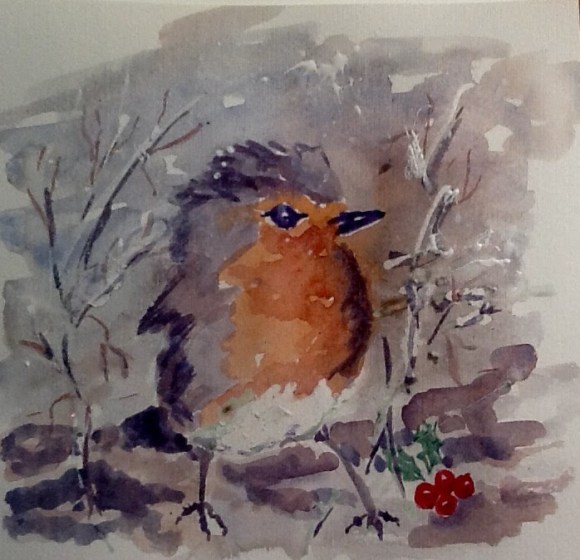
A huge thanks to all our contributors and readers, to the fabulous Borderless team without who the journal would be lost. Sohana Manzoor’s wonderful artwork continues to capture the mood of the season. Thanks to Sybil Pretious for her lovely painting. Please pause by our contents’ page to find what has not been covered in this note.
We wish you all a wonderful festive season.
Season’s Greetings from all of us at Borderless Journal.
There is someone. I am
scared of the shadow that forms
in the mirror when I stand in front
of it. The horns on my head
freak me out. This can’t be true.
No. Hell no. All of it is an illusion.
It laughs at me. The eyes are red
and they stare through me. A rugged
hand climbs to my throat like a vine.
It strangles me. Save me from this python.
Save me from this devil that lives in me.
It whispers -- urging me to commit sins
and fall. It calls me its fallen angel.
I don’t want to be. It doesn’t let me sleep.
It keeps talking in my ear to get up
and hone myself. The war against God
is coming. It’s coming sooner than
you think. I stare at the mirror again.
I see the same shadow that looks
just like me but isn’t me.
Sutputra Radheyeis a young poet from India. He has published two poetry collections — Worshipping Bodies(Notion Press) and Inqalaab on the Walls (Delhi Poetry Slam). His works are reflective of the society he lives in and tries to capture the marginalised side of the story.
.
PLEASE NOTE: ARTICLES CAN ONLY BE REPRODUCED IN OTHER SITES WITH DUE ACKNOWLEDGEMENT TO BORDERLESS JOURNAL
Meet Barun Chanda, an actor who started his career as the lead protagonist of a Satyajit Ray film and now is a bi-lingual writer of fiction and more recently, a non-fiction published by Om Books International,Satyajit Ray:The Man Who Knew Too Much in conversation Click here to read.
Jim Goodman, an American traveler, author, ethnologist and photographer who has spent the last half-century in Asia, converses with Keith Lyons. Click here to read.
Translations
Professor Fakrul Alam has translated three Tagore songs around autumn from Bengali. Click here to read.
Nagmati by Prafulla Roy has been translated from Bengali as Snake Maiden by Aruna Chakravarti. Click here to read.
A Balochi Folksong that is rather flirtatious has been translated by Fazal Baloch. Click here to read.





 Borderless