Shantanu Ray Chaudhari converses with writer Gajra Kottary, a well-known writer of Indian TV series, novels and stories. Clickhereto read.
A discussion on Samaresh Bose’s In Search of the Pitcher of Nectar, a book that takes us to the heart of the Kumbh Mela, a festival recognised by the UNESCO as an Intangible Cultural Heritage, with the translator, Nirmal Kanti Bhattacharjee. Clickhere to read.
Translations
Nazrul’s Why Provide Thorns has been translated by Professor Fakrul Alam. Clickhere to read.
Mercy, a story be P. F. Mathews, has been translated from Malayalam by Ram Anantharaman. Clickhere to read.
Songs of Freedom: Vikalangta or Disability is an autobiographical narrative by Kajal, translated from Hindustani by Janees. These narrations highlight the ongoing struggle against debilitating rigid boundaries drawn by societal norms, with the support from organisations like Shaktishalini and Pandies. Clickhere to read.
Paul Mirabile explores James Joyce’s Stephen Dedalus and his passion for words keeping in mind the hundred year old Ulysees & the even older, A Portrait of the Artists as a Young Man. Clickhere to read.
Book Excerpts
An excerpt from Radha Chakravarty’s translation of Tagore’s Farewell Song. Clickhere to read.
An excerpt or two short narratives from Rhys Hughes’ Yule Do Nicley. Clickhere to read.
The next year will do the same – we will all celebrate with Auld Lang Syneand look forward to a resolution of conflicts that reared a frightening face in 2022 and 2021. Perhaps, this time, if we have learnt from history, there will not be any annihilation but only a movement towards resolution. We have more or less tackled the pandemic and are regaining health despite the setbacks and disputes. There could be more outbreaks but unlike in the past, this time we are geared for it. That a third World War did not break out despite provocation and varied opinions, makes me feel we have really learnt from history.
That sounds almost like the voice of hope. This year was a landmark for Borderless Journal. As an online journal, we found a footing in the hardcopy world with our own anthology, Monalisa No Longer Smiles: Writings from Across the World, which had a wonderful e-launch hosted by our very well-established and supportive publisher, Om Books International. And now, it is in Om Book Shops across all of India. It will soon be on Amazon International. We also look forward to more anthologies that will create a dialogue on our values through different themes and maybe, just maybe, some more will agree with the need for a world that unites in clouds of ideas to take us forward to a future filled with love, hope and tolerance.
One of the themes of our journal has been reaching out for voices that speak for people. The eminent film critic and editor, Shantanu Ray Chaudhuri , has shared a conversation with such a person, the famed Gajra Kottary, a well-known writer of Indian TV series, novels and stories. The other conversation is with Nirmal Kanti Bhattajarchee, the translator of Samaresh Bose’s In Search of a Pitcher of Nectar, a book describing the Kumbh-mela, that in 2017 was declared to be an Intangible Cultural Heritage of Humanity by UNESCO. Bhattacharjee tells us how the festival has grown and improved in organisation from the time the author described a stampede that concluded the festivities. Life only gets better moving forward in time, despite events that terrorise with darkness. Facing fear and overcoming it does give a great sense of achievement.
In keeping with the festive season is our book excerpt from Rhys Hughes’ funny stories in his Christmas collection, Yule Do Nicely. Radha Chakravarty who brings many greats from Bengal to Anglophone readers shared an excerpt – a discussion on love — from her translation of Tagore’s novel,Farewell Song.
Love for words becomes the subject of Paul Mirabile’s essay on James Joyce’s Stephen Dedalus, where he touches on both A Portrait of the Artist as a young Man and Ulysees, a novel that completed a century this year. Love for animals, especially orangutans, colours Christina Yin’s essay on conservation efforts in Borneo while Keith Lyons finds peace and an overwhelming sense of well-being during a hike in New Zealand. Ravi Shankar takes us to the historical town of Taiping in Malaysia as Meredith Stephens shares more sailing adventures in the Southern hemisphere, where it is summer. Saeed Ibrahim instils the seasonal goodwill with native Indian lores from Canada and Suzanne Kamata tells us how the Japanese usher in the New Year with a semi-humorous undertone.
Also touching and yet almost embracing the school of Absurd is PF Mathew’s story, ‘Mercy‘, translated from Malayalam by Ram Anantharaman. Fazal Baloch has brought us a Balochi folktale and Ihlwha Choi has translated his own poem from Korean to English. One of Tagore’s last poems, Prothom Diner Shurjo, translated as ‘The Sun on the First Day’ is short but philosophical and gives us a glimpse into his inner world. Professor Fakrul Alam shares with us the lyrics of a Nazrul song which is deeply spiritual by translating it into English from Bengali.
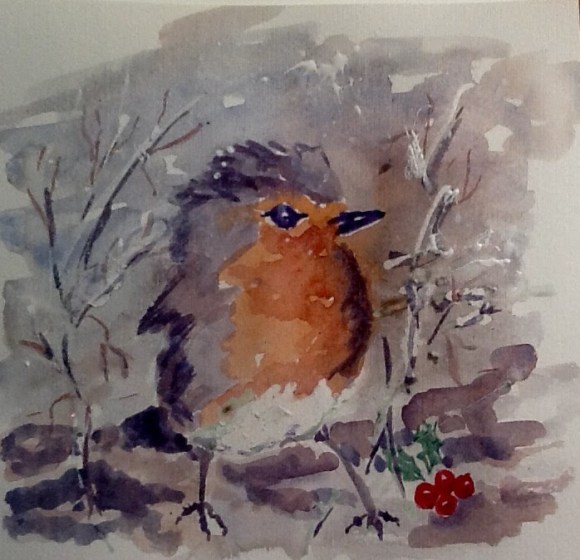
A huge thanks to all our contributors and readers, to the fabulous Borderless team without who the journal would be lost. Sohana Manzoor’s wonderful artwork continues to capture the mood of the season. Thanks to Sybil Pretious for her lovely painting. Please pause by our contents’ page to find what has not been covered in this note.
We wish you all a wonderful festive season.
Season’s Greetings from all of us at Borderless Journal.
On the last day of the year, the line at the carwash snakes all the way into the street. My family and I wait patiently in our mini-van, preparing to hose and hoover, and to slather wax onto metal. Our bodies are tired and slightly grimy. For the past two weeks, we’ve been consumed by O-soji, the traditional thorough end-of-the-year cleaning. Every window in our house has been washed. Old newspapers have been bound and toted off to the recycling center. Our floors are as shiny as mirrors.
O-soji, or “Big Cleaning”, can be quite a task for my organisationally-challenged family. As an American, I come from a country where a leading magazine encourages women to aspire to “good enough housekeeping.” Better to become a lawyer or a doctor than spend all my spare time chasing dust bunnies, I learned.
Here in Japan, however, where wiping the floor is part of a kid’s education, cleaning is serious business. And Japanese women seem to spend far more time pushing a vacuum around than their counterparts across the sea. The mother of one of my daughter’s kindergarten classmates told me that she vacuums every day! This, in a country where one has to take off one’s shoes before stepping into a house. Another mother confessed that “tidy up” were among the very first words that her son learned. On a visit to our house, my own mother-in-law once took it upon herself to line up all of the socks in my children’s sock drawer.
However, if the tendency to tidiness is hereditary, my husband apparently missed out. He often leaves a trail of dirty, balled up socks, plastic snack wrappers and empty beer cans, and the car that we are about to wash is cluttered with trash. And although my daughter is often praised by teachers at her school for her obsessive-compulsiveness – i.e., she can’t concentrate unless her pencil case is perfectly aligned with the edge of her desk and she dutifully lines up hers and others’ shoes at the entrance of her classroom – at home, she lapses into sloppiness. And my son? The floor of his room is usually layered with cast-off clothes, comic books, and school papers.
But on the last day of the year, at least, our house is as neat as the proverbial pin.
The car ahead of us finishes, and we pull up in front of the hose. The four of us clear out the empty drink containers, vacuum up crumbs and dirt, and scrub the outside of the car. When we are finished, we go home and collapse on the sofa. We will eat noodles at midnight, and then wake feeling fresh and pure, ready for the first sunrise and the first dreams of the new year.
Suzanne Kamatawas born and raised in Grand Haven, Michigan. She now lives in Japan with her husband and two children. Her short stories, essays, articles and book reviews have appeared in over 100 publications. Her work has been nominated for the Pushcart Prize five times, and received a Special Mention in 2006. She is also a two-time winner of the All Nippon Airways/Wingspan Fiction Contest, winner of the Paris Book Festival, and winner of a SCBWI Magazine Merit Award.
PLEASE NOTE: ARTICLES CAN ONLY BE REPRODUCED IN OTHER SITES WITH DUE ACKNOWLEDGEMENT TO BORDERLESS JOURNAL
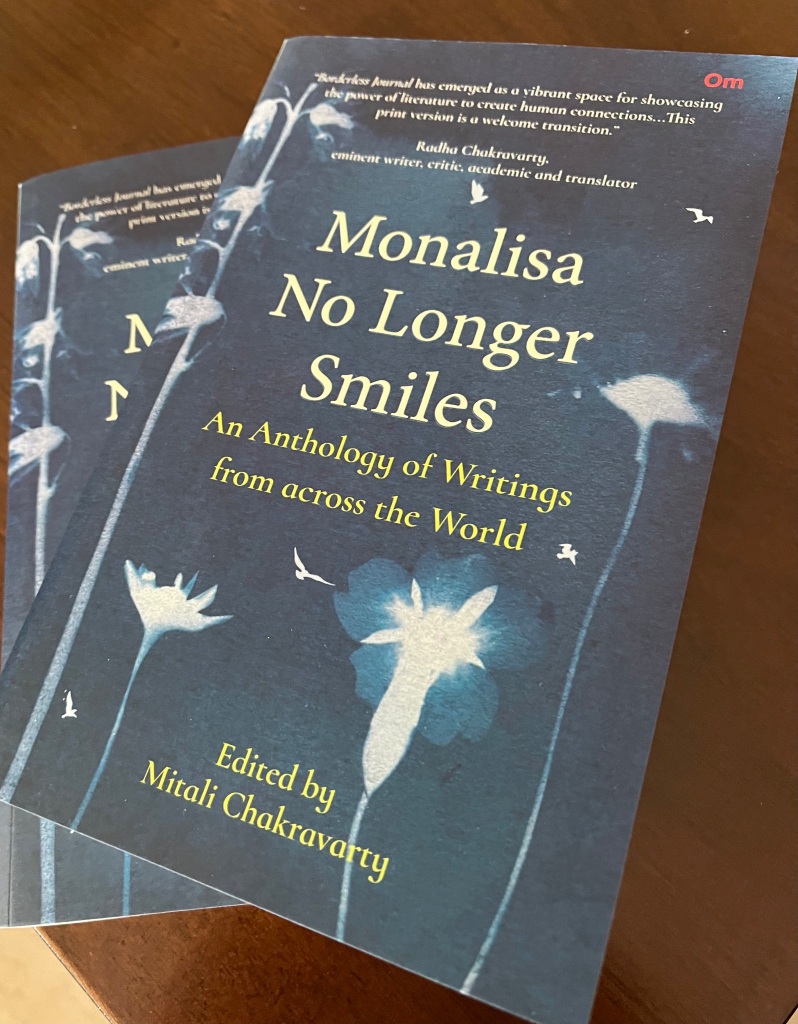
We did it! … Announcing our first anthology … Monalisa No Longer Smiles… Click here to read.
Conversations
Suchen Christine Lim, an iconic writer from Singapore in conversation about her latest book, Dearest Intimate. Click here to read.
Blazing trails, as well as retracing the footsteps of great explorers, Christopher Winnan, a travel writer, delves into the past, and gazes into the future while conversing with Keith Lyons. Click hereto read.
Saturday Afternoon is a poem by Ihlwha Choi, translated from Korean by the poet himself. Click here to read.
Tagore’s poem, Tomar Shonkho Dhulay Porey (your conch lies in the dust), has been translated from Bengali by Mitali Chakravarty as The Conch Calls. Click here to read.
Basudhara Roy has reviewed Afsar Mohammad’s Evening with a Sufi: Selected Poems, translated from Telugu by Afsar Mohammad and Shamala Gallagher. Click hereto read.
That good things happen despite darkness, despite prognostications of doom, that light glimmers hope if you strive to focus on your strength in hard times is borne true both in fiction and in life. Perhaps, we cannot get back the old ways (but is that what we want?) but new paths emerge. Old gives way to new. And while trying to gather pearls of human excellence — borne not of awards or degrees but of bringing out the best, the kindest, the most loving in human hearts — we managed to create with a team an outstanding anthology. Woven with the writings of old and new — we created a tapestry together that the editor in chief of our publishing house said was “classy, literary, engaging and international”. That one of the oldest and most reputed publishing houses in India with bookshops countrywide took it on was also an unusual event! We are truly grateful to Om Books International, Shantanu Ray Chaudhuri and Jyotsna Mehta along with all our writers and readers who made our anthology a reality, and to Radha Chakravarty and Fakrul Alam for the kind words they bestowed on our effort.
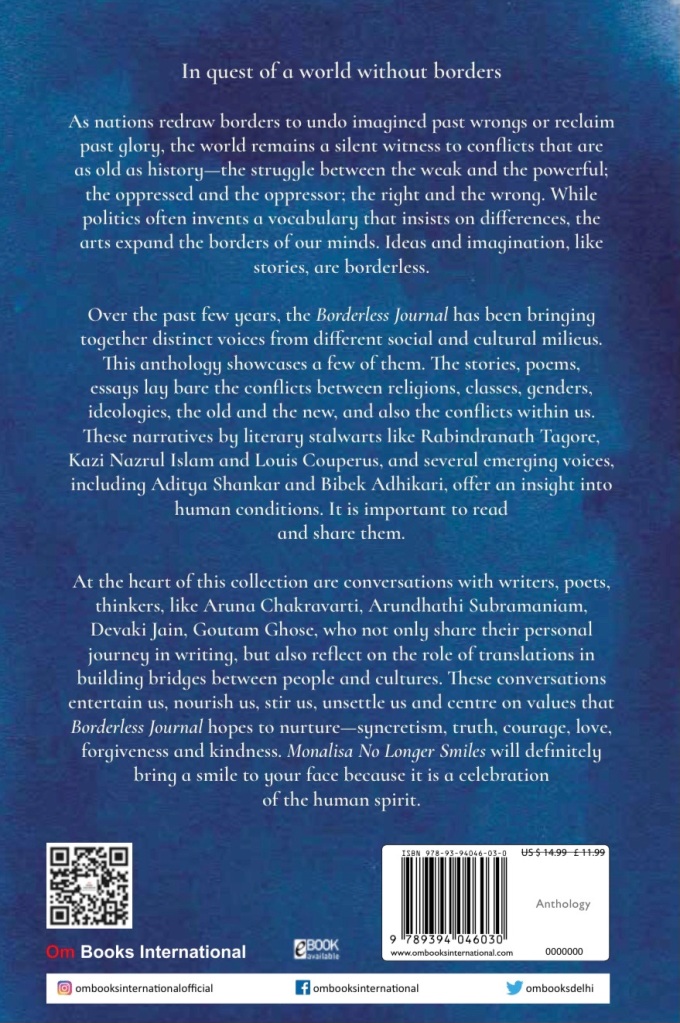
Please greet our first anthology, Monalisa No Longer Smiles, with love and friendship. It could be the perfect Christmas gift in the spirit of the season! And as the blurb says, “it will definitely bring a smile to your face because it is a celebration of the human spirit.”
The anthology is different from our journal in as much as it has a sample of an eclectic collection that has been honed with further editing and has some new features. Most of the writing is from our first year and showcases our ethos, except for Lesya’s poetry and interview. Lesya Bakun from Ukraine is still on the run, looking for a refuge — she cannot return home like you or I can. Her family is scattered across number of countries. Her cousin, who was guarding the factory at Azovstal, was taken prisoner. We included her story in the anthology hoping to create global empathy for refugees as the numbers will increase not only due to war but also due to climate change.
The reason we felt a hardcopy anthology was a good idea was because nothing beats the joy of having a bunch of interesting reads in the warmth of your hands (especially where internet cannot reach or is unavailable). In any case, books with the feel of paper, the rustling whispers which carry voices of leaves can never be replaced as Goutam Ghose had also said in his interview which is now part of our anthology.
And that is why we celebrate more books… this time we feature Singaporean prima donna of literature, Suchen Christine Lim, with her new book Dearest Intimate, a novel that spans more than hundred years including the harrowing Japanese invasion during World War II. She shared sound advice with writers: “Suffering is good for the writer. It will deepen lived experience and expand the heart’s empathy.” And perhaps that is what is echoed through the experiences of the other writer interviewed on our pages by Keith Lyons. This is a writer who not only brought out his own books but was a regular contributor of travel pieces for Frommer’s and National Geographic traveling to unexplored destinations — Christopher Winnan. Another writer Lyon had interviewed recently, Steve Carr, has passed on. We would like to convey our heartfelt condolences to his family and friends.
More translations from Bengali, Balochi and Korean enrich our November edition. Fazal Baloch has translated a story by Haneef Shareef and Rituparna Mukherjee by Shankhadeep Bhattacharya. We have the translation of an inspirational Tagore poem helping us find courage (Shonkho Dhulaye Pore or ‘the conch lies in the dust’). Another such poem by Nazrul has been rendered in English from Bengali by Professor Fakrul Alam. He has also shared an autobiographical musing on how he started translating Tagore’s Gitabitan, which also happens to be his favourite book. More discussion on the literary persona of TS Eliot and the relevance of his hundred year old poem — ‘The Waste Land’ by Dan Meloche adds variety to our essay section.
Evoking the genius of another outstanding artiste, Kishore Kumar, who happened to pen thought provoking dialogues in some films, is Shantanu Ray Chaudhuri’s essay, review of a recent book on the legendary actor-singer and an interview with the authors. Infringing the boundaries of literary with popular culture and art and integrating all forms into a wholistic bundle has been part of our ethos. In that spirit we have a musing by Prithvijeet Sinha on Edvard Munch’s famous painting called Scream. We have non-fiction from Australia spanning Meredith Stephens’s recent brush with Covid, Mike Smith visits a Scottish beach in the footsteps of a novelist, Ravi Shankar has given us a poignant piece for a late friend and Candice Lousia Daquin talks of the existence of bi-racial biases. In contrast, Suzanne Kamata sent a narrative that bridges divides showcasing a German wife of a Japanese scientist that draws us to conclude that biases erode over time to create an acceptance of bi-racial people. Devraj Singh Kalsi brings in humour with his funny narrative about a guitarist. Rhys Hughes writes in a lighter vein on Indian cuisine in his column and spouts more funny poetry bordering on the absurd.
Gathering all of your thoughts in strings of words from all corners of the world, we present to you the bumper November issue of Borderless Journal . Thank you all for sharing your thoughts with us. Thanks to Sohana Manzoor for her fantastic painting and more thanks to the whole Borderless team for seeing this issue through. We would not have been able to do the anthology or these issues without each one of you — writers and readers.
Anthony Sattin, an award winning journalist and travel writer in conversation about Nomads: The Wanderers Who Shaped our World, his recent book published by Hachette, India. Click hereto read.
VR Devika talks of the dynamic Muthulakshmi Reddy, the first woman in the world to preside over a Legislative Assembly who sought justice for Devadsis and prostitutes and discusses her book, Muthulakshmi Reddy: A Trailblazer in Surgery and Women’s Rights published by Niyogi Books. Click hereto read.
Translations
Daridro or Poverty by Nazrul has been translated from Bengali by Professor Fakrul Alam. Click here to read.
The Browless Dolls by S.Ramakrishnan, has been translated from Tamil by B Chandramouli. Click hereto read.
Two poems from Italy by Rosy Gallace have been translated from Italian by Irma Kurti. Click hereto read.
Aalo Amar Aalo (Light, My Light) a song by Tagore, has been translated by Mitali Chakravarty from Bengali. Click hereto read.
Pandies Corner
Songs of Freedom: Moh-Reenis an autobiographical story by Amreen, translated from Hindustani by Janees. These stories highlight the ongoing struggle against debilitating rigid boundaries drawn by societal norms, with the support from organisations like Shaktishalini and Pandies. Click hereto read.
Ravi Shankar recommends walking as a panacea to multiple issues, health and climate change and takes us on a tour of walks around the world. Click here to read.
Ali Jan Maqsood introduces us to a strong matriarch from a Balochi village. Click here to read.
Musings of a Copywriter
In Drill, Fill, Just Chill, Devraj Singh Kalsi gives us humour while under a dentist’s drill. Click here to read.
Notes from Japan
Suzanne Kamata writes of herA Ramble on Bizan, focussing on a writer, also by the surname of Moraes, who lived on Mount Bizan more than century ago, moving to Japan from Portugal having fallen violently in love. Click hereto read.
It stretches without borders, without interruptions, without contentions, unifying all under its life-giving ambience. We live nurtured by the sky, the water and the Earth. If we think back to times before humans made constructs and built walls to guard their own, to times when their ancestors roamed the Earth and moved to meet their needs, the population was not huge, and resources were abundant. Our species lived in consonance with nature. People revered natural forces and found trends that evolved into traditions and constructs which eventually made their progeny forget that the sky, water and Earth did not belong to them. These belong or perhaps exist for some reason that we do not comprehend despite the explanations given by science and religions. Being merely transient passers-by through these, humanity, unlike dinosaurs, has an urge to survive and be like the sky — with a past, present and future and a sense of the eternal. Though we all have short lives compared to the sky, Earth or universe, we continue to find ourselves in a homo centric world that considers all else to be made to meet their aspirations. But there was a time, when humans lacked this arrogance. They just tried to survive. And move with shifting rivers in an unbordered world.
Exploring such times, is Anthony Sattin’s profound book, Nomads: The Wanderers Who Shaped our World. He converses to reinforce reviving the concept of asabiyya or bonding between humans so that they find it in their hearts to move forward with necessary changes to avoid following in the footsteps of mammoths. A change maker who redefined constructs for humankind, a devdasi’s[1] daughter who rose to become a pioneering doctor and activist a hundred years ago, is Dr Muthulakshmi Reddy. We have an interview with her recent biographer, R Devika, who authored Muthulakshmi Reddy: A Trailblazer in Surgery and Women’s Rights.
The books reviewed this time include one featuring the writings by the greatest change maker in cinema — Satyajit Ray. Bhaskar Parichha has reviewed Satyajit Ray Miscellany: On Life, Cinema, People & Much More while Professor Somdatta Mandal has given us a candid opinion on BM Zuhara’s The Dreams of a Mappila Girl: A Memoir, translated from Malayalam by Fehmida Zakir. Taranath Tantrik and Other Tales from the Supernatural by Bibhutibhushan, translated from Bengali by Devalina Mookerjee brings unexplored dark mysterious forces into play and has been reviewed by Basudhara Roy. We have an excerpt from the titular stories of Tarantath Tantrik. Bibhutibhushan Bandopadhyay(1894-1950) was a legendary writer from Bengal. He wrote stories and novels, some of which were immortalised in cinema, such as the Apu triology by Satyajit Ray. The other book excerpt is from a translation from Kannada by an upcoming voice that needs to be heard, Maithreyi Karnoor. She has brought to the anglophone world Shrinivas Vaidya’s Handful of Sesame.
Evoking humour is not easy, but we do have a few such writers who manage it very well. Hughes has given us a tongue-in-cheek piece on the dateline, which has more than humour. And Devraj Singh Kalsi has shared his discovery that laughter is the best medicine to shrug off a dentist’s drill. He has also visited the colours of Durga Puja which, with its spirit of inclusivity, transported visitors in one marquee near Kolkata to the iconic Malaysian Twin Towers. Thus, bringing festivals in October into our purview. Candice Lousia Daquin has actually explored why we celebrate festivals and the God gene… Did you know we have a biological need for spirituality?
Suzanne Kamata has introduced us to Mount Bizan, which houses a writer by the surname of Moraes – Wenceslau José de Souza de Moraes, an expat writer who lived in Japan at the turn of the twentieth century. Wonder if he could have been related to the Anglo Indian writer, Dom Moraes? Aditi Yadav has also given us an essay on the Japanese philosophy of Wabi-sabi with its world view centred on imperfections and transience. Ravi Shankar has suggested walks for all of us, sharing his experiences in the Himalayas, the Caribbean island of Aruba and in many more places. Meredith Stephens has written of sailing to Tasmania.
The essay that brought back a flavour of home for me is one by Asad Latif, now a journalist in Singapore but long ago, he was an icon in India. We are very privileged to have his writing on what borders do for us… a piece exploring the idea on which we base our journal, also perhaps with a touch of Anthony Sattin’ s asabiyya. ‘Pandies’ Corner‘ starts another run, showcasing women’s tryst for freedom. Amreen’s ‘Moh-Reen’, her own story, translated from Hindustani by Janees, is a brave start to the series. The voices ring out asking for a change, to heal social norms to accommodate love and kindness with the backing of Shaktishalini and Pandies as does the unsupported solo voice of an older woman from Balochistan, Ganji Baloch, brought to our notice by Ali Jaan Maqsood.
We have fiction from Sohana Manzoor – again bringing to fore strange stories of women rebelling against social norms. Paul Mirabile explores death and the sea in a horrific story. Sunil Sharma’s fiction explores madness and ideators, making a social comment on recent happenings. As the sky stretches out to accommodate all kinds of writings, all creatures great and small, we try our best to give voice to a fair cross section from around the world as we have done thistime too.
There are as usual pieces that we have not mentioned in this note but they are all worth a read. Do drop in to check out our contents in this October issue. We are truly grateful to our contributors who continue to connect with words and thoughts that waft along with clouds. We would like to thank Sohana Manzoor especially for her wonderful artwork. The journal would not be a possibility without the support of the whole team and our valuable readers who make writing worth the effort. It is lovely to be read and remembered for the words we write.
        “The mountain in Awa rises in the sky like a nicely curved eyebrow
            Seeing it above the horizon, a boat is heading toward it
                     Where will it stay tonight?”
                  -from the Manyoshu, 8th century
Mt Bizan: Photo Courtesy: Suzanne Kamata
In his 1919 essay, “Impressions of a Walk,” the Portuguese expatriate Wenceslau de Moraes[1]wrote of hiking up Bizan during koharu, “the small spring” – “a delightful and rapid transition from the suffocating heat of summer to the cool breeze of the winter.” After sailing around the world, Moraes settled in Tokushima for the last sixteen years of his life. He purportedly hiked up Bizan, the prefecture’s most emblematic mountain, every day.
I have lived in Tokushima Prefecture for over twenty years now, but it’s been a while since I’ve been on the mountain. A recent popular movie, “Bizan,” was filmed on its slopes as well as at the hospital where my children were born, and the university where I teach part time. Some of my students appear as extras in the festival dance scene toward the end. It is this movie that has spurred my own outing.
My excursion to the top of Bizan begins on a day between seasons as well. A week or so ago, I was scraping ice from my windshield. Now I am getting ready to set out without a jacket under a clear blue sky. My plan is to drop my daughter off at school, and then walk to the ropeway station at the base of the mountain. Caught up in the usual frenzy of morning preparations, I cannot seem to locate my backpack. I stuff a field guide, my notebook, a photocopy of Moraes’ essay from his book Oyone and Koharu: Essays of a Portuguese Recluse in Japan, a novel, and sunglasses into a cavernous Louis Vuitton handbag my mother-in-law had given me as a gift. Then I load my daughter and her stuff into my car, and off we go.
Bizan, or “Eyebrow Mountain,” is visible from almost any point in Tokushima City. I see it every morning, off to the right, as I drive along the Yoshino River. It’s there, glimpsed through tall buildings, as I wait at a traffic light in the city. And it looms at the end of the main road stretching in front of the train station. Jackucho Setouchi, a Buddhist nun, and the most famous and prolific Tokushima-born writer, concurred in her book of autobiographical fiction Places, writing, “If I was playing by myself on the Nakazu wharf, or in the open field where once a year a circus came and set up tents, I could turn around and there was Mt. Bizan. I would look up to it in mild wonder.”
As mountains go, it’s not all that spectacular. Moraes referred to it as a hill. It is actually part of the Shikoku Mountain Range that stretches into southern Tokushima and is separated from the Sanuki Mountain Range by a river valley. There are taller peaks in the prefecture – Tsurugi-san, at 1955 meters, is the highest, but Bizan (294 meters), with its gentle slopes and more or less flat top, is perhaps the most distinctive. And the mountain is rich in culture and history.
After I drop my daughter off, I walk through Tokushima Park, then through a flurry of cars, blinking neon, and traffic signals chirping for the blind. I pass the shopping arcade, the headquarters of the religious cult Kofuku no Kagaku, and the red gates of a Shinto shrine to arrive at the Awa Odori Kaikan, which houses the ropeway station. From the base, the mountain appears easily surmountable – less than an hour to the top. But I’m not in the best of shape, and I have this heavy handbag, so I decide to take the gondola as planned.
The ride lasts about fifteen minutes. Up at the top there is a profusion of vending machines and small buildings – a café, a cell-phone transmission tower, and a white pagoda in the Burmese style. I recognise the pagoda from a scene from the movie. There is also a small museum devoted to Wenceslau de Moraes, perhaps Tokushima’s most famous expatriate. I make this my first stop.
Hiraoka-san, a small, genial grey-haired man in a jean jacket, gives me the grand tour in English. The exhibit includes some of the many books written by Moraes – both the original Portuguese versions and Japanese translations – as well as photos, his writing desk, smoking implements and bowler hat.
On the wall there are scenes from the puppet play based on the life of Moraes. The script was written by Setouchi[2]. Under glass, I see a pamphlet from a Japanese movie inspired by the bushy-bearded European sailor.
Hiraoka-san shows me the letters of appointment Moraes received from three Japanese Emperors – those of the Meiji, Taisho and Showa eras – for the position of Portuguese consul in Kobe. Moraes met with Emperor Meiji three times. There is also a model of the ship Moraes sailed on which Hiraoka-san says, “is like the one in Pirates of the Caribbean with Johnny Depp.”
Moraes first came to Japan as a member of the Portuguese navy. He’d been to other places – Mozambique, where, according to his translator Kazuo Okamoto, he’d fallen “violently and foolishly in love” with Arrussi, a woman referred to as “Miss Africa”; and Macao, where he’d bought and married Atchan, the mixed race daughter of an English father and a Chinese mother, with whom he’d had two sons and then deserted– before he took on the position of Portuguese consul in Kobe in 1899. Moraes married 25-year-old Oyone, in 1900, when he was 45 years old. She died at the age of 38, and her ashes were entombed at Chonji Temple in Tokushima, where Moraes took up residence in 1913. He visited her tomb daily, but her relatives denied his request to have his own ashes buried with hers. He later lived with Oyone’s cousin, Koharu, who became his common law wife. She, too, died young.
Moraes lived in a house at the base of Bizan, where he enjoyed gardening and, presumably, writing. He published two collections of essays about Tokushima in his native language – Oyone and Koharu and Bon Odori in Tokushima: Essays of a Portuguese Hermit in Japan. With his long white beard and kimono dyed with the locally grown indigo, he must have caused quite a stir among the locals. His first impression of Tokushima was “that along the way to the modest domicile which had been destined for me was a dominating and agreeable impression of – green. Green plunging into my aesthetic eyes! Green that rushed into my nose. Green, nothing more – an impression so strong, so all-inclusive that I could scarcely pay attention to the details of the scene spread in front of me.”
And yet he did manage to write in great detail and with much feeling of everything he observed around him. From the mountain, he saw “the houses thickly clustered together – small houses, and of wood of course — extend over a vast plain of silt on the complex waterways of the river Yoshino, from the coast to the foot of the hill ranges which bound it: a population of nearly seventy thousand, including four or five Europeans of whom I am one, but this, of course, is not mentioned in the books.”
From the top of Bizan, one can still see an expanse of greenery, the harbour adrift with boats, and ships in the Kii Channel. On a clear day, Awaji Island is visible. Down below, while wooden houses remain, white concrete apartments, schools, and office buildings tend to dominate. Shikoku is still the smallest and least populated of Japan’s four main islands, but Tokushima Prefecture now has a population of approximately 810,000, of about 6,000 whom are foreigners.
I am one of them, a woman from the United States. Like Moraes, I seek to convey the atmosphere and culture of Tokushima to the people of my native country, most of whom have never heard of this place, through my writing. Like Moraes, I have settled here with a spouse. But of course, I am not nearly so conspicuous as he was. In twenty-first century Tokushima, my blond hair blends with the dyed hair of the youth of the city. And I’m not a hermit, not hiding from the world.
Thinking to fortify myself before heading off on one of the designated walking trails, I duck into the Bizan café just outside the gondola station. I stand before a vending machine offering tickets for the usual fare – curry rice, pilaf and udon – but a woman bustles out from a back room and makes an “X” with her fingers. The shop isn’t open for business yet.
I meander down to a weathered wooden bench shaded by walnut and bayberry trees. Off in the distance, I can hear a train rumbling over the tracks; closer by, birds twitter and chirp and the brush rustles with life. I’m told that there are rabbits and monkeys on this mountain, as well as a fair share of stray cats and dogs. Here and there, signs warn of mamushi, a reddish brown snake with leopard spots whose bite can be fatal. In the early 1900s, residents sought to ward off the snakes with exorcisms written on paper. Moraes himself wrote, “My humble house is completely defended with these pieces of paper.”
I wander until I come across a white gazebo, complete with weathervane. According to a plaque, this structure was a gift from Saginaw, Tokushima’s sister city. It reminds me of a bandstand in Michigan where I grew up, of sitting on a blanket with my grandparents in summer, listening to a small orchestra. In a few months, it will offer a retreat from the blazing sun. Now, I stand under its roof and gaze out at the ribbon of river. Straight ahead, on the opposite bank, I can see the school where my son is learning to write Chinese characters.
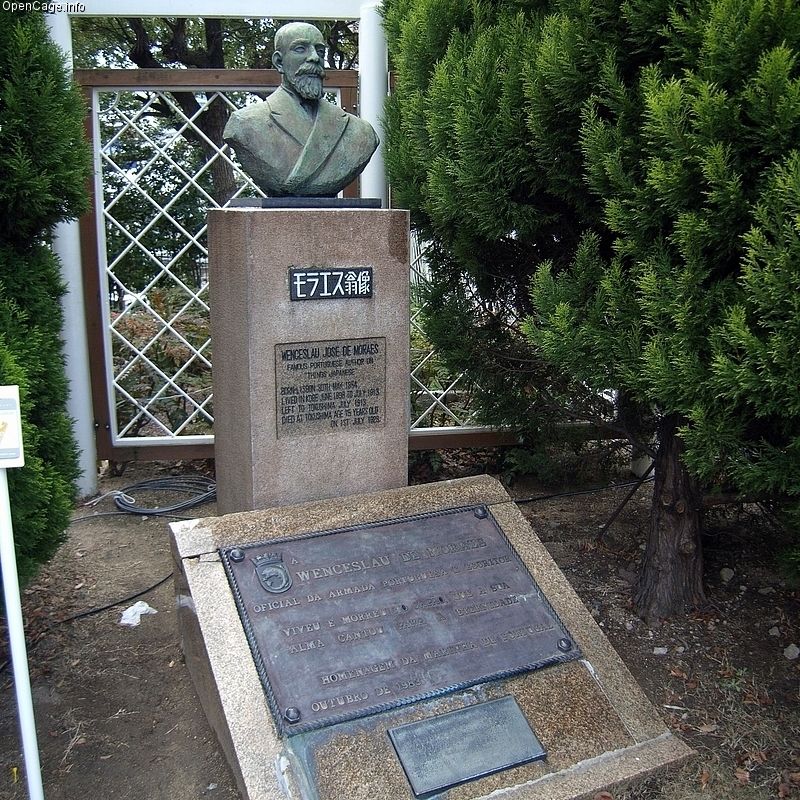
I walk a bit more, past the statue of Moraes and his dog, past the rhododendron bushes with their first intimations of spring, a hint of red, and down the hill to – what’s this, an apartment building? No, it’s a government-sponsored hotel – the Bizan Kanpo. My daughter’s kindergarten once had a sleepover at this place. I remember now that we walked up this hill for a night-time festival. The parents and teachers supervised while the children played ring toss games by lantern light. In the morning we performed “radio exercises” in the park.
Now I see a few people picnicking on benches, and I’m sorry that I didn’t bring my own lunch. I’m famished by this time, so I make my way back to the café, which is now open. I order a bowl of noodles and settle at a table covered with tie-dyed indigo cloth. There are only a couple of other customers – a pilgrim dressed all in white, his peaked straw hat resting on the counter as he takes a break between temples – and a man who works on the mountain. As I eat, I look out upon Shiroyama, a hill hunched at the center of the city, the site of the ancient shogun’s castle, and the town hall where the record of my marriage is stored.
Although I purchased a round-trip ticket on the ropeway, I decide to hike down. How hard could it be? I find the shortest route on the map, one that I think will take me to my starting point, but almost immediately I wonder at the wisdom of this decision. All morning I have been tramping up and down concrete steps and sidewalks, but this is an actual hiking trail. The steep, narrow path is strewn with dry leaves, which may be slippery. I don’t have a walking stick, and instead of a backpack, I’ve got this handbag hooked over my arm. There is also the question of snakes.
Nevertheless, I begin to pick my way down the incline, imagining Moraes nearly a century ago in these same woods in his kimono. I grab onto tree trunks and seek purchase on protruding roots and rocks. My thighs burn with the effort.
The forest is so dense that I can’t see the city beyond. No one is on the trail behind or ahead of me. No one knows where I am. It’s an odd feeling, here in this densely populated country where I am so seldom truly alone. All I can hear is the wind in the trees, and what I take to be birds rustling the leaves as they forage for food.
Although I’m tempted to pull out my field guide and try to identify some flora or fauna – were those grey-tailed birds that just flew past starlings or brown-eared bulbuls? – there are no stumps for sitting, no spots for rifling through my bag. I keep going until I spot a paved road through the trees. The trail seems to suddenly drop off to this road.
It’s a couple of meters to the ground below. I start looking for a sturdy branch that I might be able to use to vault myself down, and then I see a businessman strolling up the road. Maybe he’s out for his daily constitutional. Crouched here on the side of the mountain with my Louis Vuitton bag, I suddenly feel ridiculous. I hold myself very still and hope that he doesn’t notice me. When he’s out of sight, I manage to scoot down without scraping myself on the rocks.
Through the trees I can now see some familiar landmarks, and I know that no matter where I end up, I’ll be able to find my way back. And then I come to a set of stone stairs, and I remember climbing these very steps fifteen or sixteen or maybe seventeen years ago to drink with friends beneath the cherry blossoms.
I see that paper lanterns printed with “Asahi Beer” have already been strung across the path in anticipation of this year’s flower viewing. Soon, it will be time for the azalea festival in the Sako neighbourhood where my husband grew up.
Almost a hundred years ago, Moraes was enraptured by the pink and purple blossoms. In May of 1915 he wrote, “How beautiful the mountains are! The azaleas, above all, are most delicious, and the charm of this rosy colour, the profusion of blooms, transforms the entire mountain into a garden. I contemplate the spectacle, resting on an old piece of tumulus stone; the mountain where I am is a cemetery, as is almost every slope of this land. And in sight of the graves I want to shout, ‘Get up, you who are sleeping, come and enjoy with me the rapture of these flowers! You cannot be dead when all of nature is awaking!”
I think of these words when I see the jizo along the path. These are stone statues tied with red bibs, which represent the spirits of dead infants, especially aborted or stillborn babies. Brooms made from twigs have been left beside the shrines for caretaking. Moraes, who lost both his first Japanese wife, and his second common-law wife, Koharu, was often preoccupied with death. Though he wrote of the burgeoning nature on Bizan, he also wrote of the jizo, funeral processions, the tending of the butsudan, posthumous names, and the crematorium on the mountain.
At last, I come out in front of the red-gated shrine next to the gondola station. I pass the stone shishi – guardian lion-dogs – and a statue of a figure performing radio exercises, and then I’m on flat ground.
After I pick up my daughter from school, I drive along the Yoshino River and look to the left, to Bizan. I can pick out the hotel and the cell phone transmission tower, and the slope where I’d made my way down. This mountain has been here for centuries — it is the burial site of feudal lords, an inspiration to poets and novelists, a home to small animals, and a film location.
In a hundred years it will still be there. I wonder what other expatriates and Japanese will write about Eyebrow Mountain a century from now. Who will Bizan next inspire?
[2] Jackucho Setuchi, Japanese nun and writer (1922-2021)
Suzanne Kamatawas born and raised in Grand Haven, Michigan. She now lives in Japan with her husband and two children. Her short stories, essays, articles and book reviews have appeared in over 100 publications. Her work has been nominated for the Pushcart Prize five times, and received a Special Mention in 2006. She is also a two-time winner of the All Nippon Airways/Wingspan Fiction Contest, winner of the Paris Book Festival, and winner of a SCBWI Magazine Merit Award.
PLEASE NOTE: ARTICLES CAN ONLY BE REPRODUCED IN OTHER SITES WITH DUE ACKNOWLEDGEMENT TO BORDERLESS JOURNAL
Meet Barun Chanda, an actor who started his career as the lead protagonist of a Satyajit Ray film and now is a bi-lingual writer of fiction and more recently, a non-fiction published by Om Books International,Satyajit Ray:The Man Who Knew Too Much in conversation Click here to read.
Jim Goodman, an American traveler, author, ethnologist and photographer who has spent the last half-century in Asia, converses with Keith Lyons. Click here to read.
Translations
Professor Fakrul Alam has translated three Tagore songs around autumn from Bengali. Click here to read.
Nagmati by Prafulla Roy has been translated from Bengali as Snake Maiden by Aruna Chakravarti. Click here to read.
A Balochi Folksong that is rather flirtatious has been translated by Fazal Baloch. Click here to read.
                     “Where are the songs of Spring? Ay, where are they?
                      Think not of them, thou hast thy music too…”

                                 — John Keats (1795-1851), To Autumn
Art by Sybil Pretious
For long writers have associated autumn with “mellow wistfulness”. That loss of spring, or loss of youth is not bleak or regretful has been captured not just by Keats but also been borne out by historical facts. Anthropocene existence only get better as the human race evolves … If we view our world as moving towards an autumn, we perhaps, as Keats suggests, need to find the new “music” for it. A music that is ripe and matures with the passage of time to the point that it moves more towards perfection. Though sometimes lives fade away after autumn gives way to winter as did those of Queen Elizabeth II (April 21st 1926 – September 8th 2022) after a reign of seventy historic years and Mikhail Gorbachev (2nd March 1931 – 30thAugust 2022) with his admirable efforts to bridge divides. Both of them have left footprints that could be eternalised if voices echo in harmony. Thoughts which create bonds never die – they live on in your hearts and mine.
Imagine… ten thousand years ago, were we better off? Recorded history shows that the first war had already been fought 13,000 years ago. And they have continued to rage – but, at least, unlike the indomitable Gauls in Asterix[1] comics – not all jumped into the fray. They did during the last World Wars — which also led to attempts towards institutionalising humanitarian concerns and non-alignment. Yes, we have not had a perfect world as yet but as we age, the earth matures and we will, hopefully, move towards better times as we evolve. Climate change had happened earlier too. At a point, Sahara was green. Continental shifts split Pangaea into seven continents – that was even earlier. That might have driven the dinosaurs to extinction. But I am sure mankind will find a way out of the terror of climate change and wars over a period of time, as long as we believe in deciphering the sounds of autumn as did Keats in his poem.
Tagore had also sung of the joys of autumn which happens to be a time for festivities. Professor Fakrul Alam has translated three such songs, reflecting the joie de vivre of the season, The translation of a small poem, Eshecche Sarat[2], brings the beauty of the season in Bengal to the fore. We have a celebration of youth and romance in a Balochi folksong, an anti-thesis to autumn and aging, translated for us by Fazal Baloch and also, poetic prose in quest of God and justice by Haneef Sharif, translated from Balochi by Mashreen Hameed. Lost romance recapitulated makes interesting poetry is borne out by Ihlwha Choi’s translation of his own poem from Korean. But the topping in our translation section is a story called ‘Nagmati[3]’ by eminent Bengali writer, Prafulla Roy, translated by no less than a Sahitya Akademi winning translator – Aruna Chakravarti. This story illustrates how terrifying youthful follies can lead to the end of many young lives, a powerful narrative about the snake worshipping community of Bedeynis that highlights destruction due to youthful lusts and an inability to accept diverse cultures.
When this cultural acceptance becomes a part of our being, it creates bonds which transcend manmade borders as did the films of Satyajit Ray. His mingling was so effective that his work made it to the zenith of an international cinematic scenario so much so that Audrey Hepburn, while receiving the Oscar on his behalf, said: “Dear Satyajit Ray. I am proud and privileged to have been allowed to represent our industry in paying tribute to you as an artist and as a man. For everything you represent I send you my gratitude and love.”
This and more has been revealed to us in a book,Satyajit Ray: The Man Who Knew Too Much, authored by a protagonist from Ray’s film, Barun Chanda. This book brought out by Om Books International reflects not just Ray as a person but also how he knitted the world together with his films and took the Indian film industry to an international level. Barun Chanda has been interviewed with a focus on Satyajit Ray. Keith Lyons has also interviewed a man who has defied all norms and, in the autumn of his life, continues his journey while weaving together cultures across, China, India and Thailand by his ethnographic studies on tribes, Jim Goodman. Goodman says he left America when speaking for a war-free world became a cause for censorship. This makes one wonder if war is a game played for supporting a small minority of people who rule the roost? Or are these ramblings of a Coleridge writing ‘Kubla Khan’ under the influence of narcotics?
Poetry also brings the season into our pages with an autumnal interpretation of life from Michael Burch. More poetry from Sunil Sharma, Ryan Quinn Flanagan, Gayatri Majumdar, George Freek, Ron Pickett, Sutputra Radheye, Marianne Tefft brings a wide range of concerns to our pages – from climate to the vagaries of human nature. Poetry by an Albanian writer, Irma Kurti, and photographs by her Italian spouse, Biagio Fortini, blend together the colours of humanity. Rhys Hughes as usual, makes it to the realm of absurd – perhaps voicing much in his poetry, especially about the environment and human nature, though he talks of woodpeckers on Noah’s ark (were there any?) and of cows, yetis, monkeys and cakes… He has also given us a hilarious cat narrative for his column. Can that be called magic realism too? Or are the edges too abstract?
A book excerpt from Hughes’ Comfy RascalsShort Fiction and a review of it by Rakhi Dalal makes us wonder with the reviewer if he is a fan of Kafka or Baudelaire and is his creation a tongue-in-cheek comment on conventions? A book review by Hema Ravi of Mrutyunjay Sarangi’s A Train to Kolkata and Other Stories and another by Bhaskar Parichha of Netaji Subhash Chandra Bose’s Life, Struggle and Politics, authored by Netaji’s nephew’s wife, Krishna Bose, translated and edited by her son, Sumantra Bose, unveils the narratives around his life and death.
A leader who quested for freedom and roamed the world after being passed over by the Congress in favour of Nehru, Netaji raised an army of women who were trained in Singapore – not a small feat in the first half of the twentieth century anywhere in the world. His death in an air crash remained an unsolved mystery — another one of those controversies which raged through the century like the Bhawal case. In his review, Parichha spells out: “Aiming to bring an end to the controversies and conspiracy theories surrounding the freedom fighter, the over 300-page book gives a detailed and evidence-based account of his death in one of its chapters.”
Our non-fiction also hosts humour from Devraj Singh Kalsi about his interactions with birds and, on the other hand, a very poignant poetic-prose by Mike Smith reflecting on the vagaries of autumn. From Japan, Suzanne Kamata takes us to the Rabbit Island – and murmurings of war and weapons. We have the strangest story about a set of people who are happy to be ruled by foreign settlers – we would term them colonials – from Meredith Stephens. G Venkatesh delights with a story of love and discovery in Korea, where he had gone in pre-pandemic times. Paul Mirabile travels to Turkey to rediscover a writer, Sait Faik Abasiyanik (1906-1954). And Ravi Shankar gives us an emotional story about his trek in the Himalayas in Nepal with a friend who has passed on. Candice Louisa Daquin has written of the possibilities towards integrating those who are seen as minorities and marginalised into the mainstream.
The edition this time is like Autumn – multi-coloured. Though I am not able to do justice to all our contributors by mentioning them here, my heartfelt thanks to each as every piece only enriches our journal. I urge you to take a look at the September edition.
I would like to give huge thanks to our readers and our team too, especially Sohana Manzoor and Sybil Pretious for their artwork. We could not have come this far without support from all of you.
[1] The men in the indomitable Gaulish village (which the Romans failed to conquer) in times of Julius Caesar loved to jump into a fight for no reason…Asterix was the protagonist of the comics along with his fat friend Obelix












 Borderless