Written in summer of 1899, the poem, ‘Jonmodiner Gaan or Birthday Song’ by Tagore, was later converted to a song, ‘Bhoy Hote Tobo Abhayomaajhe’ (translates as ‘Amidst Fears, May Fearlessness’), by the maestro himself. It can be found in Gitabitan but was published originally as a part of his collection of poems called Kalpana, published in 1900.
Rabindranath Tagore (7th May 1861- 7th August 1941) Courtesy: Creative Commons
BIRTHDAY SONG

Amidst fears, may fearlessness
             Find new life, O Lord.
May poverty be erased by inexhaustible wealth,
May doubt give way to the haven of truth,
Inertness to new-born vitality —
           Confer upon me new life, O Lord.

Amidst my self-centred desires,
          O Lord, may your benevolence
Kindle the yearning for
         Your divine work —
Unite us all;
Amidst joys and sorrows,
Help us find peace —
      Confer new life upon me, O Lord
Below is a rendition of Tagore’s song, Bhoy Hotey Tobo Abhayo Majjhe, by a well-known modern vocalist, Sahana Bajpaie.
(This poem has been translated by Mitali Chakravartywith editorial support from Sohana Manzoor)
PLEASE NOTE: ARTICLES CAN ONLY BE REPRODUCED IN OTHER SITES WITH DUE ACKNOWLEDGEMENT TO BORDERLESS JOURNAL
The night has nearly come to an end.
The old year is almost past.
Under this dust, it will lay down
Its worn-out life at last.
Whether friend or foe,      wherever you go,
Old wrongs cast
Away. On this auspicious day,
Old grievances shed as the old year parts.

— Nobo Borshe or on New Year by Tagore
Art by Sohana Manzoor
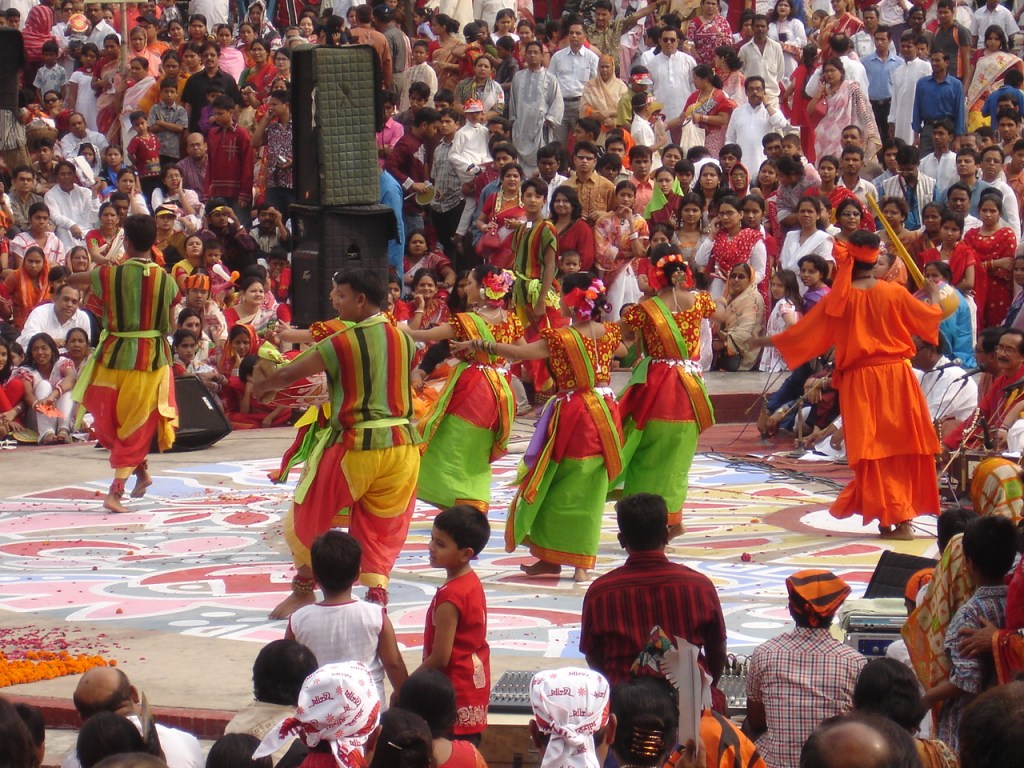
Mid-April, Thailand celebrates Songkran and Cambodia, Thingyan — water festivals like Holi. These coincide with the celebration of multiple New Years across Asia. Sikhs celebrate Baisakhi. Kerala celebrates Bishu and Tamil Nadu, Puthandu. Nepal celebrates Nava Varsha and Bengal Nobo Borsho or Poila Boisakh. A translation of Tagore’s poem on the Bengali New Year in spirit asks us to dispense with our past angst and open our hearts to the new day — perhaps an attitude that might bring in changes that are so needed in a world torn with conflicts, hatred and anger. The poet goes on to say, “I want to tie all lives with love” but do we do that in our lives? Can we? Masud Khan’s poems on love translated by Professor Fakrul Alam explore this from a modern context. From Korea, Ihlwha Choi tells us in his translation, “Loving birds is like loving stars”. But the translation that really dwells on love bringing in changes is Nabendu Ghosh’s ‘Gandhiji’, translated by Ratnottama Sengupta, his daughter. The short story by Ghosh highlights the transformation of a murderous villain to a defender of a victim of communal violence, towering above divides drawn by politics of religion.
Another daughter who has been translating her father’s works is Amna Ali, daughter of award-winning Punjabi writer, Nadir Ali. In ‘Khaira, the Blind‘, the father-daughter duo have brought to Anglophone readers a lighter narrative highlighting the erasure of divides and inclusivity. A folktale from Balochistan, translated by Fazal Baloch, echoes in the footsteps of ‘Emperor’s New Clothes’ — a story that can found in the Andersen’s Fairy Tales published in the nineteenth century. I wonder which narrative had come first? And how did it cross cultures retaining the original ideas and yet giving it a local colour? Was it with traders or immigrants?
That such narratives or thoughts are a global phenomenon is brought to the fore by a conversation between Keith Lyons and Asian Australian poet Adam Aitken. Aitken has discussed his cross-cultural identity, the challenges of travel, writing, and belonging. Belonging is perhaps also associated with acceptance. How much do we accept a person, a writer or his works? How much do we empathise with it — is that what makes for popularity?
Cross cultural interactions are always interesting as Rhys Hughes tells us in his essay titled ‘My Love for RK Narayan’. He writes: “Narayan is able to do two contradictory things simultaneously, namely (1) show that we are all the same throughout the world, and (2) show how cultures and people around the world differ from each other.” The underlying emotions that tie us together in a bond of empathy and commonality are compassion and love, something that many great writers have found it necessary to emphasise.
Mitra Phukan’sWhat Will People say?: A Novel is built around such feelings of love, compassion and patience that can gently change narrow norms which draw terrifying borders of hate and unacceptance. We carry an excerpt this time from her ‘Prologue’. Somdatta Mandal has reviewed Chitra Banerjee Divakurni’s latest , Independence. Starting from around the time of the Indian Independence too is Song of the Golden Sparrow – A Novel History of Free India by Nilanjan P. Choudhary, which has been discussed by Rakhi Dalal. The Partition seems to colour narratives often as does the Holocaust. Sometimes, one wonders if humanity will ever get over the negative emotions set into play in the last century.
Closer to our times, when mingling of diverse cultures is becoming more acceptable in arts, Basudhara Roy introduces us to Bina Sarkar Ellias’s Ukiyo-e Days…Haiku Moments, a book that links poetry to a Japanese art-form. While a non-fiction that highlights the suffering of workers by enforcing unacceptable work ethics, Japanese Management, Indian Resistance: The Struggles of the Maruti Suzuki Workersby Anjali Deshpande and Nandita Haksar has been reviewed by Bhaskar Parichha. The narrative, he writes, “tells the story of the biggest car manufacturer in India through the voices of the workers, interviewed over three years. They give us an understanding that the Maruti Suzuki revolution wasn’t the unmitigated success it was touted to be when they tell us about their resistance to being turned into robots by uncompromising management.” That lack of human touch creates distress in people’s hearts, even if we have an efficient system of management and mass production is well elucidated in the review.
These changes are reflected in our musings too. Sengupta has written on how change is wrought on a murderous villain by the charisma of Gandhi in her father’s fiction, as well as this world leader’s impact on Ghosh and her. Devraj Singh Kalsi addresses food fads with a pinch of sarcasm. From Japan, Suzanne Kamata has written of a little island with Greek influences, a result of cultural ties brought in by the emperor Hirohito. Ravi Shankar takes us to Pokhara, Nepal, and Meredith Stephen expresses surprise on meeting a shipload of people from Colorado in the far reaches of the Southern Hemisphere while on her sailing adventures with beautiful photographs. Stories by moderns reflect diverse nuances depicting change. While Brindley Hallam Dennis writes of the passing of an era, PG Thomas integrates the past into the present to reflect how they have a symbiotic structure in the scheme of creating or recreating natural movements through changes wrought over time in his story. Paul Mirabile explores the darker recesses of the human existence in his fiction. As if in continuation, the excerpt from Rhys Hughes’ The Wistful Wanderings of Perceval Pitthelmseems to step out of darker facets of humanity with a soupçon of wit at its best.
To create a world that endures, one looks for values that create inclusivity as reflected in these lines from Charles Chaplin’s My Autobiography, “Mother illuminated to me the kindliest light this world has ever known, which has endowed literature and the theatre with their greatest themes: love, pity and humanity.” This quote starts off a wonderful essay from film-buff Nirupama Kotru. Her narrative carries the tenor of Chaplin’s ‘themes’ to highlight not only her visit to the actor’s last home in Switzerland but also glances at his philosophy and his contributions to cinema across borders.
Our issue rotates around changes and the need for love and compassion to rise in a choral crescendo whirling with the voices of Tagore, Charles Chaplin as well as that of twenty-first century writers. Perhaps this new year, we can move towards a world – at least an imagined world — where love will wipe away weapons and war, where love will take us towards a future filled with the acceptance of myriad colours, where events like the Partition and the Holocaust will be history, just like dinosaurs.
Huge thanks to all our readers and contributors, some of whom may not have been mentioned here but are an integral and necessary part of the issue. Do pause by our April edition. I would also like to give my thanks to our indefatigable team whose efforts breathe life into our journal every month. Sohana Manzoor needs a special mention for her lovely artwork.
Written in April 1894 for the Bengali New Year, Tagore’s poem, Nobo Borshe, was part of his poetry collection called Chitra, published in 1896.
Bengali New Year Celebrations in Dhaka. Courtesy: Creative Commons. Poila Boisakh or Bengali New Year is celebrated in West Bengal, India and Bangladesh. Huge festivities are held in Santiniketan, the University started by Tagore. Multiple Asian New Years across Thailand, Nepal, India and more countries are celebrated mid-April.
The night has nearly come to an end.
The old year is almost past.
Under this dust, it will lay down
Its worn-out life at last.
Whether friend or foe,    wherever you go,
Old wrongs cast
Away. On this auspicious day,
Old grievances shed as the old year departs.

Today, I make new resolutions
Within my heart.
But, when I am reborn, maybe,
I will not recollect this part.
My judgement, perchance,    might be harsh.
Another’s tearful pleas thwart.
On this new-year’s morn,
I beg for clemency from the start.

As today blends into the morrow,
the future continues, unfathomable.
Will the current love and happiness
Still persist, be stable?
The flickering light     may stop tomorrow night.
Our home may be steeped with sable.
Come, this New Year’s Day,
Give what you are able.

Vast and limitless is this world.
There are so many countries.
Where will we find the confluence of
All these people and their synergies?
Spread good cheer,    with a smile appear,
Like flowers on the same trees.
If you cannot do this daily,
At least come close once please.

The time to meet will pass.
We do not know where we will go.
In the middle of eternity, we may
Never find friend or foe.
Joys and sorrows     will leave no furrows,
They will disappear like bubbles. So,
Glance at your beloved’s
Face forevermore.

For our own personal petty gains,
We raise a ruckus.
For self-conceit and blind beliefs,
We become unjust.
Today I give my best,     I dedicate
My life thus —
I will be content with what you give,
And not expect too much.

I will embrace with daily patience,
All burdens and sorrows.
I will tread the difficult path, my
Life’s mission follow.
If I break my vow,    weakened by this tired brow,
With humility, I will my head bow.
I will accept the burden
Of all my flaws.

If life seems meaningless, if there are sorrows —
They are all in transience.
It will all be wiped away in life’s
Futile insipience.
Are you alone on this earth?    Beauty, pain, hurts,
Can be found in all ambience.
You are but a tiny speck in the
Endlessness of human existence.

As long as you exist, shine
Like a star.
If you do not find happiness,
Let there be peace in your heart.
If you cannot survive,     timeless conflicts outlive,
If defeats bar,
Then learn to die with
Sincerity on your part.

In this life’s journey, who can say how
Far we need to go
While stepping on the razor’s edge of
Heartrending sorrow?
Again, in the dark,     we walk the fiery path.
At least on this day, please pardon.
With the old year
Let all the old grudges go.

There goes, there goes the time,
My past departs.
On this dawn, with tears express
Your indebtedness, O heart.
Fill the cup of life    with joys and strife.
Tell her, her memories will stay past
All times, forever.
I dedicate to you my past.

This dawn heralds new life in the
New Year.
I want to tie all lives with love,
But I hesitate, I fear.
Do not send away     visitors on this day.
Welcome the New Year,
Filling the pitcher with
Virtuous tears.
This poem has been translated by Mitali Chakravarty with editorial support from Sohana Manzoor and Anasuya Bhar
PLEASE NOTE: ARTICLES CAN ONLY BE REPRODUCED IN OTHER SITES WITH DUE ACKNOWLEDGEMENT TO BORDERLESS JOURNAL
Imagine a world without wars, without divisions, where art forms flow into each other and we live by the African concept of Ubuntu — I am because you are’ — sounds idyllic. But this is the month of March, of poetry, of getting in touch with the Dionysian elements in ourselves. And as we have said earlier in the introduction of Monalisa No Longer Smiles: An Anthology of Writings from across the World, what could be a better spot to let loose this insanity of utopian dreams than Borderless Journal!
Having completed three years of our Earthly existence on the 14th of March, we celebrate this month with poetry and writing that crosses boundaries — about films, literature and more. This month in the Festival of Letters or Sahityaotsav 2023, organised by the Sahitya Akademi, films were discussed in conjunction with literature. Ratnottama Sengupta, who attended and participated in a number of these sessions, has given us an essay to show how deep run the lyrics of Bollywood films, where her father, Nabendu Ghosh, scripted legends. It is Ghosh’s birth month too and we carry a translation from his Bengali autobiography which reflects how businessmen drew borders on what sells… After reading the excerpt from Nabendu’s narrative translated by Dipankar Ghosh and post-scripted by Sengupta, one wonders if such lines should ever have been drawn?
Questioning borders of a different kind, we have another piece of a real-life narrative on a Japanese Soldier, Uehara. Written by an Assamese writer called Kamaleswar Barua, it has been translated and introduced by Bikash K. Bhattacharya. The story focusses on a soldier’s narrative at his death bed in an alien land. We are left wondering how his need for love and a home is any different from that of any one of ours? Who are the enemies — the soldiers who die away from their homes? What are wars about? Can people live in peace? They seemed to do so in Kurigram, a land that has faded as suggests the poem by Masud Khan, brought to us in translation from Bangla by Professor Fakrul Alam, though in reality, the area exists. Perhaps, it has changed… as does wood exposed to a bonfire, which has been the subject of a self-translated Korean poem by Ihlwha Choi. Tagore’s poem, Borondalatranslated as ‘Basket of Offerings’, has the last say: “Just as the stars glimmer / With light in the dark night, / A spark awakens within/ My body. / This luminosity illuminates / All my work.” And perhaps, it is this luminosity that will also help us find our ideal world and move towards it, at least with words.
We have a book review by Aruna Chakravarti of Bornali Datta’sIn A Better Place: A Doctor’s Journey, a book that is set amidst immigrants and takes up certain social issues. Baba Padmanji’s Yamuna’s Journey, translated from Marathi by Deepra Dandekar, one of the oldest Indian novels has been discussed by Somdatta Mandal. Bhaskar Parichha has told us about S.Irfan Habib’s Maulana Azad – A Life. Basudhara Roy has brought out the simplicity and elegance of Robin Ngangom’sMy Invented Land: New and Selected Poems. He writes in the title poem that his home “has no boundaries. / At cockcrow one day it found itself/ inside a country to its west,/ (on rainy days it dreams looking east/ when its seditionists fight to liberate it from truth.)”. We also carry an excerpt from his book. Stories by Jessie Michael, Brindley Hallam Dennis, Sangeetha G and Shubhangi bring flavours of diversity in this issue.
Our journey has been a short one — three years is a short span. But, with goodwill from all our readers and contributors, we are starting to crawl towards adulthood. I thank you all as caregivers of Borderless Journal as I do my fabulous team and the artists who leave me astounded at their ability to paint and write — Sohana Manzoor, Gita Vishwanath and Pragya Bajpai.
Thank you all.
Looking forward to the next year, I invite you to savourBorderless Journal, March 2023, where more than the treasures mentioned here lie concealed.
Borondala(Basket of offerings) was written by Tagore in 1928 and published in a collection called Mahua in 1929.
Mahua(1929), named after Madhuca Longifolia, a tropical treeBorondala or basket offerings. Courtesy: Creative Commons
BASKET OF OFFERINGS

Today, in this quiet bower,
Within my being
My offering has grown
Into a garland of light.
In this spring, with climbers
Of leaves and flowers,
My verses waft in the dawn
Of the golden rays.
My whole being dances
Swinging with rhythm.
If this song doesn’t find form
I will die of shame.
Oh beloved, my body reverberates
To the beat.
I have not got you an
external offering,
My prayer flows from my own
Being like a stream.
My heart leaps
Free of my being
Impatiently pleading
A meeting with you.
Just as the stars glimmer
With light in the dark night,
A spark awakens within
My body.
This luminosity illuminates
All my work.
This poem has been translated by Mitali Chakravarty with editorial input from Sohana Manzoor & Anasuya Bhar
PLEASE NOTE: ARTICLES CAN ONLY BE REPRODUCED IN OTHER SITES WITH DUE ACKNOWLEDGEMENT TO BORDERLESS JOURNAL
Figments caught straying in whispers of a dream,
Weave together till they form a visible stream,
Filling a void with voices that sing,
With freedom and impunity ring,
Giving credence to a distant, imagined realm.

— Introduction, Monalisa No Longer Smiles: An Anthology of Writings from across the World
As we complete three years of our virtual existence in clouds, connecting, collecting and curating words of ideators, we step into our fourth year with the pleasurable experience of being in bookshops in hardcopy too. Monalisa No Longer Smiles: An Anthology of Writings from across the World, our first hardcopy anthology, takes us into the realm of real books which have evolved over eons in history. This anthology connects us to those who hesitate to step into the virtual world created by technology. And there are many such people – as ingrained in the human heritage is a love for rustling paper and the smell of books. We have had some excellent reviews, praising not just the content but also the production of the book – the cover, the print and the feel. The collection bonds traditional greats with upcoming modern voices. We are grateful to our publisher, Om Books International, Shantanu Ray Chaudhuri, Jyotsna Mehta and their team for giving our book a chance. We do look forward to more anthologies hopefully in the future.
The writings we have collected over the last three years are reflective of diverse voices— some in concurrence with our thought processes and some in discussion or even in divergence. We have a variety of forms — poetry, conversations, fiction and non-fiction. Some are humorous and some serious. We try to move towards creating new trends as reflected in our anthology and our journal. For instance, Monalisa No Longer Smiles starts with an experiment — a limerick was adapted to express the intent of our book and journal; whereas normally this form is used to express light, or even bawdy sentiments. Perhaps, as the limerick says, we will find credence towards a new world, a new thought, a restructuring of jaded systems that cry out for a change.
Borderless Journaldid not exist before 2020. Within three years of its existence, our published pieces have found voices in this anthology, in other books, journals and even have been translated to a number of languages. Our own translation section grows stronger by the day supported by translators like Aruna Chakravarti, Fakrul Alam, Radha Chakravarty and Somdatta Mandal. Our interviews and conversations probe to find similarities and divergences in viewpoints. Our stories tell a good tale rather than indulge in stylistic interplay and our poetry is meant to touch hearts, creating a bond between the writers and anglophone readers. What we hope to do is to expose our readers to writing that they can understand. Writers get lost at times with the joy of creating something new or unique and construct an abstraction that can be intimidating for readers. We hope to host writing that is comprehensible, lucid and clear to the lay person.
What we look forward to homing in the coming months is a mingling of different art forms to birth new ideas that will help our species move progressively towards a world in harmony, filled with peace and love, giving credence to voices like that of Tagore, Nazrul or Lennon. “Imagine there’s no heaven…Imagine there’s no countries…no religion, too…Imagine all the people/ Livin’ life in peace…Imagine all the people/ Sharing all the world…” The need to redefine has been felt and as Lennon says in his last paragraph: “You may say I’m a dreamer/ But I’m not the only one/ I hope someday you’ll join us/ And the world will live as one.” With this hope, we continue our journey into another year – a new adventure that will take us to a universe where heaven can be found on Earth, grounded and real, within the human reach and can be shared without war, greed, hatred and anger.
Here, we share with you a few iconic pieces that have found their way to our pages within the last three years.
Professor Anvita Abbi, a Padma Shri, discusses her experience among the indigenous Andamanese and her new book on them, Voices from the Lost Horizon. Click here to read.
In Conversation with Akbar Barakzai, a ‘Part-time Poet’ in Exile: The last interview of Akbar Barakzai where he says, ‘The East and the West are slowly but steadily inching towards each other. Despite enormous odds “the twain” are destined to “meet” and be united to get rid of the geographical lines…’ Click hereto read more.
Half-Sisters: Sohana Manzoor explores the darker regions of human thought with a haunting psychological narrative about familial structures. Click hereto read.
Rituals in the Garden: Marcelo Medone discusses motherhood, aging and loss in this poignant flash fiction from Argentina. Click here to read.
Navigational Error: Luke P.G. Draper explores the impact of pollution with a short compelling narrative. Click here to read.
Pandies’ Corner: These narratives highlight the ongoing struggle against debilitating rigid boundaries drawn by societal norms, with the support from organisations like Shaktishalini and Pandies. Click here to read.
Dilip Kumar: Kohinoor-e-Hind: Ratnottama Sengupta recollects the days the great actor sprinted about on the sets of Bombay’s studios …spiced up with fragments from the autobiography of Sengupta’s father, Nabendu Ghosh. Click here to read.
Farewell Keri Hulme: A tribute by Keith Lyons to the first New Zealand Booker Prize winner, Keri Hulme, recalling his non-literary encounters with the sequestered author. Click here to read.
Tagore Translations, including translations by Aruna Chakravarti, Fakrul Alam, Somdatta Mandal and Radha Chakravarty. Click here to read.
Nazrul Translations, including Professor Fakrul Alam and Sohana Manzoor. Click here to read.
Gandhi & Robot by Thangjam Ibopishak, translated from the Manipuri by Robin S Ngangom. Click here to read.
Songs of Freedom by Akbar Barakzai, poems translated from Balochi by Fazal Baloch. Clickhere to read.
Give Me A Rag, Please:A short story by Nabendu Ghosh, translated by Ratnottama Sengupta, set in the 1943 Bengal Famine, which reflects on man’s basic needs. Click here to read.
Thanks to our team, contributors and readers for being a part of our journey. Let’s sail onwards…
Abhirup Dhar, a horror writer whose books are being extensively adopted by Bollywood, talks about his journey and paranormal experiences. Click here to read.
Translations
Munshi Premchand’s Balak or the Child has been translated from Hindi by Anurag Sharma. Click hereto read.
Atta Shad’s Today’s Child has been translated from Balochi by Fazal Baloch. Click here to read.
Masud Khan’s History has been translated from Bengali by Professor Fakrul Alam. Click here to read.
Ihlwha Choi translates his own poem,Lunch Time, from Korean. Click here to read.
Tagore’s Somudro or Ocean has been translated from Bengali by Mitali Chakravarty. Click here to read.
“Here with a Loaf of Bread beneath the Bough,
A Flask of Wine, a Book of Verse -- and Thou
Beside me singing in the Wilderness --
And Wilderness is Paradise enow.”

― Omar Khayyám (1048-1131); translation from Persian by Edward Fitzgerald (Rubaiyat, 1859)
I wonder why Khayyam wrote these lines — was it to redefine paradise or just to woo his beloved? I like to imagine it was a bit of both. The need not to look for a paradise after death but to create one on Earth might well make an impact on humankind. Maybe, they would stop warring over an invisible force that they call God or by some other given name, some ‘ism’. Other than tens of thousands dying in natural disasters like the recent earthquake at the border of Turkiye and Syria, many have been killed by wars that continue to perpetrate divides created by human constructs. This month houses the second anniversary of the military junta rule in Myanmar and the first anniversary of the Ukrainian-Russian war that continues to decimate people, towns, natural reserves, humanity, economics relentlessly, polluting the environment with weapons of mass destruction, be it bombs or missiles. The more weapons we use, the more we destroy the environment of our own home planet.
Sometimes, the world cries for a change. It asks to be upended.
We rethink, reinvent to move forward as a species or a single race. We relook at concepts like life and death and the way we run our lives. Redefining paradise or finding paradise on Earth, redefining ‘isms’ we have been living with for the past few hundred years — ‘isms’ that are being used to hurt others of our own species, to create exclusivity and divisions where none should exist — might well be a requisite for the continuance of our race.
Voices of change-pleaders rang out in the last century with visionaries like Tagore, Gandhi, Nazrul, Satyajit Ray urging for a more accepting and less war-bound world. This month, Ratnottama Sengupta has written on Ray’s legendary 1969 film, Goopy Gyne, Bagha Byne: “The message he sent out loud and with laughter: ‘When people have palatable food to fill their belly and music to fill their soul, the world will bid goodbye to wars.’” Shantanu Ray Chaudhuri has given an essay on one of the greatest pacifists, Gandhi, and his attitudes to films as well as his depiction in movies. What was amazing is Gandhi condemned films and never saw their worth as a mass media influencer! The other interesting thing is his repeated depiction as an ethereal spirit in recent movies which ask for changes in modern day perceptions and reforms. In fact, both these essays deal with ghosts who come back from the past to urge for changes towards a better future.
Delving deeper into the supernatural is our interviewee, Abhirup Dhar, an upcoming writer whose ghost stories are being adapted by Bollywood. While he does investigative stories linked to supernatural lore, our other interviewee, Andrew Quilty, a renowned journalist who has won encomiums for his coverage on Afghanistan where he spent eight years, shows in his book, August in Kabul:America’s Last Days in Afghanistan and the Return of the Taliban, what clinging to past lores can do to a people, especially women. Where does one strike the balance? We also have an excerpt from his book to give a flavour of his exclusive journalistic coverage on the plight of Afghans as an eyewitness who flew back to the country not only to report but to be with his friends — Afghans and foreigners — as others fled out of Kabul on August 14 th 2021. While culturally, Afghans should have been closer to Khayyam, does their repressive outlook really embrace the past, especially with the Taliban dating back to about only three decades?
This intermingling of life and death and the past is brought to life in our fiction section by Sreelekha Chatterjee and Anjana Krishnan. Aditi Yadav creates a link between the past and our need to travel in her musing, which is reminiscent of Anthony Sattin’s description of asabiyya, a concept of brotherhood that thrived in medieval times. In consonance with wanderlust expressed in Yadav’s essay, we have a number of stories that explore travel highlighting various issues. Meredith Stephens travels to explore the need to have nature undisturbed by external interferences in pockets like Kangaroo Island in a semi-humorous undertone. While Ravi Shankar travels to the land’s end of India to voice candid concerns on conditions within Kerala, a place that both Keith Lyons and Rhys Hughes had written on with love and a sense of fun. It is interesting to see the contrasting perspectives on Southern India.
Professor Fakrul Alam has also translated poetry where a contemporary Bengali writer, Masud Khan, cogitates on history while Ihlwha Choi has translated his own poem from Korean. A translation of Tagore’s poem on the ocean tries to capture the vastness and the eternal restlessness that can be interpreted as whispers carried through eons of history. Fazal Baloch has also shared a poem by one of the most revered modern Balochi voices, that of Atta Shad. Our pièce de resistance is a translation of Premchand’s Balak or the Child by Anurag Sharma.
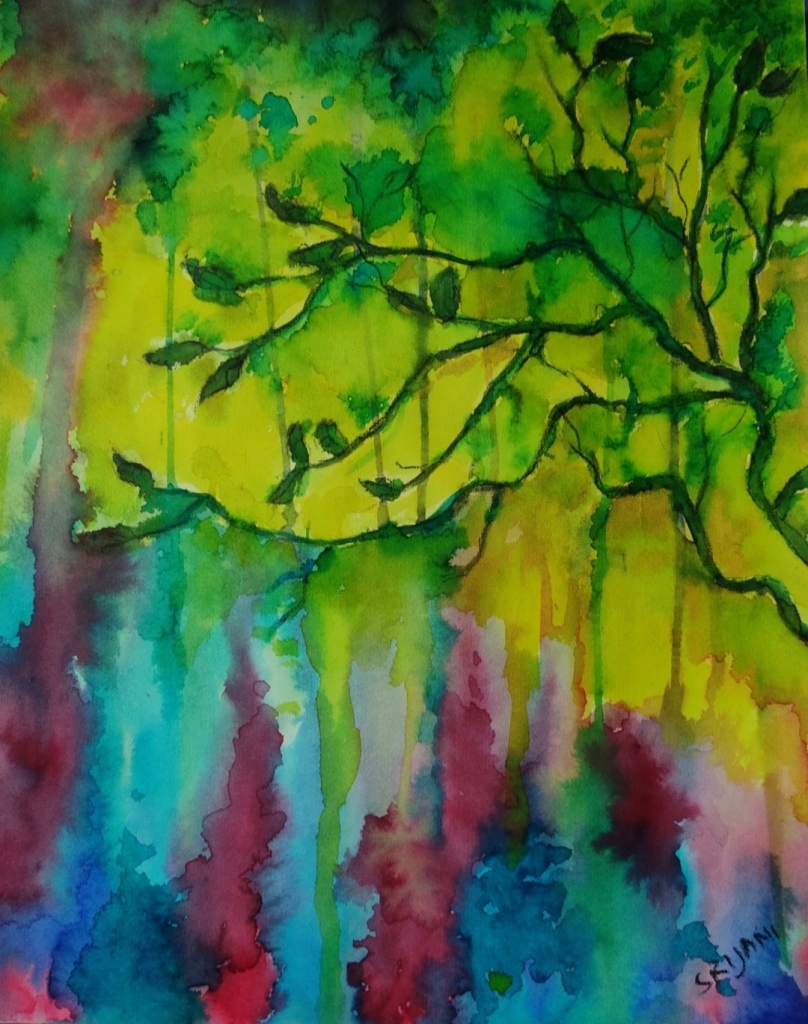
This vibrant edition would not have been possible without all the wonderful translators, writers, photographers and artists who trust us with their work. My heartfelt thanks to all of you, especially, Srijani Dutta for her beautiful painting, ‘Hope in Winter’, and Sohana for her amazing artwork. My heartfelt thanks to the team at Borderless Journal, to our loyal readers some of whom have evolved into fabulous contributors. Thank you.
Do write in telling us what you think of the journal. We look forward to feedback from all of you as we head for the completion of our third year this March.
Why is the vast ocean restless?
What bonds does it want to sunder?
It howls like a child in distress.
With incomprehensible words, it blusters.
Over eons, it rises, it soars,
It swells with an exhilarated gait —
Turbulent and huge, it roars.
The calm sky silently hears it reverberate.
Crushing its heart, it flays, it beats,
Against the rocky seaside. At high tide, its waves
Rise to smash, heralding apocalyptic feats.
Yet as the tide ebbs, the ocean gently laves
The dark core of nature, bordered by mud.
The ocean of tears continues to sway.
Each moment, desires staunched at the bud
Want to cry and drench the world away.
I yearn to be the scribe who translates
The ocean’s upheaves for humankind,
Calm the eternal unrest that agitates
The sea breeze to swish, shush and pine.
I yearn that my song rings day and night
Harmonising tunes with the Earth’s infinite…
This poem has been translated by Mitali Chakravarty with editorial input from Sohana Manzoor and Anasuya Bhar & Art by Sohana Manzoor
PLEASE NOTE: ARTICLES CAN ONLY BE REPRODUCED IN OTHER SITES WITH DUE ACKNOWLEDGEMENT TO BORDERLESS JOURNAL
Book display at Om BookstoreBook display at Midlands
The first month of 2023 has been one of the most exciting! Our first book, Monalisa No Longer Smiles: An Anthology of Writings from across the World, is now in multiple bookstores in India (including Midlands and Om Bookstores). It has also had multiple launches in Delhi and been part of a festival.
Delhi University panellists from left to right: Shantanu Ray Chaudhuri, Meenakshi Malhotra, Debraj MookerjeePanellists at Om Bookstore launch: Aruna Chakravarti, Mitali Chakravarty, Radha Chakravarty
We, Meenakshi Malhotra and I, were privileged to be together at the physical book events. We met the editor in chief of Om Books International, Shantanu Ray Chaudhuri, the editor of our anthology, Jyotsna Mehta, along with two translators and writers I most admire, Aruna Chakravarti and Radha Chakravarty, who also graced a panel discussion on the anthology during our physical book launch. The earlier e-book launch had been in November 2022. My heartfelt thanks to the two eminent translators and Chaudhuri for being part of the discussions at both these launches. Chaudhuri was also in the panel along with Debraj Mookerjee at a launch organised by Malhotra and the English Literary Society steered by Nabaneeta Choudhury at Hans Raj College, Delhi University. An energising, interactive session with students and faculty where we discussed traditional and online publishing, we are immensely grateful to Malhotra for actively organising the event and to the Pandies’ founder, Sanjay Kumar, for joining us for the discussion. It was wonderful to interact with young minds. On the same day, an online discussion on the poetry in Monalisa No Longer Smiles was released by the Pragati Vichar Literary Festival (PVLF) in Delhi.
At the PVLF session, I met an interesting contemporary diplomat cum poet, Abhay K. He has translated Kalidasa’s Meghaduta and the Ritusamhara from Sanskrit and then written a long poem based on these, called Monsoon. We are hosting a conversation with him and are carrying book excerpts from Monsoon, a poem that is part of the curriculum in Harvard. The other book excerpt is from Sanjay Kumar’s Performing, Teaching and Writing Theatre: Exploring Play, a book that has just been published by the Cambridge University Press.
Perhaps because it is nearing the Republic Day of India, we seem to have a flurry of book reviews that reflect the Sub-continental struggle for Independence from the colonials. Somdatta Mandal has reviewed Priya Hajela’s Ladies Tailor: A novel, a book that takes us back to the trauma of the Partition that killed nearly 200,000 to 2 million people – the counts are uncertain. Bhaskar Parichha has discussed MA Sreenivasan’s Of the Raj, Maharajas and Me, a biography of a long serving official in the Raj era — two different perspectives of the same period. Rakhi Dalal has shared her views on Shrinivas Vaidya’s A Handful of Sesame, translated from Kannada by Maithreyi Karnoor, a book that dwells on an immigrant to the Southern part of India in the same time period. The legendary film writer K.A. Abbas’s Sone Chandi Ke Buth: Writings on Cinema, translated and edited by Syeda Hameed and Sukhpreet Kahlon, has been praised by Gracy Samjetsabam.
We have a piece on mental health in cinema by Chaudhuri, an excellent essay written after interviewing specialists in the field. Ratnottama Sengupta has given us a vibrant piece on Suhas Roy, an artist who overrides the bounds of East and West to create art that touches the heart. Candice Louisa Daquin has written on border controls and migrants in America. High profile immigrants have also been the subject of Farouk Gulsara’s ‘What do Freddy Mercury, Rishi Sunak & Mississipi Masala have in Common?’ Sengupta also writes of her immigrant family, including her father, eminent writer, Nabendu Ghosh, who moved from Bengal during the Partition. There are a number of travel pieces across the world by Ravi Shankar, Meredith Stephens and Mike Smith — each written in distinctively different styles and exploring different areas on our beautiful Earth. Sarpreet Kaur has revisited the devastation of the 2004 tsunami and wonders if it is a backlash from nature. Could it be really that?
The flavours of cultures is enhanced by the translation of Nazrul’s inspirational poetry by Professor Fakrul Alam, Korean poetry written and translated by Ihlwha Choi and a transcreation of Tagore’s poem Banshi (or flute) which explores the theme of inspiration and the muse. We have a story by S Ramakrishnan translated from Tamil by R Sathish. The short stories featured at the start of this year startle with their content. Salini Vineeth writes a story set in the future and Paul Mirabile tells the gripping poignant tale of a strange child.
With these and more, we welcome you to savour the January 2023 edition of Borderless, which has been delayed a bit as we were busy with the book events for our first anthology. I am truly grateful to all those who arranged the discussions and hosted us, especially Ruchika Khanna, Om Books International, the English Literary Society of Hans Raj College and to the attendees of the event. My heartfelt thanks to the indefatigable team and our wonderful writers, artists and readers, without who this journey would have remained incomplete. Special thanks to Sohana Manzoor for her artwork. Many thanks to the readers of Borderless Journal and Monalisa No Longer Smiles. I hope you will find the book to your liking. We have made a special page for all comments and reviews.
I wish you a wonderful 2023. Let us make a New Year’s wish —
May all wars and conflicts end so that our iconic Monalisa can start smiling again!
Left to right: Mitali Chakravarty, Sanjay Kumar, Shantanu Ray Chaudhuri, Meenakshi Malhotra and Debraj Mookerjee After the event with a few students and teachersAt Delhi University
.
Left to right: Radha Chakravarty, Mitali Chakravarty, Aruna Chakravarti, Shantanu Ray ChaudhuriLeft to right: Shantanu Ray Chaudhuri, Aruna Chakravarti, Mitali Chakravarty, Radha Chakravarty, Jyotsna MehtaAt Om Bookstore, Ambiance Mall, GurgaonWith book reviewer Rakhi Dalal
Insta Link to an excerpt of the launch at Om Bookstore. Click here to view.
E-Launch of the first anthology of Borderless Journal, November 14th 2022. Click here to view.








 Borderless