Categories
Editorial

Its Only Hope…

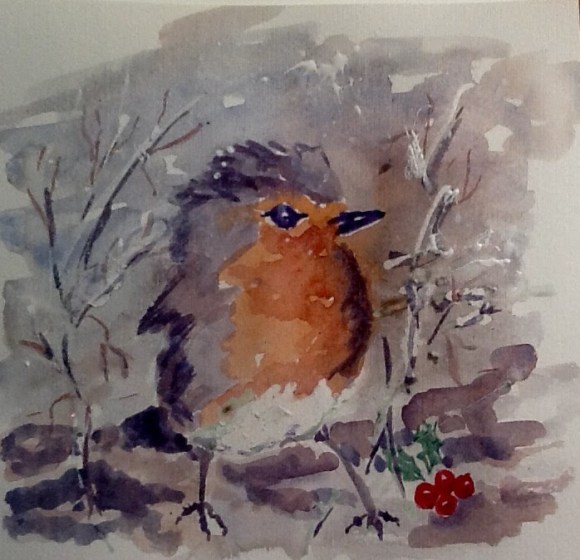
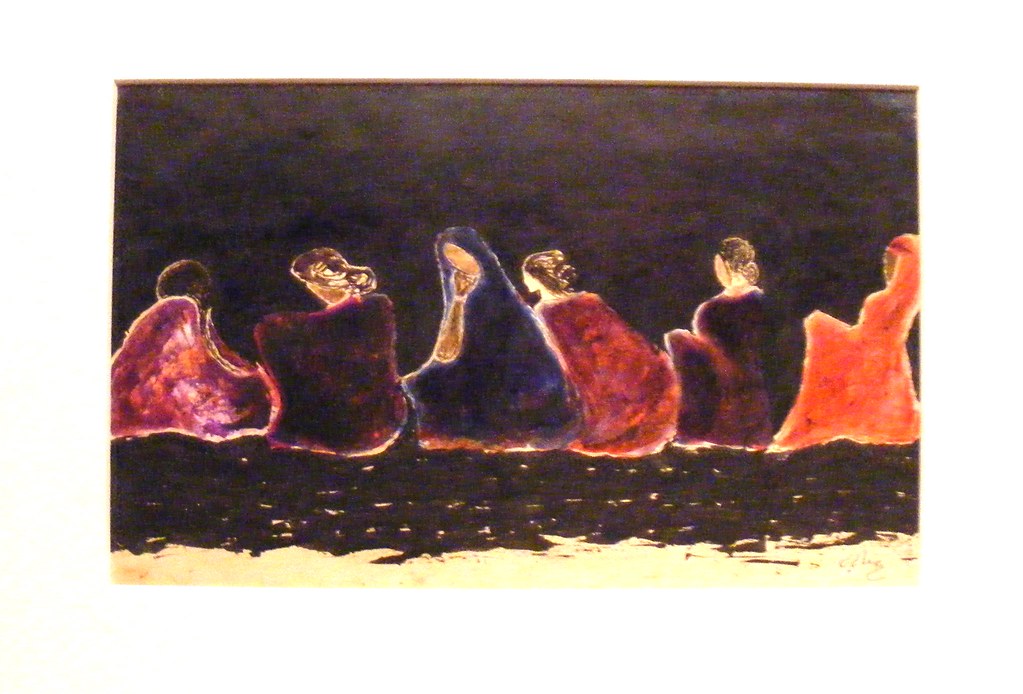
Painting by Sybil Pretious

New year, like a newborn, starts with hope.

The next year will do the same – we will all celebrate with Auld Lang Syne and look forward to a resolution of conflicts that reared a frightening face in 2022 and 2021. Perhaps, this time, if we have learnt from history, there will not be any annihilation but only a movement towards resolution. We have more or less tackled the pandemic and are regaining health despite the setbacks and disputes. There could be more outbreaks but unlike in the past, this time we are geared for it. That a third World War did not break out despite provocation and varied opinions, makes me feel we have really learnt from history.

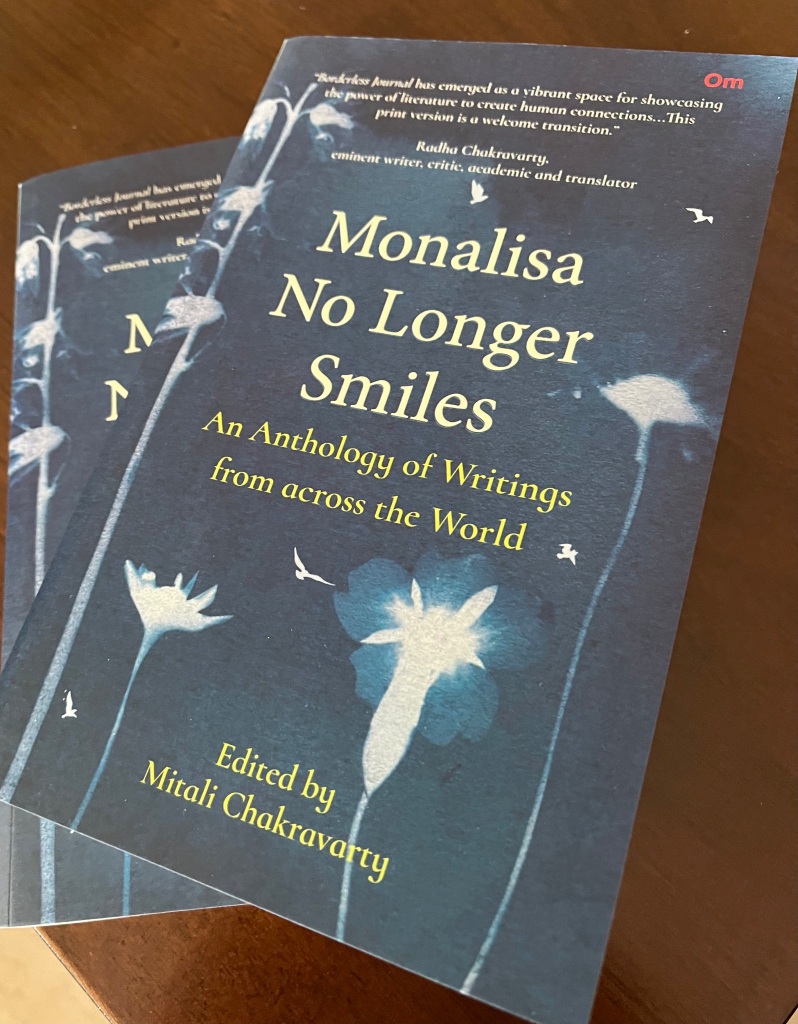
That sounds almost like the voice of hope. This year was a landmark for Borderless Journal. As an online journal, we found a footing in the hardcopy world with our own anthology, Monalisa No Longer Smiles: Writings from Across the World, which had a wonderful e-launch hosted by our very well-established and supportive publisher, Om Books International. And now, it is in Om Book Shops across all of India. It will soon be on Amazon International. We also look forward to more anthologies that will create a dialogue on our values through different themes and maybe, just maybe, some more will agree with the need for a world that unites in clouds of ideas to take us forward to a future filled with love, hope and tolerance.

One of the themes of our journal has been reaching out for voices that speak for people. The eminent film critic and editor, Shantanu Ray Chaudhuri , has shared a conversation with such a person, the famed Gajra Kottary, a well-known writer of Indian TV series, novels and stories. The other conversation is with Nirmal Kanti Bhattajarchee, the translator of Samaresh Bose’s In Search of a Pitcher of Nectar, a book describing the Kumbh-mela, that in 2017 was declared to be an Intangible Cultural Heritage of Humanity by UNESCO. Bhattacharjee tells us how the festival has grown and improved in organisation from the time the author described a stampede that concluded the festivities. Life only gets better moving forward in time, despite events that terrorise with darkness. Facing fear and overcoming it does give a great sense of achievement.

Perhaps, that is what Freny Manecksha felt when she came up with a non-fiction called Flaming Forest, Wounded Valley: Stories from Bastar and Kashmir, which has been reviewed by Rakhi Dalal. Basudhara Roy has also tuned in with a voice that struggled to be heard as she discusses Manoranjan Byapari’s How I Became a Writer: An Autobiography of a Dalit. Somdatta Mandal has reviewed The Shaping of Modern Calcutta: The Lottery Committee Years, 1817 – 1830 by Ranabir Ray Chaudhury, a book that explores how a lottery was used by the colonials to develop the city. Bhaskar Parichha has poured a healing balm on dissensions with his exploration of Rana Safvi’s In Search of the Divine: Living Histories of Sufism in India as he concludes: “Weaving together facts and popular legends, ancient histories and living traditions, this unique treatise running into more than four hundred pages examines core Sufi beliefs and uncovers why they might offer hope for the future.”

In keeping with the festive season is our book excerpt from Rhys Hughes’ funny stories in his Christmas collection, Yule Do Nicely. Radha Chakravarty who brings many greats from Bengal to Anglophone readers shared an excerpt – a discussion on love — from her translation of Tagore’s novel, Farewell Song.

Love for words becomes the subject of Paul Mirabile’s essay on James Joyce’s Stephen Dedalus, where he touches on both A Portrait of the Artist as a young Man and  Ulysees, a novel that completed a century this year. Love for animals, especially orangutans, colours Christina Yin’s essay on conservation efforts in Borneo while Keith Lyons finds peace and an overwhelming sense of well-being during a hike in New Zealand. Ravi Shankar takes us to the historical town of Taiping in Malaysia as Meredith Stephens shares more sailing adventures in the Southern hemisphere, where it is summer. Saeed Ibrahim instils the seasonal goodwill with native Indian lores from Canada and Suzanne Kamata tells us how the Japanese usher in the New Year with a semi-humorous undertone.

Humour in non-fiction is brought in by Devraj Singh Kalsi’s ‘Of Mice and Men’ and in poetry by Santosh Bakaya. Laughter is stretched further by the inimitable Rhys Hughes in his poetry and column, where he reflects on his experiences in India and Wales. We have exquisite poetry by Jared Carter, Sukrita Paul Kumar, Asad Latif, Luis Cuauhtémoc Berriozábal, Michael R Burch, Sutputra Radheye, George Freek, Jonathan Chan and many more. Short stories by Lakshmi Kannan, Devraj Singh Kalsi, Tulip Chowdhury and Sushma R Doshi lace narratives with love, humour and a wry look at life as it is. The most amazing story comes from Kajal who pours out the story of her own battle in ‘Vikalangta or Disability‘ in Pandies’ Corner, translated from Hindustani by Janees.

Also touching and yet almost embracing the school of Absurd is PF Mathew’s story, ‘Mercy‘, translated from Malayalam by Ram Anantharaman. Fazal Baloch has brought us a Balochi folktale and Ihlwha Choi has translated his own poem from Korean to English. One of Tagore’s last poems, Prothom Diner Shurjo, translated as ‘The Sun on the First Day’ is short but philosophical and gives us a glimpse into his inner world. Professor Fakrul Alam shares with us the lyrics of a Nazrul song which is deeply spiritual by translating it into English from Bengali.

A huge thanks to all our contributors and readers, to the fabulous Borderless team without who the journal would be lost. Sohana Manzoor’s wonderful artwork continues to capture the mood of the season. Thanks to Sybil Pretious for her lovely painting. Please pause by our contents’ page to find what has not been covered in this note.

We wish you all a wonderful festive season.

Season’s Greetings from all of us at Borderless Journal.

Cheers!

Mitali Chakravarty

borderlessjournal.com

.

Click here to access the Borderless anthology, Monalisa No Longer Smiles

Categories
Excerpt

Farewell Song

Title: Farewell Song

Author: Rabindranath Tagore

Translator: Radha Chakravarty

Publisher: Penguin, Hesperus Press

‘I may go away from Shillong, but the month of Agrahayan can’t suddenly slip away from the almanac! Do you know what I shall do in Calcutta?’

‘What will you do?’

‘While Mashima makes arrangements for the wedding, I must prepare for the days that are to follow. People forget that conjugal life is an art, to be created anew each day. Do you remember, Banya, how King Aja had described Indumati in Raghuvamsha?’

‘‘‘My favourite pupil has artistry in her blood,’ quoted Labanya.

‘Such artistry of the blood belongs to conjugal life,’ declared Amit. ‘Barbarians generally imagine the wedding ceremony to be the real moment of union, which is why the idea of union is often so utterly neglected afterwards.’

‘Please explain the art of union as you imagine it in your heart. If you want me to be your disciple, then let today be the first lesson.’

‘Very well, then, listen. The poet creates rhythm out of deliberately placed obstructions. Union, too, should be rendered beautiful by means of deliberately placed obstacles. To cheapen a precious thing so that it is to be had for the asking is to cheat your own self. For the pleasure of paying a high price is by no means negligible.’

‘Let’s hear how the price is to be calculated.’

‘Wait! Let me describe what my heart has visualized. Beside the Ganga, there will be a garden-estate on the other side of Diamond Harbour. A small steam-launch would take us to Calcutta and back, within a couple of hours.’

‘But why the need to travel to Calcutta?’

‘Now there is no need to, please be assured. I do visit the bar- library, not to engage in trade but to play chess.The attorneys have realized that I have no need for work and, therefore, no interest in it. When a case comes up, concerning some mutual dispute, they hand me the brief but nothing more than that. But right after marriage, I’ll show you what it means to set to work, not in search of a livelihood but in search of life. At the heart of the mango lies the seed, neither sweet, nor soft, nor edible; yet the entire mango depends on it, takes shape from it. You understand, don’t you, why the stony seed of Calcutta is necessary? To keep something hard at the core of all the sweetness of our love.’

‘I understand. In that case, I need it, too. I must also visit Calcutta, from ten to five.’

‘What’s wrong with that? But it should be for work, and not in order to explore the neighbourhood.’

‘What work can I take up, tell me? Without any wages?’

‘No, no, a job without wages is neither work nor play: it’s mostly all about shirking. If you wish, you can easily become a professor in a women’s college.’

‘Very well, that shall be my wish.What then?’

‘I can visualize it clearly: the shore of the Ganga. From the lowest level of the paved bathing area rises an ancient banyan tree, laden with aerial roots. While cruising down the Ganga to Ceylon, Dhanpati may have tethered his boat to this same banyan tree and cooked his dinner under its shade. To the south is the moss-encrusted paved bathing ghat, the stone cracked in many places, eroded in patches. At that ghat is tethered our slim, elegant boat, painted green and white. On its blue flag, inscribed in white lettering, is the name of the boat. Please tell me what the name should be.’

‘Should I? Let it be named Mitali, for friendship.’

‘Just the right name: Mitali. I had thought of Sagari, in fact I was rather proud of having thought up such a name. But you have defeated me, I must admit.Through the garden flows a narrow channel, bearing the pulsebeat of the Ganga. You live on one side of the channel, and I live just across, on the other side.’

‘Would you swim across every evening, and must I await you at my window, with a lighted lamp?’

‘I’ll swim across in my imagination, crossing a narrow wooden footbridge. Your house is named Manasi, the desired one; and you must give a name to my house.’

‘Deepak—the lamp.’

‘Just the right name. Atop my house, I shall place a lamp to suit the name. A red light will burn there on the evenings when we meet, and a blue one on nights of separation. When I return from Calcutta, I shall daily expect a letter from you. It should sometimes reach me, sometimes not. If I don’t receive it by eight in the evening, I shall curse my ill-fortune and try to read Bertrand Russell’s textbook on logic. It will be our rule, that I must never visit you uninvited.’

‘And can I visit you?’

‘Ideally, both of us should follow the same rule, but if you occasionally break it, I shall not find it intolerable.’

‘If the rule is not to be observed in the breaking, what would be the condition of your house! Perhaps I should visit you in a burkha.’

‘That’s all very well, but I want my letter of invitation. The letter need contain nothing but a few lines of verse, taken from some poem.’

‘And will there be no invitations for me?Am I to be discriminated against?’

‘You are invited once a month, on the night when the moon is at its full, after fourteen days of fragmented existence.’

‘Now offer your favourite pupil an example of the kind of letter to be written.’

‘Very well.’ He produced a notebook from his pocket and wrote, first in English, then in Bengali:

Blow gently over my garden 
Wind of the southern sea
In the hour my love cometh 
And calleth me

Labanya did not return the piece of paper to him.

‘Now for an example of the kind of letter you would write. Let’s see how much you have gained from your lessons.’

Labanya was about to write on a piece of paper. ‘No,’ insistedAmit, ‘you must write in this notebook of mine.’

Labanya wrote, in Sanskrit, and then in English:

Mita, twamasi mama jivanam, twamasi mama bhushanam, 
Twamasi mama bhavajaladhiratnam.
Mita, you are my life, my adornment, 
The jewel in the ocean of my world.

‘The amazing thing is, I have written the words of a woman, and you the words of a man,’ remarked Amit, putting the notebook in his pocket. ‘There is nothing incongruous about it. Whether the wood comes from a red silk cotton tree or from a bakul tree, when set alight, the fire looks the same.’

About the Book

Rabindranath Tagore reinvented the Bengali novel with Farewell Song, blurring the lines between prose and poetry and creating an effervescent blend of romance and satire. Through Amit and Labanya and a brilliantly etched social milieu, the novel addresses contemporary debates about ‘good’ and ‘bad’ writing, the nature of love and conjugality and the influence of Western culture on Bengali society. Set against the idyllic backdrop of Shillong and the mannered world of elite Calcutta society, this sparkling novel expresses the complex vision and the mastery of style that characterised Tagore’s later works.

About the Author

Rabindranath Tagore (1861-1941), the Renaissance man, reshaped Bengal’s literature and music, and became the first non-European to win the Nobel Prize in Literature in 1913. He introduced new prose and verse forms and the use of colloquial language into Bengali literature, thereby freeing it from traditional models based on classical Sanskrit. He was highly influential in introducing the best of Indian culture to the West and vice versa, and was a living institution for India, especially for Bengal.

About the Translator:

Radha Chakravarty is a writer, critic and translator based in New Delhi, India. She has co-edited The Essential Tagore and translated Rabindranath Tagore’s major works including Chokher Bali, Gora, Farewell Song, Four Chapters, The Land of Cards: Stories, Poems and Plays for Children and Boyhood Days. She has also translated other Bengali writers from India and Bangladesh, such as Bankimchandra Chatterjee, Kazi Nazrul Islam, Sunil Gangopadhyay, Nabaneeta Dev Sen, Mahasweta Devi, Anita Agnihotri, Selina Hossain, Hasan Azizul Haq and Syed Shamsul Huq. She is the author of Feminism and Contemporary Women Writers and Novelist Tagore. Her latest books in translation are Our Santiniketan by Mahasweta Devi and Four Chapters by Tagore. Nominated for the Crossword Translation Award, she also is also a widely published poet. She taught Comparative Literature & Translation at Dr B R Ambedkar University Delhi.

Categories
Editorial

We Did It!

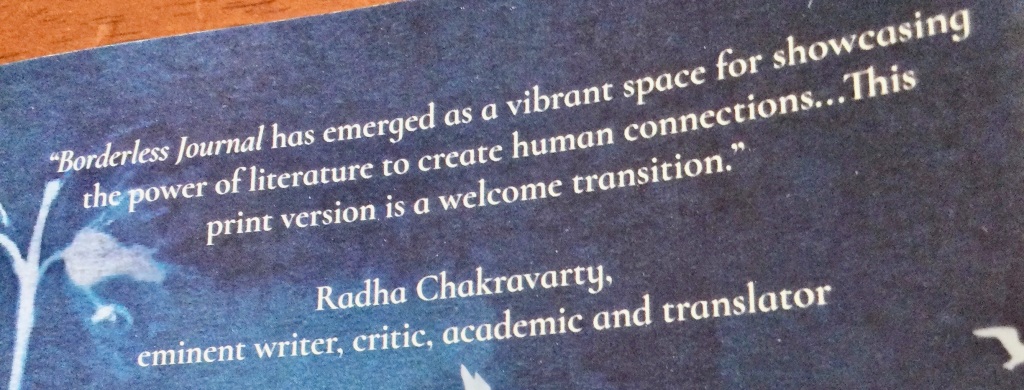
That good things happen despite darkness, despite prognostications of doom, that light glimmers hope if you strive to focus on your strength in hard times is borne true both in fiction and in life. Perhaps, we cannot get back the old ways (but is that what we want?) but new paths emerge. Old gives way to new. And while trying to gather pearls of human excellence — borne not of awards or degrees but of bringing out the best, the kindest, the most loving in human hearts — we managed to create with a team an outstanding anthology. Woven with the writings of old and new — we created a tapestry together that the editor in chief of our publishing house said was “classy, literary, engaging and international”. That one of the oldest and most reputed publishing houses in India with bookshops countrywide took it on was also an unusual event! We are truly grateful to Om Books International, Shantanu Ray Chaudhuri and Jyotsna Mehta along with all our writers and readers who made our anthology a reality, and to Radha Chakravarty and Fakrul Alam for the kind words they bestowed on our effort.

Click here to access the Borderless anthology, Monalisa No Longer Smiles

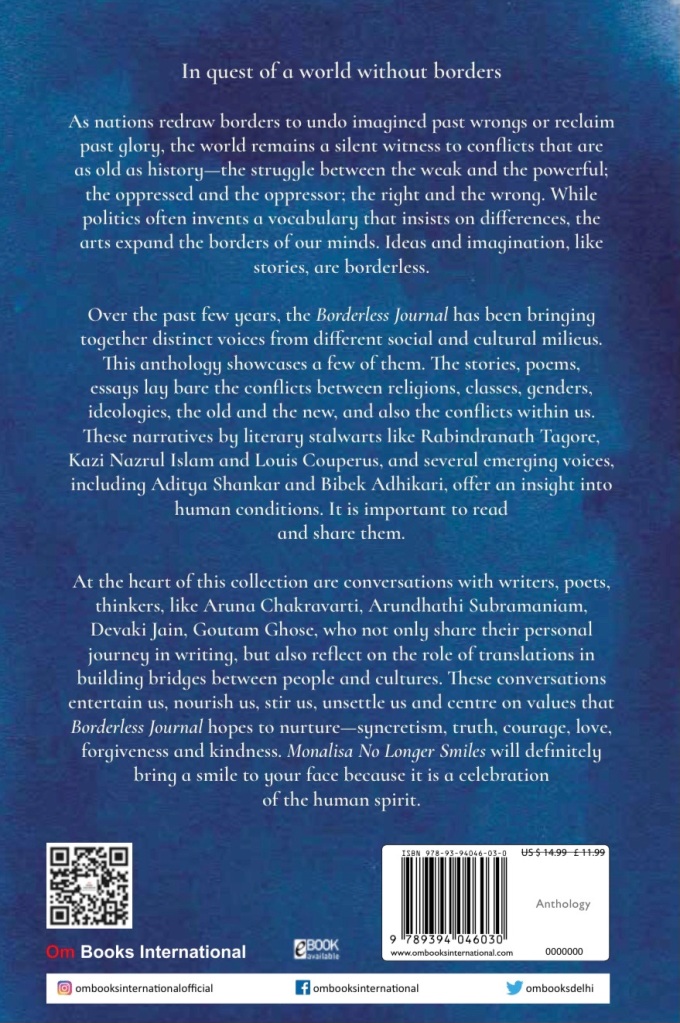
Please greet our first anthology, Monalisa No Longer Smiles, with love and friendship. It could be the perfect Christmas gift in the spirit of the season! And as the blurb says, “it will definitely bring a smile to your face because it is a celebration of the human spirit.”

The anthology is different from our journal in as much as it has a sample of an eclectic collection that has been honed with further editing and has some new features. Most of the writing is from our first year and showcases our ethos, except for Lesya’s poetry and interview. Lesya Bakun from Ukraine is still on the run, looking for a refuge — she cannot return home like you or I can. Her family is scattered across number of countries. Her cousin, who was guarding the factory at Azovstal, was taken prisoner. We included her story in the anthology hoping to create global empathy for refugees as the numbers will increase not only due to war but also due to climate change.

The reason we felt a hardcopy anthology was a good idea was because nothing beats the joy of having a bunch of interesting reads in the warmth of your hands (especially where internet cannot reach or is unavailable). In any case, books with the feel of paper, the rustling whispers which carry voices of leaves can never be replaced as Goutam Ghose had also said in his interview which is now part of our anthology.

And that is why we celebrate more books… this time we feature Singaporean prima donna of literature, Suchen Christine Lim, with her new book Dearest Intimate, a novel that spans more than hundred years including the harrowing Japanese invasion during World War II. She shared sound advice with writers: “Suffering is good for the writer. It will deepen lived experience and expand the heart’s empathy.” And perhaps that is what is echoed through the experiences of the other writer interviewed on our pages by Keith Lyons. This is a writer who not only brought out his own books but was a regular contributor of travel pieces for Frommer’s and National Geographic traveling to unexplored destinations — Christopher Winnan. Another writer Lyon had interviewed recently, Steve Carr, has passed on. We would like to convey our heartfelt condolences to his family and friends.

We have a number of books that have been reviewed. Reba Som reviewed Aruna Chakravarti’s Through the Looking Glass: Stories that span eras spread across time. Somdatta Mandal has reviewed Shehan Karunatilaka’s The Birth Lottery and Other Surprises and Bhaskar Parichha, Rahul Ramagundam’s The Life and Times of George Fernandes. Basudhara Roy has written of Afsar Mohammad’s Evening with a Sufi: Selected Poems, translated from Telugu by the poet and Shamala Gallagher, verses that again transcend borders and divides. We have an excerpt from the same book and another from Manoranjan Byapari’s How I Became a Writer: An Autobiography of a Dalit, translated from Bengali by Anurima Chanda.

More translations from Bengali, Balochi and Korean enrich our November edition. Fazal Baloch has translated a story by Haneef Shareef and Rituparna Mukherjee by Shankhadeep Bhattacharya. We have the translation of an inspirational Tagore poem helping us find courage (Shonkho Dhulaye Pore or ‘the conch lies in the dust’). Another such poem by Nazrul has been rendered in English from Bengali by Professor Fakrul Alam. He has also shared an autobiographical musing on how he started translating Tagore’s Gitabitan, which also happens to be his favourite book. More discussion on the literary persona of TS Eliot and the relevance of his hundred year old poem — ‘The Waste Land’ by Dan Meloche adds variety to our essay section.

Evoking the genius of another outstanding artiste, Kishore Kumar, who happened to pen thought provoking dialogues in some films, is Shantanu Ray Chaudhuri’s essay, review of a recent book on the legendary actor-singer and an interview with the authors. Infringing the boundaries of literary with popular culture and art and integrating all forms into a wholistic bundle has been part of our ethos. In that spirit we have a musing by Prithvijeet Sinha on Edvard Munch’s famous painting called Scream. We have non-fiction from Australia spanning Meredith Stephens’s recent brush with Covid, Mike Smith visits a Scottish beach in the footsteps of a novelist, Ravi Shankar has given us a poignant piece for a late friend and Candice Lousia Daquin talks of the existence of bi-racial biases. In contrast, Suzanne Kamata sent a narrative that bridges divides showcasing a German wife of a Japanese scientist that draws us to conclude that biases erode over time to create an acceptance of bi-racial people. Devraj Singh Kalsi brings in humour with his funny narrative about a guitarist. Rhys Hughes writes in a lighter vein on Indian cuisine in his column and spouts more funny poetry bordering on the absurd.

Jared Carter has shared beautiful poetry on murmuration in birds and we have touching verses from Asad Latif for a little girl he met on a train — reminiscent of Tagore’s poem Hide and Seek (Lukochuri). Michael R Burch has given us poems setting sombre but beautiful notes for the season. We host more poetry by Luis Cuauhtémoc Berriozábal, Quratulain Qureshi, Jim Bellamy, Gayatri Majumdar, Ryan Quinn Flanagan, Alpana, Jonathan Chan, Saranyan BV, George Freek and many more. We have stories from around the world: India, France and Bangladesh.

Gathering all of your thoughts in strings of words from all corners of the world, we present to you the bumper November issue of Borderless Journal . Thank you all for sharing your thoughts with us. Thanks to Sohana Manzoor for her fantastic painting and more thanks to the whole Borderless team for seeing this issue through. We would not have been able to do the anthology or these issues without each one of you — writers and readers.

Thank you all from the bottom of my heart.

There is always hope for a new tomorrow!

Mitali Chakravarty

borderlessjournal.com

Click here to access the Borderless anthology, Monalisa No Longer Smiles

Categories
Editorial

The Stars were Shining There for You & Me, for Liberty…

Painting by Sohana Manzoor

“It just so happens that their[1] universes were different from ours: because why would their imaginations be constrained by a nation-state that would not exist for another thousand years?”

Anirudh Kansetti, the print.in

These lines from a recent article on conquests carried out by the Indian subcontinent in ancient times brings to focus that earlier countries or nation-states as we know of them today did not exist till the industrial revolution set the concept in motion. In the month many countries in Asia celebrate their independent existence or rather the drawing of borders based on colonial mapmakers’ whims, we should perhaps relook at the way the world stands divided.

Is this what we want as humans? Where are we headed? While conquerors write the history, we tend to gloss over what is left unsaid. The millions who died crossing borders, in race riots and of hunger, starvation and disease in refugee camps is overlooked, or worse, used to justify the divisions that still hurt the residents of the sub-continent and try to destroy any sense of oneness among the human species. We tend not to forget the atrocities of the colonials but we overlook the violence of the mobs that incensed with hatred instilled by politics annihilated and murdered. Their story is reduced to “us” and “them”. In our mood of jubilation, the recent bombings in the Middle East and the Ukraine-Russia war have already been delegated to the newsreels. But these are all people who are killed and displaced without any justification for the need to do so. One of the things that George Orwell had depicted in 1984 was an acceptance of a constant state of war. Are we stepping into that frame of mind with our cold acceptance of the situation worldwide?

In the last century, many united against the atrocities of the empire builders. They wanted to rise above the divides. At least greats like Nazrul vociferously objected to the basis of divides that were used to draw the borders. Translations brought to us by Professor Fakrul Alam showcase such poetry as does much of Tagore’s own writing and actions. Tagore organised a protest march against the colonial proposal of Partition of Bengal in 1905 by taking a procession in which he encouraged Hindu and Muslim women to tie rakhis[2] on men from the other community and make them their brothers. Tagore put the welfare of humanity above nationalism as can be seen in his writings and speeches. Reflecting on humanity, we have Munshi Premchand’s powerful story, Pus Ki Raat or A Frigid Winter’s Night, translated from Hindi by C Christine Fair, dwelling on the sad state of peasantry under the Raj. In a bid to rouse people like the protagonist of Premchand’s story, Tagore wrote inspirational songs, one of which, Hobe Joye (Victory will be Ours) has been translated on our pages. We also continue sharing Rabindranath’s humour with a skit translated by Somdatta Mandal from Bengali.

Humour is also stirred into Borderless by Rhys Hughes with a series of mini sagas in his column and a trip around the world in eighty couplets. These couplets actually are more in number — I tried counting them — and are guaranteed to make you laugh. We have travel stories in plenty too. Ravi Shankar again treks to the Himalayas and brings us wonderful photographs of his journey and G Venkatesh stops over at Istanbul airport to find a friend from across the border. Meredith Stephens travels to a French colony called Lifou Island — sounds unbelievable as in the month we celebrate the independence of so many countries across Asia, there is still a country in the Pacific that owes allegiance to a democratic European power! But other than writing about the beaches, Stephens talks of a temporary pet dog while Suzanne Kamata gives us cat talk in her notes from Japan in a lighter vein — a very pleasant glimpse of life. Devraj Singh Kalsi brings a grin when he talks of his stint at trying to run a restaurant.

Interesting non-fictions from a book lover, Sindhu Shivprasad, and from PG Thomas who talks of King Lear performed a la classical Indian dance mode, Kathakali, by an international caste add to narratives that focus on bringing the pleasanter side of life to our readers. Such stories are a welcome relief in dark times when people find themselves caught between price hikes due to the pandemic and wars. An essay by Candice Louisa Daquin looks for a way out of the stresses of these times. Erwin Coombs gives us a funny, poignant and tragic classroom encounter which reminds me of the 1967 Sidney Poiter movie, To Sir, with Love. We have darker tones brought into our journal also with Aysha Baqir’s story on child exploitation, a sad but hopeful narrative from Nepal by Santosh Kalwar about the rejection of a girl-child by her mother and a horrific murder brought to us by Paul Mirabile.

Our poetry section this time flows over with poems from Michael R Burch, Ryan Quinn Flanagan, George Freek, Mike Smith, Gigi Baldvino Gosnell and even Ratnottama Sengupta, who has also given us a powerful essay on an acclaimed dancer called Zohra Sehgal whose life was changed by the Partition of the Indian subcontinent in 1947, basing her essay on Ritu Menon’s Zohra: A Biography in Four Acts and her own personal encounters with the irrepressible artiste. Michael Burch has also shared an excerpt of his book dedicated to his wife, O, Terrible Angel.

An excerpt from B. M. Zuhara’s The Dreams of a Mappila Girl: A Memoir, translated from Malayalam by Fehmida Zakeer, brings us close to a community we know very less about in the Southern part of India. Meenakshi Malhotra has reviewed Tagore’s Four Chapters translated from Bengali and introduced by Radha Chakravarty, a book that is a powerful voice against violence in the name of nationalism touching on the independence of women, a theme that is reiterated in another book that has been visited by Rakhi Dalal. While exploring Neelum Saran Gour’s Requiem in Raga Janki, Dalal contends that the book familiarises us with a singer “who carved her own destiny and lived life on her own terms, in times when women were generally subjugated and confined to roles given by society”. Gracy Samjetsabam has visited Mamang Dai’s Escaping the Land, a novel that tries to weave issues faced in the Northeast of India and integrate it with the mainstream by stirring human emotions.  Bhaskar Parichha has reviewed Rakesh Batabyal’s Building a Free India, a collection of powerful speeches from the past.

Within the confines of the Raj, there was a long court case where a prince who had been declared dead resurfaced as a Naga sadhu[3], a claimant to the throne, this time not to abuse his power as of past but to be a sympathiser of the people in their tryst to fight the Raj. Aruna Chakravarti has woven a historical fiction around this controversy centring around the prince of Bhawal. In an exclusive interview, she tells us the story behind the making of The Mendicant Prince — her novel that was published just last month. Her responses could well teach us how to write a historical novel.

We have much more than the fare that has been mentioned here. Pause by on our contents page to take a look. My heartfelt thanks to the whole team at Borderless for helping with this issue, which we managed to get out in a shorter time than usual and Sohana Manzoor for her wonderful artwork. I am grateful to all our contributors as well as our readers. We could not have made it this far without all of you.

In the spirit of uniting under a borderless sky, let us look forward to cooler climes and happier times.

Cheers!

Mitali Chakravarty

borderlessjournal.com


[1] Guptas (4-6 century CE), Cholas (300 BCE -1279 CE) and other ancient rulers in the Indian sub-continent

[2] A festival held in August where sisters of all ages tie a talisman or amulet called the rakhi around the wrists of their brothers, who promise to protect them.

[3] Mendicant

Categories
A Special Tribute Review

Rabindranath’s Protest Against Violence

Book review of Tagore’s last novel by Meenakshi Malhotra on his death anniversary

Title: Four Chapters                                           

Author: Rabindranath Tagore

Translator: Radha Chakravarty

Publisher: Penguin

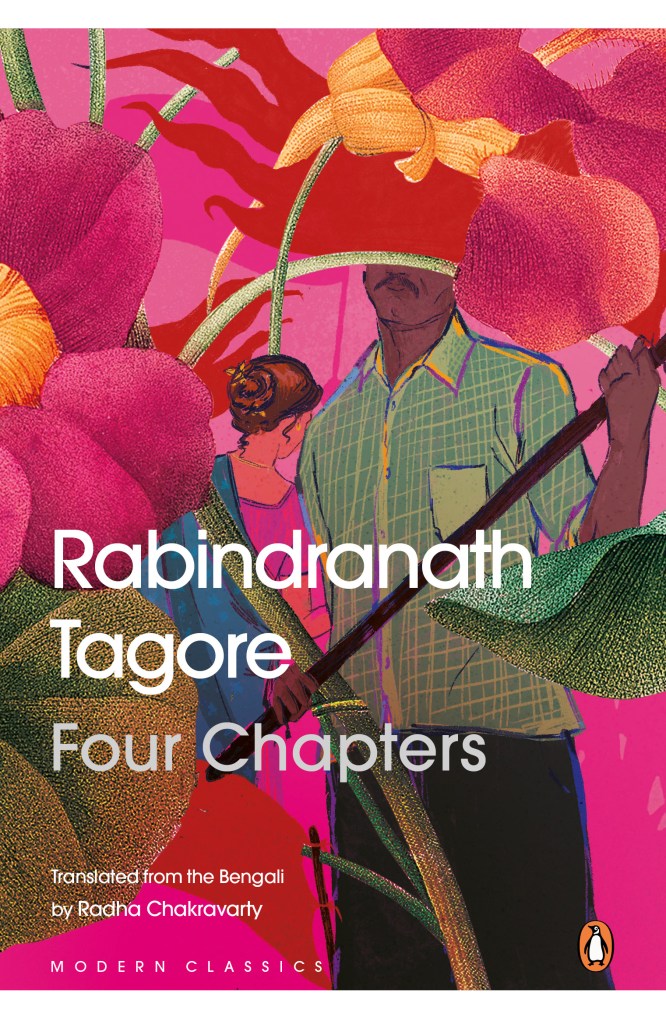
With Char Adhyay (1934, Four Chapters), Tagore’s last novel, he returns to his critique of violence, an almost ubiquitous preoccupation in this last phase of his writing which had earlier  witnessed the production of Ghare Baire (1916, The Home and the World) and his essays on nationalism. Both, The Home and the World and Four Chapters, share an underlying preoccupation about the limits of patriotism and the legitimacy of violence: does love for one’s own country justify violence and revolutionary terrorism? To put it in a philosophical vein: do the ends justify the means?

Like in The Home and the World , Tagore uses a triangulated relationship, if not a tripartite narrative structure. The plot could be summed up thus: Ela, a modern woman, looks for engagement, to give structure and meaning to her existence. At odds initially with her traditional but authoritarian mother, she grows up developing a strong sense of justice and a mistrust of blind superstitions and meaningless rituals, which hardly equip her to fit into a traditional marriage. After losing both her parents, she is under the care of her uncle and aunt, when she meets the charismatic Indranath, a disappointed scientist who has now turned to militancy and revolutionary terrorism. On  the other side is Atindranath or Atin (also called Antu), with whom Ela forms a romantic attachment. In the last segment of the novel, we realise that Ela’s politicisation had also pushed Atin into militancy since Ela’s dedication to the cause had co-opted him into it.

Stylistically this novel is striking. It consists of little narrative but is dialogic for the most part. As such, as the editor-translator mentions, the work acquires a dramatic quality. Also, Four Chapters comes across as a vehicle for ideas and at times, the novel seems to be weighed down by the predominance of ideas. Thus ideas of national regeneration, selfless action circulate in the text  without being directly co-related with the plot and story structure. The characters often are eloquent in their own praise. They seem to be mouthpieces produced as a result of clashing ideologies.

Four Chapters depicts the new, modern woman in all her complexity and confusion, poised on the brink of something new, yet unable to let go completely of the old. Torn between political zeal and romantic passion, Ela represents a model of womanhood which is recognisable and perhaps relatable. Displaying agency, she says she wants to “publicize the increase in women’s rights in the modern age.” Women , she feels, “don’t hesitate to speak the truth now”. In the “new literature, Bengali women’s characters are eloquent in their own praise. They have usurped the clay sculptor’s role of fashioning the images of goddesses.”

Both a scientist as well as a political leader, Indranath surveys human history as a continuing saga of oppression, death and destruction. His cold impersonality is contrasted with the romantic zeal and passion of Atin, who is devoted to Ela beyond doubt. Though Ela reciprocates his passion, she is committed to bow to the overarching cause of the nation and its freedom from subjugation. Yet Ela shows herself capable of great devotion as is evident  in her impassioned exchanges with Atin. She tells him, “You are great. I can see your brilliance, dazzling as a flash of lightning.” Fully aware of his devotion and of his romantic idealisation of her, she contrasts the small details which preoccupy women to the dazzling brilliance of Atin’s mind. In all these exchanges, we see her intelligence shine through. Moreover, she realises the entrapment of women’s biology. Nature, she feels, “has humiliated women from the time of our birth.” “We enter this world bearing destiny’s purpose in our biology, our bodies.”

In contrast to the passionate and emotional Atin is the  character of Indranath, who, seems cold, calculating and two-dimensional and driven by a single ideological narrative.  Indranath, the political zealot is charismatic but professes to be impersonal, commands and considers herself pledged to the nation’s cause. It is he who wins Ela over to the nationalist cause.

Nationalism here serves as a veneer for his revolutionary terrorism. As Radha Chakravarty writes in the ‘Introduction’ to the translated edition, “The novel charts the volatile scenario that arises from the conflict between Ela’s forbidden love and her dangerous involvement with political violence. Through the relationships between Ela, Atin and Indranath, the narrative explores the interface between love and revolutionary politics”. She also adds that the first draft of the novel focused on the romantic plot and did not have the character of Indranath. The character of Indranath is supposedly based upon a scholar-activist who was criticised by Tagore. In a letter written in August 1934, Tagore wrote to Prafulla Nath  Tagore, saying  that the latter must be aware of his eschewal of violence: “You are aware that I  am completely against the oppressive tactics of those who follow the path of terrorism…I have written a work of fiction that is cast as a protest against the terrorists.”

Tagore’s political views and novelistic stance elicited the wrath of many compatriots, political activists, extremists and nationalists who felt that this stance was expressive of his collusion with colonialism. Further, as Chakravarty phrases it, his “challenge to authoritarianism and insistence on freedom of thought” also aroused the suspicion of the British administration in India. Anticipating controversy, Tagore himself took steps to have it translated into English, though it took some time for the translation to see the light of day.

Radha Chakravarty’s recent translation captures the nuances of a complex text. It is one of the rare instances where the translation has rescued the occasional stiltedness of the original and thus fares better in some instances. The novel, which runs the occasional danger of collapsing under the weight of its own ideas in the original Bengali version, is modernised and through this particular translation, the narrative is made more empathetic to the needs of the contemporary reader. This is a translation of a difficult novel which serves to give a fresh lease of life to an important but not a very popular book, and restores it for the modern reader.     

.  


Dr Meenakshi Malhotra is Associate Professor of English Literature at Hansraj College, University of Delhi, and has been involved in teaching and curriculum development in several universities. She has edited two books on Women and Lifewriting, Representing the Self and Claiming the I, in addition  to numerous published articles on gender, literature and feminist theory.       

.

PLEASE NOTE: ARTICLES CAN ONLY BE REPRODUCED IN OTHER SITES WITH DUE ACKNOWLEDGEMENT TO BORDERLESS JOURNAL

Categories
Tribute

Celebrating Tagore

Was he a poet? A writer? A humorist? A social reformer…

At an intellectual plane, we could keep arguing about labelling Tagore. He was truly a polymath. But, the most important thing is he touched our hearts with his words and used that to earn and pour into projects that benefitted the underprivileged. This year, on his 161st birth anniversary, we will explore some lesser known aspects of the maestro: Rabindranath, the social reformer and the humorist weaving both the Gregorian calendar (7th May) and the Bengali calendar (9th May) dates into our celebrations.

Tagore, the Humorist 

Many of us from Bengal grew up reading light pieces by Tagore embracing his creations as a much-loved part of our hearts. We present translations by Fakrul Alam and Somdatta Mandal of Tagore’s humour — a light poem about a giraffe and playlets by the maestro. 

Giraffe’s Dad by Tagore: Giraffer Baba (Giraffe’s Dad), a short humorous poem by Tagore, has been translated from Bengali by Professor Fakrul Alam. Click here to read.

Playlets by Rabindranath Tagore : Two skits that reveal the lighter side of the poet. They have been translated from Bengali by Somdatta Mandal. Click here to read.

Tagore, the Social Reformer

Tagore thought his “life work” lay in developing villages and bridging gaps. A recent book by Uma Dasgupta brought this to light. We have an interview and review of her book, A History of Sriniketan: Rabindranath Tagore’s Pioneering work in Rural Reconstruction Along with that we have some translations of his poetry focussing on his call to bridge gaps — one of them by Fakrul Alam and another that has been mentioned in Dasgupta’s book as a description of his mindset that led to the Sriniketan project. Meenakshi Malhotra’s review of Radha Chakravarty’s translation of Mahasweta Devi’s Our Santiniketan and an interview with translator Somdatta Mandal, an ex-professor of Visva Bharati shifts the focus to Santiniketan. However, the icing on Tagore’s birthday cake is yet another excerpt from Radha Chakravarty’s latest translation of Char Adhyay or Four Chapters, his last and thirteenth novel which takes up issues of nationalism, gender, gaps in upbringing against the setting of a budding romance. The heroine is truly modern in her outlook and passionate about service to humanity. 

Sriniketan: Tagore’s “Life Work” :In Conversation with Professor Uma Das Gupta, Tagore scholar, author of A History of Sriniketan, where can be glimpsed what Tagore considered his ‘life’s work’ as an NGO. Click here to read. (Review & Interview).

Oikotan (Harmonising) has been translated by Professor Fakrul Alam and published specially to commemorate Tagore’s Birth Anniversary. Click here to read.

Ebar Phirao More (Take me Back) a poem that calls for bridging gaps between the rich and poor translated by Mitali Chakravarty … Click here to read.

Mahasweta Devi, Our Santiniketan : Meenakshi Malhotra reviews Mahasweta Devi, Our Santiniketan translated by Radha Chakravarty. Click here to read.

Where the Whole World Meets in a Single Nest: In Conversation with Somdatta Mandal, a translator, scholar and writer who has much to say on the state of Santiniketan, Tagore and more. Click here to read.

Rabindranath Tagore Four Chapters: An excerpt from a brilliant new translation by Radha Chakravarty of Tagore’s controversial last novel Char Adhyay. Click here to read.

Categories
Excerpt

Tagore’s Four Chapters in Translation by Radha Chakravarty

Title: Rabindranath Tagore Four Chapters

Translator: Radha Chakravarty

Publisher: Penguin, May 2022

‘It’s time to utter some harsh truths,’ he declared. ‘Who are you to surrender me, to the nation or to anyone else, I ask you? You had it in your power to surrender the gift of tenderness—a possession that truly belongs to you. Whether you call it service or a boon, it doesn’t matter. If you permit arrogance, I shall be arrogant. If you demand that I come to your door in humility, I can do that too. But today you belittle your own right to offer a gift. You set aside the inner wealth you could have donated from the storehouse of a woman’s glory and say instead that you are handing over the nation to me. It is not yours to give! Not yours, not anyone else’s. The nation can’t be passed around from hand to hand.’

The colour drained from Ela’s face.

‘What do you mean? I can’t quite understand,’ she said. ‘I say that the ambit of women’s glory, even if it seems to be circumscribed, has inner depths that are limitless. It is not a cage. But the space that you had designated as my nest, by giving it the name of the nation—that nation constructed by your party, whatever it may mean to others—that space itself is a cage, at least for me. My own power, because it can’t find full expression within that space, falls sick, grows distorted, commits acts of insanity in its attempt to articulate that which is not truly its own. I feel ashamed, yet the door to escape is closed. Don’t you know my wings are tattered? My legs are tightly shackled. One had the responsibility to find one’s own place in one’s own nation on one’s own strength. I possessed that strength. Why did you make me forget that?’

‘Why did you forget it, Antu?’ asked Ela, her voice full of anguish.

‘You women have an unfailing ability to make one forget—all of you. Else, I would have been ashamed of having forgotten. I insist a thousand times over that you have the capacity to make me forget myself. If I hadn’t forgotten, I would have doubted my own manhood.’

‘If that is so, then why are you rebuking me?’

‘Why? That’s what I am trying to explain. By deluding me, you carry me to your own universe where your own rights prevail. Echoing the words of your own party, you said that you and your small group have determined the only path of duty in the world. Caught in that stone-paved, official path of duty, my life-stream spins in a whirlpool and its waters grow muddy.’

‘Official duty?’

‘Yes, that Jagannath Ratha—that grand, sacred chariot of your swadeshi duty. The one who initiated you into the sacred mantra decreed that your only duty is to hoist a heavy rope onto your shoulders and keep on tugging at it—all of you together—with your eyes closed. Thousands of young men tightened their waistbands, braced themselves and grasped the rope. So many of them fell beneath the chariot wheels; so many were crippled for life. At this juncture, the moment came for the Ratha Yatra—the ceremonial chariot procession—in reverse. The chariot turned around. Broken bones can’t be mended. The masses of crippled workers were swept aside, flung down upon the dust-heaps by the roadside. Their confidence in their own power had been so utterly demolished at the very outset that all of them agreed, with great daring, to let themselves be cast in the mould of puppets of the government. When at the pull of the puppeteer’s strings everyone began to perform the same dance moves, they thought in amazement, “This is what the dance of power is all about!” When the puppeteer loosens the strings ever so slightly, thousands and thousands of human puppets get eliminated.’

‘But Antu, that only happened because many of them began to dance wildly without keeping to the rhythm.’

‘They should have known from the start that humans can’t dance like puppets for long. You may try to reform human nature, though it takes time. But it’s a mistake to imagine that destroying human nature and turning men into puppets will make things easier. Only when one thinks of human beings in terms of their diverse forms of inner power can one understand the truth about them. Had you respected me as such a being, you would have drawn me close, not to your party, but to your heart.’

‘Antu, why didn’t you humiliate and spurn me right at the beginning? Why did you make me a culprit?’

‘That’s something I have told you time and again. Very simply, I longed to be one with you. That hunger was impossible to overcome. But the usual route was closed. In desperation, I pledged my life to a crooked path. You were captivated by it. Now I have realized that I must die on the path I have taken. Once that death happens, you will call me back with open arms—call me to your empty heart, day after day, night after night.’

About Rabindranath Tagore Four Chapters

This is a brilliant new translation of Tagore’s controversial novel. Passion and politics intertwine in Char Adhyay (1934), Rabindranath Tagore’s last and perhaps most controversial novel, set in the context of the freedom struggle in pre-Independent India. Ela, a young working woman, comes under the spell of Indranath, a charismatic political activist who advocates the path of terror. She joins his band of underground rebels, vowing never to marry, and to devote her life to the nation’s cause. But through her relationship with Atindra, a poet and romantic who grows disenchanted after joining the group, Ela realizes the hollowness of Indranath’s machinations. The lovers now face a terrible choice …

This new translation brings Tagore’s text to life in a contemporary idiom, while evoking the charged atmosphere of the story’s historical setting.

About the Author

Rabindranath Tagore, Renaissance man, reshaped Bengal’s literature and music, and became the first non-European to win the Nobel Prize in Literature in 1913. He introduced new prose and verse forms and the use of colloquial language into Bengali literature, thereby freeing it from traditional models based on classical Sanskrit. He was highly influential in introducing the best of Indian culture to the West and vice versa, and was a living institution for India, especially for Bengal.

About the Translator

Radha Chakravarty is a writer, critic, and translator. In 2004, she was nominated for the Crossword Translation Award for In the Name of the Mother by Mahasweta Devi.

PLEASE NOTE: ARTICLES CAN ONLY BE REPRODUCED IN OTHER SITES WITH DUE ACKNOWLEDGEMENT TO BORDERLESS JOURNAL. 

Categories
Contents

Borderless, March 2022

Painting by Sohana Manzoor

Editorial

Where Have All the Sunflowers Gone?… Click here to read.

Ukranian Refrains

In When will we ever learn? Oh, will we ever learn?, Ratnottama Sengupta, comments on the current situation in Ukraine while dwelling on her memorable meeting with folk legend Pete Seeger, a pacifist, who wrote ‘Where have all the Flowers gone’, based on a folk song from Ukraine. Click here to read.

In Can Peace come Dropping by,Candice Louisa Daquin explores war and peace pausing over the attack on Ukraine. Click here to read.

Three Poems from Ukraine by Leslya Bakun. Click here to read.

Translations

Manush: Nazrul’s Lines for Humankind: Translated from Bengali by Professor Fakrul Alam. Click here to read.

Jibananda Das’s Where have all these Birds Gone & On the Pathways for Longtranslated from Bengali by Professor Fakrul Alam. Click here to read.

Munir Momin’s You & I translated from Balochi by Fazal Baloch. Click here to read.

Down the stairs by Nabendu Ghosh, a gripping story exploring the greyer areas of ethical dilemmas, has been translated by Sarmishta Mukhopadhyay with editorial input from Ratnottama Sengupta. Click here to read.

Autumn is Long, a poem written in Korean and translated to English by Ihlwha Choi. Click here to read.

Tagore’s Anondodhara Bohichche Bhubone (The Universe reverberates with celestial ecstasy)…translated from Bengali by Mitali Chakravarty. Click here to read.

Pandies’ Corner

These narratives are written by youngsters from the Nithari village who transcended childhood trauma and deprivation. A letter to God by Tanveer Hussain  uses the epistolary technique to asks questions that would be relevant for all humankind. It has been translated from Hindustani by Vritika Thareja. Click here to read.

Poetry

Click on the names to read

Kirpal Singh, Rhys Hughes, Sutputra Radheye, Jay Nicholls, Uma Gowrishankar, Mike Smith, Anasuya Bhar, Luis Cuauhtémoc Berriozábal, Supatra Sen, George Freek, Pramod Rastogi, Ryan Quinn Flanagan, Ananta Kumar Singh, Michael R Burch, Shaza Khan

Nature’s Musings

In Storms & Seas, Penny Wilkes explores birds and the ocean during rough weather. Click here to read.

Poets, Poetry or Rhys Hughes

In Tall or Short Tales, Rhys Hughes explores the absurd. Click here to read.

Musings/Slices from Life

Eva Zu Beck & Marco Polo

San Lin Tun writes of how, in Yangon, he spends the lockdown watching a travel blog by Eva Zu Beck. Click here to read.

Messages through Space and Time

Meredith Stephens explores how the art of letter writing creates links across borders of time and place. Click here to read.

It’s Amazing the Things We can Do

Erwin Coombs takes us through his life in Egypt and has a relook at Nazi occupied Europe with a dollop of humour to come to an amazing conclusion. Click here to read.

An Existential Dilemma

G Venkatesh uses the laws of thermodynamics to try to interpret the laws that define life. Click here to read.

Musings of a Copywriter

Devraj Singh Kalsi ponders on his Visit to a Book Fair. Click here to read.

Notes from Japan

In Imagining a Possible Future: Filmmaker Felicity Tillack, Suzanne Kamata introduces us to an Australian film maker who is making films in Japan now and some are in Japanese. Click here to read.

Mission Earth

Kenny Peavy starts his column with Mama Calling, a cry to go back to living with nature. Click here to read.

Interviews

From the Himalayas to the Banks of Thames: In Conversation with Sangita Swechcha, a writer shuttles between England and Nepal and writes of her homeland. Click here to read.

At Home Across Continents : In Conversation with Neeman Sobhan, a Bangladeshi-born writer who writes of her experiences as an expat in Pakistan, Bangladesh, Italy and America. Click here to read.

Stories

The Man Who got Eaten

 Kieran Martin tells a tall tale or is it short? Click here to read.

Death Will Come

Munaj Gul Muhammed captures the wafting sadness of grieving in this short poetic narrative. Click here to read.

SofieMol

Sharika Nair paints a vignette of the past merging with the present in her narrative. Click here to read.

Faith & Fortune

Devraj Singh Kalsi shows how the twists of faith are aligned to wealth and fame. Click here to read.

Henrik’s Journey

Farah Ghuznavi follows a conglomerate of people on board a flight to address issues ranging from Rohingyas to race bias. Click here to read.

Essays

The Kaleidoscopic World of Satyajit Ray

Anasuya Bhar takes us into the literary world of Satyajit Ray, the world famous film director. Click here to read.

Are Some of Us More Human than Others ?

Meenakshi Malhotra ponders at the exclusivity that reinforces divisions, margins and borders that continue to plague humankind, against the backdrop of the Women’s Month, March. Click here to read.

The Observant Immigrant

In The Paradox of Modern Communication, Candice Louisa Daquin takes us through the absurdities that haunt modern verbal communication. Click here to read.

Book Excerpts

An excerpt from Friends in Wild Places: Birds, Beasts and Other Companions by Ruskin Bond. Click here to read.

An excerpt of a short story by Yang Ming from Asian Anthology, edited by Ivy Ngeow. Click here to read an excerpt.

Book Reviews

Meenakshi Malhotra reviews Mahasweta Devi, Our Santiniketan translated by Radha Chakravarty. Click here to read.

Indrashish Banerjee reviews The Tombstone in My Garden: Stories From Nagaland by Temsula  Ao. Click here to read.

Keith Lyons reviews Asian Anthology: New Writing Vol. 1: Stories by Writers from Around the World, edited by Ivy Ngeow. Click here to read.

Bhaskar Parichha reviews Why They Killed Gandhi; Unmasking the Ideology and the Conspiracy by Ashok Kumar Pandey. Click here to read.

Special Issues

Imagine… Click here to read our World Poetry Day Special.

Categories
Editorial

Where Have All the Sunflowers Gone?

Only when the cries of the wretched of the earth will stop renting the skies,
Only when the oppressor’s bloody sword will cease smearing battlefields,
			A rebel, weary of war,
			Only then I won’t stir.
…
I’m the ever-rebellious hero--
	Soaring over the world, all alone, head forever held high!

--  Rebel or 'Bidrohi' (1922) by Nazrul, translated by Fakrul Alam
Borderless: Digital Art by Ayaan Ghoshal
These fragments I have shored against my ruins
…
Datta. Dayadhvam. Damyata.         
 Shantih shantih shantih

-- Wasteland (1922) by TS Eliot

These lines reiterate values we would do well to live by in a war-torn, dissension-worn world where the need for a rebel to recreate a humane society that lives with values such as peace, generosity, acceptance, tolerance, compassion and restraint — is a felt need. The two great poems made history by remaining as popular a hundred years after they were written — ‘The Rebel’ by Nazrul and TS Eliot’s ‘Wasteland’. Nazrul defined a rebel as an iconoclast who breaks norms to find peace, justice and love for all, to move towards the creation of an ideal world. TS Eliot quoted from the Upanishads and ended with redemption coming with giving (giver perhaps denoted generosity), compassion and restraint. Despite the wisdom of these great poets and seers, war still continues a reality. The values remain neglected not just in as we see in conflicts, like the one in Ukraine that destroys lives, property and nature with intolerance towards differences, but also in our personal lives. Tagore also reiterated the same need for stepping out of personal, social, economic and political insularity. We carry a translation of a song that echoed this need while inviting participation in his ecstasy. He wrote:

Why do you sit in isolation,
Dwelling on self-centred issues? 

Tagore had not only written of the negative impact of isolation from the world but he led by example, building institutions that could lead the world towards pacifism with acceptance of diversity and inclusiveness. Sriniketan and Santiniketan were created to move towards these ideals. Many of the people he influenced or who studied in Santiniketan made history, like Prime Minister Indira Gandhi, Satyajit Ray; many added to the sense of inclusiveness, like Mahasweta Devi, who other than her enormous work to integrate different cultures, also wrote a memoir about Santiniketan in Bengali. Radha Chakravarty, nominated for the Crossword Translation Award (2004) for In the Name of the Mother by Mahasweta Devi, has translated this memoir, a narrative which brings us close to Tagore’s ideals of the whole world being a family. How wonderful it would be if the world were open to such ideals and would behave like a global family and not go to war!  Mahasweta Devi, Our Santiniketan, which has been reviewed by Meenakshi Malhotra, reiterates Tagore’s vision of a planet living in harmony with the flora and fauna.

Bhaskar Parichha has reviewed another non-fiction by Ashok Kumar Pandey, Why They Killed Gandhi; Unmasking the Ideology and the Conspiracy. Parichha writes: “The finest point about this book is its storytelling…” The book review brings to mind in the midst of a war and violence that Gandhi had tried to erase this mindless destruction of lives, nature and cities with Ahimsa or non-violence. Will we ever rise up to it? Perhaps… We see strains of recognising the negative impact of insular outlook in writings like that of Temsula Ao, a Sahitya Akademi Award winner, according to Indrashish Banerjee who has reviewed her new book, The Tombstone in My Garden: Stories from Nagaland. Keith Lyons has reviewed Asian Anthology: New Writing Vol. 1: Stories by Writers from Around the World, edited by Ivy Ngeow, an exotic medley of Asian stories, one of which has been excerpted as well.

We are privileged to carry another excerpt from Ruskin Bond’s Friends in Wild Places: Birds, Beasts and Other Companions, a hilarious story about a pet tiger adopted by the legendary writer’s grandfather. What is amazing about Ruskin Bond’s writing is the love and compassions for all creatures great and small that colours the tongue-in-cheek humour he rolls out to his readers. If only we could think like Bond, there would be no wars. His writing, I feel, transcends political borders or ‘isms’, and laces with love and compassion tales of menageries of monkeys, snakes, mongoose, humans of different denominations. This excerpt is a treat we are giving Borderless Journal as the journal completes two years of its existence. We are truly grateful to Speaking Tiger for sharing this excerpt with us. But our celebrations this time are sombre as the war rages with incoherence accompanied by heart-breaking ravages.

The refrain from Ukraine has been taken up by Ratnottama Sengupta as she takes us through the past and present experiences of the devastated country, bringing in the views of the legendary folk singer and pacifist, Pete Seeger (1919-2014), who she had interviewed over a span of four days. The writer of ‘Where have all the Flowers Gone?’, a song based on an Ukrainian folk song, Seeger said, “The point is not to ask for yourself alone — one has to ask for everybody: Either we all are going to make it over the rainbow or nobody is going to make it.” Candice Louisa Daquin has also pondered on the justification of war, contextualising it with the current one along with her essay on the paradox of modern linguistic communication.

We have an exhaustive essay on the legendary Satyajit Ray’s creations by Anasuya Bhar. Malhotra has pondered at exclusivity reinforcing divisions, margins and borders to plague humankind, against the backdrop of the Women’s Month, March. Highlighting women in writing, we have interviewed two female writers, one from Nepal and another from Bangladesh. Sangita Swechcha lives in UK but her writing, till now largely in Nepali, often pines for her home embedded in the Himalayas whereas, an expat, Neeman Sobhan, shuttles between Bangladesh and Italy with the affluence and assurance of a privileged background.

Finding a way to override lack of privileges, deprivation and violence, are the youngsters of Nithari on the outskirts of Delhi where less than two decades ago other than poverty, savage criminality devastated the local populace. These youngsters transcended the suffering over time with help from volunteering NGOs to create narratives that amaze with their inventiveness and confidence. Tanveer Hussain from Nithari, self-motivated and self-made from a young age, asks questions that would be relevant for all humankind in a letter to God. It has been translated from Hindustani by Vritika Thareja of pandies’. This edition’s translations include Professor Fakrul Alam’s mellifluous rendition of Jibanananda Das’s poetry from Bengali to English, Ihlwha Choi’s Korean poetry and a Balochi poem by Munir Momin rendered in English by Fazal Baloch. Baloch had earlier translated poems by Akbar Barakzai, a great poet who departed on 7th March, depriving the world of yet another powerful writer who imbibed hope of a better future in his poetry. We are privileged to have hosted the translations of some of his poems and his last interview.

Another well-known poetic voice from Singapore, Kirpal Singh, has given us poignant poetry that can be applied to the situation that is leading to the wreck of Ukraine. Anasuya Bhar has  poetry, one of which despite being in the ilk of Nazrul’s great poem, ‘Rebel or Bidrohi’, questions gently mainly social constructs that obstruct the flow of harmony. Ryan Quinn Flanagan has pondered on the acceptance of a changed world. We have humour from Rhys Hughes in poetry and wonderful poems by Michael R Burch on spring. Jay Nicholls shares the last of her dozen Pirate poems as Blacktarn sails the lemon seas to fight pollution. Luis Cuauhtémoc Berriozábal, George Freek, Sutputra Radheye, Mike Smith, Shaza Khan and many more have contributed a wealth of beautiful lines. Penny Wilkes has captured storms and seas with photographs and text and Rhys has surprised us with some strange, bizarre tales in his column.

We have musings from around the world. San Lin Tun, Meredith Stephens, Erwin Coombs, G Venkatesh have all brought in flavours of multiple cultures. Devraj Singh Kalsi has spoken of a book fair he visited in a semi-sardonic tone. He has also given us a short story as has Farah Ghuznavi – a truly borderless story which takes place in an aeroplane, in the sky where all borders collapse. We have more stories from Balochistan, US and India.

Suzanne Kamata continues writing on Japan as she  introduces us to an Australian film maker who is making films in Japan and in Japanese, called Felicity Tillack. Cultures are perhaps truly crossing borders as we can see Kenny Peavy, an environmentalist who moved from US to Indonesia start a new column with us called ‘Mission Earth’. We hope, like Tagore or Rousseau, he will help to revive our felt need to live with nature, acknowledge the nurture that we get from the planet to live in harmony with it and on it.

At the end of twenty-four months of existence – that sounds better than a mere two years— we are happy to host a melange of writers from across the borders and be the meeting grounds of writers and readers from across continents. I am truly thankful to all of you for helping concretise an ideal. Huge thanks to all the writers, artists, photographers and the readers for the contribution of their time, effort and love. And thanks to our fabulous team who continue to support the journal unwaveringly. I would also like to thank Sohana for the lovely visuals she generously shares with us. A special thanks also to young Ayaan Ghoshal for his digital art where hands reach out to support a truly borderless world.

As usual, all the content has not been covered here, I invite you all to enjoy our March edition of Borderless Journal.

At the start of the third year of our existence, let us march onwards towards renewed hope – maybe the Ukraine experience will take us closer to a war-free world with an awakening of a felt need for peace and compassion in a planet without borders.

In quest of a peaceful, humane world, I invite you all to continue being part of this journey.  

Mitali Chakravarty

Borderless Journal

Categories
Tagore Translations

Ecstasy & Tagore

Written in 1894, the year his son Samindranath was born, Tagore’s Anondodhhara bohichche bhubone (The Universe reverberates with celestial ecstasy), can be found in the largest collection of his songs, Gitabitan.

Painting by Sohana Manzoor
The Universe reverberates with celestial ecstasy 

The Universe reverberates with celestial ecstasy. 
Days and nights overflow with ambrosia in the limitless sky. 
The moon revels sipping nectar from her cupped palms—
The eternal light that never fades shimmers forever—
Illuminating our daily lives with its aura.

Why do you sit in isolation,
Dwelling on self-centred issues? 
Look around you and expand your heart. 
Petty sorrows are insignificant.
Fill your vacant life with love for humanity. 
The Universe reverberates with celestial ecstasy. 

These lyrics seem to capture not just the distance between Tagore’s own ecstatic experience of the natural universe and the self-centred pettiness that afflict those who continue to remain disconnected from the poet’s euphoria but also his attempts to help humanity discover the same joyful reverberations. Such emotions seem to find an echo in his letters later as found in Uma Dasgupta’s A History of Sriniketan. In 1915, Tagore wrote to an estate worker who was part of his work at Sriniketan (a project to upgrade villages): “I have something else to urge upon you. A note of joy has to be sounded in all your work. Village life has become very dull. The dryness of the heart has to be banished. All welfare work ought to be turned as far as possible into an occasion of festive joy.” Is he doing just that in this song?

Here we present the song beautifully rendered by the legendary singer who was groomed in Tagore’s school at Santiniketan, Kanika Bandopadhyay during his times. Kanika Bandopadhyay was a contemporary of Mahasweta Devi who wrote of her as Mohor in her memoir on Santiniketan (translated by Radha Chakravarty) where she explained the ambience that existed, “But during my time in Santiniketan, how forceful was the torrent of energy that flowed from the source the river of creativity descending from the snowcapped mountain peak!”

(The song has been translated for Borderless Journal  by Mitali Chakravarty, edited by Anasuya Bhar. Tagore’s words used here have been translated by Uma Dasgupta in A History of Sriniketan (2022) and Mahasweta Devi’s by Radha Chakravarty in Mahasweta Devi, Our Santiniketan (2022) )

.

PLEASE NOTE: ARTICLES CAN ONLY BE REPRODUCED IN OTHER SITES WITH DUE ACKNOWLEDGEMENT TO BORDERLESS JOURNAL