Categories
Editorial

Whispers of Stones

When the mountains and grass
had life, stones whispered
how the world came to be…

'Stonehenge', Daily Star

And as the world came to be, there was war — war that seems to rage in some part of the world or other. The British Museum has an exhibit which states the first battle was staged 13,000 years ago… in what is now Sudan, long before the advent of written history. This was even before the advent of people who built the ancient Stonehenge which was constructed around 3000-2000 BCE. And battles still continue to rage. The Jebel Sahaba casualties in Sudan 13000 years ago were less than 100. But the current conflicts claim in terms of tens of thousands which prolonged could stretch to millions. The last world war (1939-1945) which lasted for six years had a total of  75-80 million persons who perished. Ukraine-Russia conflict has within five months had a casualty count of more than 14000. And yet weapons and nuclear arms continue to proliferate decimating humanity, nature and towns, destroying homes, erasing ruthlessly and creating more refugees. The only need for such battles seem to be to satiate the hunger of the warlords secure in their impenetrable fortresses while tens of thousands are annihilated and natural or nurtured landscapes lie emaciated, mutilated and polluted.

What would be a good way of ending such wars?

Tagore sought the development of better instincts in humankind as an antidote. He wrote in the last century: “Any teaching concerning man must have human nature for its chief element. How far it will harmonise with human nature is a matter of time.”

With wars getting deadlier and more horrific, we can only try to awaken, as Tagore suggests, the better nature in man to move towards a peaceful world. What would be a more effective way of doing it than writing with the hope of a kinder and accepting future?

For that let us start with translations of the maestro Tagore himself. We have a song about the season — monsoon, ‘Monomor Megher Songi (My Friends, the Clouds)’, translated by Professor Fakrul Alam, a painting by Sohana Manzoor interpreting the lyrics and a transcreation of Nababarsha or New Rains’ was shrunken into a popular Rabindra Sangeet and reduced to twenty lines in English by Tagore himself. The connect with nature is an important aspect that enables humans to transcend petty concerns leading to dissensions of different kinds as evidenced in the maestro’s humorous feline skit, translated by Somdatta Mandal. A translation of Dalip Kaur Tiwana’s ‘The Bus Conductor’ from Punjabi by C. Christine Fair adds zest to this section. Fazal Baloch has translated a folktale from Balochistan involving the supernatural and Ihlwha Choi has taken on the cry for peace on behalf of Ukraine while translating his own poem in Korean. The Nithari column has a story by Jishan in Hindustani, translated to English by Grace M Sukanya, showcasing the struggle of a youngster during the pandemic – rather a sad narrative, which though fictitious has its roots in reality. 

Our poetry section touches upon the timelessness of dissensions and darkness with Michael R Burch’s poem on Stonehenge and Supatra Sen’s poem on Ukraine. This has been allayed by love poetry by Maid Corbic from Bosnia. George Freek’s poem ruffles with its reflective lines. And in the midst of it all, is poetry by Ryan Quinn Flanagan reflecting on the seven stages of man. Will the process of aging or human nature ever change? I wonder if Rhys Hughes can find an answer for that in humorous verses as he has shared in this issue. In his column, Hughes has written about an imagined anthology of short stories.

Our short story section has echoes of humour around felines by Manzoor, somewhat in tune with the mind frame seen in Tagore’s skit on this issue. Humour rings tinged with an apparition in Erwin Coombs’s narrative – should one call it dark humour or is it just his style? Paul Mirabile goes for gothic darkness in his meanderings around Italy.

Strangely, we seem to have a focus on short stories this time. Keith Lyons has interviewed Steve Carr, a journalist, a publisher and writer of 500 short stories who is questing to create a ‘perfect short story’. Reading out excerpts from her short story at a literary festival in Simla, Bollywood celebrity, Deepti Naval, was in conversation with eminent film journalist, Ratnottama Sengupta. She spoke of her literary aspirations while unveiling her autobiography in verse, A Country Called Childhood. This conversation has been shared by Sengupta with Borderless. It is interesting to see how Naval’s reactions to social malaise contrasts with that of the film director, cinematographer and actor, Goutam Ghose, who was present during the unveiling of her book. He had responded to communal violence by making a film on Lalan Fakir extolling virtues of love and kindness, called Moner Manush (2010) and then made a book on the film called, The Quest (2013) which has beautiful translations of Lalan Fakir’s lyrics by Sankar Sen.  

Our non-fiction sections seem to be hosting multiple travel stories across UK by Mike Smith, along the Australian coastline by Meredith Stephens, on the Himalayas with Ravi Shankar and an unusual visit by Hema Ravi to a farm in US where animals that had been used in Disney films in the past are homed. Our environmental columnist, Kenny Peavy, actually wrote about his cycling trip from Thailand to Indonesia on a bamboo cycle made by a Singaporean! And from Japan, Suzanne Kamata explored a museum in the neighbouring town of Mure. The museum on a hill hosts the art of American Japanese Artists, Isamu Noguchi.

We do have non-fiction that moves away from travel: noir humour by Devraj Singh Kalsi and an essay by Candice Louisa Daquin on a very interesting subject – ‘Is it Okay to be Ordinary?’ Is it?  Dan Meloche has written a literary essay on Canadian novelist Andre Alexis’s award-winning novel, Fifteen Dogs: An Apologue (2015). While Meloche spoke of how the novel departed from Orwell’s Animal Farm, his narrative brought to my mind a novel closer to our times set in England by Jasper Fforde called Constant Rabbit (2020) – this a science fiction while Alexis’s was an apologue or an animal fable. Fforde did use the rabbits rather well to highlight the current times.

We have book excerpts of two recent books that I would call really outstanding. One of them is Aruna Chakravarti’s The Mendicant Prince, which is being released this week, and is based on the evergreen contentious case of the prince of Bhawal that has even been explored even in cinema. The other, Dadamoni: The Life and Times of Ashok Kumar by Nabendu Ghosh, has been published posthumously and is not a translation from Bengali but written in English originally by this trilingual writer.  

Called ‘Dadamoni’ affectionately, iconic actor Ashok Kumar is regarded as “the one personality who symbolises Indian cinema’s journey from Bombay Talkies to Bollywood”.  This book has been reviewed by Indrashish Banerjee, who calls it ‘a reflection on the Hindi film industry’ as well as a biography. Rakhi Dalal has reviewed Booker winner Geetanjali Shree’s Mai, Silently Mother, a Sahitya Akademi winning translation of her Hindi novel by Nita Kumar, reiterating the dialogue that had been kindled on motherhood last month by Rinki Roy Bhattacharya and Maithili Rao’s The Oldest Love Story (2022). Bhaskar Parichha has reviewed Prosanta Chakrabarty’s Explaining Life Through Evolution plotting how life evolved on earth. Parichha tells us: “Meaningful, wide-ranging and argumentative, this is a must-read book. It will propel us to imagine and reimagine life around us.” Another book that sounds like a must-read has been reviewed by Meenakshi Malhotra, Tagore’s Gleanings of the Road, translated by Mandal. She tells us: “ ‘Gleanings’ represents the quintessential Tagore…Ably introduced and translated by Somdatta Mandal, a renowned Tagore scholar, the translation captures the iridescent and luminous quality of Tagore’s prose and its chiaroscuro effects.”

There is more to tempt. Please stop by on our contents page and take a look.

We would like to hugely thank all our contributors and readers for being with us and helping us grow. I would like to thank my team, who despite hurdles they face, always lend a helping hand and wonderful words from their pens or computers to get Borderless on its feet. I apologise for the delay and thank you all for your patience. Special thanks to Sohana Manzoor for her fabulous artwork.

I wish you all a wonderful July and peace in a war-torn world. We are all affected by the ongoing conflicts. Let us hope for peaceful and just resolutions.

Thanks.

Mitali Chakravarty

borderlessjournal.com

Categories
Mission Earth

On a Bamboo Bicycle from Thailand to Indonesia

Kenny Peavy, an environmentalist, revisits his trip across Asia, exploring the enormous biodiversity and conservation efforts.

Bamboo Bicycle. Photo provided by Kenny Peavy

An idea is born

Like all good adventures, it started in a pub.

I was attending a weekend workshop on service learning and how to implement service projects with students. One of the other participants, Jamie, had come into Kuala Lumpur from Japan. We’d partnered on a few of the activities during the day and hit it off immediately. I was eager to get to know him better so invited him out for a beer to show him around town. I always liked sharing local restaurants and watering holes with visitors and this time was no exception.

Jamie agreed and we visited a few trendy spots in Bukit Bintang, downtown Kuala Lumpur.

After a walking tour of a few famous walking streets, we hit the town for a bit of street food. As Fate would have it, we soon ended up sharing a couple of drinks at Little Havana, a cool hang out spot on the corner with live music and, pub grub and nice draught beers.

After a couple of drafts of Guinness Stout, I boldly announced to Jamie my intentions to leave classroom teaching and set out on an adventure. I was burnt out and needed a break.

Hiking across Malaysia was being floated around as an idea. Being from the USA, we have plenty of cross-country trails such as the Appalachian Trail and the Pacific Crest Trail that, in my youth, had inspired me as bucket list adventures I would aspire to complete someday.

Now was the time. I needed play time. I needed adventure time. I needed to explore and roam for a spell. Hiking across a rainforest didn’t seem as feasible since there really were no trans Malaysia trails to be found. Cycling was also tossed about as an idea. Cycling across Asia had been done before. It seemed a more achievable adventure.

Back in 2012, I was not very Internet savvy and the number of blogs, vlogs and social media sites with information about how to cross Asia on a bicycle was scarce. As a result, we had to rely on our imaginations, grit and a bit of pragmatic know-how and determination to figure out what we would do and how we would do it.

During the excited and rambunctious discussion in the pub we let every wild idea and notion fly. I could ride across China. I could ride around Thailand. Maybe I could venture into Vietnam, Laos or Cambodia. All sorts of options were tossed about and floated around.

After the weekend workshop, Jamie returned to Japan. We stayed in touch.

More ideas were thrown about, and we eventually decided that a trip from Thailand to Bali would be a good course of action and something that could be achieved. Soon thereafter, Jamie announced that he’d join me!

The plan was coming together slowly but surely. An idea was taking shape.

We wanted to do something centered around conservation or environmental issues. We could focus on that during our bike ride. The idea fit because cycling is eco-friendly. No fossil fuels. No pollution. Since Jamie was joining me, it would have to be done during the school holidays which meant we had approximately six weeks to complete the adventure in July and August. Yes. We could do it!

I talked to people in my network. Someone knew someone and they sent the word out to bike shops, cycling enthusiasts and adventurers. Shortly, Sunny from Singapore reached out to us and said he made bamboo bicycles. He asked if we’d like to try them out on our Thailand to Bali adventure.

Sure, why not?!

Sunny himself had ridden a bamboo bike across China and was designing and building bamboo bikes for long haul trips. We’d get to test one out and provide feedback. The experimental science guy in me said YES!

He sent us images and catalogues and we picked a mountain bike model since we figured the roads would get a bit messy at some point and we would want fat tires for any back roads, dirt roads, palm plantations, or gravel we might encounter.

We finally had bikes! Now we just needed a route!

We’d make our way through Thailand on to Malaysia across into Singapore and then onwards to Java and eventually end up in Bali for the grade finale.

We finally had a route! Now we just needed a name!

I honestly don’t remember how the name came about but I do remember quite a few failed attempts.

I wanted something that made us sound like superheroes! Green Warriors! Eco-Adventurers!

Eventually we settled on Green Riders.

It had a superhero kind of feel. Simple. Easy. Explained our mission. Done.

Yay! We finally had a name.

We were set.

On the road

We started at Khao Sok National Park in southern Thailand for two reasons.

Firstly, it was one of the oldest and most biodiverse rainforests in southeast Asia. Secondly, I knew a guy that had a resort, and he could sponsor our first night by giving us accommodation and food!

We spent the first night in a small bamboo chalet next to a gorgeous turbulent river amidst the sounds of cicadas, swirling rapids and a myriad of jungle critters making their nightly sojourn throughout the forest by moonlight. It was paradise on Earth. The next morning, the sound of gregarious chirping birds welcomed the morning through the open-air bamboo chalet and mosquito nets.

With brand spanking new bamboo bikes, way too much gear, an adventurous spirit, and no idea on how the adventure might play out, we hit the road. Within a hundred meters my bike rack fell off and eagerly dispersed its burdensome contents onto the rich humus of the rainforest floor! Apparently, the marriage between an overburdened metal bike rack and a bamboo bike frame was not a match made in Heaven.

With plenty of laughing onlookers from the launch of Green Riders, Jamie and I made short work of the repairs and set off on the road.

During the six-week adventure we saw numerous indescribably beautiful and wild places.

We made acquaintance with numerous interesting and intriguing people and immersed ourselves in a wide array of cultural diversity ranging from the village life of rural Thailand and Malaysia to the hyper-developed modern city state of Singapore on to the chaos of the port of Jakarta and finally the super touristy island of Bali. With a tip from a local at a roadside food stall and coffee kiosk, we ended up visiting the first rubber tree planted in Thailand. Apparently, the rubber sapling had been stolen from the botanical gardens in Singapore and smuggled across borders in 1899 that eventually resulted in the booming and habitat destroying rubber industry of the 1980’s and 1990’s.

We spent the night in a pristine an efficient locally run Eco-village situated in a mangrove on the Isthmus of Kra which lies on the border of Thailand with Malaysia. There children roamed freely playing, exploring, and jumping in the brackish water as part of their daily free time. A place where a deep connection with the rhythms of the tides, the moon and the daily fishing harvest are intimately woven in the psyche of the Thai villagers that inhabit that ecosystem.

With yet another tip from a local in a pizza joint in Krabi, we made an unplanned sidetrack to see a very cool playground in a small village in Thailand that had been built from recycled and repurposed tires pulled from their local river. We ended up helping a nearby village copy the design and build their own playground and plant shade trees at a local school.

We ferried from Singapore to Jakarta aboard a defunct cruise ship, full of deportees and work permit violators from Java and Sumatra that were being deported back to their country of origin. Another crazy adventure we could not have planned.

We learned the hard way that Baluran National Park in East Java was dry and had not even a single measly roadside stall to sell water or food, making an arduous trek uphill even harder. Within the first hour of that particular day, we quickly depleted our supplies and road around for six sweaty, throat parching hours in search of liquids and sustenance. On the last leg of the ride, we sprinted as fast as we could to exit the park and crashed into the first shop to empty their barren stock of the bottles, water and soft drinks!

When we finally landed on the shores of West Bali National Park, we stood in amazement of all we had seen, done and accomplished.

We spent the last days wallowing in the company of Menjangan deer, water monitors, mangrove trees, wild boar, ebony langurs, various shore birds and the coveted Bali starling, an endangered endemic species of gorgeous bird in its protected habitat. Green Riders provided more explorations and adventures that we had counted on or even imagined!

On the road, we became absorbed in a Zen like trance that comes from 8 to 10 hours of singular focus on pedaling and riding. We learned the value of clearing the mind through the monotony of riding all day every day with a single purpose to keep pedaling.

The experience of being connected with self, with others and with Nature were priceless and life changing.

Photo provided by Kenny Peavy

Kenny Peavy is an environmentalist who has a memoir called Young Homeless Professional. He has co-authored a pioneering environmental education handbook, As if the Earth Matters, and recently, an illustrated book, The Box People , was re-released digitally to enable children, young people and their parents and educators anywhere in the world to use the book. He also created Waffle House Prophets: Poems Inspired by Sacred People and Places

.

PLEASE NOTE: ARTICLES CAN ONLY BE REPRODUCED IN OTHER SITES WITH DUE ACKNOWLEDGEMENT TO BORDERLESS JOURNAL

Categories
Editorial

We are All Going on a Summer Holiday…

Yes! It is vacation time, and we are all able to travel at last. Though the pandemic which had closed borders for us seems to be evolving as an endemic, another huge human crisis, a war which cannot be justified in any way, stares us in the face. Loss of lives, homes, towns, cities and threats of global recession follow in the footsteps of refugees wandering into our lives. Lesya Bakun, the Ukrainian refugee whose story we have been following, told me four of her relatives’ homes in Mariupol have been erased out of existence and her extended family has scattered where they found safety as her cousin continues a prisoner of war, captured while defending the iron and steel factory at Azovstal. While majority of the world expresses solidarity with the Ukrainians, another set of refugees remain in shadows. They have completely lost their country in which they had lived from ancient times. I am referring to the Rohingya of Arakan. CNN world states:

“The Rohingya are a stateless Muslim minority in Myanmar’s Rakhine State, thought to number about 1 million people.

“Myanmar does not recognize them as citizens or one of the 135 recognized ethnic groups in the country.”

 We are privileged to host a powerful poignant translation by Arifa Ghani Rahman of Shaheen Akhtar’s short story about such a voiceless Rohingya child in a refugee camp. Though this is a fiction inspired by Akhtar’s visits to such shelters, we hope at some point these children will be able to build new lives to create a world free of violence, intolerance, hatred and greed.

One of the questions that springs to one’s mind, watching such atrocities destroy innocent lives is that should one accept bullies and give in to their pressure tactics? Bullies can be found among world leaders as well as perpetrators of decadent societal norms which are often critiqued by satires. Somdatta Mandal has translated one such satirical playlet where social conventions are targeted in a lighter vein by Tagore. In the same spirit, the maestro’s iconic poem about a palmyra tree called Taal Gaachh has been transcreated to bring the joy of innocent wanderings back into the narrative, creating an island of healing thoughts. We continue with our translations of Jibananada Das by Professor Fakrul Alam, a Korean poem by Ihlwha Choi and a magical Balochi folktale by Fazal Baloch. Let us read such translations to connect with varied cultures so that compassion and acceptance of diverse perspectives end horrors like wars, starvation and hunger.  

Tagore’s writings translated to English by Mandal in Gleanings of the Road, a collection covering the maestro’s travel to the West, is part one of our book excerpts and highlights Rabindranath’s perspectives on the need to connect with the larger world. The other book excerpt, from Waiting, poetry by Suzanne Kamata, takes up the theme of victimisation, crime and murder. Dwelling on no less horrific narratives, though justified as non-criminal, is a review by Meenakshi Malhotra of Harsh Mander’s Locking down the Poor: The Pandemic and India’s Moral Centre. Gracy Samjetsabam’s assessment of Half-Blood by Pronoti Datta informs about the greyer areas of a whole community in Mumbai. Indrashish Banerjee reviewed Keki Daruwalla’s stories on human relationships anthologised in a collection called Going: Stories of Kinship while Bhaskar Parichha has acquainted us with Deepti Priya Mehrotra’s Her Stories –Indian Women Down the Ages — Thinkers, Workers, Rebels, Queens, a non-fiction that visits inspiring women.

Inspiration can also be drawn from Rinki Roy Bhattacharya’s and Maithili Rao’s The Oldest Love Story, featuring a medley of men and women writing on the theme of motherhood along with some narratives about their mothers or on the experience of being one. The medley includes well-known names from films and literature like Shabana Azmi, Saeed Mirza, Shashi Deshpande, Nabanita Dev Sen and more. We interviewed Roy Bhattacharya to find out more about this impactful book. Achingliu Kamei, an academic and writer, has conversed with Naga writer, Veio Pou, whose award-winning book, Waiting for the Dust to Settle, was reviewed earlier — a book that gives a glimpse of conflicts in the Northeast of India.

Taking on the theme of conflicts at a personal level, Atreyo Chowdhury’s and Banerjee’s stories create a sense of disquiet as Paul Mirabile’s explores crime, madness and its impact on humans. G Thomas takes a relook at heroism and bravery as a concept. His story set in Kerala shakes our complacency, upending traditional concepts of heroism and bravery just as Candice Louisa Daquin has upended the cult of positivity in her essay. Notes of discord and accord seem to ring through this edition and the undertones of greys spread out towards an exploration of life and death. We have multiple ghost stories this time, even from the Nithari column written by Kiran Mishra, a youngster who got over the trauma of violence in the community and discovered her place as a bilingual writer and educator.

Our poetry section is honoured to host Walt Whitman Award winner, Jared Carter, again with his poetry on a Japanese artefact as George Freek’s continues to be inspired by the style of Song dynasty poets. Michael Burch writes beautiful love poems. We have a vibrant poetry section with Daquin, Sutputra Radheye, Ryan Quinn Flanagan, Antara Mukherjee, Rhys Hughes, who has also revisited ‘The Penguin Café Orchestra‘. This band started a new kind of musical trend with nothing but passion and conviction. Hughes of course cannot escape the bonds of his tongue-in-cheek style, also adopted by Devraj Singh Kalsi while he pretends to be an ant.

Keith Lyons has got the bug of tongue-in-cheek too as he gives us a piece on his travels in Varanasi that well captures the dichotomies we find in India. Dwelling on social dichotomies also is Ratnottama Sengupta’s powerful tribute to Swatilekha Sengupta, a film and theatre doyenne who brought to life Tagore’s novel, Ghare Baire (Home and the World, 1985). An essay by Mozid Mahmud exploring both the syncretic elements in Tagore’s and Kabir’s works, the medieval poet’s impact on the Nobel laureate and a dispute over Rabindranath’s own translation blends with the tone of greys in this edition.

Travel narratives and photographs by Meredith Stephens sailing the seas in Tasmania and Ravi Shankar trekking on the slopes of the Himalayas to get a view of Mt Everest make for perfect holiday adventures. From Japan, Kamata has given us a narrative set in the pandemic. And environmentalist Kenny Peavy dwells on reconnecting with nature in Mission Earth.

We have a fair deal from across the globe in the June issue. But, as usual, some of the treats in the content have not been mentioned though they are wonderful pieces of writing too. We look forward to your continued support as you delve into our treasure trove of gems from across the oceans. A huge thanks to our fabulous team, to the contributors and readers. I especially want to thank Sohana Manzoor for sharing her lovely artwork and wish you all a wonderful read!

I hope you have a fabulous summer.

Thank you.

Mitali Chakravarty

borderlessjournal.com

Categories
Stories

Pagol Diaries

By Indrasish Banerjee

Courtesy: Creative Commons

I never knew Maa had developed such a filial attachment with Pagol* until I found her diary the other day. Probably to dispel her loneliness, Maa had started maintaining a diary. The diary had all the usual entries recording her day-to-day activities. Some about daily humdrum activities. “Today Anita came late again…the third day in a row….” Some on past recollections trigged by something with a tinge of melancholy. “Today morning the big glass jar slipped from my hand, raced to the floor and shattered. It was an antique dear to Gogol’s father.”

What took me by a pleasant surprise were Maa’s diary entries on Pagol. In Sweden those days lot of experiments were being carried out with robots. Robots were gradually replacing humans in various jobs. People were both excited and worried about them. Robots were being seen as a solution to many human problems as well as a threat to human existence. People felt the time when robots would completely take over humans was not very far.

Like many, I used to read a lot on the latest advancements happening in the world of robotics on my phone. One day I received an advertisement alert on my phone about a robot exhibition happening in the city. On a sunny Sunday afternoon, I visited the exhibition.

It was a noisy place. There were kiosks of companies from different parts of the world. Salesmen were demonstrating robots of different kinds to curious visitors and answering their questions. Most were basic robots which could perform singular tasks, and some were not for domestic use but meant for factories. They hardly looked like humans; in fact, some resembled snakes and even zombies of different shapes and sizes depending on the purpose they were made for. This disappointed many visitors, particularly children who had a very romantic notion about robots acquired from sci-fi comic books, TV serials and movies that were becoming very popular with youngsters.

It had been a few years since Baba had passed away when I finally left India, taking a job abroad. I had spent a few years in the West, in Germany, when Baba worked there. Since we returned to India, I always had a yearning to go back to the West. After working in India for some years, finally when I got a job abroad, Maa’s happiness was dampened by a trace of melancholy. I was the only son, after all. Initially I had plans to take Maa with me after I had settled down a bit, but it never came to pass.

When a Japanese kiosk drew my attention, a wave of euphoria gripped me. A boy was demonstrating a robot to some onlookers. The robot looked very close to an actual boy not much older than the demonstrator. The robot could have basic conversation with humans and perform basic tasks to assist elderly people. When one of the listeners referred to the contraption as robot, however, the boy immediately corrected him: “It’s a humanoid, sir.” I was familiar with the term, roughly meaning a combination of robot and human.

I tentatively approached the demonstrator, probably in his early twenties, and asked if I could take it to India. “We can completely dismantle it and put it in a suitcase for you, Sir.”  After some deliberation, I purchased the humanoid.

Later that month, I would travel to India and surprise Maa with it.

Gogol called from Sweden today. He will come to Calcutta next week. He said someone is going to come with him. He didn’t reveal anything about the person. I didn’t insist.

This morning Gogol arrived from Sweden. The first sight of him suggested he had lost some weight since he visited last time but when I complained he said he had actually put on weight and has to drop some. Apart from his usual paraphernalia, he had a metallic suitcase in hand. Once the initial euphoria was over, I asked him about the other person he had talked about on phone. He didn’t reply but I realised he was thinking about something and didn’t repeat the question. Gogol is a very absentminded boy especially when his mind is on something.  It could be the new company he has joined which is a little smaller than his last one, but he has more responsibilities, he said. Later in the day he had a telephonic meeting with his boss and immediately after the meeting his sat down to work – and remained with his laptop the rest of the day.

Today the whole day the suitcase lay in a corner of his room next to a book rack. My mild enquires about the content of the mysterious case, which looks a little unlike normal suitcases, failed to make me any wiser.

Last night, sleep arrived a little late and until it did the suitcase kept me worried. It felt like a trivial matter but somehow, I couldn’t get it out of my mind. It is an unusual looking suitcase. A modern-day version of our old-day trunk, a little smaller and stouter of course with big knob-like pins lining its sides, giving it a tough and impregnable appearance. Is it a memsahib Gogol is hiding inside? I didn’t bring up the topic at the breakfast table. We discussed humdrum things.

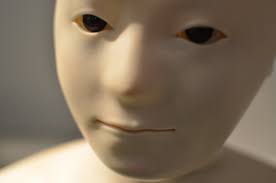
This afternoon, Anita came running to the kitchen when I was frying fish Gogol likes to eat with rice and daal. Panting, Anita mumbled something unintelligibly looking at our dining table. I held her arms and then leaned to check what it was. My heart missed a beat. A boy was standing in the passage. It had a very un-humanly chiseled looks – everything was too perfect as if it had walked out of some fairy tale book. But what would have scared Anita took me by surprise, too: its lifeless eyes, its gaze fixed in one direction. It looked like a human, but it wasn’t quite. When I stepped out of the kitchen, the boy robotically moved towards me: “Good afternoon, Maa.”

 I screamed. Gogol was standing next to the door of his room wickedly smiling as if sadistically observing what was going on and congratulating himself for his prescience.

 “Is it your surprise?” I asked now a little calmer realising that if Gogol was smiling the way he was it was part of his design.

“Yes, Maa. And now onwards it’s your companion. You have to give it a name, Maa.”

“Name? What name? What is it in the first place? Is it a live human?”

“It’s a humanoid which can do several things to assist you. It will make you feel less lonely when I am not around, Maa.”

Maa named the robot Pagol rhyming with my name, Gogol.  Until Maa became used to Pagol, there was a stiff carefulness. She had dealt with high technology in the past, particularly when we were in Germany, but not without close supervision of Baba until she became quite sure she could handle it herself. Anita learnt how to operate the robot very quickly and once she became comfortable Maa learnt things from her.

There wasn’t much to learn, though. Pagol was a fully automated robot with the intelligence of a two-year-old kid which helped it learn things by seeing them and then perform them with some basic assistance. It could perform four to five household chores, like reminding Maa of her daily medicines at the time she had to have them, bringing a tray to her with anything of moderate weight placed on it and having a basic conversation.

Slowly I’m forgetting Pagol is a robot. When Gogol visited me the next time, from Sweden, he did some tinkering to Pagol to make him more responsive to our needs and idiosyncrasies – and seeing me upset with him when he took Pagol apart to work on him, Gogol said: “Maa, you have become emotionally attached with Pagol. It’s only a contraption.” But it’s not the technological aspect of Pagol which has got me used to him but the fact that he has filled up a void in my life, one that had been left behind not so much by Gogol’s father’s sudden death in a road accident in Poland because there was Gogol to be brought up and other challenges that his passing way exposed me to, to be handled; as much by Gogol’s leaving India. Of course, Gogol does his bit to minimise the loneliness by phoning frequently and there is Anita, but the bouts of loneliness return nonetheless. I have fewer of those nowadays, thanks to Pagol.

You may find it strange that someone can develop emotions around a robot — a machine. Pagol is not many things that a normal human is. He can speak in, as Gogol calls them, preprogrammed scripts but you can’t have a conversation with Pagol. Nor can Pagol do things that come so naturally to us, like making meaningful eye contact or, say, a spontaneous chuckle or laugh or smile. But then doesn’t emotion, like beauty, lie in the eyes of the beholder?

But to Anita, Pagol was always a robot. Anita used to take care of all the mechanic needs of Pagol, setting the robot up on its charging station once every three days, calling me up in Sweden whenever Pagol needed technical attention.

But that wasn’t to be for too long.

                                                              *

When Maa called me in Sweden and very affectionately described how Pagol had ‘hit’ her gently, as if it had made the robot more endearing to her if anything, it reminded me of Edda. She had expressed her misgivings when I had told her that I was going to gift Maa an assistive robot. “There are lot of ethical concerns around these robots,” she had warned me. The concept of assistive robots for elderly people was widely known by then and so were the concerns about them. The popular concerns partly owed themselves to the sci-fi films and children’s books exaggerating these but also some incidents that had been reported widely in the media. Thanks to them, people saw robots as having a sinister side to them. What if a robot hit the elderly person it was assisting! Worse still, what if its functionality was sinisterly tweaked by someone to do so? Such were the concerns.

But Edda being a studious type was not the one to be swayed by popular beliefs. When she warned me, she had the real incidents reported in the media in mind. In one of them, an assistive robot helped an elderly person from his hospital bed to the balcony by holding his arms suddenly left the old man’s arms leaving the old man to himself and the old man, who couldn’t walk steadily without assistance, lost his balance, wobbled and fell down on a table injuring himself. 

On another occasion, an assistive robot had locked a bathroom door from outside locking an old woman in….And it took a long time for human help to arrive. The elderly woman was found in a state of panic and profusely sweating.

                                                         *

But we had to finally get rid of Pagol for entirely different reasons.

For a few days Pagol seems to have developed human qualities, a will of his own. He does things without being told to do them. This started since Gogol installed a new program in him to improve his cognitive abilities. I haven’t told it to Gogol because he would get worried and doing anything from so far is difficult anyway.

But since what Pagol did the other day, I have been a little concerned. Before Anita leaves for the day, which is generally late evening, she switches off Pagol and places him on his battery stand. It means Pagol is completely dysfunctional at night. That day I had dozed off while reading a Sunil Gangapadhay novel. After sometime, I woke up and realised I had slept off without switching off the lights and taking my medicines. I got up, finished my rituals, I retired for the day.

Sleep was hard to come by. I looked at the rafters thinking desultory thoughts until gradually the sleep god relented. Suddenly I felt the presence of another person in the room. When I looked up, I was startled. Two bright eyes were looking at me. For a moment I was paralyzed by fear, then I recognised the eyes — they were Pagol’s. I turned on the lights. I was right: Pagol was standing facing me. “Maa, you have not taken your medicines today,” he said.

But how did Pagol know this? During the day, when it is time for my medicines, he brings them to me on a tray. But at night, I take my medicines myself. And in any case Anita had put him to sleep for the night.

“What are doing here, Pagol? Didn’t Anita Di put you to sleep for night?” Pagol can respond to such simple questions nowadays, but he remained quiet, looking at me. Trying to move him to a corner of the room would be futile — Pagol was too heavy for that. The sudden surprise had dispelled my sleep. But, after sometime, I dozed off.

Next morning another surprise awaited me. When I got up, I didn’t see Pagol in the room. I rushed to the place where Anita keeps Pagol before leaving for the day — he was there exactly how Anita left him the previous day.

Today Pagol dropped a glass jar from his hand. He had taken the glass jar in his hand of his own volition; no one asked him to do it. When the glass slipped from his hand to the floor, Anita and I rushed to the kitchen. We were surprised. Not so much by the shattered jar as much by the expression of guilt on Pagol’s face. Anita shouted at Pagol: “Who asked you to play with that jar?” Later Anita saw Pagol standing in the balcony, looking at the lane below as if thinking something.

I knew very little about all this until I received a call from Anita one day. “Dada, lately Pagol has started acting strangely. It does things you don’t expect a robot to do.” She told me about the glass jar incident and what Maa had told her about finding Pagol standing in the middle of the room in the middle of night.

I was worried but I didn’t know what to do. I searched the net and found some short stories on robots developing human agencies. Finally, I mailed the Japanese company I had purchased Pagol from. After a few days, I received a response from a Japanese person by the name of Akinari, a robot engineer as per his mail signature.

Akinari said he had received similar complaints from customers before and had asked them to keep the robots under observation for some time to find out if there was any error of judgment on their part. He said he remembered almost everyone responding and confirming his doubt: that the complaints were the figment of imagination of the elderly persons receiving assistance from the robots.

I replied:

‘The robot assists my mother, and she is the person it spends most of its time with apart from Anita who takes care of my mother. It’s Anita who told me about the robot’s exploits. She wasn’t privy to some of them. She heard them from my mother, so I reluctantly ascribe some of the activities to my mother’s figment of imagination or error of judgement but Anita herself was witness to the other things the robot did.’

I want to mainly check with you if the robot can harm its benefactor.

Akinari wrote back:

‘I discussed it with other experts. Ordinarily we would have dismissed it as we have never heard anything like this before. But since you seem to be sure that your people back home have closely observed the robot for some time and are quite sure it is displaying behavior it is not programmed to, we would like to commission a special study of the robot in our lab.’

A week later a Japanese man visited our Calcutta house. Assisted by Anita, he dismantled the robot and took it with him.

The final entry on Pagol in Maa’s diary read:

It’s been six months since Pagol went missing one morning. He has not returned since. Anita assures me he will. The silly girl doesn’t seem to understand I know what they did to Pagol.

*

I never heard about Pagol again. I wrote to Akinari a few years after he sent a person to collect Pagol from our Calcutta home. But I didn’t get any reply from him. Did they completely dismantle him, and then dump his remains in a yard located somewhere in a third world country to add to the mounting pile of discarded gadgets abandoned because their utility to humankind had expired? I read on the net the other day that discarded robots are being recycled, also being used as fertilizer in some parts of the world. So, has Pagol ended up nourishing the food on the plate of someone?

I had expected Maa to react to Pagol’s sudden disappearance with the delirium of a mother who has suddenly lost her child. I had asked Anita to keep a tab on Maa in the days, weeks and months that followed Pagol’s sudden disappearance. But Maa never said anything about Pagol again. She continued with her life as if nothing had happened. Did she internalise the grief not expressing it lest it was trivialised by others? Or did she finally make peace with the fact that Pagol was a machine, after all.

After so many years I can only guess.

*Pagol in Bengali means mad or crazy.

Indrasish Banerjee has been writing and publishing his works for quite some time. He has published in Indian dailies like Hindustan Times and Pioneer, and Café Dissensus, a literary magazine. Indrasish is also a book reviewer with Readsy Discovery. Indrasish stays and works in Bangalore, India. 

.

PLEASE NOTE: ARTICLES CAN ONLY BE REPRODUCED IN OTHER SITES WITH DUE ACKNOWLEDGEMENT TO BORDERLESS JOURNAL

Categories
Editorial

Catch a Falling Star…

Art by Sohana Manzoor
For when your troubles starting multiplying
And they just might
It's easy to forget them without trying
With just a pocketful of starlight

Catch a falling star and put it in your pocket
Never let it fade away (never let it fade away)
Catch a falling star and put it in your pocket
Save it for a rainy day

'Catch a Falling Star' by Paul Vance and Lee Pockriss

Perhaps, it is time to find that fallen star popularised by pop singer Perry Como is 1957. Optimism glimmers faintly, sometimes even conceals itself, in a world passing through a dark phase in history. For instance, few of us would know that we might find more answers to tackle  climate change as dinosaur fossils (from the time an asteroid hit the planet) have been unearthed recently. That sounds like solutions can be had to what was perceived as inevitable doom.

Another bit of news that perhaps will cheer some is the first anthology of Borderless Journal will soon be available in market. It has been accepted by a publisher, an old, trusted and reputed name from India, Om Books International. They have bookshops splattered all over — should make it easy for buyers to access the book. Hopefully, you can target the anthology for your Diwali or Christmas gift hampers. Om Books has one of the most iconic editors-in chief, Shantanu Ray Chaudhuri. A multiple award-winning editor, he has worked in Penguin and Harper Collins and is currently churning out wonderful books from Om with a fabulous production team, working with whom has been a pleasure. Ray Chaudhuri is an outstanding film writer and poet. He is part of a group that is creating a film archive online. To know more about him or his views on publishing, you can read our online conversation with him.

The energy one gets from optimism like starlight from a fallen star, lightens the darker shadows that create gloom with the war leading to rise in prices and threats of recession in a post pandemic scenario. Lesya Bakun, the refugee from Ukraine whose story we carried last month, finds her starlight by sharing updates of her story.  She added to her narrative with the news that her cousin has been taken as a prisoner of war by Russia from the besieged factory in Ukraine. Though sharing does not alleviate suffering, Bakun’s ability to cling to hope and imagine a future where she gets her dream highlights the strength of her convictions. The other thing that is revealed by her narrative and media coverage is exclusivity and boxes of ideology split humankind, erase families, cities, countries, lives and sanity. The war can appease only the lust of warlords. Against this desolation caused by the devastation, what could be the starlight that would lead to a happier future?

Laughter. Unleashing the ability to laugh at oneself is as potent as laughter that generates relief and lightens our mood, so that we can view differences as whimsical, treat them with tolerance and compassion and not destroy the diversities that add colours to the world. Perhaps, that is why Tagore took to humour too. Somdatta Mandal has translated a series of humorous skits by Tagore. We are featuring one of these called the ‘Ordeal of Fame’. Yet another translation or transcreation of a poem called ‘Lukochuri’ or ‘Hide and Seek’ reflects the playful in Tagore’s oeuvre. These, along with Rhys Hughes humour on the pandemic in poetry and prose, bring good cheer into our journal. Hughes has also used his column to tell us why he curated a new humorous anthology of verses by seventeen poets called Wuxing Lyrical. I wonder if he is serious or joking!

We were fortunate to have a tongue-in-cheek online discussion with an academic with a witty sense of humour who started a book based on his PhD research with a limerick, Amit Ranjan, author of John Lang the Wanderer of Hindoostan, Slanderer in Hindoostan, Lawyer for the Ranee. While Ranjan brought to us a narrative of an Australian who challenged the colonial mindset, went to court representing the Rani of Jhansi, wrote for Charles Dickens in Household Words and moved around the world just like one of us, hopping jobs and looking for a life, we have diverse cultural streams woven into the journal with translations of a Balochi folktale from Fazal Baloch, a Korean poem by Ihlwha Choi and Professor Fakrul Alam’s translation of Jibananda’s poetry, an ongoing project in Borderless.

The Nithari column has yielded us a story that was written in a mix of Hindi and English by Yogesh Uniyal and translated fully to English by Nirbhay Bhogal. We have strange stories this time. Nileena Sunil’s short narrative and Paul Mirabile’s longer one set in Madrid explore the unusual. More stories delve into the intricacies of the human mind.

As we trot around the globe, Suzanne Kamata tells us about a Monet museum in Japan where she ate madeleines made with the artist’s recipe! Meredith Stephens sails to Tasmania with her camera and gives us a glimpse of nature’s plenty. Ravi Shankar relates his trekking adventures among the Himalayas in Nepal, with awesome photographs of these mountains, while Kenny Peavy who lives in Indonesia dwells on the value of falling down and getting up in a light humorous vein against the backdrop of nature – though metaphorically perhaps the world needs to do that. We have G Venkatesh’s story about his stay in Johannesburg where he discovers that skin tones do not matter.

Ratnottama Sengupta makes the whole world look like a home with the story of a legendary screenwriter, Jean Claude Carriere, who wrote the script of Mahabharata for Peter Brook’s play (1985) of the same name and the subsequent film (1989) — with characters drawn from all over the world. Candice gives us an overview of the pandemic, with more focus on US where she lives.

Mike Smith travels back to another time when an ailment called World War II raged and has revived a writer from the past, HE Bates (1905-1974). We have another essay by Dan Meloche on a legendary book which turned 100 this year — Herman Hesse’s Siddhartha. Rakhi Dalal revisits more than a century old translation by Devabrata Mukherjee of Tagore’s The Post Office which bears relevance to the present day as it shows how the human spirit endures over even the darkness of death.

Bhaskar Parichha has reviewed Radhika Gupta’s Limitless: The Power of Unlocking Your True Potential, by his assessment a book that inspires youngsters to take charge of their future. On the other hand, there are books that explore the darkest in humans. Basudhara Roy has reviewed a collection short stories by Sunil Sharma called Burn the Library & Other Fiction. Indrashish Banerjee reviews Upamanyu Chatterjee’s latest novel based on modern day crimes, Villainy, from which we are carrying a book excerpt too. The other excerpt is from a narrative written from a refugee’s perspective, Ramy Al-Asheq’s Ever Since I Did Not Die, translated by Isis Nusair from Arabic. Born in a refugee camp in Damascus, this Syrian-Palestinian poet defies all genres to touch hearts with brutal honesty. No less sincere is Michael Burch’s poetry on summer that ushers in the season as much as Sohana’s beautiful painting that we are using as our cover photo. We have poetry from not just Shantanu Ray Chaudhuri but also by George Freek, S. Srinivas, Tohm Bakelas, Abin Chakraborty, Marianne Tefft and many more. As usual, I have not mentioned all the treats in store for you. Delve into our contents page and browse to find out more.

Before winding up, I would want to extend my thanks not only to our team and contributors, but also to our publisher who is willing to republish our content with some tweaking. Thanks to our readers who, I hope, will be excited to have selected content between their palms as a hardcopy anthology with 49 of our most iconic pieces. We have more than a thousand published works. This anthology will be an iconic sample that you can carry anywhere with you even if there is no internet – that would include Mars and Moon!

I wish you happy reading, happy dreaming and hope… plenty of it.

Best wishes,

Mitali Chakravarty

borderlessjournal.com

Categories
Editorial

For the People, Of the People, By the People

Painting by Gita Viswanath
"I wish you survival, 
Health
And the closed sky above you."

— Refugee in my own Country/I am Ukraine, Lesya Bakun

Despite this being the season of multiple new years around Asia, we cannot close our eyes to the skies that connect all the world like a blue dome. Though celebrations and humour continue to lighten the darkness of war, while Ukraine is being wrecked, can we turn our faces towards only festivities?

I had an interesting anecdote about how before the onset of the Gregorian calendar, new years in the world were celebrated around March and in some places in September. The Earth would turn fecund and green with spring, a beautiful season sprinkled with love and nostalgia as Michael R Burch tells us in his poetry. However, despite all the opulence of nature, it is hard to watch a country being bombed and families splintered to man a war that supposedly guards a human construct called ideology and blocs. Ukranian refugee, Lesya Bakun, in an interview says: “It is not a clash of ideologies. It is a fight for our country and nation to exist.” Listening to Lesya’s stories makes one amazed at the bravery of the Ukrainians battling what seems to be cultural hegemony. It reminds of the war in Bangladesh in 1971. Though incredibly courageous in voicing her experiences, Lesya is traumatised and has a psychosomatic cough as she sends her voice and text messages from her mobile through Telegram. There were times when she was just weeping or angry for the questions asked, and justifiably so, as her home in Kharkiv, where she lived was under attack, and the town of Mariupol, where she was born, has been wrecked by the war.

The refrain of the pain of a refugee continues to reverberate in a book reviewed by Rakhi Dalal, Ramy Al-Asheq’s Ever Since I Did Not Die, written originally in Arabic and translated by Isis Nusair. The Syrian-Palestinian poet refused to clarify whether his writing was prose or poetry — perhaps these borders and boxes drawn by humankind are breaking down in reality. Perhaps, this new year, the time is ripe to look forward to a new world that transcends these borders. This is also the first time we have had the privilege of carrying reviews of translations from Arabic and also from Turkish. Gracy Samjetsabam has reviewed a translation of a Turkish novel by Iskendar Pala called The Tulip of Istanbul, translated by Ruth Whitehouse. Bhaskar Parichha has reviewed a book by Kiran Manral, Rising: 30 Women Who Changed India while Candice Louisa Daquin has drawn our focus on a poetry collection by Marjorie Maddox, Begin with a Question, where the perceived divisions do not matter while the poet questions the larger issue of faith in quest of answers.

Is it the same kind of quest that has led Strider Marcus Jones to create the Lothlorien Journal, named reminiscently after Tolkien’s elvish ‘Lothlorien’ in Lord of the Rings? Find out Jones’s views and flow with his fluid poetry in the featured interview. Keith Lyons has been in conversation with Ivy Ngeow, an upcoming writer and the editor of a recent anthology of Asian writing where she has retained different styles of English across the world in a single book. While this could be beneficial to writers, would readers be comfortable reading stories with different styles or dialects of English without a glossary?

Our book excerpts are from more Asian books.  The Year of the Rat and Other Poems edited by Malachi Edwin Vethamani has an interesting title poem which has been shared in the excerpt. The other excerpt is from a fast-paced novel, Half-Blood, by Pronoti Datta. We also have a fast-paced story by a writer from France called Paul Mirabile set in Portugal; two that verge on the bizarre from Keiran Martin and Amjad Ali Malik; a poignant story from Sutputra Radheye and another that shows the positive side of voicing a protest against wrongs by Devraj Singh Kalsi. Kalsi has also given us a tongue in cheek musing called When Books have Wings.

On the lighter vein are travel essays by Ravi Shankar and Meredith Stephens. They take us to the Himalayas in Nepal and to Tasmania! Suzanne Kamata has taken us to an owl cafe in Japan! At the end of her column, one feels sad for the owls as opposed to Erwin Coombs’ narrative that evokes laughter with his much-loved pet cat’s antics.

Humour is evoked by G. Venkatesh who with an ability to find silver linings in dark clouds talks of cricket and lessons learnt from missing his school bus. Adnan Zaidi has also analysed his poetic abilities with tongue-in-cheek comments. Kenny Peavy gives a lighthearted rendition in praise of boredom and interactions with nature. It is good to have laughter to combat the darkness of the current times, to give us energy to transcend our grief. Keith Lyons hovers on the track between humour and non-humour with his cycling adventures. Rhys Hughes seems to talk of both his favourite poem and the war in a lighter shades, in no way insensitive but his observations make us wonder at the sanity of war. We have much of war poetry by a number of writers, poetry on varied issues by Luis Cuauhtémoc Berriozabal, George Freek, Sybil Pretious, Kisholoy Roy, J.D. Koikoibo and many more.

Candice Louisa Daquin has taken on the onus of bringing to our notice how language can impact us in the long run while Ratnottama Sengupta has explored beggary in films, fiction and fact. The Nithari column runs a real-life story of a young boy narrated by his brother, Sachin Sharma. It has been translated from Hindustani by Diksha Lamba. The trauma faced in 2006 is strangely not discussed in the story though it hovers in the backdrop between the lines. We also have a translation of a Balochi folk story by Fazal Baloch and a Korean poem by Ihlwha Choi. Translations from Tagore by Fakrul Alam and Somdatta Mandal have honoured our pages again. Mandal has sent us fun-filled skits by Tagore. But are they just fun or is there something more? We also have a translation of a long poem that explores a different aspect of Tagore, his empathy for the downtrodden which led him to create Sriniketan and regard it as his ‘life work’.

We have a bumper issue this time again — especially for the Asian new years; Thai, Nepalese, Bangladeshi, multiple Indian and more…

We would like to thank Sohana Manzoor for our cover painting and Gita Viswanath for her artwork. I would like to thank our wonderful team who with their contributions make this journal a reality. All the contributors deserve a huge thanks as do our loyal readers.

I wish you all a wonderful start to a non-Gregorian new year and hope that peace prevails over parts torn by wars and dissensions.

Thank you all!

Mitali Chakravarty
borderlessjournal.com

Categories
Notes from Japan

Owls in the Ginza

Suzanne Kamata visits an ‘owl café’ in Tokyo

The last time I had found myself in Tokyo with some free time and the freedom to move about, I had tried to drop in at an owl café. However, after making my way to such an establishment on the heels of a couple of Chinese tourists, I discovered that a reservation was necessary. The place was booked weeks in advance.

A few weeks ago, I again had some business in Tokyo, so I contacted an old friend and suggested we do a bit of sightseeing together.

“What do you want to do?” she asked me.

I replied that I wanted to visit an owl café. She messaged back that she didn’t like birds.

We had lunch in a sushi restaurant that normally had a queue as early as seven a.m. Due to the coronavirus, we waltzed right in and had a leisurely lunch. After that, we went to a museum that normally required reservations, or at least a long wait. And since there had been so little time wasted standing in line, my friend agreed to take me to an owl café. She found one by using her phone and called the place up. Sure, we could visit, the owner said. No reservations were needed.

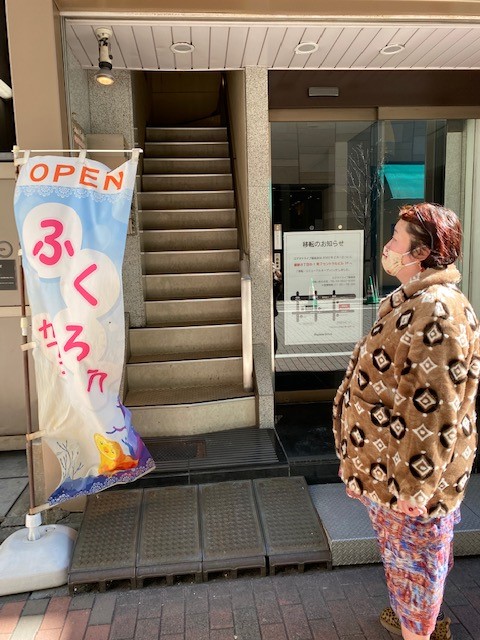
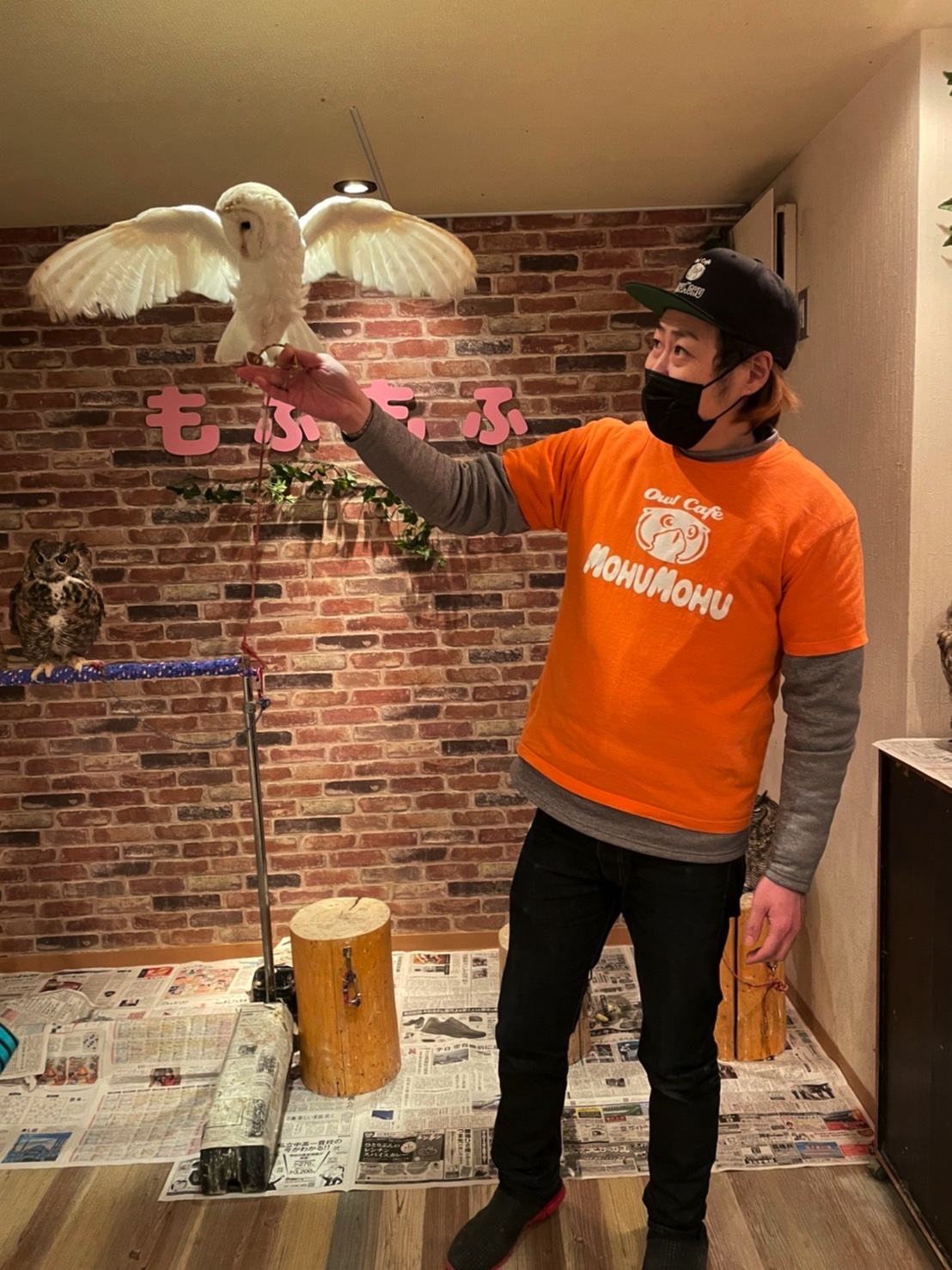
The Mofu Mofu Owl Café Ginza was down a side street in Tokyo’s tony shopping district, steps away from the likes of Louis Vuitton and Chanel. As we climbed the three flights of narrow stairs, I wondered what it would be like inside. It would be dark, I imagined, because owls are nocturnal. But no, when we pushed open the door, we were met with light.

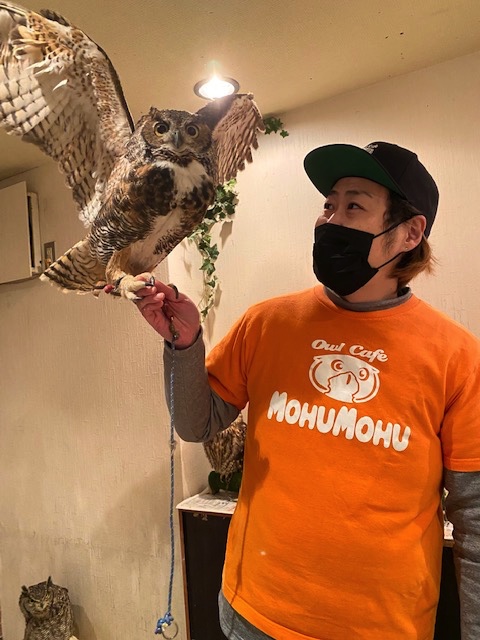
It’s a bit of a misnomer to call the place, and others like it, a café. Coffee is not served, nor is there cake or any other kind of food. There were no tables, no young women with aprons or maid costumes, just a guy wearing a T-shirt in a roomful of owls tethered to perches.

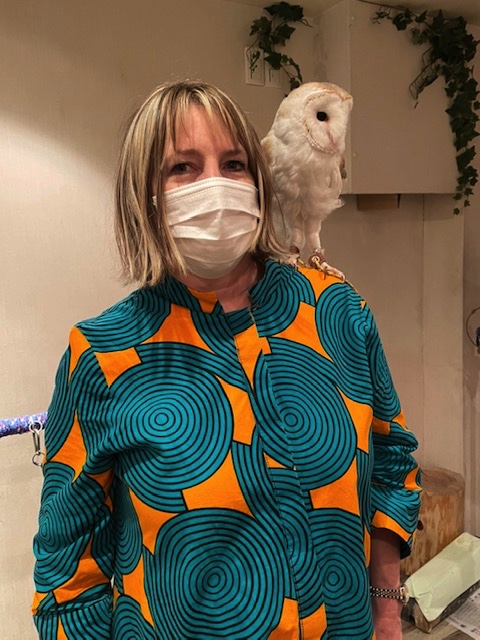
The owner seemed happy to see us. We were the only customers. He instructed us to disinfect our hands, and then showed us how to touch the owls – a gentle rub on the top of their heads, much in the way that my cat liked to be caressed. The owls were big and fluffy, like cats, and I wanted to hug them, but I figured they would probably try to bite me if I did.

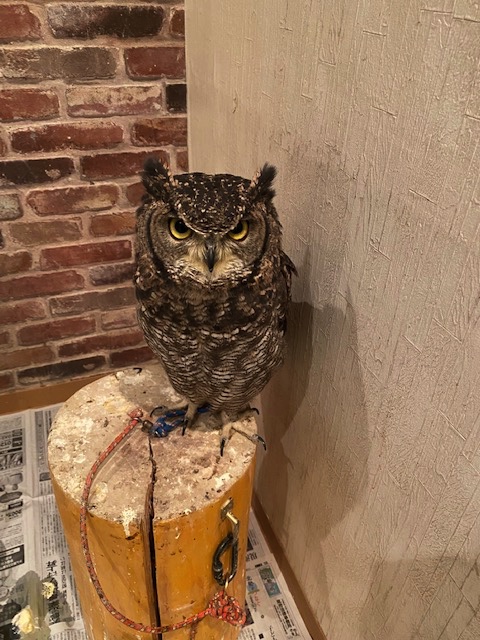
My friend, the bird-hater, hung back while I went around looking at each owl. They were of various species from around the world. I wondered if they were bored, sitting on their perches all day, with nothing to do. Maybe our being there was their entertainment.

“They wouldn’t survive in the wild,” the owner said. “They have been raised from eggs by humans.”

He told us that they might live for thirty years in captivity, but only half that in nature. What was worse, I wondered? Thirty years of boredom, or fifteen years of being stressed out about their next meal, and where they would build a nest? Was keeping owls in this room any worse that keeping a parakeet in a cage? Or not allowing my restless cats to go outside, even when they meowed pleadingly at the door? (Actually, I sometimes did allow them to go out, knowing full well that they might be dodging cars, picking up fleas, and murdering songbirds and mice.)

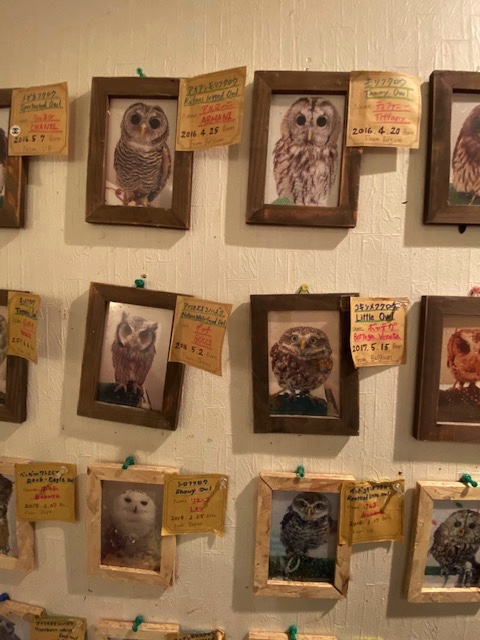
The owner explained that before the pandemic, he’d operated two cafes – this one, and another in Roppongi — but due to the travel restrictions which prevented tourists from overseas from visiting, he’d had to close that one. All the owls were now gathered here. They’d been given names of nearby shops. Gucci was a Japanese Northern White-faced Owl, while the Little Owl from Belgium was named Bottega Veneta. There was also a Tawny Owl, born in 2016, named Tiffany.

“Before the pandemic, a lot of foreigners came here,” the owner said. Some famous people, too. He showed us a photo of the singer Akiko Yano, ex-wife of internationally renowned musician Ryuichi Sakamoto, with one of the owls. Yano lives in New York City and had heard about the café while abroad. I looked around at the empty space. Apparently, Tokyoites didn’t have an urge to commune with owls. I worried about what would happen to them if the tourists weren’t welcomed back to Japan soon.

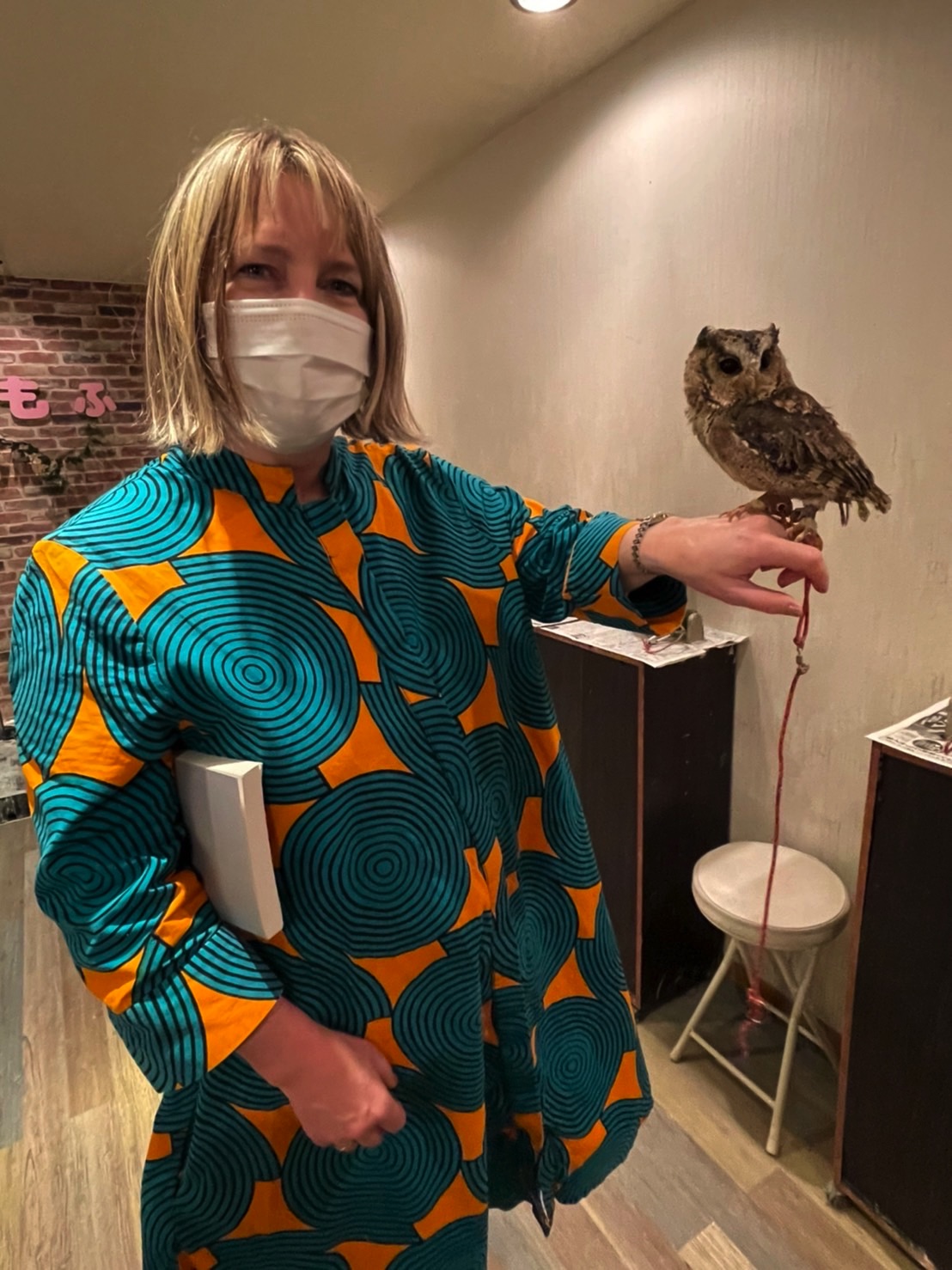
The owner let me pick out an owl and settled it on my hand. My friend finally got up the courage to stroke one of the owls between its eyes. The phone rang, and the owner went to answer it. I heard him booking another customer, and I felt a bit relieved. Apparently, this one would come at mealtime and watch the owls consume dead mice. That was probably an exciting part of the owls’ day.

Part of me thought that the birds might be happier in an atrium somewhere. But while they were here, I hoped they would be well looked after. I wanted to contribute as best as I could, so I loaded up on souvenirs – a pen encasing an owl feather, made by the owner’s wife; a handful of chopsticks with owl motifs; and a bottle of Hitachino Nest beer, which had an owl on the label. And I promised to post some photos on Instagram so that more tourists would come.

An owl in chains

Suzanne Kamata was born and raised in Grand Haven, Michigan. She now lives in Japan with her husband and two children. Her short stories, essays, articles and book reviews have appeared in over 100 publications. Her work has been nominated for the Pushcart Prize five times, and received a Special Mention in 2006. She is also a two-time winner of the All Nippon Airways/Wingspan Fiction Contest, winner of the Paris Book Festival, and winner of a SCBWI Magazine Merit Award.

Thanks to the columnist Suzanne Kamata for the photographs. 

PLEASE NOTE: ARTICLES CAN ONLY BE REPRODUCED IN OTHER SITES WITH DUE ACKNOWLEDGEMENT TO BORDERLESS JOURNAL

Categories
Editorial

Where Have All the Sunflowers Gone?

Only when the cries of the wretched of the earth will stop renting the skies,
Only when the oppressor’s bloody sword will cease smearing battlefields,
			A rebel, weary of war,
			Only then I won’t stir.
…
I’m the ever-rebellious hero--
	Soaring over the world, all alone, head forever held high!

--  Rebel or 'Bidrohi' (1922) by Nazrul, translated by Fakrul Alam
Borderless: Digital Art by Ayaan Ghoshal
These fragments I have shored against my ruins
…
Datta. Dayadhvam. Damyata.         
 Shantih shantih shantih

-- Wasteland (1922) by TS Eliot

These lines reiterate values we would do well to live by in a war-torn, dissension-worn world where the need for a rebel to recreate a humane society that lives with values such as peace, generosity, acceptance, tolerance, compassion and restraint — is a felt need. The two great poems made history by remaining as popular a hundred years after they were written — ‘The Rebel’ by Nazrul and TS Eliot’s ‘Wasteland’. Nazrul defined a rebel as an iconoclast who breaks norms to find peace, justice and love for all, to move towards the creation of an ideal world. TS Eliot quoted from the Upanishads and ended with redemption coming with giving (giver perhaps denoted generosity), compassion and restraint. Despite the wisdom of these great poets and seers, war still continues a reality. The values remain neglected not just in as we see in conflicts, like the one in Ukraine that destroys lives, property and nature with intolerance towards differences, but also in our personal lives. Tagore also reiterated the same need for stepping out of personal, social, economic and political insularity. We carry a translation of a song that echoed this need while inviting participation in his ecstasy. He wrote:

Why do you sit in isolation,
Dwelling on self-centred issues? 

Tagore had not only written of the negative impact of isolation from the world but he led by example, building institutions that could lead the world towards pacifism with acceptance of diversity and inclusiveness. Sriniketan and Santiniketan were created to move towards these ideals. Many of the people he influenced or who studied in Santiniketan made history, like Prime Minister Indira Gandhi, Satyajit Ray; many added to the sense of inclusiveness, like Mahasweta Devi, who other than her enormous work to integrate different cultures, also wrote a memoir about Santiniketan in Bengali. Radha Chakravarty, nominated for the Crossword Translation Award (2004) for In the Name of the Mother by Mahasweta Devi, has translated this memoir, a narrative which brings us close to Tagore’s ideals of the whole world being a family. How wonderful it would be if the world were open to such ideals and would behave like a global family and not go to war!  Mahasweta Devi, Our Santiniketan, which has been reviewed by Meenakshi Malhotra, reiterates Tagore’s vision of a planet living in harmony with the flora and fauna.

Bhaskar Parichha has reviewed another non-fiction by Ashok Kumar Pandey, Why They Killed Gandhi; Unmasking the Ideology and the Conspiracy. Parichha writes: “The finest point about this book is its storytelling…” The book review brings to mind in the midst of a war and violence that Gandhi had tried to erase this mindless destruction of lives, nature and cities with Ahimsa or non-violence. Will we ever rise up to it? Perhaps… We see strains of recognising the negative impact of insular outlook in writings like that of Temsula Ao, a Sahitya Akademi Award winner, according to Indrashish Banerjee who has reviewed her new book, The Tombstone in My Garden: Stories from Nagaland. Keith Lyons has reviewed Asian Anthology: New Writing Vol. 1: Stories by Writers from Around the World, edited by Ivy Ngeow, an exotic medley of Asian stories, one of which has been excerpted as well.

We are privileged to carry another excerpt from Ruskin Bond’s Friends in Wild Places: Birds, Beasts and Other Companions, a hilarious story about a pet tiger adopted by the legendary writer’s grandfather. What is amazing about Ruskin Bond’s writing is the love and compassions for all creatures great and small that colours the tongue-in-cheek humour he rolls out to his readers. If only we could think like Bond, there would be no wars. His writing, I feel, transcends political borders or ‘isms’, and laces with love and compassion tales of menageries of monkeys, snakes, mongoose, humans of different denominations. This excerpt is a treat we are giving Borderless Journal as the journal completes two years of its existence. We are truly grateful to Speaking Tiger for sharing this excerpt with us. But our celebrations this time are sombre as the war rages with incoherence accompanied by heart-breaking ravages.

The refrain from Ukraine has been taken up by Ratnottama Sengupta as she takes us through the past and present experiences of the devastated country, bringing in the views of the legendary folk singer and pacifist, Pete Seeger (1919-2014), who she had interviewed over a span of four days. The writer of ‘Where have all the Flowers Gone?’, a song based on an Ukrainian folk song, Seeger said, “The point is not to ask for yourself alone — one has to ask for everybody: Either we all are going to make it over the rainbow or nobody is going to make it.” Candice Louisa Daquin has also pondered on the justification of war, contextualising it with the current one along with her essay on the paradox of modern linguistic communication.

We have an exhaustive essay on the legendary Satyajit Ray’s creations by Anasuya Bhar. Malhotra has pondered at exclusivity reinforcing divisions, margins and borders to plague humankind, against the backdrop of the Women’s Month, March. Highlighting women in writing, we have interviewed two female writers, one from Nepal and another from Bangladesh. Sangita Swechcha lives in UK but her writing, till now largely in Nepali, often pines for her home embedded in the Himalayas whereas, an expat, Neeman Sobhan, shuttles between Bangladesh and Italy with the affluence and assurance of a privileged background.

Finding a way to override lack of privileges, deprivation and violence, are the youngsters of Nithari on the outskirts of Delhi where less than two decades ago other than poverty, savage criminality devastated the local populace. These youngsters transcended the suffering over time with help from volunteering NGOs to create narratives that amaze with their inventiveness and confidence. Tanveer Hussain from Nithari, self-motivated and self-made from a young age, asks questions that would be relevant for all humankind in a letter to God. It has been translated from Hindustani by Vritika Thareja of pandies’. This edition’s translations include Professor Fakrul Alam’s mellifluous rendition of Jibanananda Das’s poetry from Bengali to English, Ihlwha Choi’s Korean poetry and a Balochi poem by Munir Momin rendered in English by Fazal Baloch. Baloch had earlier translated poems by Akbar Barakzai, a great poet who departed on 7th March, depriving the world of yet another powerful writer who imbibed hope of a better future in his poetry. We are privileged to have hosted the translations of some of his poems and his last interview.

Another well-known poetic voice from Singapore, Kirpal Singh, has given us poignant poetry that can be applied to the situation that is leading to the wreck of Ukraine. Anasuya Bhar has  poetry, one of which despite being in the ilk of Nazrul’s great poem, ‘Rebel or Bidrohi’, questions gently mainly social constructs that obstruct the flow of harmony. Ryan Quinn Flanagan has pondered on the acceptance of a changed world. We have humour from Rhys Hughes in poetry and wonderful poems by Michael R Burch on spring. Jay Nicholls shares the last of her dozen Pirate poems as Blacktarn sails the lemon seas to fight pollution. Luis Cuauhtémoc Berriozábal, George Freek, Sutputra Radheye, Mike Smith, Shaza Khan and many more have contributed a wealth of beautiful lines. Penny Wilkes has captured storms and seas with photographs and text and Rhys has surprised us with some strange, bizarre tales in his column.

We have musings from around the world. San Lin Tun, Meredith Stephens, Erwin Coombs, G Venkatesh have all brought in flavours of multiple cultures. Devraj Singh Kalsi has spoken of a book fair he visited in a semi-sardonic tone. He has also given us a short story as has Farah Ghuznavi – a truly borderless story which takes place in an aeroplane, in the sky where all borders collapse. We have more stories from Balochistan, US and India.

Suzanne Kamata continues writing on Japan as she  introduces us to an Australian film maker who is making films in Japan and in Japanese, called Felicity Tillack. Cultures are perhaps truly crossing borders as we can see Kenny Peavy, an environmentalist who moved from US to Indonesia start a new column with us called ‘Mission Earth’. We hope, like Tagore or Rousseau, he will help to revive our felt need to live with nature, acknowledge the nurture that we get from the planet to live in harmony with it and on it.

At the end of twenty-four months of existence – that sounds better than a mere two years— we are happy to host a melange of writers from across the borders and be the meeting grounds of writers and readers from across continents. I am truly thankful to all of you for helping concretise an ideal. Huge thanks to all the writers, artists, photographers and the readers for the contribution of their time, effort and love. And thanks to our fabulous team who continue to support the journal unwaveringly. I would also like to thank Sohana for the lovely visuals she generously shares with us. A special thanks also to young Ayaan Ghoshal for his digital art where hands reach out to support a truly borderless world.

As usual, all the content has not been covered here, I invite you all to enjoy our March edition of Borderless Journal.

At the start of the third year of our existence, let us march onwards towards renewed hope – maybe the Ukraine experience will take us closer to a war-free world with an awakening of a felt need for peace and compassion in a planet without borders.

In quest of a peaceful, humane world, I invite you all to continue being part of this journey.  

Mitali Chakravarty

Borderless Journal

Categories
Notes from Japan

Imagining a Possible Future: Filmmaker Felicity Tillack

Suzanne Kamata brings to us people, experiences and cultures from Japan

Director and writer, Felicity Tillack, preparing a shot at Uji.  Photo courtesy : William Yagi Lewis

Before coming to Japan in 2006, Felicity Tillack had hoped to become a Japanese high school teacher in Australia. She had grown up in Mackay in West Queensland where Japanese was one of the languages taught in primary school. “I fell in love,” Tillack says. In spite of her passion for the language and culture, she concedes that she wasn’t very good at Japanese. She decided to drop education as a major. After earning a B.A. in literature, she got on a plane to Japan. Now based in Kyoto, Tillack teaches at an international school, writing and making films on the side.

Tillack started making videos in 2012 on her Youtube channel Where Next Japan. She eventually moved on to documentaries such as New Japanese Citizens and 3rd Culture Kids in Japan. These projects, she says, “really started me thinking more deeply about the concept of identity and how it is tied to the culture you grow up in as well as your ethnic roots and background. I’ve seen so many kids struggle with their identity. I taught many biracial kids, with one Japanese parent and one foreign parent who, in their struggle to feel legitimate and accepted within Japan, would often strongly reject their non-Japanese heritage. So, a lot of experiences and observations started to come together and slowly built into a story.”

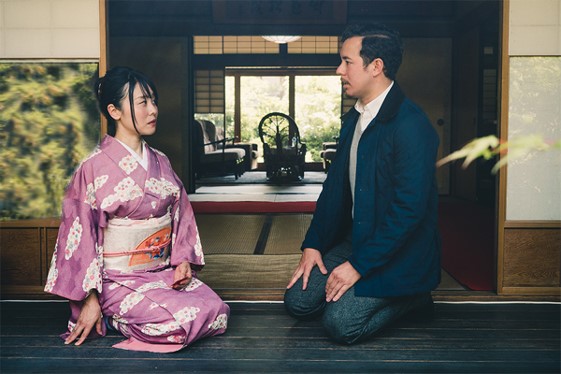
Impossible to Imagine, her debut narrative feature film is the story of Ami Shimizu (played by Yukiko Ito), a Kyoto woman doing her best to keep her mother’s kimono rental shop alive, and Hayato Arai (played by first-time actor William Yagi Lewis), the biracial Japanese business consultant that she hires for advice. It evolves into a romance, but it’s also an exploration of tradition versus change in one of Japan’s most traditional and impenetrable cities.

Although Tillack is Australian, the film is mostly in Japanese. “I felt that it was a story that needed to be told in Japanese with Japanese characters,” she says. “I wanted to start a conversation here in Japan.” She wrote the script initially in English and had it translated into Japanese. Tillack admits that the language barrier is “a big difficulty” when filmmaking in Japan, but both of the actors in the starring roles are bilingual. They were able to offer advice on cultural details and interpret, when necessary.

Tillack made the film on a shoestring budget of about a million yen (around US$10,000), financed out of her own pocket. The movie was shot in about ten days on the streets near her home. Although she wasn’t able to pay her actors and crew much, she said that she and her colleagues saw the making of the film as a “learning experience.”

Left to right: Felicity Tillack (director, writer), Yukiko Ito (main actress, Ami Shimizu) and William Yagi Lewis (main actor, Hayato Arai) at the Kyoto premiere of Impossible to Imagine.  Photo Courtesy: Morgan Lewis

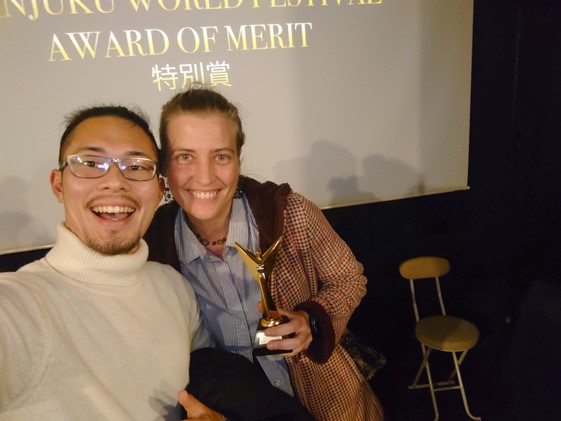
Impossible to Imagine has been shown at several film festivals, including the Paris Lift-Off Film Festival, and the Shinjuku World Film Festival in Tokyo. Tillack has also hosted screenings at various venues in Japan. At one such event held at a Buddhist temple in Kagawa Prefecture, the audience was mostly elderly and eager to discuss the issues brought up by the film. The movie is now streaming on Amazon, making it accessible to viewers all over the world.

Tillack, who cites Richard Linklater’s Before Sunrise series as an inspiration, had plans to start shooting a sequel: I had written the script, lined up financing, and everything.” But then the pandemic hit. Unable to make movies for the time being, she has started on another script, this one tentatively entitled Before Real Life Begins. It refers to the idea that foreigners often come to Japan after graduating from college intending to stay for a year or two before their “real life” starts. Tillack’s script contends that time spent in Japan is real life. Keeping in mind that Westerners experience Japan differently than Filipinos, for example, she hopes to explore this issue from various viewpoints. She is working on this story with two other writers who are based in Tokyo.

Tillack also had a hand in the forthcoming film Matcha and Vanilla, a love story written and directed by her friend Hamish Downie, who was the producer of Impossible to Imagine. Tillack is listed in the cast as “journalist” on the movie’s IMBD site, however she insists it’s only a bit part. Tillack’s future in filmmaking is off to a promising start.

In imagining a future for Japan, Felicity Tillack looks back at her own country’s history. “I was told when I was very young not to marry outside my culture,” she says – advice that she did not heed. She points out that in the 1970s, Australia was “95% white”, however, now, one in four in the country were born overseas. “Australia has changed culturally.” Through her work, both on this film and her other creative endeavors, Tillak suggests that her adopted country, too, may become more inclusive and accepting in the not-too-distant future.


Felicity Tillack (director, writer) and Shota Wanibe (sound mixer, boom operator) receiving an award at Shinjuku World Festival. Photo Courtesy: Shota Wanibe

.

Suzanne Kamata was born and raised in Grand Haven, Michigan. She now lives in Japan with her husband and two children. Her short stories, essays, articles and book reviews have appeared in over 100 publications. Her work has been nominated for the Pushcart Prize five times, and received a Special Mention in 2006. She is also a two-time winner of the All Nippon Airways/Wingspan Fiction Contest, winner of the Paris Book Festival, and winner of a SCBWI Magazine Merit Award.

Thanks to the columnist Suzanne Kamata for sourcing the photographs.

PLEASE NOTE: ARTICLES CAN ONLY BE REPRODUCED IN OTHER SITES WITH DUE ACKNOWLEDGEMENT TO BORDERLESS JOURNAL

Categories
Slices from Life

Messages through Space and Time

Meredith Stephens explores letter writing as an art that can stretch beyond a person’s lifetime and across borders of all kinds

I walked out to the end of the driveway of my Adelaide house, unlocked the letter box, and among the flyers and political brochures, I found a New Year’s card from a Japanese student called Mutsumi. It had been two years since the beginning of the pandemic, and I have been teaching on Zoom ever since. I have never met Mutsumi in person but have taught her for the two years online. When I taught in person in Japan, students would sometimes send a New Year’s card to my local Japanese address, but I had never received one at my Australian address.

New Year is just as important in Japan as Christmas is in my home country of Australia. In the pre-digital age we would send Christmas cards to friends and family destined to arrive on December 24th at the latest. They never arrived on Christmas Day because it was a public holiday. In contrast, in Japan, New Year’s cards are delivered on New Year’s Day and never any earlier. They may arrive later though, as receivers scramble to reply to those from whom they had not anticipated receiving a card. Although I had often received cards as late as the end of the first week in January, I had never received one in February. During the pandemic, international deliveries were experiencing considerable delays and some were even returned to the sender. I was grateful the New Year’s card had traversed the seven thousand kilometres to reach me at the southern coast of the southern Australian continent.

I looked at Mutsumi’s card and realized that the presentation of calligraphy was just as important as the message. Written Japanese is not just a means of relaying a message but also an art form. Primary school children must purchase a calligraphy set and are issued a calligraphy textbook to be used in their weekly calligraphy lesson. Fifteen years ago, when my daughter was in primary school, her homework was to create a piece of calligraphy which read Yama nobori, or ‘Climbing a Mountain’. The image below shows her doing her homework on the kitchen table, carefully pressing the calligraphy brush into the ink before she writes the characters on the rice paper.

English handwriting was also elegant in the writing of our forebears, although it wasn’t written with a brush. Here is a postcard written by my great great grandfather to my grandmother when she was about five, around 1907 when they cost only one penny to send. It reads, “Dear Emilie, Hope you had a good sleep last week and that you are feeling fit for school again next week. Love to all, From Grandfather.”

Although the writing is ornate the content is quotidian. The affection for his granddaughter is revealed not just in the message but also in the handwriting style.

A handwritten postcard, whether it is written in Japanese in 2022 or in English in 1907, may be considered an aesthetic work. Handwriting conveys both the literal meaning of the words and the feelings for the recipient. As Kathleen Parker reminds us[1], the pleasure of receiving a letter is that both the sender and the receiver have touched the same piece of paper. The postcard above has been touched by both my great great grandfather and me, at an interval of 115 years. I am sure that when he was writing to his granddaughter asking after her health in 1907, he never imagined that his great great granddaughter would be touching and reading it in 2022.

I rarely have a chance to put pen to paper these days, other than when writing a shopping list. My fingers fly across the keyboards almost as quickly as I can think, in a qwerty fingertip language. That’s why I appreciate those who take the time to select and purchase a postcard, and choose a fine pen or brush to produce an elegant written message that I may fondly linger over for years to come.

[1] Kathleen Parker, 2010, as cited in Baron, S. (2015). Words onscreen: The fate of reading in a digital world. Oxford University Press.

.

Meredith Stephens is an applied linguist in Japan. Her work has appeared in Transnational Literature, The Blue Nib, The Font – A Literary Journal for Language Teachers, The Journal of Literature in Language Teaching, The Writers’ and Readers’ MagazineReading in a Foreign Languageand in chapters in anthologies published by Demeter Press, Canada.

.

PLEASE NOTE: ARTICLES CAN ONLY BE REPRODUCED IN OTHER SITES WITH DUE ACKNOWLEDGEMENT TO BORDERLESS JOURNAL