Categories
Review

Rising from the Dust

Book Review by Somdatta Mandal
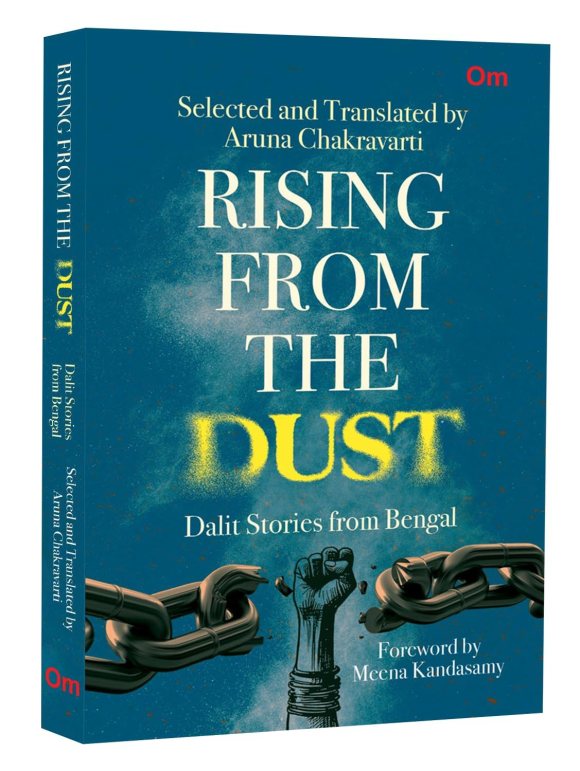
Title: Rising From the Dust: Dalit Stories from Bengal

Selected and Translated by Aruna Charavarti

Publisher: Om Books International

Though Bengali Dalit writing is comparatively newer compared to Dalit writing in Marathi and other Dravidian languages, nevertheless it has already carved a niche for itself in a significant way. The main difference between the Dalit writing emanating from other regions of India and that of Bengal is that whereas the thrust area elsewhere is primarily on the untouchables, the downtrodden and the way the Dalits have been marginalised in society for a long time, in Bengal the problem is further complicated by caste and class issues which is not so significant elsewhere. This collection of twelve Dalit short stories from Bengal, carefully selected and translated by Aruna Chakravarti, spans a long period and what distinguishes it is the gendered lens that explores the Dalit woman’s cause and holds it up to the light.

There is a difference in the style of narrating the Dalit experience from writer to writer and accordingly it can be divided into two groups. In the first category are writers who themselves belong to the Dalit community and their writing stem out of experiential feelings. The second group of writers belong to the upper castes, and their writing stems from a feeling of empathy for the marginalized and the downtrodden. Spanning a long period of almost a century, Aruna Chakravarti has decided to blend both these categories and has meticulously translated the dozen stories from well-known writers to those a little lesser known. While literary stalwarts like Mahasweta Devi, Saratchandra Chattopadhyay, Tarashankar Bandopadhyay and Prafulla Roy share their profound understanding of the Dalit woman’s fears and traumas, hopes, dreams and aspirations, contemporary voices from the Dalit community itself like Manoranjan Byapari, Bimalendu Haldar, Manohar Mouli Biswas, Kalyani Thakur Charal, Anil Ghorai and Nakul Mallik explore aspects of survival and social ostracisation with both sensitivity and angst. On the one hand we have centuries of oppression being still carried upon these subaltern people, and even within that restricted space, we also often find protest and upheaval that the doubly marginalized womenfolk attempt to revolt against.  

In the opening story titled “Fortress” by Manoranjan Byapari, we find Nakul’s widow Sarama, unwillingly forced to sell her body to oppressive menfolk everyday finds her unique way of protest by deliberately copulating with her ex-husband Ratan who is inflicted with venereal disease, thereby driving out all her fear and henceforth would ‘welcome every touch’ and ‘would wait outside her door in delicious anticipation.’ In Bimalendu Haldar’s “Salt” we are shown how a fisherman Madhai who works for his employer Nishay Ghosh, goes missing and his wife Chintay, collecting three other suffering women registers their protest in a unique way. In “Shonkhomala” Manohar Mouli Biswas tells us a relatively contemporary and true story relating to the grabbing of agricultural land in the fertile Singur area by the government for setting up of the Tata Motor Factory. It tells us of how Shonkhomala Dom, a Dalit woman, changes her name to Tapashi Malik and is gangraped and murdered because she was unwilling to give up her land and organized a protest march instead. Incidentally, till date, the court case for identifying the murderer and the rapists of Tapashi Malik is unresolved.

Another very touching story “Illegal Immigrant” by Nakul Mallick brings in the plight of refugees from erstwhile East Bengal coming to India after the partition. It tells us of the plight of an extremely poor jhalmuri seller called Madhav who, along with his wife Shefali, lives in a slum beside the train track and somehow manages to eke out a decent living. When Madhav is picked up as an illegal Bangladeshi immigrant and thrown out of the country, his wife’s life goes haywire as she goes to the Petrapole border looking for her husband in vain. Kalyani Thakur Charal deliberately adds the word ‘Charal’ meaning ‘Chandal’ or ‘untouchable’ to her name in order to take pride of her Dalit identity. In “Motho’s Daughter” she tells the story of one Nishikanta who wants to get his children educated first and foremost and is frustrated in the end because his stray son gets married to a woman who doesn’t encourage education. Anil Ghorai, another powerful Dalit writer, tells an interesting story about Larani, belonging to the tanner caste, her relationship with Hola Burho, a dhol[1] repairer and his son Pabna. The main thrust of the story “The Insect Festival” is of course the attack of locusts in the village and how the majority of the illiterate villagers take resort to superstitious rituals in order to ward off the menace instead of confronting the situation in a scientific manner.

As mentioned earlier, each story by the four empathetic writers goes on emphasizing the pressures of caste and class upon the lower classes of people in different situations. In “The True Life Story of Uli-Buli’s Mother” Mahasweta Devi tells us the story of a helpless woman who becomes a destitute after being thrown away for having four daughters. She lives under the delusion that someone has stolen her young twins Uli and Buli. Again in “Nalini’s Story” she draws a beautiful pen picture of Nalini, who after being abandoned by her husband, lives with her grandson and ekes out her living by working as a maid. Years later, her estranged son along with his wife and her landlord Gobindo all desire to take possession of her house by arranging an elaborate shraddha ceremony for her estranged husband. Nalini understands their ploy and, in the end, she puts her foot down, unwilling to be in eternal debt for the extravagant rituals proposed by them.

Prafulla Kumar Roy’s “Snake Maiden” gives us an inside story of the gypsies or nomads who are known as ‘bedyes’ and who deal with snakes and charms. Here Shankhini is the mistress of a band of bedeys who come and settle in Sonai Bibir Bil for the season and accidentally meets her ex-lover Raja saheb. She is in a quandary because he wants her to renounce the bedeni’s life and settle down in one place and turn into a farmer’s wife. The tug between domesticity and the age-old tradition of this nomadic gypsy tribe’s rituals and customs is elaborated through the rest of this interesting story. The powerful storyteller Tarashankar Bandyopadhyay gives us two stories with totally different locales and characters. In “The Witch” he elaborates upon the idea of a woman who is defined as a witch and is ostracised by society because she is said to cast an evil eye upon everything she sees. She dies an agonising death in the end as her dark and unholy blood oozes out from her veins. Incidentally, even to this day the idea of identifying certain low caste woman as witches and even burning them to death persists in several villages in rural Bengal and such superstitions are not overcome at all.

In the second story “Raikamal”, Tarashankar gives us an in-depth picture of a Vaishnav community, their rituals and their manner of living. The protagonist Kamalini had to abandon her crush on Ranjan because he belongs to another caste, weds Rasik who consumes poison in the end out of jealousy and ultimately Kamalini has to live all alone. Sarat Chandra Chattopadhyay’s eponymous story “Abhagi’s Heaven” is once again a depiction of Bengali society strictly divided according to caste lines. In this story, Kangali’s mother Abhagi, an untouchable, a ‘duley’ by caste, watches the funeral pyre of a Brahmin lady and imagines her going to heaven in a golden chariot. She nourishes the desire to be cremated in a similar fashion when she dies, but after her actual death she is denied the privilege of being burnt and has to be buried near the riverside as per societal norms.    

The stories in this collection capture the essence of a way of life marked by the enduring defiant spirit of the dispossessed and the marginalised. This is a must-read not only for literary enthusiasts, but also for students and scholars of Dalit and caste studies, development studies, Indian literature in translation and gender studies. In her foreword, Meena Kandasamy categorically states that “every short story in this collection holds together a precious, precarious universe – the old order continues with its oppression, the new is struggling to be born; everyday life is a struggle and yet, struggle itself is the terrain, where life, liveliness, and being alive come into their full glory.” This translated volume is therefore strongly recommended for non-Bengali readers who are not aware of the nuances of Bengali Dalit writing at all and it will dispel the notion that all kinds of Dalit writing cannot be brought together under a single umbrella. Kudos to Aruna Chakravarti for her excellent selection and meticulous translation of these one dozen stories.

[1] Musical instrument akin to a drum but hung from the neck

.

Somdatta Mandal, critic and translator, is a former Professor of English at Visva Bharati, Santiniketan.

PLEASE NOTE: ARTICLES CAN ONLY BE REPRODUCED IN OTHER SITES WITH DUE ACKNOWLEDGEMENT TO BORDERLESS JOURNAL

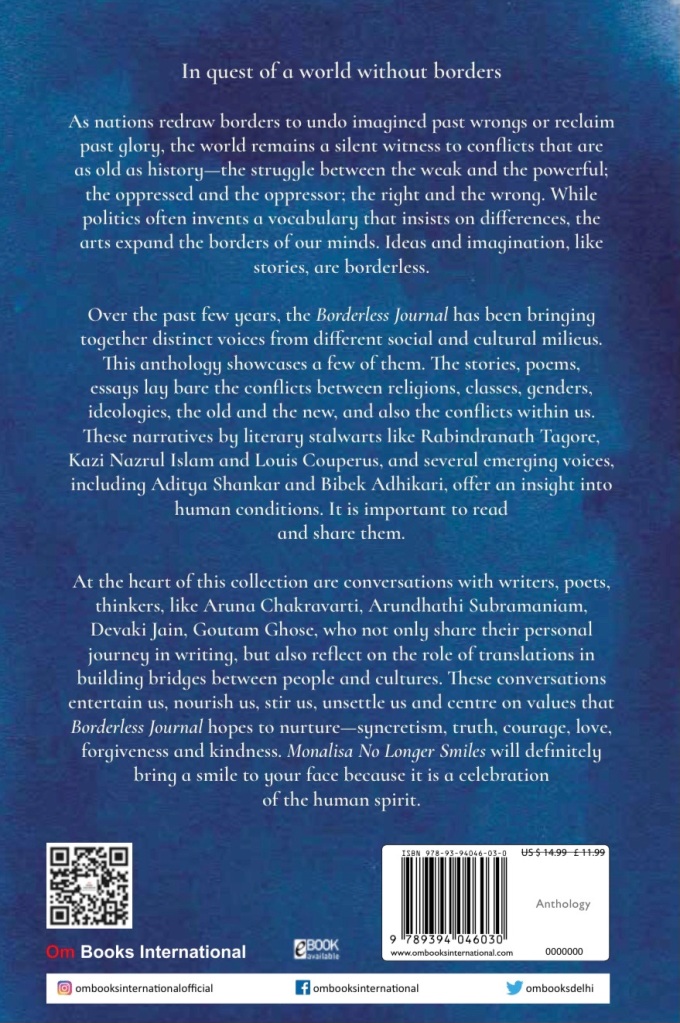
Click here to access the Borderless anthology, Monalisa No Longer Smiles

Click here to access Monalisa No Longer Smiles on Amazon International
Categories
Conversation

Exploring the Stars in their Skies

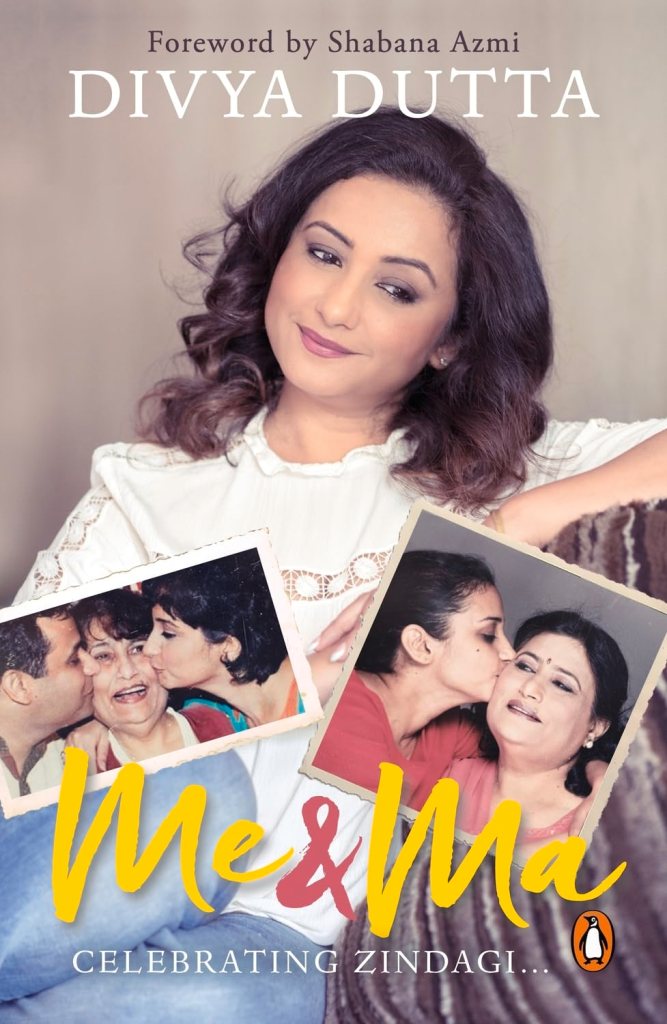
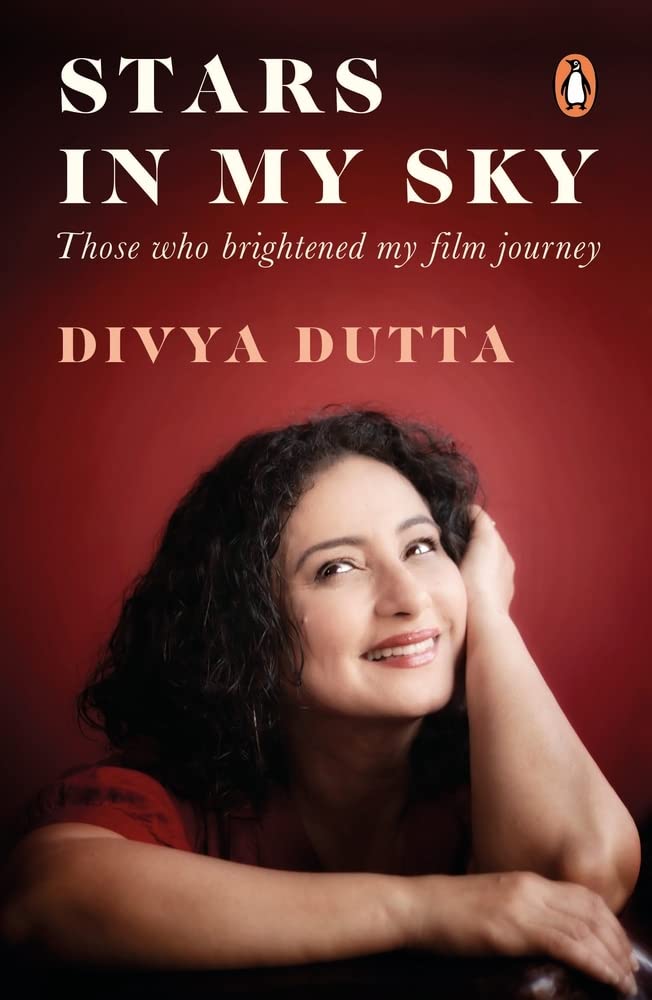
Ratnottama Sengupta, an eminent senior film journalist, converses with Divya Dutta, an award-winning actress, who has authored two books recently, Stars in my Sky and Me and Ma at a litfest in Odisha. Sengupta directs us with her questions to a galaxy littered with Bollywood snippets and emotional stories about life.

Divya you are in this literature festival organised by Shiksa O Anusandhan (SOA)[1], Bhubaneswar with your second book, Stars in My Sky[2]. But your life as an author started with Me and Ma[3]. So your first book was on your personal life. Didn’t your publishers want to know more about your professional life first? 

l never had any motive to become an author, you know! My life has been very organic. Things have just happened. Me and Ma wasn’t planned either. My biggest fear was, l didn’t want to lose my mother. Life teaches us that we don’t lose anyone. They may stop living outside of us but they stay on inside us. In our heart. And we have the security that they won’t go away from there. But l wanted to celebrate my parents.

Many a times our dreams don’t match our parents’. Some 25 years back, it was impossible in a doctor’s family to imagine that l would be an actor. There are many parents who force their children to do what they want, they don’t care to understand their children’s dreams or interests. But my mother did. 

I would often flip through the pages of Stardust, a magazine which was very popular then. One day an advertisement for a talent hunt caught my eyes. l applied with two amateurish photographs clicked by my brother and never expected to get selected. Much to my surprise, l got selected. So I told my mother, l have to go to Mumbai for an audition. 

Both, my brother and I were standing in front of her, our eyes downcast, pin drop silence in the room. My mother said, “You have your second year exams…” And l said, “l promise l will work very hard.” She said, “Look at me.” I looked up. She asked, “Are you sure?” There was a few seconds’ pause. And in those few seconds l realised that this is what l want to do in life. 

My mother said, “Okay fine, I am with you.” At that moment happiness filled my heart. And l knew l can never let down this parent because she has believed in me and stood by me, come what may. When she was in the hospital l thought to myself, “Shall l cry or shall l celebrate her?” And l realised l wanted to celebrate her. 

So I called Penguin and told them l wanted to write about my mother. They said, “It sounds beautiful, please go ahead. What do you call it?” Till then I had not even thought about what to call it! The title that came out of my heart was Me and Ma because it is the story of a mother and a daughter.

As you said, The Stars in My Sky is commercially attractive but nothing can be more fetching, more precious than your mother. So to me Me and Ma was a bestseller from the outset. I could connect with the readers through the book, through the audio book and now the Hindi version is also out.

Words from the heart!

 You see, we don’t build friendship with our parents – neither do our parents. This book is about diminishing those gaps. Children, talk to your parents. And parents, don’t think that you are older, your children should listen to you. Parents too should listen to their children though they may think differently.

I was very fortunate to have outstanding parents. So whenever people told me they had read the book l would call my mother to say, “Mamma l love you.” Many a times we do not say that. We take our parents for granted, and perhaps rightly so — other than our parents, whom can we take for granted? But having said that, I will repeat: We certainly need to convey our love.

The same way parents should convey their love to their children?

Everything in life is mutual but parents, especially a mother’s love is unconditional. Many times when we are in a rush we tell them to “hang up”. Now, when she’s no more, l think, “Whom do l call up when l want her to pick up the phone!”

You touched the core of my heart. When my mother passed away, the first thought that crossed my mind was, “l can never call her again!”

I do call her, and we talk. The bell rings from my heart and we have fun talking, bade majje ki baat hoti hain.[4]

You wrote for your school and college magazines but at which point did you realise that expressing with words rather than emoting is what you want to do? Of course younger years are more about being in front of the camera – later, with your pen dipped in experience, you turn reflective.

All these things are gifts from the universe. When l was writing in my school and college magazines, those were not coming out of experience but were full of sincerity, from my heart. My first love always was to face the camera –- perhaps because l am an ardent fan of Mr Bachchan[5]. I saw him on the screen when l was four or five and was mesmerised. I wanted to belong where he was, which world is it? l wanted to go there.

Remember the song, Khaike paan Banaraswala? [6] I would tear my mother’s dupatta or sari and wrap it around my waist over my kurti. Paan wasn’t allowed, so I would stain my lips with maa’s lipstick. I would invite the neighbourhood kids and tell them that, if they clapped louder after my performance, they would get sweets-and-savoury and rooh afzah [7]too. I loved the claps, the appreciation, the acknowledgment but above all the performance was what l loved most. 

As a student too I loved to entertain my class between two periods. I was the head girl but l was the naughtiest in the classroom. My friends would ask me to perform and l performed. So performance is what l always enjoyed. Alongside I wrote. Perhaps I had been experiencing the magic of words.

Emoting beautiful words penned by others is an actor’s job. Beautiful words always touch our hearts. I experienced the magic of words as an actor. When l started writing it wasn’t for a film, it was for me. And it was to find a different world that resonates with me. So, both go parallelly.

Both writing and acting are based on lived experiences. You write about experiences in your life; you also portray a character from your life experience. Let’s hear how your life moulded your characters.

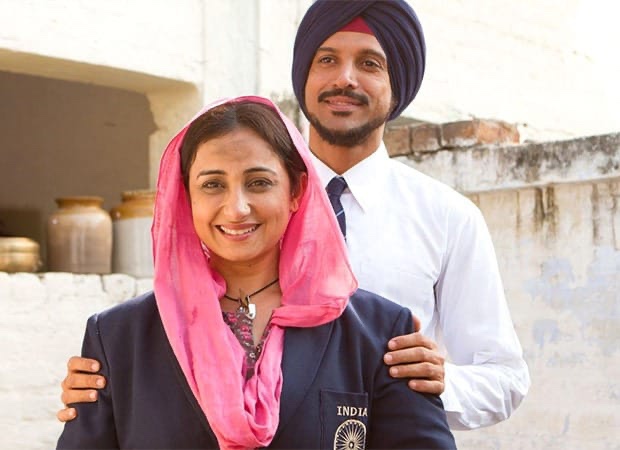
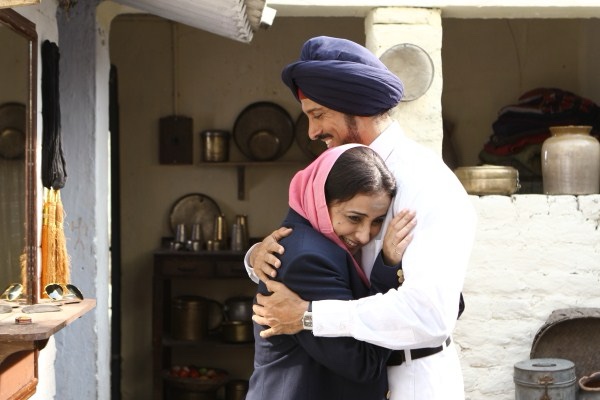
Sure! Let me tell you about Isri Kaur in Bhaag Milkha Bhaag[8].

My mother was a Doctor in a rural area. If the ladies who came for treatment were asked, “How are you?” They would cry. “You are fine?” and they could cry. They’d cry for everything. After school l used to sit in my mother’s clinic and watch everything. I would wonder why these ladies wouldn’t speak but only cry!

Cut to Bhaag Milkha Bhaag. When Rakeysh Omprakash Mehraji cast me he said, “You don’t have much of dialogue. But you must speak through your eyes.”

“No problem,” I replied.

Now let me tell you about the power of costume. I had gone in jeans for a rehearsal of the scene where I’m washing the utensils, but things were not going right, there was a gap somewhere. Then Rakeyshji asked me to wear my costume.

I said, “l’m absolutely comfortable Sir!”

He said, “I insist.”

I changed into a salwar kameez, draped the dupatta behind my ears and then wrapped it around myself — and magic happened. I was washing as if l were a pro! The Director later told me l’d put my hand on burning coal and got burnt, but l don’t have any recollection of that.

Suddenly, l recognised Isri Kaur! She could be the lady who’d come to see my mother. She was there in my subconscious, and tears just trickled down my eyes. 

At the end of the scene, l was hugging Milkha. Rakeyshji said, “Give it your end.” So l thought to myself, “Should the end be so clichéd! Brother and sister hug each other, and that’s it?!” All of a sudden l realised that the roles we play, the characters, also have subconscious memories. I remembered Isri Kaur had, as a child, seen Milkha saluting his father, “so do it!” I don’t know where the voice came from but it did. I left that embrace and saluted him just like he did. The entire set fell silent. Every person in the team was crying and that became a cherished moment. This is the power of the subconscious!

Now my eyes are moist! But just as ocean gives back what it takes, so does the ocean that’s life.

Beautiful. So aptly said!

Divya you have two books to your credit. Me and Ma is so personal, and The Stars in My Sky probes your connection with the outer world. What was the difference in writing these two books?

There’s a big difference between writing and acting. Each has a different feel altogether. In acting you part with yourself and allow the character to come in.

 You internalise an outsider.

You have put it beautifully. Yes, writing is extremely personal — as personal as my experience with my mother. But  Stars in My Sky is my experience with the people l have encountered on the sets. People l shared my movie journey with:  Amitabh Bachchan, Shabana Azmi, Irrfan Khan, Javed Akhtar, Gulzar, Shahrukh, Salman… 

In the course of making a movie we meet so many people. We cannot say, ‘This person has given me this character,’ or ‘this person has made me a star’.  But each of them did something beautiful which l will always remember. Something that brought a smile to my face at that moment. So l thought, l should write about those moments — and you cannot capture those without being personal. 

And when you write something on a director or a writer you need to share it with them. These were my personalised accounts. But I’ve had the most overwhelming experience sharing the chapters with them. I saw actors and directors alike cry on reading their chapters. One person l was sharing with over the phone fell silent. He did not speak, nor did I. And l realised that, many a times we don’t say, ‘l like this thing of yours’ or ‘what you did for me made a big difference in my life, thank you.’ So this silence was most rewarding.

It’s so very important to let people know they’ve made such an impact! Now, since we are in a lit fest – which is a celebration of words – l’d like to ask you: what is the thrill in holding a printed book in your hands? Let me elaborate: Today so many things are online. We type or key-in more than we write with pen on paper. Yet I always want to touch the book. After retiring from The Times of India, much of my writing got published online. Some of these got published as an anthology, Monalisa No Longer Smiles[9]. I was thrilled to hold a copy of that book. Why?

l can certainly tell you about scripts. These days many directors and producers say, “Shall l mail you the script?” I tell them, “Please send me a bound script.” It imparts a sense of belonging, like the power of hugging. When we hug our book, we can feel the power of touch. So I hug my script, my copy, with my name written over it… It’s fun turning the pages rather than scrolling with your finger. The smell of paper, the sound of flipping the pages, maybe reading while eating had left a spot of turmeric… All these give me the feeling, it’s mine. The touch, the smell, of a new book will always remain my first love. 

You just said you’ll write stories. Will you also write scripts, and direct them?

I’m in love with acting. And, people who write good screenplays should do that. At the same time, we should be open to life. I never knew l would be an actor, I never knew l would be an author, l don’t know what l will be in future. So l say ‘Yes!’ to what life offers us.

Right – Life is a journey, not a destination.

I will go back a little bit to Stars in My Sky. You have mentioned and we also know that Rakeysh Omprakaash Mehra, Yash Chopra, Shyam Benegal, Shabana Azmi who has written the Foreword, are important parts of your career. Can we peep into that world?

I have been fortunate to work with some brilliant and legendary directors. Let me tell you some stories.

Shyam Benegal is one of the most approachable and humble directors ever. When l came to Mumbai from Punjab, no one said ‘No’ in this industry. Who knows when you will require whom? So when l visited production houses they all said, Yes, they will work with me. And i believed them all. And l called Ma to say l was doing 22 films. Of these, 20 never happened and two were made with other heroines, not me. So I was heartbroken.

During that time l met Shyam Benegal at the premier of Train to Pakistan. I said, “Sir l want to meet you.” He said, “Okay. This is my number, call me.” By then I had become cynical, I thought, ‘Is it that simple?’ But I went to Shyam ji’s office – and he was truly honest. “My film’s casting is done,” he said, “but there is one sequence of folk dance. Will you do that?” I said, “Of course Sir.” The film was Samar. He said, “l will need seven days.” Seven days? Then l will have to learn dance and a lot of things, I thought. 

On the very first day he asked me, “What’s your hobby?” I said, “Cooking Sir, l love cooking.” “Okay,” he said, “go to the kitchen, with your co-stars, and make something you like.” I was surprised – when will the dance rehearsal start? But l went to the kitchen, there were Seema Biswas, Rajat Kapoor and others. I used to call Seema Biswas Ma’am. In the process of cooking the formality gave way to familiarity and warmth. Suddenly I found myself saying, “Didi pass me the salt, the paratha is getting burnt!” So Ma’am turned to Didi — and that translated into my chemistry with them in front of the camera. Unassumingly it moulds you into the character, without you being aware of it!

Then he told me, “Go to the folk dancers and watch them dancing.” I went, I saw them dancing, and came back. “Now listen to the song,” he told me. I listened, and responded, “The song is beautiful Sir!” “So choreograph it,” he said. “Me Sir!” I squeaked. Here was Shyam Benegal, who could get any choreographer to do it, but he asked me, all of 18, to do that. Was I nervous! I couldn’t sleep that whole night. But more than nervousness or excitement was the feeling of responsibility: none other than Mr Benegal had asked me to choreograph the song. And when I did it, he asked me to teach it to the dancers. The next day went by in teaching them their dance only!

 What a wonderful way to groom a talent!

The day after was the shoot. A night shoot. The entire crew, cast and the villagers were there to cheer me up. There was a 7-camera setup shooting the dance at one go but l was looking at one person alone – Mr Benegal: he was telling me, “Do it, do it.”

I did it to loud cheer. l was scooped up by my co-stars. I felt so beautiful, and so confident. With gratitude l turned around to thank Shyam Babu, but he had left for the next shot! Nothing mattered to him, but he had left behind a girl who had learnt how to take responsibility. A girl who now knew she had it inside her.

Fabulous! This is what make them icons!

Divya Dutta (born 25 September 1977) is an Indian actress and model. She has appeared in Hindi and Punjabi cinema, in addition to Malayalam and English-language films. She has received many awards including a National Film Award, a Filmfare OTT Award and 2 IIFA Awards.

Highlights in Acting:
1) *Shaheed-e-Mohabbat Buta Singh*/ Punjabi/ 1999
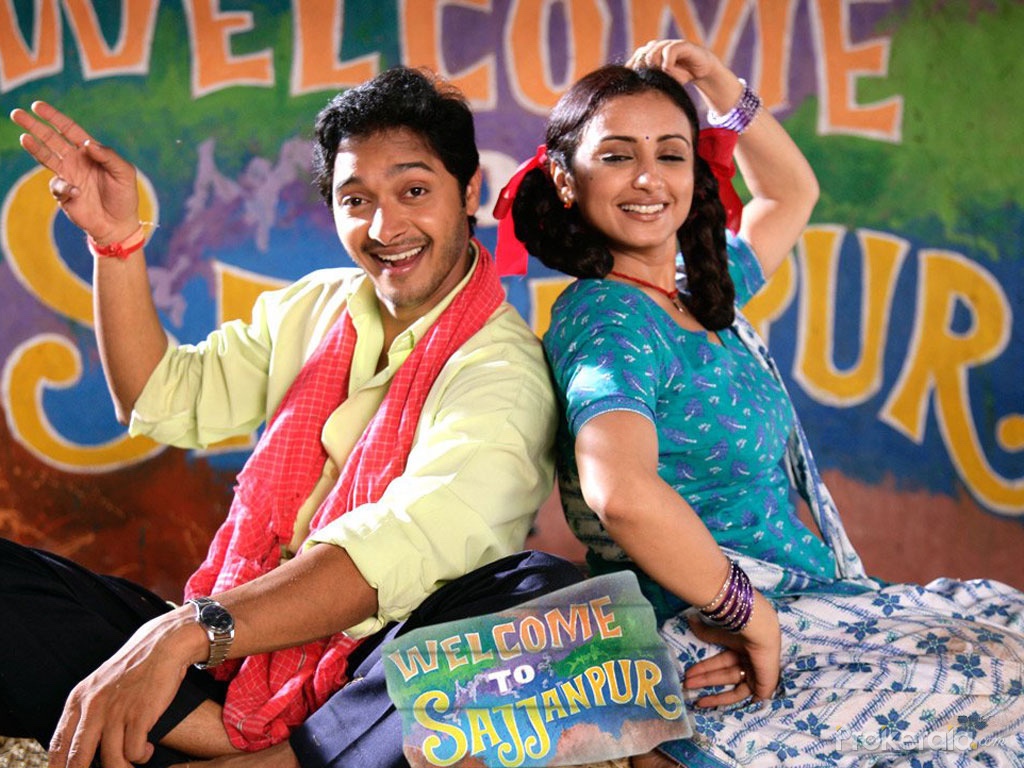
2) *Welcome to Sajjanpur*/ 2008/ Director: Shyam Benegal
3) *Delhi-6*/ 2009/Director: Rakeysh Omprakash Mehra
4) *Stanley Ka Dabba*/ 2011/ Director: Amole Gupte
5) *Bhaag Milkha Bhaag*/2013/ Director: Rakeysh Omprakash Mehra
6)*Irada*/ 2017/ Director: Aparnaa Singh
*Divya Dutta got National Film Award for Best Supporting Actress in Irada*

-- (Compiled by Ratnottama Sengupta)

[1] Studies and Research (translation from Hindi). SOA is a deemed University in Bhuwaneswar.

[2] Stars in My Sky: Those Who Brightened My Film Journey (2022)

[3] Me and Ma (2017)

[4] We really have fun.

[5] Legnedary actor Amitabh Bachchan

[6] Literal translation, ‘Eating a paan (betel leaaf) from Benares’, song from Bollywood blockbuster, Don (1978)

[7] A rose flavoured drink

[8] Run, Milkha, Run, 2013, Hindi film

[9] Monalisa No Longer Smiles: An Anthology of Writings from across the World (2022), Om Books International

.

Ratnottama Sengupta, formerly Arts Editor of  The Times of India, teaches mass communication and film appreciation, curates film festivals and art exhibitions, and translates and write books. She has been a member of CBFC, served on the National Film Awards jury and has herself been the recepient of a National Award. 

.

PLEASE NOTE: ARTICLES CAN ONLY BE REPRODUCED IN OTHER SITES WITH DUE ACKNOWLEDGEMENT TO BORDERLESS JOURNAL

Click here to access the Borderless anthology, Monalisa No Longer Smiles

Click here to access Monalisa No Longer Smiles on Amazon International
Categories
Interview Review

How Gajra Kottary Blossoms with ‘Short Tales’

A conversation with Gajra Kottary, focusing on her new short-story collection, Autumn Blossoms, published by Om Books International.

Gajra Kottary is an eminent screenplay writer on Indian television. She has had many awards and accolades for teleplays that ran into a few thousand episodes, including the very popular Astitva Ek Prem Kahani (Existence: A Love Story, 2002-2006). Trained as a journalist, she turned into a screenplay writer, and now, she opts to go back to writing books.

Her collection of fifty stories in Autumn Blossoms bloom through five hundred pages with an epigraphic verse at the start of each story summing up the intent of the narrative. The focus group of the content is mainly upper middle-class women in India—people who have studied in privileged schools and colleges, though there is a story about a tribal woman who “evolves” to be a leader. The language flows capturing the nuances of her characters, replete with their values, biases, and attitudes. The stories, like her tele series, bring to light not only societal issues but also the interactions between different economic and social strata within the country. They give a glimpse of the world she inhabits. 

Forwarded by Anupam Kher, a well-known actor, director and producer, the narratives despite being women-centric are not feminist in intent. There is a story about a girl who while opposing the patriarchy of her married home, runs away to that of her guru only to discover he lives by even more stringent rules and has an extremely gifted wife who practically gave up her life to look after the needs and career of her husband. The turn of events is such that the protagonist returns home, changed in her outlook. The story in a way upends the current norms towards concepts like patriarchy and yet, it dwells on the strength that can be found among common women, women who are housewives and ostensibly live in the shadows of men. The character of the guru’s wife brings to mind Scarlett O Hara’s mother in Margaret Mitchell’s original novel, Gone with the Wind (1936).

The plots of the stories are involved. And each story takes you through a different world. It’s like you have lived the lives of umpteen women within the social constructs of India. You live through murders, weddings, divorces, parties, terrorist kidnappings and even revolutions! In the centre of it all, are the stories of all humanity with their varied moods and flavours, their loves, compassion, happiness, grief, disappointments, and achievements.

In her ‘Afterthought’ — what in common parlance would be afterword — Kottary tells us the name, Autumn Blossoms, is the “generic descriptions of the stories” in the collection. She contends she is “a firm believer in the fact that women, and for that matter men too, bloom and discover strength in the autumn of their lives. As do many protagonists in these stories, where autumn stands as much for the vagaries of age as for what they are experiencing in life which gives them a new perspective.”

There is a story behind the book told in the afterword… how all the stories were curated into this collection. Some of the stories from her earlier collections were redone by the writer to suite her current needs. As there were many stories, she tells us the editor, Shantanu Ray Chaudhuri, “suggested that we categorise them into three sections”. She further elucidates: “The first would be the section about women’s relationships with men. The second section would be women’s relationships with other women. The third would be about women’s relationships with themselves, by far the most complex of them all. Of course, there are bound to be overlaps – these categories have permeable boundaries, so that it is possible for one story in one category to resonate in another. That too provides a sort of unity to the entire collection – apart from the overarching commonality of women being at the centre of each narrative.”

We invite you here to read what the queen of screenplay has to share with us about her journey as a writer and also on her current book, Autumn Blossoms.

Since when have you been writing? Tell us about your writerly journey.

I have been writing ever since I learned to write – quite literally. Ironically as a kid, like many silly things kids do, it was about trying to connect thoughts and make them rhyme in poems. I went to a convent school but more than my English poetry, it was my Hindi writing that got noted. I edited the Hindi section of our school magazine and I always knew I would end up with some sort of career in writing. Then in college, I tried my hand at writing middles and short journalistic pieces for The Times of India, Hindustan Times and some evening papers and women’s magazines. I was emboldened when they got published. So I did the next best thing for those times. I enrolled for a journalism diploma at the Indian Institute of Mass Communications. The course was great, but when I got down to brass tacks, I didn’t enjoy myself at all – reporting and subbing were not my scene at all. I did it for a while, but then took a motherhood break since I had married by then. My break and the quietude it brought helped me to analyse where I was going, helped me find my true calling within writing … which was fiction.

Starting with two short-story collections, I soon moved to writing for film and television and it consumed me completely for more than a decade. Until I realised that I also needed to write purely for myself too. I wrote my first novel in 2011 and have written three more after that, simultaneously with my TV work. The former has no deadlines beyond the self-imposed, while TV is all about deadlines so it’s a great mix. 

What gets your muse going?

Random thoughts triggered by happenings around … whether it’s in the news or through people’s conversations around. Basically the ‘what ifs’ part of any incident or happening is what triggers the chain of a story in my mind. There is a lovely term in Hindi called ‘udhed-boon’. By now my mind is attuned to churning the thoughts around the ‘what ifs’ to design it into a tale. One has learnt to also decide to design the idea around as a story for a TV show or a short story or a novel. For most of the time, the idea itself speaks in a manner that can be easily identified or slotted. For example, when I read about the phenomena of bride buying in Haryana, I knew I could write a whole TV show around it – so Molkki was born. Similarly the concept of age difference in marriages … it’s thematic and therefore lends itself to exploration of its myriad aspects and nuances through a long-format series like Astitva and Na Umr Ki Seema Ho did. Similarly, most of the short stories in Autumn Blossoms are short tales that can’t be stretched very long, or else they would lose their punch. 

Tell us briefly what made you opt towards moving back towards books when you are a well-known screenplay writer?

That’s my favourite question to answer. When you write for the screen you train to be collaborative. To cooperate, convince and compromise. Since the ownership of the final product is going to be shared, democracy is the need of the medium.

Published in 2011

But it is important for a writer to be in touch with their solo voice to know what it sounds like, apart from coping with the cacophony of many voices involved in screenwriting. In fact I don’t really understand why more scriptwriters don’t feel this urge to have their individual voices heard and write for print too. It is a most empowering and self-affirming thing to do, but maybe scriptwriting is so tiring that inertia creeps in.

As far as I am concerned, I desperately needed to hear my own voice after more than a decade of collaborative writing, although I started writing short fiction way before scriptwriting. So, I finally wrote my first novel in 2011. I really loved the process though it was an edgy and confusing one all through. Once I had written Broken Melodies and gauged for myself what it added to my skill set, I made a habit of periodically hearing my own voice, along with participating in the chorus of the songs of scriptwriting.  

How is writing a book different from writing a screenplay?

I am not a ‘go with the flow’ writer and need to have my goal or destination in sight before I embark on writing a new story. In that sense the process is the same for me in both kinds of writing. But after having done that basic planning for structure, while writing a book, spontaneity takes over. While writing a screenplay one has to be so much more conscious of the craft and style, the judicious part of what ideas to keep and what to discard. In a book one looks at editing much later. Although every good story should have the three-act structure working quietly in the head of the writer, I find that a book or writing for television has most of its texture in the mid portion. The first and third acts are the bookends, the former is a diving board and the latter is a climb to the crescendo. If one can get the middle right, one is sorted. Writing a book is like taking a walk in the park or the open … there’s unpredictability, adventure, mystery, open skies, fresh air to breathe and sights to savour on the way. Scriptwriting is much like walking on a treadmill – you get the required exercise and benefit but it’s not like an entire life experience.

By what I gathered from your ‘Afterthought’, these are stories that have been written over a period of time. How old is the first story and how recent the latest story? What made you think of bringing them out as a collection now?

Yes, these are virtually all the stories in the category of short fiction that I have ever written, including audiobooks. My last published collection of short stories came out in 1996, which is therefore nearly thirty years ago. The audiobooks are fairly recent. Many were written more than a decade ago when I was in between full-time writing for TV. And the last two were written a few weeks before the book went to press, so that we could reach the magical number of 50!

About the reason of bringing them out as a collection. Well it’s every writer’s dream to have a lifetime collection out, I wasn’t actively working towards it.

This book has happened solely because of its editor Shantanu Ray Chaudhuri. He is also a columnist and was writing a piece on my writing journey. As part of his research I shared with him my published, slim volumes of short stories. After he had read them – at record speed at that – he asked if I had written any more that were as yet unpublished. One thing led to another and now we have this door stopper of a volume titled Autumn Blossoms. Both Shantanu and I believe in short fiction, which frankly is challenging to sell. But the challenge is what has driven us both to bring an entire compendium out. Frankly, logically there is no real reason why short fiction shouldn’t be selling even more than novels, in these days of shorter attention span.

Why did you feel the need to have epigraphic verses at the beginning of each story? Are these epigraphs your first attempt at writing poetry … you mention in your ‘Afterthought’ they got you in touch with the ‘closet poet’ in yourself?

The idea to have epigraphic verses at the beginning of the stories was again an innovative suggestion that came from Shantanu after he read some lyrics that I had written in Hindi, and a few in English. They had all been commissioned lyrics, for music albums and the odd theme song for my own shows on TV. Shantanu is quite a poet, having published his poetry too. For me, it was like going back to my early days as a writer who had tried out all genres before I settled for quintessential storytelling. Writing these quatrains was some work and a lot of fun too and discovering the closet poet in myself gave me something to look forward to doing as an option for the coming years. A retirement activity when I perhaps won’t get story ideas anymore. It also gave me a kind of perspective of the essence of each story that I might not have made the effort to analyse otherwise.

Is your writing impacted by any writer, art or music?

My father was a classical musician, though I never pursued music. I love to listen to his music, as well as soulful Hindi film music, and for me the lyrics are as important as the melody. I love Hrishikesh Mukherjee’s films and their music and my regret over the last few years is that I have not been reading as much as I should or would have liked to. I used to love Roald Dahl, Manto, Jane Austen, and most of all Tagore. In recent times I was bowled over by Elif Shafaq’s Forty Rules of Love. I suppose when one admires an art form or artiste, influences do seep in, in terms of both style and content, so all these people’s works have impacted my writing. And also, the aspiration to be as impactful as they have been, since they have been influential across art forms.

You are writing a novel too. Tell us a bit about the novel. Would they too have something to do with these short stories?

Published in 2017

I am almost ready with two novels. Both have male protagonists at the centre which is unusual for me. They are both very different stories from each other. One is a slice-of-life story that is light-hearted in its telling – quite a challenge for me actually – and is tentatively titled Sibling Revelry. The other is a thriller, also a social commentary. It’s tentatively titled Bonds and Bondage. Both the stories, like my earlier novel Girls Don’t Cry have their roots in stories from Autumn Blossoms, that tugged away at me to develop them more, which I eventually did. My forthcoming novels are broader versions of the stories titled ‘Hello, Goodbye’ and ‘Sugar and Spice and All Things…’ respectively.

I don’t know whether this happens with other writers, but this crossover writing does happen with me at times, as I write across media and genre. By now I have come to enjoy the process of finding more and more layers to my own story as I develop some of them from one medium to another.

There are yet some more stories in Autumn Blossoms that I didn’t see as possible novels when I wrote them. But in the process of revisiting them for the collection, I feel they merit a longer format … ‘Friends Indeed’ is a case in point.

What is your favourite genre as a writer?

Honestly, there is no favourite genre. They are all flavours of the season, and I don’t mean that in a disparaging way. Currently it is the short-fiction genre, but I know that it will be my new TV show next and when that hopefully settles, my novels will draw me to them. I guess this makes my imagination more agile, though when there is an unplanned overlap of projects, I get very tired and these days, I get anxious too as energy levels are not as high as they were a few years ago.

What can we expect from you in the near future – more books or serials or both?  

God willing, there should be both, but I need to calibrate my involvement in both spheres. I am going to distance myself from the very tiring process of everyday series writing. Though of course, I will still be involved as I am experienced and can bring some wisdom to the table. I dream of writing books at a more leisurely pace; quite literally blossoming in the autumn of my life.

Thank you for the wonderful answers and your writings across the screen and in books

(The online interview has been conducted through emails and the review written by Mitali Chakravarty.)

PLEASE NOTE: ARTICLES CAN ONLY BE REPRODUCED IN OTHER SITES WITH DUE ACKNOWLEDGEMENT TO BORDERLESS JOURNAL. 

Click here to access the Borderless anthology, Monalisa No Longer Smiles

Click here to access Monalisa No Longer Smiles on Kindle Amazon International

Categories
Editorial

Will Monalisa Smile Again?

The first month of 2023 has been one of the most exciting! Our first book, Monalisa No Longer Smiles: An Anthology of Writings from across the World, is now in multiple bookstores in India (including Midlands and Om Bookstores). It has also had multiple launches in Delhi and been part of a festival.

We, Meenakshi Malhotra and I, were privileged to be together at the physical book events. We met the editor in chief of Om Books International, Shantanu Ray Chaudhuri, the editor of our anthology, Jyotsna Mehta, along with two translators and writers I most admire, Aruna Chakravarti and Radha Chakravarty, who also graced a panel discussion on the anthology during our physical book launch. The earlier e-book launch had been in November 2022. My heartfelt thanks to the two eminent translators and Chaudhuri for being part of the discussions at both these launches. Chaudhuri was also in the panel along with Debraj Mookerjee at a launch organised by Malhotra and the English Literary Society steered by Nabaneeta Choudhury at Hans Raj College, Delhi University. An energising, interactive session with students and faculty where we discussed traditional and online publishing, we are immensely grateful to Malhotra for actively organising the event and to the Pandies’ founder, Sanjay Kumar, for joining us for the discussion. It was wonderful to interact with young minds. On the same day, an online discussion on the poetry in Monalisa No Longer Smiles was released by the Pragati Vichar Literary Festival (PVLF) in Delhi.

At the PVLF session, I met an interesting contemporary diplomat cum poet, Abhay K. He has translated Kalidasa’s Meghaduta and the Ritusamhara from Sanskrit and then written a long poem based on these, called Monsoon. We are hosting a conversation with him and are carrying book excerpts from Monsoon, a poem that is part of the curriculum in Harvard. The other book excerpt is from Sanjay Kumar’s Performing, Teaching and Writing Theatre: Exploring Play, a book that has just been published by the Cambridge University Press.

Perhaps because it is nearing the Republic Day of India, we seem to have a flurry of book reviews that reflect the Sub-continental struggle for Independence from the colonials. Somdatta Mandal has reviewed Priya Hajela’s Ladies Tailor: A novel, a book that takes us back to the trauma of the Partition that killed nearly 200,000 to 2 million people – the counts are uncertain. Bhaskar Parichha has discussed MA Sreenivasan’s Of the Raj, Maharajas and Me, a biography of a long serving official in the Raj era — two different perspectives of the same period. Rakhi Dalal has shared her views on Shrinivas Vaidya’s A Handful of Sesame, translated from Kannada by Maithreyi Karnoor, a book that dwells on an immigrant to the Southern part of India in the same time period. The legendary film writer K.A. Abbas’s Sone Chandi Ke Buth: Writings on Cinema, translated and edited by Syeda Hameed and Sukhpreet Kahlon, has been praised by Gracy Samjetsabam.

We have a piece on mental health in cinema by Chaudhuri, an excellent essay written after interviewing specialists in the field. Ratnottama Sengupta has given us a vibrant piece on Suhas Roy, an artist who overrides the bounds of East and West to create art that touches the heart. Candice Louisa Daquin has written on border controls and migrants in America. High profile immigrants have also been the subject of Farouk Gulsara’s ‘What do Freddy Mercury, Rishi Sunak & Mississipi Masala have in Common?’ Sengupta also writes of her immigrant family, including her father, eminent writer, Nabendu Ghosh, who moved from Bengal during the Partition. There are a number of travel pieces across the world by Ravi Shankar, Meredith Stephens and Mike Smith — each written in distinctively different styles and exploring different areas on our beautiful Earth. Sarpreet Kaur has revisited the devastation of the 2004 tsunami and wonders if it is a backlash from nature. Could it be really that?

Suzanne Kamata gives us a glimpse of the education system in Japan in her column with a humorous overtone. Devraj Singh Kalsi dwells on the need for nostalgia with a tongue-in-cheek approach. Rhys Hughes makes us rollick with laughter when he talks of his trip to Kerala and yet there is no derision, perhaps, even a sense of admiration in the tone. Hughes poetry also revels in humour. We have wonderful poetry from Jared Carter, Ranu Uniyal, Asad Latif, Anaya Sarkar, Michael R Burch, Scott Thomas Outlar, Priyanka Panwar, George Freek and many more.

The flavours of cultures is enhanced by the translation of Nazrul’s inspirational poetry by Professor Fakrul Alam, Korean poetry written and translated by Ihlwha Choi and a transcreation of Tagore’s poem Banshi (or flute) which explores the theme of inspiration and the muse. We have a story by S Ramakrishnan translated from Tamil by R Sathish. The short stories featured at the start of this year startle with their content. Salini Vineeth writes a story set in the future and Paul Mirabile tells the gripping poignant tale of a strange child.

With these and more, we welcome you to savour the January 2023 edition of Borderless, which has been delayed a bit as we were busy with the book events for our first anthology. I am truly grateful to all those who arranged the discussions and hosted us, especially Ruchika Khanna, Om Books International, the English Literary Society of Hans Raj College and to the attendees of the event. My heartfelt thanks to the indefatigable team and our wonderful writers, artists and readers, without who this journey would have remained incomplete. Special thanks to Sohana Manzoor for her artwork. Many thanks to the readers of Borderless Journal and Monalisa No Longer Smiles. I hope you will find the book to your liking. We have made a special page for all comments and reviews.

I wish you a wonderful 2023. Let us make a New Year’s wish —

May all wars and conflicts end so that our iconic Monalisa can start smiling again!

Mitali Chakravarty,

borderlessjournal.com

.

Photographs of events around Monalisa No Longer Smiles: An Anthology of Writings from across the World. Click here to access the Book.

.

Insta Link to an excerpt of the launch at Om Bookstore. Click here to view.

E-Launch of the first anthology of Borderless Journal, November 14th 2022. Click here to view.

Categories
Editorial

Its Only Hope…

Painting by Sybil Pretious

New year, like a newborn, starts with hope.

The next year will do the same – we will all celebrate with Auld Lang Syne and look forward to a resolution of conflicts that reared a frightening face in 2022 and 2021. Perhaps, this time, if we have learnt from history, there will not be any annihilation but only a movement towards resolution. We have more or less tackled the pandemic and are regaining health despite the setbacks and disputes. There could be more outbreaks but unlike in the past, this time we are geared for it. That a third World War did not break out despite provocation and varied opinions, makes me feel we have really learnt from history.

That sounds almost like the voice of hope. This year was a landmark for Borderless Journal. As an online journal, we found a footing in the hardcopy world with our own anthology, Monalisa No Longer Smiles: Writings from Across the World, which had a wonderful e-launch hosted by our very well-established and supportive publisher, Om Books International. And now, it is in Om Book Shops across all of India. It will soon be on Amazon International. We also look forward to more anthologies that will create a dialogue on our values through different themes and maybe, just maybe, some more will agree with the need for a world that unites in clouds of ideas to take us forward to a future filled with love, hope and tolerance.

One of the themes of our journal has been reaching out for voices that speak for people. The eminent film critic and editor, Shantanu Ray Chaudhuri , has shared a conversation with such a person, the famed Gajra Kottary, a well-known writer of Indian TV series, novels and stories. The other conversation is with Nirmal Kanti Bhattajarchee, the translator of Samaresh Bose’s In Search of a Pitcher of Nectar, a book describing the Kumbh-mela, that in 2017 was declared to be an Intangible Cultural Heritage of Humanity by UNESCO. Bhattacharjee tells us how the festival has grown and improved in organisation from the time the author described a stampede that concluded the festivities. Life only gets better moving forward in time, despite events that terrorise with darkness. Facing fear and overcoming it does give a great sense of achievement.

Perhaps, that is what Freny Manecksha felt when she came up with a non-fiction called Flaming Forest, Wounded Valley: Stories from Bastar and Kashmir, which has been reviewed by Rakhi Dalal. Basudhara Roy has also tuned in with a voice that struggled to be heard as she discusses Manoranjan Byapari’s How I Became a Writer: An Autobiography of a Dalit. Somdatta Mandal has reviewed The Shaping of Modern Calcutta: The Lottery Committee Years, 1817 – 1830 by Ranabir Ray Chaudhury, a book that explores how a lottery was used by the colonials to develop the city. Bhaskar Parichha has poured a healing balm on dissensions with his exploration of Rana Safvi’s In Search of the Divine: Living Histories of Sufism in India as he concludes: “Weaving together facts and popular legends, ancient histories and living traditions, this unique treatise running into more than four hundred pages examines core Sufi beliefs and uncovers why they might offer hope for the future.”

In keeping with the festive season is our book excerpt from Rhys Hughes’ funny stories in his Christmas collection, Yule Do Nicely. Radha Chakravarty who brings many greats from Bengal to Anglophone readers shared an excerpt – a discussion on love — from her translation of Tagore’s novel, Farewell Song.

Love for words becomes the subject of Paul Mirabile’s essay on James Joyce’s Stephen Dedalus, where he touches on both A Portrait of the Artist as a young Man and  Ulysees, a novel that completed a century this year. Love for animals, especially orangutans, colours Christina Yin’s essay on conservation efforts in Borneo while Keith Lyons finds peace and an overwhelming sense of well-being during a hike in New Zealand. Ravi Shankar takes us to the historical town of Taiping in Malaysia as Meredith Stephens shares more sailing adventures in the Southern hemisphere, where it is summer. Saeed Ibrahim instils the seasonal goodwill with native Indian lores from Canada and Suzanne Kamata tells us how the Japanese usher in the New Year with a semi-humorous undertone.

Humour in non-fiction is brought in by Devraj Singh Kalsi’s ‘Of Mice and Men’ and in poetry by Santosh Bakaya. Laughter is stretched further by the inimitable Rhys Hughes in his poetry and column, where he reflects on his experiences in India and Wales. We have exquisite poetry by Jared Carter, Sukrita Paul Kumar, Asad Latif, Luis Cuauhtémoc Berriozábal, Michael R Burch, Sutputra Radheye, George Freek, Jonathan Chan and many more. Short stories by Lakshmi Kannan, Devraj Singh Kalsi, Tulip Chowdhury and Sushma R Doshi lace narratives with love, humour and a wry look at life as it is. The most amazing story comes from Kajal who pours out the story of her own battle in ‘Vikalangta or Disability‘ in Pandies’ Corner, translated from Hindustani by Janees.

Also touching and yet almost embracing the school of Absurd is PF Mathew’s story, ‘Mercy‘, translated from Malayalam by Ram Anantharaman. Fazal Baloch has brought us a Balochi folktale and Ihlwha Choi has translated his own poem from Korean to English. One of Tagore’s last poems, Prothom Diner Shurjo, translated as ‘The Sun on the First Day’ is short but philosophical and gives us a glimpse into his inner world. Professor Fakrul Alam shares with us the lyrics of a Nazrul song which is deeply spiritual by translating it into English from Bengali.

A huge thanks to all our contributors and readers, to the fabulous Borderless team without who the journal would be lost. Sohana Manzoor’s wonderful artwork continues to capture the mood of the season. Thanks to Sybil Pretious for her lovely painting. Please pause by our contents’ page to find what has not been covered in this note.

We wish you all a wonderful festive season.

Season’s Greetings from all of us at Borderless Journal.

Cheers!

Mitali Chakravarty

borderlessjournal.com

.

Click here to access the Borderless anthology, Monalisa No Longer Smiles

Categories
Editorial

We Did It!

That good things happen despite darkness, despite prognostications of doom, that light glimmers hope if you strive to focus on your strength in hard times is borne true both in fiction and in life. Perhaps, we cannot get back the old ways (but is that what we want?) but new paths emerge. Old gives way to new. And while trying to gather pearls of human excellence — borne not of awards or degrees but of bringing out the best, the kindest, the most loving in human hearts — we managed to create with a team an outstanding anthology. Woven with the writings of old and new — we created a tapestry together that the editor in chief of our publishing house said was “classy, literary, engaging and international”. That one of the oldest and most reputed publishing houses in India with bookshops countrywide took it on was also an unusual event! We are truly grateful to Om Books International, Shantanu Ray Chaudhuri and Jyotsna Mehta along with all our writers and readers who made our anthology a reality, and to Radha Chakravarty and Fakrul Alam for the kind words they bestowed on our effort.

Click here to access the Borderless anthology, Monalisa No Longer Smiles

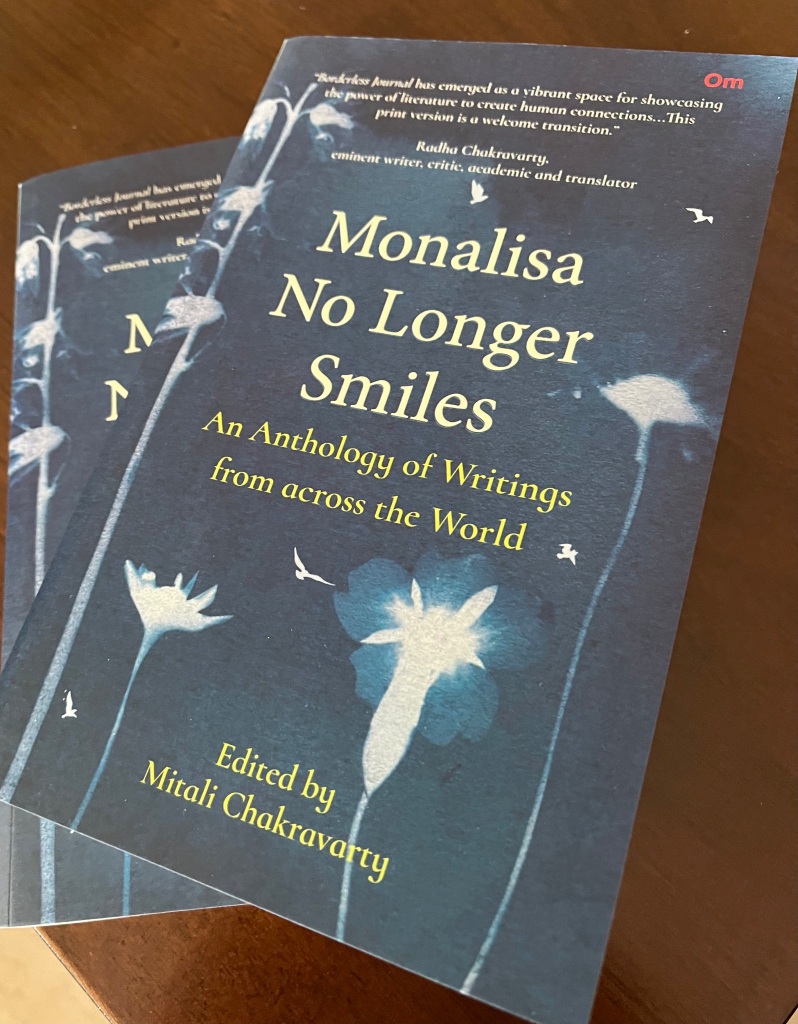
Please greet our first anthology, Monalisa No Longer Smiles, with love and friendship. It could be the perfect Christmas gift in the spirit of the season! And as the blurb says, “it will definitely bring a smile to your face because it is a celebration of the human spirit.”

The anthology is different from our journal in as much as it has a sample of an eclectic collection that has been honed with further editing and has some new features. Most of the writing is from our first year and showcases our ethos, except for Lesya’s poetry and interview. Lesya Bakun from Ukraine is still on the run, looking for a refuge — she cannot return home like you or I can. Her family is scattered across number of countries. Her cousin, who was guarding the factory at Azovstal, was taken prisoner. We included her story in the anthology hoping to create global empathy for refugees as the numbers will increase not only due to war but also due to climate change.

The reason we felt a hardcopy anthology was a good idea was because nothing beats the joy of having a bunch of interesting reads in the warmth of your hands (especially where internet cannot reach or is unavailable). In any case, books with the feel of paper, the rustling whispers which carry voices of leaves can never be replaced as Goutam Ghose had also said in his interview which is now part of our anthology.

And that is why we celebrate more books… this time we feature Singaporean prima donna of literature, Suchen Christine Lim, with her new book Dearest Intimate, a novel that spans more than hundred years including the harrowing Japanese invasion during World War II. She shared sound advice with writers: “Suffering is good for the writer. It will deepen lived experience and expand the heart’s empathy.” And perhaps that is what is echoed through the experiences of the other writer interviewed on our pages by Keith Lyons. This is a writer who not only brought out his own books but was a regular contributor of travel pieces for Frommer’s and National Geographic traveling to unexplored destinations — Christopher Winnan. Another writer Lyon had interviewed recently, Steve Carr, has passed on. We would like to convey our heartfelt condolences to his family and friends.

We have a number of books that have been reviewed. Reba Som reviewed Aruna Chakravarti’s Through the Looking Glass: Stories that span eras spread across time. Somdatta Mandal has reviewed Shehan Karunatilaka’s The Birth Lottery and Other Surprises and Bhaskar Parichha, Rahul Ramagundam’s The Life and Times of George Fernandes. Basudhara Roy has written of Afsar Mohammad’s Evening with a Sufi: Selected Poems, translated from Telugu by the poet and Shamala Gallagher, verses that again transcend borders and divides. We have an excerpt from the same book and another from Manoranjan Byapari’s How I Became a Writer: An Autobiography of a Dalit, translated from Bengali by Anurima Chanda.

More translations from Bengali, Balochi and Korean enrich our November edition. Fazal Baloch has translated a story by Haneef Shareef and Rituparna Mukherjee by Shankhadeep Bhattacharya. We have the translation of an inspirational Tagore poem helping us find courage (Shonkho Dhulaye Pore or ‘the conch lies in the dust’). Another such poem by Nazrul has been rendered in English from Bengali by Professor Fakrul Alam. He has also shared an autobiographical musing on how he started translating Tagore’s Gitabitan, which also happens to be his favourite book. More discussion on the literary persona of TS Eliot and the relevance of his hundred year old poem — ‘The Waste Land’ by Dan Meloche adds variety to our essay section.

Evoking the genius of another outstanding artiste, Kishore Kumar, who happened to pen thought provoking dialogues in some films, is Shantanu Ray Chaudhuri’s essay, review of a recent book on the legendary actor-singer and an interview with the authors. Infringing the boundaries of literary with popular culture and art and integrating all forms into a wholistic bundle has been part of our ethos. In that spirit we have a musing by Prithvijeet Sinha on Edvard Munch’s famous painting called Scream. We have non-fiction from Australia spanning Meredith Stephens’s recent brush with Covid, Mike Smith visits a Scottish beach in the footsteps of a novelist, Ravi Shankar has given us a poignant piece for a late friend and Candice Lousia Daquin talks of the existence of bi-racial biases. In contrast, Suzanne Kamata sent a narrative that bridges divides showcasing a German wife of a Japanese scientist that draws us to conclude that biases erode over time to create an acceptance of bi-racial people. Devraj Singh Kalsi brings in humour with his funny narrative about a guitarist. Rhys Hughes writes in a lighter vein on Indian cuisine in his column and spouts more funny poetry bordering on the absurd.

Jared Carter has shared beautiful poetry on murmuration in birds and we have touching verses from Asad Latif for a little girl he met on a train — reminiscent of Tagore’s poem Hide and Seek (Lukochuri). Michael R Burch has given us poems setting sombre but beautiful notes for the season. We host more poetry by Luis Cuauhtémoc Berriozábal, Quratulain Qureshi, Jim Bellamy, Gayatri Majumdar, Ryan Quinn Flanagan, Alpana, Jonathan Chan, Saranyan BV, George Freek and many more. We have stories from around the world: India, France and Bangladesh.

Gathering all of your thoughts in strings of words from all corners of the world, we present to you the bumper November issue of Borderless Journal . Thank you all for sharing your thoughts with us. Thanks to Sohana Manzoor for her fantastic painting and more thanks to the whole Borderless team for seeing this issue through. We would not have been able to do the anthology or these issues without each one of you — writers and readers.

Thank you all from the bottom of my heart.

There is always hope for a new tomorrow!

Mitali Chakravarty

borderlessjournal.com

Click here to access the Borderless anthology, Monalisa No Longer Smiles

Categories
Review

Through the Looking Glass: Stories by Aruna Chakravarti

Book Review by Reba Som

Title: Through a Looking Glass: Stories

Author: Aruna Chakravarti

Publisher: Om Books International
Aruna Chakravarti is a formidable storyteller. Her collection of short stories Through a Looking Glass reflects images from different periods of time and walks of life. Recounted with a compelling realism, these are characters from daily life, primarily women, that Chakravarti might have encountered or read about. She draws out in each, the woman’s inner cry of anguish and despair.

A keen observer of life, with an ability to discern the complex nuances in human relationships, Chakravarti’sstories are riveting. They reveal the continuing vulnerability of women even as they find their inner strength and voice to overcome age old prejudice and gender stereotype.

Chakravarti began her literary career as a translator into English from Bengali, first of Tagore’s song poems and then select writings of giants of Bengali literature like Sarat Chandra Chattopadhyay which earned her the Sahitya Akademi award and much recognition. In the process, she absorbed the vocabulary, cultural nuances and colloquialism of Bengal’s rural life so thoroughly that in her own works of fiction such as Inheritors or Suralakshmi Villa her descriptive imagery of rural Bengal, conversation among villagers and depiction of poverty in village life acquire a rare authenticity remarkable for an author who has never lived in Bengal.

Her hugely successful translation of Sunil Gangopadhyay in First Light and Those Days introduced Chakravarti to a new genre of literature where narratives of famous personalities in a historical time frame are woven together in a rich tapestry of storytelling. Aruna ventured into historical fiction with her Jorasanko and more recently with Mendicant Prince. In all her writings, the woman’s voice remains paramount to the extent that in her Daughters of Jorasanko the key figure of Rabindranath Tagore remains conspicuously absent as with an author’s imagination she pieces together the little known details in the lives of the women of the Jorasanko household.

Through a Looking Glass is an attractive and compact production containing nine short stories. ‘Mobile Mataji’, added from Chakravarti’s previous collection, describes superstition ridden rural Bengal where barren couples turn to a spurious god woman rather than seek medical advice. Cases of sexual treachery and forcible impregnation still figure in newspaper reports and Aruna’s story chillingly conveys the grim reality of woman’s vulnerability. The contrast between the inner strength of widow ‘Satwant chachi[1]’, who stoically raises her children and then experiences a sense of liberation once they are out of her hands is contrasted sharply with the weakness of her landlord who on his wife’s sudden death realises rather pathetically that he cannot live another moment without a woman. Incest within close families born from sexual inadequacies within marriages, which are never talked about or addressed, figures in several of these stories. However, her punchline in many of these stories is how after years of suffering in silence women can reinvent themselves and resist their destinies.

The characters in Aruna’s stories are drawn from diverse backgrounds and timelines battling their own conundrums and prejudices. In ‘Second Sight’, the Scottish missionary in Srirampur Bengal spreads the inclusive teachings of Christ and yet is ironically unable to accept his brown skinned native convert socially in marriage. The hapless plight of the Anglo Indians searching for an identity of their own is showcased powerfully. ‘Crooked House’, “a tall narrow house with two chimneys standing high on a hill beside the sea”, is the tale of a family in Goa at the turn of the century narrated by a girl who worked there. It is a tale of lovely women, ballad evenings with sailormen, sex, romance, marriage and family jealousy ending in violence, displacement and poverty. The story ‘From an Upstairs Window’ reads like a play where a woman’s plunge to her fall, is seen from different points of view – of the suffering wife, the jealous husband, the lover, and the helpless mother-in-law. In the end the wife recovers from her fall which leaves her an invalid for life, the lover moves on to another life, the mother-in-law is remorseful but the possessive husband is smug in the realisation that his wife can now be his alone.

Many of Chakravarti’s stories are in the form of flashbacks from imagined encounters after decades with protagonists known early in life sparking off an exploration into the past. The storyteller is inevitably a distanced observer whose life has taken a different path although curiosity to unravel family mysteries trapped in the innocence of childhood draws the author’s pen to write vignettes with empathy.

The author has an easy, flowing prose style with graphic description of the settings in which she places her stories. Her pictorial portrayal of characters helps to paint their image firmly in the minds of her readers. Take for instance her description of Mandeep in her story ‘Satwant Chachi’ (p 41):

“Words fail me when I try to describe Mandy. I’ve tried and tried but nothing I say can capture it all. She was a tall girl, very thin, with a long face as keen and eager as a greyhound’s. An amazingly attractive face! What was most striking about it was its mobility. It was as though her features hadn’t been set in a mould but left to ripple and flow at will. Her mouth looked full and smooth one moment and like crushed velvet the next.  Her eyebrows danced as she laughed and talked; her nostrils quivered – the tiny diamond in one winking wickedly. Her long shining plait, with the pink and green pompom at its end, flailed up and down her tall, narrow back with every toss of her head, and the earrings that came down, almost to her shoulders, rang like wind chimes. Even her bindi flashed and sparkled on her shining brown forehead as though it had a life and will of its own.”

[1] Aunt, father’s younger brother’s wife

Reba Som is an author and academic. She was the recipient of the prestigious Jawaharlal Nehru Fellowship in 2000–02 and the founder director of the Rabindranath Tagore Centre, ICCR, Kolkata, from 2008 to 2013. Her publications include Gandhi, Bose, Nehru and the Making of the Modern Indian Mind (Penguin 2004), Rabindranath Tagore: The Singer and His Song (Penguin, 2009) and Margot: Sister Nivedita of Vivekananda (Penguin Random House, 2017). She is also a trained singer of Rabindrasangeet and Nazrul Geeti.

.Click here to access the Borderless anthology, Monalisa No Longer Smiles

PLEASE NOTE: ARTICLES CAN ONLY BE REPRODUCED IN OTHER SITES WITH DUE ACKNOWLEDGEMENT TO BORDERLESS JOURNAL.

Categories
Editorial

When Autumn Leaves Start to Fall…

                     “Where are the songs of Spring? Ay, where are they?
                      Think not of them, thou hast thy music too…”

                                 — John Keats (1795-1851), To Autumn
Art by Sybil Pretious

For long writers have associated autumn with “mellow wistfulness”. That loss of spring, or loss of youth is not bleak or regretful has been captured not just by Keats but also been borne out by historical facts. Anthropocene existence only get better as the human race evolves … If we view our world as moving towards an autumn, we perhaps, as Keats suggests, need to find the new “music” for it. A music that is ripe and matures with the passage of time to the point that it moves more towards perfection. Though sometimes lives fade away after autumn gives way to winter as did those of  Queen Elizabeth II (April 21st 1926 – September 8th 2022) after a reign of seventy historic years and Mikhail Gorbachev (2nd March 1931 – 30thAugust 2022) with his admirable efforts to bridge divides. Both of them have left footprints that could be eternalised if voices echo in harmony. Thoughts which create bonds never die – they live on in your hearts and mine.

Imagine… ten thousand years ago, were we better off? Recorded history shows that the first war had already been fought 13,000 years ago. And they have continued to rage – but, at least, unlike the indomitable Gauls in Asterix[1] comics – not all jumped into the fray. They did during the last World Wars — which also led to attempts towards institutionalising humanitarian concerns and non-alignment. Yes, we have not had a perfect world as yet but as we age, the earth matures and we will, hopefully, move towards better times as we evolve. Climate change had happened earlier too. At a point, Sahara was green. Continental shifts split Pangaea  into seven continents – that was even earlier. That might have driven the dinosaurs to extinction. But I am sure mankind will find a way out of the terror of climate change and wars over a period of time, as long as we believe in deciphering the sounds of autumn as did Keats in his poem.

Tagore had also sung of the joys of autumn which happens to be a time for festivities. Professor Fakrul Alam has translated three such songs, reflecting the  joie de vivre of the season, The translation of a small poem, Eshecche Sarat[2], brings the beauty of the season in Bengal to the fore. We have a celebration of youth and romance in a Balochi folksong, an anti-thesis to autumn and aging, translated for us by Fazal Baloch and also, poetic prose in quest of God and justice by Haneef Sharif, translated from Balochi by Mashreen Hameed. Lost romance recapitulated makes interesting poetry is borne out by Ihlwha Choi’s translation of his own poem from Korean. But the topping in our translation section is a story called ‘Nagmati[3]’ by eminent Bengali writer, Prafulla Roy, translated by no less than a Sahitya Akademi winning translator – Aruna Chakravarti. This story illustrates how terrifying youthful follies can lead to the end of many young lives, a powerful narrative about the snake worshipping community of Bedeynis that highlights destruction due to youthful lusts and an inability to accept diverse cultures.  

When this cultural acceptance becomes a part of our being, it creates bonds which transcend manmade borders as did the films of Satyajit Ray. His mingling was so effective that his work made it to the zenith of an international cinematic scenario so much so that Audrey Hepburn, while receiving the Oscar on his behalf, said: “Dear Satyajit Ray. I am proud and privileged to have been allowed to represent our industry in paying tribute to you as an artist and as a man. For everything you represent I send you my gratitude and love.”

This and more has been revealed to us in a book, Satyajit Ray: The Man Who Knew Too Much, authored by a protagonist from Ray’s film, Barun Chanda. This book brought out by Om Books International reflects not just Ray as a person but also how he knitted the world together with his films and took the Indian film industry to an international level. Barun Chanda has been interviewed with a focus on Satyajit Ray. Keith Lyons has also interviewed a man who has defied all norms and, in the autumn of his life, continues his journey while weaving together cultures across, China, India and Thailand by his ethnographic studies on tribes, Jim Goodman. Goodman says he left America when speaking for a war-free world became a cause for censorship. This makes one wonder if war is a game played for supporting a small minority of people who rule the roost?  Or are these ramblings of a Coleridge writing ‘Kubla Khan’ under the influence of narcotics?
Poetry also brings the season into our pages with an autumnal interpretation of life from Michael Burch. More poetry from Sunil Sharma, Ryan Quinn Flanagan, Gayatri Majumdar, George Freek, Ron Pickett, Sutputra Radheye, Marianne Tefft brings a wide range of concerns to our pages – from climate to the vagaries of human nature. Poetry by an Albanian writer, Irma Kurti, and photographs by her Italian spouse, Biagio Fortini, blend together the colours of humanity. Rhys Hughes as usual, makes it to the realm of absurd – perhaps voicing much in his poetry, especially about the environment and human nature, though he talks of woodpeckers on Noah’s ark (were there any?) and of cows, yetis, monkeys and cakes… He has also given us a hilarious cat narrative for his column. Can that be called magic realism too? Or are the edges too abstract?

A book excerpt from Hughes’ Comfy Rascals Short Fiction and a review of it by Rakhi Dalal makes us wonder with the reviewer if he is a fan of Kafka or Baudelaire and is his creation a tongue-in-cheek comment on conventions? A book review by Hema Ravi of Mrutyunjay Sarangi’s A Train to Kolkata and Other Stories and another by Bhaskar Parichha of Netaji Subhash Chandra Bose’s Life, Struggle and Politics, authored by Netaji’s nephew’s wife, Krishna Bose, translated and edited by her son, Sumantra Bose, unveils the narratives around his life and death.

A leader who quested for freedom and roamed the world after being passed over by the Congress in favour of Nehru, Netaji raised an army of women who were trained in Singapore – not a small feat in the first half of the twentieth century anywhere in the world. His death in an air crash remained an unsolved mystery — another one of those controversies which raged through the century like the Bhawal case. In his review, Parichha spells out: “Aiming to bring an end to the controversies and conspiracy theories surrounding the freedom fighter, the over 300-page book gives a detailed and evidence-based account of his death in one of its chapters.”

Our book excerpts in this edition both feature writers of humour with the other being the inimitable Ruskin Bond. We have an excerpt of Bond’s nostalgia from Between Heaven and Earth: Writings on the Indian Hillsedited by Ruskin Bond and Bulbul Sharma.

Our non-fiction also hosts humour from Devraj Singh Kalsi about his interactions with birds and, on the other hand, a very poignant poetic-prose by Mike Smith reflecting on the vagaries of autumn. From Japan, Suzanne Kamata takes us to the Rabbit Island – and murmurings of war and weapons. We have the strangest story about a set of people who are happy to be ruled by foreign settlers – we would term them colonials – from Meredith Stephens. G Venkatesh delights with a story of love and discovery in Korea, where he had gone in pre-pandemic times. Paul Mirabile travels to Turkey to rediscover a writer, Sait Faik Abasiyanik (1906-1954). And Ravi Shankar gives us an emotional story about his trek in the Himalayas in Nepal with a friend who has passed on. Candice Louisa Daquin has written of the possibilities towards integrating those who are seen as minorities and marginalised into the mainstream.
The edition this time is like Autumn – multi-coloured. Though I am not able to do justice to all our contributors by mentioning them here, my heartfelt thanks to each as every piece only enriches our journal. I urge you to take a look at the September edition.

I would like to give huge thanks to our readers and our team too, especially Sohana Manzoor and Sybil Pretious for their artwork. We could not have come this far without support from all of you.

Thank you.

Happy Reading!

Mitali Chakravarty

borderlessjournal.com


[1] The men in the indomitable Gaulish village (which the Romans failed to conquer) in times of Julius Caesar loved to jump into a fight for no reason…Asterix was the protagonist of the comics along with his fat friend Obelix

[2] Arrival of Autumn

[3] Snake Maiden

Categories
Interview Review

The Oldest Love Story – In Conversation with Editor Rinki Roy

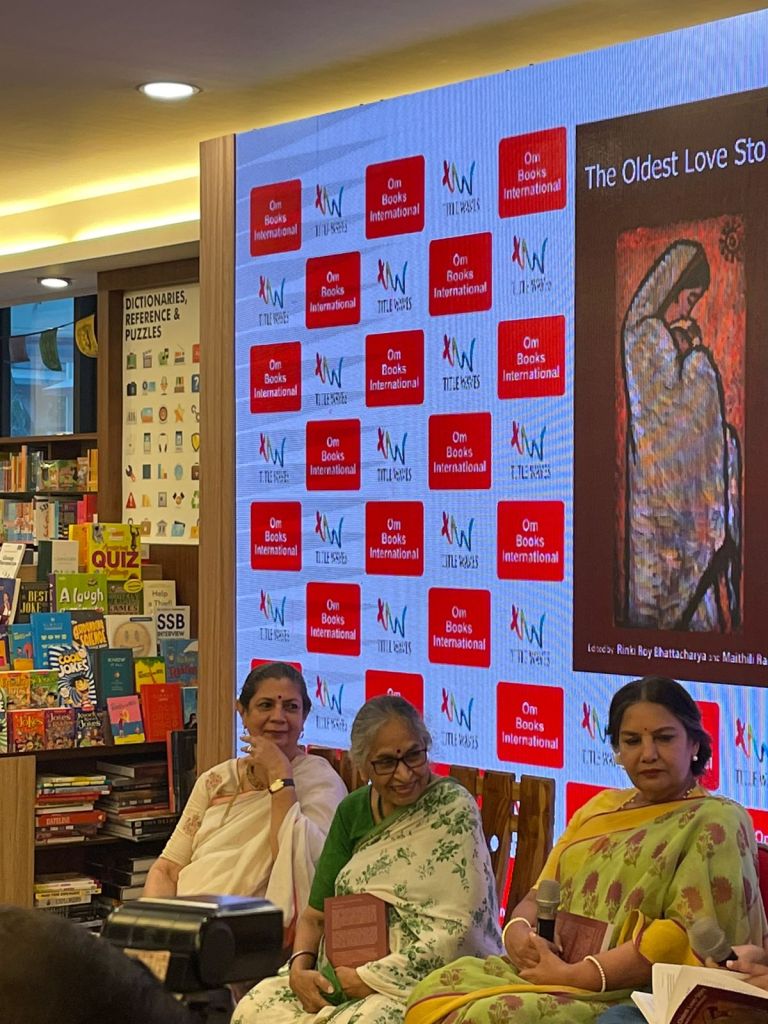
The Oldest Love Story, edited and curated by Rinki Roy and Maithili Rao published by Om Books International, 2022, carries multiple voices across cultures on a most ancient bond and nurtures pertinent questions and observation, which hope to redefine the role.

‘Antara 1’

Antara rising from primordial waters
As the first sun, forever new, forever old,
You made me the universe.
History and prehistory filed through me hand in hand 
In gradual evolution.
Antara, because of you
I have earned the right to enter
The tenfold halls of my foremothers.
Clutching your baby hands in my fist,
I have made the future a debtor to me
Antara, in an instant you have filled all time
By your grace I am coeval with the Earth today.

-- Nabanita Dev Sen, The Oldest Love Story(2022)

The Oldest Love Story, curated by two eminent authors and journalists, Rinki Roy Bhattacharya and Maithili Rao, is an anthology that not only describes a human’s first love, their mother, and their lives, but also explores the social and psychological outcomes and ramifications of motherhood with powerful narratives from multiple writers. They range from eminent names like the late Nabanita Dev Sen, Shashi Deshpande, Kamala Das to Bollywood personalities like Shabana Azmi and Saeed Mirza and contemporary names like Amit Chaudhuri or Maithili Rao herself.

The anthology has narratives clubbed into three sections: ‘Being a Mother: Rewards and Regrets’, ‘Outliers’, ‘Our Mothers: Love, Empathy and Ambivalence’. The headings are descriptive of the content of each section. These real-life narratives, some of which include translations by editors Roy and Rao among others, make for interesting and fresh perspectives of the age-old story that is as natural as water or air. More than two dozen diverse voices as well as Roy’s powerful “Preface” and Rao’s exhaustive “Introduction” paint motherhood in new colours, giving it an iridescence that glitters with varied shades. Stories of what mothers faced — bringing up a child with Down’s syndrome, a child who drove his roommate to suicide and yet another daughter who marries a man old enough to be her father — bring us close to issues we face in today’s world.

One of the most interesting and unusual aspects of this book is at the end of each essay is a takeaway from the narrative where the writers write about themselves. This is not a biography but a description of the writers’ perception about their mother or what they learnt from their experience of motherhood. The most interesting takeaway is given by Shabana Azmi, who wrote of her dynamic mother Shaukat Kaifi (1926-2019).

“I am cut from the same cloth as her. But who am I?

“I would say I’m a woman, an Indian, a wife, an actress, a Muslim, an activist, etc. My being Muslim is only one aspect of my identity but today it seems as though a concerted effort is being made to compress identity into the narrow confines of the religion one was born into, at the absence of all other aspects. This is not the truth about India. India’s greatest truth is her composite culture.

“The Kashmiri Hindu and the Kashmiri Muslim have much more in common with each other because of their ‘Kashmiriyat’ than a Kashmiri Muslim and a Muslim from Tamil Nadu in spite of them sharing a common religion. To me, my cultural identity is much stronger than my religious identity.”

And she concludes: “My mother taught me that identity must not be a melting pot in which individual identities are submerged. It should be a beautiful mosaic in which each part contributes to a larger whole.”

Major social issues are taken up in multiple narratives. Mirza used the epistolary technique to describe how his mother discarded her burqa forever in Pre-Partition India.

“You were emerging from the hall of the Eros theatre and were about to wear your burqa in the foyer when Baba popped the question to you.

“‘Begum, do you really want to wear it?’

“You told me you paused for a moment, and then you shook your head. And that was that. The rest, as they say, is history.

“I am trying to imagine that moment. The year was 1938 and you had been wearing a burqa ever since you were thirteen years old.”

Mannu Bhandari’s spine-chilling narrative of her mother, a child bride around the time when Mirza’s mother shed her burqa, shows a young girl punished and abused for accidentally tearing her sari. It showcases a conservative, abusive culture where women turn on women. An extreme contrast to the bold maternal outlook described by Mirza or Azmi, the narrative highlights the reason why women need to protest against accepting familial abuse bordering on criminality. That these three mothers lived around the same time period in different cultures and regions of India only goes to enhance the large diaspora of beliefs, customs and cultures within one country.

Dalit writer, Urmila Pawar’s reasserts her mother’s belief, “A woman is a wife for only a while/ She is a mother all her life.” “Screams Buried in the Walls” by Sudha Arora dwells on the abuse borne by women to pander to societal norms. Narratives of abuse of women who could not stand up to social malpractices seem to have turned into lessons on what not to do for daughters who condemn patriarchal norms for the suffering their mothers faced.

On the other hand, Shashi Deshpande tells us: “Motherhood becomes a monster that devours both her and her young; or, when the children go away, there is an emptiness which is filled with frustration and despair. I have been saved from this because of my work. My children no longer need me, but my life does not seem empty.” While Shashi Deshpande found her catharsis by writing her stories, Deepa Gahlot, justifies her stance of remaining unmarried and childless by espousing a voice against motherhood.  She contends that the only reason to perceive motherhood as a viable alternative would be propagation of the species. But concludes with an interesting PS: “Does it even make sense to bring a child into such an ugly, nasty, brutal world?” As one hears of senseless violence, wars and mass shootings in the news, Gahlot’s words strike a chord. She has actually researched into the subject to draw her conclusions. But one would wonder how would humankind propagate then — out of test tubes in a bleak scenario like Aldous Huxley’s Brave New World (1932)? Would humans really want such an inhuman existence?

I would rather go with Dev Sen’s outlook. While she emoted on motherhood in her poems on her daughter Antara, she has given a powerful prose narrative elucidating her own perspective. Antara, the daughter to who these poems are addressed, has given a beautiful takeaway on her mother at the end of Dev Sen’s narrative. Despite being abandoned by her husband, Amartya Sen, who later became a Nobel laureate, Dev Sen not only fulfilled herself as a woman and a mother but threw out an inspiring statement that well sums up motherhood for some: “[C]ould I do anything to make this planet worthy for my kids?”

Rinki Roy Bhattacharya, one of the editors of this sparkling collection and author of a number of books, especially on the legendary film maker, her father, Bimal Roy (1909-1966), had published an earlier collection on a similar theme called, Janani (Mother, 2006). She agreed to tell us more about the making of this meaty and gripping anthology, The Oldest Love Story.

Editor Rinki Roy Bhattacharya at the book launch in Mumbai. Photo sourced by Rinki Roy

Motherhood as a concept that is ancient, natural, and yet, not fully understood nor explored. What made you think of coming up with this collection that highlights not only stories of mothers and how it influenced women but also discusses the process of being a mother?

The present collection, titled “The Oldest love Story” goes back several decades. This is mentioned in my preface. It began when I woke up to the fact that I was redundant as a mother. By the time the children had grown up one-by-one and left home. I began to explore the situation with other women to understand, why we give so much importance to motherhood? Foolishly, I felt. Motherhood as a concept is indeed natural but taken for granted. I have a problem with that. My maid, Laxmi, is a classic example of a mother who is exploited to the hilt by her children. She is blind to their exploitation and refuses any change that will help her live with comfort or dignity. As if women are just mothers and nothing else?

Was it a personal need or one that you felt had to be explored given the current trend towards the issue where women are protesting the fact that looking after children saps them of individuality? Can you please explain?

I answered this issue as have others in this book. The deep resentment that follows after raising kids who then go away to find greener pastures, is an extremely common, and collective experience for most parents. Particularly in the Indian context. Parents cannot let go. The main reason, I think is, the parent’s fear. The fear of who will light the funeral pyre if not the son? In the event of not having a son,  a close male relative takes over. Do you see the gender bias, the patriarchal assumption? Daughters are not considered legitimate enough to light the pyre?! Yet it is daughters who care for elderly parents in most cases.

This is not the case in Europe, nor the West, where children are expected to become independent very early. In fact, European teenagers seize their independence at the earliest opportunity. It is the expected thing, and no one resents that inevitable shift.

You had an earlier collection called Janani (Mother). Did that have an impact on this book?

I am glad you referred to Janani, published by Sage books in 2006. That collection is the cornerstone of our new book. In this collection, we have included eight extraordinary essays from Janani. We have retained, for example, Kamala Das and Shashi Deshpande to name two. And guess what we discovered out of the blue? In the oldest love story, we have several Sahitya Akademi winners amongst our writers, including these stalwarts. This raises our book to a huge literary stature.

How was it to work jointly on a book with Maithili Rao? Did you both have the same vision for the book?

Working with Maithili was fantastic, and it was great fun. She is the most generous of people and shares without fuss. Ours was a good partnership. I could not have produced this book without Maithili. She has been and continues to be a rock.

You have done many translations for the book. Why is it we did not find an essay from you as we did from Maithili Rao?

Yes, I did. I helped fine-tune Mannu Bhandari’s story It ranks as one of my personal favourites. Her narrative is beautifully visual. I find it cinematic. I also translated Sudha Arora’s poignant essay. Sudha is a noted Hindi writer. It was, however, difficult for me to write my personal story. But the hope is, our next reprint will carry a story I wrote on my son Aditya’s birthday in 2021. In this I have given graphic details of how childbirth robs women of their dignity in the so-called natural process of birthing children. My essay is entertaining and somewhat satirical in style.

You have written a beautiful preface to the book, reflecting your own experience with your children. Were you, like the other writers, impacted by your mother?

I take that as a compliment. Yes, I wrote a heartfelt preface. My relationship with my mother, admittedly, was a strained one. Our age difference was just eighteen years…whatever the reason, I have not been able to fathom or pinpoint it. So, I thought it was best to refrain from the troubled territory.

Would you say that Bollywood had some bearing on the book as a number of writers are from within the industry? Also, your father, the eminent Bimal Roy, made a movie called Maa in 1952. If so how. Please explain.

I do not see any bearing from Bollywood. The fact we have eminent personalities from the world of cinema, for example, Shabana Azmi, Saeed Mirza, and Lalita Lazmi do not make it a Bollywood-driven work. My father, Bimal Roy’s Bombay debut was with a film called Maa. Apparently, Maa was inspired by a Hollywood film titled Over the Hills. The main protagonist was an elderly mother of two sons. Maa bared a socially relevant issue, elder abuse, that has been globally recognised and is prevalent. My father’s empathy for the elderly is well documented in this fictional account. In day-to-day life, my father supported the elderly. His widowed aunt in Benaras was maintained by him. His brothers were educated and helped by his generosity. Compassion was his second nature. From him, I learned that a silent, discreet way to support others is the best way to reach out.
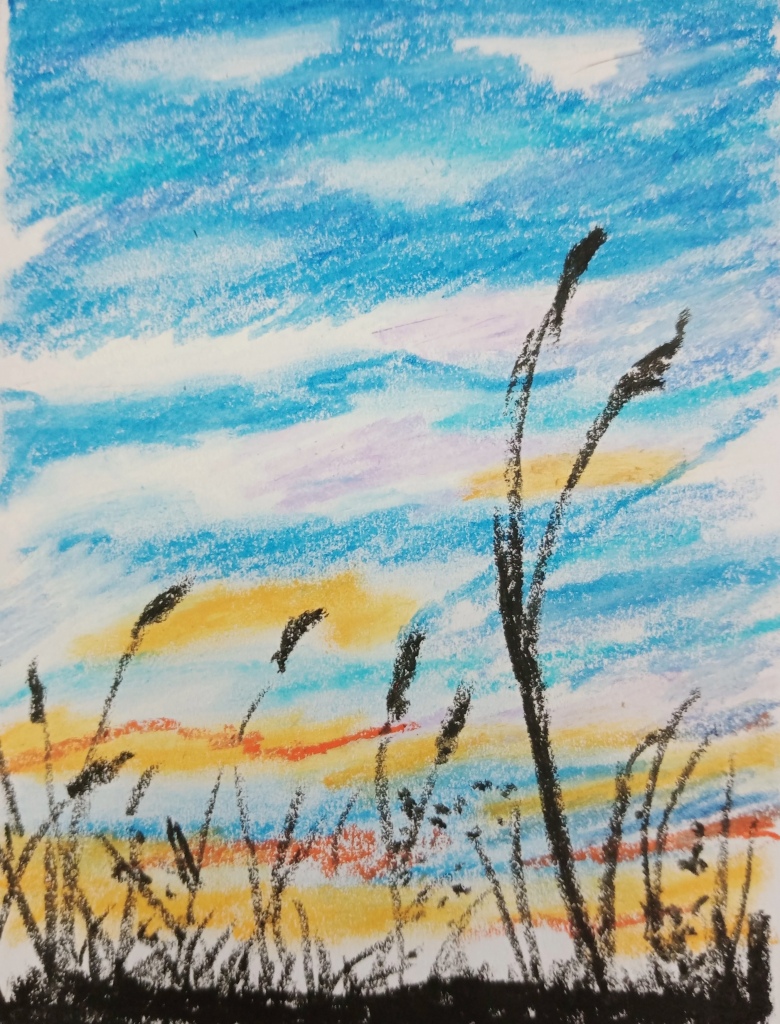
There are so many women in the anthology who reiterated the huge impact their mothers had on them, and they were quite critical of their ‘patriarchal’ fathers. Do you think this is true for all women? At a personal level, did your father or mother have a similar impact on you?

I am glad to hear that these woman are critical of their patriarchal fathers…while most women tend to overlook the patriarchal aspect. In general, women tend to ignore or even neglect, their mothers. In my case, it was distinct. My cultural upbringing was instilled by my father’s secular and inclusive vision and social values. These played a decisive part. Much more than my mother, who was a gifted photographer. My parents, by the way, were a made for each other couple. Rarest of rare in the movie industry. My father is my mentor. If you contemplate his well-loved films, let us take Sujata [1959], for one. I have yet to see another film that speaks so eloquently of social boycott. It is not just the caste issue of Sujata, which doubtless is the main thrust. It is the combined forces of class, caste, and gender that play havoc with human relationships as portrayed compassionately in this work.

Yes, Sujata is indeed a beautiful film and your book has taken up many of the issues shown in the movie through the voice of mothers, whether it is caste or religion. Was this intentional or was it something that just happened?

The voices of our contributors in the book are of individuals who write with exemplary honesty and spontaneously. Nothing is contrived in their writings. We did not brief our writers to take up any specific issue. They wrote from the heart.

One of the trends that emerged from my reading of the book was that educated and affluent mothers through the ages had it easier than child brides and less educated mothers, whose children also reacted with more vehemence, looking for a better world for themselves. Do you feel my observation has some credence? Please comment on it.

I do not agree entirely. Bearing children, and raising them in our complex, the confusing socio-economic culture is a challenging matter for all mothers. For all parents in fact. Child brides are subjected to it more intensely than others. There are no shortcuts, nor ready-made answers.

There is an essay against motherhood in this anthology. Do you agree with the author that it is a redundant institution and can be replaced by test-tube babies? Do you not think that could lead to a re-enactment of what Aldous Huxley depicted in Brave New World

I think, you mean Deepa Gahlot’s essay. This was from the earlier collection. Deepa is entitled to her views. As are others. I think many younger women would agree with Deepa. Balancing motherhood with one’s professional life is a knotty business. I know women who have opted for one or the other to do full justice to it.

Yes, it was Deepa Gahlot’s essay. As you have rightly pointed out in your preface, motherhood can be interpreted variously. What do you see as the future of motherhood in India, and in the world?

Motherhood, remains subjective. Interpreted differently in each case. Every childbirth is a different experience. It may be life-threatening. A case to note is my dear friend Smita Patil’s. She died giving birth. But, I doubt women will stop being mothers, or abandon stereotypical mothering options that live up to that Deewar [Wall, 1975] dialogue: “Mere paas maa hain [I do not have a mother]”. There is a change, a shift, nonetheless, it is slow. Women are afraid to rock this entrenched image of motherhood. At least in India. I know successful women filled with guilt that they failed to be good mothers.

Well, that is certainly a perspective that needs thought.What books and music impact your work?

I read both Bangla and English. After leaving Calcutta where I read the children’s Ramayana, Raj Kahini, or stories by Tagore and Sukumar Ray. But there was an interruption when I got into an English medium school. Culturally I moved out of Bengal. During that phase, my mother introduced me to Agatha Christie. I was 12 years perhaps…I devoured her works. And I still do. Christie fascinates me.

I fell in love with the piano and began to learn it. As a result, Chopin, Mozart, and Liszt were my musical inspirations. I also learned Rabindra sangeet and Manipuri dance in Calcutta…. there was no dearth of cultural grooming. We are especially fortunate that our parents enjoyed the best in performing arts. Pandit Sivakumar Sharma, the great santoor maestro who just passed away, played at home. Sitara Devi danced for private programs. We were wrapped in a rich tapestry of culture.

What is your next project? Are you writing/ curating something new?

I am a compulsive writer, always itching to write.  I believe that writers do not age…they mature and get better. Currently, I am compiling non-fiction episodes about some of the most celebrated artists from Indian cinema who I was privileged to meet…the collection may be titled, Brief Encounters. Writing keeps me creatively busy. Before I sign off, we have to thank our editor Shantanuray Chaudhuri for his unconditional support to make this book a reality. He has been marvellous.

Thank you for taking our work seriously.

Thank you for giving us your time and answering the questions

From Left to Right: Rinki Roy, Maithili Rao and Shabana Azmi at the Mumbai book Launch in June 2022. Photo sourced by Rinki Roy

(This is an online interview conducted by Mitali Chakravarty.)

PLEASE NOTE: ARTICLES CAN ONLY BE REPRODUCED IN OTHER SITES WITH DUE ACKNOWLEDGEMENT TO BORDERLESS JOURNAL

Categories
Editorial

Catch a Falling Star…

Art by Sohana Manzoor
For when your troubles starting multiplying
And they just might
It's easy to forget them without trying
With just a pocketful of starlight

Catch a falling star and put it in your pocket
Never let it fade away (never let it fade away)
Catch a falling star and put it in your pocket
Save it for a rainy day

'Catch a Falling Star' by Paul Vance and Lee Pockriss

Perhaps, it is time to find that fallen star popularised by pop singer Perry Como is 1957. Optimism glimmers faintly, sometimes even conceals itself, in a world passing through a dark phase in history. For instance, few of us would know that we might find more answers to tackle  climate change as dinosaur fossils (from the time an asteroid hit the planet) have been unearthed recently. That sounds like solutions can be had to what was perceived as inevitable doom.

Another bit of news that perhaps will cheer some is the first anthology of Borderless Journal will soon be available in market. It has been accepted by a publisher, an old, trusted and reputed name from India, Om Books International. They have bookshops splattered all over — should make it easy for buyers to access the book. Hopefully, you can target the anthology for your Diwali or Christmas gift hampers. Om Books has one of the most iconic editors-in chief, Shantanu Ray Chaudhuri. A multiple award-winning editor, he has worked in Penguin and Harper Collins and is currently churning out wonderful books from Om with a fabulous production team, working with whom has been a pleasure. Ray Chaudhuri is an outstanding film writer and poet. He is part of a group that is creating a film archive online. To know more about him or his views on publishing, you can read our online conversation with him.

The energy one gets from optimism like starlight from a fallen star, lightens the darker shadows that create gloom with the war leading to rise in prices and threats of recession in a post pandemic scenario. Lesya Bakun, the refugee from Ukraine whose story we carried last month, finds her starlight by sharing updates of her story.  She added to her narrative with the news that her cousin has been taken as a prisoner of war by Russia from the besieged factory in Ukraine. Though sharing does not alleviate suffering, Bakun’s ability to cling to hope and imagine a future where she gets her dream highlights the strength of her convictions. The other thing that is revealed by her narrative and media coverage is exclusivity and boxes of ideology split humankind, erase families, cities, countries, lives and sanity. The war can appease only the lust of warlords. Against this desolation caused by the devastation, what could be the starlight that would lead to a happier future?

Laughter. Unleashing the ability to laugh at oneself is as potent as laughter that generates relief and lightens our mood, so that we can view differences as whimsical, treat them with tolerance and compassion and not destroy the diversities that add colours to the world. Perhaps, that is why Tagore took to humour too. Somdatta Mandal has translated a series of humorous skits by Tagore. We are featuring one of these called the ‘Ordeal of Fame’. Yet another translation or transcreation of a poem called ‘Lukochuri’ or ‘Hide and Seek’ reflects the playful in Tagore’s oeuvre. These, along with Rhys Hughes humour on the pandemic in poetry and prose, bring good cheer into our journal. Hughes has also used his column to tell us why he curated a new humorous anthology of verses by seventeen poets called Wuxing Lyrical. I wonder if he is serious or joking!

We were fortunate to have a tongue-in-cheek online discussion with an academic with a witty sense of humour who started a book based on his PhD research with a limerick, Amit Ranjan, author of John Lang the Wanderer of Hindoostan, Slanderer in Hindoostan, Lawyer for the Ranee. While Ranjan brought to us a narrative of an Australian who challenged the colonial mindset, went to court representing the Rani of Jhansi, wrote for Charles Dickens in Household Words and moved around the world just like one of us, hopping jobs and looking for a life, we have diverse cultural streams woven into the journal with translations of a Balochi folktale from Fazal Baloch, a Korean poem by Ihlwha Choi and Professor Fakrul Alam’s translation of Jibananda’s poetry, an ongoing project in Borderless.

The Nithari column has yielded us a story that was written in a mix of Hindi and English by Yogesh Uniyal and translated fully to English by Nirbhay Bhogal. We have strange stories this time. Nileena Sunil’s short narrative and Paul Mirabile’s longer one set in Madrid explore the unusual. More stories delve into the intricacies of the human mind.

As we trot around the globe, Suzanne Kamata tells us about a Monet museum in Japan where she ate madeleines made with the artist’s recipe! Meredith Stephens sails to Tasmania with her camera and gives us a glimpse of nature’s plenty. Ravi Shankar relates his trekking adventures among the Himalayas in Nepal, with awesome photographs of these mountains, while Kenny Peavy who lives in Indonesia dwells on the value of falling down and getting up in a light humorous vein against the backdrop of nature – though metaphorically perhaps the world needs to do that. We have G Venkatesh’s story about his stay in Johannesburg where he discovers that skin tones do not matter.

Ratnottama Sengupta makes the whole world look like a home with the story of a legendary screenwriter, Jean Claude Carriere, who wrote the script of Mahabharata for Peter Brook’s play (1985) of the same name and the subsequent film (1989) — with characters drawn from all over the world. Candice gives us an overview of the pandemic, with more focus on US where she lives.

Mike Smith travels back to another time when an ailment called World War II raged and has revived a writer from the past, HE Bates (1905-1974). We have another essay by Dan Meloche on a legendary book which turned 100 this year — Herman Hesse’s Siddhartha. Rakhi Dalal revisits more than a century old translation by Devabrata Mukherjee of Tagore’s The Post Office which bears relevance to the present day as it shows how the human spirit endures over even the darkness of death.

Bhaskar Parichha has reviewed Radhika Gupta’s Limitless: The Power of Unlocking Your True Potential, by his assessment a book that inspires youngsters to take charge of their future. On the other hand, there are books that explore the darkest in humans. Basudhara Roy has reviewed a collection short stories by Sunil Sharma called Burn the Library & Other Fiction. Indrashish Banerjee reviews Upamanyu Chatterjee’s latest novel based on modern day crimes, Villainy, from which we are carrying a book excerpt too. The other excerpt is from a narrative written from a refugee’s perspective, Ramy Al-Asheq’s Ever Since I Did Not Die, translated by Isis Nusair from Arabic. Born in a refugee camp in Damascus, this Syrian-Palestinian poet defies all genres to touch hearts with brutal honesty. No less sincere is Michael Burch’s poetry on summer that ushers in the season as much as Sohana’s beautiful painting that we are using as our cover photo. We have poetry from not just Shantanu Ray Chaudhuri but also by George Freek, S. Srinivas, Tohm Bakelas, Abin Chakraborty, Marianne Tefft and many more. As usual, I have not mentioned all the treats in store for you. Delve into our contents page and browse to find out more.

Before winding up, I would want to extend my thanks not only to our team and contributors, but also to our publisher who is willing to republish our content with some tweaking. Thanks to our readers who, I hope, will be excited to have selected content between their palms as a hardcopy anthology with 49 of our most iconic pieces. We have more than a thousand published works. This anthology will be an iconic sample that you can carry anywhere with you even if there is no internet – that would include Mars and Moon!

I wish you happy reading, happy dreaming and hope… plenty of it.

Best wishes,

Mitali Chakravarty

borderlessjournal.com