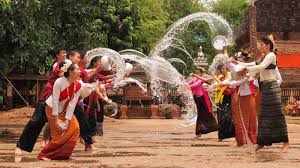
Offerings during Qing Ming Jie, a festival honouring ancestorsSongkran(Thai New Year) CelebrationsFestivals in April: From Public Domain
April is a month full of celebrations around the world. Asia hosts a spray of New Year festivities. Then there are festivals like Qing Ming Jie, Good Friday and Easter. All these are in a way reminders of our past. And yet, we critique things as old fashioned! So, where does tradition end and ‘outdated’ or ‘outmoded’ start? Meanwhile we continue to celebrate these festivals with joy but what happens to those who have lost their home, family and their living due to war or climate disasters? Can they too join in with the joie de vivre? Can we take our celebrations to them to give solace in some way?
In our April issue, we have stories from climate and conflict-ridden parts of the world. From Bangkok, Amy Sawitta Lefevre gives an eyewitness account of the March 28th Earthquake that originated in Myanmar. While in her city, the disaster was managed, she writes: “I’m also thinking of all the children in Myanmar who are sleeping in the open, who lost loved ones, who are feeling scared and alone, with no one to reassure them.” As news reels tell us, in Myanmar there have been thousands of casualties from the earthquake as well as shootings by the army.
From another troubled region, Pakistan, Zeeshan Nasir gives a heartrending narrative about climate change, which also dwells on the human suffering, including increase in underage marriages.
Human suffering can be generated by rituals and customs too. For instance, if festivals dwell on exclusivity, they can hurt those who are left out of the celebrations. Odbayar Dorje muses along those lines on Mongolian traditions and calls for inclusivity and the need to change norms. On the other hand, Devraj Singh Kalsi hums with humour as he reflects on social norms and niceties and hints at the need for change in a light-hearted manner. Farouk Gulsara makes us laugh with the antics of his spoilt pet cat. And Suzanne Kamata dwells on her animal sightings in Kruger National Park with her words and camera while Meredith Stephens takes us sailing on stormy seas… that too at night.
Art is brought into focus by Ratnottama Sengupta who introduces artist Haren Thakur with his adaptation of tribal styles that has been compared to that of Paul Klee (1879-1940). She also converses with filmmaker Leslie Carvalho, known for his film The Outhouse, and his new novel, Smoke on the Backwaters. Both of these have a focus on the Anglo-Indian community in India. Also writing on Indian film trends of the 1970s is Tamara Raza. Bhaskar Parichha pays tribute to the late Ramakanta Rath (1934-2025), whose powerful and touching poetry, translated from Odia by the poet himself, can be found in our translations section.
We have an excerpt from Professor Fakrul Alam’s unpublished translation of Tagore’sRed Oleanders. It’s a long play and truly relevant for our times. Somdatta Mandal shares with us her translation of Tagore’s essay called ‘The Classification in Society’, an essay where the writer dwells on the need for change in mindsets of individuals that make up a community to move forward. A transcreation of a poem by Tagore for his birthday in 1935 reflects the darkness he overcame in his own life. Two poems expressive of longings by Jibananada Das have been translated from Bengali by Professor Alam aswell. From Balochistan, we have an excerpt from the first Balochi novel, Nazuk, written by the late Syad Zahoor Shah Hashmi and rendered into English by Fazal Baloch. Among contemporaries, we have a short story by Bitan Chakraborty translated from Bengali by Kiriti Sengupta, a poignant story that reflects on gaps in our society. And a Korean poem by Ihlwha Choi rendered to English by the poet himself.
This issue has been made possible because of support from all of you. Huge thanks to the team, all our contributors and readers. Thanks to Sohana Manzoor for her fabulous artwork. Do pause by our contents page as all the content could not be covered here.
Perhaps, world events leave a sense of pensiveness in all of us and an aura of insecurity. But, as Scarlett O’ Hara of Gone with the Wind[2] fame says, “After all, tomorrow is another day.”
Looking forward to a new day with hope, let’s dream of happier times filled with sunshine and change.
“If you don’t put it to good use, you will not be allowed to use it at all.” My grandpa said in a stern voice, waving the magnifying glass on top of my eight-year-old head.
I had misused it twice in the past week and had already received a scolding from my grandma. To reprimand me and prevent any further mishaps, my grandpa decided to place it in the most unreachable top corner of the tall cupboard, where my height, even with the help of any furniture, would sadly not land me.
Apparently, my maternal grandpa, an eminent scientist in Odisha, wanted his firstborn granddaughter (me) to become a renowned physics teacher someday, while his grandson, my elder cousin, would become an engineer. After taking the liberty of deciding our careers—much to our discontent, as I wanted to be a lady police officer, influenced by my childhood soap Udaan[1], and my cousin dreamed of becoming a bus conductor (though I’m not sure of the source of his inspiration)— grandpa decided to teach us physics.
Of all the things he demonstrated in his lab, the one that made the strongest impression on me was how the lens of a magnifying glass, when focused on something, can set it on fire. My cousin, however, remained docile and completely uninterested in either the lens or the fire. He would roll the round Marie Gold biscuits on the floor, imagining them to be the tires of a bus, a bus for which he dreamed of being the conductor someday. My curiosity led me to do bizarre experiments with the lens. As long as I smouldered unused items, it went unnoticed, but eventually, I landed myself in trouble.
Mischief was my domain, not Tipu Bhai’s. Though my cousin was named Tipu, like the valiant Tipu Sultan, he would always retreat like a wet cat. His usual line was, “Do whatever you want, but don’t pull me into this, Nitu!”
Once, I asked him, “Tipu bhai, why do you want to be a bus conductor and not a driver?”
He simply said, “Driving is too much work. I don’t think I can drive such a huge bus. It looks like a gigantic beast. I would rather be a bus conductor.”
I knew bhai was that starry-eyed kid who loved watching the bus conductor almost falling out of the door, the wind playing in his hair, and his whistle piercing the air with a shrill sound. That must have seemed thrilling enough to spark bhai’s otherwise sorry imagination.
My grandma didn’t have many stringent parenting rules. Although she occasionally hollered at me when I was being naughty, most of the time, she pampered us with delectable food and gifts. I remember her sparing coins for us to buy chocolates.
Bhai and I would walk to the nearest market and buy lollipops in our favourite colours. People often asked if we were siblings, and I would reply, “We are cousins.” Sometimes, they would smile or say, “You both look so alike,” before resuming their stroll toward the stalls.
Bhai was too shy to even look at them, so I was usually the one to answer their curious questions when they saw two kids wandering around the market late in the afternoon.
*
We spent our school summer vacations at our grandparents’ house in Cuttack, about a fifty-minute bus ride from Bhubaneswar, where we lived with our parents. My grandpa’s house in Cuttack had a courtyard full of mango trees. That afternoon, my grandma and Malati, our seventeen-year-old maid, were busy collecting mangoes from the trees, most of them raw, to make mango pickles and chutney. The garden was covered with dried mango leaves, and my grandma had asked Malati to sweep them all to the far end and set them on fire.
I had two raw mangoes and a magnifying glass in the pockets of my overalls as I followed my grandma and Malati everywhere.
“Wait here, Nitu, while Malati climbs the tree to get more mangoes,” Grandma said, pointing toward the garden’s boundary wall before walking away.
Tipu bhai was fast asleep inside the house, and Grandpa was away at one of his meetings. I watched from a distance as Malati cautiously climbed one branch after another, tossing mangoes down for my grandma to collect. After a few minutes, I got bored standing in one place, watching Malati and Grandma work as a team while I stood feeling abandoned. I noticed a pile of dried leaves beside me and remembered the magnifying glass in my pocket—if I focused it just right, I could set anything on fire. So, I focused the blazing afternoon sun’s rays onto the leaves.
To this day, my grandma insists there wasn’t any kerosene on the leaves, while I still try to convince her that Malati must have spilled some, intending to sweep them to the other corner later. The leaves caught fire, and the flames quickly rose toward the branches of the tree, spreading fast. My grandma let out a scream and ran toward me, while Malati rushed in and together, they pulled me away from the fire. One of the burning branches fell onto the roof of the hut beside our house, setting it ablaze. The hut belonged to a woman named Foola, meaning flower, and it was her kirana[2] store.
Amidst the chaos, we didn’t realise that Grandpa had just arrived. Foola rushed out of the store in panic, and Grandpa quickly ran into the house to call the fire brigade. The fire brigade arrived ten minutes later and began pouring water on the Kirana store. By then, some neighbours, along with Malati, had already thrown buckets of water on the fire. The roof suffered some damage, but the store itself wasn’t affected much, thanks to the timely intervention. All the while, I stood there helplessly, engulfed by guilt.
In the evening, my grandma sat me down and asked if I knew how the fire had started. Her formidable figure loomed over my tiny one, her hands clasped behind her back, the serious green light from her eyes meeting my brown glaze.
“I didn’t do anything, nothing at all!” I blurted out but then grandma is an expert in studying body language and hearing the unspoken words.
“Look I know you had something to do about it. A fire doesn’t start out of the blue. Better confess it and I will not give you any harsh punishment.” Grandma said with her brows raised.
“It must have been completely accidental. I don’t remember much about how. I think there was kerosene in it.”
“There wasn’t any kerosene. I am positive.” This argument about the oil, as I mentioned, never really ended. I did my best to stay defensive without revealing any details.
Then, my grandma brought her right hand in front of my face, holding the magnifying glass. “I found this in your overalls. Any explanations about it? I may not be well educated but I had seen your grandpa demonstrating what it can do.”
That was it—I was caught red-handed. I knew any further argument would only spark more anger and trouble, so I bowed my head and kept my eyes on my toes. Suddenly, the idea of stealing my grandma’s nail polish and painting my toes red crossed my mind, but I quickly brushed it off.
My grandma pointed her index finger at me and said, “No lollipops for a week.”
“That’s too long!” I complained almost teary eyed.
“You argue more, I extend more. Your brother can have them though.”
I felt like Mowgli in The Jungle Book when he was abducted by the monkeys. However, Grandma paid no heed to my misery.
*
Foola came the next morning and stood on the veranda, sobbing. I could hear her telling my grandparents that although the fire brigade had extinguished the fire, the water had seeped into the sacks of rice and pulses, ruining almost a quarter of her grains.
“Babu, please pay for the damage. I am a widow, there is no one to look after me, with all this ruin I will be at a huge loss.” Foola said to my grandpa.
Grandpa knew that the fire had started in our courtyard, though he hadn’t bothered to find out the intricacies involved, and Grandma hadn’t cared to explain. She thought that barring me from eating lollipops for a while would be enough to teach me a lesson. I had felt guilty, then angry, and now I felt very sorry for Foola.
“How much do you think would be enough for managing the damage?” My grandpa asked Foola.
“I won’t quote more, Babu. I swear to God a hundred or two hundred rupees should be enough.” Foola answered with tears rolling down her cheeks.
My grandpa must have known that Foola was being honest. He exchanged a glance with my grandma, and she nodded in approval. I then saw him hand her two hundred-rupee notes. Grandma encouraged her to come again if she needed further help and the matter was somewhat settled.
Four days had passed without lollipops, and there were three more to go. I was craving them—their sweet and tangy taste, the scent that used to fill my nostrils. They always looked like my favourite coloured bulbs, capable of switching my mood to the happiest level every time I licked them. Furthermore, Bhai had committed the heinous crime of eating my favourite cola-flavoured lollipop the day before.
The guilt and desolation that had entangled me slowly began to be replaced by a sense of rage. I waited for my grandma to go to the bathroom, then reached under the mattress on her bed, where she kept the almirah keys. They were still there—two of them, one for the main door and the other for the locker inside.
Beside her jewellery box lay my magnifying glass. Her favourite green saree, the one she wore to the evening pujas, hung neatly on a hanger. When you’re a child and consumed by anger, reason hardly stands a chance. Without thinking, I focused the lens of the magnifying glass on the saree until it burned a hole through the fabric.
That was how, within a single week, I made two miserable mistakes. When Grandma found out, all hell broke loose in the house, followed by Grandpa reprimanding me.
*
When the anger and rage subsided, realisation dawned on me—guilt, more guilt, and an overwhelming sense of remorse, though I still occasionally craved lollipops. Grandma didn’t pamper me, and grandpa buried himself in his books, not once inviting me to his physics lab. Bhai was busy staring at every bus that passed by the house, lost in daydreams. Malati kept herself occupied with household chores and rarely engaged in outdoor activities. The mango trees had started bearing more fruit, some of them beginning to ripen. The sun was less scorching, though a hot loo blew occasionally, and a couple more weeks had passed. Soon, summer vacation would be over, and my father’d take me back home. He wouldn’t really be proud of my behaviour.
One afternoon it was hotter than usual. The sun blazed like a fiery orb, unleashing an army of relentless heat waves upon us. The air was thick with swirling dust. The garden hand pump and the water faucets in the house spewed only hot water. I sat on an armchair on the porch, with a mildly gloomy face, unperturbed by the heat.
Just then, a middle-aged woman in a saree, with a cloth bag slung over her shoulder, arrived at the gate. She looked fragile, as if the sun had drained all her energy. In a weak voice, she called out to me, “Girl, fetch me a glass of water, please.”
I rushed to open the gate and led her in by the arm. After making sure she was seated comfortably in the shade, I gave her the hand fan I wasn’t using and went inside to get some water.
“Grandma, come along. There is a woman at the door,” I said as I headed out with a jug full of water.
The woman gulped down the water, relaxed a bit, and wiped the sweat from her brow with the end of her saree. I sat close, fanning her, and asked, “Are you okay now?”
“I am, girl, I am. You saved my life!” The woman said with her hand on her chest.
“Do you want more water?” Grandma had just come out of the door.
“No sister. I am okay now. Have to get going.” The woman said, and with her hand patting my head, added, “She saved my life.”
She opened her cloth bag and gave my grandma a handful of ripe guavas. When my grandma offered to pay her, she gently refused, insisting they were a gift. She had traveled from a nearby village and often came to Cuttack to sell fruits and vegetables in the market. That afternoon, the ruthless sun had nearly exhausted her as she made her way to the bus stand. Desperate for some shade and water, she had somehow managed to reach our house.
After she left, grandma told me that good deeds bring blessings.
“You were very kind today,” she said with a smile. It had been a long time since she had given me such a radiant smile.
“And when you do wrong, Satan hovers nearby and doesn’t give you many chances to rectify your mistakes. This time, you did good. I will ask your grandpa to give you the magnifying glass back.”
She then handed me a few coins. “You can have lollipops tomorrow, but make sure to share some with Bhai.”
That was the last time grandma had been so strict, and I never got into such mischief again. After all, who would want to risk getting caught by Satan!
Mitra Samal is a writer and IT Consultant with a passion for both Literature and Technology. Her works including poems, stories, essays, and reviews have been published in The Hooghly Review, Muse India, Borderless Journal, Madras Courier, The Chakkar, and Kitaab among others. She is also an avid reader and a Toastmaster.
.
PLEASE NOTE: ARTICLES CAN ONLY BE REPRODUCED IN OTHER SITES WITH DUE ACKNOWLEDGEMENT TO BORDERLESS JOURNAL
Tumi Kon Kanoner Phulby Tagore andAnjali Loho Morby Nazrul, love songs by the two greats, have been translated from Bengali by Professor Fakrul Alam. Click hereto read.
One Life, One Love, 300 Children : Keith Lyons writes of Tendol Gyalzur, a COVID 19 victim, a refugee and an orphan who found new lives for many other orphans with love and an ability to connect. Click here to read.
When West Meets East & Greatness Blooms: Debraj Mookerjee reflects on how syncretism impacts greats like Tagore,Tolstoy, Emerson, Martin Luther King Jr, Gandhi and many more. Click here to read.
Dilip Kumar: Kohinoor-e-Hind: In a tribute to Bollywood legend Dileep Kumar, Ratnottama Sengupta, one of India’s most iconic arts journalists, recollects the days the great actor sprinted about on the sets of Bombay’s studios …spiced up with fragments from the autobiography of Sengupta’s father, Nabendu Ghosh. Click here to read.
Are Some of Us More Human than Others ?: Meenakshi Malhotra ponders at the exclusivity that reinforces divisions, margins and borders that continue to plague humankind, against the backdrop of the Women’s Month, March. Click here to read.
Reminiscences from a Gallery: MF Husain: Dolly Narang recounts how she started a gallery more than four decades ago and talks of her encounter with world renowned artist, MF Husain. Click hereto read.
Baraf Pora (Snowfall) by Rabindranath Tagore,gives a glimpse of his first experience of snowfall in Brighton and published in the Tagore family journal, Balak (Children), has been translated from Bengali by Somdatta Mandal. Clickhere to read.
Cherry Blossom Forecast: Suzanne Kamata brings the Japanese ritual of cherry blossom viewing to our pages with her camera and words. Clickhere to read.
Two Pizza Fantasies, Rhys Hughes recounts myths around the pizza in prose, fiction and poetry, Click here to read.
An Alien on the Altar!: Snigdha Agrawal writes of how a dog and lizard add zest to festivities with a dollop of humour. Click here to read.
Where it all Began: Sybil Pretious recounts her first adventure, an ascent on Mt Kilimanjaro at the age of sixty. Clickhere to read.
Conversations
Rabindranath Tagore: A Universal Bard.: This conversation between Aruna Chakravarti and Sunil Gangopadhyay that took place at a Tagore Conference organised by the Sahitya Akademi in Kochy in 2011. Click here to read.
Sriniketan: Tagore’s “Life Work”: In Conversation with Professor Uma Das Gupta, Tagore scholar, author of A History of Sriniketan, where can be glimpsed what Tagore considered his ‘life’s work’ as an NGO smoothening divides between villagers and the educated. Click here to read. (Review & Interview).
In conversation with the late Akbar Barakzai, a Balochi poet in exile who rejected an award from Pakistan Academy of Letters for his principles. Click here to read.
Jim Goodman, an American traveler, author, ethnologist and photographer who has spent the last half-century in Asia, converses with Keith Lyons. Click here to read.
InBridge over Troubled Waters, the late Sanjay Kumar tells us about Pandies, an activist theatre group founded by him that educates, bridging gaps between the divides of university educated and the less fortunate who people slums or terror zones. Click here to read.
In Lessons Old and New from a Stray Japanese Cat, Keith Lyons talks with the author of The Cat with Three Passports, CJ Fentiman who likes the anonymity loaned by resettling in new places & enjoys creating a space for herself away from her birthplace. Click hereto read.
Fiction
Aparichitaby Tagore: This short story has been translated as The Stranger by Aruna Chakravarti. Click hereto read.
Hena by Nazrul has been translated from Bengali by Sohana Manzoor. Click here to read.
Playlets byRabindranath Tagore: Two skits that reveal the lighter side of the poet. They have been translated from Bengali by Somdatta Mandal. Click here to read.
Abhagi’s Heaven, a poignant story by Saratchandra Chattopadhyay translated by Aruna Chakravarti. Click here to read.
An Eternal Void, a Balochi story by Munir Ahmed Badini translated by Fazal Baloch. Click hereto read.
The Witch, a short story by renowned Bengali writer Tarasankar Bandopadhyay (1898 to 1971), translated by Aruna Chakravarti. Clickhere to read.
I Grew into a Flute: Balochi Folktale involving magic retold by Fazal Baloch. Click here to read.
Give Me A Rag, Please:A short story by Nabendu Ghosh, translated by Ratnottama Sengupta, set in the 1943 Bengal Famine, which reflects on man’s basic needs. Click here to read
Rakhamaninov’s Sonata: A short story by Sherzod Artikov, translated from Uzbeki by Nigora Mukhammad. Click hereto read.
The Magic Staff , a poignant short story about a Rohingya child by Shaheen Akhtar, translated from Bengali by Arifa Ghani Rahman. Click here to read.
Khaira, the Blind, a story by Nadir Ali, has been translated from Punjabi by Amna Ali. Click here to read.
The Browless Dolls by S.Ramakrishnan, has been translated from Tamil by B Chandramouli. Click hereto read.
No Man’s Land: Sohana Manzoor gives us surrealistic story reflecting on after-life. Click hereto read.
The Protests Outside: Steve Ogah talks of trauma faced by riot victims in Nigeria. Click here to read.
Flash Fiction: Turret: Niles M Reddick relates a haunting tale of ghosts and more. Click here to read.
Henrik’s Journey: Farah Ghuznavi follows a conglomerate of people on board a flight to address issues ranging from Rohingyas to race bias. Click hereto read.
Does this Make Me a Psychic?; Erwin Coombs tells a suspenseful, funny, poignant and sad story, based on his real life experiences. Click here to read.
Phôs and Ombra: Paul Mirabile weaves a dark tale about two people lost in a void. Click here to read.
A Queen is Crowned: Farhanaz Rabbani traces the awakening of self worth. Click here to read.
The description in ‘Hot Dry Summers’ is not of hell but what is perceived as happening on certain parts of Earth due to global warming or climate change. Forest fires. Nearer the equator, the storms have become harsher with lightning strikes that seem to connect the Earth to the sky. Trees get uprooted as the soil is softened from excessive rain. Sometimes, they fall on passers-by killing or injuring them. There is no rain in some places, forest fires or flooding in others… The highest temperatures touched 55 degrees Celsius this year. Instead of worrying about losing our homes lodged on land masses to the oceans that continue to rise, becoming dark heat absorbers due to loss of white ice cover, we persistently fight wars, egged on by differences highlighting divisive constructs. It feels strange that we are witness to these changes which seem to be apocalyptic to doomsday sayers. Are they right? Our flora, fauna and food will also be impacted by global climate change. How will we survive these? Will we outlive these as a species?
Poetry in our translations’ section travels to Balochistan, from where a Hafeez Rauf translated from Balochi by Fazal Baloch, talks of burning tyres, again conflicts. It takes on a deeper hue as Ihlwha Choi translates his poignant poem from Korean, reflecting on the death of his mother. We have a translation of Tagore’s less popular poem, Mrityu[1], reflecting on the same theme. His reflections on his wife’s death too have been translated by Professor Fakrul Alam who has also shared a song of Nazrul, written and composed on the death of Tagore. Another lesser-known poet but brilliant nonetheless, Nirendranath Chakraborty, has been translated for us by Debali Mookerjea-Leonard. And what a tremendous poem it is when the person called Amalkanti wanted to be sunshine! We have a story too — ‘Speech Matters’ by Naramsetti Umamaheswararao translated by Johny Takkedasila.
Our stories as usual travel around the world — from Holland (by Paul Mirabile) to Hyderabad (by Mohul Bhowmick) and with a quick pause at Bangalore (by Anagha Narasimha). Travels in the real world are part of our non-fiction. Sai Abhinay Penna takes to a the second largest mangrove forest in the world and Ravi Shankar to Colombo. Madhuri Bhattachrya gives us a glimpse of an Indian summer and Snigdha Aggrawal explores the impact of climate change in her part of the world. Farouk Gulsara actually writes his reflections at a traffic junction. And it reads droll…
We have an in memoriam by Keith Lyons on Morgan Spurlock, the documentary maker who ate McDonald fare for a month and then made a film on it. We have two tributes to two legends across time. Wayne F Burke has given a brief piece on the iconic illustrator, Norman Rockwell. And Aruna Chakravarti, the queen of historic fiction who brought the Tagore family alive for us in her two very well researched novels, Jorasanko and Daughters of Jorasanko, has given us a fabulous tribute to Tagore on the not-so common aspects of him.
Suzanne Kamata, the novelist who does a column from Japan for us normally, has spoken to us about her new novel, Cinnamon Beach, which overrides multiple manmade constructs. It’s an interesting read from someone who lives her life across multiple cultures and transcends many boundaries.
This is a bumper issue, and it is difficult to convey the vibrant hues of words that colour this edition. Please do pause by our contents page for a more comprehensive look.
This issue would not have been possible without all our fabulous contributors and a wonderful, dedicated team. We are delighted that Rakhi Dalal — who has done many reviews and shares her poetry with us in this issue — has agreed to be a writer-in-residence with us. A huge thanks to all of you, and especially Sohana Manzoor for her artwork. I am truly grateful to our readers for popularising our efforts to put together an online space with free and vibrant reads.
I would like to end with a few lines that gives me hope despite climate change, wars and doomsday predictions.
There’s more to life, he says to me, than what you choose to see.
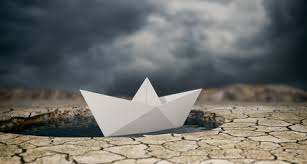
As the newspaper forecasts rain, and a dozen weather applications predict a shower, I cancel my plan to visit an expensive cafe and reminisce about the June rains from two decades ago The afternoon gets a dusky look, Swallows the sun and belches out clouds, Transforms the hot loo into a cool breeze I find myself waiting expectantly for The rain that will hopefully wash away the burdens brought by an early summer, A summer that stole a blissful winter, From children who wouldn’t know much about leather jackets and warm gloves The wilted flowers look like they would never bloom again with vibrant hues The tenderness of rain passes by swiftly with soft pressed feet, and I don’t even notice it amidst the tangles of a busy day Unforgiving glare of the sun cuts through the curtains, and I realise that this month too, the paper boats of hope may not sail
Mitra Samal is a writer and IT Consultant with a passion for both Technology and Literature. She mostly writes poems and short stories. Her works have been published in Poetry Society (India), Muse India, Borderless Journal, Madras Courier, The Chakkar, and Kitaab among others. She is also an avid reader and a Toastmaster who loves to speak her heart out. She can be found as @am_mitrasamal on Instagram.
PLEASE NOTE: ARTICLES CAN ONLY BE REPRODUCED IN OTHER SITES WITH DUE ACKNOWLEDGEMENT TO BORDERLESS JOURNAL
Celebrating poetry around the world, our focus this year is on refugees, immigrants or poetry by migrants… In a way, we are all migrants on this Earth and yet immigration for both climate and war has created dissatisfaction in the hearts of many. Can mankind unify under the single blue dome which covers all our home?
“The Journey” by Alwy Fadhel, an asylum seeker to Australia. The piece is included in the Exile collection of the Refugee Art Project. Art from Public Domain.
We start by welcoming migrants from Jupiter but how do we react to human migrants within Earth… ?
All the Way from Jupiter
By Rhys Hughes
All the way from Jupiter came the refugees, their heads made of hydrogen, and helium, their knees. No one cried: depravity! for we were pleased to help them relocate to Earth: we offered them homes inside plastic domes uncrowded but full of swirling clouds blown by the music of fierce trombones to mimic the crushing gravity.
All the way from one of our homegrown war zones came refugees on their knees and we said: no, no, no, and no again! Go back home right now, be killed, assaulted, it’s all your own fault for being born here on Earth. The newcomers from Jupiter are tubular like cucumbers, but men, women and children like yourselves aren’t welcome.
And what do refugees from war-torn zones on Earth have to add?These are poems by those who had to escape to safety or move homes for the sake of conflict.
I am Ukraine brought to us by Lesya Bakun, while she was on the run from her home to a place of refuge outside her homeland. Click here to read.
Immigrant’s dream brought to us by Ahmad Al-Khatat, who migrated from Iraq to the West to find sustenance. Click here to read.
In some cases, the wounds lingered and the progeny of those who escaped earlier conflicts give voice to past injuries as well as some immigrants who wandered to find a better life share their experiences.
In 1947, Masha Hassan writes of her grandmother’s plight during the Partition of the Indian Subcontinent. Click here to read.
Birth of an Ally reflects Tamoha Siddiqui’s wonder with new flavours she experiences away from her original homeland. Click here to read.
Two Languages by Luis Cuauhtémoc Berriozabal explores linguistic diversity in immigrants. Click here to read.
These could be listed as turns of history that made people relocate.
Red Shirt Hung from a Pine Treeby Ryan Quinn Flanagan takes two issues into account — violence against humanity and colonial displacement of indigenous people — is that migration? Click here to read.
Products of War by Mini Babu talks of the displacement of humanity for war. Click here to read.
Some empathise with those who had to move and write of the trauma faced by refugees.
Migrant Poems by Malachi Edwin Vethamani reflect on migrants and how accepted they feel. Click here to read.
Birds in Flight by A Jessie Michael empathises with the plight of refugees. Click here to read.
The Ceramicist by Jee Leong Koh records the story of a migrant. Click here to read.
And some wonder about the spiritual quest for a homeland… Is it a universal need to be associated with a homeland or can we find a home anywhere on Earth? If we stretch the definition of homeland to all the planet, do we remain refugees or migrants?
Anywhere Particular by Wendy Jean MacLean reflects on the universality of homes — perhaps to an extent on nomadism. Click here to read.
Where is Home? by Shivani Shrivastav meditates on the concept of home. Click here to read.
Sparrows, a poem translated from Korean by the poet — Ihlwha Choi — questions the borders drawn by human laws. Click here to read.
Journey of Hope by Tagore has been translated from Bengali by Mitali Chakravarty. It explores the spiritual quest for a home. Click here to read the poem in English and listen to Tagore’s voice recite his poem in Bengali.
Some look forward to a future — perhaps in another galaxy — post apocalypse.
In Another Galaxy by Masud Khan translated from Bengali by Fakrul Alam wonders at the future of mankind. Click here to read.
And yet others believe in the future of humankind.
We are all Human by Akabar Barakzai, translated from Balochi by Fazal Baloch, is a paean to humanity. Click here to read.
We are all Human
By Akbar Barakzai...
Russia, China and India, Arabs and the New World*, Africa and Europe, The land of the Baloch and Kurds -- Indeed, the whole world is ours. We are all human. We are all human...
Light of mine, O light, the universe is filled with your effulgence,
My heart is yours; my eyes drown in your refulgence.
….
The sky awakens, the breeze flits, the Earth laughs.
As luminous currents surge, thousands of butterflies take flight.
— Aalo Amar Aalo (Light, My Light), Bichitra, 1911, Rabindranath Tagore
There was a time when lights were a part of joy and celebrations as in Tagore’s poem above. Lighting lamps, people welcomed home their beloved prince Rama on Deepavali, who returned after a fourteen year exile, and during his banishment, killed the demonic Ravana. On the same day in Bengal, lamps were lit to ward off evil and celebrate the victory of Kali, (the dark woman goddess wooed by Tantrics) over the rakshasa, Raktabeeja. In the Southern part of India, lamps were lit to celebrate the victory of Krishna over Narakasura. The reasons could be many but lights and fireworks were lit to celebrate the victory of good over evil during the festival of lights.
In the current world with lines blurred between good and evil, while climate crises seeks smoke free, coal free energy, flames of fire or fireworks are often frowned upon. In these times, we can only hope to light the lamp of love — so that differences can be settled amicably without killing the helpless and innocent, infact without violence, greed, peacefully and with kindness, keeping in mind the safety of our species and our home, the Earth. We invite you to partake of our content, writings that light the lamp of love —
GLOW OF DARKNESS
Dreams are like stars, each one
has them on their share of the sky
Glistening and in its light
spreading an ocean of hope
They come only in the shades
of the night and in the shadow
of our thoughts
In a state that isn’t real but
has a tiny connection with
the dimensions of life
It twinkles its way into a path
that lies hidden from the conscious
mind, only to show the possibilities
shielded by the blinding light
The glaze of aristocracy
doesn’t shine on a plebeian
An unknown path is where all
the known paths must lead
It is what the open eyes always
fail to comprehend
The eternal glow of darkness
waiting to be discovered
CANDLE
It’s a candle fighting against
the darkness, for the ill-fated
electric bulb that failed to glow
It’s a candle that burns every
atom in it for the mood lifting
aroma and the flicker of light
It isn’t enough to keep you warm
in the chill of winter but
glows enough to ignite your mind
in the haunting absence of light
A candle that dies with the night
Giving way to more candles that
must keep burning till the breaking
dawn, for the moon isn’t enough
and the light bulb isn’t reliable
A candle that is rumoured to
raise the dead from their grave
I write with the glowing candle
in the faint moonlight
I pray with the candle to
strengthen my devotion
A candle that made a pledge to
sacrifice till the last whit of its life
Mitra Samal writes poems and stories or memoirs. Her recent poetry book called Beginning was published in 2018. Her poems have been published in Poetry Society India, Muse India, Borderless Journal, Madras Courier, Setu, The Punch Magazine, Dissident Voice and FemAsia among others.
PLEASE NOTE: ARTICLES CAN ONLY BE REPRODUCED IN OTHER SITES WITH DUE ACKNOWLEDGEMENT TO BORDERLESS JOURNAL
Reminiscence
The wind blows bringing in the
redolence of my land
I bow my head and pay my homage
When the Siberian cranes flutter
their wings in winter
I reminisce the sultry smell of our lakes
When I stretch my eyes to the
epitaph of the ocean
I feel my country’s sands slither
away from my fingers
When I hear the cuckoo’s enchanting song
I float dreamily to our mango gardens
with fresh blossoms
The sweet aroma of the baked cookies in cafes
Reminds me of my mother’s petite kitchen
Oh! How it feels to be disparate from one’s native land
To be lost in a sea of strangers for what duty demands
The lakes, the trees, the sea and my share of sky
Something that was to live for and will be always to die
If I don’t live to grow old
You will still have my verses
to trace back to the days,
we smiled despite the
summer tempest that
showered on our egos
You will still find yourself
in my words and remember
our carefree laughter from
another time that set our
moods ablaze with zest
If I don’t live to grow old
You will still have my pages
that speak of the time we spent
together, the contentment
that is timeless, and shall
last for now and ever
You will still read between
my lines and be our dream
catcher, feel what I lived
to create and saved for
you to pursue later
If I don’t live to grow old
You will still grow old
in some corner of my book,
in the lines of my page,
in the stanzas of my poetry
and in the words of my verse
Mitra Samal mostly writes poems and occasionally pens down stories or memoirs. She is a software professional with a passion for both technology and literature. She often participates in poetry open mics. Her works have been published in various online and print media. She is also an avid reader and a Toastmaster who loves to speak her heart out.
.
PLEASE NOTE: ARTICLES CAN ONLY BE REPRODUCED IN OTHER SITES WITH DUE ACKNOWLEDGEMENT TO BORDERLESS JOURNAL