In Conversation withRinki Roy(daughter of legendary director Bimal Roy) about The Oldest Love Story, an anthology on motherhood, edited and curated byjournalist and authors, Rinki Roy and Maithili Rao. Click here to read.
Achingliu Kamei in conversation with Veio Pou, author of Waiting for the Dust to Settle, a novel based on the ongoing conflicts in North-east India. Clickhereto read.
Translations
The Funeral, a satirical skit by Tagore, translated by Somdatta Mandal. Click here to read.
Pie in the Sky is a poem written and translated from Korean by Ihlwha Choi. Click here to read.
Taal Gaachh or The Palmyra Tree, a lilting light poem by Tagore, has been translated from Bengali by Mitali Chakravarty. Click here to read.
Pandies’ Corner
This narrative is written by a youngster from the Nithari village who transcended childhood trauma and deprivation. Dhaani has been written in Hindi and translated to English by Kiran Mishra. Click here to read.
Keith Lyons discovers the import and export of desires in Varanasi, one of the oldest cities in the world, beside one of the most revered rivers. Click here to read.
Notes from Japan
In Marathon Blues, Suzanne Kamata talks of pandemic outcomes in Japan in a lighter tone. Click here to read.
Musings of a Copywriter
In Journey of an Ant, Devraj Singh Kalsi explores life from an insect’s perspective. Click here to read.
Mission Earth
In Tuning in to Nature, Kenny Peavy tells us how to interact with nature. Click here to read.
Yes! It is vacation time, and we are all able to travel at last. Though the pandemic which had closed borders for us seems to be evolving as an endemic, another huge human crisis, a war which cannot be justified in any way, stares us in the face. Loss of lives, homes, towns, cities and threats of global recession follow in the footsteps of refugees wandering into our lives. Lesya Bakun, the Ukrainian refugee whose story we have been following, told me four of her relatives’ homes in Mariupol have been erased out of existence and her extended family has scattered where they found safety as her cousin continues a prisoner of war, captured while defending the iron and steel factory at Azovstal. While majority of the world expresses solidarity with the Ukrainians, another set of refugees remain in shadows. They have completely lost their country in which they had lived from ancient times. I am referring to the Rohingya of Arakan. CNN world states:
“The Rohingya are a stateless Muslim minority in Myanmar’s Rakhine State, thought to number about 1 million people.
“Myanmar does not recognize them as citizens or one of the 135 recognized ethnic groups in the country.”
We are privileged to host a powerful poignant translation by Arifa Ghani Rahman of Shaheen Akhtar’s short story about such a voiceless Rohingya child in a refugee camp. Though this is a fiction inspired by Akhtar’s visits to such shelters, we hope at some point these children will be able to build new lives to create a world free of violence, intolerance, hatred and greed.
One of the questions that springs to one’s mind, watching such atrocities destroy innocent lives is that should one accept bullies and give in to their pressure tactics? Bullies can be found among world leaders as well as perpetrators of decadent societal norms which are often critiqued by satires. Somdatta Mandal has translated one such satirical playlet where social conventions are targeted in a lighter vein by Tagore. In the same spirit, the maestro’s iconic poem about a palmyra tree called Taal Gaachh has been transcreated to bring the joy of innocent wanderings back into the narrative, creating an island of healing thoughts. We continue with our translations of Jibananada Das by Professor Fakrul Alam, a Korean poem by Ihlwha Choi and a magical Balochi folktale by Fazal Baloch. Let us read such translations to connect with varied cultures so that compassion and acceptance of diverse perspectives end horrors like wars, starvation and hunger.
Tagore’s writings translated to English by Mandal in Gleanings of the Road, a collection covering the maestro’s travel to the West, is part one of our book excerpts and highlights Rabindranath’s perspectives on the need to connect with the larger world. The other book excerpt, from Waiting, poetry by Suzanne Kamata, takes up the theme of victimisation, crime and murder. Dwelling on no less horrific narratives, though justified as non-criminal, is a review by Meenakshi Malhotra of Harsh Mander’s Locking down the Poor: The Pandemic and India’s Moral Centre. Gracy Samjetsabam’s assessment of Half-Blood by Pronoti Datta informs about the greyer areas of a whole community in Mumbai. Indrashish Banerjee reviewed Keki Daruwalla’s stories on human relationships anthologised in a collection called Going: Stories of Kinship while Bhaskar Parichha has acquainted us with Deepti Priya Mehrotra’s Her Stories –Indian Women Down the Ages — Thinkers, Workers, Rebels, Queens, a non-fiction that visits inspiring women.
Inspiration can also be drawn from Rinki Roy Bhattacharya’s and Maithili Rao’sThe Oldest Love Story, featuring a medley of men and women writing on the theme of motherhood along with some narratives about their mothers or on the experience of being one. The medley includes well-known names from films and literature like Shabana Azmi, Saeed Mirza, Shashi Deshpande, Nabanita Dev Sen and more. We interviewed Roy Bhattacharya to find out more about this impactful book. Achingliu Kamei, an academic and writer, has conversed with Naga writer, Veio Pou, whose award-winning book, Waiting for the Dust to Settle, was reviewed earlier — a book that gives a glimpse of conflicts in the Northeast of India.
Taking on the theme of conflicts at a personal level, Atreyo Chowdhury’s and Banerjee’s stories create a sense of disquiet as Paul Mirabile’s explores crime, madness and its impact on humans. G Thomas takes a relook at heroism and bravery as a concept. His story set in Kerala shakes our complacency, upending traditional concepts of heroism and bravery just as Candice Louisa Daquin has upended the cult of positivity in her essay. Notes of discord and accord seem to ring through this edition and the undertones of greys spread out towards an exploration of life and death. We have multiple ghost stories this time, even from the Nithari column written by Kiran Mishra, a youngster who got over the trauma of violence in the community and discovered her place as a bilingual writer and educator.
Keith Lyons has got the bug of tongue-in-cheek too as he gives us a piece on his travels in Varanasi that well captures the dichotomies we find in India. Dwelling on social dichotomies also is Ratnottama Sengupta’s powerful tribute to Swatilekha Sengupta, a film and theatre doyenne who brought to life Tagore’s novel, Ghare Baire (Home and the World, 1985). An essay by Mozid Mahmud exploring both the syncretic elements in Tagore’s and Kabir’s works, the medieval poet’s impact on the Nobel laureate and a dispute over Rabindranath’s own translation blends with the tone of greys in this edition.
Travel narratives and photographs by Meredith Stephens sailing the seas in Tasmania and Ravi Shankar trekking on the slopes of the Himalayas to get a view of Mt Everest make for perfect holiday adventures. From Japan, Kamata has given us a narrative set in the pandemic. And environmentalist Kenny Peavy dwells on reconnecting with nature in Mission Earth.
We have a fair deal from across the globe in the June issue. But, as usual, some of the treats in the content have not been mentioned though they are wonderful pieces of writing too. We look forward to your continued support as you delve into our treasure trove of gems from across the oceans. A huge thanks to our fabulous team, to the contributors and readers. I especially want to thank Sohana Manzoor for sharing her lovely artwork and wish you all a wonderful read!
There is the import and export of desires in one of the oldest cities in the world, beside one of the most revered rivers, as Keith Lyons discovers in Varanasi.
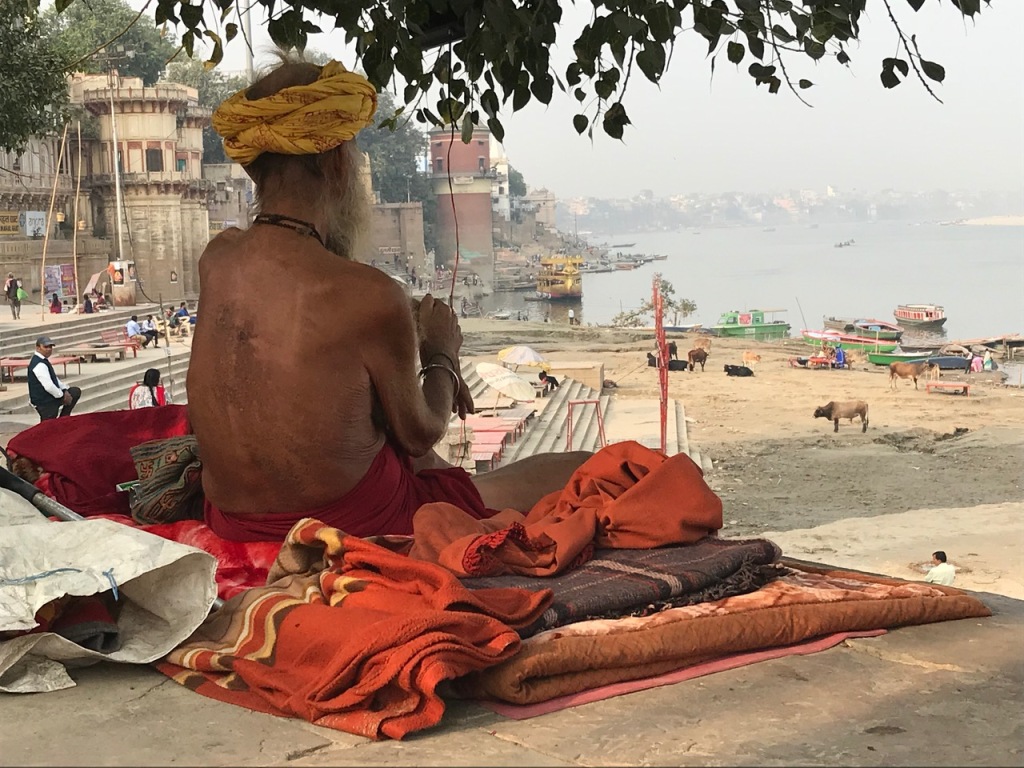
A sadhu watching over the early morning activity on the banks of the Ganges at Assi ghat. Photo Courtesy: Keith Lyons
Most who come to Varanasi, deep down, are seeking peace. The ancient city formerly known as Kashi and Benares is the holy site for three religions: Hinduism, Jainism, and Buddhism. For Hindus who flock to India’s spiritual capital from all over the country, bathing in the sacred Ganges is said to wash away all sins.
For me, as a non-religious outsider, I was also seeking inner peace, and perhaps a deeper understanding of the questions of life and death. But amid the surrealness of the labyrinthine old city, with its wandering bulls, revered shrines, marauding monkeys, and burning bodies, one thing I found was a place to satisfy my earthly material needs.
“It’s to die for,” exclaimed an American bohemian I’d met a few weeks earlier in Bodh Gaya, where the Buddha gained enlightenment. I ran into him strolling along the ghats — steps down to the Ganges that line the western bank of the curve in the wide river. Despite the 1256-page heavy Lonely Planet India, TripAdvisor and social media, there is nothing like word-of-mouth recommendations from fellow travellers. “So you are already at that party,” said Brad, impressed that I too had made it that far along the waterfront almost 2km from where I was staying. “Well, you can’t miss it, can you,” I replied. “It’s probably the only place of its kind right at the water’s edge, and if you don’t see it, you probably smell it.”
For many travellers who don’t want to be seen as sightseeing tourists but are in search of the authentic and the local, Varanasi seems to offer quite an array of experiences, some beyond the comfort level of leisure tourists who keep to the beaten path. Of the 88 ghats of Varanasi which are used for bathing, washing and ceremonial worship, there are two which are synonymous with the spiritual centre. Those two are exclusively used for cremations.
The same reason for bathing in the sacred waters to obtain forgiveness for transgressions applies, but for the recently deceased, it is believed that if their ashes are scattered into the purifying Ganga, their reincarnation cycle will end — and they will reach nirvana.
As the one of the ‘seven sacred cities’, the place supreme deity Shiva (known as ‘The Destroyer’) brought into being by meditation, Varanasi and its cremation ghats represent the ultimate ‘geographical cure’. There are rest homes and ashrams where the elderly and terminally ill wait to die, believing that if they die in the old city, they will be redeemed of all their sins by Lord Shiva on the cremation pyre.
Varanasi straddles the known world and the hidden, with the Ganges a crossing point between earth and heaven. For tens of thousands of foreigners who have Varanasi on their itinerary routes, it is fair to say many are seeking peace, but definitely not of the kind that involves the death of their current material existence. Instead, there is a curiosity about the openness of death and its rituals, and the chance to bear witness to the process which can be at the same time sad and soul-destroying yet also joyous and life-affirming.
For those that don’t share the faith that propels people to this city, perhaps any visit to Varanasi could be described as macabre or dark tourism, fueled by the antagonism between testimony and voyeurism. The epitome of this is the quest by foreigners to get as close as possible to take photos of burning bodies. As if normal travel isn’t stressful enough, the macabre tourist seeks out encounters that have the potential to be emotional and even traumatic.
I must admit, I did have a certain curiosity about witnessing wooden pyres where corpses were placed to be burned. And I did have a fear that I might identify a limb or hand being consumed by the fire, or even that somehow a writhing contorted face might emerge from the flames and snarl at me menacingly.
That didn’t happen. What did happen is that I passed the cremation grounds numerous times during my walks up and down the riverbanks, occasionally pausing to observe from a distance, but the sight didn’t stir me as much as the reflection that this was how a culture and a religion farewell their dead. Having been an altar boy in the Catholic Church, I’d seen my fair share of embalmed bodies in coffins at teary sad funerals, but there was quite a different feeling at Varanasi. Anyway, I didn’t want to intrude as a gawking foreigner.
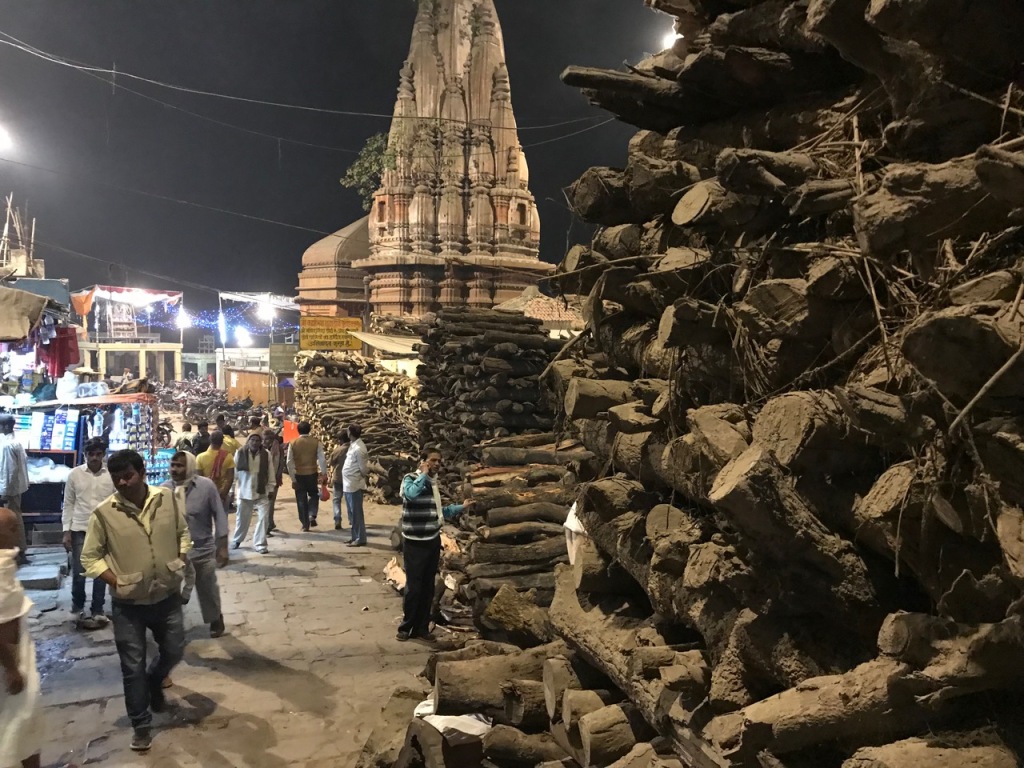
I was just as interested in the negotiations for firewood between relatives and the lower-caste Doms. The price for 400 kg of wood can be around Rs 4,000 (around US$52), a visiting insurance broker from Mumbai tells me, as we stand on the steps beside towers of split logs from the Himalayas. “The better wood is more expensive, but the government is trying to encourage using things like coconut shells and cow dung cakes instead of cutting down more trees,” he says, before the discussion turns to cricket, and a New Zealand cricketer I’d never heard of who played for his beloved Mumbai Indians. Later that evening, to make up for my lack of patriotic sporting knowledge, I impress some local boys playing cricket on the uneven surface of a terrace by catching a whizzing ball with one hand.
Wood merchant stack wood for cremations. Photo Courtesy: Keith Lyons
I noticed that after the initial shock of seeing dead bodies, and after a few days, the constant exposure to these late rites meant that I could be sitting in the open-fronted government-approved 70-year-old Blue Lassi Shop and I wouldn’t even look up when a procession march along bearing a body destined for the Manikarnika ghat. Everyday hundreds of bodies are burned on the riverbank, with the no-frills natural gas crematorium operated 24/7.
I had already taken on board — and possibly ignored through denial – the message of Varanasi: Death is unavoidable. One day, I will die. My body will be destroyed. Life on earth is finite. Make the most of it.
I reflected on this as I stood sipping my tea at Dada ki Chai, or as I sought out the best kachori sabzi[1], or the sweet and sour channa1, dahi vada[2]on the crooked and crowded streets.
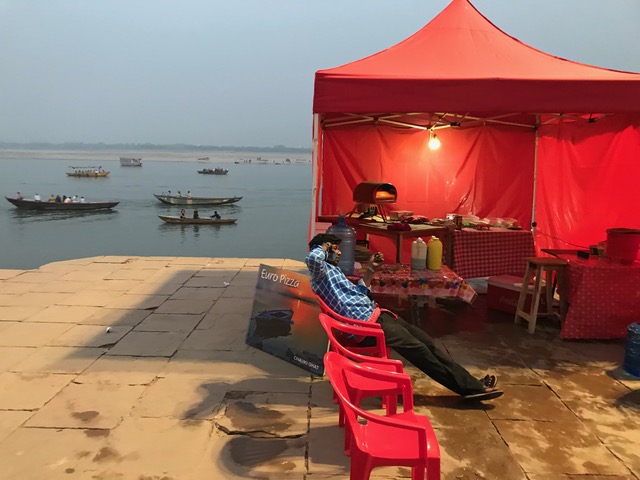
So what else did I discover among the maze of alleyways, the crumbling palaces and the riverbank steps down to the river? Don’t dismiss me as a lousy traveller who can’t be without the comforts of home, but I have to admit one of the finds of my waterside wanderings was a red tent erected on the wide path, where a family had recently set up a low-key pizza eatery.
Pizza? Yes, hand-made, wood-fired pizza. When I first visited, Sunil has only just started the venture. He was going to get some pizza boxes and a label for Euro Pizza and arrange a takeaway and delivery service. The only seating was a few plastic seats.
Diners waited patiently in the cool evening, not so intent on breaking the cycle of death and rebirths but wanting respite from the hot spicy food served up in train stations and roadside dhabas.[3]
In the distance, only a few minutes’ walk away, flames could be seen from the Maharaja Harishchandra ghat, Varanasi’s second, and smaller burning ground. Further along, sounds from the evening ceremony could be heard. But none of that mattered really. There was always a friendly grin from Sunil or a nod of recognition from his family members who cranked out the vegetarian pizzas. It was Rs.150 (US$2) for a ‘small’ pizza, but it was large enough to share. Which people did, with fellow travellers they’d just met, the whole of life made up of many triangle segments, their Varanasi stories to be told later about the burning corpses, the ashes scattered into the river, and the weirdest yet most wonderful thing: a pizzeria perched by a crematorium and a crossing to paradise.
Euro pizza’s humble red tent on the banks of the Ganges. Photo Courtesy: Keith Lyons
Keith Lyons (keithlyons.net) is an award-winning writer, author and creative writing mentor, who gave up learning to play bagpipes in a Scottish pipe band to focus on after-dark tabs of dark chocolate, early morning slow-lane swimming, and the perfect cup of masala chai tea. Find him@KeithLyonsNZor blogging at Wandering in the World (http://wanderingintheworld.com).
PLEASE NOTE: ARTICLES CAN ONLY BE REPRODUCED IN OTHER SITES WITH DUE ACKNOWLEDGEMENT TO BORDERLESS JOURNAL
Ananto Prem(Endless Love) by Tagore, translated from Bengali by Professor Fakrul Alam. Click here to read.
Playlets byRabindranath Tagorereveal the lighter side of the poet. They have been translated from Bengali by Somdatta Mandal. Click here to read.
The Faithful Wife, a folktale translated from Balochi by Fazal Baloch. Click hereto read.
Leafless Trees, poetry and translation from Korean by Ihlwha Choi. Click here to read.
Ebar Phirao More(Take me Back) by Tagore, translated from Bengali by Mitali Chakravarty. Click here to read.
Pandies’ Corner
These narratives are written by youngsters from the Nithari village who transcended childhood trauma and deprivation. Will to be Human is based on a real life story by Sachin Sharma, translated from Hindustani by Diksha Lamba. Click here to read.
InStudies in Blue and White, PennyWilkes gives us a feast of bird and ocean photography along with poetry. Clickhere to read and savour the photographs.
G. Venkatesh looks at the ability to find silver linings in dark clouds through the medium of his experiences as a cricketeer and more. Click here to write.
What can be more scary and life-threatening than the risk of getting Covid-19? Keith Lyons finds how his daily joy has menacing dangers. Click hereto read.
Musings of the Copywriter
In When Books have Wings, Devraj Singh Kalsi talks of books that disappear from one book shelf to reappear in someone’s else’s shelf. Click here to read.
Notes from Japan
InOwls in Ginza, Suzanne Kamata takes us to visit an Owl Cafe. Clickhere to read.
Mission Earth
In No Adults Allowed!, Kenny Peavy gives a light hearted rendition in praise boredom and interaction with nature. Click hereto read.
P Ravi Shankar takes us on a trek to the Himalayas in Nepal and a viewing of Annapurna peak with a narrative dipped in history and photographs of his lived experience. Click here to read.
The Observant Immigrant
In A Bouquet of Retorts, Candice Louisa Daquin discusses the impact of changes in linguistic expressions. Click here to read.
Book Excerpts
An excerpt from a fast-paced novel set in Mumbai, Half-Blood by Pronoti Datta. Click here to read.
"I wish you survival,
Health
And the closed sky above you."

— Refugee in my own Country/I am Ukraine, Lesya Bakun
Despite this being the season of multiple new years around Asia, we cannot close our eyes to the skies that connect all the world like a blue dome. Though celebrations and humour continue to lighten the darkness of war, while Ukraine is being wrecked, can we turn our faces towards only festivities?
I had an interesting anecdote about how before the onset of the Gregorian calendar, new years in the world were celebrated around March and in some places in September. The Earth would turn fecund and green with spring, a beautiful season sprinkled with love and nostalgia as Michael R Burch tells us in his poetry. However, despite all the opulence of nature, it is hard to watch a country being bombed and families splintered to man a war that supposedly guards a human construct called ideology and blocs. Ukranian refugee, Lesya Bakun, in an interview says: “It is not a clash of ideologies. It is a fight for our country and nation to exist.” Listening to Lesya’s stories makes one amazed at the bravery of the Ukrainians battling what seems to be cultural hegemony. It reminds of the war in Bangladesh in 1971. Though incredibly courageous in voicing her experiences, Lesya is traumatised and has a psychosomatic cough as she sends her voice and text messages from her mobile through Telegram. There were times when she was just weeping or angry for the questions asked, and justifiably so, as her home in Kharkiv, where she lived was under attack, and the town of Mariupol, where she was born, has been wrecked by the war.
The refrain of the pain of a refugee continues to reverberate in a book reviewed by Rakhi Dalal, Ramy Al-Asheq’s Ever Since I Did Not Die, written originally in Arabic and translated by Isis Nusair. The Syrian-Palestinian poet refused to clarify whether his writing was prose or poetry — perhaps these borders and boxes drawn by humankind are breaking down in reality. Perhaps, this new year, the time is ripe to look forward to a new world that transcends these borders. This is also the first time we have had the privilege of carrying reviews of translations from Arabic and also from Turkish. Gracy Samjetsabam has reviewed a translation of a Turkish novel by Iskendar Pala called The Tulip of Istanbul, translated by Ruth Whitehouse. Bhaskar Parichha has reviewed a book by Kiran Manral, Rising: 30 Women Who Changed India while Candice Louisa Daquin has drawn our focus on a poetry collection by Marjorie Maddox, Begin with a Question, where the perceived divisions do not matter while the poet questions the larger issue of faith in quest of answers.
Is it the same kind of quest that has led Strider Marcus Jones to create the Lothlorien Journal, named reminiscently after Tolkien’s elvish ‘Lothlorien’ in Lord of the Rings? Find out Jones’s views and flow with his fluid poetry in the featured interview. Keith Lyons has been in conversation with Ivy Ngeow, an upcoming writer and the editor of a recent anthology of Asian writing where she has retained different styles of English across the world in a single book. While this could be beneficial to writers, would readers be comfortable reading stories with different styles or dialects of English without a glossary?
Our book excerpts are from more Asian books. The Year of the Rat and Other Poemsedited by Malachi Edwin Vethamani has an interesting title poem which has been shared in the excerpt. The other excerpt is from a fast-paced novel, Half-Blood, by Pronoti Datta. We also have a fast-paced story by a writer from France called Paul Mirabile set in Portugal; two that verge on the bizarre from Keiran Martin and Amjad Ali Malik; a poignant story from Sutputra Radheye and another that shows the positive side of voicing a protest against wrongs by Devraj Singh Kalsi. Kalsi has also given us a tongue in cheek musing called When Books have Wings.
On the lighter vein are travel essays by Ravi Shankar and Meredith Stephens. They take us to the Himalayas in Nepal and to Tasmania! Suzanne Kamata has taken us to an owl cafe in Japan! At the end of her column, one feels sad for the owls as opposed to Erwin Coombs’ narrative that evokes laughter with his much-loved pet cat’s antics.
Humour is evoked by G. Venkatesh who with an ability to find silver linings in dark clouds talks of cricket and lessons learnt from missing his school bus. Adnan Zaidi has also analysed his poetic abilities with tongue-in-cheek comments. Kenny Peavy gives a lighthearted rendition in praise of boredom and interactions with nature. It is good to have laughter to combat the darkness of the current times, to give us energy to transcend our grief. Keith Lyons hovers on the track between humour and non-humour with his cycling adventures. Rhys Hughes seems to talk of both his favourite poem and the war in a lighter shades, in no way insensitive but his observations make us wonder at the sanity of war. We have much of war poetry by a number of writers, poetry on varied issues by Luis Cuauhtémoc Berriozabal, George Freek, Sybil Pretious, Kisholoy Roy, J.D. Koikoibo and many more.
Candice Louisa Daquin has taken on the onus of bringing to our notice how language can impact us in the long run while Ratnottama Sengupta has explored beggary in films, fiction and fact. The Nithari column runs a real-life story of a young boy narrated by his brother, Sachin Sharma. It has been translated from Hindustani by Diksha Lamba. The trauma faced in 2006 is strangely not discussed in the story though it hovers in the backdrop between the lines. We also have a translation of a Balochi folk story by Fazal Baloch and a Korean poem by Ihlwha Choi. Translations from Tagore by Fakrul Alam and Somdatta Mandal have honoured our pages again. Mandal has sent us fun-filled skits by Tagore. But are they just fun or is there something more? We also have a translation of a long poem that explores a different aspect of Tagore, his empathy for the downtrodden which led him to create Sriniketan and regard it as his ‘life work’.
We have a bumper issue this time again — especially for the Asian new years; Thai, Nepalese, Bangladeshi, multiple Indian and more…
We would like to thank Sohana Manzoor for our cover painting and Gita Viswanath for her artwork. I would like to thank our wonderful team who with their contributions make this journal a reality. All the contributors deserve a huge thanks as do our loyal readers.
I wish you all a wonderful start to a non-Gregorian new year and hope that peace prevails over parts torn by wars and dissensions.
What can be more scary and life-threatening than the risk of getting Covid-19? Keith Lyons finds how his daily joy has menacing dangers
Cycling in New Zealand. Photo shared by Keith Lyons
“When the spirits are low, when the day appears dark, when work becomes monotonous, when hope hardly seems worth having, just mount a bicycle and go out for a spin down the road, without thought on anything but the ride you are taking.”
While out cycling recently with a friend on a weekend ride, I was reminded that the Covid-19 pandemic has been raging waning and morphing for the last two years. With Covid cases set to peak this week in my part of the world, optimistically we hope that we’ll be in a post-pandemic world by the time 2023 starts.
Many of us are wishing for a return to normal, to the good old days of 2019. But we know deep down that while enterprise and everyday life may resume again, there is no return to normal. We can’t turn back the clock. My parents in a retirement village and rest home are still shielded to ensure the virus doesn’t spread. I have people I’m close to who have died from Covid. On both hands I can count how many friends and acquaintances continue to live despite the pandemic.
Looking back on the last two- and a-bit years, one of the good things to come out of it was that I bought a bike and got into cycling. The first bicycle I found abandoned during my lockdown walks. The second one, an e-bike, I bought in mid-2020, and last year got its mountain-bike sibling, With public transport more inconvenient as well as slightly hazardous, biking would seem to be an ideal solution for commuting and recreation. I do like the freedom it gives me, though as I found out yesterday, cycling in the rain loses its romantic notions when your every item of clothing is sodden.
Cycling has been a great vehicle of joy for me, not just for the quick run to the greengrocer, or an outing to a beach, a cafe or the hills. So today when I met a buddy for an easy ride beside a meandering river to the sea, I couldn’t but feel happy to be freewheeling along, appreciating the clarity of the river, the trees turning into autumn colours, the pleasantness of it all.
However, for me, the joy of cycling has a flip side. Even in a flat city like the one I live in, which seems so well suited to cycling. Even with its network of cycle lanes and dedicated cycle paths. I’ll be honest with you, cycling scares me like nothing else in my life. What terrifies me is the vulnerability I feel when on my bike in traffic. I feel small, insignificant and sometimes invisible.
Cars, buses and trucks speed by at 50-80km/hr within touching distance away. Not only are they travelling three or fours times faster than me, but they also weigh 15 or so times my weight. If a driver is inattentive or distracted (for example, on the phone), and I get hit or clipped or rammed by a vehicle, I know that I will unlikely be able to walk away from the crash.
My rational mind fights with my fearfulness. After all, studies show that cycling is more likely to extend your life than to shorten it — physical inactivity contributes to 1-in-8 deaths. And cyclists can fall off bikes by themselves with no other vehicles around. Yet almost every time I venture out on my bike, I have a near-miss. It could be a motorist running a red light, making a turn cutting me off, opening a car door without checking, or exiting a driveway too fast.
It is not just cyclists who are vulnerable. Walkers, children, the elderly, and motorcyclists are all neglected in transport planning, where motorised vehicles are given priority over other users who aren’t shielded or protected from impact. Recent research estimates that an adult pedestrian has around 20% of dying if struck by a car at 60km/hr. The odds are worse if it is a truck. Have you ever heard of a cyclist crashing into a motorised vehicle and causing damage or injury? Probably not.
Yet, for health and fitness, for reducing emissions and for the good of the planet, getting on your bike is good for your being, your body and the world. I cycle cautiously, wishing that my fellow road users are exercising the same alertness and consideration.
Keith Lyons (keithlyons.net) is an award-winning writer, author and creative writing mentor, who gave up learning to play bagpipes in a Scottish pipe band to focus on after-dark tabs of dark chocolate, early morning slow-lane swimming, and the perfect cup of masala chai tea. Find him@KeithLyonsNZor blogging at Wandering in the World (http://wanderingintheworld.com).
Keith Lyons in conversation with Ivy Ngeow, author and editor of a recent anthology of Asian writing
Ivy Ngeow
Ivy Ngeow has interesting perspectives on writing which would resonate with many. She started writing at a young age. With a novel in circulation, this is her first attempt to create an anthology which would unite writers and the English language variously interpreted. She has collected stories with a variety of dialects in English, retaining the differences with each telling. Her editorial experiment is unusual. She tells us, “The Asian words in the anthology are similarly seamless threads sewn into the prose. It would be oppressive to correct the patois and italicise words which are not even foreign to the characters and the narrative. Instead, they are made part of the author’s tongue and means of communication. It is how I’d develop writers writing in English.” And she is bold enough to admit, “Anyway, all writers are outsiders. That is why we write.” Keith Lyons had a candid and interesting conversation with her.
What’s your background, and writing career?
I have an MA in Writing from Middlesex University and my first novel, which won the International Proverse Prize, was published in 2017. I have been in the industry of architecture and interior design for almost 30 years, but I have been writing since I could hold a pencil. I’ve always had that sense of a writing urge which came and went depending on what I was going in my life at the time. I always wrote, whenever I could, on the plane, in hotel rooms, at home in bed. From the time I won my first commendation as a teenager in a Straits Times national competition, I felt that writing was something real, and not imaginary.
Where is home for you, how do you identify, and where’s home for you now?
I live in London. Most of the time I identify as a regular working suburban Asian mum. The long days and short-term challenges I face are just like any other family woman’s.
How did you get the idea for producing an anthology of Asian writing?
The idea was to welcome more books which I loved to read but felt were lacking: beautiful, diverse and eclectic books by the culturally underrepresented. These are the kinds of books that I was raised with — international stories with imaginative storytelling on multiple themes such as the diaspora, culture and identity, and not even necessarily Asian. It is in our collective interest, as readers and writers, to hear more diverse voices.
What was the process for seeking submissions and then selecting the featured stories for Asian Anthology: New Writing Vol. 1: Stories by Writers from Around the World?
I put out a call for submissions in October with a closing date in December. We received more than a hundred entries. Apart from the requirement for the writing to be set in Asia, writers of any nationality or gender were eligible to submit for this publication, in keeping with Leopard Print’s inclusion and diversity policy. The contributors in this book have come from Malaysia, Singapore, India, Myanmar, Hong Kong, Serbia, Austria, France, the United Kingdom and the United States of America. Although it was my first attempt at doing selection and curation, I could tell the strength of the piece from the first line or first paragraph. This is a good tip for writers. Nail that first line, then sculpt that first paragraph, so that the hook is sharp.
So was this the first time you’ve done something like this, or have you had experience in editing and publishing?
This was my first time doing a large-ish body of work. I have written and edited single stories and non-fiction pieces, newsletters, articles, blogs etc.
What’s been the response from the authors featured in the first volume?
The authors are thrilled to have a book out in the UK. They understand that getting a book out means endorsement by their readership and by the editorial team. They also appreciate that they will be receiving a share of royalties.
How do you think the book explores issues of culture and conflict, as well as insider and outsider views?
The cultural insights and conflicts are depicted through the exploration of ideas and storytelling. Only through stories and characterisation do we make sense of reality. Through the microcosms of scenarios, the viewpoints of characters are at the heart of emotional conflict and tension, whether or not it’s viewed by an outsider. Anyway, all writers are outsiders. That is why we write.
Tell us about why you decided to have a reasonably hands-off editorial stance, allowing both American and UK English, as well as use of local non-English words?
It’s hands-on, not hands off, as I feel I assimilated worlds within those literary worlds. Each story required editorial decision based on the cultural stance of the author. The language they have written in reflects their education, their origins and their own decisions. It would have been wrong to choose one English over another. The “Englishes”, colloquialism and vernacular are a reflection of our times and the modern movement. During my MA in Writing, my subject matter was patois and post-colonial literature. I have a whole story written in dialect which won the Middlesex University Literary Prize. Middlesex made me the writer that I am, because I learned that foreign is actually a very loose and relative term. What is foreign to someone is not foreign to another. The true English language is an assimilative one. It is Saxon, French and German. Later it has Portuguese, Indian, Chinese and Malay words too. Where the British sailed through, words sailed through. Are kowtow, verandah, bungalow, croissant and spaghetti still foreign? At which point did they become non-italicised? The Asian words in the anthology are similarly seamless threads sewn into the prose. It would be oppressive to correct the patois and italicise words which are not even foreign to the characters and the narrative. Instead, they are made part of the author’s tongue and means of communication. It is how I’d develop writers writing in English.
One story appears in both Malay and with its English translation – why did you decide to do that?
Most readers in Asia are bilingual if not trilingual. I feel that for the intended audience, there would be scope for a bilingual story because it is one that is about a young Muslim girl’s glimpse of her oppressors. Her language was fluid and poetic, bleeding into the English translation naturally.
One of the themes throughout the book is the conflict over tradition and duty to family, do you think this is more evident throughout Asia as it modernises and opens up?
I think so. Family and tradition create natural tension and conflict in any form of literature. Part of introducing this anthology is that Asia is modern. But. It is a modern that holds onto a traditional world that is in part dying, like dialects, foods of poverty, too much or too little education, breakdown of families. These will always be the recurrent themes in modern Asian literature.
Do you think the first volume achieved its aim to showcase new and established writers from across Asia as well as non-Asians writing about Asia?
Some have never been published or have not written for ten years. Some are published and/or award-winning. We are giving them this platform and opportunity. Reading and writing is a community, a two-way street. By giving writers online and in-person presence to raise their profiles, and readers a channel through which they not only discover and read, they can also hear, see and watch the authors.
The connection is further strengthened by organising online events, real “live” performance readings and book-signings by four of the authors in London, and distribution in real physical bookshops like Daunt in the UK and Silverfish Books in KL, and online print distribution on Waterstones, Barnes and Noble, Amazon, and online digital distribution on Scribd, Googleplay Apple Books, Barnes and Noble Nook, Kobo and Apple Books.
Social media posts which increase visibility for the authors and their audience engagement. More engagement will encourage the writers to write more and secure the notion that we as readers and writers, are not alone.
These ways of connections and relationships are long term. Our mission was to showcase and be showcased and we have done that.
What’s reception to the book been so far, with it only just appearing in hard copy and available in Malaysia and soon the UK?
From the Goodreads reviews, it has been well-received. It is unique in the sense that the strong original voices and the different “Englishes” of the writers have been retained, with foreign words not italicised. It is a true reflection of society and of our cultural diversity. The paperback version sold out within a weekend at Silverfish Books, Kuala Lumpur. Now it is on its second print run. Print copies are now available worldwide in both paperback and in ebook versions.
Do you have any plans to produce more volumes, and if so, when will you open submissions?
We will look at the profits and losses, whether it would be viable, but it is likely that we will go ahead with Vol. 2 despite global uncertainties and crises. In autumn we may put out the call for submissions for release in spring. We are also considering focusing on fiction only for Vol. 2 to further “niche down”. (I made that up but I hope it is a verb.) However, we know the economic challenges are vast. With the world only just recovering from the blight of 2020-21, now we are also seeing the consequences of the war in Europe, with purse strings being tightened. As readers and writers, we are conflicted by these factors, because more than ever, people need stories. Stories of escape, frustration, humour, darkness, love, hope. All stories are about our humanity.
Keith Lyons (keithlyons.net) is an award-winning writer, author and creative writing mentor, who gave up learning to play bagpipes in a Scottish pipe band to focus on after-dark tabs of dark chocolate, early morning slow-lane swimming, and the perfect cup of masala chai tea. Find him@KeithLyonsNZor blogging at Wandering in the World (http://wanderingintheworld.com).
In ‘When will we ever learn? Oh, will we ever learn?’, Ratnottama Sengupta,comments on the current situation in Ukraine while dwelling on her memorable meeting with folk legend Pete Seeger, a pacifist, who wrote ‘Where have all the Flowers gone’, based on a folk song from Ukraine. Click here to read.
In Can Peace come Dropping by…,Candice Louisa Daquin explores war and peace pausing over the attack on Ukraine. Click hereto read.
Munir Momin’s You & I translated from Balochi by Fazal Baloch. Clickhere to read.
Down the stairs by Nabendu Ghosh, a gripping story exploring the greyer areas of ethical dilemmas, has been translated by Sarmishta Mukhopadhyay with editorial input from Ratnottama Sengupta. Click here to read.
Autumn is Long, a poem written in Korean and translated to English by Ihlwha Choi. Click here to read.
Tagore’s Anondodhara Bohichche Bhubone (The Universe reverberates with celestial ecstasy)…translated from Bengali by Mitali Chakravarty. Click here to read.
Pandies’ Corner
These narratives are written by youngsters from the Nithari village who transcended childhood trauma and deprivation. A letter to Godby Tanveer Hussain uses the epistolary technique to asks questions that would be relevant for all humankind. It has been translated from Hindustani by Vritika Thareja. Click here to read.
Erwin Coombs takes us through his life in Egypt and has a relook at Nazi occupied Europe with a dollop of humour to come to an amazing conclusion. Click here to read.
At Home Across Continents : In Conversation with Neeman Sobhan, a Bangladeshi-born writer who writes of her experiences as an expat in Pakistan, Bangladesh, Italy and America. Click here to read.
Meenakshi Malhotra ponders at the exclusivity that reinforces divisions, margins and borders that continue to plague humankind, against the backdrop of the Women’s Month, March. Click here to read.
Only when the cries of the wretched of the earth will stop renting the skies,
Only when the oppressor’s bloody sword will cease smearing battlefields,
			A rebel, weary of war,
			Only then I won’t stir.
…
I’m the ever-rebellious hero--
	Soaring over the world, all alone, head forever held high!

--  Rebel or 'Bidrohi' (1922) by Nazrul, translated by Fakrul Alam
Borderless: Digital Art by Ayaan Ghoshal
These fragments I have shored against my ruins
…
Datta. Dayadhvam. Damyata.
 Shantih shantih shantih

-- Wasteland (1922) by TS Eliot
These lines reiterate values we would do well to live by in a war-torn, dissension-worn world where the need for a rebel to recreate a humane society that lives with values such as peace, generosity, acceptance, tolerance, compassion and restraint — is a felt need. The two great poems made history by remaining as popular a hundred years after they were written — ‘The Rebel’ by Nazrul and TS Eliot’s ‘Wasteland’. Nazrul defined a rebel as an iconoclast who breaks norms to find peace, justice and love for all, to move towards the creation of an ideal world. TS Eliot quoted from the Upanishads and ended with redemption coming with giving (giver perhaps denoted generosity), compassion and restraint. Despite the wisdom of these great poets and seers, war still continues a reality. The values remain neglected not just in as we see in conflicts, like the one in Ukraine that destroys lives, property and nature with intolerance towards differences, but also in our personal lives. Tagore also reiterated the same need for stepping out of personal, social, economic and political insularity. We carry a translation of a song that echoed this need while inviting participation in his ecstasy. He wrote:
Why do you sit in isolation,
Dwelling on self-centred issues?
Tagore had not only written of the negative impact of isolation from the world but he led by example, building institutions that could lead the world towards pacifism with acceptance of diversity and inclusiveness. Sriniketan and Santiniketan were created to move towards these ideals. Many of the people he influenced or who studied in Santiniketan made history, like Prime Minister Indira Gandhi, Satyajit Ray; many added to the sense of inclusiveness, like Mahasweta Devi, who other than her enormous work to integrate different cultures, also wrote a memoir about Santiniketan in Bengali. Radha Chakravarty, nominated for the Crossword Translation Award (2004) for In the Name of the Mother by Mahasweta Devi, has translated this memoir, a narrative which brings us close to Tagore’s ideals of the whole world being a family. How wonderful it would be if the world were open to such ideals and would behave like a global family and not go to war! Mahasweta Devi, Our Santiniketan, which has been reviewed by Meenakshi Malhotra, reiterates Tagore’s vision of a planet living in harmony with the flora and fauna.
Bhaskar Parichha has reviewed another non-fiction by Ashok Kumar Pandey, Why They Killed Gandhi; Unmasking the Ideology and the Conspiracy. Parichha writes: “The finest point about this book is its storytelling…” The book review brings to mind in the midst of a war and violence that Gandhi had tried to erase this mindless destruction of lives, nature and cities with Ahimsa or non-violence. Will we ever rise up to it? Perhaps… We see strains of recognising the negative impact of insular outlook in writings like that of Temsula Ao, a Sahitya Akademi Award winner, according to Indrashish Banerjee who has reviewed her new book,The Tombstone in My Garden: Stories from Nagaland. Keith Lyons has reviewed Asian Anthology: New Writing Vol. 1: Stories by Writers from Around the World, edited by Ivy Ngeow, an exotic medley of Asian stories, one of which has been excerpted as well.
We are privileged to carry another excerpt from Ruskin Bond’s Friends in Wild Places: Birds, Beasts and Other Companions, a hilarious story about a pet tiger adopted by the legendary writer’s grandfather. What is amazing about Ruskin Bond’s writing is the love and compassions for all creatures great and small that colours the tongue-in-cheek humour he rolls out to his readers. If only we could think like Bond, there would be no wars. His writing, I feel, transcends political borders or ‘isms’, and laces with love and compassion tales of menageries of monkeys, snakes, mongoose, humans of different denominations. This excerpt is a treat we are giving Borderless Journal as the journal completes two years of its existence. We are truly grateful to Speaking Tiger for sharing this excerpt with us. But our celebrations this time are sombre as the war rages with incoherence accompanied by heart-breaking ravages.
The refrain from Ukraine has been taken up by Ratnottama Sengupta as she takes us through the past and present experiences of the devastated country, bringing in the views of the legendary folk singer and pacifist, Pete Seeger (1919-2014), who she had interviewed over a span of four days. The writer of ‘Where have all the Flowers Gone?’, a song based on an Ukrainian folk song, Seeger said, “The point is not to ask for yourself alone — one has to ask for everybody: Either we all are going to make it over the rainbow or nobody is going to make it.” Candice Louisa Daquin has also pondered on the justification of war, contextualising it with the current one along with her essay on the paradox of modern linguistic communication.
We have an exhaustive essay on the legendary Satyajit Ray’s creations by Anasuya Bhar. Malhotra has pondered at exclusivity reinforcing divisions, margins and borders to plague humankind, against the backdrop of the Women’s Month, March. Highlighting women in writing, we have interviewed two female writers, one from Nepal and another from Bangladesh. Sangita Swechcha lives in UK but her writing, till now largely in Nepali, often pines for her home embedded in the Himalayas whereas, an expat, Neeman Sobhan, shuttles between Bangladesh and Italy with the affluence and assurance of a privileged background.
Finding a way to override lack of privileges, deprivation and violence, are the youngsters of Nithari on the outskirts of Delhi where less than two decades ago other than poverty, savage criminality devastated the local populace. These youngsters transcended the suffering over time with help from volunteering NGOs to create narratives that amaze with their inventiveness and confidence. Tanveer Hussain from Nithari, self-motivated and self-made from a young age, asks questions that would be relevant for all humankind in a letter to God. It has been translated from Hindustani by Vritika Thareja of pandies’. This edition’s translations include Professor Fakrul Alam’s mellifluous rendition of Jibanananda Das’s poetry from Bengali to English, Ihlwha Choi’s Korean poetry and a Balochi poem by Munir Momin rendered in English by Fazal Baloch. Baloch had earlier translated poems by Akbar Barakzai, a great poet who departed on 7th March, depriving the world of yet another powerful writer who imbibed hope of a better future in his poetry. We are privileged to have hosted the translations of some of his poems and his last interview.
Another well-known poetic voice from Singapore, Kirpal Singh, has given us poignant poetry that can be applied to the situation that is leading to the wreck of Ukraine. Anasuya Bhar has poetry, one of which despite being in the ilk of Nazrul’s great poem, ‘Rebel or Bidrohi’, questions gently mainly social constructs that obstruct the flow of harmony. Ryan Quinn Flanagan has pondered on the acceptance of a changed world. We have humour from Rhys Hughes in poetry and wonderful poems by Michael R Burch on spring. Jay Nicholls shares the last of her dozen Pirate poems as Blacktarn sails the lemon seas to fight pollution. Luis Cuauhtémoc Berriozábal, George Freek, Sutputra Radheye, Mike Smith, Shaza Khan and many more have contributed a wealth of beautiful lines. Penny Wilkes has captured storms and seas with photographs and text and Rhys has surprised us with some strange, bizarre tales in his column.
Suzanne Kamata continues writing on Japan as she introduces us to an Australian film maker who is making films in Japan and in Japanese, called Felicity Tillack. Cultures are perhaps truly crossing borders as we can see Kenny Peavy, an environmentalist who moved from US to Indonesia start a new column with us called ‘Mission Earth’. We hope, like Tagore or Rousseau, he will help to revive our felt need to live with nature, acknowledge the nurture that we get from the planet to live in harmony with it and on it.
At the end of twenty-four months of existence – that sounds better than a mere two years— we are happy to host a melange of writers from across the borders and be the meeting grounds of writers and readers from across continents. I am truly thankful to all of you for helping concretise an ideal. Huge thanks to all the writers, artists, photographers and the readers for the contribution of their time, effort and love. And thanks to our fabulous team who continue to support the journal unwaveringly. I would also like to thank Sohana for the lovely visuals she generously shares with us. A special thanks also to young Ayaan Ghoshal for his digital art where hands reach out to support a truly borderless world.
As usual, all the content has not been covered here, I invite you all to enjoy our March edition of Borderless Journal.
At the start of the third year of our existence, let us march onwards towards renewed hope – maybe the Ukraine experience will take us closer to a war-free world with an awakening of a felt need for peace and compassion in a planet without borders.
In quest of a peaceful, humane world, I invite you all to continue being part of this journey.
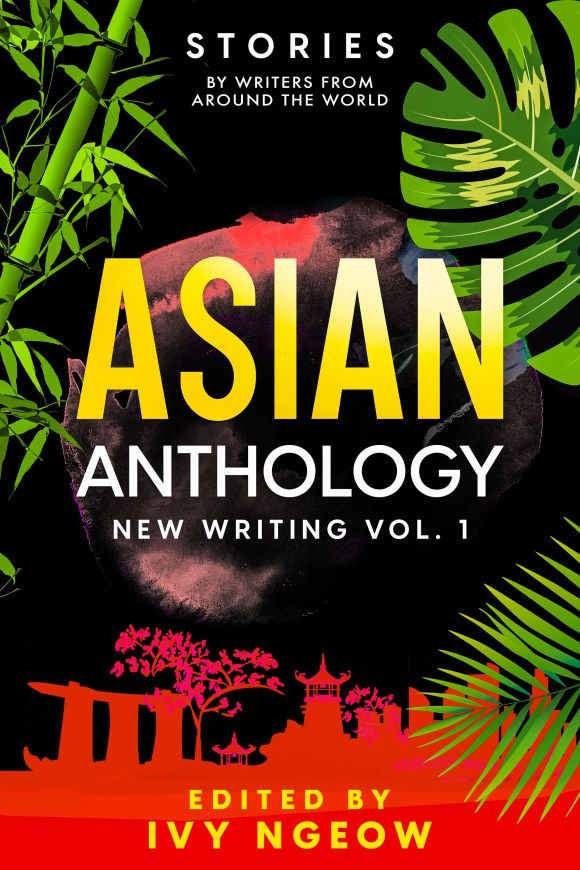
Title: Asian Anthology: New Writing Vol. 1: Stories by Writers from Around the World
Editor: Ivy Ngeow
Publisher: Leopard Print London
Probably my first taste of Asia came when as a 12-year-old, a family friend returning from Singapore gave us a gift box of Asian desserts. Inside the ornate box were individually wrapped sweets, each different in appearance, scent, flavour, and texture. One at a time, my siblings and I cautiously opened the exotic items, nominating each other to try a tiny bite before the cube, roll or round was divided up for the sample tasting every evening or so. Some morsels, featuring jellied lychee, shredded coconut, or egg custard were savoured due to their sweetness and slight familiarity. Other desserts, which we later worked out from the inner menu card were made from green tea, black sesame, or durian fruit were more foreign to our taste buds.
When, several weeks later, we eventually finished the last one in the box, we agreed it has been an interesting experience in curious expectation, overcoming resistance and expanding our food horizons.
Asian Anthology: New Writing Vol. 1 is a little like that exotic gift box, full of surprises, with no two stories alike. Rich and vibrant, the collection of stories explores an assortment of perspectives and experiences, revealing the diversity of Asian culture as well as its many contradictions and enigmas. With twenty-three stories by a selection of new and established writers, the fiction and non-fiction tales range from traditionally-structured pieces to more experimental works, from firmly grounded real-life and realistic stories to jumps into fantasy and the surreal. The variety on offer and variable story length mean the anthology has its own momentum, and is quite compelling, though there does not appear to be any thematic order in their curation. The result is that the reader is taken on many different journeys and in different directions. Almost without exception, the writing is well-crafted, accessible and touching. Picking up this collection you are transported into the lives and cultures of others. Spoiler alert: some of the subject matter is heavy or distressing but handled with sensitivity.
Many of the pieces in the collection revolve around family and food, some challenging traditional roles and raising awareness of larger issues. There are gatherings, and fallings apart, with street food having more than cameo roles. Some of the stories are entertaining, others enlightening — there are quite a few nostalgic reflections on the past as well as numerous strange happenings and breaking of rules. Stories illustrating environmental havoc and greed feature in the collection, as well as the ‘foreigner in a strange land’ type.
The contributing authors are from around the world, with a concentration of writers from Malaysia. One editorial choice I am unsure of is the hands-off editorial approach, which sees variations in British and American English, as well as the non-italicising of non-English words, most often in food terms. With all the authors either born in Asia or having lived and worked across Asia, there’s a broad range of perceptions and insight, and ultimately, some universal lessons for anyone who cares to explore these pages. If the anthology opens readers’ eyes to the fresh literary talent of Asia, then it will have achieved its purpose. Published in early 2022, and showcasing some new voices, perhaps Volume 2 will cast its net even wider.
Editor Ivy Ngeow, who now lives in her fourth culture, is spot on when she declares in the Introduction, “I have found that humanity is more similar than not.”
Asian Anthology: New Writing Vol. 1 is an eclectic collection of poignant and unexpectedly moving stories. Like a gift box of weird and wonderful novelties, your worldview may never be the same after trying it.
Keith Lyons (keithlyons.net) is an award-winning writer, author and creative writing mentor, who gave up learning to play bagpipes in a Scottish pipe band to focus on after-dark tabs of dark chocolate, early morning slow-lane swimming, and the perfect cup of masala chai tea. Find him@KeithLyonsNZor blogging at Wandering in the World (http://wanderingintheworld.com).








 Borderless