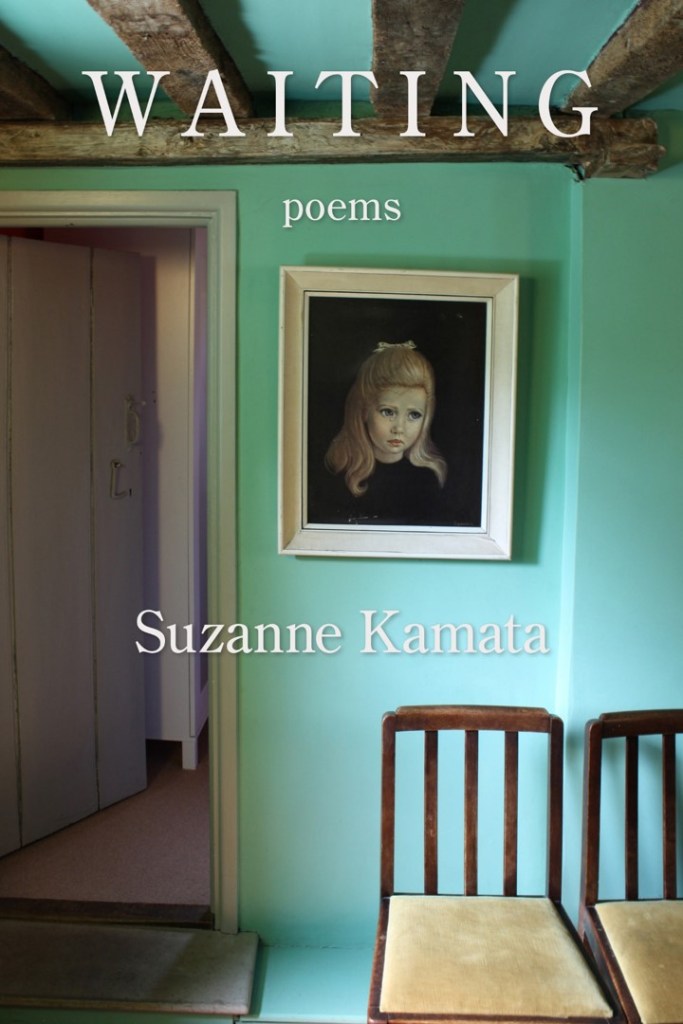
Waiting

My brother Benjamin waits
for Gent
our lost cocker spaniel
to come home.

Dad waits
for his boss
to give him a promotion.

Mom waits
for portents
and signs.

My boyfriend waits
for me to say
“yes.”

I wait
for the future
far away from
here.

The town waits
for a missing girl
to turn up and tell us
it was all just a joke.


Vigil

My little brother Benjamin
fills the plastic dish
only to later dump

the untouched nuggets
and fill the dish
again, a ritual
a sacrificial offering
to our lost cocker spaniel.

He’s gone door to door
promising mown lawns
washed windows
shined cars
in exchange for information.
No one helps.
Everyone is more concerned about
the disappearance of a young woman.

Young women disappear
with alarming regularity.
Two dead, in the woods
naked.
A third
still missing.
Shira Bates.


Shira

I was invited to her birthday party
in kindergarten.
I tried to wrap up
my mother’s engagement ring
after snatching it from a crystal saucer
while she washed dishes
a suitable gift for such a princess of a girl
I thought.

Mom caught me
spanked my behind
made me give Shira a Barbie
with silky blonde hair
smooth skin

wearing the latest fashions
like the birthday girl herself.

I was more Raggedy Ann.

Later, Shira and I drifted apart.
She fell in with the cheerleaders
became star of the chorus
girlfriend to Number One Hottie
Greg Shealy
found God.

While I faded into
gawkiness
good grades
and hid behind glasses
and my long stringy hair.

Invisible me.


Her Voice

On the last day of school
a week before she went missing
Shira Bates sang with the chorus in
the school cafeteria
while I ate my blueberry yogurt.

Her voice blended then
soared above, the others went
silent, listening to her solo before
jumping back in again.

That girl could sing angels out of
the sky, could get larks to land on
her outstretched hands, I thought with
a kind of wonder instead of the usual
jealousy that I felt around Shira Bates.
ABOUT THE BOOK
American Suzanne Kamata attended Lexington High School in South Carolina with Sharon Faye “Shari” Smith, who was kidnapped and murdered by Larry Gene Bell in 1985. This crime compelled the writing of Waiting.
ABOUT THE AUTHOR
Suzanne Kamatawas born and raised in Grand Haven, Michigan. She now lives in Japan with her husband and two children. Her short stories, essays, articles and book reviews have appeared in over 100 publications. Her work has been nominated for the Pushcart Prize five times, and received a Special Mention in 2006. She is also a two-time winner of the All Nippon Airways/Wingspan Fiction Contest, winner of the Paris Book Festival, and winner of a SCBWI Magazine Merit Award.
PLEASE NOTE: ARTICLES CAN ONLY BE REPRODUCED IN OTHER SITES WITH DUE ACKNOWLEDGEMENT TO BORDERLESS JOURNAL
“Do you want to run the Tokushima Marathon with me?” my husband asked for the third year in a row.
The first time, three years before, I’d given him a flat-out refusal. The previous year, I’d promised to register, but then my brother had died suddenly, and I’d had to fly from our home on the island of Shikoku in Japan back to the United States for the funeral. My husband had run the race for the third time on his own. This year, though, I didn’t have an excuse. “Maybe,” I said.
To be honest, running a marathon has never been one of my life goals. Nor am I interested in bungee jumping, getting a tattoo, climbing Mt. Everest, or anything else that would cause pain or discomfort. I power walk four or five kilometers per day for my health, and I did run on my high school’s cross-country team, but I am not really into long-distance running any more. My New Year’s resolutions tend to be more aligned with pleasure: Try new wines. Read more poetry.
My husband, however, couldn’t understand why I wouldn’t want to run a marathon. He told me how satisfied I would feel afterwards. And we’d get swag – a T-shirt, a medal, a certificate worth framing. Maybe he also thought it was a fun activity that we could do together. He is a high school physical education teacher. He would think that.
The Tokushima Marathon course goes along the embankment of the Yoshino River right past our house. We live at the twelve-kilometer mark. In previous years, I’d used a tracking app to determine when he was about to run by. My daughter and I had then gone up the hill in time to cheer him on. Once, he’d shoved a jacket that he no longer needed into my hands as he’d dashed past us.
“What size T-shirt do you wear?” my husband asked.
I told him. I knew that he was registering me for the marathon, even though I had said, “maybe,” not “yes.” But perhaps I could just walk and run the first twelve kilometers, and then jog down the hill to our house. I could run that little bit as a tribute to my brother who had aspired to run a marathon himself. More than once, on my visits to see him, I’d found myself waiting at the finish line of some fun run or other. He had been such a devoted runner that he had been buried with his running shoes.
I started training. My husband usually didn’t put in any effort until a month in advance, and yet he still managed to complete the whole race. But I needed more time. I walked and ran and walked and ran instead of my usual regime. I did this at night after work. Then it started to get really cold, and my self-imposed training program started to fall apart.
Enter the new coronavirus. In January, we heard news of a deadly virus in Wuhan, and then a cruise ship full of afflicted passengers in Yokohama. Even though we were far away in Shikoku, by February local events were being cancelled. There would be no graduation ceremony at the university where I taught, no farewell party for professors who were leaving to teach elsewhere. Public schools began spring vacation a month early. I wondered if the Tokushima Marathon, which was scheduled for March, would be cancelled as well. I must confess that I secretly hoped it would be because I hadn’t kept up with my training and I didn’t want to disappoint my husband.
Of course, it was cancelled, like the 2020 Tokyo Summer Olympics and the national high school baseball tournament at Koshien Stadium and everything else. We were informed that there would be no refund of our registration fees, but we would get swag. I looked forward to receiving my Tokushima Marathon T-shirt, which I would wear ironically. I waited and waited for the package to arrive.
Finally, two bulky envelopes were delivered. Around this time, my husband and I were stuck together in the house with nothing to do. We’d already gotten rid of all of the stuff that didn’t spark joy. Our clothes were rolled neatly in our drawers. We were driving each other crazy. We opened the envelopes to find the finisher medals – ha! ha! – and no T-shirts, but an indigo-dyed handkerchief each.
“Let’s make these into masks,” my husband said.
At first, I protested. They were such nice handkerchiefs! But I already had a few indigo-dyed handkerchiefs which I never used, but which nevertheless sparked joy. If we cut them up and made them into handkerchiefs, at least they would serve a purpose.
My husband dragged our dining room table in front of the wide-screen TV in the living room. He found a mask-making tutorial on YouTube. He cut up the pieces, and I sewed them together. They turned out well! We wore them every day until the elastic started to lose its spring, and health experts declared that wearing paper masks was actually better than handmade cloth ones. And the medals? Well, maybe we will someday figure out something to do with those.
Masks stitched by Suzanne. Photo Courtesy: Suzanne Kamata
Suzanne Kamatawas born and raised in Grand Haven, Michigan. She now lives in Japan with her husband and two children. Her short stories, essays, articles and book reviews have appeared in over 100 publications. Her work has been nominated for the Pushcart Prize five times, and received a Special Mention in 2006. She is also a two-time winner of the All Nippon Airways/Wingspan Fiction Contest, winner of the Paris Book Festival, and winner of a SCBWI Magazine Merit Award.
PLEASE NOTE: ARTICLES CAN ONLY BE REPRODUCED IN OTHER SITES WITH DUE ACKNOWLEDGEMENT TO BORDERLESS JOURNAL
Jibananda Das’s All Afternoon Long, translated from Bengali by Fakrul Alam. Click here to read.
The Colour of Time, Korean poetry composed and translated by Ihlwha Choi. Click here to read.
The Ordeal of Fame, a humorous skit by Rabindranath, translated by Somdatta Mandal. Click here to read.
Fazal Baloch translates a retold folktale from Balochi, The Precious Pearl. Click here to read.
Tagores’ Lukochurihas been translated from Bengali as Hide and Seek by Mitali Chakravarty. Click here to read.
Pandies’ Corner
These narratives are written by youngsters from the Nithari village who transcended childhood trauma and deprivation. The Story of Rajesh has been written by Yogesh Uniyal in a mix of English and Hindi, and translated fully to Hindi by Nirbhay Bhogal. Clickhere to read.
Rhys Hughes shares why he put together an anthology of humorous poetry with seventeen writers, Wuxing Lyrical. Is his logic funny or sane? Click here to find out.
In An Encounter with the Monet on Naoshima, Suzanne Kamata writes of snacking on Claude Monet’s hundred year old recipes while savouring his art and that of the famed artist who makes bold art with polka-dots, Yayoi Kusama. Click here to read.
An excerpt from Upamanyu Chatterjee’s Villainy. Click here to read.
An excerpt from Ramy Al-Asheq’sEver Since I Did Not Die, translated from Arabic by Isis Nusair, edited by Levi Thompson. The author was born in a refugee camp. Click here to read.
Book Reviews
Rakhi Dalal revisits Tagore’s The Post Office, translated from Bengali in 1912 by Devabrata Mukherjee. Click here to read.
Indrashish Banerjee reviews Upamanyu Chatterjee’s Villainy. Click here to read.
For when your troubles starting multiplying
And they just might
It's easy to forget them without trying
With just a pocketful of starlight

Catch a falling star and put it in your pocket
Never let it fade away (never let it fade away)
Catch a falling star and put it in your pocket
Save it for a rainy day

'Catch a Falling Star' by Paul Vance and Lee Pockriss
Perhaps, it is time to find that fallen star popularised by pop singer Perry Como is 1957. Optimism glimmers faintly, sometimes even conceals itself, in a world passing through a dark phase in history. For instance, few of us would know that we might find more answers to tackle climate change as dinosaur fossils (from the time an asteroid hit the planet) have been unearthed recently. That sounds like solutions can be had to what was perceived as inevitable doom.
Another bit of news that perhaps will cheer some is the first anthology of Borderless Journal will soon be available in market. It has been accepted by a publisher, an old, trusted and reputed name from India, Om Books International. They have bookshops splattered all over — should make it easy for buyers to access the book. Hopefully, you can target the anthology for your Diwali or Christmas gift hampers. Om Books has one of the most iconic editors-in chief, Shantanu Ray Chaudhuri. A multiple award-winning editor, he has worked in Penguin and Harper Collins and is currently churning out wonderful books from Om with a fabulous production team, working with whom has been a pleasure. Ray Chaudhuri is an outstanding film writer and poet. He is part of a group that is creating a film archive online. To know more about him or his views on publishing, you can read our online conversation with him.
The energy one gets from optimism like starlight from a fallen star, lightens the darker shadows that create gloom with the war leading to rise in prices and threats of recession in a post pandemic scenario. Lesya Bakun, the refugee from Ukraine whose story we carried last month, finds her starlight by sharing updates of her story. She added to her narrative with the news that her cousin has been taken as a prisoner of war by Russia from the besieged factory in Ukraine. Though sharing does not alleviate suffering, Bakun’s ability to cling to hope and imagine a future where she gets her dream highlights the strength of her convictions. The other thing that is revealed by her narrative and media coverage is exclusivity and boxes of ideology split humankind, erase families, cities, countries, lives and sanity. The war can appease only the lust of warlords. Against this desolation caused by the devastation, what could be the starlight that would lead to a happier future?
Laughter. Unleashing the ability to laugh at oneself is as potent as laughter that generates relief and lightens our mood, so that we can view differences as whimsical, treat them with tolerance and compassion and not destroy the diversities that add colours to the world. Perhaps, that is why Tagore took to humour too. Somdatta Mandal has translated a series of humorous skits by Tagore. We are featuring one of these called the ‘Ordeal of Fame’. Yet another translation or transcreation of a poem called ‘Lukochuri’ or ‘Hide and Seek’ reflects the playful in Tagore’s oeuvre. These, along with Rhys Hughes humour on the pandemic in poetry and prose, bring good cheer into our journal. Hughes has also used his column to tell us why he curated a new humorous anthology of verses by seventeen poets called Wuxing Lyrical. I wonder if he is serious or joking!
As we trot around the globe, Suzanne Kamata tells us about a Monet museum in Japan where she ate madeleines made with the artist’s recipe! Meredith Stephens sails to Tasmania with her camera and gives us a glimpse of nature’s plenty. Ravi Shankar relates his trekking adventures among the Himalayas in Nepal, with awesome photographs of these mountains, while Kenny Peavy who lives in Indonesia dwells on the value of falling down and getting up in a light humorous vein against the backdrop of nature – though metaphorically perhaps the world needs to do that. We have G Venkatesh’s story about his stay in Johannesburg where he discovers that skin tones do not matter.
Ratnottama Sengupta makes the whole world look like a home with the story of a legendary screenwriter, Jean Claude Carriere, who wrote the script of Mahabharata for Peter Brook’s play (1985) of the same name and the subsequent film (1989) — with characters drawn from all over the world. Candice gives us an overview of the pandemic, with more focus on US where she lives.
Mike Smith travels back to another time when an ailment called World War II raged and has revived a writer from the past, HE Bates (1905-1974). We have another essay by Dan Meloche on a legendary book which turned 100 this year — Herman Hesse’s Siddhartha. Rakhi Dalal revisits more than a century old translation by Devabrata Mukherjee of Tagore’s The Post Office which bears relevance to the present day as it shows how the human spirit endures over even the darkness of death.
Bhaskar Parichha has reviewed Radhika Gupta’s Limitless: The Power of Unlocking Your True Potential, by his assessment a book that inspires youngsters to take charge of their future. On the other hand, there are books that explore the darkest in humans. Basudhara Roy has reviewed a collection short stories by Sunil Sharma called Burn the Library & Other Fiction. Indrashish Banerjee reviews Upamanyu Chatterjee’s latest novel based on modern day crimes, Villainy, from which we are carrying a book excerpt too. The other excerpt is from a narrative written from a refugee’s perspective, Ramy Al-Asheq’s Ever Since I Did Not Die, translated by Isis Nusair from Arabic. Born in a refugee camp in Damascus, this Syrian-Palestinian poet defies all genres to touch hearts with brutal honesty. No less sincere is Michael Burch’s poetry on summer that ushers in the season as much as Sohana’s beautiful painting that we are using as our cover photo. We have poetry from not just Shantanu Ray Chaudhuri but also by George Freek, S. Srinivas, Tohm Bakelas, Abin Chakraborty, Marianne Tefft and many more. As usual, I have not mentioned all the treats in store for you. Delve into our contents page and browse to find out more.
Before winding up, I would want to extend my thanks not only to our team and contributors, but also to our publisher who is willing to republish our content with some tweaking. Thanks to our readers who, I hope, will be excited to have selected content between their palms as a hardcopy anthology with 49 of our most iconic pieces. We have more than a thousand published works. This anthology will be an iconic sample that you can carry anywhere with you even if there is no internet – that would include Mars and Moon!
I wish you happy reading, happy dreaming and hope… plenty of it.
Suzanne Kamata writes of snacking on Claude Monet’s hundred year old recipes while savouring his art and that of the famed artist who makes bold art with polka-dots, Yayoi Kusama
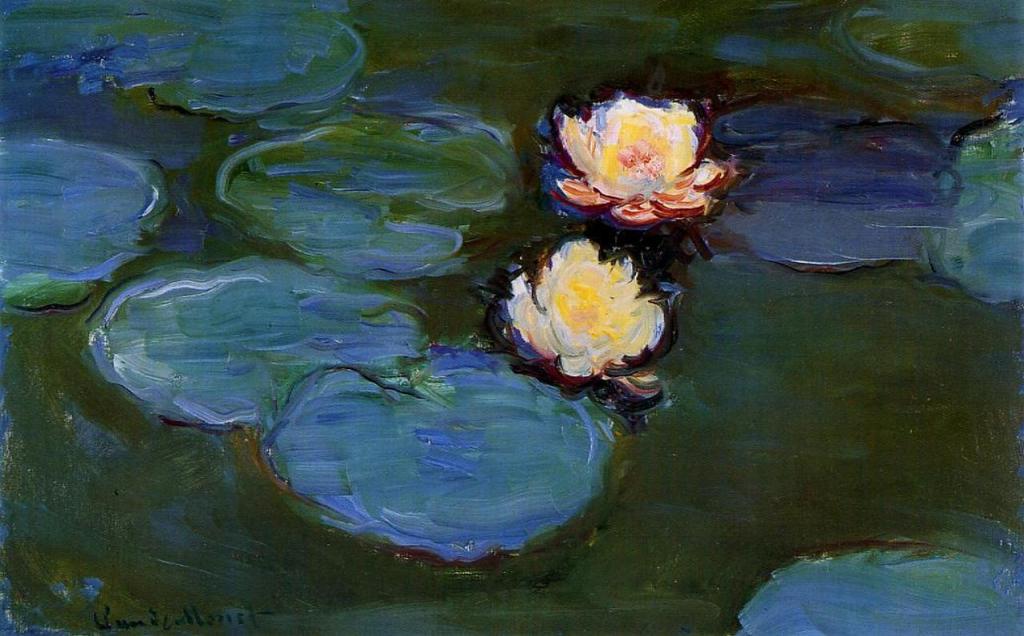
Water lilies by Claude Monet (1840-1926) Courtesy: Creative Commons
When I heard that the annual convention of the Association of Foreign Wives of Japanese would be held in nearby Takamatsu, I signed up. I would be able to meet other women with Japanese husbands and attend workshops in wine-tasting or yoga. At night, there would be a big banquet. During the day, there would time to visit the island Naoshima.
I’d heard about this island, once used primarily as a site to dump industrial waste. Now it was full of art museums, and part of the Setouchi Triennale, an art festival which takes place every three years, including this year. Among the permanent exhibitions is one of Claude Monet’s famous water lily paintings, housed in the Chichu Museum designed by world-renowned architect Tadao Ando.
Monet’s art has long been popular in Japan. The French artist had admired Japan. His garden in Giverny, France was designed in the Japanese garden style. A garden modeled after the one in France has been constructed farther south in Shikoku, but the painting was on Naoshima.
At the convention, I met up with my friend Michelle, an artist who sometimes works in coloured pencils, and sometimes in dust. She wanted to go to the island with all the art museums as much as I did. Michelle, Elana, an Italian woman whose husband is an art history professor, and I decided to visit Naoshima together. There are no bridges connecting Naoshima to Shikoku. The only way to get there is by ferry. We took a taxi to the ferry terminal and bought our tickets.
We decided to sit outside on the deck of the ferry. The wind whipped our hair and reddened our cheeks as we watched the city receding. The smaller islands scattered off the coast grew larger. Finally, we approached the dock at Naoshima. We could see the giant red polka-dotted pumpkin sculpture created by Yayoi Kusama, perhaps Japan’s most famous contemporary artists, known for her Kool-Aid colored wig and obsession with dots. Having been diagnosed with schizophrenia, Kusama has lived in a psychiatric hospital for many years. She continues to make art in her studio at the hospital.
Inside the giant red polka-dotted pumpkin by Yayoi Kusama. Photo Courtesy: Suzanne Kamata
Once off the ferry, we were confronted with a row of mom-and-pop restaurants. A bus runs from the harbour to the museums, but we decided to walk. It wasn’t far to our destination. Later that evening, we would be eating a lavish dinner and drinking wine. We needed the exercise.
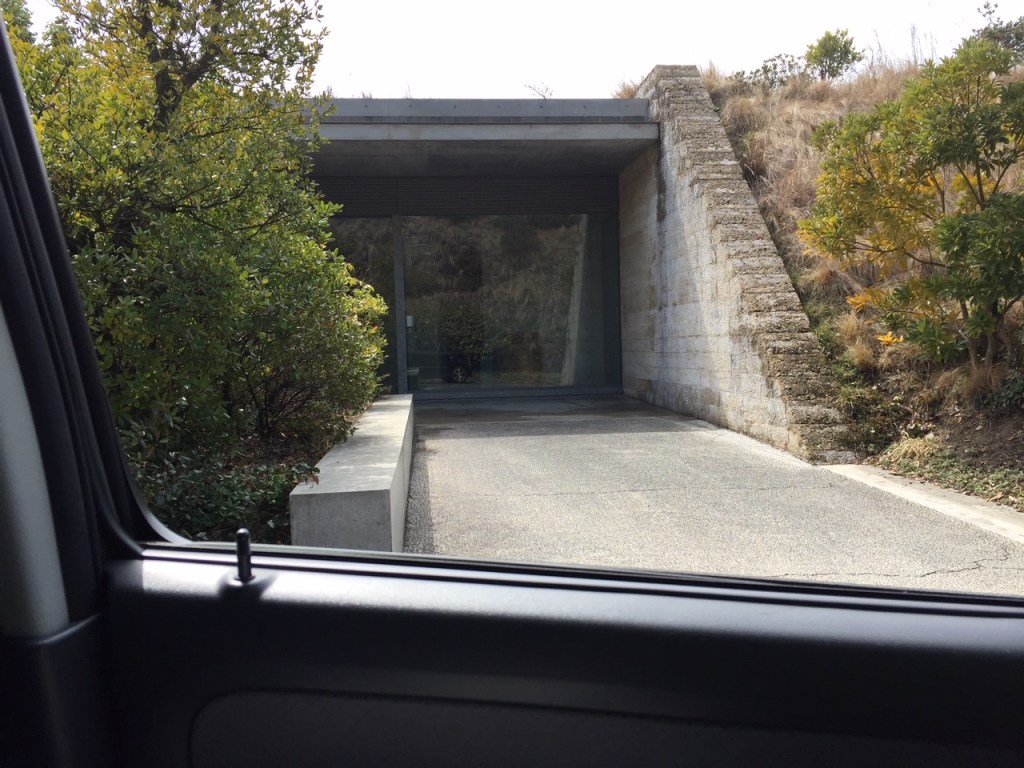
The entrance to the Chichu Museum. Photo Courtesy: Suzanne Kamata
The Chichu Museum was built into the side of a mountain, like a bunker, and lit only by whatever sunlight came in through the windows. The walls were grey concrete and most of the staff wore white lab coats. The brochure advised us to “maintain a quiet environment in the museum.”
As we were mainly there to see the Monet, we made that our first order of business. We descended an elevator to a dark hall and came upon a rack of slippers.
“Please change your shoes,” the docent said.
I removed my sneakers and slid my feet into a pair of vinyl slippers. Michelle and Elana did the same. Now we were ready to enter the hallowed space.
The room was circular, the walls blindingly white, offsetting the deep blues and purples of Monet’s sun-lit pond. We spent several seconds before each panel. The paintings were called “Water Lilies, Cluster of Grass,” “Water Lilies, Reflection of Weeping Willows,” and “Water Lily Pond.”
Michelle, who was a big fan of Monet, sighed happily. It was the off-season. We were the only ones in the gallery besides the docent. There were no other visitors in slippers waiting to shuffle in after us so we were allowed to take our time.
Michelle plopped down on the clean, white floor. Such irreverent behavior in this holy space! She leaned back and admired the paintings from this new perspective. Was she the first person to ever sit down on this floor?
“What the heck,” I thought. I admired her free spirit. I sat down on the floor beside her.
The docent stepped forward. Our unusual actions had clearly made her nervous. We weren’t touching the art or taking pictures. We weren’t doing anything bad. She had no reason to scold us, but she kept her eyes on us.
“Monet would laugh!” Michelle said. “He was messy. He would think it was funny that we had to change into slippers to look at his art.”
I was inclined to agree. I had seen photos of him. He had an unruly beard. His clothes were rumpled. Later, I would watch a video clip of Monet painting in his garden. He had a cigarette in his mouth even as he touched his brush to the canvas. Little dogs ran around at his feet. No smoking would ever again be allowed near his water lily paintings. Not these ones, at least. No dogs, either.
We visited the rest of the museum then had lunch in a café overlooking the sea which served desserts made from Monet’s recipes. In addition to painting food, he had enjoyed cooking it himself. I sampled his madeleines and apricot jam – delicious! — then bought a cookbook from the gift shop so that I could make them at home.
A madeleine made with Monet’s recipe. Photo Courtesy: Suzanne Kamata
Suzanne Kamatawas born and raised in Grand Haven, Michigan. She now lives in Japan with her husband and two children. Her short stories, essays, articles and book reviews have appeared in over 100 publications. Her work has been nominated for the Pushcart Prize five times, and received a Special Mention in 2006. She is also a two-time winner of the All Nippon Airways/Wingspan Fiction Contest, winner of the Paris Book Festival, and winner of a SCBWI Magazine Merit Award.
PLEASE NOTE: ARTICLES CAN ONLY BE REPRODUCED IN OTHER SITES WITH DUE ACKNOWLEDGEMENT TO BORDERLESS JOURNAL
Ananto Prem(Endless Love) by Tagore, translated from Bengali by Professor Fakrul Alam. Click here to read.
Playlets byRabindranath Tagorereveal the lighter side of the poet. They have been translated from Bengali by Somdatta Mandal. Click here to read.
The Faithful Wife, a folktale translated from Balochi by Fazal Baloch. Click hereto read.
Leafless Trees, poetry and translation from Korean by Ihlwha Choi. Click here to read.
Ebar Phirao More(Take me Back) by Tagore, translated from Bengali by Mitali Chakravarty. Click here to read.
Pandies’ Corner
These narratives are written by youngsters from the Nithari village who transcended childhood trauma and deprivation. Will to be Human is based on a real life story by Sachin Sharma, translated from Hindustani by Diksha Lamba. Click here to read.
InStudies in Blue and White, PennyWilkes gives us a feast of bird and ocean photography along with poetry. Clickhere to read and savour the photographs.
G. Venkatesh looks at the ability to find silver linings in dark clouds through the medium of his experiences as a cricketeer and more. Click here to write.
What can be more scary and life-threatening than the risk of getting Covid-19? Keith Lyons finds how his daily joy has menacing dangers. Click hereto read.
Musings of the Copywriter
In When Books have Wings, Devraj Singh Kalsi talks of books that disappear from one book shelf to reappear in someone’s else’s shelf. Click here to read.
Notes from Japan
InOwls in Ginza, Suzanne Kamata takes us to visit an Owl Cafe. Clickhere to read.
Mission Earth
In No Adults Allowed!, Kenny Peavy gives a light hearted rendition in praise boredom and interaction with nature. Click hereto read.
P Ravi Shankar takes us on a trek to the Himalayas in Nepal and a viewing of Annapurna peak with a narrative dipped in history and photographs of his lived experience. Click here to read.
The Observant Immigrant
In A Bouquet of Retorts, Candice Louisa Daquin discusses the impact of changes in linguistic expressions. Click here to read.
Book Excerpts
An excerpt from a fast-paced novel set in Mumbai, Half-Blood by Pronoti Datta. Click here to read.
"I wish you survival,
Health
And the closed sky above you."

— Refugee in my own Country/I am Ukraine, Lesya Bakun
Despite this being the season of multiple new years around Asia, we cannot close our eyes to the skies that connect all the world like a blue dome. Though celebrations and humour continue to lighten the darkness of war, while Ukraine is being wrecked, can we turn our faces towards only festivities?
I had an interesting anecdote about how before the onset of the Gregorian calendar, new years in the world were celebrated around March and in some places in September. The Earth would turn fecund and green with spring, a beautiful season sprinkled with love and nostalgia as Michael R Burch tells us in his poetry. However, despite all the opulence of nature, it is hard to watch a country being bombed and families splintered to man a war that supposedly guards a human construct called ideology and blocs. Ukranian refugee, Lesya Bakun, in an interview says: “It is not a clash of ideologies. It is a fight for our country and nation to exist.” Listening to Lesya’s stories makes one amazed at the bravery of the Ukrainians battling what seems to be cultural hegemony. It reminds of the war in Bangladesh in 1971. Though incredibly courageous in voicing her experiences, Lesya is traumatised and has a psychosomatic cough as she sends her voice and text messages from her mobile through Telegram. There were times when she was just weeping or angry for the questions asked, and justifiably so, as her home in Kharkiv, where she lived was under attack, and the town of Mariupol, where she was born, has been wrecked by the war.
The refrain of the pain of a refugee continues to reverberate in a book reviewed by Rakhi Dalal, Ramy Al-Asheq’s Ever Since I Did Not Die, written originally in Arabic and translated by Isis Nusair. The Syrian-Palestinian poet refused to clarify whether his writing was prose or poetry — perhaps these borders and boxes drawn by humankind are breaking down in reality. Perhaps, this new year, the time is ripe to look forward to a new world that transcends these borders. This is also the first time we have had the privilege of carrying reviews of translations from Arabic and also from Turkish. Gracy Samjetsabam has reviewed a translation of a Turkish novel by Iskendar Pala called The Tulip of Istanbul, translated by Ruth Whitehouse. Bhaskar Parichha has reviewed a book by Kiran Manral, Rising: 30 Women Who Changed India while Candice Louisa Daquin has drawn our focus on a poetry collection by Marjorie Maddox, Begin with a Question, where the perceived divisions do not matter while the poet questions the larger issue of faith in quest of answers.
Is it the same kind of quest that has led Strider Marcus Jones to create the Lothlorien Journal, named reminiscently after Tolkien’s elvish ‘Lothlorien’ in Lord of the Rings? Find out Jones’s views and flow with his fluid poetry in the featured interview. Keith Lyons has been in conversation with Ivy Ngeow, an upcoming writer and the editor of a recent anthology of Asian writing where she has retained different styles of English across the world in a single book. While this could be beneficial to writers, would readers be comfortable reading stories with different styles or dialects of English without a glossary?
Our book excerpts are from more Asian books. The Year of the Rat and Other Poemsedited by Malachi Edwin Vethamani has an interesting title poem which has been shared in the excerpt. The other excerpt is from a fast-paced novel, Half-Blood, by Pronoti Datta. We also have a fast-paced story by a writer from France called Paul Mirabile set in Portugal; two that verge on the bizarre from Keiran Martin and Amjad Ali Malik; a poignant story from Sutputra Radheye and another that shows the positive side of voicing a protest against wrongs by Devraj Singh Kalsi. Kalsi has also given us a tongue in cheek musing called When Books have Wings.
On the lighter vein are travel essays by Ravi Shankar and Meredith Stephens. They take us to the Himalayas in Nepal and to Tasmania! Suzanne Kamata has taken us to an owl cafe in Japan! At the end of her column, one feels sad for the owls as opposed to Erwin Coombs’ narrative that evokes laughter with his much-loved pet cat’s antics.
Humour is evoked by G. Venkatesh who with an ability to find silver linings in dark clouds talks of cricket and lessons learnt from missing his school bus. Adnan Zaidi has also analysed his poetic abilities with tongue-in-cheek comments. Kenny Peavy gives a lighthearted rendition in praise of boredom and interactions with nature. It is good to have laughter to combat the darkness of the current times, to give us energy to transcend our grief. Keith Lyons hovers on the track between humour and non-humour with his cycling adventures. Rhys Hughes seems to talk of both his favourite poem and the war in a lighter shades, in no way insensitive but his observations make us wonder at the sanity of war. We have much of war poetry by a number of writers, poetry on varied issues by Luis Cuauhtémoc Berriozabal, George Freek, Sybil Pretious, Kisholoy Roy, J.D. Koikoibo and many more.
Candice Louisa Daquin has taken on the onus of bringing to our notice how language can impact us in the long run while Ratnottama Sengupta has explored beggary in films, fiction and fact. The Nithari column runs a real-life story of a young boy narrated by his brother, Sachin Sharma. It has been translated from Hindustani by Diksha Lamba. The trauma faced in 2006 is strangely not discussed in the story though it hovers in the backdrop between the lines. We also have a translation of a Balochi folk story by Fazal Baloch and a Korean poem by Ihlwha Choi. Translations from Tagore by Fakrul Alam and Somdatta Mandal have honoured our pages again. Mandal has sent us fun-filled skits by Tagore. But are they just fun or is there something more? We also have a translation of a long poem that explores a different aspect of Tagore, his empathy for the downtrodden which led him to create Sriniketan and regard it as his ‘life work’.
We have a bumper issue this time again — especially for the Asian new years; Thai, Nepalese, Bangladeshi, multiple Indian and more…
We would like to thank Sohana Manzoor for our cover painting and Gita Viswanath for her artwork. I would like to thank our wonderful team who with their contributions make this journal a reality. All the contributors deserve a huge thanks as do our loyal readers.
I wish you all a wonderful start to a non-Gregorian new year and hope that peace prevails over parts torn by wars and dissensions.
The last time I had found myself in Tokyo with some free time and the freedom to move about, I had tried to drop in at an owl café. However, after making my way to such an establishment on the heels of a couple of Chinese tourists, I discovered that a reservation was necessary. The place was booked weeks in advance.
A few weeks ago, I again had some business in Tokyo, so I contacted an old friend and suggested we do a bit of sightseeing together.
“What do you want to do?” she asked me.
I replied that I wanted to visit an owl café. She messaged back that she didn’t like birds.
We had lunch in a sushi restaurant that normally had a queue as early as seven a.m. Due to the coronavirus, we waltzed right in and had a leisurely lunch. After that, we went to a museum that normally required reservations, or at least a long wait. And since there had been so little time wasted standing in line, my friend agreed to take me to an owl café. She found one by using her phone and called the place up. Sure, we could visit, the owner said. No reservations were needed.
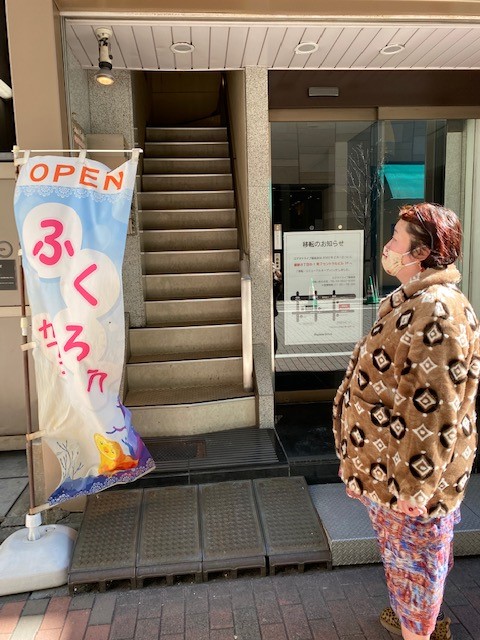
The Mofu Mofu Owl Café Ginza was down a side street in Tokyo’s tony shopping district, steps away from the likes of Louis Vuitton and Chanel. As we climbed the three flights of narrow stairs, I wondered what it would be like inside. It would be dark, I imagined, because owls are nocturnal. But no, when we pushed open the door, we were met with light.
Staircase leading to the owl caféResident owls who live tethered inside a room
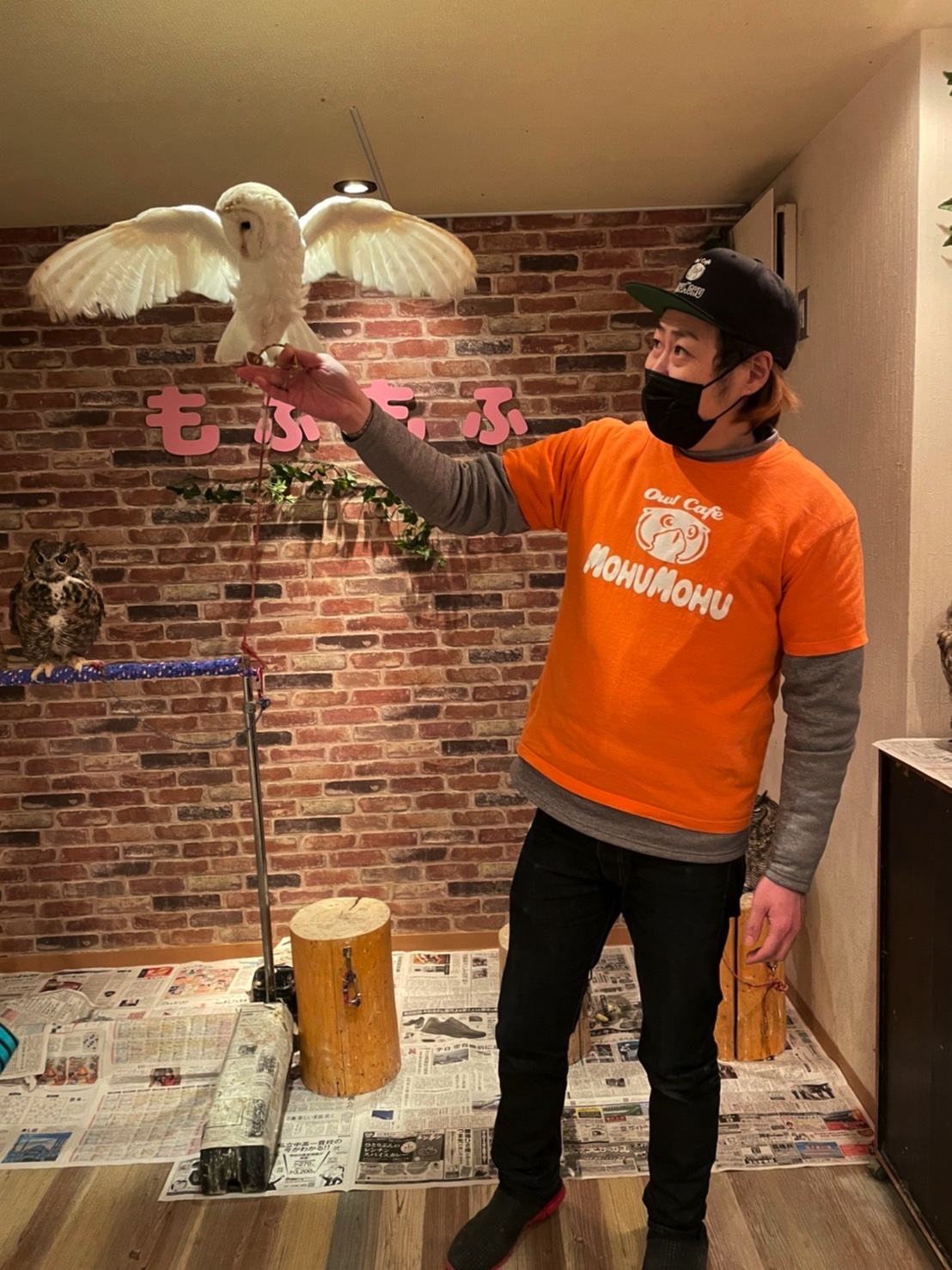
It’s a bit of a misnomer to call the place, and others like it, a café. Coffee is not served, nor is there cake or any other kind of food. There were no tables, no young women with aprons or maid costumes, just a guy wearing a T-shirt in a roomful of owls tethered to perches.
The owner seemed happy to see us. We were the only customers. He instructed us to disinfect our hands, and then showed us how to touch the owls – a gentle rub on the top of their heads, much in the way that my cat liked to be caressed. The owls were big and fluffy, like cats, and I wanted to hug them, but I figured they would probably try to bite me if I did.
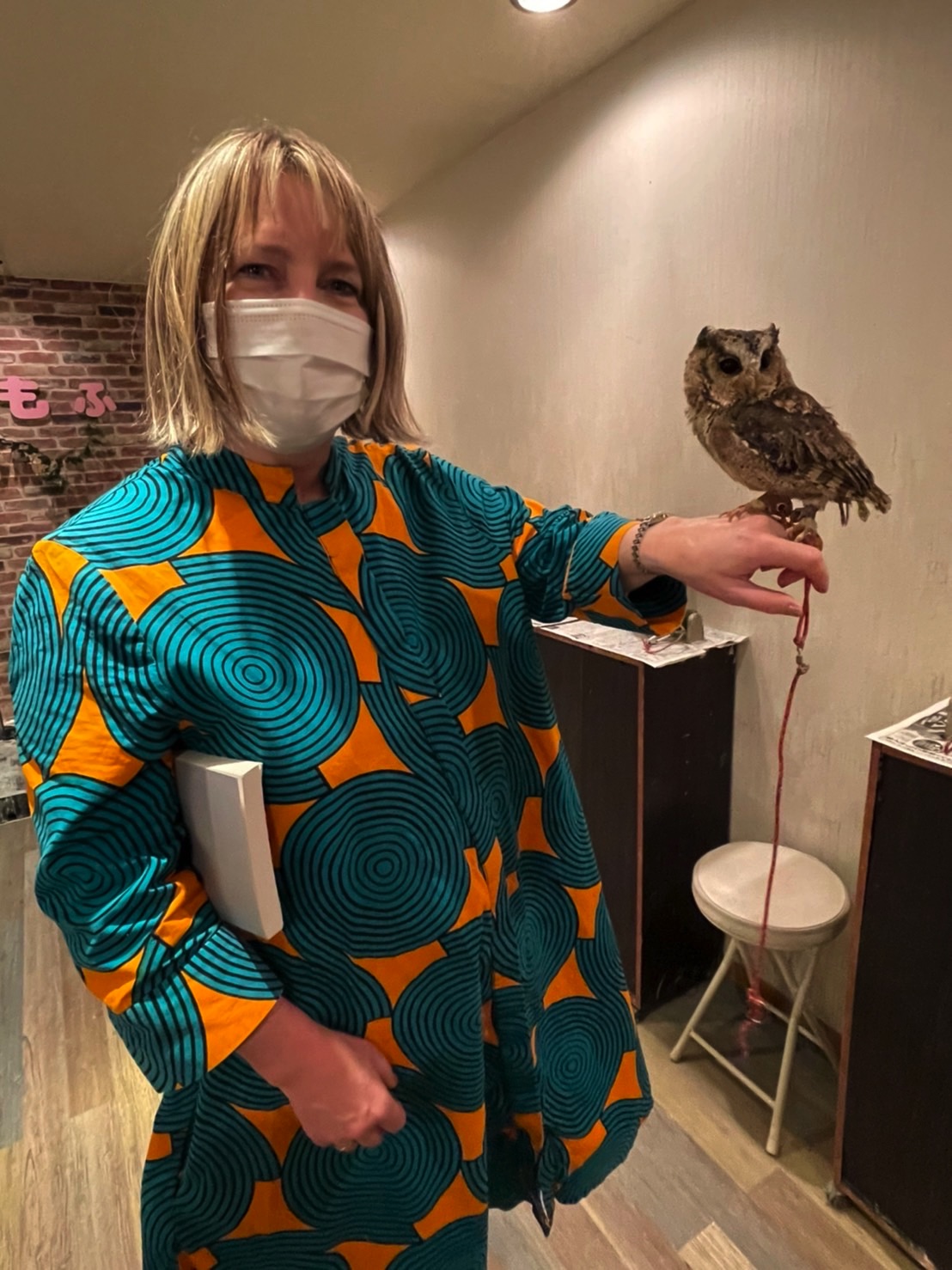
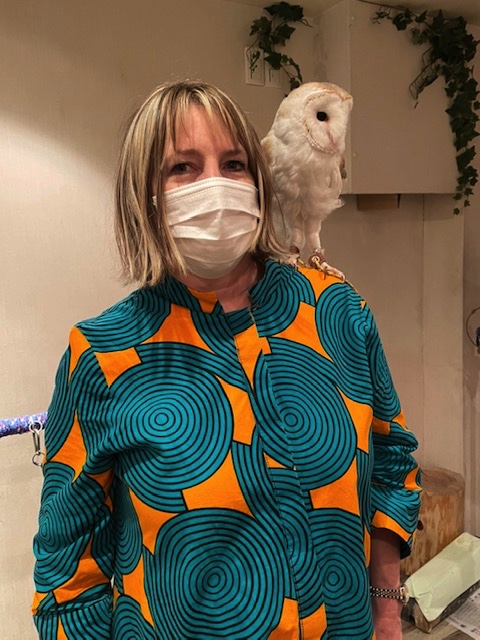
Holding a tethered OwlSuzanne Kamata with an owl
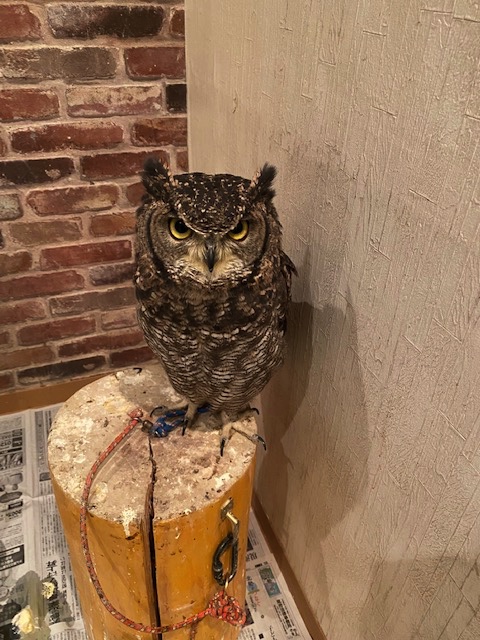
My friend, the bird-hater, hung back while I went around looking at each owl. They were of various species from around the world. I wondered if they were bored, sitting on their perches all day, with nothing to do. Maybe our being there was their entertainment.
“They wouldn’t survive in the wild,” the owner said. “They have been raised from eggs by humans.”
He told us that they might live for thirty years in captivity, but only half that in nature. What was worse, I wondered? Thirty years of boredom, or fifteen years of being stressed out about their next meal, and where they would build a nest? Was keeping owls in this room any worse that keeping a parakeet in a cage? Or not allowing my restless cats to go outside, even when they meowed pleadingly at the door? (Actually, I sometimes did allow them to go out, knowing full well that they might be dodging cars, picking up fleas, and murdering songbirds and mice.)
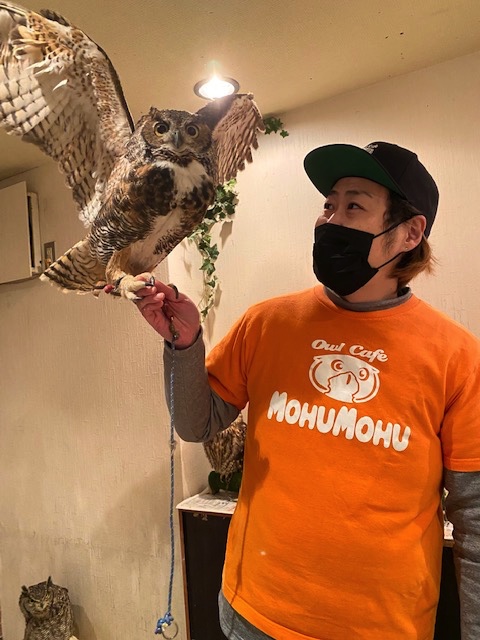
Spreading out its wings A white owl and the author
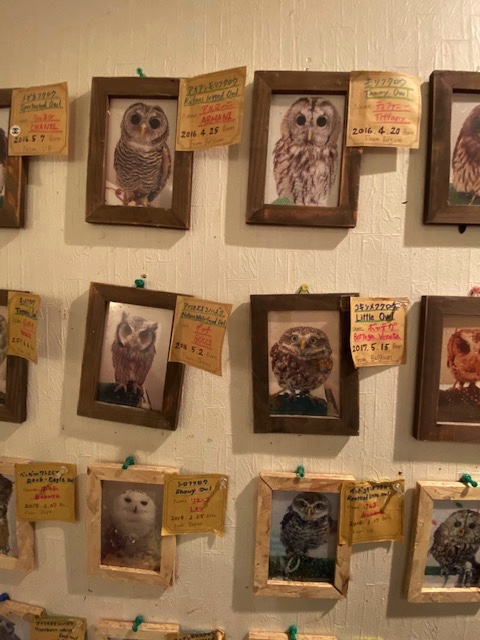
The owner explained that before the pandemic, he’d operated two cafes – this one, and another in Roppongi — but due to the travel restrictions which prevented tourists from overseas from visiting, he’d had to close that one. All the owls were now gathered here. They’d been given names of nearby shops. Gucci was a Japanese Northern White-faced Owl, while the Little Owl from Belgium was named Bottega Veneta. There was also a Tawny Owl, born in 2016, named Tiffany.
“Before the pandemic, a lot of foreigners came here,” the owner said. Some famous people, too. He showed us a photo of the singer Akiko Yano, ex-wife of internationally renowned musician Ryuichi Sakamoto, with one of the owls. Yano lives in New York City and had heard about the café while abroad. I looked around at the empty space. Apparently, Tokyoites didn’t have an urge to commune with owls. I worried about what would happen to them if the tourists weren’t welcomed back to Japan soon.
The owner let me pick out an owl and settled it on my hand. My friend finally got up the courage to stroke one of the owls between its eyes. The phone rang, and the owner went to answer it. I heard him booking another customer, and I felt a bit relieved. Apparently, this one would come at mealtime and watch the owls consume dead mice. That was probably an exciting part of the owls’ day.
Part of me thought that the birds might be happier in an atrium somewhere. But while they were here, I hoped they would be well looked after. I wanted to contribute as best as I could, so I loaded up on souvenirs – a pen encasing an owl feather, made by the owner’s wife; a handful of chopsticks with owl motifs; and a bottle of Hitachino Nest beer, which had an owl on the label. And I promised to post some photos on Instagram so that more tourists would come.
An owl in chains
Suzanne Kamatawas born and raised in Grand Haven, Michigan. She now lives in Japan with her husband and two children. Her short stories, essays, articles and book reviews have appeared in over 100 publications. Her work has been nominated for the Pushcart Prize five times, and received a Special Mention in 2006. She is also a two-time winner of the All Nippon Airways/Wingspan Fiction Contest, winner of the Paris Book Festival, and winner of a SCBWI Magazine Merit Award.
Thanks to the columnist Suzanne Kamata for the photographs.
PLEASE NOTE: ARTICLES CAN ONLY BE REPRODUCED IN OTHER SITES WITH DUE ACKNOWLEDGEMENT TO BORDERLESS JOURNAL
And as imagination bodies forth
The forms of things unknown, the poet's pen
Turns them to shapes and gives to airy nothing
A local habitation and a name.

-- Midsummer Night's Dream (premiered 1605)by William Shakespeare
Imagine… if words could weave a world in harmony! Perhaps… then as Shakespeare declared and more recently John Lennon wrote in his song ‘Imagine’ (1971), we might have constructed a new world…
In hope of the same perhaps, Nazrul had published his poem, ‘Bidrohi‘ or the rebel a hundred years ago, a few months before TS Eliot published Wasteland, again a poem raising humane concerns and reinforcing values post the First World War. More recently Akbar Barakzai who has passed on at the start of this month, wrote about a better world in his poem, ‘We are all Human‘. And yet we have a war …
In response to the war, we have modern voices that ring out in harmony, including the voice of a Ukranian refugee. In reaffirmation of a world that can transcend divisions created by human constructs and soar in a virtual world, we also present to you interviews of half-a-dozen poets.
From the Treasury
Rebel or ‘Bidrohi’: Nazrul’s signature poem from 1922, ‘Bidrohi‘, translated by Professor Fakrul Alam. Click here to read.
A Special Tribute
We are All Humanby Akbar Barkzai, translated by Fazal Baloch, has been published as not only a tribute to the poet who left us forever on 7/3/2022, but also as his paean to humanity to rise about differences which lead to war and horror, to unite us as one humankind. Clickhere to read.
War, Peace and Poetry
Poetry from across the world in support of peace and voicing concerns over the humanitarian crisis in Ukraine, we have Ukranian Lesya Bakun give us poetry as a war victim, a refugee. Rhys Hughes, Ron Pickett, Michael R Burch, Kirpal Singh, Malachi Edwin Vethamani, Suzanne Kamata, Mini Babu, Sybil Pretious and Mitali Chakravarty have contributed poetry written for the Ukraine crisis. Click here to read.
Poets across Borders
Half-a-dozen poets from different continents tell us about their poetry. The poets include Ryan Quinn Flanagan, George Freek, Luis Cuauhtémoc Berriozabal, Ihlwha Choi, Sutputra Radheye, Anusuya Bhar. Click here to read.
Featuring poetry by Lesya Bakun, Rhys Hughes, Ron Pickett, Michael R Burch, Kirpal Singh, Suzanne Kamata, Mini Babu, Malachi Edwin Vethamani, Sybil Pretious and Mitali Chakravarty
These fragments I have shored against my ruins
…
Datta. Dayadhvam. Damyata.
 Shantih shantih shantih

-- Wasteland (1922) by TS Eliot
These lines from a hundred year old poem by TS Eliot continue to cry out to be part of our civilisation’s ethos as do the lyrics of Bob Dylan’s pacifist song, ‘Blowin’ in the Wind‘ which wonders : “Yes, and how many times must the cannonballs fly/Before they’re forever banned?” The world continues to war destroying nature, lives and a common human’s need to exist in peace and go about his daily tasks, secure that the family will meet in their home for dinner and a good night’s rest. Cries of humanity in crisis from the battle grounds of Ukraine take precedence as Ukrainian Lesya Bakun writes about the plight of the people within the country stalked by violence and death.
REFUGEE IN MY OWN COUNTRY/ I AM UKRAINEBy Lesya Bakun (07.03.2022, Ukraine)
I am Kharkiv.
I am Volnovakha.
I am Kyiv.
I am the blocked Mariupol on the verge of humanitarian catastrophe.
I am the completely destroyed
City of Shchastia --
That is literally translated as "happiness" --
Where people have to sit in the bomb shelters,
Because nothing else is preserved.
The Russian troops are not letting them out.
I am Ukraine.
I am a fighter.
I am a refugee
In my own country.
What's in the minds of Russians?
Nine years ago, I was in Strasbourg, France.
Seven years ago, I was in Dublin, Ireland.
Two years ago, I was in Istanbul, Turkey.
Today, I am
In an internally displaced people’s centre --
In a city that I cannot even publicly disclose
For the security of too many families
Who are fleeing to remain safe.
"The Ukrainian IT company N has left the markets of Russia and Belarus forever".
We should have done it eight years ago.
We should have done it thirty-one years ago.
A lot of my friends are switching from Russian to Ukrainian.
We should have done that thirty-one years ago
So that no one comes to "protect us".
I am the gasoline
that NATO sent us
Instead of closing the sky --
Apparently so that we can burn
The Budapest Memorandum
We have seen the real face of Russians
Again
They negotiated green corridors
And started shelling from the heavy weaponry.
Evacuation is cancelled.
"I wish you survival,
Health
And the closed sky above you."
As the battle rages and razes, some react to what we have gleaned from media reports, some of which move hearts with stories of bravery and the spirit of the people battling the invaders who kill and destroy what they cannot possess… But can freedom of thought and resilience ever be destroyed?
THEY SHALL NOT PASSBy Rhys Hughes
They shall not pass
we cried as we held the pass
against the enemy.
And our sleepy student
days in sunlight
suddenly seemed long gone
and very far away
though it was only
a few weeks since war began.
Would such times
ever return? We had no idea.
Now the conflict is over
and the years pass
with increasing velocity
and right here
in the rebuilt city I am young
no longer. I am
the teacher: it is my turn.
And as I watch my students
dozing in sunlight
instead of revising for exams
an old refrain fills
my head: They shall not pass.
ADVANTAGE INTRUDERBy Ron Pickett
The sun edges over the cluttered horizon.
The cell towers, eucalyptus and large water tank are comforting.
The sun slowly fills the dark.
Life is safe and warm and good – for now.
The sun slides below the western horizon in Kyiv and darkness returns.
The dark brings its special unseen terrors.
The rumble and rattle of distant rockets and bombs.
The roar of jets and the throb of helicopters.
Flashes of light fill the night sky but there are no storms in the distance.
The earth trembles: the people quiver.
Daylight is ten long hours away, we who have been there remember, and shudder.
There are patches of dirty snow on the ground.
On trees and shrubs and the Peoples Friendship Arch.
And under the rubble of bombed buildings.
The snow is marked by the black stains of explosions and the red stains.
The snow will melt with the coming of spring, but the stains will remain.
The stains are physical and psychological and deep.
Dark is the province of the predator.
Dark is a comforting cover for the aggressor.
Dark is the source of fear and anguish for the weak.
This predator is man who can see in the dark.
To see at night is a huge advantage.
Advantage intruder.
FRAIL ENVELOPE OF FLESHBy Michael R Burch
for the mothers and children of Ukraine
Frail envelope of flesh,
lying cold on the surgeon’s table
with anguished eyes
like your mother’s eyes
and a heartbeat weak, unstable ...
Frail crucible of dust,
brief flower come to this—
your tiny hand
in your mother’s hand
for a last bewildered kiss ...
Brief mayfly of a child,
to live two artless years!
Now your mother’s lips
seal up your lips
from the Deluge of her tears ...
FOR A UKRANIAN CHILD WITH BUTTERFLIESBy Michael R Burch
Where does the butterfly go ...
when lightning rails ...
when thunder howls ...
when hailstones scream ...
when winter scowls ...
when nights compound dark frosts with snow ...
where does the butterfly go?
Where does the rose hide its bloom
when night descends oblique and chill,
beyond the capacity of moonlight to fill?
When the only relief’s a banked fire’s glow,
where does the butterfly go?
And where shall the spirit flee
when life is harsh, too harsh to face,
and hope is lost without a trace?
Oh, when the light of life runs low,
where does the butterfly go?
THE TIMES, THE MORALSBy Kirpal Singh
(After Ee Tiang Hong)
Testy times
Tempers flake, bruise
Blood swells veins
As memories burn.
Times were
When reason prevailed
And men talked --
Eyes glittering.
Now it’s tit for tat
No relenting
Frayed nerves
Know no restraint.
We pray n plead
For sanity’s return
As pall bearers
Carry another dead.
When will all this horror, violence and sorrow end? Will there be peace anytime soon… many voices across the globe join in quest of harmony.
Mt Fuji: Photo Courtesy: Suzanne Kamata
A VIEW OF MT. FUJI (March 3, 2022)
By Suzanne Kamata

On the third day
of the third month
of the fourth year of
Beautiful Harmony (Reiwa)
which followed the era of
Heiwa (Peaceful Harmony)
my husband, son, and I traveled to Gotemba.
We checked into our mostly vacant hotel
wandered the grounds amongst
oaks and bamboo and volcanic rocks
gazed upon the majestic mountain
symbol of Japan.
Mt. Fuji stood
calm and dormant and frilled by cloud
spotlit by late afternoon sun.

As we stared in wonder and awe
   BOOM!
an explosion resounded.
A black helicopter
like the ones over Kyiv
flew into view.
I recalled the military vehicles
we’d passed on the highway
those young men driving to
practice for self-defence.

When will there be peace in Ukraine?
When will there be peace in the world?

RUSSIA AND UKRAINE
By Mini Babu

After the war,
the repose of the dead,
settles over the nations.
The leaders will smile,
shake hands and
interchange the bodies
of the dead, maimed,
captives and,
each will dust
that which belongs to
the other, wash
their hands and
walk away.

Children hold on
expecting their fathers,
unknowing that
fathers never come back
after war.

And I, the ordinary,
instruct my children
how historic these names
are for examination.
Putin and Zelensky.

PEACE TALKS IN THE FOREST
By Sybil Pretious

I breathe
I sit on the hard cushion of root, foundation of growth
Peace talks to me  in the forest
Leaning against the rough trunk  bark,  feeling of strength
Peace talks to me in the forest
Above the leaves, cover me with a protective shade
Peace talks to me in the forest
Flowers flutter giving a splash of colour
Peace talks to me in the forest
Seeds heralding new life hang, dispersed on the wind
Peace talks to me in the forest
And I wonder
Why do warring nations not meet in forests
For peace talks
 where peace talks.


PRICE OF PEACE
By Malachi Edwin Vethamani

(I)

Peace is
a gentle brook,
natural and real.

Peace is
not things to come,
not imagined.

We arrive as beings of peace.
One with all around us,
same flesh, same blood.

Then labels are thrust upon us.
baptised into communities,
branded as nations.

Essentialist labels
bind us and blind us.
We shed our individual beings,
stitched into communities.

If you are not with us
You are against us, they say.
Taking a stand
comes with a price.

The price is often peace.


(II)

This is yet another call to stop a war.
A new plea for peace.
A shout out for prayers.

The callers change
with each new
war cry.

This too will pass.
How much will remain?
How much decimated?

Then these cries will be repeated.
What is lost?
Is anything ever gained?

We will smell
the stink of death
and see the rubble of destruction.

All the display of human unkindness
we inflict on our fellow beings.


(III)

What new enterprise,
what profiteering,
has brought on this new war?
Surely, no noble cause
can condone this waste of lives.

Whose monuments will we pull down now?
What new statues will we raise for self-proclaimed heroes?

What of the spouses who lost their partners?
What of the parents who lost their children?
Children and citizenry
casualties all.
Crushed and broken.


WASTELAND REVISITED AFTER A CENTURY
By Mitali Chakravarty

The river flowed with debris, with bodies
of the dead. When the waters reddened
with corpses crossing borders on a train,
nightmares haunted myriads of lives.

The undead cried till infecting more, the
anger, the hatred spread. That was more than
seven decades ago. History repeats itself.
Will it ever stop? This hatred? This war?

Does killing, destroying ever help? Does
it dissolve the buried hate, the anger, the
deaths? Swigging blood like vodka, the madmen
brew war with oil, weapons, the threat of nukes
to annihilate all lives — make barren the Earth.

Cosmic clouds gather to thunder,
‘Da, datta, dayadham, damyata’ till peace
comes with love songs that echo through the
Universe. A Brahmic vision of kalpas like waves
ebb and flow, calming the cries of tortured souls.

Oh God! Help us learn Mercy. When will the
white horse ride to our rescue? Or was that all
a myth? Kalki? Does the white horse ride out of each
soul to form a lightening that dispels mushroom clouds?

Peace be unto you.
Om Shantih, Shantih, Shantih!
PLEASE NOTE: ARTICLES CAN ONLY BE REPRODUCED IN OTHER SITES WITH DUE ACKNOWLEDGEMENT TO BORDERLESS JOURNAL







 Borderless