Perhaps, most sceptics will say it is against human nature to stop fighting and fanning differences. The first recorded war was fought more than 13,000 years ago in what is now a desert but was green long ago. Nature changed its face. Continents altered over time. And now again, we are faced with strange shifts in climate that could redefine not just the dimensions of the surface area available to humankind but also our very physical existence. Can we absorb these changes as a species when we cannot change our nature to self-destruct for concepts that with a little redefining could move towards a world without wars leading to famines, starvation, destruction of beautiful edifices of nature and those built by humankind? That we could feed all of humans — a theory that won economist Abhijit Banerjee his Nobel Prize in 2019 so coveted by all humanity — almost seems to have taken a backseat. This confuses — as lemmings self-destruct…do humans too? I would have thought that all humanity would have moved towards resolving hunger and facing the climate crises post-2019 and post-pandemic, instead of killing each other for retaining constructs created by powerbrokers.
In the timeless lyrics of ‘Imagine’, John Lennon found peace by suggesting we do away with manmade constructs which breed war, anger and divisions and share the world as one. Wilfred Owen and many writers involved in the World Wars wrote to showcase the desolation and the heartfelt darkness that is brought on by such acts. Nazrul also created a story based on his experience in the First World War, ‘Hena’, translated for us by Sohana Manzoor. Showcasing the downside of another kind of conflict, a struggle to survive, is a story with a distinctive and yet light touch from S Ramakrishnan translated from Tamil by B Chandramouli. And yet in a conflict-ridden world, humans still yearn to survive, as is evident from Tagore’s poem Pran or ‘Life’. Reflecting it is the conditioning that we go through from our birth that makes us act as we do are translations by Professor Fakrul Alam of Masud Khan’s poetry and from Korean by Ihlwha Choi.
A figure who questioned his own conditioning and founded a new path towards survival; propounded living by need, and not greed; renounced violence and founded a creed that has survived more than 2500 years, is the man who rose to be the Buddha. Born as Prince Siddhartha, he redefined the norms with messages of love and peace. Reiterating the story of this legendary human is debutante author, Advait Kottary with his compelling Siddhartha:The Boy Who Became the Buddha, a book that has been featured in our excerpts too. In an interview, Kottary tells us more of what went into the making of the book which perhaps is the best survivor’s guide for humanity — not that we need to all become Buddhas but more that we need to relook at our own beliefs, choices and ways of life.
Another thinker-cum-film maker interviewed in this edition is Vinta Nanda for her film Shout, which highlights and seeks resolutions for another kind of crisis faced by one half of the world population today. She has been interviewed and her documentary reviewed by Shantanu Ray Chaudhuri. Chaudhuri has also given us an essay on a bookshop called Kunzum which continues to expand and go against the belief we have of shrinking hardcopy markets.
Gastronomical adventures seem to be another concurrent theme in this edition. Rhys Hughes has written of the Indian sweets with gulab jamun as the ultimate life saver from Yetis while trekking in the Himalayas! A musing on lemon pickle by Raka Banerjee and Ravi Shankar’s quest for the ultimate dosaaround the world — from India, to Malaysia, to Aruba, Nepal and more… tickle our palate and make us wonder at the role of food in our lives as does the story about biryani battles by Anagaha Narasimha.
Talk of war, perhaps, conjures up gastronomic dreams as often scarcity of food and resources, even potable water and electricity is a reality of war or conflict. Michael Burch brings to us poignant poetry about war as Ramesh Karthik Nayak has a poem on a weapon used in wars. Ryan Quinn Flanagan has brought another kind of ongoing conflict to our focus with his poetry centring on the National Day (May 5th) in Canada for Vigils for Missing and Murdered Indigenous Women by hanging red clothes from trees, an issue that perhaps has echoes of Vinta Nanda’s Shout and Suzanne Kamata’s poetry for her friend who went missing decades ago as opposed to Rachel Jayen’s defiant poetry where she asserts her womanhood. Ron Pickett, George Freek and Sayantan Sur have given us introspective perspectives in verse. We have more poetry asking for a relook at societal norms with tongue-in -cheek humour by Jason Ryberg and of course, Rhys Hughes with his heartfelt poem on raiders in deserts.
The piece that really brought a smile to the lips this time was Farouk Gulsara’s ‘Humbled by a Pig’, a humorous recount of man’s struggles with nature after he has disrupted it. Keith Lyons has taken a look at the concept of bucket lists, another strange construct, in a light vein. Devraj Singh Kalsi has given a poignant and empathetic piece about trees with a self-reflective and ironic twist. We have narratives from around the world with Suzanne Kamata taking us to Osaka Comic Convention, Meredith Stephens to Sierra Nevada and Shivani Shrivastav to Ladakh. Paul Mirabile has travelled to the subterranean world with his fiction, in the footsteps perhaps of Jules Verne but not quite.
We are grateful to all our wonderful contributors some of whom have not been mentioned here but their works were selected because they truly enriched our June edition. Do visit our contents page to meet and greet all our wonderful authors. I would like to thank the team at Borderless without whose efforts and encouragement our journal would not exist and Sohana Manzoor especially for her fantastic artwork as well. Thank you all.
Wish you another lovely month of interesting reads!
When my twenty-three-year-old daughter Lilia, who is deaf, sent me a text saying that she wanted to attend the Osaka Comic Convention, I messaged back “Go ahead!” I figured she would want to go with her friends, fellow manga and anime and Marvel movie enthusiasts. I am more of a literary-novel-type person, unfamiliar with the DC universe. My idea of a good time is reading a book of poetry with a cat on my lap. However, a week or so later, she repeated her desire, along with a GIF of a crying cat, fountains of tears gushing from its eyes. This was followed by three attempted video phone calls while I was at work.
“Do you want me to go with you?” I texted.
“Yes,” she replied.
Well, I could do this for her. On our mother-daughter trip to Paris several years back, she had put up with my dragging her (okay, pushing; she is a wheelchair user) to the Orsay Museum, even though she would have rather gone to the Concierge to look at a lock of Marie Antoinette’s hair. She had made concessions for me, so I could make some for her. Besides, I had never been to a comic convention before. It might be fun. At the very least, I could write about it.
I put her in charge of buying the tickets from the Japanese website. She sent me a screen shot: 25,000 per ticket. What? “That’s really expensive,” I texted her. “I’ll pay for it,” she texted back.
I later found out that admission was only 3,610 yen. The extravagant fees were for a photo opportunity with one of the celebrities who would be headlining the event. One of them played the role of Lilia’s favourite character in her favourite TV series. She had watched all ten episodes of all thirteen seasons, and regularly posted related fan art on her Instagram feed. She had purchased the chance to be in close proximity to the actor.
Sure, it was expensive, but research has shown that experiences are often ultimately more satisfying than things. I know that to be true myself. In Paris, we had a never-to-be-forgotten dinner at the top of the Eiffel Tower. When we went to Hawaii, on our last trip together pre-pandemic, we had gone on an open-door helicopter ride. For Lilia, having her photo taken with the celebrity would probably be just as thrilling. She had also bought a ticket for me.
I didn’t know much about the celebrity. In fact, I knew nothing. I had glimpsed him onscreen, occasionally, when Lilia was bingeing episodes of the show on our widescreen TV. I looked him up on Wikipedia. He had an impressive background. He’d started out in politics, had probably met President Obama, and then transitioned into entertainment. He had kids, whom he was concerned about feeding well. His wife was a university professor, like me, and he’d published a book of poetry, which I immediately ordered.
I started thinking about how I could make the most of this opportunity. As the author of several novels published by small presses, I was always looking for ways to promote my books. I knew that a celebrity endorsement – or even having a famous person be photographed while holding one’s novel – could bring attention to a book. Maybe I could get the celebrity to hold my book during the photo-op, and then I could post it on Instagram.
But then I went to the website for the Comic Con. I came across a notice that one of the celebrities who had been scheduled to appear in Tokyo in 2022, would not be coming after all. The message read, “Due to a last-minute personal issue,” the celebrity “is unable to travel and had to postpone his appearance at this year’s Tokyo Comic Con. He was looking forward to coming back to Japan and seeing everyone. He is deeply sorry and looks forward to coming back to Japan next year.” But the actor was not attending this year either. He had been run over by a snow plow a few months before and was still in recovery. (This was not mentioned on the website.)
Elsewhere on the website, I came across a list of exhibitors, food vendors, celebrity guests (seven men, one woman), and rules regarding the autograph and photo sessions. So many rules! We would not be allowed to hug the celebrities or touch them at all. We would not be allowed to take selfies or other photos with our own smartphones, or bring props (like a book?), or wear masks, or give gifts to the celebrities. Okay, so maybe I wouldn’t be able to ask the TV star to hold my book.
Since the Comic Convention started relatively early, Lilia and I stayed overnight at a nice hotel in Osaka. The next morning, I put on make-up and a pretty dress. I helped Lilia with her hair. We went down to the dining room for a gorgeous buffet breakfast – made-to-order omelettes, tiny French pastries, a big bowl of fresh lychee fruits, and other delights. Although I had splurged on accommodations, I thought that we would take public transportation to the convention site to save money. But that morning, on the third day of the event, the day of our scheduled photo op, rain poured down. We had forgotten to bring waterproof ponchos and umbrellas. I decided we’d go by taxi.
We hopped into a cab at the hotel. The driver was surprised when I mentioned the destination. “We’ll have to go by highway,” he said. That would mean toll fees. But at least we would get there on time, and we would be relatively dry.
The venue, Intex Osaka, was over a bridge on a small island with lots of boxy warehouses. At first, I was amazed by the lack of cars. And people. Were we even in the right place? I didn’t have enough cash on me for a taxi ride back to Osaka Station, and this driver didn’t appear to take credit cards. At last, we reached the huge convention center.
“This is it!” the driver said. Still, no people. He continued to drive around the building, rain spattering his windshield, until, to my relief, we came across some men in uniform waving orange batons, and then to the front, where a long stream of young people holding umbrellas flowed toward the entrance.
Once inside, Lilia flashed our tickets. After a cursory bag check, red paper Comic Con bracelets were fastened to our wrists. I grabbed a map, and tried to get my bearings, but Lilia whipped out her tablet, wrote something on it in Japanese, and showed it to one of the many attendants, a young man wearing a white surgical mask. She’d asked, “Where do we go for the celebrity photos?”
“I’ll show you,” the attendant said. “Follow me.” We scurried past cosplayers dressed up like Spiderman and the Joker and one woman dressed in green carrying a huge candy cane. Some people, not in costume were slurping noodles at a table near a food booth.
Cosplayers. Courtesy: Suzanne Kamata
The attendant indicated an area at the back of the building. We still had a couple of hours before our photo session. “So, we just come here at one fifteen?” I asked. We had an appointment, after all.
“You should get here early,” he said. “At least an hour before.”
I nodded. “Now, where is the Celebrity Stage?”
According to the program, another actor, famous to this crowd, at least, for his role in a movie based on an American comic book, would be participating in a Q and A session onstage in another twenty minutes. I figured we had plenty of time to find a good spot, but when we entered the enormous hall, I saw that all of the seats were filled. We were late.
“This way,” another attendant said, lifting the chain to the wheelchair-accessible area, just to the left of the stage.
We had a good view, but I couldn’t help thinking that at such an event in my native country, the United States, there would probably be a sign language interpreter. In Japan, there was almost never one, unless it was requested in advance. I did my best to interpret for my daughter.
In the program, the celebrity was pictured as bald and sleek. With his dark glasses, he appeared to be the epitome of cool. The man who ambled onto the stage, however, looked a bit scruffy, as off-duty actors often do. He had a beard, glasses, and a leather newsboy cap over his frizzy grey hair. One of his teeth was missing. He greeted the crowd in Japanese and was met with applause.
The emcee tried to engage him in conversation, but he was hard to pin down. He wandered around the stage, joking around. When asked a fan’s earnest question, “What special thing did you have to do to prepare for your role in the film?” he replied, “Nothing.” Later, he was asked if he would appear in another superhero movie. He rubbed his fingers together to indicate it would depend on how much money he was offered, and then, to demonstrate how little most actors actually earn, he took out a one-thousand-yen bill and ripped a tiny corner off. I imagined the horror of all of the frugal, hard-working people in the audience who would never do such a thing. The emcee gently admonished him for tearing money.
Finally, in true Japanese fashion, the emcee asked him to deliver a “special message” to his fans. The celebrity avoided responding to the request, at first, hopping off the stage, and peering into the camera, pretending to check his teeth. Again, “A message for your fans, please?” He got back onstage and adjusted the interpreter’s mic, before, at last, delivering his “message,” one Japanese word: “Hai.”
In this country where everyone was always so orderly and polite, I couldn’t help but be a bit embarrassed by his behaviour. I mean, I wouldn’t have shown up to a writer’s festival or an academic conference without thinking about what I would say. Then again, maybe his performance – and he was performing – was better than him sitting calmly in the chair, giving straight answers. Maybe the unpredictability of this mad genius was entertaining. Maybe just seeing this man who had brought beloved characters to life onscreen, live and in-person, and to be able to pay homage to him, was enough for his fans.
At about 12:10, after we had checked out the exhibitors’ tables and a display of manga posters, I suggested that we get in line for the photo session. Lilia eagerly rolled herself back to the spot we’d been shown to upon arrival. This time, we were early. Not only that, we were first in line. As we waited, Lilia composed a message to the celebrity on her smartphone. I figured that since she was deaf, the convention organisers would allow her to use her phone as a communication device.
A young woman in an orange kimono filed in behind us. More and more people followed. There were other cordoned-off rows for the other celebrities who would be signing autographs and posing for photos, including a Norwegian actor who was known for his role as a cannibal.
When we got closer to the appointment time, an attendant led us to another room, cordoned off like the immigration area of an international airport. Because my daughter uses a wheelchair, we got to take a shortcut. We were still at the head of the line. We were told to put all of our possessions into baskets – again, like the security line at the airport.
“My daughter is deaf,” I explained. “Is it okay if she hangs on to her phone? She just wants to show a few words to the celebrity.”
The attendant shook his head. “Talking to the celebrity is NG.” No good. Prohibited.
Regretfully, I explained what he’d said to my daughter. Lilia, who had also read all the rules on the website, was nonplussed. She put her phone away without complaint.
We stood there, waiting. Although I had the addict’s urge to check my email and scroll through social media, I left my phone in my bag. But I did reach for a notebook and pen.
“What are you doing?” my daughter asked.
“I’m just going to make a few notes,” I told her. “I might write an essay about this.”
“No, you can’t write an essay.” She made an “X” with her arms. No selfies, no touching the celebrity, no talking to the celebrity, and probably no writing about the celebrity.
“I think it’s okay to write an essay,” I said. I scribbled a few words then put the notebook and pen back into my bag.
I asked the attendant where the nearest subway or train station was, already thinking about how we would get home. My daughter asked me what we were talking about and then became irritated. I understood that she wanted me to focus on the celebrity, to think only about him, and what would happen when he arrived. I tried.
More and more people, mostly Japanese women, lined up behind us. I began to realise why the organisers didn’t allow conversation. If the celebrity had to engage in small talk with a hundred or more people, he would become exhausted. As it was, he’d have to smile non-stop for an hour or so. His cheeks would ache. But he would probably make a lot of money from doing this. I wondered how much of a cut he would actually get from the photo-op fees. I thought about all the times I had sat at a table in a bookstore or at a book festival, hoping to sell my novels, and no one had come. Yes, I envied the celebrity.
We waited and waited. The celebrity was late to the photo op. He was probably still signing autographs. Finally, we were led, just a few of us, including the young woman in the orange kimono, into a tented area with a backdrop. A photographer and team stood at the ready. My daughter began to tremble. She indicated that her heart was pounding: doki doki. I thought she was going to hyperventilate. We waited some more.
I wondered if this guy would be scruffy and irreverent like the actor onstage. I hoped not, for my daughter’s sake. We had been planning to have our photo taken together, the three of us, but at the last minute, Lilia changed her mind. She wanted to be in the photo alone with the celebrity. Fine with me.
“He’s coming soon,” someone said. “Please be patient.”
And then…at last…he entered the tent. He was dressed nicely in a blue collared shirt and black pants, a bit of stubble peppering his handsome, now familiar face, his hair neatly groomed.
Lilia’s hands flew to her flaming cheeks. She let out a squeal. The celebrity, and everyone else, were amused by her extreme excitement. He smiled at her as she pulled up next to him in her wheelchair. A piece of tape served as a divider: fan on one side, celebrity on the other. He stood there towering over her, with his aura of fame.
And then, Lilia’s favourite actor, the man who brought her most beloved fictional character to life, crouched down so that their heads were at the same level. He put his arm firmly around her shoulders. The woman behind me, no doubt as aware of the “no touching” rule as I was, gasped. The photographer clicked the shutter, and just like that, it was over. Lilia wheeled out of the way.
Next was my turn. I stepped up to the screen. The celebrity put his arm around me, and I smiled for the camera. “Thank you,” I said in a low voice and exited the tent.
By the time we gathered our belongings, the photos were already printed and ready to be picked up. In the first one, Lilia and the celebrity grinned widely. She held both thumbs up. His body leaned toward hers. They both looked cute. In the second photo, my hands hung down, my posture was stiff, the celebrity’s smile was a tad dimmer, and…my eyes were closed.
But it was okay. The celebrity would probably never see this unflattering, awkward version of me, or the hundreds of other photos taken at this and other Comic Cons. And at least I got an essay out of it. For my daughter, though, this has been the thrill of a lifetime — expensive, yes, but more precious than gold!
A cosplayer holding Suzanne Kamata’s TheBaseball Widow. Courtesy: Suzanne Kamata
Suzanne Kamatawas born and raised in Grand Haven, Michigan. She now lives in Japan with her husband and two children. Her short stories, essays, articles and book reviews have appeared in over 100 publications. Her work has been nominated for the Pushcart Prize five times, and received a Special Mention in 2006. She is also a two-time winner of the All Nippon Airways/Wingspan Fiction Contest, winner of the Paris Book Festival, and winner of a SCBWI Magazine Merit Award.
PLEASE NOTE: ARTICLES CAN ONLY BE REPRODUCED IN OTHER SITES WITH DUE ACKNOWLEDGEMENT TO BORDERLESS JOURNAL
ProfessorFakrul Alam brings to us Tagore songs in translation and in discussion on the season that follows the scorching heat of summer months. Clickhereto read.
“May is pretty, May is mild,
Dances like a happy child…”

Annette Wynne (Early twentieth century)
Each month is expressed in a different form by nature in various parts of the world. In the tropics, May is sweltering and hot — peak summer. In the Southern hemisphere, it is cold. However, with climate change setting in, the patterns are changing, and the temperatures are swinging to extremes. Sometimes, one wonders if this is a reflection of human minds, which seem to swing like pendulums to create dissensions and conflicts in the current world. Nothing seems constant and the winds of change have taken on a menacing appearance. If we go by Nazrul’s outlook, destruction is a part of creating a new way of life as he contends in his poem, ‘Ring Bells of Victory’ — “Why fear destruction? It’s the gateway to creation!” Is this how we will move towards ‘dancing like a happy child’?
Mitra Phukan addresses this need for change in her novel, What Will People Say — not with intensity of Nazrul nor in poetry but with a light feathery wand, more in the tradition of Jane Austen. Her narrative reflects on change at various levels to explore the destruction of old customs giving way to new that are more accepting and kinder to inclusivity, addressing issues like widow remarriage in conservative Hindu frameworks, female fellowship and ageing as Phukan tells us in her interview. Upcoming voice, Prerna Gill, lauded by names like Arundhathi Subramaniam and Chitra Divakaruni, has also been in conversation with Shantanu Ray Choudhuri on her book of verses, Meanwhile. She has refreshing perspectives on life and literature.
Devraj Singh Kalsi has written a nostalgic piece that hovers between irony and perhaps, a reformatory urge… I am not quite sure, but it is as enjoyable and compelling as Meredith Stephen’s narrative on her conservation efforts in Kangaroo Island in the Southern hemisphere and fantastic animals she meets, livened further by her photography. Ravi Shankar talks of his night hikes in the Northern hemisphere, more accurately, in the Himalayas. While trekking at night seems a risky task, trying to recreate dishes from the past is no less daunting, as Suzanne Kamata tells us in her Notes from Japan.
May hosts the birthday of a number of greats, including Tagore and Satyajit Ray. Ratnottama Sengupta’s piece on Ray’s birth anniversary celebrations with actress Jaya Bachchan recounting her experience while working for Ray in Mahanagar(Big City), a film that has been restored and was part of celebrations for the filmmaker’s 102nd Birth anniversary captures the nostalgia of a famous actress on the greatest filmmakers of our times. She has also given us an essay on Tagore and cinema in memory of the great soul, who was just sixty years older to Ray and impacted the filmmaker too. Ray had a year-long sojourn in Santiniketan during his youth.
Eulogising Rabindrasangeet and its lyrics is an essay by Professor Fakrul Alam on Tagore. Professor Alam has translated number of his songs for the essay as he has, a powerful poem from Bengali by Masud Khan. A transcreation of Tagore’s first birthday poem , a wonderful translation of Balochi poetry by Fazal Baloch of Munir Momin’s verses, another one from Korean by Ihlwha Choi rounds up the translated poetry in this edition. Stories that reach out with their poignant telling include Nadir Ali’s narrative, translated from Punjabi by his daughter, Amna Ali, and Aruna Chakravarti’s translation of a short story by Tagore. We have more stories from around the world with Julian Gallo exploring addiction, Abdullah Rayhan with a poignant narrative from Bangladesh, Sreelekha Chatterjee with a short funny tale and Paul Mirabile exploring the supernatural and horror, a sequel to ‘The Book Hunter‘, published in the April issue.
All the genres we host seem to be topped with a sprinkling of pieces on Tagore as this is his birth month. A book excerpt from Chakravarti’s Daughters of Jorasankonarrates her well-researched version of Tagore’s last birthday celebration and carries her translation of the last birthday song by the giant of Bengali literature. The other book excerpt is from Bhubaneswar@75 – Perspectives, edited by Bhaskar Parichha/ Charudutta Panigrahi. Parichha has also reviewed Journey After Midnight – A Punjabi Life: From India to Canadaby Ujjal Dosanjh, a book that starts in pre-independent India and travels with the writer to Canada via UK. Again to commemorate the maestro’s birth anniversary, Meenakshi Malhotra has revisited Radha Chakravarty’s translation of Tagore’s Farewell Song. Somdatta Mandal has critiqued KR Meera’sJezebel, translated from Malayalam by Abhirami Girija Sriram and K. S. Bijukuma. Lakshmi Kannan has introduced to us Jaydeep Sarangi’s collection of poems, letters in lower case.
There are pieces that still reach out to be mentioned. Do visit our content page for May. I would like to thank Sohana Manzoor for her fantastic artwork and continued editorial support for the Tagore translations and the whole team for helping me put together this issue. Thank you. A huge thanks to our loyal readers and contributors who continue to bring in vibrant content, photography and artwork. Without you all, we would not be where we are today.
In her heyday, my mother was a full-time homemaker, and an excellent cook and baker. She managed to have lunch and dinner on the table at the exact time every day, and there was always a homemade dessert. She followed recipes closely, something that I also have a tendency to do, which irritates my freewheeling husband. Mom had a box crammed with recipes handwritten on three by five cards, and a shelf of cookbooks, many of which were community compilations filled with recipes by the members of various churches she and my grandmother had attended. Occasionally, she made alterations which became notations in the margins: “Only half a teaspoon of sugar.” “Omit garlic.”
Several years ago, my mother, now in her eighties, lost her ability to follow a recipe. Although she can handle making a sandwich or opening and heating a can of mixed vegetables, she no longer makes meals. That task has fallen mainly to my father, but on my annual trips home from Japan, where I now live, I try to help out. On my most recent visit, I made a meat loaf using the recipe that my mother used exclusively, which calls for evaporated milk, chopped onions and peppers; Japanese-style curry and rice; and macaroni and cheese. I asked my dad what else he might have a craving for. He said “chop suey.”
When I was a kid in 1970s Michigan, chop suey was one of my favorite dishes, but I hadn’t had it in ages. Last I recall, Mom had made it when my Japanese husband had accompanied me on a visit. Her version called for chunks of pork, bean sprouts, and celery with some kind of sauce. This mixture was layered over rice and topped with crunchy chow mein noodles. I knew that it wasn’t authentic Asian cuisine, that it was more of an interpretation for Americans. But the dish still conjures memories of my childhood, those days of riding bikes and climbing trees until dusk, of no homework, and ‘Gilligan’s Island’ and ‘I Dream of Jeannie’ on our black and white TV.
“Okay,” I told my dad. “I’ll make it.” I turned to my mother and asked her where the recipe was. Although she can’t cook, she remembers in exactly which cookbook certain recipes are located. But this time she said, “There’s no recipe. It’s in my head.” But she couldn’t tell me how to make it.
I turned to the internet and learned that chop suey had been all the rage in the 1950s, and that every American housewife had had her own way of making it. Some used chicken, some added snow peas and baby corn, but I remember my mother’s as being totally brown. She had never added anything green or any other color. The sauces were slightly different, too, calling for oyster sauce in one case, soy with dark molasses in another.
I went back to my mother’s cookbooks to see what I could find. Finally, I came across a recipe in a community cookbook produced by a Methodist women’s group at the church we had attended in Grand Haven, Michigan, when I was a child, before we moved to South Carolina. It was annotated in blue ink: “See p. 78 Good Housekeeping Cookbook.” I couldn’t find the volume in question.
“Maybe you don’t have it any more,” I told my dad.
He shook his head. “It’s there somewhere. She never threw anything away.”
I looked again. Nothing. Even so, the recipe I’d found seemed pretty close to what I recalled. I made a shopping list and headed to Walmart.
The grocery section at the local Walmart had a modern selection of Indian curries and Japanese Pocky sticks and Thai noodles, but I couldn’t find canned bean sprouts or those crunchy chow mein noodles. Was it due to a supply chain issue? Or maybe no one produced those ingredients anymore. Maybe, along with chipped beef on toast, chop suey was a relic of the past. Disheartened, I scoured the rows of raw vegetables; still, no luck.
As a last resort, I made a stop at Food Lion, which also had an international foods isle, heavy on the Mexican. Lo and behold, they stocked a few cans of bean sprouts and a bag or two of those crunchy La Choy noodles from my past!
Back home, after sleuthing around the shelf a bit more, I came across a thick old cookbook which had lost its cover. It turned out to be the Good Housekeeping Cookbook. Some of the pages had fallen out, and been tucked back in. I immediately turned to page 78 and found a recipe for “California Chop Suey” with further annotations.
My South Carolina version was a combination of the one found in the Methodist church community cookbook and the Good Housekeeping version. I had substituted fresh chopped celery and onions, and a can each of mushrooms, beans sprouts and water chestnuts, for the “canned oriental vegetables.”
Due to a variety of dietary restrictions, real or imagined, my mother declined to partake. She did peer into the pot and declare my concoction watery, but I didn’t want to add more cornstarch. I hefted the pot onto the table, along with the rice I’d cooked, and a bag of those crispy chow mein noodles. My dad had made salads.
We heaped our plates with rice, then ladled chop suey on top. Lastly, we sprinkled some of those chow mein noodles over the mounds.
Dad dug in with a spoon. “Mmmm! Good!”
I thought it had turned out pretty well, too. Maybe that chop suey wasn’t authentically Chinese, or any other Asian country’s dish, but it hinted at a flavour that resonated more deeply. My tongue recognised that chop suey as the taste of Mom.
Suzanne Kamatawas born and raised in Grand Haven, Michigan. She now lives in Japan with her husband and two children. Her short stories, essays, articles and book reviews have appeared in over 100 publications. Her work has been nominated for the Pushcart Prize five times, and received a Special Mention in 2006. She is also a two-time winner of the All Nippon Airways/Wingspan Fiction Contest, winner of the Paris Book Festival, and winner of a SCBWI Magazine Merit Award.
PLEASE NOTE: ARTICLES CAN ONLY BE REPRODUCED IN OTHER SITES WITH DUE ACKNOWLEDGEMENT TO BORDERLESS JOURNAL
Keith Lyons interviews Asian Australian poet Adam Aitken about cross-cultural identity, and the challenges of travel, writing, and belonging. Click here to read.
Translations
Gandhiji, a short story by Nabendu Ghosh, has been translated from Bengali by Ratnottama Sengupta. Click here to read.
Khaira, the Blind, a story by Nadir Ali, has been translated from Punjabi by Amna Ali. Click here to read.
Clothes of Spirits, a folktale, has been translated from Balochi by Fazal Baloch. Click here to read.
Many Splendored Love, four poems by Masud Khan, have been translated from Bengali by Fakrul Alam. Click hereto read.
Birds are Alive, has been written and translated from Korean by Ihlwha Choi. Clickhere to read.
Nobo Borshe or on New Year, Tagore’s poem on the Bengali New Year, has been translated from Bengali by Mitali Chakravarty for the occasion this April. Click here to read.
Ratnottama Sengupta shows the impact of Gandhi and his call for non-violence on Nabendu Ghosh as she continues to emote over his message of Ahimsa and call for peace amidst rioting. Click here to read.
The night has nearly come to an end.
The old year is almost past.
Under this dust, it will lay down
Its worn-out life at last.
Whether friend or foe,      wherever you go,
Old wrongs cast
Away. On this auspicious day,
Old grievances shed as the old year parts.

— Nobo Borshe or on New Year by Tagore
Art by Sohana Manzoor
Mid-April, Thailand celebrates Songkran and Cambodia, Thingyan — water festivals like Holi. These coincide with the celebration of multiple New Years across Asia. Sikhs celebrate Baisakhi. Kerala celebrates Bishu and Tamil Nadu, Puthandu. Nepal celebrates Nava Varsha and Bengal Nobo Borsho or Poila Boisakh. A translation of Tagore’s poem on the Bengali New Year in spirit asks us to dispense with our past angst and open our hearts to the new day — perhaps an attitude that might bring in changes that are so needed in a world torn with conflicts, hatred and anger. The poet goes on to say, “I want to tie all lives with love” but do we do that in our lives? Can we? Masud Khan’s poems on love translated by Professor Fakrul Alam explore this from a modern context. From Korea, Ihlwha Choi tells us in his translation, “Loving birds is like loving stars”. But the translation that really dwells on love bringing in changes is Nabendu Ghosh’s ‘Gandhiji’, translated by Ratnottama Sengupta, his daughter. The short story by Ghosh highlights the transformation of a murderous villain to a defender of a victim of communal violence, towering above divides drawn by politics of religion.
Another daughter who has been translating her father’s works is Amna Ali, daughter of award-winning Punjabi writer, Nadir Ali. In ‘Khaira, the Blind‘, the father-daughter duo have brought to Anglophone readers a lighter narrative highlighting the erasure of divides and inclusivity. A folktale from Balochistan, translated by Fazal Baloch, echoes in the footsteps of ‘Emperor’s New Clothes’ — a story that can found in the Andersen’s Fairy Tales published in the nineteenth century. I wonder which narrative had come first? And how did it cross cultures retaining the original ideas and yet giving it a local colour? Was it with traders or immigrants?
That such narratives or thoughts are a global phenomenon is brought to the fore by a conversation between Keith Lyons and Asian Australian poet Adam Aitken. Aitken has discussed his cross-cultural identity, the challenges of travel, writing, and belonging. Belonging is perhaps also associated with acceptance. How much do we accept a person, a writer or his works? How much do we empathise with it — is that what makes for popularity?
Cross cultural interactions are always interesting as Rhys Hughes tells us in his essay titled ‘My Love for RK Narayan’. He writes: “Narayan is able to do two contradictory things simultaneously, namely (1) show that we are all the same throughout the world, and (2) show how cultures and people around the world differ from each other.” The underlying emotions that tie us together in a bond of empathy and commonality are compassion and love, something that many great writers have found it necessary to emphasise.
Mitra Phukan’sWhat Will People say?: A Novel is built around such feelings of love, compassion and patience that can gently change narrow norms which draw terrifying borders of hate and unacceptance. We carry an excerpt this time from her ‘Prologue’. Somdatta Mandal has reviewed Chitra Banerjee Divakurni’s latest , Independence. Starting from around the time of the Indian Independence too is Song of the Golden Sparrow – A Novel History of Free India by Nilanjan P. Choudhary, which has been discussed by Rakhi Dalal. The Partition seems to colour narratives often as does the Holocaust. Sometimes, one wonders if humanity will ever get over the negative emotions set into play in the last century.
Closer to our times, when mingling of diverse cultures is becoming more acceptable in arts, Basudhara Roy introduces us to Bina Sarkar Ellias’s Ukiyo-e Days…Haiku Moments, a book that links poetry to a Japanese art-form. While a non-fiction that highlights the suffering of workers by enforcing unacceptable work ethics, Japanese Management, Indian Resistance: The Struggles of the Maruti Suzuki Workersby Anjali Deshpande and Nandita Haksar has been reviewed by Bhaskar Parichha. The narrative, he writes, “tells the story of the biggest car manufacturer in India through the voices of the workers, interviewed over three years. They give us an understanding that the Maruti Suzuki revolution wasn’t the unmitigated success it was touted to be when they tell us about their resistance to being turned into robots by uncompromising management.” That lack of human touch creates distress in people’s hearts, even if we have an efficient system of management and mass production is well elucidated in the review.
These changes are reflected in our musings too. Sengupta has written on how change is wrought on a murderous villain by the charisma of Gandhi in her father’s fiction, as well as this world leader’s impact on Ghosh and her. Devraj Singh Kalsi addresses food fads with a pinch of sarcasm. From Japan, Suzanne Kamata has written of a little island with Greek influences, a result of cultural ties brought in by the emperor Hirohito. Ravi Shankar takes us to Pokhara, Nepal, and Meredith Stephen expresses surprise on meeting a shipload of people from Colorado in the far reaches of the Southern Hemisphere while on her sailing adventures with beautiful photographs. Stories by moderns reflect diverse nuances depicting change. While Brindley Hallam Dennis writes of the passing of an era, PG Thomas integrates the past into the present to reflect how they have a symbiotic structure in the scheme of creating or recreating natural movements through changes wrought over time in his story. Paul Mirabile explores the darker recesses of the human existence in his fiction. As if in continuation, the excerpt from Rhys Hughes’ The Wistful Wanderings of Perceval Pitthelmseems to step out of darker facets of humanity with a soupçon of wit at its best.
To create a world that endures, one looks for values that create inclusivity as reflected in these lines from Charles Chaplin’s My Autobiography, “Mother illuminated to me the kindliest light this world has ever known, which has endowed literature and the theatre with their greatest themes: love, pity and humanity.” This quote starts off a wonderful essay from film-buff Nirupama Kotru. Her narrative carries the tenor of Chaplin’s ‘themes’ to highlight not only her visit to the actor’s last home in Switzerland but also glances at his philosophy and his contributions to cinema across borders.
Our issue rotates around changes and the need for love and compassion to rise in a choral crescendo whirling with the voices of Tagore, Charles Chaplin as well as that of twenty-first century writers. Perhaps this new year, we can move towards a world – at least an imagined world — where love will wipe away weapons and war, where love will take us towards a future filled with the acceptance of myriad colours, where events like the Partition and the Holocaust will be history, just like dinosaurs.
Huge thanks to all our readers and contributors, some of whom may not have been mentioned here but are an integral and necessary part of the issue. Do pause by our April edition. I would also like to give my thanks to our indefatigable team whose efforts breathe life into our journal every month. Sohana Manzoor needs a special mention for her lovely artwork.
My daughter Lilia, my friend Wendy, and I set out on a Saturday morning for Shodoshima. It’s the largest island in the Inland Sea, home to about thirty thousand people, many of them aging. My mother-in-law went there years before on a group tour. She brought back olive oil as a souvenir. I am intrigued by the idea of a Japanese island with a Greek flavour. Because of its relatively large size and population, and its popularity with tour groups, I figure it would be somewhat accessible for my daughter, who uses a wheelchair and is deaf.
On the island, we stop at a tourist center for maps. I drive through the town. Some of the streetlights are shaded by green or yellow globes. Maybe they are supposed to look like olives. The road follows the seashore. Off the coast we see fishing boats. Here and there are small clusters of olive trees, the branches beaded with black olives. We finally come across a sign advertising the Olive Garden. I pull over and park in a handicapped parking space. A restaurant is up the hill.
“Shall we go eat lunch?” I ask.
“Yes,” Lilia nods. The hill is steep, but there are no steps. Lilia gets into her wheelchair and I begin to push her up the slope. From the restaurant, the view of the sea is marvelous. I smell olive oil. Wendy and I order spaghetti, which comes with bread. Lilia orders Japanese noodles, which are served with tempura fried shrimp and vegetables. When the food arrives, the server tells us how to eat it. “You should drizzle olive oil on the tempura,” she says. “You should put some olive oil and herbed salt in a small dish and dip your bread in it.”
According to a brochure, locals make olive lip gloss, olive soap, olive wax, olive hand cream, and olive-oil smoothies. You can even take classes in using olives to dye fabric. Every October the island holds an Olive Harvest Festival. People come to pick olives. They enter the “Healthy Olive Cooking Recipe Contest.” I imagine that the people of Shodoshima spend a lot of time thinking about new ways to use the olive oil that they produce. The islanders have been growing olives since 1908, and from the taste of our lunch, it’s clear that they have gotten quite good at it.
“Shall we find the Greek windmill?” I ask after we’ve eaten. I had caught a glimpse of it on our way up the hill. It’s actually a replica of the white windmills often seen on postcards from Mykonos.
Olive Park is just down the road. According to the brochure, the chalk- white building is “an exact replica” of an ancient Greek building. The brochure continues, “You may feel as if you are standing on an island in the Aegean Sea.” I’m surrounded by people speaking Japanese. Somehow, I still feel as if I am on an island in the Inland Sea. I really want to see the Greek windmill, but it’s down another hill.
“I don’t care if I see it,” Wendy says. “I can stay here with Lilia while you go.”
I ask Lilia if she wants to see the windmill. “Yes!” she replies.
Wendy and I take turns backing the wheelchair down the hill. It’s laborious, and maybe dangerous. If we lose control, we could all be injured. At last, we enter an olive grove and get close to the white windmill, which was built to commemorate the friendship between Shodoshima and Milos Island in Greece. Emperor Hirohito planted an olive tree near the windmill. As we walk back to the main building, I pluck an olive from a branch. I pop it into my mouth. It’s bitter and tough-skinned. I spit out the black skin. So much for raw olives.
We enter the small museum. A large statue of Athena greets us. Some brooms are on sale. They’re imitations of brooms in a movie about Kiki, a young witch who runs a delivery service, which has recently been filmed on the island. Lilia wants to watch the film about olive cultivation on the island. While she watches, I look at the exhibits. There are photos of Japanese women in kimonos covered with aprons, pressing olives. “They don’t look happy,” Wendy says. “It looks like hard work,” I add. “And in those clothes!”
“Anger at the Bottom,” an art installation by Takeshi Kitano, is in another small port town called Sakate. In Japan, the artist is a famous comedian called Beat Takeshi who often appears on TV. In the West, he is considered a serious actor, writer, and artist. He created this work of art with another artist, Kenji Yanobe. At first glance, this installation is a well. On the hour, however, a monster rises out like a jack-in-the-box. Water spews from its mouth. I think that Lilia would enjoy seeing this. She loves stories about ghosts and monsters.
On the way, we pass a soy sauce factory, and a small gift shop advertising soy sauce–flavored ice cream. Yuck. But Lilia signs that she wants ice cream. “Later,” I sign back, determined to see the monster rise from the well. It’s almost three o’clock. If we’re late, we’ll have to wait another hour to see the beast rise up. We arrive at the port. Another sculpture, which resembles a silver star, faces the harbor. Some elderly men sit idly in front of a nearby building. I decide to ask one of them where the installation is located. I show him the photo I had printed from the Internet. “Where is this?” He points toward some houses. People probably ask him all the time.
“Is it within walking distance?”
“Yes, but there are few tourists now so you would be able to park closer.” He nods at the wheelchair. “It would be better to drive.”
Wendy has to go back to Takamatsu. We decide that I will drop her off at the nearest ferry terminal and then Lilia and I will come back to see the monster. After that, we’ll go farther north to our hotel. I notice that there are many signs in English directing visitors to “Anger at the Bottom.” I didn’t really need to ask how to get there. I follow the signs down a narrow road. We pass a persimmon tree heavy with fruit. There’s another slight incline. I find a parking area near the well. The monster is already out of the well, but it isn’t moving.
Lilia gets into her wheelchair and I begin pushing her up the hill. She could help me by gripping the wheels and moving them forward. She doesn’t. She sits with her hands on her lap on top of her sketchbook. “Go, Mama, go!” she says. I huff and puff. “What do you mean? Why aren’t you helping?” Surprised at my reaction, she grabs onto the wheels and pulls.
At the well, the monster is still. This is the off- season. As the man at the harbour said, there aren’t many tourists this time of year. Perhaps the monster doesn’t rise and spit out water on the hour in this season. Maybe it stays in place. The monster’s red eyes seem to stare at the sea. I detect a yearning in its expression. Its lips are pressed together. No teeth are visible. The neighbourhood is quiet. The only sounds are the flapping of a crow’s wings and the twitter of an invisible bird. A slight breeze stirs the goldenrods. I wait while Lilia sketches the monster. I’m disappointed that she couldn’t see it in motion. Since it isn’t moving, however, she takes her time drawing it. When she finishes, she shows me her work. “Good job,” I say. “Now how about some soy sauce–flavoured ice cream?”
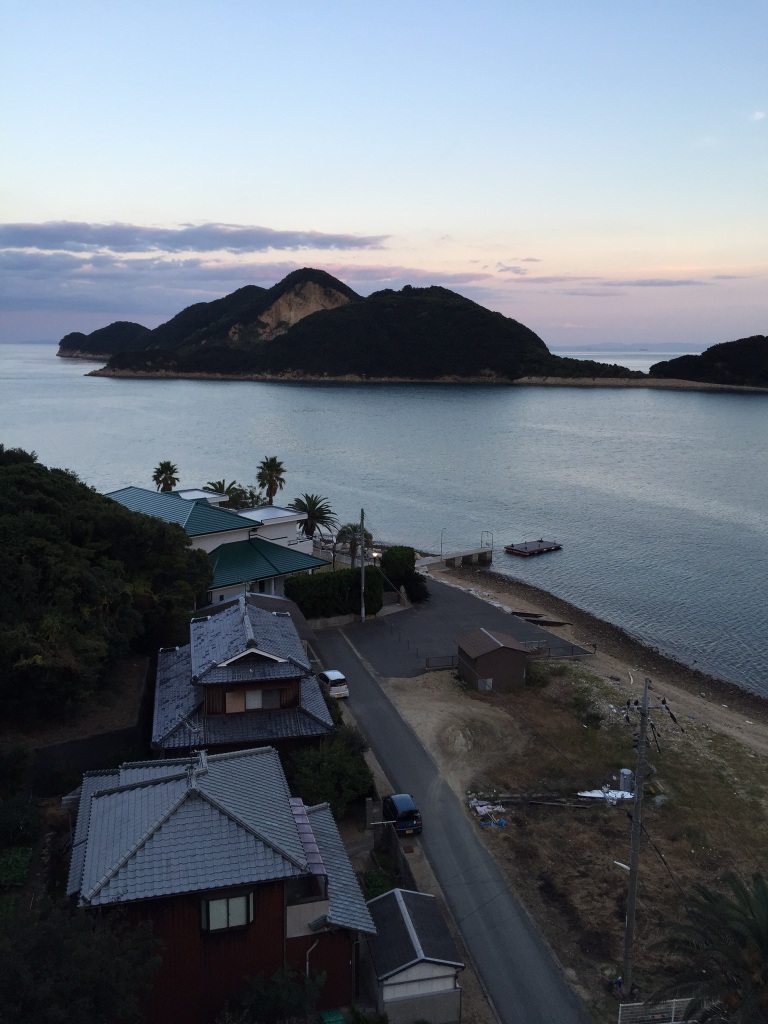
I read that the sunset somewhere on Shodoshima has been rated one of Japan’s hundred best sunsets. Since our hotel room has a view of the sea, I’m eager to check in before sundown so we can watch. I drive along twisty mountain roads, past a quarry, and past stone sculptures, down to another tiny port town in a secluded cove. I check us in to the hotel. “You can borrow DVDs,” the desk clerk says. “Or borrow books.” The lounge is filled with comfortable white leather armchairs. Some books in English are on a shelf, as well as many books in Japanese. I grab a DVD of a movie called 24 Eyes which is based on a novel written by Sakae Tsuboi, a famous Japanese writer who was born in Shodoshima. From our eighth-floor room, we can look out upon the sea from the bathtub. However, I discover that a mountain is blocking our view of the sunset.
We have dinner in the restaurant on the first floor. All the food is fresh and healthy – fish, followed by peeled grapes and slices of persimmon. After a while, we go back to our room and watch the movie. The plot of 24 Eyes is about a young teacher from the larger island of Shikoku who gets a job on Shodoshima in the 1920s. Most people on the island were poor. They wore kimonos. The teacher wore Western clothes and rode a bicycle, which shocked everyone on the island. Later, of course, everyone grew to love the teacher.
In the movie, there is a lot of singing. The children sing about dragonflies and crows. There is also a lot of crying. One girl has to give up her dream of going to music school because her parents are against it. Another gets sick and dies. Three boys go off to war. Many miserable things happen. Sometimes there is singing and crying at the same time. Lilia cries, too. I bring her tissues and give her a hug.
The next morning, we set out for The Movie Village on the southern coast of the island. Many of the tourists at the theme park are much older than us. I spot a group of senior citizens communicating in sign language. One of them notices that I am signing to Lilia and approaches us. “Where are you from?” she asks in sign language.
“Tokushima,” Lilia signs back.
The woman signs that she is from Osaka. “Is that your mother?” She gestures to me. I’m pleased. We look nothing alike. When we are in America, most people think she is adopted.
“Yes,” Lilia replies. She draws her hand down the middle of her face. “I am half.”
“It’s the first time I’ve met an American,” the woman signs.
We look at the old-fashioned wooden buildings. Kimonos are hung on bamboo poles, as if someone has just finished the laundry. Shops sell vintage toys and candies. Visitors try to walk on bamboo stilts or roll a hoop with a stick.
We come to a restaurant with painted pictures of Japanese movie stars propped in front. At the entrance is a photo of the food served. The restaurant’s theme is Shōwa- era school lunch. I ate Japanese school lunches when I first came to Japan. I taught English at junior high schools, and I ate with the students. I don’t feel nostalgic for those lunches, but Lilia wants to eat here. We go inside. Posters from different movies filmed on Shodoshima cover the walls. Some clothes worn in one movie are on display in a corner. We order school lunch. It’s served on a metal tray, just as I remember. There is a bowl of watery curry, a big white roll sprinkled with sugar, and a tangerine. Lilia gets milk in a bottle. I ask for the milk mixed with coffee, also served in a bottle. To tell the truth, it isn’t that great. I’m glad that the food in Japan has gotten better.
Lilia wants to visit the monkey park. She also wants to check out the ravine with a ropeway going across it. Sadly, we don’t have enough time. But now that she knows this island is here, she can return. We drive along the coast, back to the ferry port. The sea glistens in the late afternoon sun. Sometimes it seems as if all the beauty of the world is within our reach.
Lilia in Sodoshima
Suzanne Kamatawas born and raised in Grand Haven, Michigan. She now lives in Japan with her husband and two children. Her short stories, essays, articles and book reviews have appeared in over 100 publications. Her work has been nominated for the Pushcart Prize five times, and received a Special Mention in 2006. She is also a two-time winner of the All Nippon Airways/Wingspan Fiction Contest, winner of the Paris Book Festival, and winner of a SCBWI Magazine Merit Award.
PLEASE NOTE: ARTICLES CAN ONLY BE REPRODUCED IN OTHER SITES WITH DUE ACKNOWLEDGEMENT TO BORDERLESS JOURNAL
A translation from Nabendu Ghosh’s autobiography, Eka Naukar Jatri(Journey of a Lonesome Boat), translated by Dipankar Ghosh, from Bengali post scripted by Ratnottama Sengupta. Clickhereto read.
Ueharaby Kamaleswar Barua has been translated from Assamese and introduced by Bikash K. Bhattacharya. Clickhere to read.
Kurigram by Masud Khan has been translated by Professor Fakrul Alam from Bangla. Clickhere to read.
Bonfire by Ihlwha Choi has been translated from Korean by the poet himself. Clickhere to read.
In Indian Pale Ale, Rhys Hughes experiments with words and brews. Click here to read.
Conversation
Being fascinated with the human condition and being vulnerable on the page are the two key elements in the writing of fiction, author and poet Heidi Northtells Keith Lyons in a candid conversation. Clickhere to read.
In Multicultural Curry, Suzanne Kamata reflects on mingling of various cultures in her home in Japan and the acceptance it finds in young hearts. Clickhere to read.
Ratnottama Sengupta explores the poetry in lyrics of Bollywood songs, discussing the Sahityotsav (Literary Festival) hosted by the Sahitya Akademi. Clickhere to read.
Imagine a world without wars, without divisions, where art forms flow into each other and we live by the African concept of Ubuntu — I am because you are’ — sounds idyllic. But this is the month of March, of poetry, of getting in touch with the Dionysian elements in ourselves. And as we have said earlier in the introduction of Monalisa No Longer Smiles: An Anthology of Writings from across the World, what could be a better spot to let loose this insanity of utopian dreams than Borderless Journal!
Having completed three years of our Earthly existence on the 14th of March, we celebrate this month with poetry and writing that crosses boundaries — about films, literature and more. This month in the Festival of Letters or Sahityaotsav 2023, organised by the Sahitya Akademi, films were discussed in conjunction with literature. Ratnottama Sengupta, who attended and participated in a number of these sessions, has given us an essay to show how deep run the lyrics of Bollywood films, where her father, Nabendu Ghosh, scripted legends. It is Ghosh’s birth month too and we carry a translation from his Bengali autobiography which reflects how businessmen drew borders on what sells… After reading the excerpt from Nabendu’s narrative translated by Dipankar Ghosh and post-scripted by Sengupta, one wonders if such lines should ever have been drawn?
Questioning borders of a different kind, we have another piece of a real-life narrative on a Japanese Soldier, Uehara. Written by an Assamese writer called Kamaleswar Barua, it has been translated and introduced by Bikash K. Bhattacharya. The story focusses on a soldier’s narrative at his death bed in an alien land. We are left wondering how his need for love and a home is any different from that of any one of ours? Who are the enemies — the soldiers who die away from their homes? What are wars about? Can people live in peace? They seemed to do so in Kurigram, a land that has faded as suggests the poem by Masud Khan, brought to us in translation from Bangla by Professor Fakrul Alam, though in reality, the area exists. Perhaps, it has changed… as does wood exposed to a bonfire, which has been the subject of a self-translated Korean poem by Ihlwha Choi. Tagore’s poem, Borondalatranslated as ‘Basket of Offerings’, has the last say: “Just as the stars glimmer / With light in the dark night, / A spark awakens within/ My body. / This luminosity illuminates / All my work.” And perhaps, it is this luminosity that will also help us find our ideal world and move towards it, at least with words.
We have a book review by Aruna Chakravarti of Bornali Datta’sIn A Better Place: A Doctor’s Journey, a book that is set amidst immigrants and takes up certain social issues. Baba Padmanji’s Yamuna’s Journey, translated from Marathi by Deepra Dandekar, one of the oldest Indian novels has been discussed by Somdatta Mandal. Bhaskar Parichha has told us about S.Irfan Habib’s Maulana Azad – A Life. Basudhara Roy has brought out the simplicity and elegance of Robin Ngangom’sMy Invented Land: New and Selected Poems. He writes in the title poem that his home “has no boundaries. / At cockcrow one day it found itself/ inside a country to its west,/ (on rainy days it dreams looking east/ when its seditionists fight to liberate it from truth.)”. We also carry an excerpt from his book. Stories by Jessie Michael, Brindley Hallam Dennis, Sangeetha G and Shubhangi bring flavours of diversity in this issue.
Our journey has been a short one — three years is a short span. But, with goodwill from all our readers and contributors, we are starting to crawl towards adulthood. I thank you all as caregivers of Borderless Journal as I do my fabulous team and the artists who leave me astounded at their ability to paint and write — Sohana Manzoor, Gita Vishwanath and Pragya Bajpai.
Thank you all.
Looking forward to the next year, I invite you to savourBorderless Journal, March 2023, where more than the treasures mentioned here lie concealed.






 Borderless