Tumi Kon Kanoner Phulby Tagore andAnjali Loho Morby Nazrul, love songs by the two greats, have been translated from Bengali by Professor Fakrul Alam. Click hereto read.
One Life, One Love, 300 Children : Keith Lyons writes of Tendol Gyalzur, a COVID 19 victim, a refugee and an orphan who found new lives for many other orphans with love and an ability to connect. Click here to read.
When West Meets East & Greatness Blooms: Debraj Mookerjee reflects on how syncretism impacts greats like Tagore,Tolstoy, Emerson, Martin Luther King Jr, Gandhi and many more. Click here to read.
Dilip Kumar: Kohinoor-e-Hind: In a tribute to Bollywood legend Dileep Kumar, Ratnottama Sengupta, one of India’s most iconic arts journalists, recollects the days the great actor sprinted about on the sets of Bombay’s studios …spiced up with fragments from the autobiography of Sengupta’s father, Nabendu Ghosh. Click here to read.
Are Some of Us More Human than Others ?: Meenakshi Malhotra ponders at the exclusivity that reinforces divisions, margins and borders that continue to plague humankind, against the backdrop of the Women’s Month, March. Click here to read.
Reminiscences from a Gallery: MF Husain: Dolly Narang recounts how she started a gallery more than four decades ago and talks of her encounter with world renowned artist, MF Husain. Click hereto read.
Baraf Pora (Snowfall) by Rabindranath Tagore,gives a glimpse of his first experience of snowfall in Brighton and published in the Tagore family journal, Balak (Children), has been translated from Bengali by Somdatta Mandal. Clickhere to read.
Cherry Blossom Forecast: Suzanne Kamata brings the Japanese ritual of cherry blossom viewing to our pages with her camera and words. Clickhere to read.
Two Pizza Fantasies, Rhys Hughes recounts myths around the pizza in prose, fiction and poetry, Click here to read.
An Alien on the Altar!: Snigdha Agrawal writes of how a dog and lizard add zest to festivities with a dollop of humour. Click here to read.
Where it all Began: Sybil Pretious recounts her first adventure, an ascent on Mt Kilimanjaro at the age of sixty. Clickhere to read.
Conversations
Rabindranath Tagore: A Universal Bard.: This conversation between Aruna Chakravarti and Sunil Gangopadhyay that took place at a Tagore Conference organised by the Sahitya Akademi in Kochy in 2011. Click here to read.
Sriniketan: Tagore’s “Life Work”: In Conversation with Professor Uma Das Gupta, Tagore scholar, author of A History of Sriniketan, where can be glimpsed what Tagore considered his ‘life’s work’ as an NGO smoothening divides between villagers and the educated. Click here to read. (Review & Interview).
In conversation with the late Akbar Barakzai, a Balochi poet in exile who rejected an award from Pakistan Academy of Letters for his principles. Click here to read.
Jim Goodman, an American traveler, author, ethnologist and photographer who has spent the last half-century in Asia, converses with Keith Lyons. Click here to read.
InBridge over Troubled Waters, the late Sanjay Kumar tells us about Pandies, an activist theatre group founded by him that educates, bridging gaps between the divides of university educated and the less fortunate who people slums or terror zones. Click here to read.
In Lessons Old and New from a Stray Japanese Cat, Keith Lyons talks with the author of The Cat with Three Passports, CJ Fentiman who likes the anonymity loaned by resettling in new places & enjoys creating a space for herself away from her birthplace. Click hereto read.
Fiction
Aparichitaby Tagore: This short story has been translated as The Stranger by Aruna Chakravarti. Click hereto read.
Hena by Nazrul has been translated from Bengali by Sohana Manzoor. Click here to read.
Playlets byRabindranath Tagore: Two skits that reveal the lighter side of the poet. They have been translated from Bengali by Somdatta Mandal. Click here to read.
Abhagi’s Heaven, a poignant story by Saratchandra Chattopadhyay translated by Aruna Chakravarti. Click here to read.
An Eternal Void, a Balochi story by Munir Ahmed Badini translated by Fazal Baloch. Click hereto read.
The Witch, a short story by renowned Bengali writer Tarasankar Bandopadhyay (1898 to 1971), translated by Aruna Chakravarti. Clickhere to read.
I Grew into a Flute: Balochi Folktale involving magic retold by Fazal Baloch. Click here to read.
Give Me A Rag, Please:A short story by Nabendu Ghosh, translated by Ratnottama Sengupta, set in the 1943 Bengal Famine, which reflects on man’s basic needs. Click here to read
Rakhamaninov’s Sonata: A short story by Sherzod Artikov, translated from Uzbeki by Nigora Mukhammad. Click hereto read.
The Magic Staff , a poignant short story about a Rohingya child by Shaheen Akhtar, translated from Bengali by Arifa Ghani Rahman. Click here to read.
Khaira, the Blind, a story by Nadir Ali, has been translated from Punjabi by Amna Ali. Click here to read.
The Browless Dolls by S.Ramakrishnan, has been translated from Tamil by B Chandramouli. Click hereto read.
No Man’s Land: Sohana Manzoor gives us surrealistic story reflecting on after-life. Click hereto read.
The Protests Outside: Steve Ogah talks of trauma faced by riot victims in Nigeria. Click here to read.
Flash Fiction: Turret: Niles M Reddick relates a haunting tale of ghosts and more. Click here to read.
Henrik’s Journey: Farah Ghuznavi follows a conglomerate of people on board a flight to address issues ranging from Rohingyas to race bias. Click hereto read.
Does this Make Me a Psychic?; Erwin Coombs tells a suspenseful, funny, poignant and sad story, based on his real life experiences. Click here to read.
Phôs and Ombra: Paul Mirabile weaves a dark tale about two people lost in a void. Click here to read.
A Queen is Crowned: Farhanaz Rabbani traces the awakening of self worth. Click here to read.
Borderless Journal started on March, 14, 2020. When the mayhem of the pandemic had just set in, we started as a daily with half-a-dozen posts. Having built a small core of writings by July, 2020, we swung to become a monthly. And we still continue to waft and grow…
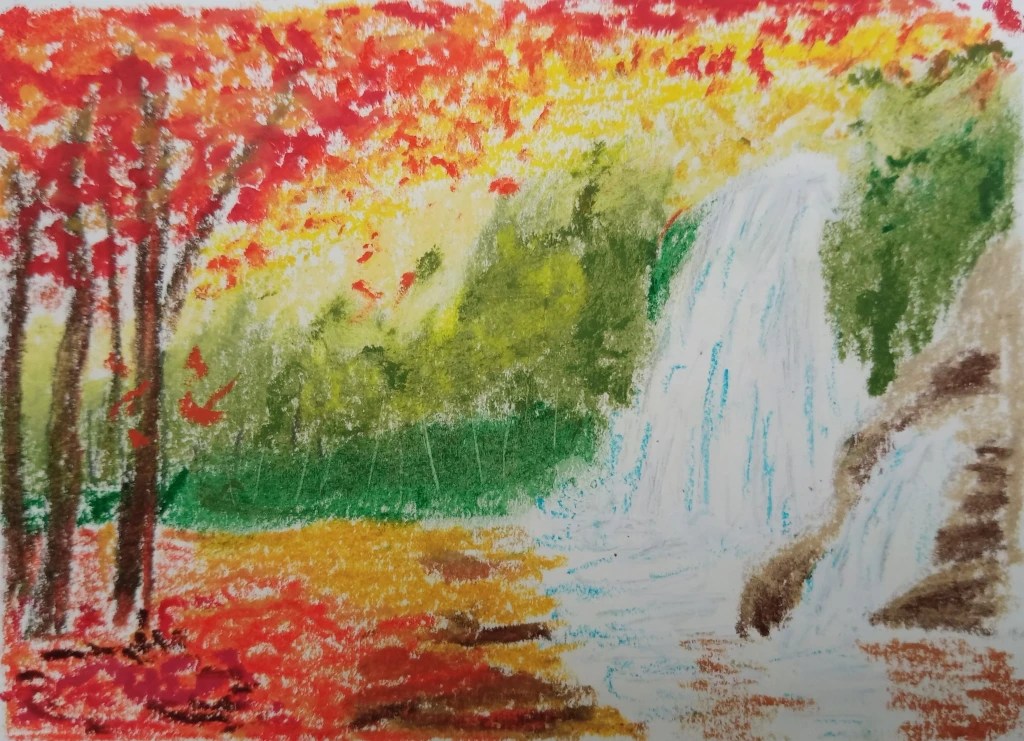
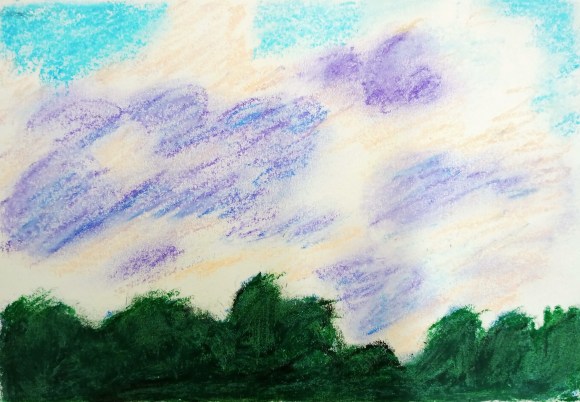
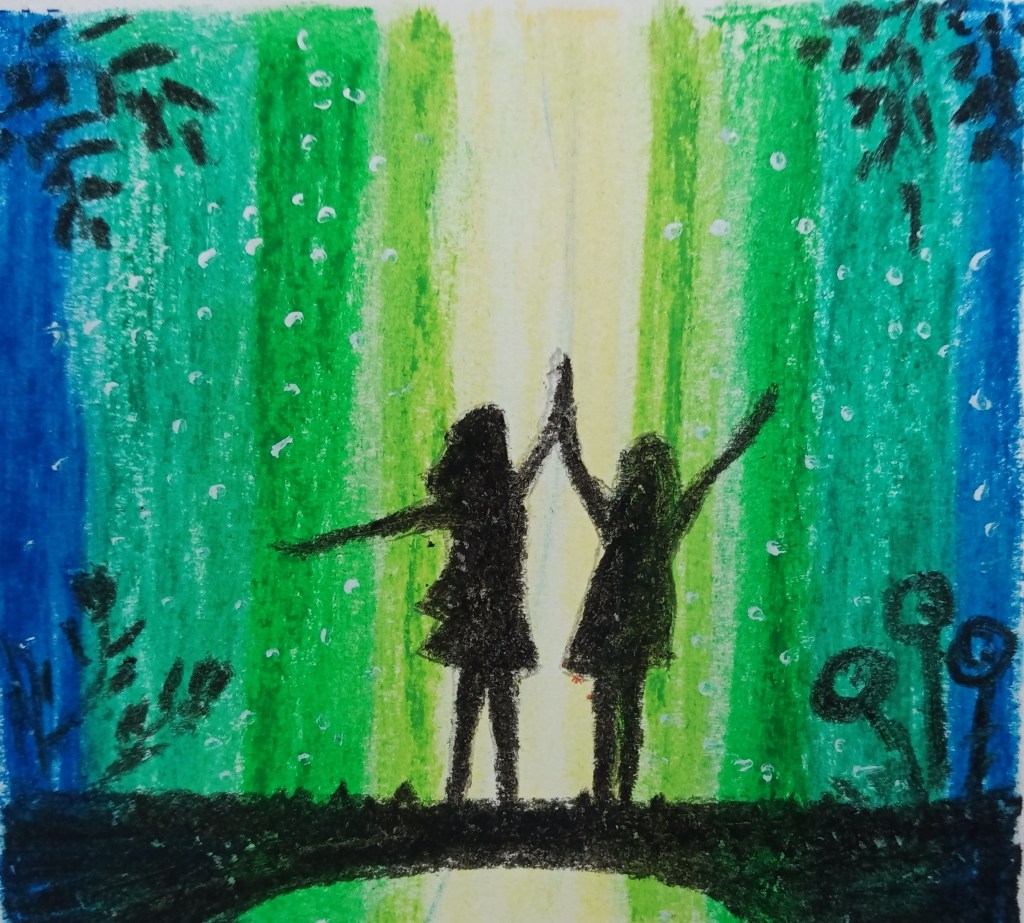
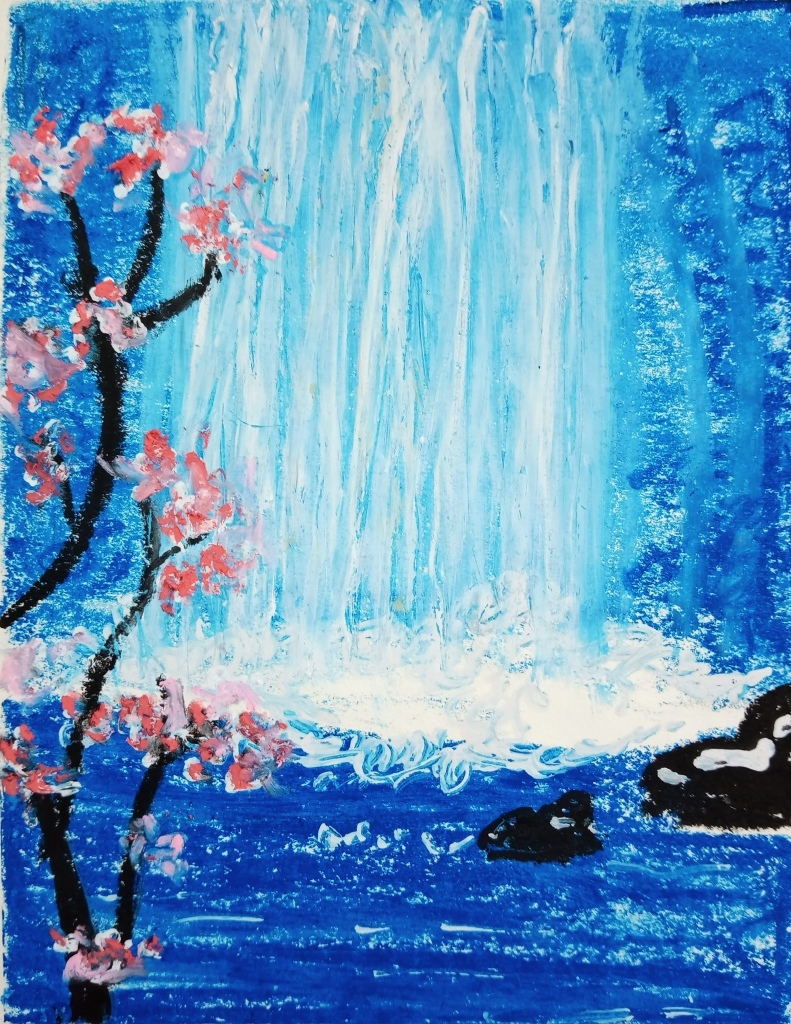
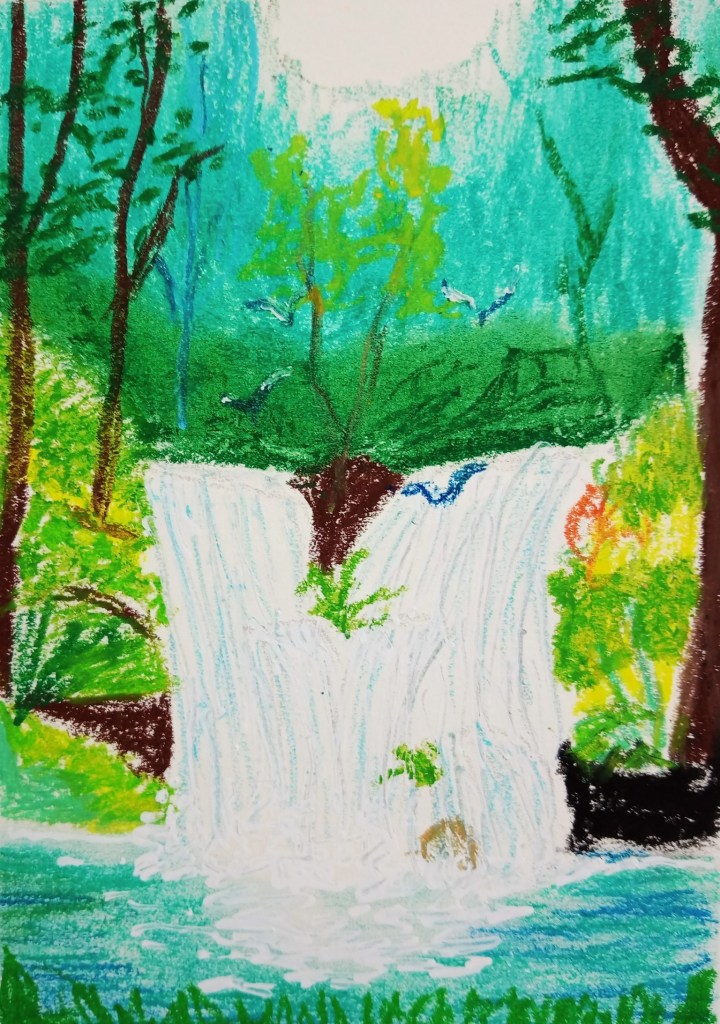
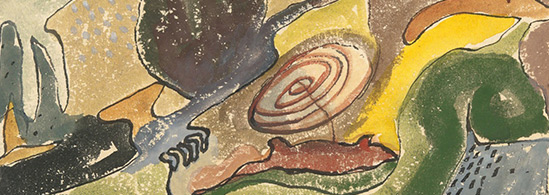
Art by Sohana Manzoor
We like to imagine ourselves as floating on clouds and therefore of the whole universe. Our team members are from multiple geographies and we request not to be tied down to a single, confined, bordered land. We would welcome aliens if they submitted to us from another galaxy…
On our Fifth Anniversary, we have collected celebratory greetings from writers and readers stretched across the world who share their experience of the journal with you and offer suggestions for the future. We conclude with words from some of the team, including my own observations on being part of this journey.
Aruna Chakravarti
Heartiest congratulations to Borderless on the occasion of its fifth anniversary! Borderless, an international journal, has the distinction of carrying contributions from many eminent writers from around the world. From its initiation in 2020, it has moved from strength to strength under the sensitive and skillful steering of its team. Today it is considered one of the finest journals of its kind. I feel privileged to have been associated with Borderless from its very inception and have contributed substantially to it. I wish to thank the team for including my work in their distinguished journal. May Borderless move meaningfully towards the future and rise to greater and greater heights! I wish it every success.
Professor Fakrul Alam
Five years ago, when Borderless set out on its literary voyage, who would have imagined the length and breadth of its imaginative crossings in this span of time? The evidence, however, is digitally there for any reader who has seen at least some of its issues. Creative writing spanning all genres, vivid illustrations, instant links giving resolute readers the option to track a contributor’s creative voyaging—here is boundless space always opening up for those seeking writing of considerable variety as well as originality. The best part here is that unlike name-brand journals, which will entice readers with limited access and then restrict their spaces unless you subscribe to them, all of Borderless is still accessible for us even though it has attracted a wide readership in five years. I certainly hope it will stay that way.
And what lies ahead for Borderless? Surely, more opportunities for the creative to articulate their deepest thoughts and feelings in virtual and seemingly infinite space, and innumerable avenues for readers to access easily. And let us hope, in the years to come Borderless will extend itself to newer frontiers of writing and will continue to keep giving space to new as well as emerging writers from our parts of the world.
May the team of Borderless, continue to live up to their claim that “there are no boundaries to human imagination and thought!”
Radha Chakravarty
Since its inception, Borderless Journal has remained true to its name, offering a vital literary space for writers, artists and scholars from around the world to engage in creative dialogue about their shared vision of a world without borders. Congratulations Borderless, and may your dream of global harmony continue to inspire.
Somdatta Mandal
According to the famous Chicana academic and theorist Gloria Anzaldua, the Borderlands are physically present wherever two or more cultures edge each other, where peopIe of different races occupy the same territory, where under, lower, middle and upper classes touch, where the space between two individuals shrinks with intimacy. Hatred, anger and exploitation are the prominent features of this landscape. There, at the juncture of cultures, languages cross-pollinate and are revitalized; they die and are born. Borders are set up to define the places that are safe and unsafe, to distinguish us from them. A border is a dividing line, a narrow strip along a steep edge. A borderland is a vague and undetermined place created by the emotional residue of an unnatural boundary. It is in a constant state of transition. The prohibited and forbidden are its inhabitants.
About five years ago, when a new online journal aptly called Borderless Journal was launched, these ideas which we had been teaching for so long were simply no longer applicable. Doing away with differences, with limits, it became a suitable platform where disparate cultures met, where people from all disciplines could express their views through different genres, be it poetry, translation, reviews, scholarly articles, creative writing and so on. Many new writers from different parts of the world became regular contributors to this unique experimentation with ‘borderlessness’ and its immense possibilities are very apt in this present global context where social media has already changed many earlier notions of scholarship, journalism, and creativity.
Jared Carter
In its first five years Borderless has become an important witness for international peace and understanding. It has encouraged submissions from writers in English based in many different countries, and has offered significant works translated from a wide range of national literatures. Its pages have featured writers based in India, Pakistan, China, Taiwan, Japan, South Korea, Australia, the UK, and the US. In the future, given the current level of world turmoil, Borderless might well consider looking more closely toward Africa and the Middle East. As the magazine continues to promote writing focused on international peace and freedom, new horizons beckon.
Teresa Rehman
The best part of this journal is that it is seamless and knows no margins or fringes. It is truly global as it has cut across geographical borders and has sculpted a novel literary genre called the ‘borderless’. It has climbed the mountains of Nepal, composed songs on the Brahmaputra in Assam, explored the hidden kingdom of Bhutan, walked on the streets of Dhaka, explored the wreckage of cyclones in Odisha, been on a cycling adventure from Malaysia to Kashmir, explored a scenic village in the Indo-China border, taken readers on a journey of making a Japanese-Malayalam dictionary, gave a first-hand account of the war in Bosnia-Herzegovina and described the syncretic culture of Bengal through its folk music and oral traditions. I hope it continues telling the untold and unchartered stories across mountains, oceans and forests.
Kirpal Singh
In a world increasingly tending towards misunderstandings across borders, this wholesome journal provides a healthy space both for diverse as well as unifying visions of our humanity. As we celebrate five distinguished years of Borderless Journal, we also look forward to another five years of such to ensure the underlying vision remains viable and visible as well as authentic and accurate.
My heartfelt Congratulations to all associated with this delightful and impressive enterprise!
Asad Latif
The proliferation of ethnic geographies of identity — Muslim/Arab, Hindu/Indian, Christian/Western, and so on — represents a threat to anything that might be called universal history. The separation and parcelling out of identities, as if they are pre-ordained, goes against the very idea (proclaimed by Edward Said) that, just as men and women create their own history, they can recreate it. Borders within the mind reflect borders outside it. Both borders resist the recreation of history. While physical borders are necessary, mental borders are not. This journal does an admirable job in erasing borders of the mind. Long may it continue to do so.
Anuradha Kumar
I have been one of Borderless’ many readers ever since its first issue appeared five years ago. Like many others, I look forward with great anticipation to every issue, complete with stories, , reviews, poems, translations, complemented with interesting artwork.
Borderless has truly lived up to its name. Within its portal, people, regardless of borders, but bound by common love for literature, and the world’s heritage, come together. I would wish for Borderless to scale even greater heights in the future. As a reader, I would very much like to read more writers from the ‘Global South’, especially in translation. Africa, Asia and Australasia are host to diverse languages, many in danger of getting lost. Perhaps Borderless could take a lead in showcasing writers from these languages to the world. That would be such an invaluable service to readers, and the world too.
Ryan Quinn Flanagan
To me, Borderless Journal is a completely free and open space. Topics and styles are never limiting, and the various writers explore everything from personal travelogues to the limp of a helpful druggist. Writers from all corners of the globe contribute, offering a plethora of unique voices from countless circumstances and walks of life. Because of this openness, Borderless Journal can, and likely will continue to grow and expand in many directions simultaneously. Curating and including many new voices along the way. Happy 5th Birthday to a truly original and wonderfully eclectic journal!
George Freek
I feel the Borderless Journal fills a special spot in the publishing world. Unlike many journals, which profess to be open-minded and have no preference for any particular style of poetry, Borderless actually strives to be eclectic. Naturally, it has its own tastes, and yet truly tries to represent the broad spectrum which is contemporary poetry. I have no advice as to where it should go. I can only say keep up the good work, and stooping to a cliche, if it’s not broken, why try to fix it?
Farouk Gulsara
They say time flies when one is having fun. It sure does when a publication we love regularly churns out its issues, month after month, for five years now.
In the post-truth world, where everybody wants to exert their exclusivity and try to find ways to be different from the person standing next to them, Borderless gives a breath of fresh air. At a time when neighboring countries are telling the world they do not share a common history, Borderless tries to show their shared heritage. We may have different mothers and fathers but are all but “ONE”!
We show the same fear found in the thunderous sounds of a growling tiger. We spill the exact hue of blood with the same pain when our skin is breached. Yet we say, “My pain is more intense than yours, and my blood is more precious.” Somehow, we find solace in playing victimhood. We have lost that mindfulness. One should appreciate freedom just as much as we realise it is fragile. Terrorism and fighting for freedom could just be opposing sides of the same coin.
There is no such thing as a just war or the mother of all wars to end all wars as it has been sold to us. One form of aggression is the beginning of many never-ending clashes. Collateral damage cannot be justified. There can be no excuse to destroy generations of human discoveries and turn back the clock to the Stone Age.
All our hands are tainted with guilt. Nevertheless, each day is another new day to make that change. We can all sing to the tune of the official 2014 World Cup song, ‘Ola Ola,’ which means ‘We are One.’ This is like how we all get together for a whole month to immerse ourselves in the world’s favourite sport. We could also reminisce about when the world got together to feed starving kids in Africa via ‘Band-Aid’ and ‘We Are the World’. Borderless is paving the way. Happy Anniversary!
Ihlwha Choi
I sincerely congratulate Borderless Journal on its 5th anniversary. I am always delighted and grateful for the precious opportunity to publish my poetry in English through this journal. I would like to extend my special thanks for this.
Through this journal, I can read a variety of literary works—including poetry, essays, and prose—from writers around the world. As someone for whom English is a foreign language, it has also been a valuable resource for improving my English skills. I especially enjoy the frequent features on Rabindranath Tagore’s poetry, which I read with great joy. Tagore is one of my favourite poets.
I have had the privilege of visiting Santiniketan three times to trace his legacy and honor his contributions to literature and education. However, one aspect I find a little disappointing is that, despite having published over 30 poems, I have yet to receive any feedback from readers or fellow writers. It would be wonderful to have such an opportunity for engagement.
Additionally, last October, a Korean woman received the Nobel Prize in Literature—the first time an author from South Korea has been awarded this honor by the Swedish Academy. She is not only an outstanding novelist but also a poet. I searched for articles about her in Borderless Journal but was unable to find any. Of course, I understand that this is not strictly a literary newspaper, but I would have been delighted to see a feature on her.
I also feel honoured that one of my poems was included in the anthology Monalisa No Longer Smiles: An Anthology of Writings from across the World. I hope such anthologies will continue to be published. In fact, I wonder if it would be possible to compile and publish collections featuring several poems from contributing poets. If these were made available on Amazon, it would be a fulfilling experience for poets to reach a broader audience.
Moving forward, I hope Borderless Journal will continue to reach readers worldwide, beyond Asia, and contribute to fostering love and peace. Thank you.
Prithvijeet Sinha
The journey of authorship, self-expression and cultural exchange that I personally associate with Borderless Journal’s always diverse archives has remained a touchstone ever since this doorway opened itself to the world in 2020. Going against the ramshackle moods of the 2020s as an era defined by scepticism and distances, The journal has upheld a principled literary worldview close to the its pages and made sure that voices of every hue gets representation. It’s also an enterprise that consistently delivers in terms of goodwill and innocence, two rare traits which are in plenteous supply in the poems, travelogues, essays and musings presented here.
The journey with Borderless has united this writer with many fascinating, strikingly original auteurs, buoyed by a love for words and expression. It is only destined for greatness ahead. Happy Birthday Borderless! Here’s to 50 more epochs.
From Our Team
Bhaskar Parichha
As Borderless Journal celebrates its fifth anniversary, it is inspiring to see its evolution into a distinguished platform for discourse and exploration. Over the years, it has carved a unique niche in contemporary journalism, consistently delivering enlightening and engaging content. The journal features a variety of sections, including in-depth articles, insightful essays, and thought-provoking interviews, reflecting a commitment to quality and fostering dialogue on pressing global issues. The diverse contributions enrich readers’ understanding of complex topics, with a particular focus on climate change, which is especially relevant today. By prioritising this critical issue, Borderless informs and encourages engagement with urgent realities. Having been involved since its inception, I am continually impressed by the journal’s passion and adaptability in a changing media landscape. As we celebrate this milestone, I wish Borderless continued success as a beacon of knowledge and thoughtful discourse, inspiring readers and contributors alike.
Devraj Singh Kalsi
Borderless Journal has a sharp focus on good writing in multiple genres and offers readable prose. The platform is inclusive and does not carry any slant, offering space to divergent opinions and celebrating free expression. By choosing not to restrict to any kind of ism, the literary platform has built a strong foundation in just five years since inception. New, emerging voices – driven by the passion to write fearlessly – find it the ideal home. In a world where writing often gets commercialised and compromised, Borderless Journal is gaining strength, credibility, and wide readership. It is making a global impact by giving shape to the dreams of legendary poets who believed the world is one.
Rakhi Dalal
My heartiest congratulations to Borderless and the entire team on the fifth Anniversary of its inception. The journal which began with the idea of letting writing and ideas transcend borders, has notably been acting as a bridge to make this world a more interconnected place. It offers a space to share human experiences across cultures, to create a sense of connection and hence compassion, which people of this world, now more distraught than ever, are sorely in need of. I am delighted to have been a part of this journey. My best wishes. May it continue to sail through time, navigating languages, literature and rising above barriers!
Keith Lyons
Is it really five years since Borderless Journal started? It seems hard to believe.
My index finger scrolls through Messenger chats with the editor — till they end in 2022. On the website, I find 123 results under my name. Still no luck. Eventually, in my ‘Sent’ box I find my first submission, emailed with high hopes (and low expectations) in March 2020. ‘Countdown to Lockdown’ was about my early 2020 journey from India through Thailand, Malaysia, Indonesia, and Australia to New Zealand as COVID-19 spread.
Just like that long, insightful trip, my involvement with Borderless Journal has been a journey. Three unique characteristics stand out for me.
The first is its openness and inclusiveness. It features writers from all over the globe, with various contributions across a wide range of topics, treatments and formats.
The second feature of the journal is its phenomenal growth, both in readers and writers, and in its reach. Borderless really does ‘walk the talk’ on breaking down barriers. It is no longer just a humble literary journal — it is so much bigger than that.
The third unique aspect of Borderless is the devotion endowed in nurturing the journal and its contributors. I love the way each and every issue is conceived, curated, and crafted together, making tangible the aspiration ‘of uniting diverse voices and cultures, and finding commonality in the process.’
So where can we go from here? One constant in this world is change. I’d like to think that having survived a global pandemic, economic recession, and troubling times, that the core values of Borderless Journal will continue to see it grow and evolve. For never has there been a greater need to hear the voices of others to discover that we are all deeply connected.
Rhys Hughes
I have two different sets of feelings about Borderless Journal. I think the journal does an excellent job of showcasing work from many different countries and cultures. I want to say it’s an oasis of pleasing words and images in a troubled sea of chaos, but that would be mixing my metaphors improperly. Not a troubled sea of chaos but a desert of seemingly shifting values. And here is the oasis, Borderless Journal, where one can find secure ideals of liberty, tolerance, peace and internationalism. I appreciate this very much. As for my other set of feelings, I am always happy to be published in the journal, and in fact I probably would have given up writing poetry two years ago if it wasn’t for the encouragement provided to me by regular publication in the journal. I have written many poems especially for Borderless. They wouldn’t exist if Borderless didn’t exist. Therefore I am grateful on a personal level, as a writer as well as a reader.
Where can Borderless Journal go from here? This is a much harder question to answer. I feel that traditional reading culture is fading away year after year. Poets write poetry but few people buy poetry books. They can read poems at Borderless for free and that is a great advantage. I would like to see more short stories, maybe including elements of fantasy and speculative fiction. But I have no strategic vision for the future of the journal. However, one project I would like to try one day is some sort of collaborative work, maybe a big poem with lots of contributors following specific rules. It’s an idea anyway!
Meenakshi Malhotra
Borderless started with a vision of transcending the shadow lines and has over time, evolved into a platform where good writing from many parts of the world finds a space , where as “imagination bodies forth/ The forms of things unknown, the poet’s pen/Turns them to shapes and gives to airy nothing/A local habitation and a name.”
It has been a privilege to be a part of Borderless’s journey over the last few years. It was a journey based on an idea and a vision. That dream of creating solidarity, of transcending and soaring over borders and boundaries, is evident in almost every page and article in the journal.
Mitali Chakravarty
Looking at all these responses, thinking on what everyone has said, I am left feeling overwhelmed.
Borderless started as a whimsical figment of the imagination… an attempt to bring together humanity with the commonality of felt emotions, to redefine literary norms which had assumed a darker hue in the post Bloomsbury, post existentialist world. The journal tried to invoke humour to brings smiles, joys to create a sense of camaraderie propelling people out of depression towards a more inclusive world, where laughter brings resilience and courage. It hoped to weave an awareness that all humans have the same needs, dreams and feelings despite the multiple borders drawn by history, geographies, academia and many other systems imagined by humans strewn over time.
Going forward, I would like to take up what Harari suggests in Homo Deus — that ideas need to generate a change in the actions of humankind to make an impact. Borderless should hope to be one of the crucibles containing ideas to impact the move towards a more wholesome world, perhaps by redefining some of the current accepted norms. Some might find such an idea absurd, but without the guts to act on impractical dreams, visions and ideas, we might have gone extinct in a post-dino Earth.
I thank the fabulous team, the wonderful writers and readers whose participation in the journal, or in engaging with it, enhances the hope of ringing in a new world for the future of our progeny.
Art by Sophia P, CypressArt by Hugo A, Quezon CityFrom Public Domain
In 1985, famous artistes, many of whom are no longer with us, collaborated on the song, We are the World, to raise funds to feed children during the Ethiopian famine (1983-85). The song was performed together by Michael Jackson, Willie Nelson, Bob Dylan, Ray Charles, Diana Ross, Stevie Wonder, Smokey Robinson, Paul Simon, Tina Turner, Dionne Warwick, Lionel Richie, Billy Joel and Bruce Springsteen. The producer, Julia Nottingham, said: “It’s a celebration of the power of creativity and the power of collective humanity.” The famine was attributed to ‘war and drought’.
Over the last few years, we have multiple wars creating hunger and drought caused by disruptions. Yet, the world watches and the atrocities continue to hurt common people, the majority who just want to live and let live, accept and act believing in the stories created by centuries of civilisation. As Yuval Noah Harari points out in a book written long before the current maladies set in, Homo Deus (2015), “…the stories are just tools. They should not become our goals or our yardsticks. When we forget that they are mere fiction, we lose touch with reality. Then we begin entire wars ‘to make a lot of money for the corporation’ or ‘to protect the national interest’. Corporations, money and nations exist only in our imagination. We invented them to serve us; why do we find ourselves sacrificing our lives in their service?”
What Harari says had been said almost ninety years ago by a voice from another region, by a man who suffered but wrote beautiful poetry, Jibanananda Das… and here are his verses —
“The stories stored in my soul will eventually fade. New ones— New festivals—will replace the old — in life’s honey-tinged slight.”
We carry the poem in this issue translated by Professor Fakrul Alam, lines that makes one dream of a better future. These ideas resonate in modern Balochi poet Ali Jan Dad’s ‘Roll Up Not the Mat’ brought to us in English by Fazal Baloch. Korean poet Ihlwha Choi’s translation takes us to longing filled with nostalgic hope while Tagore’s ‘Probhat’ (Dawn) gives a glimpse of a younger multi-faceted visionary dwell on the wonders of a perfect morning imbibing a sense of harmony with nature.
“I feel blessed for this sky, so luminous. I feel blessed to be in love with the world.”
Starting a new year on notes of hope, of finding new dreams seems to be a way forward for humanity does need to evolve out of self-imposed boundaries and darknesses and move towards a new future with narratives and stories that should outlive the present, outlive the devastating impact of climate change and wars by swapping our old narratives for ones that will help us harmonise with the wonders we see around us… wonders created by non-human hands or nature.
We start this year with questions raised on the current world by many of our contributors. Professor Alam in his essay makes us wonder about the present as he cogitates during his morning walks. Niaz Zaman writes to us about a change maker who questioned and altered her part of the world almost a century ago, Begum Roquiah. Can we still make such changes in mindsets as did Roquiah? And yet again, Ratnottama Sengupta pays homage to a great artiste, filmmaker Shyam Benegal, who left us in December 2024 just after he touched 90. Other non-fictions include musings by Nusrat Jan Esa on human nature contextualising it with Milton’s Paradise Lost (1667); Farouk Gulsara’s account of a fire in Sri Lanka where he was visiting and Suzanne Kamata’s column from Japan on the latest Japanese Literary Festival in the Fukushimaya prefecture, the place where there was a nuclear blast in 2011. What is amazing is the way they have restored the prefecture in such a short time. Their capacity to bounce back is exemplary! Devraj Singh Kalsi shares a tongue-in-cheek musing about the compatibility of banks and writers.
Exploring more of life around us are stories by Sohana Manzoor set in an expat gathering; by Priyatham Swamy about a migrant woman from Nepal and by Naramsetti Umamaheswararao set against rural Andhra Pradesh. While Ahmad Rayees gives a poignant, touching story set in a Kashmiri orphanage, Paul Mirabile reflects on the resilience of a child in a distant Greek island. Mirabile’s stories are often a throwback to earlier times.
In this issue, our book excerpts explore a writer of yore too, one that lived almost a hundred years ago, S. Eardley-Wilmot (1852-1929), a conservationist and one who captures the majesty of nature, the awe and the wonder like Tagore or Jibanananda with his book, The Life of an Elephant. The other book takes us to contemporary Urdu writers but in Kolkata —Contemporary Urdu Stories from Kolkata, translated by Shams Afif Siddiqi and edited by Shams Afif Siddiqi and Fuzail Asar Siddiqi. A set of translated stories of the well-known Bengali writer, Bibhutibhushan Bandopadhyay by Hiranmoy Lahiri, brought out in a book called Kaleidoscope of Life: Select Short Stories has been reviewed by Somdatta Mandal. Malashri Lal has discussed Basudhara Roy’s A Blur of a Woman. Roy herself has explored Afsar Mohammad’s Fasting Hymns. Bhaskar Parichha has taken us to Sri Lanka with a discussion on a book on Sri Lanka, Return to Sri Lanka: Travels in a Paradoxical Islandby an academic located in Singapore, Razeen Sally.
Bringing together varied voices from across the world and ages, one notices recurring themes raising concerns for human welfare and for the need to conserve our planet. To gain agency, it is necessary to have many voices rise in a paean to humanity and the natural world as they have in this start of the year issue.
I would like to thank all those who made this issue possible, our team and the contributors. Thank you all from the bottom of my heart. I cannot stop feeling grateful to Sohana Manzoor for her fabulous artwork too, art that blends in hope into the pages of Borderless Journal. As all our content has not been mentioned here, I invite you to pause by our content’s page to explore more of our exciting fare. Huge thanks to all readers for you make our journey worthwhile.
I would hope we can look forward to this year as being one that will have changes for the better for all humanity and the Earth… so that we still have our home a hundred years from now, even if it looks different.
King Lear, Act I, Scene I (Cordelia’s Farewell) The Metropolitan Museum of Art. Pianting by Edwin Austin Abbey (1852-1911) From Public Domain.
DESPERATE LEAR

against all winds that blow
and all the rains that pour,
Old Lear still sought home
as we all do sooner or later—

home is where the heart is—
cardiac surgeons locate hearts
but the homes seem elusive
lost perhaps among the veins
and the pulse beats which sound
okay to all intents.

thus to be without home
ported lustlessness;
perhaps for some despair
too close for comfort
too close to acknowledge,

And so I roam without a home.
return to the heart,
the heart of all things,
and I realise and learn,
my heart is here with me.
inside and pretty safe,
despite some odd beats
hardening who knows what,

home is where the heart
returns after all the wandering
finally settling all debts
owed by the stomach
in desperate circumstances,

Old Lear challenged the gods
but the  duel was one-sided
no one wanted him
as he wrestled Nature
desperately needing Cordelia,

sometimes our Cordelias die
before they’re properly born-

I know for my Cordelia died
before she could be born--

she still struggles to learn
knowing its totally futile.

after all only in rare miracles
do we resurrect from the dead,

farewell, my sometime girl,
perhaps we shall meet
somewhere in our dreams
and realise all was a nightmare!


POOR HAMLET

Poor Hamlet
forgot poor Cordelia
in another realm
also where deceit,
cunning and corruption
ruined innocence, purity
and brought hell to bear.

these poor players
whose destinies pry
and fathom deep sores,
some known only alone,
challenge our premises,
contentment, pride, joy
and much else besides—

but who are we to probe
and pry and wonder?
think and cry and ponder
when it's the same
yonder and everywhere?

in my stillness, my friend
you who smile all the time
and beguile love
will never know anguish
nor the Joy of being
humanly correspondent
despite all hints and
references, nor in the
byways of escape
and neither in the grasp
of knowing and suffering
will you understand, know
and appreciate
value and truncated joy.

in the end, nothing much
matters more than smug
satisfactions of owning
even in this simple way,

forgiveness can be all!
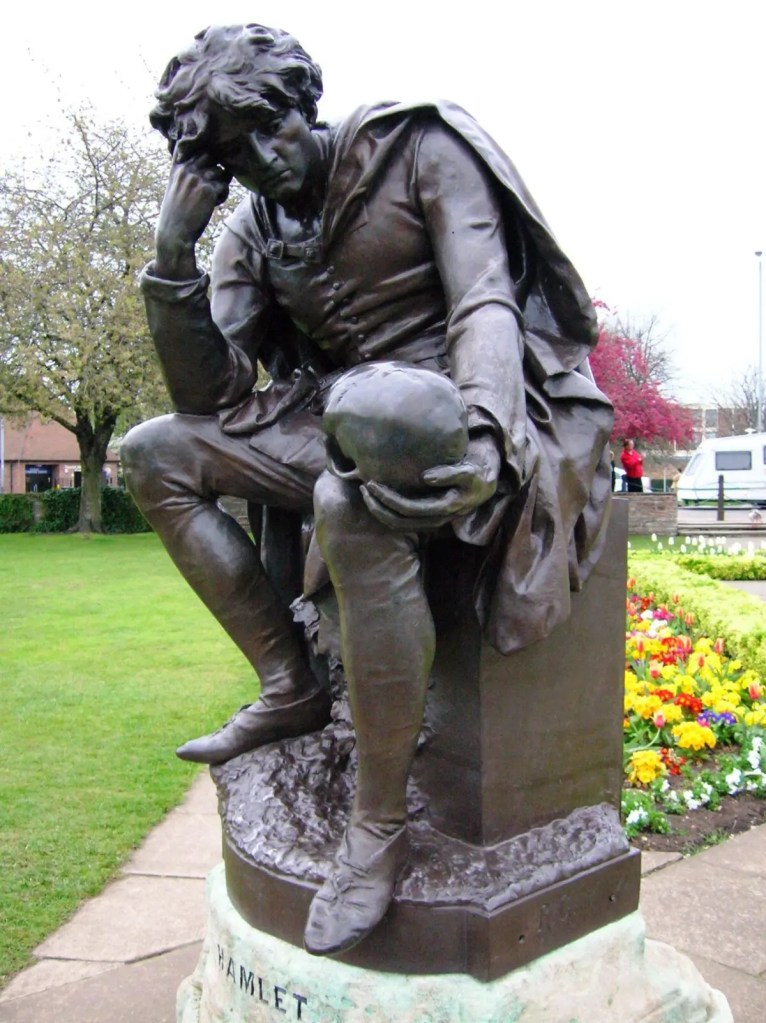
Hamlet. From Public Domain.
Kirpal Singh is a poet and a literary critic from Singapore. An internationally recognised scholar, Singh has won research awards and grants from local and foreign universities. He was one of the founding members of the Centre for Research in New Literatures, Flinders University, Australia in 1977; the first Asian director for the Commonwealth Writers’ Prize in 1993 and 1994, and chairman of the Singapore Writers’ Festival in the 1990s. He retired the Director of the Wee Kim Wee Centre.
PLEASE NOTE: ARTICLES CAN ONLY BE REPRODUCED IN OTHER SITES WITH DUE ACKNOWLEDGEMENT TO BORDERLESS JOURNAL
Art by Sohana ManzoorCourtesy: Suzanne Kamata Some of our visuals in 2024
As we wait for the new year to unfold, we glance back at the year that just swept past us. Here, gathered together are glimpses of the writings we found on our pages in 2024 that herald a world of compassion and kindness…writings filled with hope and, dare I say, even goodwill…and sometimes filled with the tears of poetic souls who hope for a world in peace and harmony. Disasters caused by humans starting with the January 2024 in Japan, nature and climate change, essays that invite you to recall the past with a hope to learn from it, non-fiction that is just fun or a tribute to ideas, both past and present — it’s all there. Innovative genres started by writers to meet the needs of the times — be it solar punk or weird western — give a sense of movement towards the new. What we do see in these writings is resilience which healed us out of multiple issues and will continue to help us move towards a better future.
A hundred years ago, we did not have the technology to share our views and writings, to connect and make friends with the like-minded across continents. I wonder what surprises hundred years later will hold for us…Maybe, war will have been outlawed by then, as have been malpractices and violences against individuals in the current world. The laws that rule a single man will hopefully apply to larger groups too…
Courtesy: Ratnottama Sengupta Courtesy: Farouk GulsaraSome of our visuals in 2024
Amalkantiby Nirendranath Chakraborty has been translated from Bengali by Debali Mookerjea-Leonard. Click hereto read.
The Mirror by Mubarak Qazi has been translated from Balochi by Fazal Baloch. Click hereto read.
Homecoming, a poem by Ihlwha Choi on his return from Santiniketan, has been translated from Korean by the poet himself. Click here to read.
Pochishe Boisakh(25th of Baisakh) by Tagore (1922), has been translated from Bengali by Mitali Chakravarty. Click here to read.
Nazrul’sGhumaite Dao Shranto Robi Re(Let Robi Sleep in Peace) has been translated from Bengali by Professor Fakrul Alam. Click hereto read.
Jibananada Das’sAndhar Dekhecche, Tobu Ache (I have seen the dark and yet there is another) has been translated from Bengali by Professor Fakrul Alam. Click here to read.
Tagore’sShotabdir Surjo Aji( The Century’s Sun today) has been translated from Bengali by Mitali Chakravarty. Clickhereto read.
A narrative by Rabindranath Tagore thatgives a glimpse of his first experience of snowfall in Brighton and published in the Tagore family journal, Balak (Children), has been translated from Bengali by Somdatta Mandal. Clickhere to read.
Suzanne Kamata discusses the peace initiatives following the terrors of the 1994 Rwandan Genocide while traveling within the country with her university colleague and students. Click here to read.
A story by Sharaf Shad, has been translated from Balochi by Fazal Baloch. Click here to read.
Conversations
Ratnottama Sengupta talks to Ruchira Gupta, activist for global fight against human trafficking, about her work and introduces her novel, I Kick and I Fly. Click here to read.
A conversation with eminent Singaporean poet and academic, Kirpal Singh, about how his family migrated to Malaya and subsequently Singapore more than 120 years ago. Click hereto read.
The description in ‘Hot Dry Summers’ is not of hell but what is perceived as happening on certain parts of Earth due to global warming or climate change. Forest fires. Nearer the equator, the storms have become harsher with lightning strikes that seem to connect the Earth to the sky. Trees get uprooted as the soil is softened from excessive rain. Sometimes, they fall on passers-by killing or injuring them. There is no rain in some places, forest fires or flooding in others… The highest temperatures touched 55 degrees Celsius this year. Instead of worrying about losing our homes lodged on land masses to the oceans that continue to rise, becoming dark heat absorbers due to loss of white ice cover, we persistently fight wars, egged on by differences highlighting divisive constructs. It feels strange that we are witness to these changes which seem to be apocalyptic to doomsday sayers. Are they right? Our flora, fauna and food will also be impacted by global climate change. How will we survive these? Will we outlive these as a species?
Poetry in our translations’ section travels to Balochistan, from where a Hafeez Rauf translated from Balochi by Fazal Baloch, talks of burning tyres, again conflicts. It takes on a deeper hue as Ihlwha Choi translates his poignant poem from Korean, reflecting on the death of his mother. We have a translation of Tagore’s less popular poem, Mrityu[1], reflecting on the same theme. His reflections on his wife’s death too have been translated by Professor Fakrul Alam who has also shared a song of Nazrul, written and composed on the death of Tagore. Another lesser-known poet but brilliant nonetheless, Nirendranath Chakraborty, has been translated for us by Debali Mookerjea-Leonard. And what a tremendous poem it is when the person called Amalkanti wanted to be sunshine! We have a story too — ‘Speech Matters’ by Naramsetti Umamaheswararao translated by Johny Takkedasila.
Our stories as usual travel around the world — from Holland (by Paul Mirabile) to Hyderabad (by Mohul Bhowmick) and with a quick pause at Bangalore (by Anagha Narasimha). Travels in the real world are part of our non-fiction. Sai Abhinay Penna takes to a the second largest mangrove forest in the world and Ravi Shankar to Colombo. Madhuri Bhattachrya gives us a glimpse of an Indian summer and Snigdha Aggrawal explores the impact of climate change in her part of the world. Farouk Gulsara actually writes his reflections at a traffic junction. And it reads droll…
We have an in memoriam by Keith Lyons on Morgan Spurlock, the documentary maker who ate McDonald fare for a month and then made a film on it. We have two tributes to two legends across time. Wayne F Burke has given a brief piece on the iconic illustrator, Norman Rockwell. And Aruna Chakravarti, the queen of historic fiction who brought the Tagore family alive for us in her two very well researched novels, Jorasanko and Daughters of Jorasanko, has given us a fabulous tribute to Tagore on the not-so common aspects of him.
Suzanne Kamata, the novelist who does a column from Japan for us normally, has spoken to us about her new novel, Cinnamon Beach, which overrides multiple manmade constructs. It’s an interesting read from someone who lives her life across multiple cultures and transcends many boundaries.
This is a bumper issue, and it is difficult to convey the vibrant hues of words that colour this edition. Please do pause by our contents page for a more comprehensive look.
This issue would not have been possible without all our fabulous contributors and a wonderful, dedicated team. We are delighted that Rakhi Dalal — who has done many reviews and shares her poetry with us in this issue — has agreed to be a writer-in-residence with us. A huge thanks to all of you, and especially Sohana Manzoor for her artwork. I am truly grateful to our readers for popularising our efforts to put together an online space with free and vibrant reads.
I would like to end with a few lines that gives me hope despite climate change, wars and doomsday predictions.
There’s more to life, he says to me, than what you choose to see.
Who would have thought it’s possible To undo centuries of traditions Trapped and shaped by norms galore?
On New Year Days, we wear black — Really — it’s the fashion these days! Even the Communists prefer black — Ditching the red to history’s dustbins!
Tough lessons History teaches, So we can make better judgments. Alas the mind resists and rejects Revisions which suggest undermining.
How weak our wills and our resolves!
I’M THE GOOD SHEPHERD
I bring you glory and a new life- History written in the Lamb’s blood And the Future assured in Love.
We hear and try to fathom meanings Written in blood — cold and hot, Alas, no revelations on the horizons And no blessings either in the making.
And so we toil and wait, Toil and wait for a new world, Where waiting will be no more And promises delivered on call—
Such, such shall be the Arrival Of a fresh understanding, Of what it means to be human, To know flesh and blood and the Soul’s search for a new heaven, And a new earth brimming, Sealing centuries of waiting, Fulfilling expectations of yore, Making past and present and future In a miracle beyond reckoning. This will come to pass as we sleep…
Kirpal Singh is a poet and a literary critic from Singapore. An internationally recognised scholar, Singh has won research awards and grants from local and foreign universities. He was one of the founding members of the Centre for Research in New Literatures, Flinders University, Australia in 1977; the first Asian director for the Commonwealth Writers’ Prize in 1993 and 1994, and chairman of the Singapore Writers’ Festival in the 1990s. He retired the Director of the Wee Kim Wee Centre.
PLEASE NOTE: ARTICLES CAN ONLY BE REPRODUCED IN OTHER SITES WITH DUE ACKNOWLEDGEMENT TO BORDERLESS JOURNAL
There was a time when humans walked the Earth crossing unnamed landmasses to find homes in newer terrains. They migrated without restrictions. Over a period of time, kingdoms evolved, and travellers like Marco Polo talked of needing permissions to cross borders in certain parts of the world. The need for a permit to travel was first mentioned in the Bible, around 450BCE. A safe conduct permit appeared in England in 1414CE. Around the twentieth century, passports and visas came into full force. And yet, humanity had existed hundreds of thousand years ago… Some put the date at 300,000!
While climate contingencies, wars and violence are geared to add to migrants called ‘refugees’, there is always that bit of humanity which regards them as a burden. They forget that at some point, their ancestors too would have migrated from where they evolved. In South Africa, close to Johannesburg is Maropeng with its ‘Cradle of Humanity’, an intense network of caves where our ancestors paved the way to our evolution. The guide welcomes visitors by saying — “Welcome home!” It fills one’s heart to see the acceptance that drips through the whole experience. Does this mean our ancestors all stepped out of Africa many eons ago and that we all belonged originally to the same land?
And yet there are many restrictions that have come upon us creating boxes which do not allow intermingling easily, even if we travel. Overriding these barriers is a discussion with Jessica Mudditt about Once Around the Sun: From Cambodia to Tibet, her book about her backpacking through Asia. Documenting a migration more than a hundred years ago from Jullundur to Malaya, when borders were different and more mobile, we have a conversation with eminent scholar and writer from Singapore, Kirpal Singh. Telling the story of another eminent migrant, a Persian who became a queen in the Mughal Court is a lyric by Nazrul, Nur Jahan, translated by Professor Fakrul Alam from Bangla. Ihlwha Choi has self-translated his own poem from Korean, a poem bridging divides with love. Fazal Baloch has brought to us some exquisite Balochi poems by Munir Momin. Tagore’s poem, Okale or Out of Sync, has been translated from Bengali to reflect the strange uniqueness of each human action which despite departing from the norm, continue to be part of the flow.
We have a tongue in cheek piece from Devraj Singh Kalsi on traveling in a train with a politician. Uday Deshwal writes with a soupçon of humour as he talks of applying for jobs. Snigdha Agrawal brings to us flavours of Bengal from her past while Ratnottama Sengupta muses on the ongoing wars and violence as acts of terror in the same region and looks back at such an incident in the past which resulted in a powerful Bengali poem by Tarik Sujat. Kiriti Sengupta has written of a well-known artist, Jatin Das, a strange encounter where the artist asks them to empty fully even a glass of water! Ravi Shankar weaves in his love for books into our non-fiction section. Recounting her mother’s migration story which leads us to perceive the whole world as home is a narrative by Renee Melchert Thorpe. Urmi Chakravorty takes us to the last Indian village on the borders of Tibet. Taking us to a Dinosaur Museum in Japan is our migrant columnist, Suzanne Kamata. Her latest multicultural novel, Cinnamon Beach, has found its way to our book excerpts as has Flanagan’s poetry collection, These Many Cold Winters of the Heart.
In reviews, Somdatta Mandal has written about an anthology, Maya Nagari: Bombay-Mumbai A City in Storiesedited by Shanta Gokhale and Jerry Pinto. Rakhi Dalal has discussed a translation from Konkani by Jerry Pinto of award-winning writer Damodar Mauzo’sBoy, Unloved. Basudhara Roy has reviewed Trailokyanath Mukhopadhyay’s Tales of Early Magic Realism in Bengali, translated by Sucheta Dasgupta. Bhaskar Parichha has introduced us toThe Dilemma of an Indian Liberal by Gurcharan Das, a book that is truly relevant in the current times in context of the whole world for what he states is a truth: “In the current polarised climate, the liberal perspective is often marginalised or dismissed as being indecisive or weak.” And it is the truth for the whole world now.
Our short stories reflect the colours of the world. A fantasy set in America but crossing borders of time and place byRonald V. Micci, a story critiquing social norms that hurt by Swatee Miittal and Paul Mirabile’s ghost story shuttling from the Irish potato famine (1845-52) to the present day – all address different themes across borders, reflecting the vibrancy of thoughts and cultures. That we all exist in the same place and have the commonality of ideas and felt emotions is reflected in each of these narratives.
We have more which adds to the lustre of the content. So, do pause by our content’s page and enjoy the reads!
I would like to thank all our team without who this journal would be incomplete, especially, Sohana Manzoor, for her fabulous artwork. Huge thanks to all our contributors who bring vibrancy to our pages and our wonderful readers, without who the journal would remain just part of an electronic cloud… We welcome you all to enjoy our June issue.







 Borderless