In winters, birds migrate. They face no barriers. The sun also shines across fences without any hindrance. Long ago, the late Nirendranath Chakraborty (1924-2018) wrote about a boy, Amalkanti, who wanted to be sunshine. The real world held him back and he became a worker in a dark printing press. Dreams sometimes can come to nought for humanity has enough walls to keep out those who they feel do not ‘belong’ to their way of life or thought. Some even war, kill and violate to secure an exclusive existence. Despite the perpetuation of these fences, people are now forced to emigrate not only to find shelter from the violences of wars but also to find a refuge from climate disasters. These people — the refuge seekers— are referred to as refugees[1]. And yet, there are a few who find it in themselves to waft to new worlds, create with their ideas and redefine norms… for no reason except that they feel a sense of belonging to a culture to which they were not born. These people are often referred to as migrants.
At the close of this year, Keith Lyons brings us one such persona who has found a firm footing in New Zealand. Setting new trends and inspiring others is a writer called Harry Ricketts[2]. He has even shared a poem from his latest collection, Bonfires on the Ice. Ricketts’ poem moves from the personal to the universal as does the poetry of another migrant, Luis Cuauhtémoc Berriozábal, aspiring to a new, more accepting world. While Tulip Chowdhury — who also moved across oceans — prays for peace in a war torn, weather-worn world:
I plant new seeds of dreams for a peaceful world of tomorrow.
Fiction in this issue reverberates across the world with Marc Rosenberg bringing us a poignant telling centred around childhood, innocence and abuse. Sayan Sarkar gives a witty, captivating, climate-friendly narrative centred around trees. Naramsetti Umamaheswararao weaves a fable set in Southern India.
A story by Nasir Rahim Sohrabi from the dusty landscapes of Balochistan has found its way into our translations too with Fazal Baloch rendering it into English from Balochi. Isa Kamari translates his own Malay poems which echo themes of his powerful novels, A Song of the Wind (2007) and Tweet(2017), both centred around the making of Singapore. Snehaprava Das introduces Odia poems by Satrughna Pandab in English. While Professor Fakrul Alam renders one of Nazrul’s best-loved songs from Bengali to English, Tagore’s translated poem Jatri (Passenger) welcomes prospectives onboard a boat —almost an anti-thesis of his earlier poem ‘Sonar Tori’ (The Golden Boat) where the ferry woman rows off robbing her client.
We have plenty of non-fiction this time starting with a tribute to Jane Austen (1775-1817) by Meenakshi Malhotra. Austen turns 250 this year and continues relevant with remakes in not only films but also reimagined with books around her novels — especially Pride and Prejudice (which has even a zombie version). Bhaskar Parichha pays a tribute to writer Bibhuti Patnaik. Ravi Varmman K Kanniappan explores ancient Sangam Literature from Tamil Nadu and Ratnottama Sengupta revisits an art exhibition that draws bridges across time… an exploration she herself curated.
Farouk Gulsara — with his dry humour — critiques the growing dependence on artificial intelligence (or the lack of it). Devraj Singh Kalsi again shares a spooky adventure in a funny vein.
We have a spray of colours from across almost all the continents in our pages this time. A bumper issue again — for which all of the contributors have our heartfelt thanks. Huge thanks to our fabulous team who pitch in to make a vibrant issue for all of us. A special thanks to Sohana Manzoor for the fabulous artwork. And as our readers continue to grow in numbers by leap and bounds, I would want to thank you all for visiting our content! Introduce your friends too if you like what you find and do remember to pause by this issue’s contents page.
Wish all of you happy reading through the holiday season!
Festivals are affirmations of joy and love that bind humanity with their sense of hope even in a world torn by violence and climate change. As the end of the year approaches, we invite you to savour flavours of festivals past and, a few, yet to come, before the cycle starts again in the new year. The colours of celebrations are vibrant and varied as shades of nature or the skies.
We have new years spread out over the year, starting with January, moving on to the Chinese New Year around February, the Bengali new year in April to festivals of environment, light, darkness as in Wiccan beliefs, Tagore’s birth, more conventional ones like Deepavali, Eid, Durga Puja and Christmas. People celebrate in different ways and for different reasons. What we have also gathered is not only the joie de vivre but also the sadness people feel when celebrations are muted whether due to the pandemic, wars or for social reasons. In some cases, we indulge in excesses with funny results! And there are of course festivals of humanity … as celebrated by the bauls — the singing mendicants of Bengal — who only recognise the religion of love, compassion and kindness.
Ramakanta Rath’sSri Radha celebrating the love of Radha and Krishna have been translated from Odiya by the late poet himself, have been excerpted from his full length translation. Click here to read.
Bijoya Doushumi, a poem on the last day of Durga Puja, by the famous poet, Michael Madhusudan Dutt, has been translated from Bengali by Ratnottama Sengupta. Click here to read.
A Clean Start: Suzanne Kamata tells us how the Japanese usher in a new year. Click here to read.
Shanghai in Jakarta: Eshana Sarah Singh takes us to Chinese New Year celebrations in Djakarta. Click here to read.
Cherry Blossom Forecast: Suzanne Kamata brings the Japanese ritual of cherry blossom viewing to our pages with her camera and words. Clickhere to read.
Pohela Boisakh: A Cultural Fiesta: Sohana Manzoor shares the Bengali New Year celebrations in Bangladesh with interesting history and traditions that mingle beyond the borders. Clickhere to read.
The New Year’s Boon: Devraj Singh gives a glimpse into the projection of a new normal created by God. Click here to read.
A Musical Soiree: Snigdha Agrawal recalls how their family celebrated Tagore’s birth anniversary. Click here to read.
An Alien on the Altar! Snigdha Agrawal writes of how a dog and lizard add zest to Janmashtami (Krishna’s birthday) festivities with a dollop of humour. Click here to read
Memories of Durga Puja : Fakrul Alam recalls the festivities of Durga Puja in Dhaka during his childhood. Click hereto read.
KL Twin Towers near Kolkata?: Devraj Singh Kalsi visits the colours of a marquee hosting the Durga Puja season with its spirit of inclusivity. Click here to read.
Hold the roast turkey please Santa: Celebrating the festive season off-season with Keith Lyons from New Zealand, where summer solstice and Christmas fall around the same time. Click here to read.
Our home is our planet with it’s unique combinations which have made life possible. These evolve and mutate with human intervention and the passage of time. The changes affect the flora and the fauna — of which we are a part — of this beautiful green planet. The World Environment Day is a UN initiative to protect the environment and to create an awareness about the changes wrought on it and how it could impact us as a species. Writers from yore have written of the beauty and the inspiration invoked by nature as have the moderns. Today, we share with you vintage writings as well as modern writing in prose on the world around us, showcasing the concerns of a century ago and the reality today.
Vintage Prose
One Small Ancient Tale: Rabindranath Tagore’s Ekti Khudro Puraton Golpo (One Small Ancient Tale) has been translated by Nishat Atiya. Click hereto read.
Bolai: Story of nature and a child translated by Chaitali Sengupta. Click hereto read.
Baraf Pora (Snowfall) : This narrative gives a glimpse of Tagore’s first experience of snowfall in Brighton and published in the Tagore family journal, Balak (Children), has been translated by Somdatta Mandal . Clickhere to read.
The Day of Annihilation, an essay on climate change by Kazi Nazrul Islam, has been translated from Bengali by Radha Chakravarty. Clickhereto read.
Modern Prose
The Gift : Rebecca Klassen shares a sensitive fiction about a child and an oak tree. Click here to read.
A Penguin’s Story: Sreelekha Chatterjee writes a fiction from a penguin’s perspective. Clickhere to read.
Navigational Error: Luke P.G. Draper explores the impact of pollution with a short compelling narrative. Click here to read.
Pigeons & People : In his fiction, Srinivasan R explores human nature and imagines impact on our fauna. Click here to read
The Theft of a River: Koushiki Dasgupta Chaudhuri reveals a poignant truth about how a river is moving towards disappearance due to human intervention. Clickhereto read.
Potable Water Crisis & the Sunderbans: Camellia Biswas, a visitor to Sunderbans during the cyclone Alia, turns environmentalist and writes about the potable water issue faced by locals. Click here to read.
Jibanananda Das’ poems on war and for the common masses have been translated from Bengali by Professor Fakrul Alam. Click here to read.
A Scene with an Aged Queen, a poem by Ihlwha Choi has been translated from Korean by the poet himself. Clickhere to read.
Tagore’sEsho Bosonto, Esho Aj Tumi(Come Spring, Come Today) has been translated from Bengali by Mitali Chakravarty. Click here to read.
Pandies’ Corner
For Sanjay Kumar: To Sir — with Love has been written for the founder of pandies’ theatre by Tanvir, a youngster from the Nithari village where pandies’ worked with traumatised victims. Over time, these kids have transcended the trauma to lead fulfilling lives. The late Sanjay Kumar passed on this January. This is a tribute to him by one of his students. It has been translated from the Hindustani original by Lourdes M Surpiya. Click here to read.
Drops of water gather to make a wave. The waves make oceans that reshape land masses over time…
Five years ago, on March 14th, in the middle of the pandemic, five or six of us got together to start an online forum called Borderless Journal. The idea was to have a space that revelled with the commonality of felt emotions. Borderless was an attempt to override divisive human constructs and bring together writers and ideators from all over the Earth to have a forum open to all people — a forum which would be inclusive, tolerant, would see every individual as a part of the fauna of this beautiful planet. We would be up in the clouds — afloat in an unbordered stratosphere— to meet and greet with thoughts that are common to all humans, to dream of a world we can have if we choose to explore our home planet with imagination, kindness and love. It has grown to encompass contributors from more than forty countries, and readers from all over the world — people who have the same need to reach out to others with felt emotions and common concerns.
Borderless not only celebrates the human spirit but also hopes to create over time a vibrant section with writings on the environment and climate change. We launch the new section today on our fifth anniversary.
Devraj Singh Kalsi with a soupçon of ironic amusement muses on humans’ attitude to the fauna around him and Farouk Gulsara lays on a coating of sarcasm while addressing societal norms. Meredith Stephens brings us concerns for a green Earth when she beachcombs in a remote Australian island. Prithvijeet Sinha continues to familiarise us with his city, Lucknow. Suzanne Kamata, on the other hand travels to Rwanda to teach youngsters how to write a haiku!
Professor Fakrul Alam takes us to libraries in Dhaka with the hope that more will start writing about the waning of such paradises for book lovers. Other than being the month that hosts World Environment Day, March also homes, International Women’s Day. Commemorating the occasion, we have essays from Meenakshi Malhotra on the past poetry of women and from Ratnottama Sengupta on women in Bengali Cinema. Sengupta has also interviewed Poulami Bose Chatterjee, the daughter of the iconic actor Soumitra Chatterjee to share with us less-known vignettes from the actor’s life. Keith Lyons has interviewed Malaysian writer-editor Daphne Lee to bring to us writerly advice and local lores on ghosts and hauntings.
We also have a translation by Lourdes M Supriya from Hindustani of a student’s heartrending cry to heal from grief for a teacher who faced an untimely end — a small dirge from Tanvir, a youngster with his roots in Nithari violence who transcended his trauma to teach like his idol and tutor, the late Sanjay Kumar. With this, we hope to continue with the pandies corner, with support from Lourdes and Anuradha Marwah, Kumar’s partner.
Borderless has grown in readership by leaps and bounds. There have been requests for books with writings from our site. On our fifth anniversary, we plan to start bringing out the creative writing housed in Borderless Journal in different volumes. We had brought out an anthology in 2022. It was well received with many reviews. But we have many gems, and each writer is valued here. Therefore, Rhys Hughes, one of our editorial board members, has kindly consented to create a new imprint to bring out books from the Borderless Journal. We are very grateful to him.
We are grateful to the whole team, our contributors and readers for being with us through our journey. We would not have made it this far without each one of you. Special thanks to Sohana Manzoor for her artwork too, something that has almost become synonymous with the cover page of our journal. Thank you all from the bottom of my heart.
Wish you all happy reading! Do pause by our content’s page and take a look at all the wonderful writers.
Storytelling is central to the life and work of Malaysian author, editor and teacher, Daphne Lee. Keith Lyons finds out what keeps her up at night.
When I1 first met Daphne Lee in person, in a Chinese Buddhist cafe in Christchurch, New Zealand, on a summery day. I was struck by her curiosity. And I came away impressed, not just by how she delights in hearing ghost stories, myths, supernatural tales, and folklore but how she makes connections to the universality of storytelling, and what lies beneath.
Daphne Lee
As well as being a collector and curator of stories, she’s a writer, a creative writing teacher, and an editor—since 2009 she’s been consulting editor at Scholastic Asia. She’s been active in supporting the work of writers and illustrators of children’s and young adult literature with Asian content. Daphne curated and edited Malaysian Tales: Retold & Remixed (ZI Publications) in 2011 and Remang: An Anthology of Ghostly Tales (Terrer Books) in 2018, while Bright Landscapes, Daphne’s first collection of short stories, was published in 2019. She’s working on a new short story collection, and her first novel, which she is currently revising while in New Zealand on a writing retreat, far from the streets of Kuala Lumpur and her Roman Catholic school upbringing.You can find out more about the multi-talented Daphne at her website https://daphnelee.org/.
Interview with Keith Lyons
What inspired you to create Remang: An Anthology of Ghostly Tales?
Malaysians love ghost stories. We would rather any misfortune or unusual occurrence be caused by a spirit or other supernatural phenomena than try to figure out a logical reason. Having said that, I don’t believe in ghosts, but I do enjoy ghost stories. I thought it would be fun to edit a collection of these, but I was wrong …
How do you approach writing and curating ghost stories? What elements do you feel make a truly eerie and memorable tale?
I prefer a story to suggest a mood and to be atmospherically or suggestively spooky than to be full of gory and blood-curdling details. I like the sort of ghost stories that are frightening only if you read between the lines or that seem unremarkable at first, but months later, you suddenly realise what it all means.
Your work often draws from Asian folklore and supernatural beliefs. Are there any particular myths or legends that have influenced your storytelling?
Nothing in particular, but I have heard the same stories all my life and with surprisingly few variations and differences. I enjoy retelling the old tales or building on elements in them. Hopefully, I make a completely new story, but with recognisable features because I like reading stories in which there are some familiar details.
Do you have a personal ghost story or supernatural experience that shaped your interest in this genre?
My family lived in a haunted house in my hometown (Segamat in Johor, the peninsula’s southern-most state) and we experienced things like lights going on and off, footsteps, odd, unexplained sounds, and so on. I can’t remember much, but I don’t think any of us ever felt threatened during the eight years we lived there. If there were spirits, they were not malevolent. My interest in the supernatural was probably more shaped by the films I watched as a child, including The Exorcist and the Hammer House of Horror — Dracula films starring Christopher Lee.
As an editor, what do you look for in a compelling ghost story?
The problem with the ghost stories we tell one another is that they are usually just anecdotal fragments. I look for fully-formed stories with well-developed characters—the ghostly element might even seem merely incidental to the plot yet be significant enough to make an impression. It should haunt you a long time after you’ve stopped reading.
How do you balance creative freedom with maintaining a strong thematic or narrative structure in an anthology?
I’ve curated two anthologies—one of ghost stories and the other of retellings of folktales, myths and legends. For both the brief was quite open and I welcomed a variety of styles and voices.
What are some of the challenges you face when working with authors, particularly in speculative fiction and folklore-based stories?
I find that when it’s an open call, it can be challenging to gather enough suitable stories for an anthology. Once you’ve made the selection, the editing process is usually long and laborious, with more back and forth than the deadline allows. It’s a much more straightforward process when experienced authors are invited to contribute to an anthology. With the authors published by my day-job (at Scholastic Asia), the major challenge is when the author is too precious about what they’ve created and is adamant about retaining something that doesn’t work or refuses to/is unable to develop a half-formed idea. Fortunately, that has rarely been the case. It’s imperative that authors trust their editors and, thankfully, I’ve had a good relationship with most of the writers with whom I’ve worked.
You’ve been deeply involved in the Malaysian publishing scene. How has the landscape for local horror and supernatural fiction evolved over the years?
I’m not directly involved in the scene as most of my work as an editor is with an American publishing house, albeit its Asian imprint. However, I am a reader of locally published books and do read some supernatural fiction written in the Malay language. When I was a teenager, I was a fan of a series of books with the series title Bercakap Dengan Jin (Talking with a Jinn)—they were dark tales that featured a witch doctor, set in rural Malaysia, with lurid covers and badly designed interior pages. The production value of horror fiction has improved, but the stories that are most popular are still the ones we are familiar with, especially about the ghosts that haunt every school and hospital in the country. They are hastily written and barely edited, with high print runs—horror sells, second only to romance novels.
How important is it for Malaysian and Asian supernatural stories to be represented in the broader literary world?
The world needs to realise that there is more to Asia than just what the West is showing it. Right now, a handful of houses controls what most of us are exposed to and end up reading. Even if Asian fiction is getting on the shelves, it’s only what these publishing houses have decided is worthy. In Asia, especially those countries that were colonised, readers are still stuck with the idea that books out of the UK and the US are better than those published locally. In Malaysia, we have some authors who have ‘made it’ in the West—people like Tan Twan Eng, Tash Aw, Preeta Samarasan and Zen Cho. They are excellent writers, but I don’t know if many Malaysians would pay attention to their work if they were published by Malaysian houses. Unfortunately, we don’t appear to be very discerning readers. Penguin Random House SEA, which runs out of Singapore and is riding on the Penguin brand, fails to offer sufficient editorial support to its authors and seems to be prioritising marketability and quantity over quality. Readers buy the books because Penguin is supposed to equal quality. Writers sign contracts with the house because they recognise PRH as a popular brand with a great reputation. They complain about the poor editing but choose to stay with the company. This is a kind of horror story too!
Do you think traditional ghost stories still resonate with modern readers? How do you adapt them to contemporary audiences?
I think so. I think part of the attraction of ghost stories is that people like to be scared as long as they can also feel safe while feeling terrified. Traditional ghost stories are the perfect comfort reads. They are thrilling yet familiar. You know what’s coming—all the scary bits, but there’s usually a happy ending too, when the ghosts are put to rest and the humans go back to their boring lives.
Many Western readers are familiar with ghosts like the vengeful spirit or the haunted house trope. What uniquely Malaysian or Asian ghostly elements do you wish more people knew about?
The Asian ghosts most familiar to Western readers are probably the Japanese yokai. Once again, there is a degree of gatekeeping going on. A Malaysian author I know was looking for a lit agent and was told that although her writing was good, her stories were ‘too South-east Asian’. What does that even mean? Western publishers and agents underestimate the ability of readers to relate to subjects unfamiliar, especially when they originate in South-east Asia. Often you hear that a publisher or agent already has a South-east Asian on their list and does not have room for more. Yet, there are officially eleven countries that make up the region. They are not interchangeable, and do not share a common language, history or culture. Malaysia has many types of ghosts and they each reflect the various beliefs and attitudes Malaysians have towards life and all its big and petty questions. To know these spirits is to know the fears and anxieties of the common Malaysian.
You’re planning an online archive of Malaysian folktales. Could you share more about this project and why it’s important to preserve these stories?
I was recently on a panel about folktales with two other Malaysian authors who write books that draw on folktales for inspiration and one of them said that the folktales that stick around are the ones that mean something to the community. This may have been true in the past when folktales were shared orally. These days, the ones that survive are those that get included in collections or are retold and reimagined into films etc. The same ones get recycled time and time again, probably because they are the most dramatic or sentimental. Collecting as many folktales as possible and storing them online gives them all a fair chance of surviving. What may be insignificant to one generation, may resonate for another. The main thing is to let each generation decide, and for the stories to be available and accessible.
Bright Landscapes was your first personal collection of short stories. How did that experience differ from curating Remang?
For Bright Landscapes I had only myself with whom to argue and disagree. My editor and I were, fortunately, on the same wavelength, but she really helped me improve on the quality of the stories. I wouldn’t undertake another project like Remang unless more time and more resources were available.
Can you share any details about your upcoming novel? What themes or ideas are you exploring?
During the pandemic I completed a novel but on reading it, I realised how rubbish it was. It’s very close to my heart, but I think it’s not quite the right time for a rewrite. It needs to ‘cook’ more, in my subconscious. That novel is set in a world where gods and humans live side-by-side, during a time of religious reform. The protagonists are a priest and a deity, and the story deals with questions of friendship, integrity, religious belief, and faith. I have a second novel that I am currently working on—a coming-of-age story set in a convent school in a small Malaysian town in the 1980s. It also explores questions of friendship and faith. I attended two Convent schools from age five to seventeen, and I was raised Roman Catholic. I did think of becoming a nun when I was in my early teens, like the protagonist of my novel, but I have been an atheist since my early twenties, although I am now probably more agnostic than anything. Religious belief and faith are subjects fascinating to me.
As a creative writing teacher, what advice would you give to aspiring writers interested in supernatural fiction?
The same advice I would give any aspiring writer: Read widely and voraciously. And write every day, about anything and everything.
If you could collaborate with any author—living or deceased—on a ghost story, who would it be and why?
I don’t want to collaborate with anyone, but I would like to have a conversation with Elizabeth Bowen about the handful of ghost stories she published. They are my favourites—quiet, mysterious, melancholy, sardonic. I have questions about them that still keep me up at night, decades after I first read them.
Keith Lyons (keithlyons.net) is an award-winning writer and creative writing mentor originally from New Zealand who has spent a quarter of his existence living and working in Asia including southwest China, Myanmar and Bali. His Venn diagram of happiness features the aroma of freshly-roasted coffee, the negative ions of the natural world including moving water, and connecting with others in meaningful ways. A Contributing Editor on Borderless Journal’s Editorial Board, his work has appeared in Borderless since its early days, and his writing featured in the anthology Monalisa No Longer Smiles.
.
PLEASE NOTE: ARTICLES CAN ONLY BE REPRODUCED IN OTHER SITES WITH DUE ACKNOWLEDGEMENT TO BORDERLESS JOURNAL.
Tumi Kon Kanoner Phulby Tagore andAnjali Loho Morby Nazrul, love songs by the two greats, have been translated from Bengali by Professor Fakrul Alam. Click hereto read.
One Life, One Love, 300 Children : Keith Lyons writes of Tendol Gyalzur, a COVID 19 victim, a refugee and an orphan who found new lives for many other orphans with love and an ability to connect. Click here to read.
When West Meets East & Greatness Blooms: Debraj Mookerjee reflects on how syncretism impacts greats like Tagore,Tolstoy, Emerson, Martin Luther King Jr, Gandhi and many more. Click here to read.
Dilip Kumar: Kohinoor-e-Hind: In a tribute to Bollywood legend Dileep Kumar, Ratnottama Sengupta, one of India’s most iconic arts journalists, recollects the days the great actor sprinted about on the sets of Bombay’s studios …spiced up with fragments from the autobiography of Sengupta’s father, Nabendu Ghosh. Click here to read.
Are Some of Us More Human than Others ?: Meenakshi Malhotra ponders at the exclusivity that reinforces divisions, margins and borders that continue to plague humankind, against the backdrop of the Women’s Month, March. Click here to read.
Reminiscences from a Gallery: MF Husain: Dolly Narang recounts how she started a gallery more than four decades ago and talks of her encounter with world renowned artist, MF Husain. Click hereto read.
Baraf Pora (Snowfall) by Rabindranath Tagore,gives a glimpse of his first experience of snowfall in Brighton and published in the Tagore family journal, Balak (Children), has been translated from Bengali by Somdatta Mandal. Clickhere to read.
Cherry Blossom Forecast: Suzanne Kamata brings the Japanese ritual of cherry blossom viewing to our pages with her camera and words. Clickhere to read.
Two Pizza Fantasies, Rhys Hughes recounts myths around the pizza in prose, fiction and poetry, Click here to read.
An Alien on the Altar!: Snigdha Agrawal writes of how a dog and lizard add zest to festivities with a dollop of humour. Click here to read.
Where it all Began: Sybil Pretious recounts her first adventure, an ascent on Mt Kilimanjaro at the age of sixty. Clickhere to read.
Conversations
Rabindranath Tagore: A Universal Bard.: This conversation between Aruna Chakravarti and Sunil Gangopadhyay that took place at a Tagore Conference organised by the Sahitya Akademi in Kochy in 2011. Click here to read.
Sriniketan: Tagore’s “Life Work”: In Conversation with Professor Uma Das Gupta, Tagore scholar, author of A History of Sriniketan, where can be glimpsed what Tagore considered his ‘life’s work’ as an NGO smoothening divides between villagers and the educated. Click here to read. (Review & Interview).
In conversation with the late Akbar Barakzai, a Balochi poet in exile who rejected an award from Pakistan Academy of Letters for his principles. Click here to read.
Jim Goodman, an American traveler, author, ethnologist and photographer who has spent the last half-century in Asia, converses with Keith Lyons. Click here to read.
InBridge over Troubled Waters, the late Sanjay Kumar tells us about Pandies, an activist theatre group founded by him that educates, bridging gaps between the divides of university educated and the less fortunate who people slums or terror zones. Click here to read.
In Lessons Old and New from a Stray Japanese Cat, Keith Lyons talks with the author of The Cat with Three Passports, CJ Fentiman who likes the anonymity loaned by resettling in new places & enjoys creating a space for herself away from her birthplace. Click hereto read.
Fiction
Aparichitaby Tagore: This short story has been translated as The Stranger by Aruna Chakravarti. Click hereto read.
Hena by Nazrul has been translated from Bengali by Sohana Manzoor. Click here to read.
Playlets byRabindranath Tagore: Two skits that reveal the lighter side of the poet. They have been translated from Bengali by Somdatta Mandal. Click here to read.
Abhagi’s Heaven, a poignant story by Saratchandra Chattopadhyay translated by Aruna Chakravarti. Click here to read.
An Eternal Void, a Balochi story by Munir Ahmed Badini translated by Fazal Baloch. Click hereto read.
The Witch, a short story by renowned Bengali writer Tarasankar Bandopadhyay (1898 to 1971), translated by Aruna Chakravarti. Clickhere to read.
I Grew into a Flute: Balochi Folktale involving magic retold by Fazal Baloch. Click here to read.
Give Me A Rag, Please:A short story by Nabendu Ghosh, translated by Ratnottama Sengupta, set in the 1943 Bengal Famine, which reflects on man’s basic needs. Click here to read
Rakhamaninov’s Sonata: A short story by Sherzod Artikov, translated from Uzbeki by Nigora Mukhammad. Click hereto read.
The Magic Staff , a poignant short story about a Rohingya child by Shaheen Akhtar, translated from Bengali by Arifa Ghani Rahman. Click here to read.
Khaira, the Blind, a story by Nadir Ali, has been translated from Punjabi by Amna Ali. Click here to read.
The Browless Dolls by S.Ramakrishnan, has been translated from Tamil by B Chandramouli. Click hereto read.
No Man’s Land: Sohana Manzoor gives us surrealistic story reflecting on after-life. Click hereto read.
The Protests Outside: Steve Ogah talks of trauma faced by riot victims in Nigeria. Click here to read.
Flash Fiction: Turret: Niles M Reddick relates a haunting tale of ghosts and more. Click here to read.
Henrik’s Journey: Farah Ghuznavi follows a conglomerate of people on board a flight to address issues ranging from Rohingyas to race bias. Click hereto read.
Does this Make Me a Psychic?; Erwin Coombs tells a suspenseful, funny, poignant and sad story, based on his real life experiences. Click here to read.
Phôs and Ombra: Paul Mirabile weaves a dark tale about two people lost in a void. Click here to read.
A Queen is Crowned: Farhanaz Rabbani traces the awakening of self worth. Click here to read.
Borderless Journal started on March, 14, 2020. When the mayhem of the pandemic had just set in, we started as a daily with half-a-dozen posts. Having built a small core of writings by July, 2020, we swung to become a monthly. And we still continue to waft and grow…
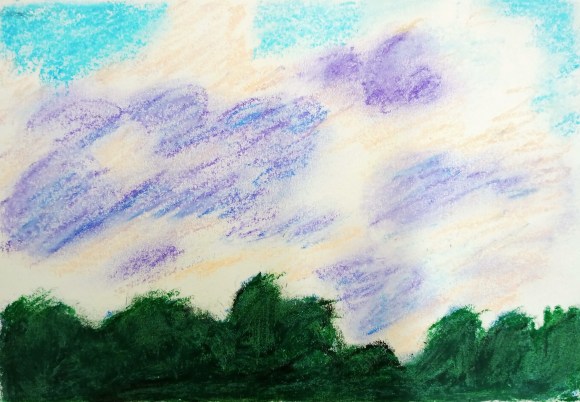
Art by Sohana Manzoor
We like to imagine ourselves as floating on clouds and therefore of the whole universe. Our team members are from multiple geographies and we request not to be tied down to a single, confined, bordered land. We would welcome aliens if they submitted to us from another galaxy…
On our Fifth Anniversary, we have collected celebratory greetings from writers and readers stretched across the world who share their experience of the journal with you and offer suggestions for the future. We conclude with words from some of the team, including my own observations on being part of this journey.
Aruna Chakravarti
Heartiest congratulations to Borderless on the occasion of its fifth anniversary! Borderless, an international journal, has the distinction of carrying contributions from many eminent writers from around the world. From its initiation in 2020, it has moved from strength to strength under the sensitive and skillful steering of its team. Today it is considered one of the finest journals of its kind. I feel privileged to have been associated with Borderless from its very inception and have contributed substantially to it. I wish to thank the team for including my work in their distinguished journal. May Borderless move meaningfully towards the future and rise to greater and greater heights! I wish it every success.
Professor Fakrul Alam
Five years ago, when Borderless set out on its literary voyage, who would have imagined the length and breadth of its imaginative crossings in this span of time? The evidence, however, is digitally there for any reader who has seen at least some of its issues. Creative writing spanning all genres, vivid illustrations, instant links giving resolute readers the option to track a contributor’s creative voyaging—here is boundless space always opening up for those seeking writing of considerable variety as well as originality. The best part here is that unlike name-brand journals, which will entice readers with limited access and then restrict their spaces unless you subscribe to them, all of Borderless is still accessible for us even though it has attracted a wide readership in five years. I certainly hope it will stay that way.
And what lies ahead for Borderless? Surely, more opportunities for the creative to articulate their deepest thoughts and feelings in virtual and seemingly infinite space, and innumerable avenues for readers to access easily. And let us hope, in the years to come Borderless will extend itself to newer frontiers of writing and will continue to keep giving space to new as well as emerging writers from our parts of the world.
May the team of Borderless, continue to live up to their claim that “there are no boundaries to human imagination and thought!”
Radha Chakravarty
Since its inception, Borderless Journal has remained true to its name, offering a vital literary space for writers, artists and scholars from around the world to engage in creative dialogue about their shared vision of a world without borders. Congratulations Borderless, and may your dream of global harmony continue to inspire.
Somdatta Mandal
According to the famous Chicana academic and theorist Gloria Anzaldua, the Borderlands are physically present wherever two or more cultures edge each other, where peopIe of different races occupy the same territory, where under, lower, middle and upper classes touch, where the space between two individuals shrinks with intimacy. Hatred, anger and exploitation are the prominent features of this landscape. There, at the juncture of cultures, languages cross-pollinate and are revitalized; they die and are born. Borders are set up to define the places that are safe and unsafe, to distinguish us from them. A border is a dividing line, a narrow strip along a steep edge. A borderland is a vague and undetermined place created by the emotional residue of an unnatural boundary. It is in a constant state of transition. The prohibited and forbidden are its inhabitants.
About five years ago, when a new online journal aptly called Borderless Journal was launched, these ideas which we had been teaching for so long were simply no longer applicable. Doing away with differences, with limits, it became a suitable platform where disparate cultures met, where people from all disciplines could express their views through different genres, be it poetry, translation, reviews, scholarly articles, creative writing and so on. Many new writers from different parts of the world became regular contributors to this unique experimentation with ‘borderlessness’ and its immense possibilities are very apt in this present global context where social media has already changed many earlier notions of scholarship, journalism, and creativity.
Jared Carter
In its first five years Borderless has become an important witness for international peace and understanding. It has encouraged submissions from writers in English based in many different countries, and has offered significant works translated from a wide range of national literatures. Its pages have featured writers based in India, Pakistan, China, Taiwan, Japan, South Korea, Australia, the UK, and the US. In the future, given the current level of world turmoil, Borderless might well consider looking more closely toward Africa and the Middle East. As the magazine continues to promote writing focused on international peace and freedom, new horizons beckon.
Teresa Rehman
The best part of this journal is that it is seamless and knows no margins or fringes. It is truly global as it has cut across geographical borders and has sculpted a novel literary genre called the ‘borderless’. It has climbed the mountains of Nepal, composed songs on the Brahmaputra in Assam, explored the hidden kingdom of Bhutan, walked on the streets of Dhaka, explored the wreckage of cyclones in Odisha, been on a cycling adventure from Malaysia to Kashmir, explored a scenic village in the Indo-China border, taken readers on a journey of making a Japanese-Malayalam dictionary, gave a first-hand account of the war in Bosnia-Herzegovina and described the syncretic culture of Bengal through its folk music and oral traditions. I hope it continues telling the untold and unchartered stories across mountains, oceans and forests.
Kirpal Singh
In a world increasingly tending towards misunderstandings across borders, this wholesome journal provides a healthy space both for diverse as well as unifying visions of our humanity. As we celebrate five distinguished years of Borderless Journal, we also look forward to another five years of such to ensure the underlying vision remains viable and visible as well as authentic and accurate.
My heartfelt Congratulations to all associated with this delightful and impressive enterprise!
Asad Latif
The proliferation of ethnic geographies of identity — Muslim/Arab, Hindu/Indian, Christian/Western, and so on — represents a threat to anything that might be called universal history. The separation and parcelling out of identities, as if they are pre-ordained, goes against the very idea (proclaimed by Edward Said) that, just as men and women create their own history, they can recreate it. Borders within the mind reflect borders outside it. Both borders resist the recreation of history. While physical borders are necessary, mental borders are not. This journal does an admirable job in erasing borders of the mind. Long may it continue to do so.
Anuradha Kumar
I have been one of Borderless’ many readers ever since its first issue appeared five years ago. Like many others, I look forward with great anticipation to every issue, complete with stories, , reviews, poems, translations, complemented with interesting artwork.
Borderless has truly lived up to its name. Within its portal, people, regardless of borders, but bound by common love for literature, and the world’s heritage, come together. I would wish for Borderless to scale even greater heights in the future. As a reader, I would very much like to read more writers from the ‘Global South’, especially in translation. Africa, Asia and Australasia are host to diverse languages, many in danger of getting lost. Perhaps Borderless could take a lead in showcasing writers from these languages to the world. That would be such an invaluable service to readers, and the world too.
Ryan Quinn Flanagan
To me, Borderless Journal is a completely free and open space. Topics and styles are never limiting, and the various writers explore everything from personal travelogues to the limp of a helpful druggist. Writers from all corners of the globe contribute, offering a plethora of unique voices from countless circumstances and walks of life. Because of this openness, Borderless Journal can, and likely will continue to grow and expand in many directions simultaneously. Curating and including many new voices along the way. Happy 5th Birthday to a truly original and wonderfully eclectic journal!
George Freek
I feel the Borderless Journal fills a special spot in the publishing world. Unlike many journals, which profess to be open-minded and have no preference for any particular style of poetry, Borderless actually strives to be eclectic. Naturally, it has its own tastes, and yet truly tries to represent the broad spectrum which is contemporary poetry. I have no advice as to where it should go. I can only say keep up the good work, and stooping to a cliche, if it’s not broken, why try to fix it?
Farouk Gulsara
They say time flies when one is having fun. It sure does when a publication we love regularly churns out its issues, month after month, for five years now.
In the post-truth world, where everybody wants to exert their exclusivity and try to find ways to be different from the person standing next to them, Borderless gives a breath of fresh air. At a time when neighboring countries are telling the world they do not share a common history, Borderless tries to show their shared heritage. We may have different mothers and fathers but are all but “ONE”!
We show the same fear found in the thunderous sounds of a growling tiger. We spill the exact hue of blood with the same pain when our skin is breached. Yet we say, “My pain is more intense than yours, and my blood is more precious.” Somehow, we find solace in playing victimhood. We have lost that mindfulness. One should appreciate freedom just as much as we realise it is fragile. Terrorism and fighting for freedom could just be opposing sides of the same coin.
There is no such thing as a just war or the mother of all wars to end all wars as it has been sold to us. One form of aggression is the beginning of many never-ending clashes. Collateral damage cannot be justified. There can be no excuse to destroy generations of human discoveries and turn back the clock to the Stone Age.
All our hands are tainted with guilt. Nevertheless, each day is another new day to make that change. We can all sing to the tune of the official 2014 World Cup song, ‘Ola Ola,’ which means ‘We are One.’ This is like how we all get together for a whole month to immerse ourselves in the world’s favourite sport. We could also reminisce about when the world got together to feed starving kids in Africa via ‘Band-Aid’ and ‘We Are the World’. Borderless is paving the way. Happy Anniversary!
Ihlwha Choi
I sincerely congratulate Borderless Journal on its 5th anniversary. I am always delighted and grateful for the precious opportunity to publish my poetry in English through this journal. I would like to extend my special thanks for this.
Through this journal, I can read a variety of literary works—including poetry, essays, and prose—from writers around the world. As someone for whom English is a foreign language, it has also been a valuable resource for improving my English skills. I especially enjoy the frequent features on Rabindranath Tagore’s poetry, which I read with great joy. Tagore is one of my favourite poets.
I have had the privilege of visiting Santiniketan three times to trace his legacy and honor his contributions to literature and education. However, one aspect I find a little disappointing is that, despite having published over 30 poems, I have yet to receive any feedback from readers or fellow writers. It would be wonderful to have such an opportunity for engagement.
Additionally, last October, a Korean woman received the Nobel Prize in Literature—the first time an author from South Korea has been awarded this honor by the Swedish Academy. She is not only an outstanding novelist but also a poet. I searched for articles about her in Borderless Journal but was unable to find any. Of course, I understand that this is not strictly a literary newspaper, but I would have been delighted to see a feature on her.
I also feel honoured that one of my poems was included in the anthology Monalisa No Longer Smiles: An Anthology of Writings from across the World. I hope such anthologies will continue to be published. In fact, I wonder if it would be possible to compile and publish collections featuring several poems from contributing poets. If these were made available on Amazon, it would be a fulfilling experience for poets to reach a broader audience.
Moving forward, I hope Borderless Journal will continue to reach readers worldwide, beyond Asia, and contribute to fostering love and peace. Thank you.
Prithvijeet Sinha
The journey of authorship, self-expression and cultural exchange that I personally associate with Borderless Journal’s always diverse archives has remained a touchstone ever since this doorway opened itself to the world in 2020. Going against the ramshackle moods of the 2020s as an era defined by scepticism and distances, The journal has upheld a principled literary worldview close to the its pages and made sure that voices of every hue gets representation. It’s also an enterprise that consistently delivers in terms of goodwill and innocence, two rare traits which are in plenteous supply in the poems, travelogues, essays and musings presented here.
The journey with Borderless has united this writer with many fascinating, strikingly original auteurs, buoyed by a love for words and expression. It is only destined for greatness ahead. Happy Birthday Borderless! Here’s to 50 more epochs.
From Our Team
Bhaskar Parichha
As Borderless Journal celebrates its fifth anniversary, it is inspiring to see its evolution into a distinguished platform for discourse and exploration. Over the years, it has carved a unique niche in contemporary journalism, consistently delivering enlightening and engaging content. The journal features a variety of sections, including in-depth articles, insightful essays, and thought-provoking interviews, reflecting a commitment to quality and fostering dialogue on pressing global issues. The diverse contributions enrich readers’ understanding of complex topics, with a particular focus on climate change, which is especially relevant today. By prioritising this critical issue, Borderless informs and encourages engagement with urgent realities. Having been involved since its inception, I am continually impressed by the journal’s passion and adaptability in a changing media landscape. As we celebrate this milestone, I wish Borderless continued success as a beacon of knowledge and thoughtful discourse, inspiring readers and contributors alike.
Devraj Singh Kalsi
Borderless Journal has a sharp focus on good writing in multiple genres and offers readable prose. The platform is inclusive and does not carry any slant, offering space to divergent opinions and celebrating free expression. By choosing not to restrict to any kind of ism, the literary platform has built a strong foundation in just five years since inception. New, emerging voices – driven by the passion to write fearlessly – find it the ideal home. In a world where writing often gets commercialised and compromised, Borderless Journal is gaining strength, credibility, and wide readership. It is making a global impact by giving shape to the dreams of legendary poets who believed the world is one.
Rakhi Dalal
My heartiest congratulations to Borderless and the entire team on the fifth Anniversary of its inception. The journal which began with the idea of letting writing and ideas transcend borders, has notably been acting as a bridge to make this world a more interconnected place. It offers a space to share human experiences across cultures, to create a sense of connection and hence compassion, which people of this world, now more distraught than ever, are sorely in need of. I am delighted to have been a part of this journey. My best wishes. May it continue to sail through time, navigating languages, literature and rising above barriers!
Keith Lyons
Is it really five years since Borderless Journal started? It seems hard to believe.
My index finger scrolls through Messenger chats with the editor — till they end in 2022. On the website, I find 123 results under my name. Still no luck. Eventually, in my ‘Sent’ box I find my first submission, emailed with high hopes (and low expectations) in March 2020. ‘Countdown to Lockdown’ was about my early 2020 journey from India through Thailand, Malaysia, Indonesia, and Australia to New Zealand as COVID-19 spread.
Just like that long, insightful trip, my involvement with Borderless Journal has been a journey. Three unique characteristics stand out for me.
The first is its openness and inclusiveness. It features writers from all over the globe, with various contributions across a wide range of topics, treatments and formats.
The second feature of the journal is its phenomenal growth, both in readers and writers, and in its reach. Borderless really does ‘walk the talk’ on breaking down barriers. It is no longer just a humble literary journal — it is so much bigger than that.
The third unique aspect of Borderless is the devotion endowed in nurturing the journal and its contributors. I love the way each and every issue is conceived, curated, and crafted together, making tangible the aspiration ‘of uniting diverse voices and cultures, and finding commonality in the process.’
So where can we go from here? One constant in this world is change. I’d like to think that having survived a global pandemic, economic recession, and troubling times, that the core values of Borderless Journal will continue to see it grow and evolve. For never has there been a greater need to hear the voices of others to discover that we are all deeply connected.
Rhys Hughes
I have two different sets of feelings about Borderless Journal. I think the journal does an excellent job of showcasing work from many different countries and cultures. I want to say it’s an oasis of pleasing words and images in a troubled sea of chaos, but that would be mixing my metaphors improperly. Not a troubled sea of chaos but a desert of seemingly shifting values. And here is the oasis, Borderless Journal, where one can find secure ideals of liberty, tolerance, peace and internationalism. I appreciate this very much. As for my other set of feelings, I am always happy to be published in the journal, and in fact I probably would have given up writing poetry two years ago if it wasn’t for the encouragement provided to me by regular publication in the journal. I have written many poems especially for Borderless. They wouldn’t exist if Borderless didn’t exist. Therefore I am grateful on a personal level, as a writer as well as a reader.
Where can Borderless Journal go from here? This is a much harder question to answer. I feel that traditional reading culture is fading away year after year. Poets write poetry but few people buy poetry books. They can read poems at Borderless for free and that is a great advantage. I would like to see more short stories, maybe including elements of fantasy and speculative fiction. But I have no strategic vision for the future of the journal. However, one project I would like to try one day is some sort of collaborative work, maybe a big poem with lots of contributors following specific rules. It’s an idea anyway!
Meenakshi Malhotra
Borderless started with a vision of transcending the shadow lines and has over time, evolved into a platform where good writing from many parts of the world finds a space , where as “imagination bodies forth/ The forms of things unknown, the poet’s pen/Turns them to shapes and gives to airy nothing/A local habitation and a name.”
It has been a privilege to be a part of Borderless’s journey over the last few years. It was a journey based on an idea and a vision. That dream of creating solidarity, of transcending and soaring over borders and boundaries, is evident in almost every page and article in the journal.
Mitali Chakravarty
Looking at all these responses, thinking on what everyone has said, I am left feeling overwhelmed.
Borderless started as a whimsical figment of the imagination… an attempt to bring together humanity with the commonality of felt emotions, to redefine literary norms which had assumed a darker hue in the post Bloomsbury, post existentialist world. The journal tried to invoke humour to brings smiles, joys to create a sense of camaraderie propelling people out of depression towards a more inclusive world, where laughter brings resilience and courage. It hoped to weave an awareness that all humans have the same needs, dreams and feelings despite the multiple borders drawn by history, geographies, academia and many other systems imagined by humans strewn over time.
Going forward, I would like to take up what Harari suggests in Homo Deus — that ideas need to generate a change in the actions of humankind to make an impact. Borderless should hope to be one of the crucibles containing ideas to impact the move towards a more wholesome world, perhaps by redefining some of the current accepted norms. Some might find such an idea absurd, but without the guts to act on impractical dreams, visions and ideas, we might have gone extinct in a post-dino Earth.
I thank the fabulous team, the wonderful writers and readers whose participation in the journal, or in engaging with it, enhances the hope of ringing in a new world for the future of our progeny.
Painting by Claud Monet (1840-1926). From Public Domain
Acknowledging our past achievements sends a message of hope and responsibility, encouraging us to make even greater efforts in the future. Given our twentieth-century accomplishments, if people continue to suffer from famine, plague and war, we cannot blame it on nature or on God.
–Homo Deus (2015),Yuval Noah Harari
Another year drumrolls its way to a war-torn end. Yes, we have found a way to deal with Covid by the looks of it, but famine, hunger… have these drawn to a close? In another world, in 2019, Abhijit Banerjee had won a Nobel Prize for “a new approach to obtaining reliable answers about the best ways to fight global poverty”. Even before that in 2015, Yuval Noah Harari had discussed a world beyond conflicts where Homo Sapien would evolve to become Homo Deus, that is man would evolve to deus or god. As Harari contends at the start of Homo Deus, some of the world at least hoped to move towards immortality and eternal happiness. But, given the current events, is that even a remote possibility for the common man?
Harari points out in the sentence quoted above, acknowledging our past achievements gives hope… a hope born of the long journey humankind has made from caves to skyscrapers. If wars destroy those skyscrapers, what happens then? Our December issue highlights not only the world as we knew it but also the world as we know it.
In our essay section, Farouk Gulsara contextualises and discusses William Dalrymple’s latest book, The Golden Road with a focus on past glories while Professor Fakrul Alam dwells on a road in Dhaka , a road rife with history of the past and of toppling the hegemony and pointless atrocities against citizens. Yet, common people continue to weep for the citizens who have lost their homes, happiness and lives in Gaza and Ukraine, innocent victims of political machinations leading to war.
Just as politics divides and destroys, arts build bridges across the world. Ratnottama Sengupta has written of how artists over time have tried their hands at different mediums to bring to us vignettes of common people’s lives, like legendary artist M F Husain went on to make films, with his first black and white film screened in Berlin Film Festival in 1967 winning the coveted Golden Bear, he captured vignettes of Rajasthan and the local people through images and music. And there are many more instances like his…
It's always the common people who pay first. They don’t write the speeches or sign the orders. But when the dust rises, they’re the ones buried under...
Echoing the theme of the state of the common people is a powerful poem by Manish Ghatak translated from Bengali by Indrayudh Sinha, a poem that echoes how some flirt with danger on a daily basis for ‘Fire is their life’. Professor Alam has brought to us a Bengali poem by Jibanananda Das that reflects the issues we are all facing in today’s world, a poem that remains relevant even in the next century, Andhar Dekhecche, Tobu Ache (I have seen the dark and yet there is another). Fazal Baloch has translated contemporary poet Manzur Bismil’s poem from Balochi on the suffering caused by decisions made by those in power. Ihlwha Choi on the other hand has shared his own lines in English from his Korean poem about his journey back from Santiniketan, in which he claims to pack “all my lingering regrets carefully into my backpack”. And yet from the founder of Santiniketan, we have a translated poem that is not only relevant but also disturbing in its description of the current reality: “…Conflicts are born of self-interest./ Wars are fought to satiate greed…”. Tagore’s Shotabdir Surjo (The Century’s Sun, 1901) recounts the horrors of history…The poem brings to mind Edvard Munch’s disturbing painting of “The Scream” (1893). Does what was true more than hundred years ago, still hold?
Reflecting on eternal human foibles, Naramsetti Umamaheswararao creates a contemporary fable in fiction while Snigdha Agrawal reflects on attitudes towards aging. Paul Mirabile weaves an interesting story around guilt and crime. Sengupta takes us back to her theme of artistes moving away from the genre, when she interviews award winning actress, Divya Dutta, for not her acting but her literary endeavours — two memoirs — Me and Ma and Stars in the Sky. The other interviewee Lara Gelya from Ukraine, also discusses her memoir, Camels from Kyzylkum, a book that traces her journey from the desert of Kyzylkum to USA through various countries. In our book excerpts, we have one that resonates with immigrant lores as writer VS Naipual’s sister, Savi Naipaul Akal, discusses how their family emigrated to Trinidad in The Naipauls of Nepaul Street. The other excerpt from Thomas Bell’s Human Nature: A Walking History of the Himalayan Landscape seeks “to understand the relationship between communities and their environment.” He moves through the landscapes of Nepal to connect readers to people in Himalayan villages.
The reviews in this issue travel through cultures and time with Somdatta Mandal’s discussion of Kusum Khemani’s Lavanyadevi, translated from Hindi by Banibrata Mahanta. Aditi Yadav travels to Japan with Nanako Hanada’s The Bookshop Woman, translated from Japanese by Cat Anderson. Jagari Mukherjee writes on the poems of Kiriti Sengupta in Onenessand Bhaskar Parichha reviews a book steeped in history and the life of a brave and daring woman, a memoir by Noor Jahan Bose, Daughter of The Agunmukha: A Bangla Life, translated from Bengali by Rebecca Whittington.
We have more content than mentioned here. Please do pause by our content’s page to savour our December Issue. We are eternally grateful to you, dear readers, for making our journey worthwhile.
Huge thanks to all our contributors for making this issue come alive with their vibrant work. Huge thanks to the team at Borderless for their unflinching support and to Sohana Manzoor for sharing her iconic paintings that give our journal a distinctive flavour.
With the hope of healing with love and compassion, let us dream of a world in peace.
Reflecting on the last 12 months, Keith Lyons finds some things fade away, others reveal themselves, and mighty trees fall.
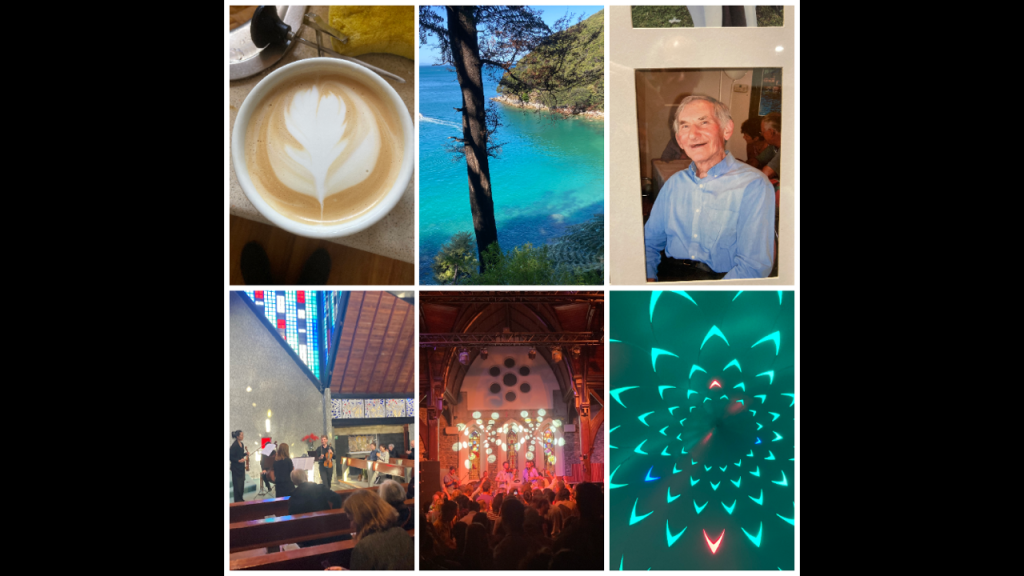
Collage courtesy: Keith Lyons
Am I over-sharing if I confess that the first photo on my iPhone of my 2024 year is a spectacle lens prescription? Or that the summary photo for 2024 — chosen by Apple and its algorithm — is of a coffee cup with the best of my efforts to create the basic latte art design: a monk’s head?
Looking back on the year, I wonder about the interplay of personal and global, a year which started with me learning how to make an origami crane, the symbol of peace, hope, longevity and good fortune, and ended with me getting ill, losing my father, without a paying job, and facing an unexpected massive bill.
The trick to making a paper crane is to have a good teacher. I was fortunate enough to connect with a semi-retired Japanese man (Mocchan) whose gift to the world is to meet strangers, have a cup of coffee, and patiently show them the dozen or so steps how to fold, flip, and unfold a piece of paper until it becomes a paper crane.
As for ill health, loss, unemployment, and debt, there are no easy tricks; you just need to go through them. “Survive til ’25” has been the mantra of bank economists and real estate pundits, recognising that 2024 has been a rough year for many sectors and most people, with inflation (and with it, rising living costs) the primary concern of citizens all around the world. Many countries are in economic recession, geopolitical threats are on the horizon, and the globe is warming faster than expected. The economic challenges were highlighted for me when earlier this year friends admitted to me they had changed their brand of coffee beans to a cheaper, no-frills variety, to cope with the cost of living squeeze. Yes, a First World problem. But who in 2024 has not examined their expenditure, put something back on the shelves, or not completed an online purchase — known as ‘cart abandonment’?
So, if I was to look back at the year in review, as a tapestry or a mosaic, what would I see? Fragments of memories, experiences, events. The days of my life, some almost the same as the previous day, others with unanticipated twists and turns. Welcome to the journey of 2024.
January
In the very centre of my city, Christchurch (New Zealand’s most English of cities), where a quake-damaged cathedral sits un-repaired, I get transported into another world, an immersive world of lights and colours in the giant inflatable sculpture Arborialis Lunminarium, made by the Architects of Air (https://www.facebook.com/watch/?v=901452564787031). Inside the labyrinth of tunnels and designs like cathedral stained-glass windows, I take time to sit in alcoves and lay in the centre of one of the domes, bathing in the natural light filtering through the installation, breathing in the tones, listening to the echoes and reverberations.
February
My next-door neighbour’s house goes on the market. I go across to an open home in the weekend. The neighbours left without saying goodbye. “Gone to Australia,” the real estate agent tells me. “Better jobs.”
Most of the prospective buyers are recent arrivals in New Zealand.
Looking across to my house, I realise, I need to do some work on my property, including having some trees cut and trimmed. I make a mental note to mention it to a friend who often meets with an arborist.
A few weeks later, the house sells at auction, for a price way beyond its valuation.
March
I go on a hiking trip with a friend in Fiordland, at one point missing a direction arrow and going off the trail, with others following us up a rocky stream-bed. After much faffing around, we retreat to the last known marked part of the trail, just as other hikers find the next marker without any problems. Lesson: sometimes the directions are up above your eyesight. Look up.
Back in internet-land, I find much merriment in watching Penn Holderness rapping in the style of Eminem wisdom found on pillows and cushions with quotes. Also, online I find a post detailing things to do for a low-dopamine morning, to sharpen mental clarity, reduce stress and anxiety, and improve long-term brain health. They include not watching Facebook reels or videos first thing in the morning (wait an hour at least), as well as drinking water, getting natural night and fresh air soon after waking, eating a high-protein breakfast, and delaying your first morning coffee for at least an hour.
April
For the first time in ages, I go out to a venue at night, listen to live music, have a few drinks, and end up dancing. The venue is a former Anglican church, built in the Gothic revival style in 1875 with an octagonal layout, and later becoming a theatre and then a Japanese wedding chapel. It is a unique setting with a micro-brewery, stained glass windows, and bouncers at the door. I am trying to recall the last time I went out to a live band and danced. My companion is also speculating that she’d also had not been out dancing since the Covid-19 pandemic. We are both in our 50s but are heartened to see others even older than us moving and grooving to the Balkan-Latin fused dub beats of Yurt Party.
May
I am late for a musical performance in the capital Wellington, and only hear half a composition that has been composed in memory of my brother. Fortunately, the performers agree to repeat the piece afterwards, to enable recording of it, and also so I can call my father so he can listen to ‘Heal’ by Salina Fisher over the phone. It is quite special. I know my father is also deeply moved by the classical composition, even without being in attendance at the Futuna Chapel, regarded as one of the outstanding pieces of 20th-century architecture in New Zealand, combining Maori and European design elements.
A day later we celebrate my father’s 88th birthday. My father is dying. A few weeks later, we are holding him and speaking with him as he takes his last breath.
June
The arborist I wanted to come cut down and trim trees on my property dies suddenly in an accident while felling a large tree on an extensive hillside property he is restoring. At a memorial service the only way through the loss is to retell stories about his character, adventures and humour.
An old friend from school days has sent a native tree to plant in memory of my father, and on the shortest day I think about where I might plant it. Winter is considered the best time to allow trees to establish in the wetter months, but it is cold outside, so I keep the tree inside in my sunroom, and ponder where it might grow best.
July
One night after visiting my mother, I come across an event that seems both crazy and appealing in the coldest time of the year. ‘Rogaining’ is a cross-country navigation sport where teams try to visit as many checkpoints as possible within a time limit. A winter series mixing strategy, adventure, orientation and the challenges of darkness. I resolve to rope in some friends to form a team. Can I offer to be the main navigator given that I’ve gotten lost in unfamiliar terrain more than once?
A pair of WWII binoculars used by my father as a naval navigator ended up in a private collection museum. It is a bittersweet part of letting go, hoping that something once connected to someone special will be put to good use, and is in good hands. When I show the photo to my mother and sister, we have a small sense of closure.
August
My work contract finishes, as our programme wraps up. The significance of the end dawns on me, as I realise the impact on many people and communities from the end of the collaborative research, including early career scientists who now may have to change professions, or go overseas in the hope of work.
In my garden, daffodils bloom bright yellow, and I bring in the flowers to spread the promise of new beginnings inside. My parents planted the bulbs when we were children.
September
Having put off appointments because of being busy at work, I get advice from a dietary nurse, fitness trainer and stress coach on improving my health, fitness, and sleep. Ultimately, I am caring for my heart. My blood pressure and cholesterol have been high in recent years. I don’t want to die ‘young’.
I go on holiday to the comforting golden sands and clear waters of Abel Tasman National Park, where I have fond memories from family trips in the 1970s. I make new memories and feel more connected to my father and brother as I gaze at night up to the vast Milky Way, with the five stars of the Southern Cross emerging over the horizon.
October
In an effort to improve my skills for employment and leisure, I start a coffee-making barista course. Each week, there is a test and challenge. I have to learn the names of the parts of the espresso machine, because at the start I only know their functions and not their exact names: group head/gasket, portafilter, basket, drip tray, steam wand.
A friend of my brother visits, bringing his partner and their child, whose first name is a composite of my brother’s name Ian, and the boy’s grandmother’s name.
November
On the barista course, we learn how to pull the perfect shot of espresso, by ensuring the best combination of freshly roasted beans, fine grind size, and how it is pressed (or tamped) to extract the full flavour of the coffee. At each one-on-one session, my tutor Masako extends my knowledge and practical skill. I have to prepare two different styles of coffee in under four minutes, from order to dispatch. I don’t make them in time. The next week, I have to make four coffees in under eight minutes — latte, long black, mocha, flat white. I am over time. Will I ever improve to be able to work in a busy cafe?
My speaking blood pressure monitor reads out my levels in mercury pilar and concludes: Result Normal. I attribute the reduction — without medication — to taking on board the advice of the Mayo Clinic around improving sleeping, reducing stress, less salt, limiting alcohol, lowering weight, and exercising frequently. After positive feedback from my health professionals on the lifestyle changes I’ve made, I felt like I undo my progress when an old school friend visits my house mid-afternoon with a carton of 18 beers and a six-pack of Guinness.
December
The day after the visit, I find the spot to plant the tree the school friend gave me in memory of my father. The tree will bloom in spring with yellow flowers to attract nectar-eating native birds. My father loved birds.
To get the temptation out of sight, I give the remaining beers away to my builder who turns up to guide an engineer through recent quake repairs to my house. The engineer, originally from China, finishes his inspection saying everything seems allright. His visit has cost me over $2,000, an unexpected extra cost due to the previous professional’s work being discredited.
I don’t even get an interview for a job I thought I was dead-certain to be shortlisted for. But another door opens, and I get a job offer for a role starting in the new year. I know I am lucky, given the tough employment market, but I know that while I might be ‘pale’ and ‘male’, I ain’t stale.
I finish my barista course, and take away the need for patience, consistency and practice.
But then, after feeling tired from a gym session, a bike ride and a hydrotherapy class, I come home and feel inertia drag me down. Will I have time to finish this piece for Borderless, I wonder? Then I test positive for Covid-19.
Best wishes to you, wherever you are.
May the past be your lesson, the present your gift, and the future your motivation.
.
Keith Lyons (keithlyons.net) is an award-winning writer and creative writing mentor originally from New Zealand who has spent a quarter of his existence living and working in Asia including southwest China, Myanmar and Bali. His Venn diagram of happiness features the aroma of freshly-roasted coffee, the negative ions of the natural world including moving water, and connecting with others in meaningful ways. A Contributing Editor on Borderless journal’sEditorial Board, his work has appeared in Borderless since its early days, and his writing featured in the anthology Monalisa No Longer Smiles.
.
PLEASE NOTE: ARTICLES CAN ONLY BE REPRODUCED IN OTHER SITES WITH DUE ACKNOWLEDGEMENT TO BORDERLESS JOURNAL.










 Borderless