Shantanu Ray Chaudhari converses with writer Gajra Kottary, a well-known writer of Indian TV series, novels and stories. Clickhereto read.
A discussion on Samaresh Bose’s In Search of the Pitcher of Nectar, a book that takes us to the heart of the Kumbh Mela, a festival recognised by the UNESCO as an Intangible Cultural Heritage, with the translator, Nirmal Kanti Bhattacharjee. Clickhere to read.
Translations
Nazrul’s Why Provide Thorns has been translated by Professor Fakrul Alam. Clickhere to read.
Mercy, a story be P. F. Mathews, has been translated from Malayalam by Ram Anantharaman. Clickhere to read.
Songs of Freedom: Vikalangta or Disability is an autobiographical narrative by Kajal, translated from Hindustani by Janees. These narrations highlight the ongoing struggle against debilitating rigid boundaries drawn by societal norms, with the support from organisations like Shaktishalini and Pandies. Clickhere to read.
Paul Mirabile explores James Joyce’s Stephen Dedalus and his passion for words keeping in mind the hundred year old Ulysees & the even older, A Portrait of the Artists as a Young Man. Clickhere to read.
Book Excerpts
An excerpt from Radha Chakravarty’s translation of Tagore’s Farewell Song. Clickhere to read.
An excerpt or two short narratives from Rhys Hughes’ Yule Do Nicley. Clickhere to read.
The next year will do the same – we will all celebrate with Auld Lang Syneand look forward to a resolution of conflicts that reared a frightening face in 2022 and 2021. Perhaps, this time, if we have learnt from history, there will not be any annihilation but only a movement towards resolution. We have more or less tackled the pandemic and are regaining health despite the setbacks and disputes. There could be more outbreaks but unlike in the past, this time we are geared for it. That a third World War did not break out despite provocation and varied opinions, makes me feel we have really learnt from history.
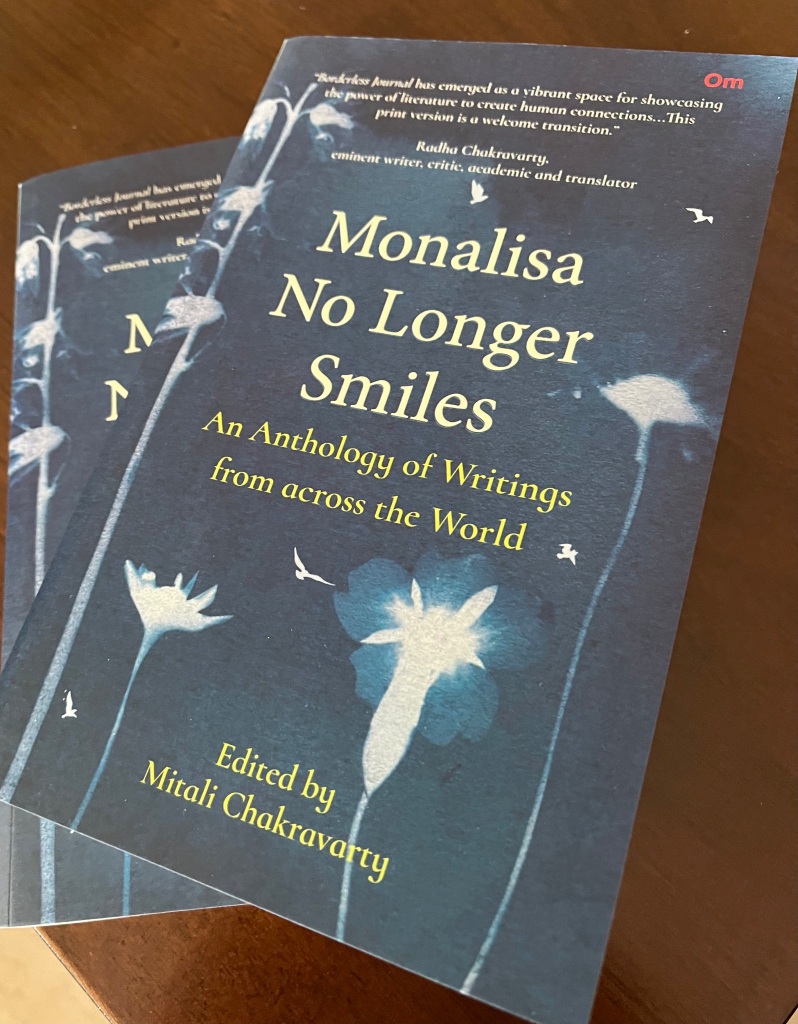
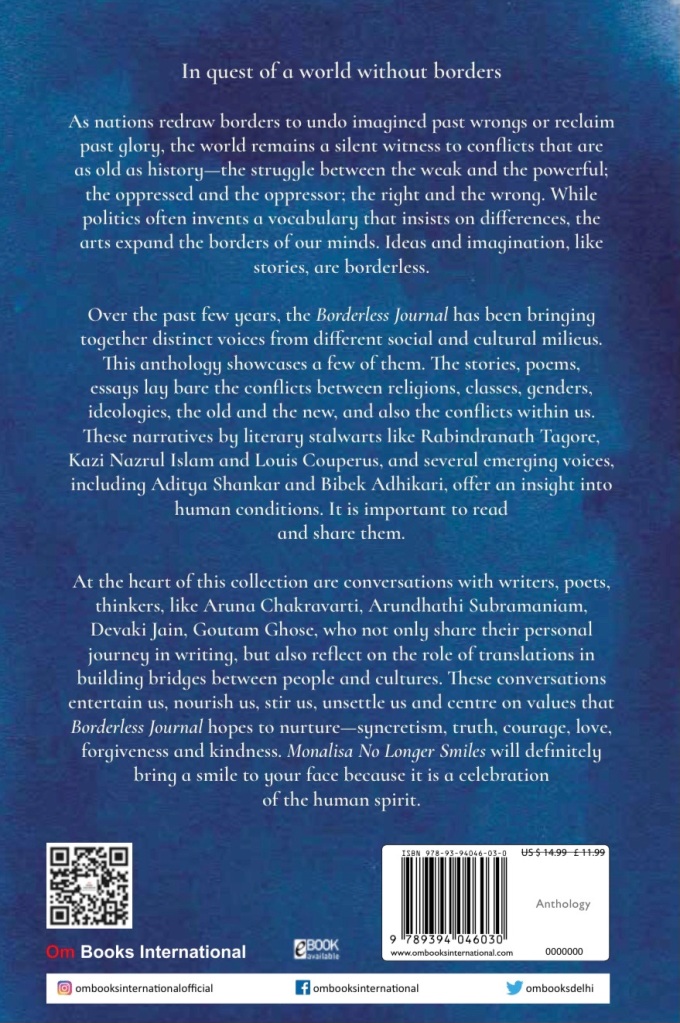
That sounds almost like the voice of hope. This year was a landmark for Borderless Journal. As an online journal, we found a footing in the hardcopy world with our own anthology, Monalisa No Longer Smiles: Writings from Across the World, which had a wonderful e-launch hosted by our very well-established and supportive publisher, Om Books International. And now, it is in Om Book Shops across all of India. It will soon be on Amazon International. We also look forward to more anthologies that will create a dialogue on our values through different themes and maybe, just maybe, some more will agree with the need for a world that unites in clouds of ideas to take us forward to a future filled with love, hope and tolerance.
One of the themes of our journal has been reaching out for voices that speak for people. The eminent film critic and editor, Shantanu Ray Chaudhuri , has shared a conversation with such a person, the famed Gajra Kottary, a well-known writer of Indian TV series, novels and stories. The other conversation is with Nirmal Kanti Bhattajarchee, the translator of Samaresh Bose’s In Search of a Pitcher of Nectar, a book describing the Kumbh-mela, that in 2017 was declared to be an Intangible Cultural Heritage of Humanity by UNESCO. Bhattacharjee tells us how the festival has grown and improved in organisation from the time the author described a stampede that concluded the festivities. Life only gets better moving forward in time, despite events that terrorise with darkness. Facing fear and overcoming it does give a great sense of achievement.
In keeping with the festive season is our book excerpt from Rhys Hughes’ funny stories in his Christmas collection, Yule Do Nicely. Radha Chakravarty who brings many greats from Bengal to Anglophone readers shared an excerpt – a discussion on love — from her translation of Tagore’s novel,Farewell Song.
Love for words becomes the subject of Paul Mirabile’s essay on James Joyce’s Stephen Dedalus, where he touches on both A Portrait of the Artist as a young Man and Ulysees, a novel that completed a century this year. Love for animals, especially orangutans, colours Christina Yin’s essay on conservation efforts in Borneo while Keith Lyons finds peace and an overwhelming sense of well-being during a hike in New Zealand. Ravi Shankar takes us to the historical town of Taiping in Malaysia as Meredith Stephens shares more sailing adventures in the Southern hemisphere, where it is summer. Saeed Ibrahim instils the seasonal goodwill with native Indian lores from Canada and Suzanne Kamata tells us how the Japanese usher in the New Year with a semi-humorous undertone.
Also touching and yet almost embracing the school of Absurd is PF Mathew’s story, ‘Mercy‘, translated from Malayalam by Ram Anantharaman. Fazal Baloch has brought us a Balochi folktale and Ihlwha Choi has translated his own poem from Korean to English. One of Tagore’s last poems, Prothom Diner Shurjo, translated as ‘The Sun on the First Day’ is short but philosophical and gives us a glimpse into his inner world. Professor Fakrul Alam shares with us the lyrics of a Nazrul song which is deeply spiritual by translating it into English from Bengali.
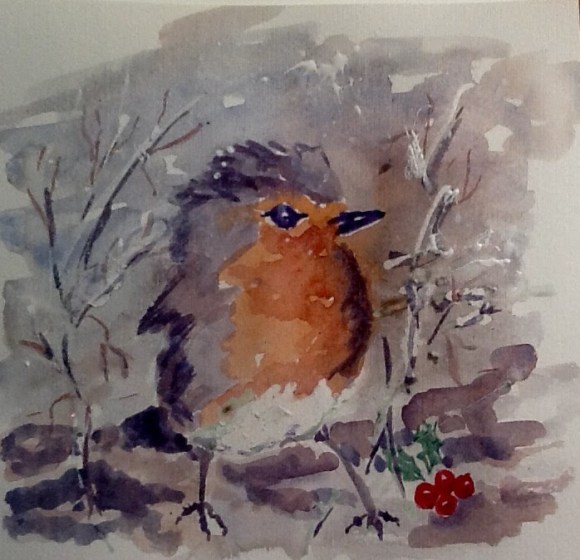
A huge thanks to all our contributors and readers, to the fabulous Borderless team without who the journal would be lost. Sohana Manzoor’s wonderful artwork continues to capture the mood of the season. Thanks to Sybil Pretious for her lovely painting. Please pause by our contents’ page to find what has not been covered in this note.
We wish you all a wonderful festive season.
Season’s Greetings from all of us at Borderless Journal.
A real-life sailing adventure with photographs by Meredith Stephens
After an arduous day of upwind sailing from Bittangabee Bay on the east coast of Australia to Nadgee Beach we crept into our cabin beds at 9 pm. A few minutes after midnight, crew member Katie suddenly roused to a bright light and looked out of the window. She observed a boat moving towards her, first coloured lights and then a white light. Katie jumped out of bed screaming “He’s gonna hit us!” Then she heard the sound of the crunching of metal against our hull. Skipper Alex got up and blasted his air horn. The neighbouring skipper moved his boat around so he could talk to us. Crew member Verity screamed in terror “Go away!”
Alex called out across the water to the other skipper.
“I can’t see how much damage there is now. What’s your phone number?”
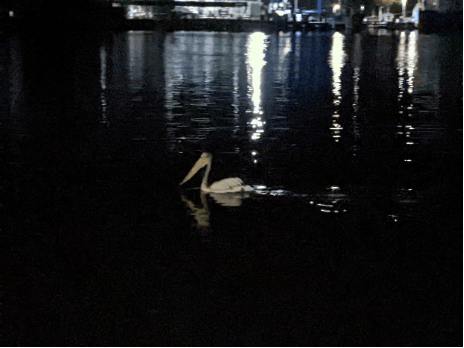
The skipper called his number across from his boat and set off on his midnight voyage. We were not due to sail out until 3 am when the conditions were predicted to become favourable, but we were so shocked at having been hit by another vessel that we could no longer rest. We decided to set out immediately. We headed to an anchorage at the uninhabited Gabo Island, dropped anchor, and slept from 3 am until 6 am. Then Alex roused himself and dutifully took himself to the helm, turned on the motor, raised the anchor and started the anticipated fourteen-hour voyage to Lakes Entrance. Ninety-nine nautical miles later, at 9.50 pm, we arrived at a free public dock, and were greeted by pelicans. Katie alighted onto the dock and secured the lines to cleats and returned to the boat. All crew members slipped into a grateful rest despite the harsh lights of the dock penetrating through the hatches.
After a day ashore to rest and reprovision, we set off the following day at seven am. We had an uneventful sail until 10.30 pm when the halyard[1] to the gennaker[2] snapped. The gennaker trailed in the water between the hulls and Alex retrieved it, replacing it with the jib[3]. I trusted Alex with sails and halyards, and I could hardly keep my eyes open, so I retreated to my cabin and tried to sleep. Not for long though because I could hear Alex and Katie shouting to each other on the deck. My body was craving sleep, but I dared not succumb when there was obviously some sort of trouble. I had never heard Alex and Katie shout at each other. The only reason they were shouting must be in order to be heard over the wind on the deck. I forced myself out of the cabin bed and dropped from its formidable height which had been designed for much taller people. I made my way to the outside door, summoning the strength to venture outside and try and make myself useful, but the darkness, the wind and cold were intimidating. As I deliberated, I heard a crash. The front window had smashed into tiny pieces, which landed on the sofa and were scattered all over the floor. Alex was shouting from the deck, “The mast is down!” I glanced outside and noticed that the mast had landed on the portside deck, and several metres of its tip were trailing submerged behind the boat.
Meanwhile, the steering had been disrupted and the autopilot was no longer functioning. Alex tried to manually manoeuvre the boat to the right, but it would not respond, and he had to turn in circles to the left to attain the right direction. The mast dangling from our port stern was acting like a giant unwanted rudder. I glanced outside and noticed a fishing trawler about five hundred metres away on our portside. I alerted Alex and he was concerned that without steering we would inadvertently hit the trawler. He grabbed the VHF[4] radio and put out a warning on Channel 16 to alert them. No response. He tried again. Still no response. He gave up and returned to the deck in order to save the sails which were trailing us in the water. I remained inside and continued to try to make contact with the trawler, to no avail.
Then Alex realised that the VHF antenna was not working because it was at the end of the mast, which was now trailing in the water. He retrieved his hand-held VHF radio and tried to make contact again. This time the skipper of the trawler responded. They decided to stay close to us and then follow us, ready in case our situation deteriorated. We maintained radio contact with the other skipper until Alex managed to hoist some of the mast out of the water and regain autopilot control. At 3 am, we were confident that we could manage on our own, so we advised the other skipper and he took his leave. A stranger had obeyed the ancient maritime code to assist those in distress at sea, and we didn’t even know his name.
Alex headed for the aptly named Refuge Cove, but another vessel was sheltering there. He wanted a wide berth, so he was reluctant to stay near another boat in case we inadvertently swung into them. He took us on to Waterloo Bay, three nautical miles further. We moved deep into the bay over the next hour and arrived at a sufficiently sheltered spot to drop anchor at 10 am.
For the first time, Alex was able to carefully inspect the damage and was shocked to discover that the cross-beam[5] was broken in half and dangling precariously. This made it too risky to use the main anchor. Alex used a spare anchor instead. By this time, he had been awake for twenty-eight hours, so, we urged him to sleep.
“I think I’ll just tidy up the sails a bit before I sleep,” he insisted.
I also ventured onto the deck to help Alex and noticed the crashed mast, and the cross-beam which looked dented but had in fact snapped in half. Alex and Katie bound up the sails with ropes so as to keep them from falling into the water for the next leg of our trip. My hair was blown into knots around my face and the fierce Australian sunshine was forcing its way into my eyes. I briefly retreated inside to restrain my hair with a scarf and returned to the deck to see Alex and Katie persisting in the cold wind. I was barefoot as this was the best way to grip to the surface of the gently rocking vessel. As I gingerly walked towards Alex and Katie, I noticed shards of glass in front of me. Katie called out in warning, and I retreated. She pointed out the safe way to climb towards them and I trod in that direction, mindful not to fall. Next Alex took the dinghy to the tip of the mast to remove dangling lines and the still-attached jib.
I glanced up and noticed pristine white sands, turquoise waters, craggy mountains and even a few bathers who had obviously hiked here. There were no roads leading to this beach deep within a national park.
We spent the next day tidying up both the topside and the inside of the boat, in particular picking the scattered glass shards. Alex needed a block of wood to secure the mast, so we headed to shore to find one. If we were on holiday this beach would have been ideal. No-one was here, but there were deep footprints in the coarsely grained sand. We walked to the end of this idyllic beach, and I collected shells. Meanwhile, Alex found the perfect sized piece of wood.
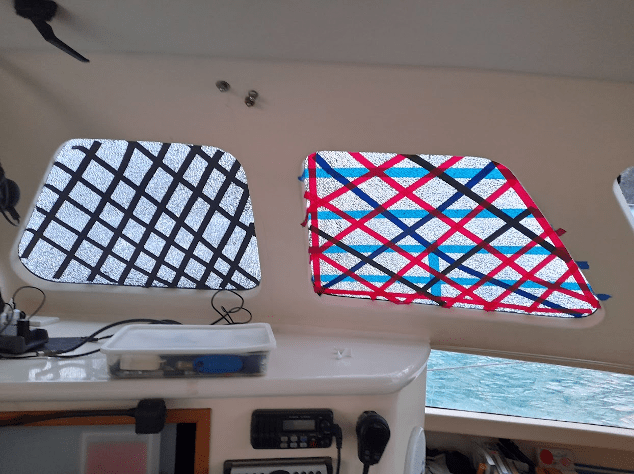
We returned to the boat for a few hours of relaxation before setting off for the night sail at 11 pm. Alex had chosen this time because the sea was predicted to be at its calmest over the next twenty-four hours. Before departing, Alex placed the block of wood under the mast to create a pivot point and winched the mast up to ensure it was completely clear of the water and would not drag. I was standing in the saloon as Alex adjusted one of the winches securing the mast, and suddenly heard a cracking noise. A third window shattered. We searched for duct tape to secure the window, but our stores had been depleted. Instead, we used electrical tape, and Katie, who happened to be an artist, taped across the windows until they had the criss-cross design of Tudor windows.
I was nervous about sailing off again into the dark ocean. Would the vessel be seaworthy? Would we be stuck in the dark waters distant from help? I had to rely on Alex’ judgment. I retreated to bed and noticed a bright light through the hatch in front of me.
“Is that a vessel ahead?” I urgently asked.
“No, that’s the moon!”
I peered myopically ahead and worked out that the large shining light ahead was the comforting moon and was shedding a kind light to guide us on the waters ahead.
Alex and Katie took charge of the vessel in the night to continue west along Bass Strait to Yaringa, the nearest marina that could host us. I could hear them calling out instructions to one another. The seas were not yet as calm as we had hoped, and Katie was worried. I didn’t know what to do and retreated to the security of my bed. Then I heard another shattering of glass. A fourth window cracked, and this time Alex was the one to use what little tape we had to secure it in a criss-cross pattern.
Alex and Katie took turns overnight to keep watch. I woke to daylight and the sea was calm. The vessel gently rocked as we cruised along Bass Strait, now powered by motor rather than sail. Finally we entered the channel east of Phillip Island.
“The tide is in our favour. We are going to arrive early!” proclaimed Alex. “Shall I make a booking for dinner at the marina cafe?” he asked.
A resounding “Yay!” followed.
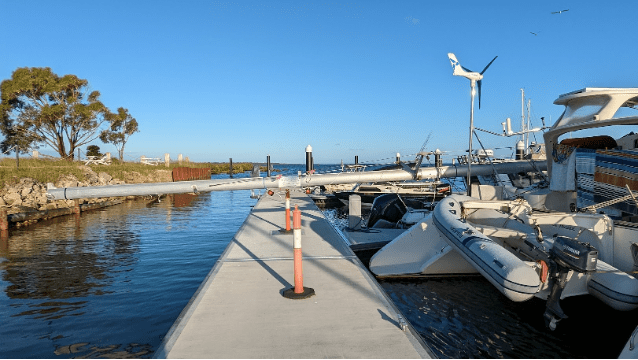
We followed the channel markers, passing small fishing vessels and a cruise ship. By 5.30 pm we arrived at Yaringa, and manoeuvred the vessel into the berth, all the while trying to prevent the mast, which was extending well beyond the boat, from hitting anything.
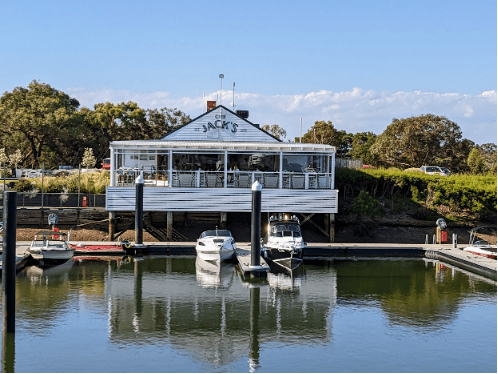
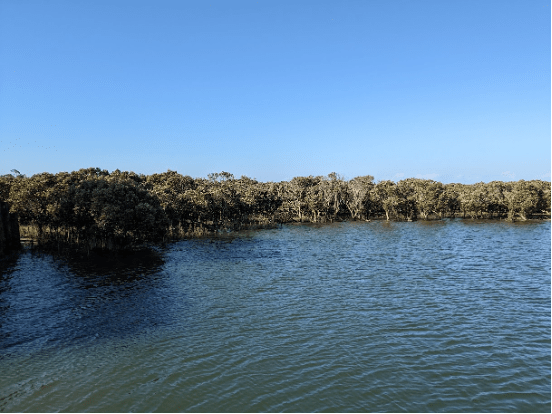
We had survived a fallen mast, four smashed windows, a broken cross beam and a disabled anchor, to arrive at the tranquility of a little-known marina at Yaringa, nestled in the mangroves on the outskirts of Melbourne. We gratefully stepped onto the pontoon, then walked ashore, savouring the sensation of terra firma. Even so, we were so used to the motion of the sea that we continued to sense the land itself rocking back and forth.
That night we enjoyed one of the best restaurant meals we have ever had, perhaps enhanced by our feelings of relief and gratitude.
We were in a quiet berth overlooking undisturbed mangroves. The boat was now motionless. There were no harsh overhead lights shining into our windows and the only ambient noise was birdsong. Alex had already contacted a shipwright and rigger who would attend to the damaged parts of the boat over the next months. We no longer needed to persevere sailing in darkness in a damaged vessel. In the relief of having reached safety, we fell into a well-deserved and deep sleep.
[5] The cross-beam connects the two bows of a catamaran.
Meredith Stephens is an applied linguist from South Australia. Her work has appeared in Transnational Literature, The Muse, The Font – A Literary Journal for Language Teachers, The Journal of Literature in Language Teaching, The Writers’ and Readers’ Magazine, Reading in a Foreign Language, and in chapters in anthologies published by Demeter Press, Canada.
PLEASE NOTE: ARTICLES CAN ONLY BE REPRODUCED IN OTHER SITES WITH DUE ACKNOWLEDGEMENT TO BORDERLESS JOURNAL
We did it! … Announcing our first anthology … Monalisa No Longer Smiles… Click here to read.
Conversations
Suchen Christine Lim, an iconic writer from Singapore in conversation about her latest book, Dearest Intimate. Click here to read.
Blazing trails, as well as retracing the footsteps of great explorers, Christopher Winnan, a travel writer, delves into the past, and gazes into the future while conversing with Keith Lyons. Click hereto read.
Saturday Afternoon is a poem by Ihlwha Choi, translated from Korean by the poet himself. Click here to read.
Tagore’s poem, Tomar Shonkho Dhulay Porey (your conch lies in the dust), has been translated from Bengali by Mitali Chakravarty as The Conch Calls. Click here to read.
Basudhara Roy has reviewed Afsar Mohammad’s Evening with a Sufi: Selected Poems, translated from Telugu by Afsar Mohammad and Shamala Gallagher. Click hereto read.
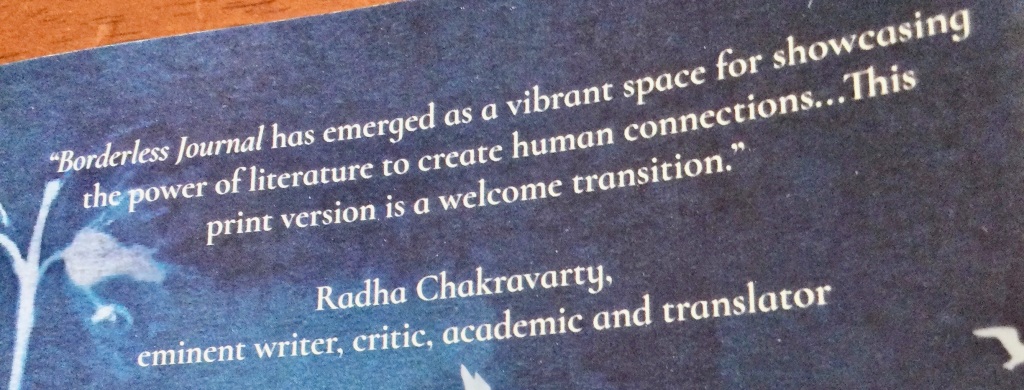
That good things happen despite darkness, despite prognostications of doom, that light glimmers hope if you strive to focus on your strength in hard times is borne true both in fiction and in life. Perhaps, we cannot get back the old ways (but is that what we want?) but new paths emerge. Old gives way to new. And while trying to gather pearls of human excellence — borne not of awards or degrees but of bringing out the best, the kindest, the most loving in human hearts — we managed to create with a team an outstanding anthology. Woven with the writings of old and new — we created a tapestry together that the editor in chief of our publishing house said was “classy, literary, engaging and international”. That one of the oldest and most reputed publishing houses in India with bookshops countrywide took it on was also an unusual event! We are truly grateful to Om Books International, Shantanu Ray Chaudhuri and Jyotsna Mehta along with all our writers and readers who made our anthology a reality, and to Radha Chakravarty and Fakrul Alam for the kind words they bestowed on our effort.
Please greet our first anthology, Monalisa No Longer Smiles, with love and friendship. It could be the perfect Christmas gift in the spirit of the season! And as the blurb says, “it will definitely bring a smile to your face because it is a celebration of the human spirit.”
The anthology is different from our journal in as much as it has a sample of an eclectic collection that has been honed with further editing and has some new features. Most of the writing is from our first year and showcases our ethos, except for Lesya’s poetry and interview. Lesya Bakun from Ukraine is still on the run, looking for a refuge — she cannot return home like you or I can. Her family is scattered across number of countries. Her cousin, who was guarding the factory at Azovstal, was taken prisoner. We included her story in the anthology hoping to create global empathy for refugees as the numbers will increase not only due to war but also due to climate change.
The reason we felt a hardcopy anthology was a good idea was because nothing beats the joy of having a bunch of interesting reads in the warmth of your hands (especially where internet cannot reach or is unavailable). In any case, books with the feel of paper, the rustling whispers which carry voices of leaves can never be replaced as Goutam Ghose had also said in his interview which is now part of our anthology.
And that is why we celebrate more books… this time we feature Singaporean prima donna of literature, Suchen Christine Lim, with her new book Dearest Intimate, a novel that spans more than hundred years including the harrowing Japanese invasion during World War II. She shared sound advice with writers: “Suffering is good for the writer. It will deepen lived experience and expand the heart’s empathy.” And perhaps that is what is echoed through the experiences of the other writer interviewed on our pages by Keith Lyons. This is a writer who not only brought out his own books but was a regular contributor of travel pieces for Frommer’s and National Geographic traveling to unexplored destinations — Christopher Winnan. Another writer Lyon had interviewed recently, Steve Carr, has passed on. We would like to convey our heartfelt condolences to his family and friends.
More translations from Bengali, Balochi and Korean enrich our November edition. Fazal Baloch has translated a story by Haneef Shareef and Rituparna Mukherjee by Shankhadeep Bhattacharya. We have the translation of an inspirational Tagore poem helping us find courage (Shonkho Dhulaye Pore or ‘the conch lies in the dust’). Another such poem by Nazrul has been rendered in English from Bengali by Professor Fakrul Alam. He has also shared an autobiographical musing on how he started translating Tagore’s Gitabitan, which also happens to be his favourite book. More discussion on the literary persona of TS Eliot and the relevance of his hundred year old poem — ‘The Waste Land’ by Dan Meloche adds variety to our essay section.
Evoking the genius of another outstanding artiste, Kishore Kumar, who happened to pen thought provoking dialogues in some films, is Shantanu Ray Chaudhuri’s essay, review of a recent book on the legendary actor-singer and an interview with the authors. Infringing the boundaries of literary with popular culture and art and integrating all forms into a wholistic bundle has been part of our ethos. In that spirit we have a musing by Prithvijeet Sinha on Edvard Munch’s famous painting called Scream. We have non-fiction from Australia spanning Meredith Stephens’s recent brush with Covid, Mike Smith visits a Scottish beach in the footsteps of a novelist, Ravi Shankar has given us a poignant piece for a late friend and Candice Lousia Daquin talks of the existence of bi-racial biases. In contrast, Suzanne Kamata sent a narrative that bridges divides showcasing a German wife of a Japanese scientist that draws us to conclude that biases erode over time to create an acceptance of bi-racial people. Devraj Singh Kalsi brings in humour with his funny narrative about a guitarist. Rhys Hughes writes in a lighter vein on Indian cuisine in his column and spouts more funny poetry bordering on the absurd.
Gathering all of your thoughts in strings of words from all corners of the world, we present to you the bumper November issue of Borderless Journal . Thank you all for sharing your thoughts with us. Thanks to Sohana Manzoor for her fantastic painting and more thanks to the whole Borderless team for seeing this issue through. We would not have been able to do the anthology or these issues without each one of you — writers and readers.
“How about you throw yourself a sixty-first birthday party?” Alex asked me.
It was hard enough having thrown myself a milestone sixtieth the year before. That had been fun, so on second thoughts I decided to throw myself another party. This time I would just ask extended family and a few close friends. I had finalised the RSVP when the day before the party my old friend Madeleine sent me a text: “Do you mind if I come without Gary? He has a clash….” I responded saying that that was fine and was looking forward to her company. Madeleine and Gary were anti-vaxxers.
I rescued the fairy lights Alex had bought for my party the year before and fixed them above the blinds. We had to leave the blinds open because our border collie had destroyed many of them when she had been left alone inside one day. We prepared the food and drinks, and my sister Rochelle brought the birthday cake. All the guests arrived except Madeleine. The evening wore on and I was getting a little tired, but as our guests were mainly around sixty like me, or young children, they excused themselves just at the right time. We don’t have stamina these days for long nights out.
Only when the last of the guests had gone home did I check my phone. Madeleine had sent me a text message excusing herself saying that she wasn’t feeling well. I knew there would have been a good reason for her not to have turned up.
The next day my adult daughter Eloise texted me to say her younger sister Annika was feverish. I went to visit her and discovered that she was motionless in her bed. I gave her a RAT[1] test and the result was negative. She was too sick to move and so I booked a locum. The receptionist told me the locum would be there in four hours. I spent the next hours bringing her water, serving her medicine to reduce her fever and passing a cool flannel over her forehead. Four hours later the locum had not arrived. So, I phoned the receptionist.
“He only has seven more calls before you,” she explained.
It was nearly midnight, so I decided to go to bed and wake up when the doorbell rang. Within thirty minutes the locum had arrived. I took him upstairs to Annika’s room.
“The RAT test was negative,” I explained, thinking he would administer a second one.
“Negative is negative,” he demurred. “Open your mouth,” he ordered my daughter.
He probed his torch inside her mouth and made her say ‘ah’. Then without any further comments or questions he announced, ‘It’s tonsillitis.’
He wrote out a prescription and was on his way, after having spent just a few minutes examining her.
I spent the rest of the night administering regular medicine to relieve her temperature. Even though the doctor had pronounced tonsillitis I had my doubts and kept my mask on. Until I didn’t. Annika was finally able to walk to the bathroom and back and seemed to have recovered slightly.
I wasn’t sure whether I should return to Alex, just in case I had caught something, but he rang me and told me it was ok to come back.
“We won’t get Covid. We’re invincible,” I asserted to Alex.
He looked at me quizzically. “Anyone can get it. Even people like us, who are triple vaxxed,” he countered.
As the day wore on, I had an unusual sensation of the onset of a fever. Unlike his usual robust self, Alex started to sense a dryness in his throat.
“We’d better go and get a PCR test,” he suggested.
We drove off to the testing center. Within twenty-four hours the results came to our phones: ‘Negative’.
Over the next day I continued to sense the onset of fever and kept taking my temperature. The thermometer confirmed what I had been suspecting. It was rising. Alex and I decided to go and get another test.
We drove to the testing center later in the evening when it was likely to be less crowded.
“Have you had a Covid test before,” the nurse questioned.
“Yes, we have.”
“When?”
“Yesterday.”
The nurse looked surprised but administered the test anyway.
The next morning a different message came to our phones: ‘Positive’ followed by an admonition to remain in our place of residence for seven days. This was followed by a message saying that if we required online counseling for the stress this would be provided.
I had to tell the party invitees about the positive case. I texted Grace and Jeremy. Negative. Next my sixty-three-year-old friend, Sally: Positive. Next my sixty-year-old friend Katie. Katie was dreading a positive diagnosis because she was looking forward to a trip to Bali with her best friend. Positive. Katie canceled her trip to Bali. I was relieved that my anti-vaxxer friends Madeleine and Gary had not attended because it would have been much worse for them had they contracted Covid.
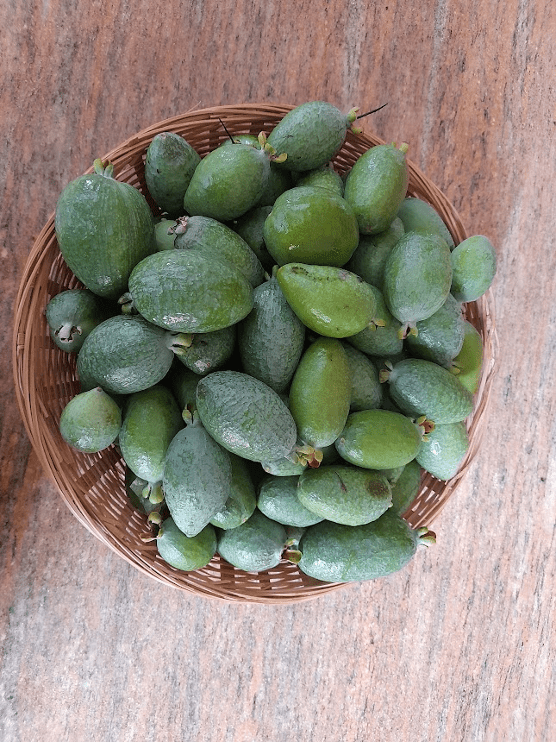
Over the next few days the temperature persisted and we felt too tired to do anything. This was followed by a sore throat so severe that we could not even sip a cup of coffee. I suddenly craved a smoothie and remembered a recipe a friend in Japan had given me when my children were toddlers. This was made by combining a banana, some milk, and slices of canned pineapple in a blender. I told Alex the recipe, and he substituted yogurt for milk. I suggested adding feijoas from the garden.
The result was something that even those with taste buds damaged from Covid could appreciate.
By Day Five our appetites had returned, and our taste buds restored. It was boring having to be confined indoors until the end of the week when we are not required by law to stay at home. It felt like the aftermath of a storm. I was grateful that the fever had gone and I could swallow again, but my body took days to recover from the shock it had had to endure.
Meredith Stephens is an applied linguist from South Australia. Her work has appeared in Transnational Literature, The Muse, The Font – A Literary Journal for Language Teachers, The Journal of Literature in Language Teaching, The Writers’ and Readers’ Magazine, Reading in a Foreign Language, and in chapters in anthologies published by Demeter Press, Canada.
PLEASE NOTE: ARTICLES CAN ONLY BE REPRODUCED IN OTHER SITES WITH DUE ACKNOWLEDGEMENT TO BORDERLESS JOURNAL
Anthony Sattin, an award winning journalist and travel writer in conversation about Nomads: The Wanderers Who Shaped our World, his recent book published by Hachette, India. Click hereto read.
VR Devika talks of the dynamic Muthulakshmi Reddy, the first woman in the world to preside over a Legislative Assembly who sought justice for Devadsis and prostitutes and discusses her book, Muthulakshmi Reddy: A Trailblazer in Surgery and Women’s Rights published by Niyogi Books. Click hereto read.
Translations
Daridro or Poverty by Nazrul has been translated from Bengali by Professor Fakrul Alam. Click here to read.
The Browless Dolls by S.Ramakrishnan, has been translated from Tamil by B Chandramouli. Click hereto read.
Two poems from Italy by Rosy Gallace have been translated from Italian by Irma Kurti. Click hereto read.
Aalo Amar Aalo (Light, My Light) a song by Tagore, has been translated by Mitali Chakravarty from Bengali. Click hereto read.
Pandies Corner
Songs of Freedom: Moh-Reenis an autobiographical story by Amreen, translated from Hindustani by Janees. These stories highlight the ongoing struggle against debilitating rigid boundaries drawn by societal norms, with the support from organisations like Shaktishalini and Pandies. Click hereto read.
Ravi Shankar recommends walking as a panacea to multiple issues, health and climate change and takes us on a tour of walks around the world. Click here to read.
Ali Jan Maqsood introduces us to a strong matriarch from a Balochi village. Click here to read.
Musings of a Copywriter
In Drill, Fill, Just Chill, Devraj Singh Kalsi gives us humour while under a dentist’s drill. Click here to read.
Notes from Japan
Suzanne Kamata writes of herA Ramble on Bizan, focussing on a writer, also by the surname of Moraes, who lived on Mount Bizan more than century ago, moving to Japan from Portugal having fallen violently in love. Click hereto read.
It stretches without borders, without interruptions, without contentions, unifying all under its life-giving ambience. We live nurtured by the sky, the water and the Earth. If we think back to times before humans made constructs and built walls to guard their own, to times when their ancestors roamed the Earth and moved to meet their needs, the population was not huge, and resources were abundant. Our species lived in consonance with nature. People revered natural forces and found trends that evolved into traditions and constructs which eventually made their progeny forget that the sky, water and Earth did not belong to them. These belong or perhaps exist for some reason that we do not comprehend despite the explanations given by science and religions. Being merely transient passers-by through these, humanity, unlike dinosaurs, has an urge to survive and be like the sky — with a past, present and future and a sense of the eternal. Though we all have short lives compared to the sky, Earth or universe, we continue to find ourselves in a homo centric world that considers all else to be made to meet their aspirations. But there was a time, when humans lacked this arrogance. They just tried to survive. And move with shifting rivers in an unbordered world.
Exploring such times, is Anthony Sattin’s profound book, Nomads: The Wanderers Who Shaped our World. He converses to reinforce reviving the concept of asabiyya or bonding between humans so that they find it in their hearts to move forward with necessary changes to avoid following in the footsteps of mammoths. A change maker who redefined constructs for humankind, a devdasi’s[1] daughter who rose to become a pioneering doctor and activist a hundred years ago, is Dr Muthulakshmi Reddy. We have an interview with her recent biographer, R Devika, who authored Muthulakshmi Reddy: A Trailblazer in Surgery and Women’s Rights.
The books reviewed this time include one featuring the writings by the greatest change maker in cinema — Satyajit Ray. Bhaskar Parichha has reviewed Satyajit Ray Miscellany: On Life, Cinema, People & Much More while Professor Somdatta Mandal has given us a candid opinion on BM Zuhara’s The Dreams of a Mappila Girl: A Memoir, translated from Malayalam by Fehmida Zakir. Taranath Tantrik and Other Tales from the Supernatural by Bibhutibhushan, translated from Bengali by Devalina Mookerjee brings unexplored dark mysterious forces into play and has been reviewed by Basudhara Roy. We have an excerpt from the titular stories of Tarantath Tantrik. Bibhutibhushan Bandopadhyay(1894-1950) was a legendary writer from Bengal. He wrote stories and novels, some of which were immortalised in cinema, such as the Apu triology by Satyajit Ray. The other book excerpt is from a translation from Kannada by an upcoming voice that needs to be heard, Maithreyi Karnoor. She has brought to the anglophone world Shrinivas Vaidya’s Handful of Sesame.
Evoking humour is not easy, but we do have a few such writers who manage it very well. Hughes has given us a tongue-in-cheek piece on the dateline, which has more than humour. And Devraj Singh Kalsi has shared his discovery that laughter is the best medicine to shrug off a dentist’s drill. He has also visited the colours of Durga Puja which, with its spirit of inclusivity, transported visitors in one marquee near Kolkata to the iconic Malaysian Twin Towers. Thus, bringing festivals in October into our purview. Candice Lousia Daquin has actually explored why we celebrate festivals and the God gene… Did you know we have a biological need for spirituality?
Suzanne Kamata has introduced us to Mount Bizan, which houses a writer by the surname of Moraes – Wenceslau José de Souza de Moraes, an expat writer who lived in Japan at the turn of the twentieth century. Wonder if he could have been related to the Anglo Indian writer, Dom Moraes? Aditi Yadav has also given us an essay on the Japanese philosophy of Wabi-sabi with its world view centred on imperfections and transience. Ravi Shankar has suggested walks for all of us, sharing his experiences in the Himalayas, the Caribbean island of Aruba and in many more places. Meredith Stephens has written of sailing to Tasmania.
The essay that brought back a flavour of home for me is one by Asad Latif, now a journalist in Singapore but long ago, he was an icon in India. We are very privileged to have his writing on what borders do for us… a piece exploring the idea on which we base our journal, also perhaps with a touch of Anthony Sattin’ s asabiyya. ‘Pandies’ Corner‘ starts another run, showcasing women’s tryst for freedom. Amreen’s ‘Moh-Reen’, her own story, translated from Hindustani by Janees, is a brave start to the series. The voices ring out asking for a change, to heal social norms to accommodate love and kindness with the backing of Shaktishalini and Pandies as does the unsupported solo voice of an older woman from Balochistan, Ganji Baloch, brought to our notice by Ali Jaan Maqsood.
We have fiction from Sohana Manzoor – again bringing to fore strange stories of women rebelling against social norms. Paul Mirabile explores death and the sea in a horrific story. Sunil Sharma’s fiction explores madness and ideators, making a social comment on recent happenings. As the sky stretches out to accommodate all kinds of writings, all creatures great and small, we try our best to give voice to a fair cross section from around the world as we have done thistime too.
There are as usual pieces that we have not mentioned in this note but they are all worth a read. Do drop in to check out our contents in this October issue. We are truly grateful to our contributors who continue to connect with words and thoughts that waft along with clouds. We would like to thank Sohana Manzoor especially for her wonderful artwork. The journal would not be a possibility without the support of the whole team and our valuable readers who make writing worth the effort. It is lovely to be read and remembered for the words we write.
Meredith Stephenswrites ofsailing to Tasmania when the pandemic had just started loosening its grip
Neither the wind speed nor direction were favourable as we tacked our way upwind. It was my turn to make the soup. I headed into the kitchen, grabbing rails and fixed furniture to steady myself. With each wave the boat lurched violently. I opened the fridge and a bottle of drink torpedoed across the galley. Then, on my hands and knees, I opened a bilge compartment trying to find the root vegetables. As I stood up, another wave surged and I nearly fell into the bilge. As I was trying to find cutlery I heard Luke’s voice offering to help me. I gladly accepted and found refuge after retreating to my bed. Luke’s steady sea legs meant the soup was ready in minutes.
We were sailing from Granite Island to Robe, in South Australia, on our way south-east to Tasmania. A four-hour journey by road would turn out to be thirty-six-hours by sea. Alex and Luke took three hour shifts at the helm overnight. The waves lurched beneath us. The sails were disobedient. Alex attached the tether to his belt and the rails, and headed out to the foredeck to fix it. Luke was at the helm and I held a rope at the rear deck. They shouted directions to me to pull and then release the rope. Alex fixed the sail as the boat accelerated.
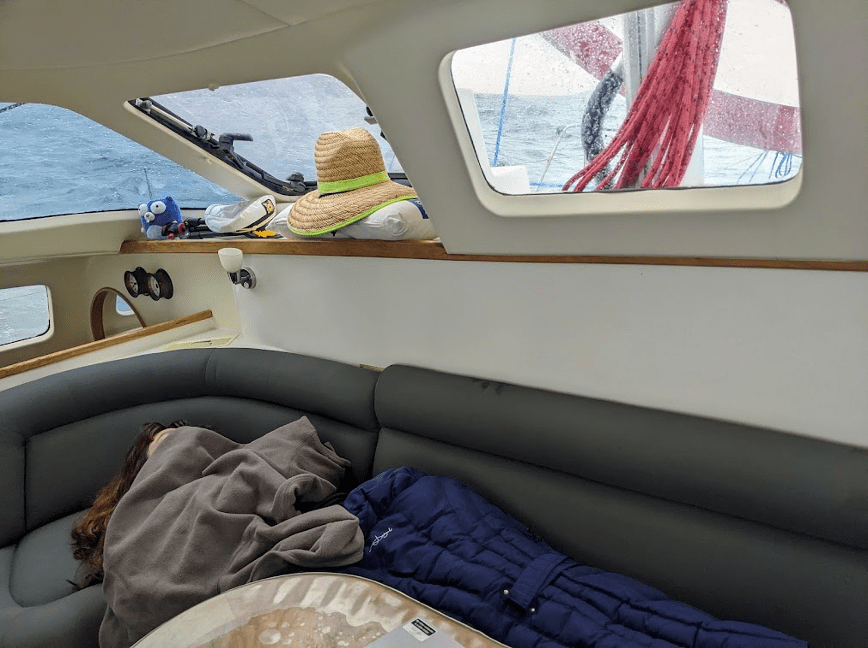
That night the bed in my cabin surged with every crashing wave. There was no relief in the morning when the harsh Australian sunshine pushed its way into the cabin and gave me a resounding migraine. Trying to find relief from the skylight above my bed I staggered up the stairs to the saloon, lay down on the sofa and hid from the sun under a hoodie and coat.
Alex entreated me to lift my gaze to the horizon and so I peeped out and reacquainted myself with the shoreline. My normally healthy appetite disappeared and I had an overwhelming desire to sleep. But Alex was an experienced sailor and never gave up on encouraging me, pushing me beyond what I imagined I could do. Rather than curling up into a ball and giving up, I heeded his encouragement, and my seasickness gradually dissipated. I was well enough by the evening to accompany Alex on the twelve am to three am shift, but noting my tired expression, Alex told me to take leave and go to bed at two thirty am. Luke took over the three to six am shift, and then Alex took over from six am. When I woke at eight the waters were calm. My seasickness had gone and my appetite returned. I enjoyed a hearty breakfast and we calmly motored on to Robe.
We had to sail continuously for two long days and nights on the voyage from Robe to King Island, Tasmania. Alex consulted the app Predict Wind for the weather forecast and assured me that there would be little wind. He, of course, was disappointed because he wanted to sail, but I was quite happy to motor on calm seas if it meant I could be spared from seasickness. He is a climate warrior and wanted to rely on natural sources of energy such as wind. I knew we shouldn’t use fossil fuels, but I decided to tease him, urging, ‘Let’s use diesel!’, knowing full well how it contradicted his principles. He put my needs first, foregoing his love of sailing to motor on calm waters instead.
I only knew about King Island because of its specialty cheese production, and looked forward to some cheese tastings. Alex asked me to do some research on King Island, and soon I learned that it had been the site of around 800 shipwrecks. This was not what I wanted to hear. I knew Bass Strait was notorious, but not that this single island in the strait had been the site of hundreds of shipwrecks. Nevertheless, Alex had equipped himself with state-of-the-art navigational equipment, and had the assistance of sailor Luke who had once sailed across the Atlantic, and he was unperturbed. I trusted Alex, and his confidence was contagious.
“It’s pretty shallow here,” I announced to Luke from the cockpit during my shift. “Only twenty-five metres.”
Luke and Alex guffawed. “That’s only because it’s too deep for the instruments to measure. It’s actually 1500 metres,” Alex explained.
I had a book ready to read for my three-hour shift but I left it unopened. I was enraptured by the milky and glassy surface and the ripples that glistened in the sun. I scanned the horizon for vessels, and tried to discover the ones that appeared in the monitor reported by Automatic Identification System (AIS). Unlike us, the other vessels on the monitor were container ships. Black birds perched on the surface of the water and took off as we approached.
“Where are the dolphins?” I quizzed Alex.
“It’s too deep for them here.”
We repeated the shifts. As Alex’s research had predicted the waters were calm. My seasickness had disappeared altogether.
Two days after leaving Robe, the township of Currie on King Island came into view. Anchoring took a while because of the many submerged rocks. Finally, Alex was satisfied with the anchorage, and we decided to hop into the dinghy and go ashore. First, we had to register online with the Tasmanian e-travel. I completed the documentation on my laptop and finally was required to receive a verification code by SMS on my phone. I kept requesting new codes but none came. It turned out that there was no reception on this remote island for my phone provider. I gave up.
The four of us lowered ourselves into the dinghy with our bags. Alex pulled the cord to start the outboard motor, and we weaved between the other berthed boats to the shore. A police vehicle was parked on the shore facing us. A barrel chested police officer in a fluorescent orange vest motioned where we should land. At the wharf he was accompanied by a biosecurity officer.
The police officer greeted us politely and asked whether we had the necessary paperwork for entry. Luke and Alex had theirs, but Verity and I did not. Despite numerous reminders from Alex I had procrastinated and now I was paying for it. We clambered out of the dinghy to the wharf, and the officers took down Verity’s and my details.
I had not been able to complete my application because my phone would not receive signals in this remote location. Alex tethered me to his phone, because his carrier had coverage. I fumbled around in the sunshine to download various apps to process my application. The phone screen was too small and the glare from the sunshine disturbed my vision even further. Even though I was traveling domestically, it was like trying to enter a foreign country without the right visa.
“I don’t want to hold you all up,” I said to the others. “Let me go back to the boat. I don’t care. I can read a book.”
Alex would have none of it. Then the biosecurity officer briefly disappeared, and reappeared with paper forms.
“You can fill these out instead,” he offered. “Then you will have to take Rapid Antigen Tests back in the boat and wait fifteen minutes for the result. If it is negative you are free to travel. I’m just going to make a detour to the airport to pick up the tests for you.”
The biosecurity officer made the eleven kilometre trip to the airport and back to retrieve the Rapid Antigen Tests. Meanwhile, Luke cleverly engaged the police officer in banter, trying to find out the best places for tourists to visit on the island.
“The races are on this afternoon,” he kindly informed us. “They are held four times a year over summer.”
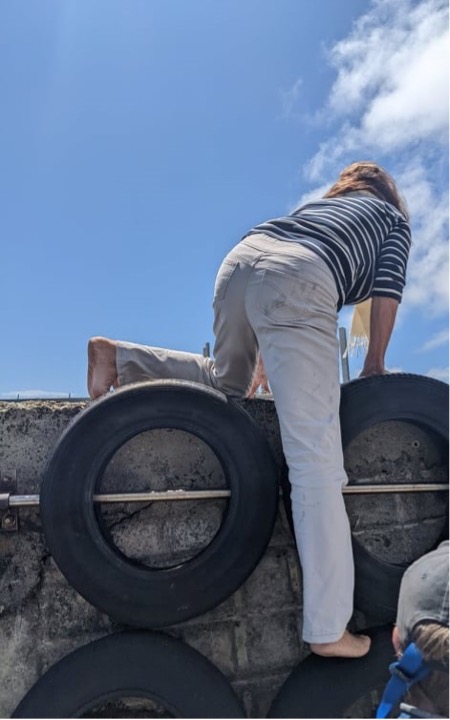
If it weren’t for the banter with the police officer we could never have learned this. We scrambled back into the dinghy with the Rapid Antigen Tests. Or to be more precise, the others scrambled into the dinghy. I lost my footing on the tires on the way down and collapsed in a heap into the dinghy. The mask had obscured my downward vision and I couldn’t see where I was placing my feet. I was rattled after having been greeted by a police officer and a biosecurity officer on the shore of the quiet fishing cove nestling alongside Currie. The others gasped as I fell and then fussed over me and I soon recovered. We sped back towards the boat.
“What else did the police officer tell you, Luke?” we probed, once in the dinghy.
“He said that the other day another vessel had come here from interstate. They too had had trouble getting internet access on this remote island and did not know that the entry requirements for Tasmania had changed while they were on board. They were so upset at being greeted on the shore by a police officer and a biosecurity officer that they started an altercation and had to be locked up.”
Hearing this I felt grateful that we had been treated with such civility. Again we clambered back on to the boat. Exhausted but relieved that we had been able to go on land in Tasmania, we decided to celebrate with Luke’s bottle of Chardonnay. Then, we proceeded with the tests.
As expected, we all tested negative and we took the dinghy ashore to explore Currie. We followed the police officer’s advice and walked through the town to the races. Alex and I were sitting in the stands, enjoying not only the horses but the spectacle of the local crowd in their finery. Alex abruptly looked up to the end of the aisle.
“Is that the police officer?” he asked me.
I studied him chatting to other racegoers in full regalia of his flack jacket, guns in his holster and fluorescent orange vest.
Alex turned to me and quipped, “Maybe that is why he seemed to be in a hurry to process our entry? He wanted to be at the races.
I had been struck by the story that Luke had heard from the police officer that the other interstate visitors had acted defensively when they heard about the new complicated entry requirements to Tasmania. Why had we been treated so differently? We were simply sent back to the boat and the officers had trusted us to act appropriately on the basis of the results of the COVID test. The officers seemed to be in a bit of a hurry to let us get on our way. Now we had an inkling why.
*All the photographs have been supplied by Meredith Stephens.
Meredith Stephens is an applied linguist from South Australia. Her work has appeared in Transnational Literature, The Muse, The Font – A Literary Journal for Language Teachers, The Journal of Literature in Language Teaching, The Writers’ and Readers’ Magazine, Reading in a Foreign Language, and in chapters in anthologies published by Demeter Press, Canada.
PLEASE NOTE: ARTICLES CAN ONLY BE REPRODUCED IN OTHER SITES WITH DUE ACKNOWLEDGEMENT TO BORDERLESS JOURNAL
                     “Where are the songs of Spring? Ay, where are they?
                      Think not of them, thou hast thy music too…”

                                 — John Keats (1795-1851), To Autumn
Art by Sybil Pretious
For long writers have associated autumn with “mellow wistfulness”. That loss of spring, or loss of youth is not bleak or regretful has been captured not just by Keats but also been borne out by historical facts. Anthropocene existence only get better as the human race evolves … If we view our world as moving towards an autumn, we perhaps, as Keats suggests, need to find the new “music” for it. A music that is ripe and matures with the passage of time to the point that it moves more towards perfection. Though sometimes lives fade away after autumn gives way to winter as did those of Queen Elizabeth II (April 21st 1926 – September 8th 2022) after a reign of seventy historic years and Mikhail Gorbachev (2nd March 1931 – 30thAugust 2022) with his admirable efforts to bridge divides. Both of them have left footprints that could be eternalised if voices echo in harmony. Thoughts which create bonds never die – they live on in your hearts and mine.
Imagine… ten thousand years ago, were we better off? Recorded history shows that the first war had already been fought 13,000 years ago. And they have continued to rage – but, at least, unlike the indomitable Gauls in Asterix[1] comics – not all jumped into the fray. They did during the last World Wars — which also led to attempts towards institutionalising humanitarian concerns and non-alignment. Yes, we have not had a perfect world as yet but as we age, the earth matures and we will, hopefully, move towards better times as we evolve. Climate change had happened earlier too. At a point, Sahara was green. Continental shifts split Pangaea into seven continents – that was even earlier. That might have driven the dinosaurs to extinction. But I am sure mankind will find a way out of the terror of climate change and wars over a period of time, as long as we believe in deciphering the sounds of autumn as did Keats in his poem.
Tagore had also sung of the joys of autumn which happens to be a time for festivities. Professor Fakrul Alam has translated three such songs, reflecting the joie de vivre of the season, The translation of a small poem, Eshecche Sarat[2], brings the beauty of the season in Bengal to the fore. We have a celebration of youth and romance in a Balochi folksong, an anti-thesis to autumn and aging, translated for us by Fazal Baloch and also, poetic prose in quest of God and justice by Haneef Sharif, translated from Balochi by Mashreen Hameed. Lost romance recapitulated makes interesting poetry is borne out by Ihlwha Choi’s translation of his own poem from Korean. But the topping in our translation section is a story called ‘Nagmati[3]’ by eminent Bengali writer, Prafulla Roy, translated by no less than a Sahitya Akademi winning translator – Aruna Chakravarti. This story illustrates how terrifying youthful follies can lead to the end of many young lives, a powerful narrative about the snake worshipping community of Bedeynis that highlights destruction due to youthful lusts and an inability to accept diverse cultures.
When this cultural acceptance becomes a part of our being, it creates bonds which transcend manmade borders as did the films of Satyajit Ray. His mingling was so effective that his work made it to the zenith of an international cinematic scenario so much so that Audrey Hepburn, while receiving the Oscar on his behalf, said: “Dear Satyajit Ray. I am proud and privileged to have been allowed to represent our industry in paying tribute to you as an artist and as a man. For everything you represent I send you my gratitude and love.”
This and more has been revealed to us in a book,Satyajit Ray: The Man Who Knew Too Much, authored by a protagonist from Ray’s film, Barun Chanda. This book brought out by Om Books International reflects not just Ray as a person but also how he knitted the world together with his films and took the Indian film industry to an international level. Barun Chanda has been interviewed with a focus on Satyajit Ray. Keith Lyons has also interviewed a man who has defied all norms and, in the autumn of his life, continues his journey while weaving together cultures across, China, India and Thailand by his ethnographic studies on tribes, Jim Goodman. Goodman says he left America when speaking for a war-free world became a cause for censorship. This makes one wonder if war is a game played for supporting a small minority of people who rule the roost? Or are these ramblings of a Coleridge writing ‘Kubla Khan’ under the influence of narcotics?
Poetry also brings the season into our pages with an autumnal interpretation of life from Michael Burch. More poetry from Sunil Sharma, Ryan Quinn Flanagan, Gayatri Majumdar, George Freek, Ron Pickett, Sutputra Radheye, Marianne Tefft brings a wide range of concerns to our pages – from climate to the vagaries of human nature. Poetry by an Albanian writer, Irma Kurti, and photographs by her Italian spouse, Biagio Fortini, blend together the colours of humanity. Rhys Hughes as usual, makes it to the realm of absurd – perhaps voicing much in his poetry, especially about the environment and human nature, though he talks of woodpeckers on Noah’s ark (were there any?) and of cows, yetis, monkeys and cakes… He has also given us a hilarious cat narrative for his column. Can that be called magic realism too? Or are the edges too abstract?
A book excerpt from Hughes’ Comfy RascalsShort Fiction and a review of it by Rakhi Dalal makes us wonder with the reviewer if he is a fan of Kafka or Baudelaire and is his creation a tongue-in-cheek comment on conventions? A book review by Hema Ravi of Mrutyunjay Sarangi’s A Train to Kolkata and Other Stories and another by Bhaskar Parichha of Netaji Subhash Chandra Bose’s Life, Struggle and Politics, authored by Netaji’s nephew’s wife, Krishna Bose, translated and edited by her son, Sumantra Bose, unveils the narratives around his life and death.
A leader who quested for freedom and roamed the world after being passed over by the Congress in favour of Nehru, Netaji raised an army of women who were trained in Singapore – not a small feat in the first half of the twentieth century anywhere in the world. His death in an air crash remained an unsolved mystery — another one of those controversies which raged through the century like the Bhawal case. In his review, Parichha spells out: “Aiming to bring an end to the controversies and conspiracy theories surrounding the freedom fighter, the over 300-page book gives a detailed and evidence-based account of his death in one of its chapters.”
Our non-fiction also hosts humour from Devraj Singh Kalsi about his interactions with birds and, on the other hand, a very poignant poetic-prose by Mike Smith reflecting on the vagaries of autumn. From Japan, Suzanne Kamata takes us to the Rabbit Island – and murmurings of war and weapons. We have the strangest story about a set of people who are happy to be ruled by foreign settlers – we would term them colonials – from Meredith Stephens. G Venkatesh delights with a story of love and discovery in Korea, where he had gone in pre-pandemic times. Paul Mirabile travels to Turkey to rediscover a writer, Sait Faik Abasiyanik (1906-1954). And Ravi Shankar gives us an emotional story about his trek in the Himalayas in Nepal with a friend who has passed on. Candice Louisa Daquin has written of the possibilities towards integrating those who are seen as minorities and marginalised into the mainstream.
The edition this time is like Autumn – multi-coloured. Though I am not able to do justice to all our contributors by mentioning them here, my heartfelt thanks to each as every piece only enriches our journal. I urge you to take a look at the September edition.
I would like to give huge thanks to our readers and our team too, especially Sohana Manzoor and Sybil Pretious for their artwork. We could not have come this far without support from all of you.
[1] The men in the indomitable Gaulish village (which the Romans failed to conquer) in times of Julius Caesar loved to jump into a fight for no reason…Asterix was the protagonist of the comics along with his fat friend Obelix















 Borderless