Bankim Chandra Chattopadhyay’s Bangalar Nobbyo Lekhokdiger Proti Nibedon(a request to new writers of Bengali), has been translated from Bengali and introduced by Abdullah-Al-Musayeb. Clickhere to read.
Poetry on Rain by Masud Khanhas been translated from Bengali by Professor Fakrul Alam. Click here to read.
Dancerby Bashir Baidar, has been translated from Balochi by Fazal Baloch. Click here to read.
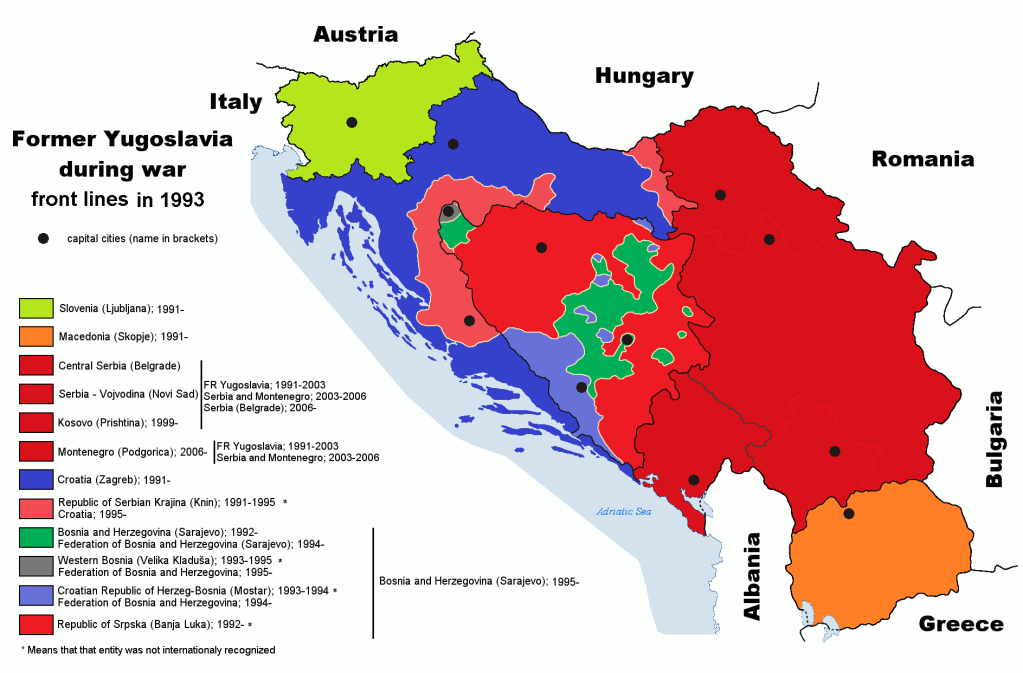
Ratnottama Sengupta presents the first hand account of the war in Bosnia-Herzegovina (1992-1995) from a letter from her brother, who was posted there as part of the peace-keeping troops. Click here to read.
And as imagination bodies forth
The forms of things unknown, the poet's pen
Turns them to shapes and gives to airy nothing
A local habitation and a name
A Midsummer Night's Dream (1595) by William Shakespeare
Famous lines by Shakespeare that reflect on one of the most unique qualities in not only poets — as he states — but also in all humans, imagination, which helps us create our own constructs, build walls, draw boundaries as well as create wonderful paintings, invent planes, fly to the moon and write beautiful poetry. I wonder if animals or plants have the same ability? Then, there are some who, react to the impact of imagined constructs that hurt humanity. They write fabulous poetry or lyrics protesting war as well as dream of a world without war. Could we in times such as these imagine a world at peace, and — even more unusually — filled with consideration, kindness, love and brotherhood as suggested by Lennon’s lyrics in ‘Imagine’ – “Imagine all the people/ Livin’ life in peace…”. These are ideas that have been wafting in the world since times immemorial. And yet, they seem to be drifting in a breeze that caresses but continues to elude our grasp.
Under such circumstances, what can be more alluring than reflective Sufi poetry by an empathetic soul. Featuring an interview and poetry by such a poet, Afsar Mohammad, we bring to you his journey from a “small rural setting” in Telangana to University of Pennsylvania, where he teaches South Asian Studies. He is bilingual and has brought out many books, including one with his translated poetry. Translations this time start with Bankim Chandra Chattopadhyay’s advice to new writers in Bengali, introduced and brought to us by Abdullah-Al-Musayeb. Tagore’s seasonal poem, ‘Megh or Cloud’, has been transcreated to harmonise with the onset of monsoons. However, this year with the El Nino and as the impact of climate change sets in, the monsoons have turned awry and are flooding the world. At a spiritual plane, the maestro’s lines in this poem do reflect on the transience of nature (and life). Professor Fakrul Alam’s translation of Masud Khan’s heartfelt poetry on rain brings to the fore the discontent of the age while conveying the migrant’s dilemma of being divided between two lands. Fazal Baloch has brought us a powerful Balochi poet from the 1960s in translation, Bashir Baidar. His poetry cries out with compassion yet overpowers with its brutality. Sangita Swechcha’s Nepali poem celebrating a girl child has been translated by Hem Bishwakarma while Ihlwha Choi has brought his own Korean poem to readers in English.
An imagined but divided world has been explored by Michael Burch with his powerful poetry. Heath Brougher has shared with us lines that discomfit, convey with vehemence and is deeply reflective of the world we live in. Masha Hassan is a voice that dwells on such an imagined divide that ripped many parts of the world — division that history dubs as the Partition. Don Webb upends Heraclitus’s wisdom: “War is the Father of All, / War is the King of All.” War, as we all know, is entirely a human-made construct and destroys humanity and one cannot but agree with Webb’s conclusion. We have more from Kirpal Singh, Ryan Quinn Flanagan, Nivedita N, John Grey, Carol D’Souza, Vernon Daim, George Freek, Saranyan BV, Samantha Underhill and among the many others, of course Rhys Hughes, who has given us poetry with a unique alphabetical rhyme scheme invented by him and it’s funny too… much like his perceptions on ‘Productivity’, where laziness accounts for an increase in output!
Ratnottama Sengupta takes us back to how imagined differences can rip humanity by sharing a letter from her brother stationed in Bosnia during the war that broke Yugoslavia (1992-1995). He writes: “It is hard to be surrounded by so much tragedy and not be repulsed by war and the people who lead nations into them.” This tone flows into our book excerpts section with Red Sky Over Kabul: A Memoir of a Father and Son in Afghanistanby Baryalai Popalzai and Kevin McLean. Popalzai was affected by the Russian invasion of Afghanistan in 1980 and had to flee. A different kind of battle can be found in the other excerpt from The Blue Dragonfly – healing through poetry by Veronica Eley – a spiritual battle to heal from experiences that break.
In our reviews section, KPP Nambiar reviews The Stolen Necklace: A Small Crime in a Small Town by Shevlin Sebastian and VK Thajudheen, a book that retells a true story. Sangeetha G’s novel, Drop of the Last Cloud, we are told by Rakhi Dalal, explores the matrilineal heritage of Kerala, that changed to patriarchal over time. Bhaskar Parichha reviews Burning Pyres, Mass Graves and A State That Failed Its People: India’s Covid Tragedy by Harsh Mander. Parichha emphasises the need never to forget the past: “It is a powerful book and sometimes it is even shattering. The narrative is a live remembrance of a national tragedy that too many of us wish to forget when we should, instead, etch it in our minds so that we can prevent another national tragedy like this one from recurring in the future.” While we need to learn from the past as Parichha suggests, Somdatta Mandal has given a review that makes us want to read Ujjal Dosanjh’s book, The Past is Never Dead: A Novel. She concludes that it “pays tribute to the courage and tenacity of the human spirit and its capacity for hope despite all odds.”
We have more content than mentioned here… all of it enhances the texture of our journal. Do pause by our July issue to savour all the writings. Huge thanks to all our contributors, artists, all our readers and our wonderful team. Without each one of you, this edition would not have been what it is.
If religion has bound people of different lands, religion has also crafted gulfs between people who shared the birthplace and spoke the same language. If religious hatred led to the holocaust, religion became the cornerstone of India’s Partition. The crimes against humanity in Bosnia also were rooted in religious intolerance, as Ratnottama Sengupta retraced when her brother, Dr Dipankar Ghosh wrote to her from Bosnia-Herzegovina, as part of the peace-keeping forces in 1996.
The Bosnian War (1992-1995) was an immediate fallout of the break-up of the Socialist Federal Republic of Yugoslavia. It began to disintegrate when Slovenia and Croatia seceded in 1991. Serbia, the largest constituent in the Republic of Yugoslavia, did not want Croatia’s independence as a large Serb minority lived in Croatia. But the rest of the state declared national sovereignty in October 1991 (two years after the fall of the Berlin Wall) and held a referendum for independence on 29 Feb 1992.
Bosnia, the largest nationality, was home to Muslim Bosniaks – they wanted Bosnia to be a unitary multi-ethnic state. The Serbs wanted to be independent if not to unite with Serbia. Likewise, the Croats wanted significant autonomy for their majority areas or secession to Croatia.
The referendum favoured independence, but the Bosnian Serbs opposed this, as they aimed at creating a new state – Republika Srpska (RS) that would include Bosniak majority areas. So, their political representatives boycotted it. And a day before the outcome of the referendum, on 28 February 1992, the Assembly of the Serb People in Bosnia and Herzegovina adopted the Constitution of the Serbian Republic of Bosnia and Herzegovina.
Eventually, the European Union formally recognised the newly constituted Republic, as did the UN. It was inhabited mainly by Muslim Bosniaks, Orthodox Serbs, and Catholic Croats. As this Republic gained international recognition, the earlier Cutiliero Plan proposing a division of Bosnia into ethnic cantons collapsed.
Now the Bosnian Serbs, led by Radovan Karadzic and supported by the Serbian regime of Slobodan Milosevic and the Yugoslav People’s Army (JNA), mobilised their forces inside Bosnia and Herzegovina in order to secure ethnic Serb territory. Soon war spread across the Balkan land, accompanied by ethnic cleansing.
Siege of Sarajevo (1992-1996): The Bosnian Serbs who would settle for nothing less than a new state, Republika Srpska (RS), now encircled Sarajevo, the capital of Bosnia-Herzegovina. With a siege force of 13,000 stationed in the surrounding hills, they assaulted the city with artillery, tanks, and small arms. The army of RS, which had transformed from the Yugoslav Army units in Bosnia, fought the army of the Republic of Bosnia and Herzegovina (ARBiH).
Inside the city ARBiH, which was the Bosnian government’s defence force composed of Bosniaks and Croat forces in the Croatin Defence Council (HVO), was poorly equipped. It could not break the siege and for six months, the population of Sarajevo lived without gas, electricity or water. It is estimated that of the 13,952 killed during the siege, 5434 were civilians.
Within a year increased tension between the Bosniaks and the Croats led to escalation of the Bosnian war, in 1993. Here on, the war was characterised by bitter fighting, indiscriminate shelling of cities and towns, ethnic abuse, forcible transfer and systematic mass rape of Bosniak Muslim women – perpetrated mainly by Serbs and, to a lesser extent, by Croat and Bosniak forces. Events such as Markale massacre and Srebrenica genocide, perpetrated to raze the Bosniak’s morale and willingness to fight, became iconic of the conflict.
Markale Massacre: In February 1994, the open-air market in the historic core of Sarajevo. Mortars were shelled. This act of targeting civilians in the marketplace was carried out, it was later confirmed, by the Army of Republika Sprska (VRS).
Initially the Serbs were militarily superior due to the weapons and resources from the JNA. Eventually they lost momentum as the Bosniaks and Croats allied against RS following the creation of the Federation of Bosnia and Herzegovina in 1994.
The repeat shelling of the Markale Market in August 1995 prompted the NATO airstrikes against Bosnian Serb forces and eventually led to the Dayton Peace Accord. The peace negotiations were held in Dayton, Ohio and signed on 21 November 1995.
Srebrenica Genocide: In July 1995, more than 8000 Bosniak Muslim men and boys in and around the town in eastern Bosnia were killed by the Bosnian Serb Army of Republika Srpska (VRS) under the command of Ratko Mladic. Prior to the massacre UN had declared the besieged enclave of Srebrenica a “safe” area but had failed to demilitarise the area or break the siege of Sarajevo. By 2012, close to 7,000 genocide victims were identified by DNA analysis of the recovered body parts.
Some Serb accounts say that the massacre was in retaliation of civilian conflicts on Serbs by Bosniak soldiers from Srebrenica. This claim has been rejected by the UN and ICTY as “bad faith attempt to justify the crime against humanity”.
US Inaction: The United States took no action till 1995 against the smuggling of arms that had become rampant. It was widely believed that the CIA funded, trained and supplied the Bosnian Army. EU intelligence sources maintained that the US organised arms shipment to Bosnia through its Muslim allies. Pakistan, for one, ignored the UN ban that declared it illegal for other Muslim countries to supply arms in the war. It not only supplied arms and ammunition to Bosnian Muslims, it also airlifted anti-tank missiles.
Serbia did not fight but supported RS with money, arms and volunteers. Croatia too did the same for Croats.
The war ended with the signing of the General Framework Agreement for Peace in Bosnia and Herzegovina in Paris on 14 December 1995. British soldiers were first deployed in 1992 to protect aid convoys in Bosnia during the vicious civil war. They stayed on for peacekeeping duty.
War Crimes: Radovan Kradzic, the first President of Sprska during the Bosnian war, was a trained psychiatrist who was also known for his poetry. But the co-founder of the Serbs Democratic Party was declared a War Criminal. He was hunted down after 12 years as a fugitive in Belgrade and Austria, and extradited to the Netherlands which was then heading EU. There the International Crimes Tribunal for Yugoslavia (ICTY) convicted him on 11 counts of crimes against Bosniak and Croat civilians. Found guilty of the genocide in Srebrenica, he was sentenced to 40 years imprisonment.
Reportedly hundreds of people had demonstrated in his support. Others pleaded that Bosnia and Serbia could not move ahead economically as long as he was at large.
By 2008 ICTY had convicted 45 Serbs, 12 Croats, and 4 Bosniaks of War Crimes against Humanity. Estimates suggest that around 12,000-50,000 – mostly Bosniak – were raped, mainly by Serb forces. About 1 million people were killed and 2.2 million were displaced. This makes the Bosnian war the most devastating conflict in Europe since the end of World War II.
Net Outcome: The Bosniaks accomplished their goal of independent Bosnia. But the Serbs preserved their territorial gains a change in the demographic and self-rule in Republika Sprska. Also, the ethnic cleansing led to changes in the demographic composition of the Bosnian region – with the Serbs gaining the most.
History of the Conflict: The roots of the Bosnian War lies in the history that dates back to the 6th and 7th century when the region came to be inhabited by Slavic tribes. Bosnia was conquered in 1463 by the Ottoman Turks. Under their rule, large sections of the population converted to Islam while the rest remained either Orthodox Christians or Catholics. The Christian Orthodoxy came to be associated with Serbian nationality and Catholicism with Croat nationality. It is interesting to note that all these people spoke the same Slavic language.
Ethnic violence has been endemic in Bosnia and Herzegovina that had been under Austrian rule (1878-1918) before becoming a part of Yugoslavia. Violence engulfed it during WW2 when it was under Croatia, a puppet of Nazi Germany. In 1943-44, most of Bosnia was conquered by Serb-dominated Communists. Consequently, when WW2 ended, Bosnia became a constituent of the Socialist Federal Republic of Yugoslavia. It was led by Josip Broz Tito (1892-1980), an ethnic Croat who tried to create a common Yugoslav identity based on adherence to Communist ideology. When that glue wore off, the nationalist separatist forces surfaced again.
*
Dipankar Ghosh, since he went to Pune’s Shivaji Preparatory Military School as a teenager, was mentally equipped to face the tribulations a war brings in its wake. His graduation from Kolkata’s Neel Ratan Sircar Medical College armed him to care for the ailing. And, being the firstborn of celebrated writer Nabendu Ghosh, he had a flair for writing.
All three qualities surfaced whenever the doctor, who retired as a Colonel in Britain’s Royal Army Medical Corp, put pen to paper. And he did that whenever he felt the urge to touch base with his parents in Bombay. From wherever he was camping — Belize, Belsen, Brunei, Cyprus, or in the Gulf War…
In the process, he breathed life into the now lost art of writing letters — which often became travelogues… like this letter to his father:
*
Mrkonic Grad. Photo provided by Ratnottama Sengupta
Lt Col D Ghosh, RAMC
RMO, 1 WFR
SHOE Factory, Mrkonic Grad
BFPO 551.U.K.
5th July 1996
Dear Baba,
I have just received your last letter from Bombay. I was worried about your health, which is why I rang you last night. Sorry it was so late. There was quite a queue for the phone, so I had to wait for my turn, Lt Col notwithstanding! I am reassured that you are okay.
I am sorry the line was so poor, but it is a satellite line, which travels from Bosnia to the USA then is beamed on to India — hence all the static. Mind you, it is full of static when I speak to Lesley and Children in the UK too. Sadly, it is only an outgoing line, which takes call out, but no incoming calls. If you need to get in touch with me urgently, the best thing would be for you to ring Lesley and she can get in touch with me via the Ministry of Defence.
We have been out in Bosnia for just over three months now, and the problems here seem to be in a state of very uneasy peace, now that Dr Radovan Karadzic has finally handed over the reins of power (Oh Yes!?). We are somewhat concerned that the proposed elections in September might bring about fresh unease and disturbance, even without Dr Karadzic at the hustings, and we might be, willy-nilly, dragged into a situation of tension to try to maintain peace. Nonetheless, the Bosnians are making some efforts to keep the peace, albeit because we are waving a big stick whilst holding out a carrot.
The position is especially delicately balanced for us at the moment, due to the ICFWCB’s (International Commission for War Crimes in Bosnia) declaration of the good Dr Karadzic and his General, Ratko Mladic as ‘War Criminals’ for genocide against the Muslims of Bosnia. There’s little doubt, this is due to pressure from the countries with more than a few spare billions of petrodollar in western banks. We are hoping that we will not need to confront the Bosnian Serbs by having to arrest these two persons (since this was not a part of the Dayton agreement that has laid the framework last year for ending the war ravaging Bosnia for more than three years). These two still hold considerable political sway, and have a significant following in this country.
It seems likely that we (British Army as well as the Americans, much as they might dislike it) will have to stay on in Bosnia for quite a while longer than we’d initially made allowance for. If the yanks want out, I hope we shall pull out as well. The Serbs seem to prefer having us around, to maintain the peace, than any other European nation, as they feel the British army of IFOR has, so far, been fair and reasonable in their dealings with them. (IFOR, you do know, is the NATO-led multinational peace enforcement force here under a one-year mandate).
This was not the feeling they had about us last year though!
The biggest single problem at the moment, which might cause a major flare up for us, is Mostar. The people of this divided town straddling the river Neretva in south-east Bosnia have selected a Muslim majority council: this, the minority Croatian population are unwilling to accept, and have been boycotting. So far the town, which is known for its mediaeval arched bridge Stari Most, has been run by a peace committee from the European community with the help of IFOR, but they have threatened to hand over the council and resign from running it.
This would effectively ring the death knell for the first election in Bosnia. Which would mean that the results of all the country-wide elections, due in September, may be an exercise in futility.
The sad news this morning is that the iconic bridge, which connected the two parts of the city, was blown up by ‘unknown miscreants’ – very likely to have been Croats. Thankfully, Mostar is in the French sector of IFOR overall, so let’s hope and pray.
*
Now to give you some idea of all the other things that I’ve been up to, here in Bosnia. In May we started what we call a G5 project, a ‘Hearts and Minds’ operation to try and persuade the people at the grassroots about the benefits of Peace. This is in a small village called Podrasnica, with medical logistic support — essentially, medicines — from Medicine Sans Frontier (MSF), an international humanitarian organisation that provides medical assistance to people affected by wars, epidemics or other disasters.
Podrasnica is a village of some 950 people and is, like most places in the Balkans, nestled in a valley, about ten miles from our location in Mrkonic Grad.
The people are mostly poor agrarians, eking out a living on small land holdings, or are involved in the logging industry. I run a Primary Health Care Clinic here, twice a week. The locals and also some people from the surrounding villages (though they never let on they are from another village!) are very grateful to have this facility, as they are very poor and many of them are unable to afford the price of medicine, or have transport to travel to Mrkonic Grad, and certainly not to their only surviving big hospital at Banja Luka. We do the basic medical care and also provide them with medicines which are given to us by MSF.
Most of my patients are elderly people and small children, as the majority of young healthy men and women go to other places, bigger cities or towns, to earn a living as best as they can. I’ve never come across so many people, in such a small community, with so much Hypertension amongst them. How much of that is the result of the stresses of war and how much of it due to the Turkish coffee they drink, would be interesting to investigate.
The majority of people are by and large sick of the war, and this is the first time, in five years, some of them will be able to harvest their own crops. The vast quantity of what they grew in the last few years was either commandeered by their own Army or looted by the opposition (Muslims and/or Croats).
The clinic is now quite popular, but it is time consuming as we have to use an interpreter, and I am lucky if I can get through more than 15-20 patients per clinic.
I have a special admirer called Milija (Serbian version of our dear Emily!) who brings us Turkish coffee. She was one of my first patients. She is sixty-two years old, and is a real darling. She doesn’t believe I’m fifty, which is wonderful for my morale!
Later this month, possibly on the 16th, we will ‘hand over’ the clinic to the local Serbs, to continue the clinic with ongoing Medical support from MSF and support from us, if they want it. If they do take over the clinic completely, I shall miss seeing the patients. I’m hoping that they will be happy to allow me to continue the clinic, at least once a week.
The clinic work sustains me through the boredom and the non-events (in real life terms) of the remainder of the week. So far I have had one bottle of ten-year-old Brandy, and a bottle of the local firewater called Sliivo — a fruit brandy they make out of plums). I’ve found out the hard way that it is safer to keep a hand over the little glasses they offer the slivovitz in, otherwise it gets automatically topped up! Even better, so that I don’t drink whilst on duty.
The vegetables are coming on a treat in Milija’s garden, and the palm trees are loaded with fruits, as are the apple trees next to the clinic. Milija thinks they will have a decent harvest, if the peace holds, and she’s trying hard to dissuade her oldest son from drinking too much — otherwise, she says, she will force him to come and see me!
The men who do not have regular employment, and there’s a lot of them about, have become apathetic. So alcoholism is rife, and hence, I think, Hypertension and Peptic disease. All my boys have now developed a taste for Milija’s Turkish coffee, but I try to dissuade Milija, as I am fairly certain that the coffee beans must cost quite a bit.
We always have an interpreter for the clinic, who are generally Bosnian girls, or fellers. They are generally chary (maybe even contemptuous) of the local yorkels, as is normal in all developing nations, and certainly in India. But the vast majority of them seem to have developed a special protective shell, to help them cope with the business of dealing with the needs of their poorer country folks, as the vast majority of them (the interpreters) get paid some DM 1000–12,00/ a month. This is eight to ten times what the ordinary folks in the country earn.
There are some really bright students amongst these interpreters, who have given up career courses in order to take up jobs with IFOR, so that they can look after their families. One of the girls we have with us in Mrkonic Grad was a second year medical student when the war broke out. Another girl, the daughter of a Chemistry Professor (her mother), is a graduate Electronic Engineer. She is trying to get funds organised so she can do a Master degree, and then probably a PhD. What will happen to all these blighted lives eventually, who knows?
I am constantly amazed how well these girls cope with living amongst all of our sex-starved, often foul mouthed soldiers. Some, of course, cope better than others, the youngest being just over 16 years old! IFOR has arranged a free scholarship for her, to study in the UK after she’s done her stint with the Army.
It is hard to be surrounded by so much tragedy and not be repulsed by war and the people who lead nations into them. But draw the experiences of N Ireland into the reckoning and you realise that humankind has still some way to go before being called truly civilised. Amongst all this, when one has to cope with the petty point scoring of the self-seeking people, and self-aggrandizement of personalities around you, then it can get somewhat wearying.
So far I am managing to cope with the changes that have occurred in my life, and find it comforting to accept that “This too shall pass”. Your letter was a solace.
I hope that my dear mother is keeping well. Please convey my pronam and love to Maa. Hope you are both well when this gets to you. I’ve rambled on too long for now.
With pronam and love,
Yours, as ever, Khoka
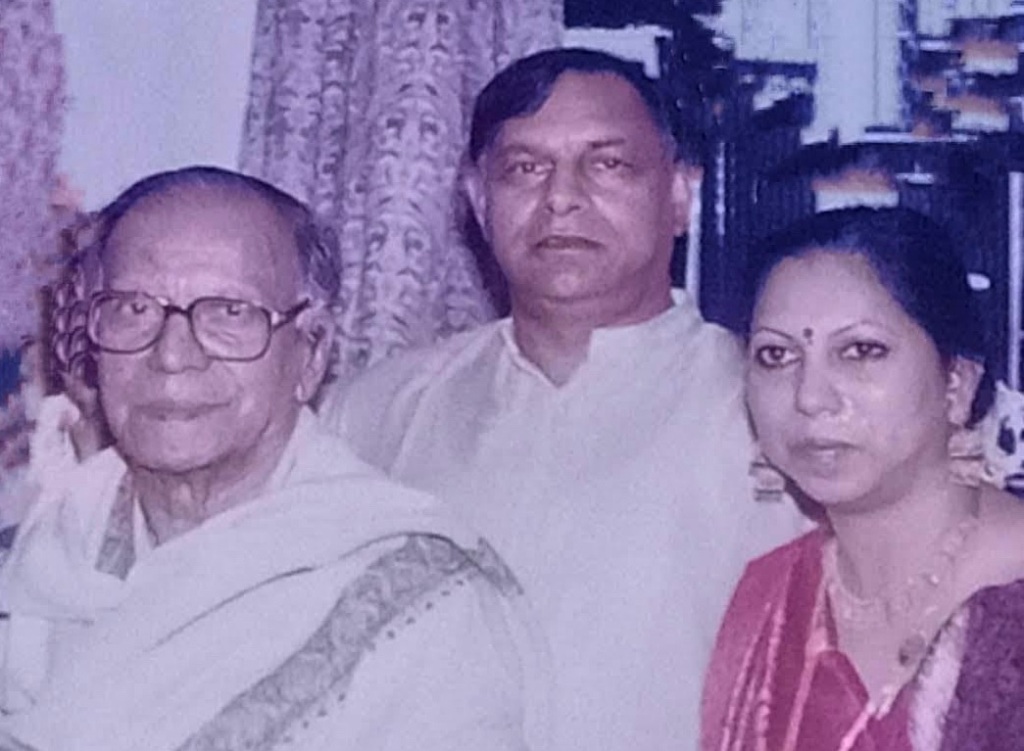
From left to right: Nabendu Ghosh, Dipankar Ghosh and Ratnottama Sengupta. Photo provided by Ratnottama Sengupta.
Ratnottama Sengupta, formerly Arts Editor of The Times of India, teaches mass communication and film appreciation, curates film festivals and art exhibitions, and translates and write books. She has been a member of CBFC, served on the National Film Awards jury and has herself won a National Award.
.
PLEASE NOTE: ARTICLES CAN ONLY BE REPRODUCED IN OTHER SITES WITH DUE ACKNOWLEDGEMENT TO BORDERLESS JOURNAL
ProfessorFakrul Alam brings to us Tagore songs in translation and in discussion on the season that follows the scorching heat of summer months. Clickhereto read.
“May is pretty, May is mild,
Dances like a happy child…”
Annette Wynne (Early twentieth century)
Each month is expressed in a different form by nature in various parts of the world. In the tropics, May is sweltering and hot — peak summer. In the Southern hemisphere, it is cold. However, with climate change setting in, the patterns are changing, and the temperatures are swinging to extremes. Sometimes, one wonders if this is a reflection of human minds, which seem to swing like pendulums to create dissensions and conflicts in the current world. Nothing seems constant and the winds of change have taken on a menacing appearance. If we go by Nazrul’s outlook, destruction is a part of creating a new way of life as he contends in his poem, ‘Ring Bells of Victory’ — “Why fear destruction? It’s the gateway to creation!” Is this how we will move towards ‘dancing like a happy child’?
Mitra Phukan addresses this need for change in her novel, What Will People Say — not with intensity of Nazrul nor in poetry but with a light feathery wand, more in the tradition of Jane Austen. Her narrative reflects on change at various levels to explore the destruction of old customs giving way to new that are more accepting and kinder to inclusivity, addressing issues like widow remarriage in conservative Hindu frameworks, female fellowship and ageing as Phukan tells us in her interview. Upcoming voice, Prerna Gill, lauded by names like Arundhathi Subramaniam and Chitra Divakaruni, has also been in conversation with Shantanu Ray Choudhuri on her book of verses, Meanwhile. She has refreshing perspectives on life and literature.
Devraj Singh Kalsi has written a nostalgic piece that hovers between irony and perhaps, a reformatory urge… I am not quite sure, but it is as enjoyable and compelling as Meredith Stephen’s narrative on her conservation efforts in Kangaroo Island in the Southern hemisphere and fantastic animals she meets, livened further by her photography. Ravi Shankar talks of his night hikes in the Northern hemisphere, more accurately, in the Himalayas. While trekking at night seems a risky task, trying to recreate dishes from the past is no less daunting, as Suzanne Kamata tells us in her Notes from Japan.
May hosts the birthday of a number of greats, including Tagore and Satyajit Ray. Ratnottama Sengupta’s piece on Ray’s birth anniversary celebrations with actress Jaya Bachchan recounting her experience while working for Ray in Mahanagar(Big City), a film that has been restored and was part of celebrations for the filmmaker’s 102nd Birth anniversary captures the nostalgia of a famous actress on the greatest filmmakers of our times. She has also given us an essay on Tagore and cinema in memory of the great soul, who was just sixty years older to Ray and impacted the filmmaker too. Ray had a year-long sojourn in Santiniketan during his youth.
Eulogising Rabindrasangeet and its lyrics is an essay by Professor Fakrul Alam on Tagore. Professor Alam has translated number of his songs for the essay as he has, a powerful poem from Bengali by Masud Khan. A transcreation of Tagore’s first birthday poem , a wonderful translation of Balochi poetry by Fazal Baloch of Munir Momin’s verses, another one from Korean by Ihlwha Choi rounds up the translated poetry in this edition. Stories that reach out with their poignant telling include Nadir Ali’s narrative, translated from Punjabi by his daughter, Amna Ali, and Aruna Chakravarti’s translation of a short story by Tagore. We have more stories from around the world with Julian Gallo exploring addiction, Abdullah Rayhan with a poignant narrative from Bangladesh, Sreelekha Chatterjee with a short funny tale and Paul Mirabile exploring the supernatural and horror, a sequel to ‘The Book Hunter‘, published in the April issue.
All the genres we host seem to be topped with a sprinkling of pieces on Tagore as this is his birth month. A book excerpt from Chakravarti’s Daughters of Jorasankonarrates her well-researched version of Tagore’s last birthday celebration and carries her translation of the last birthday song by the giant of Bengali literature. The other book excerpt is from Bhubaneswar@75 – Perspectives, edited by Bhaskar Parichha/ Charudutta Panigrahi. Parichha has also reviewed Journey After Midnight – A Punjabi Life: From India to Canadaby Ujjal Dosanjh, a book that starts in pre-independent India and travels with the writer to Canada via UK. Again to commemorate the maestro’s birth anniversary, Meenakshi Malhotra has revisited Radha Chakravarty’s translation of Tagore’s Farewell Song. Somdatta Mandal has critiqued KR Meera’sJezebel, translated from Malayalam by Abhirami Girija Sriram and K. S. Bijukuma. Lakshmi Kannan has introduced to us Jaydeep Sarangi’s collection of poems, letters in lower case.
There are pieces that still reach out to be mentioned. Do visit our content page for May. I would like to thank Sohana Manzoor for her fantastic artwork and continued editorial support for the Tagore translations and the whole team for helping me put together this issue. Thank you. A huge thanks to our loyal readers and contributors who continue to bring in vibrant content, photography and artwork. Without you all, we would not be where we are today.
Ratnottama Sengupta time travels fifty years back as famed actress Jaya Bachchan recounts her first day on the sets of Satyajit Ray’s Mahanagar
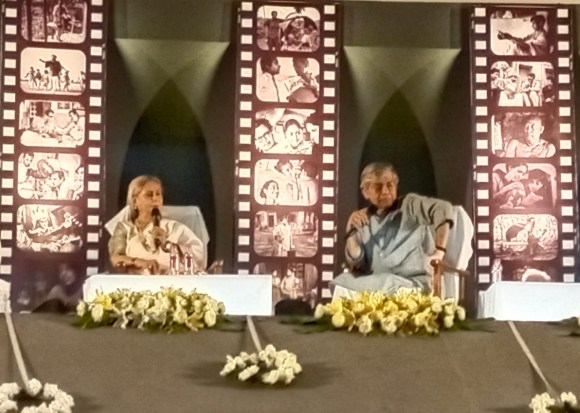
In this event, Jaya Bachchan recounts her days while acting in Satyajit Ray’s award-winning film Mahanagar or The Big City. Photo provided by Ratnottama Sengupta
When Shanti Di, my eldest aunt’s eldest daughter, had got married in 1964, she was already working. So she did not have to face the resistance Arati, the pivotal character of Mahanagar had to face from her in-laws and son. But prejudices and cryptic comments she did face — from her male colleagues. “Women in workplace? They only deprive deserving men of a livelihood,” they would say. “Because, men have to run entire households on their earnings while women work only for the ‘sauce’ — jewellery and saris!”
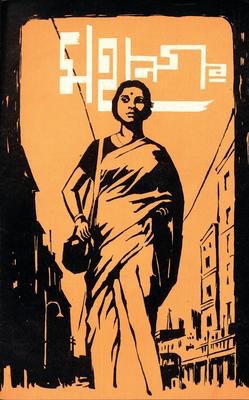
Mahanagar poster designed by Satyajit Ray. Photo provided by Ratnottama Sengupta
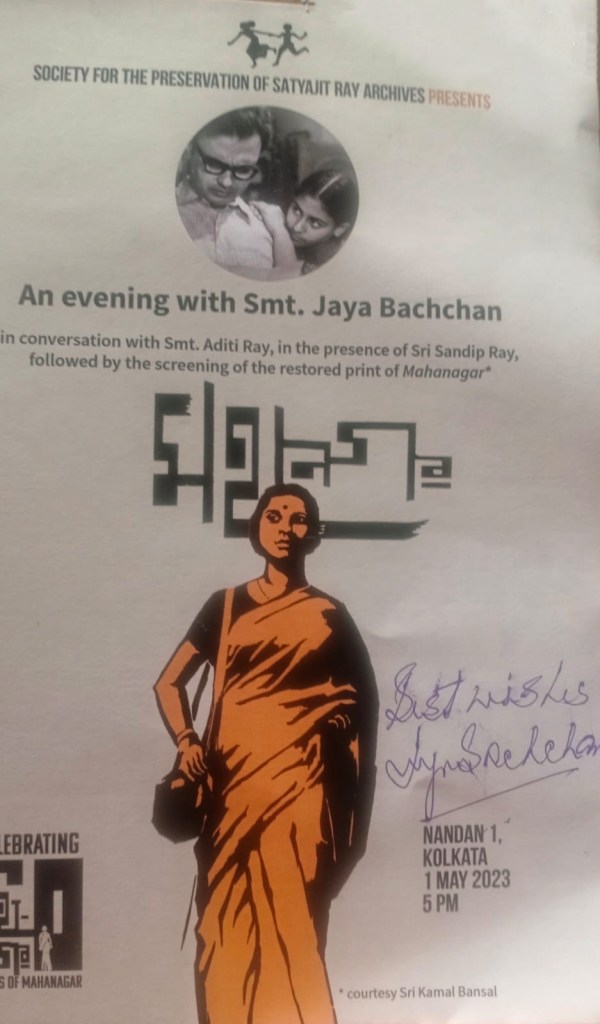
I remembered this at the screening of a restored print of Mahanagar (The Big City, 1963) at Nandan, the West Bengal Film Centre, to mark the 102nd birth anniversary of Satyajit Ray. Based on Narendra Mitra[1]‘s novel, Abataranika (Staircase), the film followed the trials and triumph of Arati, a housewife who steps out of the narrow domestic walls when she finds her husband Subrato bending under the weight of fending for a superannuated father, an aged mother, a school going sister, and their little boy along with themselves.
But once she starts working, she enjoys her new role of conversing with and convincing women with deep pockets to buy her products — and soon her confidence in her work grows along with her empathy with other women who are yet to be empowered like her sister-in-law, Bani, her mother-in-law, Sarojini, her Anglo Indian colleague, Edith Simmons… When her husband loses his job, Arati firmly negotiates a raise. And when Edith is fired for absence due to ill health she takes up cudgel for the ‘insult’.
The remarkable sensitivity and the eye for details with which Satyajit Ray etched the ordinary lives of a middle class family earned him the Golden Bear at the Berlin Film Festival 1964. The director’s son, Sandip Ray, remembers attending the ceremony with his parents. “Why were you not there?” a voice from the audience asked Jaya Bachchan, who was in conversation with the maestro’s son, now a renowned director in his own right. “Why would they invite me, who was just a ‘cameo artiste’ as someone mentioned this evening?”
Jaya Bachchan and Sandipt Ray conversing at the event on May 1, 2023.
Jaya Di[2] — as I am privileged to address her, much like Sandip ‘Babu’ Ray — was much more than a cameo artiste in Mahanagar. Her ‘Bani’ was a flesh and blood character as she brought to life a marriageable sister who, in my childhood and not just in Bengal, was a part and parcel of any Indian household. Bubbly, sincere, attached to her Boudi as much as to her little nephew whom she mothers when the housewife is earning the family its bread, she is pampered by her brother even as she is being trained by her mother to pick up the haata-khunti…spatula-spoon…in the kitchen!
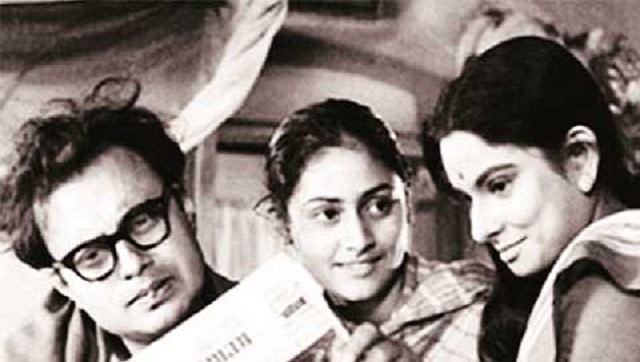
“I distinctly remember the first day of shooting in Indrapuri Studios. It marked my debut in films. Madhabi Di and Anil Kaku were in that shot which is reproduced whenever something is written about Mahanagar. I am at the study table, trying to write something. Those days I used to wear specs when I was reading. Manik[3] Kaku must have made a mental note of that, he said, ‘Don’t take off your specs, keep them on for the shot.’ I didn’t have any dialogue for the scene. So, although I had not even been on stage before this, I didn’t feel that I was acting. The camera in front of me with Subrata Mitra behind it was not daunting. I was comfortable, just my usual self…”
Little did Jaya Bhaduri know, then, that this ‘girl-next-door’ identity would become her calling card in the years to come, storming even the glamorous boulevards of tinsel town Bollywood.
*
How did Jaya reach the sets of Mahanagar? She didn’t: Ray had sent for the girl in her teens. In all probability, she was recommended by Robi Ghosh and Sharmila Tagore. “They were shooting for Tapan Sinha’s Nirjan Saikatey (1963) when I had gone to Puri with my father, Tarun Bhaduri,” Jaya Di recounts. “We met them and on their return to Kolkata both Robi Kaku[4] and Rinku[5] Di told Manik Kaku that ‘the girl for that role (of sister) has been found at last!'”
The first time she met Ray he did not ask her anything special. Nor did he ask her to do anything particular on the set. Young Jaya was told to read her lessons aloud, which she did, just as any school going child in Bengal did half a century ago. “I remember that Baba told Jaya Di to continue reading after the camera had moved on because he wanted an audio track of her reading in the background,” Sandip recalled in the course of the conversation. “She continued to read, but suddenly there was a sound of coughing. What happened?? In reply to everyone’s anxious query she coolly replied, ‘Why? Can’t a fly wing its way into my mouth while I’m reading?'”
Jaya Di herself has no recollection of this prank, but she vividly remembers that she would pester people on the set, incessantly asking questions. She especially questioned Subrato Mitra for taking time to light up! “It was as if we were out on a picnic,” she smiles. “The entire unit indulged me like a little girl. I was very comfortable because I had no burden to carry. In the presence of major actors I was required to do very little!”
*
Jaya Bhaduri was not given any express direction — neither about how to speak her lines nor about action or emotion. She had full freedom to interpret the scene and react to the other characters. “Manik Kaku used to call all the artistes and read out all the dialogues to us. His intonation would give us an idea of what he wanted from us. We interpreted the scene according to our capacity and gave our best shot. He went about canning it, he never had any problem with my delivery.”
But lessons in acting she did learn on the sets of Mahanagar — by observing how the director groomed the lead actress. “I have seen Manik Kaku directing Madhabi Di to grow into the role of Arati. He literally groomed her in acting. ‘Look this way, through the corner of your eyes. Turn your head like this. Say it like this. Wear the sari in this manner…’ The fact is that Satyajit Ray had a strong visual sense. He envisaged how the character would look and behave at the outset, how she would change, how she would resolve her dilemmas.”
In other words, his actors were not puppets: he allowed the spontaneity of some, like Jaya; he moulded the emotive action of some, like Madhabi Mukherjee who would soon storm the silver screen as Charulata (1964).
*
“Mahanagar was a very modern film, and not just at the time it was made,” Jaya Bachchan observes. Her critique of Ray’s first urban development film gains greater weight from the fact that, in the intervening years, she has ‘grown up’. From a school girl to a trained actor. From the heartthrob of every Indian family in 1970s to the heartthrob of her ‘Lambuji[6]‘ — Amitabh Bachchan — whose charisma straddles two centuries, three generations, five continents. From a reclusive personal life to a vibrant political presence in the upper house of India’s Parliament.
Young Jaya Bhaduri (now Jaya Bachchan) in between lead actress Madhabi Mukherjee and Anil Chatterjee. Photo provided by Ratnottama Sengupta
So let me elaborate on her observation, taking off from a scene between her and Subroto, her elder brother in Mahanagar, enacted by Anil Chatterjee.
Subrato has come home from work and his sister asks him for his pen as hers has run out of ink. He enquires when her exams are to commence, then he comments, “What use is this reading and writing? Sei toh henshel thelte hobey, you’ll end up dealing with only pots and pans!”
“Sekhaay toh,” Bani is quick to revert. “They teach us that too – it’s Domestic Science.”
That statement portrayed Ray’s attitude towards housewife. It was and still is a commentary on the identity — role — of a contemporary wife. It is in fact every woman’s attitude in contemporary India,
Jaya Di has observed: “Today every woman also has to and does work. Not only for economic reasons but for identity, purpose in life. Those who have had higher education, certainly do. Those who have not studied much, who help with housework also have such dignity. I see their confidence in the way they carry themselves. They know their mind and they don’t hesitate to say up front what work they will do and what they won’t; how much time they will apportion to a household and when they will leave. And like urban working women, they too save a little from their earnings, use some of it and keep some for emergencies.”
*
Ray’s masterstroke is seen in the way he sketched the nuances of the bank clerk husband, complete with his angst and jealousy. He is proud of his wife’s charming appearance, he is confident she can steer herself through the career of a salesgirl, he is happy when the second income flows in. Yet — and especially when he loses his job — he suffers from insecurity, jealousy, suspicion. To the extent that the man who wrote her application letters, goads her to write a resignation letter. He is redeemed by the stand he takes at the very end when she gives up her much-needed job to protest a wrong against a colleague.
Critics have found Ray to be more kind to the protagonist than Narendra Nath Mitra, the Bengali author who also penned Ras[7] (made into the Hindi film Saudagar (Trader, 1973) which again builds upon how economic realities can make or mar a marriage. About a decade later Jaya Bachchan co-starred with husband Amitabh Bachchan in Abhimaan[8](1973). In it Hrishikesh Mukherjee takes to an extreme the consequences of a husband’s ego trip when his wife fares better than him, professionally and financially.
*
Earlier Hrishikesh Mukherjee had, in Guddi (1971), given the young sister of Mahanagar a full canvas to come into her own as an actor. The same bubbly girl matures into a woman who can differentiate between love and infatuation. “After Mahanagar I was very selective. I chose to work only with directors who had a ‘Bengali’ sensibility,” Jaya Di says without a hint of hesitation.
And the rapport she struck with Ray? It lasted a lifetime. When she joined the Film and Television Institute of India (FTII) she asked her Manik Kaku for a letter of commendation to go with her biodata. He wrote back saying that she doesn’t need an institute but join it, “it is the place for you”.
She went thinking she would not last beyond a few months but with batchmates like Anil Dhawan, her co-star in Piya Ka Ghar (1972), and Danny Denzongpa, she stayed the full course. “And when Manik Kaku came with the print of Goopy Gyne Bagha Byne (1969), I felt so proud! I went to the airport to pick him up!”
That bonding would show every time they were in each other’s vicinity, Sandip Ray reiterates. “Once we were in Bombay and Baba stepped out of the Taj Mahal Hotel to leaf through books in the stall just outside. Suddenly a shrill voice screamed, ‘Manik Kakuuu!’ Jaya Di was passing by in her car and had spotted him!” “And I hugged him!” Jaya Di adds, “I took liberties others would hesitate to.”
So why was she was not seen in his films again? “There were talks of casting me in Pratidwandi (1970) opposite Dhritiman Chatterjee,” Jaya recalls, “but I was in FTII then. Later I accosted him for not giving me a thought (for the role) – ‘You could have at least called me!’ His reply? ‘It was not necessary.’ That’s all!
“As if to add insult to injury, Manik Kaku got Amitji to do the voice over for Shatranj Ke Khilari (The Chess Players, 1977) but a role for me? No! I was so angry I went and met him in Rajkamal Studio. His reply? ‘ Ha ha ha…’ Not a word more.”
Amitabh Bachchan doing the voice over for Satyajit Ray in Shatranj Ke Khilari. Picture from Bachchan’s FB, provided by Ratnottama Sengupta.
That did not stop Jaya Bachchan from going to Bishop Lefroy Road every time she happened to be in Kolkata. She had, after all, seen the films the ‘Towering Inferno’ made even before Mahanagar. “Every time I watched a film by Ray I felt this is his best. Until the next one came along…” So, when Charulata came, Mahanagar paled. But wait, to this day Debi (The Goddess, 1960) continues to haunt Jaya Bachchan.
And to think that, when Ray had sent for her, the young girl growing up in Bhopal was beset with doubt and hesitation. “I was studying in a convent school, and I feared that the nuns would disapprove of my acting in a film. But my father said, ‘It’s the opportunity of a lifetime — don’t let go of it.'”
Cut to the convent when she went back after Mahanagar. The same austere nuns came and said, ” ‘You have acted in a Satyajit Ray film?! You are so lucky!!’ That is when I first realised, even before he was crowned in Berlin, what a major director my Manik Kaku was!”
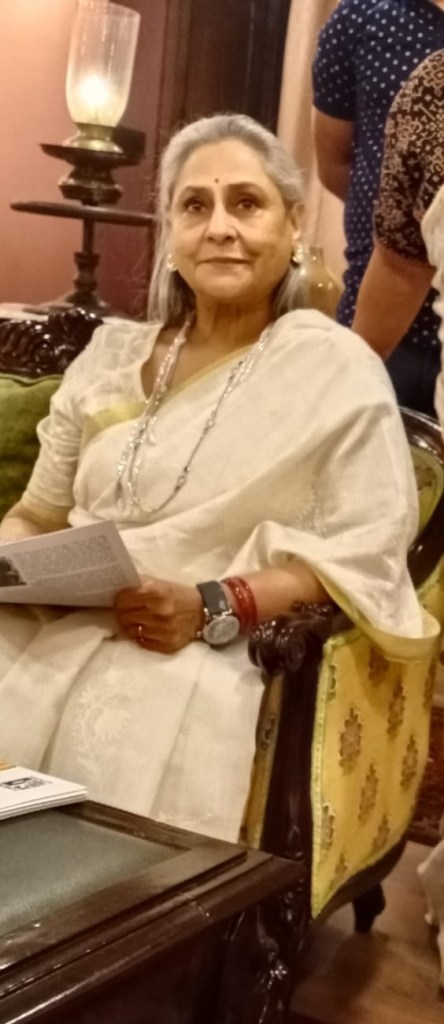
Jaya Bachchan on 1/5/2023. Photo provided by Ratnottama Sengupta
Ratnottama Sengupta, formerly Arts Editor of The Times of India, teaches mass communication and film appreciation, curates film festivals and art exhibitions, and translates and write books. She has been a member of CBFC, served on the National Film Awards jury and has herself won a National Award.
.
PLEASE NOTE: ARTICLES CAN ONLY BE REPRODUCED IN OTHER SITES WITH DUE ACKNOWLEDGEMENT TO BORDERLESS JOURNAL
Rabindranath Tagore spells different things to different people: National Anthems; the Nobel, Rabindra Sangeet, a veiled woman, Sriniketan or Santiniketan. A cineaste might think of Charulata or Kabuliwala, Chokher Bali (Best Friend) or Kadambari. But the subject ‘Tagore and Cinema’ would mean talking of Tagore’s exposure to cinema, his interest in the medium, the fate of his involvement with celluloid, the films based on stories penned by him, their interpretation in a world that is so far removed from his, in historical, economical, and cultural terms… In other words, it would mean talking of what about Tagore endures — and why it reaches out to the wide world of humanity.
To me, it is Tagore’s awesome, inspiring humanism that offers us immense scope to transcreate, reinterpret, relocate the socially relevant developments and rooted characters again and again onscreen. Like Shakespeare, his works are universal in terms of age, geophysical location, terrain of the mind and tugs of emotions…
Rabindranath was almost seventy when he exhibited his paintings that were so radically different from the style associated with the Tagore family artists, Abanindranath, Gaganendranath, Sunayani Devi, or Nandalal Bose. For, if the Bengal School looked East and sought inspiration in delicate miniatures, Chinese watercolours or the sparseness of Japanese zen, Tagore absorbed the boldness of German expressionism and created a unique style. It’s impossible for someone so open to avant garde trends to take no interest in cinema, the 20th century art form that was silently taking its juvenile steps in India when Tagore won the Nobel.
When he visited Russia, he watched Battleship Potemkin, the classic ‘handbook for editors’ (to quote Phalke winner Hrishikesh Mukherjee) that influenced a long line of filmmakers in India too. By 1931, the year when Alam Ara (Hindi) and Jamai Shasti’(Bengali) turned ‘movie’ into ‘talkie’, Tagore was in the last decade of his life. So, when he directed Natir Puja (The Dancing Girl’s Worship) at New Theatres, he was substantially assisted by Premankur Atorthi, who was the first to direct a film based on a Tagore composition. This was the only time when the Renaissance personality directly interacted with the celluloid medium. His nephew Dinendra wrote the screenplay, albeit under Tagore’s guidance, and students of Santiniketan acted in it. More importantly, Tagore himself essayed an important role in the dance-drama which was shot with a static camera over four days. However, the result was more a staged play than cinema. A greater tragedy is that the reels perished within 10 years, when a fire ravished the New Theatres Studio in 1941.
Atarthi’s own direction of Chirakumar Sabha (1932) set off a tradition that received a robust boost, first in the 100th year of the poet’s birth, and again in 2011, when he turned 150 and further. If literary treasures like Gora (1938) and Chokher Bali (1938) were adapted onscreen by Naresh Mitra and Satu Sen, they were remade and reinterpreted by Rituparno Ghosh who veered towards Tagore rather than Saratchandra, the more popular litterateur of Bengal who was a staple of Tollygunge for years. In fact all major names of Tollygunge, from Nitin Bose, Agradoot, Tapan Sinha, to Purnendu Pattrea, Partha Pratim Chowdhury and Rituparno Ghosh have announced their coming of age in cinema with a film based on a Tagore composition.
It is interesting to note that when Tagore visited Russia in September of 1930 members of the Cinema Board who had a conversation with him regarding his “new film stories” were deeply impressed by the short versions of the stories (as narrated) by the Poet, and they met him at his hotel to discuss in detail the possibilities of filming them. Tagore himself had enough interest in cinema to visit the Amalgamated Cinema Union, where he was received by its president M Rutin and was shown Eisentein’s Battleship Potemkin and portions of Old and New, we learn from his Letters from Russia.
Although evoking the Bengal of his time in divergent hues, Tagore’s stories continue to inspire man to go beyond divisions of nation, religion, caste or gender, perhaps because they explore how society shapes our love and relationships. This essay dwells on films that highlight the pervading themes of feminism, humanism and universalism in Tagore’s literary works.
Not Slave, Nor Goddess
The champion of women tells us to enunciate aami nari, I am a woman … with pride, because a woman is not a slave nor needs to be the other extreme, a goddess. That it is right for a woman, whether young, maiden, or widowed, to be a person of flesh and blood. That Tagore empathised so deeply with his women characters that today’s social historians are talking of an androgynous strain in the humanist.
* When Satyajit Ray filmed Ghare Bairey (The Home and the World), we got a glimpse of the regressive practices that ailed even the wealthy and educated households. However the most symbolic scene was the one where Bimala is inspired by Nikhilesh to step out of the inner quarters of the zamindar’s household. Even Sandip, the false god, hails it as a ‘social revolution’. Tagore the author goes on to criticise the pseudo rebel but at no point does he criticise Bimala — not even when her sister-in-law cautions Nikhilesh about the freedom his wife is abusing. We find a repeat of this theme in Char Adhyay (Four Chapters) – but we’ll come to that later.
* Chokher Bali, first filmed in 1938, turned the spotlight on the deprivations young widows were subjected to even after the reformist crusades of Raja Ram Mohan Roy and Ishwar Chandra Vidyasagar. Very sympathetically, and most aesthetically, it held a brief for their sensuality — even sexual needs, especially when Rituparno Ghosh filmed it in 2003. But even here, before Mahendra’s mother dies, she urges that in her memory he should host a feast for widows — “people feed Brahmins, beggars, even animals, but never for the unfortunate widows,” he underscores.
* Nitin Bose’s bilingual Noukadubi was probably the first to take Tagore to Hindi cine-goers. Incidentally Rituparno and Subhash Ghai’s Noukadubi were also bilingual. In 1944, Milan afforded Dilip Kumar opportunity to mature as an actor, for here Ramesh upholds the flag of humanism. After being boat wrecked he comes home with Kamala, the ‘bride’ he has not deigned to look at, and realises that she is in fact someone else’s wife. The gentleman in him decides to take her to a convent and give her not just protection (from a par purush, stranger) but also proper education — even at the cost of his own spotless reputation and his chances of finding happiness with his beloved, Hem Nalini.
* In Charulata (1964), although Satyajit Ray continues to unfold her story from Amal’s point of view, his sympathy without reservation lies with the lonely wife. For half a century and more viewers have no doubt that Charu was an alter ego for Tagore’s Natun Bouthan – his sister-in-law Kadambari Devi, who took her own life. This story has inspired Bandana Mukherjee’s Srimati Hey and Suman Ghosh’s Kadambari (2015). Ray underscores this aspiration aspect in the film when Charu writes, gleaning from her experiences, and her writings are published in a magazine. This was unthinkable in the 19th century — and only a deeply humane soul could understand that a woman too needed to express her intellectual and creative self. (This aspect is completely missing in Charulata of 2011, directed by Agnideb Chatterjee, although it unfolds from the woman’s perspective and unabashedly speaks of her physical intimacy with Amal.)
* For Tagore, perhaps the stifling of this intellectual self was as great a tragedy as the ‘burying’ of her potentials within the walls of domesticity. In the poem ‘Sadharan Meye’ (Ordinary Girl), he urges his contemporary Sarat Babu to write a novel where the protagonist — a scorned woman — goes on to study, travel abroad, re-valued by several admirers, including the man who ditched her for being an ‘ordinary’ woman. The core thought of this poem had inspired a script by Nabendu Ghosh, an altered (and unacknowledged) version of which was made by Hrishikesh Mukherjee as ‘Pyar Ka Sapna’ (Dream of Love, 1969). In recent times the theme has been most successfully revisited in Vikas Bahl’s Queen (2014).
* In Megh O Roudro (Clouds and Sunshine), Rabindranath’s short story creates a protagonist whose struggle to affirm her dignity in the British ruled 19th century prompts her to read and write under the tutorship of a stubborn law student who is jailed for constantly challenging the discriminatory ways of the imperialists. By the time he is released, she is a prosperous widow who courteously acknowledges his role in her achieving self-confidence. In 1969, Arundhuti Debi, herself raised in Tagore’s ethos at Santiniketan, chose this for her second outing after Chhuti (Holiday) and her lyrical treatment brought her recognition as a director of substance.
* But what happens when a woman cannot fulfill her destiny, as in Streer Patra (A wife’s Letter, 1972)? How did Rabi Babu want his Mejo Bou — haus frau — to behave when the acutely male dominated household turns a blind eye to the injustice of marrying off the hapless orphan Bindu to a lunatic? Not drown her woes in the vast ocean at Puri but to slough off, in a moment of illumination, the shell of ‘Mejo Bou’ and become Mrinal, a woman with .her own soul and individual identity Why must she end her life like his Natun Bouthan — “Meera Bai didn’t,” he points out. And to us, even by today’s standards, it is the ultimate expression of feminism.
* Perhaps because of the class she belonged to, and with the support of a rebellious brother, Mrinal could do what Chandara couldn’t in Shasti (Punishment, 1970). Tagore knew that neither his ‘Notun Bouthan’ nor his own wife Mrinalini got the opportunities enjoyed by his ICS brother’s wife. Far from it: Chandara’s husband Chhidam places the burden of his Boudi’s death at the hands of his elder brother on his wife. In the prevailing patriarchal society it wasn’t unthinkable: a wife was expendable because you could get another, but not a brother. But the unlettered Chandara has her own estimation of the sanctity that is the conjugal bond. When her husband comes to meet the wife condemned to hang, she denies him the right of visitation by disdainfully uttering a single word: “Maran!” How should we read it today? Go, drop dead or go hang yourself!
* Jogajog (Connection) was written in 1929 in a society where there were caste/ class distinctions even amongst zamindars. Tagore had first-hand experience of this within his family. His crude protagonist is a johnny-come-lately who seeks revenge by marrying the educated and cultured Kumudini. He cannot stand any expression of respect for her brother and feels belittled at the slightest hint of will in his wife. Matters go so far that in the 2015 film, director Sekhar Das can effortlessly trace moments of marital rape in their conjugal discord.
* Chitrangada had poised the question: where lies a woman’s true beauty – in her outward appearance or her inner worth? Should the princess, raised to be as good as a prince, deny her essential self to please a man? Or is she wrong to sacrifice her being for one she loves? In 2008, Rituparno Ghosh gave a whole new androgynous reading of the dance drama, with Madan/ Cupid becoming a psychoanalyst.
Child — The Father and Mother of Man
Robi, who immortalised his childhood in Chhelebela (Boyhood), could never forget the restrictions imposed by adults and the suffocating effect it had on an imaginative soul. Therefore in Ichhapuran (Wish Fulfillment,1970), directed by Mrinal Sen for the Children’s Film Society of India, he effected a role reversal whereby their bodies get swapped. The naughty child Sushil becomes the father and the senior who covets the youthfulness becomes the free spirited son.
The comical confusion this ensues in the village leads both to realise the importance of their individual positions in life. They get back to their original self with the profound lesson for humanity – that each one of us has a place in the world no one else can ever fulfill.
* Of course the best known child in Rabindra Rachanabali (Creations of Tagore) is Amal. Essentially Dakghar (Post Office) was a testimonial against the crushing of childhood Tagore suffered. In the recent past actors Chaiti Ghoshal and Kaushik Sen have proved the enduring appeal of Dakghar — she in the form of a recorded audio play (CD); he on stage. Chaiti Ghoshal interprets the protagonist she had played with Shambhu and Tripti Mitra not as a Rabindrik character but as any child today, familiar with cricket and computer. Manipur’s Kanhailal has used elements of dance and drama to reinforce this message of freedom beyond frontiers. And, following the 2007 police firing in Nandigram (that killed 14 persons who were opposing state officials on land acquisition drive), Kaushik Sen had interpreted Amal’s desire to send a letter as a message to every household to raise awareness.
Sen’s Dakghar, then, was not about death but about liberation from life in bondage. “Perhaps that’s why, a day before Paris was stormed during WWII, Radio France had broadcast Andre Gide’s French translation of the play,” Kaushik had said while staging the play. “Around the same time, in a Polish ghetto, Janus Kocak had enacted the play with Jewish kids who were gassed to death soon after.” After such multi-layered readings of the text, Dakghar as filmed by Anmol Vellani in 1961 remains a simplistic viewing — perhaps because it was made for the Children’s Film Society.
* In The Postmaster the child – an illiterate village girl in this instance – metaphorically becomes a mother and a priya , or beloved, of the pedantic city boy who is stirred by beauty of the moon but can’t wait to go back. When he falls critically ill she dutifully serves him and cares for him like a wife. When he is set to depart by simply tipping her with silver coins, the child with a maturity beyond her years refuses to say goodbye. Rejection doesn’t need words: she can negate his very existence by her silence.
* Samapti (Finale) the concluding story of Teen Kanya (1965) remade by Sudhendu Roy as Upahaar ( The Gift, 1975), builds on the flowering of a woman in an unconventional girl child. Mrinmoyee is certainly not a Lakkhi Meye…a good girl , she’s a scandal in rural Bengal of 100 years ago. She escapes her wedding night by climbing down a tree, she spends the night on her favourite swing on the riverbank, she snatches marbles from her friend, a boy… When they try to tame her by locking her up in a room she throws things at Amulya. But when he returns to Calcutta and she’s sent back to her mother’s, she realises grown up love for the man she’s married to, and sneaks into his room by climbing the same tree!
* Buddhadev Dasgupta had woven Shey from Tagore’s late novel written for his granddaughter, and then scripted a feature based on 13 poems by the bard. When we read a poem, certain images arise before our mind’s eye. The director interprets Tagorean poetry through such images and experiences. “It is about how a poet responds to another poet,” he explains.
Of Zamindars and Servants
Robi, the ‘good for nothing’ youngest son of Debendranath, had to prove himself in his father’s eyes by successfully performing the job he was entrusted with – that of collecting taxes, ‘khajna’, from the ‘prajas’, subjects, no matter how impoverished they were. We all know that in doing the job he came across a vast cross section of people of the land whom he would not otherwise get to know so intimately. And while he could not be lenient as his father’s representative, he created caring characters like the zamindar in Atithi ( The Guest) who brings home a vagabond, gives him education, and even prepares to give his daughter in marriage to the free spirited boy whose restless soul drives him away…
* But having seen the reality of the lives of the subjects Rabindranath also created uncaring zamindars like the one in ‘Dui Bigha Jami’ (Two Bighas of Land) that had inspired the Bimal Roy classic Do Bigha Zamin (1953), set in a post-independence India that was rapidly industrialising. Debaki Bose attempted a more literal visualisation as part of Arghya, his Centenary Tribute to Tagore, along with his poem ‘Puratan Bhritya’, (Old Retainer).
* Robi, the motherless child who was raised in a large household in the rigid care of servants, said ‘Thank You’ to them through characters like Kesto, the old family retainer who refuses to leave even when he’s dubbed a thief or driven away. Instead, he saves his master from small pox at the cost of his own life. Tagore, in fact, goes a step further in his short story, ‘Khokababur Pratyabartan’. The trusted servant even raises his son to eventually give him up as the master’s child lost to a landslide in the river! Oppression of Religion
Pujarini (Worshipper) was immortalised by Manjushri Chaki Sircar’s dance. Although set in the revivalist times of Ajatshatru who was set upon putting the clock back and wipe out the Buddhist tenor of his father Bimbisara, we can easily identify with Rabindranath’s condemnation of any excess – violence in particular – in the name of Religion. Visarjan (Immersion) too raises consciousness against violence in any form, against even animals, in the name of religion.
* Nor can we overlook instances where he raises his angst ridden voice against the inhuman treatment of humans on grounds of caste or creed. In Chandalika, the untouchable gets a new mantra to live by when the Buddhist monk Ananda says “Jei manab aami sei manab tumi kanya (You, lady, and I are part of the same humanity).” The act becomes a beacon for Sujata, the eponymous protagonist of Bimal Roy’s film, who is on the verge of ending her life (following casteist discrimination).
* Tagore’s poem called ‘Debatar Grash’ (God’s Greed), lashes out against the cruelty people can unleash through the heart rending plight of the mother whose child is snatched from her and thrown into the raging waters to appease the villagers superstitious belief in god’s wrath. Shubha O Debatar Grash (Shubha and God’s Greed, 1964) remains a signature film of Partha Pratim Chowdhury.
* Tagore questioned the very concept of belonging to ideological boxes. His time-transcending novel, Chaturanga (Four Quartet), points out that human experiments (like, say, Communism) have failed because they put ideology in watertight boxes that do not have any room for flexibility. This inspired Suman Mukhopadhyay to film it in 2008. Tagore, who himself created walls and broke them, questions this through Jyathamoshai, his uncle, and Sachish, who invite Muslim singers and feed them at shraddha or funeral as much as through Damini, whom Sachish wants to domesticate much against her wish. She even questions her husband’s authority to will her away along with his property, to his religious guru. Tagore uses the graphic imagery of a hawk and a mongoose that Damini has as her pet (it is well known that these animals cannot be domesticated).
Nationalism to Internationalism
‘Where the world has not been fragmented by narrow domestic walls, and the clear stream of reason has not lost its way into the dreary desert sand of dead habits: into that heaven of freedom’ Tagore, forever and always, wanted his compatriots to awake. That is why Nikhilesh, in Ghare Bairey, does not condone violence even in the name of nationalism. That is why he decries Sandip, who uses the passion of young freedom fighters and the wealth of the poor to fill his coffers.
Beware the false god: Tagore repeats the criticism in Char Adhyay. In 2012 Bappaditya Bandopadhyay revisits the novel filmed by Kumar Shahani in 1997, the golden jubilee of Independence. But Ela’s Char Adhyay review it for its politics, its backdrop of ultras and violence, for the debate that acquired a new validity in the world after 9/11. Tagore was much in favour of non-violence, so much so that he criticised the nationalist movement too when it turned violent. How much of a visionary he was to ask a full century ago: “What will be the state of the nation that is based on violence?”
Young filmmakers are amazed by Tagore’s vivid criticism of the deterioration of party structures although he himself never belonged to any party. Sarat Chandra’s Pather Dabi (Demands of the Path), written about eight years before Char Adhyay, had taken a populist stand while Tagore didn’t hesitate to say through the protagonist Atin, ‘I am not a patriot in the sense you use the term.”
* That Rabindranath was against any form of regimentation is well established. His play, Tasher Desh or the land of cards, perhaps, written to criticise the submission of the conscience in Hitler’s Germany, remains the ultimate critique of regimentation. Directed by Q in 2012, the text layers his criticism of contemporary society by “trippy” visuals. By Q’s own submission, it is a “quirky” retelling of the Tagorean allegory.
* Gora (directed by Naresh Mitra in 1938) goes further: He bows to his adopted mother, hails her as his Motherland and says, every child is equal for a mother, she does not differentiate on any ground. Tagore here gives us a blueprint for an ideal Republic where a hundred flowers can fill the air with a hundred different colours.
* Perhaps the ultimate example of Tagore’s humanism is Kabuliwala, directed in Bengali by Tapan Sinha in 1958 and in Hindi by Hemen Gupta in 1961. An Afghan selling his wares in a Calcutta 150 years ago and striking a friendship with a child who reminds him of his own daughter back home, is a story that will strike a chord in anybody, anywhere in the world, at any given point in time — even in a world swamped with internet, chat rooms, mobile phones and multimedia messaging.
All of this reiterates the ‘forever-ness’ of Tagore. It also redefines the need to interpret his farsightedness, his comprehensiveness, his universality for our own times, in our own terms. Tagore himself had observed in a letter: “Cinema will never be slave to literature – literature will be the lodestar for cinema.” So we may conclude that since Tagore was primarily delving into human emotions, into the psyche of men and women placed in demanding situations that forced them to measure up to social, political, cultural or gender-based challenges, films based on his stories not only continue to be made but find an ever-growing audience in the globalised world.
(Courtesy: Tagore and Russia: International Seminar of ICCR 2011 held in Moscow. Har Anand publications, 2016. Edited by Reba Som and Sergei Serebriany)
.
Ratnottama Sengupta, formerly Arts Editor of The Times of India, teaches mass communication and film appreciation, curates film festivals and art exhibitions, and translates and write books. She has been a member of CBFC, served on the National Film Awards jury and has herself won a National Award.
.
PLEASE NOTE: ARTICLES CAN ONLY BE REPRODUCED IN OTHER SITES WITH DUE ACKNOWLEDGEMENT TO BORDERLESS JOURNAL
Satyajit Ray(2 May 1921-23 April 1992) in New York. Courtesy: Creative Commons
A film-maker, writer, musician and more, perhaps Satyajit Ray can best be described in the maestro’s lead actor (Seemabadha, 1971) Barun Chanda’s words:
[O]ne would like to remember Ray as one of the last truly great renaissance men of Bengal, moulded much in the tradition of Tagore, in the sense that his genius manifested itself in manifold directions: film-making, photography, writing, composing poetry, limericks, music, designing, drawing, developing new typefaces, you name it.
For a long time, he was also our most distinguished cultural ambassador to the world.
-- Barun Chanda, Satyajit Ray: The Man Who Knew Too Much
Barun Chanda, introduces Satyajit Ray, the film maker, to us in his book, Satyajit Ray:The Man Who Knew Too Much. This in-depth conversation with the author and a review of his book introduces us to the unforgettable world of Satyajit Ray. Click here to read.
In When ‘they’ Danced…, Ratnottama Sengupta discusses the unique Bhooter Naach or the Ghost Dance, in Satyajit Ray’s Goopy Gyne Bagha Byne. Click hereto read.
Satyajit Ray, Bibhuti Bhushan & Nabendu Ghosh and a Famous Triology: Pather Panchali(Song of the Road) by Bibhuti Bhushan Bandopadhyay was a classic novel, immortalised further by Satyajit Ray’s films, also known know as the Apu Triology. Here is a translation from Nabendu Ghosh’s autobiography which introduces how the film came to be. This portion has been excerpted from Eka Naukar Jatri (Journey of a Lonesome Boat) and translated by Ratnottama Sengupta as a celebration of the Satyajit Ray Centenary. Click hereto read.
Keith Lyons interviews Asian Australian poet Adam Aitken about cross-cultural identity, and the challenges of travel, writing, and belonging. Click here to read.
Translations
Gandhiji, a short story by Nabendu Ghosh, has been translated from Bengali by Ratnottama Sengupta. Click here to read.
Khaira, the Blind, a story by Nadir Ali, has been translated from Punjabi by Amna Ali. Click here to read.
Clothes of Spirits, a folktale, has been translated from Balochi by Fazal Baloch. Click here to read.
Many Splendored Love, four poems by Masud Khan, have been translated from Bengali by Fakrul Alam. Click hereto read.
Birds are Alive, has been written and translated from Korean by Ihlwha Choi. Clickhere to read.
Nobo Borshe or on New Year, Tagore’s poem on the Bengali New Year, has been translated from Bengali by Mitali Chakravarty for the occasion this April. Click here to read.
Ratnottama Sengupta shows the impact of Gandhi and his call for non-violence on Nabendu Ghosh as she continues to emote over his message of Ahimsa and call for peace amidst rioting. Click here to read.
The night has nearly come to an end.
The old year is almost past.
Under this dust, it will lay down
Its worn-out life at last.
Whether friend or foe, wherever you go,
Old wrongs cast
Away. On this auspicious day,
Old grievances shed as the old year parts.
— Nobo Borshe or on New Year by Tagore
Art by Sohana Manzoor
Mid-April, Thailand celebrates Songkran and Cambodia, Thingyan — water festivals like Holi. These coincide with the celebration of multiple New Years across Asia. Sikhs celebrate Baisakhi. Kerala celebrates Bishu and Tamil Nadu, Puthandu. Nepal celebrates Nava Varsha and Bengal Nobo Borsho or Poila Boisakh. A translation of Tagore’s poem on the Bengali New Year in spirit asks us to dispense with our past angst and open our hearts to the new day — perhaps an attitude that might bring in changes that are so needed in a world torn with conflicts, hatred and anger. The poet goes on to say, “I want to tie all lives with love” but do we do that in our lives? Can we? Masud Khan’s poems on love translated by Professor Fakrul Alam explore this from a modern context. From Korea, Ihlwha Choi tells us in his translation, “Loving birds is like loving stars”. But the translation that really dwells on love bringing in changes is Nabendu Ghosh’s ‘Gandhiji’, translated by Ratnottama Sengupta, his daughter. The short story by Ghosh highlights the transformation of a murderous villain to a defender of a victim of communal violence, towering above divides drawn by politics of religion.
Another daughter who has been translating her father’s works is Amna Ali, daughter of award-winning Punjabi writer, Nadir Ali. In ‘Khaira, the Blind‘, the father-daughter duo have brought to Anglophone readers a lighter narrative highlighting the erasure of divides and inclusivity. A folktale from Balochistan, translated by Fazal Baloch, echoes in the footsteps of ‘Emperor’s New Clothes’ — a story that can found in the Andersen’s Fairy Tales published in the nineteenth century. I wonder which narrative had come first? And how did it cross cultures retaining the original ideas and yet giving it a local colour? Was it with traders or immigrants?
That such narratives or thoughts are a global phenomenon is brought to the fore by a conversation between Keith Lyons and Asian Australian poet Adam Aitken. Aitken has discussed his cross-cultural identity, the challenges of travel, writing, and belonging. Belonging is perhaps also associated with acceptance. How much do we accept a person, a writer or his works? How much do we empathise with it — is that what makes for popularity?
Cross cultural interactions are always interesting as Rhys Hughes tells us in his essay titled ‘My Love for RK Narayan’. He writes: “Narayan is able to do two contradictory things simultaneously, namely (1) show that we are all the same throughout the world, and (2) show how cultures and people around the world differ from each other.” The underlying emotions that tie us together in a bond of empathy and commonality are compassion and love, something that many great writers have found it necessary to emphasise.
Mitra Phukan’sWhat Will People say?: A Novel is built around such feelings of love, compassion and patience that can gently change narrow norms which draw terrifying borders of hate and unacceptance. We carry an excerpt this time from her ‘Prologue’. Somdatta Mandal has reviewed Chitra Banerjee Divakurni’s latest , Independence. Starting from around the time of the Indian Independence too is Song of the Golden Sparrow – A Novel History of Free India by Nilanjan P. Choudhary, which has been discussed by Rakhi Dalal. The Partition seems to colour narratives often as does the Holocaust. Sometimes, one wonders if humanity will ever get over the negative emotions set into play in the last century.
Closer to our times, when mingling of diverse cultures is becoming more acceptable in arts, Basudhara Roy introduces us to Bina Sarkar Ellias’s Ukiyo-e Days…Haiku Moments, a book that links poetry to a Japanese art-form. While a non-fiction that highlights the suffering of workers by enforcing unacceptable work ethics, Japanese Management, Indian Resistance: The Struggles of the Maruti Suzuki Workersby Anjali Deshpande and Nandita Haksar has been reviewed by Bhaskar Parichha. The narrative, he writes, “tells the story of the biggest car manufacturer in India through the voices of the workers, interviewed over three years. They give us an understanding that the Maruti Suzuki revolution wasn’t the unmitigated success it was touted to be when they tell us about their resistance to being turned into robots by uncompromising management.” That lack of human touch creates distress in people’s hearts, even if we have an efficient system of management and mass production is well elucidated in the review.
These changes are reflected in our musings too. Sengupta has written on how change is wrought on a murderous villain by the charisma of Gandhi in her father’s fiction, as well as this world leader’s impact on Ghosh and her. Devraj Singh Kalsi addresses food fads with a pinch of sarcasm. From Japan, Suzanne Kamata has written of a little island with Greek influences, a result of cultural ties brought in by the emperor Hirohito. Ravi Shankar takes us to Pokhara, Nepal, and Meredith Stephen expresses surprise on meeting a shipload of people from Colorado in the far reaches of the Southern Hemisphere while on her sailing adventures with beautiful photographs. Stories by moderns reflect diverse nuances depicting change. While Brindley Hallam Dennis writes of the passing of an era, PG Thomas integrates the past into the present to reflect how they have a symbiotic structure in the scheme of creating or recreating natural movements through changes wrought over time in his story. Paul Mirabile explores the darker recesses of the human existence in his fiction. As if in continuation, the excerpt from Rhys Hughes’ The Wistful Wanderings of Perceval Pitthelmseems to step out of darker facets of humanity with a soupçon of wit at its best.
To create a world that endures, one looks for values that create inclusivity as reflected in these lines from Charles Chaplin’s My Autobiography, “Mother illuminated to me the kindliest light this world has ever known, which has endowed literature and the theatre with their greatest themes: love, pity and humanity.” This quote starts off a wonderful essay from film-buff Nirupama Kotru. Her narrative carries the tenor of Chaplin’s ‘themes’ to highlight not only her visit to the actor’s last home in Switzerland but also glances at his philosophy and his contributions to cinema across borders.
Our issue rotates around changes and the need for love and compassion to rise in a choral crescendo whirling with the voices of Tagore, Charles Chaplin as well as that of twenty-first century writers. Perhaps this new year, we can move towards a world – at least an imagined world — where love will wipe away weapons and war, where love will take us towards a future filled with the acceptance of myriad colours, where events like the Partition and the Holocaust will be history, just like dinosaurs.
Huge thanks to all our readers and contributors, some of whom may not have been mentioned here but are an integral and necessary part of the issue. Do pause by our April edition. I would also like to give my thanks to our indefatigable team whose efforts breathe life into our journal every month. Sohana Manzoor needs a special mention for her lovely artwork.