Nazrul’s lyrics of Mor Priya Hobe Eso Rani (My Sweetheart, Be My Queen) has been translated from Bengali by Professor Fakrul Alam
From Public Domain
MY SWEETHEART, BE MY QUEEN

My sweetheart, be my queen!
Let me make a garland of stars for your chignon.
Dear girl, your ears I’ll adorn
With the spring moon’s third visitation.
Your throat, dear girl, I’ll deck with a pair of dangling swans.
I’ll make a ribbon too to tie your cloud-coloured disheveled hair
Out of the lightening in the spring moon’s third visitation!
A paste blended from moonlight and sandalwood
Will be your body’s balm. The red of the rainbow
Will be the lac-dye used to color your feet
The seven notes of my song will compose
Your bridal chamber’s decor
While my muse’s bulbul bird will sing a song for you—
in full-throated ease!
Born in united Bengal, long before the Partition, Kazi Nazrul Islam(1899-1976) was known as the Bidrohi Kobi, or “rebel poet”. Nazrul is now regarded as the national poet of Bangladesh though he continues a revered name in the Indian subcontinent. In addition to his prose and poetry, Nazrul wrote about 4000 songs.
The Great War is over
And yet there is left its vast gloom.
Our skies, light and society’s soul have been overcast…

'The Great War is Over' by Jibanananda Das (1899-1954), translated from Bengali by Professor Fakrul Alam.
Jibanananda Das wrote the above lines in the last century and yet great wars rage even now. As the world struggles to breathe looking for a beam of hope to drag itself out of the darkness induced by natural calamities, accidents, terror attacks and wars that seem to rage endlessly, are we moving towards the dystopian scenario created by George Orwell in 1984, which would be around the same time as Jibanananda Das’s ‘The Great War is Over’?
Describing such a scenario, Ahmed Rayees writes a moving piece from the Kashmiri village of Sheeri, the last refuge of the displaced refugees who were bombarded after peace was declared in their refuge during the clash across Indo-Pak borders. He contends: “People walked back not to homes, but to ruins. Entire communities had been reduced to ash and rubble. Crops were destroyed, livestock gone, schools turned into shelters or craters. How do you rebuild a life when all that remains is dust?”
People could be asking the same questions without finding answers in Gaza or Ukraine, where the cities are reduced to rubble. While we look for a ray of sunshine, amidst the rubble, Farouk Gulsara muses on hope that has its roots in eternity. Vela Noble wanders on nostalgic beaches in Adelaide. And Meredith Stephens travels to the Australian outback. Devraj Singh Kalsi brings in lighter notes writing of driving lessons while Suzanne Kamata creeps back to darker recesses musing on likely ‘criminals’ and crimes in her neighbourhood.
Lopamudra Nayak writes on social media and its impact while Bhaskar Parichha writes of trends that could be brought into Odia literature. What he writes could apply well to all regional literature, where they lose their individual colouring to paint dystopian realities of the present world. Does modernising make us lose our ethnic identity and how important is that? These are questions that sprung to the mind reading his essay. As if in an attempt to hold on to the past ethos, Prithvijeet Sinha wafts around old ruins in Lucknow and sees a cemetery for colonial soldiers and concludes: “Everybody has formidable stakes, and the dead don’t preach the gospel of victory or sombre defeat.”
We have mainly poetry in translation this time. Snehaprava Das has brought to us Soubhagyabanta Maharana’s poems from Odia and Ihlwha Choi has translated his own poem from Korean. Sangita Swechcha’s poem in Nepali has been rendered to English by Saudamini Chalise. From Bengali, other that Jibanananda Das’s poems translated by Professor Fakrul Alam, we have Tagore’s pensive and beautiful poem, Sonar Tori (the golden boat). Yet another Bengali poet, one who died young and yet left his mark, Sukanta Bhattacharya (1926-1947), has been translated by Kiriti Sengupta. Sengupta has also translated the responses of Bitan Chakravarty in a candid conversation about his dream child — the Hawakal Publishers. We also have a feature on this based on a face-to-face conversation, giving the story of how this publishing house grew out of an idea. Now, they publish poetry traditionally, without costs to the poet. Their range of authors are spread across continents.
Our fiction again returns to the darkness of war. Young Leishilembi Terem has given a story set in conflict-ridden Manipur from where she has emerged safely — a story that reiterates the senselessness of violence and politics. While Jeena R. Papaadi writes of modern human relationships that end without commitment, Naramsetti Umamaheswararao relates a value-based story in a small hamlet of southern India.
We have more content. Do pause by our contents page and take a look.
Huge thanks to all our contributors without who this issue would not have materialised. Heartfelt thanks to the team at Borderless for their support, especially Sohana Manzoor for her iconic artwork that has almost become a signature statement for Borderless.
Let’s hope that next month brings better news for the whole world.
Poetry, prose — all art forms — gather our emotions into concentrates that distil perhaps the finest in human emotions. They touch hearts across borders and gather us all with the commonality of feelings. We no longer care for borders drawn by divisive human constructs but find ourselves connecting despite distances. Strangers or enemies can feel the same emotions. Enemies are mostly created to guard walls made by those who want to keep us in boxes, making it easier to manage the masses. It is from these mass of civilians that soldiers are drawn, and from the same crowds, we can find the victims who die in bomb blasts. And yet, we — the masses — fight. For whom, for what and why? A hundred or more years ago, we had poets writing against wars and violence…they still do. Have we learnt nothing from the past, nothing from history — except to repeat ourselves in cycles? By now, war should have become redundant and deadly weapons out of date artefacts instead of threats that are still used to annihilate cities, humans, homes and ravage the Earth. Our major concerns should have evolved to working on social equity, peace, human welfare and climate change.
One of the people who had expressed deep concern for social equity and peace through his films and writings was Satyajit Ray. This issue has an essay that reflects how he used art to concretise his ideas by Dolly Narang, a gallery owner who brought Ray’s handiworks to limelight. The essay includes the maestro’s note in which he admits he considered himself a filmmaker and a writer but never an artist. But Ray had even invented typefaces! Artist Paritosh Sen’s introduction to Ray’s art has been included to add to the impact of Narang’s essay. Another person who consolidates photography and films to do pathbreaking work and tell stories on compelling issues like climate change and helping the differently-abled is Vijay S Jodha. Ratnottama Sengupta has interviewed this upcoming artiste.
Reflecting the themes of welfare and conflict, Prithvijeet Sinha’s essay takes us to a monument in Lucknow that had been built for love but fell victim to war. Some conflicts are personal like the ones of Odbayar Dorj who finds acceptance not in her hometown in Mongolia but in the city, she calls home now. Jun A. Alindogan from Manila explores social media in action whereas Eshana Sarah Singh takes us to her home in Jakarta to celebrate the Chinese New Year! Farouk Gulsara looks into the likely impact of genetic engineering in a world already ripped by violence and Devraj Singh Kalsi muses on his source of inspiration, his writing desk. Meredith Stephens tells the touching story of a mother’s concern for her child in Australia and Suzanne Kamata exhibits the same concern as she travels to Happy Village in Japan to meet her differently-abled daughter and her friends.
As these real-life narratives weave commonalities of human emotions, so do fictive stories. Some reflect the need for change. Fiona Sinclair writes a layered story set in London on how lived experiences define differences in human perspectives while Parnika Shirwaikar explores the need to learn to accept changes set in her part of the universe. Spandan Upadhyay explores the spirit of the city of Kolkata as a migrant with a focus on social equity. Both Paul Mirabile and Naramsetti Umamaheswararao write stories around childhood, one set in Europe and the other in Asia.
Do pause by our contents page for this issue and enjoy the reads. We are ever grateful to our ever-growing evergreen readership some of whom have started sharing their fabulous narratives with us. Thanks to all our readers and contributors. Huge thanks to our wonderful team without whose efforts we could not have curated such valuable content and thanks specially to Sohana Manzoor for her art. Thank you all for making a whiff of an idea a reality!
Rabindranath Tagore (1861-1941) in the role of the blind singer in his play, Falguni (published in 1917). Art by Abanindranath Tagore. From Public Domain
On May 7th 1861, or Pochishe Boisakh of the Bengali year 1268, Rabindranth Tagore was born in Jorsanko, Calcutta. That time, there was one subcontinent. Borders were fluid though the concept of countries had already started making inroads with the onset of colonials more than a couple of centuries ago. Rabindranath Tagore — a man who rejected the academia and earned no degrees — set the world aflame with his words and ideals. Many of his works hope to inspire people out of miseries by getting them in touch with their own strength. He created Santiniketan and Sriniketan to train young minds, to close social and economic gaps, to override the stigma of walls that continue to box and divide humanity to this date. Subsequently, his works, especially his writings, have become subjects of much academic discourse as well as part of popular cultural lore.
Tagore celebrated his own birthdays with poetry on Pochishe Boishakh. Pochishe Boisakh falls between 7-9 May on the Gregorian calendar. We start our celebrations with translations of his birthday songs and poems. The song translated by Aruna Chakravarti was the last he wrote, and based on a long poem he had written in 1922, also featured here. We also have the first birthday song he composed in 1899. In prose, we bring to you works that showcase his call for change and reform. Fakrul Alam has translated a powerful play by him, Red Oleanders, which strongly seems to reflect the machinations of the current world and ends on a note of hope. We can only carry an excerpt from this long play but it will be a powerful read when published in full. Somdatta Mandal shares a translations of an essay in which Tagore airs his views on the need for change in social norms — the strange thing is it would still seem relevant today. And Himadri Lahiri rendered an essay from Bengali to English on his views about the British Raj. We also have a story about a woman who changed social norms and her religion, translated by Chakravarti.
Birthday Poems & Lyrics
Hey Nutan or Oh ever new has been translated by Aruna Chakravarti inDaughters of Jorasanko. This was the last birthday song he wrote in 1941, a few months before he died. It was based on the long birthday poem he had written in 1922. Click here to read.
Pochishe Boisakh Cholechhe(The twenty fifth of Boisakh draws close…), a birthday poem written in 1935, seems to be a sad reminder of mortality and dreams left unfinished. Click hereto read.
Pochishe Boisakh(25th of Baisakh) is a birthday poem Tagore wrote in 1922 and the poem from which he derived the lyrics of his last birthday song written in 1941. Click here to read.
Jonmodiner Gaan or Birthday Song by Tagore was written in 1899 and later sung as Bhoye Hote Tobo Abhayemajhe ( Amidst Fears, May Fearlessness). Click hereto read the translation.
Prose
An excerpt from Tagore’s long play, Roktokorobi or Red Oleanders, has been translated by Professor Fakrul Alam. Click here to read.
Translations are like bridges. Three years ago, we decided to start a bridge between Tagore’s ideas and the world that was unfamiliar with his language, Bengali. He has of course written a few pieces in Brajbuli too. We started our journey into the territory of Tagore translations with Aruna Chakravarti’s Songs of Tagore. Now we have expanded hugely this section of our translations with many prose pieces and more translations of his lyrics and poetry by writers like Aruna Chakravarti, Fakrul Alam, Radha Chakravarty, Somdatta Mandal, Himadri Lahiri, Ratnottama Sengupta, Chaitali Sengupta and Nishat Atiya other than our team’s efforts. To all these translators our heartfelt thanks. We share with you their work celebrating one of the greatest ideators of the world.
Prose
Stories
.Aparichitaby Tagore :This short story has been translated as The Stranger by Aruna Chakravarti. Click hereto read.
Musalmanir Galpa(A Muslim Woman’s Story): This short story has been translated by Aruna Chakravarti. Clickhere to read.
One Small Ancient Tale: Rabindranath Tagore’s Ekti Khudro Puraton Golpo (One Small Ancient Tale) from his collection Golpo Guchcho ( literally, a bunch of stories) has been translated by Nishat Atiya. Click hereto read.
Bolai: Story of nature and a child translated by Chaitali Sengupta. Click hereto read.
Baraf Pora (Snowfall) : This narrative gives a glimpse of Tagore’s first experience of snowfall in Brighton and published in the Tagore family journal, Balak (Children), has been translated by Somdatta Mandal . Clickhere to read.
Himalaya Jatra( A trip to Himalayas) :This narrative about Tagore’s first trip to Himalayas and beyond with his father, has been translated from his Jibon Smriti (1911, Reminiscenses) by Somdatta Mandal. Click here to read.
Library: A part of Bichitro Probondho(Strange Essays) by Rabindranath Tagore, this essay was written in 1885, translated by Chaitali Sengupta. Click hereto read.
Book Excerpts
The Parrot’s Tale: Excerpted from Rabindranth Tagore. The Land of Cards: Stories, Poems and Plays for Children, translated by Radha Chakravarty, with a foreword from Mahasweta Devi. Clickhere to read
Rabindranath Tagore Four Chapters: An excerpt from a brilliant new translation by Radha Chakravarty of Tagore’s controversial last novel Char Adhyay. Click here to read.
Farewell Song :An excerpt from Radha Chakravarty’s translation of Tagore’s novel. Click hereto read.
Oikotan(Harmonising) has been translated by Professor Fakrul Alam and published specially to commemorate Tagore’s Birth Anniversary. Click hereto read.
Monomor Megher O Shongi (or The Cloud, My friend) has been translated by Professor Fakrul Alam. Click here to read.
Professor Fakrul Alam has translated Tomra Ja Bolo Tai Bolo, Hridoy Chheele Jege and Himer Raate — three songs around autumn from Clickhere to read.
Tagore’sAchhe Dukhu, Achhe Mrityu, (Sorrow Exists, Death Exists) has been translated from Bengali by Fakrul Alam. Click hereto read.
Tagore’s long poem, Dushomoy (translated as Journey of Hope though literally the poem means bad times). Click here to read the poem in English and listen to Tagore’s voice recite his poem in Bengali. We also have a sample of the page of his diary where he first wrote the poem as ‘Swarga Pathhe'(On the Path to Heaven).
Deliverance by Tagore: ‘Tran’by Tagore, a prayer for awakening of the subjugated. Click here to read the translation.
Abhisar byTagore: A story poem about a Buddhist monk by Rabindranath Tagore in Bengali. Click here to read the translation.
Amaar Nayano Bhulano Eledescribes early autumn when the festival of Durga Puja is celebrated. Click here to read the translation from Bengali.
Morichika or Mirage by Tagoreis an early poem of the maestro that asks the elites to infringe class divides and mingle. Click here to read the translation from Bengali.
Pochishe Boisakh(25th of Baisakh) is a birthday poem Tagore wrote in 1922 and from he derived the lyrics of his last birthday song written in 1941. Click here to read.
Chhora or Rhymes, a poem describing the creative process, it was written in 1941. Click here to read.
Okale or Out of Syncgives a glimpse of how out of sync situations are also part of our flow. Click here to read.
Mrityu or Death dwells on Tagore’s ability to accept death as a reality. Clickhere to read.
Songs of Tagore: Seven songs translated by Aruna Chakravarti from a collection that started her on her litrary journey and also our Tagore translation section. Click here to read.
Imagine the world envisioned by John Lennon. Imagine the world envisioned and partly materialised by Tagore in his pet twin projects of Santiniketan and Sriniketan, training institutes made with the intent of moving towards creating a work force that would dedicate their lives to human weal, to closing social gaps borne of human constructs and to uplifting the less privileged by educating them and giving them the means to earn a livelihood. You might well call these people visionaries and utopian dreamers, but were they? Tagore had hoped to inspire with his model institutions. In 1939, he wrote in a letter: “My path, as you know, lies in the domain of quiet integral action and thought, my units must be few and small, and I can but face human problems in relation to some basic village or cultural area. So, in the midst of worldwide anguish, and with the problems of over three hundred millions staring us in the face, I stick to my work in Santiniketan and Sriniketan hoping that my efforts will touch the heart of our village neighbours and help them in reasserting themselves in a new social order. If we can give a start to a few villages, they would perhaps be an inspiration to some others—and my life work will have been done.” But did we really have a new social order or try to emulate him?
If we had acted out of compassion and kindness towards redefining with a new social order, as Miriam Bassuk points out in her poem based on Lennon’s lyrics of Imagine, there would be no strangers. We’d all be friends living in harmony and creating a world with compassion, kindness, love and tolerance. We would not have wars or regional geopolitical tensions which act against human weal. Perhaps, we would not have had the issues of war of climate change take on the proportions that are wrecking our own constructs.
Natural disasters, floods, fires, landslides have affected many of our lives. Bringing us close to such a disaster is an essay by Salma A Shafi at ground level in Noakhali. More than 4.5 million were affected and 71 died in this disaster. Another 23 died in the same spate of floods in Tripura with 65,000 affected. We are looking at a single region here, but such disasters seem to be becoming more frequent. And yet. there had been a time when Noakhali was an idyllic vacation spot as reflected in Professor Fakrul Alam’s nostalgic essay, filled with memories of love, green outdoors and kindnesses. Such emotions reverberate in Ravi Shankar’s account of his medical adventures in the highlands of Kerala, a state that suffered a stupendous landslide last month. While Shafi shows how extreme rainfall can cause disasters, Keith Lyons writes of water, whose waves in oceanic form lap landmasses like bridges. He finds a microcosm of the whole world in a swimming pool as migrants find their way to New Zealand too. Farouk Gulsara muses on kindness and caregiving while Priyanka Panwar ponders about ordinary days. Saeed Ibrahim gives a literary twist to our musings. Tongue in cheek humour is woven into our nonfiction section by Suzanne Kamata’s notes from Japan, Devraj Singh Kalsi’s piece on premature greying and Uday Deshwal’s paean to his sunglasses!
In translations, we have Nazrul lyrics transcreated from Bengali by Professor Alam and poetry from Korean by Ihlwha Choi. We pay our respects to an eminent Balochi poet who passed on exactly a year ago, Mubarak Qazi, by carrying a translation by Fazal Baloch. Tagore’s Suprobhat (Good morning) has been rendered in English from Bengali. His descriptions of the morning are layered and amazing — with a hint of the need to reconstruct our world, very relevant even today. A powerful essay by Tagore called Raja O Praja(The King and His Subjects), has been translated by Himadri Lahiri.
Our fiction hosts two narratives that centre around childhood, one by Naramsetti Umamaheswararao and another by G Venkatesh, though with very different approaches. Mahila Iqbal relates a poignant tale about aging, mental health and neglect, the very antithesis of Gulsara’s musing. Paul Mirabile has given a strange story about a ‘useless idler’.
A short story collection has been reviewed by Rakhi Dalal, Swadesh Deepak’s A Bouquet of Dead Flowers, translated from Hindi by Jerry Pinto, Pratik Kanjilal, Nirupama Dutt, Sukant Deepak. Somdatta Mandal has written about a book by a Kashmiri immigrant which is part based on lived experiences and part fictive, Karan Mujoo’s This Our Paradise: A Novel. Bhaskar Parichha has reviewed Ayurveda, Nation and Society: United Provinces, c. 1890–1950by Saurav Kumar Rai, a book which shows how healthcare was even a hundred years ago, politicised. Meenakshi Malhotra has reviewed Anuradha Marwah’s novel, Aunties of Vasant Kunj, of which we also have an excerpt. The other excerpt is from Mineke Schipper’s Widows: A Global History. Ratnottama Sengupta converses with Reba Som, author of Hop, Skip and Jump; Peregrinations of a Diplomat’s Wife.
We have more content that adds to the vibrancy of the issue. Do pause by this issue and take a look. This issue would not have been possible without all your writings. Thank you for that. Huge thanks to our readers and our team, without whose support we could not have come this far. I would especially like to thank Sohana Manzoor for her continued supply of her fabulous and distinctive artwork and Gulsara for his fabulous photographs.
Let us look forward to a festive season which awakens each autumn and stretches to winter. May we in this season find love, compassion and kindness in our hearts towards our whole human family.
Nur Jahan, Nur Jahan,
Floating down a river you came
To a land full of clouds
A land of gardens—Iran!
You had your plate filled
With Nargis flowers, poppies and roses
And had brought them all along.
You brought as well legends
Of Shirin and Farhad and Shiraz.
With your graceful and slim self came
Bulbuli, Dilruba and Rabab’s songs.
Your love healed even Emperor Salim’s lunacy!
You daubed sandalwood paste on yourself
And bore the stigma in front of everyone --
A stigma the moon bears in the blue sky
Smilingly. It’s what is written in lovers’ tales.
I’ll ensure that it ambles along pathways
Forever, questing for love’s pleasures,
Despite any infamy linked to the affair.
Jahangir(Prince Salim) and his beloved empress, Nur Jahan
Nazrul’s Nur Jahan sun by the legendary Feroza Begum
Born in united Bengal, long before the Partition, Kazi Nazrul Islam(1899-1976) was known as the Bidrohi Kobi, or “rebel poet”. Nazrul is now regarded as the national poet of Bangladesh though he continues a revered name in the Indian subcontinent. In addition to his prose and poetry, Nazrul wrote about 4000 songs.
I’m a cyclone, a whirlwind,
	I pommel all that lie in my path,
	I am a dance-driven swing,
I dance to my own beat, I’m a free spirit, high on life...

-- Kazi Nazrul Islam, Rebel or Bidrohi, translated by Prof Fakrul Alam.
Young Nazrul
Nazrul’s writing has the power of whirlwind or a tornado — it can break with its force and make with love. His songs are a law unto themselves and called Nazrul geeti. And all this remains popular and still relevant more than a century after he was born.
Kazi Nazrul Islam (1899-1976) was born in Burdwan, a part of the Bengal Presidency that stretched from Bengal to Singapore during colonial times. Nazrul lived through the colonial rule, the independence of the subcontinent, the Partition and the creation of Bangladesh. He was multifaceted — he had tried his hand at soldiering and then settled for being a poet, writer, journalist, and musician. He is now regarded as the national poet of Bangladesh, the Bidrohi Kobi or the rebel poet.
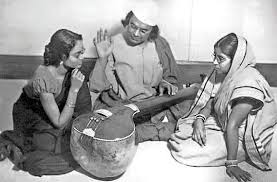
Nazrul teaching Nazrul Geeti
Here, we have tried to gather flavours of his writing and life. We start with the translation of his lyrics (a Nazrul geeti) on butterflies, translated by Fakrul Alam performed by the legendary Feroza Begum, move on to his response to Tagore’s poetry — they had a vibrant relationship as Somdatta Mandal has reflected in her discussion on Radha Chakravarty’s recent translation of his Selected Essays. It’s followed by more translations of three of his poems by Niaz Zaman, who has also written about Nazrul’s support for women. A searing essay on religious divides and socio economic gaps, translated by Sohana Manzoor, also brings to focus the plight of a beggar woman torn by poverty. A short story , showcasing him as a fiction writer, is borne of his experiences as a soldier. Last but not the least, we have a fiery speech by Nazrul from Chakravarty’s translation.
On Nazrul’s 125th birth anniversary, we welcome you to muse on him and his world…
Poetry
Projapoti (Butterfly) by Nazrul has been translated by Fakrul Alam from Bengali. Click here to read.
Somdatta Mandal writes about Radha Chakravarty’s translation of Selected Essays: Kazi Nazrul Islam and in the process explores his life and times. Click here to read.




 Borderless