A Tamil story by S Ramakrishnan, translated by B.Chandramouli
From Public Domain
That town had fewer than a hundred homes. Children playing in the street looked at them curiously when they alighted from the car. Kandasamy called one boy and asked him where Venangulam was. That boy asked him mockingly, “Do you want to do a penance in the Venangulam pond?” and pointed him towards the south.
His wife, their only daughter, and the astrologer who had brought them to perform the penance got out of the car. The astrologer tightened his loose dhoti and said, “This is a powerful pond, Sir; all your ‘dosha[1]’s would wash away.”
Kandasamy nodded and started walking towards the south.
Kandasamy had been suffering for over ten years with a skin disease; he had suffered an unexpected loss in his business. There were problems in his daughter’s in-laws home as well. As if these were not enough, he lost an old lawsuit he had been fighting in court. He felt as though the snake in the Snakes and Ladders game had brought him down. He visited many temples, performed pujas[2] and penances; nothing had worked. Only then did an astrologer tell him about Venangulam and the story of the king of Venangulam himself, who had dipped in that pond to get rid of his doshas. Kandasamy felt a sense of hope and agreed to visit Venangulam.
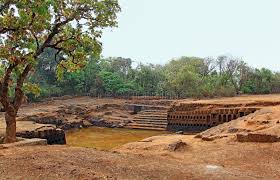
It was a small village with red tile roofs and somewhat broad streets. However, the people had nearly deserted it; some houses were locked up. When they went to Venangulam, they found it to be dry; the steps were dusty. There were four idols on the four sides of the pond.
Doubtful if that was Venangulam, he asked a person splitting logs nearby, “Is this the pond for penance?” That person nodded yes and continued his work.
Kandasamy stood on the dried-up pond’s steps and waited for his wife and daughter.
He wondered if they had come there not knowing that the pond had dried up; he felt angry thinking, “Didn’t the astrologer inquire about this even?”
The astrologer, Kandasamy’s wife and daughter, came near Venangulam.
The pond was full of torn clothes, dried leaves, and plastic waste. Kandasamy said to the astrologer, “There’s no water in this pond.”
The astrologer said,” It had been dry for several years. You get down, imagine that there is water, and sprinkle water on your head.”
“How can I bathe without water?” asked Kandasamy angrily.
“Can you see the sins you have committed with your eyes? But doesn’t the mind feel them? Similar to that, this pond contains invisible water; if you feel that and have a bath, your sins will wash away. Belief is everything, isn’t it?”
Kandasamy descended the steps of the dry pond. Though the pond appeared to have only ten or twenty steps, as he descended, the steps seemed to keep going down forever. Kandasamy kept on descending the steps alone. He did not know how long he had been descending, but when he looked up, it appeared as though he had descended into an abyss. He had not yet reached the bottom of the pond. The steps still kept descending.
He got confused, thinking, “What kind of magic is this? How did this small pond become so huge?” Various thoughts crowded his mind. He thought of how he had deceived his elder brother when they ran a joint business, and how he had cheated money entrusted to him. All these past sins returned as memories.
How can a person who deceived his own brother not fail in life? Suddenly, his elder brother’s face flashed in his mind. In that minute, the thought that until then, he had been pretending as though he had committed no mistakes bothered him. Kandasamy felt that one’s mistakes become weightless when hidden, but once you start realising them, they feel heavy.
Kandasamy realised he was descending the steps of his conscience.
He felt that to relieve himself of his sin, he must return the money he had cheated from his elder brother to his brother’s family. No sooner had this thought occurred to him than he felt a sudden wetness on his feet. The step beneath him seemed to be underwater. He pretended to bend down and sprinkle the water from the pond onto his head.
When his wife asked him loudly, “What are you thinking, standing on the steps?” he came to his senses.
Thinking, “Have I not gone to the depth of the pond? Was it all in my imagination?” He looked closely at the pond. He saw only dried steps and a pond without water.
He realised that the pond awakened the conscience and made you understand the crimes you have committed. It was indeed a magical pond.
He pretended as though he had had a bath and came out of the pond.
The astrologer said, “Think of something in your mind and throw coins into the pond.”
He took coins from his pocket and threw them into the pond, thinking that he would pay back the amount due to the family of his elder brother.
The idols’ eyes in the pond seemed to smile at him mockingly.
S. Ramakrishnan is a writer from Tamil Nadu, India. He is a full-time writer who has been active over the last 27 years in diverse areas of Tamil literature like short stories, novels, plays, children’s literature and translations. He has written and published 9 novels, 20 collections of short stories, 3 plays, 21 books for children, 3 books of translation, 24 collections of articles, 10 books on world cinema, 16 books on world literature including seven of his lectures, 3 books on Indian history, 3 on painting and 4 edited volumes including a Reader on his own works. He also has 2 collections of interviews to his credit. He was awarded the Sahitya Akademi Award in 2018 in the Tamil language category for his novel Sanjaaram.
Dr.B. Chandramouli is a retired Physician. He has published several translations. He has translted Jack Londen’s novel, White Fang and Somerset Maugham’s Razor’s edge (2024) to English and various English translations of Tamil fiction and non-fiction.
PLEASE NOTE: ARTICLES CAN ONLY BE REPRODUCED IN OTHER SITES WITH DUE ACKNOWLEDGEMENT TO BORDERLESS JOURNAL
It’s again that time of the year when we have fun spooking each other with stories of ghosts and haunting. While festivals of light1 and darkness vie with each other for a spot on the same date, observances to pay our respects to our forefathers follow at their heels, some before and some after.
In this selection, we bring to you narratives that could be dark, strange or funny or all of these … a selection of poetry, fiction and non-fiction from around the world. Enjoy the reads!
The Ghosts of Hogshead: Paul Mirabile wanders into the realm of the supernatural dating back to the Potato Famine of Ireland in the 1800s. Clickhere to read.
Nagmati: Prafulla Roy’s long story based on strange folk beliefs has been translated from Bengali as Snake Maiden by Aruna Chakravarti. Click here to read.
From Public Domain
.
Deepavali or festival of lights is on October 31st this year along with Kali Puja and Halloween. October 30th is Bhooth Chaturdashi, or Indian Festival of Ghosts while All Saints’ Day and all Souls’ Day are observed at the start of November. Early October hosted Pitri Paksha, observances for apeasing forefathers in India. ↩︎
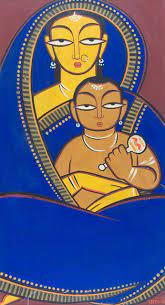
Mother & Child by Jamini Roy (1887-1972)Mother and Child by Picasso (1881-1973)
‘Victory to Man, the newborn, the ever-living.’ They kneel down, the king and the beggar, the saint and the sinner, the wise and the fool, and cry: ‘Victory to Man, the newborn, the ever-living.’
This is the month— the last of a conflict-ridden year— when we celebrate the birth of a messiah who spoke of divine love, kindness, forgiveness and values that make for a better world. The child, Jesus, has even been celebrated by Tagore in one of his rarer poems in English. While we all gather amidst our loved ones to celebrate the joy generated by the divine birth, perhaps, we will pause to shed a tear over the children who lost their lives in wars this year. Reportedly, it’s a larger number than ever before. And the wars don’t end. Nor the killing. Children who survive in war-torn zones lose their homes or families or both. For all the countries at war, refugees escape to look for refuge in lands that are often hostile to foreigners. And yet, this is the season of loving and giving, of helping one’s neighbours, of sharing goodwill, love and peace. On Christmas this year, will the wars cease? Will there be a respite from bombardments and annihilation?
We dedicate this bumper year-end issue to children around the world. We start with special tributes to love and peace with an excerpt from Tagore’s long poem, ‘The Child‘, written originally in English in 1930 and a rendition of the life of the philosopher and change-maker, Vivekananda, by none other than well-known historical fiction writer, Aruna Chakravarti. The poem has been excerpted from Indian Christmas: Essays, Memoirs, Hymns, an anthology edited by Jerry Pinto and Madhulika Liddle, a book that has been reviewed by Somdatta Mandal and praised for its portrayal of the myriad colours and flavours of Christmas in India. Christ suffered for the sins of humankind and then was resurrected, goes the legend. Healing is a part of our humanness. Suffering and healing from trauma has been brought to the fore by Christopher Marks’ perspective on Veronica Eley’s The Blue Dragonfly: healing through poetry. Basudhara Roy has also written about healing in her take of Kuhu Joshi’s My Body Didn’t Come Before Me.Bhaskar Parichha has reviewed a book that talks of healing a larger issue — the crises that humanity is facing now, Permacrisis: A Plan to Fix a Fractured World, by ex-British Prime Minister Gordon Brown, Nobel Laureate Michael Spence, Mohamed El-Erian and Reid Lidow. Parichha tells us that it suggests solutions to resolve the chaos the world is facing — perhaps a book that the world leadership would do well to read. After all, the authors are of their ilk! Our book excerpts from Dr Ratna Magotra’s Whispers of the Heart – Not Just A Surgeon: An Autobiographyand Manjima Misra’s The Ocean is Her Titleare tinged with healing and growth too, though in a different sense.
The theme of the need for acceptance, love and synchronicity flows into our conversations with Afsar Mohammad, who has recently authored Remaking History: 1948 Police Action and the Muslims of Hyderabad. He shows us that Hyderabadi tehzeeb or culture ascends the narrow bounds set by caged concepts of faith and nationalism, reaffirming his premise with voices of common people through extensive interviews. In search of a better world, Meenakshi Malhotra talks to us about how feminism in its recent manifestation includes masculinities and gender studies while discussing The Gendered Body: Negotiation, Resistance, Struggle, edited by her, Krishna Menon and Rachana Johri. Here too, one sees a trend to blend academia with non-academic writers to bring focus on the commonalities of suffering and healing while transcending national boundaries to cover more of South Asia.
That like Hyderabadi tehzeeb, Bengali culture in the times of Tagore and Nazrul dwelled in commonality of lore is brought to the fore when in response to the Nobel laureate’s futuristic ‘1400 Saal’ (‘The year 1993’), his younger friend responds with a poem that bears not only the same title but acknowledges the older man as an “emperor” among versifiers. Professor Fakrul Alam has not only translated Nazrul’s response, named ‘1400Saal’ aswell, but also brought to us the voice of another modern poet, Quazi Johirul Islam. We have a self-translation of a poem by Ihlwha Choi from Korean and a short story by S Ramakrishnan in Tamil translated by T Santhanam.
Our short stories travel with migrant lore by Farouk Gulsara to Malaysia, from UK to Thailand with Paul Mirabile while chasing an errant son into the mysterious reaches of wilderness, with Neeman Sobhan to Rome, UK and Bangladesh, reflecting on the Birangonas (rape victims) of the 1971 Bangladesh Liberation war, an issue that has been taken up in Malhotra’s book too. Sobhan’s story is set against the backdrop of a war which was fought against linguistic hegemony and from which we see victims heal. Sohana Manzoor this time has not only given us fabulous artwork but also a fantasy hovering between light and dark, life and death — an imaginative fiction that makes a compelling read and questions the concept of paradise, a construct that perhaps needs to be found on Earth, rather than after death.
The unusual paradigms of life and choices made by all of us is brought into play in an interesting non-fiction by Nitya Amlean, a young Sri Lankan who lives in UK. We travel to Kyoto with Suzanne Kamata, to Beijing with Keith Lyons, to Wayanad with Mohul Bhowmick and to Langkawi with Ravi Shankar. Wendy Jones Nakanishi argues in favour of borders with benevolent leadership. Tongue-in-cheek humour is exuded by Devraj Singh Kalsi as he writes of his attempts at using visiting cards as it is by Rhys Hughes in his exploration of the truth about the origins of the creature called Humpty Dumpty of nursery rhyme fame.
Poetry again has humour from Hughes. A migrant himself, Jee Leong Koh, brings in migrant stories from Singaporeans in US. We have poems of myriad colours from Ryan Quinn Flanagan, Patricia Walsh, John Grey, Kumar Bhatt, Ron Pickett, Prithvijeet Sinha, Sutputra Radheye, George Freek and many more. Papia Sengupta ends her poem with lines that look for laughter among children and a ‘life without borders’ drawn by human constructs in contrast to Jones Nakanishi’s need for walls with sound leadership. The conversation and dialogues continue as we look for a way forward, perhaps with Gordon Brown’s visionary book or with Tagore’s world view of lighting the inner flame in each human. We can hope that a way will be found. Is it that tough to influence the world using words? We can wish — may there be no need for any more Greta Thunbergs to rise in protest for a world fragmented and destroyed by greed and lack of vision. We hope for peace and love that will create a better world for our children.
As usual, we have more content than mentioned here. All our pieces can be accessed on the contents’ page. Do pause by and take a look. This bumper issue would not have been possible without the contribution of all the writers and our fabulous team from Borderless. Huge thanks to them all and to our wonderful readers who continue to encourage us with their comments and input.
Here’s wishing you all wonderful new adventures in the New Year that will be born as this month ends!
Short story by S Ramakrishnan, translated from Tamil by T Santhanam
It was Malavika who sent me the video of the monk who plays guitar. Malavika is my daughter. She is pursuing fashion designing course in Kingston University, England. Her desires and interests are a puzzle to me. Some days ago, she sent a recording of a poem by William Blake in her voice. After that, she sent a photo of her carrying a placard in a demonstration against global warming. As clouds change to forms unimaginable, her interests keep on changing. After watching a butterfly, she had sent her impressions in writing. It seemed as though it was from a seasoned writer.
Children who leave home for far off places, in a sense, leave us. She was no longer the girl she was in Chennai. The new country and new environment have changed her. The changes are reflected in her appearance and deeds. My wife did not like these alterations. Below the video of the monk who played guitar, she had given the caption: “Music is Meditation”. I could not understand her. At the age of twenty-two, I thought she would be fondly giving herself to worldly pleasure. But she was immersed in meditation, agitation and museum visits.
In the video sent by Malavika, the monk must have been about thirty years old. His head was tonsured. He wore a robe coloured orange. His ears were slightly big. He had a sharp nose and small lips where a smile was frozen. It was hard to find out if he was a Nepali or a foreigner. On his left arm, was tattooed the image of Buddha.
It was funny to see a Monk with a guitar. The image we have formed about saints and the looks of current day saints are not alike. Perhaps, we refuse to update that image. Perhaps, the meaning of sainthood has changed.
The musical piece was given the title “Falling flowers”. From the way he was playing, it seemed as real as the blossomed cherry leaves falling gently. The normal rapidity and gush associated with guitar music was not there. Like an insect that moves in the water, his fingers moved on the guitar strings. Music tunes to the past more easily than photographs. A small piece of music is enough to take us back to our school days.
I saw the video once or twice. I felt the urge to listen to it again and again. While listening at night, I felt as if the fragrance of incense was wafting into the vacant spaces of my heart. I found His name was Limang Tolma while searching for his other videos. There were hundreds of musical pieces by him. All of them were only seven minutes long. Evidently, he played the guitar for only seven minutes in a day. That too under the sal tree in Coben Monastery seated on a stool. Hundreds of people from various countries pour in to listen to his performance. All this I gathered while browsing the internet. His music was melodious and sweet. Why did he play for seven minutes only at each stretch was beyond comprehension.
To know more about Limang Dolma, I called Malavika on her mobile. She sent a message that she was observing silence for the past five days. Why this silence? Tongue can be tied down. But the mind?
I told my wife. She responded that she had scolded Malavika and that was why she was doing this.
I could not understand. What was the skirmish between mother and daughter? I sent a message to Malavika asking her how long her silence would continue. “God only knows,” was her reply.
As I am a senior executive in an automobile company, I had to conduct two to three meetings in a day. My blood pressure sometimes would rise after returning from these meetings.Sometimes, I would have a headache too. At times, the meetings would last for ten hours. After the meeting, I would feel as if somebody has placed a pile of iron on my shoulders. I would feel sick, wondering why we could not conduct our work without talking, discussing or fighting.
One day, before the commencement of the meeting, I started to listen to the monk’s guitar music from my cell phone rather impulsively. I closed my eyes for seven minutes as though I was in a deep meditation. It was as pleasant a feeling as a moist breeze caressing my body. There was peace in my heart and an exhilaration I had never known before. On that day, I could sense the change in my voice and the way I was moving towards a solution. Somehow the officials of the sales department seemed to understand this. After the conclusion of the meeting while coming down in the lift, Amarnath said, “There was something new in your speech today. You spoke like a Zen Master.”
“Yes” I nodded approvingly with a smile. I was just wondering how a small piece of music could bring such a tremendous change in me.
I wanted to know more about Limang Dolma. Searching through the internet I was more and more astonished. The real name of Limang Dolma is Christopher Cane. He was born in Milan. He had pursued Anthropology. After coming into contact with a Buddhist monk, he has embraced Buddhism and become a monk in the Buddhist Monastery. He plays the guitar only under the tree of the monastery and nowhere else. Young people throng to him. They listen to his music. Some of them stay there for days together to savour his music. They wear T-shirts bearing his image with the words, “Buddha plays Guitar”. In an interview, a young lady asks him. “All saints in India hold one or other instruments. Why does Buddha not play any instrument nor is seen holding one?”
“He himself is a musical instrument. One who knows how to tune himself finds no need for a musical instrument. In the same way, Nature tunes itself. Is there any tune better than what the water plays?”
“Why do you play only for seven minutes?”
“Seven is the symbol of consciousness in Buddhism.”
“Seven minutes is not enough for us. Can’t you play more?”
“Will you take honey in a gulp? Is a spoonful not enough?” he asks.
I admired Limong Dolma fo his speech, poise and the way he handled guitar. I too felt like wearing a T-shirt bearing his image. I sent the video of Limang Dolma to some of my friends asking them to listen to his music. Only Mohan Muralidharan, a neurologist and my school mate, sent a reply saying that a man from Turkey played better than the monk and shared the video. Why should one musician be compared to another? Can’t this foolishness be avoided?
I called Mohan and blurted out my irritation. He said in a mocking tone, “You’re aging. That is why you listen to a monk playing the guitar. Music should make us feel young. It should twinge our nerves. You have never touched a musical instrument in your entire life. Can you whistle atleast?”
Mohan was right. I haven’t even played the mouth organ which many played during my school days.
I felt like owning a guitar. The same evening, I went to a musical store in Leo mall. I showed the video of Limang Dolma and asked for a guitar like the one in the video. The face of the girl at the counter brightened. “Limang Dolma?” she asked. I felt glad that she too has listened to the music. She brought a guitar from inside. I told her, ” I don’t know how to play guitar. This is for my daughter.”
The girl told with a smile, “Limang Dolma was a thief. He was in prison. After his release, he became a Monk. People say he speaks to Buddha through his music.”
“Really!”
“I overheard two girls talk of it when they came to purchase a guitar.”
“Do you believe that?”
“I believe it partially.”
“Which part?”
“That he speaks to Buddha,” she smiled.
She looked like my daughter when she smiled. Perhaps for young girls Buddha is a different personality. May be, the Buddha known by the ones who have crossed fifty years like me and the Buddha these young girls adore are not the same.
When I brought guitar home, my wife chided me.
“Why have you brought this? Who will play?”
“Just let it be,” I responded.
“Is it a show piece to be kept just like that?” she asked.
I did not reply.
I placed the guitar in Malavika’s room close to her bed. I had a feeling that Malavika had returned. I sent that night the picture of guitar to Malavika by WhatsApp. She sent an emoji of two clapping hands. Also, she sent a message “We are going to visit Limang Dolma.”
Though I felt happy, I was eager to know who was the other in the ‘We’. I did not venture to ask Malavika. Instead, I asked, “When?” She did not respond.
After five days, she sent a picture to me. She was among the hundreds of youngsters before Limang Dolma, as he was playing the guitar. My eyes were cast on a young man with long hair, not on Limang Dolma. The young man hung his arms around Malavika’s shoulder.
Who was this fellow? How long had she known him? I could not see his face properly. I widened the image. An European face. Perhaps was he also a musician? I thought of asking Malaviika. But I curbed that thought and went on to ask about the musical event, as I called her. She was full of cheer. She told me,” Listening to Dolma’s music, one feels like a kite fluttering in the air. I do not know what to say. Flying to heaven.”
“I read somewhere that he was a thief,” I said.
” Oh, that’s a myth constructed by magazines. When asked about this, Dolma says raindrops do not have a past. Jonah and myself were in the Monastery for three days. Wonderful experience!”
A question arose on my mind as to who Jonah was. I was not sure whether to ask her or not. Why wouldn’t she talk about him?
I asked, “Is Jonah a musician?”
“Dad, how do you know? Indeed, he is. He plays the guitar well. It was he who introduced me to Dolma’s music.”
“Is Jonah your classmate?”
“No, he works in a bar where I hold a part time job.”
“You didn’t tell me,” I pretended to be angry.
“Dad, don’t tell Mom about this.”
“About your working in bar?” I asked deliberately.
“About Jonah too?” she laughed. As she was so laughing, she seemed to be some other young girl. After she hung up, I was thinking about Jonah. Was he a good person or bad? Was he also a thief earlier? Or could he be a drug addict? Who were his parents? Was he in love with Malavika? Had I become old? Was Mohan right? I
admired a Monk playing guitar somewhere. But I do not like Jonah who also plays guitar. Why? I was perplexed. Suppose if Limong Dolma put his arm around the shoulder of my daughter, would I dislike him too? I was confused.
Two days later, Malavika forwarded a video of Limang Dolma downloaded in her phone. Limong Dolma walked as though he was floating in the air. He sat under the tree. Peace was on his face as he tuned the guitar — the same music that I savoured earlier. No longer did I feel close to that music. Somehow, instead of Limang, Jonah’s face came before me. I felt as if a bitterness had settled down on my tongue.
The same night, Malavika called me. Before my asking anything, she said, ” After visiting Limang Dolma, I do not feel like listening to his music again”
“Why?” I asked as if I did not know anything.
“I do not like it any more just the way I suddenly liked it before.”
“How is Jonah?” I asked intentionally.
“Do not talk about him. I hate him. I hate whatever he introduced to me.”
Inwardly I was happy.
” Any problem? Shall I talk to Jonah?”
“Why should you talk to him? The days I moved with him, it was a nightmare. Daddy, why do you not rebuke me?”
“You are not a kid, after all.”
“But you think of me as a kid only. You don’t know me as Mom does.”
I was flummoxed. I could hear Malavika sobbing for the first time ever. I did not know how to console her. I hurriedly gave the phone to my wife. She started walking towards the kitchen with her words of consolation. What has transpired between her and Jonah? Why was she weeping? I could not make out. At the same time, I was happy that she disliked the world she created for herself and moved back towards my world. A thought arose that she was coming home. I asked my wife what Malavika had said.
“That boy is not good. I told her from the beginning itself. But she did not pay heed.”
“Did you know about Jonah before?”
“She told me six months back. I scolded her saying that your Dad will not like this. I have spoken to Jonah also.”
“To Jonah? You?”
“Yes, I could not understand a bit of what he spoke.”
“What is the problem now?”
“It’s over. No use talking about it!”
I could not understand what happened. But Malavika had been closer to her mother than to me. She had shared everything with her mother. I was pained at this. Why then did she asked me not to tell her mother? Why this drama? Children after growing up, treat their father as a plaything. The daughter I know is now the girl I do not know. I could not reconcile myself to this.
I heard the guitar music of the monk that night. I was more attracted to the tree than to the music.
Leaves do not stay on the tree for long. When a leaf falls, the tree does not reach out to catch it. When falling leaves sail along the wind, the trees can do nothing but look at them in silence. Somehow, the music stirred a grief in me.
As I prepared to leave for office next morning, I saw my wife keeping the guitar next to dustbin. What was the fault of the guitar after all?
” What are you going to do with this?” I asked.
“Anish told me, he will take it. What do we do with this? Malavika does not want it any more.”
I nodded giving the impression that she was right. But I felt sorry while doing that.
.
S. Ramakrishnan is an eminent Tamil writer who has won the Sahitya Akademi Award in the Tamil Language category in 2018. He has published 10 novels, 20 collections of short stories, 75 collections of essays, 15 books for children, 3 books of translation and 9 plays. He also has a collection of interviews to his credit. His short stories are noted for their modern story-telling style in Tamil and have been translated and published in English, Malayalam, Hindi, Bengali, Telugu, Kannada and French.
T Santhanam is a retired Bank Executive in Bangalore, India. He has a passion for literature with a special affinity for poetry. He writes poetry in Tamil. He is also a blogger.
.
PLEASE NOTE: ARTICLES CAN ONLY BE REPRODUCED IN OTHER SITES WITH DUE ACKNOWLEDGEMENT TO BORDERLESS JOURNAL
While the horror generated by wars deeply saddens with its ultimate disregard for all kinds of flora and fauna, including humans, the horrific as we savour in festivals can cease to be terrifying. It can even be cathartic in the midst of the terror of destruction and violence. Halloween is a festival that brings to mind a time when kids go trick or treating as houses and gardens assume a ‘haunted look’. This year, in the spirit of fun, we bring to you a collection of the spooky and the gooky — poems and prose — from across multiple countries and cultures. These hope to provide a moment of respite and unalloyed fun for all of you, despite their darker notes. Perhaps, as an afterthought, these will also unite with the commonality of human needs to connect… even if it’s with a plethora of spooks from across all kinds of human borders…
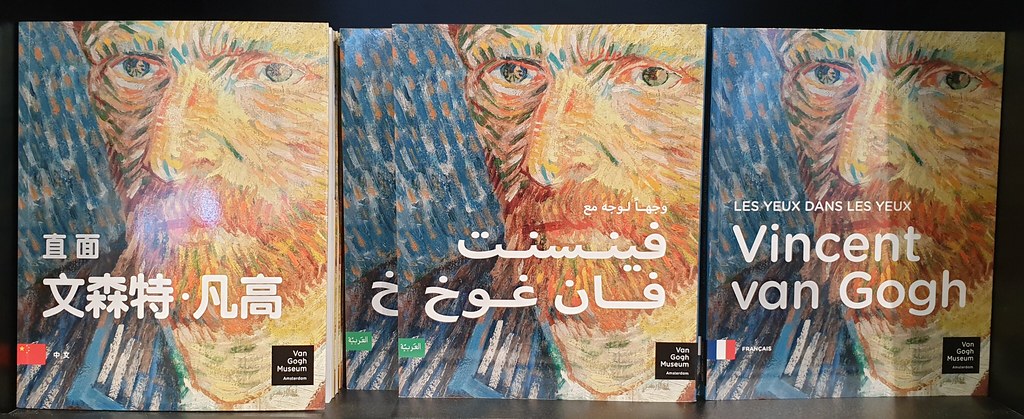
Vincent Van Gogh written is different scripts. Courtesy:Creative Commons
The whole world opens up in the realm of ideas that have existed wafting and bridging across time and space. Sometimes they find conduits to come to the fore, even though they find expression in different languages, under varied cultural milieus. One way of connecting these ideas is to translate them into a single language. And that is what many have started to do. Celebrating writers and translators who have connected us with these ideas across boundaries of time and place, we bring to you translated writings in English from twenty eight languages on the International Translation Day, from some of the most iconic thinkers as well as from contemporary voices.
Prose
Tagore’s short story, Aparichita, has been translated from Bengali as The Stranger by Aruna Chakravarti. Click hereto read.
Nadir Ali’s The Kabbadi Player has been translated from Punjabi by Amna Ali. Click here to read.
Kamaleswar Barua’s Uehara by has been translated from Assamese and introduced by Bikash K. Bhattacharya. Click here to read.
S Ramakrishnan’s Muhammad Ali’s Singnature has been S. Ramakrishnan, translated from Tamil by Dr B. Chandramouli. Click here to read.
PF Mathews’Mercy, has been translated from Malayalam by Ram Anantharaman. Click here to read.
Road to Nowhere, an unusual story about a man who heads for suicide, translated from Odiya by the author, Satya Misra. Click here to read.
An excerpt from A Handful of Sesame by Shrinivas Vaidya, translated from Kannada by Maithreyi Karnoor. Click hereto read.
Writings from Pandies’ Cornerhighlight the ongoing struggle against debilitating rigid boundaries drawn by societal norms. Each piece is written in Hindustani and then translated by a volunteer from Pandies’ in English. Clickhere to read.
Rakhamaninov’s Sonata, a short story by Sherzod Artikov, translated from Uzbeki by Nigora Mukhammad. Click hereto read.
Of Days and Seasons, a parable by the eminent Dutch writer, Louis Couperus (1863-1923), translated by Chaitali Sengupta. Click here to read.
The Faithful Wife, a folktale translated from Balochi by Fazal Baloch. Click hereto read.
An excerpt from Ramy Al-Asheq’sEver Since I Did Not Die, translated from Arabic by Isis Nusair, edited by Levi Thompson. The author was born in a refugee camp. Click here to read.
Poetry
Two songs byTagore written originally in Brajabuli, a literary language developed essentially for poetry in the sixteenth century, has been translated by Radha Chakravarty. Click here to read.
Rebel or ‘Bidrohi’, Nazrul’s signature poem, ‘Bidrohi‘, translated from Bengali by Professor Fakrul Alam. Click here to read.
Banlata Sen, Jibananada Das’s iconic poem, translated from Bengali by Professor Fakrul Alam. Click here to read.
Shadows, a poem in Korean, has been translated by the poet himself, Ihlwha Choi. Click hereto read.
Pranor Lifeby Tagore has been translated from Bengali by Mitali Chakravarty. Click hereto read.
Conversations
Shantanu Ray Chaudhuri converses withVinta Nanda about the Shout, a documentary by Vinta Nanda that documents the position of women in Indian society against the backdrop of the #MeToo movement and centuries of oppression and injustice. Click here to read.
Perhaps, most sceptics will say it is against human nature to stop fighting and fanning differences. The first recorded war was fought more than 13,000 years ago in what is now a desert but was green long ago. Nature changed its face. Continents altered over time. And now again, we are faced with strange shifts in climate that could redefine not just the dimensions of the surface area available to humankind but also our very physical existence. Can we absorb these changes as a species when we cannot change our nature to self-destruct for concepts that with a little redefining could move towards a world without wars leading to famines, starvation, destruction of beautiful edifices of nature and those built by humankind? That we could feed all of humans — a theory that won economist Abhijit Banerjee his Nobel Prize in 2019 so coveted by all humanity — almost seems to have taken a backseat. This confuses — as lemmings self-destruct…do humans too? I would have thought that all humanity would have moved towards resolving hunger and facing the climate crises post-2019 and post-pandemic, instead of killing each other for retaining constructs created by powerbrokers.
In the timeless lyrics of ‘Imagine’, John Lennon found peace by suggesting we do away with manmade constructs which breed war, anger and divisions and share the world as one. Wilfred Owen and many writers involved in the World Wars wrote to showcase the desolation and the heartfelt darkness that is brought on by such acts. Nazrul also created a story based on his experience in the First World War, ‘Hena’, translated for us by Sohana Manzoor. Showcasing the downside of another kind of conflict, a struggle to survive, is a story with a distinctive and yet light touch from S Ramakrishnan translated from Tamil by B Chandramouli. And yet in a conflict-ridden world, humans still yearn to survive, as is evident from Tagore’s poem Pran or ‘Life’. Reflecting it is the conditioning that we go through from our birth that makes us act as we do are translations by Professor Fakrul Alam of Masud Khan’s poetry and from Korean by Ihlwha Choi.
A figure who questioned his own conditioning and founded a new path towards survival; propounded living by need, and not greed; renounced violence and founded a creed that has survived more than 2500 years, is the man who rose to be the Buddha. Born as Prince Siddhartha, he redefined the norms with messages of love and peace. Reiterating the story of this legendary human is debutante author, Advait Kottary with his compelling Siddhartha:The Boy Who Became the Buddha, a book that has been featured in our excerpts too. In an interview, Kottary tells us more of what went into the making of the book which perhaps is the best survivor’s guide for humanity — not that we need to all become Buddhas but more that we need to relook at our own beliefs, choices and ways of life.
Another thinker-cum-film maker interviewed in this edition is Vinta Nanda for her film Shout, which highlights and seeks resolutions for another kind of crisis faced by one half of the world population today. She has been interviewed and her documentary reviewed by Shantanu Ray Chaudhuri. Chaudhuri has also given us an essay on a bookshop called Kunzum which continues to expand and go against the belief we have of shrinking hardcopy markets.
Gastronomical adventures seem to be another concurrent theme in this edition. Rhys Hughes has written of the Indian sweets with gulab jamun as the ultimate life saver from Yetis while trekking in the Himalayas! A musing on lemon pickle by Raka Banerjee and Ravi Shankar’s quest for the ultimate dosaaround the world — from India, to Malaysia, to Aruba, Nepal and more… tickle our palate and make us wonder at the role of food in our lives as does the story about biryani battles by Anagaha Narasimha.
Talk of war, perhaps, conjures up gastronomic dreams as often scarcity of food and resources, even potable water and electricity is a reality of war or conflict. Michael Burch brings to us poignant poetry about war as Ramesh Karthik Nayak has a poem on a weapon used in wars. Ryan Quinn Flanagan has brought another kind of ongoing conflict to our focus with his poetry centring on the National Day (May 5th) in Canada for Vigils for Missing and Murdered Indigenous Women by hanging red clothes from trees, an issue that perhaps has echoes of Vinta Nanda’s Shout and Suzanne Kamata’s poetry for her friend who went missing decades ago as opposed to Rachel Jayen’s defiant poetry where she asserts her womanhood. Ron Pickett, George Freek and Sayantan Sur have given us introspective perspectives in verse. We have more poetry asking for a relook at societal norms with tongue-in -cheek humour by Jason Ryberg and of course, Rhys Hughes with his heartfelt poem on raiders in deserts.
The piece that really brought a smile to the lips this time was Farouk Gulsara’s ‘Humbled by a Pig’, a humorous recount of man’s struggles with nature after he has disrupted it. Keith Lyons has taken a look at the concept of bucket lists, another strange construct, in a light vein. Devraj Singh Kalsi has given a poignant and empathetic piece about trees with a self-reflective and ironic twist. We have narratives from around the world with Suzanne Kamata taking us to Osaka Comic Convention, Meredith Stephens to Sierra Nevada and Shivani Shrivastav to Ladakh. Paul Mirabile has travelled to the subterranean world with his fiction, in the footsteps perhaps of Jules Verne but not quite.
We are grateful to all our wonderful contributors some of whom have not been mentioned here but their works were selected because they truly enriched our June edition. Do visit our contents page to meet and greet all our wonderful authors. I would like to thank the team at Borderless without whose efforts and encouragement our journal would not exist and Sohana Manzoor especially for her fantastic artwork as well. Thank you all.
Wish you another lovely month of interesting reads!
By S. Ramakrishnan, translated from Tamil by Dr B. Chandramouli
The man was around 30. He had sleepless eyes, unkempt hair, and pale lips. He had on a grey half sleeve shirt and blue pants which did not match. Wearing rubber slippers with frayed edges, he was carrying a cloth bag, which he guarded closely on his lap, as if it contained a rare object. Because persons like him were a common sight at the taluka[1] office, no one paid him any attention. He had the hesitant look of someone about to request a loan. He was sitting in a slanted position leaning on his right leg.
The taluka office assumes a relaxed atmosphere during lunchtime. Losing its stiffness, it becomes more like a public library. Workers smile; you can talk to them easily. Maybe he was waiting for that stretch of time. They had built this new office with three floors on a side street near the end of the overhead bridge. When you think of a taluka office, you get the picture of a dusty neem tree, dirty steps and semi-dark rooms; this building was not like that. But there was a jeep blocking the entrance and abandoned bikes that reminded of the old office.
Most government offices did not have lifts; even if they did, they did not work. This office also had only a big staircase. While climbing the stairs, you could see a big government poster pasted on the opposite wall. The office had big windows, like in wedding halls. One worker who did not like too much light had opened only half of the window near his seat. During lunchtime, there was big traffic of vendors: Bagyathammal who sells hot murukku in a silver bucket; Muthu, who sells sweets and snacks; Kasim, who sells towels and lungis, and Kalaivani, who sells nighties and cotton sarees. The workers at the office were their favourite customers.
They continued to visit, even though the office had moved. Especially, Kesavan who sells the hot coconut sweet ‘boli’, had a free run of this office; he would enter regardless of who was there. He will place two bolis wrapped in newspaper on the Tahsildar’s table.
Bagyathammal could climb the stairs slowly only because she was overweight and also had a corn on her foot. They would know of her arrival just by the noise the silver bucket made on the steps. Many workers would be satiated only after munching on her murukku after lunch. They had a water cooler for cold water, which the old office did not have. Kasim would always fill his green bottle with the cold water. He would relish drinking that cold water with a unique expression of bliss on his face. Except for the boy from the tea stall opposite, and Subbiah from the xerox store, most people who came to the office were there to get certificates for caste, income, residency or land ownership. You could easily identify them by their looks. Being nervous, they would drop and scatter their certificates; some could not even answer the questions. Though all the wooden tables were similar, only the table where the officer received the petitions would appear huge to them. Even the leaders in the pictures hung on the wall were unsmiling.
After lunch, many of the workers would not return to their tables immediately. Some would go downstairs to smoke. Raghavan, who was going downstairs, noticed the man sitting aslant.
“What do you want?” he asked while passing.
When the man hesitantly said, “You see.., I.. well,…”
Raghavan told him, “Go inside and ask.”
Some workers had returned after the lunch break. Jayanthi was keeping her washed tiffin box near the window. The man stood in front of Sabapathy’s table and called out — “Sir…”
.
Sabapathy was searching for a pin to use as a toothpick. Thinking that the man was selling some snacks, he asked, “What did you bring?”
The man produced an old photograph from his bag and said. “Muhammad Ali’s photo.”
Startled and uncomprehending, Sabapathy asked, “What is that?”
“Muhammad Ali Sir, the world famous boxer. My father is the one standing nearby; see here, it has Muhammad Ali’s signature at the bottom.”
“OK, but why are you showing it to me?” asked Sabapathy, not understanding.
“They took it when Muhammad Ali came to Madras.”
“That is all fine. Are you here to give some petition?”
“I came to sell Muhammad Ali’s signature, Sir,” he said hesitantly.
Sabapathy did not understand what he said.
“Selling a signature?… But what can I do with it?” asked sarcastically.
The man hung his head and said, “It is a very valuable signature, Sir. I have money problems at home; that is why I came to sell.”
Sabapathy smiled sarcastically, as if he has found the right person to pass the time with and said, “I know nothing about boxing. See Sekhar in the corner seat? Show it to him.”
Sekhar was the one who can get a loan for anybody in the office. Nobody knew where he got the money from. But he would get a commission of Rs50 for every Rs1000.He had loaned many of his colleagues money during contingencies. He would strictly collect his share on payday.
The man went to Sekhar and showed him the old photograph.
Sekhar looked up at it and asked thoughtfully, “Do you want a death certificate?”
“No, Sir; this is Muhammad Ali.”
“Muhammad Ali means?” Sekhar asked, confused.
“Famous boxing champion; he came to Madras in 1980. He boxed with Jimmy Ellis in front of MGR. My dad was a big boxer in those days; he lost one eye in boxing, but could still fight very well. Muhammad Ali himself had congratulated him. They took this photo when Muhammad Ali was staying in Connemara hotel. There was a huge crowd to see him. My dad was waiting to get his signature on this photo. Muhammad Ali himself took him to his room and signed it for him. My father was thrilled.” he was narrating it like a story.
“Just tell me what you want now,” said Sekhar.
“Please buy this signature. All I want is Rs 500.”
Sekhar did not expect this.
“What am I going to do with this — clean my tongue?” Sekhar asked angrily.
“Do not say that Sir. Muhammad Ali’s signature has value.”
“Let us see how many people in this office know who Muhammad Ali is.” As if taking up a great challenge, Sekhar grabbed the photo from the man and gathered all the office staff in front of him.
Sekhar said in a mocking tone,
“If anyone can correctly identify the man in this photo, I will give the person Rs100.”
One lady asked, “An actor?”
“There is a tailor in my street who looks just like him; his ears are exactly like his,” said Jayanthi.
“Isn’t he the football champion?” asked Mani.
Rangachari was the one who correctly said.
“That is Muhammad Ali, World heavyweight boxing champion. He was born Cassius Clay; he later changed his name to Muhammad Ali.”
“Correct Sir; and it is his signature. At least you can buy this.”
“I do not even have enough time to box with my wife; what am I going to do this? If it was a foreign stamp, at least I could give it to my daughter,” said Rangachari in a mocking voice.
“Do not say that, Sir. I can cut off my father’s picture. Please give me Rs 500,” the man pleaded.
“Five hundred rupees is too much for a signature,” said Rangachari.
“You people demand like that too,” he thought. But he swallowed the thought and said, “If my dad were alive, he would not sell this.”
“It is alright if you want to sell, but where did you come to the taluka office?” asked Rangachari mockingly.
“You are all educated people. I thought you would know the value of this.”
“Forget the signature; you see, even if Muhammad Ali himself comes here, there is no value.” Rangachari laughed automatically, as if he has cracked a joke.
Meanwhile, hearing some footsteps on the stair, peon Munusamy announced that the Tahsildar[2] has arrived.
The safari suit clad Tahsildar Rathinasamy must have noticed the man as he went to his room. He rang the bell as soon as he sat down.
Peon Munusamy hurried into the room.
“Who is that guy standing outside? Is he selling perfume? I told you not to let people like that.”
Munusamy said, “He is not selling perfume, Sir; he came to sell some photo.”
“Ask him to come in,” the Tahsildar said angrily.
The peon told the man who was standing helplessly that the Tahsildar wanted to see him.
The man entered the room slowly.
The Tahsildar asked him with a stern face, “What is this, a marketplace where anyone can walk in and sell stuff? Who are you and why did you come here?”
The man was scared at his anger and hesitantly said, “Muhammad Ali’s signature…photo”
“Ask S1 to come in,” said the Tahsildar angrily.
Sabapathy came.
“Is this a government office or an exhibition? How did you let this man in?”
“We thought he came to give some petition. But he is spinning a yarn about a photograph.”
The Tahsildar said loudly “We should not leave it like this; you call the police. If we grab someone like this, the next one will be afraid to come.”
The man said with a troubled face, “Sorry, sir. I will leave,” he turned to walk out.
“What do you have in your hand? Show it to me.” the Tahsildar asked with the same anger.
The man showed him the photo with Muhammad Ali and his father.
“Did you come to get a donation?”
“No Sir; I came to sell Muhammad Ali’s signature,” he said in a weak voice.
“Don’t you have some other place for that?” the Tahsildar threw the photograph on the table carelessly.
“It is alright sir; just give me the photo; I will leave”
By this time, Rangachari had entered the room and described about Muhammad Ali in fluent English; the Tahsildar listened, only half understanding.
“Who will buy this?”
“There are collectors for this. You can get for 5000, or 10,000 rupees for that.”
“Is that right?”
“Severe money problems at home; that is why I came to sell.” the man repeated.
“What am I going to do if I buy this? I do not even have a place to hang my picture at my home.” the Tahsildar expressed his sense of humour with that statement.
At his juncture, Sekhar came to the office and said, “It is a new type of fraud, Sir. They print a picture off the internet and try to sell it.”
“No Sir. This is my father.”
“Do you have any certificate to prove it?” asked Sekhar.
“Why should I deceive you, Sir,” the man asked pitifully.
“Sekhar is correct. Nowadays, it is difficult to trust anyone; we should be cautious,” said Rangachari.
“Get rid of him and post a notice saying no outside persons are allowed here.” said Tahsildar.
The man took the photograph from the table and placed it in his bag, and walked downstairs.
An old man waiting to submit some petition asked him if the Tahsildar has arrived. He answered yes and left.
It was after three. He felt like fainting because of extreme hunger. The street was hot in the scorching sun. There was no breeze. He walked towards the bus stand to catch a bus to his suburban home.
Suddenly the bag in his hand felt heavy. It sounded as though someone was laughing.
Was that Muhammad Ali laughing?
It was as if his arm was being dragged down by the heavy bag.
He took out the photo and looked at it. His father’s face standing near Muhammad Ali had a unique smile.
He was wondering what he is going to do by taking the photo back to his home.
There was a tar drum standing under the tamarind tree; it was leaking tar. He took out the photo and stuck it on the tar. Muhammad Ali was looking at the street baking in the scorching sun from the photograph stuck to the tar tin.
As if to express his anger, he shrugged off his slippers and started walking barefoot at a fast pace.
The road stretched like the tongue of a strange beast.
S. Ramakrishnanis an eminent Tamil writer who has won the Sahitya Akademi Award in the Tamil Language category in 2018. He has published 10 novels, 20 collections of short stories, 75 collections of essays, 15 books for children, 3 books of translation and 9 plays. He also has a collection of interviews to his credit. His short stories are noted for their modern story-telling style in Tamil and have been translated and published in English, Malayalam, Hindi, Bengali, Telugu, Kannada and French.
Dr.Chandramouli is a retired physician.. He is fluent in English and Tamil. He has done several English to Tamil, and Tamil to English. He has published some of them.
.
PLEASE NOTE: ARTICLES CAN ONLY BE REPRODUCED IN OTHER SITES WITH DUE ACKNOWLEDGEMENT TO BORDERLESS JOURNAL
In Conversation with Abhay K, a poet turned diplomat, translator and a polyglot, converses of how beauty inspired him to turn poet and translating Kalidasa and other poets taught him technique. Click here to read.
Between 1990 and 2017 one in seven people in India suffered from mental illness. However, the depiction of this in cinema has been poor and sensationalist contends Shantanu Ray Chaudhuri. Click hereto read.
The Observant Immigrant
In The Immigrant’s Dilemma, Candice Louisa Daquin explores immigrants and the great American Dream. Click hereto read.











 Borderless