Categories
Pirate Poems

Pirate Blacktarn & the Mermaid

By Jay Nicholls

PIRATE BLACKTARN AND THE MERMAID


Pirate Blacktarn was sailing on a quest.
Each day he woke, feeling full of joy and zest.
“I’m going to find a mermaid, swimming in the sea
And then when I find one, I’ll ask her to marry me.”

The crew all sighed, “Blacktarn’s full of daft ideas,
We can see this adventure is going to end in tears.
Who’d marry Blacktarn when he doesn’t wash his hair?
And he’s got holes in his socks that let in all the air.
He’s lost his sword and the sheath is full of sweets
And he’s useless at cards ’cos he always cheats.”

“If he thinks a mermaid is going to marry him,
He’s soft in the head,” agreed Parrot Tim.
“Poor old Captain,” said Stowaway Fay,
“But we won’t find mermaids anyway.
They’re magic and mysterious and secret and strange
And they live in hidden places, far out of range.”

But then one evening, after a long day’s sail
They saw a mermaid on a rock, swishing her tail.
“A mermaid, a mermaid,” Blacktarn cried with delight.
“Come Crew, come and see this special sight.”

“Mermaid, mermaid, mermaid ahoy!
I’ve come to marry you,” cried Blacktarn with joy.
But the mermaid just laughed and jumped from the rocks.
“I can’t marry a man with big holes in his socks.”

Poor Pirate Blacktarn was dreadfully upset
But he found Bosun Mick, mending a fishing net.
And he asked if he’d help him mend his holy socks.
“You do it,” said Mick, “here’s the sewing box.”
So as the red sun set and the silver moon rose,
Poor Pirate Blacktarn sat darning his hose.

Then the very next day, all tidy and neat
He went to the mermaid, who sat looking sweet
And he showed her his socks and his very clean feet.
“Now you can marry me, oh mermaid my dear.”
“Oh no,” she said, “you’d better disappear.
You haven’t washed your hair for at least a year.
And your beard is tangled and matted and rough
I can’t marry you, you’re not smart enough.”

Poor Pirate Blacktarn shed a very sad tear
Then he whispered to Rakesh, hardly loud enough to hear
“Please will you lend me your comb and your shampoo.”
Rakesh was astonished but he didn’t dare to argue.
All night long, Blacktarn washed and brushed his hair
And curled and combed his beard with the utmost care.
And then in the morning, all shiny and tangle free,
He went to the mermaid and asked, “Will you marry me?”

But the cruel mermaid only shook her head
“No, for you haven’t got a sword,” she said.
“And even worse, you keep sweets in the sheath.”
And laughing she dived into the waves beneath.

Poor Pirate Blacktarn went grumpily away
“Looks like I’ll have to go searching today.”
“Will you help me find my sword?” he asked Big Bob the cook.
“No,” answered Bob, “you’ll have to look.”
All day and night, Blacktarn rummaged through his junk
And found his rusty sword, hidden by his bunk.
He cleaned and polished till it gleamed and flashed
Then put it in his sheath and to the mermaid dashed. 
“Now you must marry me, please dearest mermaid.”

“Oh no Pirate Blacktarn, I can’t I’m afraid.”
“Oh dear,” groaned Blacktarn, “now what must I do?”
“Nothing, because I’m married to a merman, fine and true.”

“What!” Blacktarn jumped up and down with rage,
Then burst into tears and started to rampage.

“But never mind Pirate, I’ve bought you a gift
For I can see your spirits are in need of a lift.”
And she held out a shell, all curved and curly,
A beautiful thing, all whorled and pearly.
This magical shell you must put to your ear
And the music of Mer is the melody you’ll hear,
The sound of their singing will make you happy again
And you’ll forget all your anger and sadness and pain,
So all your hard work hasn’t been in vain.”
And down she dived into the green sea’s domain.

“Farewell Pirate”

Blacktarn held the shell and listened amazed,
For a wonderful music made him joyous and dazed.
“You know,” he said merrily to his startled crew
“I’m glad I didn’t marry, it really wouldn’t do.
That mermaid now, might have made a nice wife
But would she have suited our sea faring life?”

“Well come on crew, now we’re single and free
We must get sailing across the Lemon Sea.”

Note: The ‘Pirate Blacktarn’ poems were written in the early 1990s but were never submitted anywhere or shown to anyone. By lucky chance they were recently rescued from a floppy disc that had lain in the bottom of a box for almost thirty years. There are twelve poems in the series but no indication as to what order they were written in and the author no longer remembers. However, they seem to work well when read in any order. They all feature the same cast of characters, the eponymous pirate and his crew, including a stowaway and an intelligent parrot. The stories told by the poems are set on a fictional body of water named the Lemon Sea. (Dug up by Rhys Hughes from the bottom of an abandoned treasure chest).

Jay Nicholls was born in England and graduated with a degree in English Literature. She has worked in academia for many years in various student support roles, including counselling and careers. She has written poetry most of her life but has rarely submitted it for publication.

.

Categories
Contents

Borderless January, 2022

Painting by Sohana Manzoor

Editorial

Elephants & Laughter… Click here to read.

Interviews

Keith Lyons introduces us to Kenny Peavy, an author, adventurer, educator and wilderness first-aider who has travelled far and wide and wishes everyone could connect with the natural world right outside their door. Click here to read.

In Rhys Hughes Unbounded, Hughes, an author and adventurer, tells us about his inclination for comedies. Click here to read

Translations

Professor Fakrul Alam translates If Life were Eternal by Jibananada Das from Bengali. Click here to read.

Ratnottama Sengupta translates Bengali poet Michael Madhusudan Dutt’s Bijoya Doushami. Click here to read.

Korean poet Ihlwha Choi translates his own poem, Sometimes Losing is Winning, from Korean. Click here to read.

Give Me A Rag, Please:A short story by Nabendu Ghosh, translated by Ratnottama Sengupta, set in the 1943 Bengal Famine, which reflects on man’s basic needs. Click here to read.

On This Auspicious Day is a translation of a Tagore’s song, Aaji Shubhodine Pitaar Bhabone, from Bengali by Mitali Chakravarty. Click here to read.

Poetry

Click on the names to read

Rhys Hughes, Ryan Quinn Flanagan, Anasuya Bhar, Jay Nicholls, Anuradha Vijayakrishnan, Vernon Daim, Mathangi Sunderrajan, William Miller, Syam Sudhakar, Mike Smith, Pramod Rastogi, Ivan Peledov, Subzar Ahmed, Michael R Burch

Nature’s Musings

In Best Friends, Penny Wilkes takes us for a photographic treat. Click here to read.

Poets, Poetry & Rhys Hughes

In Making Something of Nothing…, Rhys Hughes explores sources of inspirations with a dollop of humour. Click here to read.

Musings/Slices from Life

Wooing Children to School

Munaj Gul writes of how volunteers are engaged in wooing children from poverty stricken backgrounds to school in Turbat, Balochistan. Click here to read.

Historical Accuracy

Ravibala Shenoy ponders over various interpretations of the past in media and through social media. Click here to read.

The Ocean & Me

Meredith Stephens writes of her sailing adventures in South Australia. Click here to read.

Crotons

Kavya RK finds her fascination for plants flourish in the pandemic. Click here to read.

The Great Freeze

P Ravi Shankar trots through winters in different parts of the globe. Click here to read.

Two Birds

Ratnottama Sengupta muses as she translates a Tagore’s song. Click here to read.

Musings of a Copywriter

In The New Year’s Boon, Devraj Singh gives a glimpse into the projection of a new normal created by God. Click here to read.

Essays

Dramatising an Evolving Consciousness: Theatre with Nithari’s Children

Sanjay Kumar gives us a glimpse of how theatre has been used to transcend trauma and create bridges. Click here to read.

Potable Water Crisis & the Sunderbans

Camellia Biswas, a visitor to Sunderbans during the cyclone Alia, turns environmentalist and writes about the potable water issue faced by locals. Click here to read.

The Malodorous Mountain: A Contemporary Folklore

Sayantan Sur looks into environmental hazards due to shoddy garbage disposal. Click here to read.

Where Sands Drift Back in Time…

Shernaz Wadia explores Western Australia. Click here to read.

The Observant Immigrant

In The Changing Faces of the Family, Candice Louisa Daquin explores the trends in what is seen as a family now. Click here to read.

Bhaskar’s Corner

In Fakir Mohan: A Tribute, Bhaskar Parichha introduces us to Fakir Mohan Senapati, the writer he considers the greatest in Odia literature. Click here to read.

Stories

Folklore from Balochistan: The Pearl

Balochi folktales woven into a story and reinvented by Fazal Baloch highlighting the wisdom of a woman. Click here to read.

The American Wonder

Steve Ogah takes us to a village in Nigeria. Click here to read.

The Boy

Neilay Khasnabish shares a story on migrant labours with a twist. Click here to read.

Stranger than Fiction

Sushant Thapa writes of real life in Nepal, which at times is stranger than fiction. Click here to read.

The Solace

Candice Louisa Daquin takes us on a poignant story of longing. Click here to read.

The Doll

Sohana Manzoor tells a story around the awakening of a young woman. Click here to read.

Among Our PeopleDevraj Singh Kalsi gives a fictitious account of a common man’s quest for security in a country that is one of the world’s largest democracy. Click here to read.

Book Excerpts

An excerpt from Shazi Zaman’s Akbar: A Novel of History detailing his interactions with Surdas and Braj. Click here to read.

Excerpts from A Glimpse Into My Country, An Anthology of International Short Stories edited by Andrée Roby & Dr Sangita Swechcha. Click here to read.

Book Reviews

Meenakshi Malhotra reviews Somdatta Mandal’s translation of A Bengali Lady in England by Krishnabhabini Das (1885). Click here to read.

Gracy Samjetsabam reviews Anuradha Kumar’s The Hottest Summer in Years. Click here to read.

Rakhi Dalal reviews Selma Carvalho’s Sisterhood of Swans. Click here to read.

Bhaskar Parichha reviews Amit Ranjan’s John Lang; Wanderer of Hindoostan; Slanderer in Hindoostanee; Lawyer for the Ranee. Click here to read.

Categories
Editorial

Elephants & Laughter

Run, Painting by Sybil Pretious

Ideally, I would love to start the New Year with laughter and happiness! Then perhaps, the whole year would be dotted with humour …

Laughter clubs often practice laughing for health benefits. I know the pandemic makes both guffawing outdoors or in a group hard but think of the funniest possible thing and, perhaps, you will start laughing. For me what works other than children’s and monkeys’ antics, are my trips to the dentist, especially the trip where I wondered on the fringe benefits of ‘laughing gas’ (as given in the PG Wodehouse novel of the same name), only to be informed that it was used exclusively for young children. For me, an adult, there was only — you have guessed it — the jab that numbs your lip function to lubber. I discovered if I could make light of a dentist drilling by learning from Harry Potter (the spell to get rid of the terrifying boggart, who took the shape of the thing you feared most, was to imagine the funniest thing, focus on the humour in it, and shout ‘Riddikulus’ with a wand pointed at the creature in the form of your worst nightmare), then I could pretty much get rid of most fears.

The other thing I have been wondering for sometime is can one write an editorial that is humorous when the content is serious? I would have wanted to ask that question to many, including Ruskin Bond, who continues as one of my idols. I would love to touch hearts with the humour and the sensitivity that flavours his writing. It is tough to convey a complex thought with the simplicity and elegance of a writer who can be read and understood easily. I think we have a few of them around and I interviewed one. You all probably know him well— Rhys Hughes. I have given the reasons for the interview in lieu of Mr Bond, who continues a distant star beyond the horizon of online interviews. We discussed humour and its role in literature, leaving out completely in the cold, the fictional Mr Bond who answers to the names of James and 007 and has made entertaining films, which can be seen as serious or non-serious.

Hughes has of course, given some writerly advice not just in the interview but in ‘Making Something of Nothing’ – pretty much the advice that God had probably been given when he asked an unspecified friend on how to create the universe and multiple realities. Hughes has also added to our galaxy of poets where Michael Burch, Ryan Quinn Flanagan, Anasuya Bhar, Vernon Daim, William Miller, Pramod Rastogi, Mike Smith, Jay Nicholls and many more continue to sparkle. Taking up the theme of God’s creations, Devraj Singh Kalsi has added to more humour with a dream of divine intervention to make the ‘New Normal’ in 2022 – a plan for this year. Will it ever be real?

Another major issue in this world currently is climate change. In keeping with the need for acceptance of this reality, Keith Lyons introduced us to a nature lover, author and adventurer Kenny Peavy, who loved the fictional adventurer called Indiana Jones and has been working towards living in harmony with nature. He moved to Indonesia from America and is trying to raise awareness. You can find much, though not elephants, in the interview that encompasses the story of a man who cycled across a continent on a bike made of bamboo. However, you can find some writing on a king who acquired the skill to ride and tame elephants in our book excerpt from Shazi Zaman’s Akbar: A Novel of History. The excerpt does not showcase his elephant taming skills as did the Bollywood blockbuster Jodha Akbar but is focussed on bringing out the syncretism in the Mughal monarch’s outlook which made him seek out exponents of other religions. Sangita Swechcha’s and Andrée Roby’s anthology, A Glimpse Into My Country, with excerpts of short stories from Nepal and Zimbabwe, like Kenny Peavy, cycle across multiple borders as does our fiction. We feature stories from within and without the continent with Fazal Baloch recombining a couple of folklores from Balochistan to a single tale. Fiction from young writers highlight compassion and a varied perspective. Steve Ogah has a story from Nigeria which almost rings with overtones of Alex Haley’s Roots. Sohana Manzoor has given us a poignant narrative with an inspiring twist at the end, an absolute antithesis of the humorous one she rolled out for us last month. Candice Louisa Daquin has also given us an exceptional short fiction along with her column where she discusses the changing face of families in the current context.

While Daquin’s focus is mainly towards the West, we have an essay from Sanjay Kumar on families that live in the greyer zones of big cities, children from an outcropping called Nithari in Delhi, where they or theirs suffered neglect, abuse, carnage and cannibalism in their formative years.  Introducing the impacted children, Kumar explains how they transcended the wounds that lacerated their lives. This piece is a precursor to a column called ‘Children of Nithari’. Starting February, the abuse victims will give us a story a month which will be translated by young volunteers from pandies’, an activist theatre group founded by Kumar, and published in Borderless. Another article from Balochistan reflects on the lack of literacy and efforts to bring children into the folds of schooling. Pakistan ranked 99th out of 132 countries on the literacy survey in 2021. We are privileged to be the voice of the unheard.

Two essays that ring of concerns raised in the Kenny Peavy interview are to do with climate crisis in the Sunderbans and waste disposal in Delhi. Both of these are written by researchers who are working on these issues.

We have travel pieces from Australia – one is a sailing adventure by Meredith Stephens and the other is about a trip to the Sand Dunes of Western Australia by Shernaz Wadia. Ravi Shankar has also taken us through winters from the Everest to New York with his globe-trotting non-fiction. Penny Wilkes takes us on a flight of creativity with beautiful photography.

We have a stellar layout of translations. Professor Fakrul Alam translated another poem by Jibananada Das and Borderless is honoured to publish it to the world for the first time. We have a translation from Korea and another of a Brahmo hymn, Aji Shubho Dine, by Tagore, which is sung often during festivals. The icing in our Tagore section in this issue is Ratnottama Sengupta’s translation of the Kobiguru’s ‘Two Birds’ (Khanchar Pakhi Chhilo) along with a musing which reflects on the perspectives of the two contemporaries, Tagore and Saratchandra. She has also translated a well-known Bengali poet, Michael Madhusudan Dutt. Dutt wrote just before the advent of Tagore and had an interesting past which has been vividly depicted by Sunil Gangopadhyay in Those Days (Sei Somoy in Bengali), a novel that has been translated by Aruna Chakravarti. Bhaskar Parichha has given us a tribute on the occasion of the birth anniversary of Fakir Mohan Senapati, who, he claims, has the same standing in Odia literature as Tagore in Bengali or Premchand in Hindi.

Parichha has also reviewed Amit Ranjan’s John Lang; Wanderer of Hindoostan; Slanderer in Hindoostanee; Lawyer for the Ranee. It looks like an interesting read where an immigrant Australian came supported Rani of Jhansi in India. Rakhi Dalal has reviewed Selma Carvalho’s Sisterhood of Swans, again a story of migrants and their lives. The theme seems to echo among the books that have been reviewed this time, including Gracy Samjetsabam’s take on Anuradha Kumar’s The Hottest Summer in Years, a story about a German immigrant to India in the twentieth century. Meenakshi Malhotra’s review of Somdatta Mandal’s translation of A Bengali Lady in England by Krishnabhabini Das (1885) highlights the views of a traveller rather than an immigrant as the lady did return home after a ten-year sojourn in Britain. As Meenakshi contends, “The process of travel offers opportunities for emancipation where exposure to other cultures offers her a way of viewing and of gaining a perspective on her own experiences and that of her sisters in India. Krishnabhabini constantly refers to her Indian sisters and bemoans their sorry state and ignorance when she sees how active British women were in their families and societies…”

I was supposed to try my hand at a humorous editorial, but I realise that is tough when the ground is small. For humour, we need rolling acres where we can etch out each detail till it cannot be milked further for laughter. But I promise you I will keep trying to please the readers till one evolves to write like Ruskin Bond.

I would like to thank my fabulous team who even if not actively contributing to content are always at hand to advise and help. I would especially want to thank both Sohana Manzoor and Sybil for their fantastic artwork, which is as wonderful as their writings. I would like to give heartfelt thanks to all the contributors who have made this journal possible and each reader who comes back to our journal for more every month. Some of the pieces remain unmentioned adding to the mystery of the content, just like, Christmas gifts which need to be unwrapped and continue a reality even in January in some parts of the world – the Russians celebrate on January 7th and the Spaniards extend their festivities to January 6th.

Do take a look at this month’s edition for not just the stories mentioned here but for more.

I wish you all a wonderful New Year filled with laughter.

Mitali Chakravarty

Borderless Journal

Categories
Pirate Poems

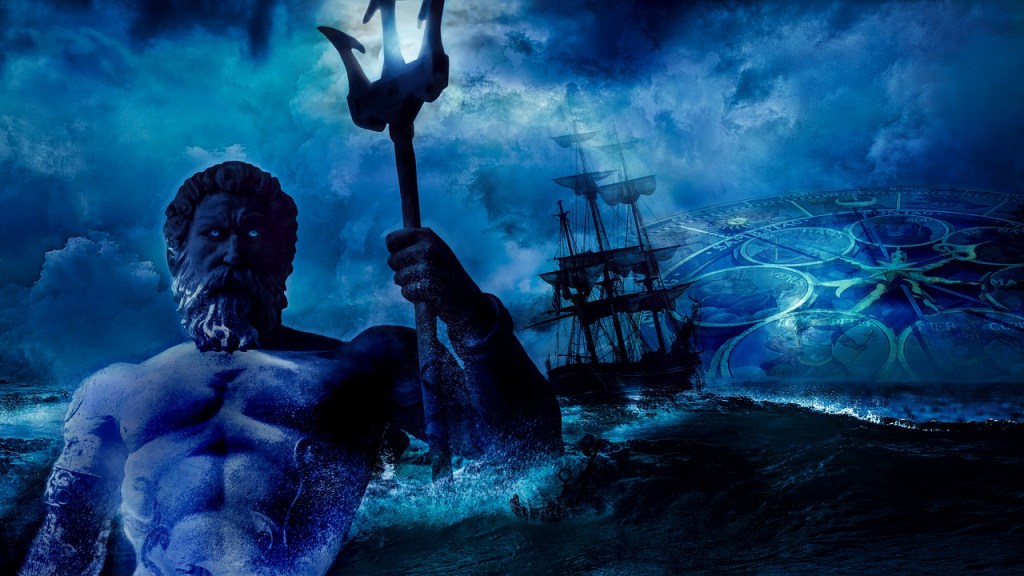
Pirate Blackarn Meets Neptune

By Jay Nicholls

PIRATE BLACKTARN MEETS NEPTUNE


Pirate Blacktarn, Terror of the Lemon Seas 
Swung in his hammock, taking his ease. 
The sea was calm and the day was hazy,
The pirate ship’s crew were feeling lazy. 

“But look,” said Fay, “what’s happening there?”
She pointed her finger and the crew turned to stare.
All except Blacktarn, whose eyes began to close. 
His head began to nod and he fell into a doze. 

“WOW!” cried the crew, “look, look, LOOK!” 
“What can be happening?” asked Big Bob the Cook. 
“Don’t make a noise when you know I’m having a nap, 
I must get my rest,” said Blacktarn with a snap. 

“But the sea’s gone purple and now it’s turning gold, 
Oh come on Captain, don’t wait to be told. 
Look how now the sea’s bright orange 
It’s so mysterious and strange.”
“Oh do stop bothering me,” said Blacktarn, very cross. 

“But the seabirds have gathered, even the albatross. 
And the dolphins are dancing and the flying fish are leaping. 
Oh Captain Blacktarn, do stop sleeping. 
Hey, do you hear all that wonderful singing?
The sea nymphs are chanting and the Mer bells are ringing. 
See all that spray? It’s the great whales blowing. 
And look, now watch, how the whole sea is glowing.”

Rising from the ocean, a figure started to appear 
Waving a trident, a huge three-pronged spear. 
His hair was green as seaweed and he wore a starfish crown
And he rode a giant seahorse which danced up and down. 

“I know who it is,” squawked Tim Parrot, all excited.
It’s Neptune, the sea god,” cried Bosun Mick, delighted.
And all Blacktarn’s crew roared out a great big cheer.
For every creature of the Lemon Sea was here, 
All waiting to greet Neptune, the sea’s great Lord,
All except Blacktarn, who just snored and snored and snored.

“I think he’s coming here,” gasped Stowaway Fay
For the great god Neptune was riding their way.
“Captain Blacktarn, you must be ready to meet him.
Neptune is here, quick, wake up and greet him.”

“Neptune,” muttered Blacktarn, “don’t be ridiculous. 
Neptune’s just a fairy tale, rather like St Nicholas.”

“No, no, he’s here Captain,” cried Mick in alarm. 
Come on, wake up now, it’s no time for calm.”

But Blacktarn closed his eyes again and sank into a slumber 
And Neptune gave a grin, for he’d got Blacktarn’s number. 
He borrowed a big feather from a seagull’s long grey wing 
And tickled Blacktarn’s nose, till soon he started blinking. 

“Go away,” huffed the Pirate, pushing the feather aside. 
Then all of a sudden, he opened his eyes wide.

“NNN Neptune! 
I thought you were a fairy tale but now I see I’m wrong. 
PPP please don’t prod me with that scary prong.” 
But Neptune hooked his trident fast on Blacktarn’s braces. 
“Now you pirate, let’s have no more airs and graces” 
He told the dangling captain in a very firm way. 
“This is a poor welcome, I’m very sorry to say. 
But as I’m in a good mood, you have a chance to please me. 
For the reason I’m visiting this lovely Lemon Sea 
Is most of all because I want a special cup of tea. 
I’ve heard from the mermaids that the finest brew to savour
Is made from water with that special lemon flavour. 
So now if you make me a special cup of tea
I might just forgive your lack of courtesy.” 

“Of course,” stuttered Blacktarn, “if you’ll just put me down.”
So Big Bob brewed the tea, all hot and strong and brown. 
“This is what I’ve been wanting,” said Blacktarn with glee
And now I think it’s time we had a tea party.”

So they had the best of parties, right there on the ship.
There was lemon tea and grog, rock buns and seaweed dip. 
Stowaway Fay did daring acrobatics
And Rakesh the mate did magic tricks.
Mick danced a jig and Tim Parrot squawked a solo
Which shivered the timbers, above and below.
Blacktarn cheered up and played the perfect host
Even though the sea horse ate all his toast.

And Neptune beamed a lot and enjoyed himself no end 
“Well I’ve had such a good time, I could happily spend 
Many days on your good ship but sadly I must go. 
I have important business in the deep ocean below.”
And lifting his trident high, he left them with a sigh.
Back into the sea he plunged, waving them goodbye.

“Goodbye,” called the seabirds, the dolphins and the whales,
“Goodbye,” called the Mermaids, swishing their tails.
“Well I’m glad I invited him,” said Blacktarn looking smug. 
Now it’s time to sail again – oh Neptune’s gone off with my mug!”

Note: The ‘Pirate Blacktarn’ poems were written in the early 1990s but were never submitted anywhere or shown to anyone. By lucky chance they were recently rescued from a floppy disc that had lain in the bottom of a box for almost thirty years. There are twelve poems in the series but no indication as to what order they were written in and the author no longer remembers. However, they seem to work well when read in any order. They all feature the same cast of characters, the eponymous pirate and his crew, including a stowaway and an intelligent parrot. The stories told by the poems are set on a fictional body of water named the Lemon Sea. (Dug up by Rhys Hughes from the bottom of an abandoned treasure chest).

Jay Nicholls was born in England and graduated with a degree in English Literature. She has worked in academia for many years in various student support roles, including counselling and careers. She has written poetry most of her life but has rarely submitted it for publication.

.

PLEASE NOTE: ARTICLES CAN ONLY BE REPRODUCED IN OTHER SITES WITH DUE ACKNOWLEDGEMENT TO BORDERLESS JOURNAL

Categories
Pirate Poems

Pirate Blacktarn’s Teeth

By Jay Nicholls

PIRATE BLACKTARN’S TEETH


Pirate Blacktarn had terrible teeth, 
He kept sweets instead of a sword in his sheath,
And he ate so many, his teeth began to rot 
And as for brushing them, he always forgot. 
The inside of his mouth was greenish and grimy 
His teeth were broken and black and slimy. 

“You’re revolting,” said all the crew. 
“We’re not coming too close to you.”
Poor Pirate Blacktarn was quite upset
“What’s the matter with me?” he asked as he ate. 
“You need new teeth,” the crew replied. 
Blacktarn was hurt and went off to hide. 
He sulked in his cabin, all day and all night 
While the stars came out, very shiny and bright.
Out too fell his teeth, dropping one by one, 
Onto the floor till all were gone.

“Oh no,” mumbled Blacktarn, “what shall I do?”
“Serves you right,” said his unkind crew. 
But Blacktarn was angry and ranted and raved 
Till the crew became quite well behaved. 
“If I can’t eat, then neither can you,
Don’t think you’re going to scoff that stew,”
Said Blacktarn crossly as his stomach rumbled. 
“Now what a mess,” his hungry crew grumbled. 

The crew grew thinner and thinner and thinner.
Big Bob the Cook groaned, “We want dinner.”
But toothless Blacktarn was stern and cruel, 
Grumpy and stubborn, as bad as a mule. 
The crew were miserable, bad tempered and sad
Their empty bellies were making them mad. 

But deep in thought sat Stowaway Fay.
“I know how to make things OK,” 
She told the crew one happy day.
“We’ll make him dentures, all clean and smart. 
Come on everyone, let’s make a start.”

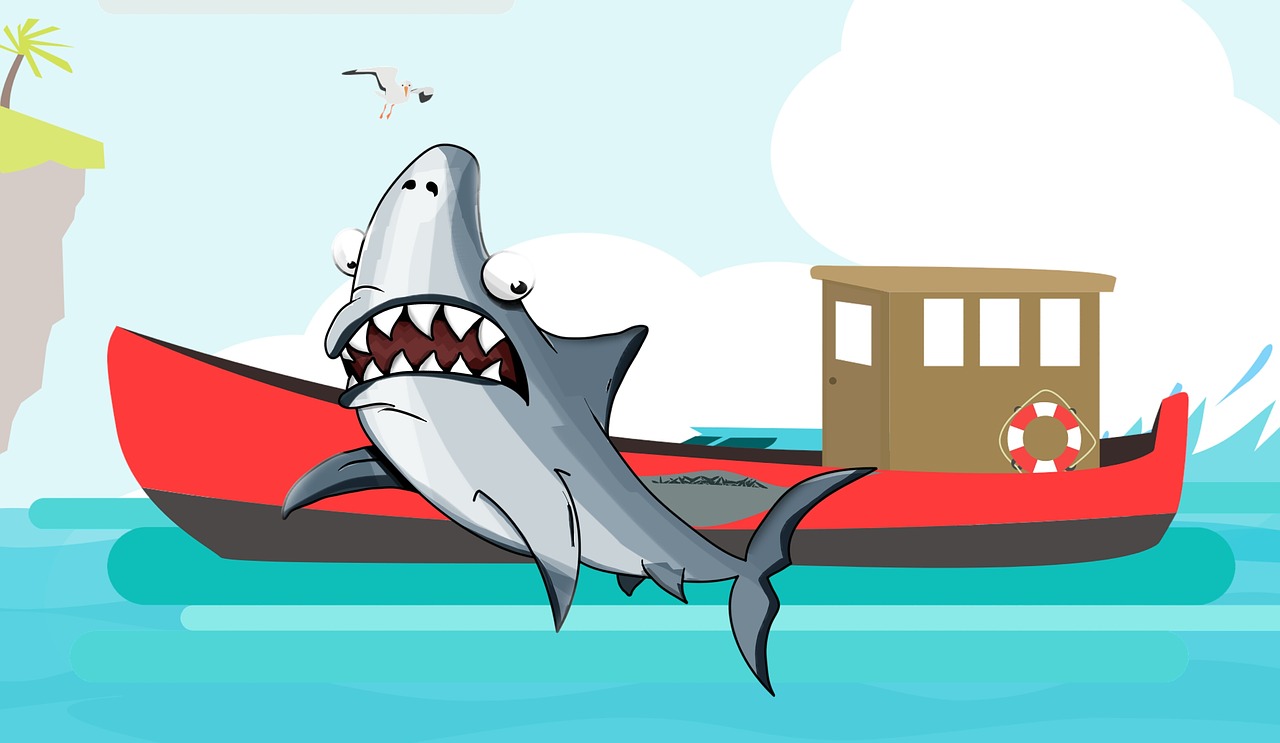
They caught a shark, basking close by the ship
And cut out its teeth, snip by snip by snip,
Then stuck them in jelly mould shaped like a grin
And as Blacktarn lay dozing, they popped them in. 
He woke with a start, “My mouth’s full of choppers!”
“So it is,” said the crew, “What great long whoppers.”

“Hey, I can eat,” Blacktarn cried with delight. 
“Quick, let’s have a feast, this very fine night.”
So Big Bob went down to the galley to bake 
And made sausages and stew and cookies and cake. 
Then the starving crew just ate and ate and ate.
“Oh well done Fay,” said Rakesh the mate. 
“Oh yes, well done,” they all agreed.
“Well done, well done, well done indeed.” 

Now long toothed Blacktarn looks sharp and mean 
But he takes out his teeth each night to clean.
He brushes them carefully twice a day,
So his shark’s teeth dentures are here to stay. 

“Come on crew,” he cried with a big white grin
“We’ve got all the Lemon Seas for sailing in.”

Note: The ‘Pirate Blacktarn’ poems were written in the early 1990s but were never submitted anywhere or shown to anyone. By lucky chance they were recently rescued from a floppy disc that had lain in the bottom of a box for almost thirty years. There are twelve poems in the series but no indication as to what order they were written in and the author no longer remembers. However, they seem to work well when read in any order. They all feature the same cast of characters, the eponymous pirate and his crew, including a stowaway and an intelligent parrot. The stories told by the poems are set on a fictional body of water named the Lemon Sea. (Dug up by Rhys Hughes from the bottom of an abandoned treasure chest).

Jay Nicholls was born in England and graduated with a degree in English Literature. She has worked in academia for many years in various student support roles, including counselling and careers. She has written poetry most of her life but has rarely submitted it for publication.

.
PLEASE NOTE: ARTICLES CAN ONLY BE REPRODUCED IN OTHER SITES WITH DUE ACKNOWLEDGEMENT TO BORDERLESS JOURNAL

Categories
Travel

Planes, Trains & Automobiles

I should like to rise and go
Where the golden apples grow;—
Where below another sky
Parrot islands anchored lie...

-- Travel, RL Stevenson (1850-1894)

December is often a time when we look forward to a vacation and travel. Through the pandemic ravaged years, moving out of the house itself had become a challenge. Now as the world opens up slowly (hopefully the Omicron variant of the virus will be more benign), travel stretches its limbs to awaken to a new day with new trends and rules. Borderless invites you to savour of writing that takes you around the world with backpackers, travellers, hikers, sailors and pirates — fantastical, imaginary or real planned ones in a post-pandemic world. Enjoy!

Poetry

In the Honduran Dusk

Lorraine Caputo takes us on a visit to a small Garífuna village on Honduras’ Caribbean coast. Click here to read.

The Voyages of Caracatus Gibbon

Rhys Hughes time travels back to the first century voyaging vicariously with his imagination and a Welsh king who resisted Roman invasion. Click here to read.

Pirate Blacktarn gets Lost

Have you ever got lost while traveling like Pirate Blacktarn? Who can help the pirate find his way… Narrated by Jay Nicholls, click here to read.

Classics

Travel & Holidays: Humour from Rabindranath

Do you enjoy babysitting nieces, nephews on trips and have you ever traveled with ‘hundreds of pieces of luggage, a few coolies, five women and only one man’? Tagore did. Somdatta Mandal translates hilarious writings from young Tagore on travel. Click here to read.

The Witch

Travel through Bengal with Shorodhoni, a woman dubbed a ‘Daini’ or witch, in her quest to find a home in Aruna Chakravarti’s translation of Tarasankar Bandhopadhyay’s poignant story. Click here to read.

Gliding down the Silk Road

“Stories that tell us about human lives and human emotions highlight one simple thing: Humans are the same everywhere.” That is what Ratnottama Sengupta concludes as she vicariously travels through the famed route from the past. Click here to read.

Around the World

Antarctica

Click here to read Keith Lyon’s travels in Antarctica and savour the photographs he clicked.

Adventures of a Backpacking Granny

Sybil Pretious takes you on her adventures that start at sixty years of age with photographs and narration.

St Petersburg, Russia

Click here to read.

Mount Kiliminjaro

Click here to read.

Lake Baikal in Siberia

Click here to read.

Baoying, Rural China

Click here to read.

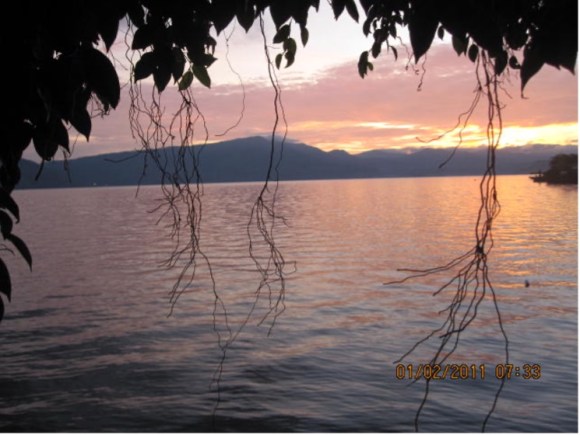
Volcanic Lake Toba. Photo Courtesy: Sybil Pretious

Philippines, Volcanoes & More

Click here to read.

Indonesia

Click here to read

Myanmar

Click here to read John Herlihy’s exhilaration with Myanmar in a pre-pandemic world in four-parts.

Australia

Click here to read Meredith Stephens’ sailing experiences between Adelaide and Kangaroo island.

Pandemic Diaries

Click here to read how Sunil Sharma moved continents, pausing in Maldives to find a new home in Canada.

Categories
Contents

Borderless, November, 2021

Autumn: Painting in Acrylic by Sybil Pretious

Editorial

Colours of the Sky…Click here to read.

Interviews

In Conversation with Akbar Barakzai, a Balochi poet in exile who rejected an award from Pakistan Academy of Letters for his principles. Click here to read.

In Conversation with Somdatta Mandal, a translator, scholar and writer who has much to say on the state of Santiniketan, Tagore, women’s writing on travel and more. Click here to read.

Translations

Rebel or ‘Bidrohi’

Nazrul’s signature poem,Bidrohi, translated by Professor Fakrul Alam. Click here to read.

Motorcar

Jibonananda Das‘s poetry translated from Bengali by Rakibul Hasan Khan. Click here to read.

The Beloved City

Poetry of Munir Momin, translated from Balochi by Fazal Baloch. Click here to read.

Rebranding

A poem in Korean, written & translated by Ihlwha Choi. Click here to read.

Perhaps the Last Kiss

A short story by Bhupeen giving a vignette of life in Nepal, translated from Nepali by Ishwor Kandel. Click here to read.

Morichika or Mirage by Tagore

Tagore’s poetry translated by Mitali Chakravarty. Click here to read.

Poetry

Click on the names to read

Rhys Hughes, Sutputra Radheye, Luis Cuauhtémoc Berriozábal, Sheshu Babu, Michael Lee Johnson, Prithvijeet Sinha, George Freek, Sujash Purna,  Ashok Manikoth, Jay Nicholls, Pramod Rastogi, Ryan Quinn Flanagan, Vijayalakshmi Harish, Mike Smith, Neetu Ralhan, Michael R Burch

Poets, Poetry & Rhys Hughes

A story poem about The Clock Tower of Sir Ticktock Bongg. Click here to read.

Nature’s Musings

Penny Wilkes takes us for a stroll into the avian lives with photographs and poetry in Of Moonshine & Birds. Click here to read.

Stories

Waking Up

Christina Yin takes us on a strange journey in Sarawak, Malaysia. Click here to read.

Rains

A pensive journey mingling rain and childhood memories by Garima Mishra. Click here to read.

Khatme Yunus

Jackie Kabir brings us a strange story from Bangladesh. Click here to read.

First International Conference on Conflict Continuation

Steve Davidson explores an imaginary conference. Click here to read.

The Literary Fictionist

In Fragments of a Strange Journey, Sunil Sharma sets out with Odysseus on a tour of the modern day world. Click here to read.

Musings/Slices from Life

Yesterday Once More?

Ratnottama Sengupta recalls her experiences of the Egyptian unrest while covering the 35th Cairo International Film Festival in 2012. Click here to read.

Embroidering Hunger

An account of life of dochgirs (embroiderers) in Balochistan by Tilyan Aslam. Click here to read.

To Daddy — with Love

Gita Viswanath takes us into her father’s world of art and wonder. Click here to read.

Simon Says

Ishita Shukla, a young girl, explores patriarchal mindset. Click here to read.

Welcoming in the dark half of the year

Candice Louisa Daquin takes a relook at the evolution of Halloween historically. Click here to read.

Musings of the Copywriter

In Crematoriums for the Rich, Devraj Singh Kalsi regales his readers with a dark twist of the macabre. Click here to read.

Essays

Renewal

Jayat Joshi, a student of development studies, takes a dig at unplanned urban development. Click here to read.

Once Upon A Time in Burma: Leaving on a Jet Plane

John Herlihy’s last episode in his travels through Burma. Click here to read.

A Legacy of Prejudice, Persecution and Plight

Suvrat Arora muses on the impact of a classic that has been coloured with biases. Click here to read.

The Observant Migrant

In Is Sensitivity a Strength or a Weakness?, Candice Louisa Daquin explores our value systems. Click here to read.

Book Excerpts

Arundhathi Subramaniam’s Women Who Wear Only Themselves. Click here to read.

CJ Fentiman’s award winning book, The Cat with Three Passports. Click here to read.

Book Reviews

Himadri Lahiri reviews Somdatta Mandal’s ‘Kobi’ and ‘Rani’: Memoirs and Correspondences of Nirmalkumari Mahalanobis and Rabindranath Tagore. Click here to read.

Suzanne Kamata reviews Iain Maloney’s Life is Elsewhere/ Burn Your Flags. Click here to read.

Bhaskar Parichha reviews Anita Agnihotri’s Mahanadi –The Tale of a River, translated from Bengali by Nivedita Sen. Click here to read.

Meenakshi Malhotra reviews Turmeric Nation: A Passage Through India’s Tastes, authored by Shylashri Shankar. Click here to read.

Categories
Pirate Poems

Pirate Blacktarn & The Worm

By Jay Nicholls

PIRATE BLACKTARN AND THE WORM


Pirate Blacktarn, Terror of the Lemon Seas 
Was feeling so hungry he ate three teas
And even after that he still wanted more.
He ate cookies and cakes and puddings galore.
But though Big Bob the Cook kept cooking and cooking
Blacktarn ate parrot food when Tim wasn’t looking.
He ate sea weed and star fish and slippery eels
And doughnuts and dumplings, all between meals.

“You’ll burst,” said Mick, “this is rather a worry.”
“No I won’t,” answered Blacktarn, eating barnacle curry. 
“This is ridiculous,” said Big Bob, feeling cross,
“You’re eating more than the great albatross.
The ship’s stores and supplies are vanishing fast,
These barrels of food are meant to last.”

But even though Blacktarn still ate and ate
He went on being hungry from morning till late.
In the middle of the night he crept out of his hammock
To try asking for crumbs from the wild seagull flock. 
And he stole Big Bob’s stew that he’d d only just made 
In a secret and stealthy, dark midnight raid.
But strangest of all, he grew more and more thin.
His cheeks became hollow and sunken in. 
His legs and arms looked like sticks on a twig 
And only his tummy stayed round and big.
“I’m fading away,” cried Blacktarn, eating some more,
“I’ll be nothing but a belly with the food it can store.”

“Something very strange is going on here,”
Said Bob to Rakesh, who was standing near. 
“Are you thinking what I’m thinking?”
“What?” asked Blacktarn, his fearful heart sinking.

“Worms!” said Bob. 

“WORMS!” cried Blacktarn. “HELP! HELP! I’ve got WORMS!” 

A small sneaky worm living in a ship’s biscuit 
Had jumped right out when Blacktarn bit into it.
It had slithered down his throat and settled in his stomach
And once it was there, it couldn’t believe its luck, 
For so much food kept coming its way,
Chocolate and cake, sweets and biscuits, day after day,
That the worm grew bigger and bigger and bigger 
While Blacktarn shrank to a small, thin figure. 
“Help,” groaned Blacktarn, so scared he nearly cried, 
“I’ll starve to death with this worm inside.”

“Don’t worry Captain,” said Rakesh the mate,
“We’ll see this worm has a nasty fate.”
And he took out his pipe and started to play
In a wiggly, weavy, wormy way.
And the worm stopped eating and started to listen 
To the magical music that made his eyes glisten. 
The tune sang of sea serpents swimming through the waves
And electric eels in undersea caves 
And the gleaming glow worms that light up the deeps
And the huge ocean snake that never ever sleeps. 

And the worm uncurled and started to rise 
In Blacktarn’s stomach which burped in surprise. 
And Rakesh played on, in his wriggly way 
And the worm began to squirm, then started to sway
Forwards and back he wriggled his body about 
Till he reached Blacktarn’s mouth and peered right out. 

Then fast as a dart swooped Parrot Tim 
And grabbed the worm and pulled and pulled him. 
Until out he wriggled all pink and squirmy 
And Tim quickly snatched him and dropped him in the sea,
Where he swam away most unhappily. 

Hurrah, hurrah Captain,” everyone cried. 
“Hurrah,” exclaimed Blacktarn, “that worm’s not inside.
But I’m feeling so hungry I really need a feast 
Now I’ve got rid of that slinky slimy beast.”

Big Bob groaned but began cooking again
And they ate huge helpings of cake and sugar cane 
And mangoes and melons all firm and ripe,
While Rakesh played more tunes on his marvellous pipe. 
And they danced the dance of the greedy little worm
Until Blacktarn spoke, sounding very firm,
“Of course no worm could last long in a pirate like me 
But now I’m worm free and I’m not even hungry,
I think we should sail again, across the Lemon Sea.”

Note: The ‘Pirate Blacktarn’ poems were written in the early 1990s but were never submitted anywhere or shown to anyone. By lucky chance they were recently rescued from a floppy disc that had lain in the bottom of a box for almost thirty years. There are twelve poems in the series but no indication as to what order they were written in and the author no longer remembers. However, they seem to work well when read in any order. They all feature the same cast of characters, the eponymous pirate and his crew, including a stowaway and an intelligent parrot. The stories told by the poems are set on a fictional body of water named the Lemon Sea. (Dug up by Rhys Hughes from the bottom of an abandoned treasure chest).

Jay Nicholls was born in England and graduated with a degree in English Literature. She has worked in academia for many years in various student support roles, including counselling and careers. She has written poetry most of her life but has rarely submitted it for publication.

.

PLEASE NOTE: ARTICLES CAN ONLY BE REPRODUCED IN OTHER SITES WITH DUE ACKNOWLEDGEMENT TO BORDERLESS JOURNAL

Categories
Halloween Greetings

Ghosts, Spooks and Pirates

Why do we enjoy literature on spooks and ghosts?

A million dollar question that seems to have no satisfactory answers. While around October-November, many cultures pay respects to the departed, there are those who do pray at a different time of the year. Is there a link between that and the fun of disguising and collecting candy or playing tricks on Halloween? There are no conclusive answers or evidence to link these.

In this special edition, we decided to have a bit of fun with imps, pirates, ghost, zombies and spooks brought to you from across the world on Halloween as well as a concluding essay on the reasons we celebrate spooks. Enjoy!

Poetry

Witchy Halloween: Michael Lee Johnson gives us a magical glimpse into Halloween night. Click here to read.

Pirate Poems: Jay Nicholls brings us fun-filled ‘spooky-gooky’ adventures across the Lemon Sea. Click here to read.

The Tickle Imp: Is this horrific, funny or what? Only can be had from the bizarre or genius pen of Rhys Hughes. Click here to read.

Prose

The Turret: An eerie story by Niles M Reddick that seems to be right out of an edition of The Most Haunted Houses. Click here to read.

The Return of the Dead: Gita Vishwanath explores spooks in afterlife in a short story. Do we become zombies? Click here to find out.

Ketchup: A scintillating ghost story by Rakhi Pandey, set in the old Residency at Lucknow. Click here to read.

When Two or Three are Gathered: A weird dark tale from Tan Kaiyi where a victims of a virus mutate. What kind of fear is instilled by this situation? Click here to find out.

Welcoming the Dark Half of the Year: Winding up the section is Candice Louisa Daquin’s essay that takes a relook at the evolution of Halloween historically. Click here to read.

Categories
Contents

Borderless, October 2021

An Ode to Autumn: Painting by Sohana Manzoor.

Editorial

Making a Grecian Urn… Click here to read.

Interviews

Unveiling Afghanistan: In Conversation with Nazes Afroz, former editor of BBC and translator of a book on Afghanistan which reflects on the present day crisis. Click here to read.

The Traveller in Time: An interview with Sybil Pretious who has lived through history in six countries and travelled to forty — she has participated in the first democratic elections in an apartheid-worn South Africa and is from a time when Rhodesia was the name for Zimbabwe. Click here to read.

Translations

Travels & Holidays: Humour from Rabindranath

Translated from the original Bengali by Somdatta Mandal, these are Tagore’s essays and letters laced with humour. Click here to read.

The Quest for Home

Nazrul’s Kon Kule Aaj Bhirlo Tori translated from Bengali by Professor Fakrul Alam. Click here to read.

Mysteries of the Universe

Akbar Barakzai’s poetry in Balochi, translated by Fazal Baloch. Click here to read.

Gandhi & Robot

A poem reflecting the state of Gandhi’s ideology written in Manipuri by Thangjam Ibopishak and translated from the Manipuri by Robin S Ngangom. Click here to read.

Sorrows Left Alone

A poem in Korean, written & translated by Ihlwha Choi. Click here to read.

The Song of Advent by Tagore

Written by Tagore in 1908, Amaar Nayano Bhulano Ele describes early autumn when the festival of Durga Puja is celebrated. It has been translated from Bengali by Mitali Chakravarty. Click here to read.

Poetry

Click on the names to read

Michael R Burch, A Jessie Michael, John Grey, Rupali Gupta Mukherjee, Mike Smith, Saranyan BV, Tony Brewer, Baisali Chatterjee Dutt, Jay Nicholls, Beni S Yanthan, Luis Cuauhtémoc Berriozábal, Pramod Rastogi, Jason Ryberg, Michael Lee Johnson, Oormila Vijayakrishnan Prahlad, Rhys Hughes

Animal Limericks by Michael R Burch. Click here to read.

Nature’s Musings

In The Lords of Lights, with photographs and a story, Penny Wilkes makes an interesting new legend. Click here to read.

Poets, Poetry & Rhys Hughes

In Pessoa and Cavafy: What’s in a Name?, Rhys Hughes comically plays with the identity of these two poets. Click here to read.

Musings/ Slices From Life

At the Doctor’s

In this lighthearted narration, Farouk Gulsara uses humour to comment on darker themes. Click here to read.

Taking an unexpected turn

Nitya Pandey talks of a virtual friendship that bloomed across borders of countries during the pandemic. Click here to read.

Travel in the Time of Pandemics: Select Diary Entries of an Urban Nomad

Sunil Sharma gives us a slice from his travels with vibrant photographs, changing continents and homes during the pandemic. Click here to read.

Musings of a Copywriter

In Surviving to Tell a Pony-taleDevraj Singh Kalsi journeys up a hill on a pony and gives a sedately hilarious account. Click here to read.

Essays

A Season of Magical Mellow Wistfulness

Meenakshi Malhotra through folk songs that are associated with Durga Puja explores the theme of homecoming. Click here to read.

What Gandhi Teaches Me

Candice Louisa Daquin applies Gandhiism to her own lived experiences. Click here to read.

How Women’s Education Flourished in Aligarh Muslim University

Sameer Arshad Khatlani dwells on the tradition of education among Muslim women from early twentieth century, naming notables like Ismat Chughtai and Rashid Jahan. Click here to read.

Once Upon a Time in Burma: Of Friendships & Farewells

John Herlihy takes us through more of Myanmar with his companion, Peter, in the third part of his travelogue through this land of mystic pagodas. Click here to read.

When Needles Became Canons…

Ratnottama Sengupta, who has edited an encyclopaedia on culture and is a renowned arts journalist, gives us the role ‘kanthas’ (hand-embroidered mats, made of old rags) played in India’s freedom struggle. Click here to read.

Stories

Lunch with Baba Rinpoche in Kathmandu

Steve Davidson takes us for a fictitious interview with a Tibetan guru in Nepal. Click here to read.

The Tree of Life

An unusual flash fiction by Parnil Yodha about a Tibetan monk. Click here to read.

Odysseus & Me: A Quest for Home

A short fiction from Bangladesh by Marzia Rahman on immigrants. Click here to read.

Dawn in Calicut

Krishna Sruthi Srivalsan writes of a past that created the present. Click here to read.

I am a Coward with Priorities

Tejaswinee Roychowdhury tells a story from a soldier’s perspective. Click here to read.

The Literary Fictionist

In Bapu, Denied, Sunil Sharma explores the fate of Gandhiism in a world where his values have been forgotten. Click here to read.

Book Excerpts

An excerpt of In a Land Far From Home: A Bengali in Afghanistan by Syed Mujtaba Ali, translated by Nazes Afroz. Click here to read.

An excerpt from letters written by Tagore from Kobi & Rani, translated by Somdatta Mandal. Click here to read.

Book Reviews

Aruna Chakravarti reviews Golden Bangladesh at 50: Contemporary Stories & Poems edited by Shazia Omar. Click here to read.

Somdatta Mandal reviews Wooden Cow by T. Janakiraman, translated from Tamil by Lakshmi Kannan. Click here to read.

Gracy Samjetsabam reviews Suzanne Kamata’s The Baseball Widow. Click here to read.

Bhaskar Parichha reviews Mohona Kanjilal’s A Taste of Time: A Food History of Calcutta. Click here to read.