A translation from Nabendu Ghosh’s autobiography, Eka Naukar Jatri(Journey of a Lonesome Boat), translated by Dipankar Ghosh, from Bengali post scripted by Ratnottama Sengupta. Clickhereto read.
Ueharaby Kamaleswar Barua has been translated from Assamese and introduced by Bikash K. Bhattacharya. Clickhere to read.
Kurigram by Masud Khan has been translated by Professor Fakrul Alam from Bangla. Clickhere to read.
Bonfire by Ihlwha Choi has been translated from Korean by the poet himself. Clickhere to read.
In Indian Pale Ale, Rhys Hughes experiments with words and brews. Click here to read.
Conversation
Being fascinated with the human condition and being vulnerable on the page are the two key elements in the writing of fiction, author and poet Heidi Northtells Keith Lyons in a candid conversation. Clickhere to read.
In Multicultural Curry, Suzanne Kamata reflects on mingling of various cultures in her home in Japan and the acceptance it finds in young hearts. Clickhere to read.
Ratnottama Sengupta explores the poetry in lyrics of Bollywood songs, discussing the Sahityotsav (Literary Festival) hosted by the Sahitya Akademi. Clickhere to read.
Imagine a world without wars, without divisions, where art forms flow into each other and we live by the African concept of Ubuntu — I am because you are’ — sounds idyllic. But this is the month of March, of poetry, of getting in touch with the Dionysian elements in ourselves. And as we have said earlier in the introduction of Monalisa No Longer Smiles: An Anthology of Writings from across the World, what could be a better spot to let loose this insanity of utopian dreams than Borderless Journal!
Having completed three years of our Earthly existence on the 14th of March, we celebrate this month with poetry and writing that crosses boundaries — about films, literature and more. This month in the Festival of Letters or Sahityaotsav 2023, organised by the Sahitya Akademi, films were discussed in conjunction with literature. Ratnottama Sengupta, who attended and participated in a number of these sessions, has given us an essay to show how deep run the lyrics of Bollywood films, where her father, Nabendu Ghosh, scripted legends. It is Ghosh’s birth month too and we carry a translation from his Bengali autobiography which reflects how businessmen drew borders on what sells… After reading the excerpt from Nabendu’s narrative translated by Dipankar Ghosh and post-scripted by Sengupta, one wonders if such lines should ever have been drawn?
Questioning borders of a different kind, we have another piece of a real-life narrative on a Japanese Soldier, Uehara. Written by an Assamese writer called Kamaleswar Barua, it has been translated and introduced by Bikash K. Bhattacharya. The story focusses on a soldier’s narrative at his death bed in an alien land. We are left wondering how his need for love and a home is any different from that of any one of ours? Who are the enemies — the soldiers who die away from their homes? What are wars about? Can people live in peace? They seemed to do so in Kurigram, a land that has faded as suggests the poem by Masud Khan, brought to us in translation from Bangla by Professor Fakrul Alam, though in reality, the area exists. Perhaps, it has changed… as does wood exposed to a bonfire, which has been the subject of a self-translated Korean poem by Ihlwha Choi. Tagore’s poem, Borondalatranslated as ‘Basket of Offerings’, has the last say: “Just as the stars glimmer / With light in the dark night, / A spark awakens within/ My body. / This luminosity illuminates / All my work.” And perhaps, it is this luminosity that will also help us find our ideal world and move towards it, at least with words.
We have a book review by Aruna Chakravarti of Bornali Datta’sIn A Better Place: A Doctor’s Journey, a book that is set amidst immigrants and takes up certain social issues. Baba Padmanji’s Yamuna’s Journey, translated from Marathi by Deepra Dandekar, one of the oldest Indian novels has been discussed by Somdatta Mandal. Bhaskar Parichha has told us about S.Irfan Habib’s Maulana Azad – A Life. Basudhara Roy has brought out the simplicity and elegance of Robin Ngangom’sMy Invented Land: New and Selected Poems. He writes in the title poem that his home “has no boundaries. / At cockcrow one day it found itself/ inside a country to its west,/ (on rainy days it dreams looking east/ when its seditionists fight to liberate it from truth.)”. We also carry an excerpt from his book. Stories by Jessie Michael, Brindley Hallam Dennis, Sangeetha G and Shubhangi bring flavours of diversity in this issue.
Our journey has been a short one — three years is a short span. But, with goodwill from all our readers and contributors, we are starting to crawl towards adulthood. I thank you all as caregivers of Borderless Journal as I do my fabulous team and the artists who leave me astounded at their ability to paint and write — Sohana Manzoor, Gita Vishwanath and Pragya Bajpai.
Thank you all.
Looking forward to the next year, I invite you to savourBorderless Journal, March 2023, where more than the treasures mentioned here lie concealed.
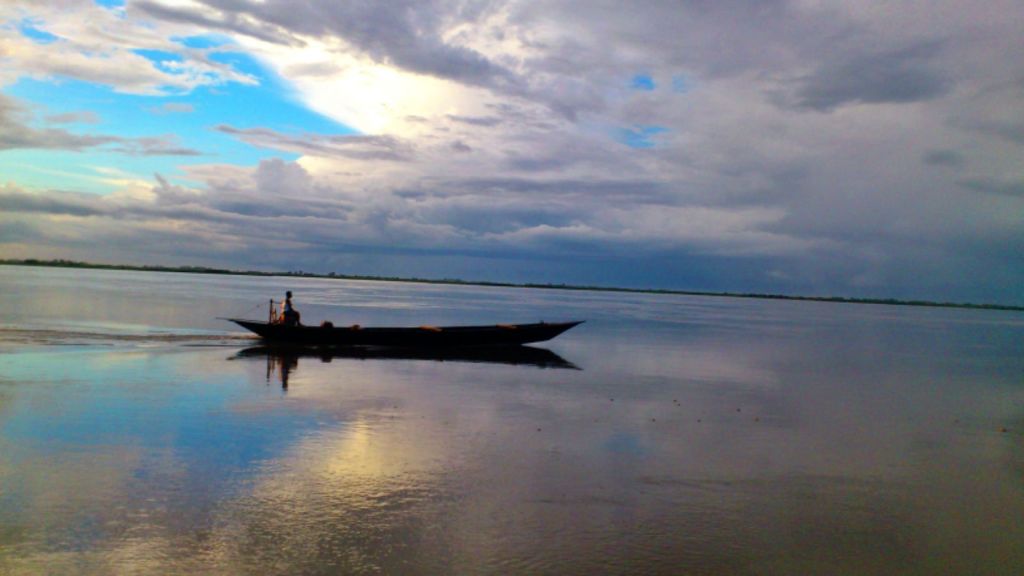
I’ve never been to Kurigram.

In the dead of night, sleeping Kurigram steadily detaches itself
From the world that we know.
Ignores gravity completely
Taking off with its tiny kingdom
To some far-off galaxy.

We keep looking then at the deep blue of the sky
While the tiny village becomes a speck up high.

For a long while Kurigram floats from one dome of heaven to another.
Till that star in the southern sky that pursued it so single-mindedly
Settles by its side and claims it as its own.
Then from this new luminary
A mild red vaporous smell wafts across the sky.

In that realm, in Kurigram,
The Kingfisher and the Pankouri bird are stepbrothers.
When all the rivers of Kurigram become calm
The two brothers make the river their home
Squabbling with each other like families bickering!

When the river calms down again
The womenfolk, once bound by scriptural edicts,
Throng to the riverbank.
Breaking all barriers,
They sparkle like large resplendent crystals.

Suddenly, a lonely babui bird, sans weaving skills,
Perched on a battered old mast, starts swinging,
Finally settling down on the translucent steel-foiled river water.
Kurigram, ah Kurigram!

Where Kurigram used to be
Is a dark and solitary space now.

Alas, I’ve never been to Kurigram
And I don’t think I ever will!

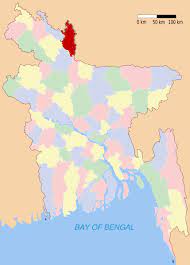
Kurigram—An innocuous town located in the northern region of Bangladesh
Paankouri—A species of bird, black in colour, found in marshes and rivers
Babui—A species of weaving bird
Masud Khan (b. 1959) is a Bengali poet and writer. He has, authored nine volumes of poetry and three volumes of prose and fiction. His poems and fictions (in translation) have appeared in journals including Asiatic, Contemporary Literary Horizon, Six Seasons Review, Kaurab, 3c World Fiction, Ragazine.cc, Nebo: A literary Journal, Last Bench, Urhalpul, Tower Journal, Muse Poetry, Word Machine, and anthologies including Language for a New Century: Contemporary Poetry from the Middle East, Asia, and Beyond (W.W. Norton & Co., NY/London); Contemporary Literary Horizon Anthology,Bucharest; Intercontinental Anthology of Poetry on Universal Peace (Global Fraternity of Poets); and Padma Meghna Jamuna: Modern Poetry from Bangladesh(Foundation of SAARC Writers and Literature, New Delhi). Two volumes of his poems have been published as translations, Poems of Masud Khan(English), Antivirus Publications, UK, and Carnival Time and Other Poems (English and Spanish), Bibliotheca Universalis, Romania. Born and brought up in Bangladesh, Masud Khan lives in Canada and teaches at a college in Toronto.
Figments caught straying in whispers of a dream,
Weave together till they form a visible stream,
Filling a void with voices that sing,
With freedom and impunity ring,
Giving credence to a distant, imagined realm.

— Introduction, Monalisa No Longer Smiles: An Anthology of Writings from across the World
As we complete three years of our virtual existence in clouds, connecting, collecting and curating words of ideators, we step into our fourth year with the pleasurable experience of being in bookshops in hardcopy too. Monalisa No Longer Smiles: An Anthology of Writings from across the World, our first hardcopy anthology, takes us into the realm of real books which have evolved over eons in history. This anthology connects us to those who hesitate to step into the virtual world created by technology. And there are many such people – as ingrained in the human heritage is a love for rustling paper and the smell of books. We have had some excellent reviews, praising not just the content but also the production of the book – the cover, the print and the feel. The collection bonds traditional greats with upcoming modern voices. We are grateful to our publisher, Om Books International, Shantanu Ray Chaudhuri, Jyotsna Mehta and their team for giving our book a chance. We do look forward to more anthologies hopefully in the future.
The writings we have collected over the last three years are reflective of diverse voices— some in concurrence with our thought processes and some in discussion or even in divergence. We have a variety of forms — poetry, conversations, fiction and non-fiction. Some are humorous and some serious. We try to move towards creating new trends as reflected in our anthology and our journal. For instance, Monalisa No Longer Smiles starts with an experiment — a limerick was adapted to express the intent of our book and journal; whereas normally this form is used to express light, or even bawdy sentiments. Perhaps, as the limerick says, we will find credence towards a new world, a new thought, a restructuring of jaded systems that cry out for a change.
Borderless Journaldid not exist before 2020. Within three years of its existence, our published pieces have found voices in this anthology, in other books, journals and even have been translated to a number of languages. Our own translation section grows stronger by the day supported by translators like Aruna Chakravarti, Fakrul Alam, Radha Chakravarty and Somdatta Mandal. Our interviews and conversations probe to find similarities and divergences in viewpoints. Our stories tell a good tale rather than indulge in stylistic interplay and our poetry is meant to touch hearts, creating a bond between the writers and anglophone readers. What we hope to do is to expose our readers to writing that they can understand. Writers get lost at times with the joy of creating something new or unique and construct an abstraction that can be intimidating for readers. We hope to host writing that is comprehensible, lucid and clear to the lay person.
What we look forward to homing in the coming months is a mingling of different art forms to birth new ideas that will help our species move progressively towards a world in harmony, filled with peace and love, giving credence to voices like that of Tagore, Nazrul or Lennon. “Imagine there’s no heaven…Imagine there’s no countries…no religion, too…Imagine all the people/ Livin’ life in peace…Imagine all the people/ Sharing all the world…” The need to redefine has been felt and as Lennon says in his last paragraph: “You may say I’m a dreamer/ But I’m not the only one/ I hope someday you’ll join us/ And the world will live as one.” With this hope, we continue our journey into another year – a new adventure that will take us to a universe where heaven can be found on Earth, grounded and real, within the human reach and can be shared without war, greed, hatred and anger.
Here, we share with you a few iconic pieces that have found their way to our pages within the last three years.
Professor Anvita Abbi, a Padma Shri, discusses her experience among the indigenous Andamanese and her new book on them, Voices from the Lost Horizon. Click here to read.
In Conversation with Akbar Barakzai, a ‘Part-time Poet’ in Exile: The last interview of Akbar Barakzai where he says, ‘The East and the West are slowly but steadily inching towards each other. Despite enormous odds “the twain” are destined to “meet” and be united to get rid of the geographical lines…’ Click hereto read more.
Half-Sisters: Sohana Manzoor explores the darker regions of human thought with a haunting psychological narrative about familial structures. Click hereto read.
Rituals in the Garden: Marcelo Medone discusses motherhood, aging and loss in this poignant flash fiction from Argentina. Click here to read.
Navigational Error: Luke P.G. Draper explores the impact of pollution with a short compelling narrative. Click here to read.
Pandies’ Corner: These narratives highlight the ongoing struggle against debilitating rigid boundaries drawn by societal norms, with the support from organisations like Shaktishalini and Pandies. Click here to read.
Dilip Kumar: Kohinoor-e-Hind: Ratnottama Sengupta recollects the days the great actor sprinted about on the sets of Bombay’s studios …spiced up with fragments from the autobiography of Sengupta’s father, Nabendu Ghosh. Click here to read.
Farewell Keri Hulme: A tribute by Keith Lyons to the first New Zealand Booker Prize winner, Keri Hulme, recalling his non-literary encounters with the sequestered author. Click here to read.
Tagore Translations, including translations by Aruna Chakravarti, Fakrul Alam, Somdatta Mandal and Radha Chakravarty. Click here to read.
Nazrul Translations, including Professor Fakrul Alam and Sohana Manzoor. Click here to read.
Gandhi & Robot by Thangjam Ibopishak, translated from the Manipuri by Robin S Ngangom. Click here to read.
Songs of Freedom by Akbar Barakzai, poems translated from Balochi by Fazal Baloch. Clickhere to read.
Give Me A Rag, Please:A short story by Nabendu Ghosh, translated by Ratnottama Sengupta, set in the 1943 Bengal Famine, which reflects on man’s basic needs. Click here to read.
Thanks to our team, contributors and readers for being a part of our journey. Let’s sail onwards…
“Here with a Loaf of Bread beneath the Bough,
A Flask of Wine, a Book of Verse -- and Thou
Beside me singing in the Wilderness --
And Wilderness is Paradise enow.”

― Omar Khayyám (1048-1131); translation from Persian by Edward Fitzgerald (Rubaiyat, 1859)
I wonder why Khayyam wrote these lines — was it to redefine paradise or just to woo his beloved? I like to imagine it was a bit of both. The need not to look for a paradise after death but to create one on Earth might well make an impact on humankind. Maybe, they would stop warring over an invisible force that they call God or by some other given name, some ‘ism’. Other than tens of thousands dying in natural disasters like the recent earthquake at the border of Turkiye and Syria, many have been killed by wars that continue to perpetrate divides created by human constructs. This month houses the second anniversary of the military junta rule in Myanmar and the first anniversary of the Ukrainian-Russian war that continues to decimate people, towns, natural reserves, humanity, economics relentlessly, polluting the environment with weapons of mass destruction, be it bombs or missiles. The more weapons we use, the more we destroy the environment of our own home planet.
Sometimes, the world cries for a change. It asks to be upended.
We rethink, reinvent to move forward as a species or a single race. We relook at concepts like life and death and the way we run our lives. Redefining paradise or finding paradise on Earth, redefining ‘isms’ we have been living with for the past few hundred years — ‘isms’ that are being used to hurt others of our own species, to create exclusivity and divisions where none should exist — might well be a requisite for the continuance of our race.
Voices of change-pleaders rang out in the last century with visionaries like Tagore, Gandhi, Nazrul, Satyajit Ray urging for a more accepting and less war-bound world. This month, Ratnottama Sengupta has written on Ray’s legendary 1969 film, Goopy Gyne, Bagha Byne: “The message he sent out loud and with laughter: ‘When people have palatable food to fill their belly and music to fill their soul, the world will bid goodbye to wars.’” Shantanu Ray Chaudhuri has given an essay on one of the greatest pacifists, Gandhi, and his attitudes to films as well as his depiction in movies. What was amazing is Gandhi condemned films and never saw their worth as a mass media influencer! The other interesting thing is his repeated depiction as an ethereal spirit in recent movies which ask for changes in modern day perceptions and reforms. In fact, both these essays deal with ghosts who come back from the past to urge for changes towards a better future.
Delving deeper into the supernatural is our interviewee, Abhirup Dhar, an upcoming writer whose ghost stories are being adapted by Bollywood. While he does investigative stories linked to supernatural lore, our other interviewee, Andrew Quilty, a renowned journalist who has won encomiums for his coverage on Afghanistan where he spent eight years, shows in his book, August in Kabul:America’s Last Days in Afghanistan and the Return of the Taliban, what clinging to past lores can do to a people, especially women. Where does one strike the balance? We also have an excerpt from his book to give a flavour of his exclusive journalistic coverage on the plight of Afghans as an eyewitness who flew back to the country not only to report but to be with his friends — Afghans and foreigners — as others fled out of Kabul on August 14 th 2021. While culturally, Afghans should have been closer to Khayyam, does their repressive outlook really embrace the past, especially with the Taliban dating back to about only three decades?
This intermingling of life and death and the past is brought to life in our fiction section by Sreelekha Chatterjee and Anjana Krishnan. Aditi Yadav creates a link between the past and our need to travel in her musing, which is reminiscent of Anthony Sattin’s description of asabiyya, a concept of brotherhood that thrived in medieval times. In consonance with wanderlust expressed in Yadav’s essay, we have a number of stories that explore travel highlighting various issues. Meredith Stephens travels to explore the need to have nature undisturbed by external interferences in pockets like Kangaroo Island in a semi-humorous undertone. While Ravi Shankar travels to the land’s end of India to voice candid concerns on conditions within Kerala, a place that both Keith Lyons and Rhys Hughes had written on with love and a sense of fun. It is interesting to see the contrasting perspectives on Southern India.
Professor Fakrul Alam has also translated poetry where a contemporary Bengali writer, Masud Khan, cogitates on history while Ihlwha Choi has translated his own poem from Korean. A translation of Tagore’s poem on the ocean tries to capture the vastness and the eternal restlessness that can be interpreted as whispers carried through eons of history. Fazal Baloch has also shared a poem by one of the most revered modern Balochi voices, that of Atta Shad. Our pièce de resistance is a translation of Premchand’s Balak or the Child by Anurag Sharma.
This vibrant edition would not have been possible without all the wonderful translators, writers, photographers and artists who trust us with their work. My heartfelt thanks to all of you, especially, Srijani Dutta for her beautiful painting, ‘Hope in Winter’, and Sohana for her amazing artwork. My heartfelt thanks to the team at Borderless Journal, to our loyal readers some of whom have evolved into fabulous contributors. Thank you.
Do write in telling us what you think of the journal. We look forward to feedback from all of you as we head for the completion of our third year this March.
Translated by Professor Fakrul Alam from the Bengali poem, Itihas (History)
Masud Khan
How then can an authentic history of the world be written? The one who writes— who is he and where is he writing from? When is he writing? From which vantage point is he writing and for what reason? All these factors will decide the truth of the history. And in any case the subject itself is bound by its own conventions and is inevitably subjective.

Is it then impossible to write an authentic history of the world?

No! In the light already reflected from the surface of the world till now is impressed the history of the world— chronologically! Which is to say, the history of the world is in the light dispersed from the world. And that must be authentic version of the history of the world since it’s being written naturally. Perhaps in kingdom after kingdom of the cosmos someone or the other is sighting that history through telescopes, unknown to us all.

But will such a history be absolutely authentic? What about the chapters of history that are dark and depressing? Of episodes that have been denuded of light and have become shrouded in darkness and decadence? Of episodes that have never exuded light and will never reflect any radiance anywhere? What about them?

And what about the history of people who are dark or tan-brown?

Perhaps their evolution has become blurred in the lenses of telescopes; perhaps their histories have become obscure in the telling— since they are dark and tan-brown; perhaps because they are able to transmit only a feeble light they are deemed to be totally incapable of reflecting any light at all!

Does this mean that the history of dark and tan-brown people will remain obscure forever in the history of mankind? And in nature? Bereft of light and therefore of history too?
Masud Khan (b. 1959) is a Bengali poet and writer. He has, authored nine volumes of poetry and three volumes of prose and fiction. His poems and fictions (in translation) have appeared in journals including Asiatic, Contemporary Literary Horizon, Six Seasons Review, Kaurab, 3c World Fiction, Ragazine.cc, Nebo: A literary Journal, Last Bench, Urhalpul, Tower Journal, Muse Poetry, Word Machine, and anthologies including Language for a New Century: Contemporary Poetry from the Middle East, Asia, and Beyond (W.W. Norton & Co., NY/London); Contemporary Literary Horizon Anthology, Bucharest; Intercontinental Anthology of Poetry on Universal Peace (Global Fraternity of Poets); and Padma Meghna Jamuna: Modern Poetry from Bangladesh (Foundation of SAARC Writers and Literature, New Delhi). Two volumes of his poems have been published as translations, Poems of Masud Khan (English), Antivirus Publications, UK, and Carnival Time and Other Poems (English and Spanish), Bibliotheca Universalis, Romania. Born and brought up in Bangladesh, Masud Khan lives in Canada and teaches at a college in Toronto.
In Conversation with Abhay K, a poet turned diplomat, translator and a polyglot, converses of how beauty inspired him to turn poet and translating Kalidasa and other poets taught him technique. Click here to read.
Between 1990 and 2017 one in seven people in India suffered from mental illness. However, the depiction of this in cinema has been poor and sensationalist contends Shantanu Ray Chaudhuri. Click hereto read.
The Observant Immigrant
In The Immigrant’s Dilemma, Candice Louisa Daquin explores immigrants and the great American Dream. Click hereto read.
Nazrul’s poem, Proloyullash, has been translated as ‘The Frenzy of Destruction’ by Professor Fakrul Alam, published in his first anthology Agnibeena (Fiery Instrument) in 1922.
Born in united Bengal, long before the Partition, Kazi Nazrul Islam(1899-1976) was known as the Bidrohi Kobi, or “rebel poet”. Nazrul is now regarded as the national poet of Bangladesh though he continues a revered name in the Indian subcontinent. In addition to his prose and poetry, Nazrul wrote about 4000 songs.
THE FRENZY OF DESTRUCTION

Ring bells of victory!
Ring bells of victory!
Summer’s storm flutters the flag of the New!
Ring bells of victory!
Ring bells of victory!

He who was to come is coming,
Dancing as if possessed and bent on destruction!
Crossing Oceans, storming the Main Gate, smashing portals,
Into the dark hole of death
In the guise of the eternal executioner—
Through smouldering smoke
Lighting the lamp of lightning
The Violent One comes,
Bursting with glee!
Ring bells of victory!
Ring bells of victory!

Locks swaying in the overcast sky, He makes the sky flare,
Forcing even the fiery all-consuming comet’s tail to tremble.
In the very heart of the Creator of the universe
Like an unsheathed sword the blood sparkles
Roll and sway!
His loud laughter stuns the universe into silence—
Look how stunned the universe is!
Ring bells of victory!
Ring bells of victory!

A dozen suns’ rays stream fiercely from His eyes
The sorrows of the world stick in His disheveled hair.
Every teardrop falling from His eyes
Makes the seven seas roll and swell
His cheeks flush and glow!
Hugging Mother Earth in His huge arms,
He thunders, “Let destruction triumph!”
Ring bells of victory!
Ring bells of victory!

Take heart, take heart, cataclysms shake the universe,
The sluggish and shrunken, the dying and decrepit,
Hide and flee because of the coming catastrophe.
Cheerfully, compassionately,
The infant moon’s beams will shine in the sky’s unkempt locks.
Light will flood your home now!
Ring bells of victory!
Ring bells of victory!

The eternal charioteer comes, lashing his bloodied whip,
His horses neigh out; their cries resound in thunder and rain.
Their hooves spark off stars and scatter them across the blue sky
In the covered well of the dark dungeon
The gods are tied up with sacrificial stakes
And heaped in cold stony pillars.
Time for Him and His chariot to shake the earth.
Ring bells of victory!
Ring bells of victory!

Why fear destruction? It’s the gateway to creation!
The new will arise and rip through the unlovely.
Hair disheveled and dressed carelessly
Destruction makes its way gleefully.
Confident it can destroy and then build again!
Ring bells of victory!
Ring bells of victory!

Why fear since destruction and creation are part of the same game?
Ring bells of victory!
Wives, hold up your lamps of welcome!
The Beautiful comes in the guise of the Violent One

Ring bells of victory!


(The translation was first Published in Daily Star, 2007)
It was converted to a song called Tora Sab Jayadhani Kar or ‘Ring Bells of Victory’ in 1921 and set to tune by Nazrul himself.
Tora Sab Jayadhwani Kar sung in Bengali by contemporary singer Swagatalakshmi.
The right to exist with freedom to choose is threatened when dictatorial regimes try to erase a culture or linguistic group as we can see in the current conflict that rages between Russia and Ukraine. In 1971, Bangladesh came into existence over a similar issue. The colonials had divided the Indian subcontinent on the basis of religion — not culture. Before this division, Bengal was a whole. In 1905, Tagore had marched against the British directive to divide Bengal and Lord Curzon, the Viceroy of India. In 1911, Bengal was reunited to be slashed again in 1947 and made a part of Pakistan with Urdu as its national language. Bangladesh fought a war to find the right to exist as an entity outside of Pakistan — adopting their favoured language Bangla. Throwing off the yoke of Urdu, Bangladesh came to its own. On 16th December, the battle against cultural hegemony was won with warplanes drawing to a halt.
Celebrating freedom from oppression, we have an article by Fakrul Alam giving the historical background of the struggle. A musing from across the border about the 1971 refugee exodus into India has been written by Ratnottama Sengupta. Asad Latif muses on the need to identify with a culture. We have translations of poetry by Nazrul to add a dash of seasoning.
The Birth of Bangladesh & the University of Dhaka: Professor Fakrul Alam takes us through the Partitions of Bengal which ultimately led to the creation of Bangladesh, with focus on the role of Dhaka University. Click here to read.
Joy Bangla: Memories of 1971: Ratnottama Sengupta recaptures a time when as a teenager she witnessed a war that was fought to retain a culture. Click here to read.
Shantanu Ray Chaudhari converses with writer Gajra Kottary, a well-known writer of Indian TV series, novels and stories. Clickhereto read.
A discussion on Samaresh Bose’s In Search of the Pitcher of Nectar, a book that takes us to the heart of the Kumbh Mela, a festival recognised by the UNESCO as an Intangible Cultural Heritage, with the translator, Nirmal Kanti Bhattacharjee. Clickhere to read.
Translations
Nazrul’s Why Provide Thorns has been translated by Professor Fakrul Alam. Clickhere to read.
Mercy, a story be P. F. Mathews, has been translated from Malayalam by Ram Anantharaman. Clickhere to read.
Songs of Freedom: Vikalangta or Disability is an autobiographical narrative by Kajal, translated from Hindustani by Janees. These narrations highlight the ongoing struggle against debilitating rigid boundaries drawn by societal norms, with the support from organisations like Shaktishalini and Pandies. Clickhere to read.
Paul Mirabile explores James Joyce’s Stephen Dedalus and his passion for words keeping in mind the hundred year old Ulysees & the even older, A Portrait of the Artists as a Young Man. Clickhere to read.
Book Excerpts
An excerpt from Radha Chakravarty’s translation of Tagore’s Farewell Song. Clickhere to read.
An excerpt or two short narratives from Rhys Hughes’ Yule Do Nicley. Clickhere to read.







 Borderless