Categories
Contents

Borderless September 2023

Art by Sohana Manzoor

Editorial

What do They Whisper?… Click here to read.

Conversations

Shantanu Ray Chaudhuri in conversation with M.S. Viraraghavan and Girija Viraraghavan ( grand daughter of President Sarvepalli Radhakrishnan) on their new book, Roses in the Fire of Spring: Better Roses for a Warming World and Other Garden Adventures. Click here to read.

In conversation with Isa Kamari, a celebrated writer from Singapore, with focus on his latest book, Maladies of the Soul. Click here to read.

Translations

A Hunger for Stories, a poem by Quazi Johirul Islam, has been translated by Professor Fakrul Alam. Click here to read.

A Hand Mill, a story by Ammina Srinivasaraju, has been translated from Telugu by Johny Takkedasila. Click here to read.

Kiyya and Sadu, a part of this long ballad on the legendary lovers from Balochistan, has been translated from Balochi by Fazal Baloch. Click here to read.

The Time for the Janitor to Pass by, poetry written in Korean and translated by Ilhwah Choi. Click here to read.

Sharat or Autumn, a poem by Tagore, has been translated from Bengali by Mitali Chakravarty. Click here to read.

Poetry

Click on the names to read the poems

Jared Carter, Rhys Hughes, Santosh Bakaya, Luis Cuauhtémoc Berriozábal, Sagar Mal Gupta, Nirmala Pillai, George Freek, Pramod Rastogi, Peter Devonald, Afshan Aqil, Hela Tekali, Swarnendu Ghosh, Alpana, Michael Burch

Poets, Poetry & Rhys Hughes

In Tintin in India, Rhys Hughes traces the allusions to India in these iconic creations of Hergé while commenting on Tintin’s popularity in the subcontinent. Click here to read.

Musings/Slices from Life

Black Pines and Red Trucks

Meredith Stephens shares the response of some of the Californian community to healing after the 2020 forest fires with a narrative and photographs. Click here to read.

Remembering Jayanta Mahapatra

KV Raghupathi travels down nostalgia with his memories of interactions with the recently deceased poet and his works. Click here to read.

The Toughness of Kangaroo Island 

Vela Noble draws solace and lessons from nature around her with her art and narrative. Click here to read.

Where is Your Home?

Madhulika Vajjhala explores her concept of home. Click here to read.

A Homecoming like No Other

Saumya Dwivedi gives a heartwarming anecdote from life. Click here to read.

Musings of a Copywriter

In Hair or There: Party on My Head, Devraj Singh Kalsi explores political leanings and hair art. Click here to read.

Notes from Japan

In Against Invisibility, Suzanne Kamata challenges traditions that render a woman invisible with a ‘sparkling’ outcome. Click here to read.

Essays

Jayanta Mahapatra: A Tribute to a Poetic Luminary

Dikshya Samantrai pays tribute to a poet who touched hearts across the world with his poetry. Click here to read.

Celebrating the novel… Where have all the Women Writers Gone?

G Venkatesh writes about a book from 1946. Click here to read.

Chandigarh: A City with Spaces

Ravi Shankar travels back to Chandigarh of 1990s. Click here to read.

The Observant Immigrant

In Climate Change: Are You for Real?, Candice Louisa Daquin explores the issue. Click here to read.

Stories

The Infamous Art Dealer

Paul Mirabile travels through Europe with an art scammer. Click here to read.

Getting Old is like Climbing a Mountain

Saranyan BV explores aging and re-inventing homes. Click here to read.

The Airport

Prakriti Bandhan shares a short, whimsical narrative. Click here to read.

Book Excerpts

An excerpt from Syed Mujtaba Ali’s Tales of a Voyager (Joley Dangay), translated by Nazes Afroz. Click here to read.

An excerpt from Sanket Mhatre’s A City Full of Sirens. Click here to read.

Book Reviews

Somdatta Mandal reviews Begum Hazrat Mahal: Warrior Queen of Awadh by Malathi Ramachandran. Click here to read.

Basudhara Roy reviews Sanket Mhatre’s A City Full of Sirens. Click here to read.

Bhaskar Parichha reviews Samragngi Roy’s The Wizard of Festival Lighting: The Incredible Story of Srid. Click here to read.

.

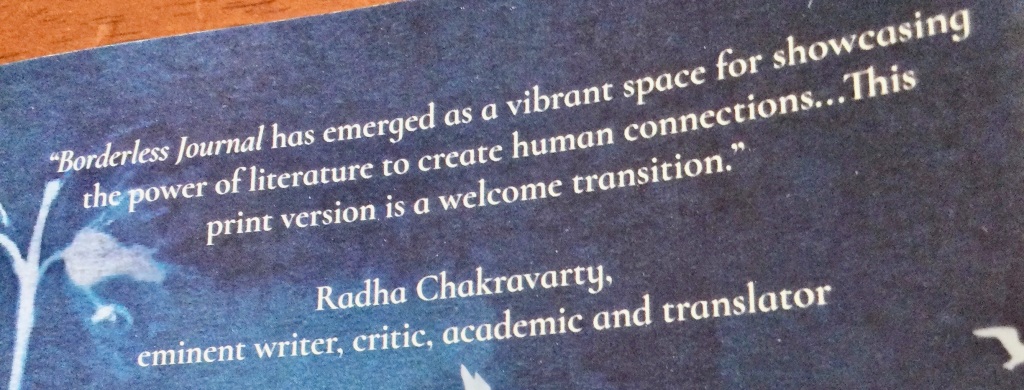
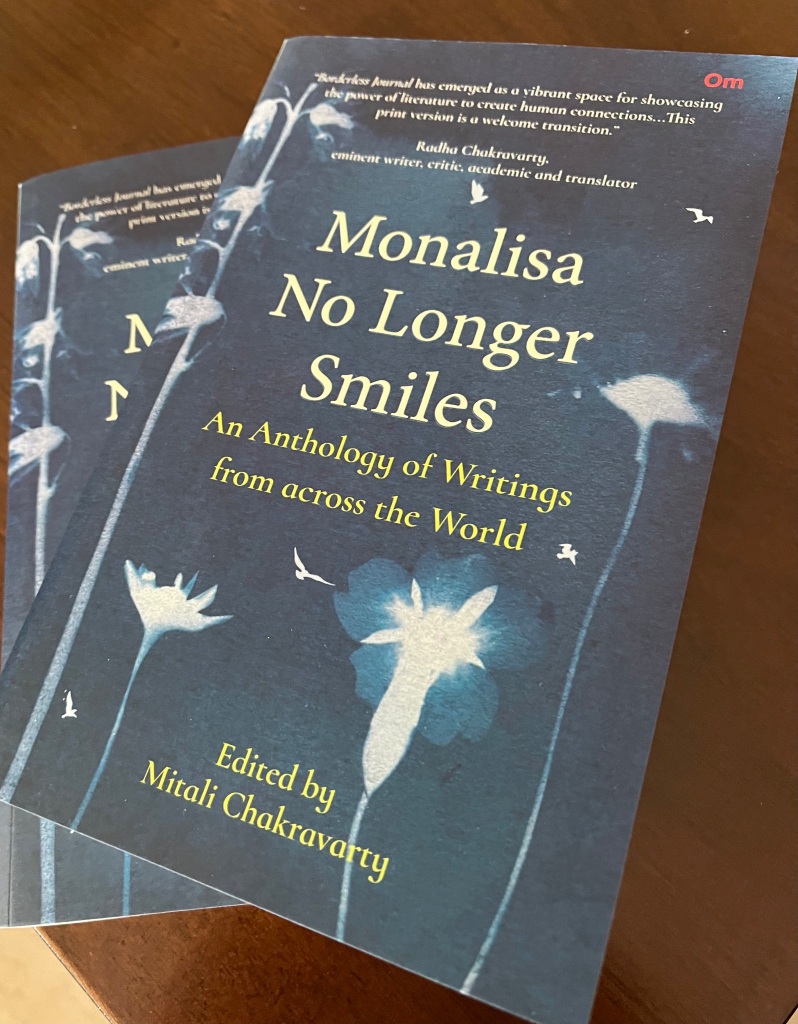
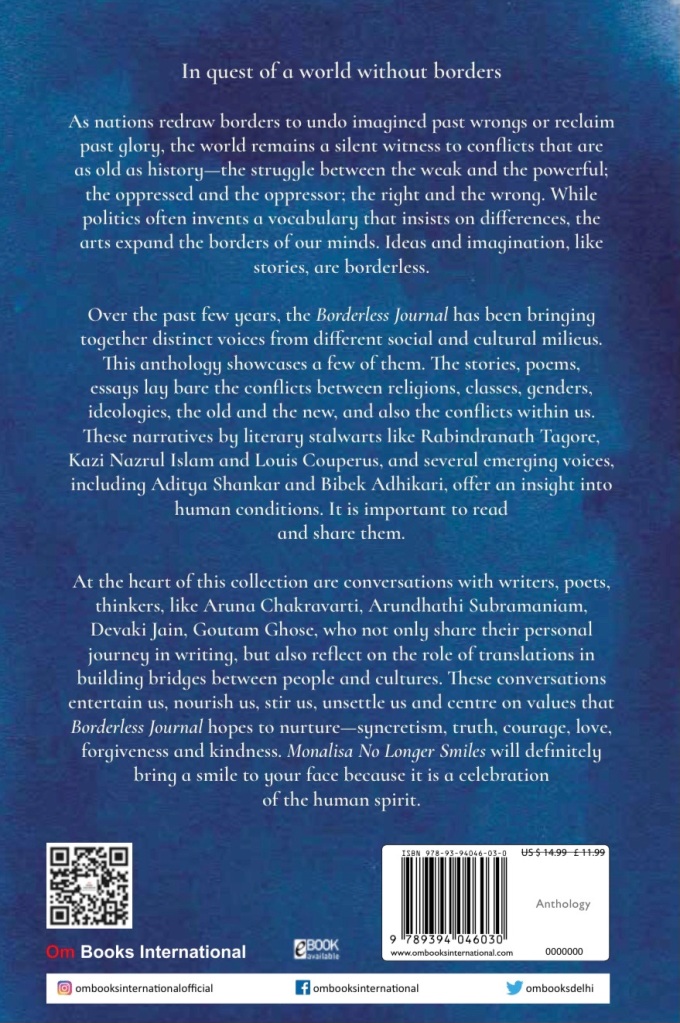
Click here to access the Borderless anthology, Monalisa No Longer Smiles

Click here to access Monalisa No Longer Smiles on Kindle Amazon International

Categories
The Observant Immigrant

Climate Change: Are You for Real? 

By Candice Louisa Daquin

In childhood I recall getting my coveted membership to Save Our Seas. I loved the sea and marine animals, and this seemed a meaningful way of helping from a child’s perspective. I recall reading Rachael Carsons famous books Silent Spring and The Sea Around Us at the same age and wondering how a book written in the sixties could be so prescient and why the subject was still under debate? If a ten-year-old can understand the message Carson had, of indiscriminate application of agricultural chemicals, pesticides, and other modern chemicals polluting waterways, damaging wildlife populations and causing health problems for humans, then why not adults?

It’s easy for a child’s mind to think those simple questions, not understanding the intricacies of what’s at play. Not least; politics, big business and money. These more than anything has dictated international policy, and it’s not science that sways policy, it’s influence. Vandana Shiva, an Indian environmentalist, is another such example of a prescient activist whose truth has been stifled in the march toward profit. Shiva, both physicist and social activist, founded the Research Foundation for Science, Technology, and Natural Resource Policy devoted to developing sustainable methods of agriculture. Shiva is contended; “Justice and sustainability both demand that we do not use more resources than we need. Uniformity is not nature’s way; diversity is nature’s way. We are either going to have a future where women lead the way to make peace with the Earth or we are not going to have a human future at all.”

Sadly, Shiva’s work is less known than companies like Monsanto  who are responsible for mass destruction due to putting profits before conscience in the selling of GMO[1] seeds that caused widespread bankruptcy, suicides and irreversible environmental damage. In 1995, the United States Environmental Protection Agency, EPA, listed Monsanto among the top 5 lethal corporations dumping toxic waste, as it was recorded dumping nearly 37 million tons of toxic waste, through air, water, and land. . It is unfathomable why such blatant atrocities should be permitted but our global history is littered with them.

Scientists have warned since the 1800s, where experiments suggesting that human-produced carbon dioxide (CO2) and other gases were able to collect in the atmosphere and insulate Earth (or its reverse) were met with more curiosity than concern. By the late 1950s, CO2 readings would offer some of the first data to corroborate the global warming theory. That it’s not if, but when, climate change will alter the way humans experience life on this planet, let alone wildlife and nature.

At one extreme we have the eco warrior who has valiantly tried to campaign and actively fight against human encroachment; in the middle, we have the skeptic who points to fluctuating weather patterns going back millennia and at the other extreme, there are the climate deniers who despite having children seem not to be concerned about the earth those children will inherit. There is proof that “Dating back to the ancient Greeks, many people had proposed that humans could change temperatures and influence rainfall by chopping down trees, plowing fields or irrigating a desert.”

If I sound biased it is because it’s a generally accepted fact that the earth isn’t just heating up, it is changing. The only issue under debate now is who or what is responsible, if anyone is, and how long do we have before things get really bad. Twenty years ago, people still mulled over whether climate change was happening, many believing it was just cyclical and sometimes it was, but there have been enough giant seismic changes in the last 40 years to put that doubt to rest. “Scientists have pieced together a record of the earth’s climate by analysing a number of indirect measures of climate, such as ice cores, tree rings, glacier lengths, pollen remains, and ocean sediments, and by studying changes in the earth’s orbit around the sun. This record shows that the climate varies naturally over a wide range of time scales, but this variability does not explain the observed warming since the 1950s. Rather, it is extremely likely (> 95%) that human activities have been the dominant cause of that warming.”  

Now if you turn on the TV, the nightly news is as much about weather as it is other things. Weather dominates our lives more than ever. Perhaps it’s ironic that ancient man would live or die by weather and we are now doing the same. The heyday of calm weather may have been slightly exaggerated but most people over 50 can attest that things weren’t quite as dramatic all the time, every year, as they appear to be now.

The harbinger of our behaviour in terms of polluting the environment has speeded up, something that may have been inevitable but could possibly have been avoided. The hardest part being that ‘developed’ countries such as America and Europe asked ‘developing’ countries to reduce their carbon and other emissions without really reflecting that they were as if not more guilty, relatively speaking, before they ‘saw the light’. To ask developing countries to leapfrog ahead in their development for the sake of the environment is coming from a position of privilege, having already polluted the world themselves first.

On the other hand, developing countries may struggle to reduce emissions because they are gaining traction in terms of improving quality of life for most of their population but are not there yet in terms of having the luxury to reduce emissions. It takes a lot of money, effort, commitment and determination to do this and for a country that is trying to improve its lot for its citizens this isn’t always their first priority, not to mention the patronising tone of developed countries demanding this be done. It is important to see this relationally which means understanding the difference in countries development and that some of those countries were abused and depleted of resources and kept ‘poor’ by conquering overlords who reaped the benefits and left them poor as a result. Those counties will struggle to climb out of the post-colonial model and that should be considered when judging them.

But we don’t have time. Despite know this beforehand, we did not do enough. In the late 1800’s, Swedish chemist Svante Arrhenius [1859-1927] wondered if decreasing levels of CO2 in the atmosphere might cool Earth. To explain earth’s ice ages, he considered if decreased volcanic activity could lower CO2 levels globally. Those calculations evidenced that if CO2 levels were halved, global temperatures may decrease by about 9 degrees Fahrenheit. From this, Arrhenius investigated if the reverse were also true; investigating what would occur if CO2 levels doubled. His results suggested global temperatures would increase by the same amount.  

By the 1980s global temperatures were going rapidly higher. So, climate-based experts use 1988 as a critical turning point when events placed global warming in the spotlight with extreme weather and increased public interest. Scientists, the UN and many others warned we were heading to a point of no return.

Turn on the news today and we seem to be there.

Even if we did everything right as a planet from now on, it would still be too late to repair the biggest climate change consequences. That doesn’t mean we shouldn’t try but it’s alarming to imagine we’ve let it become too late, though not surprising when you consider the apathy of world leaders to come together and make this happen.

UN Secretary-General António Guterres’ remarks to the General Assembly in March 2022 illustrates this: “Just last week, the Intergovernmental Panel on Climate Change issued an alarming report that showed climate impacts are already devastating every region of the world, but particularly developing countries and small island States.  The session considered the irreversible impacts of the climate crisis, which could render some parts of the earth uninhabitable.”  What does it mean for us? For the future generations if there are to be any? It means things we took for granted will change. Just as more animals are going extinct than ever before we also must look to history to give us an idea of what we might face in the near future.

Look how many times there have been huge seismic shifts in the earth? One example in particular is quite interesting. The Storegga Slide happened in approximately (600-BCE) and was the largest Paleo tsunami to hit Europe in the (Paleo) era. It altered the geography of Europe massively, causing England to break off from continental Europe from where Scotland was attached to Scandinavia. This was lost beneath the sea as a huge part of Scandinavia broke off and caused giant waves that poured over this fertile land and swallowed it whole.  

Climate deniers use these types of stories to explain away climate change as being a natural phenomenon but that’s inaccurate. Whilst significant and damaging things have occurred throughout history and will continue to, as scientists warned, it’s the number of disasters and changes occurring that count, not that they happen but that they happen with such regularity and severity. It’s been this hot before, but has it been this hot consistently and throughout the world for as long before? I was born in a year where there was freak heatwave but that’s just it, it was a freak heatwave.

Such things are natural in nature but not if its progressive or things keep happening one after the other. People assume if there is a cold winter then climate change can’t be real but that’s the funny thing, it’s the extremes of weather as much as heat, that are indicative of climate change. For every extraordinarily hot summer and burning Hawaii, there are extreme weather events in winter too as the planet falls out of a healthy cycle and is slowly losing its ability to nurture life like it used to.  

Does it mean we will become extinct? Or just that life will become harder and less places habitable? And hasn’t that happened before? Well, it has, in so much as once Africa was a grassland without drought and Europe was covered in ice. But when a planet first forms it’s likely to have extreme weather. As long as humans have been churning out chemicals that pollute the seas and mining the earth for its ore, we’ve accelerated and exacerbated those disasters. And just as it is believed a meteor killed off the dinosaurs and a virus might have killed off the Neanderthals it’s possible our actions will hasten our demise and at very least make life more unbearable.  

How? Along with viruses being more omnipresent than previously and antibiotic resistance, UV exposure and higher radiation have increased. The average human has more chemicals and formaldehyde and plastics in their body than at any other point in history. It affects our health, our reproduction and our longevity. Cancers hit the young more than ever before. We’re either over medicated or not able to afford medication. If global temperatures rose by 11 or 12 degrees, more than half the world’s population, as distributed today, would die of direct heat. The disparity between the ‘haves’ and the ‘have nots’ have exaggerated like in the feudal past. The idea we’re all middle class is a myth borne on ownership for technology rather than quality of life, which for many working two or three jobs to sustain their lifestyle, is hardly enviable.

The world is heading for a collision, and we are propagating this by a lifestyle we don’t seem capable of changing. If we label those who care about the environment as eco terrorists and pay football players millions whilst leaving nurses and teachers underfunded? Our priorities must be reflected in these things to have a trickledown effect in the future. If we can’t educate our children to understand that saving the planet isn’t just a day every year or a whim but must be a full-time effort, then what hope does the future possess?

ActNow is the United Nations campaign to inspire people to act for the Sustainable Development Goals and many other organisations like it fight against misinformation and seek to actuate these goals, but they’re often drowned out by lobbyists for special interests, such as the car industry, gas industry, fossil fuel industry, nuclear industry etc.

Just like in the fight against cancer, we need science to lead the way, that science which is not the influenced by special interest groups, like in the case of cancer, big-pharma and big-business. We need to take profit out of research and make it objective rather than tied to business, so it can be unimpeded to do what’s necessary. With cancer research, profit has stymied progress and stalled any meaningful change, instead people believe cancer is being cured by pharmaceutical promises, whilst more people than ever are getting cancer. Contrast this to climate change and if we don’t do the research into sustainable alternatives and ways to live into the future, there may be no future worth living for.

All hope is not completely lost of course. We always find ways, maybe one of them will be to go off world whilst another would be to live in Antarctica when it melts, provided the sea doesn’t swallow it. But what of the towns and cities by the coasts? What will that look like in 50 years? Maybe less. I think in my life time it is predicted that many of these places will be unliveable, beneath water, and whilst this has happened before it hasn’t happened to this degree. Yes, Venice has always been sinking and maybe NYC wasn’t built on the best land but everywhere else? And what will the displaced do? And how is space travel possible without a healthy earth?  

Those old enough can attest that the world seems to be burning and statistically with more people than ever on an already burgeoning planet in terms of resources. We seem to be wasting more food, yet more people are hungry in certain pockets of the world. We are growing hotter in some parts, colder in others, heatwaves represent an increasing threat to cities in both the Northern and Southern hemispheres. And it’s shifting agricultural production. Heatwaves are affecting colder countries too. A study states: “As illustrated by the example of Quebec, rising temperatures and heatwaves are an increasing hazard in countries of comparably cold climate as well as in warmer climates. According to a report published by UN Climate Change, higher temperatures due to climate change cause heatwaves which affect human health. For example, in Germany alone, the heatwave of 2003 resulted in nearly 7,000 deaths and many heat-related illnesses due to heat stroke, dehydration, and cardiovascular disease.”

Realistically many places in the planet are harder to live in, firstly because prices are pushed artificially high by unrelenting inflation but slower wage increases, people are often underemployed or expected to work longer hours for less pay if you consider the cost of living 50 years ago to now and relate that to increase in wages. On another level, people’s standards of living seem to improve in some areas, but again this is hard to gauge when you consider the divide between the very wealthy elite and the rest.

In America at least, displaced people’s flood through the borders and are hopefully given shelter and housing and opportunities but are they really better off than from the places they have fled? In some circumstances invariably, but for others, they may earn more but that money is swallowed by the higher cost of living; so, they’re not really better off. It’s an illusion to consider America as the land of the free or the American Dream, with so many living below the poverty line or just above it, which is negligible when you consider you may have slightly more money but you are thus not eligible for social assistance so you end up being as poor or poorer than those who do qualify for social assistance. This all relates to climate change because what incentive do people who are struggling to survive have, to help save the environment? Can you blame them? Shouldn’t we blame if we are to allocate blame, those who perpetuate poverty and turn a blind eye to its outcomes? Like former colonial countries who once having raped the land, decry its poverty, even as it’s the direct result of such pillage? Haiti being a great example of that.

Meanwhile the war machine grinds on and we pour money into that, to the detriment of climate change. Climate change is left for summits about but little changes. Countries make pledges but few are actuated and that’s without considering the lies that abound, or the cover ups of environmental disasters that are hushed up but have caused immeasurable harm. In 2017, the US Air Force used USD$4.9 billion worth of fuel; also, that year, the US military was responsible for 59 million tons of CO2 which is the same as total emissions of some industrialised countries like Switzerland or Sweden.

If we don’t even get the actual truth, how can we know the true extent of damage and our real part in it? Think of the nuclear disasters? That said, it’s understandable countries seeking to free themselves from fossil fuels would consider nuclear power, but how tenable is that when it depends upon people to function, what if those people were lost? Would the sites go critical and kill all survivors? Where do we safely store radioactive nuclear waste when it takes thousands of years to degrade even slightly? Just like those toxic super-dumping sites dotted throughout the planet, filling the seas with plastic and debris, we don’t think about the consequence of such dumping, only the immediacy of needing air conditioners.

Eventually fossil fuels will run out, but we haven’t found a tangible replacement. Electric car batteries don’t do well in heat, they also aren’t as durable in distance driving, cost a lot in using electricity which is still using resources, are prohibitively expensive and likewise with solar energy and wind energy. It seems there are downsides to all we’ve come up with so far, and whilst some progress is made with desalination of water to ensure clean drinking water and terraforming of previously uninhabitable land, is it enough to ward off the inevitable or does it mean those who already are rich, will be somewhat protected from the first consequences of planet earths deteriorating climate, whilst those without, will be the first to pay the price?

We’ve had so many canaries in the coal mine warnings from long before now, that none of this is news but people still en mass prefer not to think of it. When polled, voters in America usually do not put climate change in the top five concerns they have. The last few years this has changed, and that might signal a positive shift to taking climate change seriously, but it’s a bit late. Things can be done to shore up some of the fragile resources, but it will take a sustained commitment. How can that happen if majority of politicians’ are more focused on power and money than true change, renewable energy that works and a consensus that if we do nothing, we only have ourselves to blame? We have to change politics, policies and education if we hope to have a meaningful impact long term.

If we replace jobs with AI and technology as we are doing, how will people afford to improve their lives and make significant change? Everything is interconnected, it all matters, but we have to care, and being distracted by technology and super stars isn’t the answer. Why can’t an eco-warrior be a hero as much as a basketball player? We must keep trying. As Dr. Vandana Shiva is quoted as saying; “I do not allow myself to be overcome by hopelessness, no matter how tough the situation. I believe that if you just do your little bit without thinking of the bigness of what you stand against, if you turn to the enlargement of your own capacities, just that itself creates new potential.”

[1] Genetically Modified Organism

.

Candice Louisa Daquin is a Psychotherapist and Editor, having worked in Europe, Canada and the USA. Daquins own work is also published widely, she has written five books of poetry, the last published by Finishing Line Press called Pinch the Lock. Her website is www thefeatheredsleep.com

.

PLEASE NOTE: ARTICLES CAN ONLY BE REPRODUCED IN OTHER SITES WITH DUE ACKNOWLEDGEMENT TO BORDERLESS JOURNAL

Click here to access the Borderless anthology, Monalisa No Longer Smiles

Click here to access Monalisa No Longer Smiles on Kindle Amazon International

Categories
Editorial

Will Monalisa Smile Again?

The first month of 2023 has been one of the most exciting! Our first book, Monalisa No Longer Smiles: An Anthology of Writings from across the World, is now in multiple bookstores in India (including Midlands and Om Bookstores). It has also had multiple launches in Delhi and been part of a festival.

We, Meenakshi Malhotra and I, were privileged to be together at the physical book events. We met the editor in chief of Om Books International, Shantanu Ray Chaudhuri, the editor of our anthology, Jyotsna Mehta, along with two translators and writers I most admire, Aruna Chakravarti and Radha Chakravarty, who also graced a panel discussion on the anthology during our physical book launch. The earlier e-book launch had been in November 2022. My heartfelt thanks to the two eminent translators and Chaudhuri for being part of the discussions at both these launches. Chaudhuri was also in the panel along with Debraj Mookerjee at a launch organised by Malhotra and the English Literary Society steered by Nabaneeta Choudhury at Hans Raj College, Delhi University. An energising, interactive session with students and faculty where we discussed traditional and online publishing, we are immensely grateful to Malhotra for actively organising the event and to the Pandies’ founder, Sanjay Kumar, for joining us for the discussion. It was wonderful to interact with young minds. On the same day, an online discussion on the poetry in Monalisa No Longer Smiles was released by the Pragati Vichar Literary Festival (PVLF) in Delhi.

At the PVLF session, I met an interesting contemporary diplomat cum poet, Abhay K. He has translated Kalidasa’s Meghaduta and the Ritusamhara from Sanskrit and then written a long poem based on these, called Monsoon. We are hosting a conversation with him and are carrying book excerpts from Monsoon, a poem that is part of the curriculum in Harvard. The other book excerpt is from Sanjay Kumar’s Performing, Teaching and Writing Theatre: Exploring Play, a book that has just been published by the Cambridge University Press.

Perhaps because it is nearing the Republic Day of India, we seem to have a flurry of book reviews that reflect the Sub-continental struggle for Independence from the colonials. Somdatta Mandal has reviewed Priya Hajela’s Ladies Tailor: A novel, a book that takes us back to the trauma of the Partition that killed nearly 200,000 to 2 million people – the counts are uncertain. Bhaskar Parichha has discussed MA Sreenivasan’s Of the Raj, Maharajas and Me, a biography of a long serving official in the Raj era — two different perspectives of the same period. Rakhi Dalal has shared her views on Shrinivas Vaidya’s A Handful of Sesame, translated from Kannada by Maithreyi Karnoor, a book that dwells on an immigrant to the Southern part of India in the same time period. The legendary film writer K.A. Abbas’s Sone Chandi Ke Buth: Writings on Cinema, translated and edited by Syeda Hameed and Sukhpreet Kahlon, has been praised by Gracy Samjetsabam.

We have a piece on mental health in cinema by Chaudhuri, an excellent essay written after interviewing specialists in the field. Ratnottama Sengupta has given us a vibrant piece on Suhas Roy, an artist who overrides the bounds of East and West to create art that touches the heart. Candice Louisa Daquin has written on border controls and migrants in America. High profile immigrants have also been the subject of Farouk Gulsara’s ‘What do Freddy Mercury, Rishi Sunak & Mississipi Masala have in Common?’ Sengupta also writes of her immigrant family, including her father, eminent writer, Nabendu Ghosh, who moved from Bengal during the Partition. There are a number of travel pieces across the world by Ravi Shankar, Meredith Stephens and Mike Smith — each written in distinctively different styles and exploring different areas on our beautiful Earth. Sarpreet Kaur has revisited the devastation of the 2004 tsunami and wonders if it is a backlash from nature. Could it be really that?

Suzanne Kamata gives us a glimpse of the education system in Japan in her column with a humorous overtone. Devraj Singh Kalsi dwells on the need for nostalgia with a tongue-in-cheek approach. Rhys Hughes makes us rollick with laughter when he talks of his trip to Kerala and yet there is no derision, perhaps, even a sense of admiration in the tone. Hughes poetry also revels in humour. We have wonderful poetry from Jared Carter, Ranu Uniyal, Asad Latif, Anaya Sarkar, Michael R Burch, Scott Thomas Outlar, Priyanka Panwar, George Freek and many more.

The flavours of cultures is enhanced by the translation of Nazrul’s inspirational poetry by Professor Fakrul Alam, Korean poetry written and translated by Ihlwha Choi and a transcreation of Tagore’s poem Banshi (or flute) which explores the theme of inspiration and the muse. We have a story by S Ramakrishnan translated from Tamil by R Sathish. The short stories featured at the start of this year startle with their content. Salini Vineeth writes a story set in the future and Paul Mirabile tells the gripping poignant tale of a strange child.

With these and more, we welcome you to savour the January 2023 edition of Borderless, which has been delayed a bit as we were busy with the book events for our first anthology. I am truly grateful to all those who arranged the discussions and hosted us, especially Ruchika Khanna, Om Books International, the English Literary Society of Hans Raj College and to the attendees of the event. My heartfelt thanks to the indefatigable team and our wonderful writers, artists and readers, without who this journey would have remained incomplete. Special thanks to Sohana Manzoor for her artwork. Many thanks to the readers of Borderless Journal and Monalisa No Longer Smiles. I hope you will find the book to your liking. We have made a special page for all comments and reviews.

I wish you a wonderful 2023. Let us make a New Year’s wish —

May all wars and conflicts end so that our iconic Monalisa can start smiling again!

Mitali Chakravarty,

borderlessjournal.com

.

Photographs of events around Monalisa No Longer Smiles: An Anthology of Writings from across the World. Click here to access the Book.

.

Insta Link to an excerpt of the launch at Om Bookstore. Click here to view.

E-Launch of the first anthology of Borderless Journal, November 14th 2022. Click here to view.

Categories
The Observant Immigrant

The Immigrant’s Dilemma

By Candice L. Daquin

Courtesy: Creative Commons

I have been an immigrant to a new country three times: from France to England, England to Canada and then, Canada to America. Being an immigrant is often a highly positive experience. We may have greater opportunities, we seek our dreams, we grow them. On the other hand, immigration for those of us who have gone through the process, is not easy. It is expensive, time-consuming, nail-biting and often lonely. It is said that those who immigrate ‘successfully’ do so because of familial support and/or because their children reap the benefits of their sacrifice.

Whilst there are too many stories to condense any one feature of immigration, we can only talk of our own experiences and somehow in understanding that, perhaps stay open enough to understand others. We can come together through that collective understanding.

As a psychotherapist, I work with many immigrants. I see clients daily who were born elsewhere and sometimes struggle to acculturate in their new-found country. Where I live, near the border between Mexico and America, we have a multitude of immigrants from Mexico, central and south America as well as from around the world, coming through the borders, seeing asylum and a better life.

Consequently, there can be a high degree of racism in rebuke for the startling numbers of immigrants passing through our city. I can drive down a road and see people lined on the street much as you would see in other countries, begging and homeless. Our resources are stretched and one option chosen by the Governor of Texas was to bus immigrants and asylum seekers to other states in the US. Initially this was considered a racist, insensitive act that treated people like cattle. When you look at it closer, you can see it was perhaps these things but also a desperate plea for other states to understand the overwhelming nature of immigration for border states and share in the expense.

It is easy for a non-border state to believe the border should be effectively kept open and all immigrants allowed in. but when it’s on your door step it can be challenging. Most people in Texas care about immigrants but also experience some of the downsides of too many immigrants at once. In El Paso, people froze to death sleeping on the streets, houses were broken into, the situation was dire and extreme and locals didn’t have enough resources to manage. Shipping immigrants who wish to go to other states, to those states, might appear cruel, but also makes sense, if it’s consensual. Whilst many of the Texan Governors decisions have been quite possibly racist and prejudicial, this choice was in part to show other states how dire the situation is.

Why are there so many asylum seekers right now? As President Biden announced the lifting of closed borders to asylum seekers, the numbers attempting to come into America increased exponentially. Under the Trump administration, the Department of Homeland Security (DHS) called the “Remain in Mexico” policy (officially, the Migrant Protection Protocols) caused immigration to be somewhat halted. The original reason countries like America accepted asylum seekers goes back to WW II where the Jews who survived ethnic cleansing had nowhere to live and were essentially stateless. The right to seek asylum was incorporated into international law following the atrocities of World War II. Congress adopted key provisions of the Geneva Refugee Convention (including the international definition of a refugee) into U.S. immigration law when it passed the Refugee Act of 1980.

The laws that exist now were enacted to protect them and ensure stateless people were never again turned away in droves. The creation of Israel was in part the consequence of WW2 and the abuse against the Jews. It could be argued any issues with Israel are directly linked to the ethnic cleansing the Jews experienced and their subsequent statelessness. Laws endeavoring to protect future people from such experiences are what we now use in our handling of asylum seekers. “When Congress finally eliminated the racial provisions in U.S. immigration and nationality law in the 1940s and 1950s, generations of federal practice and procedure did not instantly disappear without a trace. Over the years, other government agencies had developed their own racial classification systems, often partially borrowed from INS experience, and such systems could take on lives of their own.”

The downside to this is, the world has dramatically changed since the 1940s (2,307M versus over 7 million today). the population is growing at a heady rate and thus, even if a small percent of people seek asylum from any one country, it is huge in comparison to previous numbers. Department of Homeland Security  statistics show that from Biden’s Inauguration Day through May 2022—just 16 months and change—about 1.05 million migrants were apprehended on the southwestern border and then released into the US. With every year, the worlds population swells and with it, a strain on resources. ‘Affluent’ countries such as America, may literally speaking have the resources to help asylum seekers but the reality for many asylum seekers is quite different once they are in-country. According to Census Bureau statistics, immigrants’ share of the U.S. population rose more from 1990 to 2010 than during any other 20-year period since these figures were first recorded in 1850—from 7.9 percent to 12.9 percent

What constituted poverty in their country of origin may be considerably lower than what money they can earn in America, if indeed such earnings can be made at all. The social welfare system protects asylum seekers by giving them somewhere to live and a stipend until they are able to find work but what of those who do not possess the necessary skills? Not to mention the dearth of certain jobs. Immigrants wishing to live in the cities, may find work is only available in the agricultural parts of America and not earn enough to live on without language and education in a city. Likewise, they must contend with crime, safety issues and making the meager money they receive, stretch to pay for themselves and their families. What might seem initially like a lot of money, in comparison to their home-countries, is quickly devoured by the more expensive living expenses of America.

Immigrants who move to America or other developed countries, on a visa rather than asylum, may fare better. But note how many PhD’s are driving cabs or serving in restaurants. Underemployment is a phenomenon whereby those who are educated, are working at a lower level than that education would typically warrant. For their children there may be greater opportunities but for many first-generation immigrants, the adjustment and opportunities are restricted. Doctors in their own countries, they find American prohibitions on accepting foreign transcripts and learning, despite the low quality of American education in comparison to many other countries. It’s almost if you were being subjective about it, like having to pay the price for immigration.

When I immigrated to Canada, I found many who possessed PhDs and advanced education were unable to find work. There was some push back from locals who resented skilled workers and felt all immigrants should ‘know their place’ and take the dregs work. This is something you really don’t believe will happen to you when you are very educated, and get a skilled worker visa, but it’s a reality, perhaps less spoken about because it makes the host country look unkind. But go beyond the shiny posters about immigration and speak to the people and you will find it’s not uncommon.

Immigration is necessary for many reasons, not least the Western world ageing and requiring new blood because of declining birth rates. But the Western world wants immigrants to do the work they don’t want to do just as much as they may appear to want immigrants to ‘succeed’ and for every Doctor and PhD who was an immigrant, there are plenty who find themselves no better off through immigration. That’s a sacrifice worth making when you have no other choices or you hope your children will inherit the American Dream but if you have no children and you’re sold a false dream, then it can be disheartening if not crushing. There are 11 million recent immigrants in transition, best estimates predict, who labour in American fields, construction and kitchens, as well as American classrooms, detention centers and immigration courts.

What we hear less about, is how many immigrants leave. And how many suffer silently, having fallen between the gaps, into anything but the American Dream. What can be done about this? Should we impose immigration restrictions not out of cruelty but an understanding that a host country is ill equipped to deal with mass influxes and that the original reasons for the laws have evolved/changed as our population has grown? Should we insist other states take some responsibility for asylum seekers? As well as demand other countries pitch in more? And understand that what may look racist, is in fact a more realistic approach than flinging open the border and allowing everyone to come in at once?

It is an interesting dilemma and one that won’t be decided any time soon. The racists and extreme economic conservatives will battle against the diametric opposite liberals who believe all should inherit the opportunity a country like America holds. Both sides are too extreme in that they don’t consider the reality. The reality is racism should not and cannot endure in a country like America where soon ‘brown skin’ will be the majority and old racist ways are being challenged. But equally, being so ‘woke’ that you don’t see the fall out of idealistic policies, isn’t the answer either. In tandem with an identity politics that emphasises the subnational, a too progressive project may place global concerns above national interests. Hence, the oft repeated slogan “global problems require global solutions.”

Speak to the people. Many times, people criticise me for living in Texas. They assume I’m one of the ‘bad guys’ without understanding Texas is made up of a huge diverse population. Within that diversity are many Latinos who don’t want mass unchecked immigration any more than the racists, but for radically different reasons. Things aren’t as simple as they seem in a Twitter comment. There are many complex considerations that must be taken into account to ensure the best outcome not only for asylum seekers but those who already live in-country. There are answers, but they won’t come from knee jerk reactions or entrenched thinking on either side.

What we do know today, is people are literally dying to come into America and with them, perhaps some unchecked terrorists sneak in, just as they did before 9/11. In order to protect everyone and ensure things are done legally and safely, immigration must have some controls and should be funded accordingly, without any one state taking the majority of the strain. Many Texans are quite the reverse from what you’d imagine, if you subscribe to stereotypes. Maybe the problem is we should really get rid of stereotypes and try knowing who people really are before we judge en mass. Houston has one of the highest Indian communities in the world. All cities within Texas have absorbed huge numbers of immigrants from around the world. Let’s think less of ‘them and us’ and more about truly doing what will be best for those seeking to come into a country and begin a new life. Immigration is a conundrum, but if we work together, instead of apart, we can find answers.

.

Candice Louisa Daquin is a Psychotherapist and Editor, having worked in Europe, Canada and the USA. Daquins own work is also published widely, she has written five books of poetry, the last published by Finishing Line Press called Pinch the Lock. Her website is www thefeatheredsleep.com

.

PLEASE NOTE: ARTICLES CAN ONLY BE REPRODUCED IN OTHER SITES WITH DUE ACKNOWLEDGEMENT TO BORDERLESS JOURNAL.

Click here to access the Borderless anthology, Monalisa No Longer Smiles

Categories
Editorial

We Did It!

That good things happen despite darkness, despite prognostications of doom, that light glimmers hope if you strive to focus on your strength in hard times is borne true both in fiction and in life. Perhaps, we cannot get back the old ways (but is that what we want?) but new paths emerge. Old gives way to new. And while trying to gather pearls of human excellence — borne not of awards or degrees but of bringing out the best, the kindest, the most loving in human hearts — we managed to create with a team an outstanding anthology. Woven with the writings of old and new — we created a tapestry together that the editor in chief of our publishing house said was “classy, literary, engaging and international”. That one of the oldest and most reputed publishing houses in India with bookshops countrywide took it on was also an unusual event! We are truly grateful to Om Books International, Shantanu Ray Chaudhuri and Jyotsna Mehta along with all our writers and readers who made our anthology a reality, and to Radha Chakravarty and Fakrul Alam for the kind words they bestowed on our effort.

Click here to access the Borderless anthology, Monalisa No Longer Smiles

Please greet our first anthology, Monalisa No Longer Smiles, with love and friendship. It could be the perfect Christmas gift in the spirit of the season! And as the blurb says, “it will definitely bring a smile to your face because it is a celebration of the human spirit.”

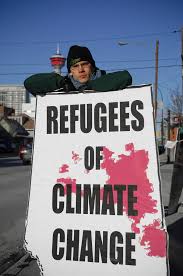
The anthology is different from our journal in as much as it has a sample of an eclectic collection that has been honed with further editing and has some new features. Most of the writing is from our first year and showcases our ethos, except for Lesya’s poetry and interview. Lesya Bakun from Ukraine is still on the run, looking for a refuge — she cannot return home like you or I can. Her family is scattered across number of countries. Her cousin, who was guarding the factory at Azovstal, was taken prisoner. We included her story in the anthology hoping to create global empathy for refugees as the numbers will increase not only due to war but also due to climate change.

The reason we felt a hardcopy anthology was a good idea was because nothing beats the joy of having a bunch of interesting reads in the warmth of your hands (especially where internet cannot reach or is unavailable). In any case, books with the feel of paper, the rustling whispers which carry voices of leaves can never be replaced as Goutam Ghose had also said in his interview which is now part of our anthology.

And that is why we celebrate more books… this time we feature Singaporean prima donna of literature, Suchen Christine Lim, with her new book Dearest Intimate, a novel that spans more than hundred years including the harrowing Japanese invasion during World War II. She shared sound advice with writers: “Suffering is good for the writer. It will deepen lived experience and expand the heart’s empathy.” And perhaps that is what is echoed through the experiences of the other writer interviewed on our pages by Keith Lyons. This is a writer who not only brought out his own books but was a regular contributor of travel pieces for Frommer’s and National Geographic traveling to unexplored destinations — Christopher Winnan. Another writer Lyon had interviewed recently, Steve Carr, has passed on. We would like to convey our heartfelt condolences to his family and friends.

We have a number of books that have been reviewed. Reba Som reviewed Aruna Chakravarti’s Through the Looking Glass: Stories that span eras spread across time. Somdatta Mandal has reviewed Shehan Karunatilaka’s The Birth Lottery and Other Surprises and Bhaskar Parichha, Rahul Ramagundam’s The Life and Times of George Fernandes. Basudhara Roy has written of Afsar Mohammad’s Evening with a Sufi: Selected Poems, translated from Telugu by the poet and Shamala Gallagher, verses that again transcend borders and divides. We have an excerpt from the same book and another from Manoranjan Byapari’s How I Became a Writer: An Autobiography of a Dalit, translated from Bengali by Anurima Chanda.

More translations from Bengali, Balochi and Korean enrich our November edition. Fazal Baloch has translated a story by Haneef Shareef and Rituparna Mukherjee by Shankhadeep Bhattacharya. We have the translation of an inspirational Tagore poem helping us find courage (Shonkho Dhulaye Pore or ‘the conch lies in the dust’). Another such poem by Nazrul has been rendered in English from Bengali by Professor Fakrul Alam. He has also shared an autobiographical musing on how he started translating Tagore’s Gitabitan, which also happens to be his favourite book. More discussion on the literary persona of TS Eliot and the relevance of his hundred year old poem — ‘The Waste Land’ by Dan Meloche adds variety to our essay section.

Evoking the genius of another outstanding artiste, Kishore Kumar, who happened to pen thought provoking dialogues in some films, is Shantanu Ray Chaudhuri’s essay, review of a recent book on the legendary actor-singer and an interview with the authors. Infringing the boundaries of literary with popular culture and art and integrating all forms into a wholistic bundle has been part of our ethos. In that spirit we have a musing by Prithvijeet Sinha on Edvard Munch’s famous painting called Scream. We have non-fiction from Australia spanning Meredith Stephens’s recent brush with Covid, Mike Smith visits a Scottish beach in the footsteps of a novelist, Ravi Shankar has given us a poignant piece for a late friend and Candice Lousia Daquin talks of the existence of bi-racial biases. In contrast, Suzanne Kamata sent a narrative that bridges divides showcasing a German wife of a Japanese scientist that draws us to conclude that biases erode over time to create an acceptance of bi-racial people. Devraj Singh Kalsi brings in humour with his funny narrative about a guitarist. Rhys Hughes writes in a lighter vein on Indian cuisine in his column and spouts more funny poetry bordering on the absurd.

Jared Carter has shared beautiful poetry on murmuration in birds and we have touching verses from Asad Latif for a little girl he met on a train — reminiscent of Tagore’s poem Hide and Seek (Lukochuri). Michael R Burch has given us poems setting sombre but beautiful notes for the season. We host more poetry by Luis Cuauhtémoc Berriozábal, Quratulain Qureshi, Jim Bellamy, Gayatri Majumdar, Ryan Quinn Flanagan, Alpana, Jonathan Chan, Saranyan BV, George Freek and many more. We have stories from around the world: India, France and Bangladesh.

Gathering all of your thoughts in strings of words from all corners of the world, we present to you the bumper November issue of Borderless Journal . Thank you all for sharing your thoughts with us. Thanks to Sohana Manzoor for her fantastic painting and more thanks to the whole Borderless team for seeing this issue through. We would not have been able to do the anthology or these issues without each one of you — writers and readers.

Thank you all from the bottom of my heart.

There is always hope for a new tomorrow!

Mitali Chakravarty

borderlessjournal.com

Click here to access the Borderless anthology, Monalisa No Longer Smiles

Categories
The Observant Immigrant

Piano Board Keys

By Candice Louisa Daquin

In 1967 the US Supreme Court decision Loving v. Virginia, ruled that blacks and whites had a legal right to intermarry. Between 2000 and 2010, the number of white and black biracial Americans doubled, while the population of adults with a white and Asian background increased by 87%. (Pew Research) “horizontal hostility” describes black mixed-race experiences of societal black rejection, and how this perception of ‘(in)authenticity’ impacts self-perception and the expression of ethnic identity.

Recently something that happened to me personally that segued into a greater story of biracial identification in America. I have lived in four countries in my life so far and nowhere has racial identity been as contentious as in the USA. When The Queen died, like many others, I did a post saying ‘Rest in Peace’. I am by no means, a Monarchist but serving for 70 years felt like an impressive feat. I was immediately jumped on by a few who felt I was a pro-colonialism and “white privilege oppressor”.

As a psychotherapist, I often bite my tongue and do not express myself when others are insulting or being triggered. I have grown to respect the value of doing this, because too often it inflames things when we say anything to clarify or defend contentious subjects. However as this was posted publicly, I had to clarify. My point is not about what happened to me, but about the assumption that individual made in calling me a “white privileged oppressor.” Likewise, assuming I am white.

If people of colour decide the degree of melanin in another’s skin represents their race and culture, this will only end up emulating what was done to people of colour by white-skinned racists. Two wrongs do not make a right. It is something that comes up a lot as we discuss what it means to be a person of colour. African-American presidential candidate Ben Carson accused President Obama of not being able to understand “the experience of black Americans” because he was “raised white”. It is more common for those mixed-race than a singular race to fail to ‘please’ either side.

Just ask celebrities like singers Mariah Carey or Shakira who have struggled with this their entire lives. Or singer Lenny Kravitz (Black, Jewish, and Native American) who is quoted as saying when he had to fill out the ‘race’ sections on school forms, “My great-grandmother’s Cherokee Indian. My father’s a Russian Jew. My mom’s Bahamian. [I thought], ‘what the hell do I put on this thing?’ The teachers came over and [said], “Black. That’s what you are.” And so, so many parts of your heritage are just squashed. ‘That’s it.” (Huffington Post, 2013). Obviously if you can ‘pass’ then you have that attending privilege. Where I live about 70 percent are Hispanic and only recently there is talk of ‘white’ Hispanics versus ‘brown’ Hispanics, which goes back to the caste system in countries like Mexico, where historically the darker you were, you’d be considered serving class because you were more ‘Indio’ and if you were lighter, you were considered more Spanish. Ultimately these sub-categories seek to further divide people rather than describe them.  

Fortunately, this racist tide is beginning to turn as people understand skin colour should never confer privilege even if historically it was warped to do so. Perhaps like any culture, there is a desire to stand out from the average, so anyone different may be admired more, if you are lighter than average, you may be admired more (or less), and vice versa. Ironically in countries like England, Canada, France, Germany etc., if you are darker skinned, you are considered more attractive and admired for being darker skinned, in countries where everyone is trying to tan and become darker. So, we have two polar opposites, parts of Asia where women may even bleach themselves to be lighter, and parts of Europe (and America) where people may literally die to tan.

In this day and age, so many of us are ‘mutts’ meaning we are so mixed; we carry Black, Asian, European, everything. But we’re still striated into colors because of racism and casteism. They are not the only reasons, it’s also about how we identify and how others identify us.

“Individuals who do not fit monoracial categories may be oppressed on systemic and inter-personal levels because of underlying assumptions and beliefs in singular, discrete racial categories” (Johnston, Marc P, and Kevin L Nadal. 2010. “Multiracial Microaggressions: Exposing Mono-racism in Everyday Life and Clinical Practice.”). I was assumed to be Anglo because I look it, so as far as others were concerned, I cannot understand the experience of being of colour because I don’t have any colour. Even if I were married to a person of colour with children of colour and my parents were of colour, it would be about my individual experience. But the flaw lies in assuming we can have an individual experience. We can’t. We are moulded by our family and our ancestors and whilst some of us may not know where we come from, DNA testing makes it more possible. This should alleviate some of the worst racism, but it hasn’t. Both sides seem further apart than ever before.

Author and activist James Baldwin defined his stance thus: “he was a Negro by choice and by depth of involvement–by experience, in fact.” Meaning, even if someone did not ‘look’ black if they were, and identified as such, they were. The one-drop rule is a long held legal principle of ‘racial classification,’ prominent in the 20th century United States. It asserts any person with even one ancestor of black ancestry (“one drop” of “black blood”) is considered black. Before the American Civil War, free individuals of mixed race (free people of color) were considered legally white if they had less than either one-eighth or one quarter African ancestry (depending on the state). Equally during slavery in America being born to an enslaved mother, made them automatically enslaved from birth. Racial integrity laws have existed throughout time with different groups and are essentially used to oppress a particular group. In theory they could be easier to enact now, given DNA testing.

Ironically, I have more blood of ‘colour’ than many, who if we were in a photograph together, would be assumed to be of colour, whist I would not. Which is understandable, but what is not understandable is when people deny mixed-race individuals their identity in seeking to label them or condemn them for being able to ‘pass’ ethnic groups and racially distinctive groups vary but can also be the same. Respecting someone’s ethnicity and race are necessary in order to avoid becoming as bigoted and discriminatory as the past.

When George Zimmerman fatally shot Treyvon Martin, he was called a ‘White Hispanic’ for three reasons. One he was light skinned. Two his last name was a non-Hispanic name. three, he shot a black child. It was an example of the media manipulating the truth in order to make Zimmerman more of a racist seeming person. Perhaps Zimmerman is just a bad racist, or maybe he would have shot a kid no matter their skin colour, we may never know. We know Martin called Zimmerman racist things like ‘Cracker’, but since society says a person of color cannot be racist then that was not considered. Whist most of us hopefully want violence against young black men to end, we shouldn’t deny that much violence toward young black men is perpetuated by young black men. Lack of opportunities seem to kill young black men as much as racism but maybe the two are the same thing, coming from difference directions.  

What we can say is our society hasn’t given young black men chances and that can lead to increased temptation toward crime or violence. Surely if a young black man is shot for simply walking down a street, nobody should justify it. Just as with Brianna Taylor and so many innocents, killed for the colour of their skin. However, we should be able to make this argument without turning the perpetrator into a white man when he was not. It is a classic example of manipulating the truth in order to make it more about racism than it may have been. Or it was purely about racism, but if two people of colour cannot be racist then how can it be? There are so many issues here what we do know is two wrongs don’t make a right.

Pew Research has found most Americans who are mixed race, identify with one race (61 percent) because they ‘look’ like that race. Which points to how we look as continuing to be the determinant for racial identity even if it’s inaccurate and often leaves people feeling they have lost half of their identity The survey also found that the way people may describe their personal racial background does not always match the way they think others see them. “Six-in-ten Americans with a white and black background (61%) believe they are seen as black; only 19% say they would be seen as multiracial (an additional 7% say they would be perceived as white only). The shift is happening, case in point, Rachel Dolezal, who was the head of the local chapter of the NAACP and identified herself as African-American. But her Montana birth certificate said she was born to two Anglo people. Dolezal earned a master’s degree from the historically black Howard University in Washington, D.C., and was a professor of Africana Studies at Eastern Washington University. Her contemporaries assumed she was African American. It shows that whilst for many years, people with black heritage may have sought to deny it, now some Anglos seek to be black.

One of my best friends had a red-haired white mother and a Jamaican father. She was 70 percent ‘Anglo’ because her Jamaican father was not entirely black but mixed race himself. But she ‘looked’ black and identified as black whist her brother looked white and identified as white. Which are they? Is identity sufficient to say? Or how others perceive us? I can say I’m mixed race but if I tell people I’m a black woman or a Latin woman I might be laughed at because I don’t look like I am. Would it even be right to say so? What is right? It depends upon whom you’re speaking to. These are reductive discussions of identity that parody race and don’t allow individuals to say who they are.

My siblings could look black whilst I could look white, it can leave people feeling like they have racial imposter syndrome where a person feels they are appropriating a culture that actually not their own! If we feel liminal like we drift between cultures but belong to none, isn’t that often because of the stereotyping that goes on even within cultures as much as without cultures?

I’m Jewish but I do not believe in God, nor do I go to Temple, so when I have tried to join Jewish writing groups, I have been shunned as not being Jewish enough. When I worked for a Jewish organisation, I was considered Jewish, but I was the ‘wrong’ kind of Jew because I was Mizrahi and Sephardi rather than Ashkenazi. In other settings, I wasn’t brown enough to be considered a Mizrahi or Sephardi jew. The absurdity of all the micro aggressive ways a person can be catalogued or disqualified wasn’t lost on me. It is worse for some who are more obviously mixed race but don’t possess whatever that group demands for admission but are also racially attacked by other groups. For example, what does ‘you act white’ really mean? That you are not speaking with the right accent, or that you should know another language or wear different clothes or? My other friend is constantly told she is not Latina enough because she has no accent, and her Spanish is perfect rather than Tex-Mex and she likes to eat Indian food. Does one group have more of a ‘claim’ to being of colour?

References:

https://www.pbs.org/wgbh/pages/frontline/shows/jefferson/mixed/onedrop.html

https://www.npr.org/sections/codeswitch/2017/06/08/462395722/racial-impostor-syndrome-here-are-your-stories

https://www.npr.org/2010/12/20/132209189/how-multi-ethnic-people-identify-themselves

https://theconversation.com/who-counts-as-black-71443

https://www.cnn.com/2016/10/10/health/biracial-black-identity https://www.tandfonline.com/doi/full/10.1080/01419870.2019.1642503

.

Candice Louisa Daquin is a Psychotherapist and Editor, having worked in Europe, Canada and the USA. Daquins own work is also published widely, she has written five books of poetry, the last published by Finishing Line Press called Pinch the Lock. Her website is www thefeatheredsleep.com

.

PLEASE NOTE: ARTICLES CAN ONLY BE REPRODUCED IN OTHER SITES WITH DUE ACKNOWLEDGEMENT TO BORDERLESS JOURNAL.
Categories
Halloween Greetings

Ghosts, Spooks & Spirits of the Night Arise…

Halloween returns, bringing back memories of trick or treating with children collecting candies, celebrating — celebrating perhaps to get over the fear of darkness, the unknown or perhaps, even the experience of global disasters ? The Bengali equivalent of Halloween — Bhoot Chaturdashi — was celebrated a day before Diwali. And as people do up ‘haunted homes and dress as witches, zombies and ghosts, I wonder, why do we celebrate such dark festivals and also enjoy them?

Perhaps, the answer is given in an essay by Candice Louisa Daquin that we have a gene that helps us enjoy such occasions… And then there is always the necessary adjunct of ghost stories and spooky rhymes that makes us feel ooky as our hearts beat and nervous snots of laughter explode from chests beating in anticipation…Wafting on borderless clouds that float mysteriously on Halloween nights, we invite you to visit a few spooks, ghosts, goblins, witches and spirits…

Poetry

It’s Halloween by Michael R Burch… Click here to read.

Horrific Humour by Rhys Hughes… Click here to read.

Prose

My Christmas Eve “Alone” : Erwin Coombs has a ghostly encounter at night. Is it real? Click here to read. 

Flowers on the Doorstep :Shivani Shrivastav writes of an encounter with a mysterious creature in Almora. Click here to read. 

A Curse: San Lin Tun gives us a macabre adventure with malicious spirits lurking in a jungle in Myanmar. Click here to read.

Pothos: Rakhi Pande gives us a macabre story set in Singapore that borders on the supernatural? Click here to read.

I Grew into a Flute: A Balochi Folktale involving the supernatural retold by Fazal Baloch. Click here to read.

Categories
Contents

Borderless, October 2022

Art by Sohana Manzoor

Editorial

The Sky … Click here to read.

Conversations

Anthony Sattin, an award winning journalist and travel writer in conversation about Nomads: The Wanderers Who Shaped our World, his recent book published by Hachette, India. Click here to read.

VR Devika talks of the dynamic Muthulakshmi Reddy, the first woman in the world to preside over a Legislative Assembly who sought justice for Devadsis and prostitutes and discusses her book, Muthulakshmi Reddy: A Trailblazer in Surgery and Women’s Rights published by Niyogi Books. Click here to read.

Translations

Daridro or Poverty by Nazrul has been translated from Bengali by Professor Fakrul Alam. Click here to read.

The Browless Dolls by S.Ramakrishnan, has been translated from Tamil by B Chandramouli. Click here to read.

Two poems from Italy by Rosy Gallace have been translated from Italian by Irma Kurti. Click here to read.

Flowers of Love Bloom Everywhere, a poem for peace, written by and translated from Korean by Ihlwha Choi. Click here to read.

Aalo Amar Aalo (Light, My Light) a song by Tagore, has been translated by Mitali Chakravarty from Bengali. Click here to read.

Pandies Corner

Songs of Freedom: Moh-Reen is an autobiographical story by Amreen, translated from Hindustani by Janees. These stories highlight the ongoing struggle against debilitating rigid boundaries drawn by societal norms, with the support from organisations like Shaktishalini and Pandies. Click here to read.

Poetry

Click on the names to read

Michael R Burch, Kirpal Singh, Ryan Quinn Flanagan, Jonathan Chan, Ron Pickett, Saranyan BV, George Freek, Pramod Rastogi, Mike Smith, Gayatri Majumdar, John Grey, Vandana Kumar, Ahmad Al-Khatat, Rhys Hughes

Poets, Poetry & Rhys Hughes

In Crossing the Date Line, Rhys talks of his fascination with this imagined construct. Click here to read.

Essays

Epaar Bangla, Opaar Bangla:  Bengals of the Mind

Asad Latif explores if homeland is defined by birth. Click here to read.

The Wabi-Sabi of Making a Living

Aditi Yadav calls for taking a break from hectic work schedules. Click here to read.

Just a Face on Currency Notes?

Debraj Mookerjee writes of Gandhi’s relevance and evolution. Click here to read.

A Mother, a Daughter & a Demon Slayer?

Meenakshi Malhotra checks out the festival of Durga Puja, declared the a heritage festival by UNESCO. Click here to read.

The Observant Immigrant

Candice Lousia Daquin explores festivals and the God gene in We had Joy, We Had Fun…. Click here to read.

Musings/Slices from Life

KL Twin Towers near Kolkata?

Devraj Singh Kalsi visits the colours of a marquee hosting the Durga Puja season with its spirit of inclusivity. Click here to read.

A Five Hundred Nautical Mile Voyage to Tasmania

Meredith Stephens writes of sailing to Tasmania when the pandemic had just started loosening its grip. Click here to read.

Keep Walking…

Ravi Shankar recommends walking as a panacea to multiple issues, health and climate change and takes us on a tour of walks around the world. Click here to read.

The Matriarch of Hirronk

Ali Jan Maqsood introduces us to a strong matriarch from a Balochi village. Click here to read.

Musings of a Copywriter

In Drill, Fill, Just Chill, Devraj Singh Kalsi gives us humour while under a dentist’s drill. Click here to read.

Notes from Japan

Suzanne Kamata writes of her A Ramble on Bizan, focussing on a writer, also by the surname of Moraes, who lived on Mount Bizan more than century ago, moving to Japan from Portugal having fallen violently in love. Click here to read.

Short Stories

Half-Sisters

Sohana Manzoor explores the darker regions of human thought with a haunting psychological narrative about familial structures. Click here to read.

Homecoming

Rituparna Mukherjee gives a poignant story about missing home. Click here to read.

The Phosphorescent Sea

Paul Mirabile journeys with his protagonist into the depths of the ocean. Click here to read.

The Literary Fictionist

In Deathless are the Words, Sunil Sharma explores madness and ideators who believe in the power of words. Click here to read.

Book Excerpts

An excerpt from Taranath Tantrik and Other Tales from the Supernatural by Bibhutibhushan, translated from Bengali by Devalina Mookerjee. Click here to read.

An excerpt from A Handful of Sesame by Shrinivas Vaidya, translated from Kannada by Maithreyi Karnoor. Click here to read.

Book Reviews

Somdatta Mandal has reviewed BM Zuhara’s The Dreams of a Mappila Girl: A Memoir, translated from Malayalam by Fehmida Zakir. Click here to read.

Basudhara Roy has reviewed Taranath Tantrik: And Other Tales from the Supernatural by Bibhutibhushan, translated from Bengali by Devalina Mookerjee. Click here to read.

Bhaskar Parichha has reviewed Satyajit Ray Miscellany: On Life, Cinema, People & Much More, a collection of the maestro’s writings and illustrations. Click here to read.

Categories
The Observant Immigrant

We had Joy, We had Fun…

By Candice Louisa Daquin

Courtesy: Creative Commons

Heortology (the study of festivals) has expanded beyond its initial Christian focus to embrace all festivals and their enduring appeal and necessity in our human culture. Festivals remind us to celebrate, and celebration is a positive experience. The very idea of festivals is ancient. No existing history book is old enough to document when the first festival took place or what its origins were, but it’s a safe bet they had some kind of worship element attached. Modern festivals often also land on old pagan holidays, whilst others are more obvious in their origins. Many who attend festivals have no idea of their origins but go for entirely celebratory reasons. We have learned a lot about the history of varied festivals but another question to consider is: Why are humans drawn to festivals and what do they provide us?

Imagine the ancient world. As much as we think we know now, they knew a tremendous amount also, considering their lack of modern resources. This may well be down to the ‘necessity is the mother of invention’ paradigm. Or that we severely underestimate our ancient ancestors, in our egocentric belief the modern world knows best. Just as we underestimate the knowledge of animals and their abilities to survive. Perhaps we could even say, we have lost the art of survival and wouldn’t know how to, if our computers were offline and our cars did not work and the supermarkets were empty.

What we do know, is the ancients were able to amass a great deal of knowledge, despite seemingly not having easy access like we do today, with our modern telescopes and technology. They had to understand mathematics and science at the very core, to establish theorems on the universe and our place in it. Whilst many were later corrected, it is surprising how many ancient scientists, mathematicians and philosophers, got it right. Almost against all odds. It is fair then to say, we dismiss the richness of the ancient world, and imagine everyone lived ignorant lives, which was not the case. When ignorance did reign, it did so deliberately, with the quashing of knowledge by various religious groups, and resulting periods of ‘dark ages’.

The ancient world was in touch with what it means to be human. Being human isn’t knowing how to work your iPhone or microwave. It’s not having a huge house, with a swimming pool and driving a Lexus. Nor is it eternal youth, fame and glory. Being human is about surviving — just as it is with any animal. When we then add an awareness of our own being, which it is argued, not all animals understand, then we become the modern human we recognise today. A being who has the choice, the ability to reflect and learn, and a tendency to seek beyond themselves. In seeking beyond oneself, we find an innate or shaped desire for ‘more’ and that ‘more’ has often come in the guise of a God-head or spirituality of some kind.

Whether we believe humans are prone to worshipping gods or being spiritual, because Gods actually exists or we just have a propensity to create them, is immaterial. The outcome is the same. The God gene hypothesis proposes that human spirituality is influenced by heredity and that a specific gene, called vesicular monoamine transporter 2 (VMAT2), predisposes humans towards spiritual or mystic experiences, perhaps that is what is at work? In essence a transmitter in our brain that makes it more likely we will believe in God (and could explain why some people do so fervently, whilst others do not). Or perhaps we may find meaning in believing in a spirituality beyond the temporal world. But what we do know is, as long as humans evolved from their primate ancestors, they have formed meaning around some kind of spiritual observance and festivals were tied to this worship.

Why do we do this? We are born part of something (a family) but are also separate (an individual). Perhaps festivals and what they represent, is the coming together of all things: Nature. The seasons. Marking time (birth and death). Marking passages (fertility, menstruation, maturity, marriage, children, dying). These are the cornerstones of meaning, with or without God. I say without God, because for many, their notions of God are tied to nature, so it’s more the world around them than specific deities. For others, it’s the manifold destinies of humanity, or history of deities. But whatever the reason there is a sense of coming together in celebration of being alive, and acknowledging that life. A festival in that sense, irrespective of its actual purpose (the harvest, pagan holidays, etc.) is a ‘fest’ of life. Maybe this is why we can have such a happy time being part of it.

Growing up, neither of my parents liked festivals. They thought they were silly. I remember a street festival I went to as a child, for Fête du Travail (Labour Day) in France. I dressed up as princess and the frog (taking my toy Kermit with me) and felt an excitement like I had never felt before. The throngs of people and other children, the food, the smells, the magicians, the shows and the things to see. It was like walking through a market of treasures. I couldn’t understand why neither of my parents liked this; to me, it felt like a jewel had opened. But for some, festivities are synonymous with rituals and a degree of adherence to religion, even when it’s not. And rather than entering into the spirit of it and enjoying it, they feel what it represents is part of social control.

In France, like many countries, festivals abound. The national Fête du Citron (Menton Lemon Festival) draws crowds from around the world, as does the film screening: Festival de Cannes –near where I grew up — and Fête des Lumières (festival of lights, in Lyon). More traditional festivals include Défilé du 14 Juillet (Bastille Day). In the Middle Ages in France, on Midsummer’s Day, at the end of June, people would celebrate one last party (fête de la Saint-Jean or St. John’s Day). Bonfires would mark this longest day and young men would jump over the flames. This also happened on the first Sunday of Lent (le Dimanche de la Quadragésime), where fires are lit to dance around before carrying lit torches. Religion dominated many of the Autumn/Winter festivals historically.

In France, Christmas, is marked over twelve days with the Feast of the Innocents, the Feast of the Fools, New Year’s Eve and culminates in the Feast of the Kings with its traditional galette des Rois. Events include Candlemas (Chandeleur) with its candlelight process. Likewise, many Christian societies have some celebration connected to Easter (Pâques, in French)) or its Pagan roots. In France (and New Orleans in America) these include Shrove Tuesday (typically Mardi-Gras in America), marking the last feast day before Lent, and many others until Pentecost Sunday. My favorite ‘fest’ was Shrove Tuesday (also known as Fat Tuesday or Pancake Day, in other countries) because my grandma would make pancakes, despite our being Jewish. The notion was to eat before Christian Lent and a period of fasting, which has much in common with Muslim beliefs too (unsurprisingly since God is one in the Jewish, Christian and Muslim faiths). In America, they serve fish options every Friday for much the same reason.

Far more impressive and immersive festivals occur in India, with Hinduism celebrating among the highest number of festival days in the world. Over 50 festivals are celebrated throughout India by people of different cultures and religions. These Indian festivals form an integral part of the rich heritage of the country. The ancient Hindu festival of Spring, colors and love known as Holi is one. “Holi is considered as one of the most revered and celebrated festivals of India and it is celebrated in almost every part of the country. It is also sometimes called as the ‘festival of love’ as on this day people get to unite together forgetting all resentments and all types of bad feeling towards each other.” Holi is celebrated on the last full moon in the lunar month of Phalgun, the 12th month in the Hindu calendar (which corresponds to February or March in the Gregorian calendar).

With social media, more of the world have been granted access to the visual beauty of Holi – “This ancient tradition marks the end of winter and honors the triumph of good over evil. Celebrants’ light bonfires, throw colourful powder called gulal, eat sweets, and dance to traditional folk music.” One of the most popular legends in Hindu mythology says the Holi festival marks Lord Vishnu’s triumph over King Hiranyakashyapu, who killed anyone who disobeyed him or worshipped other gods. With coloured powder thrown on people as part of the celebration, many countries now celebrate Holi just as Indians may celebrate Halloween or Día de Muertos. The crossover effect may seem to dismiss the individualistic cultural value and smack of appropriation but, in reality, it’s more a sign of respecting other cultures, learning about them, and celebrating with them.

Mexico, which I live near to now, celebrates over 500 festivals yearly and consequently is one of the most festive cultures in the world. In San Antonio, TX, where I currently live, we celebrate many of these fiestas, alongside American ones. The most popular being Día de Muertos, Día de la Virgen de Guadalupe, Cinco de Mayo and Día de la Candelaria, (like the French Candlemas, celebrated after Three Kings Day, which is a bigger holiday than Christmas in Mexico). The variables in cultures are fascinating. In San Antonio, we get a huge influx of Mexican tourists over Christmas because they aren’t home celebrating as they do so a few days later. We have a fiesta in San Antonio that is much like those in Mexico, due to our large Mexican population and it’s heartening to see the merging of the two.

As a child I celebrated the Jewish Pilgrim Festivals—Pesaḥ (Passover), Shavuot (Feast of Weeks, or Pentecost), and Sukkoth (Tabernacles)—and the High Holidays—Rosh Hashana (New Year) and Yom Kippur (Day of Atonement). But I attended a school that celebrated all faiths so we also celebrated Ramadan, the Muslim sacred month of fasting, akin to Christian Lent. Growing up, my friends of all faiths, celebrated Eid-ul-Fitr or simply Eid which is among the religious festivals for the Muslim community, marking the end of Ramadan. This festival is celebrated on the day after seeing the night crescent moon with devotees offering prayers at mosques and then feasting with their near and dear ones.

We would also celebrate Kwanzaa, which is a worldwide celebration of African culture, running from December 26 to January 1, culminating in a communal feast called Karamu. Its creator was a major figure in the black power movement in America, “Maulana Karenga created Kwanzaa in 1966 during the aftermath of the Watts riots as a specifically African-American holiday. Karenga said his goal was to ‘give black people an alternative to the existing holiday of Christmas, and give black people an opportunity to celebrate themselves and their history, rather than simply imitate the practice of the dominant society.’”

Are we socially controlled when we attend festivals? Given we have a choice, I would say no. Someone who chooses to be part of something, isn’t signing up for life, they’re passing through. Since my childhood I have been lucky enough to have attended many festivals in many countries. For me it is a reaffirming experience, seeing people from all walks of life come together in happiness. I like nothing better than dressing up and meeting with others and walking through streets thronged with people. Be they carnivals, even political events, there is an energy that you rarely feel anywhere else.

The May Pole festival, believed to have started in Roman Britain around 2,000 years ago, when soldiers celebrated the arrival of spring by dancing around decorated trees thanking their goddess Flora, is an especially interesting festival because it is still practiced almost as in ancient times. The ribbons and floral garlands that adorned it represent feminine energy and the beauty of the ritual is enduringly something to behold.

Likewise, another event ‘Guy Fawkes Night’ is steeped in ritual and British history, with much symbolism in the burning of straw dummies that are meant to represent Guy Fawkes thrown onto bonfires. However, the act of throwing a dummy on the fire to represent a person, has also been done since the 13th century to drive away evil spirits. What most people seem to take away from Guy Fawkes Night are the abundant fireworks in a beautiful night sky, alongside children and families holding sparklers and eating horse chestnuts in the cold, wrapped up in mittens. It’s a ritual that is beloved and a chance to ‘be festive’ even if it’s not a specific festival. As much as anything, it marks time, another year, another November, and gives wonderful memories. If we didn’t mark time or have those memories, we’d still have others, but there is an ease with festivals because they do it for us, unconsciously.

Young collegiates often attend festivals that involve dancing and sometimes drugs. Again, this is not a modern occurrence but has been going on for years, as rites of entering adulthood. The desire of the young to get out and meet others and dance and enjoy life, is primeval, and possibly a part of who we are as humans, marking a potent stage in our lives. Recently I went to a birthday party at a night club. I observed the diverse throngs of party goers and reveled in that abundant diversity. In just one night I saw: Pakistani women in saris, Japanese girls in anime costumes with ears, a pagan woman with huge, curled bull horns and floor length leather dress, Jamaican families in neon shorts and t-shirts, transgender wearing spandex dresses and big wigs, Hispanic Westsider’s filled with tattoos, and gold necklaces, Lesbian and gay couples holding hands. Old couples in sensible church clothes including one old black man with a pork pie hat and a waist coat.

I thought of all the diversity that had attended this club to dance the night away. All ages, all genders and backgrounds and ethnicities, and I thought how wonderful it was that one place could hold them all. In many ways this is the essence of a festival, especially nowadays where anyone can attend most festivals. Years previous, they were segregated by subject. Only those followers of that subject usually attended and you could be harmed if you tried to attend and were an outsider. The advantage we have today is we are more accepting of outsiders and when you attend festivals today, you see a wide range of people. Maybe this is the best opportunity we have to put down our differences and celebrate our similarities.

When I lived in Canada, I loved the homage paid to different seasons in varied outdoor festivals, where shaking off the lethargy of Winter, Canadians would celebrate with fairgrounds, amusements, shows and food among other things. It was like a period of renewal. Likewise, during my time in England, the Notting Hill Carnival, celebrated the Afro Caribbean culture, so essential and entrenched in English culture, with gorgeous street displays and floats, as well as some of the best music around. The idea of welcoming everyone into the fold, helps to remove any tensions between cultures and promote a feeling of unity, whilst not denying the unique properties of those cultures and ensuring they are promoted in their adopted countries. It may be idealistic and not entirely accurate, but it’s a better step than ignoring those myriad cultures exist.

As Halloween and Día de Muertos is fast approaching, I am thinking of how many of my neighbours attend these parties, despite some of them being from very conservative churches. Just last year, we all sat outside in the green spaces and had a mini fireworks display. I sat next to my little 4-year-old neighbour and watched her face as the older kids, dressed in all sorts of costumes, shrieked at the fireworks, and ran around with neon bangles, throwing glow powder at each other. I saw how inculcated we are, since childhood, but despite this I truly believe festivities are in our hearts, even if we weren’t introduced to them at an early age. Children mark their growing up by the events of their lives and it’s not just their birthday they celebrate but the touchstones of their respective culture and nowadays, many other cultures.

My Egyptian grandfather used to tell me about the Nile festival which celebrated the flooding of the river and the replenishing of life in Egypt. Without the Nile, Egypt couldn’t exist, and the ancients knew this. They employed methods to enhance the flooding and gave thanks for it. Gratitude like this can be found in many celebrations, including the American Thanksgiving (although this is a double-edged sword, given the history of genocide of the Native Americans by European pilgrims and invaders) and Harvest throughout the world. A celebration of life through food with music, is at the core of the human ability to endure and overcome hardship. More recently many of us celebrated healthcare workers by singing out of our windows and putting messages of thanks in our windows. We do this because it symbolizes essential parts of our lives, without which we would suffer.

Owing to its melting pot past, Egypt celebrates the Coptic Orthodox Christmas, the more ancient Abu Simbel Sun Festival that is akin to the Egyptian Sun God Ra (who in turn was one inspiration for the Christian God many years later), Sham Ennessim, the national festival marking the beginning of spring, as it originates from the ancient Egyptian Shemu festival, Ramadan and the Muslim Eid al-Adha (honoring the willingness of Ibrahim (Abraham) to sacrifice his son Ismail (Ishmael) as an act of obedience to Allah’s command). As a Jew, my grandfather’s family celebrated Passover, the festival celebrating the Jews Exodus from Egypt, despite our family still living there! Nowadays it is no longer safe to live in Egypt as a Jew but the memory of all people’s experiences is preserved through ancient festivals and events, marking our shared history.

Before the advent of mass-produced entertainment, festivals were also a highlight in any village or town, because they were entertainment. Traveling theatres and shows for children, even book sellers and traders of items not commonly found locally, could be bartered or purchased at such events and it was almost a spilling out from the market square economy that kept such villages alive. Perhaps evolving from our natural tendency to barter for things we want, we evolved to invite others from outside to come for specific events to gain greater reach. With this trading and bartering, came the accoutrements such as eating, drinking, dancing. Not only did this increase diversity and knowledge of foods and drinks from other locales, but brought people who may otherwise not meet, together into a camaraderie.

Sharing stories is also part of festivals, by way of theatre, or more improvised scenarios. It is at our heart to pass on oral knowledge and we haven’t lost that desire. We may do this now via YouTube more than face to face (which is a shame), but the desire to get out and talk directly, is innate, as evidenced by how many people have done just that since Covid 19 restrictions are eased. Religion, folklore, ritual and a desire for escapism, alongside our desire to celebrate things or others (saints, gods, seasons, harvest) are all reasons why festivals endure. Just like children will instinctively dance when music is played, maybe it is our innate nature to enjoy festivals because they foster inter-relationships we all crave to some degree. We may be diverse and believe different things, but we can also come together and respect the perspectives of others. Never more so than through our shared love of celebration.

.

Candice Louisa Daquin is a Psychotherapist and Editor, having worked in Europe, Canada and the USA. Daquins own work is also published widely, she has written five books of poetry, the last published by Finishing Line Press called Pinch the Lock. Her website is www thefeatheredsleep.com

.

PLEASE NOTE: ARTICLES CAN ONLY BE REPRODUCED IN OTHER SITES WITH DUE ACKNOWLEDGEMENT TO BORDERLESS JOURNAL.

Categories
Contents

Borderless, September 2022

Art by Sohana Manzoor

Editorial

When Autumn Leaves Start to Fall Click here to read.

Conversations

Meet Barun Chanda, an actor who started his career as the lead protagonist of a Satyajit Ray film and now is a bi-lingual writer of fiction and more recently, a non-fiction published by Om Books International, Satyajit Ray: The Man Who Knew Too Much in conversation Click here to read.

Jim Goodman, an American traveler, author, ethnologist and photographer who has spent the last half-century in Asia, converses with Keith Lyons. Click here to read.

Translations

Professor Fakrul Alam has translated three Tagore songs around autumn from Bengali. Click here to read.

Nagmati by Prafulla Roy has been translated from Bengali as Snake Maiden by Aruna Chakravarti. Click here to read.

A Balochi Folksong that is rather flirtatious has been translated by Fazal Baloch. Click here to read.

A Letter Adrift in the Breeze by Haneef Sharif has been translated from Balochi by Mashreen Hameed. Click here to read.

Jajangmyeon Love, a poem has been written in Korean and translated by Ihlwha Choi. Click here to read.

Eshechhe Sarat (Autumn) by Tagore has been translated from Bengali by Mitali Chakravarty. Click here to read.

Poetry

Click on the names to read

Michael R Burch, Sunil Sharma, George Freek, Sutputra Radheye, Ryan Quinn Flanagan, Arshi Mortuza, Ron Pickett, Prasant Kumar B K, David Francis, Shivani Srivastav, Marianne Tefft, Saranyan BV, Jim Bellamy, Shareefa BeegamPP, Irma Kurti, Gayatri Majumdar, Rhys Hughes

Poets, Poetry & Rhys Hughes

In The Chopsy Moggy, Rhys Hughes gives us a feline adventure. Click here to read.

Musings/Slices from Life

A Tale of Two Flags in the South Pacific

Meredith Stephens visits an island that opted to adopt the ways of foreign settlers with her camera and narrates her experiences. Click here to read.

A Taste of Bibimbap & More…

G Venkatesh revisits his Korean experience in a pre-pandemic world. Click here to read.

September Nights

Mike Smith in a short poetic monologue evokes what the season means for him. Click here to read.

Musings of a Copywriter

In El Condor Pasa or I’d Rather be a Sparrow…, Devraj Singh Kalsi explores his interactions with birds with a splatter of humour. Click here to read.

Notes from Japan

In Rabbit Island, Suzanne Kamata visits the island of Okunoshima, where among innocence of rabbits lurk historic horrors. Click here to read.

Essays

A Turkish Adventure with Sait Faik

Paul Mirabile takes us on a journey to Burgaz with his late Turkish friend to explore the writings of Sait Faik Abasiyanik. Click here to read.

A Salute to Ashutosh Bodhe

Ravi Shankar pays a tribute to a fellow trekker and gives a recap of their trekking adventures together near Mt Everest base camp. Click here to read.

The Observant Immigrant

In Sometimes Less is More, Candice Louisa Daquin explores whether smaller communities can be assimilated into the mainstream. Click here to read.

Stories

Where Eagles Dare…

Munaj Gul Muhammad takes on the persona of a woman to voice about their rights in Balochistan. Click here to read.

My Eyes Don’t Speak

Chaturvedi Divi explores blindness and its outcome. Click here to read.

The Royal Retreat

Sangeetha G gives a brief view of intrigue at court. Click here to read.

Book Excerpts

Ruskin Bond, excerpted from Between Heaven and Earth: Writings on the Indian Hills, edited by Ruskin Bond and Bulbul Sharma. Click here to read.

Excerpts from Rhys Hughes’ Comfy Rascals: Short Fictions. Click here to read.

Book Reviews

Rakhi Dalal reviews Rhys Hughes’ Comfy Rascals: Short Fictions. Click here to read.

Hema Ravi reviews Mrutyunjay Sarangi’s A Train to Kolkata and Other Stories. Click here to read.

Bhaskar Parichha reviews Krishna Bose’s Netaji Subhash Chandra Bose’s Life, Struggle and Politics, translated and edited by Sumantra Bose. Click here to read.