Rakhi Dalal reviews Geetanjali Shree’s Mai, Silently Mother, a Sahitya Akademi winning translation of the Hindi novel by Nita Kumar
Title: Mai, Silently Mother
Author: Geetanjali Shree, Translator: Nita Kumar
Publisher: Niyogi Books
To live in a South Asian country means to grow up with an absolute idea of a mother. A mother is always giving, nurturing, sacrificing and working. Her day begins and ends with looking after the household. In context with India, this notion also seems to be defined by the structures of caste and class. Although an opinion of her position, based upon the ideas imbedded in conscience, takes on different interpretations when seen broadly from the lenses of patriarchy or feminism. With the former, it is more of a responsibility or duty that is taken for granted and in many cases not even given a second thought. In the case of latter, it might be considered as oppression in some situations, where the mothers are deliberately subjugated into drudgery of family grind by the patriarchal structure.
Mai by Geentajali Shree presents to us the complexities brought about by the conflict between both of these ideas in a domestic realm. However more than that it compels us to think when we talk of a mother, exactly whose opinions are being discussed and whether we also explore it from the point of view of the mother herself.
It is the debut Hindi novel of the author and is centred on the world of a mother as observed by her daughter. The English translation of Mai by Nita Kumar had won Sahitya Academy Award in 2002 and was shortlisted for the Crossword Book Award in 2001. Ret Samadhi by Geetanjali Shree, whose English translation Tomb of Sand by Daisy Rockwell won International Booker this year, also has at its centre a mother.
Shree writes stories and novels in Hindi. Her much acclaimed novels Tirohit and Khali Jagah have also been translated into English. She has written a biography of Premchand in English and is also associated with theatre. Nita Kumar, the translator of Mai, is a Brown Family Professor of South Asian History at Claremont McKenna College, Claremont, California. She has also authored several books and is engaged in innovative education in Varanasi since 1990.
The household in Mai is a typical middle class in a small North-Indian town where the patriarch set the diktats rolling for a joint family. Governed by the binaries of outside and inside, the roles of each member are clearly defined. ‘Outside’ is a world to be conquered by the men whereas the confines within the house are to be looked after and cared for by the women. Three generations of a family living under the same roof offer resonance with confirmations and contradictions inherent to the structure they are bound by.
With this backdrop, the author successfully pulls strings to present an image closer to the familiar realities of such a household. Silently mother, the subtitle of Mai, is the identifier which Sunaina, the third generation daughter, associates with her mother. From her early childhood, she has watched her mother attending to the call of her family silently. Always bent, always working, from behind her purda, the mother seemed weak. Slowly however, and with much subtlety, Shree offers the reader certain glimpses into the character of silent Mai. Instances which, as Kumar suggests, mean that her silence does not equate with being speechless. At the most crucial points, we witness the mother speaking up for her children, even if it is only a single word or sentence is being uttered. She never questions their choices or decisions, thereby giving them freedom to get on with their own lives, something which makes them closer to her than to their father or grandparents.
The reader also finds that mother does have her own moments of joy when she retires at night to the bedroom she shares with her children, lets go off her veil and laughs at their jokes, when she appears in the forbidden courtyard humming a song or when she takes on the responsibility of entire house after her husband meets a tragic accident.
For Sunaina and her brother Subodh however, her silence equates with oppression. They are obsessed with the idea of rescuing her from the fetters which they believe are afflicted upon her. So much so that it becomes the sole purpose of their lives. With passage of time, their mission nevertheless remains unaccomplished as they realise in frustration that their mother doesn’t need to be saved. It is only towards the end that they realise her strength and contribution in building their lives.
In the afterword, Kumar says, “We do not know ‘what’ mothers are, we do not know if a given mother is ‘fulfilled’ in what she does, or what else she ‘wants’. But we could progressively know whether to ask certain questions, how to ask some others, what any of them might imply, how to refrain from asking and retrack, how to pause and begin to comprehend little glimpses better. We could start evaluating silence differently from what we do in our dichotomous, rationalist world, like Subodh and Sunaina’s tells us to. We could question agency, strength and weakness anew.”
With an impressive 50 page critique of Mai, the afterword is an added treat to the reader. Kumar writes on the matter of mother and looks at it from the point of history and anthropology. She discusses the challenges associated with the task of translation and her discourse engages the reader, bringing focus on her work which is done exceptionally well.
This splendid novel by Geetanjali Shree, with its nuanced portrayal of sensibilities across class, gender and age, invites the reader to look closely into the preconceived as well as acquired notions around ‘mother’. It stresses profoundly that the mothers are not only made invisible by the veil which patriarchy forces upon them but also by the partial and opinionated understanding of their desires. Maybe if we try to catch the little glimpses better, we may start seeing her coming out of shadows.
.
Rakhi Dalal is an educator by profession. When not working, she can usually be found reading books or writing about reading them. She writes at https://rakhidalal.blogspot.com/ .
.
PLEASE NOTE: ARTICLES CAN ONLY BE REPRODUCED IN OTHER SITES WITH DUE ACKNOWLEDGEMENT TO BORDERLESS JOURNAL.
Chaturbhuj Babu has come to his village after passing his M.A. exams. He had expected the entire village to be exuberant. He has a stout Kabul cat with him.
Enter Nilratan
Nilratan: So here is Chatubabu. When did you come?
Chaturbhuj: After appearing for my M.A. examination in college –
Nilratan: Oh! This cat is very exquisite.
Chaturbhuj: The examination this time was –
Nilratan: Sir, where did you get this cat?
Chaturbhuj: Bought it. The subject I had elected this year –
Nilratan: How much did you pay for it, sir?
Chaturbhuj: Can’t remember. Nilratanbabu, has anyone graduated from our village?
Nilratan: Plenty. But there is no such cat in the vicinity.
Chaturbhuj: (to himself) Oh God! He only speaks about cats. He does not talk about my success in the exams.
Enter the Zamindar
Zamindar: Oh, here is Chaturbhuj! What did you do all this while in Kolkata, son?
Chaturbhuj: Sir, just came after my M.A. exams.
Zamindar: What did you say? Meye[2]? Given a girl to somebody? To whom have you given?
Chaturbhuj: No, not that. After B.A.—
Zamindar: You have got your daughter married? Her biye[3]? But we did not get to know about it.
Chaturbhuj: Not marriage, but B.A. –
Zamindar: Oh, it’s the same thing. In the city you call it B.A., in our village we call it biye. Ok. Let that be. This cat is very beautiful.
Chaturbhuj: You are mistaken. My –
Zamindar: What mistake? Go and find a similar cat in this whole district.
Chaturbhuj: No, sir. I am not talking about cats –
Zamindar: Yes, we are talking about cats. I am saying that we can’t get such cats.
Chaturbhuj: (to himself) Goodness gracious!
Zamindar: Come with your cat to our locality in the afternoon. The children will be very happy to see it.
Chaturbhuj: Yes, they will surely be happy. They haven’t seen me for a long time.
Zamindar: Yes, that’s true. But I am saying that if you cannot come, then send it through Beni. I want to show it to the children.
[Exit]
Uncle Satu enters
Uncle Satu: Here you are. Seeing you after a long time.
Chaturbhuj: Won’t it take long? So many examinations –
Uncle Satu: This cat –
Chaturbhuj: (annoyed) I am going home.
[About to leave]
Uncle Satu: Here, listen to me. This cat –
Chaturbhuj: No sir, I have work at home.
Uncle Satu: Here, at least answer one question. This cat –
[Chaturbhuj does not reply but walks out hurriedly]
Uncle Satu: Oh God! These children have become very clever after being educated. They have many attributes but too much pride.
[Exit]
Scene Two
The inner domain of Chaturbhuj’s house
Maid: Mistress. Dada has come home very angry.
Mother: Why?
Maid: How do I know?
Enter Chaturbhuj
Small boy: Brother, I want this cat –
Chaturbhuj: (slapping him) Day in and day out only cat, cat, cat!
Mother: Poor son. Is he annoyed for nothing? He has come home after such a long time and the children are pestering him too much. Go! All of you go from here. [To Chaturbhuj] Give it to me, son. I have kept rice and milk for it. I’ll go feed your cat.
Chaturbhuj: (angrily) Take it, mother. All of you only feed the cat. I will not have food. I’m leaving.
Mother: (earnestly) What sort of statement is that? Son, your meal is ready. Just go and take your bath.
Chaturbhuj: I am leaving. In your country only cats are admired. There is no place for geniuses. (He kicks the cat)
Aunt: Oh, don’t beat it. It has done no harm.
Chaturbhuj: All your affection is for the cat. You don’t have any pity for the human being. (Exit)
Small girl: (pointing offstage) Uncle Hari, come and see. Its tail is so thick and bushy.
Hari: Who’s tail?
Girl: There, his.
Hari: Is it Chaturbhuj’s?
Girl: No, the cat’s.
Scene Three
The road. Chaturbhuj with a bag in hand. No cat with him.
Sadhucharan: Sir, where is your cat?
Chaturbhuj: It’s dead.
Sadhucharan: Oh! How did it die?
Chaturbhuj: (Disgusted) I don’t know, sir.
Enter Paranbabu.
Paran: Sir, what happened to your cat?
Chaturbhuj: It is dead.
Paran: Really? How did it die?
Chaturbhuj: Just as you all will die. With a rope around your neck.
Paran: Oh my god, He is too angry.
A group of boys follow Chaturbhuj. Clapping themselves they tease him shouting
“Kabuli Cat,” “Kabuli Cat.”
[1] [Translated from “Abhyarthana” (Bhadra 1292 B.S.) by Somdatta Mandal]
Somdatta Mandalis a former Professor of English and ex-Chairperson, Department of English, Visva-Bharati, Santiniketan, India. A recipient of several prestigious fellowships like the Fulbright Research and Teaching Fellowships, British Council Charles Wallace Trust Fellowship, Rockefeller Residency at Bellagio, Italy, Salzburg Seminar and Shastri Indo-Canadian Faculty Enrichment Fellowship, she has been published widely both nationally and internationally. She has also an award from Sahitya Akademi for the All India Indian Literature Golden Jubilee (1957-2007) Literary Translation Competition in the Fiction category for translating short stories series ‘Lalu’ by Sarat Chandra Chattopadhyaya.
.
PLEASE NOTE: ARTICLES CAN ONLY BE REPRODUCED IN OTHER SITES WITH DUE ACKNOWLEDGEMENT TO BORDERLESS JOURNAL
Eminent film journalist, Ratnottama Sengupta, in conversation with legendary actress Deepti Naval, on her penchant for words at the unveiling of her memoir, A Country Called Childhood, at an international literary festival in Shimla, India.
Ratnottama Sengupta in conversation with Deepti Naval at the Simla Literary Festival. Photo courtesy: Ratnottama Sengupta
“Where’s the session?”
That was the question on every lip as I entered the beautifully restored Gaiety Theatre – the Gothic architecture that was designed 135 years ago by an English architect following examples of Victorian Britannia, to be the Opera in the Town Hall complex built for the British rajas who’d shift the capital from Delhi to Shimla to escape the oppressive Indian summer.
It was the second day of Unmesh[1], and I was to conduct a conversation with Deepti Naval whose appearance on the Hindi screen with Shyam Benegal’s Junoon[2](1978) had given every young girl like me a new icon – one we could readily identify with, since the doe-eyed beauty was so Indian! Not overwhelmingly dolled up, not westernised, not running around trees mindlessly, the personas she essayed were so close to life! If anything, here was an actor who’d come back from the US armed with a training in Fine Art – but spoke like us.
The literary face of Deepti Naval is not so well known, though. In fact, some of the youngsters in the audience – which was studded with stars of Indian Cinema like Sai Paranjpye, Goutam Ghose and Atul Tiwari – didn’t expect the actress to be there, in the International Festival of Literature organised by the Sahitya Akademi, and hosted by the Ministry of Culture to mark 75 Years of Independence. “Who’s this writer? The actor Deepti Naval? Didn’t know that!”
So, although I cherish every memory of Miss Chamko in Chashme Baddoor (1981, As Far be the Evil eye); of Sandhya Sabnis in Katha (1982, Stories); of Mahatmain in Damul (1985, Bonded Until Death); of Ek Aur Panchavati (1986, One More Panchavati[3]) where she acted with my father, Nabendu Ghosh; of Memories in March (2010) and Listen..Amaya (2013), I decided to ignore the actress and bring to the fore the writer Deepti Naval, of whom Gulzar wrote in the Preface to Black Wind and Other poems (2004), her poetry collection: “She has her brains in her heart, or her heart in her head. She lives the experience twice. First, when she actually lands in a situation and takes the full experience of life. The second, when she filters it, takes the essence in a poem and relives it.”
RS: I’ve heard some of your poems on YouTube; I’ve read some of your stories, and though we don’t have the visa yet, we will soon have entry into that country when your memoirs are launched: A Country Called Childhood — I love the name!
All your stories and certainly your poems come out of your lived life. Is it always your own life or does your aesthetics sometimes follow what happened to another person? I know you’ve directed a television serial, so – d’you sometimes become the camera and simply watch the characters in action?
Deepti: Yes, all my stories come from real life. Most of the stories are my own experience and the rest either happened to friends or I heard the story, perhaps three sentences, that has stayed with me for some reason. It has registered and never left me. So, when I got down to writing, I thought, ‘Why don’t I recreate what could have happened?’
Obviously, there’s an element of imagination in recreating the stories but they’re real episodes that have happened to real people. There’s only one story – The Morning After – which is completely fictional. The rest of the stories are all somebody’s or the other’s experience.
RS: Just taking up on that expression — completely fiction: Does ‘fiction’ come out of the air or does it come out the soil?
Deepti: Always from somewhere — in life, in this world. Something has got rooted in your mind, and you feel that you can develop it. If you write about it, you can share.
RS: I know at least one story that I read – ‘Thhulli’[4]– has come out of the homework you did for a film that probably never happened.
Deepti: No, the film never got made. The film, Red Light, was to come out of a script that was given to me by Vijay Tendulkar. It was about a girl who stands under the lamppost in a red-light district, and then whatever happens… I was to play that girl. So, I felt I should do some homework.
Actors love to indulge in things like that. So, I went to a red-light district with three of my colleagues. And that experience, of that one night in Kamathipura, the red-light district of Bombay, what happened that whole night… How I met this girl called Thhulli, up in one of the brothels. How I pursued her — I wanted her to give me time. I wanted to sit and chat with her, and that was managed. I got that space with her — until things got a little rough. The whole ambience became very tense, and I had to be salvaged from that situation into getting out. It was an eye-opener.
RS: The portion that first grabbed me was your first encounter with Kamathipura.
Deepti: Yes, I’m particularly drawn to this one experience. It was a dark monsoon night when we first stepped into that area. And you know what the monsoon in Bombay is like — if it starts to pour, it is unending. So, it was one of those nights and we’re in my Ambassador car. We were just cruising along the red-light district. You don’t see many people because it’s pouring, and it’s very late in the night.
Reading from ‘Thulli’ by Deepti Naval
The street we had now entered was completely dark, the only source of visibility being the headlights of our car. It was an eerie feeling driving through a lane where you could see nothing, just the sense of something not being right. We drove slowly into the uncanny silence of the waterlogged avenue, broken only by the sound of ripples caused by the whirring of car tyres.
‘Something tells me we should turn back,’ Tanvir spoke gravely. No one said a word. Inayat drove cautiously up to the end of the lane, then switched gears. Slowly the Ambassador started to swerve, heavy with the water in its wake. This is when I began to get my bearings.
Thrown suddenly into the floodlights as the car made a gurgling U-turn, on both sides of the street, were women – standing behind the bars, their powdered-to-white faces alternately Illuminating in the shifting light. They were neither soliciting customers nor bargaining. They just stood there, languid, confined within their cages, each occupying a separate, dark world.
“Why are they locked behind bars?” — I spoke under my breath, not believing what I saw.
“These are cages,” answered Tanvir. “Women here are not allowed to get out.’
‘They’d be killed if they did,” declared Inayat.
“My God! So, they do exist, the famous Cages of Falkland Road!”
Excerpted from The Mad Tibetan: Stories from Then and Now
RS: But let me read a few lines from the portion where you’re recognised as an actress. That must be quite a common experience for you…
Reading from ‘Thulli’ by Ratnottama Sengupta
“No, no more Ikkey! Go…go! No more! The girls are tired and sleeping. I cannot wake them up now.”
“It is not a customer Thhulli!” he said in a hushed tone, then moved aside to reveal me standing nervously behind him. The woman saw me, and for a moment there was in her eyes… not instant recognition, as I had expected, but disbelief.
She suddenly looked perplexed. “She is… she is…”
“She is a film star…” and he whispered my name to her, bending real low, as if he was the only person who knew about my dark secret.
“She wants to talk to you. They want to make a film on your life.”
I shot a glance at him — a clever little fellow, I thought.
“At this time?”
“Just for a few minutes…” I quickly pleaded, the ‘please’ carried forward with my eyes.
The woman relented. The man stepped aside allowing me to enter through the half gate. “Yeh Thhulli hai!” he said, introducing me formally to the woman from the window.
The greater part of the room was in darkness. I walked into my grim surroundings, grateful for being let in at this unearthly hour.
I looked about the room. It was just a single room, very small, cramped with two giant sized wooden beds with bright coloured curtains hanging around them. Underneath the beds, sprawled all over the floor were girls. Nine of them, Thhulli informed me as she asked me to follow her.
She adroitly crossed over to the other side; I hesitated a bit, looking at the bare legs zigzagging the floor. Knees jutting into knees, hair enmeshed with hair, the girls slept soundly, huddled into each other. I followed Thhulli avoiding placing my foot on braids collaged against the burnt grey cement floor.
Suddenly, I stood face to face with a distorted version of myself in the huge mirror tilted against the green wall. Appearing strange in this setting, I saw myself slanted in the mirror — a cotton stole wrapped around my head, blue jeans and a white top, wearing my trekking shoes, the old olive Timberlands that refuse to wear out. A low night lamp turned to lime green the corner where the cupboard was cemented into the wall. Both of us now stood in the only space left in the room — the window.
“Baitho[5],” said Thhulli, looking around for something for me to sit on.
From under a heap of bedsheets she pulled a red plastic stool spilling sleazy magazines about the floor. I tried not to look. She dusted the stool with it, then fixing her own hair in the mirror, moved down on the floor, gracefully. I looked at the stool at first, then, decided to sit down on the floor next to Thhulli — at the window.
Thhulli curled up and smiled, the innocent smile of a child. A woman of thirty or so, she looked older than her years. Her face had great beauty, I could see, with clear skin and gentle features. “Assamese?” I inquired. “No, Nepali,” she replied, her legs pulled up against her chest.
For a long awkward moment we looked at each other, then she spoke in awe, “You are very famous.” Her Hindi had a falling forward tilt to it. “I have seen you,” she said gently.
“In a film?” I asked, my hopes rising. This was my chance of connecting with her instantly.
“No, not in film. On the wall, on a poster… and on that!” She pointed towards a small television set, a grimy fourteen-inch B&W[6] perched on a heap of aluminium trunks at the other end.
“You were singing,” she said shyly.
“Singing?” I tried to restrict my voice to a whisper.
“Yes, under a waterfall… with… with Mithoon Chakraborthy… your song Uthaile ghunghata… chand dekh le!” [7]
“Oh my God! You watch that stuff!”
“The girls watch it all the time! They love that song. They love seeing films. We get to watch them in the afternoons. The minute they wake up, they switch on the TV set. I let them… they are young.”
“And you don’t go to the cinema hall?”
“We hardly go out!” Thhulli became quiet almost as soon as she said that. Dressed in a lungi and kurta, her knees pulled up on one side, she was far from the pan-spitting, hard faced kaddak madams of kothas[8] that we see in Hindi films. This was a face you would never expect to see in a brothel. I quickly revised my pre-conceived notion of prostitutes.
Excerpted from The Mad Tibetan: Stories from Then and Now
RS: The rest of it is also full of sensitive moments. And this is a story that we would not hear if she were not an actor. The amazing thing is this seems timeless! Recently we saw a similar situation in Gangubai Kathiawadi, which is set at least half a century ago, in Nehru’s time. There too the girl says, “We see the actors only on the posters, because we are never allowed to go out.”
Deepti: That’s a hard-hitting reality. They Are Behind Bars… and never allowed to go out!
RS: Deepti you’ve travelled widely, across the globe. After your studies you came back to Mumbai. You’ve travelled across India. You’ve also travelled through the arts. You’ve studied Fine Art in New York, you’ve seriously done photography, you’ve been in films, you’ve taken to writing. Lamha Lamha (Moment to Moment), your first book of Hindi poems, came out almost 40 years ago?
Of course, I’m going to ask you to recite one of your poems. Again, I won’t ignore the actress all together. In fact, one of my favourites is about Smita and you. It’s again an experience that you can share only with another actor.
Deepti: Smita and I? That’s from my second book of poems, Black Wind[9]. By the time it came out, I had lived life. Lamha Lamha was all about romantic ideas about life, about love, those tender feelings you have before you really start living the harsher realities of life. And Black Wind came out in 2004 – it was a dark period, when things were not going well. So, the poems turned out… a bit dark (smiles). But there’s this nice poem addressed to my friend Smita Patil. It kind of describes Smita’s and my relationship. I wrote this poem after she was gone.
SMITA AND I

Always on the run,
Chasing our dreams…
We met each time
At baggage claim
VIP lounges
Check-in counters.
Stood a while together
Among gaping crowds.
Spoke unspoken words.
Yearning to share
Yet afraid,
Afraid of ourselves.
All around us people
Cheering, leering…
And we, like spectacles
Amidst the madness.
Trying to live a moment,
A glance, a touch,
A feeling to hold on to –
And move on…
The last time we sat together
Waiting for a flight,
I remember I'd said,
“There must be another way
Of living this life!”
For a long time you remained silent.
Then,
Without blinking,
Without turning,
Said,
“There isn't.”
Today
You're gone
And I’m still running…
Still trying
To prove you wrong.
R.S Deepti, you’re a woman. And by that very definition you’re an artist. An artist who speaks in many voices. Do you still do photography?
Deepti: That’s taken a back seat since writing took over. But painting I still do, yes.
RS: So, in the title story of the collection, The Mad Tibetan, you’re relating your experience of travelling in Ladakh with the camera. You’re looking at your protagonist through the camera aren’t you?
Deepti: When I first went to Ladakh in 1993 there weren’t too many Indians there. Leh was full of foreigners. It was as if I’m in Europe. As a photographer it had fascinated me. About four years later, I wanted to see that landscape during winter. In summer you see these patches of green, a cultivated green patch between two houses. I thought, let me see how the landscape changes in winter, how it turns grey and brown and black.
So, after a Film Festival at Siri Fort [Delhi] I got onto a flight with some faujis – military men flying there from Jammu. Then I looked for a taxi. In summer I’d seen many tourists – foreigners toh bhare pade thhe[10]. But now I didn’t see a soul, taxis too were difficult to come by. So one fauji said, “Ma’am you wait here, we’ll organise a vehicle for you. Where d’you want to go?” “Leh,” I said. But Leh was deserted. No hotels in sight, the streets were deserted. I knew one co-actor, Phunsook Ladakhi, lived in Stok, some 13 kms away. I asked if they could take me there.
Phunsook was not there but his wife, her sister and a child were there. I stayed with them. They didn’t speak Hindi and I didn’t speak their language, but we could communicate. There I would take my camera, take some rajma — kidney beans — rolled in a dry roti in the pocket of my parka jacket, and go around Stok and Choglamsar. There I saw this Tibetan man in an open tent by the river Indus. I found it fascinating that a man was living in a tent that didn’t have a roof – it was tied down with bamboo poles but had no roof! ‘This is weird’ I thought and started taking photos. Pictures of him. A few kids were playing around him, calling out ‘Nyonba! Nyonba!’ – the word means crazy.
Meanwhile it started to snow. I was taking pictures – and I realised that in that wide open, with the kids gone, I was alone with the camera and this man! He was then posing for me with animated gestures, and I thought, “Wow! What a study for a photographer!” Then, once I realised that there was something off with the man, I started to retreat and get back on the tar road which is the old highway. And he ran after me for quite a bit. But he ran up to the point where there was a barbed wire. Perhaps that was symbolic: I managed to pull it up, got under it and came out on the tar road. He stayed there, and his expression was one of a child. Like, ‘Now you were playing with me, and now you’re running away! Game over?’
In the night, in the place I was staying in Stok, I could hear some sound: Ta-tar-tar-ta… It was a scary sound that I’d been hearing over the past couple of nights. I came down and didn’t see the women or the kids. I knocked on their door and got no response. There was no sign of life. And the sound had come really close. So, I said to myself, “No good being scared.” So at three at night, I opened the window and tried to confront the source of the strange sound. “Who’s there, trying to bother me?” I called out.
And then I see this Nyonba. The mad Tibetan had strung together a whole lot of Coca Cola cans and was dragging them on the tar road like a rattle – going this way and then going that way…!
It was an amazing sight, and sound. I ran for my camera, but it was nighttime, there was hardly any light on the road, and I was on the first floor. So, I said, forget the camera, let me just be in this moment. The camera cannot capture all the beauty that we experience!
RS: Sometimes we don’t have the time – or the opportunity – to read but the experience is shared when the screenwriter narrates it so vividly like you just did. And clearly you have the eye for details. We see this in all your stories. Also, as I have already mentioned, most of your stories are about women – as was the series you directed, Thoda Sa Aasman[11].
I was touched by the story, ‘Sisters’, about the two pre-teen siblings who live with their alcoholic father because their mother has left them. And the father decides to shave off their hair because it’s full of lice. And the agony the loss of hair causes – only a woman can realise what it is to be forcefully deprived of their hair! It’s not vanity, it’s something deeper, it’s the crowning glory of an Indian woman.
Deepti: Yes, this story is set in Joginder Nagar, a small place in remote Himachal Pradesh where my mother had lived. When the father shaves off all their hair, and they have to walk back bald-headed, they are so embarrassed. Everybody is staring at them, the other kids are jeering at them. These Pahari women had beautiful long hair and now they were takla munda, a shining bald pate! The humiliation of being heckled at, the agony, is too much.
RS: But even at that tender age, and in such a disturbed state, the girls are so sensitive! They plan to leave their father and go away to the city where he won’t find them…
Deepti: They try to take the last train at night and get away from the misery of facing their neighbours after the unbearable loss. But then they think of their father, so forlorn without them. One of them gets on the train, but the other says, “Wait… what if mother comes back?” So, they both stay back!
RS: But Deepti, there’s at least one story – ‘Bombay Central[12]’ – which is entirely from the male perspective. It’s also happening primarily between two men. It’s not only a man’s point of view, it is a masculine experience too. How did you come by it? It was also the first story I read because, being born and bred in Bombay, I was lured by the title – I expected to see some of my city in it.
Deepti: I’d heard the story from an Assistant Director(AD) during one of my film projects. We were talking about who came to Bombay – now Mumbai — from where and how. This AD told me later, “I couldn’t bring it up in front of everyone, but I was only fifteen when I came to Bombay. And something strange happened…”
This boy was on the train coming from some place in Madhya Pradesh. Sitting across him in a starched white kurta-pyjama was this very proper slim man who kept looking at him, as if sizing him up. “Why is he staring away at me?” the boy started to wonder. As the train approached the Bombay Central station, the man started to make small talk with the boy. The conversation continued and when they alighted at the station, he brought the boy home.
The boy gets his first glimpse of Bombay, its downtown area, and is struck by it, and the house where he lands up. And through the night he spends there, he realises that he was brought home by the man for his wife! It so happens that she kind of seduces him – and he is made to sleep with her while the man is in the verandah across, lying on charpoy with his face the other way while the full thing happens here! The boy realises that he is probably impotent, but he loves his wife so much that he doesn’t want her to leave him… so he brought home a naïve young person who wouldn’t fight!
When I heard this, I felt I had to write it. I wrote some of it from imagination, building some of the description on what I was told – whatever he had conveyed to me… Yes, it is a male story!
RS: But as I finished reading it, I thought to myself, what if we change the gender? Would anyone be surprised if an elderly woman takes home a naïve young girl for her husband? I think we’ve all heard some such thing happening, being experienced so many years back and perhaps even now. But this was so startling, it reminded me of Roald Dahl.
I must mention two other things about the story. First, this is also happening on a monsoon night – the boy decides to stay in the man’s house because it is pouring when he arrives in a new city late in the night…
Deepti: Yeah! My stories are full of the Bombay monsoon! The rest are all in the pahar, mountains…
RS: The other thing is that the boy was also lured to the city by the moving images of the tinsel town on the silver screen. Of course, this guy was not coming to be an actor…
Deepti: No, he was coming to assist in filmmaking, to learn to eventually be a director and make his own movies…
RS: And what was the final resolution in life? Did he achieve his dream?
Deepti: Yeah, he became a filmmaker and made three-four decent films (laughs).
RS: Wonderful to know that Tinsel Town is not always heartbreaking, full of shattered dreams! Now, with A Country Called Childhood, we are in Amritsar…
Deepti: Yes, we will go there but before that – I will go back to my book of poems, Black Wind and Other Poems. There’s a section here called The Silent Scream. This came out of my curiosity, and deep interest in psychology and the aberrations of the so-called sane mind.
While I was writing these poems, I was also writing a script called Split. This was about an actor who gets a script where she has to play a mentally disturbed woman. I wrote about how the actor goes into that role for which she’s shooting in Ranchi. How she goes to the asylum, spends time in the women’s ward, comes to know some of them and imbibes all that into her work. But eventually her own ghosts start popping out from the closet – and in a cathartic moment she breaks down in front of the camera.
Yes, it turned out to be a dark script. Nobody wanted to put in money on a subject like this – so that got shelved. But what happened is that despite writing that script, there were many images that were floating around in my head, “this hasn’t been woven in… that too got left out…” Those came out in the form of these 22 poems.
What happened was, when I was shooting Hip Hip Hurray for Prakash (ex-husband Prakash Jha) I came to know that there’s a very big mental institution there – Ranchi Mansik Arogyashala.
At this time, I was offered a role by Amol Palekar in Ankahee where I play a girl who is slightly off the rocker. I told Amol, “I can’t do the scene – hallucinating, convulsing and all that. I need to see how some of the patients behave.” Amol said, “No no don’t – you’ll come up with all kinds of strange ideas.” But since I was in Ranchi, I decided to go. On one occasion, I went with Goutam Ghose – I wanted him to direct the film.
I went in planning to go there 2-3 days, and I spent 23 days. After the first four hours I spent there, I was so zapped, so enervated! I felt, “My god! Just one visit and I’m feeling so drained – what if I were to do an entire 30 days of shoot! What would it do to me as a person? And if an actor has to stay for 30 days in that character’s state of mind, would she remain unaffected? That was the seed of the script Split. The mirror image, but there’s a split.
So, I took permission and spent the whole day inside the ward, on the verandah with all the women. I came to know them at close quarters and ended up with a deeper understanding of their minds. Some of the women were clinically not even mad, but if someone came and wrote “her mind is not stable,” they can put you there. He can go frolicking and nobody comes to take the girls back. They can be excluded from property and everything, totally discarded. There were so many girls like that.
So, here’s a girl I used to watch every night. I’d be sitting in the verandah and she’d come out – I could see her trying to deal with herself…
OUT ALONE

She stands at one end of the verandah,
A naked bulb glows at the other end
Staining the dark floor with dull yellow light.
Beyond the empty ward
Drag echoes of the autumn night.
From pillar to pillar, in severe silence
Skulk slithering shadows.
Out alone in the cold she stands
Night after night
Fighting her demons!
Her body, frail and brittle,
Flaps leaf-like, on two glass feet.
The torched face, broken
Then tacked together, so bluntly
The ragged joints show.
Hounded eyes that do not blink
Frozen in a deathlike glaze.
Her fragile spirit, splintered.
These are not the features
She was born with.
This is the face we gave her.
Another poem is about a girl who’s different from the rest of us. She’s different, but delightfully confident. She has this flight of mind which the world doesn’t easily accept…
GODDESS

‘I’m DURGA! I’m KALI!
The GODDESS!
No one can conquer me!’
She pulled the crown off the idol’s head
And wore it on herself.
The crowds were aghast!
They swore at her,
Chased her with sticks, stones, screams…
But she slipped into the wilds
Flying beyond their reach.
At the magic hour
When sun and rain dazzle the earth,
She danced and skipped,
Jumped and leaped,
Chasing a single rainbow…
Light-footed, she glided
Through the celestial landscape
Wearing her cheap silver crown
She tripped the light, luminous.
“I am DURGA! I am KALI!”
A frog leapt in the slush –
She lunged towards it, caught it!
Croaky frog twitching in her left hand
Stick in the right,
A tinsel crown aslant her forehead
She was one with the elements.
With earth, with sky, with slush,
With trees, with breeze…
Dancing! Mesmerising her Gods!
Her laughter gurgled in the wind
Her feet spinning the good earth.

And then the villagers got her.
Caught her by her feet
Dragged her through the sludge.
Frog, stick, crown dragged behind,
Straggled on the muddy track.
‘She’s too dangerous to be left free!’
They signed on a piece of paper,
Dumped her in the loony bin,
Wiped the vermilion off her forehead
Chopped the long black hair
Razed it to scalp
Locked her behind the solid grill.
Left her squalling, on the cold dank floor.
Now, when the sky is overcast
And the earth is wet and brown,
She walks down the courtyard,
Blue-templed and dead-eyed,
The cardboard crown trails behind her,
None make a sound.
There’s another aspect to this. I was working on the script, taking notes, talking to the women. And there was one girl, she was mad on seeing me there. She was livid, she just didn’t want me there. She would come up and tell me, “Chiriya ghar hai kya? Is this a zoo? Ka dekhne aaye ho, tamasa? Have you come to see a spectacle?”
I knew what she was feeling. She thought – and it wasn’t tamasha, people just walk in to see us, “What are we? Creatures to be stared at?” She would confront me whenever she got a chance. Her state of mind I have tried to put down in this poem which is addressed to me – the so-called sane world.
THE STENCH OF SANITY

There’s something rotten inside of you.
In your flesh, the stench of sanity!
It breathes in your eyes, this thing…
Something decadent in your flesh
Decaying…
It will be too late,
You will die of it.
This thing that sleeps with you
Night after night,
Like an ageing wanton woman,
Spent, but not quite spent.
And she waits for you to dump her
In some dark street corner.
Yet she follows you, drunken whore!
There’s no getting away for you
You will die of it,
This thing, that breathes…
Inside of you, in your flesh
The stench of sanity!
The anthology Black Wind got its name from the lovely poem of that name. That was at a time when everything I was going through was dark. Between 1990 and 1995, I was going through depression, and suicidal attacks. It’d come every 20-25 days and I had to fight it. And I did!
Deepti Naval recites a poem from Black Wind
One has gone through all kinds of ups and downs in personal life, so my poems are autobiographical. There’s not much to hide – nothing that I am embarrassed of, nothing that needs camouflage. What I was reluctant to talk about, that is also in this new book, so I’m very comfortable with myself now.
RS: So now it is time for celebration… We’re about to enter A Country Called Childhood. What made you think of this title?
Deepti: I was writing and sharing my chapters with my editor, David Davidar of Aleph Book Company. Somewhere I’d written a sentence that these were the sound, the smell, the feel of a country where I grew up, a country called ‘Childhood’. He caught on to that phrase and said, “This will be the title of your book.”
Yes, childhood is a country where we’ve all been and at some point, we leave that country – ‘that museum of innocence’, as Goutam Ghose just mentioned – for good. And we leave with no return ticket! We only live with the memories of that place.
Deepti Naval and Goutam Ghose at the Simla Literary Festival. Photo credit: Ratnottama Sengupta
RS: Surely your childhood was in an actual geographical landscape?
Deepti: My entire childhood was spent in Amritsar. That’s where I was till I turned 19, then I went to America. But all the 18 years until then had been spent in Amritsar and growing up there left vivid imprints in my mind. The rest of it I’m a little vague. Sometimes a colleague says, “Arre we were there in such-n-such festival, together we did this, or that.” And I think, “This person remembers all this so distinctly, but I don’t!” But my childhood I remember.
The first four chapters were written 20 years ago, and since then I’ve been jotting down even the smallest incident that comes back at odd moments. Later on, I would recall it and write it the way I remember it.
Then of course there was this whole element of research. Because family history se jo suni-sunai baat hai — all that I’d heard or was part of family lore — had to be cross-checked to make sure they have a foothold on the ground. There was a lot on the Partition, there was the Japanese Invasion of Burma during WWII when my mother’s family walked over the Assam Hills and came into India over months. All these stories rooted in historical events needed cross checking.
And looking for photographs! From whichever source I could think of, any relative I met, I’d say, “Aunty you must be having some pictures? Please look for them!” “Y-e-s, there are some lying somewhere upstairs!” I’d coax them and chase them and get them to bring down the suitcase from the attic or wherever, dust it, tease them out of envelopes… And if I saw anything that was of interest to me, I’d plead, “Give this to me, I’ll get it professionally scanned… and cleaned!”
This went on endlessly. Off and on, I was also involved in [film] shootings. Only when the publisher came into the picture some five years ago that I said to myself, “Now this is a project, I have to complete it before I do anything else.” I did a couple of web series and a film too, but these were a distraction for me. I was dying to get back to the book. Because when you’re writing, if you do anything else, it takes so much more effort to pick up from where you left. Woh wapas itni aasani se nahin hota — it’s not easy to get back to the same state of mind. It’s a discipline I have to learn from people like Atul (Tiwari) here. Sai (Paranjpye) also has written her memoirs — A Patchwork Quilt, is a wonderful book. Sai’s the sole reason for people knowing me as Miss Chamko – that’s why my writing has been overshadowed by my on-screen essays (smiles).
RS: Is there anything on Sai in A Country Called Childhood?
Sai Paranjpye with Deepti at the Simla Literary Festival. Photo credits: Ratnottama Sengupta
Deepti: No, my next book will have a huge chunk on Sai. This is only about my childhood. I started to write it as a homage to my parents. But it took me so long to finish this book, they have both gone. That’s the only thing that’ll hurt me about this book.
RS: Are you a single child?
Deepti: No, I have an older sister and a younger brother in America.
RS: So what will you read out to us today?
Deepti: Let me read the opening of my book. I’ve tried to recreate my childhood as vividly as possible, the way I remember it visually. And I want the reader to come with me… through my childhood.
Prologue — Reading by Deepti Naval
Memory rushes back. At times it pulls me by my finger, eggs me on, saying, “Come, let’s go inside those dark chambers where you stood in the light, rejoicing a life yet to unfold.”
It’s getting dark in the city of Amritsar. Shops are shutting down, street lamps come on, casting dim, yellow light. Rickshaws and bicycles hustle to make their way home. A handcart loaded with gunny bags wobbles down the street. Even Dwarka’s wine shop is closing. The old salwar tailor pulls his rickety shutter down, gets on his bicycle and paddles away. Shahani’s voice can be heard – she’s urging her buffaloes home. Grubby little boys, the mochis[13], play outside in the gully and behind the threshold of the phatak, the big iron gate, two little sister, Bobby and Dolly go about their lives…
This scene seems like it is from hundreds of years ago but it actually dates back to the year 1956. It’s one of my earliest memories, in which I’m almost four years old. It’s the street I remember the most, the street on which I lived.
So now I go into third person and I see myself there.
A litte girl darts out of a house, crying, “I want to go to my Mamma.”
“Your Mamma has gone to the cinema. You get in here at once.”
“I will also go to the cinema,” she retorts and runs down the street.
Suddenly something stirs in the air. There’s a muffled grunt in the sky and the breeze changes. The sky turns red. Tin sheds begin to flap and rattle. The smell of wind on earth. It’s a dust storm. Stray pieces of paper littering the ground outside the book binders shop fly up and float in the air. Bicycles fall in a slow, studied motion along the wall of the cinema hall. The wooden shutter of Gyan Halwai’s[14]shop tilts and slips out of its clamp. He stands with his arms outstretched, holding it with all his malai lassi strength against the wind, his lungi threatening to fly off. A rickshaw puller pedals backwards and sideways. The world seems to slant at the edges. Dust storms the streets.
My Sardi’s voice cuts through the mayhem. “Stop, I say. Get back girl. It’s dark!” she yells.
The girl is not coming back. She runs all the way to the end of the street and suddenly finds herself in the middle of Katra Sher Singh Chowk in front of the Regent Talkies, surrounded by huge cinema posters. The posters begin to tear from the whiplash of the wind. Sarr… sarr… sarr… faces of actors and actresses fold up and slap against the dry whitewash of the decrepit cinema.
Unable to keep her eyes open from the dust, wind and tears, the little girl hides her face in her sleeve. At her feet swirl particles of dust-torn scraps of paper; bright orange and pink trimmings from the tailor’s shop gather momentum. She stands still for a while, watching the little merry-go-round go around her dotted booties, until her eyes fall upon something.
Across the street, the Plotwala is doing a Tandav[15]. He’s the skinny man who sells little leaflets with the plot and songs of Hindi films printed on them. A strong gust wisps away the sepia-coloured leaflets from his hands and flings them into the wind. They soar in the air, going up and up in circles, dodging the poor man’s attempts to retrieve them. Tossed into the wind, the yellowed sheets somersault, now diving to his feet, now rising as if in sudden applause. He leaps and plunges by the side of the road, flapping his arms around, hurling himself at the musical notes. One leap slips into two and two into four till the songs dance above his gaunt, lanky frame. He dances with the songs, the poor Plotwala, trying in vain to hang on to his only means of livelihood as it slips away into grainy air.
No one notices the little girl as she stands in the middle of the road, enthralled by the dance of songs. Her large eyes filled with tears but she forgets to cry.
“There you are Marjani!” – my Sardi steps forward, scoops me…Now I’m back to first person: … scoops me in one sweeping movement, lodges me onto her hip, strides down the street, puts me back inside the house where I belong.
As we enter, my grandmother rises from a chair, pointing a finger at me, “No little girls from good homes go out to cinemas on the street.”
Excerpted from A Country Called Childhood by Deepti Naval
RS: One question in the mind of those who’ve been hearing you: Is poetry closer to your heart, than prose/ fiction?
Deepti: Writing is close to my heart. I look at life through both. I’m always looking for the little things that make life so interesting. At the end of the day, I would like to be known as an artist. Somebody who just felt compelled to express herself any which way, whichever form comes in front of me. Work is joyous, interesting work more so.
RS: One of our listeners here feels that the actor in you is talking when you are writing – because your writing is very vivid and visual. Does it come from your experience as an actor? Do you pay greater attention to details in life because you have to act?
Deepti: I think being an actor does train us to observe life. And when you notice something, you grab that and keep it somewhere in your emotional reservoir – perhaps for future use! But as a child too, I was very observant. I used to observe my mother very keenly. So yes, looking into the shadows helps me be Miss Chamko, and definitely it helps me in my writing.
RS: So which expression is more satisfying to the artist in you – acting or writing?
Deepti: It is immensely satisfying for me to put down something in writing. Because, as an actor I’m carrying to the audience a concept that is the director’s, and the writer’s. Then there’s an editor there who has put it together in the best way to take the emotion of the moment to the audience. I’m a tool in chiseling the portrait – Miss Chamko – that people love…
But we – artists — continually interpret life through our work. Even acting. Acting isn’t a camouflage either, you have to bare yourself, your inner self. There’s no work that is not autobiographical. Writing is perhaps more so.
Deepti Naval and Ratnottama Sengupta at the launch. Photo credit: Ratnottama Sengupta
[1] Translates from Hindi as ‘Awakening’. This is the name of the festival in Simla in June where Deepti Naval’s book was launched in 2022 June.
[2] Film based on Ruskin Bond’s A Flight of Pigeons (1978), set in 1857 against the backdrop of the revolt.
[3] The forest where Rama built a hut and stayed during his exile in Ramayana
Ratnottama Sengupta, formerly Arts Editor of The Times of India, teaches mass communication and film appreciation, curates film festivals and art exhibitions, and translates and write books. She has been a member of CBFC, served on the National Film Awards jury and has herself won a National Award. Ratnottama Sengupta has the rights to translate her father, Nabendu Ghosh.
.
PLEASE NOTE: ARTICLES CAN ONLY BE REPRODUCED IN OTHER SITES WITH DUE ACKNOWLEDGEMENT TO BORDERLESS JOURNAL
The Oldest Love Story, edited and curated by Rinki Roy and Maithili Rao published by Om Books International, 2022, carries multiple voices across cultures on a most ancient bond and nurtures pertinent questions and observation, which hope to redefine the role.
‘Antara 1’

Antara rising from primordial waters
As the first sun, forever new, forever old,
You made me the universe.
History and prehistory filed through me hand in hand
In gradual evolution.
Antara, because of you
I have earned the right to enter
The tenfold halls of my foremothers.
Clutching your baby hands in my fist,
I have made the future a debtor to me
Antara, in an instant you have filled all time
By your grace I am coeval with the Earth today.

-- Nabanita Dev Sen, The Oldest Love Story(2022)
The Oldest Love Story, curated by two eminent authors and journalists, Rinki Roy Bhattacharya and Maithili Rao, is an anthology that not only describes a human’s first love, their mother, and their lives, but also explores the social and psychological outcomes and ramifications of motherhood with powerful narratives from multiple writers. They range from eminent names like the late Nabanita Dev Sen, Shashi Deshpande, Kamala Das to Bollywood personalities like Shabana Azmi and Saeed Mirza and contemporary names like Amit Chaudhuri or Maithili Rao herself.
The anthology has narratives clubbed into three sections: ‘Being a Mother: Rewards and Regrets’, ‘Outliers’, ‘Our Mothers: Love, Empathy and Ambivalence’. The headings are descriptive of the content of each section. These real-life narratives, some of which include translations by editors Roy and Rao among others, make for interesting and fresh perspectives of the age-old story that is as natural as water or air. More than two dozen diverse voices as well as Roy’s powerful “Preface” and Rao’s exhaustive “Introduction” paint motherhood in new colours, giving it an iridescence that glitters with varied shades. Stories of what mothers faced — bringing up a child with Down’s syndrome, a child who drove his roommate to suicide and yet another daughter who marries a man old enough to be her father — bring us close to issues we face in today’s world.
One of the most interesting and unusual aspects of this book is at the end of each essay is a takeaway from the narrative where the writers write about themselves. This is not a biography but a description of the writers’ perception about their mother or what they learnt from their experience of motherhood. The most interesting takeaway is given by Shabana Azmi, who wrote of her dynamic mother Shaukat Kaifi (1926-2019).
“I am cut from the same cloth as her. But who am I?
“I would say I’m a woman, an Indian, a wife, an actress, a Muslim, an activist, etc. My being Muslim is only one aspect of my identity but today it seems as though a concerted effort is being made to compress identity into the narrow confines of the religion one was born into, at the absence of all other aspects. This is not the truth about India. India’s greatest truth is her composite culture.
“The Kashmiri Hindu and the Kashmiri Muslim have much more in common with each other because of their ‘Kashmiriyat’ than a Kashmiri Muslim and a Muslim from Tamil Nadu in spite of them sharing a common religion. To me, my cultural identity is much stronger than my religious identity.”
And she concludes: “My mother taught me that identity must not be a melting pot in which individual identities are submerged. It should be a beautiful mosaic in which each part contributes to a larger whole.”
Major social issues are taken up in multiple narratives. Mirza used the epistolary technique to describe how his mother discarded her burqa forever in Pre-Partition India.
“You were emerging from the hall of the Eros theatre and were about to wear your burqa in the foyer when Baba popped the question to you.
“‘Begum, do you really want to wear it?’
“You told me you paused for a moment, and then you shook your head. And that was that. The rest, as they say, is history.
“I am trying to imagine that moment. The year was 1938 and you had been wearing a burqa ever since you were thirteen years old.”
Mannu Bhandari’s spine-chilling narrative of her mother, a child bride around the time when Mirza’s mother shed her burqa, shows a young girl punished and abused for accidentally tearing her sari. It showcases a conservative, abusive culture where women turn on women. An extreme contrast to the bold maternal outlook described by Mirza or Azmi, the narrative highlights the reason why women need to protest against accepting familial abuse bordering on criminality. That these three mothers lived around the same time period in different cultures and regions of India only goes to enhance the large diaspora of beliefs, customs and cultures within one country.
Dalit writer, Urmila Pawar’s reasserts her mother’s belief, “A woman is a wife for only a while/ She is a mother all her life.” “Screams Buried in the Walls” by Sudha Arora dwells on the abuse borne by women to pander to societal norms. Narratives of abuse of women who could not stand up to social malpractices seem to have turned into lessons on what not to do for daughters who condemn patriarchal norms for the suffering their mothers faced.
On the other hand, Shashi Deshpande tells us: “Motherhood becomes a monster that devours both her and her young; or, when the children go away, there is an emptiness which is filled with frustration and despair. I have been saved from this because of my work. My children no longer need me, but my life does not seem empty.” While Shashi Deshpande found her catharsis by writing her stories, Deepa Gahlot, justifies her stance of remaining unmarried and childless by espousing a voice against motherhood. She contends that the only reason to perceive motherhood as a viable alternative would be propagation of the species. But concludes with an interesting PS: “Does it even make sense to bring a child into such an ugly, nasty, brutal world?” As one hears of senseless violence, wars and mass shootings in the news, Gahlot’s words strike a chord. She has actually researched into the subject to draw her conclusions. But one would wonder how would humankind propagate then — out of test tubes in a bleak scenario like Aldous Huxley’s Brave New World (1932)? Would humans really want such an inhuman existence?
I would rather go with Dev Sen’s outlook. While she emoted on motherhood in her poems on her daughter Antara, she has given a powerful prose narrative elucidating her own perspective. Antara, the daughter to who these poems are addressed, has given a beautiful takeaway on her mother at the end of Dev Sen’s narrative. Despite being abandoned by her husband, Amartya Sen, who later became a Nobel laureate, Dev Sen not only fulfilled herself as a woman and a mother but threw out an inspiring statement that well sums up motherhood for some: “[C]ould I do anything to make this planet worthy for my kids?”
Rinki Roy Bhattacharya, one of the editors of this sparkling collection and author of a number of books, especially on the legendary film maker, her father, Bimal Roy (1909-1966), had published an earlier collection on a similar theme called, Janani (Mother, 2006). She agreed to tell us more about the making of this meaty and gripping anthology, The Oldest Love Story.
Editor Rinki Roy Bhattacharya at the book launch in Mumbai. Photo sourced by Rinki Roy
Motherhood as a concept that is ancient, natural, and yet, not fully understood nor explored. What made you think of coming up with this collection that highlights not only stories of mothers and how it influenced women but also discusses the process of being a mother?
The present collection, titled “The Oldest love Story” goes back several decades. This is mentioned in my preface. It began when I woke up to the fact that I was redundant as a mother. By the time the children had grown up one-by-one and left home. I began to explore the situation with other women to understand, why we give so much importance to motherhood? Foolishly, I felt. Motherhood as a concept is indeed natural but taken for granted. I have a problem with that. My maid, Laxmi, is a classic example of a mother who is exploited to the hilt by her children. She is blind to their exploitation and refuses any change that will help her live with comfort or dignity. As if women are just mothers and nothing else?
Was it a personal need or one that you felt had to be explored given the current trend towards the issue where women are protesting the fact that looking after children saps them of individuality? Can you please explain?
I answered this issue as have others in this book. The deep resentment that follows after raising kids who then go away to find greener pastures, is an extremely common, and collective experience for most parents. Particularly in the Indian context. Parents cannot let go. The main reason, I think is, the parent’s fear. The fear of who will light the funeral pyre if not the son? In the event of not having a son, a close male relative takes over. Do you see the gender bias, the patriarchal assumption? Daughters are not considered legitimate enough to light the pyre?! Yet it is daughters who care for elderly parents in most cases.
This is not the case in Europe, nor the West, where children are expected to become independent very early. In fact, European teenagers seize their independence at the earliest opportunity. It is the expected thing, and no one resents that inevitable shift.
You had an earlier collection called Janani (Mother). Did that have an impact on this book?
I am glad you referred to Janani, published by Sage books in 2006. That collection is the cornerstone of our new book. In this collection, we have included eight extraordinary essays from Janani. We have retained, for example, Kamala Das and Shashi Deshpande to name two. And guess what we discovered out of the blue? In the oldest love story, we have several Sahitya Akademi winners amongst our writers, including these stalwarts. This raises our book to a huge literary stature.
How was it to work jointly on a book with Maithili Rao? Did you both have the same vision for the book?
Working with Maithili was fantastic, and it was great fun. She is the most generous of people and shares without fuss. Ours was a good partnership. I could not have produced this book without Maithili. She has been and continues to be a rock.
You have done many translations for the book. Why is it we did not find an essay from you as we did from Maithili Rao?
Yes, I did. I helped fine-tune Mannu Bhandari’s story It ranks as one of my personal favourites. Her narrative is beautifully visual. I find it cinematic. I also translated Sudha Arora’s poignant essay. Sudha is a noted Hindi writer. It was, however, difficult for me to write my personal story. But the hope is, our next reprint will carry a story I wrote on my son Aditya’s birthday in 2021. In this I have given graphic details of how childbirth robs women of their dignity in the so-called natural process of birthing children. My essay is entertaining and somewhat satirical in style.
You have written a beautiful preface to the book, reflecting your own experience with your children. Were you, like the other writers, impacted by your mother?
I take that as a compliment. Yes, I wrote a heartfelt preface. My relationship with my mother, admittedly, was a strained one. Our age difference was just eighteen years…whatever the reason, I have not been able to fathom or pinpoint it. So, I thought it was best to refrain from the troubled territory.
Would you say that Bollywood had some bearing on the book as a number of writers are from within the industry? Also, your father, the eminent Bimal Roy, made a movie called Maa in 1952. If so how. Please explain.
I do not see any bearing from Bollywood. The fact we have eminent personalities from the world of cinema, for example, Shabana Azmi, Saeed Mirza, and Lalita Lazmi do not make it a Bollywood-driven work. My father, Bimal Roy’s Bombay debut was with a film called Maa. Apparently, Maa was inspired by a Hollywood film titled Over the Hills. The main protagonist was an elderly mother of two sons. Maa bared a socially relevant issue, elder abuse, that has been globally recognised and is prevalent. My father’s empathy for the elderly is well documented in this fictional account. In day-to-day life, my father supported the elderly. His widowed aunt in Benaras was maintained by him. His brothers were educated and helped by his generosity. Compassion was his second nature. From him, I learned that a silent, discreet way to support others is the best way to reach out.
There are so many women in the anthology who reiterated the huge impact their mothers had on them, and they were quite critical of their ‘patriarchal’ fathers. Do you think this is true for all women? At a personal level, did your father or mother have a similar impact on you?
I am glad to hear that these woman are critical of their patriarchal fathers…while most women tend to overlook the patriarchal aspect. In general, women tend to ignore or even neglect, their mothers. In my case, it was distinct. My cultural upbringing was instilled by my father’s secular and inclusive vision and social values. These played a decisive part. Much more than my mother, who was a gifted photographer. My parents, by the way, were a made for each other couple. Rarest of rare in the movie industry. My father is my mentor. If you contemplate his well-loved films, let us take Sujata[1959], for one. I have yet to see another film that speaks so eloquently of social boycott. It is not just the caste issue of Sujata, which doubtless is the main thrust. It is the combined forces of class, caste, and gender that play havoc with human relationships as portrayed compassionately in this work.
Yes, Sujata is indeed a beautiful film and your book has taken up many of the issues shown in the movie through the voice of mothers, whether it is caste or religion. Was this intentional or was it something that just happened?
The voices of our contributors in the book are of individuals who write with exemplary honesty and spontaneously. Nothing is contrived in their writings. We did not brief our writers to take up any specific issue. They wrote from the heart.
One of the trends that emerged from my reading of the book was that educated and affluent mothers through the ages had it easier than child brides and less educated mothers, whose children also reacted with more vehemence, looking for a better world for themselves. Do you feel my observation has some credence? Please comment on it.
I do not agree entirely. Bearing children, and raising them in our complex, the confusing socio-economic culture is a challenging matter for all mothers. For all parents in fact. Child brides are subjected to it more intensely than others. There are no shortcuts, nor ready-made answers.
There is an essay against motherhood in this anthology. Do you agree with the author that it is a redundant institution and can be replaced by test-tube babies? Do you not think that could lead to a re-enactment of what Aldous Huxley depicted in Brave New World?
I think, you mean Deepa Gahlot’s essay. This was from the earlier collection. Deepa is entitled to her views. As are others. I think many younger women would agree with Deepa. Balancing motherhood with one’s professional life is a knotty business. I know women who have opted for one or the other to do full justice to it.
Yes, it was Deepa Gahlot’s essay. As you have rightly pointed out in your preface, motherhood can be interpreted variously. What do you see as the future of motherhood in India, and in the world?
Motherhood, remains subjective. Interpreted differently in each case. Every childbirth is a different experience. It may be life-threatening. A case to note is my dear friend Smita Patil’s. She died giving birth. But, I doubt women will stop being mothers, or abandon stereotypical mothering options that live up to that Deewar [Wall, 1975] dialogue: “Mere paas maa hain [I do not have a mother]”. There is a change, a shift, nonetheless, it is slow. Women are afraid to rock this entrenched image of motherhood. At least in India. I know successful women filled with guilt that they failed to be good mothers.
Well, that is certainly a perspective that needs thought.What books and music impact your work?
I read both Bangla and English. After leaving Calcutta where I read the children’s Ramayana, Raj Kahini, or stories by Tagore and Sukumar Ray. But there was an interruption when I got into an English medium school. Culturally I moved out of Bengal. During that phase, my mother introduced me to Agatha Christie. I was 12 years perhaps…I devoured her works. And I still do. Christie fascinates me.
I fell in love with the piano and began to learn it. As a result, Chopin, Mozart, and Liszt were my musical inspirations. I also learned Rabindra sangeet and Manipuri dance in Calcutta…. there was no dearth of cultural grooming. We are especially fortunate that our parents enjoyed the best in performing arts. Pandit Sivakumar Sharma, the great santoor maestro who just passed away, played at home. Sitara Devi danced for private programs. We were wrapped in a rich tapestry of culture.
What is your next project? Are you writing/ curating something new?
I am a compulsive writer, always itching to write. I believe that writers do not age…they mature and get better. Currently, I am compiling non-fiction episodes about some of the most celebrated artists from Indian cinema who I was privileged to meet…the collection may be titled, Brief Encounters. Writing keeps me creatively busy. Before I sign off, we have to thank our editor Shantanuray Chaudhuri for his unconditional support to make this book a reality. He has been marvellous.
Thank you for taking our work seriously.
Thank you for giving us your time and answering the questions
From Left to Right: Rinki Roy, Maithili Rao and Shabana Azmi at the Mumbai book Launch in June 2022. Photo sourced by Rinki Roy
(This is an online interview conducted by Mitali Chakravarty.)
PLEASE NOTE: ARTICLES CAN ONLY BE REPRODUCED IN OTHER SITES WITH DUE ACKNOWLEDGEMENT TO BORDERLESS JOURNAL
Ray Krishnakishore Bahadur is lying on his deathbed. His three sons Chandrakishore, Nandakishore and Indrakishore are busy consulting each other. A doctor is present. The women are close to tears.
Chandra: Who are the people we should write to?
Indra: Write to Sir Reynolds.
Krishna: (With great difficulty) What will you write, son?
Nanda: The news of your death.
Krishna: But I am not yet dead, son.
Indra: You might not die right now, but we have to fix a time for the event and write that down…
Chandra: We should collect the condolence letters from all the Englishmen here and get them published in newspapers. No point in publishing them when all the excitement is gone!
Krishna: Patience boys; let me die first.
Nanda: We can’t wait, father. Let’s make a list of the letters to be sent to the people in Shimla and Darjeeling. Come on, let’s get all the names down.
Chandra: The Governor, Sir Ilbert, Sir Wilson, Beresford, Macaulay, Peacock –
Krishna: Boys, what names are you chanting so close to my ears? Chant God’s name instead. When the time comes, He is the only one who can save us! Hari –
Indra: Yes, good thing that you reminded us, we forgot to include Sir Harrison.
Krishna: My sons, say Ram, Ram –
Nanda: Really, I had forgotten about Sir Ramsey.
Krishna: Narayan, Narayan!
Chandra: Nanda, write down the name of Sir Noran also.
Enter Skandakishore.
Skanda: So, you people seem so relaxed! You still haven’t done the real thing!
Chandra: And what is that?
Skanda: We have to inform in advance all the people who will be part of the procession going to the funeral ghat.
Krishna: Sons, which one do you consider the real thing? First, I’ll have to die, only then –-
Chandra: No worries on that account. Doctor!
Doctor: Yes sir!
Chandra: How much time is left for father to go? When do the public have to be here?
Doctor: Perhaps–
The women start wailing.
Skanda: (Disgusted) Ma, will you stop it? You’re creating quite a scene! It’s better to sort out everything in advance. When doctor?
Doctor: Most likely this night at—
The women start wailing again.
Nanda: This is a huge problem! You shouldn’t disturb us during work. What do you think your crying will accomplish? We are planning to publish condolence letters sent by important Englishmen in newspapers.
The women are sent out.
Skanda: Doctor, what do you think?
Doctor: From what I can see I think he will expire around four a.m.
Chandra: Then there is no time – Nanda, go quickly, get the slips printed at once right in front of your eyes.
Doctor: But first mustn’t the medicine—
Skanda: Look here! Your medicine shop will not run away. On the other hand, we’ll be in trouble if the print ring shop shuts down.
Doctor: Sir, the patient might not —
Chandra: That is why you must hurry. For who knows what might happen if the slips are printed before the patient —
Nanda: Here I go.
Skanda: Write down that the procession will begin at eight tomorrow.
Scene Two
Skanda: What, doctor? It’s already seven now instead of four.
Doctor: (Apologetically) Yes, yes, amazing the pulse is still strong.
Chandra: You are a fine one doctor to have got us into this mess!
Nanda: Everything went wrong when I was late in bringing the medicine. In fact, dad began to recover as soon as the doctor’s medicine was stopped.
Krishna: All this time you were so very cheerful, why is everyone looking so glum all of a sudden? I am feeling fine now.
Skanda: We aren’t feeling that great. We had already finalized all preparations to go to the funeral pyre.
Krishna: Is that so? I guess I should have died.
Doctor: (Feeling irritated) Do one thing and that will solve all problems.
Indra: What?
Skanda: What?
Chandra: What?
Nanda: What?
Doctor: Instead of him why don’t one of you die when the time is ripe.
Scene Three
A lot of people have assembled in the outer house.
Kanai: Hello, It’s already eight thirty. Why are you all late?
Chandra: Please sit down. Have some tobacco.
Kanai: I’ve been [chewing] tobacco from the morning!
Bolai: Where is everybody? I can’t see signs of any arrangements being made.
Chandra: Everything is ready – it’s not our fault – now only—
Ramtaran: Hey, Chandra, we shouldn’t waste any more time.
Chandra: Don’t I understand that – but—
Harihar: What is causing the delay? We’ll be late for office, what’s the matter?
Indrakishore enters.
Indra: Don’t be impatient. We are almost ready. In the meantime, why don’t you read the condolence letters?
He distributes them.
This is from Lambert, this from Harrison, this is Sir James’s—
Skandakishore enters.
Skanda: Here take them. In the meantime, read the obituary notices on father in the newspapers. Here is The Statesman, here TheEnglishman.
Madhusudan: (To Yadav) Isn’t this typical? Bengalis won’t ever learn what punctuality is all about.
Indra: You’re absolutely right. They will die and yet never learn to be punctual.
The guests shed tears reading the newspapers and the condolence messages.
Radhamohan: (in tears) Oh God, the poor man’s friend!
Nayanchand: Alas! To think that even such a good man has his share of troubles.
Nabadwipchandra: (in a deep breath) Lord! Everything is your will!
Rasik:‘The lotus that blooms in the heart’ – I’m forgetting what comes after that –
‘The lotus that blooms in the heart
Has been plucked untimely
The lotus heart sinks in the sea of sorrow!’
This is exactly the case here. The lotus heart in the sea of sorrow. How sad! Add esquire. Otempora! O mores[2]!
Tarkabagish[3]:Challchittang challadbittang, challajiwan – The mind is inconsistent, wealth is transitory and one’s life is perishable. Oh how sad!
Nyayabagish[4]:Yadupathe kri gata mathurapuri, raghupate – Where is the city of Mathura that belonged to the Lord of the Yadavas (i.e. Krishna), to the Lord of the Raghus (i.e. Rama Chandra)? (chokes)
Dukhiram: Oh Krishnakishore Bahadur, where have you gone?
A faint voice can be heard from within: I am here. Please, don’t shout.
[1] [Translated from “Antyashti-Satkar” in the Hasyakoutuk series Bhadra 1293 B.S. by Somdatta Mandal].
[2] “Oh the times! Oh the customs!” – Latin phrase, first recorded to have been spoken by Cicero
Somdatta Mandalis a former Professor of English and ex-Chairperson, Department of English, Visva-Bharati, Santiniketan, India. A recipient of several prestigious fellowships like the Fulbright Research and Teaching Fellowships, British Council Charles Wallace Trust Fellowship, Rockefeller Residency at Bellagio, Italy, Salzburg Seminar and Shastri Indo-Canadian Faculty Enrichment Fellowship, she has been published widely both nationally and internationally. She has also an award from Sahitya Akademi for the All India Indian Literature Golden Jubilee (1957-2007) Literary Translation Competition in the Fiction category for translating short stories series ‘Lalu’ by Sarat Chandra Chattopadhyaya.
.
PLEASE NOTE: ARTICLES CAN ONLY BE REPRODUCED IN OTHER SITES WITH DUE ACKNOWLEDGEMENT TO BORDERLESS JOURNAL
FRAMED MESH

The rasp of sand on sieve,
flipping urgency
in rice grains on heat,
an entourage to the jangle
of her dozen green translucent dreams
sold to her at the village fair
wafting of love
through hordes
in sherwanis and seheras alike
matched with mannequin reds
conceding to a horoscoped fate

indistinguishable

like the men in her new home,
who take turns
to unveil her at nights
distributed even
by the hypostyles
of power and precedence,
polyandrous as Pandavas
fading in the daylight
that ripens guavas, pickles, needlework
in the barefoot corridors
while the granular language of being
falls through
her framed mesh
—the penury of silence.
Antara Mukherjee’s poems and stories have appeared in Kitaab, Sahitya Akademi, Muse India, The Chakkar, Joao-Roque Literary Journal, Usawa Literary Review, The Chakkar, The Alipore Post and Verse of Silence among others.
PLEASE NOTE: ARTICLES CAN ONLY BE REPRODUCED IN OTHER SITES WITH DUE ACKNOWLEDGEMENT TO BORDERLESS JOURNAL
Only when the cries of the wretched of the earth will stop renting the skies,
Only when the oppressor’s bloody sword will cease smearing battlefields,
			A rebel, weary of war,
			Only then I won’t stir.
…
I’m the ever-rebellious hero--
	Soaring over the world, all alone, head forever held high!

--  Rebel or 'Bidrohi' (1922) by Nazrul, translated by Fakrul Alam
Borderless: Digital Art by Ayaan Ghoshal
These fragments I have shored against my ruins
…
Datta. Dayadhvam. Damyata.
 Shantih shantih shantih

-- Wasteland (1922) by TS Eliot
These lines reiterate values we would do well to live by in a war-torn, dissension-worn world where the need for a rebel to recreate a humane society that lives with values such as peace, generosity, acceptance, tolerance, compassion and restraint — is a felt need. The two great poems made history by remaining as popular a hundred years after they were written — ‘The Rebel’ by Nazrul and TS Eliot’s ‘Wasteland’. Nazrul defined a rebel as an iconoclast who breaks norms to find peace, justice and love for all, to move towards the creation of an ideal world. TS Eliot quoted from the Upanishads and ended with redemption coming with giving (giver perhaps denoted generosity), compassion and restraint. Despite the wisdom of these great poets and seers, war still continues a reality. The values remain neglected not just in as we see in conflicts, like the one in Ukraine that destroys lives, property and nature with intolerance towards differences, but also in our personal lives. Tagore also reiterated the same need for stepping out of personal, social, economic and political insularity. We carry a translation of a song that echoed this need while inviting participation in his ecstasy. He wrote:
Why do you sit in isolation,
Dwelling on self-centred issues?
Tagore had not only written of the negative impact of isolation from the world but he led by example, building institutions that could lead the world towards pacifism with acceptance of diversity and inclusiveness. Sriniketan and Santiniketan were created to move towards these ideals. Many of the people he influenced or who studied in Santiniketan made history, like Prime Minister Indira Gandhi, Satyajit Ray; many added to the sense of inclusiveness, like Mahasweta Devi, who other than her enormous work to integrate different cultures, also wrote a memoir about Santiniketan in Bengali. Radha Chakravarty, nominated for the Crossword Translation Award (2004) for In the Name of the Mother by Mahasweta Devi, has translated this memoir, a narrative which brings us close to Tagore’s ideals of the whole world being a family. How wonderful it would be if the world were open to such ideals and would behave like a global family and not go to war! Mahasweta Devi, Our Santiniketan, which has been reviewed by Meenakshi Malhotra, reiterates Tagore’s vision of a planet living in harmony with the flora and fauna.
Bhaskar Parichha has reviewed another non-fiction by Ashok Kumar Pandey, Why They Killed Gandhi; Unmasking the Ideology and the Conspiracy. Parichha writes: “The finest point about this book is its storytelling…” The book review brings to mind in the midst of a war and violence that Gandhi had tried to erase this mindless destruction of lives, nature and cities with Ahimsa or non-violence. Will we ever rise up to it? Perhaps… We see strains of recognising the negative impact of insular outlook in writings like that of Temsula Ao, a Sahitya Akademi Award winner, according to Indrashish Banerjee who has reviewed her new book,The Tombstone in My Garden: Stories from Nagaland. Keith Lyons has reviewed Asian Anthology: New Writing Vol. 1: Stories by Writers from Around the World, edited by Ivy Ngeow, an exotic medley of Asian stories, one of which has been excerpted as well.
We are privileged to carry another excerpt from Ruskin Bond’s Friends in Wild Places: Birds, Beasts and Other Companions, a hilarious story about a pet tiger adopted by the legendary writer’s grandfather. What is amazing about Ruskin Bond’s writing is the love and compassions for all creatures great and small that colours the tongue-in-cheek humour he rolls out to his readers. If only we could think like Bond, there would be no wars. His writing, I feel, transcends political borders or ‘isms’, and laces with love and compassion tales of menageries of monkeys, snakes, mongoose, humans of different denominations. This excerpt is a treat we are giving Borderless Journal as the journal completes two years of its existence. We are truly grateful to Speaking Tiger for sharing this excerpt with us. But our celebrations this time are sombre as the war rages with incoherence accompanied by heart-breaking ravages.
The refrain from Ukraine has been taken up by Ratnottama Sengupta as she takes us through the past and present experiences of the devastated country, bringing in the views of the legendary folk singer and pacifist, Pete Seeger (1919-2014), who she had interviewed over a span of four days. The writer of ‘Where have all the Flowers Gone?’, a song based on an Ukrainian folk song, Seeger said, “The point is not to ask for yourself alone — one has to ask for everybody: Either we all are going to make it over the rainbow or nobody is going to make it.” Candice Louisa Daquin has also pondered on the justification of war, contextualising it with the current one along with her essay on the paradox of modern linguistic communication.
We have an exhaustive essay on the legendary Satyajit Ray’s creations by Anasuya Bhar. Malhotra has pondered at exclusivity reinforcing divisions, margins and borders to plague humankind, against the backdrop of the Women’s Month, March. Highlighting women in writing, we have interviewed two female writers, one from Nepal and another from Bangladesh. Sangita Swechcha lives in UK but her writing, till now largely in Nepali, often pines for her home embedded in the Himalayas whereas, an expat, Neeman Sobhan, shuttles between Bangladesh and Italy with the affluence and assurance of a privileged background.
Finding a way to override lack of privileges, deprivation and violence, are the youngsters of Nithari on the outskirts of Delhi where less than two decades ago other than poverty, savage criminality devastated the local populace. These youngsters transcended the suffering over time with help from volunteering NGOs to create narratives that amaze with their inventiveness and confidence. Tanveer Hussain from Nithari, self-motivated and self-made from a young age, asks questions that would be relevant for all humankind in a letter to God. It has been translated from Hindustani by Vritika Thareja of pandies’. This edition’s translations include Professor Fakrul Alam’s mellifluous rendition of Jibanananda Das’s poetry from Bengali to English, Ihlwha Choi’s Korean poetry and a Balochi poem by Munir Momin rendered in English by Fazal Baloch. Baloch had earlier translated poems by Akbar Barakzai, a great poet who departed on 7th March, depriving the world of yet another powerful writer who imbibed hope of a better future in his poetry. We are privileged to have hosted the translations of some of his poems and his last interview.
Another well-known poetic voice from Singapore, Kirpal Singh, has given us poignant poetry that can be applied to the situation that is leading to the wreck of Ukraine. Anasuya Bhar has poetry, one of which despite being in the ilk of Nazrul’s great poem, ‘Rebel or Bidrohi’, questions gently mainly social constructs that obstruct the flow of harmony. Ryan Quinn Flanagan has pondered on the acceptance of a changed world. We have humour from Rhys Hughes in poetry and wonderful poems by Michael R Burch on spring. Jay Nicholls shares the last of her dozen Pirate poems as Blacktarn sails the lemon seas to fight pollution. Luis Cuauhtémoc Berriozábal, George Freek, Sutputra Radheye, Mike Smith, Shaza Khan and many more have contributed a wealth of beautiful lines. Penny Wilkes has captured storms and seas with photographs and text and Rhys has surprised us with some strange, bizarre tales in his column.
Suzanne Kamata continues writing on Japan as she introduces us to an Australian film maker who is making films in Japan and in Japanese, called Felicity Tillack. Cultures are perhaps truly crossing borders as we can see Kenny Peavy, an environmentalist who moved from US to Indonesia start a new column with us called ‘Mission Earth’. We hope, like Tagore or Rousseau, he will help to revive our felt need to live with nature, acknowledge the nurture that we get from the planet to live in harmony with it and on it.
At the end of twenty-four months of existence – that sounds better than a mere two years— we are happy to host a melange of writers from across the borders and be the meeting grounds of writers and readers from across continents. I am truly thankful to all of you for helping concretise an ideal. Huge thanks to all the writers, artists, photographers and the readers for the contribution of their time, effort and love. And thanks to our fabulous team who continue to support the journal unwaveringly. I would also like to thank Sohana for the lovely visuals she generously shares with us. A special thanks also to young Ayaan Ghoshal for his digital art where hands reach out to support a truly borderless world.
As usual, all the content has not been covered here, I invite you all to enjoy our March edition of Borderless Journal.
At the start of the third year of our existence, let us march onwards towards renewed hope – maybe the Ukraine experience will take us closer to a war-free world with an awakening of a felt need for peace and compassion in a planet without borders.
In quest of a peaceful, humane world, I invite you all to continue being part of this journey.
Title: The Tombstone in My Garden: Stories From Nagaland
Author: Temsula Ao
Publisher: Speaking TigerBooks
The problem with any place that’s politically disturbed is that the rest of the aspects of the place – its culture, society, myths, beliefs – are obscured to outsiders. The place comes to be seen only through the prism of the disturbances and not savoured for its characteristics, its turmoils casting an impregnable shadow on its people, myths, its flora and fauna. Slowly even literature gets so obsessed with its ‘issues’ that it becomes difficult to find anything to read on the place which doesn’t talk about them or delves deeper.
Temsula Ao’s The Tombstone in My Garden cuts through that roughage and takes its readers to the soul of Nagaland – to its villages, tribal myths, social practices that have been woven into five short stories that light a torch into every aspect of society in Nagaland. Without the pretence of being a social observer or commentator, the narratives unfold with the unobtrusiveness of a storyteller who doesn’t highlight social practices judgementally but as ordinary things — unworthy of special attention. The perniciousness can be felt only after they arrive at their narrative outcomes.
A very significant voice from Nagaland and contemporary Indian literature, Temsula Ao, has won several prestigious awards including the Padma Shri in 2007 and the Nagaland Governors’ Award for Distinction in Literature in 2009. Her Laburnum for My Head, a collection of short stories, won her the Sahitya Academy Award in 2013.
The opening story, ‘The Platform’, takes us into the world of Nandu, a Bihari migrant to Nagaland who earns his living working as a coolie in Dimapur railway station. Promoted to become a senior among other porters for his hard work and his knowledge of various languages, including Nagamese, one day Nandu picks up an abandoned Muslim boy from the platform. He, slowly, develops paternal feelings for the waif despite a constant tension between the two due to their religious differences.
But life in a railway station is hardly far from the lives who make a living from vices. As the boy grows up, he falls into the company of Shankar, a pimp. One day a fight breaks out between the boy and Shankar over a prostitute – and it ends in the boy’s carefully guarded religious identity getting exposed. The next day Nandu sees a crowd in the platform. He goes to find out what it’s about – and finds the boy dead.
‘Snow-Green’, the third story in the collection, is thematically an open-ended story – where enthusiasts of many stripes will find something for them. The fate of the self-centred mistress will warm the cockles of the environmentalist’s heart. When Snow-Green’s trauma starts, the climate enthusiast will feel vindicated about his convictions about human treatment of nature being responsible for our current climate-induced miseries. The turn of the events at the end is impressive.
In the ‘Saga of a Cloth’, when a brawl becomes the last straw, leading the village Council to expel Imlijongshi from the village, you will feel a bit vindicated: Imlijongshi, the self-destructive fool has finally got what he deserved. However, when the story makes a complete U-turn after that, you will feel you should have held back your judgement.
“In a small voice almost breaking with grief and perhaps regrets too, Otsu addressed the departing figure, ‘Jongshi, wait, I have something important to tell you which you must know; do not leave me to die alone with this secret’.”
This passage brimming with suspense is almost a start to another story retreating three generations, to a different time and space, when Otsu was a young girl dating Imdong and being stalked by Lolen unaware of what the future held in store. By the time the narrative descends three generations and returns to Imlijongshi, your feelings about the boy, his fate, his grandmother and the whole business of life — will be much more introspective, much more nuanced, much less stereotypical.
‘The Tombstone in my Garden’, the title story of the collection, has some similarities with ‘The Saga of Cloth’. Both are long stories spanning generations; both have a woman at the centre suffering because of marriages to men they hadn’t intended to marry. But there the similarities end. Whereas ‘The Saga of Cloth’ has a rural, rustic setting, ‘The Tombstone in my Garden’ has an urban setting. Whereas Otsu is rooted in Naga traditions, Lily Anne is just the opposite, an Anglo Indian who deals with jibes about her dual cultural identity her whole life. But that is just one aspect of ‘The Tombstone in my Garden’.
A first-person narrative, the story starts on a suspenseful note, an old lady explaining her relationship with a tombstone, the graveyard of her husband, in her garden. Using the tombstone as a starting point, she slowly meanders into her story. The reader is kept guessing till her narrative is complete. The story has a feminist touch.
The stories in The Tombstone in My Garden may be short but they are very unlike short stories. They don’t rely on snappy twists in the tale to keep them going. Instead the plots move at an unhurried speed, one subplot making way for another seamlessly and gracefully. For instance, the impact of Lolen’s contempt for Otsu’s life riles not so much while reading of the deeds, their immediacy and narrative pace preoccupying the reader, but impacts when Otsu’s entire later life seems mangled by Lolen’s intemperate actions. Similarly, the reader is miffed not so much by the supercilious indifference of the mistress to the Snow-Green, a flowering plant of rare beauty but how a shallow human need of the mistress — her desire to win the first prize in the annual flower show — towers over the most existential concerns of the flowering plant.
You may argue this is the nature of all narratives – to take you to extraordinary outcomes through seemingly ordinary occurrences – but where Tombstone In My Garden differs is that it acquaints with the ‘ordinary’ things about a place where we have come to believe the ordinary is always in short supply.
At the end, almost all the stories have clearly demarcated epilogues narrating the later fates of the characters. This helps remove the conclusions from the immediacy of the preceding story leaving the reader ruminating with the advantage of hindsight and a melancholic feeling, like an aftertaste of a novel.
As time goes short stories are moving away from their parental identity – the novel. They are getting shorter all the time and are being seen as tools for instant gratification. The current song and dance over flash fiction is an example. Temsula Ao’s collection of short stories makes the reverse journey, taking the short story back to its parental origin – the novel.
.
Indrasish Banerjee has been writing and publishing his works for quite some time. He has published in Indian dailies like Hindustan Times and Pioneer, and Café Dissensus, a literary magazine. Indrasish is also a book reviewer with Readsy Discovery. Indrasish stays and works in Bangalore, India.
.
PLEASE NOTE: ARTICLES CAN ONLY BE REPRODUCED IN OTHER SITES WITH DUE ACKNOWLEDGEMENT TO BORDERLESS JOURNAL
‘Why does education in love not feature in today’s curriculum?’
— Mahasweta Devi, Our Santiniketan(Translated by Radha Chakravarty, 2022, Seagull Books)
As the world celebrates Valentine’s Day, one pauses to think how far commercialisation has seeped in over time that the very concept of a tender emotion was questioned by Tina Turner in a song called, “What’s love got to do with it” nearly four decades ago.
This was written even before Mahasweta Devi (1926-2016) published a nostalgic memoir of 1930’s Santiniketan in Bengali in 2001. She raised her pen to ask the very pertinent question that is quoted above. Why is education in love not a part of our curriculum anymore? She was reminiscing about her days in Santiniketan where children were brought up with rigorous academics while discipline was coloured with love and affection. They nurtured a love for nature in students too. This has become a rarity for many and perhaps needs to be revived as the Earth struggles to continue habitable for humankind. In the process of educating students to love and give, Santiniketan threw up many greats like the writer herself. We are delighted to host an excerpt from the start of Our Santiniketan translated beautifully by Radha Chakravarty.
Santiniketan was only the very visible part of a huge project taken on by Tagore (1861-1941). The other part now united with Santiniketan under the banner of Visva Bharati University is Sriniketan, a group of villages where Tagore experimented with raising consciousness and standards of villagers to integrate them into a larger world. He brought in new techniques in agriculture and crafts into the villages under this programme involving many prominent scientists, artists and humanists. And the project has blossomed. Did you know Tagore thought of himself as an NGO and his ‘life work’ he felt was developing villages (Sriniketan) and educating young minds to build a world where borders of knowledge, poverty and ignorance could be smoothened?
He wrote: “I alone cannot take responsibility for the whole of India. But even if two or three villages can be freed from the shackles of helplessness and ignorance, an ideal for the whole of India would be established.
“Fulfill this ideal in a few villages only, and I will say that these few villages are my India. And only if that is done, will India be truly ours.”
All this can be found in a book called A History of Sriniketan (Niyogi Books), written by Uma Das Gupta, a major authority on Tagore who moved from Oxford to Santiniketan and made Tagore’s work in these two institutions her own life’s work. We have featured her and her book in our interview/review section.
Raised out of such ashes of poverty that Tagore sought to dispel, are youngsters from the village of Nithari, where ceaseless efforts by volunteers of organisations like Saksham and pandies’ has given a new lease for life to those who have been exposed to violations, violence, divides, poverty and deprivation. One of them, Sharad Kumar, now studying to be an engineer, kicks off our new section called Pandies’ Corner with his story in Hindustani translated by a volunteer, Grace M Sukanya. His story learns from history and shows rather than tells.
A similar approach to view the present through lenses focussed on the past at a much grander scale has been taken by Shazi Zaman, an author and journalist, who has stepped into the Anglophone world with the transcreation of his own novel from Hindi to English, Akbar, A Novel of History (Speaking Tiger Books). He has brought to the fore how in days when sectarian violence based on religions killed, Akbar (1542-1605) tried to create a new path that would lead to peace so that he could rule over an empire united by administration and not broken by contentious religious animosities which often led to wars. In his interview, he tells us of the relevance of the Great Mughal in a period of history that was torn by divides, divisions so deep that they continue to smoulder to this day and date. That history repeats itself is evident though our living standards seem to improve over time. Bhaskar Parichha’s review of Growing up Jewish in India: Synagogues, Customs, and Communities from the Bene Israel to the Art of Siona Benjamin, edited by Ori Z. Soltes, also reinforces these divides and amalgamations in the modern context. The other books that have been reviewed include The Best of Travel Writing of Dom Moraes: Under Something of a Cloudby Indrashish Banerjee, and Gracy Samjetsabam has introduced us to an intriguing murder mystery in Masala and Murder by Patrick Lyons.
Translations have thrown up interesting colours this time with a Tamil story by a Sahitya Akademi winning writer, S Ramakrishnan, translated on our pages by B Chandramouli, one from Korean by Ihlwha Choi and of course a transcreation of Tagore’s songs where he sings of the meeting of horizons. A beautiful poem by eminent Balochi poet Atta Shad (1939-1997) has been translated by Fazal Baloch. We are again privileged to host an original translation of Jibananda Das(1899-1954) by Professor Fakrul Alam. We also managed to get permission to share some of Professor Alam’s fabulous translations of Jibananada Das from UPL (United Press Limited) and are starting it out by excerpting two of his poems on Banalata Sen, which were till now restricted to readership who only had access to the hardcopy. Rakibul Hasan Khan has given us an essay on these translations. An interesting essay on Satyajit Ray (1921-1992) by Rebanata Gupta and personalised tribute to the first Booker Prize winner from New Zealand, Keri Hulme (1947-2021), by Keith Lyons, who had many non-literary encounters with the sequestered author, add to the richness of our oeuvre.
Ratnottama Sengupta has also paid a moving tribute to the music legend, Lata Mangeshkar, who died at the age of 92 on 6th February, 2022. The choral symphony of multiple voices that hums through the paean recreating the larger than life presence of Lata reinforces that her lilting voice will stay embedded in many hearts and lives forever. Her perfect honing of musical skills delivered with the right emotions make her an epitome of human excellence. She gave the best of herself to the world.
Wrapped in more dry humour is Devraj Singh Kalsinarrative on why he does not want pets. Meredith Stephens, on the contrary loves pets and sails the seas of West Australia with her camera, words, seals and dolphins. Luke PG Draper also speaks for animals — for the intrusion of pollutants that harm creatures like whales in his short story. Hop all over the world with Ravi Shankar breaking nightly fasts with food from different cultures. More colour is brought in by Suzanne Kamata who starts a new column, Notes from Japan — introducing us to Japanese sensation, Masaki Nakagawa, who has sung his way to hearts with Lativian songs that he loves, so much so that he got to perform at the Japanese coronation and has pictures with the Latvian President.
The time has come to let you discover the mysterious pieces that have not been mentioned here in the February edition — and there are many.
Before I wind up till the next month, I would like to thank our fabulous team who make this journal possible. Keith Lyons has now become part of that team and has graciously joined our editorial board. Sohana Manzoor and Sybil Pretious deserve a special kudos for their fabulous artwork. Our grateful, heartfelt thanks to all our wonderful contributors and readers who keep the journal alive.
Ratnottama Sengupta, formerly Arts Editor of The Times of India, teaches mass communication and film appreciation, curates film festivals and art exhibitions, and translates and write books. She has been a member of CBFC (Certified Board of Film Certification), served on the National Film Awards jury and has herself won a National Award.
A conversation about an eminent screenwriter and author, Nabendu Ghosh. His daughter, senior journalist Ratnottama Sengupta, unfolds stories about her father. Clickhereto read.
Eminent film journalist, Ratnottama Sengupta, converses with legendary actress, Deepti Naval, on her literary aspirations at the Simla Literary festival, Unmesh, in June 2022. Click hereto read.
Ratnottama Sengupta introduces Bulbul Sharma to converse with her on Mrinal Sen, the legendary filmmaker, reflecting on Bulbul Sharma’s experience as an actress in his film, Interview.Click here to read.
Ratnottama Sengupta presents the first hand account of the war in Bosnia-Herzegovina (1992-1995) from a letter from her brother, who was posted there as part of the peace-keeping troops. Click here to read.
Ratnottama Sengupta shows the impact of Gandhi and his call for non-violence on Nabendu Ghosh as she continues to emote over his message of Ahimsa and call for peace amidst rioting. Click here to read.
Ratnottama Sengupta explores the poetry in lyrics of Bollywood songs, discussing the Sahityotsav (Literary Festival) hosted by the Sahitya Akademi. Clickhere to read.
Ratnottama Senguptagives a glimpse of the life of Zohra Sehgal, based on the book Zohra: A Biography in Four ActsbyRitu Menon, and her own personal interactions with the aging Zohra Sehgal. Click here to read.
Ratnottama Sengupta,comments on the current situation in Ukraine while dwelling on her memorable meeting with folk legend Pete Seeger, a pacifist, who wrote ‘Where have all the Flowers gone’, based on a folk song from Ukraine. Click here to read.
Ratnottama Sengupta writes of a time a palace called Bardhaman House became the centre of a unique tryst against cultural hegemony. The Language Movement of 1952 that started in Dhaka led to the birth of Bangladesh in 1971. In 1999, UNESCO recognised February 21 as the Mother Language Day. Click here to read.
Ratnottama Sengupta sings her own paean in which a chorus of voices across the world join her to pay a tribute to a legend called LataMangeshkar. Click here to read.
Ratnottama Sengupta muses on an NGO who has won a Magsaysay Award for his work with cloth distribution in India contextualising it against the issues raised in Give Me a Rag, Please by Nabendu Ghosh. Click here to read.
In a tribute to Bollywood legend Dileep Kumar, Ratnottama Sengupta recollects the days the great actor sprinted about on the sets of Bombay’s studios …spiced up with fragments from the autobiography of Sengupta’s father, Nabendu Ghosh. Click here to read.
Ratnottama Sengupta recalls her experiences of the Egyptian unrest while covering the 35th Cairo International Film Festival in 2012. Click here to read.
Ratnottama Sengupta journeys to show how past and present are interlinked in art and pays tribute to a polyglot, Maniklal Chatterjee. Click hereto read.
Ratnottama Sengupta discusses how translations impact the world of literature. Click hereto read.
Translations
Gandhiji, a short story by Nabendu Ghosh, has been translated from Bengali by Ratnottama Sengupta. Click here to read.
A translation from Nabendu Ghosh’s autobiography, Eka Naukar Jatri(Journey of a Lonesome Boat), translated by Dipankar Ghosh, from Bengali post scripted by Ratnottama Sengupta. Clickhereto read.
Down the stairs by Nabendu Ghosh, a gripping story exploring the greyer areas of ethical dilemmas, has been translated by Sarmishta Mukhopadhyay with editorial input from Ratnottama Sengupta. Click here to read.
Give Me A Rag, Please:A short story by Nabendu Ghosh, translated by Ratnottama Sengupta, set in the 1943 Bengal Famine, which reflects on man’s basic needs. Click here to read.
Ratnottama Sengupta translates Bengali poet Michael Madhusudan Dutt’sBijoya Doushami. Click here to read.
Colour the World: Rangiye Diye Jao, a song by Tagore, transcreated by Ratnottama Sengupta. Click hereto read.
Yet, Forget Me Not…: Short story by actress film-maker Aparajita Ghosh translated from Bengali by Ratnottama Sengupta. Click here to read.
Across Time: Ratnottama Senguptatranscreates three poems from Bengali. Clickhereto read.
An August Account of ‘Quit India’ Movement: Ratnottama Sengupta translates from Bengali the excerpts recorded by Sandhya Sinha (1928-2016), who witnessed an upsurge in the wake of the Quit India Movement, part of India’s struggle against colonial rule. Click here to read.
The Magic Spell of Scheherazade’s Nights: Translated by Ratnottama Sengupta, these are reflections by Sandhya Sinha (1928-2016) on the magic of storytelling in Arabian Nights. Clickhere to read.
The Awaited Mother’s Day: Translated by Ratnottama Sengupta, a short story by Sandhya Sinha (1928-2016). Click here to read.
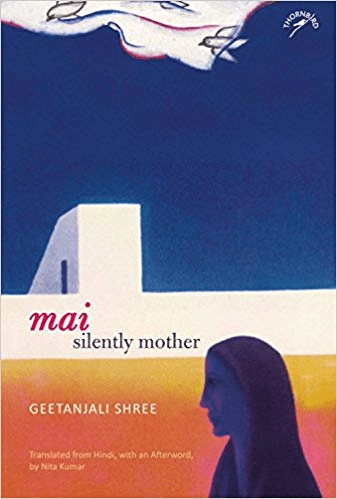



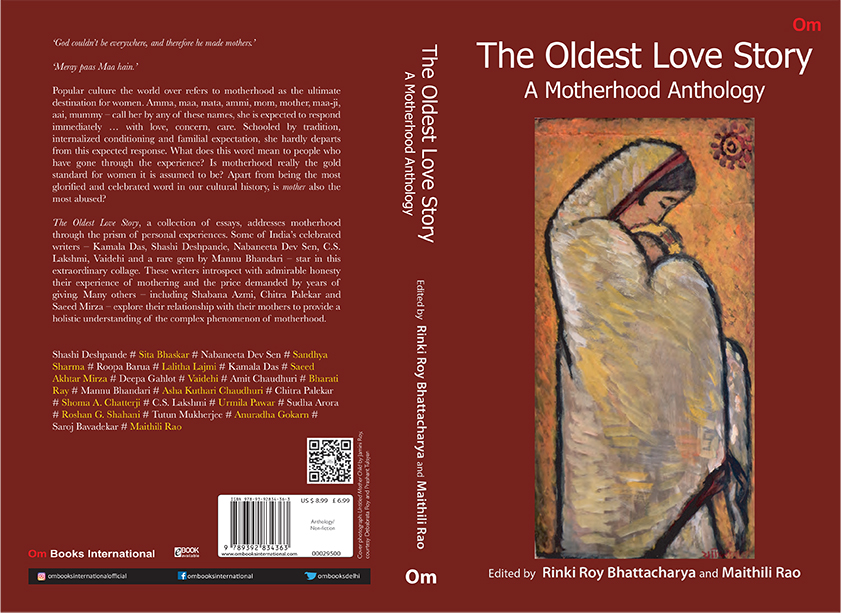

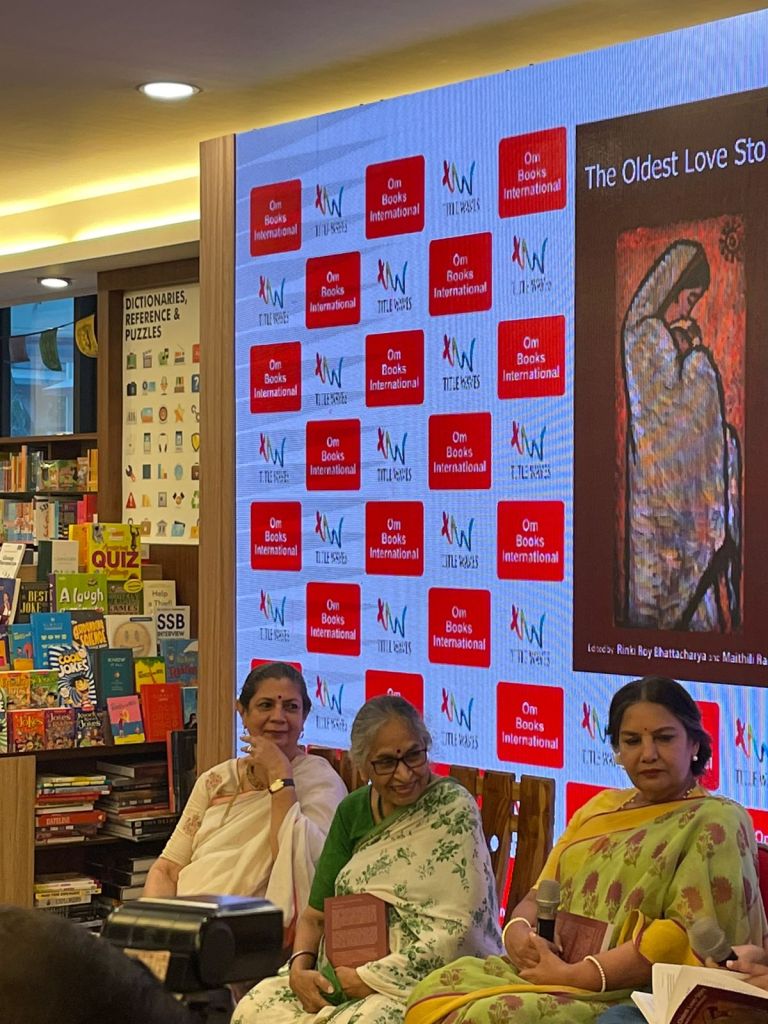
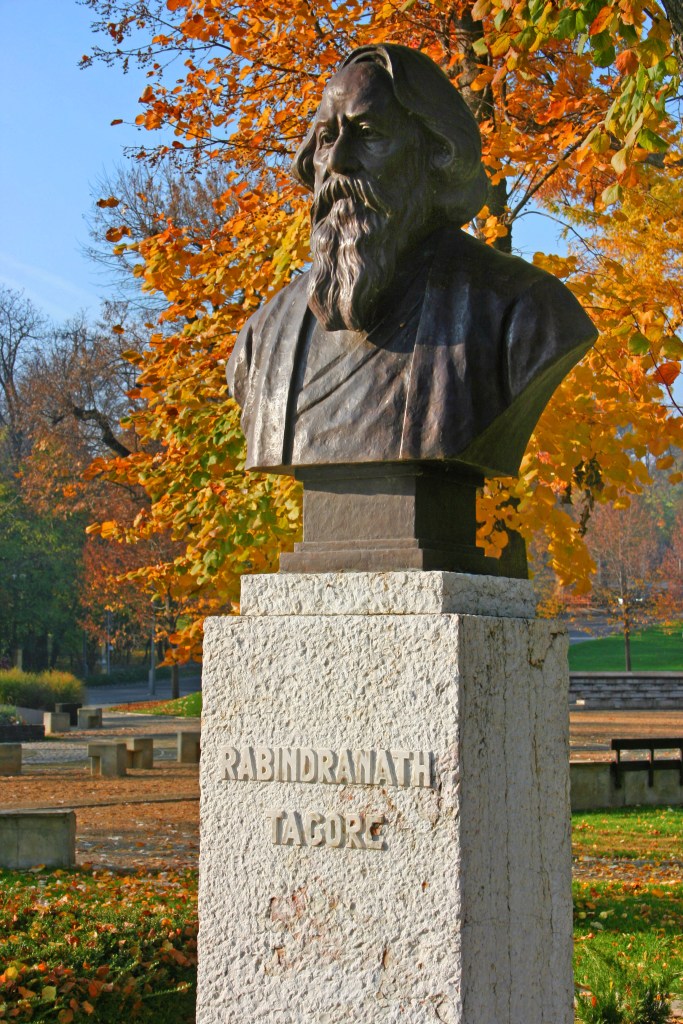

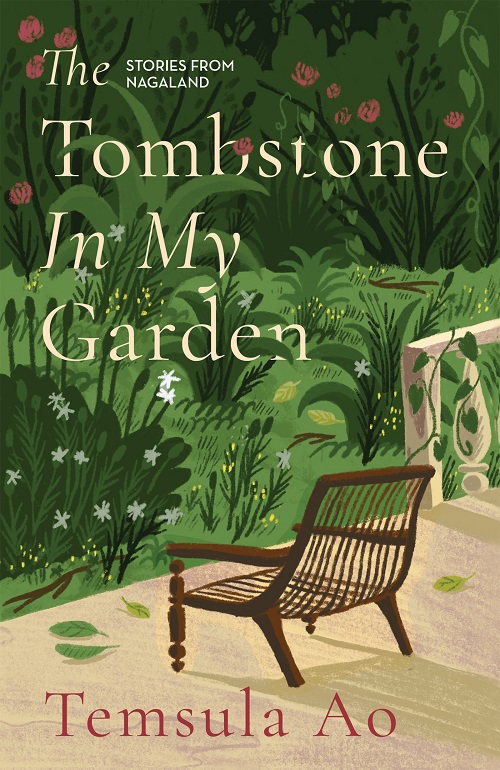
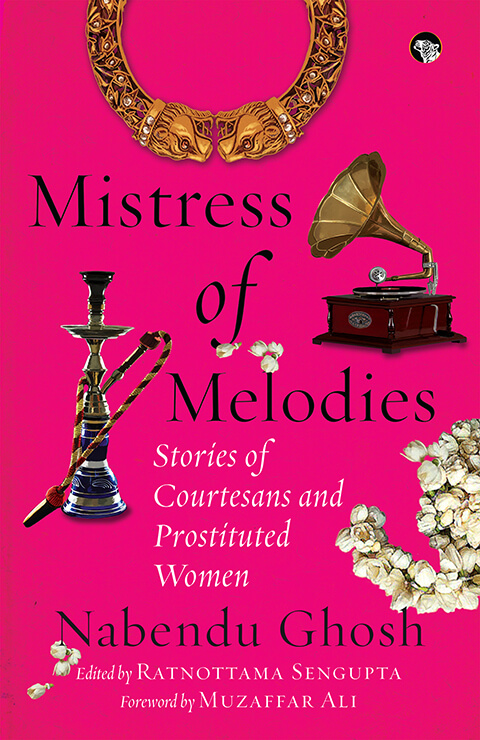

 Borderless