Categories
Stories

Ali the Dervish

By Paul Mirabile

Whirling Dervishes, painting by Jean Baptiste Vanmour (1671-1737). From Public Domain

In 1976, I bought a small country cottage very pleasantly located near the town of Sheffield at Dronfield in South Yorkshire from an elderly woman who informed me she that had travelled quite extensively throughout Asia in the nineteen twenties and thirties before settling down here. She never married. The learned woman left no forwarding address.

Settling in took much time and energy because of my abundant belongings. At last, one rainy afternoon having nothing to do, I climbed the shaky stairway that led to the garret. The door had been left ajar. Inside the low-ceiling, ill-lite space, there was nothing but a large chest placed in the middle. The lid lay aslant. Its hinges were broken. 

Curious about its contents, I began rummaging through the numerous newspaper and magazine clippings, booklets, letters and other documents. A particular envelop caught my eye because the red wax seal had been broken. Wax-sealed letters are very out-dated these days. When I opened the envelop I understood why it was sealed. A seven-page letter had been written in fine, elegant script, by Lady Sheil, dated 1869. Lady Sheil was quite a prominent woman in her time[1] . This indeed was a remarkable find. It baffled me why the former proprietor would leave in a chest of documents a letter of such archival interest. Since there was little light in the garret, I took the letter downstairs to read it. Unfortunately there was no addressee, so I assumed it was sent to the former proprietor. I must confess that a feeling of guilt touched me when I began my reading. Luckily I overcame this sensation because the contents of the letter proved extraordinary …

Lady Sheil details a very peculiar adventure of an Englishman who named himself Ali the Dervish -or as she spelt it, Deervish — who had undertaken a voyage to ‘Balochestan, Persia’[2]. As I read through her letter, I came to realise that the Englishman had abandoned his British ways entirely, adopting those of the semi-nomad Balochi. To such an extent was his assimilation that he even married a Balochi woman, something utterly unthinkable at that time — in the year 1856. Why Lady Sheil would write a long letter about this chap to an unknown reader or readers heightened my curiosity.

I began investigations at the Sheffield library and found Lady Sheil’s Glimpses of Persian[3] though I found nothing at all about Ali the Dervish. Lady Sheil mentioned something about his diary but nothing substantial came of this. Be that as it may, the letter fascinated me by its mysterious allusions and ellipses, especially concerning this unusual identity change. Not a simple task for a European in the nineteenth century, or even in our century for that matter. This Ali even outdid Sir Richard Burton’s bursts of outlandish impersonation …

Examining the letter carefully, I felt a strange, slight tremor goading me to do justice to this eccentric Ali. Something unsaid in the sentences urged me to read between them, to scrutinize the margins and the paragraph indents as if Lady Sheil had deliberately left out parts of her narrative for her reader to fill in those blank, yellowing spaces.

I picked up my pen, imagining myself to be both Lady Sheil and Ali the dervish, and began filling in the those blanks, writing in the gaps, the lacuna, the untold events and details so to speak. Indeed, I had convinced myself that the letter had been destined for me. And this resolution was enough for me to divulge the mystery of Ali …

Ali, whose English-born name was left unknown, had had the best of aristocratic educations in the fine arts, especially languages. He was fluent in Hindustani, Persian, Pashtun and Turkish, besides having mastered four or five European languages, including Hungarian. This was quite a linguistic feat, second only to Richard Burton whom, by the way, Ali had the occasion to meet in Lahore. A meeting which lasted two or three weeks according to a friend of Burton’s memoirs. Little, however, is reported about their relationship.

Prior to Ali’s arrival in India and that fortuitous encounter with Burton, he apparently had led a rather lukewarm existence in England, and this in spite of his family wealth, or perhaps because of it. His accumulation of capital was analogous to his successive accumulations of prolonged bouts of depression. They left him utterly exhausted. How and when he left England is not written in the letter, although he probably reached India by ship, then on horseback or foot into Northwestern India, accompanied often by erring minstrels and story-tellers. From whom Ali learned the art of dancing, chanting and story-telling. It was not a question of imitating these rituals and customs. Ali had integrated them as if they had been part of some distant, latent self that required jolts of recollection to surge up from the depths of the unconscious. In fact, Burton was quite taken aback by Ali’s very ‘unEnglish’ appearance. His manner of speaking English, too, possessed a curious twist of Persian and Hindustani syntax — a ring of their tonal stress.

To Ali’s pleasant surprise, he no longer suffered from bouts of violent depressions. The former Englishman on leaving Burton, perhaps in 1849, rid himself of paper money, donating it to missionaries, then rode off into the verdant valleys of North-western India towards Afghanistan carrying only the clothes on his back, two gourds of fresh water, several loaves of acorn-bread and a pouch of Arabic gum. Ali carried no weapon.

Ali’s sound knowledge of Hindustani, Pashtun and Persian offered him unparallel glimpses of these undomesticated lands. Lands of shifting desert sands whose rising heat conjured in the distance illusions of ravishing oases and sparkling cascades off tree-laden crags. Ali had been warned about these deceitful mirages (by Burton?) whose marvellous vision had been the death of many a brave adventurer.

He kept to the clayey track, accepting food and board from the hospitable villagers or sleeping under the silver stars on his woven kilim-saddle cloth. He rode days or nights penetrating landscapes of indescribable beauty, of terrifying singularity, of unbearable heat in the day and equally freezing nights. At one point in his wanderings, Ali, slumbering on his horse due to the rising heat and lack of food, looked up to discover a gigantic Buddha hewn into a tuft-like cliff. A small stream ran in front of the lithic niche along which flourished many date trees. There the Buddha stood, calm, reposed, sedentary, encased in his stone casket, home to a myriad birds who had made their nests on his rounded shoulders and shaven head. Ali jumped off his horse, filled his gourds with clean water, scouted about for fresh dates. With one last look at the towering Enlightened One he set off towards Persia, filled with equivocal sensations. He felt that his nomad days would soon be numbered …

A month or two passed. Now villagers tilling their fields or collecting wood no longer greeted or spoke Pashtun to him, but in Dehwari or Persian. He welcomed this language shift. Ali felt more at ease in Persian, albeit it be the Dehwari dialect, which he had learnt from one or two erring Zarathustrian talebearers in India. By then his uncombed beard touched his chest and his hair his shoulders. In one village he traded his khaki-coloured shorts for a shalwar[4] and his boots for goat-skin sandals. In another his Safari sun hat for a turban and his heavy flax shirt for a long, cotton tunic. Whenever he met tillers or merchants they would greet him with the customary ‘hoş amati’[5]. By their pronunciation and vocabulary Ali knew he was travelling southwards into Balochestan. Temperatures rose and rose — 37° C … 42° C. His horse trotted slower and slower. Her rider drooped soporifically over her mane. Ali no longer calculated his wanderings in farsakhs[6] but by the risings and settings of the sun …

Notwithstanding these discomfitures, the persevering Ali carried on. To his delight the track widened, hospitable shepherds driving before them their herds of sheep or goats offered the solitary traveller the warmth of their camp-fires, goat’s milk, cheese and acorn-bread. Caravans of transhumance nomads pressing towards the high plateaus nodded to him. The stony-faced herdsmen chanted in their own language which translated means —

 A breath of mountain breeze,
A breath of wind from the Sea,
In the middle,
We trudge
The pilgrims of the fountain…

Then they called after their huge, savage dogs. Ali seized upon that admirable chant and intoned it to himself or aloud …

One sparkling, azure day, Ali, road-weary, alighted from his horse in a large settlement of tents, called Sa’idi. There both Persian and Dehwari were spoken, judging from the scores of people who came to greet him. It was a charming settlement, surrounded by fields of red poppies, iris, bluer than the blue of the sky, crown imperials whose orange tints glowed like lit candles, and tulips. Horses, sheep and goats dotted the terraced rows of poppies on the hills and skirts of the low-laying piebald mountains, motionless. Ali, both dazzled and comforted by the undulating kaleidoscope colours decided to halt for the night in this welcoming settlement to rest his fatigued physical and mental state and his horse.

When he asked for the elder of the settlement, he was directed to a very large white tent. In fact, since his arrival the snowy-bearded elder had been eyeing the stranger askance. He threw open the flap of his tent and greeted him in Persian as custom would have it, inviting his visitor inside for tea. Sipping their respective glasses of sugared tea, the snowy-bearded elder’s deep-set black eyes peered into those hazel-brown of Ali’s. Though he was pleased to meet this curious traveller, he was confused about his identity. Finally he put the question point blank to his sipping visitor: “Are you Persian?”  

Ali nodded neither yes nor no. His ambiguous nod set off the string of events that followed. events that transformed the already transforming Ali into a rather ambiguous Other …

The snowy-bearded elder had read that ambiguous nod as a sign of belonging. Ali’s sun-mat complexion, his extraordinary command of both Persian and Dehwari, his knowledge of social and religious habits and practices, mostly acquired during his years on the road, opened the elder’s heart and those of the Balochi people of Sa’idi, people who now had stepped into the tent, forming a large circle round Ali and the snowy-bearded elder. Out of this wide circle came the elder’s three sons and daughter to lead him to his own red tent at the outskirts of the settlement. His horse was led to pasture with the others.

On the thick carpets of his medium-sized tent, Ali sat and meditated upon that ambiguous nod. Had he really become the one of them? Deep within his heart, the former Englishman rejoiced … rejoiced at his ‘crossing over’. He had become what he really was …  

Several years passed. Ali no longer felt guilty about leaving his past behind. His immersion seemed complete. He sang and danced round the ritual fire at night. He told stories night after night after a hard day’s work in the poppy fields, apple and peach orchards and the vineyards, the tribesmen chanted their chants of ancestral lore, joined him in his whirling dance, one palm to the Heavens and the other to the Earth, eyes staring into a void of quiescence …

It was in Sa’idi that he began to be called Ali the Dervish, whirling as he did before and behind the leaping flames. Ali taught his dance to the snowy-bearded elder’s three sons. In turn, the elder offered his daughter to him in marriage — a privilege since this signified entrance into the chieftain’s family.

Once the three-day marriage ceremonies were over, his lovely bride — for she was truly lovely — sat next to him in the nuptial red tent. His wife, whose name has never been recorded, demanded nothing of him. She accepted all his nightly hesitations … ‘failings’ … Her fruity laugh and obsidian back eyes spoke a language that communicated higher values … loftier treasures than uncertainty, physical gratification or hereditary obligations.

Ali slowly discovered that his young bride possessed the quality of a seer, perhaps even belonged to a long lineage of Central Asian mystics. Intense were her meditations and visions of the Other World, of events passed and those to come … His past … Their future … Ali, both bewildered and beguiled by this power of prophesy, would timidly question his bride about her unusual gifts. She would answer enigmatically: “One must remove the Husk before bringing in the Bride,” an adage he never fully understood, nor would she ever elucidate.

On other moonlit nights, alone within the sanctuary of their intimacy, Ali’s wife would envision scenes of his long aristocratic lineage, each member afflicted by physical or mental atrophies, plagued by wasting ennui. The Dervish listened in awe as she revealed events quite unknown to him. Yet, he remained speechless, peering into the almond-shaped eyes of this woman depicting scenes that could very well cost him his life. She said nothing. He yearned to avow everything to her but some fey voice prevented him each time. She read his mind and laughed her fruity laugh, delving ever deeper into his life … theirs !

Ali accompanied her with his eyes then turned them to the dying embers of the stove fire, the glowing logs sizzled lightly in the silence. Was he deluding himself? He knew that his wife had discovered his native idenity. But were all those past scenes his true identity? He indeed stemmed from that hoary lineage, the last scion. Was he the last to play a role on this world stage of masquerade and mummery? No ! He was Ali the Dervish … Here amongst these hearty tribesmen he played no role. He had overcome the hardships of childhood as a fatherless boy. That unknown gentleman had left for Africa never to return! Never a letter nor a message brought by acquaintances. Before dying of grief, his poor mother repeated to him everynight: “Look to the stars.” And the sullen boy looked, and believed that they would lead him to another life … another identity !

Once Ali began to cry softly listening to the sizzling embers and the light, rhythmical breathing of his strange wife.

Many years had passed and yet, they had no children. His hair and beard had greyed. Yet, no reprimand, no rebuke, no judgement ever came from the community, especially from her aging father. Was the power of her revelations known to him ? Would he be the last branch of that gnarled and rotten aristocratic tree ?

Ali rode often into the fields and mountains to gather wood to build tent-frames or glean fruit from the many apple and peach trees. During these solitary moments his past crept up on him, making him feel guilty. There seemed only one solution : speak openly, candidly to his wife about his British birth, his genuine desire to become the Other. She would surely understand since she had already read his former life by sounding his heart. That night he would go straight to his wife.

But, just then out of the blue sky his wife came galloping towards him, whipping up her stead. She jumped off, an odd expression wrinkling her forehead. Ali ran up to her, took her shoulders gently, admiring the sapphire blue that framed them so perfectly like a painting. There she stood, basking in the soft glow of the mellowing, evening sun. Before he could utter his rehearsed confession she put a hand to his lips.

“Father has just passed away,” she whispered softly, without emotion. “He has been freed from the trammels of worldly existence.” She smiled. “Now you too are free to divest yourself of a personage that has been conferred to you by the stars and the strength of your will.”

“But who am I really, my dear?” her husband wondered. She caressed his bearded, burning cheeks. She answered: “If you want the horse to neigh, you must slacken the reins.” Turning round, she rode back to the settlement to wash the body of her deceased father and prepare the three-day funeral rites with her brothers. Ali puzzled by that enigmatic counsel trudged to his horse.

He rode back far behind her, meditating his ‘freedom’. What other choice had he?

This sentence was the last in Lady Sheil’s long, detailed letter. On further investigation into this strange fellow at the London library, I discovered that Ali the Dervish had divorced and remarried his bride to one of her brother’s mates, then left Sa’idi. He was last seen in Tabriz, Persia. No document reports his whereabouts after his reaching that northwestern town in the lands of the Azeri people. 

I have often wondered whether Lady Sheil ever knew who Ali the Dervish really was. I have my doubts. Only his Balochi wife knew, and of course, that mysterious person could have never been questioned. It’s also odd that Ali himself — whatever self that be– had never woven his thoughts and experiences into a book, never enlightened a Western public on integration and assimilation into a foreign culture.

As time went by I even considered that this letter might have been a hoax to hoodwink a naive fellow like myself into clothing Ali in legendary fashion. On second thought, though, who’s to arbitrate between fact and fiction ? Not I, in any case. For isn’t it a refreshing act of freedom to slip from one to the other without a pinch of guilt ?     

.

[1]        1803-1871.

[2] Balochistan is in Pakistan but the Baloch community spreads to Iran and Ali’s story dates before the formation of Pakistan.

[3]        Published in 1856.

[4]        Large, light baggy trousers.

[5]        ‘Welcome’ in Persian.

[6]        A Persian measurement equivalent to 5.35 kilometres

.

Paul Mirabile is a retired professor of philology now living in France. He has published mostly academic works centred on philology, history, pedagogy and religion. He has also published stories of his travels throughout Asia, where he spent thirty years.

.

PLEASE NOTE: ARTICLES CAN ONLY BE REPRODUCED IN OTHER SITES WITH DUE ACKNOWLEDGEMENT TO BORDERLESS JOURNAL

Click here to access the Borderless anthology, Monalisa No Longer Smiles

Click here to access Monalisa No Longer Smiles on Kindle Amazon International
Categories
Contents

Borderless April, 2024

Art by Sohana Manzoor

Editorial

April Showers… Click here to read.

Translations

Baraf Pora (Snowfall) by Rabindranath Tagore, gives a glimpse of his first experience of snowfall in Brighton and published in the Tagore family journal, Balak (Children), has been translated from Bengali by Somdatta Mandal. Click here to read.

Himalaya Jatra ( A trip to Himalayas) by Tagore, has been translated from his Jibon Smriti (1911, Reminiscenses) by Somdatta Mandal from Bengali. Click here to read.

Bhumika (Introduction) by Tagore has been translated from Bengali by Ratnottama Sengupta. Click here to read.

The Fire-grinding Quern by Manzur Bismil has been translated from Balochi by Fazal Baloch. Click here to read.

The Tobacco Lover by Ihlwha Choi has been translated from Korean by the poet himself. Click here to read.

Pochishe Boisakh (25th of Baisakh) by Tagore(1922), has been translated from Bengali by Mitali Chakravarty. Click here to read.

Pandies Corner

Songs of Freedom: Dear Me… is an autobiographical narrative by Ilma Khan, translated from Hindustani by Janees. These narrations highlight the ongoing struggle against debilitating rigid boundaries drawn by societal norms, with the support from organisations like Shaktishalini and pandies’. Click here to read.

Poetry

Click on the names to read the poems

Michael Burch, Kirpal Singh, Scott Thomas Outlar, Nusrat Jahan Esa, George Freek, Snigdha Agrawal, Phil Wood, Pramod Rastogi, Stuart McFarlane, Ahmad Al-Khatat, Shamik Banerjee, Ryan Quinn Flanagan, Lisa Sultani, Jenny Middleton, Kumar Bhatt, Rhys Hughes

Poets, Poetry & Rhys Hughes

In The Desk, Rhys Hughes writes of his writerly needs with a speck of humour. Click here to read.

Musings/Slices from Life

Heatwave & Tagore

Ratnottama Sengupta relates songs of Tagore to the recent heatwave scorching Kolkata. Click here to read.

The Older I get, the More Youthful Feels Tagore

Asad Latif gives a paean in prose to the evergreen lyrics of Tagore. Click here to read.

No Film? No Problem

Ravi Shankar takes us through a journey of cameras and photography, starting with black and white films. Click here to read.

Musings of a Copywriter

In Witches and Crafts: A Spook’s Tale, Devraj Singh Kalsi finds a ghostly witch in his library. Click here to read.

Notes from Japan

In Of Peace and Cheese, Suzanne Kamata gives us a tongue in cheek glimpse of photo-modelling mores. Click here to read.

Essays

Discovering Rabindranath and My Own Self

Professor Fakrul Alam muses on the impact of Tagore in his life. Click here to read.

The Lyric Temper

Jared Carter explores the creative soul of poets through varied times and cultures. Click here to read.

Bengaliness and Recent Trends in Indian English Poetry: Some Random Thoughts

Somdatta Mandal browses over multiple Bengali poets who write in English. Click here to read.

Stories

Hope is the Waking Dream of a Man

Shevlin Sebastian gives a vignette of life of an artist in Mumbai. Click here to read.

Viceregal Lodge

Lakshmi Kannan explores patriarchal mindsets. Click here to read.

The Thirteen-Year Old Pyromaniac

Paul Mirabile gives a gripping tale about a young pyromaniac. Click here to read.

Conversation

Ratnottama Sengupta in conversation about Kitareba, a contemporary dance performance on immigrants, with Sudarshan Chakravorty, a choreographer, and founder of the Sapphire Dance Company. Click here to read.

Book Excerpts

An excerpt from Jessica Mudditt’s Once Around the Sun – From Cambodia to Tibet. Click here to read.

An excerpt from Bhaskar Parichha’s Biju Patnaik: The Rainmaker of Opposition Politics. Click here to read.

Book Reviews

Meenakshi Malhotra reviews Mahasweta Devi: Writer, Activist, Visionary, edited by Radha Chakravarty. Click here to read.

Basudhara Roy reviews Out of Sri Lanka: Tamil, Sinhala and English Poetry from Sri Lanka and its Diasporas, edited by Vidyan Ravinthiran, Seni Seneviratne, Shash Trevett. Click here to read.

Swagata Chatterjee reviews Sanjukta Dasgupta’s Ekalavya Speaks. Click here to read.

Bhaskar Parichha reviews Bhang Journeys: Stories, Histories, Trips and Travels by Akshaya Bahibala. Click here to read.

.

Click here to access the Borderless anthology, Monalisa No Longer Smiles

Click here to access Monalisa No Longer Smiles on Amazon International

Categories
Contents

Borderless, February 2024

Art by Sohana Manzoor

Editorial

Finding Godot?… Click here to read.

Conversations

Ratnottama Sengupta talks to Ruchira Gupta, activist for global fight against human trafficking, about her work and introduces her novel, I Kick and I Fly. Click here to read.

A conversation with Ratna Magotra, a doctor who took cardiac care to the underprivileged and an introduction to her autobiography, Whispers of the Heart: Not Just a Surgeon. Click here to read.

Translations

Two poems by Nazrul have been translated from Bengali by Niaz Zaman. Click here to read.

Masud Khan’s poetry has been translated by Fakrul Alam. Click here to read.

The White Lady by Atta Shad has been translated from Balochi by Fazal Baloch. Click here to read.

Sparrows by Ihlwha Choi has been translated from Korean by the poet himself. Click here to read.

Tagore’s Dhoola Mandir or Temple of Dust has been translated from Bengali by Mitali Chakravarty. Click here to read.

Pandies Corner

Songs of Freedom: What are the Options? is an autobiographical narrative by Jyoti Kaur, translated from Hindustani by Lourdes M Supriya. These narrations highlight the ongoing struggle against debilitating rigid boundaries drawn by societal norms, with the support from organisations like Shaktishalini and pandies’. Click here to read.

Poetry

Click on the names to read the poems

Rhys Hughes, Maithreyi Karnoor, Luis Cuauhtémoc Berriozábal, Sivakami Velliangiri, Wendy Jean MacLean, Pramod Rastogi, Stuart McFarlean, Afrida Lubaba Khan, George Freek, Saranyan BV, Ryan Quinn Flanagan, Sanjay C Kuttan, Peter Magliocco, Sushant Thapa, Michael R Burch

Poets, Poetry & Rhys Hughes

In City Life: Samples, Rhys Hughes takes on the voice of cities. Click here to read.

Musings/Slices from Life

Ratnottama Sengupta Reminisces on Filmmaker Mrinal Sen

Ratnottama Sengupta travels back to her childhood wonderland where she witnessed what we regard as Indian film history being created. Click here to read.

Suga Didi

Snigdha Agrawal gives us a slice of nostalgia. Click here to read.

Healing Intellectual Disabilities

Meenakshi Pawha browses on a book that deals with lived experiences of dealing with intellectual disabilities. Click here to read.

Musings of a Copywriter

In Hobbies of Choice, Devraj Singh Kalsi explores a variety of extra curriculums. Click here to read.

Notes from Japan

In Becoming a Swiftie in my Fifties, Suzanne Kamata takes us to a Taylor Swift concert in Tokyo. Click here to read.

Essays

Walking about London Town

Sohana Manzoor takes us around the historic town. Click here to read.

How Do You Live?

Aditi Yadav explores the universal appeal of the translation of a 1937 Japanese novel that recently came to limelight as it’s rendition on the screen won the Golden Globe Best Animated Feature Film award (2024). Click here to read.

The Magic Dragon: Cycling for Peace

Keith Lyons writes of a man who cycled for peace in a conflict ridden world. Click here to read.

Stories

A Night at the Circus

Paul Mirabile tells a strange tale set in Montana. Click here to read.

Echoes in the Digital Expanse

Apurba Biswas explores a futuristic scenario. Click here to read.

Two Countries

Ravi Shankar gives a story about immigrants. Click here to read.

Chadar

Ravi Prakash writes about life in an Indo-Nepal border village. Click here to read.

Just Another Day

Neeman Sobhan gives a story exploring the impact of the politics of national language on common people. Click here to read.

Book Excerpts

An excerpt from Nabendu Ghosh’s Journey of a Lonesome Boat( Eka Naukar Jatri), translated from Bengali by Ratnottama Sengupta. Click here to read.

An excerpt from Upamanyu Chatterjee’s Lorenzo Searches for the Meaning of Life. Click here to read.

Book Reviews

Somdatta Mandal reviews The History Teacher of Lahore: A Novel by Tahira Naqvi. Click here to review.

Basudhara Roy reviews Srijato’s A House of Rain and Snow, translated from Bengali by Maharghya Chakraborty. Click here to read.

Bhaskar Parichha reviews Toby Walsh’s Faking It : Artificial Intelligence In a Human World. Click here to read.

.

Click here to access the Borderless anthology, Monalisa No Longer Smiles

Click here to access Monalisa No Longer Smiles on Amazon International

Categories
pandies' corner

Songs of Freedom: What are the Options?

By Jyoti[1], translated from Hindustani by Lourdes M Supriya

Songs of Freedom bring stories from women — certainly not victims, not even survivors but fighters against the patriarchal status quo with support from the organisation Shaktishalini[2].

–Sanjay Kumar, founder, pandies

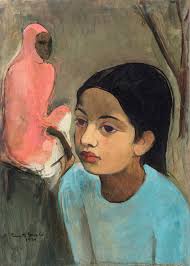
Painting by Amrita Shergil (1913-1941)
What are the Options?

“So then what happened?”

Nothing. My father came and took me back to his house. My nana-nani [3] didn’t stop him. He put me in a good school though, so this time I didn’t mind going back there. Last time he took me, I hated it.

“Why did you hate it?”

He wasn’t a nice man. I think that’s why my grandparents took me in. They knew what kind of a man he was. I loved being at my grandparents’. My mama, mother’s brother, he would take me shopping during holidays. I could pick anything in the entire shop, he’d never say no. Whenever I wanted new clothes, my masi, mother’s sister, took me to the markets\. She was like my mother. I was so loved there. But then my father took me away…

He had too many restrictions. My mother and I weren’t allowed to leave the house. I couldn’t leave after I came back from school. He kept an eye on us from his shop, it was down the street. Then the drinking got too much, the yelling, the swearing. I was afraid of his footsteps. I could tell from the sound of them what the night was going to be like. My mother was very scared of him, she couldn’t protect me from him. She felt helpless, I felt really bad for her. Then I was sent away again to my grandparents. I liked it there. I was studying in a government school. I did well in studies. I liked it. But then he came and took me back to the village. I had to repeat my third standard[4] there. I cried a lot at first, but it was a private school, better than the government one in Delhi.

“So this was the second time you were going there?”

Yes. I’ve lived at my father’s a couple of times. Sometimes I ran away and came back to my grandparents’, sometimes my mother brought me with her and stayed. But she always went back pretty soon. The first time he took me, I used to cry to my grandparents every night to take me back. I had to repeat classes so many times, I’m really behind on my studies. This has ruined my education. That’s why I hate it.

“What about the last time you were there? What happened then?”

Nothing. The same. But worse. He was more violent. My mother herself asked me to go with her to my grandparent’s. But I had exams in a month. I was a good student. I’d worked so hard. That year was especially bad at home; I’d put all my energy into school. I didn’t want to just drop it all and repeat the class again. I begged my mother to stay till the end of the term. He would beat her over everything. So I had to beg her. I promised her I would support her if she’d just let me give those exams. I was 14. I was old enough to start working.

“So did she stay?”

Yes. And then I came back to my grandparents’. But she went back the second day. Then she stopped taking my calls. Finally, I called her from someone else’s phone. She recognised my voice. I could tell. She didn’t say anything for a long time. I kept asking her to come. Then she said, “Aaj se tera mera rishta khatam; you’re not my daughter anymore. Don’t call again.”

I felt very alone. Things at my grandparents’ were also changing. My aunt was getting married. Everyone was busy with the preparations.

Nana[5] used to drive the auto 15 hours a day to save up for it. But he first had to pay back the loan he took out for the auto before he could save for the wedding. It was his last installment and they were really breathing down on him. One day he came home and told us he was short of 1000 bucks and it was time to make the payment. He asked my uncle, who was married by then, but his wife said they couldn’t spare it since they were also paying for the wedding and saving for the baby they planned to have next year. My uncle didn’t even have the balls to refuse his father himself. His wife had to do it. My grandfather turned to my mother, but she said, she couldn’t spare it either, she’d spent it all on me.

“Wait, your mother was there?”

Yes. She’d come eventually, some two months after me. She was working as a cook. It was really nice. For the first time, it felt like she was there. But that day she had used me as an excuse. I didn’t see any of that money. She wasn’t even paying for my school fees. I took tuitions and paid for it. I was starting to resent her too, I could see why the rest of them hated her.

“Wait, who hated her? Why did you resent her, you just said she was there for you.”

She was. When she came. She got a job. She got offs on Sunday and she would spend those with me. On Sundays, I didn’t have to cook for the family, she did. She even gave me money for school supplies, like new copies or pens, whenever I asked for it. She got me a small phone too. But this didn’t last long. She met someone. She used to take the same rickshaw to work everyday. He’d take her from one place to the next, they used to talk, then she’d talk to him at night too. She kept to herself. She started spending her Sundays with him. He wasn’t a good man. One day, he went to the village.

I thought it would end but her late-night conversations continued. They hated her, my grandparents and my uncle, his wife, even my mother’s sister. She knew her sister was to get married soon but she was roaming around with a man. All the neighborhood knew about it. What would they think? And then she stopped contributing to the house. How much could my grandfather do? She didn’t even give me any money anymore. Not even for notebooks. I had to work. And it was so difficult. I had to make breakfast for everyone in the house in the mornings, pack my lunch, rush back and do all the cleaning of the house, make lunch for everyone, then clean up the kitchen and wash the vessels. Then my kids would come. But everyone was selfish then. They were angry with my mother, and then with me. I gave my grandmother a part of my earnings, and I paid for my school. I did everything. She’d stopped staying home on Sundays too, so I had to do the work. That day, when my grandfather asked for money, she said she didn’t have any. He got so angry with her, he called her a slut, a leach, a parasite, draining him, killing him slowly, he slapped her. She ran away. I noticed that he didn’t react the same way when his daughter-in-law had refused to give him the money. But he was just so upset, he started crying. I couldn’t bear it. So I took one thousand from the money I’d saved for all those months and gave it to him. My grandmother took me aside and told me I shouldn’t have done it, that she could have dipped into the money I gave her. I told her that was for her. She didn’t have any money at all. And she’d been so kind to me. She was the only one who didn’t resent me. But she respected my grandfather too much to contradict him when he called me names.

“I thought your grandparents were supportive, that you’d felt safe in their house?”

I did. But my aunt was getting married, that changed everything. And I understand why they were angry with my mother. She brought us so much shame. One day, that man that she’d been having an affair with, he went to her workplace and started beating her up. He forced her onto his rickshaw, holding her hair throughout, and then brought her to our neighborhood and dragged her through the streets by her hair to his friend’s house. She’d started an affair with his friend when he’d gone to his village, and he found out about it. All the people heard him that day. She was so scratched up when he finally let her go. I took her to the police station but they didn’t file a complaint. My grandparents also encouraged her to file a complaint. But she didn’t. The new man she was seeing told her he was going to help her. So she listened to him, trusted that he would get her justice. I’ve never seen him, none of us had. But she really trusted him.

One day my aunt was really anxious. She came into the room when I was taking a class, and she asked me to go to the terrace because she needed the room. I had to move all the kids upstairs, take all the chairs. When I came back after the class, she started yelling at me, telling me I’m a burden, then she started beating me, abusing my mother too. I didn’t say anything to her when she was beating me; she left me in the room. I waited for my mother to come and comfort me. But she didn’t come. So I went looking for her, thinking this could bring us together. But I found her on the terrace, talking to her new boyfriend, telling him about all this. I felt really abandoned. She couldn’t even bother to check on me but she wanted his sympathy. Then they got into a fight. At one point, I overheard her begging him not to leave her or she’d kill herself. It made me so angry, I felt like I could break something.  I didn’t like this man at all. One day, she just got up left. I asked my grandparents to file a missing person’s report but they didn’t want to do it because it would bring shame to the family and my aunt was getting married. So they waited till it was over and then filed it, three years later. But I haven’t seen her since. I think she’s missing, we need to find her.

“How long ago was this?”

I don’t know. I can’t tell.

“What happened after your mother left?”

They all blamed me, they said I drove her to do it, that I hated her, that I was like her. They asked me to start contributing to the house, to stop living like a freeloader. I started giving all my tuition money home. I couldn’t continue school anymore. But they were so angry. One day, after my aunty’s marriage, the police came to our house in response to the missing person’s complaint I’d made them file. They wanted to ask questions about my mother and her boyfriend. I think she planned her escape. She’d been staying overnight at his house 2-3 times a week, and slowly taking her clothes there. The police pointed this out,  how she couldn’t have taken a big bag when she escaped, or we’d have seen her packing. I think they’re right. She abandoned me.

“Do your grandparents believe she’s okay, living somewhere else?”

Yes. It makes sense. She didn’t like it at home. They felt so ashamed by the police visit. They were angry that I’d made them file the complaint only to find out that their daughter had run away willingly. My grandfather was livid that day. He beat me up, then tried to drag me down the stairs. But I fell down at the 3rd floor landing so he started kicking me. Then he left me lying there. My grandmother didn’t come to help me. I was so distraught. I couldn’t even go to school, everyone hated me. What future did I have? No one wanted to help me, I didn’t know anyone who could help me or even who to turn to. I jumped off the landing there. I tried to commit suicide. That’s why I’m here now. Now I go to school.

[1] Note: Loosely based on the writer’s lived experiences

[2]  “Establishing itself as a premier women’s organisation in India from 1987, Shaktishalini has spread out and deals with all kinds of gender based violence. A shelter home, a helpline and more than that a stunning activist passion are the hallmarks of this organisation. 

pandies and Shaktishalini – different in terms of the work they do but firmly aligned in terms of ideological beliefs and where they stand and  speak from. It goes back to 1996 when members of the theatre group went to the Shaktishalini office to research on (Dayan Hatya) witch burning for a production and got the chance to learn from the iconic leaders of Shaktishalini, Apa Shahjahan and Satya Rani Chadha. And collaborative theatre and theatre therapy goes back there. It is a mutual learning space that has survived over 25 years. Collaborative and interactive, this space creates anti-patriarchal and anti-communal street and proscenium performances and provides engaging workshop theatre with survivors of domestic and societal patriarchal violence. Many times we have sat together till late night, in small or large groups debating what constitutes violence? Or what would be gender equality in practical, real terms? These and many such questions will be raised in the stories that follow.” — Sanjay Kumar

[3] Maternal grandparents

[4] Grade. Third grade

[5] Maternal grandfather

Jyoti Kaur is a 19-year-old from Delhi, currently pursuing her 10th grade studies. She likes to dance, read books and loves to travel at night.

Lourdes M Supriya is a Delhi based filmmaker, editor, and theatre practitioner who has been associated with pandies’ theatre since 2015.

PLEASE NOTE: ARTICLES CAN ONLY BE REPRODUCED IN OTHER SITES WITH DUE ACKNOWLEDGEMENT TO BORDERLESS JOURNAL

Click here to access the Borderless anthology, Monalisa No Longer Smiles

Click here to access Monalisa No Longer Smiles on Kindle Amazon International
Categories
Editorial

Whispers of Stones

When the mountains and grass
had life, stones whispered
how the world came to be…

'Stonehenge', Daily Star

And as the world came to be, there was war — war that seems to rage in some part of the world or other. The British Museum has an exhibit which states the first battle was staged 13,000 years ago… in what is now Sudan, long before the advent of written history. This was even before the advent of people who built the ancient Stonehenge which was constructed around 3000-2000 BCE. And battles still continue to rage. The Jebel Sahaba casualties in Sudan 13000 years ago were less than 100. But the current conflicts claim in terms of tens of thousands which prolonged could stretch to millions. The last world war (1939-1945) which lasted for six years had a total of  75-80 million persons who perished. Ukraine-Russia conflict has within five months had a casualty count of more than 14000. And yet weapons and nuclear arms continue to proliferate decimating humanity, nature and towns, destroying homes, erasing ruthlessly and creating more refugees. The only need for such battles seem to be to satiate the hunger of the warlords secure in their impenetrable fortresses while tens of thousands are annihilated and natural or nurtured landscapes lie emaciated, mutilated and polluted.

What would be a good way of ending such wars?

Tagore sought the development of better instincts in humankind as an antidote. He wrote in the last century: “Any teaching concerning man must have human nature for its chief element. How far it will harmonise with human nature is a matter of time.”

With wars getting deadlier and more horrific, we can only try to awaken, as Tagore suggests, the better nature in man to move towards a peaceful world. What would be a more effective way of doing it than writing with the hope of a kinder and accepting future?

For that let us start with translations of the maestro Tagore himself. We have a song about the season — monsoon, ‘Monomor Megher Songi (My Friends, the Clouds)’, translated by Professor Fakrul Alam, a painting by Sohana Manzoor interpreting the lyrics and a transcreation of Nababarsha or New Rains’ was shrunken into a popular Rabindra Sangeet and reduced to twenty lines in English by Tagore himself. The connect with nature is an important aspect that enables humans to transcend petty concerns leading to dissensions of different kinds as evidenced in the maestro’s humorous feline skit, translated by Somdatta Mandal. A translation of Dalip Kaur Tiwana’s ‘The Bus Conductor’ from Punjabi by C. Christine Fair adds zest to this section. Fazal Baloch has translated a folktale from Balochistan involving the supernatural and Ihlwha Choi has taken on the cry for peace on behalf of Ukraine while translating his own poem in Korean. The Nithari column has a story by Jishan in Hindustani, translated to English by Grace M Sukanya, showcasing the struggle of a youngster during the pandemic – rather a sad narrative, which though fictitious has its roots in reality. 

Our poetry section touches upon the timelessness of dissensions and darkness with Michael R Burch’s poem on Stonehenge and Supatra Sen’s poem on Ukraine. This has been allayed by love poetry by Maid Corbic from Bosnia. George Freek’s poem ruffles with its reflective lines. And in the midst of it all, is poetry by Ryan Quinn Flanagan reflecting on the seven stages of man. Will the process of aging or human nature ever change? I wonder if Rhys Hughes can find an answer for that in humorous verses as he has shared in this issue. In his column, Hughes has written about an imagined anthology of short stories.

Our short story section has echoes of humour around felines by Manzoor, somewhat in tune with the mind frame seen in Tagore’s skit on this issue. Humour rings tinged with an apparition in Erwin Coombs’s narrative – should one call it dark humour or is it just his style? Paul Mirabile goes for gothic darkness in his meanderings around Italy.

Strangely, we seem to have a focus on short stories this time. Keith Lyons has interviewed Steve Carr, a journalist, a publisher and writer of 500 short stories who is questing to create a ‘perfect short story’. Reading out excerpts from her short story at a literary festival in Simla, Bollywood celebrity, Deepti Naval, was in conversation with eminent film journalist, Ratnottama Sengupta. She spoke of her literary aspirations while unveiling her autobiography in verse, A Country Called Childhood. This conversation has been shared by Sengupta with Borderless. It is interesting to see how Naval’s reactions to social malaise contrasts with that of the film director, cinematographer and actor, Goutam Ghose, who was present during the unveiling of her book. He had responded to communal violence by making a film on Lalan Fakir extolling virtues of love and kindness, called Moner Manush (2010) and then made a book on the film called, The Quest (2013) which has beautiful translations of Lalan Fakir’s lyrics by Sankar Sen.  

Our non-fiction sections seem to be hosting multiple travel stories across UK by Mike Smith, along the Australian coastline by Meredith Stephens, on the Himalayas with Ravi Shankar and an unusual visit by Hema Ravi to a farm in US where animals that had been used in Disney films in the past are homed. Our environmental columnist, Kenny Peavy, actually wrote about his cycling trip from Thailand to Indonesia on a bamboo cycle made by a Singaporean! And from Japan, Suzanne Kamata explored a museum in the neighbouring town of Mure. The museum on a hill hosts the art of American Japanese Artists, Isamu Noguchi.

We do have non-fiction that moves away from travel: noir humour by Devraj Singh Kalsi and an essay by Candice Louisa Daquin on a very interesting subject – ‘Is it Okay to be Ordinary?’ Is it?  Dan Meloche has written a literary essay on Canadian novelist Andre Alexis’s award-winning novel, Fifteen Dogs: An Apologue (2015). While Meloche spoke of how the novel departed from Orwell’s Animal Farm, his narrative brought to my mind a novel closer to our times set in England by Jasper Fforde called Constant Rabbit (2020) – this a science fiction while Alexis’s was an apologue or an animal fable. Fforde did use the rabbits rather well to highlight the current times.

We have book excerpts of two recent books that I would call really outstanding. One of them is Aruna Chakravarti’s The Mendicant Prince, which is being released this week, and is based on the evergreen contentious case of the prince of Bhawal that has even been explored even in cinema. The other, Dadamoni: The Life and Times of Ashok Kumar by Nabendu Ghosh, has been published posthumously and is not a translation from Bengali but written in English originally by this trilingual writer.  

Called ‘Dadamoni’ affectionately, iconic actor Ashok Kumar is regarded as “the one personality who symbolises Indian cinema’s journey from Bombay Talkies to Bollywood”.  This book has been reviewed by Indrashish Banerjee, who calls it ‘a reflection on the Hindi film industry’ as well as a biography. Rakhi Dalal has reviewed Booker winner Geetanjali Shree’s Mai, Silently Mother, a Sahitya Akademi winning translation of her Hindi novel by Nita Kumar, reiterating the dialogue that had been kindled on motherhood last month by Rinki Roy Bhattacharya and Maithili Rao’s The Oldest Love Story (2022). Bhaskar Parichha has reviewed Prosanta Chakrabarty’s Explaining Life Through Evolution plotting how life evolved on earth. Parichha tells us: “Meaningful, wide-ranging and argumentative, this is a must-read book. It will propel us to imagine and reimagine life around us.” Another book that sounds like a must-read has been reviewed by Meenakshi Malhotra, Tagore’s Gleanings of the Road, translated by Mandal. She tells us: “ ‘Gleanings’ represents the quintessential Tagore…Ably introduced and translated by Somdatta Mandal, a renowned Tagore scholar, the translation captures the iridescent and luminous quality of Tagore’s prose and its chiaroscuro effects.”

There is more to tempt. Please stop by on our contents page and take a look.

We would like to hugely thank all our contributors and readers for being with us and helping us grow. I would like to thank my team, who despite hurdles they face, always lend a helping hand and wonderful words from their pens or computers to get Borderless on its feet. I apologise for the delay and thank you all for your patience. Special thanks to Sohana Manzoor for her fabulous artwork.

I wish you all a wonderful July and peace in a war-torn world. We are all affected by the ongoing conflicts. Let us hope for peaceful and just resolutions.

Thanks.

Mitali Chakravarty

borderlessjournal.com

Categories
Contents

Borderless April, 2022

Art by Sohana Manzoor

Editorial

For the People, Of the People, By the People Click here to read.

Ukrainian Refrains

In A Voice from Kharkiv: A Refugee in her Own Country, Lesya Bukan relates her journey out of Ukraine as a refugee and the need for the resistance. Click here to read.

Refugee in my Own Country/ I am Ukraine Poetry by Lesya Bukan of Ukraine. Click here to read.

Translations

Ananto Prem (Endless Love) by Tagore, translated from Bengali by Professor Fakrul Alam. Click here to read.

Playlets by Rabindranath Tagore reveal the lighter side of the poet. They have been translated from Bengali by Somdatta Mandal. Click here to read.

The Faithful Wife, a folktale translated from Balochi by Fazal Baloch. Click here to read.

Leafless Trees, poetry and translation from Korean by Ihlwha Choi. Click here to read.

Ebar Phirao More (Take me Back) by Tagore, translated from Bengali by Mitali Chakravarty. Click here to read.

Pandies’ Corner

These narratives are written by youngsters from the Nithari village who transcended childhood trauma and deprivation. Will to be Human is based on a real life story by Sachin Sharma, translated from Hindustani by Diksha Lamba. Click here to read.

Interviews

In When a Hobo in a Fedora Hat Breathes Tolkien…, Strider Marcus Jones, a poet and the editor of Lothlorien Journal, talks of poetry, pacifism and his utopia or Lothlorien. Click here to read.

In Why We Need Stories, Keith Lyons converses with Ivy Ngeow, author and editor of a recent anthology of Asian writing. Click here to read.

Poetry

Click on the names to read

Michael R Burch, Mini Babu, Luis Cuauhtémoc Berriozabal, Anjali V Raj, George Freek, Ashok Suri, Ron Pickett, Sutputra Radheye, Dr Kisholoy Roy, David Francis, J.D. Koikoibo, Sybil Pretious, Apphia Ruth D’souza, Rhys Hughes

Nature’s Musings

In Studies in Blue and White, Penny Wilkes gives us a feast of bird and ocean photography along with poetry. Click here to read and savour the photographs.

Poets, Poetry & Rhys Hughes

In My Favourite Poem, Rhys Hughes discloses a secret. Click here to read.

Musings/Slices from Life

Getting My Nemesis

Erwin Coombs laces his cat’s story with humour. Click here to read.

A Writer’s Pickle

Adnan Zaidi has analysed his poetic abilities with tongue-in-cheek comments. Click here to write.

Great Work…Keep Going!

G. Venkatesh looks at the ability to find silver linings in dark clouds through the medium of his experiences as a cricketeer and more. Click here to write.

Cycling for my Life

What can be more scary and life-threatening than the risk of getting Covid-19? Keith Lyons finds how his daily joy has menacing dangers. Click here to read.

Musings of the Copywriter

In When Books have Wings, Devraj Singh Kalsi talks of books that disappear from one book shelf to reappear in someone’s else’s shelf. Click here to read.

Notes from Japan

In Owls in Ginza, Suzanne Kamata takes us to visit an Owl Cafe. Click here to read.

Mission Earth

In No Adults Allowed!, Kenny Peavy gives a light hearted rendition in praise boredom and interaction with nature. Click here to read.

Stories

Chameleon Boy

Kieran Martin gives a short fiction woven with shades of nature. Click here to read.

The Circle

Sutputra Radheye narrates a poignant story about love and loss. Click here to read.

Before the Sun Goes Down

Amjad Ali Malik gives us a strange tale of flatmates. Click here to read.

The Agent

Paul Mirabile takes us to Nisa, Portugal, with his narrative. Click here to read.

The Rebel Sardar

Devraj Singh Kalsi has written of how one man’s protest impacts a whole community. Click here to read.

Essays

Beg Your Pardon

Ratnottama Sengupta explores beggary in fact, films and fiction. Click here to read.

A Tasmanian Adventure: Bushwhacking in East Pillinger

A photo-essay set in Tasmania by Meredith Stephens. Click here to read.

The Call of the Himalayas

P Ravi Shankar takes us on a trek to the Himalayas in Nepal and a viewing of Annapurna peak with a narrative dipped in history and photographs of his lived experience. Click here to read.

The Observant Immigrant

In A Bouquet of Retorts, Candice Louisa Daquin discusses the impact of changes in linguistic expressions. Click here to read.

Book Excerpts

An excerpt from a fast-paced novel set in Mumbai, Half-Blood by Pronoti Datta. Click here to read.

An excerpt from a Malaysian anthology, The Year of the Rat and Other Poems edited by Malachi Edwin Vethamani. Click here to read.

Book Reviews

Rakhi Dalal reviews Ramy Al-Asheq’s Ever Since I Did Not Die, translated by Isis Nusair, edited by Levi Thompson. Click here to read.

Gracy Samjetsabam reviews Iskendar Pala’s Tulip of Istanbul, translated from Turkish by Ruth Whitehouse. Click here to read.

Candice Louisa Daquin reviews Marjorie Maddox’s poetry collection, Begin with a Question. Click here to read.

Bhaskar Parichha reviews Kiran Manral’s Rising: 30 Women Who Changed India. Click here to read.

Tagore Anniversary Special

Click here to read.

Categories
Editorial

For the People, Of the People, By the People

Painting by Gita Viswanath
"I wish you survival, 
Health
And the closed sky above you."

— Refugee in my own Country/I am Ukraine, Lesya Bakun

Despite this being the season of multiple new years around Asia, we cannot close our eyes to the skies that connect all the world like a blue dome. Though celebrations and humour continue to lighten the darkness of war, while Ukraine is being wrecked, can we turn our faces towards only festivities?

I had an interesting anecdote about how before the onset of the Gregorian calendar, new years in the world were celebrated around March and in some places in September. The Earth would turn fecund and green with spring, a beautiful season sprinkled with love and nostalgia as Michael R Burch tells us in his poetry. However, despite all the opulence of nature, it is hard to watch a country being bombed and families splintered to man a war that supposedly guards a human construct called ideology and blocs. Ukranian refugee, Lesya Bakun, in an interview says: “It is not a clash of ideologies. It is a fight for our country and nation to exist.” Listening to Lesya’s stories makes one amazed at the bravery of the Ukrainians battling what seems to be cultural hegemony. It reminds of the war in Bangladesh in 1971. Though incredibly courageous in voicing her experiences, Lesya is traumatised and has a psychosomatic cough as she sends her voice and text messages from her mobile through Telegram. There were times when she was just weeping or angry for the questions asked, and justifiably so, as her home in Kharkiv, where she lived was under attack, and the town of Mariupol, where she was born, has been wrecked by the war.

The refrain of the pain of a refugee continues to reverberate in a book reviewed by Rakhi Dalal, Ramy Al-Asheq’s Ever Since I Did Not Die, written originally in Arabic and translated by Isis Nusair. The Syrian-Palestinian poet refused to clarify whether his writing was prose or poetry — perhaps these borders and boxes drawn by humankind are breaking down in reality. Perhaps, this new year, the time is ripe to look forward to a new world that transcends these borders. This is also the first time we have had the privilege of carrying reviews of translations from Arabic and also from Turkish. Gracy Samjetsabam has reviewed a translation of a Turkish novel by Iskendar Pala called The Tulip of Istanbul, translated by Ruth Whitehouse. Bhaskar Parichha has reviewed a book by Kiran Manral, Rising: 30 Women Who Changed India while Candice Louisa Daquin has drawn our focus on a poetry collection by Marjorie Maddox, Begin with a Question, where the perceived divisions do not matter while the poet questions the larger issue of faith in quest of answers.

Is it the same kind of quest that has led Strider Marcus Jones to create the Lothlorien Journal, named reminiscently after Tolkien’s elvish ‘Lothlorien’ in Lord of the Rings? Find out Jones’s views and flow with his fluid poetry in the featured interview. Keith Lyons has been in conversation with Ivy Ngeow, an upcoming writer and the editor of a recent anthology of Asian writing where she has retained different styles of English across the world in a single book. While this could be beneficial to writers, would readers be comfortable reading stories with different styles or dialects of English without a glossary?

Our book excerpts are from more Asian books.  The Year of the Rat and Other Poems edited by Malachi Edwin Vethamani has an interesting title poem which has been shared in the excerpt. The other excerpt is from a fast-paced novel, Half-Blood, by Pronoti Datta. We also have a fast-paced story by a writer from France called Paul Mirabile set in Portugal; two that verge on the bizarre from Keiran Martin and Amjad Ali Malik; a poignant story from Sutputra Radheye and another that shows the positive side of voicing a protest against wrongs by Devraj Singh Kalsi. Kalsi has also given us a tongue in cheek musing called When Books have Wings.

On the lighter vein are travel essays by Ravi Shankar and Meredith Stephens. They take us to the Himalayas in Nepal and to Tasmania! Suzanne Kamata has taken us to an owl cafe in Japan! At the end of her column, one feels sad for the owls as opposed to Erwin Coombs’ narrative that evokes laughter with his much-loved pet cat’s antics.

Humour is evoked by G. Venkatesh who with an ability to find silver linings in dark clouds talks of cricket and lessons learnt from missing his school bus. Adnan Zaidi has also analysed his poetic abilities with tongue-in-cheek comments. Kenny Peavy gives a lighthearted rendition in praise of boredom and interactions with nature. It is good to have laughter to combat the darkness of the current times, to give us energy to transcend our grief. Keith Lyons hovers on the track between humour and non-humour with his cycling adventures. Rhys Hughes seems to talk of both his favourite poem and the war in a lighter shades, in no way insensitive but his observations make us wonder at the sanity of war. We have much of war poetry by a number of writers, poetry on varied issues by Luis Cuauhtémoc Berriozabal, George Freek, Sybil Pretious, Kisholoy Roy, J.D. Koikoibo and many more.

Candice Louisa Daquin has taken on the onus of bringing to our notice how language can impact us in the long run while Ratnottama Sengupta has explored beggary in films, fiction and fact. The Nithari column runs a real-life story of a young boy narrated by his brother, Sachin Sharma. It has been translated from Hindustani by Diksha Lamba. The trauma faced in 2006 is strangely not discussed in the story though it hovers in the backdrop between the lines. We also have a translation of a Balochi folk story by Fazal Baloch and a Korean poem by Ihlwha Choi. Translations from Tagore by Fakrul Alam and Somdatta Mandal have honoured our pages again. Mandal has sent us fun-filled skits by Tagore. But are they just fun or is there something more? We also have a translation of a long poem that explores a different aspect of Tagore, his empathy for the downtrodden which led him to create Sriniketan and regard it as his ‘life work’.

We have a bumper issue this time again — especially for the Asian new years; Thai, Nepalese, Bangladeshi, multiple Indian and more…

We would like to thank Sohana Manzoor for our cover painting and Gita Viswanath for her artwork. I would like to thank our wonderful team who with their contributions make this journal a reality. All the contributors deserve a huge thanks as do our loyal readers.

I wish you all a wonderful start to a non-Gregorian new year and hope that peace prevails over parts torn by wars and dissensions.

Thank you all!

Mitali Chakravarty

borderlessjournal.com

Categories
pandies' corner

Children of Nithari: A Will To Be Human

Based on a real life story by Sachin Sharma, translated from Hindustani by Diksha Lamba

Sachin Sharma joined the pandies’ workshops when they started there in 2006 and has been among the most consistent ‘performers’ there. He calls himself a dreamer who harboured a secret desire to be an actor as a child. He found an English word to describe his shyness when he joined the school run by the NGO, Saksham, in 2003 — “introvert”. The support of the two organisations helped him survive the difficult times following the Nithari pogrom. He resolved to not give up on his passion for the arts while doing what was necessary, financially, to aid his family. His family also encouraged and supported his interest in acting and singing. The onset of the pandemic left him unemployed as the company he worked for shut down under economic losses brought on by the lockdowns. He used that time to finish a Masters’ degree in English Literature. He sings Haryanavi songs along with his elder brother and works for a multi-national company at present. He is also pursuing a course in Event Management as that area would combine his passion for acting and entertainment with the capability to earn for the family. 

A Will To Be Human

In this world brimming with desires, humans have high expectations from life. Some look up to others, some to God and some look within to find the human strength and courage to achieve those. All of us do know that in this world full of hopes and desires no one has it all. 

This is a story of the human will to resolve to find happiness and purpose in life despite many hardships. Here we have a boy who was dealt a bad fate, you could say, because of a disease but it was made worse by a human error, yet he refused to accept defeat.

Ankit was born in a small village called Nithari in Uttar Pradesh to a middle class family. In this village, which sat uncomfortably as a necessary evil in the heart of Noida City, children are born with desires higher than the skyscrapers and malls towering on top of their village and desires deeper than the overflowing drains and sewage pipes under their feet. 

The fragrance of freshly made sweets greeted the guests who had visited the family to welcome Ankit into this hardened world. Ankit’s family could not stop smiling and distributed gifts and clothes to near and dear ones. These smiles would be wiped off their faces soon. Small villages like Nithari are treated as necessary evil by the encircling city.  The children born here have as precarious an existence as the village itself. They may or may not find the right kind of medical care at the right time. 

At the height of festivities and celebrations, Ankit’s body started to burn with high fever. He was immediately rushed to Mandiki hospital where the doctor, unfortunately or just out of sheer habit, was not on duty. A compounder (close to quacks with no medical education) gave Ankit the wrong injection in doctor’s absence. Polio preyed upon Ankit’s small body and he lost the use of both his legs. This resulted in a lifelong dependency on crutches. 

The family felt crushed with helplessness. The government’s polio awareness campaign had not yet crossed the residential complex across the street to this village yet. The cramped lanes and the aroma of overflowing drains make it harder for public awareness campaigns to reach such small places. This smallness was not to define who Ankit would become as he grew up. Such is the strength and power of the human desire to live and to live with dignity. 

When Ankit started school, he made many friends. They were supportive and sympathetic about his situation. The thought that he could not jump around and play like other kids in school kept nagging Ankit. He gradually resigned to what fate had in store for him. Something else – that was more powerful – also grew out of his handicap. He started focusing on the talents he did have. His heart and mind took up the challenges life had strewn in his path. 

Even when he was just a child, Ankit had a sharp mind and a keen interest in sports and education. Unable to play with friends, he spent most of his time studying. He earned a postgraduate degree and simultaneously started to work harder on his interest in music.

He made it a point to spare enough time from his hectic coursework to practice music at home with his younger siblings. With a desire to establish himself an artist, he picked up musical instruments like dholak (drums) and harmonium, and started singing. 

He managed to take long strides ahead with his brothers by his side. He made considerable progress day by day and released his first Haryanavi song on YouTube along with his younger brother in 2018. The song received much love and appreciation online. Ankit has never looked back since that day. He carries on singing. Many of his songs are played during wedding festivities and are famous on YouTube.

Ankit’s will power had the courage to change his weakness into his strength. This story is about all those people who find their inner strength when life gets tough. People who accept defeat should take inspiration from Ankit’s story. If you are willing to work hard, it is possible to make a mark in this world. 

This is my elder brother’s story. You can find this name, Titu Sharma Nithariya, on any social media platform today. The boy fought against hopelessness and followed his passion against many odds to start his own company, TSN Records. I write in the hope that, like me, you will find inspiration to dream big even in moments of crisis. My brother has been my inspiration and both of us have decided to contribute to the world of singing. We hope to inspire others through our art.

Diksha Lamba is among the senior members of pandies’, having over 15 years of experience of performing (acting and workshopping) for the group. Coming from a background of studying and teaching English Literature, Diksha is now pursuing Law and teaching a course module of Theatre and Law at NLSIU, Bangalore.  She has been associated with Saksham, Nithari from the time that pandies’ started working there and has a 15 year association with the place and with Sachin.

.

PLEASE NOTE: ARTICLES CAN ONLY BE REPRODUCED IN OTHER SITES WITH DUE ACKNOWLEDGEMENT TO BORDERLESS JOURNAL