Categories
Slices from Life

From Gatwick to Kangaroo Island

Phtographs & Narrative by Meredith Stephens

When I recently flew from Australia into Gatwick Airport, London, I was struck by the ease of passing through customs and immigration. Once I exited the plane, I was ushered to an empty lane and directed to a machine to present my passport. As I had nothing to declare I walked through the green lane. A group of four customs officers were engaged in conversation and did not notice me. I had entered the UK seamlessly in about five minutes without making eye contact with a single person.

Not so when travelling within my home state of South Australia. Alex, Verity and I were on our way from Adelaide to Kangaroo Island, situated across Investigator Strait off the southern coast of South Australia. We would have preferred to sail there, but Alex’s boat was high and dry, awaiting repairs to the mast and windows in Yaringa, eight hundred kilometres away in the state of Victoria. We had made a booking for the three o’clock ferry from Cape Jervis to Penneshaw, on Kangaroo Island. We left Adelaide at 1 pm, allowing ninety minutes for the drive and thirty minutes to board, as we always do.

Half an hour into our trip, we were stuck in a traffic jam along the arterial roadway heading south. We had never been trapped in a traffic jam in this direction before, because it was leading away from Adelaide towards sparsely populated farmland.

“Oh no! It’s the Tour Down Under! The road is closed for the cycling race,” lamented Alex.

He did a U-turn and headed west to the side streets in the hope of finding an alternative route along the Esplanade. After winding through the coastal suburbs, we arrived at a T junction facing the Esplanade, and were greeted by a woman in a bright orange vest holding a prominent sign saying ‘Stop!’

Onlookers lined the streets holding their cameras ready to snap the cyclists. We waited, all the while nervously checking the time on our phones, wondering whether we would miss our ferry. A few minutes later we heard an excited murmur run through the crowd, and sure enough, a group of cyclists whizzed past.
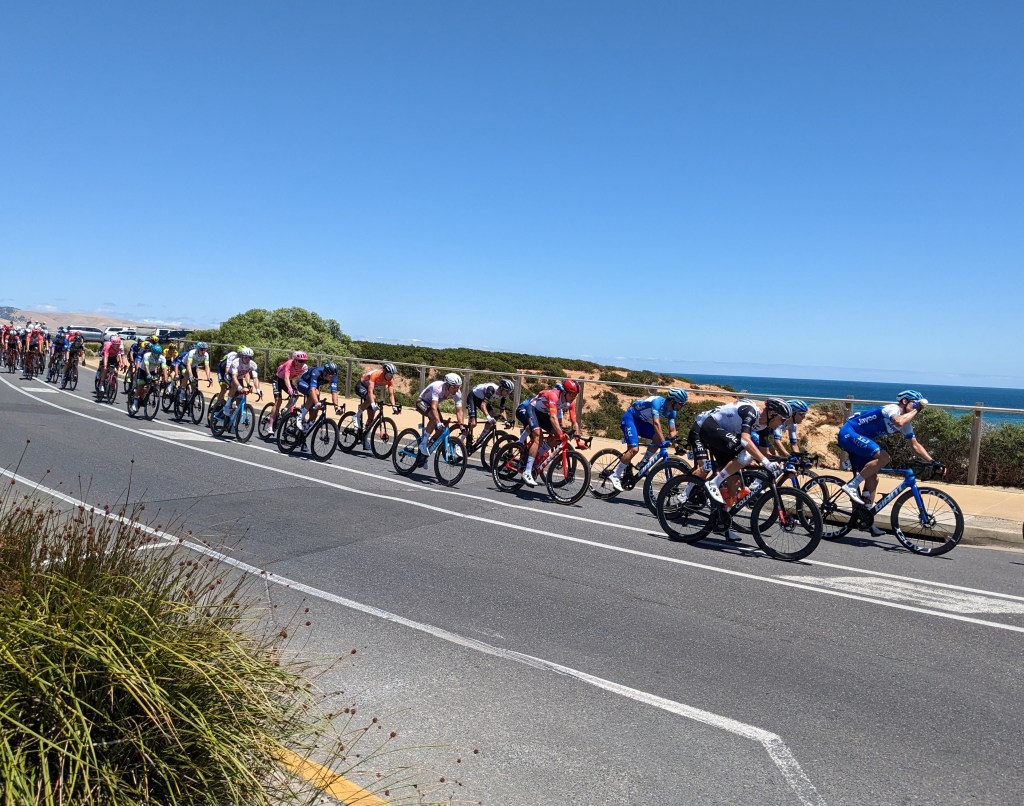
We glanced at the woman in the orange vest, hoping she would let us pass. She was on her walkie talkie and shook her head at us. Soon another group of cyclists raced past. Then the woman let us on to the Esplanade and we headed south. Soon after we were stopped by a police officer on a bicycle, who directed us away from the Esplanade. We turned east to weave our way back to our original route.

“We won’t make it to the ferry on time!” complained Alex, pressing heavily on the accelerator.

We arrived back on the highway that we had originally departed from and tried to turn right so that we could head south to Cape Jervis. A line of cars from the north were trying to turn right into our street.

“We’ll be here for hours. Best turn left and then do a U-turn,” announced Alex.

Alex turned left, accelerated, and braked when he found a gap in the oncoming traffic. He quickly did a U-turn and then headed south, passing the line of cars waiting to turn right onto the road where we had been waiting.

Would all of this be in vain? Would we get to Cape Jervis just after 3 pm to watch the ferry departing, on its way to Penneshaw? I held my phone to check the distance to Cape Jervis and noted that the estimated time of arrival was 2.54 pm. Alex tried to make up time by driving to the speed limit. A truck was labouring up the hill in front of us. Alex waited until we reached a passing lane, and then floored the accelerator. The estimated time of arrival was now 2.52 pm. Sitting next to Alex as he sped along the highway was more exciting than rides on a fairground had been when I was a child. I trusted his judgment and felt safe all the while enjoying the exhilarating speed. Next, there was a red car dawdling in front of us. Again, Alex waited until we reached a passing lane, and overtook them. The estimated time of arrival was still 2.52 pm. At least we had not been losing time as we were delayed by the slow coaches ahead of us. We entered the township of Cape Jervis, rounded the hill, and then descended to the ferry port, arriving as predicted at 2.52 pm. We expected boarding to be well underway. Instead, four lanes of cars were waiting in the line-up to board the empty ferry, which was running late. We slid into the shortest lane and turned off the engine. A biosecurity officer approached Alex’ window, his curly auburn ponytail blowing in the wind. Alex wound down the car window.

“Do you live on Kangaroo Island or are you just visiting?” he asked.

“We’re just visiting.”

“Oh, lovely! Do you have any honey?”

“No honey.”

“Do you have any bee-keeping equipment?”

“No, definitely not.”

“How about fruit?”

“We have some apples.”

“Are they from the supermarket?”

“Yes.”

“Where did you buy them?”

“In Adelaide.”

“How about potatoes?”

“No.”

“Do you have any plants?”

“We have some caper plants in the back.”

He looked at the back of our vehicle in acknowledgement.

“Oh capers! They look nice. Where did you get them?”

“From a business in Port Adelaide.”

The biosecurity officer seemed satisfied and waved us on.

“Have a lovely trip!”

Shortly after we boarded the 45-minute ferry for Penneshaw. We had been asked more biosecurity questions than at any other place on our travels, and we hadn’t even left our home state. I yearned for the ease of passing through immigration at Gatwick Airport. I had felt perversely miffed at Gatwick for having been ignored by immigration and customs officials.

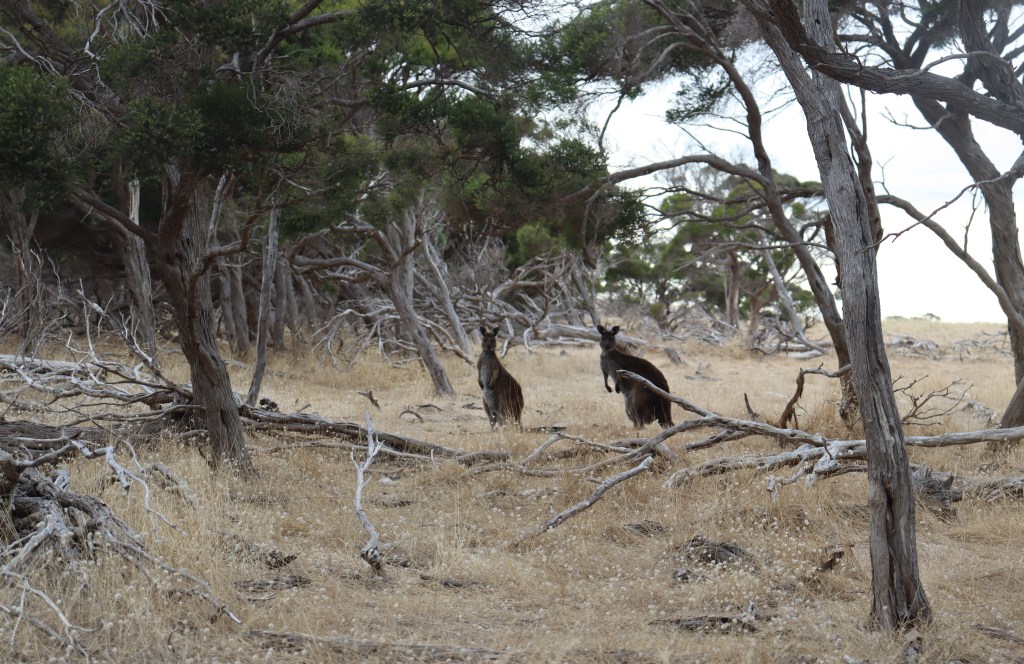
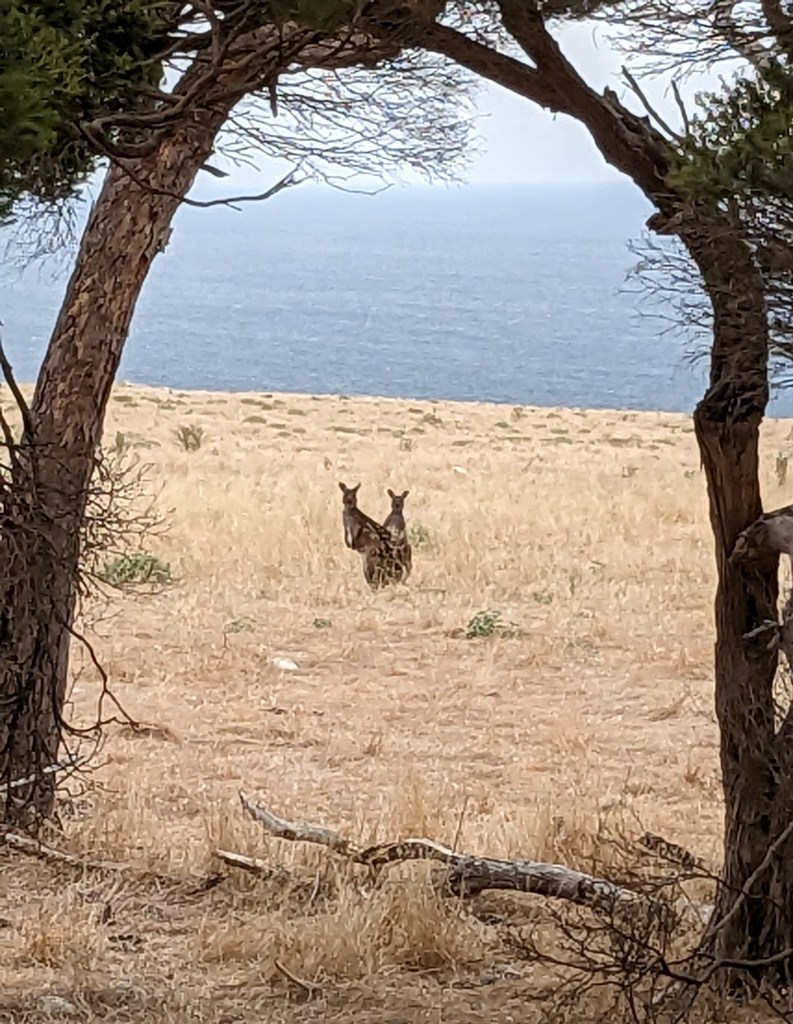
No sooner had we arrived at our destination though, did we spot a marvellous mob of kangaroos bounding across the property.
Then the following day we had a charming encounter with a Rosenberg’s Monitor looking for a drink of water – a species that is endangered on the mainland.

Rosenberg’s monitor lizard

Verity later came across an elusive short-beaked echidna.
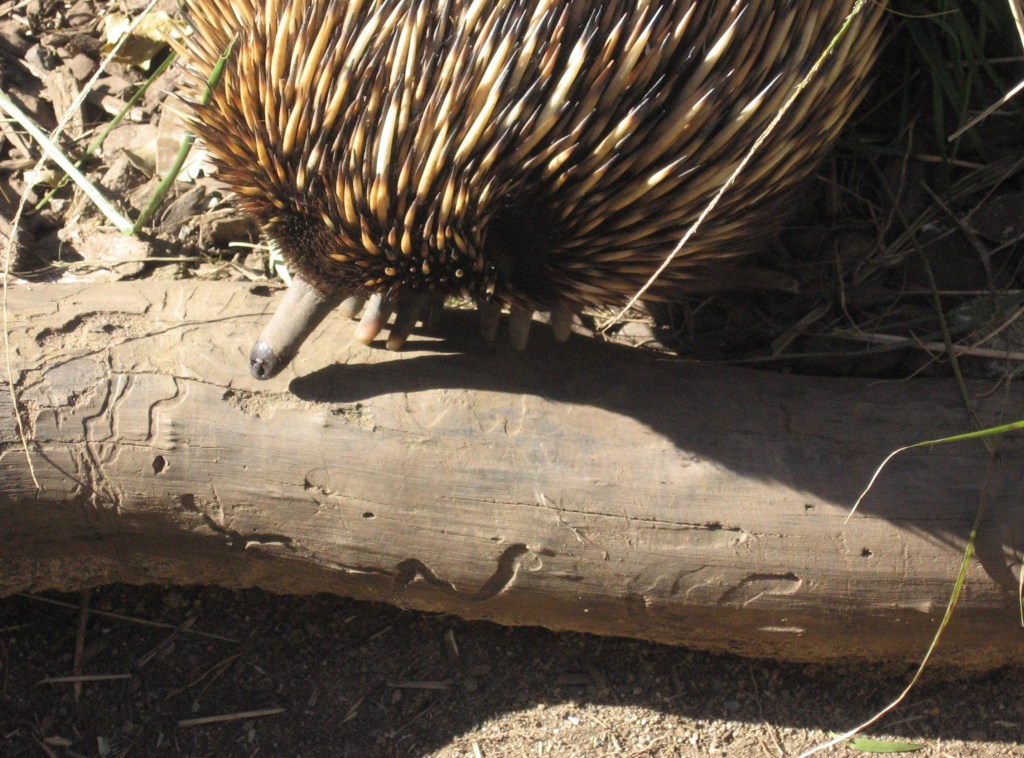
Short-beaked echidna

At last I could appreciate that protecting the fauna and flora of Kangaroo Island was important and necessary, and well worth the interrogations of a biosecurity officer.
Meredith Stephens is an applied linguist from South Australia. Her work has appeared in Transnational Literature, The Muse, The Font – A Literary Journal for Language Teachers, The Journal of Literature in Language Teaching, The Writers’ and Readers’ Magazine, Reading in a Foreign Language, and in chapters in anthologies published by Demeter Press, Canada.

PLEASE NOTE: ARTICLES CAN ONLY BE REPRODUCED IN OTHER SITES WITH DUE ACKNOWLEDGEMENT TO BORDERLESS JOURNAL

Click here to access the Borderless anthology, Monalisa No Longer Smiles

Categories
Editorial

Will Monalisa Smile Again?

The first month of 2023 has been one of the most exciting! Our first book, Monalisa No Longer Smiles: An Anthology of Writings from across the World, is now in multiple bookstores in India (including Midlands and Om Bookstores). It has also had multiple launches in Delhi and been part of a festival.

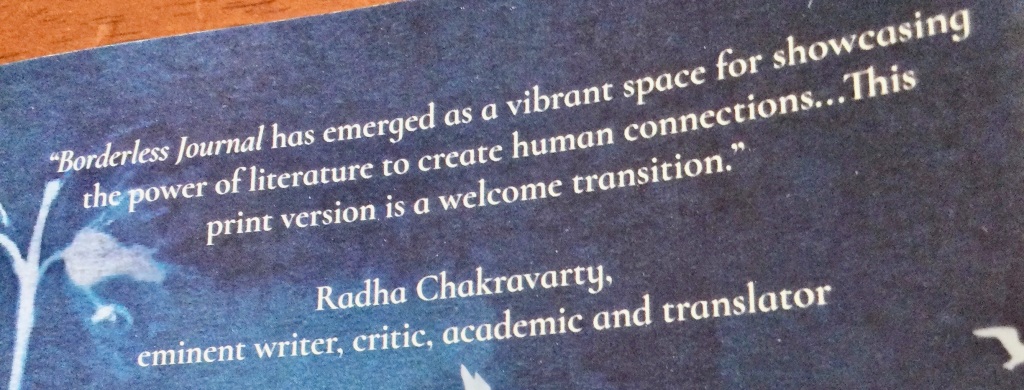
We, Meenakshi Malhotra and I, were privileged to be together at the physical book events. We met the editor in chief of Om Books International, Shantanu Ray Chaudhuri, the editor of our anthology, Jyotsna Mehta, along with two translators and writers I most admire, Aruna Chakravarti and Radha Chakravarty, who also graced a panel discussion on the anthology during our physical book launch. The earlier e-book launch had been in November 2022. My heartfelt thanks to the two eminent translators and Chaudhuri for being part of the discussions at both these launches. Chaudhuri was also in the panel along with Debraj Mookerjee at a launch organised by Malhotra and the English Literary Society steered by Nabaneeta Choudhury at Hans Raj College, Delhi University. An energising, interactive session with students and faculty where we discussed traditional and online publishing, we are immensely grateful to Malhotra for actively organising the event and to the Pandies’ founder, Sanjay Kumar, for joining us for the discussion. It was wonderful to interact with young minds. On the same day, an online discussion on the poetry in Monalisa No Longer Smiles was released by the Pragati Vichar Literary Festival (PVLF) in Delhi.

At the PVLF session, I met an interesting contemporary diplomat cum poet, Abhay K. He has translated Kalidasa’s Meghaduta and the Ritusamhara from Sanskrit and then written a long poem based on these, called Monsoon. We are hosting a conversation with him and are carrying book excerpts from Monsoon, a poem that is part of the curriculum in Harvard. The other book excerpt is from Sanjay Kumar’s Performing, Teaching and Writing Theatre: Exploring Play, a book that has just been published by the Cambridge University Press.

Perhaps because it is nearing the Republic Day of India, we seem to have a flurry of book reviews that reflect the Sub-continental struggle for Independence from the colonials. Somdatta Mandal has reviewed Priya Hajela’s Ladies Tailor: A novel, a book that takes us back to the trauma of the Partition that killed nearly 200,000 to 2 million people – the counts are uncertain. Bhaskar Parichha has discussed MA Sreenivasan’s Of the Raj, Maharajas and Me, a biography of a long serving official in the Raj era — two different perspectives of the same period. Rakhi Dalal has shared her views on Shrinivas Vaidya’s A Handful of Sesame, translated from Kannada by Maithreyi Karnoor, a book that dwells on an immigrant to the Southern part of India in the same time period. The legendary film writer K.A. Abbas’s Sone Chandi Ke Buth: Writings on Cinema, translated and edited by Syeda Hameed and Sukhpreet Kahlon, has been praised by Gracy Samjetsabam.

We have a piece on mental health in cinema by Chaudhuri, an excellent essay written after interviewing specialists in the field. Ratnottama Sengupta has given us a vibrant piece on Suhas Roy, an artist who overrides the bounds of East and West to create art that touches the heart. Candice Louisa Daquin has written on border controls and migrants in America. High profile immigrants have also been the subject of Farouk Gulsara’s ‘What do Freddy Mercury, Rishi Sunak & Mississipi Masala have in Common?’ Sengupta also writes of her immigrant family, including her father, eminent writer, Nabendu Ghosh, who moved from Bengal during the Partition. There are a number of travel pieces across the world by Ravi Shankar, Meredith Stephens and Mike Smith — each written in distinctively different styles and exploring different areas on our beautiful Earth. Sarpreet Kaur has revisited the devastation of the 2004 tsunami and wonders if it is a backlash from nature. Could it be really that?

Suzanne Kamata gives us a glimpse of the education system in Japan in her column with a humorous overtone. Devraj Singh Kalsi dwells on the need for nostalgia with a tongue-in-cheek approach. Rhys Hughes makes us rollick with laughter when he talks of his trip to Kerala and yet there is no derision, perhaps, even a sense of admiration in the tone. Hughes poetry also revels in humour. We have wonderful poetry from Jared Carter, Ranu Uniyal, Asad Latif, Anaya Sarkar, Michael R Burch, Scott Thomas Outlar, Priyanka Panwar, George Freek and many more.

The flavours of cultures is enhanced by the translation of Nazrul’s inspirational poetry by Professor Fakrul Alam, Korean poetry written and translated by Ihlwha Choi and a transcreation of Tagore’s poem Banshi (or flute) which explores the theme of inspiration and the muse. We have a story by S Ramakrishnan translated from Tamil by R Sathish. The short stories featured at the start of this year startle with their content. Salini Vineeth writes a story set in the future and Paul Mirabile tells the gripping poignant tale of a strange child.

With these and more, we welcome you to savour the January 2023 edition of Borderless, which has been delayed a bit as we were busy with the book events for our first anthology. I am truly grateful to all those who arranged the discussions and hosted us, especially Ruchika Khanna, Om Books International, the English Literary Society of Hans Raj College and to the attendees of the event. My heartfelt thanks to the indefatigable team and our wonderful writers, artists and readers, without who this journey would have remained incomplete. Special thanks to Sohana Manzoor for her artwork. Many thanks to the readers of Borderless Journal and Monalisa No Longer Smiles. I hope you will find the book to your liking. We have made a special page for all comments and reviews.

I wish you a wonderful 2023. Let us make a New Year’s wish —

May all wars and conflicts end so that our iconic Monalisa can start smiling again!

Mitali Chakravarty,

borderlessjournal.com

.

Photographs of events around Monalisa No Longer Smiles: An Anthology of Writings from across the World. Click here to access the Book.

.

Insta Link to an excerpt of the launch at Om Bookstore. Click here to view.

E-Launch of the first anthology of Borderless Journal, November 14th 2022. Click here to view.

Categories
Slices from Life

Sails, Whales, and Whimsical Winds

Photographs & Narrative by Meredith Stephens

It was June, and we were sailing north along the coast of New South Wales. We arrived at Hacking Bay to weigh anchor at sunset, and later fell asleep to the gently rocking motion of the boat. The following day, Alex made an early start up the coast before I roused. In anticipation of rough waters, he brought me an anti-seasickness pill and a glass of water. After lying there in my cabin for half an hour, I heard Alex uncharacteristically utter an expletive. I knew I couldn’t stay in bed any longer.

“There’s a tear in my mainsail!”

“What now?”

“We can’t get to Pittwater today. We have to find a sailmaker as soon as we can.”

Alex rang his sailor friend Luke who put him on to a competent sailmaker. We had just passed Botany Bay near where the sailmaker worked, so had to turn around in rough waters and motor upwind back to the bay.

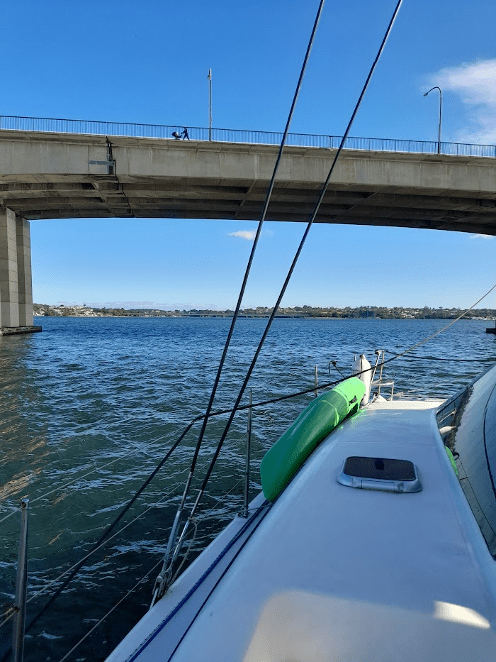
Soon after entering the bay into the St George Estuary we spotted the Captain Cook Bridge looming ahead of us. Would the mast clear the underside of the bridge? We gently and carefully started moving under the bridge. As we passed under it, we noticed the VHF antenna on top of the mast bending while scraping the underside of the bridge, so we reversed as quickly as we could and decided to wait nearby until low tide. After finding out the precise time of low tide we tentatively approached the bridge again, Alex all the while craning his head upwards and to the side of the helm to find the high point of the bridge. The VHF barely tickled the bridge, and we made it to the other side.

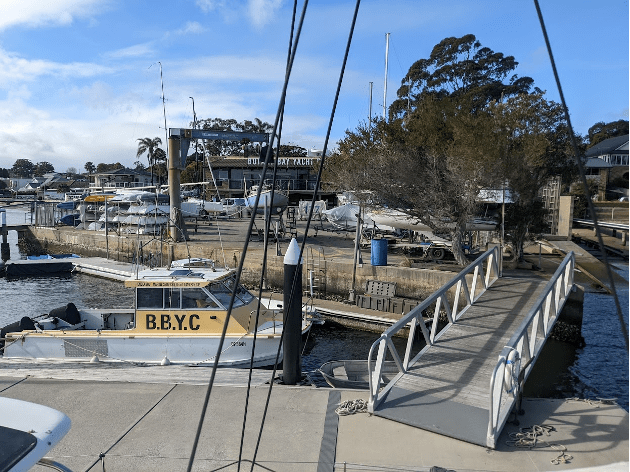
Then we navigated the boats dotted around the harbour while we made our way to the wharf. Shipwrights working there approached the berth and greeted us warmly. We threw them the docking lines and they expertly tied them to the cleats. The sailmaker arrived soon after to take the sail away for repair. We entreated him to have it ready before low tide the following day so we could pass back under the bridge and avoid being trapped another day.

We had twenty-four hours to pass in the Sans Souci neighbourhood and spent most of our time strolling along the pedestrian path by Botany Bay. Upon our return to the boatyard, the gates were locked, and we could not access the boat. Alex spied a metal ladder lying in the boat yard. He pulled it under a gap in the base of the fence and laid it against it. We climbed up and stepped onto one of the boats on the other side, and then lowered ourselves onto the ground. I ruefully thought that this was something only teenagers would do, but here we were in our sixties, using a ladder to enter a locked property.

The next morning the sailmaker arrived in good time and we heaved the sail back onto the boat. Alex raised the sail and looked pleased with the neat patch.

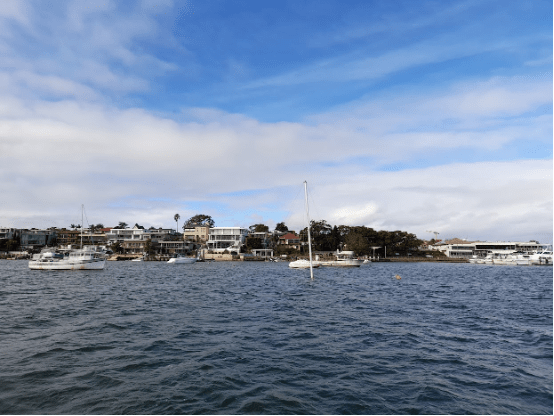
We waited until low tide, and then wove our way once more through the moored boats, even passing a sunken boat with its mast protruding through the surface of the water.

We precisely timed our passing under the bridge to low tide. As before, Alex proceeded under the highest point of the bridge.

We were exhilarated to have timed the low tide accurately and to have passed under the bridge with only the tip of the VHF antenna having gently grazed its underbelly. We exited the bay in relief and headed back to the Tasman Sea, turning back north to resume our trip up the coast.

Over the next few days, we enjoyed fair conditions for winter sailing. Sailing downwind was like floating in space. The boat cantered across the surface of the water but we had the sensation of being gently propelled through the air.

“This wind is a bit whimsical,” complained Alex, as he moved to the helm to turn on the engine.

“We are approaching Ballina so I have to keep an eye out for…”

“Whales?” I interrupted.

“No, craypots. There might be whales too, though.”

Alex scrutinized the horizon, shivering in his wet weather gear, searching for unforeseen objects.

The name of the town, Ballina, reminded me of the word for ‘whale’ in French:  une baleine. In fact, the name has nothing to do with whales. Rather it was probably named after the Irish town of the same name.

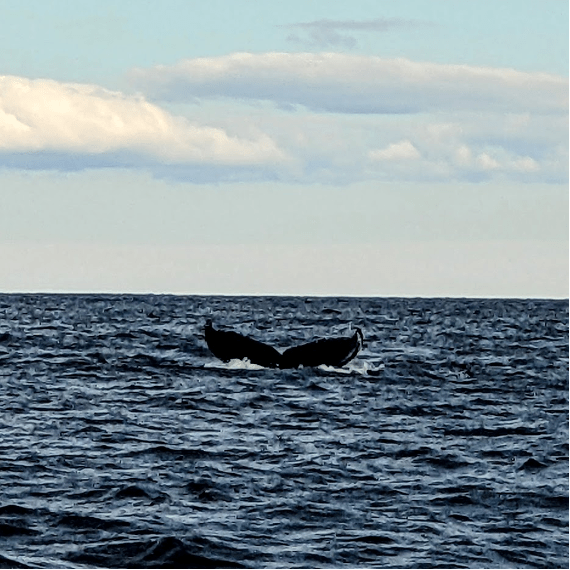
Whale sightings were the highlight of our voyage as we sailed north up the coast of New South Wales. They had migrated from the Antarctica for calving. These were my reward when it was my stint at the helm. Sitting still and observing did not come easily to me. Usually, I liked to busy myself with errands, reading, writing or socialising. I gradually became used to sitting at the helm for hours at a time trying to remain vigilant to spot obstacles to our path. One such day I was sitting there, sensing the swell of the ocean gently rocking beneath me as I held my posture erect, listening to the swishing of the water against the hull, when I was suddenly shocked out of my trance by a spout of water erupting from the ocean surface. Waves do not erupt horizontally so it held my attention. Then I saw a whale throw herself into the air to somersault, and then reveal her fluke as she dived back in again.

“Alex!” I screamed, uncharacteristically, surprising even myself.

It was like being transported to a film set. Alex sensed my excitement and came out with his phone camera, moving to the bow to get as close as he could.

“They’re only a hundred metres away,” he observed.

They performed another flip for us, and flashed their flukes as they dived down. We kept scanning the patch of ocean where they had given their performance, but they did not reappear. I retreated to the helm and then turned around as I heard another splash behind me. The boat had moved on, and the whales were making a reappearance in their original spot.

The trials of seasickness, straining to keep alert while on duty, and sail damage were more than compensated for in the unanticipated sight of a whale breaching before my eyes. All the hardships dimmed in those moments of awe.

Meredith Stephens is an applied linguist from South Australia. Her work has appeared in Transnational Literature, The Muse, The Font – A Literary Journal for Language Teachers, The Journal of Literature in Language Teaching, The Writers’ and Readers’ Magazine, Reading in a Foreign Language, and in chapters in anthologies published by Demeter Press, Canada.

PLEASE NOTE: ARTICLES CAN ONLY BE REPRODUCED IN OTHER SITES WITH DUE ACKNOWLEDGEMENT TO BORDERLESS JOURNAL

Click here to access the Borderless anthology, Monalisa No Longer Smiles

Categories
Contents

Borderless, December 2022

Art by Sohana Manzoor

Editorial

It’s Only Hope… Click here to read.

Conversations

Shantanu Ray Chaudhari converses with writer Gajra Kottary, a well-known writer of Indian TV series, novels and stories. Click here to read.

A discussion on Samaresh Bose’s In Search of the Pitcher of Nectar, a book that takes us to the heart of the Kumbh Mela, a festival recognised by the UNESCO as an Intangible Cultural Heritage, with the translator, Nirmal Kanti Bhattacharjee. Click here to read.

Translations

Nazrul’s Why Provide Thorns has been translated by Professor Fakrul Alam. Click here to read.

Mercy, a story be P. F. Mathews, has been translated from Malayalam by Ram Anantharaman. Click here to read.

Even A Simurgh Cannot Change Destiny, a Balochi folktale translated and retold by Fazal Baloch. Click here to read.

Confessions, a poem written by and translated from Korean by Ihlwha Choi. Click here to read.

The Sun on the First Day, a translation of Tagore’s Prothom Diner Shurjo by Mitali Chakravarty. Click here to read.

Pandies’ Corner

Songs of Freedom: Vikalangta or Disability is an autobiographical narrative by Kajal, translated from Hindustani by Janees. These narrations highlight the ongoing struggle against debilitating rigid boundaries drawn by societal norms, with the support from organisations like Shaktishalini and Pandies. Click here to read.

Poetry

Click on the names to read

Jared Carter, Sukrita Paul Kumar, Rhys Hughes, Asad Latif, Luis Cuauhtémoc Berriozábal, Santosh Bakaya, Phil Wood, Sharanya B, George Freek, Saibal Chatterjee, Jonathan Chan, Sutputra Radheye, Shambhu Nath Banerjee, Michael Burch

Poets, Poetry & Rhys Hughes

In Some Differences Between Wales and India, Rhys Hughes makes some hilarious comparisons. Click here to read.

Musings/ Slices from Life

Near-Life Experiences: Hiking in New Zealand

Keith Lyons escapes city life to find his happy place while hiking in New Zealand. Click here to read.

The Seven Grandfather Teachings

Saeed Ibrahim introduces us to Native Indian lore from Canada and shows its relevance in the current times. Click here to read.

Dismasted in Bass Strait

Meredith Stephens takes us for a sailing adventure with photographs in the Southern Hemisphere. Click here to read.

Musings of a Copywriter

In Of Mice & Men, Devraj Singh Kalsi talks of his encounters with rats. Click here to read.

Notes from Japan

In A Clean Start, Suzanne Kamata tells us how the Japanese usher in a new year. Click here to read.

Stories

Annapurna Bhavan

Lakshmi Kannan closes class divides in Chennai over a meal. Click here to read.

Two Faces of a Mirror

Tulip Chowdhury gives us a story set in a Bangladeshi village. Click here to read.

The Slip

Sushma R Doshi takes a look at the pandemic against an Indian middle-class set up. Click here to read.

Till Life Do Us Part

Devraj Singh Kalsi explores a strange new trend. Click here to read.

Essays

Orangutans & a School at Sarawak

Christina Yin, a conservationist, travels to Borneo in an attempt to create awareness for conserving the Orangutan. Click here to read.

Taiping of the Raj Era

Ravi Shankar explores Taiping in Malaysia with a camera and words. Click here to read.

Ivory Ivy & Stephen Dedalus

Paul Mirabile explores James Joyce’s Stephen Dedalus and his passion for words keeping in mind the hundred year old Ulysees & the even older, A Portrait of the Artists as a Young Man. Click here to read.

Book Excerpts

An excerpt from Radha Chakravarty’s translation of Tagore’s Farewell Song. Click here to read.

An excerpt or two short narratives from Rhys Hughes’ Yule Do Nicley. Click here to read.

Book Reviews

Somdatta Mandal reviews The Shaping of Modern Calcutta: The Lottery Committee Years, 1817 – 1830 by Ranabir Ray Chaudhury. Click here to read.

Rakhi Dalal reviews Freny Manecksha’s Flaming Forest, Wounded Valley: Stories from Bastar and Kashmir. Click here to read.

Basudhara Roy reviews Manoranjan Byapari’s How I Became a Writer: An Autobiography of a Dalit. Click here to read.

Bhaskar Parichha reviews In Search of the Divine: Living Histories of Sufism in India by Rana Safvi. Click here to read.

.

Click here to access the Borderless anthology, Monalisa No Longer Smiles

You are all welcome to the book talks of our first anthology

Categories
Editorial

Its Only Hope…

Painting by Sybil Pretious

New year, like a newborn, starts with hope.

The next year will do the same – we will all celebrate with Auld Lang Syne and look forward to a resolution of conflicts that reared a frightening face in 2022 and 2021. Perhaps, this time, if we have learnt from history, there will not be any annihilation but only a movement towards resolution. We have more or less tackled the pandemic and are regaining health despite the setbacks and disputes. There could be more outbreaks but unlike in the past, this time we are geared for it. That a third World War did not break out despite provocation and varied opinions, makes me feel we have really learnt from history.

That sounds almost like the voice of hope. This year was a landmark for Borderless Journal. As an online journal, we found a footing in the hardcopy world with our own anthology, Monalisa No Longer Smiles: Writings from Across the World, which had a wonderful e-launch hosted by our very well-established and supportive publisher, Om Books International. And now, it is in Om Book Shops across all of India. It will soon be on Amazon International. We also look forward to more anthologies that will create a dialogue on our values through different themes and maybe, just maybe, some more will agree with the need for a world that unites in clouds of ideas to take us forward to a future filled with love, hope and tolerance.

One of the themes of our journal has been reaching out for voices that speak for people. The eminent film critic and editor, Shantanu Ray Chaudhuri , has shared a conversation with such a person, the famed Gajra Kottary, a well-known writer of Indian TV series, novels and stories. The other conversation is with Nirmal Kanti Bhattajarchee, the translator of Samaresh Bose’s In Search of a Pitcher of Nectar, a book describing the Kumbh-mela, that in 2017 was declared to be an Intangible Cultural Heritage of Humanity by UNESCO. Bhattacharjee tells us how the festival has grown and improved in organisation from the time the author described a stampede that concluded the festivities. Life only gets better moving forward in time, despite events that terrorise with darkness. Facing fear and overcoming it does give a great sense of achievement.

Perhaps, that is what Freny Manecksha felt when she came up with a non-fiction called Flaming Forest, Wounded Valley: Stories from Bastar and Kashmir, which has been reviewed by Rakhi Dalal. Basudhara Roy has also tuned in with a voice that struggled to be heard as she discusses Manoranjan Byapari’s How I Became a Writer: An Autobiography of a Dalit. Somdatta Mandal has reviewed The Shaping of Modern Calcutta: The Lottery Committee Years, 1817 – 1830 by Ranabir Ray Chaudhury, a book that explores how a lottery was used by the colonials to develop the city. Bhaskar Parichha has poured a healing balm on dissensions with his exploration of Rana Safvi’s In Search of the Divine: Living Histories of Sufism in India as he concludes: “Weaving together facts and popular legends, ancient histories and living traditions, this unique treatise running into more than four hundred pages examines core Sufi beliefs and uncovers why they might offer hope for the future.”

In keeping with the festive season is our book excerpt from Rhys Hughes’ funny stories in his Christmas collection, Yule Do Nicely. Radha Chakravarty who brings many greats from Bengal to Anglophone readers shared an excerpt – a discussion on love — from her translation of Tagore’s novel, Farewell Song.

Love for words becomes the subject of Paul Mirabile’s essay on James Joyce’s Stephen Dedalus, where he touches on both A Portrait of the Artist as a young Man and  Ulysees, a novel that completed a century this year. Love for animals, especially orangutans, colours Christina Yin’s essay on conservation efforts in Borneo while Keith Lyons finds peace and an overwhelming sense of well-being during a hike in New Zealand. Ravi Shankar takes us to the historical town of Taiping in Malaysia as Meredith Stephens shares more sailing adventures in the Southern hemisphere, where it is summer. Saeed Ibrahim instils the seasonal goodwill with native Indian lores from Canada and Suzanne Kamata tells us how the Japanese usher in the New Year with a semi-humorous undertone.

Humour in non-fiction is brought in by Devraj Singh Kalsi’s ‘Of Mice and Men’ and in poetry by Santosh Bakaya. Laughter is stretched further by the inimitable Rhys Hughes in his poetry and column, where he reflects on his experiences in India and Wales. We have exquisite poetry by Jared Carter, Sukrita Paul Kumar, Asad Latif, Luis Cuauhtémoc Berriozábal, Michael R Burch, Sutputra Radheye, George Freek, Jonathan Chan and many more. Short stories by Lakshmi Kannan, Devraj Singh Kalsi, Tulip Chowdhury and Sushma R Doshi lace narratives with love, humour and a wry look at life as it is. The most amazing story comes from Kajal who pours out the story of her own battle in ‘Vikalangta or Disability‘ in Pandies’ Corner, translated from Hindustani by Janees.

Also touching and yet almost embracing the school of Absurd is PF Mathew’s story, ‘Mercy‘, translated from Malayalam by Ram Anantharaman. Fazal Baloch has brought us a Balochi folktale and Ihlwha Choi has translated his own poem from Korean to English. One of Tagore’s last poems, Prothom Diner Shurjo, translated as ‘The Sun on the First Day’ is short but philosophical and gives us a glimpse into his inner world. Professor Fakrul Alam shares with us the lyrics of a Nazrul song which is deeply spiritual by translating it into English from Bengali.

A huge thanks to all our contributors and readers, to the fabulous Borderless team without who the journal would be lost. Sohana Manzoor’s wonderful artwork continues to capture the mood of the season. Thanks to Sybil Pretious for her lovely painting. Please pause by our contents’ page to find what has not been covered in this note.

We wish you all a wonderful festive season.

Season’s Greetings from all of us at Borderless Journal.

Cheers!

Mitali Chakravarty

borderlessjournal.com

.

Click here to access the Borderless anthology, Monalisa No Longer Smiles

Categories
Slices from Life

Dismasted in Bass Strait

A real-life sailing adventure with photographs by Meredith Stephens

After an arduous day of upwind sailing from Bittangabee Bay on the east coast of Australia to Nadgee Beach we crept into our cabin beds at 9 pm. A few minutes after midnight, crew member Katie suddenly roused to a bright light and looked out of the window. She observed a boat moving towards her, first coloured lights and then a white light. Katie jumped out of bed screaming “He’s gonna hit us!” Then she heard the sound of the crunching of metal against our hull. Skipper Alex got up and blasted his air horn. The neighbouring skipper moved his boat around so he could talk to us. Crew member Verity screamed in terror “Go away!”

Alex called out across the water to the other skipper.

“I can’t see how much damage there is now. What’s your phone number?”

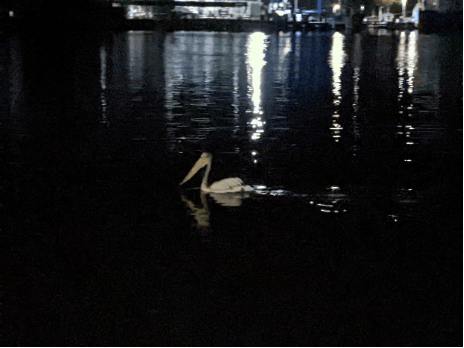
The skipper called his number across from his boat and set off on his midnight voyage. We were not due to sail out until 3 am when the conditions were predicted to become favourable, but we were so shocked at having been hit by another vessel that we could no longer rest. We decided to set out immediately. We headed to an anchorage at the uninhabited Gabo Island, dropped anchor, and slept from 3 am until 6 am. Then Alex roused himself and dutifully took himself to the helm, turned on the motor, raised the anchor and started the anticipated fourteen-hour voyage to Lakes Entrance. Ninety-nine nautical miles later, at 9.50 pm, we arrived at a free public dock, and were greeted by pelicans. Katie alighted onto the dock and secured the lines to cleats and returned to the boat. All crew members slipped into a grateful rest despite the harsh lights of the dock penetrating through the hatches.

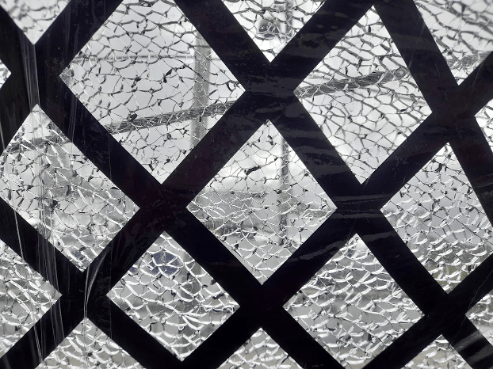
After a day ashore to rest and reprovision, we set off the following day at seven am. We had an uneventful sail until 10.30 pm when the halyard[1] to the gennaker[2] snapped. The gennaker trailed in the water between the hulls and Alex retrieved it, replacing it with the jib[3]. I trusted Alex with sails and halyards, and I could hardly keep my eyes open, so I retreated to my cabin and tried to sleep. Not for long though because I could hear Alex and Katie shouting to each other on the deck. My body was craving sleep, but I dared not succumb when there was obviously some sort of trouble. I had never heard Alex and Katie shout at each other. The only reason they were shouting must be in order to be heard over the wind on the deck. I forced myself out of the cabin bed and dropped from its formidable height which had been designed for much taller people. I made my way to the outside door, summoning the strength to venture outside and try and make myself useful, but the darkness, the wind and cold were intimidating. As I deliberated, I heard a crash. The front window had smashed into tiny pieces, which landed on the sofa and were scattered all over the floor. Alex was shouting from the deck, “The mast is down!” I glanced outside and noticed that the mast had landed on the portside deck, and several metres of its tip were trailing submerged behind the boat.

Meanwhile, the steering had been disrupted and the autopilot was no longer functioning. Alex tried to manually manoeuvre the boat to the right, but it would not respond, and he had to turn in circles to the left to attain the right direction. The mast dangling from our port stern was acting like a giant unwanted rudder. I glanced outside and noticed a fishing trawler about five hundred metres away on our portside. I alerted Alex and he was concerned that without steering we would inadvertently hit the trawler. He grabbed the VHF[4] radio and put out a warning on Channel 16 to alert them. No response. He tried again. Still no response. He gave up and returned to the deck in order to save the sails which were trailing us in the water. I remained inside and continued to try to make contact with the trawler, to no avail.

Then Alex realised that the VHF antenna was not working because it was at the end of the mast, which was now trailing in the water. He retrieved his hand-held VHF radio and tried to make contact again. This time the skipper of the trawler responded. They decided to stay close to us and then follow us, ready in case our situation deteriorated. We maintained radio contact with the other skipper until Alex managed to hoist some of the mast out of the water and regain autopilot control. At 3 am, we were confident that we could manage on our own, so we advised the other skipper and he took his leave. A stranger had obeyed the ancient maritime code to assist those in distress at sea, and we didn’t even know his name.

Alex headed for the aptly named Refuge Cove, but another vessel was sheltering there. He wanted a wide berth, so he was reluctant to stay near another boat in case we inadvertently swung into them. He took us on to Waterloo Bay, three nautical miles further. We moved deep into the bay over the next hour and arrived at a sufficiently sheltered spot to drop anchor at 10 am.

For the first time, Alex was able to carefully inspect the damage and was shocked to discover that the cross-beam[5] was broken in half and dangling precariously. This made it too risky to use the main anchor. Alex used a spare anchor instead. By this time, he had been awake for twenty-eight hours, so, we urged him to sleep.

“I think I’ll just tidy up the sails a bit before I sleep,” he insisted.

I also ventured onto the deck to help Alex and noticed the crashed mast, and the cross-beam which looked dented but had in fact snapped in half. Alex and Katie bound up the sails with ropes so as to keep them from falling into the water for the next leg of our trip. My hair was blown into knots around my face and the fierce Australian sunshine was forcing its way into my eyes. I briefly retreated inside to restrain my hair with a scarf and returned to the deck to see Alex and Katie persisting in the cold wind. I was barefoot as this was the best way to grip to the surface of the gently rocking vessel. As I gingerly walked towards Alex and Katie, I noticed shards of glass in front of me. Katie called out in warning, and I retreated. She pointed out the safe way to climb towards them and I trod in that direction, mindful not to fall. Next Alex took the dinghy to the tip of the mast to remove dangling lines and the still-attached jib.

I glanced up and noticed pristine white sands, turquoise waters, craggy mountains and even a few bathers who had obviously hiked here. There were no roads leading to this beach deep within a national park.

We spent the next day tidying up both the topside and the inside of the boat, in particular picking the scattered glass shards. Alex needed a block of wood to secure the mast, so we headed to shore to find one. If we were on holiday this beach would have been ideal. No-one was here, but there were deep footprints in the coarsely grained sand. We walked to the end of this idyllic beach, and I collected shells. Meanwhile, Alex found the perfect sized piece of wood.

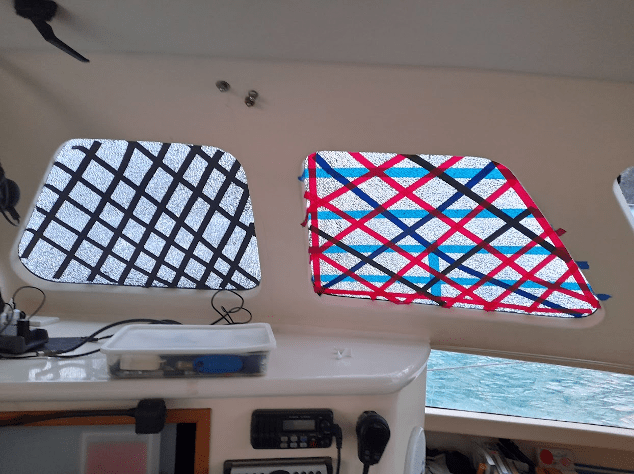
We returned to the boat for a few hours of relaxation before setting off for the night sail at 11 pm. Alex had chosen this time because the sea was predicted to be at its calmest over the next twenty-four hours. Before departing, Alex placed the block of wood under the mast to create a pivot point and winched the mast up to ensure it was completely clear of the water and would not drag. I was standing in the saloon as Alex adjusted one of the winches securing the mast, and suddenly heard a cracking noise. A third window shattered. We searched for duct tape to secure the window, but our stores had been depleted. Instead, we used electrical tape, and Katie, who happened to be an artist, taped across the windows until they had the criss-cross design of Tudor windows.

I was nervous about sailing off again into the dark ocean. Would the vessel be seaworthy? Would we be stuck in the dark waters distant from help? I had to rely on Alex’ judgment. I retreated to bed and noticed a bright light through the hatch in front of me.

“Is that a vessel ahead?” I urgently asked.

“No, that’s the moon!”

I peered myopically ahead and worked out that the large shining light ahead was the comforting moon and was shedding a kind light to guide us on the waters ahead.

Alex and Katie took charge of the vessel in the night to continue west along Bass Strait to Yaringa, the nearest marina that could host us. I could hear them calling out instructions to one another. The seas were not yet as calm as we had hoped, and Katie was worried. I didn’t know what to do and retreated to the security of my bed. Then I heard another shattering of glass. A fourth window cracked, and this time Alex was the one to use what little tape we had to secure it in a criss-cross pattern.

Alex and Katie took turns overnight to keep watch. I woke to daylight and the sea was calm. The vessel gently rocked as we cruised along Bass Strait, now powered by motor rather than sail. Finally we entered the channel east of Phillip Island.

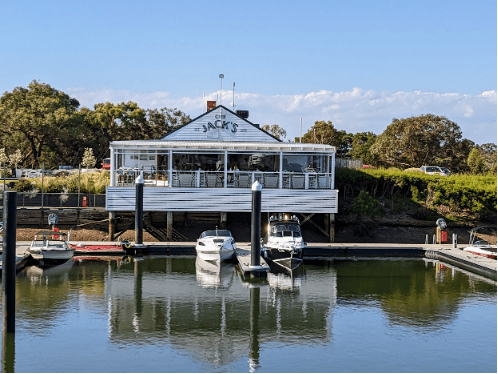
“The tide is in our favour. We are going to arrive early!” proclaimed Alex. “Shall I make a booking for dinner at the marina cafe?” he asked.

A resounding “Yay!” followed.

We followed the channel markers, passing small fishing vessels and a cruise ship. By 5.30 pm we arrived at Yaringa, and manoeuvred the vessel into the berth, all the while trying to prevent the mast, which was extending well beyond the boat, from hitting anything.

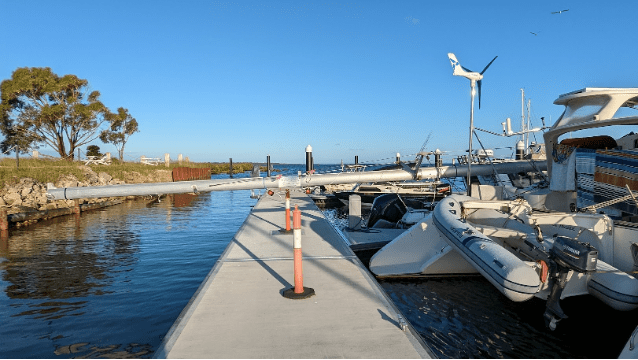
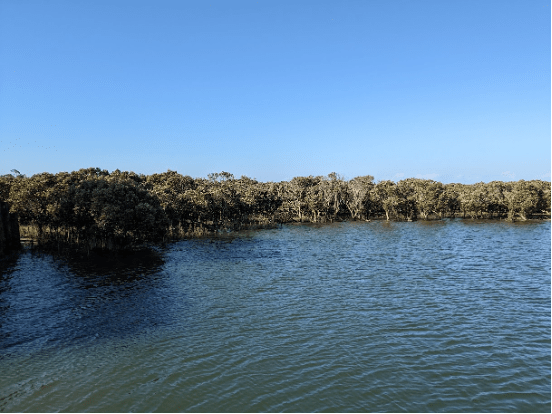
We had survived a fallen mast, four smashed windows, a broken cross beam and a disabled anchor, to arrive at the tranquility of a little-known marina at Yaringa, nestled in the mangroves on the outskirts of Melbourne. We gratefully stepped onto the pontoon, then walked ashore, savouring the sensation of terra firma. Even so, we were so used to the motion of the sea that we continued to sense the land itself rocking back and forth.

That night we enjoyed one of the best restaurant meals we have ever had, perhaps enhanced by our feelings of relief and gratitude.

We were in a quiet berth overlooking undisturbed mangroves. The boat was now motionless. There were no harsh overhead lights shining into our windows and the only ambient noise was birdsong. Alex had already contacted a shipwright and rigger who would attend to the damaged parts of the boat over the next months. We no longer needed to persevere sailing in darkness in a damaged vessel. In the relief of having reached safety, we fell into a well-deserved and deep sleep.


[1] A halyard is a rope that holds up a sail.

[2] A gennaker is a large sail attached to the bow used for sailing at right angles to the wind.

[3] The jib is a small sail set before the mast.

[4] Very High Frequency

[5] The cross-beam connects the two bows of a catamaran.

Meredith Stephens is an applied linguist from South Australia. Her work has appeared in Transnational Literature, The Muse, The Font – A Literary Journal for Language Teachers, The Journal of Literature in Language Teaching, The Writers’ and Readers’ Magazine, Reading in a Foreign Language, and in chapters in anthologies published by Demeter Press, Canada.

PLEASE NOTE: ARTICLES CAN ONLY BE REPRODUCED IN OTHER SITES WITH DUE ACKNOWLEDGEMENT TO BORDERLESS JOURNAL

Click here to access the Borderless anthology, Monalisa No Longer Smiles

Categories
Contents

Borderless, November 2022

Art by Sohana Manzoor

Editorial

We did it! … Announcing our first anthology … Monalisa No Longer Smiles… Click here to read.

Conversations

Suchen Christine Lim, an iconic writer from Singapore in conversation about her latest book, Dearest Intimate. Click here to read.

Blazing trails, as well as retracing the footsteps of great explorers, Christopher Winnan, a travel writer, delves into the past, and gazes into the future while conversing with Keith Lyons. Click here to read.

Translations

Rows of Betelnut Trees by My Window by Nazrul has been translated from Bengali by Professor Fakrul Alam. Click here to read.

A Day in the Life of the Pink Man is a story by Shankhadeep Bhattacharya, translated from Bengali by Rituparna Mukherjee. Click here to read.

The Clay Toys and The Two Boys is a story by Haneef Shareef, translated from Balochi by Fazal Baloch. Click here to read.

Saturday Afternoon is a poem by Ihlwha Choi, translated from Korean by the poet himself. Click here to read.

Tagore’s poem, Tomar Shonkho Dhulay Porey (your conch lies in the dust), has been translated from Bengali by Mitali Chakravarty as The Conch Calls. Click here to read.

Poetry

Click on the names to read

Jared Carter, Asad Latif, Rhys Hughes, Alpana, Mimi Bordeaux, Saranyan BV, Luis Cuauhtémoc Berriozábal, Quratulain Qureshi, Jim Bellamy, Sourav Sengupta, Ron Pickett, Davis Varghese, Ryan Quinn Flanagan, Jonathan Chan, Terry Trowbridge, Amrita Sharma, George Freek, Gayatri Majumdar, Michael R Burch

Poets, Poetry and Rhys Hughes

In Infinite Tiffin, Rhys Hughes gives an unusual short story centring around food and hunger. Click here to read.

Musings/Slices from Life

The Scream & Me

Prithvijeet Sinha writes of how Edvard Munch’s painting, The Scream, impacts him. Click here to read.

A Fine Sunset

Mike Smith travels with a book to a Scottish beach and walks in the footsteps of a well-know novelist. Click here to read.

The Death of a Doctor

Ravi Shankar mourns the loss of a friend and muses on mortality in his experience. Click here to read.

My Contagious Birthday Party

Meredith Stephens writes of her experience of Covid. Click here to read.

Dim Memories of the Festival of Lights

Farouk Gulsara takes a nostalgic trip to Deepavali celebrations in Malaysia. Click here to read.

Musings of a Copywriter

In Strumming Me Softly with His Guitar…, Devraj Singh Kalsi talks of his friends’s adventure with the guitar. Click here to read.

Notes from Japan

In Therese Schumacher and Nagayoshi Nagai: A Love Story, Suzanne Kamata introduces us to one of the first German women married to a Japanese scientist and their love story. Click here to read.

Essays

My Favourite Book by Fakrul Alam

The essay is a journey into Fakrul Alam’s evolution as a translator. Click here to read.

The Ultimate Genius of Kishore Kumar

Shantanu Ray Chaudhuri, an eminent film critic, writes on the legend of Kishore Kumar. Click here to read.

T.S Eliot’s The Waste Land: Finding Hope in Darkness

Dan Meloche muses on the century-old poem and its current relevance. Click here to read.

The Observant Immigrant

In Piano Board Keys, Candice Louisa Daquin talks of biracial issues. Click here to read.

Stories

The Funeral Attendee

Ravi Prakash shares the story of the life of a migrant in rural India. Click here to read.

A Letter I can Never Post

Monisha Raman unravels the past in a short narrative using the epistolary technique. Click here to read.

Red Moss at the Abbey of Saint Pons

Paul Mirabile takes us to St Pons Abbey in France in the fifteenth century. Click here to read.

You have lost your son!

Farhanaz Rabbani gives a light story with a twist that shuttles between Dhaka and Noakhali. Click here to read.

Book Excerpts

An Excerpt from Manoranjan Byapari’s How I Became a Writer: An Autobiography of a Dalit, translated from Bengali by Anurima Chanda. Click here to read.

An excerpt from Evening with a Sufi: Selected Poems by Afsar Mohammad, translated from Telugu by Afsar Mohammad & Shamala Gallagher. Click here to read.

Book Reviews

Reba Som has reviewed Aruna Chakravarti’s Through the Looking Glass: Stories. Click here to read.

Somdatta Mandal has reviewed Shehan Karunatilaka’s The Birth Lottery and Other Surprises. Click here to read.

Basudhara Roy has reviewed Afsar Mohammad’s Evening with a Sufi: Selected Poems, translated from Telugu by Afsar Mohammad and Shamala Gallagher. Click here to read.

Bhaskar Parichha has reviewed Rahul Ramagundam’s The Life and Times of George Fernandes. Click here to read.

Borderless Journal Anthology

Click here to access the Borderless anthology, Monalisa No Longer Smiles

Categories
Editorial

We Did It!

That good things happen despite darkness, despite prognostications of doom, that light glimmers hope if you strive to focus on your strength in hard times is borne true both in fiction and in life. Perhaps, we cannot get back the old ways (but is that what we want?) but new paths emerge. Old gives way to new. And while trying to gather pearls of human excellence — borne not of awards or degrees but of bringing out the best, the kindest, the most loving in human hearts — we managed to create with a team an outstanding anthology. Woven with the writings of old and new — we created a tapestry together that the editor in chief of our publishing house said was “classy, literary, engaging and international”. That one of the oldest and most reputed publishing houses in India with bookshops countrywide took it on was also an unusual event! We are truly grateful to Om Books International, Shantanu Ray Chaudhuri and Jyotsna Mehta along with all our writers and readers who made our anthology a reality, and to Radha Chakravarty and Fakrul Alam for the kind words they bestowed on our effort.

Click here to access the Borderless anthology, Monalisa No Longer Smiles

Please greet our first anthology, Monalisa No Longer Smiles, with love and friendship. It could be the perfect Christmas gift in the spirit of the season! And as the blurb says, “it will definitely bring a smile to your face because it is a celebration of the human spirit.”

The anthology is different from our journal in as much as it has a sample of an eclectic collection that has been honed with further editing and has some new features. Most of the writing is from our first year and showcases our ethos, except for Lesya’s poetry and interview. Lesya Bakun from Ukraine is still on the run, looking for a refuge — she cannot return home like you or I can. Her family is scattered across number of countries. Her cousin, who was guarding the factory at Azovstal, was taken prisoner. We included her story in the anthology hoping to create global empathy for refugees as the numbers will increase not only due to war but also due to climate change.

The reason we felt a hardcopy anthology was a good idea was because nothing beats the joy of having a bunch of interesting reads in the warmth of your hands (especially where internet cannot reach or is unavailable). In any case, books with the feel of paper, the rustling whispers which carry voices of leaves can never be replaced as Goutam Ghose had also said in his interview which is now part of our anthology.

And that is why we celebrate more books… this time we feature Singaporean prima donna of literature, Suchen Christine Lim, with her new book Dearest Intimate, a novel that spans more than hundred years including the harrowing Japanese invasion during World War II. She shared sound advice with writers: “Suffering is good for the writer. It will deepen lived experience and expand the heart’s empathy.” And perhaps that is what is echoed through the experiences of the other writer interviewed on our pages by Keith Lyons. This is a writer who not only brought out his own books but was a regular contributor of travel pieces for Frommer’s and National Geographic traveling to unexplored destinations — Christopher Winnan. Another writer Lyon had interviewed recently, Steve Carr, has passed on. We would like to convey our heartfelt condolences to his family and friends.

We have a number of books that have been reviewed. Reba Som reviewed Aruna Chakravarti’s Through the Looking Glass: Stories that span eras spread across time. Somdatta Mandal has reviewed Shehan Karunatilaka’s The Birth Lottery and Other Surprises and Bhaskar Parichha, Rahul Ramagundam’s The Life and Times of George Fernandes. Basudhara Roy has written of Afsar Mohammad’s Evening with a Sufi: Selected Poems, translated from Telugu by the poet and Shamala Gallagher, verses that again transcend borders and divides. We have an excerpt from the same book and another from Manoranjan Byapari’s How I Became a Writer: An Autobiography of a Dalit, translated from Bengali by Anurima Chanda.

More translations from Bengali, Balochi and Korean enrich our November edition. Fazal Baloch has translated a story by Haneef Shareef and Rituparna Mukherjee by Shankhadeep Bhattacharya. We have the translation of an inspirational Tagore poem helping us find courage (Shonkho Dhulaye Pore or ‘the conch lies in the dust’). Another such poem by Nazrul has been rendered in English from Bengali by Professor Fakrul Alam. He has also shared an autobiographical musing on how he started translating Tagore’s Gitabitan, which also happens to be his favourite book. More discussion on the literary persona of TS Eliot and the relevance of his hundred year old poem — ‘The Waste Land’ by Dan Meloche adds variety to our essay section.

Evoking the genius of another outstanding artiste, Kishore Kumar, who happened to pen thought provoking dialogues in some films, is Shantanu Ray Chaudhuri’s essay, review of a recent book on the legendary actor-singer and an interview with the authors. Infringing the boundaries of literary with popular culture and art and integrating all forms into a wholistic bundle has been part of our ethos. In that spirit we have a musing by Prithvijeet Sinha on Edvard Munch’s famous painting called Scream. We have non-fiction from Australia spanning Meredith Stephens’s recent brush with Covid, Mike Smith visits a Scottish beach in the footsteps of a novelist, Ravi Shankar has given us a poignant piece for a late friend and Candice Lousia Daquin talks of the existence of bi-racial biases. In contrast, Suzanne Kamata sent a narrative that bridges divides showcasing a German wife of a Japanese scientist that draws us to conclude that biases erode over time to create an acceptance of bi-racial people. Devraj Singh Kalsi brings in humour with his funny narrative about a guitarist. Rhys Hughes writes in a lighter vein on Indian cuisine in his column and spouts more funny poetry bordering on the absurd.

Jared Carter has shared beautiful poetry on murmuration in birds and we have touching verses from Asad Latif for a little girl he met on a train — reminiscent of Tagore’s poem Hide and Seek (Lukochuri). Michael R Burch has given us poems setting sombre but beautiful notes for the season. We host more poetry by Luis Cuauhtémoc Berriozábal, Quratulain Qureshi, Jim Bellamy, Gayatri Majumdar, Ryan Quinn Flanagan, Alpana, Jonathan Chan, Saranyan BV, George Freek and many more. We have stories from around the world: India, France and Bangladesh.

Gathering all of your thoughts in strings of words from all corners of the world, we present to you the bumper November issue of Borderless Journal . Thank you all for sharing your thoughts with us. Thanks to Sohana Manzoor for her fantastic painting and more thanks to the whole Borderless team for seeing this issue through. We would not have been able to do the anthology or these issues without each one of you — writers and readers.

Thank you all from the bottom of my heart.

There is always hope for a new tomorrow!

Mitali Chakravarty

borderlessjournal.com

Click here to access the Borderless anthology, Monalisa No Longer Smiles

Categories
Slices from Life

My Contagious Birthday Party

By Meredith Stephens

“How about you throw yourself a sixty-first birthday party?” Alex asked me.

It was hard enough having thrown myself a milestone sixtieth the year before. That had been fun, so on second thoughts I decided to throw myself another party. This time I would just ask extended family and a few close friends. I had finalised the RSVP when the day before the party my old friend Madeleine sent me a text: “Do you mind if I come without Gary? He has a clash….” I responded saying that that was fine and was looking forward to her company. Madeleine and Gary were anti-vaxxers.

I rescued the fairy lights Alex had bought for my party the year before and fixed them above the blinds. We had to leave the blinds open because our border collie had destroyed many of them when she had been left alone inside one day. We prepared the food and drinks, and my sister Rochelle brought the birthday cake. All the guests arrived except Madeleine. The evening wore on and I was getting a little tired, but as our guests were mainly around sixty like me, or young children, they excused themselves just at the right time. We don’t have stamina these days for long nights out.

Only when the last of the guests had gone home did I check my phone. Madeleine had sent me a text message excusing herself saying that she wasn’t feeling well. I knew there would have been a good reason for her not to have turned up.

The next day my adult daughter Eloise texted me to say her younger sister Annika was feverish. I went to visit her and discovered that she was motionless in her bed. I gave her a RAT[1] test and the result was negative. She was too sick to move and so I booked a locum. The receptionist told me the locum would be there in four hours. I spent the next hours bringing her water, serving her medicine to reduce her fever and passing a cool flannel over her forehead. Four hours later the locum had not arrived. So, I phoned the receptionist.

“He only has seven more calls before you,” she explained.

It was nearly midnight, so I decided to go to bed and wake up when the doorbell rang. Within thirty minutes the locum had arrived. I took him upstairs to Annika’s room.

“The RAT test was negative,” I explained, thinking he would administer a second one.

“Negative is negative,” he demurred. “Open your mouth,” he ordered my daughter.

He probed his torch inside her mouth and made her say ‘ah’. Then without any further comments or questions he announced, ‘It’s tonsillitis.’

He wrote out a prescription and was on his way, after having spent just a few minutes examining her.

I spent the rest of the night administering regular medicine to relieve her temperature. Even though the doctor had pronounced tonsillitis I had my doubts and kept my mask on. Until I didn’t. Annika was finally able to walk to the bathroom and back and seemed to have recovered slightly.

I wasn’t sure whether I should return to Alex, just in case I had caught something, but he rang me and told me it was ok to come back.

“We won’t get Covid. We’re invincible,” I asserted to Alex.

He looked at me quizzically. “Anyone can get it. Even people like us, who are triple vaxxed,” he countered.

As the day wore on, I had an unusual sensation of the onset of a fever. Unlike his usual robust self, Alex started to sense a dryness in his throat.

“We’d better go and get a PCR test,” he suggested.

We drove off to the testing center. Within twenty-four hours the results came to our phones: ‘Negative’.

Over the next day I continued to sense the onset of fever and kept taking my temperature. The thermometer confirmed what I had been suspecting. It was rising. Alex and I decided to go and get another test.

We drove to the testing center later in the evening when it was likely to be less crowded.

“Have you had a Covid test before,” the nurse questioned.

“Yes, we have.”

“When?”

“Yesterday.”

The nurse looked surprised but administered the test anyway.

The next morning a different message came to our phones: ‘Positive’ followed by an admonition to remain in our place of residence for seven days. This was followed by a message saying that if we required online counseling for the stress this would be provided.

I had to tell the party invitees about the positive case. I texted Grace and Jeremy. Negative. Next my sixty-three-year-old friend, Sally: Positive. Next my sixty-year-old friend Katie. Katie was dreading a positive diagnosis because she was looking forward to a trip to Bali with her best friend. Positive. Katie canceled her trip to Bali. I was relieved that my anti-vaxxer friends Madeleine and Gary had not attended because it would have been much worse for them had they contracted Covid.

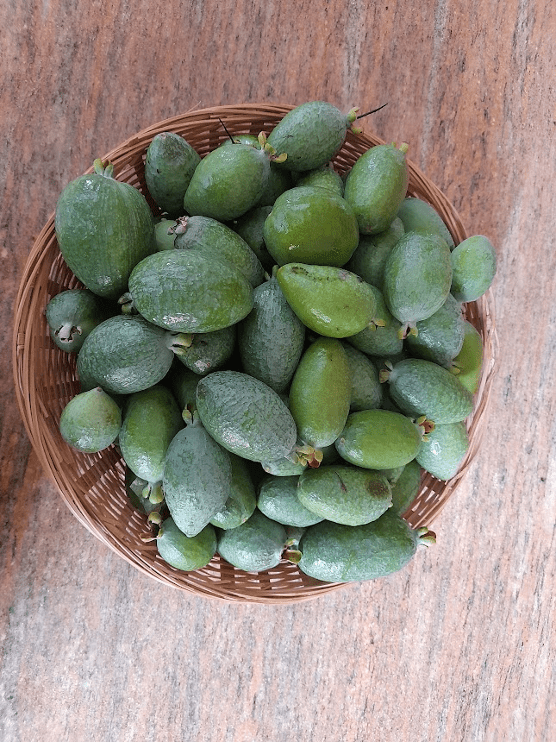
Over the next few days the temperature persisted and we felt too tired to do anything. This was followed by a sore throat so severe that we could not even sip a cup of coffee. I suddenly craved a smoothie and remembered a recipe a friend in Japan had given me when my children were toddlers. This was made by combining a banana, some milk, and slices of canned pineapple in a blender. I told Alex the recipe, and he substituted yogurt for milk. I suggested adding feijoas from the garden.

 The result was something that even those with taste buds damaged from Covid could appreciate.

By Day Five our appetites had returned, and our taste buds restored. It was boring having to be confined indoors until the end of the week when we are not required by law to stay at home. It felt like the aftermath of a storm. I was grateful that the fever had gone and I could swallow again, but my body took days to recover from the shock it had had to endure.

(Photographs provided by Meredith Stephens)

[1] Rapid Antigen Test

.

Meredith Stephens is an applied linguist from South Australia. Her work has appeared in Transnational Literature, The Muse, The Font – A Literary Journal for Language Teachers, The Journal of Literature in Language Teaching, The Writers’ and Readers’ Magazine, Reading in a Foreign Language, and in chapters in anthologies published by Demeter Press, Canada.

PLEASE NOTE: ARTICLES CAN ONLY BE REPRODUCED IN OTHER SITES WITH DUE ACKNOWLEDGEMENT TO BORDERLESS JOURNAL

Categories
Contents

Borderless, October 2022

Art by Sohana Manzoor

Editorial

The Sky … Click here to read.

Conversations

Anthony Sattin, an award winning journalist and travel writer in conversation about Nomads: The Wanderers Who Shaped our World, his recent book published by Hachette, India. Click here to read.

VR Devika talks of the dynamic Muthulakshmi Reddy, the first woman in the world to preside over a Legislative Assembly who sought justice for Devadsis and prostitutes and discusses her book, Muthulakshmi Reddy: A Trailblazer in Surgery and Women’s Rights published by Niyogi Books. Click here to read.

Translations

Daridro or Poverty by Nazrul has been translated from Bengali by Professor Fakrul Alam. Click here to read.

The Browless Dolls by S.Ramakrishnan, has been translated from Tamil by B Chandramouli. Click here to read.

Two poems from Italy by Rosy Gallace have been translated from Italian by Irma Kurti. Click here to read.

Flowers of Love Bloom Everywhere, a poem for peace, written by and translated from Korean by Ihlwha Choi. Click here to read.

Aalo Amar Aalo (Light, My Light) a song by Tagore, has been translated by Mitali Chakravarty from Bengali. Click here to read.

Pandies Corner

Songs of Freedom: Moh-Reen is an autobiographical story by Amreen, translated from Hindustani by Janees. These stories highlight the ongoing struggle against debilitating rigid boundaries drawn by societal norms, with the support from organisations like Shaktishalini and Pandies. Click here to read.

Poetry

Click on the names to read

Michael R Burch, Kirpal Singh, Ryan Quinn Flanagan, Jonathan Chan, Ron Pickett, Saranyan BV, George Freek, Pramod Rastogi, Mike Smith, Gayatri Majumdar, John Grey, Vandana Kumar, Ahmad Al-Khatat, Rhys Hughes

Poets, Poetry & Rhys Hughes

In Crossing the Date Line, Rhys talks of his fascination with this imagined construct. Click here to read.

Essays

Epaar Bangla, Opaar Bangla:  Bengals of the Mind

Asad Latif explores if homeland is defined by birth. Click here to read.

The Wabi-Sabi of Making a Living

Aditi Yadav calls for taking a break from hectic work schedules. Click here to read.

Just a Face on Currency Notes?

Debraj Mookerjee writes of Gandhi’s relevance and evolution. Click here to read.

A Mother, a Daughter & a Demon Slayer?

Meenakshi Malhotra checks out the festival of Durga Puja, declared the a heritage festival by UNESCO. Click here to read.

The Observant Immigrant

Candice Lousia Daquin explores festivals and the God gene in We had Joy, We Had Fun…. Click here to read.

Musings/Slices from Life

KL Twin Towers near Kolkata?

Devraj Singh Kalsi visits the colours of a marquee hosting the Durga Puja season with its spirit of inclusivity. Click here to read.

A Five Hundred Nautical Mile Voyage to Tasmania

Meredith Stephens writes of sailing to Tasmania when the pandemic had just started loosening its grip. Click here to read.

Keep Walking…

Ravi Shankar recommends walking as a panacea to multiple issues, health and climate change and takes us on a tour of walks around the world. Click here to read.

The Matriarch of Hirronk

Ali Jan Maqsood introduces us to a strong matriarch from a Balochi village. Click here to read.

Musings of a Copywriter

In Drill, Fill, Just Chill, Devraj Singh Kalsi gives us humour while under a dentist’s drill. Click here to read.

Notes from Japan

Suzanne Kamata writes of her A Ramble on Bizan, focussing on a writer, also by the surname of Moraes, who lived on Mount Bizan more than century ago, moving to Japan from Portugal having fallen violently in love. Click here to read.

Short Stories

Half-Sisters

Sohana Manzoor explores the darker regions of human thought with a haunting psychological narrative about familial structures. Click here to read.

Homecoming

Rituparna Mukherjee gives a poignant story about missing home. Click here to read.

The Phosphorescent Sea

Paul Mirabile journeys with his protagonist into the depths of the ocean. Click here to read.

The Literary Fictionist

In Deathless are the Words, Sunil Sharma explores madness and ideators who believe in the power of words. Click here to read.

Book Excerpts

An excerpt from Taranath Tantrik and Other Tales from the Supernatural by Bibhutibhushan, translated from Bengali by Devalina Mookerjee. Click here to read.
An excerpt from A Handful of Sesame by Shrinivas Vaidya, translated from Kannada by Maithreyi Karnoor. Click here to read.

Book Reviews

Somdatta Mandal has reviewed BM Zuhara’s The Dreams of a Mappila Girl: A Memoir, translated from Malayalam by Fehmida Zakir. Click here to read.

Basudhara Roy has reviewed Taranath Tantrik: And Other Tales from the Supernatural by Bibhutibhushan, translated from Bengali by Devalina Mookerjee. Click here to read.

Bhaskar Parichha has reviewed Satyajit Ray Miscellany: On Life, Cinema, People & Much More, a collection of the maestro’s writings and illustrations. Click here to read.