It was a stage of life when we were friends without knowing the meaning of friendship. Just like that. As we grew up and grasped what friendship meant, we lost the capacity to nurture unconditional friendship. Although we rarely admit our incompetence to strike genuine bonds, we always make tall claims of being real friends for life. Utter one word that pricks a friend’s ego, and you are thrown out of the chat room with collective opposition to make you a pariah forever. It is the equivalent of being punished by the schoolteacher who made you stand outside the classroom for disturbing the entire class.
Attending a grand gala reunion organised by school friends offers an opportunity to revive and relive childhood memories — although the attendees are more engrossed in observing your receding hairline or the protruding belly. Your grey hair reassures those with jet-black hair and gives the scope to suggest effective herbal therapy. Your glowing skin stirs jealousy, and curious friends, eager to dig up the secret of your taut skin, surround you. Tell them you apply nothing to nourish it, and they conclude you are simply masking the truth.
If you have been stylish during childhood but now prefer simple clothes, get ready to be accosted by a friend who flaunts branded apparel and tries to draw your attention to his fancy imported jacket by raising its hood again and again.
Life is strange, and meeting childhood friends makes you realise this bitter truth. Those who were the most dignified and sober types have turned out to be drunkards. Those who never used a cuss word now hurl abuses as an energy booster. Those who wore tidy shoes have turned out to be careless about polish. Those who were always late have now become punctual in life. Those with a strict routine for everything have no routine to follow. Those who never laughed or cracked a joke in school have become humorists. Those who were toppers have become showstoppers of a different kind. Those fond of reading books now dread owning a bookshelf. The compulsive liars have become worshippers of truth. Those friends who never said prayers have now become staunch devotees. Life has its unpredictable ways of shaping people and their destinies.
In a reunion, you meet old buddies and see how they have changed, grown, or decayed in the intervening decades. Although I do not attend these reunions, it fascinates me to wonder how they get the wavelength right to connect. Dance, swing, or hop to revive bonhomie? Do they stand in a queue and pass through the school corridors? Do they enter the classroom and sit on the last bench? Do they fiddle with the chalk and duster to sign their flamboyant designations and titles? Do they revisit the loo where they discovered their youth? Do they stand or jostle near the tap to drink water and then splash it on friends for aqua fun? Do they huff and puff and yet run and climb the guava tree or dangle from its lowest branch in a brave and desperate show of fitness and agility that they have lost? Do they shake an arthritic leg with a fake smile? Do they try to appear healthy and hide their blood sugar levels by gorging on sweets? Do they sprinkle table salt on chops and cutlets to show hypertension has left them untouched? Well, it is a heroic attempt to present the best side with a smiling visage.
Such impulses get the better of you in your middle age when you realise the risk of dying of a sudden heart attack looms large. Before you depart, you wish to meet these childhood buddies and relive the lost innocence. You are back to your primary school — as those were the days you lived without stress and shared without ulterior motives. Life was good, but then you wanted a life of your choice — to carve a niche, rise, and race ahead. The world beckons you then, and now your town of birth makes you feel this had been heaven on earth. Yet, it was the place you were eager to leave to explore the world. Now you have done everything, so you want to return to where it all started. Just another wish like the one that made you navigate the world for golden opportunities.
Now you want to sit under a shady tree and philosophise whether you have lived a good life. Deep inside, you realise it has been a mixed bag, and the cycle is almost complete. You want to slow down and enjoy what you lost or left behind in childhood in a somewhat apologetic way, and you want the company of friends who share a similar worldview now. The future holds no promise of anything worthwhile. But there is a lot in the haystack of the past to cherish and relish. Remember the jam and jelly and butter toast in the tiffin you shared. Perhaps the joys of a simple life pull the heartstrings, and those childhood friends allow you to be yourself and help you recognise the person were and have left behind to a long forgotten past.
Devraj Singh Kalsiworks as a senior copywriter in Kolkata. His short stories and essays have been published in Deccan Herald, Tehelka, Kitaab, Earthen Lamp Journal, Assam Tribune, and The Statesman. Pal Motors is his first novel.
PLEASE NOTE: ARTICLES CAN ONLY BE REPRODUCED IN OTHER SITES WITH DUE ACKNOWLEDGEMENT TO BORDERLESS JOURNAL.
As the old year winds up, we wait for the new year in anticipation… We wait to see how the new born blossoms as each year takes a unique form. This year, while we strengthened the population with vaccines, other kind of politics set in, which finally found fruition in a war that has perhaps been one of the saddest events of human history — people made homeless, towns erased, lives lost, nature polluted with gunpowder and shreds of machinery along with the ultimate threat of nuclear weapons erupting every now and then. What could possibly give hope amidst the darkness of the receding year with price hikes, the threat of looming hunger, joblessness, more conflicts and fear?
The fact that we have survived for more than 200,000 years in our current form is heartening. That we have lived through wars, plagues and disasters without being erased out of existence only highlights the resilience of our species to adapt to all kinds of contingencies. Perhaps, with the current crises, we will move towards new world orders…perhaps, we will find hope in creating and evolving new ways of living in consonance with nature and more by our need than greed.
With that hope in heart, we wish you a wonderful start to the New Year with a few interesting pieces from our journal, including a highly entertaining piece by Suzanne Kamata on how the Japanese traditionally, literally make a clean start each New Year and Michael Burch’s fun poems and a translation of Tagore’s adaptation of the traditional year-end Auld Lang Syne. We have sprinkled more humour in poetry by Rhys Hughes and Santosh Bakaya and, in prose, by Tagore, translated by Somdatta Mandal, Ruskin Bond and Devraj Singh Kalsi. Laughter at the this juncture will hopefully give us a year with more shades of happiness.
Shantanu Ray Chaudhari converses with writer Gajra Kottary, a well-known writer of Indian TV series, novels and stories. Clickhereto read.
A discussion on Samaresh Bose’s In Search of the Pitcher of Nectar, a book that takes us to the heart of the Kumbh Mela, a festival recognised by the UNESCO as an Intangible Cultural Heritage, with the translator, Nirmal Kanti Bhattacharjee. Clickhere to read.
Translations
Nazrul’s Why Provide Thorns has been translated by Professor Fakrul Alam. Clickhere to read.
Mercy, a story be P. F. Mathews, has been translated from Malayalam by Ram Anantharaman. Clickhere to read.
Songs of Freedom: Vikalangta or Disability is an autobiographical narrative by Kajal, translated from Hindustani by Janees. These narrations highlight the ongoing struggle against debilitating rigid boundaries drawn by societal norms, with the support from organisations like Shaktishalini and Pandies. Clickhere to read.
Paul Mirabile explores James Joyce’s Stephen Dedalus and his passion for words keeping in mind the hundred year old Ulysees & the even older, A Portrait of the Artists as a Young Man. Clickhere to read.
Book Excerpts
An excerpt from Radha Chakravarty’s translation of Tagore’s Farewell Song. Clickhere to read.
An excerpt or two short narratives from Rhys Hughes’ Yule Do Nicley. Clickhere to read.
The next year will do the same – we will all celebrate with Auld Lang Syneand look forward to a resolution of conflicts that reared a frightening face in 2022 and 2021. Perhaps, this time, if we have learnt from history, there will not be any annihilation but only a movement towards resolution. We have more or less tackled the pandemic and are regaining health despite the setbacks and disputes. There could be more outbreaks but unlike in the past, this time we are geared for it. That a third World War did not break out despite provocation and varied opinions, makes me feel we have really learnt from history.
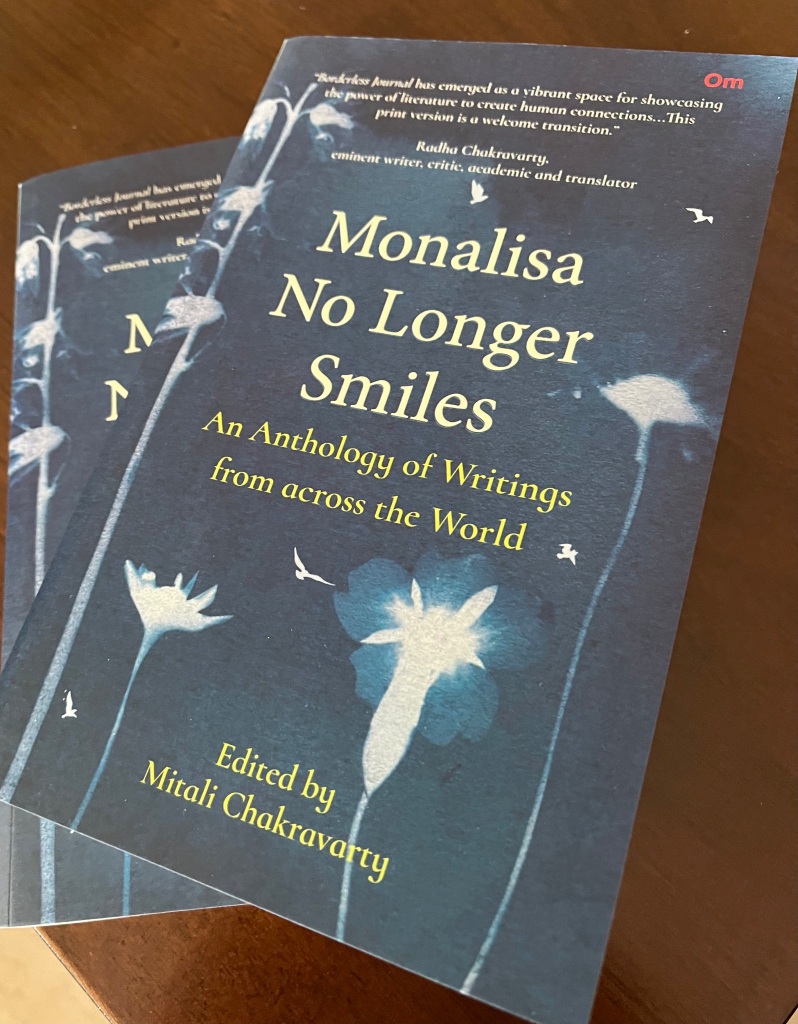
That sounds almost like the voice of hope. This year was a landmark for Borderless Journal. As an online journal, we found a footing in the hardcopy world with our own anthology, Monalisa No Longer Smiles: Writings from Across the World, which had a wonderful e-launch hosted by our very well-established and supportive publisher, Om Books International. And now, it is in Om Book Shops across all of India. It will soon be on Amazon International. We also look forward to more anthologies that will create a dialogue on our values through different themes and maybe, just maybe, some more will agree with the need for a world that unites in clouds of ideas to take us forward to a future filled with love, hope and tolerance.
One of the themes of our journal has been reaching out for voices that speak for people. The eminent film critic and editor, Shantanu Ray Chaudhuri , has shared a conversation with such a person, the famed Gajra Kottary, a well-known writer of Indian TV series, novels and stories. The other conversation is with Nirmal Kanti Bhattajarchee, the translator of Samaresh Bose’s In Search of a Pitcher of Nectar, a book describing the Kumbh-mela, that in 2017 was declared to be an Intangible Cultural Heritage of Humanity by UNESCO. Bhattacharjee tells us how the festival has grown and improved in organisation from the time the author described a stampede that concluded the festivities. Life only gets better moving forward in time, despite events that terrorise with darkness. Facing fear and overcoming it does give a great sense of achievement.
In keeping with the festive season is our book excerpt from Rhys Hughes’ funny stories in his Christmas collection, Yule Do Nicely. Radha Chakravarty who brings many greats from Bengal to Anglophone readers shared an excerpt – a discussion on love — from her translation of Tagore’s novel,Farewell Song.
Love for words becomes the subject of Paul Mirabile’s essay on James Joyce’s Stephen Dedalus, where he touches on both A Portrait of the Artist as a young Man and Ulysees, a novel that completed a century this year. Love for animals, especially orangutans, colours Christina Yin’s essay on conservation efforts in Borneo while Keith Lyons finds peace and an overwhelming sense of well-being during a hike in New Zealand. Ravi Shankar takes us to the historical town of Taiping in Malaysia as Meredith Stephens shares more sailing adventures in the Southern hemisphere, where it is summer. Saeed Ibrahim instils the seasonal goodwill with native Indian lores from Canada and Suzanne Kamata tells us how the Japanese usher in the New Year with a semi-humorous undertone.
Also touching and yet almost embracing the school of Absurd is PF Mathew’s story, ‘Mercy‘, translated from Malayalam by Ram Anantharaman. Fazal Baloch has brought us a Balochi folktale and Ihlwha Choi has translated his own poem from Korean to English. One of Tagore’s last poems, Prothom Diner Shurjo, translated as ‘The Sun on the First Day’ is short but philosophical and gives us a glimpse into his inner world. Professor Fakrul Alam shares with us the lyrics of a Nazrul song which is deeply spiritual by translating it into English from Bengali.
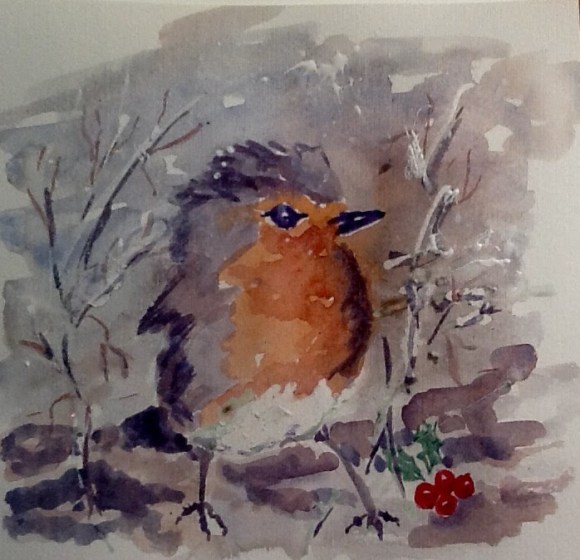
A huge thanks to all our contributors and readers, to the fabulous Borderless team without who the journal would be lost. Sohana Manzoor’s wonderful artwork continues to capture the mood of the season. Thanks to Sybil Pretious for her lovely painting. Please pause by our contents’ page to find what has not been covered in this note.
We wish you all a wonderful festive season.
Season’s Greetings from all of us at Borderless Journal.
Waking up in the ambrosial wee hours of the morning to find my silk scarf dragged to the bathroom door sent shivers down my spine. I suspected the sneaky presence of a stranger in the house, most likely a petty thief who fancied this extravagant piece of clothing around his neck to rev up his vagrant style. Rattled by this intrusion, I turned around, with one eye stationed on the wall. I tried to track shadows lurking behind me to hammer my moderately creative head. Nothing appeared in sight or peripheral vision, so I looked up for open ventilators or any broken windowpane to unravel the mystery of the great escape of an agile thief who decamped with more valuable stuff than what had come to my notice so far.
Picking up the scarf and dumping it in the woven basket, I retraced my steps to enter the bedroom and checked the cash box in the wardrobe. I was about to step in when something scurried very fast along the base of the wall in front of me, squeaking behind the refrigerator in search of a haven, probably feeling scared and jittery of a predatory attack and sending distress signals to its fraternity to stay holed up underground.
The supposed culprit – a squeaking rat – had made a fleeting appearance. I confess I do not possess the olfactory vigour to smell its presence like many others do. But there was no denying the fact that there was a family of rats residing at my address without my knowledge and permission. The tell-tale signs were their droppings splattered on the marble slab in the kitchen and the dining space. One rat would surely not have such a bulky output even if it enjoyed a wholesome feast every night. Besides, dragging my silk scarf was a specimen of well-orchestrated teamwork.
As the storytelling instinct does not let go of an opportunity to find a crack for a new narrative, the presence of a ghost could well be another strong possibility. Possibly the rat was not the culprit but the saviour to chase away the spirit in search of salvation or relief from the wintry chill as it rested on the mango tree in the backyard. Spirits enter and exit through closed doors and windows with ease, so this was another fascinating interpretation that engaged me for a while when I traced no sign of pilferage in my wardrobe.
Since I had witnessed the presence of a shy rat lacking the courage to own up its mischief, I was inclined to go with this credible version. With another rat collaborating to displace my favourite scarf. It was quite a distinct possibility though I was yet to attach a motive to it. Were they just trying to foment trouble in the household? Were they having good fun with my scarf to end their boredom? I had checked the scarf for possible tears but it bore no sign of violence.
I must praise their good behaviour and upbringing. Though they could have wreaked havoc on my belongings lying in the open, they exercised remarkable restraint. Or perhaps, they had damaged things I had not examined yet. Maybe, the cloth bags, the plastic containers on the kitchen shelf, the woollen carpet, or the backside of the leather sofa were what they preferred to bite into. On the upside, there was still no clinching evidence of their destructive avatar in the household. Playing the devil’s advocate, I thought the rats tried to take my scarf to the washroom and plunge it into the water drum to serve me a reminder. Washing it was a pending task for quite some time. The stubborn stains of tomato sauce on the scarf were unlikely to go away if there were any further delays.
Instead of thanking them for the timely assistance, I chose to be thankless, like humans tend to do all the time. I preferred to place a rat trap with irresistible bait: jam cookies for dinner. With those tantalising pieces dangling from the iron hook inside the wooden box, a fool-proof trap was laid, like those gorgeous dresses displayed to entice shoppers into a store. The rat trap was not big enough for the pair to walk into comfortably without jostling for space. However, in the cover of darkness, I was sure at least one would go inside to fetch the gourmet food while the partner waited outside, just as a biker ducks into a takeaway snack counter and his pillion-riding girlfriend guards the bike.
My concern regarding the safety of bestselling books was paramount though I was okay if they chewed the books written by me, to cut their teeth and gain experience of what they were best at. I was impressed with their perfect coordination, fighting like a healthy couple, making a big noise on piffling issues but staying united to stave off external attacks.
Getting the rats out of their hiding place was a problem that plagued me. I hoped the bait would work as a talisman for me. But deep within, I thanked them for doing good work instead of damaging the items. This was a radical change that deserved praise instead of this brazen attempt to evict them. Human beings find innovative ways to eliminate rivals of all species. My eviction drive was a moderate and tolerant act though I had the freedom to snuff out their precious lives with a mild dose of poison sprayed on bread crumbs or try a glue mat that immobilise them once they have stepped on it accidentally and keep screeching for relief till their last breath.
I thought the next morning I would push the wooden box out of the house, lift the cage door and set it free to roam the big, bad world instead of remaining cloistered here. But the rats were intelligent and clever to guess my moves. Staying close to books led to some transfer of knowledge. I saw the trap door still open and the jam cookies lying untouched. It proved to be quite a greed-resistant pair, unlike human beings. Let me not read too much into it. Maybe they were fasting that night, maybe the cookies were placed a bit too far beyond their reach, or maybe, they were having something yummier than what I had served them.
The next day, I placed the same delicacy in a different spot. Closer to the cavity behind the door to shorten its travel distance and switched on a mellow yellow night bulb for ease of movement without stumbling in the dark. It would be quite a romantic setting for the couple to waltz for a while before getting inside the cosy cabin to feast on jam cookies.
I was growing impatient to get them inside the rat trap. By hook or by crook. Surprisingly, this time it worked. Early in the morning, I spotted a long tail swishing. Curious eyes looked at me with horror and betrayal. There was a tacit appeal to reciprocate goodness just as they had been good to my belongings even though they had the power to ruin everything. I dragged the box out of the house, wore the gloves of a gardener, and put on a mask as if I were about to perform a surgical experiment. I pushed the wooden box down the stairs and it was a tumble, a freefall, a deep dive like a car plunging into the deep gorge from a mountain road.
The world of the rat also turned as topsy-turvy as mine. When he finally crashed and landed on the cement floor with a thud, the shocked rat recovered from the initial rude jolt and looked through the grille at the vast blue sky before establishing eye contact with me. I pushed the entrance door open to set him free. He came out quickly and vamoosed, taking a diagonal route to enter a pesky neighbour’s compound. This was my unintended gift to his house but I hoped the rat would make it hell for him, and settle scores on my behalf, for dumping all his dry waste in front of my house to keep his façade look super clean.
I abandoned the gloves after the successful operation and washed my hands with anti-septic liquid before going for a breakfast of oats. A day of peace later, I found disturbing noises again. Deprived of its companion, the surviving partner in the household was making fervent screeching pleas to be reunited. I was afraid she would seek revenge this time so I should get it out at the earliest.
I was mistaken in thinking trapping her would be a challenge. The rat was more than willing to be trapped as it knew this was the vehicle that carried its partner away. Placing a bit of walnut cake slice inside the rat trap allured the survivor though I knew she would have stepped in even without the bait. I found her lying inside listlessly the next morning, without any visible effort to move an inch. She was eager to be ferried out of the house. So, I did what was necessary.
When I finally set her free, she went in the same diagonal direction the earlier one had gone even though I did not provide any clues or hint of direction to proceed. She was rather quick and entered the compound of the same pesky neighbour who would now have two unwanted guests in his elegant villa.
I know they would recollect memories of happy days spent in my humble abode and glorify my benevolence. I set them free, but they were destined to be united again. Even if the neighbour poisons the two after detecting their presence, they would still be happy to die together instead of living sad lives in separation.
Devraj Singh Kalsiworks as a senior copywriter in Kolkata. His short stories and essays have been published in Deccan Herald, Tehelka, Kitaab, Earthen Lamp Journal, Assam Tribune, and The Statesman. Pal Motors is his first novel.
PLEASE NOTE: ARTICLES CAN ONLY BE REPRODUCED IN OTHER SITES WITH DUE ACKNOWLEDGEMENT TO BORDERLESS JOURNAL
The Duggals had received their first invitation to attend a grand reception organised to celebrate the divorce of Upasana Malhotra, the only daughter of a reputed steel magnate diversifying into organic agribusiness. Having lived in the same colony before fortune ferried the Malhotras away from the middle-class neighbourhood to a posh locality teeming with industrialists, the Duggals were the only family they shared close ties with decades ago. The same affection remained in place even though their visits happened only on special occasions. So, it was a surprise for the Duggals to be invited again after three years to the same household where they had gone to bless the couple exchanging vows for continuing wedded for life.
More startling was that the girl possessed the courage to throw a lavish party, inviting distinguished guests who came to her wedding party to re-appear, bless and congratulate her again for her decision to leave the Poddar surname attached in haste. After a breezy romantic courtship that blossomed in a top-notch US university campus, the much-talked-about marriage solemnised three summers ago hurtled to a premature end. The Duggals knew it was one of her crazy ideas to celebrate the mutual separation ostentatiously and showcase the event for public consumption, with attendees looking baffled about how they should behave on her D-day (read Divorce Day).
As the Duggals were flabbergasted, they sought the help from Google to find out more about such parties. They could not find ample content to clarify their doubts, so they sought help from their tech-savvy son, Shamsher Duggal, who called up an event manager friend to dig up details about divorce parties. She said there were no separate rules to follow, and it was just held the way marriage parties are held, with much scope to innovate for the couple. The guests were expected to maintain the usual decorum and focus on wine, food and music to celebrate the bright future for the divorcees. Shamsher asked his parents to keep the Charh di Kala[1]approach in mind, to calibrate themselves with the equivalent of joie de vivre: stay indulgent, in high spirits to mint fresh memories of fun and enjoyment.
Mr Duggal kept gazing at the invitation card delivered by courier, running his podgy fingers on the embossed letters. It was fancier than any marriage invitation card. The gold-plated card glittered, perhaps indicating the glittering future after the mutual separation that was to be formalised at an auspicious hour. The names of the couple and their families were mentioned along with the programme schedule, with the Lord’s name emblazoned on it to suggest this separation was being formalised with divine blessings, to thank Him for mercy and saving the couple from a boring life together.
Freedom at midnight is always good as it heralds a new dawn. The midnight timeline for the divorce echoed in a similar strain. The couple would wake to a new life of freedom after their tryst with matrimony. The big idea behind the invitation was to come and bless the separating couple with tons of happiness in their post-divorce lives. The creative note was penned by a professional copywriter who gave it a spin and hyped it to such an extent that it seemed missing this event would be the biggest blunder for couples who had experienced the beautiful side of getting hitched but not the equally, if not more, wonderful side of getting ditched. When Mrs Duggal picked it up to read, those emotional lines struck a chord with her and filled the gaps in their marriage. She looked at divorce through the prism of optimism.
Mr Duggal, yet to recover from the initial shock of being invited to attend the divorce party, found it challenging to customise his expressions to suit the occasion, to look happy like he did when Upasana married this guy three years ago. He remembered sharing with relatives and friends the video clip featuring their energetic Bhangra dance to show how charged they were as a doting, retired couple.
“Do you think we are expected to bless them again? Isn’t it a farce? Grooving and smiling would be tough, isn’t it? Those vivid memories of blessing her would haunt me. What is the need to hold this function? What are they trying to prove? Mocking at the institution of marriage? Don’t you think they are making a grand show of putting up a brave face when misfortune looms large? Check the program list. Leading pop singers from the film world are going to perform live,” Mr Duggal went hammer and tongs.
“They are not going to sing sad songs of separation. Not your favourite dard bhare geet. They wish to celebrate divorce as a happy occasion – the harbinger of good times. A peppy show loaded with dance and masti[2]. Frankly, I am impressed with her plan, no matter what you say. Chalo[3], let’s not waste time. Choose my dress and matching jewellery, so much to do. Stop brooding and decide which suit you want to wear or buy something traditional,” Mrs Duggal showed her positive frame of mind for the special event they were privileged to attend. Finally, she would have something unique to discuss at her kitty party next week.
Mr Duggal was not in high spirits, unlike his wife who got another opportunity to look fabulous and interact with the upwardly mobile guests she had met at Upasana’s theme wedding. When he mentioned the name of the sensational singer, Mrs Duggal slipped into dance mode, visualising it to be awesome.
“Our blessings are mere formality; did not mean much the last time and it is not going to matter this time again,” Mr Duggal tried to get her back on a serious track.
“Oh Sardarji, come on, you know it is all like that. Do not ruin the fun part. They have entertainment. We ate a gourmet dinner last time. Expect the same this time. They are sweetly mocking the institution of marriage so let them do it. Relationships are like that only today. Here, we carry dead relationships on our shoulders and try to revive them instead of ending everything on a bitter-sweet note,” Mrs Duggal offered her worldview without sounding preachy.
“So, you mean our marriage can also go to the rocks one day? Our four decades of marriage can crumble,” Mr Duggal expressed concern, “In case you have such intent, do let me know a year in advance so I can prepare and plan my future, and get check-ups done to avoid cardiac arrest. But if you decide suddenly – just give me a slow disclosure so that the shock does not upset my weak but vital organs,” Mr Duggal pleaded with her in a lighter vein.
“Now stop worrying about your fate and go and ask if Shamsher would join us,” Mrs Duggal tried to reduce his anxiety.
“Has he ever been anywhere with us in the last ten years? No point asking and getting the same standard reply,” Mr Duggal furnished his bland refusal.
“He was not asked to accompany us to Upasana’s wedding. They were friends in childhood. Maybe now you can ask if he…” Mrs Duggal tried to persuade him.
“You remember so much. Anyway, since you insist, I am seeking his presence. Did he complain he was not asked to go last time?” Mr Duggal asked with curiosity.
Mrs Duggal kept mum, waiting for him to understand something without words.
Mr Duggal went and knocked at his son’s frosted glass door and asked if he would like to go.
Instead of refusing, he said he had an important presentation that evening so he would stay home for the project.
“I told your Mummy you are not a party-loving guy, but she insisted I should ask you to join us. When will your mother understand you as I do?”
*
Mr Duggal rummaged the wardrobe looking for a suitable blazer and trailed a volley of queries after informing her that Shamsher was not joining them.
“Do you have any idea how we are going to behave there? I mean do we look sad or happy? I am bad at faking, you know that. Are you going to give them bouquets separately?” Mr Duggal fired a big one.
“Not decided. But yes, better if we give one each separately. You give to Upasana, your missed Bahu[4]. And I will give her divorcee hubby. Don’t think so much. They are happy to heal this way, so why should we grudge? We are invited – go and enjoy. Be practical like them. Just chill,” Mrs Duggal gave sound advice to make him comfortable.
Mr Duggal was not okay with this whole idea. He thought this was intended to make fun of marriage although his wife and son were on the same page in this matter and hailed it as a progressive step.
“I am clear I am not going to bless them again,” Mr Duggal stressed with raised eyebrows, “I know the Malhotras will be upset doing this tamasha[5]but Upasana is forcing them to stage this show.”
“Whoever has planned it, at least some people got work, some organisers, catering guys, bartenders, and DJs. Money is flowing out of the tycoon’s coffers for a divorce party that is just like a farewell party. Touchwood, I am super excited. I am going to wear a silk Sharara[6], and diamond jewellery for the divorce party,” Mrs Duggal revealed her plans.
Shamsher joined their discussion late and cheered for his mother and persuaded her to buy a flashy suit for his father, maybe a tuxedo.
When Mrs Duggal mentioned this divorce party, none of her friends reacted with excitement as they were not invited. It was a matter of privilege for the Duggal family to be invited. Upasana liked Duggal Uncle when her father was not super-rich. As good family friends, Upasana bonded well with Duggal Uncle who gave her strong lessons to be independent and brave like a boy child. This gender parity thing was a gift from Duggal Uncle who wanted her to be free in her choices.
“You are the one who put those modern ideas in her at that young age,” Mrs Duggal accused her husband of being the real culprit.
There was no denying the fact that Mr Duggal never discriminated against based on gender and encouraged girls to follow their dreams. He had encouraged his sister to join the medical profession. Considering Upasana to be just like his own child, he gave her genuine advice as her father was busy expanding his business empire.
*
On the day of reception, the Duggals walked in, decked in their best. Upasana spotted them from a distance and walked down the aisle to receive them and hugged them after touching their feet. She had not forgotten the traditions. Mrs Duggal congratulated her for being bold enough to walk out of a loveless marriage based on presumptions. Citing this as the most probable reason, she went ahead with examples of women from her community separating fast. As they reached the dais where the florally decorated, chairs for the split couple were arranged, her ex-hubby greeted them with folded hands and shook hands with Mr Duggal who almost squeezed it in true Punjabi style, and his smile almost dried up under pressure.
“Nice, you are leaving Upasana, not made for each other type actually,” Mr Duggal said to the former groom, Puneet Poddar while releasing his hand from his firm grip. Mrs Duggal offered him a bouquet of roses and congratulated him on his quick release from the marriage cell with a sardonic smile and an avancular peck on his chubby cheek.
Trying to appreciate her sense of humour, Puneet Poddar reciprocated with a half-hearted smile and claimed it was his idea to throw a party and seconded by Upasana. “The real purpose behind this party is to meet you, guys. All those who attended our marriage got the invite to this party – from both sides. Our families loved this idea and gave the go-ahead to end it on a happy note,” Puneet explained briefly to the Duggals and guided them to settle in the front row seats on the other stage put up for the gala musical night.
Mr Duggal wanted to meet the Malhotras first and asked him, “Where are your parents and in-laws?”
Mrs Duggal went to reserve the best seats for the music show while her husband continued the chat with Puneet Poddar who informed their parents that were together, formalising last-minute plans of setting up a new company abroad.
“Son and daughter are separating but the parents are forging a new bond?” Mr Duggal looked stunned.
“That is the beauty of our separation, Uncle. No bitterness. They remain friends and come closer while we call it over. They clicked as business partners, but we did not as partners. Simple as that.”
“This is something unique, never heard of, dear, business interest supreme,” Mr Duggal admitted, “very practical, beta[7], loving it now.”
“Honestly Uncle, we all are happy, we are beginning new lives,” Puneet Poddar asserted with a dash of confidence.
“Where did Upasana vanish? Let me find her.”
“Must be busy with her girl gang inside,” Puneet said coldly.
Guests started trooping in with gift hampers and the band of musicians arrived on the stage. Mr Duggal looked around and found the best whiskey.
Contrary to Mr Duggal’s expectation of tearjerker numbers, sad songs of the Rafi-Lata-Kishore era being played out in a remix version, or some Ghalib ghazals, the band started jamming on peppy songs of freedom and carefree living and travelling the world. Perhaps that was the brief: celebrate freedom and free living. The dance floor rocked, as couples of all age groups began to waltz. The laser beams flash here and there to create colourful images of a happy crowd enjoying every moment of the party, with dozens of cameras zooming and capturing the party from various angles.
The couple that was breaking up could be spotted together on the stage, flanked by their parents for the last photo-op. The press guys went click, click, click.
Mr Malhotra held the mike and spoke with verve, “We are glad to have you all with us on this happy day, to wish the separating pair the best for their future lives as independent people in their solo journeys.”
He gave it to Puneet to utter a few words, and he trundled out a stirring speech. “It was a wonderful journey of three years, and we realised this is all we had to share. No question of remarrying but remaining focused on living as free souls. Marriage is not fit for our nature and temperament. I am not marriage material. I guess we both have this trait in common. These three years have convinced us. There are many more like us who keep quiet and continue. Not us because we have choices. I was lucky to have Upasana who realised the same, and we gave each other the best gift possible. Freedom. If marriage was wrong, divorce is right.”
Puneet Poddar won a legion of admirers with his speech, and the guests expected Upasana to say a few words to surpass him.
Upasana picked it up from where he left, “Yeah right, marriages don’t have to be dysfunctional and then end in a split. Even apparently peaceful and stable marriages can end without raising a flutter. When beautiful things unfold in our lives, more beautiful than marriage that impedes and dilutes the experience, marriage should give way to that beautiful future we cannot share. Our lives cannot be beautiful together, not as much as our separate lives can be, and we realised it,” Upasana poured forth, “perhaps we come across as selfish, but if the sole focus of marriage is to make two people happy forever, we felt we were not going to make it as a couple. Better to part ways as friends who tried out marriage but thankfully did not suffer in it.”
The thunderous applause for her fiery words paled everything else into insignificance and glorified their divorce.
*
The priest who had come to perform their marriage rituals had come for the divorce. His presence was needed to bless them again for a new phase. His holy presence would be seen as auspicious for their divorce. After blessing them on stage, he came down and went to have his quota of snacks and drinks.
Mr Duggal bumped into him and held his arm, “Arrey[8], Sharma, where are you running and with what?”
There was a glass of drink in his hand, and he claimed it was nothing but a cold drink.
“When did I say you are having anything else?” Mr Duggal quipped.
“Sardarji, the couple took the right decision,” the priest confessed, before taking a sip, “Their stars did not match, but I got paid extra to match everything. There is a defect in the birth chart and a big chance of a fatal accident if they remain married for five years. This is the real reason for the split, I am telling you. But anyway, it is a new experience for me. I am enjoying a divorce party for the first time at fifty-five. I have performed hundreds of marriages, and many couples split up in courts, but nobody tried this. Congratulations to their families, and hope this inspires more couples planning to split, to follow suit.”
Mr Duggal was not the superstitious type, and such disclosures did not cut much ice with him. Polishing off the drink, the priest went to relish paneer butter masala[9]and kulchas[10]while Mrs Duggal remained busy in the chaat[11] stalls and savoured scoops of gelato ice cream.
The parents of the divorcing couple ate together while the pair was busy with their bosom friends. Everybody seemed to enjoy the evening, except for Mr Duggal who felt a tad remorseful as this was not what he was expecting to happen. Since everyone seemed happy, he had no reason to feel sad. Puneet was a nice man and what more do you need than a nice person as a life partner? He could not answer that for himself and realised nobody knew for sure what they wanted in life but knew only what they wanted at a particular stage of life.
The priest disappeared to gorge more kulchas while Mr Duggal set forth to take charge of his wife, who was careless regarding her sugar intake. She seemed to have enjoyed the sweets — all alone. With Mr Duggal reminding her of dietary restrictions, she lost the sense of freedom and almost threatened to leave him, “Stay away, or there will be two divorces today. Let me indulge in what I like.” Mrs Duggal made it resoundingly clear.
Mr Duggal felt scared of divorce at his advanced age and let her have her way. He went to listen to the music band singing some peppy chartbusters from across the world. Soon after, they wanted to leave but the divorcing couple and their parents were nowhere around. They moved out quickly without informing anyone except the priest who trailed behind them to the exit gate. Mr Malhotra was already at the gate when he saw them. He gave a warm hug and apologised for being tied up during the entire evening, “Thanks for coming, yaar[12], our friendship from Model Town days survives despite everything. Upasana was closer to you than me. She still misses Bhabhiji ke Chhole Bhaturey[13].”
On the way home in their hatchback car, Mr Duggal could not convince himself whether this was all real or fake.
“When people appear madly in love after marriage, it is also far from real,” Mrs Duggal hinted how a façade is always in place, “Forget everything, it was a good freak-out session. I enjoyed the music, golgappas[14], chaat and ice cream flavours like mint and paan[15], just wonderful. I remember that. Nothing else. Perhaps divorce is not a bad thing after this. The lesser burden on our courts. You have to admit they set an example. End it without scars and bruises, without social stigma. The same people who attended the marriage were present at their divorce, so hopefully, they will not badmouth them. I won’t be surprised if this catches up fancy and becomes a trend here like in the West,” Mrs Duggal gave her candid views while Mr Duggal focused on driving safely to negotiate the final bend near their house.
“Perhaps you are right,” Mr Duggal agreed as he stopped the car at the entrance. Shamsher came out to open the gate and asked,” So how was your party, guys?”
“Oh, it was lovely, beta. You should have comewith us. I have something for you,” Mrs Duggal gave him the box of laddoos[16]they were gifted before leaving the party ground.
While Mr Duggal parked the car in the garage, Shamsher opened the designer box and saw the printed photo of Upasana, with a thank-you note.
“Like Shaadi ka laddoo[17], this is divorce ka laddoo, taste it, beta,” Mrs Duggal teased her son who was unwilling to marry even though he was close to forty.
When they entered the living room, Shamsher went to the upper floor and stood on the balcony. Mrs Duggal sent his father upstairs to check his emotional state. Mr Duggal came and placed his hand on his son’s shoulder.
“Did you like Upasana?”
Shamsher did not turn around to answer the question. In the meanwhile, Mrs Duggal came upstairs slowly with her arthritic knees, and responded on his behalf, “What will this coward say? He could never say it earlier. Always busy with computers.”
Finding him unusually quiet after this salvo for the first time in years, his parents left him alone to regain emotional composure. However, his silence answered a lot.
“You knew all this?” Mr Duggal asked her after reaching their bedroom.
“Of course, I am his mother. I can sense that. I know his feelings better than you do,” Mrs Duggal shot back with confidence.
“But you never said it to me. Maybe I could take it up with her,” Mr Duggal said.
“But I was not sure if she was also having the same feelings for him,” Mrs Duggal explained to justify her silence.
Shamsher recollected the three years he and Upasana studied in the same school together. Then she left the locality and was admitted to a girl’s convent. Later she left for the US to pursue higher studies where she fell in love with Puneet Poddar who was studying on the same campus. Some mutual friends kept offering updates though he never established contact with her.
Shamsher picked up one laddoo from the box without hesitation and put it in his mouth. The saffron flavour was awesome, cooked in desi ghee[18]. His smile of satisfaction grew wider as he stuffed another laddoo – to celebrate their divorce and gave a hearty laugh to release his residual feelings of childhood love.
Devraj Singh Kalsiworks as a senior copywriter in Kolkata. His short stories and essays have been published in Deccan Herald, Tehelka, Kitaab, Earthen Lamp Journal, Assam Tribune, and The Statesman. Pal Motors is his first novel.
PLEASE NOTE: ARTICLES CAN ONLY BE REPRODUCED IN OTHER SITES WITH DUE ACKNOWLEDGEMENT TO BORDERLESS JOURNAL.
That good things happen despite darkness, despite prognostications of doom, that light glimmers hope if you strive to focus on your strength in hard times is borne true both in fiction and in life. Perhaps, we cannot get back the old ways (but is that what we want?) but new paths emerge. Old gives way to new. And while trying to gather pearls of human excellence — borne not of awards or degrees but of bringing out the best, the kindest, the most loving in human hearts — we managed to create with a team an outstanding anthology. Woven with the writings of old and new — we created a tapestry together that the editor in chief of our publishing house said was “classy, literary, engaging and international”. That one of the oldest and most reputed publishing houses in India with bookshops countrywide took it on was also an unusual event! We are truly grateful to Om Books International, Shantanu Ray Chaudhuri and Jyotsna Mehta along with all our writers and readers who made our anthology a reality, and to Radha Chakravarty and Fakrul Alam for the kind words they bestowed on our effort.
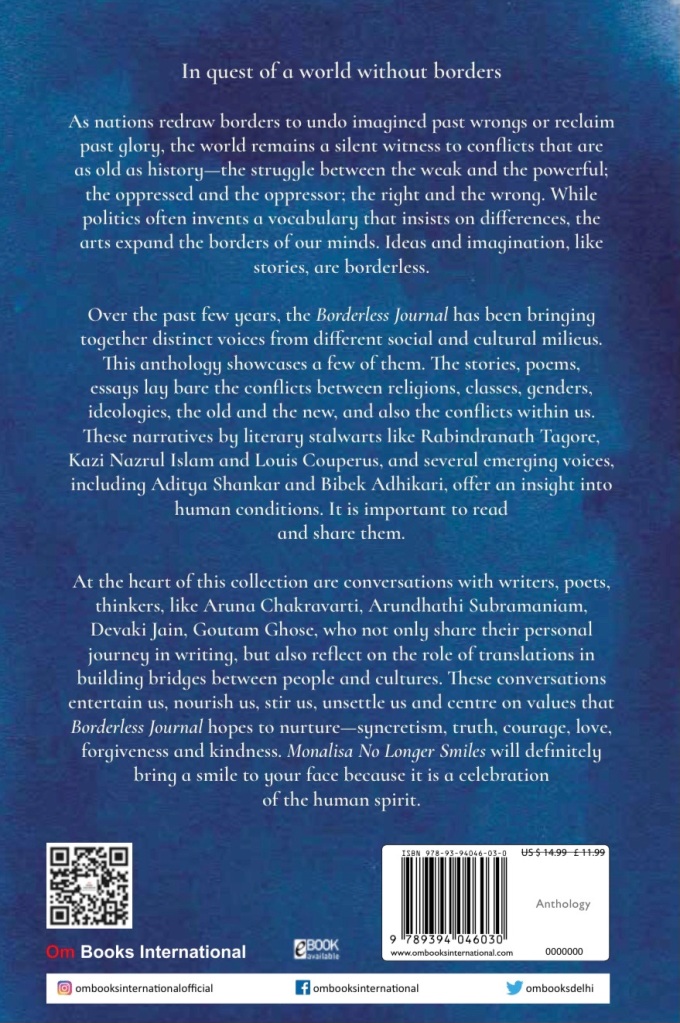
Please greet our first anthology, Monalisa No Longer Smiles, with love and friendship. It could be the perfect Christmas gift in the spirit of the season! And as the blurb says, “it will definitely bring a smile to your face because it is a celebration of the human spirit.”
The anthology is different from our journal in as much as it has a sample of an eclectic collection that has been honed with further editing and has some new features. Most of the writing is from our first year and showcases our ethos, except for Lesya’s poetry and interview. Lesya Bakun from Ukraine is still on the run, looking for a refuge — she cannot return home like you or I can. Her family is scattered across number of countries. Her cousin, who was guarding the factory at Azovstal, was taken prisoner. We included her story in the anthology hoping to create global empathy for refugees as the numbers will increase not only due to war but also due to climate change.
The reason we felt a hardcopy anthology was a good idea was because nothing beats the joy of having a bunch of interesting reads in the warmth of your hands (especially where internet cannot reach or is unavailable). In any case, books with the feel of paper, the rustling whispers which carry voices of leaves can never be replaced as Goutam Ghose had also said in his interview which is now part of our anthology.
And that is why we celebrate more books… this time we feature Singaporean prima donna of literature, Suchen Christine Lim, with her new book Dearest Intimate, a novel that spans more than hundred years including the harrowing Japanese invasion during World War II. She shared sound advice with writers: “Suffering is good for the writer. It will deepen lived experience and expand the heart’s empathy.” And perhaps that is what is echoed through the experiences of the other writer interviewed on our pages by Keith Lyons. This is a writer who not only brought out his own books but was a regular contributor of travel pieces for Frommer’s and National Geographic traveling to unexplored destinations — Christopher Winnan. Another writer Lyon had interviewed recently, Steve Carr, has passed on. We would like to convey our heartfelt condolences to his family and friends.
More translations from Bengali, Balochi and Korean enrich our November edition. Fazal Baloch has translated a story by Haneef Shareef and Rituparna Mukherjee by Shankhadeep Bhattacharya. We have the translation of an inspirational Tagore poem helping us find courage (Shonkho Dhulaye Pore or ‘the conch lies in the dust’). Another such poem by Nazrul has been rendered in English from Bengali by Professor Fakrul Alam. He has also shared an autobiographical musing on how he started translating Tagore’s Gitabitan, which also happens to be his favourite book. More discussion on the literary persona of TS Eliot and the relevance of his hundred year old poem — ‘The Waste Land’ by Dan Meloche adds variety to our essay section.
Evoking the genius of another outstanding artiste, Kishore Kumar, who happened to pen thought provoking dialogues in some films, is Shantanu Ray Chaudhuri’s essay, review of a recent book on the legendary actor-singer and an interview with the authors. Infringing the boundaries of literary with popular culture and art and integrating all forms into a wholistic bundle has been part of our ethos. In that spirit we have a musing by Prithvijeet Sinha on Edvard Munch’s famous painting called Scream. We have non-fiction from Australia spanning Meredith Stephens’s recent brush with Covid, Mike Smith visits a Scottish beach in the footsteps of a novelist, Ravi Shankar has given us a poignant piece for a late friend and Candice Lousia Daquin talks of the existence of bi-racial biases. In contrast, Suzanne Kamata sent a narrative that bridges divides showcasing a German wife of a Japanese scientist that draws us to conclude that biases erode over time to create an acceptance of bi-racial people. Devraj Singh Kalsi brings in humour with his funny narrative about a guitarist. Rhys Hughes writes in a lighter vein on Indian cuisine in his column and spouts more funny poetry bordering on the absurd.
Gathering all of your thoughts in strings of words from all corners of the world, we present to you the bumper November issue of Borderless Journal . Thank you all for sharing your thoughts with us. Thanks to Sohana Manzoor for her fantastic painting and more thanks to the whole Borderless team for seeing this issue through. We would not have been able to do the anthology or these issues without each one of you — writers and readers.
Strumming a guitar promises a note of success and a rush of adrenalin. Otherwise, there is no reason for young men with brawny biceps attired in sleeveless vests to sit beside the grilled window with creeping money plants on the balcony to invest their time and energy to impress the girl next door. Instead of handsome returns, the well-orchestrated operation often draws the unwarranted attention of the girl’s bifocal father who sniffs an ulterior motive while speed-reading the nasty headlines of the newspaper in hand and patrolling the antiskid balcony space in visible anxiety to crack a strategy to foil the covert takeover bid before his innocent girl slips for the nerd rock star.
Despite the long-drawn, dedicated mission of playing popular romantic numbers to woo the girl, my dear friend did not have any stroke of luck. But the girl’s father did suffer an unexpected stroke, leading to the untimely demise of the romantic misadventure. Assailed by the remorse of having stressed out the old fogey with his musical renditions and clandestine romantic intentions, he decided to punish himself by hanging the guitar on the wall.
Years later, the girl’s mother visited my friend’s house one evening. That she was up to some mischief became evident when she disclosed to my friend’s bride how he played music for her teenage daughter every morning before she left for school. All hell broke loose when he returned home from the tailoring shop to face an angry spouse who picked up the guitar from the wall as if it were a royal sword and presented it to him with a solemn request to strum it and croon something for her. He tried to duck it by saying he had made a vow, a gentleman’s promise to abstain from playing music again. But she spilt the beans, charging him with how desperately and unsuccessfully he once tried to lure the neighbour’s daughter with his musical foray.
Shocked by this disclosure, he found no escape route from the mess. He had to either recapitulate the long story long forgotten from his point of view or play the instrument and let his wife be instrumental in reviving his defunct musical career. Instead of denying what his wife accused him of doing many moons ago, he added a divine dimension as he decided that musical pursuit could be another way of attaining God. The fact that he chose the wrong instrument for that purpose was not pointed out by his wife. She was eager to see him perform live and exclusively for her – in front of her smouldering kohl-lined eyes dying to blink in symphony with his heartbeat. She sat on the cushioned swing suspended from the balcony ceiling, with her long, lustrous hair thrown open, with a blooming pink rose plucked from the painted pot kept nearby and tucked neatly in her straightened tresses. He dithered and fine-tuned the guitar and then decided to select a few lilting numbers from his vast repertoire to play for her in the incandescent light of the paper lantern bulbs setting the romantic mood for the musical soiree.
The story of this guitar began in Delhi when my friend accompanied me on what is called a business cum pleasure trip. Reaching the capital from Kolkata was a historic visit for my friend who was keen to pose in front of the Red Fort and go on a shopping spree in Connaught Place (CP). While walking on the CP pavement, similar to the Grand Hotel Arcade in design, my friend suddenly entered a music instruments store and quoted an incredible budget for an imported guitar. The bewildered shop owner remained quiet and scanned him for a while before asking him the difference between boiled rice and basmati rice. Taking it as an affront to his dignity and knowledge about the price of musical instruments, he shot back in accented Hindi with a quick reply to salvage his self-respect by claiming that his Ustad had taught many Indian classical legends and he knew several of them personally in Kolkata.
Many other customers inside the store began to label us as pretentious ignoramuses from another planet. The smart-alecky shopkeeper asked us to identify the portraits on the upper portion of the wall right behind his counter. They were the leading lights who patronised his shop to buy instruments and agreed to get clicked with the owners of the music store that had been in existence for more than a century. My friend cast a quick look but failed to recognise any of them. So, the shopkeeper schooled us further by conducting a master class.
We had to either buy the guitar we had asked for or disappear from the store. I took small steps and reached the exit when I heard my friend holler in a stentorian voice: “Pack this guitar for me. Here — take the money.”
The price was well beyond his budget, but he saved our image and came out of the store with the guitar and a cash memo in hand. It was evident from the facial expression he had picked up a costly instrument he was not ready to buy. But the joy of silencing the shopkeeper and mellowing his tenor was a resounding victory, and he claimed he did not argue much regarding music since he respected elders. But an hour later, when he again felt pricked by this expenditure, he exploded in a language devoid of an iota of respect and issued threats of teaching that bald, grinning shopkeeper a proper lesson had this incident occurred in Bengal. The remarkable story of saving dignity became the dominant aspect of purchasing this guitar. I felt he had risen to the occasion though he had to cancel plans for his shopping spree as his money had gone into this guitar.
He sat with the guitar and posed with fake smiles for my camera to capture. He did not appear comfortable holding it in his hands and passed it to me after a while. I found it a huge responsibility and took extra care of the guitar as we were proudly taking home something pricey. It was nothing less than a trophy won in a tough competition.
This imported guitar regaled many local listeners – including my friend’s wife at present. She had no idea that how her husband had acquired the prized beauty, saved our self-respect, and preserved the prestige of our state known for culture and music by shelling out an enormous amount to grab something rare that few people in our country can afford even today. Although his father never cut anything other than a piece of cloth, he had big dreams of cutting a music album someday, of inviting the Delhi-based shopkeeper to his launch event as the chief guest for the ribbon-cutting ceremony. This would prove that those from a non-privileged background also had the right to contribute to the enrichment of music was music to his ears.
After returning home, my friend toyed with the idea of forming a music band, got his ears pierced to wear rings to connect with trendy youth, and offered to engage my services as a lyricist. Within the year, even before I could take a call on this offer, the band he had formed with much fanfare was disbanded due to the sudden exit of the lead vocalist poached by a more resourceful rival music band. He soon realized though he was getting offers to perform in local community functions with a limited budget, it was impossible to sustain this ambitious musical venture. Soon, he joined his father’s tailoring unit and restricted his role as a musician to woo the girl he loved. But some people, like my dear friend, are perhaps naturally attracted to failures and their dreams suffer from a chronic motivational deficiency syndrome that leads them to quit at the earliest pretext.
When his mother pressurised him to settle down as he pushed into his mid-thirties, her history of myocardial infarction made him agree to her proposal. And that is how the lady who was now making him sing live for her breezed into his life. In one of her disclosures after marriage, she revealed to my friend that she had agreed to marry him only because she had seen his photograph where he was strumming a guitar. The direct benefit she expected would be the opportunity to listen to his music after a tiring day in the kitchen. But she hesitated to make it explicit so long as her father-in-law was alive. The arrival of the mother of his lost love simplified the matter for her.
After listening to his live performance for half an hour, she gave her verdict and a standing ovation with thunderous applause. She regretted such a talent could not deliver anything substantial. Even if half of her praise was a pure exaggeration for her doting husband, there were traces of truth in her observation. When she threatened to leave him forever if he did not resume his journey as a guitarist, he agreed to reconsider his earlier decision to give up music for the sake of his lost love. While this was her loving way to resurrect the failed artist and get him back on track, music had the power to make him a divorcee. The prospect of stitching together his life once again looked remote. So, he succumbed to her demands by resuming his practice sessions on the balcony. Unlike the earlier occasion when he sat on the windowsill and performed for the girl outside the house, this musical foray was for the kitchen queen regaling herself with Bollywood numbers and soothing her frayed nerves with the fragrance of tuberoses he brought home for the bedroom vase every evening.
.
Devraj Singh Kalsiworks as a senior copywriter in Kolkata. His short stories and essays have been published in Deccan Herald, Tehelka, Kitaab, Earthen Lamp Journal, Assam Tribune, and The Statesman. Pal Motors is his first novel.
PLEASE NOTE: ARTICLES CAN ONLY BE REPRODUCED IN OTHER SITES WITH DUE ACKNOWLEDGEMENT TO BORDERLESS JOURNAL.
Anthony Sattin, an award winning journalist and travel writer in conversation about Nomads: The Wanderers Who Shaped our World, his recent book published by Hachette, India. Click hereto read.
VR Devika talks of the dynamic Muthulakshmi Reddy, the first woman in the world to preside over a Legislative Assembly who sought justice for Devadsis and prostitutes and discusses her book, Muthulakshmi Reddy: A Trailblazer in Surgery and Women’s Rights published by Niyogi Books. Click hereto read.
Translations
Daridro or Poverty by Nazrul has been translated from Bengali by Professor Fakrul Alam. Click here to read.
The Browless Dolls by S.Ramakrishnan, has been translated from Tamil by B Chandramouli. Click hereto read.
Two poems from Italy by Rosy Gallace have been translated from Italian by Irma Kurti. Click hereto read.
Aalo Amar Aalo (Light, My Light) a song by Tagore, has been translated by Mitali Chakravarty from Bengali. Click hereto read.
Pandies Corner
Songs of Freedom: Moh-Reenis an autobiographical story by Amreen, translated from Hindustani by Janees. These stories highlight the ongoing struggle against debilitating rigid boundaries drawn by societal norms, with the support from organisations like Shaktishalini and Pandies. Click hereto read.
Ravi Shankar recommends walking as a panacea to multiple issues, health and climate change and takes us on a tour of walks around the world. Click here to read.
Ali Jan Maqsood introduces us to a strong matriarch from a Balochi village. Click here to read.
Musings of a Copywriter
In Drill, Fill, Just Chill, Devraj Singh Kalsi gives us humour while under a dentist’s drill. Click here to read.
Notes from Japan
Suzanne Kamata writes of herA Ramble on Bizan, focussing on a writer, also by the surname of Moraes, who lived on Mount Bizan more than century ago, moving to Japan from Portugal having fallen violently in love. Click hereto read.
I have been one of those unlucky fellows who occupy the dentist’s chair, with mouth wide open for harsh light to illuminate every corner and crevice, waiting for the dentist to tap and spot cavities. My habit of going to bed with a toffee in my mouth almost every night since teenage years was the prime reason behind this early dental crisis, much before wisdom teeth could stage an appearance.
When the first molar turned 70% darker than the chocolate I ate, I rushed to the dentist recommended by my tutor who was happy with his tooth extraction skills. I plonked on his leather seat and mentioned my tutor. He heard it all but continued unaffected, perhaps unable to recall the patient I was referring to. After he examined my troublesome tooth, he gave a smile and wrote a reference note suggesting a senior dentist he considered fit for performing root canal therapy.
Root and canal generated separate images in my mind. I was unable to link how these two came together inside my mouth. Anyway, I paid his consultation fee and walked out to buy the pain killers he had prescribed in case the damaged tooth turned troublesome at night. It was a relief that he did not uproot it but asked me to undergo the treatment to restore the crown once he was convinced looking at my branded watch that I could afford the treatment but could not afford to lose the tooth. When people the world over are losing their crown, I was thrilled to get one for myself. With fond hope, I traced the senior doctor (in pre-GPRS[1] days) who had his chamber located in a somewhat dilapidated house with branches of a banyan tree providing shade to the crumbling façade.
The senior doctor looked younger in age to the bald dentist who suggested his name. He read the prescription and checked the tooth x-ray report. He gave me an appointment and his assistant shared the total cost of the dental surgery, assuring me that the tooth would not give me any trouble for at least fifteen years. I divided the total amount by the number of years and found the annual maintenance cost was economical. I proposed to pay through my credit card to convert it into easy EMIs[2] but his staff declined saying no machine was installed to swipe any card.
I was nervous when I went the second time to undergo what he fondly called operation. I felt the need for a moral booster shot to ease my anxiety. With a small prayer on my chapped lips, I surrendered my mouth to his shining tools. The atmosphere was conducive as I found him jovial this time, chatting animatedly with his two burly assistants who looked like they were bouncers in a night club before applying for apprenticeship under him.
As the process began, I noticed good coordination among them. The first sitting provided an idea of what dental surgeons love to talk about. It was a session where they discussed film releases and star scandals.
One acolyte suggested abandoning this ramshackle unit at the earliest. It was a middle-class locality where people mostly preferred cheaper tooth extractions instead of costly cosmetic dental surgery and restoration options. It was obvious the dentist was interested in minting money, and he identified the areas in the city where such lucrative dentistry could be carried out successfully. Since he was young and ambitious, he had everything right to rake in the moolah.
It was a relief when gave me another date for the second sitting. I went again after a few days and sat through the operation while the trio discussed opening a swanky clinic in a posh area and the property rates in several upscale neighbourhoods. It appeared the dentist paid more attention to their plans and proposals instead of me. But when he said it was all done and fixed, I was surprised with his multi-tasking prowess. He said he was confident this job would keep me pain-free for twenty years.
Precisely twenty years later, I felt I should consult him once. When I went there, I was told the dentist had stopped coming to this place many years ago. So, I went to the dentist who had suggested his name, but he could not provide his current address as he had shifted to another city. My praise for the dentist who gave me a long-lasting crown stoked his jealousy and he said he was well-equipped now to perform critical dental surgeries. After checking my mouth, he did not comment negatively on the restored tooth but offered the breaking news that another tooth in the upper row would soon require surgical intervention. It was like a forecast that an elected government would soon get toppled.
I gave him the go-ahead to do the needful and he started to drill. But I did not feel any sensation. After a while he stopped drilling and asked me if I was feeling any pain. When I said there was no pain at all, he looked carefully and then apologised to me for drilling the wrong tooth. How could this happen? I looked at him carefully for the first time and noticed some defect in his right eye, something like squint. After the metal filling job was performed on the painful tooth, his assistant said the doctor suffered a car accident last year and his vision was affected. Since he had already apologised for the error and assured not much damage had been caused to the good tooth. I did not sue him, but I felt I should consult a dentist with the vision of a pilot for a second opinion.
This new dentist was a marketing genius of another kind. He made me sit with a big, fat album first. I thought it was some good stuff on nature, travel, and leisure. As I flipped through the pages, I found photographs of men and women of all age groups with mouth wide open.
It was an album loaded with photos of happy patients he had treated successfully. There were names, addresses, and contact numbers – these albums were used as testimonials from patients.
I had the freedom to contact any person and seek their feedback. I found a couple of beautiful girls who underwent dental treatment here and noted down their phone numbers. When I dialled those numbers, there was no response.
I was sure he would take my picture and add it to the album. What surprised me further was the fact that he was an inter-city dentist. He sat in his Mumbai clinic twice a week and three days in Kolkata. I told him I am travelling to Mumbai soon and would like him to operate on me there. He gave me the visiting card but looked doubtful when I said I would travel to Mumbai to get myself treated. Picking up one of the tools from the dirty box, I said your Mumbai chamber will have a much cleaner set.
I did not visit his chamber again and prayed to God to save my remaining teeth so that I can chew at least chapattis for the rest of my life without undergoing the harrowing experience of dental trips and flips. The sweet tooth craze still remains child-like although the habit of stuffing a toffee has been replaced by having an ice cream every night – just to test whether any tooth gives a tingling sensation or not.
Devraj Singh Kalsiworks as a senior copywriter in Kolkata. His short stories and essays have been published in Deccan Herald, Tehelka, Kitaab, Earthen Lamp Journal, Assam Tribune, and The Statesman. Pal Motors is his first novel.
PLEASE NOTE: ARTICLES CAN ONLY BE REPRODUCED IN OTHER SITES WITH DUE ACKNOWLEDGEMENT TO BORDERLESS JOURNAL.









 Borderless