My memories of my Dadaji[1] are numerous — profound, etched and radiant. I lost my grandfather in March of 2023. Therefore, you will witness grief being poured in the garb of this write up. Emanating heartfelt respect and love his grandchildren preserve in their hearts, it is difficult to comprehend grief. Many being young and thriving in their adulthood, all my cousins reminisce the remains of the day he passed.
Being a married, working parent, life does not give much room to stop the grind and think. There is an unsaid, unwritten normative rush to sustain, to survive and to soar high. Nevertheless, the souls do get sun kissed, the rumbling tummies do find solace in a warm home cooked meal and the minds find sheer joy in observing the cheers and jeers of their kids. Amidst the routine hullabaloo, there are moments offering whiff of fresh air and a dash of seasonal fragrance.
March is followed by April. It’s the month of harvest, month of Baisakhi[2], reaping what was sown to make space for the new. That’s how didactic and instructional nature is in its true sense, gradually progressing at a slow and steady pace. Embracing the untimely rains and hailstorms and yet reviving to thrive in the new day. That’s how grief pertaining to the loss of a grandparent might look like. It pulls you back so that you can consciously chart your future trajectory. The force holds you back in order to pierce the sky with your flight because that force makes us move, march and advance. That’s what we learn from our grandparents. Their relentless effort, how small or minute it might be, helps us to garner the courage and thick skin we must develop to remain afloat.
My Dadaji was an old wise man, true to his words, cool headed and had no qualms about people being judgemental or nosey. Always calling a spade a spade, he would make a statement, almost as firm as a sermon, and take leave, without worrying about what turn his children’s responses.
The constant urge to jump to conclusions gives us major disappointments but my grandparents taught us how to lead a life, sans the hurry, the anxiety and the inevitable will to speed up the tasks. I recall an incident when my Dadaji accompanied me to a district level speech competition because my parents were posted in some other town for a certain period. He had never been to a school, didn’t know how to hold a pen and yet agreed to listen to my speech delivered in English in an assembly of teachers, parents and students. I secured third position in that competition but what stole the thunder was how he reviewed my performance before my parents. In his words, “Sabte badhiya boli. Baaki to ruke thi.” (She spoke flawlessly. Others fumbled many times.) The memory of such observation, coming from a man alien to the academics and yet giving feedback so constructive and encouraging, can never be erased. Such is the magic of grandparents, enchanting, uplifting and promising.
Alpana is an assistant professor in English at Pt. CLS Government College, Sec-14, Karnal, Haryana. She completed her higher education in English literature from University of Delhi. When not teaching or reading, she can be spotted collecting fallen flowers from garden with her toddler.
PLEASE NOTE: ARTICLES CAN ONLY BE REPRODUCED IN OTHER SITES WITH DUE ACKNOWLEDGEMENT TO BORDERLESS JOURNAL
Fall is as cold as the moon. In nature’s way, clouds say snow is coming. Monks, seeking comfort, mutter incantations in their self-absorbed occupations, but in their trance, they ignore the signs in the sky. I watch the moon as it begins to die. I wonder where does heaven lie? Monks pray for signs. Drunk, I sing to the moon. Like an unhappy monk, I get the same reply.
George Freek’s poetry has recently appeared in The Ottawa Arts Review, Acumen, The Lake, The Whimsical Poet, Triggerfish and Torrid Literature.
PLEASE NOTE: ARTICLES CAN ONLY BE REPRODUCED IN OTHER SITES WITH DUE ACKNOWLEDGEMENT TO BORDERLESS JOURNAL
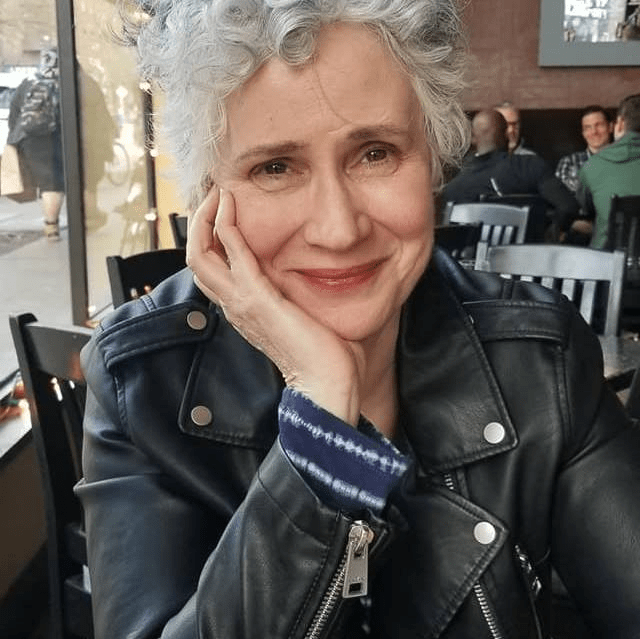
Lya Badgley’s life reads like an exotic adventure book you can’t put down, but she writes plot-driven suspense about women overcoming life-changing odds, against a backdrop of global conflict. In this interview, she shares her views about creativity, courage, persistence and resilience.
You’ve had an interesting life – how often do people say that to you? How do you tell the story of your life in a short elevator pitch?
I’ve been very lucky to have had choices – many do not. That said, being born in Myanmar to Montana parents, was a good start. From Seattle’s arts scene to documenting war crimes in Cambodia and opening a restaurant in Yangon, my life experiences fuel my creativity. I’ve been a mother, a former city council member, and an environmental activist and now write novels drawing deeply from my lived experiences.
So, you were born in Yangon, Myanmar. How did your parents from the Rocky Mountains come to be in Burma? What are your first memories from there?
My parents discovered the wider world when my father was stationed in northern Japan during the Korean War. They fell in love with Asia, and he went on to dedicate his life to academia, earning a doctorate in political science. They first arrived in Burma (Myanmar) in the late 1950s. One of my earliest memories is coming home from kindergarten in up-country Burma and telling my mother that all the children spoke English in class. Astonished, she accompanied me to school the next day, only to find that the children were speaking Burmese. I had simply assumed it was English. To this day, I love languages.
What kind of environment did your parents create which encouraged your creativity?
My mother was a true artist, always encouraging me to find beauty in everything around me. My father sparked a deep curiosity about the world, especially about the lives of everyday people. Our dinner table conversations were always lively, full of challenges and excitement, fueling my imagination and intellect. I was never allowed to leave the table without sharing something interesting and eating all my vegetables.
In 1987 what changed your life? How does Multiple Sclerosis affect you today?
In 1987, I developed a persistent headache that wouldn’t go away. Within two weeks, I lost vision in one eye. The diagnosis of Multiple Sclerosis came swiftly. I’ll never forget the mix of terror and wonder as I looked at the pointillistic MRI image of my brain, and the doctor casually said, “Yep, see those spots? That’s definitely MS,” as if he were ordering lunch. Strangely, that diagnosis liberated me—after all, what’s the worst that could happen? Now, as I age, the disease may slow my body, but it hasn’t dimmed my spark.
In what ways has being a musician/poet/writer/artist been a struggle and challenge? Do you think that is part of process and it in turn fosters innovation?
The struggles of being an artist—whether overcoming rejection, creative blocks, or balancing art with daily life—are definitely part of the journey. But there’s also magic in that process. There’s something almost alchemical about wrestling with a challenge and, through that tension, creating something entirely new. It’s in those moments of uncertainty that the most unexpected ideas emerge, as if they’re waiting for the right spark. The struggle doesn’t just foster creativity—it transforms it, turning obstacles into opportunities. And the joy comes from watching that magic unfold, as your vision takes on a life of its own.
When did you return to Southeast Asia, and how did you come to work as a videographer on a clandestine expedition interviewing Burmese insurgents, and later helping document the genocide cases in Cambodia?
The short answer is — a boyfriend! In the early ’90s, I returned to Southeast Asia, driven by a deep connection to the region and feeling uncertain about what to do next after a failed marriage. Through a friend I met during Burmese language studies, I stumbled upon an unexpected opportunity to work as a videographer on a covert mission, documenting interviews with Burmese insurgents. That intense experience then led to my role in Cambodia, where I worked with Cornell University’s Archival Project. There, I helped microfilm documents from the Tuol Sleng Museum of Genocide, preserving crucial evidence that would later hold war criminals accountable. Both experiences were life-changing and cemented my passion for telling these vital stories.
You were among the few foreigners to open businesses in Burma in the 1990s. What hurdles were there to opening the 50th Street Bar & Grill Restaurant in Yangon, Myanmar? How was Burma at that time?
Opening the 50th Street Bar & Grill in Yangon in the mid ’90s was a real adventure, and I take great pride in being part of the first foreign-owned project of its kind at that time. Myanmar was just emerging from decades of isolation, with very few foreigners and even fewer foreign businesses. Navigating the bureaucracy was incredibly challenging — layers of red tape, and we often had to rely on outdated laws from the British colonial era just to get things moving. It took persistence, creative problem-solving, and a lot of patience. I had the advantage of understanding the culture and speaking a bit of the language, and I never worked through a proxy. I handled even the most mundane tasks myself—like sitting for hours in a stifling hot bank, waiting to meet the manager, who was hiding in the bathroom to avoid me!
Basic infrastructure issues like inconsistent electricity and unreliable suppliers were ongoing challenges. But despite all the hurdles, Yangon had a special energy then. The people were incredibly warm and resilient, and there was a palpable sense that the country was on the cusp of major change, even though it remained under military rule. Looking back, I’m proud to have been part of something so groundbreaking during such a unique moment in Myanmar’s history. It’s heartbreaking to see the return of darker times.
When did you first start writing and what has kept you writing?
In the ’80s, I began writing song lyrics for my music, which eventually evolved into poetry. It turned out I had more to say, and my word count steadily grew from there. I write because I have no choice; it’s an essential part of who I am.
Your first novel, The Foreigner’s Confession, out in 2022, in the middle of the Covid-19 pandemic, weaves together one person’s story and a country’s painful history. How do you integrate in the legacy of the past, a personal journey, a war-torn country and the themes of loss and regret?
In The Foreigner’s Confession, I explore the interconnectedness of personal stories and a nation’s history. I like using conflict zones as backdrops for my protagonist’s inner turmoil. These settings highlight the psychological landscape shaped by war and trauma, reflecting the chaos within the character. I’m fascinated by the notion that evil exists in each of us, and under the right circumstances, we’re all capable of bad things. This theme resonates throughout the narrative, as the characters grapple with their moral choices amidst the turmoil surrounding them. As Tom Waits[1] beautifully puts it, “I like beautiful melodies telling me terrible things” — that juxtaposition is central to my writing, illustrating how beauty and darkness can coexist and inform our understanding of the human experience.
When it comes to writing are you a planner or a pantser? What’s your process for writing, particularly when you want to bring in the setting, the history of a place, and authenticity?
I’m a pantser all the way! Just saying the word “spreadsheet” makes me break into a sweat. I wish I could create meticulous diagrams and beautiful whiteboards filled with colorful, fluttering sticky notes, but that just isn’t my style. For me, the story unfolds as I write. I refer to myself as a discovery writer. It’s a slow and sometimes tedious process but discovering what I didn’t know was going to happen is truly amazing. I draw from my personal experiences to provide authenticity.
Does writing suspense/mystery help make a novel more compelling because it has to be well-crafted and cleverly constructed?
I write the story buzzing in my brain and then try to determine the genre.
What do you think about the power and potential of a novel to reach readers in a different way, for example as a vehicle to give insight into the situation in Cambodia or Myanmar, the wider/deeper issues (like geopolitics/colonialism), and the present reflecting a troubled past?
Yes, yes, yes! Novels have the potential to foster empathy and understanding, challenging readers to confront uncomfortable truths. Can we humans please stop being so stupid? It’s doubtful, but we can only hope.
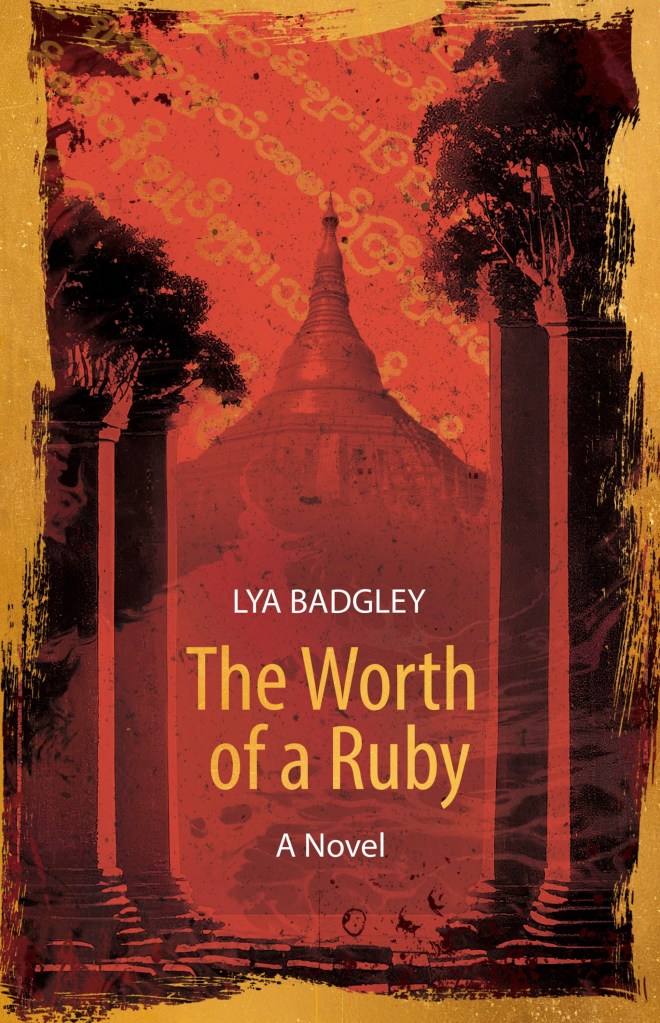
Last year your second novel, The Worth of a Ruby, was launched, and you’ve recently been in Myanmar. What’s been your impression of the place in 2024, still suffering under the coup and with not such good prospects as in the 2010s? Could you ever go back there to live?
Sitting in the Inya Lake Hotel in Yangon as I write this, I can see that the people here carry a veil over their eyes that I don’t recall from my previous visits. Nevertheless, the cyclical nature of oppression has persisted here for a long time. My husband and I would move back in a heartbeat if there were opportunities and adequate healthcare for my situation. This country remains a part of my identity, and I dream of a future where I can return to help contribute to its recovery.
Your current/recent visit to SE Asia has taken you to what places? What have been the most memorable experiences?
I’m in Yangon until mid-October and will then spend a few days in Singapore, slogging my books to the shops there. As always, the most memorable experiences are renewing the deep connections with the people I care about.
Both your books feature people/countries having to confront their past/dark side. How do you think a novel can help navigate through the complexities and nuances of situations, or at least show that nothing is as black and white as first thought?
That’s a complex question, and any answer can only touch the surface. Both of my novels explore people and countries grappling with their pasts and confronting their darker sides, but the truth is, no single story can fully capture the complexity of these situations. What a novel can do, however, is open a window into the nuances and shades of gray that exist beneath the surface. By diving into characters’ personal struggles and the layered histories of their countries, readers can begin to see that nothing is as black and white as it might seem. A novel helps illuminate the hidden motivations, moral ambiguities, and emotional complexities that are often overlooked, offering a more profound understanding of the tangled web of human experience.
Your work-in-progress novel is set in Bosnia. What themes will that explore?
The themes in my work-in-progress novel set in Bosnia will continue to explore the complexities of personal and national histories, much like my previous work. However, this time I’m weaving in elements of magic realism, drawing inspiration from the Sarajevo Haggadah and Balkan folktales. These mystical elements will add a new layer to the narrative, deepening the exploration of identity, memory, and the ways in which the past haunts the present. The use of folklore will allow me to delve into the region’s rich cultural traditions while keeping the focus on the enduring human themes of loss, resilience, and transformation.
Where is ‘home’ for you now? How do you think living in other countries has influenced your outlook and personality?
I am wildly curious, and home is the room I’m sitting in. Though we pay a mortgage on our condo in Snohomish, home has always been more about where I am in the moment than a fixed place. Living in different countries has profoundly shaped my outlook and personality. It’s given me a deep appreciation for diverse perspectives and a sense of adaptability. I’ve learned that people’s values and struggles can be both uniquely local and universally human. Experiencing different cultures has also sparked my curiosity and influenced the way I approach storytelling, allowing me to blend personal and global themes into my work.
What do you think are your points of difference/advantages that you bring to your writing?
One of the key differences I bring to my writing is my unique upbringing. Growing up in Myanmar with parents who encouraged both critical thinking and creativity gave me an early appreciation for the complexities of the world. I’ve lived in many countries and experienced firsthand the way cultures can both clash and blend, and that depth of perspective is something I try to infuse into my stories. Navigating a chronic disease like multiple sclerosis has also shaped my writing. It’s taught me resilience, patience, and how to find beauty in challenging situations. I think these experiences allow me to write characters and narratives that explore the shades of gray in life—the areas where pain, perseverance, and hope intersect.
Why do you think that a high proportion of expats/students/backpackers/digital nomads are from the Pacific Northwest and find themselves living and working in Southeast Asia? (I know three people from Snohomish who live in Asia).
It’s an interesting phenomenon, and I think the Pacific Northwest has some unique qualities that make it a breeding ground for wanderers. Growing up on the edge of the continent, facing west, there’s always been a sense of curiosity about what’s beyond the horizon. The region’s creative spirit—fueled by its music scene, constant rain, endless coffee, and a long history of innovation with computers and tech—fosters a mindset that’s open to exploration and new ideas. People from the PNW are used to thinking outside the box, and there’s a certain resilience that comes from enduring gray skies. This drive for adventure and discovery seems to naturally extend to places like Southeast Asia, where expats, students, backpackers, and digital nomads can experience a different pace of life while still tapping into their creative or entrepreneurial sides. Though, it blows my mind that you know three people from my little town of Snohomish living in Asia!
For aspiring writers and creatives, and for readers of Borderless, what’s your advice?
My advice for aspiring writers, creatives, and readers of Borderless is simple: always take the step, go through the door you don’t know. The unknown is where growth, creativity, and discovery happen. Don’t be afraid to embrace uncertainty and take risks in your work and life. Whether it’s starting a new project, exploring a different idea, or venturing into unfamiliar territory, those leaps often lead to the most rewarding experiences. Stay curious, keep pushing boundaries, and trust that the act of creating—no matter how daunting—will always teach you something new.
Keith Lyons (keithlyons.net) is an award-winning writer and creative writing mentor originally from New Zealand who has spent a quarter of his existence living and working in Asia including southwest China, Myanmar and Bali. His Venn diagram of happiness features the aroma of freshly-roasted coffee, the negative ions of the natural world including moving water, and connecting with others in meaningful ways. A Contributing Editor on Borderless journal’s Editorial Board, his work has appeared in Borderless since its early days, and his writing featured in the anthology Monalisa No Longer Smiles.
.
PLEASE NOTE: ARTICLES CAN ONLY BE REPRODUCED IN OTHER SITES WITH DUE ACKNOWLEDGEMENT TO BORDERLESS JOURNAL.
Translations are like bridges. Three years ago, we decided to start a bridge between Tagore’s ideas and the world that was unfamiliar with his language, Bengali. He has of course written a few pieces in Brajbuli too. We started our journey into the territory of Tagore translations with Aruna Chakravarti’s Songs of Tagore. Now we have expanded hugely this section of our translations with many prose pieces and more translations of his lyrics and poetry by writers like Aruna Chakravarti, Fakrul Alam, Radha Chakravarty, Somdatta Mandal, Himadri Lahiri, Ratnottama Sengupta, Chaitali Sengupta and Nishat Atiya other than our team’s efforts. To all these translators our heartfelt thanks. We share with you their work celebrating one of the greatest ideators of the world.
Prose
Stories
.Aparichitaby Tagore :This short story has been translated as The Stranger by Aruna Chakravarti. Click hereto read.
Musalmanir Galpa(A Muslim Woman’s Story): This short story has been translated by Aruna Chakravarti. Clickhere to read.
One Small Ancient Tale: Rabindranath Tagore’s Ekti Khudro Puraton Golpo (One Small Ancient Tale) from his collection Golpo Guchcho ( literally, a bunch of stories) has been translated by Nishat Atiya. Click hereto read.
Bolai: Story of nature and a child translated by Chaitali Sengupta. Click hereto read.
Baraf Pora (Snowfall) : This narrative gives a glimpse of Tagore’s first experience of snowfall in Brighton and published in the Tagore family journal, Balak (Children), has been translated by Somdatta Mandal . Clickhere to read.
Himalaya Jatra( A trip to Himalayas) :This narrative about Tagore’s first trip to Himalayas and beyond with his father, has been translated from his Jibon Smriti (1911, Reminiscenses) by Somdatta Mandal. Click here to read.
Library: A part of Bichitro Probondho(Strange Essays) by Rabindranath Tagore, this essay was written in 1885, translated by Chaitali Sengupta. Click hereto read.
Book Excerpts
The Parrot’s Tale: Excerpted from Rabindranth Tagore. The Land of Cards: Stories, Poems and Plays for Children, translated by Radha Chakravarty, with a foreword from Mahasweta Devi. Clickhere to read
Rabindranath Tagore Four Chapters: An excerpt from a brilliant new translation by Radha Chakravarty of Tagore’s controversial last novel Char Adhyay. Click here to read.
Farewell Song :An excerpt from Radha Chakravarty’s translation of Tagore’s novel. Click hereto read.
Oikotan(Harmonising) has been translated by Professor Fakrul Alam and published specially to commemorate Tagore’s Birth Anniversary. Click hereto read.
Monomor Megher O Shongi (or The Cloud, My friend) has been translated by Professor Fakrul Alam. Click here to read.
Professor Fakrul Alam has translated Tomra Ja Bolo Tai Bolo, Hridoy Chheele Jege and Himer Raate — three songs around autumn from Clickhere to read.
Tagore’sAchhe Dukhu, Achhe Mrityu, (Sorrow Exists, Death Exists) has been translated from Bengali by Fakrul Alam. Click hereto read.
Tagore’s long poem, Dushomoy (translated as Journey of Hope though literally the poem means bad times). Click here to read the poem in English and listen to Tagore’s voice recite his poem in Bengali. We also have a sample of the page of his diary where he first wrote the poem as ‘Swarga Pathhe'(On the Path to Heaven).
Deliverance by Tagore: ‘Tran’by Tagore, a prayer for awakening of the subjugated. Click here to read the translation.
Abhisar byTagore: A story poem about a Buddhist monk by Rabindranath Tagore in Bengali. Click here to read the translation.
Amaar Nayano Bhulano Eledescribes early autumn when the festival of Durga Puja is celebrated. Click here to read the translation from Bengali.
Morichika or Mirage by Tagoreis an early poem of the maestro that asks the elites to infringe class divides and mingle. Click here to read the translation from Bengali.
Pochishe Boisakh(25th of Baisakh) is a birthday poem Tagore wrote in 1922 and from he derived the lyrics of his last birthday song written in 1941. Click here to read.
Chhora or Rhymes, a poem describing the creative process, it was written in 1941. Click here to read.
Okale or Out of Syncgives a glimpse of how out of sync situations are also part of our flow. Click here to read.
Mrityu or Death dwells on Tagore’s ability to accept death as a reality. Clickhere to read.
Songs of Tagore: Seven songs translated by Aruna Chakravarti from a collection that started her on her litrary journey and also our Tagore translation section. Click here to read.
Fakrul Alam writes nostalgically of his visits to Feni in Noakhali, a small town which now suffers from severe flooding due to climate change. Click here to read.
Rakhi Dalal reviews Swadesh Deepak’s A Bouquet of Dead Flowers translated from Hindi by Jerry Pinto, Pratik Kanjilal, Nirupama Dutt, Sukant Deepak. Click here to read.
Imagine the world envisioned by John Lennon. Imagine the world envisioned and partly materialised by Tagore in his pet twin projects of Santiniketan and Sriniketan, training institutes made with the intent of moving towards creating a work force that would dedicate their lives to human weal, to closing social gaps borne of human constructs and to uplifting the less privileged by educating them and giving them the means to earn a livelihood. You might well call these people visionaries and utopian dreamers, but were they? Tagore had hoped to inspire with his model institutions. In 1939, he wrote in a letter: “My path, as you know, lies in the domain of quiet integral action and thought, my units must be few and small, and I can but face human problems in relation to some basic village or cultural area. So, in the midst of worldwide anguish, and with the problems of over three hundred millions staring us in the face, I stick to my work in Santiniketan and Sriniketan hoping that my efforts will touch the heart of our village neighbours and help them in reasserting themselves in a new social order. If we can give a start to a few villages, they would perhaps be an inspiration to some others—and my life work will have been done.” But did we really have a new social order or try to emulate him?
If we had acted out of compassion and kindness towards redefining with a new social order, as Miriam Bassuk points out in her poem based on Lennon’s lyrics of Imagine, there would be no strangers. We’d all be friends living in harmony and creating a world with compassion, kindness, love and tolerance. We would not have wars or regional geopolitical tensions which act against human weal. Perhaps, we would not have had the issues of war of climate change take on the proportions that are wrecking our own constructs.
Natural disasters, floods, fires, landslides have affected many of our lives. Bringing us close to such a disaster is an essay by Salma A Shafi at ground level in Noakhali. More than 4.5 million were affected and 71 died in this disaster. Another 23 died in the same spate of floods in Tripura with 65,000 affected. We are looking at a single region here, but such disasters seem to be becoming more frequent. And yet. there had been a time when Noakhali was an idyllic vacation spot as reflected in Professor Fakrul Alam’s nostalgic essay, filled with memories of love, green outdoors and kindnesses. Such emotions reverberate in Ravi Shankar’s account of his medical adventures in the highlands of Kerala, a state that suffered a stupendous landslide last month. While Shafi shows how extreme rainfall can cause disasters, Keith Lyons writes of water, whose waves in oceanic form lap landmasses like bridges. He finds a microcosm of the whole world in a swimming pool as migrants find their way to New Zealand too. Farouk Gulsara muses on kindness and caregiving while Priyanka Panwar ponders about ordinary days. Saeed Ibrahim gives a literary twist to our musings. Tongue in cheek humour is woven into our nonfiction section by Suzanne Kamata’s notes from Japan, Devraj Singh Kalsi’s piece on premature greying and Uday Deshwal’s paean to his sunglasses!
In translations, we have Nazrul lyrics transcreated from Bengali by Professor Alam and poetry from Korean by Ihlwha Choi. We pay our respects to an eminent Balochi poet who passed on exactly a year ago, Mubarak Qazi, by carrying a translation by Fazal Baloch. Tagore’s Suprobhat (Good morning) has been rendered in English from Bengali. His descriptions of the morning are layered and amazing — with a hint of the need to reconstruct our world, very relevant even today. A powerful essay by Tagore called Raja O Praja(The King and His Subjects), has been translated by Himadri Lahiri.
Our fiction hosts two narratives that centre around childhood, one by Naramsetti Umamaheswararao and another by G Venkatesh, though with very different approaches. Mahila Iqbal relates a poignant tale about aging, mental health and neglect, the very antithesis of Gulsara’s musing. Paul Mirabile has given a strange story about a ‘useless idler’.
A short story collection has been reviewed by Rakhi Dalal, Swadesh Deepak’s A Bouquet of Dead Flowers, translated from Hindi by Jerry Pinto, Pratik Kanjilal, Nirupama Dutt, Sukant Deepak. Somdatta Mandal has written about a book by a Kashmiri immigrant which is part based on lived experiences and part fictive, Karan Mujoo’s This Our Paradise: A Novel. Bhaskar Parichha has reviewed Ayurveda, Nation and Society: United Provinces, c. 1890–1950by Saurav Kumar Rai, a book which shows how healthcare was even a hundred years ago, politicised. Meenakshi Malhotra has reviewed Anuradha Marwah’s novel, Aunties of Vasant Kunj, of which we also have an excerpt. The other excerpt is from Mineke Schipper’s Widows: A Global History. Ratnottama Sengupta converses with Reba Som, author of Hop, Skip and Jump; Peregrinations of a Diplomat’s Wife.
We have more content that adds to the vibrancy of the issue. Do pause by this issue and take a look. This issue would not have been possible without all your writings. Thank you for that. Huge thanks to our readers and our team, without whose support we could not have come this far. I would especially like to thank Sohana Manzoor for her continued supply of her fabulous and distinctive artwork and Gulsara for his fabulous photographs.
Let us look forward to a festive season which awakens each autumn and stretches to winter. May we in this season find love, compassion and kindness in our hearts towards our whole human family.
Tagore’s poem Suprobhat or Good morning was originally published in in Purabi (Name of a Raga) in 1925 by Vishwa Bharati.
Art by Sohana Manzoor
Sunshine, your radiance
Bursts through the doorway.
Like lightning, it has stunned
Penetrating the dreamworld.
I was wondering if I should arise,
If the blinding darkness has passed,
If I should open my closed eyes
Redolent with sleep.
Meanwhile, the northeast
Heralds your arrival.
Amidst the bright sky
Clouds waft,
As if set aflame.
The Eastern breeze
Stunned awake, blushes red.

Bhairav*, in what guise have you come?
Snakes twine around your fron,
The Rudra bina* plays a melody
To welcome the ragini of the morn.
Does the enchanted koel coo?
Do the flowers in the woods bloom?
After eons, suddenly,
The dark night has split.
Your sword has sliced
The darkness into two.
In pain, the universe
Shivers, bleeding light,
And spills it across the skies.
Some have woken up with the tremor,
Some continue to dream with fright.

Though hungry after the night
At the cremation ground, your followers,
Moisten and wet their lips
To scream, to holler.
They are our guests.
They dance in our yards.
Open, O householder, open
Your door, do not hide —-
Bring everything you have.
You will have to give your all.
Do not sleep any more.
Rend your heart,
Pour your being.
O devout, why are you
 Attached to false affections?

As the sun rises, I hear an unknown voice:
“There is no fear. O, there is no fear —
In the final reckoning, he who gives up
His life is immortalised in eternity.”
Oh Rudra, I sing for you.
Tell me how to invoke you.
I will drum the tabor in rhythm
With the dance of death.
I will decorate your offering
With a basket of pain.
The morning has come.
The destroyer of darkness,
Shiva, roars with laughter.
The hearts of the awakened
Flow with joyous contentment.

A new entity will emerge by
dedicating life to the life force.
Invoking your glory,
All fears can be overcome.
It is good that the storm
Has destroyed the decadent.
It is good that the morning arrived
Riding the lion-cloud—
The union will be set aflame
By a fiery bolt of lightning.
For you, I will give up
All my wealth.
Life can be eternalised by ambrosia,
Partaken with your grace.

*Bhairav is another name for Shiva. It is also the name of a morning raga.
*Rudra bina is a type of vina. Rudra is another name for Shiva.
(Translated from Bengali by Mitali Chakravarty with editorial input by Sohana Manzoor)
.
PLEASE NOTE: ARTICLES CAN ONLY BE REPRODUCED IN OTHER SITES WITH DUE ACKNOWLEDGEMENT TO BORDERLESS JOURNAL
Salma A. Shafi writes from ground level at Noakhali
From Public Domain
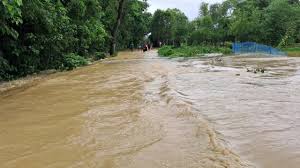
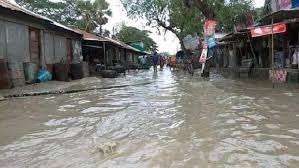
The Greater Noakhali region of Bangladesh is experiencing one of the most severe flood and water-logging crises in recent memory, driven by persistent heavy rainfall since mid-August 2024. The flood affected more than 5 million people, submerging houses, roads, and marketplaces, and leaving large portions of the region inundated. A total of 71 people, including women and children, lost their lives in the flood affected areas. With water levels reaching alarming heights, the disaster has raised significant concerns about vulnerability of the region for future flooding.
Almost every year floods occur in Bangladesh, but the intensity and magnitude vary from year to year. Their nature causes and extent of destruction gives them various definitions such as river flood, rainfall flood, flash flood, tidal flood, storm surge flood. The term manmade flood is a recent phenomenon attributed to encroachment on vital water channels, such as canals and wetlands sometimes for construction of roads and bridges and frequently for fish cultivation, hatcheries and shrimp farming.
Context of recent flood in Bangladesh
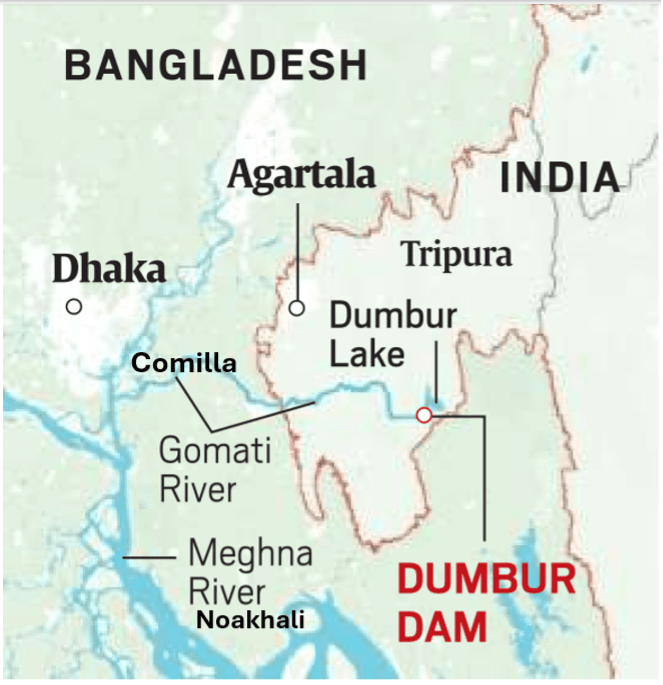
Since August 20, 2024, Bangladesh has been facing severe flooding triggered by continuous heavy rainfall and, according to the Bangladesh Ministry of External Affairs, water releases from Dumbur Dam, upstream in Tripura, India[1], a claim that is denied by the Indian government. Tripura also suffered severe floods and landslides[2] from this August. The flood impacted several districts in Bangladesh, including Feni, Noakhali, Comilla, Lakshmipur, Brahmanbaria, Cox’s Bazar, Khagrachhari, Chattogram, Habiganj, and Moulvibazar. By August 23, 2024, the Ministry of Disaster Management and Relief reported that floods had affected 4.5 million people across 77 upazilas in 11 districts. Nearly 194,000 people, along with over 17,800 livestock sought refuge in 3,170 shelters as the crisis continued.
In addition to widespread displacement, the floods led to tragic fatalities, with deaths reported across multiple districts. Communication with key river stations, such as Muhuri[3] and Halda[4], were completely severed, hampering collection of vital data necessary for relief and rescue operations. The extensive flooding has caused significant damage to property, crops, and infrastructure, displacing thousands of families. The disruption to transportation and agriculture deepened the humanitarian crisis, demanding immediate action to mitigate long-term impacts of disaster on the affected communities.
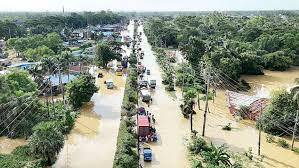
The flood situation in Noakhali District worsened due to continuous heavy rainfall and rising water levels of the Muhuri River. The district Weather Office recorded 71 mm of rainfall within 24 hours, exacerbating the flooding. Approximately 2 million people were stranded as floodwaters submerged roads, agricultural fields, and fish ponds. Seven municipalities in the district went underwater, with widespread waterlogging affecting both rural and urban settlements.
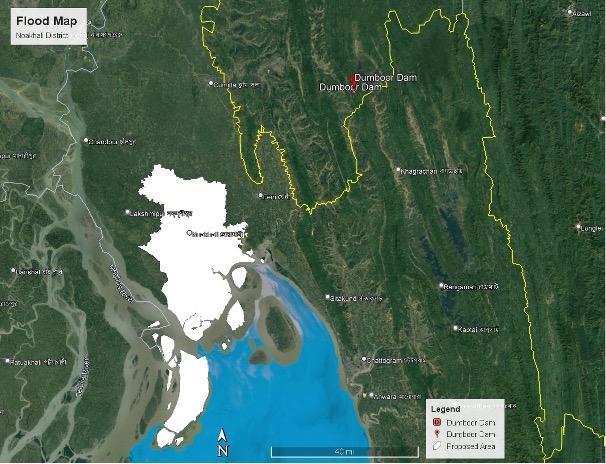
Map provided by Salma A Shafi
On September 1, 2024, the Noakhali Meteorological Office reported a staggering 174 mm of rainfall within a 12-hour period, causing widespread flooding and waterlogging across low-lying areas. The worst-affected upazilas include Noakhali, Senbagh, Sonaimuri, Chatkhil, Begumganj, Kabirhat, Companiganj, and Subarnachar, where over 2.1 million people were stranded. Additionally, more than 264,000 individuals sought refuge in emergency shelters and school buildings. The prolonged water-logging devastated local economy, particularly the agricultural sector, where vast areas of farmland, including Aman rice seedbeds and vegetable fields, were submerged, jeopardizing livelihoods of farmers and disrupting essential food production for a prolonged period.
With 90% of Noakhali district’s population impacted by this flash flood, the region faced critical humanitarian and environmental emergency. An analysis of the causes and consequences of flood and waterlogging in Greater Noakhali reveals an interplay of meteorological, infrastructural, and environmental factors coupled with geographic location of Bangladesh and the geo morphology of the river systems of the region. Bangladesh and India share 54 rivers of which the Teesta, Ganges, Brahmaputra, Meghna forming the GBM basin are the most important. This river basin is one of the largest hydrological regions in the world and stretches across five countries Bangladesh, Bhutan, China, India and Nepal. This basin area is home to 47 percent of the Indian population and 80 percent of the Bangladeshi population. Food security, water supply, energy and environment of both countries are dependent on the water resource of the rivers.
Uncertainty and Challenges in Flood situation
During the monsoon periods development of a low-pressure system over northern Bangladesh can bring very heavy to extremely heavy rainfall in Assam, Meghalaya, and Tripura posing great threat to flood-prone areas in Bangladesh. These overlapping weather patterns and regional dynamics create highly uncertain and dangerous situation, making it difficult to coordinate an effective response and leave millions of people vulnerable to worsening flood conditions.
Map provided by Salma A Shafi
Flooding in Noakhali region resulted from heavy rainfall and floods in western Tripura in August and as per MEA[5] news broadcast that the Dumbur Dam, a hydro power project had been, “auto releasing”, water as a consequence of the rainfall. The Dumbur Dam in Tripura is located far from the border about 120km upstream of Bangladesh. It is a low height dam (30m) that generates power and feeds into a grid from which Bangladesh also draws 40MW power. There are three water level observation sites along the 120km river course. As per news from the monitoring agencies excess water from the Gumti reservoir was automatically released through the spillway once it crossed the 94m mark which is the reservoirs full capacity. It is a known fact there is no comprehensive regional mechanism for transboundary water governance or multilateral forum involving the five Asian nations. The lower riparian nations particularly India and Bangladesh are therefore the worst sufferers.
Key Impact Areas in Bangladesh:
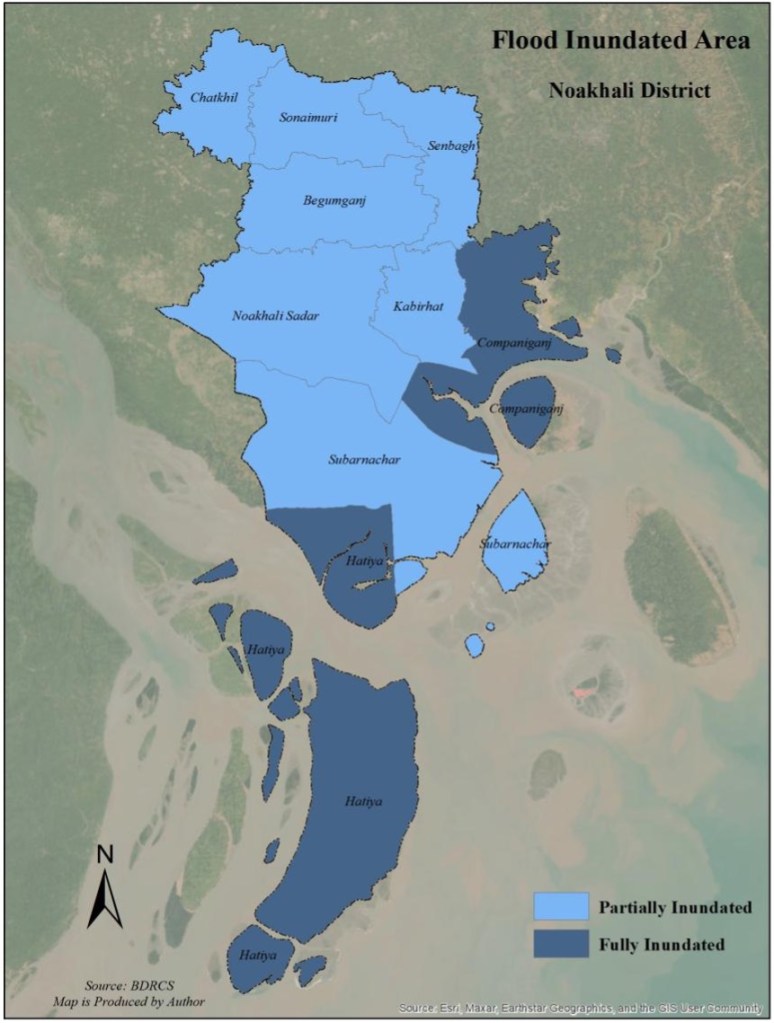
The flood in the Noakhali region was caused by overflow of water from the large catchment areas downstream of the Dumbur Dam. While river channels were not deep enough to accommodate the excess water, unplanned constructions on rivers and canals caused the water to spill into settlement areas causing humanitarian crisis unseen in decades. Kompaniganj and Hatiya upazilas (sub-districts) were completely inundated by floodwaters, while Subarna Char, Sonaimuri, Noakhali Sadar, Kabir Hat, and Senbag upazilas were partially affected. The flooding submerged homes, roads, and marketplaces, with water levels reaching roof levels in the high flood zones, waist-deep in some areas and knee-deep inside most homes. The rising floodwaters devastated farmlands, particularly Aman paddy seedbeds and vegetable fields, swept away, a large number of the cattle, poultry including the sheds which sheltered them.
Current Challenges
The ongoing flood crisis in Bangladesh faces several critical challenges. One of the most immediate issues is the submersion of roads and the disruption of communication networks, which has significantly hindered relief efforts. The situation is fluid, with new districts continuously being affected, complicating the delivery of aid and emergency services to those in need. This has also resulted in delays in evacuations, leaving many communities stranded without access to basic necessities.
Another key challenge is the conflicting information from different meteorological agencies. The Bangladesh Meteorological Department and the Flood Forecasting and Warning Center (FFWC) have issued varying reports regarding upcoming weather conditions. This uncertainty is affecting the preparedness of the affected populations, making it difficult for them to take timely and appropriate measures to protect themselves and their property.
Geo-political Tension in River Management in Bangladesh
Bangladesh, known as one of the most climate-vulnerable nations globally is facing increasing geopolitical challenges due to its strategic location on the Ganges-Brahmaputra Delta. Besides, annual monsoon floods, flash flood, particularly in northeastern districts of Sylhet, Feni and Cumilla, Noakhali are exacerbated by water releases from upstream dams, such as the Dumbur Dam. These actions have intensified tensions between Bangladesh and India, highlighting the complex dynamics of transboundary river management.
Despite legal recognition of rivers as living entities, both nations continue to exploit these water resources through infrastructure projects that disrupt natural river flows. Extensive dam and hydropower projects on shared rivers have caused significant environmental and social injustices downstream, impacting both ecosystems and livelihoods. This situation reflects a broader pattern of unilateral control and inadequate cooperation in water management, which contradicts international agreements and hinders equitable water sharing.
The Bangladesh-India Joint River Commission, established in 1972, is yet to resolve these critical issues. The recent floods have further underscored the need for more effective communication and cooperation between the two nations to prevent future disasters. As calls for water justice grow louder, there is increasing pressure on both countries to remove barriers and ensure the free flow of rivers across borders, upholding the principles of transboundary water governance and protecting the rights of those affected downstream.
Flood Map of Noakhali District, 2024. Map provided by Salma A Shafi
[5] Ministry of External Affairs, in this case Bangladesh.
Salma A. Shafi is an architect and urban planner. She did her MSc. in Urban Planning from AIT, Bangkok, Thailand and has a Bachelor of Architecture (B. Arch.) degree from BUET, Dhaka. Salma Shafi has extensive experience in urban research and consultancy, specialising in urban land use and infrastructure planning, housing and tenure issues. She is a well-known researcher in the field of urbanisation and urban planning. Urban Crime and Violence in Dhaka published by the University Press Limited (2010), Housing Development Program for Dhaka City, Centre for Urban Studies, Dhaka (2008) and Feroza, a biography of her mother published by Journeyman (2021).
.
PLEASE NOTE: ARTICLES CAN ONLY BE REPRODUCED IN OTHER SITES WITH DUE ACKNOWLEDGEMENT TO BORDERLESS JOURNAL
I am an early riser. This morning I could not get up. I was in an ocean dream. The fish talked to me. I was delighted to hear them speak. I thought the ocean dream was real. The alarm clock must have been in the ocean dream as well.
KNOWING NOTHING
Here I contemplate knowing nothing. There is my plan laid out. It is a dismal
plan. Out in the town I paint on walls, wooden and brick ones, and metal doors. Humming a song, I paint question marks and rain drops. It’s nothing artistic like a flower in a vase, a yellow rose shining.
FATIGUED
Fatigued, I dream so deep, I become ashes in an urn.
I am below the earth, above the clouds.
In a dream, a woman sleeps with me and next to me. A river flows outside our window.
Birds sing baleful songs.
I feel my broken teeth with my tongue -- there is no fixing them or anything else.
Luis Cuauhtémoc Berriozábal lives in California, works in Los Angeles, and was born in Mexico. His poetry and illustrations have appeared in Black Petals, Borderless Journal, Blue Collar Review, KendraSteiner Editions, and Unlikely Stores. His latest poetry book, Make the Water Laugh, was published by Rogue Wolf Press.
PLEASE NOTE: ARTICLES CAN ONLY BE REPRODUCED IN OTHER SITES WITH DUE ACKNOWLEDGEMENT TO BORDERLESS JOURNAL
Fakrul Alam writes nostalgically of his visits to Feni in Noakhali, a small town which now suffers from severe flooding due to climate change.
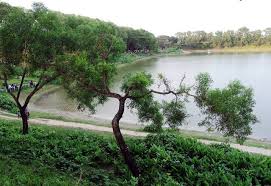
Green Feni, Noakhali Feni flooded due to climate change From Public Domain
Every year, twice a year, during winter and summer vacations, my family would travel to Feni, Noakhali, where we would spend our holidays in our Nana Bari, the home of my Nana, or maternal grandfather.
For days before the journey, our excitement would keep mounting. For one thing, Amma[1] would make frequent trips to Nawabpur, or what was then called Jinnah Avenue, to buy fabrics or wool which she would then sew/darn/weave into clothes or woolens to gift her family members when in Feni. She would also spend more time in the kitchen than usual, cooking as many dishes as she could for my father, the only one of us who would be staying behind since he had his office to attend to; he would join us, if at all, for a few days at the end. For days before she left, Amma would repeat instructions to our household help until, by the time we left, we had memorised what they were supposed to be doing while we were away. Moreover, she would spend the last few days before the journey packing and repacking since she had to ensure that we had everything we needed, not only for the fortnight or so we would spend in Feni, but also for the journey back and forth.
And then, finally, the day of the journey to Feni would arrive! The six of us would board two or three rickshaws in the morning elatedly and head for the railway station in Phulbaria. We would have to thread our way through a platform overflowing with passengers and hangers-on, coolies and vendors, beggars and con-artists, as well as railway police and ticket checkers. Intrepid and inspired, Amma would lead us through the milling and tense crowd. It was as if the whole world was heading for the same interclass compartment; indeed, it seemed that we always managed to reach it just when the train was ready to leave the station.
Eventually, the train would leave Phulbaria and we would relax and feel exhilarated again. Because we did the trip so often, we looked forward to the highlights on the way. Bhairab Bridge, huge and unending, had views of the riverscape that were breathtaking in all seasons and for as long as the train clanged through it we were awestruck. Kasba, the station on the border where Pakistani and Indian troops skirmished frequently throughout the 1960s, was always the place where we tensed up a little. The red hills of Mainamati looked incongruous in the green world of Bangladesh. There were junctions like Brahmanbaria and Laxam, where vendors hawked their wares and cries of “cha gorom[2]” and “deem[3]” filled the air. Although the trip to Feni was supposed to be seven or eight hours long, by the time the train reached Feni station, it would be late in the evening and we would be exhausted, worn out by a journey that seemed to have gone on and on.
Feni in the 1960s was a small mofussil town, and to us Dhakaites, quaintly interesting. Rickshaws were often veiled! The traffic consisted almost entirely of rickshaws and bullock carts; the buildings seemed rickety or run-down, as if someone had forbidden them all to look good or completed or told them not to stand up straight. Although the trip to our Nana Bari from the station was not more than a few minutes by rickshaw, to us, it seemed to take forever; we just couldn’t wait for the journey to end by this time.
But all our fatigue evaporated as soon as our rickshaw took a bend and Nana Bari swung into view, revealing our uncles and aunts waiting eagerly to take us in. Nana, intensely religious at this stage of his life, would often be waiting to greet us with the warmest of smiles before hurrying off to prayer. My Nani[4] would first embrace Amma and the two of them would sniff a little, both overcome by the emotion of the oldest daughter returning home after some months. Then she would hug the five of us turn by turn and dash for the kitchen where she had been supervising the cooking. We would join her there as soon as we had washed and changed so that she could serve us delicious pithas[5] and all sorts of delicacies that Amma could cook in Dhaka only now and then. If it wasn’t too late, Amma’s relatives and friends would drop in, making us feel very important, for everyone wanted to know what we children were doing in school and the details of our Dhaka life. Eventually, we would drop off to sleep in utter exhaustion, but not before our uncles and aunts revealed the plans they had for us for the next few days.
The next few days, in fact, would go in a whirl. If it was summer and the heat was too intense or the rain too heavy, we would play carom or snakes and ladders inside for a while; if there was a cloud cover or only a drizzle outside, we would play hopscotch or football in the courtyard or retreat to the shaded grove in the backyard. Sooner or later, though, we would head for the pond, the centre of our daily rituals. Once we went into the water, we stayed in till Nani and Amma dragged us out for lunch. It was in this pond that we all learned to swim in successive trips; here we floated on banana-trunk rafts for hours and were thrilled at the way my uncles caught fish either with a net or a fishing rod. Sometimes, a tiger-skinned snake would slither past us shushing us instantly until it disappeared. Then we would resume our water games once again. If it was winter, on the other hand, we would stay in bed as long as possible, until the sun was completely up; afterwards, we would head for the courtyard where we would play hopscotch or cricket or go to the farthest reach of our Nana Bari in the plot of land adjacent to the pond, pretending to be picnicking. And then after we had psyched and warmed ourselves adequately we would go to the pond for a quick dip and rush out shivering to dry ourselves and have lunch in the sun.
Some evenings Amma would take us out to visit her relatives. Other evenings, we would go out for strolls. At least one evening we would spend promenading all around the dighi (large tank) around which colonial Feni had grown and where there were dak bungalows and the offices of this sub-divisional town. On one of these evenings, our uncle would take us to the edge of the town to show the old bridge and the massive and ancient banyan tree on the Grand Trunk Road, narrating to us, as we went, the story of how Sher Shah had built it and the bridge hundreds of years ago as part of his plan to administer efficiently the territories he had wrested from the Mughals. On another evening, our uncle would take us to see the ruins of Feni airport, for the town was once one of the key forward bases of the Royal Air Force, even though it would be abandoned at the bend of our history when India was partitioned. At least once during every visit to Feni, we would sneak out to go to see a film, for our now-puritan Nana was known to frown even at the mention of the cinema and would get mad at my uncles and aunts if he came to know where they had taken us.
At night, we would occasionally go to dawats[6]. Once every trip, Nanu would reciprocate by inviting relatives, friends, and even acquaintances she considered important to Nana Bari so that they could also meet us over dinner. On nights when we stayed home all by ourselves, Nana would join us after evening prayers, relaxing and joking with us for at least an hour, and thus remind the other elders of how he had been full of life and a Swadeshi (self-rule) campaigner once, an activist in the cause of one Bengal, but how he had become other-worldly now. Sometimes his stepbrother would visit us, tooting his odd-sounding bicycle horn entirely for our benefit as he came and went, and filling Nana Bari with his booming voice and loud laughter. Nani, too, would join us for a while, finally relaxing after another day of hard work, and would tease us as grandmothers are supposed to do, making us grandchildren feel silly and important at the same time.
Reluctantly, we would go to sleep after dinner; some on beds and some on the mats spread out on the floor. But sleep would take long to come, for we would first review the events of the day or plan for the one that was coming up, exchange secrets in the dark, or whisper stories about the ghosts and robbers that were supposed to be all around Nana Bari.
But we felt totally secure in Nana Bari, wrapped up in the love of my grandparents and uncles and aunts. Every part of the Bari[7] was full of family history. “There,” an aunt would say, “was where you were born!” “Those rooms are where all of us used to live before your Nana decided to extend the house for all you grandchildren,” my Nani would tell us proudly. In time, I began to fill parts of Nana Bari with my own memories too, although I was still a boy. Wasn’t that the room, for instance, where I was painfully initiated into the faith, though the occasion led to a feast in my honour afterwards? Occasionally, we all became part of family history in the making, as an uncle or an aunt got married, or one of us or a cousin had his akika[8] or birthday celebrated, and Nana Bari would then take on a festive air for days.
For the fortnight or so we were in Nana Bari, we were thus completely happy. Little did we know then the financial difficulties my Nana was experiencing due to the religious turn he had taken in old age; the hours he was spending in prayers and meditation meant that other people were taking advantage of him, encroaching on his land and trying to defraud him in business. Little did we know the strain Nani was going through then, running the large family on a reduced budget—Amma had three brothers and seven sisters—for she was always generous with us. Little did we realise that our uncles and aunts had to make do with much less than they had been once used to, for they seemed to be totally indulgent and giving whenever we asked them for anything.
No wonder that when the time to return to Dhaka came we were all quite unhappy. As we departed, Amma (and Nani) cried a lot, this time because mother and daughter knew that they would not be seeing each other for at least another six months, and because every leave-taking now confirmed to them that the first parting was irrevocable. We felt a little sad too. School was something to look forward to, but how could the cramped life we led in the busy city compensate for the freedom and the open spaces and the love swirling all around Nana Bari? The journey back, therefore, would seem uneventful and unending and we would go back to Dhaka a fatigued and melancholy lot.
*
Last year, two of our sisters and I visited Nana Bari for a few hours. My Nana had died in 1970, and my Nani went in 1997; all my uncles and aunts were now in Dhaka or abroad. Nana Bari had shrunk in size, for my uncles had decided to sell parts of it in a strategic move to secure the main house from the machinations of the covetous lot that controls remittance-rich and hooligan-infested Feni. The pond, the shaded groves, and all our favorite haunts were gone and we felt totally depressed at the diminished thing that the Bari had become. Better not to come any more, I told myself, better to keep Nana Bari intact in memory than confront the diminution of the place where more than anywhere else we had once been totally happy. Better to wax nostalgic than be confronted with the ever-increasing intimations of mortality.






 Borderless