Bankim Chandra Chattopadhyay’s Bangalar Nobbyo Lekhokdiger Proti Nibedon(a request to new writers of Bengali), has been translated from Bengali and introduced by Abdullah-Al-Musayeb. Clickhere to read.
Poetry on Rain by Masud Khanhas been translated from Bengali by Professor Fakrul Alam. Click here to read.
Dancerby Bashir Baidar, has been translated from Balochi by Fazal Baloch. Click here to read.
Ratnottama Sengupta presents the first hand account of the war in Bosnia-Herzegovina (1992-1995) from a letter from her brother, who was posted there as part of the peace-keeping troops. Click here to read.
In your final rest
on a rope-cot,
were you still dreaming
of a piece of bread?
Beloved one,
we the people
of this country,
of that country,
can make anything
but a piece of bread
for you.
--Evening with a Sufi: Selected Poemsby Afsar Mohammad, translated from the Telugu by Afsar Mohammad & Shamala Gallagher, Red River Books, 2022.
These lines send shivers down the spine and recreate an empathetic longing for immigrant souls in search of succour. They also swiftly draw an image laced with poignancy — a loss, a regret, the economics that deny innovative young men their keep and force immigration in search of sustenance. Would the poet have been one of them?
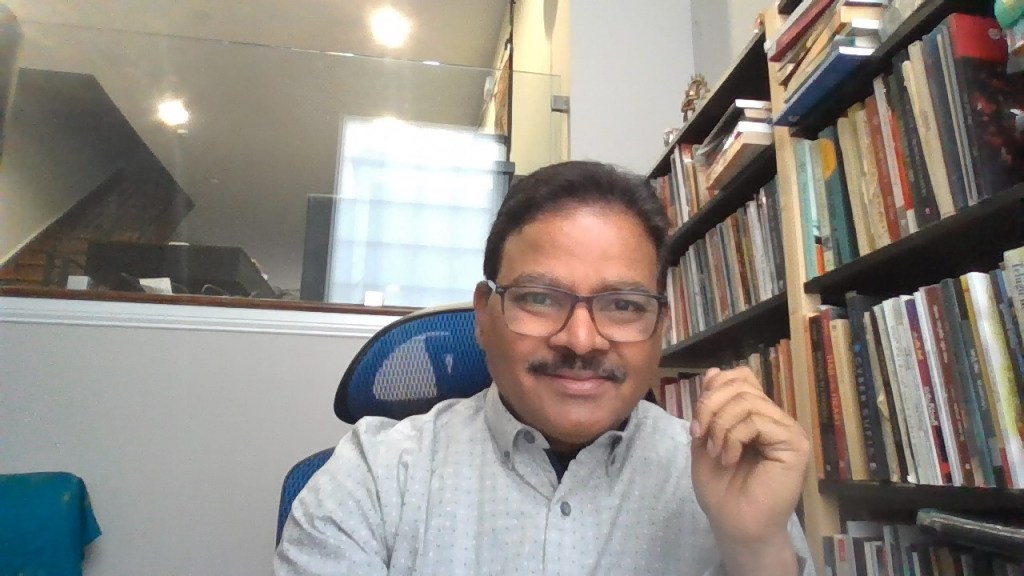
Travelling from a small village in the South Indian state of Telangana, Afsar Mohammad has journeyed across continents and now teaches South Asian Studies at the University of Pennsylvania. Known as a trendsetting poet and literary critic for post-1980s Telugu literature, Afsar has brought out five volumes of poetry, one collection of short stories and two volumes of literary theory essays. He is also a distinguished scholar of Indian studies and has published extensively with various international presses, including Oxford and Cambridge. He is currently working on a translation of Sufi poetry from Telugu to English. In this interview, we trace his growth as a writer and editor of the webzine, Saranga, which now seems to be transcending linguistic barriers to give voice to multiple cultures…
Tell us about your journey as a writer. When and how did it start?
It’s a long story, but to cut it short — the beginnings were somewhat puzzling… Inspired by Shakespearean sonnets, I first wrote some sonnets in English, and then switched to free verse. Since most of my friends in my high school started pushing me to write something in Telugu, I had to migrate to Telugu. Quite surprisingly, I was first published in English, and then it took me a while to get something published in Telugu. I had hard time getting published in Telugu due to its newness in expressions and most editors felt that there was nothing “Telugu” in that kind of writing. So, my early writings quite naturally found their home in some English journals!
Your poetry rings with the pain of distance, the pain and struggle from others’ suffering transcending your own self. What is the source of your inspiration — is it your past or your present?What affects you more — your being an immigrant or a Sufi?
We’re distanced by many things — not just physically! We live in many shattered and scattered worlds, and sometimes we fail to reflect on those worlds. I feel like I’m a constant immigrant — despite my formal citizenship and legal boundaries. Sufism is merely a segment of this expansive realm. Both past and present define our destiny, right?! Of course, I try to live in the present rather than in the past, but never deny the baggage of the past.
Why do you subscribe to the Sufi school of poetry? What is Sufism all about?
I come from an extremely local rural setting where such Sufi mystical practices openly defined my everyday life. It’s not about the technicalities and theories or institutionalised Sufi schools of their philosophies, this is more about what I learned from my childhood, and its physical surroundings dotted by several hybrid shrines. I’ve described this cultural setting in my 2013 Oxford University Press publication, The Festival of Pirs: Popular Islam and Shared Devotion in South India. This version of Sufism has more to do with everyday life rather than a spiritual domain.
You have lived away from your country for long, and yet the past seems to still haunt you. What is the identity you seek as a poet? Is it necessary to have a unique identity or can one be like a drop that flows and moulds as per the needs of the vessel?
In a way — physically– I’m away from my birth place, but in many ways, I’m also closer to my homeland than in my past. When I moved away from the actual picture, I see many dimensions from a new lens. Each dimension contributed to my rethinking and reconsidering the idea of India. As I wander around and meet totally different places and people, I learn more about my birthplace and moved a little closer to it. I totally understand this as a process to reconcile with the past and connect it to a new present intensified by many factors, not just personal. We’re living in a virtual world, which also looks like “real” in its sounds, colours and words. Every moment it makes me realise that I’m actually not that far. On the other hand, I also see the people in my homeland who are far more removed by their immediate reality and everyday experiences. We need to read this conditionality more in terms of perspective rather than physical distance.
You are fluent in Telugu, Urdu and English. You started writing in English and then moved to Telugu. And all your poetry collections have been in Telugu. Why? Would the outreach of English not have been wider? What made you pick Telugu over English?
Great question! My literary graph is neither linear nor simplistic. When I look back and reflect on it, it’s a quite messy roadmap — actually, there’s nothing like a map to get its contours. Yes, I started writing in English and then suddenly stopped sending out the poems to magazines. In fact, I write more in my personal journals rather than in print journals. Theoretically, I saw poetry as a personal diary for my experiences for many years. Due to financial concerns within my family, I had to start working very early on and left most of my journals at home. Then, my friends found them by chance and put them together that became my first collection of poems in Telugu. The collection was an instant success for its innovative style and then that opened up my career in Telugu rather than English which was my first language of literary expression.
You are now bringing out a bi-lingual online magazine, Saranga? What made you think of a magazine in two languages?
Before entering into teaching career, I worked as an editor of the literary supplement and Sunday magazine for a largest circulated Telugu newspaper. When we moved to the USA, I thought it would be better to have some outlet to engage with my home language and literature. In the early phase, Saranga was primarily a Telugu webmagazine. When I started teaching South Asian literature, then I realised the importance of making Indian literary texts available to contemporary generation in the USA. That was just one reason, but there’re were many factors as our team saw a rise in the Indian diaspora writings in the new millennium. Luckily, we got wonderful support from writers and poets in various Indian languages. The humble beginnings have actually ended up as a rewarding experience.
What is it you look for in contributors from two languages? Is it the same guidelines or different?
We’re still learning how this works! As it appears now, these two sections require two different approaches and guidelines. Since the English section has been now attracting writers from various languages, it’s moving more towards a multi-lingual base. We’re trying to accommodate more translations into English from different Indian languages. We still need to do lots of work there.
Is the journal only aimed at South Asian diaspora or would you be extending your services to all cultures and all geographies?
Saranga, as we see it right now, is more about South Asia and its diaspora. As you know, we need more such spaces for South Asia and its diaspora. Not sure about its future directions at this point, however, if the situation demands, we will extend its services further.
You have number of essays and academic books in English. But all your creative writing is in Telugu. Why? Would you be thinking of writing in English too because proficiency in the language is obviously not an issue?
Most of my academic writing came out of my teaching experience. As I started teaching new courses, I then realised that we need more material from South Asia. I started focusing on producing such materials primarily for my courses and then gradually, they became useful for many academicians elsewhere too. I still believe creating writing as a more personal space — that enables me to articulate more about myself. However, the publication of Evening with a Sufi, brought a new change — as I’ve been getting more requests for more writing in English for the last two years. As you know pretty well, I’m an extremely slow writer.
How do you perceive language as a tool for a poet?
I see language working many ways since I dwell in multiple languages. I started my elementary education in Urdu, and my middle school was in Telugu, and the subsequent studies were in English. Through the last day of her life, my mother was extremely particular about me learning Arabic and Farsi. So, I believe that helped me so much to understand how language works in a poem. When I published my first poem in Telugu, the immediate critique was it was a not a “Telugu” poem. Telugu literary critics labelled me as a poet who thinks either in Urdu or English, then writes in Telugu. Of course, most of them were also fascinated by the new syntax of my Telugu poems and the new images and metaphors—that totally deviate from a normative or mainstream Telugu poem of those days. The uses of language in a poem varies for each poet. If you’re reading, writing and thinking in just “one” language, that might be a safe condition. A contemporary or modern poet, however, belongs to many languages and cultures. We also migrate from one language to another in our everyday life.
Do borders of nationalism, mother tongue and geographies divide or connect in your opinion? Do these impact your writing?
The response to this question might be an extension to the above conditionality of a person. Anyway, I’m not a big fan of those ideas of nationalism, mother tongue and singular geographies. They don’t exist in my world. Most of my writings both creative and academic contest such boundaries and borders. To describe this in a single term- borderless. In fact, I believe we’re all borderless, but unfortunately, many boundaries and borders are now being imposed on our personalities.
(The online interview has been conducted by emails by Mitali Chakravarty)
Published in 1906,Megh (cloud)can be found in Tagore’s collection called Kheya (boat).
Adrift, without a beginning and an end,
With an awning of black and white blend,
        The sky is dressed whimsically.
We are all merely mounds,
Stacks of wafting clouds.
    I think only of him and his whimsicality.
We have no boundaries nor home,
We come and we are gone.

Suns, planets, stars shine bright.
Though they are garlands of lights,
        They remain tied to eternal tasks.
With permanence, they grace
Words illuminating a dark page.
         We are merely like drafts—
 With myriad of colours filled,
Re-written and erased at will.

Sometimes, when we are free,
We call out in a spree,
              Smiling without a reason.
Does our caprice create an illusion?
The rain still falls without evasion.
            The lightning is not a diversion.
Only, my friend, we do not stay.
With the breeze, we drift in or float away.
(This poem has been translated by Mitali Chakravartywith editorial support from Sohana Manzoor)
PLEASE NOTE: ARTICLES CAN ONLY BE REPRODUCED IN OTHER SITES WITH DUE ACKNOWLEDGEMENT TO BORDERLESS JOURNAL
Shadows, a poem in Korean, has been translated by the poet himself, Ihlwha Choi. Click hereto read.
Pranor Lifeby Tagore has been translated from Bengali by Mitali Chakravarty. Click hereto read.
Conversations
Shantanu Ray Chaudhuri converses withVinta Nanda about the Shout, a documentary by Vinta Nanda that documents the position of women in Indian society against the backdrop of the #MeToo movement and centuries of oppression and injustice. Click here to read.
Perhaps, most sceptics will say it is against human nature to stop fighting and fanning differences. The first recorded war was fought more than 13,000 years ago in what is now a desert but was green long ago. Nature changed its face. Continents altered over time. And now again, we are faced with strange shifts in climate that could redefine not just the dimensions of the surface area available to humankind but also our very physical existence. Can we absorb these changes as a species when we cannot change our nature to self-destruct for concepts that with a little redefining could move towards a world without wars leading to famines, starvation, destruction of beautiful edifices of nature and those built by humankind? That we could feed all of humans — a theory that won economist Abhijit Banerjee his Nobel Prize in 2019 so coveted by all humanity — almost seems to have taken a backseat. This confuses — as lemmings self-destruct…do humans too? I would have thought that all humanity would have moved towards resolving hunger and facing the climate crises post-2019 and post-pandemic, instead of killing each other for retaining constructs created by powerbrokers.
In the timeless lyrics of ‘Imagine’, John Lennon found peace by suggesting we do away with manmade constructs which breed war, anger and divisions and share the world as one. Wilfred Owen and many writers involved in the World Wars wrote to showcase the desolation and the heartfelt darkness that is brought on by such acts. Nazrul also created a story based on his experience in the First World War, ‘Hena’, translated for us by Sohana Manzoor. Showcasing the downside of another kind of conflict, a struggle to survive, is a story with a distinctive and yet light touch from S Ramakrishnan translated from Tamil by B Chandramouli. And yet in a conflict-ridden world, humans still yearn to survive, as is evident from Tagore’s poem Pran or ‘Life’. Reflecting it is the conditioning that we go through from our birth that makes us act as we do are translations by Professor Fakrul Alam of Masud Khan’s poetry and from Korean by Ihlwha Choi.
A figure who questioned his own conditioning and founded a new path towards survival; propounded living by need, and not greed; renounced violence and founded a creed that has survived more than 2500 years, is the man who rose to be the Buddha. Born as Prince Siddhartha, he redefined the norms with messages of love and peace. Reiterating the story of this legendary human is debutante author, Advait Kottary with his compelling Siddhartha:The Boy Who Became the Buddha, a book that has been featured in our excerpts too. In an interview, Kottary tells us more of what went into the making of the book which perhaps is the best survivor’s guide for humanity — not that we need to all become Buddhas but more that we need to relook at our own beliefs, choices and ways of life.
Another thinker-cum-film maker interviewed in this edition is Vinta Nanda for her film Shout, which highlights and seeks resolutions for another kind of crisis faced by one half of the world population today. She has been interviewed and her documentary reviewed by Shantanu Ray Chaudhuri. Chaudhuri has also given us an essay on a bookshop called Kunzum which continues to expand and go against the belief we have of shrinking hardcopy markets.
Gastronomical adventures seem to be another concurrent theme in this edition. Rhys Hughes has written of the Indian sweets with gulab jamun as the ultimate life saver from Yetis while trekking in the Himalayas! A musing on lemon pickle by Raka Banerjee and Ravi Shankar’s quest for the ultimate dosaaround the world — from India, to Malaysia, to Aruba, Nepal and more… tickle our palate and make us wonder at the role of food in our lives as does the story about biryani battles by Anagaha Narasimha.
Talk of war, perhaps, conjures up gastronomic dreams as often scarcity of food and resources, even potable water and electricity is a reality of war or conflict. Michael Burch brings to us poignant poetry about war as Ramesh Karthik Nayak has a poem on a weapon used in wars. Ryan Quinn Flanagan has brought another kind of ongoing conflict to our focus with his poetry centring on the National Day (May 5th) in Canada for Vigils for Missing and Murdered Indigenous Women by hanging red clothes from trees, an issue that perhaps has echoes of Vinta Nanda’s Shout and Suzanne Kamata’s poetry for her friend who went missing decades ago as opposed to Rachel Jayen’s defiant poetry where she asserts her womanhood. Ron Pickett, George Freek and Sayantan Sur have given us introspective perspectives in verse. We have more poetry asking for a relook at societal norms with tongue-in -cheek humour by Jason Ryberg and of course, Rhys Hughes with his heartfelt poem on raiders in deserts.
The piece that really brought a smile to the lips this time was Farouk Gulsara’s ‘Humbled by a Pig’, a humorous recount of man’s struggles with nature after he has disrupted it. Keith Lyons has taken a look at the concept of bucket lists, another strange construct, in a light vein. Devraj Singh Kalsi has given a poignant and empathetic piece about trees with a self-reflective and ironic twist. We have narratives from around the world with Suzanne Kamata taking us to Osaka Comic Convention, Meredith Stephens to Sierra Nevada and Shivani Shrivastav to Ladakh. Paul Mirabile has travelled to the subterranean world with his fiction, in the footsteps perhaps of Jules Verne but not quite.
We are grateful to all our wonderful contributors some of whom have not been mentioned here but their works were selected because they truly enriched our June edition. Do visit our contents page to meet and greet all our wonderful authors. I would like to thank the team at Borderless without whose efforts and encouragement our journal would not exist and Sohana Manzoor especially for her fantastic artwork as well. Thank you all.
Wish you another lovely month of interesting reads!
Pran or Life by Tagore was published in 1886 as part of his collection called, Kori O Komal (Sharp and Flat). The book featured 83 poems by him.
Art by Sohana Manzoor
LIFE

I do not desire death in this resplendent universe.
I want to live amidst the ocean of humanity.
In this radiant sunny garden of floral swirls,
I yearn for acceptance from hearts filled with vitality.
Life on Earth ebbs and flows in transient waves.
Partings and meetings are filled with tears and joys.
I want to bead these emotions into melodic strains,
To create songs that will be eternal and spirits buoy.
If I cannot achieve that, then as long as I live,
Let me find shelter in your midst.
Let me, every morning and evening, give
Lyrics that bloom like flowers waiting for a tryst.
Pluck the blossoms happily, and then, without a sigh,
Throw them away, alas, if they wilt or dry.
A recitation of the original poem in Bengali by Swati
(This poem has been translated by Mitali Chakravartywith editorial support from Sohana Manzoor)
PLEASE NOTE: ARTICLES CAN ONLY BE REPRODUCED IN OTHER SITES WITH DUE ACKNOWLEDGEMENT TO BORDERLESS JOURNAL
Excerpted from Rhys Hughes latest anthology of light verses, Animal, Vegetable, Mineral: Light Verse about Life & Other Heavy Things with contributions from writers across all continents, except from Antarctica, these poems stretch a little to reflect on the wonders of the universe, both past and present with perhaps, an evolutionary sense of humour. They make you smile, ponder and pause…
SPIRIT ANIMALBy Richard Temple
I am cuttlefish:
jet propelled cephalopod –
self-defence with ink.
MY NAME IS LUCABy Rhys Hughes
My name is LUCA,
I live on the second floor
of a hydrothermal vent.
I am the Last Universal
Common Ancestor
of all life on Earth today,
including aardvarks, gibbons,
walruses and jesters.
I don’t live upstairs from you
and you have probably
never seen me before,
unless you have a time machine
and a very good submarine.
My name is LUCA,
I lived on the second floor
billions of years ago.
THE HUMAN RACEBy Tim Newton Anderson
The Human Race was started by Darwin’s gun
Early runners were Kenyapithecus,
Orrorin, Sahelanthropus and Griphopithecus
Neanderthals fell out at the Pleistocene after a model run
Followed shortly by Heidelbergensis
and then by another - Homo Rudolfensis
And so it was, by a stride, that Austrelopithecus won
SWEET SABRE-TOOTHED TIGERBy Rhys Hughes
Sweet Sabre-Toothed Tiger,
your mate has gone into labour.
She will deliver eight or nine kittens
like uncomfortable mittens
and you will dance and drink cider
to celebrate their arrival
into the unspoiled ancient world.
Palaeolithic cider, of course,
because that’s all there was back then
before the invention of gin.
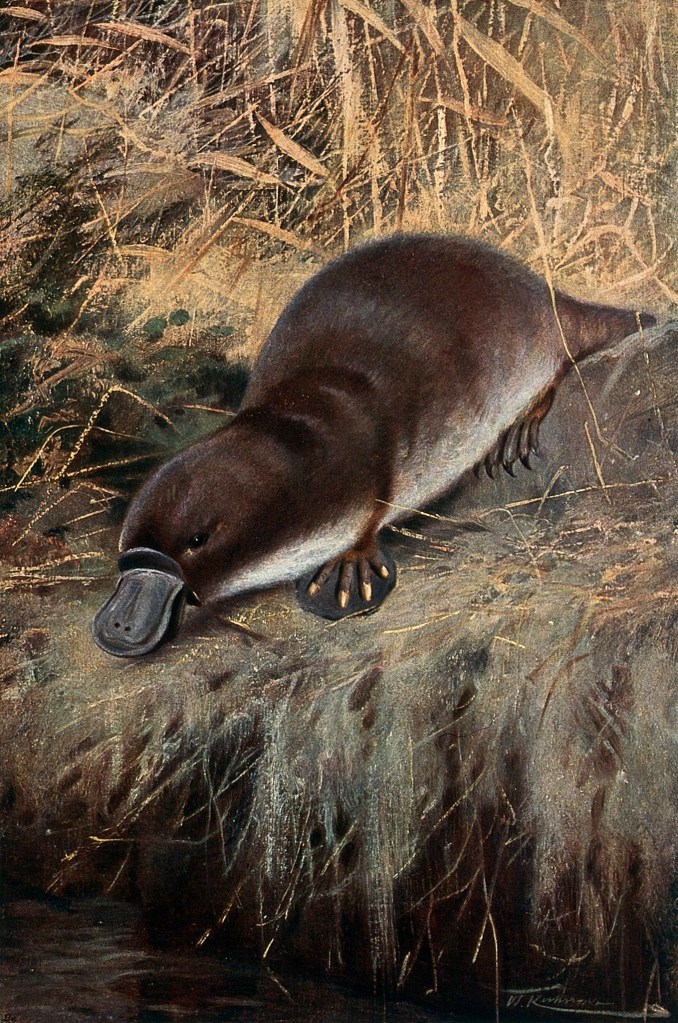
THE PLATYPUSBy Roman Godzich
A famous creature is the Platypus.
Not noted for its song and dance.
It still commands such great respect
Despite the fact that so few ever get the chance
To see one in the wild alone
Or even in the tame with others.
The Platypus stands sole, dear heart
And far away from other brothers.
Its culinary skills set it apart
And not for what it does with mustard
THE COMMITTEE By Doug Skinner
A wolf, a horse, a rat, a goose,
A frog, a rattlesnake, a moose,
A wallaby, a flea, a stoat,
A chimp, a bear, an eel, a goat,
A kinkajou, a brace of quail,
A pig, a crocodile, a whale,
A hummingbird, a snail, a hawk,
A manatee, a carp, an auk,
A mole, a duck, a bandicoot,
An octopus, a cat, a newt,
A unicorn, a cockatrice,
A badger, and a dozen mice
Sat down in one tremendous ring
And disagreed on everything.
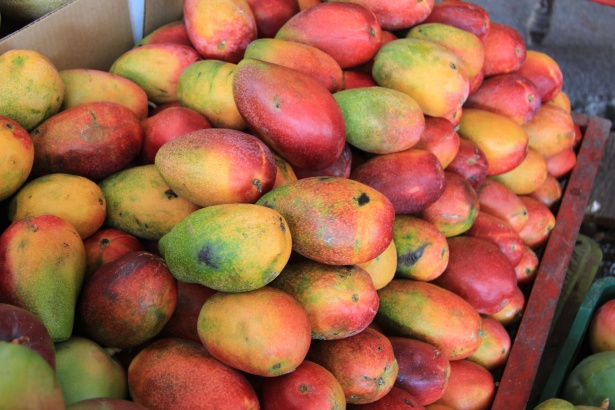
MANGO PULP FICTIONBy Maithreyi Karnoor
Like vanquished kings and squished nothings
The alphonsos, here, have no show
Without the ring of the hype and bling
Sweetly loved the mancurads grow
Here pulp fiction has got its own diction
Old uncle Albuquerque barbed in his garb
When comes in for a juicy benediction
Is redeemed as silly Albukar baab.
FLOWER MAY MOON By Jeanne Van Buren
Flower moon, I waited tonight to see you
at your brightest
shining down on dogwood blossoms and lilacs
I need sleep
couldn’t rest till I saw you
like lost love.
TRANSIENCE?By Mitali Chakravarty
A butterfly flits from flower
to flower sipping honey.
A bloom is but a transient
passenger that rides on
waves of time. And yet, the
poet who writes of the bloom
and the butterfly looks for
immortality in words. Will
words change over eons? Will
histories change? Will Earth
remain? What are we but a
drifting speck in the Universe?
ProfessorFakrul Alam brings to us Tagore songs in translation and in discussion on the season that follows the scorching heat of summer months. Clickhereto read.
“May is pretty, May is mild,
Dances like a happy child…”

Annette Wynne (Early twentieth century)
Each month is expressed in a different form by nature in various parts of the world. In the tropics, May is sweltering and hot — peak summer. In the Southern hemisphere, it is cold. However, with climate change setting in, the patterns are changing, and the temperatures are swinging to extremes. Sometimes, one wonders if this is a reflection of human minds, which seem to swing like pendulums to create dissensions and conflicts in the current world. Nothing seems constant and the winds of change have taken on a menacing appearance. If we go by Nazrul’s outlook, destruction is a part of creating a new way of life as he contends in his poem, ‘Ring Bells of Victory’ — “Why fear destruction? It’s the gateway to creation!” Is this how we will move towards ‘dancing like a happy child’?
Mitra Phukan addresses this need for change in her novel, What Will People Say — not with intensity of Nazrul nor in poetry but with a light feathery wand, more in the tradition of Jane Austen. Her narrative reflects on change at various levels to explore the destruction of old customs giving way to new that are more accepting and kinder to inclusivity, addressing issues like widow remarriage in conservative Hindu frameworks, female fellowship and ageing as Phukan tells us in her interview. Upcoming voice, Prerna Gill, lauded by names like Arundhathi Subramaniam and Chitra Divakaruni, has also been in conversation with Shantanu Ray Choudhuri on her book of verses, Meanwhile. She has refreshing perspectives on life and literature.
Devraj Singh Kalsi has written a nostalgic piece that hovers between irony and perhaps, a reformatory urge… I am not quite sure, but it is as enjoyable and compelling as Meredith Stephen’s narrative on her conservation efforts in Kangaroo Island in the Southern hemisphere and fantastic animals she meets, livened further by her photography. Ravi Shankar talks of his night hikes in the Northern hemisphere, more accurately, in the Himalayas. While trekking at night seems a risky task, trying to recreate dishes from the past is no less daunting, as Suzanne Kamata tells us in her Notes from Japan.
May hosts the birthday of a number of greats, including Tagore and Satyajit Ray. Ratnottama Sengupta’s piece on Ray’s birth anniversary celebrations with actress Jaya Bachchan recounting her experience while working for Ray in Mahanagar(Big City), a film that has been restored and was part of celebrations for the filmmaker’s 102nd Birth anniversary captures the nostalgia of a famous actress on the greatest filmmakers of our times. She has also given us an essay on Tagore and cinema in memory of the great soul, who was just sixty years older to Ray and impacted the filmmaker too. Ray had a year-long sojourn in Santiniketan during his youth.
Eulogising Rabindrasangeet and its lyrics is an essay by Professor Fakrul Alam on Tagore. Professor Alam has translated number of his songs for the essay as he has, a powerful poem from Bengali by Masud Khan. A transcreation of Tagore’s first birthday poem , a wonderful translation of Balochi poetry by Fazal Baloch of Munir Momin’s verses, another one from Korean by Ihlwha Choi rounds up the translated poetry in this edition. Stories that reach out with their poignant telling include Nadir Ali’s narrative, translated from Punjabi by his daughter, Amna Ali, and Aruna Chakravarti’s translation of a short story by Tagore. We have more stories from around the world with Julian Gallo exploring addiction, Abdullah Rayhan with a poignant narrative from Bangladesh, Sreelekha Chatterjee with a short funny tale and Paul Mirabile exploring the supernatural and horror, a sequel to ‘The Book Hunter‘, published in the April issue.
All the genres we host seem to be topped with a sprinkling of pieces on Tagore as this is his birth month. A book excerpt from Chakravarti’s Daughters of Jorasankonarrates her well-researched version of Tagore’s last birthday celebration and carries her translation of the last birthday song by the giant of Bengali literature. The other book excerpt is from Bhubaneswar@75 – Perspectives, edited by Bhaskar Parichha/ Charudutta Panigrahi. Parichha has also reviewed Journey After Midnight – A Punjabi Life: From India to Canadaby Ujjal Dosanjh, a book that starts in pre-independent India and travels with the writer to Canada via UK. Again to commemorate the maestro’s birth anniversary, Meenakshi Malhotra has revisited Radha Chakravarty’s translation of Tagore’s Farewell Song. Somdatta Mandal has critiqued KR Meera’sJezebel, translated from Malayalam by Abhirami Girija Sriram and K. S. Bijukuma. Lakshmi Kannan has introduced to us Jaydeep Sarangi’s collection of poems, letters in lower case.
There are pieces that still reach out to be mentioned. Do visit our content page for May. I would like to thank Sohana Manzoor for her fantastic artwork and continued editorial support for the Tagore translations and the whole team for helping me put together this issue. Thank you. A huge thanks to our loyal readers and contributors who continue to bring in vibrant content, photography and artwork. Without you all, we would not be where we are today.
In Conversation with Mitra Phukanabout her latest novel, What Will People Say?A Novel , published by Speaking Tiger Books, March 2023
Mitra Phukan. Courtesy: Speaking Tiger Books
What will people Say? A Novel by Mitra Phukan, a well-known writer from Assam, plays out like a sonata with fugues introducing complexities into the narrative. It concludes in a crescendo of hope with an acceptance of love. At the end, Phukan writes: “It was love. A love great enough to conquer all the ‘What Will People Says’.”
What is remarkable about the novel is the light touch with which it deals with major issues like communal tensions, acceptance of love across divisive human constructs and questioning of social norms. She elucidates: “I have written What Will People Say in a conversational, everyday style, sprinkled liberally with humour, even though the themes are very serious.”
Phukan’s novel moves towards a more accepting world where social norms adapt to changing needs — perhaps an attitude we would all do well to emulate, given the need for a change in mindsets to broach not only divisive societal practices but the advancing climate crises which calls for unconventional, untried steps to create cohesive bonds among humanity.
The story is set in a small town in Assam called Tinigaon. Where the protagonist, Mihika, a widow and a professor, upends accepted social norms with her budding romance to a Muslim expat, a friend of her deceased husband. She has strong supporters among her family and friends but faces devastating social criticism and even some ostracisation. This makes her think of giving up the relationship that drew her out of the darkness of widowhood.
Suffering during widowhood is a topic that has been broached by many Indian writers ranging from Tagore, Sunil Gangopadhyay to many more. Before the advent of these writers, in 1856, the Hindu Widows’ Remarriage Act was brought into play by the efforts of Ishwar Chandra Vidyasagar, who had also written on the issue. But despite the law, has it as yet been accepted by conventional society? And how would such a society which bases its perceptions on rituals and traditions respond further to a relationship that discards marriage as a norm? These are questions that Phukan deals with not only in her novel but in the conversation that follows.
The plot showcases an interesting interplay of different perspectives. In certain senses, it has the delightful touch of a Jane Austen novel, except it is set in India in the twenty first century, where relationships are impacted by even social media. Phukan, herself, sees “ageism” and female bonding and friendship” as major issues addressed in the novel. She says that women’s bonding is a theme that “has not been focused on enough, at least in Assamese writing”, even though, it is a fact that this has been the focus in other literature like, Jane Austen’s novels written in the nineteenth century and in subsequent modern-day take-offs on her novels, like the The Jane Austen Book Club by Karen Joy Fowler, published in 2004. In the sub-continent, Begum Rokeya described a full woman’s utopia in Sultana’s Dream(1905), though Rokeya’s story is essentially a feminist sci-fi. Unlike Rokeya’s book, Phukan’s is not an intense feminist novel. The protagonist, Mihika, has men well-wishers and men friends-cum-colleagues too. The tone is lighter and makes for a fabulous read, like Austen’s novels.
As if rising in a fugue to Mihika’s romance are two more relationships of a similar nature. One is between her daughter and a young boy from a traditional, respected, conventional home. The other, which I found more interesting, and I wish Phukan had explored a bit more, is a relationship between Mihika’s Bihari beautician, Sita, and a tribal boy. While the girl is from a traditional vegetarian strictly Hindu family, the boy is an orphan, a tribal. It is a romance that is outside the conventional affluent, middle-class circle. And is used as a contrast to Mihika’s and her daughter’s experiences. Sita’s narrative highlights how the conventional finally accept the unconventionality of a romance that in the past might have been completely rejected.
The novel rises above victimhood by looking for resolutions outside the accepted norms subtly. The plot weaves the triangular interplay of relationships with notes of harmony. The story, devoid of gender biases and darker shades of drama, delves into serious themes with a feathery touch.
The structuring of the novel arrests the reader with its seeming simplicity but each is fitted into the composition to create a fiction that touches your heart and leaves you pining for a bit more… like the strains of a composition that has the deftness and neatness of a Jane Austen novel, written in the context of twenty first century Assam.
Phukan herself is a trained vocalist in Indian classical, a columnist, a translator and a writer. In this conversation, she reveals more about the making and intent of her novel and her journey as a writer.
You wear a number of hats — that of an Indian classical vocalist, a columnist, a children’s writer, a translator and so much more. How does this impact your work as a novelist?
I feel everything is related; everything flows seamlessly into the other aspects. Yes, I am a trained Shastriya Sangeet[1]vocalist, though I have retired from performances now. But at one time that was my life…even now, I write extensively about music through essays and reviews. And I’m always listening to music, of many genres.
I began writing, hesitantly comparatively late, though I always enjoyed it, getting prizes in school and college. Later, I began to write stories, etc, for magazines such as Femina, Eve’s Weekly. Mainly though it was the paper The Sentinel and its editor D N Bezboruah which gave me a platform through middles, short fiction, essays and other genres. My children were very young at the time, and somehow the children’s stories came to me at that point. Now that they are grown up, those stories don’t come any more…and I regret that.
Translation happened because two stalwarts of Assamese literature, Jnanpith awardee Dr Indira Goswami and Sahitya Akdami awardee poet Dr Nirmal Prova Bordoloi encouraged me to try my hand at it by translating their work. I found I enjoyed it …and the journey continues!
Writing fiction, especially novels, needs the writer to have a wide view of life, I feel. I love storytelling. I write from observation, but also, I learn a lot about the literature of the place I come from, Assam, through the works of the greats in Assamese.
Do your other passions, especially music, impact your writing?
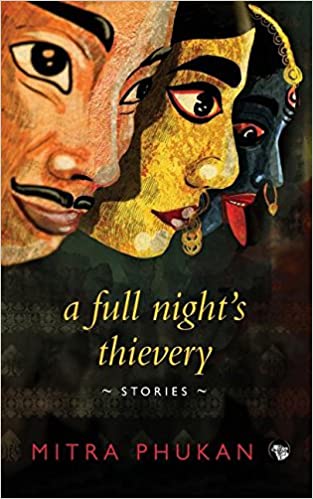
Music, definitely. In What Will People Say, for instance, there are so many references to songs and music, to concerts and musicians. There is an entire chapter devoted to songs in Hindi and Assamese where the theme is music. Besides, my novel A Monsoon of Music is about the lives of four practicing musicians. Many of my short stories from A Full Night’s Thievery have music as a theme …’The Tabla Player’, ‘The Choice’, ‘Spring Song’, and so on.
Also, musical metaphors seem to creep in, unbidden, to my writing…
Among the other passions that are reflected to a greater or lesser degree in my writing are gardening, and of course food!
What led you to write What Will People Say?
My stories, whether long or short, are always triggered by events, people, that I see around me. Sometimes it could even be a sentence I overhear while waiting at an airport, or maybe an expression on somebody’s face. They are based on reality, though they are fictionalised as they pass through the prism of my mind, my imagination.
What Will People Say was triggered by the fact that I see so many older women who have lost their spouses spend their lives in loneliness and sometimes despondency. Yes, their children may be caring, they may have women friends, a profession, but that is not enough. Love, finding a romantic partner, even companionship, is very unusual as a senior. There are so many unwritten codes, so many taboos and restrictions, especially in the small, peri-urban places.
And yet I find that change is coming. After all, people are exposed to other cultures, where going in for a second relationship is not seen as a betrayal of the dead husband, as it tends to be here.
The need for social change and a questioning of norms is part of the journey you take your readers through in your novel. Were these consciously woven into the story or did the story just happen? Please tell us about the journey of the novel.
This was the theme I have had in my mind for a while now. It was a conscious decision, and not always an easy one to implement, because of the binaries involved.
The place where I live, the larger society, prides itself on being “liberal”. And it is, compared to some other places on the planet, or in the country. But in the twenty first century, we are aware that there is much more that needs to be done, a much longer path to be traversed. The theme came first. After which I began to think of the storyline, the characters, the incidents that would make the theme come alive, all in a fictional way, of course.
What Will People Say, the line, is a kind of whip used to keep “straying” members of society, usually young people, within the fold. But here I have inverted it …it is the older members, those who are supposed to uphold the status quo, who are doing what, for many, would be the unthinkable.
Do you still see widow remarriage as an issue? Is it still an issue in Northeast India as your book shows?
Assam is a multi-ethnic, multi-lingual, multi-cultural and multi-religious society.
The community I am describing is what is known as the “caste Hindu” society, in which, traditionally, widow remarriage is not “allowed”. Even now, even in urban Assamese society, it is uncommon. There are unspoken taboos, unwritten codes of conduct. The extreme strictness of the past has lessened no doubt, but also a lot depends on the economic and social status of the woman. I never, for instance, saw my grandmother, a staunch Brahmin, wear anything but stark white after she was widowed. Her vegetarian kitchen was separate from the main kitchen …leave aside meat or fish, even onions, garlic were not allowed there. My mother wanted to follow the same route after my father passed away, but her doctor forbade her from doing that, while her children insisted, she wear colour. Today, my generation of women wear colour and eat non-vegetarian after the demise of their husbands, so things are slowly changing. But a second marriage, or a romantic relationship, in middle age is still very rare indeed.
Your book describes middle class liberals, conservatives as well as immigrants and tribals. What kind of impact have tribals and immigrants had in Assam over time?
There have been many waves of migration into this fertile valley of the Brahmaputra. As a result, it is a rich cultural and linguistic mosaic. Different influences are at play all the time, communities that live in proximity to each other are definitely influenced. But it is a slow process, naturally. And usually takes place over generations.
You have hinted that tribals are more liberal and out of the framework of Hindu rituals. Is that a fact?
Many tribes are, in general, indeed more liberal when it comes to widow remarriage, as are the large Muslim and also the Christian communities. It is the “caste Hindus”, especially those from the “top” of the caste pyramid, who mostly have these taboos. The original inhabitants of these valleys were different ethnic groups, which, because of the riverine, heavily forested aspects of the region, tended to remain in isolation from each other. As a result, cultural practices were unique to each one. Different waves of immigrants from both the East of the region, from Southeast Asia and beyond, and from the rest of India in the west brought in different influences, which were absorbed slowly. We see this in the food practices, the music, the weaves and clothes that we traditionally wear, and religious and social practices, among other things.
How do your characters evolve? Out of fact or are they just a figment of your imagination?
All are creations of my mind, my imagination. But I try to keep them as real as possible. It is all fiction. I love adding layers to them as I go along, till they have their own individuality, their own body language, their own ways of thinking, speaking, their food preferences, everything. By the end, they are “real” to me, though they actually exist only within the pages of a book.
What writers/ musicians/art impact you as a writer? Is there any writer who you feel impacts you more than others?
My music gurus have impacted me in many ways, beyond music. Guru Birendra Kumar Phukan, especially, taught me …through his music …what it means to be steeped in spirituality, and how to aspire higher through Shastriya music, which, to him, and sometimes to me, too, was and is prayer.
As for writers, there are so many I admire deeply. Among the Assamese writers are the scholar and creative writer of the 15th-16th Century, the Saint Srimanta Sankardev, Jnanpith awardees Birendra Kumar Bhattacharyya and Indira Goswami. I am always deeply moved by their humanity. Their works, their characters, are drenched in it.
Among writers that I have read in English are the obvious ones, so many of them …but for style and humour, I think nobody can beat P G Wodehouse, and for irony, Jane Austen. And my Go To book during the pandemic was Three Men in a Boat by Jerome K Jerome, for an instant lifting of spirits.
You have written a lot of children’s stories and written columns. Have these impacted you as a novelist? How is writing a novel different from doing a fantasy-based children’s story or writing a column?
I have written biographies, short stories and essays too. Basically, I see myself as a storyteller, though I write non-fiction too. The children’s stories came from my observations of the child’s world at one time, the way they thought and reacted. My columns are commentaries on society, couched in different “rasas”, including the humorous, but are sometimes a narration in the form of a story. The practice of writing, whatever the genre, and the habit of observation, have all helped me in the marathon task of writing novels!
What can we look forward to from you next? Are you working on a new novel?
Yes. I do have a novel in the pipeline, am giving it some final touches now. But what is due to be published next is a biography of Dr Bhupen Hazarika, a monograph really. He is a musical icon and so much else for us. It is being published by Sahitya Akademi. And then there is a translation of a novella by Sahitya Akademi Awardee Dr Dhrubjyoti Borah, to be published later this year by Om Books. And then of course there are the columns which I really enjoy doing, since the paper that I write for, The Assam Tribune, reaches the deepest areas of rural Assam. Many of the readers of this column, ‘All Things Considered’ are first generation literates, and that makes me really happy.










 Borderless