Categories
Slices from Life

Embracing the Earth and Sky…

By Prithvijeet Sinha

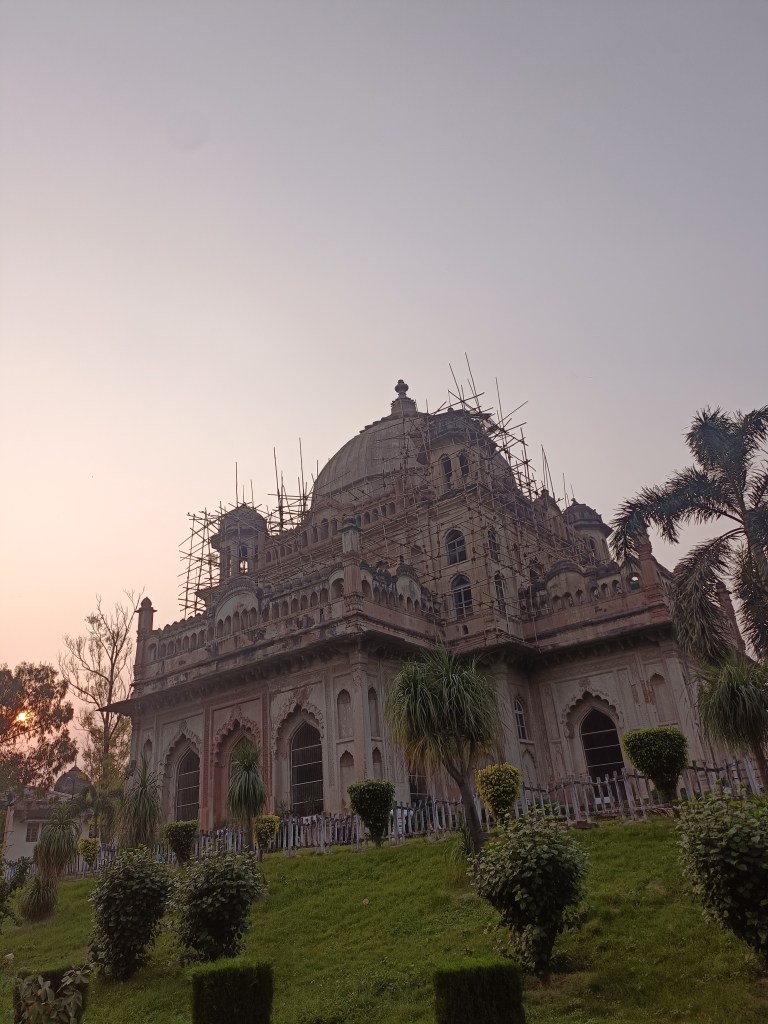
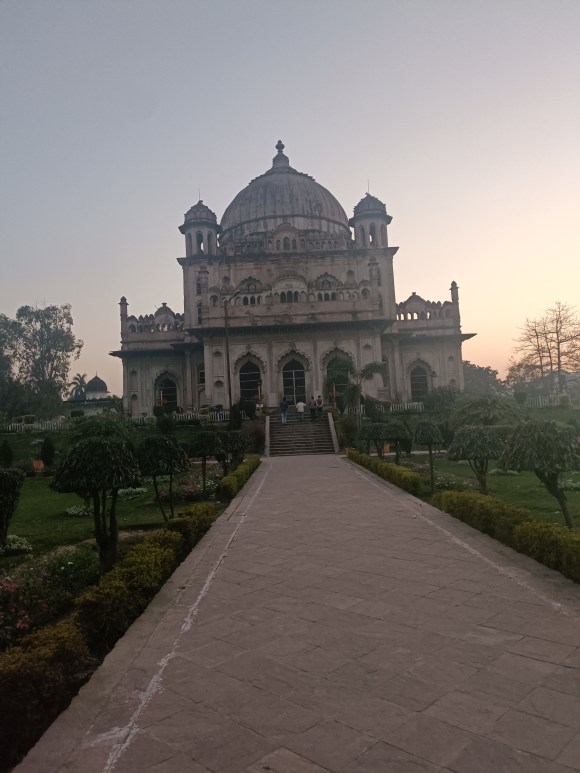
Saadat Ali Khan’s tomb. Photo Courtesy: Prithvijeet Sinha

In Lucknow, there’s a peculiar yet quintessential fascination with preserving the dead, ensuring that monuments to revere them are not only easy on the eyes but also constructed with a certain soulfulness. The sublime, inevitable poetry of mortality is hence the reason why multiple Imambaras and Maqbaras (resting places and tombs) eulogise the architects of a region that led the charge by invigorating secularism, architecture and employment to the masses.

The stunning Saadat Ali Khan tomb testifies to all these features with poignant grace till this present era. Built by Ghazi-ud-Din Haider, the crowned King of Awadh in the early years of the 19th century in memory of his father, the eponymous Nawab Wazir of Awadh, Saadat Ali Khan, it was a palace of refined craftsmanship that took on the sombre hues of remembrance and eternal memory by being rebuilt as a tomb. Such is the fervour of familial legacies. Those eternal memories of wives and children now rest in the vaults that have been preserved in the inner chamber of the structure in its rear end.

On his part, Ghazi-ud-Din Haider (1769-1827) was a man of poise and taste. But he was also operating at a time when colonial powers were shareholders of Awadh as much as any other part of the country. Being a ruler may have been as much a nominal position for him as it was for his father, Yameen-ud Daula Saadat Ali Khan II Bahadur (1752 – 1814). But they both walked on common ground as they ensured that administrative duties fuelled by colonial interests didn’t usurp the spirit of their homeland. Lucknow was much more to Ghazi-ud-Din Haider and his father than just a city. Hence, their architectural aesthetics came into play to build a monumental legacy. If father Saadat Ali Khan was the mind who gave Lucknow a large number of memorable monuments between the city’s fabled Kaiserbagh and Dilkusha corridor then son Ghazi was no flash in the pan himself. The majestic Chattar Manzil, the quietly captivating Vilayati Bagh (built in memory of his beloved English wife Mary Short/ Padshah Begum) and the impressive Shah Najaf Imambara (modelled after the holy Shia site of Najaf in Iran) are all beholden to his vision. They all occupy pivotal central areas of the city today and are a visitors’ delight. He was also the pioneer behind a printing press, employing English and local scholars who were versed in multiple languages and enriched his court with the compilation of an extensive Persian dictionary.

Saadat Ali Khan’s Tomb extends his legacy, it’s a stunning architectural design of a palace turned resting place for dearly departed retaining Lucknow’s exquisite stamp. The magnificent dome, arches, unbridled calligraphy of designs, decorative motifs and the pillars echo with two hundred years and more of all that the structure represents. The distinctive wash of yellow, brown and sometimes bleached lemon in the building are all captivating to discerning eyes. Under this dome and the parapets, one walks in circles and picks up the nuances of beauty that surround it. Chief among them being huge windows framed with nets, galloping squirrels and various potted plants covering the expanse.

Even more wonderful is the tomb of Mursheer Zadi, Saadat Ali Khan’s beloved wife, that stands parallel to his tomb. With its similarly constructed structure and darker tones, the confluence of dome, spires, parapets, inner chamber and decorative motifs become breathtaking. If the morning reveals these structures as enchanting dual partners, afternoons suffuse them with a time-honoured glow while the evenings bathe them with shades of devotion to this cityscape.

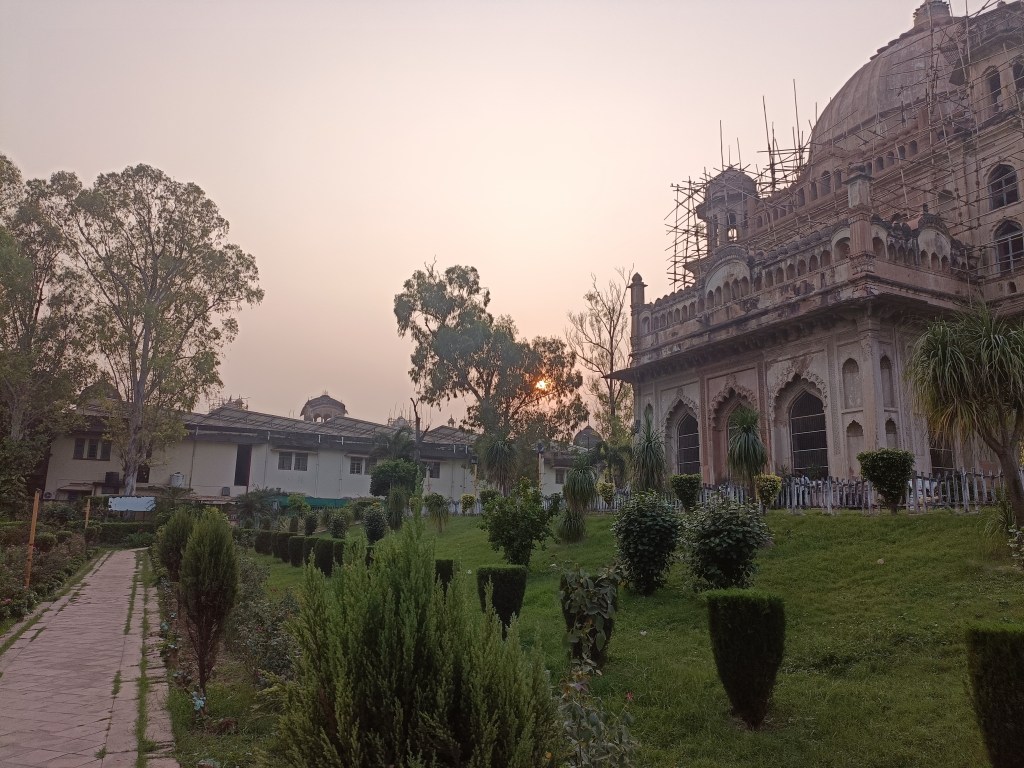
Visitors people the verandahs that surround it. At the Saadat Ali Khan Tomb and Garden, we relive the permanence of smiling flowers, the majestic architecture and the surreal power of its mystique. It’s a structure that seems to literally rise out of the earth and court the sky in reverence to both. We, in turn, understand its juxtapositions of mortality and muted grandeur as die-hard Lucknawis.

As scaffolds populate the tombs and restoration work ensures more renewed glint for its overall structure in the new year as also for its neighbouring Chattar Manzil, this site becomes the classical storyteller it has always been. Its saga is continuous, eternal. Its haunting understories are as soaked in legends and myths as is the wonderful city of Lucknow. The dead don’t just rest in peace here, they converse in whispers that become the wind and birdcalls.

Photo Courtesy: Prithvijeet Sinha

Prithvijeet Sinha  is an MPhil from the University of Lucknow, having launched his prolific writing career by self-publishing on the worldwide community Wattpad since 2015 and on his WordPress blog An Awadh Boy’s Panorama. Besides that, his works have been published in several journals and anthologies. 

PLEASE NOTE: ARTICLES CAN ONLY BE REPRODUCED IN OTHER SITES WITH DUE ACKNOWLEDGEMENT TO BORDERLESS JOURNAL

Click here to access the Borderless anthology, Monalisa No Longer Smiles

Click here to access Monalisa No Longer Smiles on Kindle Amazon International

Categories
Poetry

Five Short Poems by Munir Momin

Translated from Balochi by Fazal Baloch

From Public Domain
ENCHANTED

As I watched --
She wrapped the rainbow round her finger,
and drifted away -- slowly, ever so slowly.
Yet
The Heavens saw nothing.

EVENING

The wind wanders,
seeking the fragrance of your musk:
My heart and a fading leaf are carried along.

SPRING

The poor larks that returned this year
peck at the scent of your bosom,
still drifting through the footprints
along the path of yesteryear.

JUNGLE

Such terror stirs within,
none dare to face themselves.
The road runs deep with fear—
no one walks it alone.

THE WAIT

Shall I open a window?
Will you come—or the moon?

Munir Momin is a contemporary Balochi poet widely cherished for his sublime art of poetry. Meticulously crafted images, linguistic finesse and profound aesthetic sense have earned him a distinguished place in Balochi literature. His poetry speaks through images, more than words. Momin’s poetry flows far beyond the reach of any ideology or socio-political movement. Nevertheless, he is not ignorant of the stark realities of life. The immenseness of his imagination and his mastery over the language rescues his poetry from becoming the part of any mundane narrative. So far Munir has published seven collections of his poetry and an anthology of short stories. His poetry has been translated into Urdu, English and Persian.  He also edits a literary journal called Gidár.

Fazal Baloch is a Balochi writer and translator. He has translated many Balochi poems and short stories into English. His translations have been featured in Pakistani Literature published by Pakistan Academy of Letters and in the form of books and anthologies. Fazal Baloch has the translation rights to Munir Momin’s works. 

.

PLEASE NOTE: ARTICLES CAN ONLY BE REPRODUCED IN OTHER SITES WITH DUE ACKNOWLEDGEMENT TO BORDERLESS JOURNAL

Click here to access the Borderless anthology, Monalisa No Longer Smiles

Click here to access Monalisa No Longer Smiles on Kindle Amazon International

Categories
Stories

Ali the Dervish

By Paul Mirabile

Whirling Dervishes, painting by Jean Baptiste Vanmour (1671-1737). From Public Domain

In 1976, I bought a small country cottage very pleasantly located near the town of Sheffield at Dronfield in South Yorkshire from an elderly woman who informed me she that had travelled quite extensively throughout Asia in the nineteen twenties and thirties before settling down here. She never married. The learned woman left no forwarding address.

Settling in took much time and energy because of my abundant belongings. At last, one rainy afternoon having nothing to do, I climbed the shaky stairway that led to the garret. The door had been left ajar. Inside the low-ceiling, ill-lite space, there was nothing but a large chest placed in the middle. The lid lay aslant. Its hinges were broken. 

Curious about its contents, I began rummaging through the numerous newspaper and magazine clippings, booklets, letters and other documents. A particular envelop caught my eye because the red wax seal had been broken. Wax-sealed letters are very out-dated these days. When I opened the envelop I understood why it was sealed. A seven-page letter had been written in fine, elegant script, by Lady Sheil, dated 1869. Lady Sheil was quite a prominent woman in her time[1] . This indeed was a remarkable find. It baffled me why the former proprietor would leave in a chest of documents a letter of such archival interest. Since there was little light in the garret, I took the letter downstairs to read it. Unfortunately there was no addressee, so I assumed it was sent to the former proprietor. I must confess that a feeling of guilt touched me when I began my reading. Luckily I overcame this sensation because the contents of the letter proved extraordinary …

Lady Sheil details a very peculiar adventure of an Englishman who named himself Ali the Dervish -or as she spelt it, Deervish — who had undertaken a voyage to ‘Balochestan, Persia’[2]. As I read through her letter, I came to realise that the Englishman had abandoned his British ways entirely, adopting those of the semi-nomad Balochi. To such an extent was his assimilation that he even married a Balochi woman, something utterly unthinkable at that time — in the year 1856. Why Lady Sheil would write a long letter about this chap to an unknown reader or readers heightened my curiosity.

I began investigations at the Sheffield library and found Lady Sheil’s Glimpses of Persian[3] though I found nothing at all about Ali the Dervish. Lady Sheil mentioned something about his diary but nothing substantial came of this. Be that as it may, the letter fascinated me by its mysterious allusions and ellipses, especially concerning this unusual identity change. Not a simple task for a European in the nineteenth century, or even in our century for that matter. This Ali even outdid Sir Richard Burton’s bursts of outlandish impersonation …

Examining the letter carefully, I felt a strange, slight tremor goading me to do justice to this eccentric Ali. Something unsaid in the sentences urged me to read between them, to scrutinize the margins and the paragraph indents as if Lady Sheil had deliberately left out parts of her narrative for her reader to fill in those blank, yellowing spaces.

I picked up my pen, imagining myself to be both Lady Sheil and Ali the dervish, and began filling in the those blanks, writing in the gaps, the lacuna, the untold events and details so to speak. Indeed, I had convinced myself that the letter had been destined for me. And this resolution was enough for me to divulge the mystery of Ali …

Ali, whose English-born name was left unknown, had had the best of aristocratic educations in the fine arts, especially languages. He was fluent in Hindustani, Persian, Pashtun and Turkish, besides having mastered four or five European languages, including Hungarian. This was quite a linguistic feat, second only to Richard Burton whom, by the way, Ali had the occasion to meet in Lahore. A meeting which lasted two or three weeks according to a friend of Burton’s memoirs. Little, however, is reported about their relationship.

Prior to Ali’s arrival in India and that fortuitous encounter with Burton, he apparently had led a rather lukewarm existence in England, and this in spite of his family wealth, or perhaps because of it. His accumulation of capital was analogous to his successive accumulations of prolonged bouts of depression. They left him utterly exhausted. How and when he left England is not written in the letter, although he probably reached India by ship, then on horseback or foot into Northwestern India, accompanied often by erring minstrels and story-tellers. From whom Ali learned the art of dancing, chanting and story-telling. It was not a question of imitating these rituals and customs. Ali had integrated them as if they had been part of some distant, latent self that required jolts of recollection to surge up from the depths of the unconscious. In fact, Burton was quite taken aback by Ali’s very ‘unEnglish’ appearance. His manner of speaking English, too, possessed a curious twist of Persian and Hindustani syntax — a ring of their tonal stress.

To Ali’s pleasant surprise, he no longer suffered from bouts of violent depressions. The former Englishman on leaving Burton, perhaps in 1849, rid himself of paper money, donating it to missionaries, then rode off into the verdant valleys of North-western India towards Afghanistan carrying only the clothes on his back, two gourds of fresh water, several loaves of acorn-bread and a pouch of Arabic gum. Ali carried no weapon.

Ali’s sound knowledge of Hindustani, Pashtun and Persian offered him unparallel glimpses of these undomesticated lands. Lands of shifting desert sands whose rising heat conjured in the distance illusions of ravishing oases and sparkling cascades off tree-laden crags. Ali had been warned about these deceitful mirages (by Burton?) whose marvellous vision had been the death of many a brave adventurer.

He kept to the clayey track, accepting food and board from the hospitable villagers or sleeping under the silver stars on his woven kilim-saddle cloth. He rode days or nights penetrating landscapes of indescribable beauty, of terrifying singularity, of unbearable heat in the day and equally freezing nights. At one point in his wanderings, Ali, slumbering on his horse due to the rising heat and lack of food, looked up to discover a gigantic Buddha hewn into a tuft-like cliff. A small stream ran in front of the lithic niche along which flourished many date trees. There the Buddha stood, calm, reposed, sedentary, encased in his stone casket, home to a myriad birds who had made their nests on his rounded shoulders and shaven head. Ali jumped off his horse, filled his gourds with clean water, scouted about for fresh dates. With one last look at the towering Enlightened One he set off towards Persia, filled with equivocal sensations. He felt that his nomad days would soon be numbered …

A month or two passed. Now villagers tilling their fields or collecting wood no longer greeted or spoke Pashtun to him, but in Dehwari or Persian. He welcomed this language shift. Ali felt more at ease in Persian, albeit it be the Dehwari dialect, which he had learnt from one or two erring Zarathustrian talebearers in India. By then his uncombed beard touched his chest and his hair his shoulders. In one village he traded his khaki-coloured shorts for a shalwar[4] and his boots for goat-skin sandals. In another his Safari sun hat for a turban and his heavy flax shirt for a long, cotton tunic. Whenever he met tillers or merchants they would greet him with the customary ‘hoş amati’[5]. By their pronunciation and vocabulary Ali knew he was travelling southwards into Balochestan. Temperatures rose and rose — 37° C … 42° C. His horse trotted slower and slower. Her rider drooped soporifically over her mane. Ali no longer calculated his wanderings in farsakhs[6] but by the risings and settings of the sun …

Notwithstanding these discomfitures, the persevering Ali carried on. To his delight the track widened, hospitable shepherds driving before them their herds of sheep or goats offered the solitary traveller the warmth of their camp-fires, goat’s milk, cheese and acorn-bread. Caravans of transhumance nomads pressing towards the high plateaus nodded to him. The stony-faced herdsmen chanted in their own language which translated means —

 A breath of mountain breeze,
A breath of wind from the Sea,
In the middle,
We trudge
The pilgrims of the fountain…

Then they called after their huge, savage dogs. Ali seized upon that admirable chant and intoned it to himself or aloud …

One sparkling, azure day, Ali, road-weary, alighted from his horse in a large settlement of tents, called Sa’idi. There both Persian and Dehwari were spoken, judging from the scores of people who came to greet him. It was a charming settlement, surrounded by fields of red poppies, iris, bluer than the blue of the sky, crown imperials whose orange tints glowed like lit candles, and tulips. Horses, sheep and goats dotted the terraced rows of poppies on the hills and skirts of the low-laying piebald mountains, motionless. Ali, both dazzled and comforted by the undulating kaleidoscope colours decided to halt for the night in this welcoming settlement to rest his fatigued physical and mental state and his horse.

When he asked for the elder of the settlement, he was directed to a very large white tent. In fact, since his arrival the snowy-bearded elder had been eyeing the stranger askance. He threw open the flap of his tent and greeted him in Persian as custom would have it, inviting his visitor inside for tea. Sipping their respective glasses of sugared tea, the snowy-bearded elder’s deep-set black eyes peered into those hazel-brown of Ali’s. Though he was pleased to meet this curious traveller, he was confused about his identity. Finally he put the question point blank to his sipping visitor: “Are you Persian?”  

Ali nodded neither yes nor no. His ambiguous nod set off the string of events that followed. events that transformed the already transforming Ali into a rather ambiguous Other …

The snowy-bearded elder had read that ambiguous nod as a sign of belonging. Ali’s sun-mat complexion, his extraordinary command of both Persian and Dehwari, his knowledge of social and religious habits and practices, mostly acquired during his years on the road, opened the elder’s heart and those of the Balochi people of Sa’idi, people who now had stepped into the tent, forming a large circle round Ali and the snowy-bearded elder. Out of this wide circle came the elder’s three sons and daughter to lead him to his own red tent at the outskirts of the settlement. His horse was led to pasture with the others.

On the thick carpets of his medium-sized tent, Ali sat and meditated upon that ambiguous nod. Had he really become the one of them? Deep within his heart, the former Englishman rejoiced … rejoiced at his ‘crossing over’. He had become what he really was …  

Several years passed. Ali no longer felt guilty about leaving his past behind. His immersion seemed complete. He sang and danced round the ritual fire at night. He told stories night after night after a hard day’s work in the poppy fields, apple and peach orchards and the vineyards, the tribesmen chanted their chants of ancestral lore, joined him in his whirling dance, one palm to the Heavens and the other to the Earth, eyes staring into a void of quiescence …

It was in Sa’idi that he began to be called Ali the Dervish, whirling as he did before and behind the leaping flames. Ali taught his dance to the snowy-bearded elder’s three sons. In turn, the elder offered his daughter to him in marriage — a privilege since this signified entrance into the chieftain’s family.

Once the three-day marriage ceremonies were over, his lovely bride — for she was truly lovely — sat next to him in the nuptial red tent. His wife, whose name has never been recorded, demanded nothing of him. She accepted all his nightly hesitations … ‘failings’ … Her fruity laugh and obsidian back eyes spoke a language that communicated higher values … loftier treasures than uncertainty, physical gratification or hereditary obligations.

Ali slowly discovered that his young bride possessed the quality of a seer, perhaps even belonged to a long lineage of Central Asian mystics. Intense were her meditations and visions of the Other World, of events passed and those to come … His past … Their future … Ali, both bewildered and beguiled by this power of prophesy, would timidly question his bride about her unusual gifts. She would answer enigmatically: “One must remove the Husk before bringing in the Bride,” an adage he never fully understood, nor would she ever elucidate.

On other moonlit nights, alone within the sanctuary of their intimacy, Ali’s wife would envision scenes of his long aristocratic lineage, each member afflicted by physical or mental atrophies, plagued by wasting ennui. The Dervish listened in awe as she revealed events quite unknown to him. Yet, he remained speechless, peering into the almond-shaped eyes of this woman depicting scenes that could very well cost him his life. She said nothing. He yearned to avow everything to her but some fey voice prevented him each time. She read his mind and laughed her fruity laugh, delving ever deeper into his life … theirs !

Ali accompanied her with his eyes then turned them to the dying embers of the stove fire, the glowing logs sizzled lightly in the silence. Was he deluding himself? He knew that his wife had discovered his native idenity. But were all those past scenes his true identity? He indeed stemmed from that hoary lineage, the last scion. Was he the last to play a role on this world stage of masquerade and mummery? No ! He was Ali the Dervish … Here amongst these hearty tribesmen he played no role. He had overcome the hardships of childhood as a fatherless boy. That unknown gentleman had left for Africa never to return! Never a letter nor a message brought by acquaintances. Before dying of grief, his poor mother repeated to him everynight: “Look to the stars.” And the sullen boy looked, and believed that they would lead him to another life … another identity !

Once Ali began to cry softly listening to the sizzling embers and the light, rhythmical breathing of his strange wife.

Many years had passed and yet, they had no children. His hair and beard had greyed. Yet, no reprimand, no rebuke, no judgement ever came from the community, especially from her aging father. Was the power of her revelations known to him ? Would he be the last branch of that gnarled and rotten aristocratic tree ?

Ali rode often into the fields and mountains to gather wood to build tent-frames or glean fruit from the many apple and peach trees. During these solitary moments his past crept up on him, making him feel guilty. There seemed only one solution : speak openly, candidly to his wife about his British birth, his genuine desire to become the Other. She would surely understand since she had already read his former life by sounding his heart. That night he would go straight to his wife.

But, just then out of the blue sky his wife came galloping towards him, whipping up her stead. She jumped off, an odd expression wrinkling her forehead. Ali ran up to her, took her shoulders gently, admiring the sapphire blue that framed them so perfectly like a painting. There she stood, basking in the soft glow of the mellowing, evening sun. Before he could utter his rehearsed confession she put a hand to his lips.

“Father has just passed away,” she whispered softly, without emotion. “He has been freed from the trammels of worldly existence.” She smiled. “Now you too are free to divest yourself of a personage that has been conferred to you by the stars and the strength of your will.”

“But who am I really, my dear?” her husband wondered. She caressed his bearded, burning cheeks. She answered: “If you want the horse to neigh, you must slacken the reins.” Turning round, she rode back to the settlement to wash the body of her deceased father and prepare the three-day funeral rites with her brothers. Ali puzzled by that enigmatic counsel trudged to his horse.

He rode back far behind her, meditating his ‘freedom’. What other choice had he?

This sentence was the last in Lady Sheil’s long, detailed letter. On further investigation into this strange fellow at the London library, I discovered that Ali the Dervish had divorced and remarried his bride to one of her brother’s mates, then left Sa’idi. He was last seen in Tabriz, Persia. No document reports his whereabouts after his reaching that northwestern town in the lands of the Azeri people. 

I have often wondered whether Lady Sheil ever knew who Ali the Dervish really was. I have my doubts. Only his Balochi wife knew, and of course, that mysterious person could have never been questioned. It’s also odd that Ali himself — whatever self that be– had never woven his thoughts and experiences into a book, never enlightened a Western public on integration and assimilation into a foreign culture.

As time went by I even considered that this letter might have been a hoax to hoodwink a naive fellow like myself into clothing Ali in legendary fashion. On second thought, though, who’s to arbitrate between fact and fiction ? Not I, in any case. For isn’t it a refreshing act of freedom to slip from one to the other without a pinch of guilt ?     

.

[1]        1803-1871.

[2] Balochistan is in Pakistan but the Baloch community spreads to Iran and Ali’s story dates before the formation of Pakistan.

[3]        Published in 1856.

[4]        Large, light baggy trousers.

[5]        ‘Welcome’ in Persian.

[6]        A Persian measurement equivalent to 5.35 kilometres

.

Paul Mirabile is a retired professor of philology now living in France. He has published mostly academic works centred on philology, history, pedagogy and religion. He has also published stories of his travels throughout Asia, where he spent thirty years.

.

PLEASE NOTE: ARTICLES CAN ONLY BE REPRODUCED IN OTHER SITES WITH DUE ACKNOWLEDGEMENT TO BORDERLESS JOURNAL

Click here to access the Borderless anthology, Monalisa No Longer Smiles

Click here to access Monalisa No Longer Smiles on Kindle Amazon International

Categories
Musings

What is Great Anyway?

By Farouk Gulsara

It all started with a Facebook post which quoted Churchill and read, “If you are twenty and not a Communist[1], you don’t have a heart. But if you are forty and still a leftist, you do not have a brain.” That snowballed into a literary discourse on the word great and what constitutes greatness. The funny thing is that Churchill never said anything to that effect. The closest one gets to that quotation is Otto von Bismarck, the first Chancellor of Germany who may have uttered, “He who is not a socialist at 19, has no heart. He who is still a socialist at 30, has no brain.” By the way, Bismarck’s brand of politics earned him the title ‘Iron Chancellor’. How do we classify something or someone as great or otherwise?

As written by the victors, history also designates Churchill as a great leader and statesman. A towering figure, he stood steadfast with the people, with his oratory skills, during ‘The Darkest Hour[2], as London was bombarded by German fighter planes. Surprisingly, he was also voted out of office after World War II. He was mentioned to have said, “History will be kind to me, for I intend to write it.”[3] I do not think that the family members of the 1943 Bengal famine victims will consider him anything but great – a racist, a bigot and a white supremacist, maybe. 

Even then, many in the United Kingdom thought Churchill was not a statesman but a foul-mouthed drunkard. At a function, a female guest of aristocratic standing, obviously not his fan, berated him and his politics. She is said to have said, “Sir, if you were my husband, I’d poison your tea.” Without a single pause, the witty Churchill quipped, “Madame, if you were my wife, I’d drink it!” [4]

When Churchill was informed about the Bengal Famine, he was infamously quoted as saying, “Serves them right for breeding like rabbits and, by the way, why isn’t Gandhi dead yet?” [5]

My point is that one man’s great leader may be another’s mortal enemy. This is especially true in a world where power and wealth are used as a yardstick of prosperity. We often forget that these commodities are finite; the losses of one side exactly offset the gains of the other.

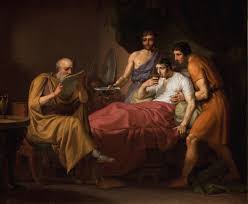
Alexander may be ‘Great’ for putting a small region called Macedonia on the world map. With all the carnage and misery he spread over the lands he and his army traversed, it took only the might of a tiny mosquito to bring him down. At least, that is one of the likely ways he died. Other contenders include alcoholic liver disease, depression and strychnine poisoning. 

Alexander The Great On His Sickbed, By Christoffer Wilhelm Eckersberg (c. 1783 – 1853). From Public Domain

Like Alexander, many monarchs with the suffix ‘The Great’, such as Peter, Catherine, and Frederick II, left behind an enormous body count and a trail of devastation. 

The Great ‘state-of-the-art’ Titanic was marketed as ‘unsinkable’, and itself was a lifeboat with tight watertight compartments, giving ample time for ferry passengers to be rescued by rescue vessels. Hence, the need for an adequate number of lifeboats was deemed unnecessary. We all know about the irony of its disastrous maiden journey, which is still spoken about a century later as one of Man’s greatest miscalculations.[6]

Indians of the 20th century honoured Karamchand Mohandas Gandhi as a selfless soul who chose a life of poverty to stir the masses’ consciousness towards self-rule. The people thought it appropriate to address him as Mahatma (the Great Soul) or the Father of the Nation. Today, an increasing number of Indians are having second thoughts. Perhaps they may have been taken for a ride and got the short end of the stick from the British. It is amusing that Gandhi’s son, Harilal, despite the reverence of the people of the subcontinent towards his father, also did not hold his father in high regard. Disillusioned with the senior’s move to block his law scholarship to England, Harilal became a rebel, spiralling into alcoholism, eventually becoming a public nuisance and falling into oblivion.[7] 

The Great War, also known as World War I, was touted as a necessary battle to end all wars. We know it never ended anything, but its post-war deals remain a nidus for World War II and the turmoils that persist even today. 

The Great Gatsby exposes the fallacy of the American Dream and the notion of a successful life under capitalism. F. Scott Fitzgerald shows that success-based materialism and trying to relive a nostalgic past will not lead to fulfilment. Instead, it will lead to a decadent path and disappointment. [8]

In a world so entrenched in wealth acquisition, we have heard of many families afflicted with the misfortune of striking it rich in the lottery and seeing their family spiral into an abyss.

The Great Train Robbery in 1963, the UK’s biggest heist, where the robbers scooted off with the present-day value of £62 million, ended with none of the culprits laying their hands on the loot, but mostly just behind bars. [9]

Just look at Trump and his track to the White House using the ticket which promises to ‘Make America Great Again (MAGA)’. The illusion of the blissful past only morphed into civil unrest, which required the deployment of National Guards and Marines to use flash-bang grenades and tear gas to squash down their own citizens. If that was not enough, now there is talk of MIGA — Make Iran Great Again, perhaps returning Iran to its glory days of the Persian Empire! [10]

When we describe something as great, we usually refer to it in a positive light, as something extraordinary pushing human abilities beyond normal boundaries. It is a subjective assessment. One man’s greatness is another’s failure. It can serve as a cautionary tale for those who have fallen. 

It’s just food for thought. After having a bad day at the office when nothing went right, we returned to find that we had forgotten the house key at work and had to go all the way back to the office to retrieve it. What do we say? “Great!”

.

[1] ). Even though this quote is often referred to as coming from Churchill, it may have  been originated from Otto von Bismarck, the first Chancellor of unified Germany between 1871 and 1890. He could have said, “he who is not a socialist at 19, has no  heart. He who is still a socialist at 30, has no brain.”

Katycarruther’s.com

https://en.wikiquote.org/wiki/Talk:Otto_von_Bismarck#Unsourced

[2] Speech and 2017 bmovie, which included the speech called ‘The Darkest Hour’

[3] https://www.goodreads.com/quotes/4611-history-will-be-kind-to-me-for-i-intend-to

[4] People probably put words into Churchill’s mouth. It may be a misquotation. The conversation may have taken place between Lady Astor and Churchill’s aide. 

https://www.smithsonianmag.com/history/illustrious-history-misquoting-winston-churchill-180953634/

[5] Churchill’s policies contributed to the 1943 Bengal famine – study.

https://www.theguardian.com/world/2019/mar/29/winston-churchill-policies-contributed-to-1943-bengal-famine-study

[6] Did Anyone Really Think the Titanic was Unsinkable? The makers probably oversold it.’

https://www.britannica.com/story/did-anyone-really-think-the-titanic-was-unsinkable

[7] Father to a nation, stranger to his son.

https://www.theguardian.com/film/2007/aug/10/india

[8] The reality was not what success for everyone in America.

https://www.ewadirect.com/proceedings/chr/article/view/9147

[9] The men behind the Great Train Robbery

https://www.bbc.co.uk/culture/article/20250410-the-men-behind-the-great-train-robbery

[10] MAGA to MIGA.

https://www.wionews.com/world/from-maga-to-miga-donald-trump-suggests-regime-change-to-make-iran-great-again-1750631822282/amp

.

Farouk Gulsara is a daytime healer and a writer by night. After developing his left side of his brain almost half his lifetime, this johnny-come-lately decided to stimulate the non-dominant part of his remaining half. An author of two non-fiction books, Inside the twisted mind of Rifle Range Boy and Real Lessons from Reel Life, he writes regularly in his blog, Rifle Range Boy.

Disclaimer: The opinions expressed are solely that of the author and not of Borderless Journal.

PLEASE NOTE: ARTICLES CAN ONLY BE REPRODUCED IN OTHER SITES WITH DUE ACKNOWLEDGEMENT TO BORDERLESS JOURNAL

Click here to access the Borderless anthology, Monalisa No Longer Smiles

Click here to access Monalisa No Longer Smiles on Kindle Amazon International

Categories
Poetry

Identity by Munir Momin

Translated from Balochi by Fazal Baloch

From Public Domain
(1) 

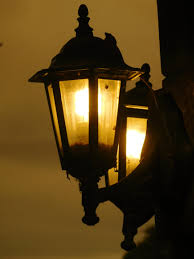
If you were a lamp,
I would not become the night—
Nor a moth,
Nor a window,
Nor an eye.
If you were a lamp,
I too would be a lamp.

(2)

Whether you dwell afar or near,
To me, you are everywhere.
Be it dawn or dusk,
You bloom—verdant, evergreen.
With famished lamps,
I wander, seeking you.
I crumble, collapse.
With my tired soul,
I sow and grow whispers.
You are my pasture.

Munir Momin is a contemporary Balochi poet widely cherished for his sublime art of poetry. Meticulously crafted images, linguistic finesse and profound aesthetic sense have earned him a distinguished place in Balochi literature. His poetry speaks through images, more than words. Momin’s poetry flows far beyond the reach of any ideology or socio-political movement. Nevertheless, he is not ignorant of the stark realities of life. The immenseness of his imagination and his mastery over the language rescues his poetry from becoming the part of any mundane narrative. So far Munir has published seven collections of his poetry and an anthology of short stories. His poetry has been translated into Urdu, English and Persian.  He also edits a literary journal called Gidár. This poem originally titled as Pajjar (Identity) is taken from Munir Momin’s poetry collection Yak Bechelley Aazman (A Span Long Sky) published by Gidar Publications in 2014.

Fazal Baloch is a Balochi writer and translator. He has translated many Balochi poems and short stories into English. His translations have been featured in Pakistani Literature published by Pakistan Academy of Letters and in the form of books and anthologies. Fazal Baloch has the translation rights to Munir Momin’s works.

.

PLEASE NOTE: ARTICLES CAN ONLY BE REPRODUCED IN OTHER SITES WITH DUE ACKNOWLEDGEMENT TO BORDERLESS JOURNAL

Click here to access the Borderless anthology, Monalisa No Longer Smiles

Click here to access Monalisa No Longer Smiles on Kindle Amazon International

Categories
Musings

Felix, the Philosophical Cat

By Farouk Gulsara

Just the other day, a visitor to my home made a remark. She observed that my cat, Felix, was staring into the horizon while sitting by the glass window. Felix seemed unfazed by the activities within the house, instead focusing his gaze on the neighbour’s gate. In front of the neighbour’s compound stood a few stray cats, returning his stare. It resembled a kind of staring competition.  

The visitor remarked that Felix might be looking at all his stray friends on the other side of the fence, envying their lifestyles. They could roam freely whenever they wished, accompanied by their pack of friends. Wherever they rested their heads was their home. Moreover, they did not have to endure his fortnightly baths or grooming. Oh, how Felix loathed those cold showers and the bare feeling afterwards when there was not enough fur on his Persian body to lick, beautify, and flaunt. As for the food… throughout his life, the only sustenance he consumed was in pellet form. The occasional lizards and insects he hunted down with the remnants of what his dormant DNA offered were swiftly intercepted by his owners. This is why Felix the Cat was often seen engaged in forlorn glances, brooding over his seemingly helpless situation. 

In response, I told the visitor that Felix’s feline friends on the other side of the fence would likely feel the same way. They would be gazing at him with eyes brimming with envy. If only they grasped a bit of philosophy, they would be yelling, “life is not fair!” Here sits Felix in the comfort of the house, in an aesthetically pleasing environment shielded from the harsh forces of weather and nature, with love overflowing all around, soothing tactile stimuli to caress and rub against him, protected from noxious ailments, and safeguarded against prancing predators and cruel individuals discontented with their presence or their annoying mating calls.

They would probably pray to swap places with a house cat in their next life. Felix, were he to believe in rebirth, would likely yearn to roam free without being tethered—symbolically, of course, as cats are not leashed, a privilege they possess over their fellow domesticated ‘friends’, the dogs!

That is life, is it not? No one is truly satisfied with their existence. Everyone believes the grass is greener on the other side of the fence. What they may fail to grasp is that it appears greener because the soil is fertilised with manure. One must endure the stench of excrement to appreciate the outcome. The poor man looks at his wealthy neighbour and assumes that once he secures that coveted high-paying job and some money, everything will be splendid. Meanwhile, the rich man gazes at the poor, reminiscing about his long-lost days of poverty when life was simple and sleep was undisturbed.  

Poet Kannadasan[1], in one of his many wisdom-filled compositions, envisioned a situation: the snake, a natural prey of the eagle, residing upon Lord Shiva’s neck, haughtily sneering at Garuda[2] and inquiring if he was well. The snake, securely nestled in the protection of the Lord, knows that Garuda cannot harm him. Garuda responds that everyone would be just fine if they were in the place they are meant to be. Kannadasan then quotes the Tamil poet Avvaiyar[3],who asserted that the world respects you when you hold a prominent position. When you stumble, even your shadow will defy you. I believe the essence of the message is to accept and appreciate what one possesses in life. Unrealistic expectations lead only to disappointment, whilst acceptance fosters contentment.

.

[1] Kannadasan (1927-81), also known as Kaviarasu (King of Poets) is considered one of the greatest Tamil poets.

[2] A legendary divine eagle-like bird who is the mount of Vishnu.

[3] A Tamil woman poet (supposed to have lived in the first century BCE) from the Sangam period (300BCE – 300 CE).

Farouk Gulsara is a daytime healer and a writer by night. After developing his left side of his brain almost half his lifetime, this johnny-come-lately decided to stimulate the non-dominant part of his remaining half. An author of two non-fiction books, Inside the twisted mind of Rifle Range Boy and Real Lessons from Reel Life, he writes regularly in his blog, Rifle Range Boy.

.

PLEASE NOTE: ARTICLES CAN ONLY BE REPRODUCED IN OTHER SITES WITH DUE ACKNOWLEDGEMENT TO BORDERLESS JOURNAL

Click here to access the Borderless anthology, Monalisa No Longer Smiles

Click here to access Monalisa No Longer Smiles on Kindle Amazon International

Categories
Excerpt

Nazuk by Syad Zahoor Shah Hashmi

Translated by Fazal Baloch

This is first chapter of the first Balochi novel that was published in 1976. It has been translated into Urdu and Persian. The narrative depicts everyday life and experiences of the people living around the coastal area of Makkuran especially Gwadar and its surroundings.

The cover of Nazuk. provided by Fazal Baloch.

For about a week, the weather had been pleasant, with a cool wind blowing across the sea—a true blessing for the fishermen. A calm sea meant loss for them, while a rough sea spelled devastation. Over the past few days, the fleet of fishing boats had been returning to the shore with plenty of catch.

The sun had completed three-quarters of its journey, racing through the sky like a messenger in haste in the final quarter. Its burning rays were yielding to the soothing coolness of the approaching evening. The long, serene shadows stretching behind the houses provided an ideal setting for a public gathering.

Away from the shore, an old voyager boat, anchored in the red sands, stood tall like a pyramid—a symbol of the unshakable bond between the boundless sea and its people. Who could say how many joyful and sad years the sea’s companions had spent navigating across its waters on that very boat? Though the sea often rocked their boat like a cradle, not once had these brave sons of the ocean furrowed their brows in fear or discontent.

The fleeting morning shadows soon vanished to the unknown but the evening shadows lingered longer, creeping towards the damp sands of the shore and eventually reaching the water, as if embodying the spirit of the giant old boat longing for the sea’s embrace to soothe its heart.

The shadow it cast offered an ideal venue for one of the biggest public gatherings in the evening. At times, it seemed as if people sitting on its plank were aboard the boat chatting to pass their time on a deep-sea trip. The cool breeze blew across reflected the pleasant weather at sea.

The wind had cooled the sands of the shore, making them so comfortable that those who lay on them forgot the comfort of even the most luxurious mattresses and cushions. Men, women, and children all came to enjoy themselves, especially today, which was more crowded than usual as it was Friday and no one had ventured into the sea for fishing the night before, giving the fishermen a day off.

For those who lived around the sea, there were only two vocations: fishing or navigating across the sea on a boat. And everyone acknowledged that sea navigation was one of the most cherished vocations in the world. Thanks to these navigations and explorations, humans had even set foot on the moon.

Navigation in the sea made fishermen exceptionally skilled and resourceful. They sailed from one country to another, learning about different lands and their people. Some sailors, despite being illiterate, exhibited such remarkable knowledge that even the learned were left in awe.

On the right, in front of a small roadside hotel, people sat on benches, sipping tea and chatting with each other. Some distance away, a group had gathered around a tall and smart man, listening intently to him. Let’s draw closer. Oh! He is Captain Naguman, moving his lips and hands alike. With his hands, he fidgets with a rope, perhaps knitting a net, while with his lips, he narrates the story of the First World War so enthusiastically as if he were a part of it himself. At that moment, someone called out from behind: “Captain! Hey Captain Naguman!”

Naguman turned around, shaking his head annoyingly, and said, “This jinxed fellow never lets me speak properly.”

“Captain! Hey Captain Naguman!”

The call came from inside the hotel’s kitchen, and from his voice, the Captain recognised him.

“Abdul is really a cursed man! Look how he disturbed the Captain in the middle of his speech,” someone said with rage.

“Exactly. He always jumps in during my speech,” Naguman turned somewhat dismayed.

“Hey Captain! Would you like tea? A cup of tea?” Abdul’s voice reached their ears again.

“If you’re going to give him a cup of tea, then bring it, you the cursed scoundrel,” someone whispered, and the Captain replied loudly, “Yes, bring it.”

Abdul immediately came and placed the cup before the Captain. He too sat down to listen. A few people from the audience cast side-glances at Abdul. The Captain smiled, sipped his tea, and resumed his speech, “Listen, you blind fishermen! Just in a single day, over a hundred planes swarmed in like locusts…”

A little farther away, a few women and children were sitting. Children were playing with the sands. The first woman was busy weaving a net, and the second one was keenly observing her. The third one was still pondering about what to do or say. The second woman said with great lament: “Mamma Papi didn’t help me weave a net. At least I could have moved my otherwise idle hands,” lamented the first woman.

“Move your hands or make some money?” replied the third woman, as if she had been waiting for the perfect moment to speak.

Papi raised her experienced eyes slightly, smiled gently, and stopped weaving the net and glanced around. When she was sure that nobody was looking at them, she retorted in a hushed tone, “The ‘Young Man’ wouldn’t let you bother yourself with work, dear Mahbalok!”

“Waiy waiy! Mamma Papi, don’t defame me,” Mahbalok said slowly, taken by surprise.

“Mamma Papi! Mamma Papi! Look there. He’s coming right here,” the third woman hastily whispered. No sooner had she uttered these words, Mahbalok became so edgy that she almost broke into a sprint.

But Mamma Papi let out a hearty laugh, then she threw the spool of thread and half-woven net on the ground. With both her hands, she held Mahbalok’s shoulders and said: “What happened to you, the cursed woman? Where are you going? Look, you’re even getting fooled by this little Hajok. I’ve had enough with you. You’re almost out of your mind,” exclaimed one of the women.

“Hajok! May the lord of the sea curse you! I’ve never seen such a jinxed woman in my entire life. Mamma Papi, by God, my heart almost sank,” Mahbok tried to maintain her unsteady breath.

Waiy Mahbok! Hajok is your neighbor and best friend,” remarked Mamma Papi.

“By God, Mahbok, don’t tease me again. I wouldn’t like it,” Mahbok was yet to come to herself.

“It’s alright. Don’t open your basket-like mouth. Men are looking at us,” Papi warned them.

Rows of boats lined up along the arched shore, resembling horses ready for a race. It seemed as if riders had tightly held the reins and were waiting for the whistle to be blown. A few boys were playing tag behind those boats and yawls. On the left, some nets were placed on a plank.

“Come! They taste like halwa. Come! They’re fresh and hot,” Zalya shouted as if warning those who couldn’t get any that they’d only have to blame themselves. And it did the trick. In a moment, people swarmed around her cauldron. A while later, a young man and his friend called out to her:

“O, Mamma Zalya! Send us half a rupee worth of Mat, please.”

“Pindi, my son! I don’t have that much left. They’re barely worth twenty-five paisa.”

“It’s alright. Leave it.” Then he turned to his friend and said, “We’ll go to the bazaar and have tea with biscuits.”

Pindi and his friend Guli got up and made their way towards the bazaar. Two young men were playing Liddi. The game seemed to absorb to the duo as if it were the greatest challenge of their lives.

“Jalu! Jalu! Come on, boy. Pass this net to your uncle. Every day these blind fishermen return it damaged. They’ve spent their entire lives at sea, yet they can’t keep the net away from the rocks,” an old man, while weaving a net, turned to a boy sitting next to him.

“Jalu, my son! Go and get me your uncle Shahdost’s net.”

“Uncle, let me finish my peanuts first,” the boy replied indifferently.

“I’ll keep your peanuts. Get me the net first, then you can eat your peanuts.”

The boy slipped the peanuts into his pocket and scurried off. He returned almost panting and threw the net with a thud before his uncle.

He closely examined the net to determine the nature of the damage. Startled, he suddenly blurted out, “Such a new net! They have damaged it terribly,” he mumbled in anger. “They’re blind in both eyes. Neither do they know how to properly cast the net nor do they know how to untangle it.”

The sea was crowded. A few boys were playing tip-cat, and some other people were watching and enjoying the game. It’s played differently in different areas, but the version played in the coastal area is distinct. Some other boys were playing hopscotch. Two young boys were drawing sketches of fish, boats, and yawls in the sand with knife-like-sharp fish bones. A little farther away, a few young men were playing bazari. Two young men looked at them and tempted them, “You blind men! Is this the time to play this game? You’re flaunting your skills. We’ll challenge you to a match. Come tonight at the sands of Kala Teembok. We’ll show you how it’s played and won.”

A few girls were playing with beads, and some others were collecting salps[1]. It is believed that when you bury them in the ground, after seven days they will turn into beads provided no boy sees you burying them. On the seventh day, when they fail to unearth any beads, they wouldn’t turn dismayed. But at that moment, one of the girls would claim, “You know, Mami is a… he had been following us. He secretly watched us behind the wall. Thus, we couldn’t get beads.”

“Today I will complain to her mother,” the second girl replied.

“Anok! Anok! It’s better not to visit his mother.”

“Why, Jani?”

“Yesterday his father severely thrashed his mother… “

“Ah! But why?”

“You know Sayaki, the carpenter? She had visited his house.”

“May God keep us away from…”

Far in the distance, a woman called out, “Sharok! Come on, dear, look after the baby. I’ll be back from the bazaar just in a while.” Sharok, who was playing with beads, strode towards her mother. The youngest of them took all the beads from the girls, dismantled the holes, and chanted, “The game is over. Yes, it is all over.”

Two younger girls cried out, “Give us back our beads!” But by the time their sobbing subsided, she had already gone home. Determined, the two girls began digging through the holes again, hoping to find a bead hidden somewhere. However, there was nothing. Disappointed, they stood up and walked to the sea to wash their hands. Spotting other girls collecting salps nearby, they joined in, clinging to the hope that by the next Friday, the salps might somehow transform into beads.

The sun descended lower, casting the shore in hues of orange and gold. By sunset, the beach was nearly deserted, save for the men gathered around, engrossed in Naguman’s tale of the German War.

Glossary

Halwa, Mat: Types of sweets.

Liddi, Bazaari: Local ga

[1] A tiny sea creature

Syad Zahoor Shah Hashmi (1926-78) is known as the pioneer of modern Balochi literature. He was simultaneously a poet, fiction writer, critic, linguist and a lexicographer par excellence. Though he left undeniable marks on various genres of Balochi literature, poetry remained his mainstay. With his enormous imagination and profound insight he laid the foundation of a new school of Balochi poetry especially Balochi ghazal which mainly emphasises on the purity of language and simplicity of poetic thoughts. This school of poetry subsequently attracted a wide range of poets to its fold. He also authored the first ever Balochi novel ‘Nazuk’ and compiled the first comprehensive Balochi-to-Balochi dictionary containing over twenty thousand words and hundreds of pictorial illustrations.

Fazal Baloch is a Balochi writer and translator. He has translated many Balochi poems and short stories into English. His translations have been featured in Pakistani Literature published by Pakistan Academy of Letters and in the form of books and anthologies. Baloch has the translation rights of this novel.

PLEASE NOTE: ARTICLES CAN ONLY BE REPRODUCED IN OTHER SITES WITH DUE ACKNOWLEDGEMENT TO BORDERLESS JOURNAL

Click here to access the Borderless anthology, Monalisa No Longer Smiles

Click here to access Monalisa No Longer Smiles on Amazon International

Categories
Essay

Drinking the Forbidden Milk of Paradise…

By Meenakshi Malhotra

Mount Parnassus in Greece, where the muses were said to gather, was regarded as the home of poetry: From Public Domain

For the longest time, women were uncomfortable occupants of the house of poesy[1], particularly where there were existing canons of poetry established by the institutional gate-keepers and male custodians of literature. At best, they were viewed as Jane-come-latelies who sought to transgress the hitherto hallowed domains of high verse, interlopers to the hallowed heights of Parnassus who dared not “drink the milk of paradise”.

This ‘absence’ of women from the terrain of poetry is in spite of the fact that women have always written poetry, from ancient times to now. Sappho in the western tradition, was a Grecian poet from 5th-6th century BCE who was the pioneer of lyric poetry, a genre which apart from being set to music, also inaugurated the poetic ‘I’. In India, Buddhist nuns in the Mahayana and Theravadas who wrote poems known as the therigathas were early precursors of female poets. These early women poets engaged in the sometimes forbidden, sometimes lascivious charms of verse and versification. Down the ages, there were many others who joined them and kept the lamp of women’s versification lit. However, if women have always been versifiers, why has there been a  resistance and grudging admission for women to the poetic domain, which becomes a sort of “No (Wo)man’s land”? Why do women poets have only a token presence in traditional poetic anthologies?

Some reasons have been offered, not least among them being the preponderance of male poets who have often also been self-proclaimed and self-appointed guardians, legatees and arbiters of poetic tradition. Canonical poetic traditions, many claim, require a knowledge and understanding of Latin and Greek in the West while a knowledge of Sanskrit/Persian in the Asian context was deemed necessary. Thus women, who, for the most part, lacked formal education and had but small Latin and less Greek, could only hover around the margins and fringes of poetry. The situation with Sanskrit and Persian was similar and women remained mostly absent from or shadowy denizens of poetic terrains. Even if and when women were writing, they were doing so in colloquial registers and in the languages of the common people  and not in formal or decorative language, deemed essential for poetry, for the most part. Almost the first group of women writing poetry in India were Buddhist nuns who wrote in Pali, one of the many ancient languages in the ancient Indian subcontinent, which enshrined its own scholarly tradition. Sappho wrote in the Greek Aeolic dialect, which was difficult for Latin writers to translate.

Between 12th and 17th century, there was an advent  of devotional mystic poetry called “Bhakti” and “Sufi” poetry. While the poems were uttered/written in a devotional idiom, the poems and songs were often rebellious and iconoclastic, rejecting institutional religions and social norms. This poetry was rooted in personal and unmediated devotion and rejected formal languages and established societal norms. Some of this poetry was in an informal register, colloquial language and performative with a strong dramatic quality. Thus we have lines in Kannada from Akka Mahadevi (1130-1160) who rejects her earthly husband:

I love the handsome one: He has  no death decay nor form… no end no clan, no land.
Take these husbands who die, decay, and feed them to your kitchen fires.(Vachanas)

Women poets for the longest time had a crisis of identity, identification and non-belonging. They laboured under the anxiety of authorship where they felt the absence of precursors and fore-mothers and the lack of a poetic tradition to which they could belong. They were often made to feel as if they lacked genuine poetic talent or that they were transgressors against womanhood and femininity.

In Aurora Leigh (1855) by Elizabeth Barrett Browning, the eponymous title character, considers  the diverse fields of literature where women can exercise their talent and claim a space. The field of dramatic writing poses a challenge because the former demands that the woman writer be in the public eye in order to promote her plays. Further, to achieve or even aspire to the rank of Poet, Aurora must become capable of  “widening a large lap of life to hold the world-full woe”. Over the course of the long epic poem, she tries to reconcile her femininity with her artistic aspirations. In both cases, she is denied emotional fulfilment. She refuses to accept the role of an obedient wife, since it would mean foregoing the intellectual independence needed to develop as an artist, but then she must also refuse the love of a husband. In Book Five, she mentions three poets, none of whom she admires for their “popular applause”. Yet she admits that she envies them for the time they can devote to their chosen vocation and the adoring women that surround them and provide emotional support and fill their days with glory.

Another issue with women’s writing and poetry is the uncomfortable positioning of women in relation to patriarchal language or male centred language. If as Dale Spender  declares in “Man-made Language”, the masculine is asserted as the norm, where do we position women’s voices? While language is a universal medium of communication, man-made language is full of sexism and chauvinism and expresses reality from a predominantly masculine and patriarchal perspective. If language is a social system which women are persuaded or co-opted to use, how do they work within its confines to express their poetic aspirations? How do they stretch, bend, subvert language to express their own realities? Can we read techniques of irony, satire and other figurative and metaphoric strategies of defiance and subversion and an attempt to undermine from within?

Juliet Mitchell in her essay on ‘Femininity, Narrative and Psychoanalysis’ states that the woman writer/novelist must of necessity be a hysteric, straddling two opposed worlds. One world is that of male definitions and conceptions of femininity  and the other, a resistance and defiance of such conceptualising, accompanied by an attempt to undermine from within. Her defiance and resistance makes her character that of a hysteric, one who defies accepted notions and standards of femininity and is therefore considered transgressive. She troubles fixed gender categories, roles and definitions. She also disrupts and challenges the symbolic order of language, one which insists on rules of grammar and linguistic structures through the semiotic order which uses word play, repetitions and  childish rhymes, in order to express inner desires and drives. The symbolic order deals with the denotative aspects of language and the semiotic order with the affective aspect.

Women’s poetry often houses and accommodates the semiotic, seeming psychobabble that plays with and disturbs fixed notions of femininity and binary gender identities.

What are the popular themes that inform women’s poetry? Some themes are to with women’s search for authentic  self-hood and identity, their search for roots and a space of their own. As we see in Aurora Leigh, much of women’s poetry is self-conscious and self-reflexive, about the act of writing itself, the “awful daring of a moment’s surrender which an age of prudence could never retract.”(T.S.Eliot

Many contemporary women poets, across continents, have evinced a substantial  interest in exploring their poetic self  through their poems. On the one hand is the confessional poetry of Sylvia Plath and Anne Sexton, on the other the brief gnomic utterances of Emily Dickinson. Before the advent of the twentieth century, one hears of Barrett Browning, Emily Dickinson and Christina Rossetti, among many others. Names like Aphra Behn and Anne Bradstreet have been included in many syllabi, often as a token inclusion in an otherwise male centric course.

Women poets have talked about the horrors of war including rape, pillage and destruction. In their critique of war and violence, we find the forging of transnational solidarities, whether it is women’s poetry from Sri Lanka or Birangona (War heroines). 

In India the many names that come to mind are that of  Kamala Das, Eunice D’Souza, Meena Alexander, Sujata Bhatt and Sunuti Namjoshi. Women poets have employed effective means to explore the entire gamut of experience.The private  and the public domain, their process of  self-analysis; the process of poetic creativity and a probe into  poetic identities are all significant fields of exploration. For these women writers, analysing the creative process becomes much more than just a poetic theme. As they unravel the mystery of their poetic psyche in their writings, it becomes an epiphanic journey for the poets and their readers.

[1] Archaic word for poetry

Dr Meenakshi Malhotra is an Associate Professor of English Literature at Hansraj College, University of Delhi, and has been involved in teaching and curriculum development in several universities. She has edited two books on Women and Lifewriting, Representing the Self and Claiming the I, in addition  to numerous published articles on gender, literature and feminist theory.  Her most recent publication is The Gendered Body: Negotiation, Resistance, Struggle.

.

PLEASE NOTE: ARTICLES CAN ONLY BE REPRODUCED IN OTHER SITES WITH DUE ACKNOWLEDGEMENT TO BORDERLESS JOURNAL

Click here to access the Borderless anthology, Monalisa No Longer Smiles

Click here to access Monalisa No Longer Smiles on Amazon International

Categories
Review

…My Heart Wanders Wailing with the Restless Wind…

Book Review by Meenakshi Malhotra

Title: Shabnam

Author: Syed Mujtaba Ali

Translator from Bengali: Nazes Afroz

Publisher: Speaking Tiger Books

Shabnam (1960) by Syed Mujtaba Ali is a love story that is set in the third decade of the 20th century. ‘Shabnam’ in Persian means a ‘dewdrop’. The polyglot scholar Mujtaba Ali’s love story becomes a vehicle for articulating the profundities of life which extends beyond the plot and the telling just like that of his teacher, Rabindranath Tagore. To quote the words of another reviewer: “His novel can be compared to a dewdrop which assumes rainbow hues during sunrise as it encompasses not only the passionate cross-cultural romance of Shabnam and the young Bengali lecturer, Majnun, but also shades of humanity, love, compassion set against the uncertainties generated by ruthless political upheavals.” Sweeping in scope, set against the backdrop of the Afghan Civil War (1928-29) and beyond, the novel narrates an epic love story. That this has recently been translated by a former BBC editor stationed in Afghanistan, Nazes Afroz, and published for a wider readership, emphasises its relevance in the current context, where regressive curtailment of human rights and liberties are evident on a daily basis.

Shabnam is a young, upper class and educated Afghan woman, fluent in French and Persian. As we learn in the course of the narrative, she is daring and apparently fearless. She is proud of her Turkish heritage as she invokes it while introducing herself: “You know I’m a Turkish woman. Even Badshah Amanullah has Turkish blood. Amanullah’s father, the martyred Habibullah, realised how much power a Turkish woman—his wife, Amanullah’s mother—held. She checkmated him with her tricks. Amanullah wasn’t even supposed to be the king, but he became one because of his mother.” Given the current context, with its attack on womens’ freedom, it is perhaps difficult to imagine that a woman like Shabnam or anyone with a similar persona or voice could be found at all. She seems at times to inhabit the rarefied realms of her author’s imagination, beyond the earthly realm.

Shabnam’s knowledge of history and the world is extensive. She actively chooses and decides about her surroundings and her own life, which is more than what many women can do in today’s Afghanistan. Characters like Shabnam are also the result of the varied travels of the author Mujitaba Ali, who traveled and taught in five countries. On the power wielded by women, Shabnam offers a rejoinder to her lover/narrator: “In your own country, did Noor Jahan not control Jahangir? Mumtaz—so many others. How much knowledge do people have of the power of Turkish women inside a harem?”

The novel has a tripartite structure. In the first part, is the dramatic meeting of the narrator, Majnun, with the striking and unconventional Shabnam at a ball given by Amanullah Khan, the sovereign of Afghanistan from 1919 to 1929. The novel’s narrative is dialogic in nature and the introduction and subsequent exchanges of the protagonists  are peppered with wit and poetry. The first part concludes with the two of them acknowledging their love for each other.

In the second part of this novel,we witness more developments in their relationship. Shabnam assumes an agential role and makes a decision to marry Majnun secretly with only their attendants looking on. And then later, this decision receives a legitimate sanction since a wedding is organised for them by her father, who does not know they are already married. Despite the xenophobic approach in those times of many Afghans (and other South Asian communities) against marrying their daughters to foreigners, her family decides to marry Shabnam to Majnun as they wanted her out of conflict-ridden Afghanistan and in a safer zone. Her father hopes she will go off to India with her husband. This seems unexpectedly progressive in the Afghanistan of  almost a century ago. But instead, in the third part, she is abducted by the marauding hordes while her beloved attempts to organise their return from Afghanistan.

The last part continues with Majnun’s quest for his beloved. His endeavour leads him to travel, hallucinate and drives him almost insane, reminiscent of the Majnun of Laila-Majnun fame, a doomed union that resonates in and forms a motif in the narrator/lover’s repeated conversations with Shabnam. At the end of the novel, Majnun ascends the physical realm of love. He says: “Now after losing all my senses, I turn into a single being free of all impurities. This being is beyond all senses—yet all the senses converge there… There is Shabnam, there is Shabnam, there is Shabnam.”

The novel concludes with the realisation that “there is no end” (tamam na shud). This feeling seems to echo the idea of  “na hanyate hanyamane sarire”(“It does not die”) in Sanskrit signifying that love is eternal, even beyond the material realm. Both the luminosity and fragility of love is represented in the novel.

Mujtaba Ali’s wide and varied experience is in evidence at several points in the novel, as is his wit and satiric sense, some of which filters through to his created characters.   This can be experienced in the dialogues and descriptions even in its translated form. In order to conceal her identity from the marching and rustic hordes, Shabnam comes to visit her beloved in a burqa. She argues that it is not a symbol of oppression but a self-chosen disguise: “Because I can go about in it without any trouble. The ignorant Europeans think it was an imposition by men to keep women hidden. But it was an invention by women—for their own benefit. I sometimes wear it as the men in this land still haven’t learned how to look at women. How much can I hide behind the net in the hat?”

A valuable addition to the rich corpus of travel writing in Bangla Literature, the book remained unknown to the world outside Bengal despite its excellence as there were no translations. In 2015, Afroz had translated and published this book as In a Land Far from Home: A Bengali in Afghanistan. It was subsequently shortlisted for the Crossword Book Award. That translations can provide a bridge across cultures is eminently clear from this work, which gives us a tantalising glimpse of a culture beyond our own and encourages us, the readers, to recognise that true love transcends borders or boundaries and that the language of true love is the same everywhere.

The novel’s title, Shabnam, is a natural choice, as the intelligent, courageous and beautiful Shabnam is the emotional centre of the novel. To describe her ineffable charm, we could draw upon Mujtaba’s teacher’s words, in Gitanjali (Song Offerings by Tagore):

She who ever had remained in the 
depth of my being, in the twilight of
gleams and of glimpses…

… Words have wooed yet failed to win
her; persuasion has stretched to her its
eager arms in vain.

Song 66, Gitanjali by Tagore

Majnun, the narrator lover is left, in Tagore’s words: “gazing on the faraway gloom of the sky, and my heart wanders wailing with the restless wind.” Romance by its very nature, is fleeting and  transient and romantic love in its literary avatars/depictions acquires a bitter-sweetness when its founded on loss and longing. So it is with Shabnam.

.

Dr Meenakshi Malhotra is an Associate Professor of English Literature at Hansraj College, University of Delhi, and has been involved in teaching and curriculum development in several universities. She has edited two books on Women and Lifewriting, Representing the Self and Claiming the I, in addition  to numerous published articles on gender, literature and feminist theory.  Her most recent publication is The Gendered Body: Negotiation, Resistance, Struggle.

.

PLEASE NOTE: ARTICLES CAN ONLY BE REPRODUCED IN OTHER SITES WITH DUE ACKNOWLEDGEMENT TO BORDERLESS JOURNAL

Click here to access the Borderless anthology, Monalisa No Longer Smiles

Click here to access Monalisa No Longer Smiles on Amazon International

Categories
Musings

Just Another Day?

By Farouk Gulsara

Photo Courtesy: Farouk Gulsara

The Sun rears its orangey hue over the horizon. Yet another new day dawns. The Sun does not know it is starting a new horizon. It performs its preordained duty, firing nuclear fusion reactions on its surface. It is the round Earth that revolves around the Sun. The Earth does not know a new day has begun. It just revolves counterclockwise on its axis. It has multiple new dawns at its manufactured latitudes. It neither knows where it started nor its point of reference. A series of celestial accidents brought it to be with its speed and its faithful lunar companion.

The day does not know it is a new day. Wednesday does not know it is Wednesday. It is merely an agreed arrangement for convenience. There is nothing specific about Wednesday or, for that matter, any day. It can rain, shine, snow, or be a non-discrete day. Good or bad things can happen, just like any other day. It is daylight, and night befalls before another day.

Earthlings have been miscalculating their calendars anyway. In 1582, Pope Gregory XIII replaced the Julian calendar with the Gregorian calendar. They realised they had miscalculated the solar cycle and had to remove ten days from the Julian calendars to be in sync with a complete revolution. It took the world three centuries to agree on a single calendar. Imagine the ensuing pandemonium. Sweden had to add two leap days to correct their miscalculations. Imagine finding headstones bearing dates like February 30 or 31 as death dates! So, going back, today’s Wednesday could have been a Saturday in the old Julian calendar.

Different cultures view the beginning of the calendar year at various times, depending on whether they follow a solar, lunar, or lunisolar calculation. The Chinese, who follow a lunar system, celebrate theirs in late January or early February, allowing for leap years. The Persians start theirs, Nowruz, on the summer solstice. The Indians and their Southeast Asian counterparts usher it in April with a water festival, prayers and much merriment. Not to forget the Cambodian despotic leader who established Year 0 on 17th April 1975 to whitewash their glorious past, much like the French Year Zero of the 1789 Bastille Day.

In essence, it is just another day. Just as Paul McCartney described in his song, ‘Another Day‘, one merely slips into shoes on the first day of the calendar and follows the same old routine. That is sad. So, to break the monotony, we attach importance to these days. We start a new ledger or a new school term in some countries. In Malaysia, our school term used to begin on the first Monday of January until COVID-19 befuddled everything. The Education Ministry had to close the schools and postpone examinations. The public examinations used to be done at the end of the year those days. Now, nobody knows when the term begins and when the examinations are written.

Many seize the opportunity to use the new year as leverage to get their lives in order. In the post-inebriation hangover following Christmas and New Year’s Eve, one would vow to become a teetotaller. The resurgence of gym memberships can be observed again. The days into the New Year would see new, eager, wannabe Jane Fondas, who would be MIA by mid-January, often seen arguing at the front desk for a refund.

Life is a continuum; it is not compartmentalised. Though it is good to use the birth of a new year as a fulcrum to springboard oneself to greater heights, any day is a good day to start. All it requires is determination and focus. However, it is easier said than done, and the motivational push varies from person to person. Elements that break the will and opinionated naysayers are aplenty.

Anyway, life will be boring if there are no days to look forward to— no birthdays to shower love, no Christmas to bond, no Harvest Festivals to show gratitude to the forces of Nature, and no New Year’s to make new resolutions for the umpteenth time and break them once again. This makes the world go on. There is always something to look forward to.

Photo Courtesy: Farouk Gulsara

Farouk Gulsara is a daytime healer and a writer by night. After developing his left side of his brain almost half his lifetime, this johnny-come-lately decided to stimulate the non-dominant part of his remaining half. An author of two non-fiction books, Inside the twisted mind of Rifle Range Boy and Real Lessons from Reel Life, he writes regularly in his blog, Rifle Range Boy.

.

PLEASE NOTE: ARTICLES CAN ONLY BE REPRODUCED IN OTHER SITES WITH DUE ACKNOWLEDGEMENT TO BORDERLESS JOURNAL

Click here to access the Borderless anthology, Monalisa No Longer Smiles

Click here to access Monalisa No Longer Smiles on Kindle Amazon International