World Poetry Day falls in March — the same month that houses the World Wildlife Day. Our beautiful planets’ flora and fauna, impacted by the changing climate, might have to adapt or alter. Part of the land masses are likely to return to rest under rising tides. And humanity, how will we respond or survive these phenomena?
We have here responses in poetry from our newly-minted section on Environment and Climate. We celebrate with poetry on our home and hearth, the Earth.
From Public Domain
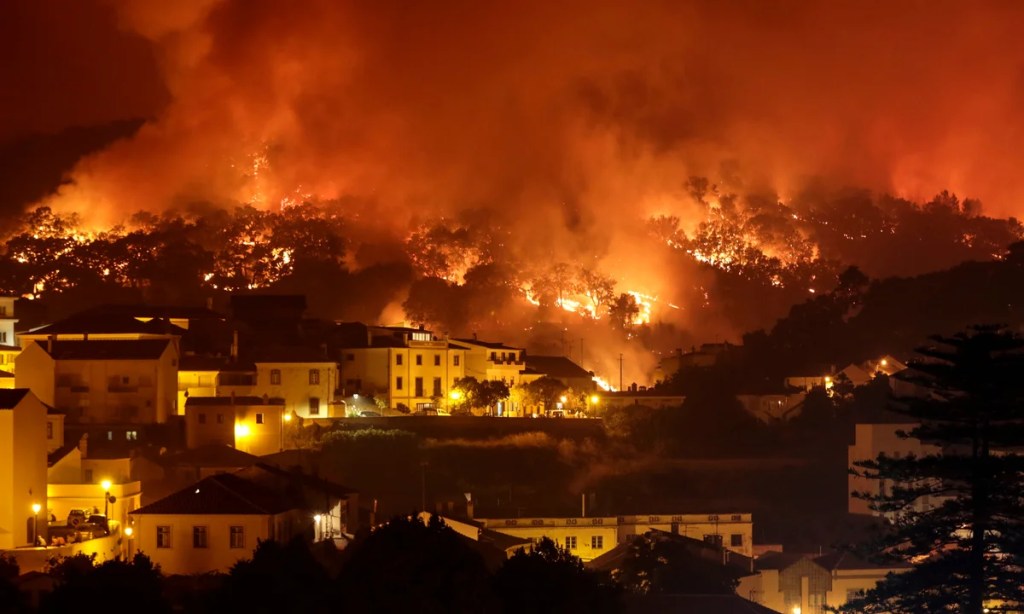
We start with poetry on fires that seems to have razed large parts of our planet recently…
In Dylan on Worm’s Head, Rhys Hughes describes a misadventure that the Welsh poet had while hiking as a tribute to him on Dylan Thomas Day. Clickhereto read.
Munaj Gul gives an in memoriam for a photographer from Balochistan. Clickhere to read.
Musings of a Copywriter
In ‘Is this a Dagger I See…?‘, Devraj Singh Kalsi gives a tongue-in-cheek account of a writer’s dilemma. Click here to read.
Notes from Japan
In A Golden Memory of Green Day in Japan, Suzanne Kamata tells us of a festival where she planted a tree in the presence of the Japanese royalty. Click here to read.
Perhaps when Dylan Thomas wrote these lines, he did not know how relevant they would sound in context of the world as it is with so many young dying in wars, more than seven decades after he passed on. No poet does. Neither did he. As the world observes Dylan Thomas Day today — the day his play, Under the Milkwood, was read on stage in New York a few months before he died in 1953 — we have a part humorous poem as tribute to the poet and his play by Stuart McFarlane and a tribute from our own Welsh poet, Rhys Hughes, describing a fey incident around Thomas in prose leading up to a poem.
May seems to be a month when we celebrate birthdays of many writers, Tagore, Nazrul and Ruskin Bond. Tagore’s birthday was in the early part of May in 1861 and we celebrated with a special edition on him. Bond, who turns a grand ninety this year, continues to dazzle his readers with fantastic writings from the hills, narratives which reflect the joie de vivre of existence, of compassion and of love for humanity and most importantly his own world view. His books have the rare quality of being infused with an incredible sense of humour and his unique ability to make fun of himself and laugh with all of us.
Nazrul, on the other hand, dreamt, hoped and wrote for an ideal world in the last century. The commonality among all these writers, seemingly so diverse in their outlooks and styles, is the affection they express for humanity. Celebrating the writings of Nazrul, we have one of his fiery speeches translated from Bengali by Radha Chakravarty and a review of her Selected Essays: Kazi Nazrul Islam by Somdatta Mandal. An essay from Niaz Zaman dwells on the feminist side of Nazrul while bringing in Begum Roquiah. Zaman has also shared translations of his poetry. Professor Fakrul Alam, who had earlier translated Nazrul’s iconic ‘Bidrohi or Rebel‘, has given us a beautiful rendition of his song ‘Projapoti or Butterfly’ in English. Also in translation, is a poem by Tagore on the process of writing poetry. Balochi poetry by Manzur Bismil on human nature has been rendered into English by Fazal Baloch and yet another poem from Korean to English by Ilwha Choi.
Ratnottama Sengupta this month converses with a dancer who tries to build bridges with the tinkling of her bells, Sohini Roychowdhury. Gita Viswanthan travels to Khiva in Uzbekistan, historically located on the Silk Route, with words and camera. An essay on Akbar Barakzai by Hazran Rahim Dad and another looking into literature around maladies by Satyarth Pandita add zest to our non-fiction section. Though these seem to be a heterogeneous collection of themes, they are all tied together with the underlying idea of creating links to build towards a better future.
In focus this time is a writer whose prose is almost akin to poetry, Rajat Chaudhuri. A proponent of solarpunk, his novel, Spellcasters, takes us to fictitious cities modelled on Delhi and Kolkata. In his interview, Chaudhuri tells us: “The path to utopia is not necessarily through dystopia. We can start hoping and acting today before things get really bad. Which is the locus of the whole solarpunk movement with which I am closely associated as an editor and creator…”
On that note, I would like to end with a couple of lines from Nazrul, who reiterates how the old gives way to new in Proloyullash (The Frenzy of Destruction, translated by Alam): “Why fear destruction? / It’s the gateway to creation!” Will destruction be the turning point for creation of a new world? And should the destruction be of human constructs that hurt humanity (like wars and weapons) or of humanity and the planet Earth? As the solarpunk movement emphasises, we need to act to move towards a better world. And how would one act? Perhaps, by getting in touch with the best in themselves and using it to act for the betterment of humankind? These are all points to ponder… if you have any ideas that need a forum on such themes, do share with us.
We have more content which has not been woven into this piece for the sheer variety of themes they encompass. Do pause by our content’s page and browse on all our pieces.
With warm thanks to our wonderful team at Borderless — especially Sohana Manzoor for her fabulous art — I would like to express gratitude to all our contributors, without who we could not create this journal. We would also like to thank our readers for making it worth our while to write — for all of our words look to be read, savoured and mulled, and maybe, some will evolve into treasured wines.
Millions of years ago,
Life bubbled into being
In a world without walls…
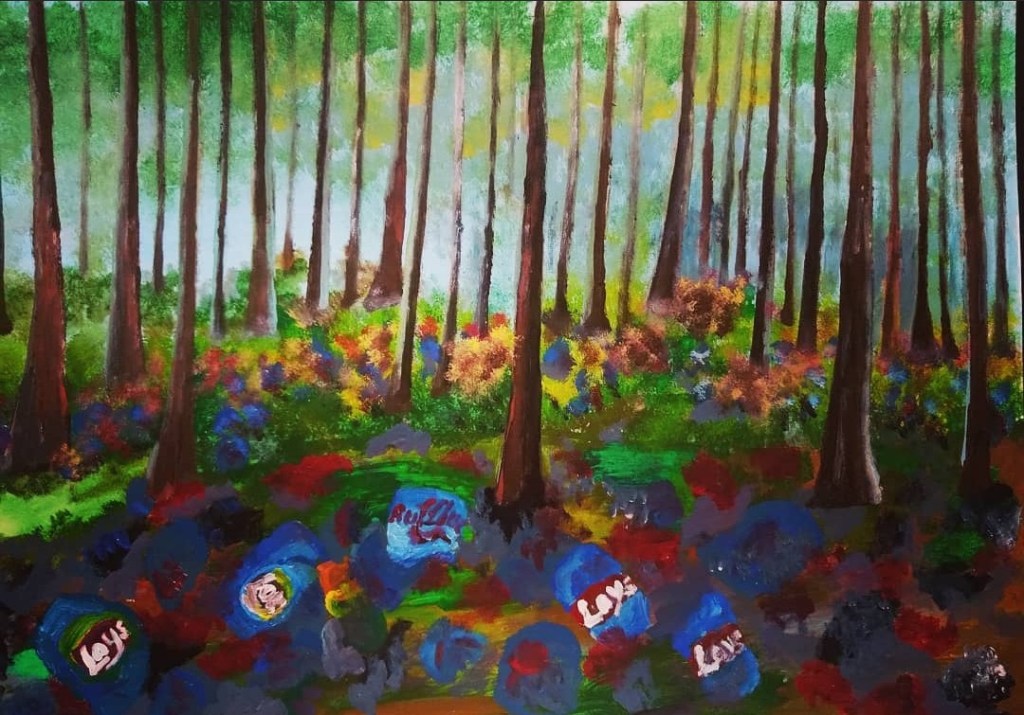
While the World Environment Day steps in once a year, we live in an ever-changing environment every moment of our lives. The environment is what we make of it as it continues to evolve around us. It is impacted by our very presence. There was a time when all the world was a huge continent — Pangaea. Climate must have been as different as the flora and fauna then by what scientists tell us.
We have come a long way since that period. Looking at the concerns we face today, the United Nations has announced a plastic awareness drive. Plastic is not natural… but of human origin, just like United Nations. Climate change is the focus of the whole world, as temperatures rise, ice-caps melt and the weather turns more unpredictable.
In this special issue, we have poetry from around the world showcasing the evolution of Earth, climate change, the way life has evolved and will continue to evolve —
Dreams of Disenchantment: Poetry by Michael Burch maps how man has contributed to global disasters through history. Click here to read.
Specks & Spirits: Showcasing selected poetry excerpted from Rhys Hughes’ latest anthology of global voices,Animal, Vegetable, Mineral: Light Verse about Life & Other Heavy Things, these poems map the historic evolution of life on Earth, of humans, celebrate the diversity of flora and fauna and muse to wonder at our evolving place in the Universe… Click here to read.
Imagine a world without wars, without divisions, where art forms flow into each other and we live by the African concept of Ubuntu — I am because you are’ — sounds idyllic. But this is the month of March, of poetry, of getting in touch with the Dionysian elements in ourselves. And as we have said earlier in the introduction of Monalisa No Longer Smiles: An Anthology of Writings from across the World, what could be a better spot to let loose this insanity of utopian dreams than Borderless Journal!
Having completed three years of our Earthly existence on the 14th of March, we celebrate this month with poetry and writing that crosses boundaries — about films, literature and more. This month in the Festival of Letters or Sahityaotsav 2023, organised by the Sahitya Akademi, films were discussed in conjunction with literature. Ratnottama Sengupta, who attended and participated in a number of these sessions, has given us an essay to show how deep run the lyrics of Bollywood films, where her father, Nabendu Ghosh, scripted legends. It is Ghosh’s birth month too and we carry a translation from his Bengali autobiography which reflects how businessmen drew borders on what sells… After reading the excerpt from Nabendu’s narrative translated by Dipankar Ghosh and post-scripted by Sengupta, one wonders if such lines should ever have been drawn?
Questioning borders of a different kind, we have another piece of a real-life narrative on a Japanese Soldier, Uehara. Written by an Assamese writer called Kamaleswar Barua, it has been translated and introduced by Bikash K. Bhattacharya. The story focusses on a soldier’s narrative at his death bed in an alien land. We are left wondering how his need for love and a home is any different from that of any one of ours? Who are the enemies — the soldiers who die away from their homes? What are wars about? Can people live in peace? They seemed to do so in Kurigram, a land that has faded as suggests the poem by Masud Khan, brought to us in translation from Bangla by Professor Fakrul Alam, though in reality, the area exists. Perhaps, it has changed… as does wood exposed to a bonfire, which has been the subject of a self-translated Korean poem by Ihlwha Choi. Tagore’s poem, Borondalatranslated as ‘Basket of Offerings’, has the last say: “Just as the stars glimmer / With light in the dark night, / A spark awakens within/ My body. / This luminosity illuminates / All my work.” And perhaps, it is this luminosity that will also help us find our ideal world and move towards it, at least with words.
We have a book review by Aruna Chakravarti of Bornali Datta’sIn A Better Place: A Doctor’s Journey, a book that is set amidst immigrants and takes up certain social issues. Baba Padmanji’s Yamuna’s Journey, translated from Marathi by Deepra Dandekar, one of the oldest Indian novels has been discussed by Somdatta Mandal. Bhaskar Parichha has told us about S.Irfan Habib’s Maulana Azad – A Life. Basudhara Roy has brought out the simplicity and elegance of Robin Ngangom’sMy Invented Land: New and Selected Poems. He writes in the title poem that his home “has no boundaries. / At cockcrow one day it found itself/ inside a country to its west,/ (on rainy days it dreams looking east/ when its seditionists fight to liberate it from truth.)”. We also carry an excerpt from his book. Stories by Jessie Michael, Brindley Hallam Dennis, Sangeetha G and Shubhangi bring flavours of diversity in this issue.
Our journey has been a short one — three years is a short span. But, with goodwill from all our readers and contributors, we are starting to crawl towards adulthood. I thank you all as caregivers of Borderless Journal as I do my fabulous team and the artists who leave me astounded at their ability to paint and write — Sohana Manzoor, Gita Vishwanath and Pragya Bajpai.
Thank you all.
Looking forward to the next year, I invite you to savourBorderless Journal, March 2023, where more than the treasures mentioned here lie concealed.
Yes, electric is gone, now it’s plastic—
From sex to food to procreation
Plastic rules the day and rues our time
Making it all easy and oh so convenient!

All is plastic save, possibly, the brain;
This mass of nerves and neurons
Mirrors the bewilderment outside
Where people die and kill and cry

Where O where is the human
We crave for meaninglessly?
In the dust bins of our hearts
Mangled and confused, dying.

Save us O Lord, save us. Save.
Kirpal Singh is a poet and a literary critic from Singapore. An internationally recognised scholar, Singh has won research awards and grants from local and foreign universities. He was one of the founding members of the Centre for Research in New Literatures, Flinders University, Australia in 1977; the first Asian director for the Commonwealth Writers’ Prize in 1993 and 1994, and chairman of the Singapore Writers’ Festival in the 1990s. He retired the Director of the Wee Kim Wee Centre.
PLEASE NOTE: ARTICLES CAN ONLY BE REPRODUCED IN OTHER SITES WITH DUE ACKNOWLEDGEMENT TO BORDERLESS JOURNAL
ENTWINED PLACES

Standing on the Juhu beach,
I heard, more than a decade ago,
The winds from the Marina,
In a smattering of Marathi and Tamil,
Accompanying birdsongs.

Blame that on a bout of homesickness
But what about last year, when

The Sealdah station, its turf
Pounded by the waves of human feet,
Seemed to me to reverberate
With the weighty steps of the rush hour,
Also felt in Mylapore and Nariman Point?

Perhaps, the crowds stirred me then
But that cannot be all, for

Often on cool Hyderabadi afternoons,
I have worn, in silence, the unease
Of Bangalore's woolen evenings;
And sensed in Delhi's nippy nights
The cold grip of other Indian winters...

Extremes sometimes addle the brain
And lull the heart, but…

Even when I take a leisurely stroll
On a summer dusk, around the lake
That girdles my neck of the woods,
I am greeted by the lush sights, of
The long winding ways yonder...

To Darjeeling and Kodaikkanal,
To Yercaud and Dehradun,
To Kashmir and Kanyakumari,
And to all that lies beyond.
Srinivas S teaches English at the Rishi Valley School, India. He spends his free time taking long walks, watching cricket and writing poetry in short-form (mostly haiku).
.
PLEASE NOTE: ARTICLES CAN ONLY BE REPRODUCED IN OTHER SITES WITH DUE ACKNOWLEDGEMENT TO BORDERLESS JOURNAL
"I wish you survival,
Health
And the closed sky above you."

— Refugee in my own Country/I am Ukraine, Lesya Bakun
Despite this being the season of multiple new years around Asia, we cannot close our eyes to the skies that connect all the world like a blue dome. Though celebrations and humour continue to lighten the darkness of war, while Ukraine is being wrecked, can we turn our faces towards only festivities?
I had an interesting anecdote about how before the onset of the Gregorian calendar, new years in the world were celebrated around March and in some places in September. The Earth would turn fecund and green with spring, a beautiful season sprinkled with love and nostalgia as Michael R Burch tells us in his poetry. However, despite all the opulence of nature, it is hard to watch a country being bombed and families splintered to man a war that supposedly guards a human construct called ideology and blocs. Ukranian refugee, Lesya Bakun, in an interview says: “It is not a clash of ideologies. It is a fight for our country and nation to exist.” Listening to Lesya’s stories makes one amazed at the bravery of the Ukrainians battling what seems to be cultural hegemony. It reminds of the war in Bangladesh in 1971. Though incredibly courageous in voicing her experiences, Lesya is traumatised and has a psychosomatic cough as she sends her voice and text messages from her mobile through Telegram. There were times when she was just weeping or angry for the questions asked, and justifiably so, as her home in Kharkiv, where she lived was under attack, and the town of Mariupol, where she was born, has been wrecked by the war.
The refrain of the pain of a refugee continues to reverberate in a book reviewed by Rakhi Dalal, Ramy Al-Asheq’s Ever Since I Did Not Die, written originally in Arabic and translated by Isis Nusair. The Syrian-Palestinian poet refused to clarify whether his writing was prose or poetry — perhaps these borders and boxes drawn by humankind are breaking down in reality. Perhaps, this new year, the time is ripe to look forward to a new world that transcends these borders. This is also the first time we have had the privilege of carrying reviews of translations from Arabic and also from Turkish. Gracy Samjetsabam has reviewed a translation of a Turkish novel by Iskendar Pala called The Tulip of Istanbul, translated by Ruth Whitehouse. Bhaskar Parichha has reviewed a book by Kiran Manral, Rising: 30 Women Who Changed India while Candice Louisa Daquin has drawn our focus on a poetry collection by Marjorie Maddox, Begin with a Question, where the perceived divisions do not matter while the poet questions the larger issue of faith in quest of answers.
Is it the same kind of quest that has led Strider Marcus Jones to create the Lothlorien Journal, named reminiscently after Tolkien’s elvish ‘Lothlorien’ in Lord of the Rings? Find out Jones’s views and flow with his fluid poetry in the featured interview. Keith Lyons has been in conversation with Ivy Ngeow, an upcoming writer and the editor of a recent anthology of Asian writing where she has retained different styles of English across the world in a single book. While this could be beneficial to writers, would readers be comfortable reading stories with different styles or dialects of English without a glossary?
Our book excerpts are from more Asian books. The Year of the Rat and Other Poemsedited by Malachi Edwin Vethamani has an interesting title poem which has been shared in the excerpt. The other excerpt is from a fast-paced novel, Half-Blood, by Pronoti Datta. We also have a fast-paced story by a writer from France called Paul Mirabile set in Portugal; two that verge on the bizarre from Keiran Martin and Amjad Ali Malik; a poignant story from Sutputra Radheye and another that shows the positive side of voicing a protest against wrongs by Devraj Singh Kalsi. Kalsi has also given us a tongue in cheek musing called When Books have Wings.
On the lighter vein are travel essays by Ravi Shankar and Meredith Stephens. They take us to the Himalayas in Nepal and to Tasmania! Suzanne Kamata has taken us to an owl cafe in Japan! At the end of her column, one feels sad for the owls as opposed to Erwin Coombs’ narrative that evokes laughter with his much-loved pet cat’s antics.
Humour is evoked by G. Venkatesh who with an ability to find silver linings in dark clouds talks of cricket and lessons learnt from missing his school bus. Adnan Zaidi has also analysed his poetic abilities with tongue-in-cheek comments. Kenny Peavy gives a lighthearted rendition in praise of boredom and interactions with nature. It is good to have laughter to combat the darkness of the current times, to give us energy to transcend our grief. Keith Lyons hovers on the track between humour and non-humour with his cycling adventures. Rhys Hughes seems to talk of both his favourite poem and the war in a lighter shades, in no way insensitive but his observations make us wonder at the sanity of war. We have much of war poetry by a number of writers, poetry on varied issues by Luis Cuauhtémoc Berriozabal, George Freek, Sybil Pretious, Kisholoy Roy, J.D. Koikoibo and many more.
Candice Louisa Daquin has taken on the onus of bringing to our notice how language can impact us in the long run while Ratnottama Sengupta has explored beggary in films, fiction and fact. The Nithari column runs a real-life story of a young boy narrated by his brother, Sachin Sharma. It has been translated from Hindustani by Diksha Lamba. The trauma faced in 2006 is strangely not discussed in the story though it hovers in the backdrop between the lines. We also have a translation of a Balochi folk story by Fazal Baloch and a Korean poem by Ihlwha Choi. Translations from Tagore by Fakrul Alam and Somdatta Mandal have honoured our pages again. Mandal has sent us fun-filled skits by Tagore. But are they just fun or is there something more? We also have a translation of a long poem that explores a different aspect of Tagore, his empathy for the downtrodden which led him to create Sriniketan and regard it as his ‘life work’.
We have a bumper issue this time again — especially for the Asian new years; Thai, Nepalese, Bangladeshi, multiple Indian and more…
We would like to thank Sohana Manzoor for our cover painting and Gita Viswanath for her artwork. I would like to thank our wonderful team who with their contributions make this journal a reality. All the contributors deserve a huge thanks as do our loyal readers.
I wish you all a wonderful start to a non-Gregorian new year and hope that peace prevails over parts torn by wars and dissensions.
Bending over his sketch book with an array of art supplies spread around him, he drew with the concentration of a hawk stalking his prey. He stared at the object he was copying in the classic style of an art student doing his assignment. Whoever said art is therapeutic couldn’t have been more correct. From a sense of redundancy to finding a new joy at the ripe old age of 89, Daddy had bounced back from the day he felt a deep sense of despondency, when he woke up late because as he put it, ‘Wake up early and do what?’ Especially for a man of his era who cannot potter around the kitchen, cannot make grocery lists and cannot fold washed clothes. These are some activities that kept Mummy meaningfully occupied all day through but for Daddy, even television, books and newspapers proved inadequate.
This once smartly attired man went to work daily as a senior official in a public sector undertaking and took off on work to countries like the former USSR, Japan, England and Kenya with a complete sense of purpose and fulfilment. Struck by a paralytic attack almost twenty years ago that left him with a speech impairment and a disabled right hand, he taught himself to write with his left hand. Such was his tenacity and to think a person like this found no meaning in waking up was tragic to say the least. But that was some months ago. Rediscovering his passion for drawing, he has, of late, been engrossed in his new preoccupation, feeling like a child with a box of crayons.
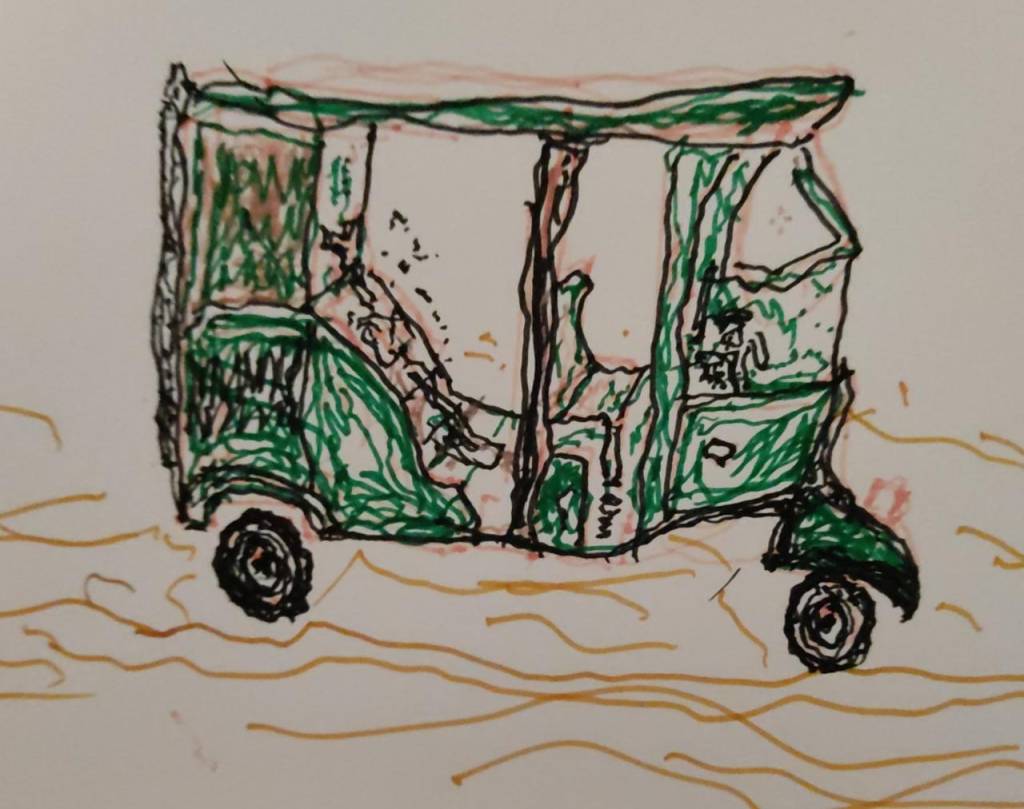
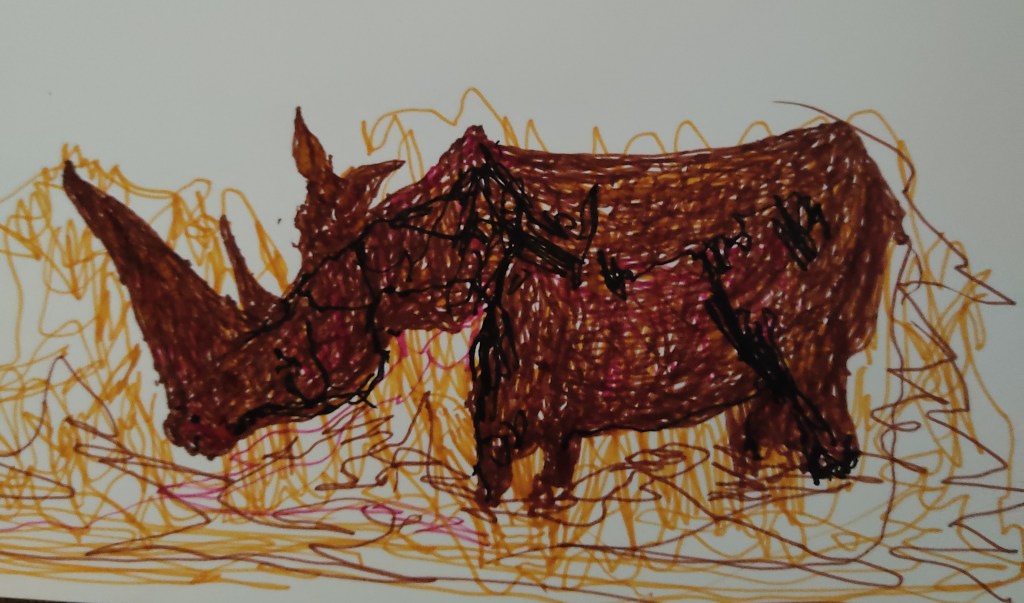
After all, he had graduated with a major in Zoology around the year 1955. As a child, I had learned to draw an elephant from him. He chose from the shelves, with great care, art pieces he had picked up on his travels – an ebony rhino, a brass coffee kettle, a wooden auto rickshaw and so on. With sketch pens and water colour pens, he began gingerly. Gradually, he became totally absorbed, almost meditative. Probably, each object he drew acted as a mnemonic device plunging him into the memory of another time. Filling time apart, the practice of art had surely enabled him to rediscover his own abilities and despite shaky hands, he found great joy in drawing.
His work with its wavy lines may be the consequence of shaky hands. However, what they evoke is certainly symbolic. The lines that resemble the waves of the sea could not have been more telling for one who worked for a shipping company! The lines, equally, indicate movement and like waves, the unstoppable passage of time. The colour palette is thoughtfully selected to reflect reality, like green and yellow for the autorickshaw, as well as a fine eye for the aesthetic. What’s interesting is also the fact that he drew on only a small part of the page. Of course, a large-sized drawing could be too daunting. Nevertheless, the blankness seemed to point towards a much larger universe that can only be imprinted in minimal ways.
But for now, he seemed to enjoy seeing the blank, white page come alive with colours that he filled into shapes that he was creating. Clearly, he was captivated by the magic of the creative process.
‘Wake up early and do what?’
Daddy draws again!
Courtesy: Gita Viswanath
Gita Viswanath is the author of a novel, Twice it Happened. Her second novel, A Journey Gone Wrong, is forthcoming. She has published short stories and poems in several journals.
.
PLEASE NOTE: ARTICLES CAN ONLY BE REPRODUCED IN OTHER SITES WITH DUE ACKNOWLEDGEMENT TO BORDERLESS JOURNAL
A million dollar question that seems to have no satisfactory answers. While around October-November, many cultures pay respects to the departed, there are those who do pray at a different time of the year. Is there a link between that and the fun of disguising and collecting candy or playing tricks on Halloween? There are no conclusive answers or evidence to link these.
In this special edition, we decided to have a bit of fun with imps, pirates, ghost, zombies and spooks brought to you from across the world on Halloween as well as a concluding essay on the reasons we celebrate spooks. Enjoy!
Poetry
Witchy Halloween: Michael Lee Johnson gives us a magical glimpse into Halloween night. Click here to read.
Pirate Poems: Jay Nicholls brings us fun-filled ‘spooky-gooky’ adventures across the Lemon Sea. Clickhereto read.
The Tickle Imp: Is this horrific, funny or what? Only can be had from the bizarre or genius pen of Rhys Hughes. Click here to read.
Prose
The Turret: An eerie story by Niles M Reddick that seems to be right out of an edition of The Most Haunted Houses. Click here to read.
The Return of the Dead: Gita Vishwanath explores spooks in afterlife in a short story. Do we become zombies? Click here to find out.
Ketchup: A scintillating ghost story by Rakhi Pandey, set in the old Residency at Lucknow. Click here to read.
When Two or Three are Gathered: A weird dark tale from Tan Kaiyi where a victims of a virus mutate. What kind of fear is instilled by this situation? Click here to find out.
Welcoming the Dark Half of the Year: Winding up the section is Candice Louisa Daquin’s essay that takes a relook at the evolution of Halloween historically. Clickhere to read.








 Borderless