A conversation with the author,Afsar Mohammed, and a brief introduction to his latest book, Remaking History: 1948 Police Action and the Muslims of Hyderabad. Click hereto read.
A conversation with Meenakshi Malhotra over The Gendered Body: Negotiation, Resistance, Struggle, edited by Meenakshi Malhotra, Krishna Menon and Rachana Johri and a brief introduction to the book. Click hereto read.
In His Unstable Shape, Rhys Hughes explores the narratives around a favourite nursery rhyme character with a pinch of pedantic(?) humour. Click here to read.
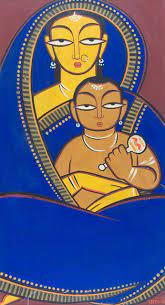
Mother & Child by Jamini Roy (1887-1972)Mother and Child by Picasso (1881-1973)
‘Victory to Man, the newborn, the ever-living.’ They kneel down, the king and the beggar, the saint and the sinner, the wise and the fool, and cry: ‘Victory to Man, the newborn, the ever-living.’
This is the month— the last of a conflict-ridden year— when we celebrate the birth of a messiah who spoke of divine love, kindness, forgiveness and values that make for a better world. The child, Jesus, has even been celebrated by Tagore in one of his rarer poems in English. While we all gather amidst our loved ones to celebrate the joy generated by the divine birth, perhaps, we will pause to shed a tear over the children who lost their lives in wars this year. Reportedly, it’s a larger number than ever before. And the wars don’t end. Nor the killing. Children who survive in war-torn zones lose their homes or families or both. For all the countries at war, refugees escape to look for refuge in lands that are often hostile to foreigners. And yet, this is the season of loving and giving, of helping one’s neighbours, of sharing goodwill, love and peace. On Christmas this year, will the wars cease? Will there be a respite from bombardments and annihilation?
We dedicate this bumper year-end issue to children around the world. We start with special tributes to love and peace with an excerpt from Tagore’s long poem, ‘The Child‘, written originally in English in 1930 and a rendition of the life of the philosopher and change-maker, Vivekananda, by none other than well-known historical fiction writer, Aruna Chakravarti. The poem has been excerpted from Indian Christmas: Essays, Memoirs, Hymns, an anthology edited by Jerry Pinto and Madhulika Liddle, a book that has been reviewed by Somdatta Mandal and praised for its portrayal of the myriad colours and flavours of Christmas in India. Christ suffered for the sins of humankind and then was resurrected, goes the legend. Healing is a part of our humanness. Suffering and healing from trauma has been brought to the fore by Christopher Marks’ perspective on Veronica Eley’s The Blue Dragonfly: healing through poetry. Basudhara Roy has also written about healing in her take of Kuhu Joshi’s My Body Didn’t Come Before Me.Bhaskar Parichha has reviewed a book that talks of healing a larger issue — the crises that humanity is facing now, Permacrisis: A Plan to Fix a Fractured World, by ex-British Prime Minister Gordon Brown, Nobel Laureate Michael Spence, Mohamed El-Erian and Reid Lidow. Parichha tells us that it suggests solutions to resolve the chaos the world is facing — perhaps a book that the world leadership would do well to read. After all, the authors are of their ilk! Our book excerpts from Dr Ratna Magotra’s Whispers of the Heart – Not Just A Surgeon: An Autobiographyand Manjima Misra’s The Ocean is Her Titleare tinged with healing and growth too, though in a different sense.
The theme of the need for acceptance, love and synchronicity flows into our conversations with Afsar Mohammad, who has recently authored Remaking History: 1948 Police Action and the Muslims of Hyderabad. He shows us that Hyderabadi tehzeeb or culture ascends the narrow bounds set by caged concepts of faith and nationalism, reaffirming his premise with voices of common people through extensive interviews. In search of a better world, Meenakshi Malhotra talks to us about how feminism in its recent manifestation includes masculinities and gender studies while discussing The Gendered Body: Negotiation, Resistance, Struggle, edited by her, Krishna Menon and Rachana Johri. Here too, one sees a trend to blend academia with non-academic writers to bring focus on the commonalities of suffering and healing while transcending national boundaries to cover more of South Asia.
That like Hyderabadi tehzeeb, Bengali culture in the times of Tagore and Nazrul dwelled in commonality of lore is brought to the fore when in response to the Nobel laureate’s futuristic ‘1400 Saal’ (‘The year 1993’), his younger friend responds with a poem that bears not only the same title but acknowledges the older man as an “emperor” among versifiers. Professor Fakrul Alam has not only translated Nazrul’s response, named ‘1400Saal’ aswell, but also brought to us the voice of another modern poet, Quazi Johirul Islam. We have a self-translation of a poem by Ihlwha Choi from Korean and a short story by S Ramakrishnan in Tamil translated by T Santhanam.
Our short stories travel with migrant lore by Farouk Gulsara to Malaysia, from UK to Thailand with Paul Mirabile while chasing an errant son into the mysterious reaches of wilderness, with Neeman Sobhan to Rome, UK and Bangladesh, reflecting on the Birangonas (rape victims) of the 1971 Bangladesh Liberation war, an issue that has been taken up in Malhotra’s book too. Sobhan’s story is set against the backdrop of a war which was fought against linguistic hegemony and from which we see victims heal. Sohana Manzoor this time has not only given us fabulous artwork but also a fantasy hovering between light and dark, life and death — an imaginative fiction that makes a compelling read and questions the concept of paradise, a construct that perhaps needs to be found on Earth, rather than after death.
The unusual paradigms of life and choices made by all of us is brought into play in an interesting non-fiction by Nitya Amlean, a young Sri Lankan who lives in UK. We travel to Kyoto with Suzanne Kamata, to Beijing with Keith Lyons, to Wayanad with Mohul Bhowmick and to Langkawi with Ravi Shankar. Wendy Jones Nakanishi argues in favour of borders with benevolent leadership. Tongue-in-cheek humour is exuded by Devraj Singh Kalsi as he writes of his attempts at using visiting cards as it is by Rhys Hughes in his exploration of the truth about the origins of the creature called Humpty Dumpty of nursery rhyme fame.
Poetry again has humour from Hughes. A migrant himself, Jee Leong Koh, brings in migrant stories from Singaporeans in US. We have poems of myriad colours from Ryan Quinn Flanagan, Patricia Walsh, John Grey, Kumar Bhatt, Ron Pickett, Prithvijeet Sinha, Sutputra Radheye, George Freek and many more. Papia Sengupta ends her poem with lines that look for laughter among children and a ‘life without borders’ drawn by human constructs in contrast to Jones Nakanishi’s need for walls with sound leadership. The conversation and dialogues continue as we look for a way forward, perhaps with Gordon Brown’s visionary book or with Tagore’s world view of lighting the inner flame in each human. We can hope that a way will be found. Is it that tough to influence the world using words? We can wish — may there be no need for any more Greta Thunbergs to rise in protest for a world fragmented and destroyed by greed and lack of vision. We hope for peace and love that will create a better world for our children.
As usual, we have more content than mentioned here. All our pieces can be accessed on the contents’ page. Do pause by and take a look. This bumper issue would not have been possible without the contribution of all the writers and our fabulous team from Borderless. Huge thanks to them all and to our wonderful readers who continue to encourage us with their comments and input.
Here’s wishing you all wonderful new adventures in the New Year that will be born as this month ends!
Short story by S Ramakrishnan, translated from Tamil by T Santhanam
It was Malavika who sent me the video of the monk who plays guitar. Malavika is my daughter. She is pursuing fashion designing course in Kingston University, England. Her desires and interests are a puzzle to me. Some days ago, she sent a recording of a poem by William Blake in her voice. After that, she sent a photo of her carrying a placard in a demonstration against global warming. As clouds change to forms unimaginable, her interests keep on changing. After watching a butterfly, she had sent her impressions in writing. It seemed as though it was from a seasoned writer.
Children who leave home for far off places, in a sense, leave us. She was no longer the girl she was in Chennai. The new country and new environment have changed her. The changes are reflected in her appearance and deeds. My wife did not like these alterations. Below the video of the monk who played guitar, she had given the caption: “Music is Meditation”. I could not understand her. At the age of twenty-two, I thought she would be fondly giving herself to worldly pleasure. But she was immersed in meditation, agitation and museum visits.
In the video sent by Malavika, the monk must have been about thirty years old. His head was tonsured. He wore a robe coloured orange. His ears were slightly big. He had a sharp nose and small lips where a smile was frozen. It was hard to find out if he was a Nepali or a foreigner. On his left arm, was tattooed the image of Buddha.
It was funny to see a Monk with a guitar. The image we have formed about saints and the looks of current day saints are not alike. Perhaps, we refuse to update that image. Perhaps, the meaning of sainthood has changed.
The musical piece was given the title “Falling flowers”. From the way he was playing, it seemed as real as the blossomed cherry leaves falling gently. The normal rapidity and gush associated with guitar music was not there. Like an insect that moves in the water, his fingers moved on the guitar strings. Music tunes to the past more easily than photographs. A small piece of music is enough to take us back to our school days.
I saw the video once or twice. I felt the urge to listen to it again and again. While listening at night, I felt as if the fragrance of incense was wafting into the vacant spaces of my heart. I found His name was Limang Tolma while searching for his other videos. There were hundreds of musical pieces by him. All of them were only seven minutes long. Evidently, he played the guitar for only seven minutes in a day. That too under the sal tree in Coben Monastery seated on a stool. Hundreds of people from various countries pour in to listen to his performance. All this I gathered while browsing the internet. His music was melodious and sweet. Why did he play for seven minutes only at each stretch was beyond comprehension.
To know more about Limang Dolma, I called Malavika on her mobile. She sent a message that she was observing silence for the past five days. Why this silence? Tongue can be tied down. But the mind?
I told my wife. She responded that she had scolded Malavika and that was why she was doing this.
I could not understand. What was the skirmish between mother and daughter? I sent a message to Malavika asking her how long her silence would continue. “God only knows,” was her reply.
As I am a senior executive in an automobile company, I had to conduct two to three meetings in a day. My blood pressure sometimes would rise after returning from these meetings.Sometimes, I would have a headache too. At times, the meetings would last for ten hours. After the meeting, I would feel as if somebody has placed a pile of iron on my shoulders. I would feel sick, wondering why we could not conduct our work without talking, discussing or fighting.
One day, before the commencement of the meeting, I started to listen to the monk’s guitar music from my cell phone rather impulsively. I closed my eyes for seven minutes as though I was in a deep meditation. It was as pleasant a feeling as a moist breeze caressing my body. There was peace in my heart and an exhilaration I had never known before. On that day, I could sense the change in my voice and the way I was moving towards a solution. Somehow the officials of the sales department seemed to understand this. After the conclusion of the meeting while coming down in the lift, Amarnath said, “There was something new in your speech today. You spoke like a Zen Master.”
“Yes” I nodded approvingly with a smile. I was just wondering how a small piece of music could bring such a tremendous change in me.
I wanted to know more about Limang Dolma. Searching through the internet I was more and more astonished. The real name of Limang Dolma is Christopher Cane. He was born in Milan. He had pursued Anthropology. After coming into contact with a Buddhist monk, he has embraced Buddhism and become a monk in the Buddhist Monastery. He plays the guitar only under the tree of the monastery and nowhere else. Young people throng to him. They listen to his music. Some of them stay there for days together to savour his music. They wear T-shirts bearing his image with the words, “Buddha plays Guitar”. In an interview, a young lady asks him. “All saints in India hold one or other instruments. Why does Buddha not play any instrument nor is seen holding one?”
“He himself is a musical instrument. One who knows how to tune himself finds no need for a musical instrument. In the same way, Nature tunes itself. Is there any tune better than what the water plays?”
“Why do you play only for seven minutes?”
“Seven is the symbol of consciousness in Buddhism.”
“Seven minutes is not enough for us. Can’t you play more?”
“Will you take honey in a gulp? Is a spoonful not enough?” he asks.
I admired Limong Dolma fo his speech, poise and the way he handled guitar. I too felt like wearing a T-shirt bearing his image. I sent the video of Limang Dolma to some of my friends asking them to listen to his music. Only Mohan Muralidharan, a neurologist and my school mate, sent a reply saying that a man from Turkey played better than the monk and shared the video. Why should one musician be compared to another? Can’t this foolishness be avoided?
I called Mohan and blurted out my irritation. He said in a mocking tone, “You’re aging. That is why you listen to a monk playing the guitar. Music should make us feel young. It should twinge our nerves. You have never touched a musical instrument in your entire life. Can you whistle atleast?”
Mohan was right. I haven’t even played the mouth organ which many played during my school days.
I felt like owning a guitar. The same evening, I went to a musical store in Leo mall. I showed the video of Limang Dolma and asked for a guitar like the one in the video. The face of the girl at the counter brightened. “Limang Dolma?” she asked. I felt glad that she too has listened to the music. She brought a guitar from inside. I told her, ” I don’t know how to play guitar. This is for my daughter.”
The girl told with a smile, “Limang Dolma was a thief. He was in prison. After his release, he became a Monk. People say he speaks to Buddha through his music.”
“Really!”
“I overheard two girls talk of it when they came to purchase a guitar.”
“Do you believe that?”
“I believe it partially.”
“Which part?”
“That he speaks to Buddha,” she smiled.
She looked like my daughter when she smiled. Perhaps for young girls Buddha is a different personality. May be, the Buddha known by the ones who have crossed fifty years like me and the Buddha these young girls adore are not the same.
When I brought guitar home, my wife chided me.
“Why have you brought this? Who will play?”
“Just let it be,” I responded.
“Is it a show piece to be kept just like that?” she asked.
I did not reply.
I placed the guitar in Malavika’s room close to her bed. I had a feeling that Malavika had returned. I sent that night the picture of guitar to Malavika by WhatsApp. She sent an emoji of two clapping hands. Also, she sent a message “We are going to visit Limang Dolma.”
Though I felt happy, I was eager to know who was the other in the ‘We’. I did not venture to ask Malavika. Instead, I asked, “When?” She did not respond.
After five days, she sent a picture to me. She was among the hundreds of youngsters before Limang Dolma, as he was playing the guitar. My eyes were cast on a young man with long hair, not on Limang Dolma. The young man hung his arms around Malavika’s shoulder.
Who was this fellow? How long had she known him? I could not see his face properly. I widened the image. An European face. Perhaps was he also a musician? I thought of asking Malaviika. But I curbed that thought and went on to ask about the musical event, as I called her. She was full of cheer. She told me,” Listening to Dolma’s music, one feels like a kite fluttering in the air. I do not know what to say. Flying to heaven.”
“I read somewhere that he was a thief,” I said.
” Oh, that’s a myth constructed by magazines. When asked about this, Dolma says raindrops do not have a past. Jonah and myself were in the Monastery for three days. Wonderful experience!”
A question arose on my mind as to who Jonah was. I was not sure whether to ask her or not. Why wouldn’t she talk about him?
I asked, “Is Jonah a musician?”
“Dad, how do you know? Indeed, he is. He plays the guitar well. It was he who introduced me to Dolma’s music.”
“Is Jonah your classmate?”
“No, he works in a bar where I hold a part time job.”
“You didn’t tell me,” I pretended to be angry.
“Dad, don’t tell Mom about this.”
“About your working in bar?” I asked deliberately.
“About Jonah too?” she laughed. As she was so laughing, she seemed to be some other young girl. After she hung up, I was thinking about Jonah. Was he a good person or bad? Was he also a thief earlier? Or could he be a drug addict? Who were his parents? Was he in love with Malavika? Had I become old? Was Mohan right? I
admired a Monk playing guitar somewhere. But I do not like Jonah who also plays guitar. Why? I was perplexed. Suppose if Limong Dolma put his arm around the shoulder of my daughter, would I dislike him too? I was confused.
Two days later, Malavika forwarded a video of Limang Dolma downloaded in her phone. Limong Dolma walked as though he was floating in the air. He sat under the tree. Peace was on his face as he tuned the guitar — the same music that I savoured earlier. No longer did I feel close to that music. Somehow, instead of Limang, Jonah’s face came before me. I felt as if a bitterness had settled down on my tongue.
The same night, Malavika called me. Before my asking anything, she said, ” After visiting Limang Dolma, I do not feel like listening to his music again”
“Why?” I asked as if I did not know anything.
“I do not like it any more just the way I suddenly liked it before.”
“How is Jonah?” I asked intentionally.
“Do not talk about him. I hate him. I hate whatever he introduced to me.”
Inwardly I was happy.
” Any problem? Shall I talk to Jonah?”
“Why should you talk to him? The days I moved with him, it was a nightmare. Daddy, why do you not rebuke me?”
“You are not a kid, after all.”
“But you think of me as a kid only. You don’t know me as Mom does.”
I was flummoxed. I could hear Malavika sobbing for the first time ever. I did not know how to console her. I hurriedly gave the phone to my wife. She started walking towards the kitchen with her words of consolation. What has transpired between her and Jonah? Why was she weeping? I could not make out. At the same time, I was happy that she disliked the world she created for herself and moved back towards my world. A thought arose that she was coming home. I asked my wife what Malavika had said.
“That boy is not good. I told her from the beginning itself. But she did not pay heed.”
“Did you know about Jonah before?”
“She told me six months back. I scolded her saying that your Dad will not like this. I have spoken to Jonah also.”
“To Jonah? You?”
“Yes, I could not understand a bit of what he spoke.”
“What is the problem now?”
“It’s over. No use talking about it!”
I could not understand what happened. But Malavika had been closer to her mother than to me. She had shared everything with her mother. I was pained at this. Why then did she asked me not to tell her mother? Why this drama? Children after growing up, treat their father as a plaything. The daughter I know is now the girl I do not know. I could not reconcile myself to this.
I heard the guitar music of the monk that night. I was more attracted to the tree than to the music.
Leaves do not stay on the tree for long. When a leaf falls, the tree does not reach out to catch it. When falling leaves sail along the wind, the trees can do nothing but look at them in silence. Somehow, the music stirred a grief in me.
As I prepared to leave for office next morning, I saw my wife keeping the guitar next to dustbin. What was the fault of the guitar after all?
” What are you going to do with this?” I asked.
“Anish told me, he will take it. What do we do with this? Malavika does not want it any more.”
I nodded giving the impression that she was right. But I felt sorry while doing that.
.
S. Ramakrishnan is an eminent Tamil writer who has won the Sahitya Akademi Award in the Tamil Language category in 2018. He has published 10 novels, 20 collections of short stories, 75 collections of essays, 15 books for children, 3 books of translation and 9 plays. He also has a collection of interviews to his credit. His short stories are noted for their modern story-telling style in Tamil and have been translated and published in English, Malayalam, Hindi, Bengali, Telugu, Kannada and French.
T Santhanam is a retired Bank Executive in Bangalore, India. He has a passion for literature with a special affinity for poetry. He writes poetry in Tamil. He is also a blogger.
.
PLEASE NOTE: ARTICLES CAN ONLY BE REPRODUCED IN OTHER SITES WITH DUE ACKNOWLEDGEMENT TO BORDERLESS JOURNAL
Banjara author Ramesh Karthik Nayakdiscusses his new book, Chakmak (flintsone), giving us a glimpse of his world. We also have a brief introduction to his work. Clickhere to read.
Translations
Demanding Longevityby Quazi Johirul Islam has been translated from Bengali by Fakrul Alam. Clickhere to read.
Moonlight, a poem by Bashir Baidar, has been translated from Balochi by Fazal Baloch. Clickhere to read.
Maithili Poetryby Vidyanand Jha has been translated from Maithili by the poet himself. Click hereto read.
Is it appropriate to speak of transnational glee as a legitimate audience response to a film? If so, that might be a fitting label for the global spectator reaction to the blockbuster Indian film, Jailer, released worldwide on August 10, 2023. The film whose OTT rights were purchased by Amazon Prime is streaming online while simultaneously playing to packed theatres in India, Sri Lanka, Malaysia, China, the Middle East, Australia, Canada, the US, the UK, France, and other countries. In its first month of theatrical release, Jailer brought in an impressive 300 crores in India alone with over 600 crores and counting (just shy of 22 million US dollars) as its worldwide earnings. Many Indian blockbuster films have had a worldwide high-performance index recently with the likes of Ponniyin Selvan, Pathaan, Bahubali etc. thriving on an exoticised glamour of an India of kings and queens and palaces and freedom fighters and medieval breakdance routines, a sort of mystified enchanting India of the travel brochure version for viewers both inside and outside India. Even a mediocre film like RRR had a localised transnational success in the United States during the academy award season as well.
Unlike these historical and revisionist costume dramas, Jailer is a full-on pop culture phenomenon, a movie of the moment, a tale of its time; it is as au courant as cellphones and police corruption. It is full of attitude, and packed chockful of allusions and homages to both Indian and western movies in what is essentially a fun romp. Shot mostly in sumptuous wide shots and rhythmic cuts, it establishes an onscreen India, dry and dusty, with industrial warehouses running forgery, guns and knives, roadside ice cream vendors, fly-by beheadings, and struggling gardens along with elementary school YouTube influencers. Its real distinction is that people all over the world get it. But it is as Indian, specifically, it is as Tamil as a Tamil can be, and it puts a smile on the face of anyone anywhere who watches it. The international blockbuster with no pretensions to anything other than cinematic entertainment is back, thanks to Jailer and its vibrant young director Nelson Dilipkumar.
Jailer tells the story of two men, a hero and a villain, a retired police officer Tiger Muthuvel Pandian, the eponymous jailer, and a criminal mastermind Varman who runs an art forgery ring. They make counterfeit Indian statuary and sells them in the international market. Their encounter becomes complicated when the jailor’s son, a corrupt police officer, starts working for the villain, the male melodrama of father-son conflict being a favorite trope in Tamil cinema from older films like Thangappathakkam (The Golden Badge,1974) that starred an earlier era’s superstar Shivaji Ganesan. Jailer belongs to the same pedigree of male melodramatic films. The hero is played by the Tamil superstar Rajnikanth and the villain, the psychopathic leader of the forgers by Vinayakan from the nearby Malayalam film industry in Kerala.
Both Rajnikanth and Vinayakan belong to the highly successful world of mainstream, commercial Indian cinema with strong populist reception while also maintaining a certain level of middle-class entertainment sophistication. When compared to Rajnikanth, Vinayakan is relatively a newcomer, but one who has very quickly claimed his own space in Mollywood, Kerala’s film industry that produces Malayalam language-based films.
Vinayakan’s breakout performance as an underworld operative, an executioner and strongman, a complex character who is right, wrong and everything in between in Kammatti Padam[1] (2016) earned him a Kerala State Film Award for Best Actor. Jailer sees him as a criminal psychopath with unpredictable ticks like instructing his lackeys to dance for him, drowning his enemies in big vats of sulphuric acid, delivering his Tamil-Malayalam pidgin with menacing comic timing etc. The overall excesses of his character have the potential to turn him into a stereotypical villain, especially since the sulphuric acid dunking trope has a colourful cinematic legacy in Indian popular culture. (The “sulphuric acid joke” is an instantly recognisable film joke in Indian pop culture attributed to the persona of an outlandish villain played by the erstwhile Bollywood star Ajit who is credited with asking his henchman Raabert (Hindi pronunciation of Robert) the following purely apocryphal lines: “Raabert, is haraami ko liquid oxygen mein dal do; liquid ise jeene nahin dega, oxygen ise marna nahin dega” (Robert, drown him in Liquid Oxygen; the Liquid won’t let him live, and the Oxygen won’t let him die!”). Jailer abounds in many such recognisable “quotation marks” throughout the film, including an ear-slicing scene, an evident homage to Quentin Tarantino’s Reservoir Dogs(1992), and “Stuck in the Middle with You”. These artfully placed allusions create an enjoyable self-reflexive layer in the film where Jailer talks to film materials that have provided evident inspiration. The self-conscious scripting and direction, and the sheer enjoyment and abandonment with which Vinayakan embraces the deranged psyche of Varman makes him a bonafide villain and not a caricature.
Rajnikanth who plays the title role of the jailer is the 72-year-old veteran superstar of Tamil cinema known to his massive adoring fan base as thalaivar (“Leader/Chief” in Tamil). Rajanikanth started his film career with the 1975 romantic drama Apoorva Ragangal (Rare Melodies), a far cry from the action crime thriller genre which would soon become synonymous with his name in the industry. With his trademark moustache, lopsided pursed lips, thick mop of straight black hair swiped across the forehead, lean frame, and long lanky legs, Rajnikanth from the 80s onwards played the righteous underdog on both sides of the law who took on the snobbish elite as well as the violent underworld players and won. He played orphans, rickshaw drivers, underworld consigliere, police officer, milkman, engineer, writer, grandfather, father, son, brother, husband, lover – he played the full spectrum of masculine roles in mainstream Indian cinema.
There is an underacknowledged colour line in Indian films where the relatively whiter-complexioned actors and actresses are considered stardom material. Rajnikanth with his dark-complexion and Midas touch at the box office demolished this industry practice and became the mirror for the ordinary darker Dravidian face on the Indian silver screen. Jailer sees him aged but fuller and lighter than his earlier years, though what has not changed are his instantly recognisable dance moves; underworld or the penthouse, underdog or the aggressor, Rajnikanth’s dance moves set the tone in his films. The standing jogs, the high kicks, the hip shake, the robotic arm movements and hand props like dark glasses and hand towels showed a new definition of “cool” to his fans. His tentative dance performance in Jailer is reminiscent of another accomplished dancer who exhibits a pretend stage fright; John Travolta in Pulp Fiction dancing with Uma Thurman to Chuck Berry’s “You Never Can Tell.”
Other significant performances include Vasanth Ravi as the jailor’s corrupt and clueless son, Ramya Krishnan as the jailer’s visibly irritated wife, along with hilarious cameos by Malayalam superstar, Mohanlal, Bollywood star, Jackie Shroff, and Kannada star, Shiva Rajkumar — all of them act as outlaws who help the jailer in his fight against Varman. An equally hilarious subplot involves a love triangle between the dancing beauty Kamna, her lecherous costar “Blast” Mohan, and her lover, the timid film director.
The film clocks an impressive two hours and fifty minutes on the strength of these men and their vivacious performances, smart, sharp, and funny dialogue, over-the-top violence, and a sizzling cameo dance sequence, popularly known in Indian film lingo as an “item number” by the alluring Bollywood actress Tamannah. The single “Kaavaala[2]” composed by the music director, Anirudh, is a proper earworm turned worldwide viral hit with the young and the old alike shaking their hips to its mood altering percussive rhythm, the latest being a Japanese version of the song. Perhaps as a testament to the song’s instant infectious popularity, the original dance features dancers of multiple ethnicities, a global potpourri as it were, with a set reminiscent of the production design of Raiders of the Lost Ark[3] (1981) as well as a flute intro that calls out to Andean musicians. If any song can bring the world together, “Kaavaala” can.
Indeed, the multiple references to Quentin Tarantino, Reservoir Dogs and Pulp Fiction are unavoidable while watching Jailer. As with Tarantino, director Nelson (as he is popularly known) too operates inside a similar vision of cinematic storytelling.
The proper subject of Jailer is cinema, cinemas of India, cinemas of the world. Tamil melodramas of the 1970s, the middle class Tamil comedies of the eighties and the nineties, Bollywood action flicks, Hollywood adventure films, the black crime comedies of Quentin Tarantino, the epic blood splatter of Robert Rodriguez, the bumbling and menacing sociopathic capers of Guy Ritchie films – Jailer tips its hat to all of these crime-as-entertainment influences through its multilayered dense scripting, the large cast of characters, and the no holds barred display of gory violence. It is a refreshingly confident film without any false notes though some of the repeated explosion scenes could be tightened.
Jailer tells an old story familiar to the Tamil audience, a story as old as Shivaji Ganesan in Thangappathakkam(1974)—the upright police officer father and the fallen corrupt son. The film chugs through its dense thicket of plot and counterplot towards an inevitable moral resolution to this impasse. This is where the power of the star system in Indian cinema, a status equal to that of gods, plays its trump card. With Rajnikanth playing the jailer father there can be only one moral resolution, son, or no son. It is a formula that never fails, and speaks of a justice perhaps unique to cinema.
.
[1]Kammatti Paadam — is the name of a slum in Kochi, Kerala. It is a place name. Kammatti is a proper noun without any traceable etymology. Paadam means “field” in Malayalam. “The Slum Fields” of “The Slum” could be an appropriate translation.
[2]Kaavaalaya — A Telugu phrase, “I Want You, Man”
While the horror generated by wars deeply saddens with its ultimate disregard for all kinds of flora and fauna, including humans, the horrific as we savour in festivals can cease to be terrifying. It can even be cathartic in the midst of the terror of destruction and violence. Halloween is a festival that brings to mind a time when kids go trick or treating as houses and gardens assume a ‘haunted look’. This year, in the spirit of fun, we bring to you a collection of the spooky and the gooky — poems and prose — from across multiple countries and cultures. These hope to provide a moment of respite and unalloyed fun for all of you, despite their darker notes. Perhaps, as an afterthought, these will also unite with the commonality of human needs to connect… even if it’s with a plethora of spooks from across all kinds of human borders…
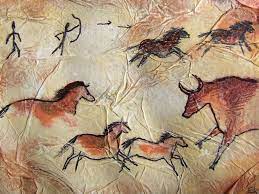
Pre-historic cave painting in France La Tauromaquia. Leap with the Spear by Picasso (1881-1973)Courtesy: Creative Commons
There was a time when there were no boundaries drawn by humans. Our ancestors roamed the Earth like any other fauna — part of nature and the landscape. They tried to explain and appease the changing seasons, the altering landscapes and the elements that affected life and living with rituals that seemed coherent to them. There were probably no major organised structures that laid out rules. From such observances, our festivals evolved to what we celebrate today. These celebrations are not just full of joie de vivre, but also a reminder of our syncretic start that diverged into what currently seems to be irreparable breaches and a lifestyle that is in conflict with the needs of our home planet.
Reflecting on this tradition of syncretism in our folklore and music, while acknowledging the boundaries that wreak havoc, is an essay by Aruna Chakravarti. She expounds on rituals that were developed to appease natural forces spreading diseases and devastation, celebrations that bring joy with harvests and override the narrowness of institutionalised human construct. She concludes with Lalan Fakir’s life as emblematic of the syncretic lore. Lalan, an uneducated man brought to limelight by the Tagore family, swept across religious divides with his immortal lyrics full of wisdom and simplicity. Dyed in similar syncretic lore are the writings of a student and disciple of Tagore from Santiniketan, Syed Mujtaba Ali (1904-1974). His works overriding these artificial constructs have been brought to light, by his translator, former BBC editor, Nazes Afroz. Having translated his earlier book, In a Land Far from Home: A Bengali in Afghanistan, Afroz has now brought to us Syed Mujtaba Ali’s Tales of a Voyager (Jolay Dangay), in which we read of his travels to Egypt almost ninety years ago. In his interview, the translator highlights the current relevance of this remarkable polyglot.
Humming the tunes of Mujtaba Ali’s tutor, Tagore, a translation of Tagore’s song, AmraBeddhechhi Kasher Guchho (We have Tied Bunches of Kash[1]) captures the spirit of autumnal opulence which heralds the advent of Durga Puja. A translation by Fazal Baloch has brought a message of non-violence very aptly in these times from recently deceased eminent Balochi poet, Mubarak Qazi. Professor Fakrul Alam has translated a very contemporary poem by Quazi Johirul Islam on Barnes and Nobles while from Korea, we have a translation of a poem by Ihlwha Choi on the fruit, jujube, which is eaten fresh of the tree in autumn.
A poem which starts with a translation of a Tang dynasty’s poet, Yuan Zhen, inaugurates the first translation we have had from Mandarin — though it’s just two paras by the poet, Rex Tan, who continues writing his response to the Chinese poem in English. Mingling nature and drawing life lessons from it are poems by George Freek,Ryan Quinn Flanagan and Gopal Lahiri. We have poetry which enriches our treasury by its sheer variety from Hawla Riza, Pramod Rastogi, John Zedolik, Avantika Vijay Singh, Tohm Bakelas and more. Michael Burch has brought in a note of festivities with his Halloween poems. And Rhys Hughes has rolled out humour with his observations on the city of Mysore. His column too this time has given us a table and a formula for writing humorous poetry — a tongue-in-cheek piece, just like the book excerpt from The Coffee Rubaiyat. In the original Rubaiyat, Omar Khayyam (1048–1131) had given us wonderful quatrains which Edward Fitzgerald immortalised with his nineteenth century translation from Persian to English and now, Hughes gives us a spoof which would well have you rollicking on the floor, and that too, only because as he tells us he prefers coffee over wine!
Humour tinged with irony is woven into Devraj Singh Kalsi’s narrative on red carpet welcomes in Indian weddings. We have a number of travel stories from Peru to all over the world. Ravi Shankar takes us to Lima and Meredith Stephens to Californian hot springs with photographs and narratives while Sayani De does the same for a Tibetan monastery in Lahaul. Keith Lyons converses with globe trotter Tomaž Serafi, who lives in Ljubljana. And Suzanne Kamata adds colour with a light-veined narrative on robots and baseball in Japan. Syncretic elements are woven by Dr. KPP Nambiar who made the first Japanese-Malyalam Dictionary. He started nearly fifty years ago after finding commonalities between the two cultures dating back to the sixteenth century. Tulip Chowdhury brings in colours of Halloween while discussing ghosts in Bangladesh and America, where she migrated.
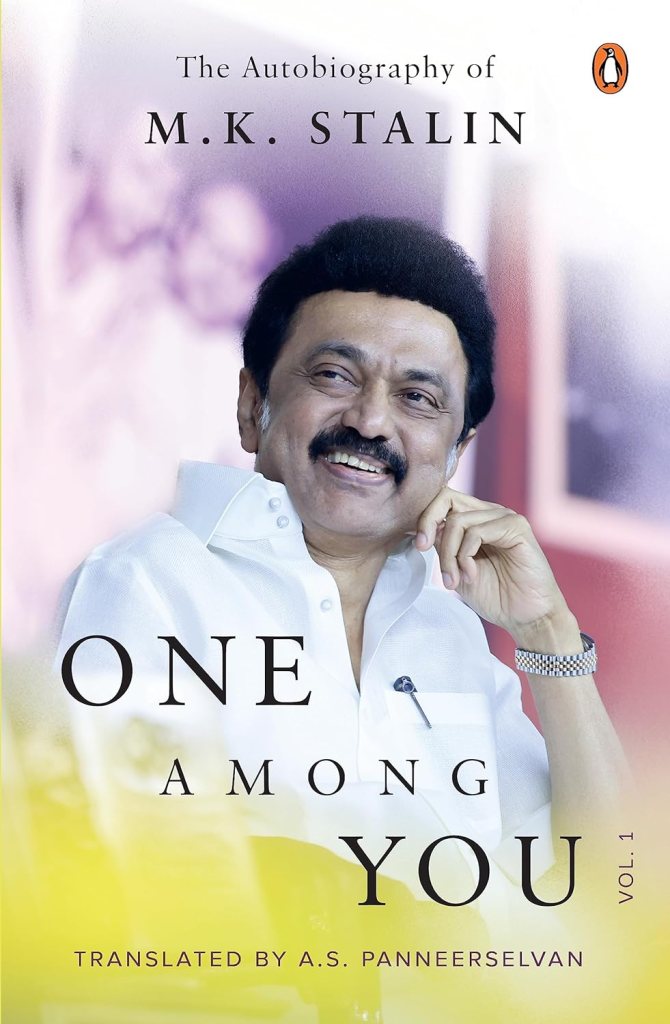
The theme of immigration is taken up by Gemini Wahaaj as she reviews South to South: Writing South Asia in the American South edited by Khem K. Aryal. Japan again comes into focus with Aditi Yadav’s Makoto Shinkai’s and Naruki Nagakawa’s She and Her Cat, translated from Japanese by Ginny Tapley Takemori. Somdatta Mandal has also reviewed a translation by no less than Booker winning Daisy Rockwell, who has translated Usha Priyamvada’sWon’t You Stay, Radhika? from Hindi. Our reviews seem full of translations this time as Bhaskar Parichha comments on One Among You: The Autobiography of M.K. Stalin, the current Chief Minister of Tamil Nadu, translated from Tamil by A S Panneerselvan. In fiction, we have stories that add different flavours from Paul Mirabile, Neera Kashyap, Nirmala Pillai and more.
“One of the children gave it [the bunch of bananas] to the child sitting in front. An emaciated girl and a little boy were seated next to me. I told them to pass on the fruit to everyone in the back and keep one each for themselves. The girl looked curiously at the bunch as she turned it around in her hands. Then she looked at the other children.
“‘I’ve never seen an onion like this one,’ she said.
“Her little companion also touched the fruit gingerly and innocently added, ‘Yes, this is not even a potato.’
“I was speechless to say the least. These children had never seen anything apart from onions and potatoes. They had definitely never chanced upon bananas…”
Heart-wrenching but true! Maybe, we can all do our bit by reaching out to some outside our comfort or social zone to close such alarming gaps… Uma Dasgupta’s book tells us that Tagore had hoped many would start institutions like Sriniketan all over the country to bridge gaps between the underprivileged and the privileged. People like Satyarthi are doing amazing work in today’s context, but more like him are needed in our world.
We have more writings than I could mention here, and each is chosen with much care. Please do pause by our contents page and take a look. Much effort has gone into creating a space for you to relish different perspectives that congeal in our journal, a space for all of you. For this, we have the team at Borderlessto thank– without their participation, the journal would not be as it is. Sohana Manzoor with her vibrant artwork gives the finishing touch to each of our monthly issues. And lastly, I cannot but express my gratefulness to our contributors and readers for continuing to be with us through our journey. Heartfelt thanks to all of you.
Title: One Among You: The Autobiography of M.K. Stalin
Translator: A S Panneerselvan
Publisher: Penguin Viking
Muthuvel Karunanidhi, or MK Stalin, is a prominent politician in India. A member of the Dravida Munnetra Kazhagam (DMK) party, he is the son of former Chief Minister of Tamil Nadu, M. Karunanidhi. In Tamil Nadu’s political landscape, Stalin has emerged as a key figure in politics for several decades. In 1966, M.K. Stalin began his political innings by launching the Gopalapuram Youth Dravida Munnetra Kazhagam. Over the next five decades, his political career would see him rise to become Mayor of Chennai in 1996. Stalin began his political career in the 1980s when he was elected to the Tamil Nadu Legislative Assembly. He has held various positions within the DMK party over the years, including Treasurer and Deputy General Secretary. He was appointed Minister for Rural Development and Local Administration in Tamil Nadu in 2011. He would also become the President of the Dravida Munnetra Kazhagam (DMK) in 2018 and the Chief Minister of Tamil Nadu in 2021.
DMK has seen significant growth and success in Tamil Nadu under Stalin’s leadership. His efforts have contributed to the implementation of various welfare schemes and development projects aimed at improving the quality of life for the people of the state. With his emphasis on social justice, inclusive growth, and empowering marginalized communities, he has gained a wide following and support among the general public.
Stalin’s leadership style is characterised by his ability to reach out to the people and address their concerns. His communication skills and ability to mobilise party members are well-known. The DMK’s success in state elections has been attributed to his strategic decision-making and political acumen. Aside from his political career, Stalin has also been recognised for his commitment to public service. Throughout his career, he has been actively involved in a number of social initiatives, including education, healthcare, and environmental conservation. Recognition and appreciation have been given for his efforts to improve education and healthcare facilities in Tamil Nadu.
One Among You, a translation of Stalin’s Tamil autobiography, Ungalil Oruvan, is the story of the first twenty-three years of his life, from 1953 to 1976. These formative years witnessed Stalin’s school and college days, his early involvement with the DMK and his integral role in the party publication, Murasoli. But Stalin’s journey extends beyond politics. He also had a profound connection to the world of theatre and cinema, where his passion for art intersected with his pursuit of social change.
Translator A.S. Panneerselvan is head of the Centre for Study in the Public Sphere at Roja Muthiah Research Library, Chennai. For nearly a decade, he was The Hindu‘s Readers’ Editor (an independent internal news ombudsman). Panneerselvan is also an adjunct faculty member at the Asian College of Journalism, Chennai. His book, Karunanidhi: A Life, was published by Penguin Random House in 2021.
The first volume of this book describes some of the pivotal events in Stalin’s initial twenty-three years of life, events that have significantly contributed to his current role as Chief Minister of Tamil Nadu, a topic to be explored in later volumes of the autobiography.
The autobiography begins with a declaration, ‘I was born as a son of a leader’, underscoring his father’s profound influence in his life. M. Karunanidhi popularly known as ‘Kalaignar’ (great scholar) served as CM for almost two decades, making him a major source of inspiration for Stalin. His name ‘Stalin,’ meaning ‘man of steel,’ was bestowed upon him by his father. His father drew inspiration from Joseph Stalin’s influential leadership in shaping the Soviet Union. Further, the book delves into the impactful role played by his grandmother, mother, former Chief Ministers C. N. Annadurai and MGR, and others.
Central to the book is the assertion that politics was Stalin’s destiny, his calling to leadership from the outset. Even in his early years, he actively participated in party activities, immersing himself in every facet. He contributed significantly to his father’s publication, Murasoli, engaged in theatrical performances at party gatherings, organised fundraising efforts, and even faced imprisonment, all while steadfastly pursuing his studies. In his own words, “I had fully surrendered myself as a flame to the party,” a testament to his deep-seated dedication to politics.
The title — One Among You — reflects Stalin’s relatability and ordinary life. He championed his state and party, always connected to the people. He stood as a fellow citizen, demonstrating he was no different from others.
Stalin’s life is meticulously examined in this book, which explains how he became a leader by highlighting the essential facets of his life. It provides a comprehensive overview of his life’s journey. Throughout the narrative, the author maintains a consistent tone and uses clear language. A number of characters who contributed to the shaping of Stalin’s trajectory are depicted in these pages. Portraits, both of Stalin and those intertwined with his narrative; provide further evidence of that era’s atmosphere.
An interesting read.
.
Bhaskar Parichha is a journalist and author of Unbiased, No Strings Attached: Writings on Odisha and Biju Patnaik – A Political Biography. He lives in Bhubaneswar and writes bilingually. Besides writing for newspapers, he also reviews books on various media platforms.
.
PLEASE NOTE: ARTICLES CAN ONLY BE REPRODUCED IN OTHER SITES WITH DUE ACKNOWLEDGEMENT TO BORDERLESS JOURNAL
Can anyone say for sure, when Japan and Kerala or, for that matter, Japanese and Malayalam languages, came into contact for the first time? No, it is all buried in the chronicles of yore! This is so, in spite of the legendary Bodhidharma travelling from somewhere in the South-West part of India (Kerala?) to China on its way to Japan in AD 520, albeit still disputed!
With the arrival of the Portuguese in Southern Japan from Cochin(?) during AD 1543, there was obviously a possibility of Malayalee priests or laymen including ‘horse trainers’ and cooks, reaching Japan along with Portuguese navigators. But records of such visits are yet to be made public, being either in Portuguese, Chinese or Japanese archives.
However, according to Takako Mulloor, a daughter-in-law from Japan living in Kerala for the past half a century, such obscurities need not always be the case. She remembers the story of four Japanese youths who happened to visit Quilon and from there to North Kerala, sometime during the reign of Ōtomo Sōrin (1530-1587).
Sorin was one of the few feudal lords of Japan (Daimyo), to embrace Catholicism under the influence of Portuguese missionaries. Originally known as ‘Fujiwara-no-Yoshishige’, he was very powerful at the time, ruling most of Japan. Apparently, he thought it apt to ascertain the ‘truth’ behind the new religion that was spreading fast in his domain. Thus, he is said to have deputed four Japanese youths to Rome and Europe – a new world — to meet the Holy Pope and report back to him.
These youths, after completing their mission successfully, landed in Quilon, on their return voyage. Quilon was a flourishing port of that period. Due to some unknown reasons, they proceeded further north towards Cochin by local crafts, called ‘Kettuvalloms’. Unfortunately, one of them caught malaria and died somewhere on the way and was buried.
According to personal communication from Takako, such records are available with the NHK ( Nippon Hōsō Kyōkai) Brodcasting Corporation of Japan. She remembered that a TV team from NHK had visited Kerala sometime in 1979-80, to make a documentary on these youths and to locate the grave of the one who had lost his life. Takako was their interpreter on this mission, being fluent in Malayalam, Japanese and English.
While I was in Japan from 1965 to 1969, very little information was available in Kerala about Japan. Prior to leaving India, except for some writings by the renowned author MT Vasudevan Nair, the knowledge of Japanese language or culture was scanty.
On joining Osaka University of Foreign Languages (Ōsaka Gaidai), I was fascinated by the general manners of people in and out of the university. They were always kind, polite and willing to help especially students and others from abroad.
Despite having an advanced ‘Language Laboratory’ and excellent faculty, my language proficiency was mostly strengthened by the people on the street or in the villages of the Osaka suburbs. From the very beginning, I was also struck with an inexplicable quality in their language, with its unaccented delivery and melodious intonations that always reminded me nostalgically, of Malayalam!
Amazingly, both these languages were similar in several respects such as the order of alphabets, vowels and structure of sentences that usually didn’t end in a consonant.
We foreign students had to learn some special topics namely ‘Things Japanese’ that included Flower arrangement (Ikebana); Japanese theatre traditions Kabuki, Bunraku and the oral Rakugo and so on. In general, most of them including folk arts, proverbs, and day to day practices, reminded me of the village life in Kerala.
For instance, ‘banishing’ evil spirits from home was just the same as practiced in villages here. Above all, I could also recognise a few Japanese words more or less similar in meaning and pronunciation, synonymous with Malayalam!
That was when the idea of a Japanese-Malayalam Dictionary germinated in me. But, back in Tokyo University after completing six months’ language course, my attention was mainly focused on research, to earn a doctorate. Still, I was able to hone my Japanese speaking skills by constant interaction with the local people who were always enthusiastic about teaching foreigners, their language.
During the second year in Tokyo, unexpectedly one day, the Indian Embassy in Tokyo called me to enquire if I could teach a few senior Japanese government officials, Malayalam.
Didactic skill being not my forte with Malayalam, my first response was a polite ‘no’, despite the attractive remuneration offered. But the potential pupils would not be dissuaded. Thus started my part-time job as ‘Malayalam Teacher’, in Tokyo. Nearly three years of teaching came to an end on my completing my doctoral research, so as to return home.
Contacts with my erstwhile students were soon reduced to almost nil. One exception was an exchange of communication with a Shyoichi Itoh, who retained his interest in Malayalam as also Kerala. Occasionally, he used to write to me in Malayalam to my great delight, for comments and correction. He had also written some articles on Kerala in Japanese journals, on topics of interest to Japanese readers, based on his experience.
The unique Writers’ Co-operative of Kerala (SPCS) was one of such topics covered. Similarly, at my request and as suggested by the editor M T Vasudevan Nair, he wrote an article for the Malayalam weekly, Mathrubhoomi, focusing on the ritual suicide of the famous Japanese writer Yukio Mishima, in 1970. He had also written a guide book for Japanese students interested in learning Malayalam entitled ‘Malayalam for Beginners’.
Subsequently in 1974, Itoh made a surprise visit to me in Poona where I was working at the time. In fact, he came with the happy news of joining The Tokyo University of Foreign Studies (TUFS) as Professor and Head of the Department of Malayalam. That was a deserving recognition of his dedication to the study of Malayalam. His Malayalam for Beginners is still in use in the University and elsewhere.
My last meeting with Prof. Itoh was during early 1982, when he visited my official residence in Tokyo, with his dear daughter. At that time, I was on a government of India assignment (1981-’85), renewing old contacts as well.
Sadly, Prof. Itoh passed away rather prematurely, in 1998.
After taking superannuation from my employer — an international organisation at that time – at the beginning of the current millennium, I settled down in Cochin, India. Still, the dictionary dream was alive and efforts for bringing Japanese and Malayalam closer, was always a passion!
During the early nineties, despite being immersed in professional activities, I had undertaken the translation of Nobel Laureate Yasunari Kawabata’s [1]novel, Yama no Oto or ‘Sound of the Mountain’ (1971) directly from Japanese to Malayalam as Malayute Shabdam.
Published by Current Books (Trissur) in 1994, the translation was well received by Malayalee readers, resulting in more editions. Considering the fact that such translations are usually based on the English version due to language constrains, my work, directly from the original Japanese, is thought to be the first of its kind, in Malayalam.
However, the dictionary project could not be taken up immediately even after retirement, due to personal preoccupations. Ultimately, work on this long-awaited project was started in 2002, two years after retirement, in right earnest.
An old dictionary of Japanese-English-Japanese format, brought along from my ‘student’ days in Osaka was used as the first reference source. Published in 1950 by the Obunsha Company of Tokyo, it was the only one available for me at that juncture.
Following untiring work, the first draft was ready in two years. It was prepared in the Japanese-English-Malayalam format covering some 2000 foolscap pages and nearly a hundred thousand head-words. The meaning of each word and phrase was given in English and Malayalam with Japanese pronunciation in Malayalam fonts. The entire manuscript was compiled in long hand, without using a typewriter or computer!
Thereafter, attempts to get a competent publisher in Kerala was futile mainly due to the non-availability of Japanese fonts for printing. As a final solution, it was felt necessary to obtain fonts from Japan. However, the impasse was broken finally when my old friend and great historian Prof (Dr.) M.G.S. Narayanan introduced Toshie Awaya, a faculty member of the TUFS, as a conduit for assistance from that university.
While discussing various possibilities with Awaya, it was a pleasant surprise to know that late Prof. Itoh, my ‘old student’, used to be her Malayalam Professor!
Subsequently, on visiting Japan with my wife, a meeting was arranged with the late Indologist and renowned historian, Prof. Noboru Karashima, whom I knew during Tokyo University days. He was living in Kamakura, and Awaye took us to his very impressive residence for discussion.
On that occasion, as he suggested, it was decided we meet Prof. Jun Takashima and Prof. Makoto Minegishi engaged in dictionary-related research, in TUFS. They were attached to the Institute of Languages and Cultures of Asia and Africa (ILCAA). Established in 1964 within TUFS, this institute was engaged in promoting academic exchanges between Japan and other Asian-African nations, having been recognised as competent to carry out that task.
The two Professors during a meeting that ensued in the Institute, were amazed to see the sample manuscript of the dictionary that was shown to them. Firstly, use of ‘long hand’ instead of typing or computer printing, seemed out of this world to them.
Another fact, of more importance, was that the dictionary used as reference source material was outdated. It was pointed out that in view of the fast-evolving nature of languages with the addition of new words incessantly, the earlier work had become redundant.
While agreeing to discard the manuscript, we decided to start afresh using a latest dictionary as source to digitalise the new version with the help of a software developed by Prof. Takashima! It was also agreed that the manuscript thus produced with my data would be arranged in a ‘camera-ready’ copy at the ILCAA, that could be suitably published in Kerala.
After several exchanges of visits from India to Japan and Japan to India followed by umpteen number of corrections and revisions, the promised ‘final’ product was ready by the end of 2018.
Then, it was a matter of finding a qualified publisher. The Kerala State Institute of Languages, Thiruvananthapuram, that readily agreed, was found to be the most appropriate one to accomplish that task, in an excellent manner.
The formal release of the beautifully printed and bound Japanese-Malayalam Dictionary of some 1500 pages was formally carried out in the presence of the ILCAA Professors, by Kerala State Cultural Minister A.K. Balan. Hideki Asari, Minister and Dy. Chief of Mission, Japanese Embassy, New Delhi and several other dignitaries were present on the occasion in Thiruvananthapuram on March 8, 2019.
With such a happy finale of a hard work put in during some sixteen years of my post-retirement years, the dictionary may represent a milestone in the annals of Japanese-Malayalam affinities.
During the half a century that elapsed from the time of my first landing in Japan and the release of the dictionary, major changes are manifested in the ethos of Japan-Kerala interactions. Exchange of visits by artists, academics, writers and common people, resulted in the publication of several travelogues, translations, studies, and so forth enabling people of these two parts of the world to come closer, as I dreamt in the 1960s.
Several literary works from Japanese were translated into Malayalam by eminent writers from Kerala including M.K. Menon (Vilasini), K. Kunhikrishnan and others! General studies were also published about Japan, in Malayalam. An in-depth study of Kerala-Japan cultural relations is available in the remarkable book, ‘The Throne of Chrysanthemums’ by the gifted writer and artist, K. Asok Kumar.
In addition to such developments, many professionals from Kerala are now finding gainful employment in Japan, something unheard of a few years back.
In conclusion, it has to be emphasised that the age-old affinity between Japanese and Malayalam needs to be studied afresh by our linguists and historians, in the light of significant evidence emerging from various new studies.
When Rev.(Dr.) Robert Caldwell (1814-1891) postulated the theory of possible origin of Japanese and Tamil languages from the same root, there was no mention of Malayalam, in particular. So also Japanese professors – Akira Fujiwara (1981) and Susumu Ohno (2007) — who revived that hypothesis recently, were also not referring to the Malayalam connection.
Meanwhile, some of our erudite linguists such as Prof. Naduvattom Gopala Krishnan, were able to prove the ancient origin of Malayalam, from the same root as modern Tamil, proving eligibility of both these languages to be included in the ‘Classical Languages’ category, already accepted officially.
According to Prof Gopala Krishnan, the very fact that some ‘Malayalam only’ words were identified in ‘Sangam Literature’ of 300 BCE- 300 ACE, reaffirms its classical position. Even epigraphical evidence from the Edakkal Caves of Wayanad (Malabar), that go back to 6000 BCE, are said to be supportive of ancient origin of Malayalam, together with Tamil.
As such, there is an urgent need for a relook into our perspective of the gamut of Japanese-Malayalam affinities!
[1] Yasunari Kawabata (1899-1972) was the first Japanese to win a Nobel prize in 1968
Dr. KPP Nambiar, formerly a Consultant/Technocrat at the UN Food and Agriculture Organisation, is the author of many scientific papers and books, including a 1500-page Japanese-Malayalam dictionary.
PLEASE NOTE: ARTICLES CAN ONLY BE REPRODUCED IN OTHER SITES WITH DUE ACKNOWLEDGEMENT TO BORDERLESS JOURNAL.
Vincent Van Gogh written is different scripts. Courtesy:Creative Commons
The whole world opens up in the realm of ideas that have existed wafting and bridging across time and space. Sometimes they find conduits to come to the fore, even though they find expression in different languages, under varied cultural milieus. One way of connecting these ideas is to translate them into a single language. And that is what many have started to do. Celebrating writers and translators who have connected us with these ideas across boundaries of time and place, we bring to you translated writings in English from twenty eight languages on the International Translation Day, from some of the most iconic thinkers as well as from contemporary voices.
Prose
Tagore’s short story, Aparichita, has been translated from Bengali as The Stranger by Aruna Chakravarti. Click hereto read.
Nadir Ali’s The Kabbadi Player has been translated from Punjabi by Amna Ali. Click here to read.
Kamaleswar Barua’s Uehara by has been translated from Assamese and introduced by Bikash K. Bhattacharya. Click here to read.
S Ramakrishnan’s Muhammad Ali’s Singnature has been S. Ramakrishnan, translated from Tamil by Dr B. Chandramouli. Click here to read.
PF Mathews’Mercy, has been translated from Malayalam by Ram Anantharaman. Click here to read.
Road to Nowhere, an unusual story about a man who heads for suicide, translated from Odiya by the author, Satya Misra. Click here to read.
An excerpt from A Handful of Sesame by Shrinivas Vaidya, translated from Kannada by Maithreyi Karnoor. Click hereto read.
Writings from Pandies’ Cornerhighlight the ongoing struggle against debilitating rigid boundaries drawn by societal norms. Each piece is written in Hindustani and then translated by a volunteer from Pandies’ in English. Clickhere to read.
Rakhamaninov’s Sonata, a short story by Sherzod Artikov, translated from Uzbeki by Nigora Mukhammad. Click hereto read.
Of Days and Seasons, a parable by the eminent Dutch writer, Louis Couperus (1863-1923), translated by Chaitali Sengupta. Click here to read.
The Faithful Wife, a folktale translated from Balochi by Fazal Baloch. Click hereto read.
An excerpt from Ramy Al-Asheq’sEver Since I Did Not Die, translated from Arabic by Isis Nusair, edited by Levi Thompson. The author was born in a refugee camp. Click here to read.
Poetry
Two songs byTagore written originally in Brajabuli, a literary language developed essentially for poetry in the sixteenth century, has been translated by Radha Chakravarty. Click here to read.
Rebel or ‘Bidrohi’, Nazrul’s signature poem, ‘Bidrohi‘, translated from Bengali by Professor Fakrul Alam. Click here to read.
Banlata Sen, Jibananada Das’s iconic poem, translated from Bengali by Professor Fakrul Alam. Click here to read.