Meenakshi Malhotra writes of the diverse ways histories can be viewed, reflecting on the perspective from the point of view of water, climate, migrations or women. Click here to read.
Sometimes, we have an idea, a thought and then it takes form and becomes a reality. That is how the Borderless Journal came to be six years ago while the pandemic raged. The pandemic got over and takeovers and wars started. We continued to exist because all of you continue to pitch in, ignoring the differences created by certain human constructs. We meet with the commonality of felt emotions and aesthetics to create a space for all those who believe in looking beyond margins. We try to erase margins or borders that lead to hatred, anger, violence and war. Learning from the natural world, we believe we can be like the colours of the rainbow that seem to grow out of each other or the grass that is allowed to grow freely beyond manmade borders. If nature gives us lessons through its processes, is it not to our advantage to conserve what nurtures us, and in the process, we save our home planet, the Earth? We could all be together in peace, enjoying nature and nurture, living in harmony in the Universe if only we could overlook differences and revel in similarities.
A young poet Nma Dhahir says it all in her poem that is a part of our journal this month —
This is how we stay human together: by refusing the easy damage, by carrying each other without calling it sacrifice, by believing that what we protect in one another eventually protects the world.
Translations has more poetry with Professor Fakrul Alam bringing us Nazrul’s Bengali lyrics in English and Fazal Baloch familiarising us with beautiful Balochi poetry of the late Majeed Ajez, a young poet who left us too soon. Isa Kamari translates his own poems from Malay, capturing the colours of the community in Singapore to blend it with a larger whole. And of course, we have a Tagore poem rendered into English from Bengali. This time it’s a poem called ‘Jatra (Journey)’ which reflects not only on social gaps but also on politics through aeons.
Christine C Fair has translated a story from Punjabi by Lakhvinder Virk, a story that reflects resilience in women who face the dark end of social trends, a theme that reverberates in Flanagan’s poetry and Meenakshi Malhotra’s essay, which while reflecting on the need of different perspectives in histories – like water and nomads — peeks into the need to recall women’s history aswell. This is important not just because March hosts the International Women’s Day (IWD) but because one wonders if women in Afghanistan are better off now than the suffragettes who initiated the idea of such a day more than a century ago?
This time our non-fiction froths over with scrumptious writings from across continents. Tamara-Lee Brereton-Karabetsos muses on looking at numbers and beyond to enjoy the essence of nature. Farouk Gulsara ideates about living on in posterity through deeds and ideas. Gower Bhat shares how he learns story writing skills from watching movies. Meredith Stephens talks of her experience of a fire in the Australian summer. Bhaskar Parichha writes with passion about his region, Odisha. We have a heartfelt tribute to Mark Tully, who transcended borders, from Bhowmick. And an essay on Arundhati Roy’s memoir, Mother Mary Comes to Me, from Somdatta Mandal, which explores not just the book but also the covers which change with continents. Prithvijeet Sinha travels beyond Lucknow and Suzanne Kamata brings to us stories about her trip to Phnom Penh.
Keith Lyons draws from the current crises and writes about changing times, suggesting: “Changes aren’t endings, but thresholds.” Perhaps, if we see them as ‘thresholds of change’, the current events are emphasising the need to accept that human constructs can be redefined. I am sure a Neolithic or an Australopithecus would have been equally scared of evolving out of their system to one we would deem ‘superior’. Life in certain ways can only evolve towards the future, even if currently certain changes seem to be retrogressive. We can never correctly predict the future… but can only imagine it. And Devraj Singh Kalsi imagines it with a dollop of humour where tails become a trend among humans again!
Humour and absurdity are woven into a series of short fables by Hughes while Naramsetti Umamaheswarao weaves a fable around acceptanceof differences. In fiction, we have stories of resilience from Jonathon B Ferrini and Terry Sanville. Bhat gives us a story set in Kashmir and Sohana Manzoor gives us one set in Dhaka, a narrative that reminds one of Jane Austen… and perhaps even an abbreviated version of the 2001 film, Monsoon Wedding.
In reviews we have, Mohammad Asim Siddiqui discussing Anisur Rahman’s The Essential Ghalib. Rituparna Khan has written on Malashri Lal’s poetry collection reflecting on women, Signing in the Air. And Bhaskar Parichha has reviewed Deepta Roy Chakraverti’s Daktarin Jamini Sen: The Life of British India’s First Woman Doctor, a book that reflects on the resilience that makes great women. Thus, weaving in flavours of the IWD, which applauds women who are resilient while urging humans for equal rights for one half of the world population.
While we ponder on larger realities, Borderless Journal looks forward to a future with more writings centred around humanity, climate change, our planet and all creatures great and small. This year has not only seen a rise in readership and contributors — and the numbers rose further after our unsolicited Duotrope listing in October 2025 — but has also attracted writers from more challenged parts of the world, like Ukraine, Iran, Tunisia and Kurdistan. We are delighted to home writing from all those who attempt to transcend borders and be a part of the larger race of humanity. I would like to quote Margaret Atwood to explain what I mean. “I hope that people will finally come to realize that there is only one ‘race’—the human race—and that we are all members of it.” And I would like to extend her view to find solidarity with all living beings. I hope that there will be a point in time when we will realise there’s not much difference between, a lizard, a fly, a human or a tree… All these lifeforms are necessary for our existence.
I would want to hugely thank all our team for stretching out and making this a special issue for our sixth anniversary and Manzoor for her fabulous artwork. Huge thanks to all our contributors and readers for being with us through our journey. Let’s change the world with peace, love and friendship!
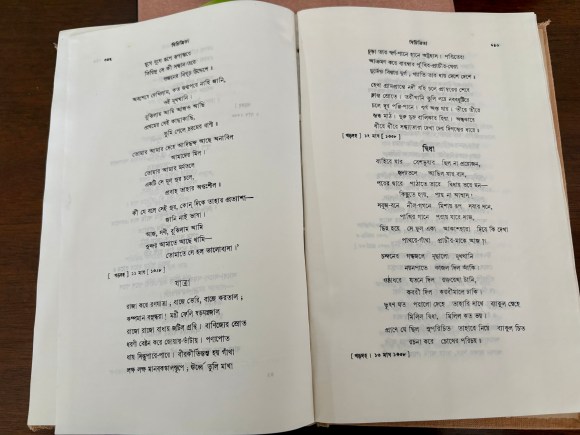
Written in 1932 by RabindranathTagore, Jatra (Journey) is a part of Rabindra Rachnabali (Writings of Ranbindranath) and Sanchayita (Compilation — in this case of poems).
The poem, Jatra (Journey) in Sanchayita
                JOURNEY

The emperor journeys to battle. The earth trembles
With the clash of drums and cymbals. The minister
Conspires, spreads web of deceit through realms.
Trading streams encircle the world with ebb and flow.
Cargo ships travel to distant shores. Monuments of
Heroism grow out of piles of human skeletons raising
Their heads heavenward to laugh with disregard.
The learned repeatedly attack impenetrable fortresses
Of knowledge, walled by books. The king’s fame spreads far and wide.

Here, in the village, the river flows sluggishly
In the distance. The ferry picks up the new bride
Sailing to a far colony. The sun sets. The shores
Are lined with silent fields. The girl’s heart shivers.
In the darkness, slowly, the evening star rises on the horizon.
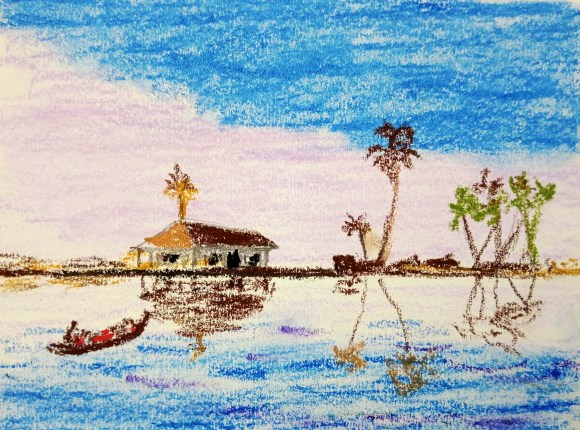
Art by Sohana Manzoor
.
This poem has been translated from Bengali by Mitali Chakravarty with editorial input by Sohana Manzoor
.
PLEASE NOTE: ARTICLES CAN ONLY BE REPRODUCED IN OTHER SITES WITH DUE ACKNOWLEDGEMENT TO BORDERLESS JOURNAL
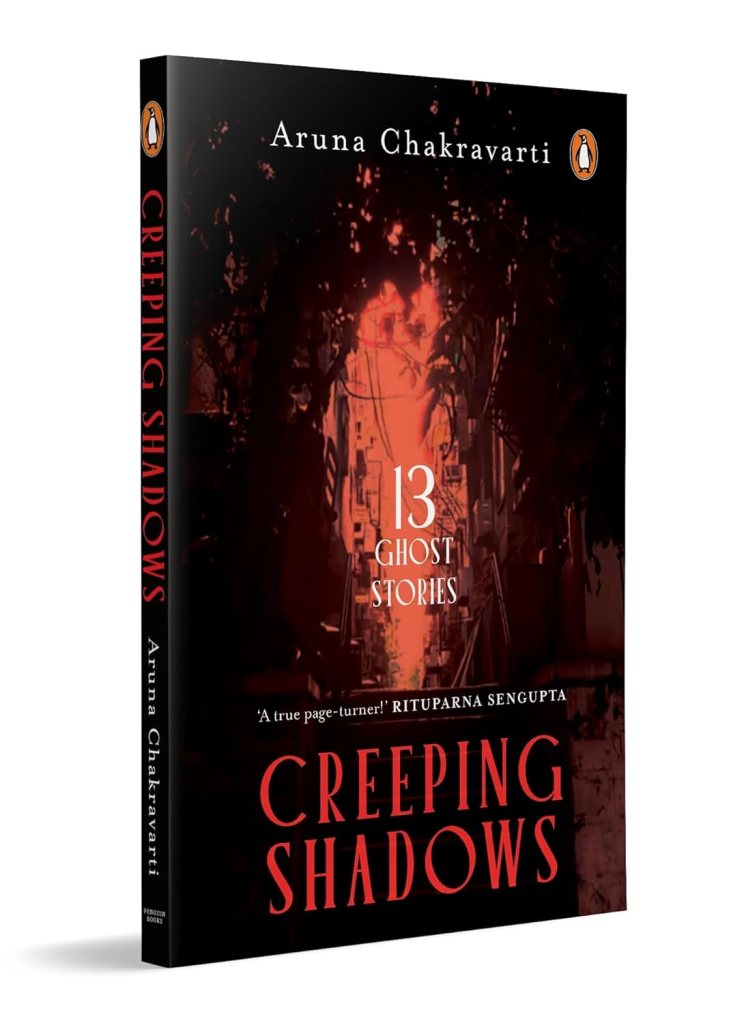
An introduction to Aruna Chakravarti’s Creeping Shadows: 13 Ghost Stories, published by Penguin India, along with a discussion with the author.
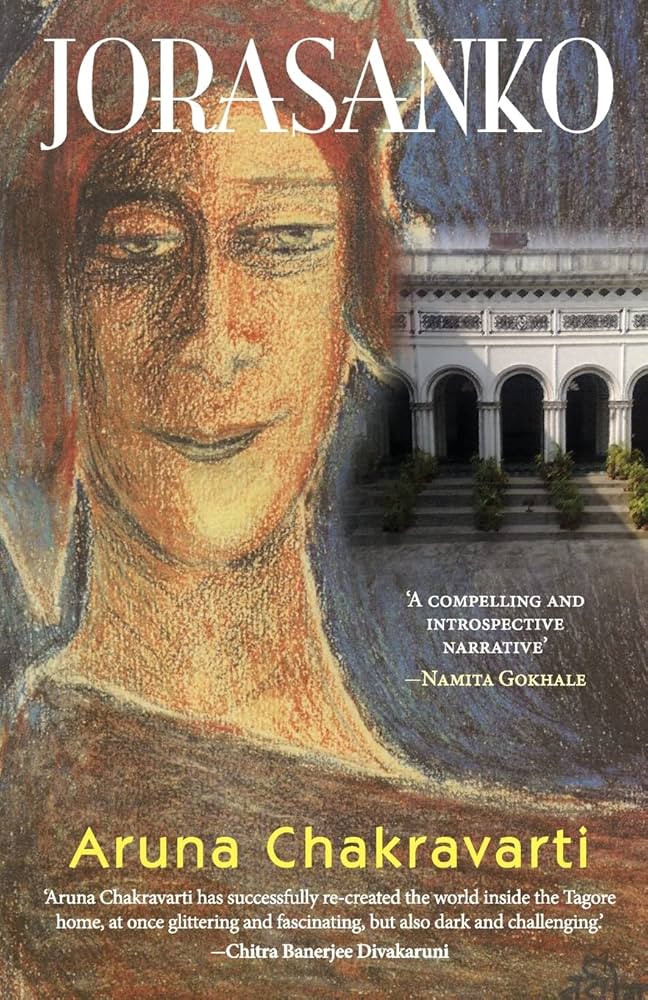
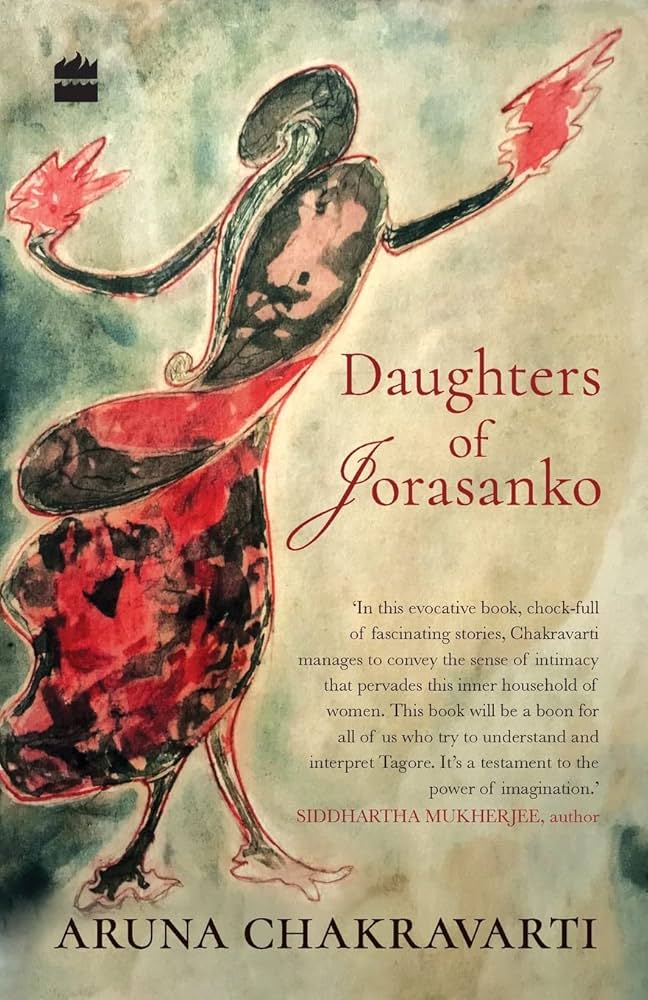
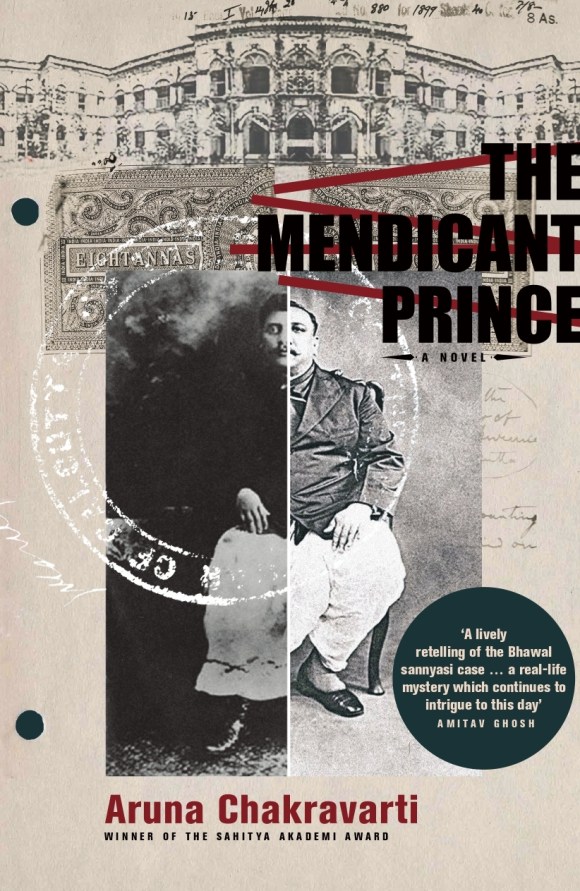
Ghosts are evocative of a past… of history one could say. Then who could be a better storyteller of the past than an author steeped in colours of historical fiction — Aruna Chakravarti! In the past she not only translated novels set in colonial India but evoked the Bengal Renaissance to perfection in her two Jorasanko novels and details of a court hearing in her retelling of the Bhawal prince! This time the diva of historical fiction brings to us a book of spine chilling, ghost stories, Creeping Shadows: 13 Ghost Stories. It is her third collection of short stories.
Aruna ChakravartiPublished in 2026
The narratives are so vivid and visual that they could be worthy of being made into films. They are distinctive in that she has mostly created her own very horrific ghouls – not the traditional ones. They pop up and frighten the reader with their bizarreness and terrifying presences which linger even when you try to sleep at night! She has given us thirteen stories — a spooky number in itself — spread across multiple communities in Asia.
Some of the narratives evoke the past, starting from the 1800s. ‘The House of Flowers’ is set in China partly and partly in Kolkata, where there is now a thriving Chinatown known as “Tangra” and a Kali temple that serves ‘noodles’ as its prasad or offering. The story has echoes of Pearl S Buck’s China interestingly. What was a surprise was the fluency with which she wove in the influences that impact a community of migrants!
Chakravarti has used her skills as a writer of historical fiction in some of the stories like, ‘The Road to Karimganj’, in which a spook takes us back to undivided Bengal, when passports were not needed as in the story of the migrant Chinese. Hovering around history are more narratives like ‘Possessed’, where a courtesan who performs with the legendary Girish Ghosh1 of the nineteenth century Kolkata undergoes, along with the audience, a strange spooky experience!
Traveling down the century, closer to our times, is the story that is perhaps one of the most bizarre and yet most relatable, ‘The Necklace’. Set in the Anglo-Indian community and the glamour of Park Street — where Wiccan writer, Rajorshi Patranabis, claimed to have met a colonial ghost awaiting her lover — Chakravarti’s narrative is of black magic and betrayal. The fiction is far more impactful and frightening than the factual narrative, which too was spine chilling! You realise what makes fiction so much more gripping than facts — anything can happen in fiction. Chakravarti is imaginative enough to make it as creepy and shadowy as any regular horror writer!
Holding on to that thought, the author holds the key to our experiences as she skillfully outlines two demons grown out of poverty in ‘A Winter Night’. The conclusion has a sense of irony and tragedy. ‘Truth is stranger than Fiction’ weaves in more of the diversity in the historic annals of Bengal. The story that starts the book, ‘The Caregivers of Gazipur’, has an unresolved ending, like some of her other narratives. Though there is a frightful resolution in ‘They Come Out After Dark’. The ghosts play spine chilling havoc with fears of the living while recalling the senseless violence of 1947. ‘There are More Things in Heaven and Earth’…takes us back to the atrocities committed during the Sikh riots of 1984 in Delhi. The mingling of fact and fiction to create weird a fantastical narrative is addressed during a conversation on the supernatural. And there is an exploration of the lines from Shakespeare’s Hamlet, which probably is a touch of the academic as Chakravarti had a long tenure as the principal of a girl’s college in Delhi. It also defines the authorial stance in this story:
‘Don’t forget what Hamlet said to Horatio? There are more things in heaven and earth, Horatio, than are dreamt of in your philosophy.’
What is unusual about these stories is the way she has created fictitious geographies and personas, evoking historic realities. They seem perfectly authentic to the reader, including the one set in China. There is a vast mingling of facts and fiction in these stories all to lead to spine-chilling ends with strange twists.
‘Grandmother’s Bundle’ stands out in its rendition as the ghosts given out are part of the mythical lore of Bengal — stories that were related to most Bengali kids of the twentieth century. They have a touch of humour and dry wit, perhaps introducing a sense of comic relief among very dark and horrific stories that transport us into different worlds.
‘The Motorcycle Rider’, set in modern times, takes us into a university campus to shock us with horrific spooks born out of tragic deaths, while ‘Twenty-nine Years, Seven Months and Eleven Days’, merges a modern outlook with an unfathomable past, touching upon strange tantric yearnings. ‘Vendetta’ twirls nature and supernatural to give a frightening narrative of how nature takes its revenge… a theme that reiterates in writings addressing our current concerns with climate change.
The ease and fluidity with which she has switched from history and realism to horror and fantasy is amazing. Let’s find out more from her about this new persona that inhabits her writerly self…
Till now we have had translations, numerous novels—many of which can be called historical fiction—and realistic short stories with their base in history or contemporary life. What made you think of writing ghost stories?
After writing The Mendicant Prince which involved extensive research into the life and times of Prince Ramendranarayan Roy of Bhawal, I didn’t feel up to writing a historical novel again. The work had demanded delving into sociological texts, court records, letters, insurance papers and medical reports. Apart from research, historical fiction also demands a certain amount of field work.
Published in 2013Published in 2016
Before writing the Jorasanko novels I visited the Tagore mansion thrice and while writing The Mendicant Prince, I went to Bangladesh to see the royal palace in Bhawal, renamed Gazipur. Though it has been totally neglected, with shopkeepers and squatters having overtaken most of the area, I was able to get some idea of the topography of the palace and its grounds. I saw the lake and the temple (which was locked) and was able to visualise where the halls and galleries and the apartments of the queens and princesses would have stood. All this work was exhausting. So, for a change, I decided to try my hand at short stories which emerge straight from the imagination. And while at it, I decided to break out of the mould of “historical fiction” writer in which I had trapped myself and try a completely new genre.
Published in 2022
I wrote the first one on an impulse and found myself quite enjoying the process. I didn’t even think of publishing at that time. The first story led to another and another. When eleven stories had been written I sent the manuscript to three publishers and was surprised when all three accepted it. It was then that I found out that ghost stories were the in-thing. That they were selling well and that publishers were looking out for them. I signed up with Penguin as you know. At one point my editor Moutushi Mukherjee suggested I write another two. Thirteen stories will make it even more spooky, she said. So, I wrote another two.
Would you list these stories as fantasies or fantastical? Or are they stories of personal experience? Please elaborate.
No. They are not born out personal experience. I must confess that I have never seen a ghost in my life. I believe in sixth sense. As a matter of fact, I have acted on my sixth sense on occasions. I have had sudden impulses to do certain things and realised later that if I hadn’t yielded to the impulses, I would have regretted it. But I have had no brush with the supernatural. These stories were sparked off by sudden memories. Something I had read somewhere. Something somebody had told me years ago. A face I had seen in childhood which had stuck in my mind though whose I don’t remember. A conversation overheard which made no sense at the time but which, as an adult, seemed ridden with sinister nuances. A phrase from a book whose title and author’s name I had forgotten. In fact, I didn’t even remember the context from where the phrase had come.
Sudden flashes such as these triggered off the stories. But in the writing, they took on a life and soul of their own. I even feel, sometimes, that the pen took over and they were written by an invisible hand.
Your stories are set, sometimes in real landscapes and sometimes in fictional ones. What kind of research went into creating them? How do you make them so vivid and real?
There wasn’t any immediate research. I needed to look up a few facts, now and then, mostly to be sure of their authenticity. But nothing truly back breaking. The landscapes, both physical and of the mind, were culled from my travels and my reading of both English and Bengali writers over the eight decades of my life. Much of it stayed with me tucked away in some unconscious part of the mind. Although I write in English, you will notice that almost all the stories are about Bengalis. Bengalis living in Delhi, Kolkata, Bihar and the small towns and villages of Bengal. There are Anglo-Indians, Punjabis and Chinese, too among my characters. But having lived in Bengal for generations, they have adopted Bengali customs and a quasi-Bengali way of living. Many of the locales in which, they appear are fictional…gathered from my reading and observation of people from different strands of Bengali life.
You have a story set in China which also has the Chinatown of Kolkata in it. Have you been to China? What was the reason for the choice? Were you influenced by any Chinese writers? How did you visualise the Chinese migrants in Kolkata?
Yes, I have been to China. I visited the cities of Guangzhou, Shanghai and Beijing in 2004. Naturally, I have no personal experience of life as it was lived in the late 18th century which is the period covered in the story ‘The House of Flowers’. For this I had to rely totally on my reading of English authors writing about China like Pearl Buck and Amy Tan. Pearl Buck was a great influence on me while writing this story. It was from her books that I was able to catch the ambience of tea houses and brothels of the period. In depicting the Chinese family who lived in Calcutta in the early 20th century I had to rely on childhood experience, I knew some Chinese girls who had lived for several generations in Calcutta. And my imagination went into full play, of course.
In ‘Grandmother’s Bundle’ you have written about spooks from Bengal. It departs from your other stories in as much as it does not really introduce the supernatural except as a source of folklore. Do you feel it blends with the other narratives in your collection?
Well. It is different from my other stories in certain ways. Firstly, it is three stories rolled into one. Secondly, unlike the others, they are children’s stories. Thirdly, it is the only one that deals with ghosts and other supernatural beings with humour. Lastly, they have been drawn from folklore. I agree that it doesn’t quite blend with the others in this collection. But it is also true that each story in this collection is different from another. There are different time spans. Different locales. Different themes. Characters from different levels of society. That being the case, I think that this story lends variety and another flavour to the collection.
Your stories aren’t like the usual ghost stories one reads. The structure and content seem different. Your comments.
You are right. These stories do not belong to the gothic/horror genre. They are not about vampires, blood sucking bats, severed heads or violence heaped on violence. They are essentially human-interest stories with a supernatural twist at the end. I have taken my cue, you may say, from Coleridge’s demand for a willing suspension of disbelief before reading his poetry. These stories have innocuous beginnings. Two friends sharing an apartment, a boy walking from his village to an unseen destination, a dinner party in an exclusive area of the capital, a marital spat or a telephone call at dawn. Then, a few paragraphs later a subtle hint is dropped startling the reader into a realisation that it is not a simple story of human relationships. That it is headed in another, more sinister direction. Another hint is dropped and another. Then in the final sentence the bomb bursts. The last line is the most important line of the story.
Which is your favourite story? And why?
Just as a mother loves all her children, I love all my stories. But mothers also have favourites and so do I. “The House of Flowers,” “Vendetta,” “Possessed” and “The Necklace” are my favourites. That’s because their themes are unusual and posed a greater challenge. And, perhaps, because I had to work harder on them than on the others.
Are you planning any new books? Exploring any new genres? Any new book we can expect soon?
I always think of a new book even when I am writing the current one. Yes, I am planning to explore yet another genre of writing. But my ideas are nebulous at the moment. Still in a fluid state That being the case I cannot share them with you. All I can say is that the work will be a challenging one and I’m not even sure I’ll be able to see it through. So, we must both wait for some more time
Girish Ghosh (1844-1912) Actor and Director from Bengal ↩︎
(This review and online interview by email is by Mitali Chakravarty)
Six years ago, a few of us got together to bring out the first issue of Borderless Journal. We started as a daily blog and then congealed into a monthly journal offering content that transcends artificial borders to meet with the commonality of felt emotions, celebrating humanity and the Universe. Today as we complete six years of our existence in the clouds, we would like to celebrate with all writers and readers who made our existence a reality. We invite you to savour writings collected over the years that reflect and revel in transcending borders, touching hearts and some even make us laugh while exploring norms.
In this special issue. we can only offer a small sample of writings but you can access many more like these ones at our site…Without further ado, let us harmonise with words. We invite you to lose yourselves in a borderless world in these trying times.
Rebel or ‘Bidrohi’, Nazrul’s signature poem, ‘Bidrohi‘, translated by Professor Fakrul Alam. Click here to read.
Manish Ghatak’s Aagun taader Praan (Fire is their Life) has been translated from Bengali by Indrayudh Sinha. Click here to read.
Tagore’s poem, Tomar Shonkho Dhulay Porey (your conch lies in the dust), has been translated from Bengali by Mitali Chakravarty as ‘The Conch Calls’. Click here to read.
Ihlwha Choi spent some time in Santiniketan and here are poems he wrote in reaction to his observations near the ‘home of R.Tagore’, as he names Santiniketan and the Kobiguru. Click here to read Nandini.
Rituals in the Garden: Marcelo Medone discusses motherhood, aging and loss in this poignant flash fiction from Argentina. Click here to read.
Navigational Error: Luke P.G. Draper explores the impact of pollution with a short compelling narrative. Click here to read.
Henrik’s Journey: Farah Ghuznavi follows a conglomerate of people on board a flight to address issues ranging from Rohingyas to race bias. Click hereto read.
The Magic Staff , a poignant short story about a Rohingya child by Shaheen Akhtar, translated from Bengali by Arifa Ghani Rahman. Click here to read.
A Cat Story : Sohana Manzoor leaves one wondering if the story is about felines or… Clickhere to read.
When West Meets East & Greatness Blooms: Debraj Mookerjee reflects on how syncretism impacts greats like Tagore,Tolstoy, Emerson, Martin Luther King Jr, Gandhi and many more. Click here to read.
The Day Michael Jackson Died: A tribute by Julian Matthews to the great talented star who died amidst ignominy and controversy. Click here to read.
Potable Water Crisis & the Sunderbans: Camellia Biswas, a visitor to Sunderbans during the cyclone Alia, turns environmentalist and writes about the potable water issue faced by locals. Click here to read.
My Love for RK Narayan, Rhys Hughes discusses the novels by ths legendary writer from India. Click here to read.
Travels ofDebendranath Tagore: These are travel narratives by Debendranath Tagore, father of Rabindranath Tagore, translated from Bengali by Somdatta Mandal. Click here to read.
Baraf Pora (Snowfall): This narrative gives a glimpse of Tagore’s first experience of snowfall in Brighton and published in the Tagore family journal, Balak (Children), has been translated by Somdatta Mandal . Clickhere to read.
The Day of Annihilation: An essay on climate change by Kazi Nazrul Islam has been translated from Bengali by Radha Chakravarty. Clickhereto read.
Reminiscences from a Gallery: The Other Ray: Dolly Narang muses on Satyajit Ray’s world beyond films and shares a note by the maestro and an essay on his art by the eminent artist, Paritosh Sen. Click here to read.
The Bauls of Bengal: Aruna Chakravarti writes of wandering minstrels called bauls and the impact they had on Tagore. Click here to read.
Most people like you and me connect with the commonality of felt emotions and needs. We feel hungry, happy, sad, loved or unloved and express a larger plethora of feelings through art, theatre, music, painting, photography and words… With these, we tend to connect. And yet, larger structures created over time to offer security and governance to the masses—of which you and I are a part — have grown divisive, and, by the looks of it, the fences nurtured over time seem insurmountable. To retain these structures that were meant to keep us safe, wars are being fought and many are getting killed, losing homes and going hungry. We showcase such stories, poems and non-fiction to create an awareness among those who are lucky enough to remain untouched. But is there a way out, so that all of us can live peacefully, without war, without hunger and with love and a vision towards surviving climate change which (like it or not) is upon us?
Creating an awareness of hunger and destruction wreaked by war is a heartrending story set in Gaza by JK Miller. While Snigdha Agrawal’s narrative gives a sense of hope, recounting a small kindness by a common person, Sayan Sarkar shares a more personal saga of friendship and disillusionment — where people have choice. But does war leave us a choice as it annihilates friendships, cities, homes and families? Naramsetti Umamaheswararao’s story reiterates the belief in the family – peace being an accepted unit. Vela Noble’s fantastical fiction and art comes like a respite– though there is a darker side to it — with a touch of fun. Perhaps, a bit of fantasy and humour opens the mind to deal with the more sombre notes of existence.
The translation section hosts a story by Hamiruddin Middya, who grew up as a farmer’s son in Bengal. Steeped in local colours, it has been rendered into English by V Ramaswamy. Nazrul’s song revelling in the colours of spring has been translated from Bengali by Professor Fakrul Alam. Atta Shad’s pensive Balochi lines have been brought to us in English by Fazal Baloch. Isa Kamari continues to bring the flavours of an older, more laid-back Singapore with translations of his own Malay poems. A couple of Persian verses have been rendered into English by the poet, Akram Yazdani, herself. Questing for harmony, Tagore’s translated poem while reflecting on a child’s life, urges us to have the courage to be like a child — open, innocent and willing to imagine a world laced with trust and hope. If we were all to do that, do you think we’d still have wars, violence and walls built on hate and intolerance?
Mario Fenech takes a look at the idea of time. Amir Zadnemat writes of how memory is impacted by both science and humanities while Andriy Nivchuk brings to us snippets from Herodotus’s and Pericles’s lives that still read relevant. Ravi Varmman K Kanniappan gives the journey of chickpeas across space and time, asserting: “The chickpea does not care about your ideology, your portfolio, or your meticulously curated identity. It will grow, fix nitrogen, feed someone, and move on without a press release.” It has survived over aeons in a borderless state!
In book excerpts, we have a book that transcends borders as it’s a translation from Assamese by Ranjita Biswas of Arupa Kalita Patangia’s Moonlight Saga. Any translation is an attempt to integrate the margins into the mainstream of literature, and this is no less. The other excerpt is from Natalie Turner’s The Red Silk Dress. Keith Lyons has interviewed Turner about her novel which crosses multiple cultures too while on a personal quest.
Holding on to that idea, we invite you to savour the contents of our February issue.
Huge thanks to all our contributors and readers for making this issue possible. Heartfelt thanks to our wonderful team, especially Sohana Manzoor for her fabulous artwork.
Enjoy the reads!
Let’s look forward to the spring… May it bring new ideas to help us all move towards more amicable times.
Shishur Jibon (The Child’s Life) is a part of Tagore’s 1922 collection of poems, Shishu Bholanath (Child Bholanath).
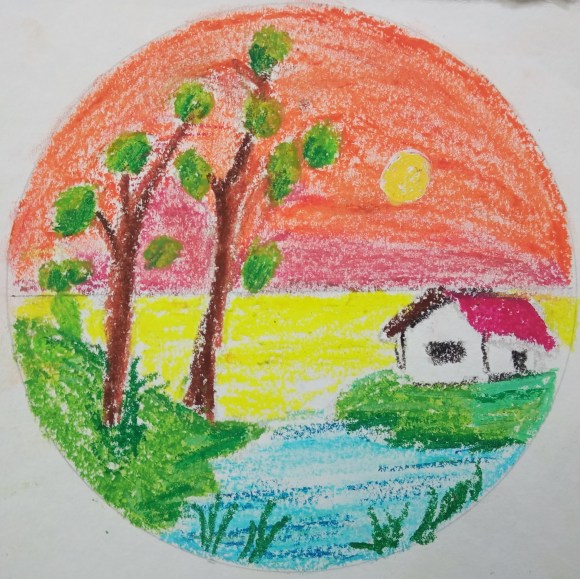
Art by Sohana Manzoor
THE CHILD’S LIFE

Do we have the
     courage to be a child?
         That’s why we die old.
We store every little thing,
         Hoard over time in trunks,
                   Stash in piles.
Today is ruined with thoughts
Of tomorrow. Tomorrow, we’ll stock
         For the burdens of the next day.
We get objects of desire,
And realise we have no need for them.
        We quest for things gone astray.
Fearing for the unknown future,
We lose sight of the path,
     And plan for the day after.
The future will always
          Be shrouded in mystery.
Then, will we have no reprieve?
As we ignite the lamp of intellect,
The flame flickers in the breeze —
         We calculate each step.
Numerous people advise
With subtle judgement
 Hair-splitting details before every quest.
Let my heart again be filled
      With the desire to be a trustful child.
         Let me flow freely like the breeze,
Swiftly unmask fears
   Hovering about the future.
      I will confront them as they are seen.
By the pond or on the rooftop,
     Mingling the known and unknown,
        The common and uncommon,
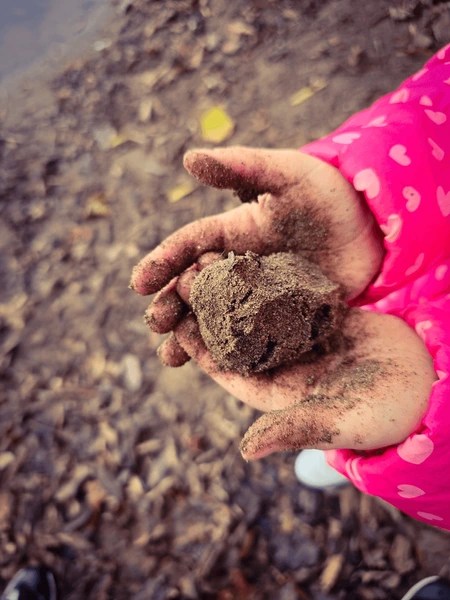
I will roll a ball of mud.
 This will be my toy.
      Happiness doesn’t need to be bought.
Taking on the onus of adulthood,
     I come to this huge market,
            Where grownups push and jostle.
Selling my world, when I
        Head home, I take
           With me only verbosity.
I have wasted away my time
    looking for bargains.
          The hours passed swiftly.
As dusk turns to twilight,
I suddenly feel, I do not like
        The deals I made deftly.
Our lives start
     With childhood.
          Let childhood prevail again.
Let us find companionship
     Like land and water,
        Let us play again in the dusty glen.
Breaking the boundaries of possibilities,
Let us sail on waves of impossibilities,
        Navigating on a ferry of dreams.
Again, let’s abandon logic
And create our world of magic,
        Forgetting the practical realms.
The first day when I arrived
           In this new world,
              Sunlight bathed my life.
 That period was filled with
     Childish imaginings —
       Where did it come from?
Who secretly beads
Dewdrops each night?
        Crickets chirp in unison.
 At dawn, I notice,
The interplay
        Of glittering lights.
There was a time
     When holidays blew in
       With breezy blue skies.
We looked for partners
     While playing games
       As childhood flew by.
Trees in play bloom flowers.
Flowers in play fruit fruits.
           Fruits sprout new buds.
Lands play with the lapping water.
Waters play with the swaying breeze.
         The breeze plays in its own tune.
With the youth,
     You remain young
              Despite your baggage.
You fly paper lanterns
Of many colours,
       Paint the skies with vibrant shades.
That day I fantasied
Being back by your side.
        We played together holding hands.
We floated many dreams,
 Conversed on sad and happy themes,
          And together, we relaxed.
The flowers burdened
       By the colours of seasons,
         Flow away in the stream of time.
Again, they come to shore
        As the breeze blows,
                Drifting to the waterside.
In the wicker basket of the world,
Your flowers with my garland twirled,
      Decorating the ferry of seasons.
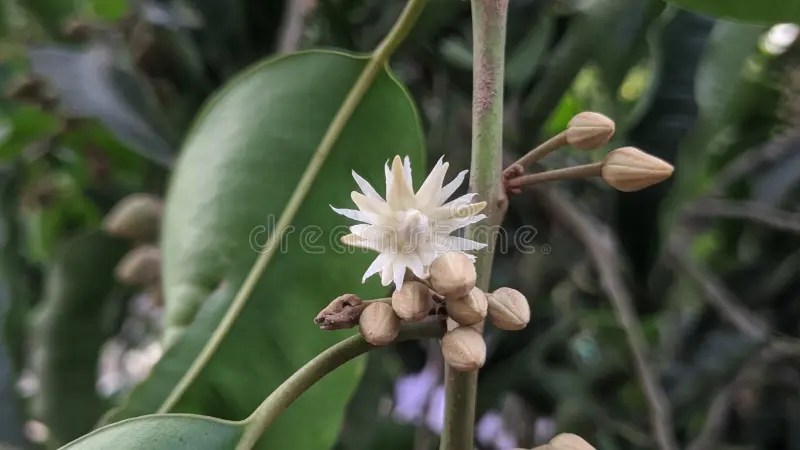
I have hope in my heart,
The bokul ferry’ll return to the earth,
      Listening to the shiuli’s reasons.
When I hummed a song
That day on my own,
         It drifted by unoccupied.
That day, I saw a flicker
      In your eyes of laughter,
            You recognised me by your side.
Seeing your dusty play, your light,
My heart was filled with delight,
         Despite the sad notes on the flute.
I understood that spring,
You heard me sing.
          I too love to hear your tune.
The day passed in fields and paths.
            Dusk settled in.
                If you bid me farewell,
Then in your twilight
   Raise the sail of the boat,
     I will cross the river aswell.
Again, O friend of the child,
Let’s play on our own to abide
         In a youthful Universe.
Gazing at your face,
Your world I’ll embrace,
      I’ll view it in a simple light.
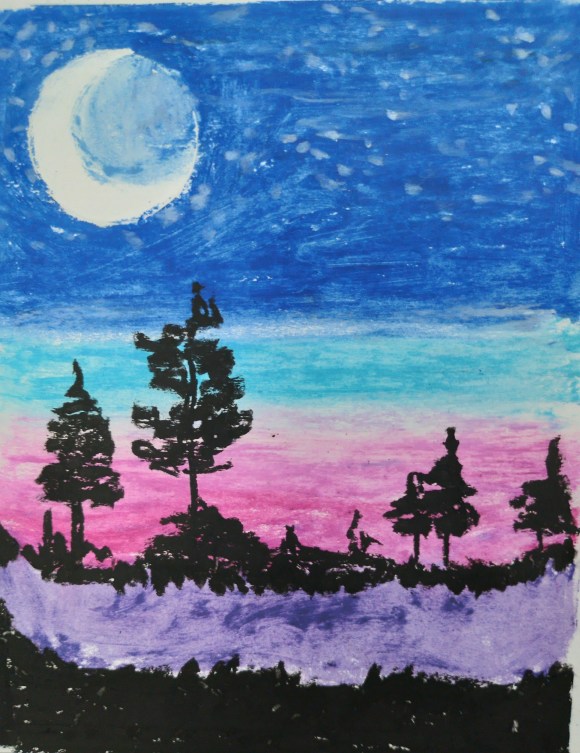
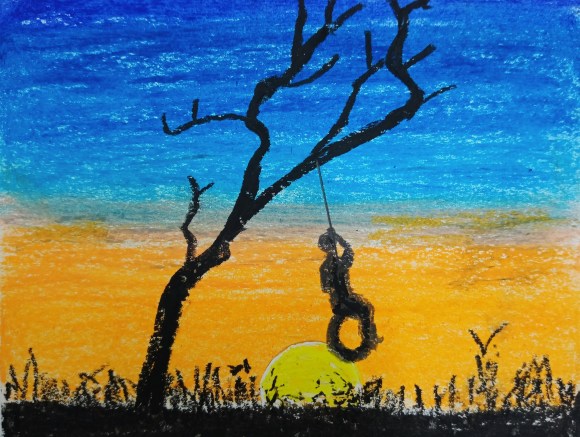
Colourful paper lanterns in the skyA child making a mud ballFrom Public Domain BokulShiuliFrom Public Domain
.
This poem has been translated from Bengali by Mitali Chakravarty with editorial input by Sohana Manzoor
.
PLEASE NOTE: ARTICLES CAN ONLY BE REPRODUCED IN OTHER SITES WITH DUE ACKNOWLEDGEMENT TO BORDERLESS JOURNAL
Five poems by Pravasini Mahakudahave been translated to English from Odia by Snehaprava Das. Click here to read.
A Poet in Exileby Dmitry Blizniuk has been translated from Ukranian by Sergey Gerasimov. Click hereto read.
Kalponik or Imaginedby Tagore has been translated from Bengali by Mitali Chakravarty. Click hereto read.
Pandies Corner
Songs of Freedom: The Seven Mysteries of Sumona’s Life is an autobiographical narrative by Sumona (pseudonym), translated from Hindustani by Grace M Sukanya. These stories highlight the ongoing struggle against debilitating rigid boundaries drawn by societal norms, with the support from organisations like Shaktishalini and Pandies. Click here to read.
It has been a strange year for all of us. Amidst the chaos, bloodshed and climate disasters, Borderless Journal seems to be finding a footing in an orphaned world, connecting with writers who transcend borders and readers who delight in a universe knit with the variety and vibrancy of humanity. Like colours of a rainbow, the differences harmonise into an aubade, dawning a world with the most endearing of human traits, hope.
A short round up of this year starts with another new area of focus — a section with writings on environment and climate. Also, we are delighted to add we now host writers from more than forty countries. In October, we were surprised to see Borderless Journal listed on Duotrope and we have had a number of republications with acknowledgement — the last request was signed off this week for a republication of Ihlwha Choi’s poem in an anthology by Hatchette US. We have had many republications with due acknowledgment in India, Bangladesh, Pakistan and UK too among other places. Our team has been active too not just with words and art but also with more publications from Borderless. Rhys Hughes, who had a play performed to a full house in Wales recently, brought out a whole book of his photo-poems from Borderless. Bhaskar Parichha has started an initiative towards another new anthology from our content — Odia poets translated by Snehaprava Das. We are privileged to have all of you — contributors and readers — on board. And now, we invite you to savour some of our fare published in Borderless from January 2025 to December 2025. These are pieces that embody the spirit of a world beyond borders…
I Am Not My Mother: Gigi Baldovino Gosnell gives a story of child abuse set in Philippines where the victim towers with resilience. Click here to read.
Persona: Sohana Manzoor wanders into a glamorous world of expats. Click here to read.
In American Wife, Suzanne Kamata gives a short story set set in the Obon festival in Japan. Click here to read.
Sandy Cannot Write: Devraj Singh Kalsi takes us into the world of advertising and glamour. Click here to read.
Reminiscences from a Gallery: The Other Ray: Dolly Narang muses on Satyajit Ray’s world beyond films and shares a note by the maestro and an essay on his art by the eminent artist, Paritosh Sen. Click here to read.
A discussion of Jaladhar Sen’s The Travels of a Sadhu in the Himalayas, translated from Bengali by Somdatta Mandal, with an online interview with the translator. Click here to read.






 Borderless