Title: Jibanananda Das: Selected Poems with an Introduction, Chronology and Glossary
Translated by Fakrul Alam
Publisher: The University Press Limited, Dhaka.
BANALATA SEN

For a thousand years I have walked the ways of the world,
From Sinhala's Sea to Malaya's in night's darkness,
Far did I roam. In Vimbisar and Ashok's ash-grey world
Was I present; Farther off, in distance Vidarba city's darkness,
I, a tired soul, around me, life's turbulent, foaming ocean,
Finally found some bliss with Natore's Banalata Sen.
Her hair was full of the darkness of a distant Vidisha night,
Her face was filigreed with Sravasti's artwork. As in a far-off sea,
The ship-wrecked mariner, lonely, and no relief in sight,
Sees in a cinnamon isle signs of a lush grass-green valley,
Did I see her in darkness; said she, "Where had you been?"
Raising her eyes, so bird's nest-like, Natore's Banalata Sen.
At the end of the day, with the soft sound of dew,
Night falls; the kite wipes the sun's smells from its wings;
The world's colours fade; fireflies light up the world anew;
Time to wrap up work and get set for the telling of tales;
All birds home—rivers too—life's mart close again;
What remains is darkness and facing me—Banalata Sen!


LIFE'S MART HAS CLOSED AGAIN
(Shesh Holo Jeebaner Lenden)

Life’s mart has closed again
			Banalata Sen!
Where have you gone at this time of the day
The kingfisher hasn’t forgotten its noontime play
The shalik bird to its nest has found its way
Excited, the river is foaming again
	But you are nowhere, Banalata Sen.

Was there anyone like you anywhere?
Why is it that you are the first to disappear?
	Why do you have to be the first
	To go and make the world a desert
	(Why are you always the first?)
The magician’s mantras have lost their hold over men
	But you are far away Banalata Sen.

Evening will always come and spread across the sky
	Often I go to sleep where slums are close by
	Often winds startle and go on a high
In a station in hijal jam forests has stopped the night train
	Late night’s Banalata Sen!
(These translations are from Jibanananda Das: Selected Poems with an Introduction, Chronology and Glossary, translated by Fakrul Alam, published by The University Press Limited, Dhaka, 1999. Republished with permission from the original publisher.)
About the Book: Jibanananda Das (1899-1954) is one of the most important poets of Bengal. Nevertheless, he remains a poet little known outside West Bengal and Bangladesh. Perhaps due to the absence of competent translations into English and other languages, Das achievement as a poet remains unrepresented in world literature. This selection of poems is designed to emphasise how Das’s poems are great treasures of our literature through the medium of translation. Fakrul Alam’s uniquely competent English translations were done originally mark the birth centenary celebrations of Jibanananda Das this year (1999). In this second edition, he has translated a few more poems to show even more fully the range of Das’s verse. Lovers of poetry outside the Bengali-speaking world should get a sense of the richness of Das’s poetry, his growth as a poet, and the extraordinary range of his work through these translations.
Rakibul Hasan Khan explores death and darkness in Fakrul Alam’s translation of Jibanananda Das’s poetry
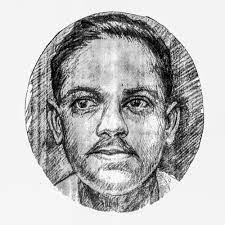
Jibanananda Das: Courtesy: Creative CommonsProfessor Fakrul Alam
I
Literary translation is a creative work, and the literariness of a translated work reflects the creativity of the translator. From a reader’s perspective who does not know the language of the “original”, the more the translated work reads “natural”, the better is the translation. But it is very intriguing from the viewpoint of someone who has access to both the original and the language of the translation. Reading the translation for such a reader is sometimes like reading the same poem in two languages at the same time, which is often a very enriching and exhilarating experience. But it is not always the case, for such readers may show a critical attitude to the translation for having a “bias” towards the original, especially if the latter is written in their first language. Then their reading turns out to be more an evaluation of the translation than enjoying the work in translation. It is a difficult task for such readers to overcome this predicament.
I also face this predicament while reading Fakrul Alam’s translations of Jibanananda Das’(1899-1954) poetry in Jibanananda Das: Selected Poems with an Introduction, Chronology, and Glossary (Dhaka: UPL, 2nd Ed, 2003). To keep aside my evaluative concerns, therefore, a middle course was necessary, while still comparing the translations with the originals. To this end, I read some of the most “popular” poems by Das in Alam’s translations with a particular focus on the latter’s recreation of the images of death, dread, and darkness.
There is a personal preference for my choosing of the dark images, for I always find Das’ grotesque or dreadful images as appealing as the beautiful ones, but more important reason for my choosing of the dreadful than the beautiful is to underscore the experience of a poet who lived under the dark shadow of colonial rule. Initially, I thought it would be very intriguing to read Das’ poetry postcolonially in Alam’s translations because of the latter’s reputation as an academic in the field of postcolonial studies. But while reading the translations, particularly the erudite introduction that he has included at the beginning of the volume to introduce the salient features of Das’ poetry as well as to offer a very insightful and resourceful discussion on others’ and his translations of the poet, I felt that Alam almost altogether suspended his postcolonial self and fully activated his own creativity to capture the sights and sounds of the works of a poet who is extraordinarily famous for the aesthetic and artistic qualities of his poetry. Alam seems to have embraced this challenge enthusiastically and has succeeded with flying colours, but his emphasis on the art may have cost him thematically on certain occasions, although it has not diminished the overall quality of the translations. His translations also continue to bear the mark of his academic background as a scholar in English studies.
In spite of discovering that Fakrul Alam does not highlight the postcolonial elements in Jibanananda Das’s poetry, I did not abandon my initial plan of reading his translations through postcolonial lenses. Therefore, I resort to Edward Said, whom Alam considers his “guru”, to adopt the former’s concept of “contrapuntal reading” and apply it on the latter’s translations.
Said theorised contrapuntal reading as a technique of reading the texts of English literature, particularly the novel, to unravel the unrecognised and unarticulated elements of colonisation which are ostensibly absent in those texts. I adopted this technique for reading Alam’s translations to examine the images of death, dread, and darkness in Das’ poetry as the expressions of the poet’s experience as a colonised person. To view translation as an act of interpreting a text, I invoked Frederic Jameson’s formulation that interpretations of literary texts could bring to surface the repressed political unconscious in the narrative. Although Jameson’s theory is essentially a Marxist reading strategy, for my postcolonial materialist reading of Fakrul Alam’s translations, a reworking was necessary. Alam’s translations brought to light the repressed political unconscious in Das’ poetry, giving clue to the poet’s rendition of the grotesques as a result of the material realities of his time under the British Empire.
II
The first poem of Jibanananda Das that I read in Fakrul Alam’s translations is “An Overwhelming Sensation” (“Bodh”) – a deeply engaging poem that highlights the extraordinary sensibilities of a poet that separate them from the multitude. There are two “dreadful” images in this poem, and the first one is as follows:
In my head!
Walking along beaches – crossing shores
I try to shake it off;
I want to grab it as I would a dead man’s skull
And dash it on the ground; yet, like a live man’s head,
It wheels all around my heart!
(26-31, p. 30)
The image of death and dread in the above quotation reminds me of Shakespeare’s the “grave diggers scene” in Hamlet as well as “Lady Macbeth’s persuasion scene” in Macbeth, although the original poem does not allude to Shakespeare so noticeably. Similarly, the second dreadful image of the poem resonates a Shakespearean diseased imagery in Alam’s translation:
Eyes whose nerves have dried up,
Ears which cannot hear,
And like that hump – a goitre erupting on flesh
Rotten cucumber – putrid pumpkin –
All that have grown rank in the heart –
All that.
(101-106, p. 32)
Is it a mere coincidence that Alam’s translations of the above images of death and dread remind me of Shakespeare? Do they have any connection with his academic background of English studies that must have included Shakespeare? It is also not a coincidence that Das himself was a student of English literature, who also pursued a teaching career in English. The colonial connection of English studies in the Indian subcontinent is a historical fact, which occasioned for the poet, the translator, and me to study the Bard, but more important is to note on how the presence of Shakespeare becomes more obvious in Alam’s translation than it is in the original. To me, the dreadful images recreated by Alam reflects the tormented mental state of the colonised poet. If we keep in mind that the original poem was written around the death throes of the colonial rule in India, we cannot overlook the link between these images and colonisation.
“Camping” (“Campe”) is another poem that contains some extremely poignant and dreadful images. In Fakrul Alam’s translation, this poem’s connection with colonisation becomes more recognisable than it is in the original. The poem describes a hunting night in a forest where the speaker of the poem is camping: “Somewhere deer are being hunted this day; / Hunters have moved into the heart of the forest today” (6-7, p. 32). The night for the speaker is both enchanting and mysterious – “a night full of wonders” (60, p. 34), but it turns into a horrible one due to the presence of the hunters. In Alam’s translation, the anxiety of the speaker reflects an acutely sensitive mind of a person who is restless by what is happening around him:
I can sleep no more;
Lying down
I hear gunshots;
And then more guns firing.
In the moonlight the doe in heat call again.
Lying down here all by myself
I feel a heaviness in my heart
Hearing gunshots
Hearing the doe calling.
(42-50, p. 33-34)
Alam’s use of the words, “gunshots” and “guns firing”, perfectly captures the dreadfulness of the night and clarifies the heaviness of the speaker’s heart. He makes the anxiety of the speaker palpable. As he informs the reader with a footnote at the beginning of the poem, Jibanananda Das wrote this poem as an expression of “the helplessness of life” (p. 32), the above lines represent that helplessness of the speaker.
Interestingly, this is a love poem – seemingly. The speaker compares himself with the fallen lovers of the doe who tempts the stags to come out of their hideouts by calling them passionately but deceivingly to be shot by hunters. According to the speaker, the doe has learnt this art of deception and cruelty from humans: “Lessons she has learnt from humans!” (51-54, p. 34). In Alam’s translation, the cruelty of hunting and the agony of the speaker become obvious:
I hear a double-barreled gun thunder,
The doe in heat keeps calling,
My heart can’t get to sleep
As I lie down all by myself;
(79-82, p. 35)
Here the doe is a symbol of deceptive love. The speaker himself is also a victim of such love. His heart bleeds at the sound of gunfire. The innocent death of the stags reminds him of his own wretched state, but he is aware that he needs to learn how to negotiate with this wretchedness: “Still I must learn to forget sound of guns going off” (83, p. 35). This realisation gives the speaker the composure to reflect on the identity of the hunters:
They who own the double-barreled guns that destroyed the stags this day,
They who brought the relish of deer flesh and bones to their dinner
Are like you –
Lying in camp beds they are drying up their souls
Reflecting on their feast – reminiscing – remembering.
(84-88, p. 35)
The hunters are those who “own the double-barreled guns”. Does it ring a bell? Although the first Mughal Emperor Babur introduced guns in India in the sixteenth century, it is the British who made use of guns the most in the Indian subcontinent. Thus, there is a strong association between the British colonisers and the hunters in this poem.
Alam’s translation brings to surface the repressed political unconscious of the poem. If the poem is an expression of “the helplessness of life”, he heightens that helplessness, demystifying some of the obscurities of the original poem in the process of translating it. He succeeds in recreating the atmosphere of horror that does not let the speaker sleep. The anxiety of the speaker over the helplessness of his fellow people and of the animal world as a whole make us think about the time and place of writing this poem.
The dreadful images of death and dread recreated by Alam using words and phrases like “gunshots”, “guns firing”, and “double-barreled gun thunder” present before us a troubled world where the serenity of the natural world is shattered by the sound of gunshots. Yet, the speaker realises that he needs to negotiate. The colonised also had to negotiate with the colonisers. Therefore, if we situate the poem against the backdrop of its writing during the colonial period from a colonised location, can we overlook its colonial connection? Does Das portray the tormented state of the colonised through this allegorical love poem? This allegory of the hunted existence of the colonised becomes more perceptible than the original through Alam’s interpretative translation – translating as interpreting. Alam’s translated version of the poem reveals the material realities of the poet’s time which are largely concealed by symbols and imageries in the original poem.
III
To write on the theme of darkness, the poem “Banalata Sen” first comes to my mind, for I consider it as one of the darkest poems by Das. The poem’s darkness is very subtly camouflaged by a tapestry of extraordinary images. Its astonishing popularity as a love poem also often hides the darkness. Alam’s translation largely unveils the camouflage, and brings to light the overwhelming darkness of the poem. In the Bangla version, Das deploys the word “darkness” by somewhat screening it with other associated images and allusions. Alam also does so without using any synonym for “darkness” in his English translation, understandably for not affecting the poetic quality of the poem. As a result, the word “darkness” appears as many as five times in his translation, which is the same number as in the original. Here, the recurrent word has been put on bold typeface.
From Sinhala’s Sea to Malaya’s in night’s darkness,
…
Was I present; Farther off, in distant Vidarba city’s darkness,
…
Her hair was full of the darkness of a distant Vidisha night,
…
Did I see her in darkness; said she, “Where had you been?”
…
What remains is darkness and facing me – Banalata Sen!
(2, 4, 7, 11, 18, p. 61)
Fakrul Alam does justice to the original while translating this “difficult” poem, and exposes the dominance of darkness in it. Probably any other translator would also keep the word “darkness” the same number of times, but Alam’s success lies in his maintaining a similar artistic sublimity that we find in the original poem. It is evident in his coining or use of the phrases like “the ways of the world”, “ash-grey world”, “foaming ocean”, “the soft sound of dew”, “fireflies light up the world anew”, and “life’s mart close again”. His successful recreation of the images of darkness opens up the opportunity to explore the political potentialities of the poem.
“Darkness” (“Andhakar”) is another poem of overwhelming darkness. Fakrul Alam’s translated version of this poem also testifies my claim of his interpretive translation. He also explains in the introduction of the volume the process of his using self-explanatory words for retaining Bengali names to honour Jibanananda Das’s preference for this: “[t]he sensible option, it appeared to me, was to use Bengali names when an exact English equivalent was not available, and then to use a Bengali word in such a way that the meaning could be conveyed where possible within the line” (p. 21). Alam’s explanatory use of two Hindu mythological rivers’ names in the following lines of “Darkness” may also clarify my point:
I looked up and saw the pale moon withdrawing half of its shadow from that river of death, Vaitarani,
As if gesturing towards the river of mutability, the Kirtanasha. (2-3, p. 72)
Alam supplements the meanings of the rivers by using the phrases “that river of death” and “the river of mutability” before Vaitarani and Kirtanasha respectively, while in the original poem, there is no such explanatory “notes” preceding the rivers’ names, assumingly because the Bengali readers of the poem are supposed to know the names of these mythological rivers, although I think many Bengali readers are also not fully informed of the significance of these rivers. Therefore, Alam’s innovative use of these rivers’ names becomes self-explanatory, without undermining the poetic quality of the lines. Similarly, the following line of the same poem is another example of his explanatory translation: “O Moon whose brightness has faded to a faint blue” (6, p. 72). In this line, the part following “O Moon” is clearly an attempt by the translator to explain the faded colour of the moon. However, Alam’s translation of this poem, like “Banalata Sen”, enhances the deep darkness manifested in the original.
If we go back to the time of publication of the volume Banalata Sen (1942) where the two poems “Banalata Sen” and “Darkness” were included, we can get an explanation to the poet’s obsession with darkness. It was indeed the darkest time for the people of the Indian subcontinent under British colonisers. The colonial rule affected the Bengal province (where Jibanananda Das is from) so severely that it resulted in the worst famine in the subcontinental history in 1943. The Bengal famine of 1943 has been called a “man-made holocaust” by Gideon Polya, for which the then Prime Minister of England Winston Churchill’s policy of hoarding food supplies for the British soldiers fighting in the Second World War by depriving the colonised. Apart from the effects of the famine and the World War, communal conflicts also ravaged the peacefulness and harmony of life in this region. The optimism of anti-colonial movement was soon to be marred by the proposal of partitioning India on the basis of “two-nation theory”. All these must have affected Das while writing “Banalata Sen” or “Darkness”, and Alam’s translations give us a clear view of the unfathomable darkness that engulfed the poet’s world.
IV
In this section, Fakrul Alam’s translations of the poems of Beautiful Bengal [Ruposhi Bangla], one of Jibanananda Das’ most loved poetry collections, will be discussed. The poems of this collection reflect the poet’s deep attachment with his land as well as his meditations on death and reincarnation through picturesque and sensuous portrayals of the flora and fauna and the landscapes of rural Bengal. The first poem of this volume that appears in Alam’s translations reveals the poet’s musings on death. The very title of the poem, “Knowing How These Fields Will Not Be Hushed That Day” (“Shei Din Ei Math”), alludes to the day after the poet’s death. In Alam’s translation, the poet’s sense of grief imagining the day when he will be no more becomes as poignant as it is in the original:
Because I will disappear one day
Won’t dewdrops ever cease to wet chalta flowers
In surges of soft scent?
(4-6, p. 43)
These lines demonstrate the poet’s wistful imaginings of the time after his own death, but at the final stanza of the poem, he perceives death from an objective viewpoint. Alam perfectly captures this transition from subjective to objective, and presents it as authentically as possible:
Quiet lights – moist smells – murmurings everywhere;
Ferryboats moor very close to sandbanks;
These tales of earth live on forever,
Though Assyria in dust – Babylon in ashes – lie.
(9-12, p. 43)
In Alam’s translation, the poet’s contemplation of the inevitability of death and the impermanence of everything, including great civilizations, appear in a perfect state of semblance and equipoise as in the original poem.
“Go Wherever You Want To” (“Tomra Jekhane Shadh”), one of the most famous poems of Beautiful Bengal, bears evidence of the poet’s deep desire to stay eternally in the lap of Bengal amidst its unique beauties, refusing the prospects of moving to elsewhere, especially to any foreign land. The poet asks those fascinated by the attractions of foreign lands to go wherever they want to, but he himself wants to remain in Bengal eternally, justifying his decision by describing its bewitching beauty. Fakrul Alam is at his best as a translator in recreating the sights and sounds of the poet’s beautiful Bengal, where the sestet of the sonnet implies the poet’s eternal connection with this land:
Ready to take her grey-coloured duck to some storyland –
As if the smell of Paran’s tale is sticking to her soft flesh,
As if she has risen from her underwater kalmi reed abode –
Silently leaving herself in water once – then disappearing
Into the fog far, far away – but I know I’ll never lose sight of her
Even in the press of the world – for she is in my Bengal evermore.
(9-14, p. 44)
Apparently, this poem is free from the heaviness of death imageries, but a close examination may bring to surface the poet’s embedded desires for death and rebirth. His yearning for remaining in Bengal eternally is only possible through his reincarnation in this land after his death.
The poem “I Have Seen Bengal’s Face” (“Banglar Mukh Ami Dekhiyachhi”), another sonnet of Beautiful Bengal, further justifies the poet’s decision to stay in Bengal for good and to go nowhere else. In his translation of the poem, Alam shows outstanding artistic skills to emulate the aesthetic and poetic beauty of the original. The octave quoted below may clarify my point:
I have seen Bengal’s face, and seek no more,
The world has not anything more beautiful to show me.
Waking up in darkness, gazing at the fig-tree, I behold
Dawn’s swallows roosting under huge umbrella-like leaves.
I look all around me and discover a leafy dome,
Jam kanthal bat hijol aswatha trees all in a hush,
Shadowing clumps of cactus and zeodary bushes.
When long, long ago, Chand came in his honeycombed boat
To a blue Hijal Bat Tamal shade near the Champa, he too sighted

Bengal’s incomparable beauty.
(1-9, p. 49)
Alam’s innovative use of native tress and legends appear as spontaneously and effectively as possible to make the piece apprehensible to non-native readers. The poem gestures to the poet’s desire to glorify his land and culture, and Alam’s translation further accomplishes that glorification.
The poet’s desire for rebirth in Bengal is emphatically expressed in the poem “Beautiful Bengal” (“Abar Ashibo Phire”). Since the poems of the Beautiful Bengal are untitled, the first line of each poem is mostly accepted as the titles of the poems in Bangla original. Fakrul Alam also mostly follows this tradition, but often makes use of his freedom as a translator to change the title. The title of this poem “Beautiful Bengal” in Alam’s translation is another example of his applying that freedom. Perhaps he translates the title so differently from the “original” title, which could be something like “I Will Come Again”, to emphasise the extraordinary popularity of the poem that could easily be rendered as the titular poem of the volume. While I agree with this position, I feel it is deviating from the sense of reincarnation that the “original” title evokes. However, Alam does not deviate from the idea of return used as a refrain in the whole poem, and maintains the same stature as a translator that I find him in most other poems. I quote first few lines of the poem to support my view:
I’ll come again to the banks of the Dhanshiri – to this land
Perhaps not as a human – maybe as a white-breasted
shankachil or a yellow-beaked shalik;
Or as a morning crow I’ll return to this late autumnal rice-harvest laden land,
Wafting on the fog’s bosom I’ll float one day into the jackfruit tree shade;
(1-4, p. 51)
This poem can be read as a companion piece to the two other poems I have discussed above: “Go Wherever You Want To”, and “I Have Seen Bengal’s Face”. The idea of reincarnation and the feeling of an inseparable connection with the homeland reverberate in these poems with exquisite descriptions of the beauty of Bengal.
The poems of Beautiful Bengal are perhaps most passionate “postcolonial poems” by Jibanananda Das, where he glorifies his native land and culture as an attempt to recuperate the damages done to those by colonials. Fakrul Alam’s translations bring to surface the repressed postcoloniality of these poems by making the poet’s postcolonial sensibility more prominent than they are in the originals. Das’s deep rootedness in his land and culture expressed in the poems of Beautiful Bengal exemplifies his unequivocal stand on the question of belonging. During a time when the colonial effects occasioned for many of his contemporaries to leave their homelands and embrace diaspora identities, Das’s unwavering utterance like “Go Wherever You Want To” reflects his resistance to colonization. It remains as a source of inspiration for many in the days to come, particularly at the wake globalization when the lure of a transnational identity complicates the questions of home and belonging.
V
In the final section of the essay one of Jibanananda Das’ most overtly time conscious poem entitled “1946-47” will be discussed. As the title suggests, this poem reflects Das’ deep observations on the contemporary sociopolitical issues of his time during and preceding the year of partition of India. Fakrul Alam adds a brief note to the poem to brief his readers the poem’s background. I find that note as a very helpful starting point for those who are not informed of the history of the Indian subcontinent. I quote it entirely to demonstrate how meticulous Alam is to make his translations comprehensive as well as comprehensible, particularly for non-native readers:
” “1946-47” is the longest poem by Jibanananda Das that I have translated and is one of his most impressive meditations on contemporary history. In it, he broods on the communal strife, chaos, and diasporas that accompanied the partition of India in general and Bengal in particular. Das himself had been uprooted by historical events, and had moved from the Muslim majority district of Barisal to Calcutta, where Hindus were in a majority. But Calcutta too was in tumult and riven by religious riots; the names and places mentioned in the poem represent Hindus and Muslims and localities associated with these communities.“(p. 115)
With this note, the translated version of the poem becomes self-explanatory and more transmissible than the original, but it may surprise one that neither Das nor Alam directly mention the culpability of the colonization for the tumultuous historical events that the poem foregrounds. Perhaps both of them skip this deliberately, for the role of the British colonisers is too obvious to mention.
The long history of colonial rule culminated in the partition of India, which was preceded and followed by communal riots and dispersion of people from their homelands, resulting in deaths, dreads, and destructions. Therefore, the poem is replete with images of dead, dread, and darkness that best describe the time it represents. In Alam’s translation, the horror of human atrocities becomes as poignant as in the original:
Somewhere someone’s house will be auctioned off now,
Possibly for a song!
And so you must cheat everyone else
And be the first to reach heaven!.
…
Thousands of Bengali villages, drowned in disillusionment and
benighted, have become silenced.
…
The children now are close to death, trampled
By ignorant exhausted rulers of an era of misgovernment;
Their ancestors had once laughed and loved and played,
And had gone to rest in dark after raising permanently
The swing landlords had them make from tall trees for charak festivals.
They were not that well off then; yet compared to present-day villagers,
Blinded and tattered by famines, riots, darkness and ignorance,
They lived in a distinct and clear world.

Is everything indistinct today? It is difficult to speak or think well now;
The rule is to keep everyone in the dark, full of half-truths;
The practice is to infer the other half of truth
All by yourself in the dark; all are suspicious of each other.
(3-6, 31, 49-60, p. 115-17)
The implications of the lines I have quoted above from Fakrul Alam’s translation of the poem “1946-47” are so obvious that they do not require further explanation. Das’ political consciousness is relatively more apparent here than his most other poems. In Alam’s translation, that political consciousness resonates very loudly. Like a typical postcolonial poet, Das highlights the miseries caused by colonial rule, comparing the present with a “better” past. While making this comparison, he refers to the exploitative system called “Permanent Settlement of Bengal” introduced by Earl Cornwallis on behalf of the East India Company in 1793 to settle a deal between the Company and the landlords, causing enormous oppression and deprivation for the peasants and those at the margins. Fakrul Alam aptly explains this reference with a footnote that “[t]here is an allusion here to the system introduced by Lord Cornwallis in colonial Bengal in 1793 which created a class of landlords and let to the impoverishments of peasants” (p. 116). Notes like this and the glossary he has added to the volume makes the poems very much accessible not only to the non-native readers but also the native readers of the translations.
In fine, I repeat that translating is a process of explaining a text, and often it is on the discretion of the translator how explanatory the translation would be. In the case of Fakrul Alam’s translations of Jibanananda Das’ poetry, sometimes his attempts to explain the texts are explicit. He even points out where the intertextuality of a particular poem is quite obvious by quoting some lines from the “original” poem that inspired Das to write that poem. In my discussion, I have so far deliberately avoided this point of intertextuality because I find those poems so authentic in expression that the “originals” seem to replicate those, but it is an important point that I cannot avoid altogether. The Western “influence” on Das’ poetry indicates the Western education and culture in which he was exposed to through colonization. As a poet, he and his contemporaries of Bangla poetry were “benefited” from that exposure, which makes it clear that to oppose European colonisation or Western imperialism does not necessarily mean to reject their artistic, cultural, literary, or scientific achievements. But it is also not to be forgotten that the artistic, cultural, or literary matters were often used by the colonizers to maintain their hegemonic dominance by relegating the same originating from the native societies to an inferior status. In Orientalism (1978), Edward Said categorically explains the basis of cultural supremacy of the European that prompted them to colonize. Therefore, a critical awareness is necessary to approach those even at this age of the so-called postcolonial period. In the case of Jibanananda Das, whereas he mostly succeeded in maintaining his originality while writing poetry being inspired by Western poets, many of his contemporaries merely imitated them as blind devotees, which makes him truly “a poet apart”. However, Fakrul Alam’s all-encompassing translations help his readers to access the poems with much ease than it is in the case of the originals, foregrounding the repressed political unconscious of the poems. And in spite of this “explanatory translating”, he succeeds exceedingly in maintaining the poetic qualities of his translations, and that makes the volume so special.
Keith Lyons introduces us to Kenny Peavy, an author, adventurer, educator and wilderness first-aider who has travelled far and wide and wishes everyone could connect with the natural world right outside their door. Click here to read.
In Rhys Hughes Unbounded, Hughes, an author and adventurer, tells us about his inclination for comedies. Click here to read
Translations
Professor Fakrul Alam translates If Life were Eternal by Jibananada Das from Bengali. Click here to read.
Ratnottama Sengupta translates Bengali poet Michael Madhusudan Dutt’sBijoya Doushami. Click here to read.
Give Me A Rag, Please:A short story by Nabendu Ghosh, translated by Ratnottama Sengupta, set in the 1943 Bengal Famine, which reflects on man’s basic needs. Click here to read.
On This Auspicious Day is a translation of a Tagore’s song, Aaji Shubhodine Pitaar Bhabone, from Bengali by Mitali Chakravarty. Click here to read.
Munaj Gul writes of how volunteers are engaged in wooing children from poverty stricken backgrounds to school in Turbat, Balochistan. Click here to read.
Camellia Biswas, a visitor to Sunderbans during the cyclone Alia, turns environmentalist and writes about the potable water issue faced by locals. Click here to read.
In Fakir Mohan: A Tribute, Bhaskar Parichha introduces us to Fakir Mohan Senapati, the writer he considers the greatest in Odia literature. Click here to read.
Sohana Manzoor tells a story around the awakening of a young woman. Click here to read.
Among Our People: Devraj Singh Kalsi gives a fictitious account of a common man’s quest for security in a country that is one of the world’s largest democracy. Click here to read.
Book Excerpts
An excerpt from Shazi Zaman’sAkbar: A Novel of Historydetailing his interactions with Surdas and Braj. Click here to read.
Ideally, I would love to start the New Year with laughter and happiness! Then perhaps, the whole year would be dotted with humour …
Laughter clubs often practice laughing for health benefits. I know the pandemic makes both guffawing outdoors or in a group hard but think of the funniest possible thing and, perhaps, you will start laughing. For me what works other than children’s and monkeys’ antics, are my trips to the dentist, especially the trip where I wondered on the fringe benefits of ‘laughing gas’ (as given in the PG Wodehouse novel of the same name), only to be informed that it was used exclusively for young children. For me, an adult, there was only — you have guessed it — the jab that numbs your lip function to lubber. I discovered if I could make light of a dentist drilling by learning from Harry Potter (the spell to get rid of the terrifying boggart, who took the shape of the thing you feared most, was to imagine the funniest thing, focus on the humour in it, and shout ‘Riddikulus’ with a wand pointed at the creature in the form of your worst nightmare), then I could pretty much get rid of most fears.
The other thing I have been wondering for sometime is can one write an editorial that is humorous when the content is serious? I would have wanted to ask that question to many, including Ruskin Bond, who continues as one of my idols. I would love to touch hearts with the humour and the sensitivity that flavours his writing. It is tough to convey a complex thought with the simplicity and elegance of a writer who can be read and understood easily. I think we have a few of them around and I interviewed one. You all probably know him well— Rhys Hughes. I have given the reasons for the interview in lieu of Mr Bond, who continues a distant star beyond the horizon of online interviews. We discussed humour and its role in literature, leaving out completely in the cold, the fictional Mr Bond who answers to the names of James and 007 and has made entertaining films, which can be seen as serious or non-serious.
Hughes has of course, given some writerly advice not just in the interview but in ‘Making Something of Nothing’ – pretty much the advice that God had probably been given when he asked an unspecified friend on how to create the universe and multiple realities. Hughes has also added to our galaxy of poets where Michael Burch, Ryan Quinn Flanagan, Anasuya Bhar, Vernon Daim, William Miller, Pramod Rastogi, Mike Smith, Jay Nicholls and many more continue to sparkle. Taking up the theme of God’s creations, Devraj Singh Kalsi has added to more humour with a dream of divine intervention to make the ‘New Normal’ in 2022 – a plan for this year. Will it ever be real?
Another major issue in this world currently is climate change. In keeping with the need for acceptance of this reality, Keith Lyons introduced us to a nature lover, author and adventurer Kenny Peavy, who loved the fictional adventurer called Indiana Jones and has been working towards living in harmony with nature. He moved to Indonesia from America and is trying to raise awareness. You can find much, though not elephants, in the interview that encompasses the story of a man who cycled across a continent on a bike made of bamboo. However, you can find some writing on a king who acquired the skill to ride and tame elephants in our book excerpt from Shazi Zaman’sAkbar: A Novel of History. The excerpt does not showcase his elephant taming skills as did the Bollywood blockbuster Jodha Akbar but is focussed on bringing out the syncretism in the Mughal monarch’s outlook which made him seek out exponents of other religions. Sangita Swechcha’s and Andrée Roby’s anthology, A Glimpse Into My Country, with excerpts of short stories from Nepal and Zimbabwe, like Kenny Peavy, cycle across multiple borders as does our fiction. We feature stories from within and without the continent with Fazal Baloch recombining a couple of folklores from Balochistan to a single tale. Fiction from young writers highlight compassion and a varied perspective. Steve Ogah has a story from Nigeria which almost rings with overtones of Alex Haley’s Roots. Sohana Manzoor has given us a poignant narrative with an inspiring twist at the end, an absolute antithesis of the humorous one she rolled out for us last month. Candice Louisa Daquin has also given us an exceptional short fiction along with her column where she discusses the changing face of families in the current context.
While Daquin’s focus is mainly towards the West, we have an essay from Sanjay Kumar on families that live in the greyer zones of big cities, children from an outcropping called Nithari in Delhi, where they or theirs suffered neglect, abuse, carnage and cannibalism in their formative years. Introducing the impacted children, Kumar explains how they transcended the wounds that lacerated their lives. This piece is a precursor to a column called ‘Children of Nithari’. Starting February, the abuse victims will give us a story a month which will be translated by young volunteers from pandies’, an activist theatre group founded by Kumar, and published in Borderless. Another article from Balochistan reflects on the lack of literacy and efforts to bring children into the folds of schooling. Pakistan ranked 99th out of 132 countries on the literacy survey in 2021. We are privileged to be the voice of the unheard.
Two essays that ring of concerns raised in the Kenny Peavy interview are to do with climate crisis in the Sunderbans and waste disposal in Delhi. Both of these are written by researchers who are working on these issues.
We have travel pieces from Australia – one is a sailing adventure by Meredith Stephens and the other is about a trip to the Sand Dunes of Western Australia by Shernaz Wadia. Ravi Shankar has also taken us through winters from the Everest to New York with his globe-trotting non-fiction. Penny Wilkes takes us on a flight of creativity with beautiful photography.
We have a stellar layout of translations. Professor Fakrul Alam translated another poem by Jibananada Das and Borderless is honoured to publish it to the world for the first time. We have a translation from Korea and another of a Brahmo hymn, Aji Shubho Dine, by Tagore, which is sung often during festivals. The icing in our Tagore section in this issue is Ratnottama Sengupta’s translation of the Kobiguru’s ‘Two Birds’ (Khanchar Pakhi Chhilo) along with a musing which reflects on the perspectives of the two contemporaries, Tagore and Saratchandra. She has also translated a well-known Bengali poet, Michael Madhusudan Dutt. Dutt wrote just before the advent of Tagore and had an interesting past which has been vividly depicted by Sunil Gangopadhyay in Those Days (Sei Somoy in Bengali), a novel that has been translated by Aruna Chakravarti. Bhaskar Parichha has given us a tribute on the occasion of the birth anniversary of Fakir Mohan Senapati, who, he claims, has the same standing in Odia literature as Tagore in Bengali or Premchand in Hindi.
Parichha has also reviewed Amit Ranjan’sJohn Lang; Wanderer of Hindoostan; Slanderer in Hindoostanee; Lawyer for the Ranee. It looks like an interesting read where an immigrant Australian came supported Rani of Jhansi in India. Rakhi Dalal has reviewed Selma Carvalho’s Sisterhood of Swans, again a story of migrants and their lives. The theme seems to echo among the books that have been reviewed this time, including Gracy Samjetsabam’s take on Anuradha Kumar’s The Hottest Summer in Years, a story about a German immigrant to India in the twentieth century. Meenakshi Malhotra’s review of Somdatta Mandal’s translation of A Bengali Lady in England by Krishnabhabini Das (1885) highlights the views of a traveller rather than an immigrant as the lady did return home after a ten-year sojourn in Britain. As Meenakshi contends, “The process of travel offers opportunities for emancipation where exposure to other cultures offers her a way of viewing and of gaining a perspective on her own experiences and that of her sisters in India. Krishnabhabini constantly refers to her Indian sisters and bemoans their sorry state and ignorance when she sees how active British women were in their families and societies…”
I was supposed to try my hand at a humorous editorial, but I realise that is tough when the ground is small. For humour, we need rolling acres where we can etch out each detail till it cannot be milked further for laughter. But I promise you I will keep trying to please the readers till one evolves to write like Ruskin Bond.
I would like to thank my fabulous team who even if not actively contributing to content are always at hand to advise and help. I would especially want to thank both Sohana Manzoor and Sybil for their fantastic artwork, which is as wonderful as their writings. I would like to give heartfelt thanks to all the contributors who have made this journal possible and each reader who comes back to our journal for more every month. Some of the pieces remain unmentioned adding to the mystery of the content, just like, Christmas gifts which need to be unwrapped and continue a reality even in January in some parts of the world – the Russians celebrate on January 7th and the Spaniards extend their festivities to January 6th.
Do take a look at this month’s edition for not just the stories mentioned here but for more.
I wish you all a wonderful New Year filled with laughter.
IF LIFE WERE ETERNAL…

Given the boon of eternity, I would walk the ways of the world eternally.
All, all alone -- what if I would see lush green grass in full bloom then?
And what if I beheld the yellowing grass withering away -- And view
The sky full of wan white clouds at dawn? Like a tattered munia bird
Blood reddened breast in the evening -- I would see the stars repeatedly;
I would see an unknown woman’s hair drifting away from a loosened bun;
A woman who would leave -- with a face bereft of the evening sun’s glow.
Jibonanada Das (1899-1954) was a Bengali writer, who now is named as one of the greats. During his life he wrote beautiful poetry, novels, essays and more. He believed: “Poetry and life are two different outpouring of the same thing; life as we usually conceive it contains what we normally accept as reality, but the spectacle of this incoherent and disorderly life can satisfy neither the poet’s talent nor the reader’s imagination … poetry does not contain a complete reconstruction of what we call reality; we have entered a new world.”
Professor Fakrul Alam takes us through the three Partitions of Bengal whichultimately led to the creation of Bangladesh, with focus on the role of Dhaka University. Click hereto read.
Professor Fakrul Alam brings to us Tagore songs in translation and in discussion on the season that follows the scorching heat of summer months. Clickhere to read.
Fakrul Alam writes nostalgically of his visits to Feni in Noakhali, a small town which now suffers from severe flooding due to climate change. Click here to read.
Giraffe’s Dad by Tagore: Giraffer Baba (Giraffe’s Dad), a short humorous poem by Tagore, has been translated from Bengali by Professor Fakrul Alam. Click here to read.
Oikotan(Harmonising) has been translated by Professor Fakrul Alam and published specially to commemorate Tagore’s Birth Anniversary. Click here to read.
Monomor Megher Songi (or The Cloud, My friend) has been translated by Professor Fakrul Alam. Click hereto read.
Commemorating fifty years of Bangladesh which struggled for the right to freedom from oppression and succeeded finally on 16th December, 1971
Landscape in Bengal. Painting by Sohana Manzoor
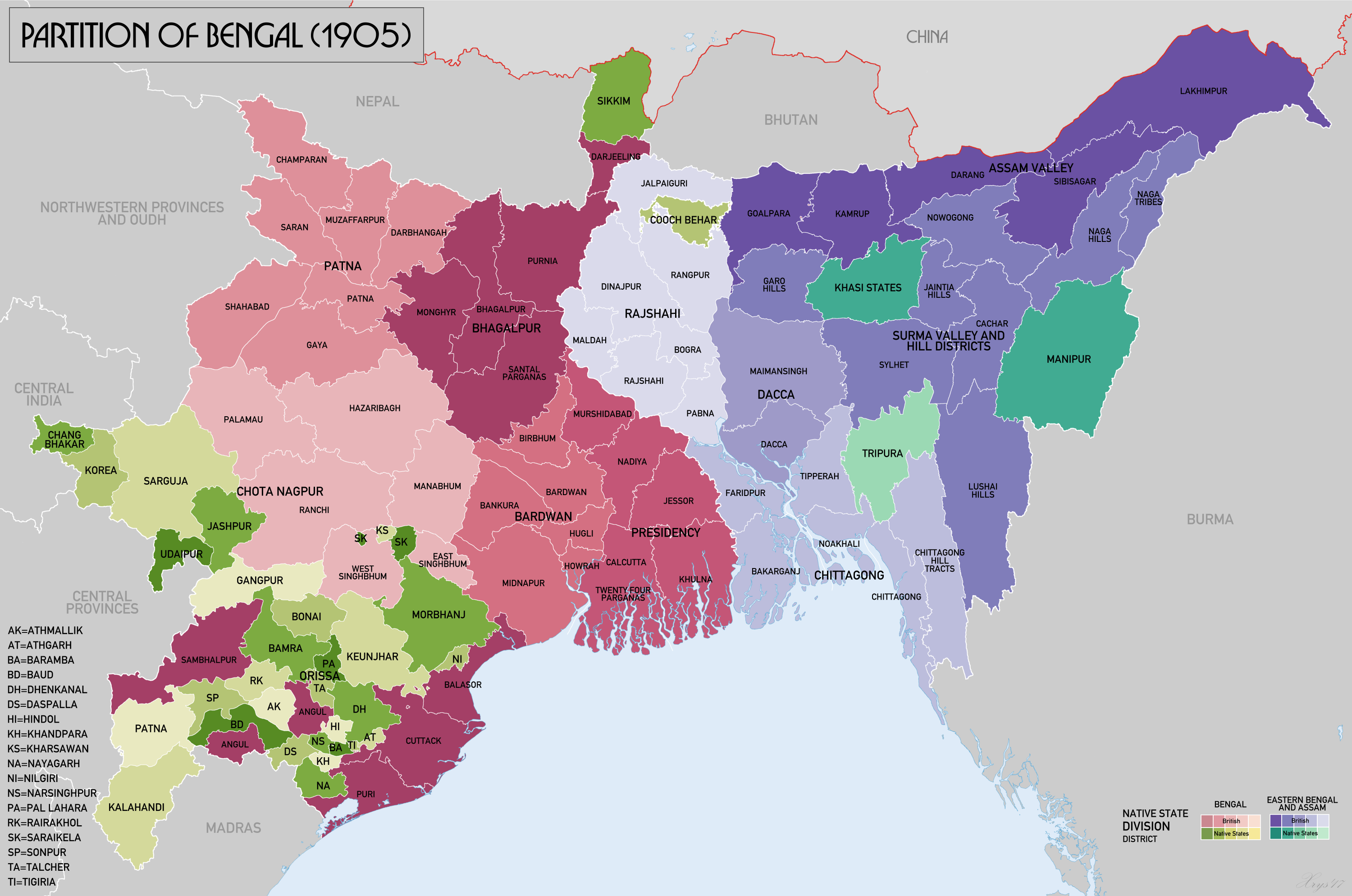
Bengal went through three Partitions, the final one being in 1971, when Bangladesh came to be its own entity. The first Partition of Bengal was in 1905, when Lord Curzon sliced it along the lines of faith, which as Ratnottama Sengupta points out in her musing was the result of the colonial policy of divide and rule implemented along religious lines for earlier when Hindus and Muslims had combined forces against colonials, it took a year to quell the revolt of 1857. Due to opposition from many, including Tagore, the colonials were forced to revoke the Partition in 1911.
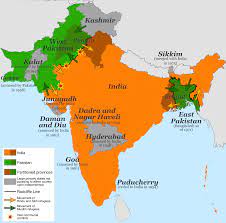
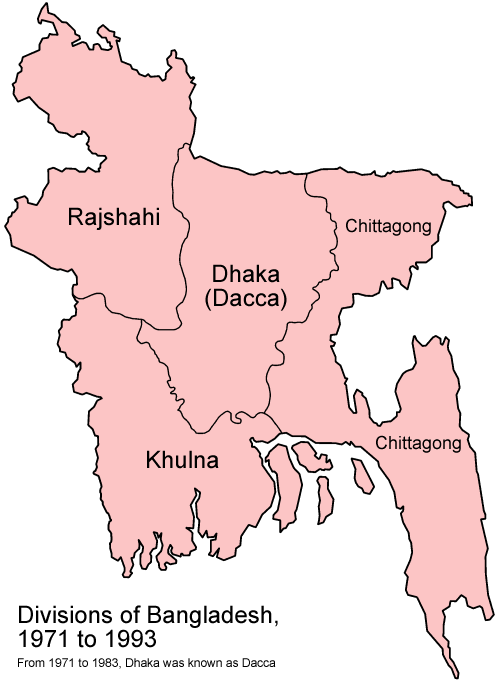
19051947Post-1971The three Partitions of Bengal in Maps: Courtesy: Creative Commons
In 1947, the subcontinent was again divided along religious lines. So, technically, there was Pakistan and India. Pakistan included East (Bengal) and West. As Fakrul Alam tells us in his essay, the Bengalis resented the imposition of Urdu by Pakistan. After a struggle of three decades, and a war in which India supported East Pakistan and America supported West Pakistan, Bangladesh gained complete independence in 1971 with Sheikh Mujibur Rahman, the founding father of the country, at its helm.
We present to you a glimpse of this part of history as told by various contributors on our forum.
Interview
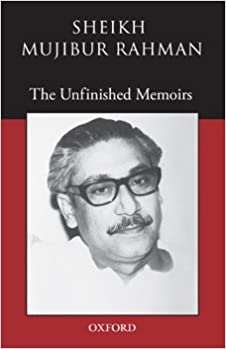
Professor Fakrul Alam, the translator of Bongobondhu (friend of Bengal) Mujibur Rahman’s autobiography, to takes us on a journey to the inception of Bangladesh and beyond. Click here to read the interview.
Professor Fakrul Alam takes us through the three Partitions of Bengal whichultimately led to the creation of Bangladesh, with focus on the role of Dhaka University. Click hereto read.
Ratnottama Sengupta recaptures vignettes from her past, from across the border where the same language was spoken, some in voices of refugees from East Pakistan to India. Click here to read.
Rakibul Hasan Khan pays a tribute with a twist to a recently deceased Bangladeshi writer, Hasan Azizul Huq, a writer who wrote of the Partition victims. Click here to read.
Aruna Chakravarti reviews Golden Bangladesh at 50: Contemporary Stories & Poemseditedby Shazia Omar, bringing to focus the Partition between 1905-1911. She also explains the story of the creation of Aamar Shonar Bangla (My Golden Bengal, the Bangladesh National Anthem) by Tagore around this period. Click here to read.
Professor Fakrul Alam takes us through the Partitions of Bengal which ultimately led to the creation of Bangladesh, with focus on the role of Dhaka University.
In Dhaka University: the Convocation Speeches, a volume compiled with an introduction by Serajul Islam Choudhury in 1988, we read that the university was established by the British as a “splendid imperial compensation” for the Muslims of East Bengal (Choudhury, 26). They had wanted the current rulers of India to make up through it for the loss, they felt, they had suffered because of the reunion of Bengal in 1911. Delivering his inaugural speech as the Chancellor of Dhaka University (DU) in 1923, Lord Lytton had not only made this point but had also expressed the hope that it would soon become “the chief center of Muhammadan learning” in India and would “devote special attention to higher Islamic studies” (26). However, Lytton had ended his speech by urging graduands to conceive of the institution “as an Alma Mater in whose service the Muhammadan and the Hindu can find a common bond of unity” (Choudhury, 29). The subsequent history of the university reveals that while some of its future students would viewed it as a site for cultivating Islamic values and consolidating the Islamic heritage of the part of Bengal in which it was located, others would claimed it as a space where a democratic and secular notion of being Bengalis could be disseminated.
DU started playing a decisive role in Bangladeshi national identity formation almost as soon as the Islamic state of Pakistan was born. It became the center of the movement that would lead to the creation of the country born out of the ashes of East Pakistan in 1971. The key issue here was language and the catalyst was the insistence by the central government of Pakistan that Urdu should be the lingua franca of the country, regardless of the fact that only three percent of Pakistanis actually used it in their everyday lives. For two successive days on 5 and 6 December 1947, teachers and students of the university demonstrated on campus and the streets of Dhaka against the government decision and in favour of Bengali.
The Pakistani government, however, paid no heed to the protests and went ahead with its decision to impose Urdu as the sole official language of the country. In response to this ruling DU students mobilised on 26 February, 1948 to form an “All Party Language Committee of Action.” Not daunted, Mohammad Ali Jinnah, the Governor General of Pakistan, and identified as the “Father of the Country” by the official media, reiterated publicly while on a visit to Dhaka on the 21st of March that “the state language of Pakistan is going to be Urdu and no other language” (Islam, 224). When he made the same point in addressing the DU Special Convocation on the 22nd of March, Bengali students present at the convocation protested. On March 11, 1950 the Dhaka University Language Action Committee was formed. In essence, the movement that was being spearheaded by university students and that soon spread across East Pakistan, ultimately led to the break-up of Pakistan, a state built entirely on Islamist nationalism.
A direct outcome of the language movement was that the government that had been held responsible for bruising the Bengali consciousness was voted out of power in East Pakistan in 1954. Instead, a short-lived but popular coalition government that was viewed to be pro-Bengali took over up the administration of the province. Students had played a major part in the election and the tradition of student activism in the cause of Bangladeshi nationalism became very noteworthy in national politics from this point onwards.
In retrospect, we can see the Pakistani period was one which had witnessed a continuous tussle between successive Pakistani regimes wielding state power to curb Bengali rights and impose an Islamist state at the expense of Bengali language and culture and Bengali nationalism. DU teachers and students played a crucial part in the confrontation. It was mostly because of them that the Pakistani state apparatus failed to suppress Bengalis and prevent them from expressing themselves. The campus was at the heart of activity that promoted an awareness of secularism and brandished democracy as a goal to be achieved in national life.
It was to be expected, then, that when the Pakistani state made one last desperate attempt to suppress Bengalis clamouring for full autonomy and democracy on March 26, 1971 they would do so by targeting DU and attempting to mow down Dhaka university faculty members and students ruthlessly. When the Pakistani government decided to postpone the National Assembly meet, where the Awami League had got an absolute majority and where they were in a position to claim self-rule for East Pakistan and dominate Pakistani politics for the first time in that nation’s history, the campus broke out once again in loud protest. On the 7th of March, when the Awami League’s chief, Sheikh Mujibur Rahman, gave his historic speech claiming full autonomy and threatening to launch an armed movement that would drive away the Pakistanis from East Pakistan forever, DU student leaders were at his side as he spoke in Ramna Park, which borders the university.
What happened on 26 March was nothing less than a calculated bid to blast DU to smithereens, murder student leaders and selected faculty members, and drive out all students from the campus for playing leading roles in the movement against the Pakistani state. The Pakistani Army was nothing short of murderous in attempting to neutralize dissent. Inevitably, DU bore the brunt of their initial fury. Anybody found in the university that night was mowed down and dorms, faculty residences and the DU Teacher’s Club were shot at indiscriminately. The Shaheed Minar was razed to the ground and Bangla Academy was subject to artillery fire. Even university non-teaching staff and cafeteria officials were not spared. Madhu’s canteen – the favorite haunt of student politicians throughout the sixties – was attacked and Madhu – the benign owner of the cafeteria – was murdered. The huge bot tree (banyan) which provided shade under which student leaders delivered speeches and from which they had given the declaration of independence on one of the turbulent March days – was blasted out of existence.
It was clear that the Army had decided that DU was the ultimate symbol of the unacceptable form Bangladeshi national identity formation was assuming. As Professor Serajul Islam Chowdhury observes in “Ekattor O Dhaka Visva-Bidyalaya (1971 & DU),” the university ambience encouraged people to not merely dream about freedom and equality but to create an environment where the dream seemed to come close to reality. Also, the University had been consistently a site of resistance in its efforts to impose a theocratic or monolingual state on Bengalis, as on-campus happenings from the time of Jinnah’s 1948 declaration about making Urdu the only state language and the protest movements of the fifties and sixties that culminated in the month-long protests of March 1971 demonstrated. The six-point program proposed by the Awami League for financial and political autonomy had been drafted by DU professors.
In the nine-month liberation war that followed the Pakistani army crackdown on DU and the rest of Bangladesh, the university once again became a microcosm of the country in that almost all of its entire faculty and students fled it. Academic activities came to a standstill and it became a campus bereft of students who had deserted it along with most of their teachers since they were unwilling to kowtow to the Pakistani design to create a quiescent institution run by quislings and were not inclined to impart or acquire education in line with proto-Islamist and/or totalitarian concepts of nationalism. Many students died in the course of the next nine months fighting for liberation or suspected of doing so. When the birth of Bangladesh seemed imminent at the end of the year, the Pakistani Amy and its local collaborators carried out a systematic search of faculty members on, and outside, the campus to murder the ones still around, holding them largely responsible for the breakup of the country they had not been able to prevent from cracking up.
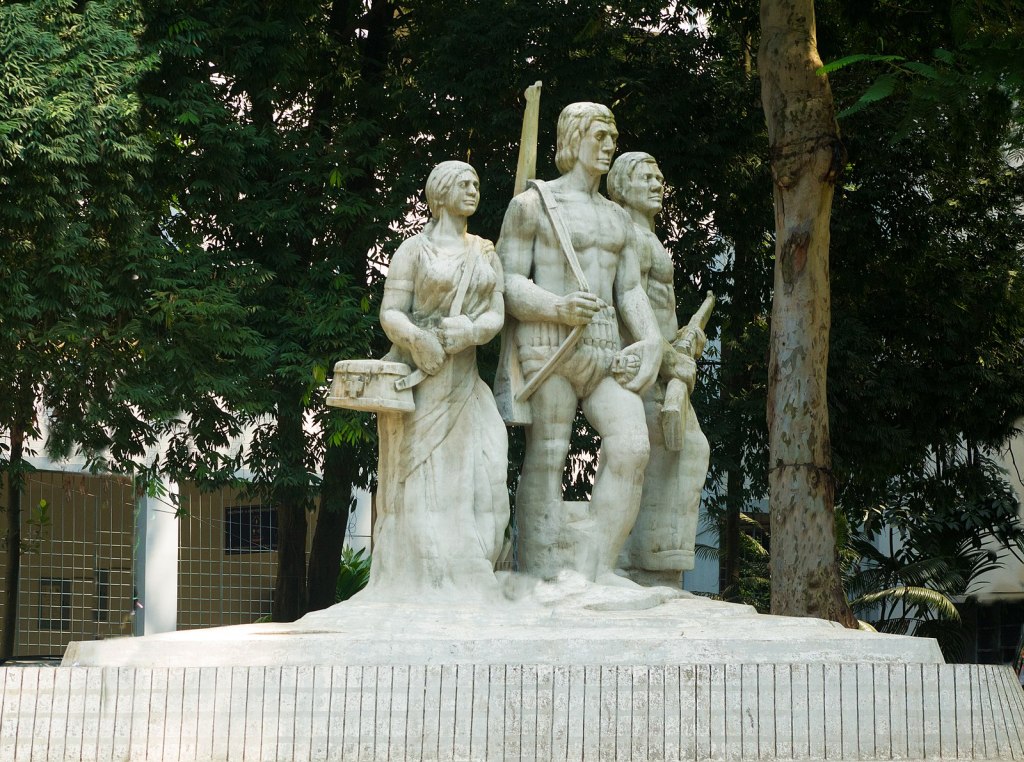
When independence finally came to Bangladesh on December 16, it was fitting that the Pakistani Army would surrender in the open space adjacent to the university known as Ramna Park. The many teachers and students who had been murdered since March 26 as well as the resistance put up by them were later commemorated with structures erected all over the campus, the most prominent of them being the “Aporajeyo Bangla” or “Invincible Bengal” sculpture in front of Kala Bhabhan or the Arts faculty building, the martyrs plaque put up opposite the central mall, and the sculpted figures of the freedom fighters erected in front of the Teachers-Students Centre. December 14 became from then on the day when the DU Liberation War martyrs were to be ceremonially remembered and December 16 the day when DU faculty and staff joined the rest of the country in celebrating Victory Day.
“Aporajeyo Bangla” or “Invincible Bengal” sculpture. Courtesy: Creative Commons
InBridge over Troubled Waters, academic Sanjay Kumar tells us about Pandies, an activist theatre group founded by him that educates, bridging gaps between the divides of University educated and the less fortunate who people slums or terror zones. Click here to read.
In Lessons Old and New from a Stray Japanese Cat, Keith Lyons talks with the author of The Cat with Three Passports, CJ Fentiman who likes the anonymity loaned by resettling in new places & enjoys creating a space for herself away from her birthplace. Click hereto read.
A transcreation of Tagore’s song, Purano Sei Diner Kotha, based on Robert Burn’s poem associated with new year’s revelries by Mitali Chakravarty. Click here to read.
Professor Fakrul Alam takes us through the three Partitions of Bengal whichultimately led to the creation of Bangladesh, with focus on the role of Dhaka University. Click hereto read.
With Christmas at our heels and the world waking up slowly from a pandemic that will hopefully become an endemic as the Omicron seems to fizzle towards a common cold, we look forward to a new year and a new world. Perhaps, our society will evolve to become one where differences are accepted as variety just as we are fine with the fact that December can be warm or cold depending on the geography of the place. People will be welcomed even if of different colours and creed. The commonality of belonging to the same species will override all other disparities…
While we have had exciting developments this year and civilians have moved beyond the Earth — we do have a piece on that by Candice Louisa Daquin — within the planet, we have become more aware of the inequalities that exist. We are aware of the politics that seems to surround even a simple thing like a vaccine for the pandemic. However, these two years dominated by the virus has shown us one thing — if we do not rise above petty greed and create a world where healthcare and basic needs are met for all, we will suffer. As my nearly eighty-year-old aunt confided, even if one person has Covid in a remote corner of the world, it will spread to all of us. The virus sees no boundaries. This pandemic was just a start. There might be more outbreaks like this in the future as the rapacious continue to exploit deeper into the wilderness to accommodate our growing greed, not need. With the onset of warmer climates — global warming and climate change are realities — what can we look forward to as our future?
Que sera sera — what will be, will be. Though a bit of that attitude is necessary, we have become more aware and connected. We can at least visualise changes towards a more egalitarian and just world, to prevent what happened in the past. It would be wonderful if we could act based on the truth learnt from history rather than to overlook or rewrite it from the perspective of the victor and use that experience to benefit our homes, planet and all living things, great and small. In tune with our quest towards a better world, we have an interview with an academic, Sanjay Kumar, founder of a group called Pandies, who use theatre to connect the world of haves with have-nots. What impressed me most was that they have actually put refugees and migrant workers on stage with their stories. They even managed to land in Kashmir and work with children from war-torn zones. They have travelled and travelled into different dimensions in quest of a better world. Travelling is what our other interviewee did too — with a cat who holds three passports. CJ Fentiman, author of The Cat with Three Passports, has been interviewed by Keith Lyons, who has reviewed her book too.
This time we have the eminent Aruna Chakravarti review Devika Khanna Narula’sBeyond the Veils, a retelling of the author’s family history. Perhaps, history has been the common thread in our reviews this time. Rakhi Dalal has reviewed Anirudh Kala’sTwo and a Half Rivers, a fiction that focusses on the Sikh issues in 1980s India from a Dalit perspective. It brought to my mind a family saga I had been recently re-reading, Alex Haley’s Roots, which showcased the whole American Revolution from the perspective of slaves brought over from Africa. Did the new laws change the fates of the slaves or Dalits? To an extent, it did but the rest as fact and fiction showcase were in the hands that belonged to the newly freed people. To enable people to step out of the cycle of poverty, the right attitudes towards growth and the ability to accept the subsequent changes is a felt need. That is perhaps where organisations like Pandies step in. Another non-fiction which highlights history around the same period and place as Kala’s novel is BP Pande’sIn the Service of Free India –Memoirs of a Civil Servant. Reviewed by Bhaskar Parichha, the book explores the darker nuances of human history filled with violence and intolerance.
That violence is intricately linked to power politics has been showcased often. But, what would be really amazing to see would be how we could get out of the cycle as a society. With gun violence being an accepted norm in one of the largest democracies of the world, perhaps we need to listen to the voice of wisdom found in the fiction by Steve Davidson who meets perhaps a ghost in Hong Kong. Musing over the ghost’s words, the past catches up in Sunil Sharma’s story, ‘Walls’. Sharma has also given us a slice from his life in Canada with its colours, vibrancy and photographs of the fall. As he emigrated to Canada, we read of immigrants in Marzia Rahman’s touching narrative. She has opted to go with the less privileged just as Lakshmi Kannan has opted to go with the privileged in her story.
Sharma observes, while we find the opulence of nature thrive in places people inhabit in Canada, it is not so in Asia. I wonder why? Why are Asian cities crowded and polluted? There was a time when Los Angeles and London suffered smogs. Has that shifted now as factories relocated to Asia, generating wealth in currency but taking away from nature’s opulence of fresh, clean air as more flock into crowded cities looking for sustenance?
Humour is introduced into the short story section with Sohana Manzoor’s hilarious rendering of her driving lessons in America, lessons given to foreigners by migrants. Rhys Hughes makes for more humour with a really hilarious rendition of men in tea cosies missing their…I think ‘TrouserHermit’ will tell you the rest. He has perhaps more sober poetry which though imaginative does not make you laugh as much as his prose. Michael Burch has shared some beautiful poetry perpetuating the calmer nuances of a deeply felt love and affection. George Freek, Anasuya Bhar, Ryan Quinn Flanagan, Dibyajyoti Sarma have all given us wonderful poetry along with many others. One could write an essay on each poem – but as we are short shrift for time, we move on to travel sagas from hiking in Australia and hobnobbing with kangaroos to renovated palaces in Bengal.
We have also travelled with our book excerpts this time. Suzanne Kamata’sThe Baseball Widowshuttles between US and Japan and Somdatta Mandal’s translation of A Bengali lady in England by Krishnabhabi Das, actually has the lady relocate to nineteenth century England and assume the dress and mannerisms of the West to write an eye-opener for her compatriots about the customs of the colonials in their own country.
While mostly we hear of sad stories related to marriages, we have a sunny one in which Alpana finds much in a marriage that runs well with wisdom learnt from Kung Fu Panda. Devraj Singh Kalsi has given us a philosophical piece with his characteristic touch of irony laced with humour on statues. If you are wondering what he could have to say, have a read.
In Nature’s Musings, Penny Wilkes has offered us prose and wonderful photographs of the last vestiges of autumn. As the season hovers between summer and winter, geographical boundaries too can get blurred at times. A nostalgic recap given by Ratnottama Sengupta along the borders of Bengal, which though still crossed by elephants freely in jungles (wild elephants do not need visas, I guess), gained an independence from the harshness of cultural hegemony on December 16th, 1971. Candice Louisa Daquin has also looked at grey zones that lie between sanity and insanity in her column. An essay which links East and West has been given to us by Rakibul Hasan about a poet who mingles the two in his poetry. A Bengali song by Tagore, Purano shei diner kotha, that is almost a perfect trans creation of Robert Burn’s Scottish Auld Lang Syne in the spirit of welcoming the New Year, has been transcreated to English. The similarity in the content of the two greats’ lyrics showcase the commonalities of love, friendship and warmth that unite all cultures into one humanity.
Our first translation from Uzbekistan – a story by Sherzod Artikov, translated from Uzbeki by Nigora Mukhammad — gives a glimpse of a culture that might be new to many of us. Akbar Barakzai’s shorter poems, translated by Fazal Baloch from Balochi and Ratnottama Sengupta’s transcreation of a Tagore song, Rangiye Die Jao, have added richness to our oeuvre along with one from Korean by Ihlwha Choi. Professor Fakrul Alam, who is well-known for his translation of poetry by Jibonanda Das, has started sharing his work on the Bengali poet with us. Pause by and take a look.
There is much more than what I can put down here as we have a bumper end of the year issue this December. There is a bit of something for all times, tastes and seasons.
I would like to thank my wonderful team for helping put together this issue. Sohana Manzoor and Sybil Pretious need double thanks for their lovely artwork that is showcased in our magazine. We are privileged to have committed readers, some of who have started contributing to our content too. A huge thanks to all our contributors and readers for being with us through our journey.
I wish you a very Merry Christmas and a wonderful transition into the New Year! May we open up to a fantastic brave, new world!







 Borderless