Categories
Review

Connecting Diverse Cultures and Generations

Book review by Bhaskar Parichha
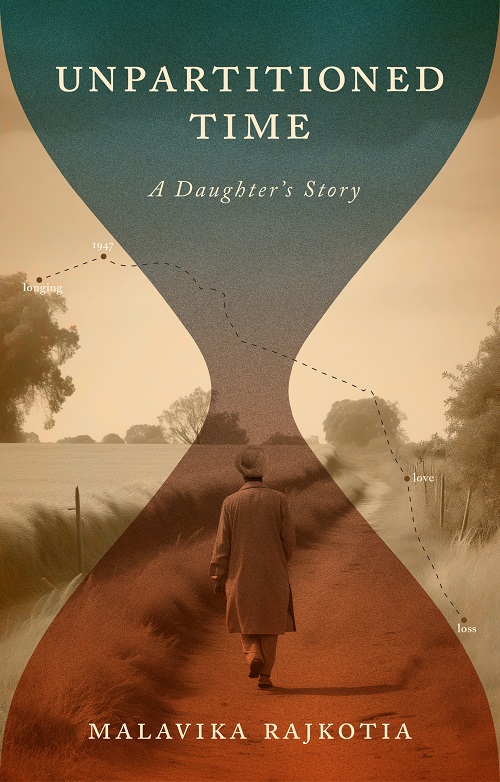
 

Title: Unpartioned Time: A Daughter’s Story 

Author: Malvika Rajkotia

Publisher: Speaking Tiger Books

Malavika Rajkotia is a prominent divorce attorney based in Delhi. She has collaborated with numerous non-governmental organisations addressing civil liberties and human rights concerns. Additionally, she has a strong background in theatre, participating in approximately thirty productions in both Hindi and English. She has also served as the host of Shakti, the inaugural television talk show in India dedicated to women’s rights.

Her memoir, Unpartitioned Time: A Daughter’s Story, is a complex tale that intertwines the history and current experiences of a family following the Partition. Jindo, Malavika Rajkotia’s father, arrives in India amidst the chaos of the Partition riots. He is allocated a piece of desolate land in the small town of Karnal, where he must clear and cultivate the land to reclaim his role as landlord and patriarch. However, devoid of his past and confronted with an uncertain future in a place where the language is foreign to him, he undergoes a significant transformation. Rajkotia intricately weaves a narrative around this generous, humorous, loving, and increasingly despondent figure, delving into her family’s history and present.

The story explores themes of yearning and belonging, the nature of privilege and its loss, while reflecting on the resilience of a people stripped of their autonomy. Through her evocative and lyrical writing, she leads readers through the challenges faced by a large family—comprising uncles, aunts, siblings, cousins, and esteemed figures—who are all in pursuit of recognition, identity, and stability.

Rajkotia fearlessly confronts her milieu, whether navigating the radical Khalistan movement, the tensions between the Sikh faith and Hindu nationalism, or the pervasive cynicism of Indian politics. Her vivid, meditative, finely detailed portraits of a rich family life are filled with moments of tears, laughter, and music, and a diverse array of characters who are immensely relatable. Ultimately, this brave and moving book is about the enduring quest for meaning and fulfilment that transcends cultural boundaries.

Narrates Rajkotia: “The diffused light of dawn lit a dull, flat landscape cut by the highway, gleaming under randomly spaced streetlights. Until about thirty years ago, this single carriageway witnessed an almost daily carnage that left heavy and light motor vehicles, bicyclists, and bullock carts in confused mangles. Everyone had a personal story of loss on this road. Three of my family was killed in two separate accidents. A splintered windshield glass lodged in a young girl’s throat. An aunt and cousin died when their car rammed into a truck to avoid a cyclist.”

She has a detailed account of the road in Karnal town thus: “For over 2,500 years, this road has streamed with traders from Central Asia, scholars from China, adventurers from Europe, sadhus from the Himalayas, and armies coveting Hindustan. This portion of the road was the battlefield of the story of the eighteen-day Mahabharata war, marking the cusp of the end of the Dwapar Yuga and the rise of the Kali Yuga. Eighteen days of soldiers’ cries and trumpeting elephants and neighing horses, each ending with sunsets blackened by smoke from the funeral pyres hanging heavy until impelled by the sounds of wailing women.

“From myth, we come to somewhat recorded history in 300 BCE, when Chandragupta Maurya built this road to connect his fast-growing kingdom, spanning the north of the subcontinent from the source of the Ganga to its northwestern limits. The road was developed by Sher Shah Suri. My father remembered the time when it was called ‘Jarnailly Sadak’ under the British, and then GT Road, its official name, The Grand Trunk Road. The government of independent India called it Sher Shah Suri Marg, the Sanskrit ‘marg’ guillotining the English ‘road’ and the Urdu ‘sadak’.”

The memoir stands as a testament to the power of storytelling in bridging gaps between cultures and generations, ensuring that the voices of those who experienced Partition are heard and remembered. As part of the growing body of literature on this subject, it encourages further exploration and discussion, ultimately contributing to a more nuanced understanding of the complexities surrounding Partition and its enduring legacy.

.

Bhaskar Parichha is a journalist and author of UnbiasedNo Strings Attached: Writings on Odisha and Biju Patnaik – A Political Biography. He lives in Bhubaneswar and writes bilingually. Besides writing for newspapers, he also reviews books on various media platforms.

.

PLEASE NOTE: ARTICLES CAN ONLY BE REPRODUCED IN OTHER SITES WITH DUE ACKNOWLEDGEMENT TO BORDERLESS JOURNAL

Click here to access the Borderless anthology, Monalisa No Longer Smiles

Click here to access Monalisa No Longer Smiles on Amazon International

Categories
Contents

Borderless, December 2023

Art by Sohana Manzoor

Editorial

Celebrating the Child & Childhood… Click here to read.

Special Tributes

An excerpt from Rabindranath Tagore’sThe Child‘, a poem originally written in English by the poet. Click here to read.

Vignettes from an Extraordinary Life: A Historical Dramatisation by Aruna Chakravarti… Click here to read.

Conversations

A conversation with the author, Afsar Mohammed, and a brief introduction to his latest book, Remaking History: 1948 Police Action and the Muslims of Hyderabad. Click here to read.

A conversation with Meenakshi Malhotra over The Gendered Body: Negotiation, Resistance, Struggle, edited by Meenakshi Malhotra, Krishna Menon and Rachana Johri and a brief introduction to the book. Click here to read.

Translations

The Monk Who Played the Guitar, a story by S Ramakrishnan, has been translated from Tamil by T Santhanam. Click here to read.

The White-Coloured Book, a poem by Quazi Johirul Islam has translated from Bengali by Professor Fakrul Alam. Click here to read.

Indecisiveness has been written and translated from Korean by Ihlwha Choi. Click here to read.

Tagore’s 1400 Saal (The Year 1993) has been translated from Bengali by Mitali Chakravarty. Click here to read.

Nazrul’s rejoinder to Tagore’s 1400 Saal has been translated from Bengali by Professor Fakrul Alam. Click here to read.

Poetry

Click on the names to read the poems

Ron Pickett, Prithvijeet Sinha, George Freek, Sutputra Radheye, Caroline Am Bergris, Thoyyib Mohammad, Kumar Bhatt, Patricia Walsh, Hamza Azhar, John Grey, Papia Sengupta, Stuart McFarlane, Padmanabha Reddy, Ryan Quinn Flanagan, Jee Leong Koh, Rhys Hughes

Poets, Poetry & Rhys Hughes

In His Unstable Shape, Rhys Hughes explores the narratives around a favourite nursery rhyme character with a pinch of pedantic(?) humour. Click here to read.

Musings/ Slices from Life

Trojan Island

Nitya Amalean writes of why she chooses to be an immigrant living out of Sri Lanka. Click here to read.

Wayward Wayanad

Mohul Bhowmick travels to the tea gardens and hills of Wayanad. Click here to read.

Musings of a Copywriter

In Visiting Cards & Me…, Devraj Singh Kalsi ponders on his perspective on the need and the future for name cards. Click here to read.

Notes from Japan

In Kyoto: Where the Cuckoo Calls, Suzanne Kamata introduces us to Kyoto. Click here to read.

Essays

Peeking at Beijing: The Epicentre of China

Keith Lyons travels to the heart of Beijing with a sense of humour and a camera. Click here to read.

To Be or Not to Be or the Benefits of Borders

Wendy Jones Nakanishi argues in favour of walls with wit and facts. Click here to read.

Where Eagles Soar

Ravi Shankar gives a photographic treat and a narrative about Langkawi. Click here to read.

Stories

Heather Richards’ Remarkable Journey

Paul Mirabile journeys into a womb of mystery set in Thailand. Click here to read.

The Untold Story

Neeman Sobhan gives us the story of a refugee from the 1971 Bangladesh Liberation War. Click here to read.

Wrath of the Goddess?

Farouk Gulsara narrates a story set in 1960s Malaya. Click here to read.

No Man’s Land

Sohana Manzoor gives us surrealistic story reflecting on after-life. Click here to read.

Book Excerpts

An excerpt from Dr Ratna Magotra’s Whispers of the Heart – Not Just A Surgeon: An Autobiography. Click here to read.

An excerpt from Manjima Misra’s The Ocean is Her Title. Click here to read.

Book Reviews

Somdatta Mandal reviews Indian Christmas: Essays, Memoirs, Hymns, an anthology edited by Jerry Pinto and Madhulika Liddle. Click here to read.

Christopher Marks reviews Veronica Eley’s The Blue Dragonfly: healing through poetry. Click here to read.

Basudhara Roy reviews Kuhu Joshi’s My Body Didn’t Come Before Me. Click here to read.

Bhaskar Parichha reviews Permacrisis: A Plan to Fix a Fractured World by Gordon Brown, Mohamed El-Erian, Michael Spence, Reid Lidow 

.

Click here to access the Borderless anthology, Monalisa No Longer Smiles

Click here to access Monalisa No Longer Smiles on Kindle Amazon International

Categories
Contents

Borderless September 2023

Art by Sohana Manzoor

Editorial

What do They Whisper?… Click here to read.

Conversations

Shantanu Ray Chaudhuri in conversation with M.S. Viraraghavan and Girija Viraraghavan ( grand daughter of President Sarvepalli Radhakrishnan) on their new book, Roses in the Fire of Spring: Better Roses for a Warming World and Other Garden Adventures. Click here to read.

In conversation with Isa Kamari, a celebrated writer from Singapore, with focus on his latest book, Maladies of the Soul. Click here to read.

Translations

A Hunger for Stories, a poem by Quazi Johirul Islam, has been translated by Professor Fakrul Alam. Click here to read.

A Hand Mill, a story by Ammina Srinivasaraju, has been translated from Telugu by Johny Takkedasila. Click here to read.

Kiyya and Sadu, a part of this long ballad on the legendary lovers from Balochistan, has been translated from Balochi by Fazal Baloch. Click here to read.

The Time for the Janitor to Pass by, poetry written in Korean and translated by Ilhwah Choi. Click here to read.

Sharat or Autumn, a poem by Tagore, has been translated from Bengali by Mitali Chakravarty. Click here to read.

Poetry

Click on the names to read the poems

Jared Carter, Rhys Hughes, Santosh Bakaya, Luis Cuauhtémoc Berriozábal, Sagar Mal Gupta, Nirmala Pillai, George Freek, Pramod Rastogi, Peter Devonald, Afshan Aqil, Hela Tekali, Swarnendu Ghosh, Alpana, Michael Burch

Poets, Poetry & Rhys Hughes

In Tintin in India, Rhys Hughes traces the allusions to India in these iconic creations of Hergé while commenting on Tintin’s popularity in the subcontinent. Click here to read.

Musings/Slices from Life

Black Pines and Red Trucks

Meredith Stephens shares the response of some of the Californian community to healing after the 2020 forest fires with a narrative and photographs. Click here to read.

Remembering Jayanta Mahapatra

KV Raghupathi travels down nostalgia with his memories of interactions with the recently deceased poet and his works. Click here to read.

The Toughness of Kangaroo Island 

Vela Noble draws solace and lessons from nature around her with her art and narrative. Click here to read.

Where is Your Home?

Madhulika Vajjhala explores her concept of home. Click here to read.

A Homecoming like No Other

Saumya Dwivedi gives a heartwarming anecdote from life. Click here to read.

Musings of a Copywriter

In Hair or There: Party on My Head, Devraj Singh Kalsi explores political leanings and hair art. Click here to read.

Notes from Japan

In Against Invisibility, Suzanne Kamata challenges traditions that render a woman invisible with a ‘sparkling’ outcome. Click here to read.

Essays

Jayanta Mahapatra: A Tribute to a Poetic Luminary

Dikshya Samantrai pays tribute to a poet who touched hearts across the world with his poetry. Click here to read.

Celebrating the novel… Where have all the Women Writers Gone?

G Venkatesh writes about a book from 1946. Click here to read.

Chandigarh: A City with Spaces

Ravi Shankar travels back to Chandigarh of 1990s. Click here to read.

The Observant Immigrant

In Climate Change: Are You for Real?, Candice Louisa Daquin explores the issue. Click here to read.

Stories

The Infamous Art Dealer

Paul Mirabile travels through Europe with an art scammer. Click here to read.

Getting Old is like Climbing a Mountain

Saranyan BV explores aging and re-inventing homes. Click here to read.

The Airport

Prakriti Bandhan shares a short, whimsical narrative. Click here to read.

Book Excerpts

An excerpt from Syed Mujtaba Ali’s Tales of a Voyager (Joley Dangay), translated by Nazes Afroz. Click here to read.

An excerpt from Sanket Mhatre’s A City Full of Sirens. Click here to read.

Book Reviews

Somdatta Mandal reviews Begum Hazrat Mahal: Warrior Queen of Awadh by Malathi Ramachandran. Click here to read.

Basudhara Roy reviews Sanket Mhatre’s A City Full of Sirens. Click here to read.

Bhaskar Parichha reviews Samragngi Roy’s The Wizard of Festival Lighting: The Incredible Story of Srid. Click here to read.

.

Click here to access the Borderless anthology, Monalisa No Longer Smiles

Click here to access Monalisa No Longer Smiles on Kindle Amazon International

Categories
Contents

Borderless August 2023

Art by Sohana Manzoor

Editorial

Other Echoes in the Garden… Click here to read.

Interviews

Ujjal Dosanjh, former Minister from Canada and former Premier of British Columbia, discusses his autobiography, Journey After Midnight – A Punjabi Life: From India to Canada, and the need for a world with less borders. Click here to read.

Professor Fakrul Alam discusses his new book of Tagore translations, Gitabitan: Selected Song-Lyrics of Rabindranath Tagore. Click here to read.

Translations

Tagore’s Musalmanir Galpa (A Muslim Woman’s Story) has been translated from Bengali by Aruna Chakravarti. Click here to read.

Masud Khan’s poem, In Another Galaxy, has been translated from Bengali by Professor Fakrul Alam. Click here to read.

Wakeful Stays the Door, a poem by Munir Momin, has been translated from Balochi by Fazal Baloch. Click here to read.

Dangerous Coexistence, written in Korean and translated by Ilhwah Choi. Click here to read.

Proshno or Questions by Tagore has been translated by Mitali Chakravarty. Click here to read.

Pandies Corner

Songs of Freedom: An Ordinary Tale is a narrative by Nandani based on her own experiences, translated from Hindustani by Janees. These narrations highlight the ongoing struggle against debilitating rigid boundaries drawn by societal norms, with the support from organisations like Shaktishalini and Pandies. Click here to read.

Poetry

Click on the names to read the poems

Jared Carter, Rhys Hughes, Malachi Edwin Vethamani, Luis Cuauhtémoc Berriozábal, Saranyan BV, Ryan Quinn Flanagan, A Jessie Michael, Jahnavi Gogoi, George Freek, Koushiki Dasgupta Chaudhuri, David Francis, Akil Contractor, Michael Burch

Poets, Poetry & Rhys Hughes

In An Experiment with Automatic Poetic Translation, Rhys Hughes auto translates an English poem sequentially through 28 languages and then back to English with hilarious results. Click here to read.

Musings/ Slices from Life

Mister, They’re Coming Anyway

Timothy Jay Smith writes on the refugee crisis in Lesbos Island, Greece with photographs by Michael Honegger. Click here to read.

Migrating to Myself from Kolkata to Singapore

Asad Latif explores selfhood in context of diverse geographies. Click here to read.

Islands that Belong to the Seas

Paul Mirabile muses on how humans are like migrants on islands borrowed from the seas. Click here to read.

Of Dreams, Eagles and Lost Children

Aysha Baqir muses on the narrow, closed borders that condemn children. Click here to read.

Mushroom Clouds and Movies: Response from a Hibakusha’s Daughter

Kathleen Burkinshaw discusses Oppenhiemer the movie. Click here to read.

Sleepless in the High Desert, Slumber in the Sierra

Meredith Stephens covers Nevada to Columbia in a car with her camera. Click here to read.

My Hostel Days

Ravi Shankar reminisces on bygone days. Click here to read.

Musings of a Copywriter

In The Amateur Professional, Devraj Singh Kalsi writes of a amateur who thought of himself as a professional. Click here to read.

Notes from Japan

In How I Wound Up in Japan, Suzanne gives her story as an immigrant. Click here to read.

Essays

A Different Persuasion: On Jane Austen’s Novels & their Adaptations

Deepa Onkar delves into the world of Jane Austen books and films. Click here to read.

A Foray into Andamans

Mohul Bhowmik explores Andaman with a camera and narrative. Click here to read.

Bhaskar’s Corner

In Chittaranjan Das: A Centenary Tribute, Bhaskar Parichha discusses the life of one of the most legendary Odia writers. Click here to read.

Stories

Belacan

Farouk Gulsara shares a story based on the life of a migrant in 1950s. Click here to read.

The Japanese Maple

Shivani Shrivastav weaves a story of friendship and loneliness among migrants. Click here to read.

The Coin

Khayma Balakrishnan explores human and supernatural interactions in a school setting in Malaysia. Click here to read.

The Vagrant

Reeti Jamil narrates a strange tale set in a village and told by a farmer. Click here to read.

Book Excerpts

An excerpt from Ujjal Dosanjh’s Journey After Midnight: A Punjabi Life from Canada to India. Click here to read.

An excerpt from Roses in the Fire of Spring: Better Roses for a Warming World and Other Garden Adventures, by M.S. Viraraghavan and Girija Viraraghavan. Click here to read.

Book Reviews

Somdatta Mandal reviews Amitav Ghosh’s Smoke and Ashes: A Writer’s Journey Through Opium’s Hidden Histories. Click here to read.

Basudhara Roy reviews Greening the Earth: A Global Anthology of Poetry, edited by K. Satchidanandan & Nishi Chawla. Click here to read.

Bhaskar Parichha reviews Arunava Sinha’s The Greatest Indian Stories Ever Told: Fifty Masterpieces from the Nineteenth Century to the Present. Click here to read.

.

Click here to access the Borderless anthology, Monalisa No Longer Smiles

Click here to access Monalisa No Longer Smiles on Kindle Amazon International

Categories
Editorial

Other Echoes in the Garden…

“Other echoes
Inhabit the garden. Shall we follow?
Quick, said the bird, find them, find them…”

— TS Eliot, ‘Four Quartets: Burnt Norton’(1936)

Humans have always been dreamers, ideators and adventurers.

Otherwise, could we have come this far? From trees to caves to complex countries and now perhaps, an attempt to reach out towards outer space for an alternative biome as exploring water, in light of the recent disaster of the Titan, is likely to be tougher than we imagined. In our attempt to survive, to live well by creating imagined constructs, some fabrications backfired. Possibly because, as George Orwell observed with such precision in Animal Farm, some perceived themselves as “more equal”. Of course, his was an animal allegory and we are humans. How different are we from our brethren species on this beautiful planet, which can survive even without us? But can humanity survive without Earth? In science fiction, we have even explored that possibility and found home among stars with the Earth becoming uninhabitable for man. However, humanity as it stands of now, continues to need Earth. To live amicably on the planet in harmony with nature and all the species, including our own, we need to reimagine certain constructs which worked for us in the past but seem to have become divisive and destructive at this point.

Ujjal Dosanjh, former Minister in the Canadian cabinet and former Premier of British Columbia, in his autobiography, Journey After Midnight – A Punjabi Life: From India to Canada, talks of regionalism as an alternative to narrow divisive constructs that terrorise and hurt others. He writes in his book: “If humanity isn’t going to drown in the chaos of its own creation, the leading nations of the world will have to create a new world order, which may involve fewer international boundaries.” We have a candid conversation with him about his beliefs and also a powerful excerpt from his autobiography.

An interview with Professor Fakrul Alam takes us into Tagore’s imagined world. He discussed his new book of Tagore translations, Gitabitan: Selected Song-Lyrics of Rabindranath Tagore. He has brought out a collection of 300 songs translated to English. In a bid to emphasise an inclusive world, we also have a translation of Tagore’s ‘Musalmanir Galpa’ (A Muslim Woman’s Story) by Aruna Chakravarti. A transcreation of his poem, called ‘Proshno or Questions’ poses difficult challenges for humanity to move towards a more inclusive world. Our translation by Ihlwha Choi of his own Korean poem to English also touches on his visit to the polymath’s construct in the real world, Santiniketan. All of these centring around Tagore go to commemorate the month in which he breathed his last, August. Professor Alam has also translated a poem from Bengali by Masud Khan that has futuristic overtones and builds on our imagined constructs. From Fazal Baloch we have a Balochi translation of a beautiful, almost a surrealistic poem by Munir Momin.

The poetry selections start with a poem on ‘Wyvern’, an imagined dragon, by Jared Carter. And moves on to the plight of refugees by Michael Burch, A Jessie Michael, and on migrants by Malachi Edwin Vethamani. Ryan Quinn Flanagan has poetry that suggests the plight of refugees at a metaphorical level. Vibrant sprays of colours are brought into this section by Luis Cuauhtémoc Berriozábal, Saranyan BV, Jahnavi Gogoi, George Freek and many more. Rhys Hughes brings in a spot of humour with his mountainous poetry (literally) and a lot of laughter with his or rather Google’s attempt at automatic translation of a poem. Devraj Singh Kalsi has shared a tongue in cheek story about an ‘amateur professional’ — rather a dichotomy.

We travel to Andaman with Mohul Bhowmick and further into Sierra with Meredith Stephens. Ravi Shankar travels back in nostalgia to his hostel and Kathleen Burkinshaw dives into the past — discussing and responding to the media presentation of an event that left her family scarred for life, the atomic holocaust of 1945 in Japan. This was a global event more than seven decades ago that created refugees among the survivors whose homes had been permanently destroyed. Perhaps, their stories are horrific, and heart wrenching like the ones told by those who suffered from the Partition of India and Pakistan, a divide that is celebrated by Independence Days for the two nations based on a legacy of rifts created by the colonials and perpetrated to this day by powerbrokers. Aysha Baqir has written of the wounds suffered by the people with the governance gone awry. Some of the people she writes of would have been refugees and migrants too.

A poignant narrative about refugees who flock to the Greek island of Lesbos by Timothy Jay Smith with photographs by Michael Honegger, both of whom served at the shelters homing the displaced persons, cries out to halt wars and conflicts that displace them. We have multiple narratives of migrants in this issue, with powerful autobiographical stories told by Asad Latif and Suzanne Kamata. Paul Mirabile touches on how humans have adopted islands by borrowing them from seas… rather an unusual approach to migrations. We have an essay on Jane Austen by Deepa Onkar and a centenary tribute to Chittaranjan Das by Bhaskar Parichha.

The theme of migrants is echoed in stories by Farouk Gulsara and Shivani Shrivastav. Young Nandani has given an autobiographical story, translated from Hindustani to English by Janees, in which a migration out of various homes has shredded her family to bits — a narrative tucked in Pandies Corner.  Strange twists of the supernatural are woven into fiction by Khayma Balakrishnan and Reeti Jamil.

In reviews, Parichha has explored Arunava Sinha’s The Greatest Indian Stories Ever Told: Fifty Masterpieces from the Nineteenth Century to the Present. Somdatta Mandal’s review of Amitav Ghosh’s Smoke and Ashes: A Writer’s Journey Through Opium’s Hidden Histories seems to be an expose on how historical facts can be rewritten to suit different perceptions and Basudhara Roy has discussed the Greening the Earth: A Global Anthology of Poetry, edited by K. Satchidanandan and Nishi Chawla.

There is more wonderful content. Pop by our August’s bumper edition to take a look.

I would like to give my grateful thanks to our wonderful team at Borderless, especially to Sohana Manzoor for her fabulous artwork. Huge thanks to all our gifted contributors and our loyal readers. Borderless exists today because of all of you are making an attempt to bringing narratives that build bridges, bringing to mind Lennon’s visionary lyrics:

You may say I'm a dreamer
But I'm not the only one
I hope someday you'll join us
And the world will live as one

Thank you for joining us at Borderless Journal.

Have a wonderful month!

Mitali Chakravarty

borderlessjournal.com

.

Visit the August edition’s content page by clicking here

READ THE LATEST UPDATES ON THE FIRST BORDERLESS ANTHOLOGY, MONALISA NO LONGER SMILES, BY CLICKING ON THIS LINK.

Categories
Contents

Borderless June 2023

Art by Sohana Manzoor

Editorial

Where have All the People Gone? … Click here to read.

Translations

Hena, a short story by Nazrul, has been translated from Bengali by Sohana Manzoor. Click here to read.

Mohammad Ali’s Signature, a short story by S Ramakrishnan, has been translated from Tamil by Dr B Chandramouli. Click here to read.

Three poems by Masud Khan have been translated from Bengali by Professor Fakrul Alam. Click here to read.

Shadows, a poem in Korean, has been translated by the poet himself, Ihlwha Choi. Click here to read.

Pran or Life by Tagore has been translated from Bengali by Mitali Chakravarty. Click here to read.

Conversations

Shantanu Ray Chaudhuri converses with Vinta Nanda about the Shout, a documentary by Vinta Nanda that documents the position of women in Indian society against the backdrop of the #MeToo movement and centuries of oppression and injustice. Click here to read.

In Conversation with Advait Kottary about his debut historic fiction, Siddhartha: The Boy Who Became the Buddha. Click here to read.

Poetry

Click on the names to read the poems

Michael Burch, Ananya Sarkar, George Freek, Smitha Sehgal, Rachel Jayan, Michael Lee Johnson, Sayantan Sur, Ron Pickett, Saranyan BV, Jason Ryberg, Priya Narayanan, Ryan Quinn Flanagan, Evangeline Zarpas, Ramesh Karthik Nayak, Rhys Hughes

Poets, Poetry & Rhys Hughes

In Ghee-Wizz, Rhys Hughes talks of the benefits of Indian sweets while wooing Yetis. Click here to read.

Musings/Slices from Life

Humbled by a Pig

Farouk Gulsara meets a wild pig while out one early morning and muses on the ‘meeting’. Click here to read.

Spring Surprise in the Sierra

Meredith Stephens takes us hiking in Sierra Nevada. Click here to read.

Lemon Pickle without Oil

Raka Banerjee indulges in nostalgia as she tries her hand at her grandmother’s recipe. Click here to read.

Apples & Apricots in Alchi

Shivani Shrivastav bikes down to Alchi Ladakh to find serenity and natural beauty. Click here to read.

Musings of a Copywriter

In Trees from my Childhood, Devraj Singh Kalsi muses on his symbiotic responses to trees that grew in their home. Click here to read.

Notes from Japan

In Superhero Sunday in Osaka, Suzanne Kamata writes of her experience at the Osaka Comic Convention with her daughter. Click here to read.

Stories

The Trial of Veg Biryani

Anagha Narasimha gives us a social satire. Click here to read.

Am I enough?

Sarpreet Kaur explores social issues in an unusual format. Click here to read.

Arthur’s Subterranean Adventure

Paul Mirabile journeys towards the centre of the Earth with his protagonist. Click here to read.

Essays

No Bucket Lists, No Regrets

Keith Lyons muses on choices we make while living. Click here to read.

In Search of the Perfect Dosa

Ravi Shankar trots around the world in quest of the perfect dosa — from South India to Aruba and West Indies. Click here to read.

“Bookshops don’t fail. Bookshops run by lazy booksellers fail.”

Shantanu Ray Chaudhuri takes us for a tour of the Kunzum bookstore in New Delhi. Click here to read.

Book Excerpts

An excerpt from Greening the Earth: A Global Anthology of Poetry, edited by K. Sachitanandan and Nishi Chawla. Click here to read.

An excerpt from Advait Kottary’s Siddhartha: The Boy Who Became the Buddha. Click here to read.

Book Reviews

Somdatta Mandal reviews Behind Latticed Marble: Inner Worlds of Women by Jyotirmoyee Devi Sen, translated from Bengali by Apala G. Egan. Click here to read.

Rakhi Dalal reviews Rhys Hughes’ The Wistful Wanderings of Perceval Pitthelm. Click here to read.

Basudhara Roy reviews Prerna Gill’s Meanwhile. Click here to read.

Bhaskar Parichha reviews Zac O’Yeah’s Digesting India: A Travel Writer’s Sub-Continental Adventures With The Tummy (A Memoir À La Carte). Click here to read.

.

PLEASE NOTE: ARTICLES CAN ONLY BE REPRODUCED IN OTHER SITES WITH DUE ACKNOWLEDGEMENT TO BORDERLESS JOURNAL

Click here to access the Borderless anthology, Monalisa No Longer Smiles

Click here to access Monalisa No Longer Smiles on Kindle Amazon International

Categories
Editorial

Where have All the People Gone?

Courtesy: Creative Commons

Can humankind ever stop warring and find peace?

Perhaps, most sceptics will say it is against human nature to stop fighting and fanning differences. The first recorded war was fought more than 13,000 years ago in what is now a desert but was green long ago. Nature changed its face. Continents altered over time. And now again, we are faced with strange shifts in climate that could redefine not just the dimensions of the surface area available to humankind but also our very physical existence. Can we absorb these changes as a species when we cannot change our nature to self-destruct for concepts that with a little redefining could move towards a world without wars leading to famines, starvation, destruction of beautiful edifices of nature and those built by humankind? That we could feed all of humans — a theory that won economist Abhijit Banerjee his Nobel Prize in 2019 so coveted by all humanity — almost seems to have taken a backseat. This confuses — as lemmings self-destruct…do humans too? I would have thought that all humanity would have moved towards resolving hunger and facing the climate crises post-2019 and post-pandemic, instead of killing each other for retaining constructs created by powerbrokers.

In the timeless lyrics of ‘Imagine’, John Lennon found peace by suggesting we do away with manmade constructs which breed war, anger and divisions and share the world as one. Wilfred Owen and many writers involved in the World Wars wrote to showcase the desolation and the heartfelt darkness that is brought on by such acts. Nazrul also created a story based on his experience in the First World War, ‘Hena’, translated for us by Sohana Manzoor. Showcasing the downside of another kind of conflict, a struggle to survive, is a story with a distinctive and yet light touch from S Ramakrishnan translated from Tamil by B Chandramouli. And yet in a conflict-ridden world, humans still yearn to survive, as is evident from Tagore’s poem Pran or ‘Life’. Reflecting it is the conditioning that we go through from our birth that makes us act as we do are translations by Professor Fakrul Alam of Masud Khan’s poetry and from Korean by Ihlwha Choi.

A figure who questioned his own conditioning and founded a new path towards survival; propounded living by need, and not greed; renounced violence and founded a creed that has survived more than 2500 years, is the man who rose to be the Buddha. Born as Prince Siddhartha, he redefined the norms with messages of love and peace. Reiterating the story of this legendary human is debutante author, Advait Kottary with his compelling Siddhartha: The Boy Who Became the Buddha, a book that has been featured in our excerpts too. In an interview, Kottary tells us more of what went into the making of the book which perhaps is the best survivor’s guide for humanity — not that we need to all become Buddhas but more that we need to relook at our own beliefs, choices and ways of life.

Another thinker-cum-film maker interviewed in this edition is Vinta Nanda for her film Shout, which highlights and seeks resolutions for another kind of crisis faced by one half of the world population today. She has been interviewed and her documentary reviewed by Shantanu Ray Chaudhuri. Chaudhuri has also given us an essay on a bookshop called Kunzum which continues to expand and go against the belief we have of shrinking hardcopy markets.

The bookshop has set out to redefine norms as have some of the books featured in our reviews this time, such as Rhys Hughes’ latest The Wistful Wanderings of Perceval Pitthelm. The reviewed by Rakhi Dalal contends that the subtitle is especially relevant as it explores what it says — “The Absurdity of Existence and The Futility of Human Desire” to arrive at what a person really needs. Prerna Gill’s Meanwhile reviewed by Basudhara Roy and poetry excerpted from Greening the Earth: A Global Anthology of Poetry, edited by K. Satchidanandan and Nishi Chawla, also make for relooking at the world through different lenses. Somdatta Mandal has written about Behind Latticed Marble: Inner Worlds of Women by Jyotirmoyee Devi Sen, translated by Apala G. Egan and Bhaskar Parichha has taken us on a gastronomic tour with Zac O’Yeah’s Digesting India: A Travel Writer’s Sub-Continental Adventures with the Tummy (A Memoir À La Carte).

Gastronomical adventures seem to be another concurrent theme in this edition. Rhys Hughes has written of the Indian sweets with gulab jamun as the ultimate life saver from Yetis while trekking in the Himalayas! A musing on lemon pickle by Raka Banerjee and Ravi Shankar’s quest for the ultimate dosa around the world — from India, to Malaysia, to Aruba, Nepal and more… tickle our palate and make us wonder at the role of food in our lives as does the story about biryani battles by Anagaha Narasimha.

Talk of war, perhaps, conjures up gastronomic dreams as often scarcity of food and resources, even potable water and electricity is a reality of war or conflict. Michael Burch brings to us poignant poetry about war as Ramesh Karthik Nayak has a poem on a weapon used in wars. Ryan Quinn Flanagan has brought another kind of ongoing conflict to our focus with his poetry centring on the National Day (May 5th) in Canada for Vigils for Missing and Murdered Indigenous Women by hanging red clothes from trees, an issue that perhaps has echoes of Vinta Nanda’s Shout and Suzanne Kamata’s poetry for her friend who went missing decades ago as opposed to Rachel Jayen’s defiant poetry where she asserts her womanhood. Ron Pickett, George Freek and Sayantan Sur have given us introspective perspectives in verse. We have more poetry asking for a relook at societal norms with tongue-in -cheek humour by Jason Ryberg and of course, Rhys Hughes with his heartfelt poem on raiders in deserts.

The piece that really brought a smile to the lips this time was Farouk Gulsara’s ‘Humbled by a Pig’, a humorous recount of man’s struggles with nature after he has disrupted it. Keith Lyons has taken a look at the concept of bucket lists, another strange construct, in a light vein. Devraj Singh Kalsi has given a poignant and empathetic piece about trees with a self-reflective and ironic twist. We have narratives from around the world with Suzanne Kamata taking us to Osaka Comic Convention, Meredith Stephens to Sierra Nevada and Shivani Shrivastav to Ladakh. Paul Mirabile has travelled to the subterranean world with his fiction, in the footsteps perhaps of Jules Verne but not quite.

We are grateful to all our wonderful contributors some of whom have not been mentioned here but their works were selected because they truly enriched our June edition. Do visit our contents page to meet and greet all our wonderful authors. I would like to thank the team at Borderless without whose efforts and encouragement our journal would not exist and Sohana Manzoor especially for her fantastic artwork as well. Thank you all.

Wish you another lovely month of interesting reads!

Mitali Chakravarty

borderlessjournal.com

.

READ THE LATEST UPDATES ON THE FIRST BORDERLESS ANTHOLOGY, MONALISA NO LONGER SMILES, BY CLICKING ON THIS LINK.

Categories
Editorial

Dancing in May?

Courtesy: Creative Commons
“May is pretty, May is mild,
Dances like a happy child…”

Annette Wynne (Early twentieth century)

Each month is expressed in a different form by nature in various parts of the world. In the tropics, May is sweltering and hot — peak summer. In the Southern hemisphere, it is cold. However, with climate change setting in, the patterns are changing, and the temperatures are swinging to extremes. Sometimes, one wonders if this is a reflection of human minds, which seem to swing like pendulums to create dissensions and conflicts in the current world. Nothing seems constant and the winds of change have taken on a menacing appearance. If we go by Nazrul’s outlook, destruction is a part of creating a new way of life as he contends in his poem, ‘Ring Bells of Victory’ — “Why fear destruction? It’s the gateway to creation!” Is this how we will move towards ‘dancing like a happy child’?

Mitra Phukan addresses this need for change in her novel, What Will People Say — not with intensity of Nazrul nor in poetry but with a light feathery wand, more in the tradition of Jane Austen. Her narrative reflects on change at various levels to explore the destruction of old customs giving way to new that are more accepting and kinder to inclusivity, addressing issues like widow remarriage in conservative Hindu frameworks, female fellowship and ageing as Phukan tells us in her interview. Upcoming voice, Prerna Gill, lauded by names like Arundhathi Subramaniam and Chitra Divakaruni, has also been in conversation with Shantanu Ray Choudhuri on her book of verses, Meanwhile. She has refreshing perspectives on life and literature.

Poetry in Borderless means variety and diaspora. Peter Cashorali’s poem addresses changes that quite literally upend the sky and the Earth! Michael Burch reflects on a change that continues to evolve – climate change. Ryan Quinn Flanagan explores societal irritants with irony. Seasons are explored by KV Raghupathi and Ashok Suri. Wilda Morris brings in humour with universal truths. William Miller explores crime and punishment. Lakshmi Kannan and Shahriyer Hossain Shetu weave words around mythical lore. We have passionate poetry from Md Mujib Ullah and Urmi Chakravorty. It is difficult to go into each poem with their diverse colours but Rhys Hughes has brought in wry humour with his long poem on eighteen goblins… or is the count nineteen? In his column, Hughes has dwelt on tall tales he heard about India during his childhood in a light tone, stories that sound truly fantastic…

Devraj Singh Kalsi has written a nostalgic piece that hovers between irony and perhaps, a reformatory urge… I am not quite sure, but it is as enjoyable and compelling as Meredith Stephen’s narrative on her conservation efforts in Kangaroo Island in the Southern hemisphere and fantastic animals she meets, livened further by her photography. Ravi Shankar talks of his night hikes in the Northern hemisphere, more accurately, in the Himalayas. While trekking at night seems a risky task, trying to recreate dishes from the past is no less daunting, as Suzanne Kamata tells us in her Notes from Japan.

May hosts the birthday of a number of greats, including Tagore and Satyajit Ray. Ratnottama Sengupta’s piece on Ray’s birth anniversary celebrations with actress Jaya Bachchan recounting her experience while working for Ray in Mahanagar (Big City), a film that has been restored and was part of celebrations for the filmmaker’s 102nd Birth anniversary captures the nostalgia of a famous actress on the greatest filmmakers of our times. She has also given us an essay on Tagore and cinema in memory of the great soul, who was just sixty years older to Ray and impacted the filmmaker too. Ray had a year-long sojourn in Santiniketan during his youth.

Eulogising Rabindrasangeet and its lyrics is an essay by Professor Fakrul Alam on Tagore. Professor Alam has translated number of his songs for the essay as he has, a powerful poem from Bengali by Masud Khan. A transcreation of Tagore’s first birthday poem , a wonderful translation of Balochi poetry by Fazal Baloch of Munir Momin’s verses, another one from Korean by Ihlwha Choi rounds up the translated poetry in this edition. Stories that reach out with their poignant telling include Nadir Ali’s narrative, translated from Punjabi by his daughter, Amna Ali, and Aruna Chakravarti’s translation of a short story by Tagore. We have more stories from around the world with Julian Gallo exploring addiction, Abdullah Rayhan with a poignant narrative from Bangladesh, Sreelekha Chatterjee with a short funny tale and Paul Mirabile exploring the supernatural and horror, a sequel to ‘The Book Hunter‘, published in the April issue.

All the genres we host seem to be topped with a sprinkling of pieces on Tagore as this is his birth month. A book excerpt from Chakravarti’s Daughters of Jorasanko narrates her well-researched version of Tagore’s last birthday celebration and carries her translation of the last birthday song by the giant of Bengali literature. The other book excerpt is from Bhubaneswar@75 – Perspectives, edited by Bhaskar Parichha/ Charudutta Panigrahi. Parichha has also reviewed Journey After Midnight – A Punjabi Life: From India to Canada by Ujjal Dosanjh, a book that starts in pre-independent India and travels with the writer to Canada via UK. Again to commemorate the maestro’s birth anniversary, Meenakshi Malhotra has revisited Radha Chakravarty’s translation of Tagore’s Farewell Song. Somdatta Mandal has critiqued KR Meera’s Jezebeltranslated from Malayalam by Abhirami Girija Sriram and K. S. Bijukuma. Lakshmi Kannan has introduced to us Jaydeep Sarangi’s collection of poems, letters in lower case.

There are pieces that still reach out to be mentioned. Do visit our content page for May. I would like to thank Sohana Manzoor for her fantastic artwork and continued editorial support for the Tagore translations and the whole team for helping me put together this issue. Thank you. A huge thanks to our loyal readers and contributors who continue to bring in vibrant content, photography and artwork. Without you all, we would not be where we are today.

Wish you a lovely month.

Mitali Chakravarty

borderlessjournal.com

Categories
Review

A Journey, a Memoir and an Inspiration

Book Review by Bhaskar Parichha

Title: Journey After Midnight – A Punjabi Life: From India to Canada

Author: Ujjal Dosanjh

Publisher: Speaking Tiger Books

The Punjabi Diaspora is a global phenomenon that has grown in size and complexity in recent years. It is estimated that there are around 20 million Punjabis living outside the Punjab region in India and Pakistan. This is stretching across multiple continents and countries. Punjabis have migrated to different parts of the world since the British Raj. However, this diaspora has become more visible in recent decades due to technology and global connectivity.

Highly diverse and dynamic, with different groups of Punjabis living in different places around the world. In North America, Punjabis are concentrated in the United States and Canada. In Europe they are mainly settled in the United Kingdom, Germany, Italy, and France. In the Middle East, they are found in the United Arab Emirates, Qatar, Kuwait, and Saudi Arabia. In South East Asia, they are mainly settled in Malaysia, Singapore, and Indonesia.

Punjabis have had a significant impact on the culture and economy of the countries where they have settled. Their positive contributions were felt in multiple industries, from agriculture to tech. They have been key to spurring economic growth in the areas where they have settled. They have also had a major influence on the culture and cuisine of these countries, with Punjabi food being a popular choice in many areas.

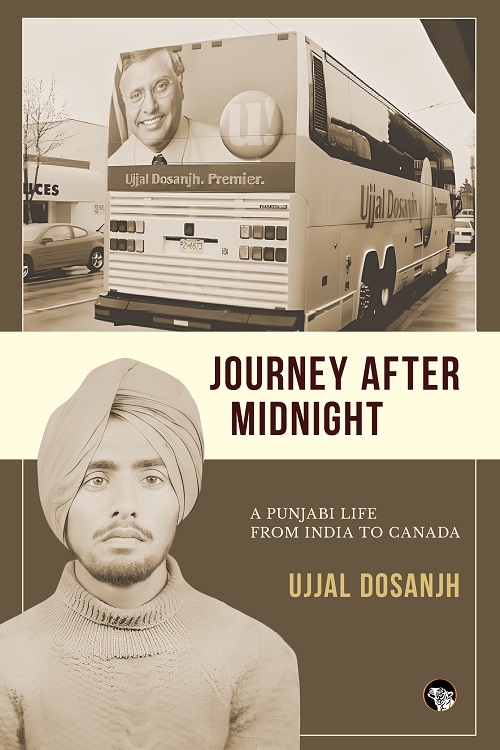
Journey After Midnight – A Punjabi Life : From India to Canada by Ujjal Dosanjh speaks about the Punjabi diaspora in all its splendor.  Dosanjh was born in the Jalandhar district of Punjab in 1946. He emigrated to the UK in 1964 and from there to Canada in 1968. He was Premier of British Columbia from 2000 to 2001 and a Liberal Party of Canada Member of Parliament from 2004 to 2011, including a period as Minister of Health and Minister Responsible for Multiculturalism, Human Rights and Immigration. In 2003 he was awarded the Pravasi Bharatiya Samman, the highest honour conferred by the Government of India on overseas Indians.

The blurb contends: “Journey After Midnight is the compelling story of a life of rich and varied experience and rare conviction. With fascinating insight, Ujjal Dosanjh writes about life in rural Punjab in the 1950s and early ’60s; the Indian immigrant experience—from the late 19th century to the present day—in the UK and Canada; post-Independence politics in Punjab and the Punjabi diaspora— including the period of Sikh militancy—and the inner workings of the democratic process in Canada, one of the world’s more egalitarian nations.”

Dosanj states candidly: “Today’s world has few leaders brimming with great ideas. The paucity of great leaders afflicts India as well. There are no inspiring giants on the national stage tall enough to lead India out of the ethical and moral quagmire. Asked whether he was working to create a new India along with seeking its independence from Britain, Mahatma Gandhi had declared that he was trying to create a new Indian–an honest, fair and just Indian for a proud, progressive, prosperous and caring India. Since the Mahatma’s time the moral and ethical values of India have decayed. In Indian politics, civil service and public life, there is little evidence of the ideals he lived and died for.”

He continues: “A substantial portion of the Indian economy is underground; all due to the sadly enduring disease of corruption. The albatross of financial, ethical and moral corruption is strangulating and shortchanging the country. Those who say economic progress will by itself free India from corruption are just as wrong as those who in the 1950s maintained that education by itself would reduce corruption. It obviously hasn’t, and India finds itself counted among the most corrupt countries on earth. Corruption shatters human dreams and stunts ingenuity. It constrains personal and political liberties. It severely limits opportunities. The main hindrance in the path of social, political, economic and cultural progress is the disconnect between knowing what is right and doing the right thing; most know what is the right and the ethical thing to do, but they continue to do the wrong and the unethical thing; hence the ubiquitous corruption.

Calling upon the Indians for a moral revolution Dosanj writes: “The sculpting of Gandhi’s Indians, and the building of the India of the dreams of its founding fathers and mothers, requires a moral and ethical revolution-a revolution of values that are of Indians, by Indians and for Indians. No matter how bleak the political and ethical scene today, I’m certain there are great minds fearless, humane and brave among the billion plus residents of India. We may not see
them, but they exist. We may not know them, but they are among us. They must heed India’s call. They must come forward and lead. India’s destiny demands it.”

In the ‘Afterword’ he laments about the state of affairs of Punjab in recent times: “Punjab is staring at the prospect of turmoil, radicalization and violent fundamentalism, and yet many in the government and otherwise seem obsessed with presenting and treating the likes of the late singer Moosewala as modern Punjab’s heroes. That the young singer’s life was cut short by gangsters’ guns was horrible and must be condemned. Beyond that the AAP and others must be careful not to glorify violence. Unfortunately, almost the whole of Punjab seems taken with Moosewala; the young man was a talented singer but much of his poetry and music was about guns and aggressive machismo. Is that what Punjab needs and must idolize?”

Dosanjh writes candidly about his dual identity as a first-generation immigrant. And he describes how he has felt compelled to campaign against the discriminatory policies of his adopted country. He opposes regressive and extremist tendencies within the Punjabi community. His outspoken views against the Khalistan movement in the 1980s led to death threats and vicious physical assaults, and he narrowly escaped the bombing of Air India Flight 182 in 1985. Yet he has remained steadfast in his defence of democracy, human rights and effective governance in the two countries he calls home—Canada and India.  

The writing style is fluid and languid. This is not a book that can be judged on the basis of its literary merit. It isn’t just a simple memoir, but rather a record of a turbulent period in India’s history. It is a book that represents a lifetime journey, crossing oceans and cultures. As a memoir, Ujjal Dosanjh’s book is at once personal and political, but most importantly, it is inspiring.

.

Bhaskar Parichha is a journalist and author of UnbiasedNo Strings Attached: Writings on Odisha and Biju Patnaik – A Political Biography. He lives in Bhubaneswar and writes bilingually. Besides writing for newspapers, he also reviews books on various media platforms.

.

PLEASE NOTE: ARTICLES CAN ONLY BE REPRODUCED IN OTHER SITES WITH DUE ACKNOWLEDGEMENT TO BORDERLESS JOURNAL

Click here to access the Borderless anthology, Monalisa No Longer Smiles

Click here to access Monalisa No Longer Smiles on Kindle Amazon International

Categories
Tribute

Satyajit Ray & the World

Satyajit Ray(2 May 1921-23 April 1992) in New York. Courtesy: Creative Commons

A film-maker, writer, musician and more, perhaps Satyajit Ray can best be described in the maestro’s lead actor (Seemabadha, 1971) Barun Chanda’s words:

[O]ne would like to remember Ray as one of the last truly great renaissance men of Bengal, moulded much in the tradition of Tagore, in the sense that his genius manifested itself in manifold directions: film-making, photography, writing, composing poetry, limericks, music, designing, drawing, developing new typefaces, you name it.

For a long time, he was also our most distinguished cultural ambassador to the world.

-- Barun Chanda, Satyajit Ray: The Man Who Knew Too Much

Barun Chanda, introduces Satyajit Ray, the film maker, to us in his book, Satyajit Ray:The Man Who Knew Too Much. This in-depth conversation with the author and a review of his book introduces us to the unforgettable world of Satyajit Ray. Click here to read.

In When ‘they’ Danced…, Ratnottama Sengupta discusses the unique Bhooter Naach or the Ghost Dance, in Satyajit Ray’s Goopy Gyne Bagha Byne. Click here to read.

Nivedita Sen reviews Upendrakishore Ray Chowdhury’s The Adventure Of Goopy The Singer And Bagha The Drummer, later made into a movie by the legendary grandson of the author, Satyajit Ray. Click here to read.

In Satyajit Ray’s Cinematic Universe: Can Isolation Lead to a New World?, Rebanta Gupta explores two films of Satyajit Ray, Kanchenjunga & Charulata to see what a sense of isolation can do for humans? Click here to read.

Satyajit Ray, Bibhuti Bhushan & Nabendu Ghosh and a Famous Triology: Pather Panchali (Song of the Road) by Bibhuti Bhushan Bandopadhyay was a classic novel, immortalised further by Satyajit Ray’s films, also known know as the Apu Triology. Here is a translation from Nabendu Ghosh’s autobiography which introduces how the film came to be. This portion has been excerpted from Eka Naukar Jatri (Journey of a Lonesome Boat) and translated by Ratnottama Sengupta as a celebration of the Satyajit Ray Centenary. Click here to read.

In The Kaleidoscopic World of Satyajit Ray, Anasuya Bhar takes us into the literary world of Satyajit Ray, the world famous film director. Click here to read.

Bhaskar Parichha has reviewed Satyajit Ray Miscellany: On Life, Cinema, People & Much More, a collection of the maestro’s writings and illustrations. Click here to read.