Categories
Contents

Borderless, August 2026

Art by Sohana Manzoor

Editorial

Bells, Corners, Changes and Life… Click here to read.

Translations

Robihara 2 (Sunless 2) by Nazrul has been translated from Bengali by Professor Fakrul Alam. Click here to read.

Chapter 1 of Isa Kamari’s novel, The Throne, has been translated by the author from Malay. We will be running the whole novel as serial through the year. Click here to read.

An excerpt from Aslam Dostains novel, Sótkál, has been translated from Balochi by Fazal Baloch. Click here to read.

A Sudden Shower has been written and translated from Korean by Ihlwha Choi. Click here to read.

Jhor or Storm, a poem by Tagore, has been translated from Bengali by Mitali Chakravarty. Click here to read.

Poetry

Click on the names to read the poems

Luis Cuauhtémoc Berriozábal, Akil Contractor, George Freek, Pramod Rastogi, Khayelihle Benghu, John Grey, Mary Tina Shamli Pillay, John Britten, Bharti Mehra, David Francis, Laila Brahmbhatt, Ryan Quinn Flanagan

Poets, Poetry & Rhys Hughes

In Bell Poems, Rhys Hughes shares a series of poems inspired by Edgar Allan Poe’s ‘The Bell’. Click here to read.

Musings/Slices from Life

The Elusive Horizontal Falls

Meredith Stephens writes about her sailing adventures in Australia as Alan Noble shares his photographs. Click here to read.

Reading, Writing, and the Long, Dark Tunnel of Despair

Jeena R. Papaadi explores her own literary journey. Click here to read.

Another Waterworld?

Jun A. Alindogan writes of typhoons that are on the rise in Philippines. Click here to read.

Notes from Japan

In The Zine Scene, Suzanne Kamata participates at ‘The Zine Festival’ in Kobe. Click here to read.

Musings of a Copywriter

In Riverside Reflections, Devraj Singh Kalsi gives a dark satire which almost reads like fiction. Click here to read.

Essays

When Life gives us Lemons, make Lemonade!

Farouk Gulsara looks at the impact of climate events and climate change. Click here to read.

On Both Sides of the Border: The Techno-Political Erasure of Bureaucracy, Memory, and Refugee Lives

Rengin Uçkan takes a look at the plight of refugees. Click here to read.

Neither Automaton nor Oracle: A Satirical Inquiry into Morality, Conditioning, Football, and the End of Human Civilisation

Ravi Varmman K Kanniappan muses on the modern civilisation and its outlooks. Click here to read.

Stories

Shadow Play

Yi-jung Chen shares a unique love story set in Taiwan. Click here to read.

Fairway

Brindley Hallam Dennis shares a short narrative about a dog. Click here to read.

The Space Between Notifications

Jay Samanta shares a modern day relationship. Click here to read.

My Brother’s Room

Devraj Singh Kalsi gives a story of two brothers. Click here to read.

A Walk Through Nature

Naramsetti Umamaheswararao shares a fable set in a village in Andhra Pradesh. Click here to read.

Interview

Keith Lyons interviews author, Jayanthi Sankar, who also shares an excerpt from one of her stories. Click here to read.

Book Excerpts

An excerpt from Rhys Hughes’ The Biscuit Thief. Click here to read.

An excerpt from Ramananda Bharati’s The Forest of Snow, translated from Bengali by Somdatta Mandal. Click here to read.

Book Reviews

Aruna Chakravarti has reviewed Ramananda Bharati’s The Forest of Snow, translated from Bengali by Somdatta Mandal. Click here to read.

Somdatta Mandal has reviewed Arupa Patangia Kalit’s The Moonlight Saga, translated from Assamese by Ranjita Biswas. Click here to read.

Bhaskar Parichha has reviewed Rabindranath Tagore: The Myriad-Minded Man, co-authored by Krishna Dutta and Andrew Robinson. Click here to read.

.

Click here to access Wild Winds: The Borderless Anthology of Poems

Click here to access the Borderless anthology, Monalisa No Longer Smiles

Categories
Editorial

Bells, Corners, Changes and Life

Rain, Steam, and Speed – The Great Western Railway, 1844, Painting by Joseph Mallord William Turner

Perhaps, the only constant that makes a difference in this ever-transforming world is how we react to changes around us. How do we interact with not just humans but our whole planet with its climate, contours, its plethora of flora and fauna?  Will that impact our survival in the long run? And yet with our focus on legacies, traditions, beliefs, we tend to ignore the call to adapt to the new that might help us move towards an unpredictable future. We forget perhaps that these systems had all been made by our ancestors to ensure survival. Somewhere along the way, these have become like fences caging us into small subsets. The strange thing is we continue to allow that to happen and create enclosures which we fight to maintain. The future that we face now seems even more tumultuous with climate change, rising sea levels and global warming taking a front seat while influx of refugees from war and natural disasters have already started making themselves felt. Add to that the shortages of resources that we have taken for granted for centuries. How would we survive these?

Is it by redefining the constructs we have created or just meeting in corners and finding commonalities as suggested by Ryan Quinn Flanagan in his poem ‘Corners’?

Corners are a meeting place, 
they hold a room together

Our poetry section often reflects what we experience, feel or see around us. We have poems on how nature overrides human constructs by Khayelihle Benghu. In ‘Passport for the Rain‘, she writes:

If rain possessed a passport, it would read:
Citizen of every place that drinks.

We have variety from around the world with poems from Luis Cuauhtémoc Berriozábal, Akil Contractor, George Freek, Pramod Rastogi, John Grey, Mary Tina Shamli Pillay, John Britten, Bharti Mehra, David Francis and Laila Brahmbhatt. Rhys Hughes has given us poetry inspired by Edgar Allan Poe’s poem, The Bell. While Poe wrote one poem in 1848 ( published posthumously in 1849), Hughes has written nine sprinkled with his brand of humour, including on cowbells and bell peppers!

We also have poetry in our translations with Ihlwha Choi giving us a glimpse of Korean life. Professor Fakrul Alam has brought to us in English a Bengali poem by Nazrul written on the death of Tagore, a poem that was read out in Calcutta radio by the poet himself in 1941. Tagore’s poem, Storm, has been translated in keeping with the heavy downpours in Asia this season. Fazal Baloch has shared an excerpt in English, which reads like a short story, from Aslam Dostain’s Balochi novel, Sótkál, giving us a flavour of the hard life in their region, where self-reliance is a felt need for survival. We have mental heath issues woven into this section with Isa Kamari’s translation of his own Malay novel into English, The Throne. We will be running a chapter every month from this novel.

Book excerpts also has a translation this time with Ramananda Bharati’s Bengali travelogue, The Forest of Snow, brought to us in English by Somdatta Mandal. Aruna Chakravarti has reviewed this non-fiction for us. The other excerpt is from Hughes’ The Biscuit Thief, a book that reflects his distinct brand of absurd humour. Keith Lyons’ interview this time features an excerpt from interviewee Jayanthi Sankar’s short story set in Singapore. Mandal has written on yet another translation from Assamese by Ranjita Biswas of Arupa Patangia Kalita’s The Moonlight Saga. Bhaskar Parichha has discussed Rabindranath Tagore: The Myriad-Minded Man, co-authored by Krishna Dutta and Andrew Robinson. He claims that this book is “is indispensable reading for anyone interested in literature, intellectual history, cultural modernity, or the life of a man whose vision of humanity continues to speak powerfully to an increasingly interconnected world.”

This month’s non-fiction section has trotted around the globe. We have Ravi Varmman K Kanniappan’s essay discussing how to redefine norms. His take is a bit different from Flanagan’s. He tells us, using Huck Finn, Terminator and Sangam Literature, people need to ask not, “What is right?” but “How did I come to believe this is right?” Rengin Uçkan’s writes on the need for framing rules that are compassionate for refugees. And Farouk Gulsara with his inevitable gruff humour talks of climate change while stating things as it is: “Climate change not only shrinks our summer beachwear but also makes outdoor living impossible. Additionally, it’s proving to be more expensive to consume anything…”  Jun A. Alindogan narrates how typhoons have increased in number in Philippines and how it affects them while Jeena R. Papaadi reflects on her literary journey. Meredith Stephens shares her sailing adventures in Australia with stunning photographs by Alan Noble. And Suzanne Kamata has brought us a flavour of the unique Zine Fest in Kobe, where both groceries and books find a place!

Devraj Singh Kalsi hovers between fact and fiction. He has a musing which seems like a hash of dark fiction but based on his experiences. He has also shared a story that is purely fictional. Yi-jung Chen brings to us a quirky love story set in Taiwan across time and space while Brindley Hallam Dennis tells a tale about a dog who sits at a table and sips drinks with a straw! Jay Samanta gives a narrative about a modern relationship based on social media output. Naramsetti Umamaheswararao has shared a fable that talks of freeing nature. The issue is, can we really?

In Borderless Journal, we hope to create a space which will help reflect not just the times but also look forward to ideas that can move us towards surviving in a happier world, built on the basis of accepting differences, filled with love, kindness and compassion. While this may sound clichéd and repetitive, given the current climes, these values cannot be emphasised often enough and perhaps our content to an extent does reflect that, sometimes with a soupçon of humour. Do pause by our contents page for this August and tell us what you think.  

Winding up this issue, we would like to thank our all contributors for their wonderful writings and photographs. Huge thanks to the Borderless team without who this issue would not have been as vibrant. Special thanks to Sohana Manzoor for her fabulous artwork. Thank you all. All of you together make this journal come alive.

Enjoy the reads!

Cheers,

Mitali Chakravarty

borderlessjournal.com

CLICK HERE TO ACCESS THE CONTENTS FOR THE AUGUST 2026 ISSUE

.

READ THE LATEST UPDATES ON THE BORDERLESS ANTHOLOGIES BY CLICKING ON THIS LINK

Categories
Poetry

Poems by Akil Contractor

From Public Domain
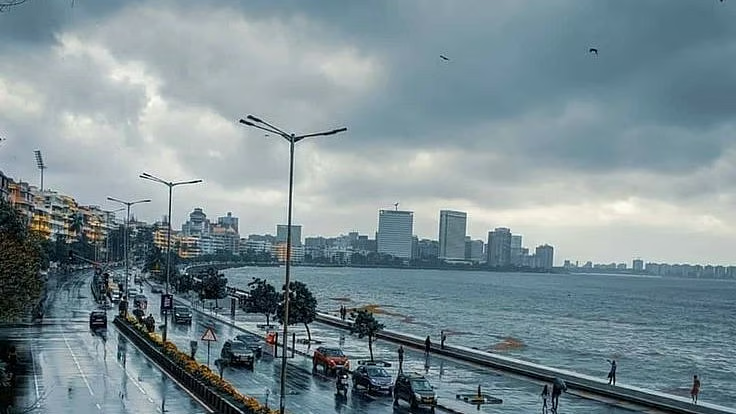
THE FIRST EXHALATION – MUMBAI RAIN 

The concrete cracks open,
releasing a breath held captive since March.
It is the smell of survival—
baked earth meeting the first dark arrow of water.

No warning sirens sound,
just the sudden, heavy drumming on corrugated tin roofs,
the sky bruising into shades of slate and indigo
over the Arabian Sea.

At Marine Drive, the tetra-pods break the spray,
blurring the boundary between ocean and air.
The local trains click-clack through a new, silver world,
tracks slicked with the grease of a long summer.

Nobody runs for cover.
Instead, umbrellas remain folded like sleeping birds.
Faces turn upward,
letting the cool torrent wash away the salt of sweat,
the grime of the local,
the memory of the heatwaves.

A city of twenty million stops,
just for a heartbeat,
to listen to the rhythm of its own washing clean.


CONVERSATIONS WITH MY SHADOW

You are the only one who walks at my exact pace,
stretching out across the concrete,
mimicking my posture but keeping your secrets.
We walk in a synchronised silence,
two versions of the same tired anatomy
negotiating with the afternoon sun.

"Why do you stay so quiet?" I ask.
But you only lengthen,
pulling yourself toward the edges of the walls,
as if trying to escape the heavy frame
of the body that anchors you to the ground.
You are my most faithful witness,
yet you refuse to testify.

When the light dies, you dissolve first,
leaving me alone in the dark room
to wonder which of us is the real entity
and which of us is just the displacement of light.
You have no voice, no friction,
just a quiet, stretching mimicry
that reminds me I am never entirely alone,
even when I am completely forgotten.


WAITING FOR A GHOST

The ordinary world is too well-mapped,
trapped in the flat geometry of the routine,
where every hour arrives exactly on schedule,
devoid of friction, stripped of mystery.
We scrub the static from our television screens
and pave over the wild, irregular earth,
until the mind begins to starve for the impossible—
the sudden, terrifying tilt of the axis.

So I sit in the drafty dark of the attic,
listening to the house settle into its bones,
actively inviting a presence I cannot explain.
I do not crave the safety of a clean answer;
I want the cold draft that defies the thermometer,
the floorboard that creaks without a footstep,
the sudden, rogue drop in atmospheric pressure
that proves the veil is thinner than we think.

To wait for a ghost is to reject the sterile grid,
demanding a life that leaks beyond the margins.
We need the shock of the unverified frequency,
the beautiful distortion of a world interrupted,
to remind us that we are more than biological clocks
ticking down in empty rooms—
we are participants in a dark, magnificent theatre
longing for the curtain to rip in two.


HAVE WE REALLY SCRAPED THE SKIES?

We built them high to pierce the blue,
a cold, reflective, glass array,
to show the clouds what we could do,
and scrape the boring sky away.

We poured the aggregate and steel
to give our pride a vertical spine,
and made the old horizon kneel
before a corporate boundary line.

But look up at the ninety-fourth:
a broker spills his lukewarm tea,
and tracks the market going north,
while suffocating in the breeze.

The smog is thick, the air is dead,
we trapped the wind inside a shaft;
we bought a penthouse overhead
but lost the sky to overdraft.

We haven't touched a single star,
nor made the heavy cosmos blink;
we only built a higher bar
to sit inside the dark and drink.

The skyscrapers are standing tall,
a monument of concrete grey,
but we just built a thicker wall
to keep the actual sky away.

Akil Contractor is a prominent Indian poet based in Mumbai. He was one of the founding members of Mumbai’s historic Poetry Circle in 1986.  Contractor writes across diverse linguistic traditions; his published English titles include After Kalinga and Other Poems (1986), Spirit Song (1986), and Rhyming Verses (2023). Under the pen name Talabgaar, he has also authored two celebrated volumes of Urdu Shayari. His latest English manuscript is Going Nowhere to a Place.

.

PLEASE NOTE: ARTICLES CAN ONLY BE REPRODUCED IN OTHER SITES WITH DUE ACKNOWLEDGEMENT TO BORDERLESS JOURNAL

Click here to access the Borderless anthology, Monalisa No Longer Smiles
Click here to access Monalisa No Longer Smiles on Kindle Amazon International

Categories
Contents

Borderless August 2023

Art by Sohana Manzoor

Editorial

Other Echoes in the Garden… Click here to read.

Interviews

Ujjal Dosanjh, former Minister from Canada and former Premier of British Columbia, discusses his autobiography, Journey After Midnight – A Punjabi Life: From India to Canada, and the need for a world with less borders. Click here to read.

Professor Fakrul Alam discusses his new book of Tagore translations, Gitabitan: Selected Song-Lyrics of Rabindranath Tagore. Click here to read.

Translations

Tagore’s Musalmanir Galpa (A Muslim Woman’s Story) has been translated from Bengali by Aruna Chakravarti. Click here to read.

Masud Khan’s poem, In Another Galaxy, has been translated from Bengali by Professor Fakrul Alam. Click here to read.

Wakeful Stays the Door, a poem by Munir Momin, has been translated from Balochi by Fazal Baloch. Click here to read.

Dangerous Coexistence, written in Korean and translated by Ilhwah Choi. Click here to read.

Proshno or Questions by Tagore has been translated by Mitali Chakravarty. Click here to read.

Pandies Corner

Songs of Freedom: An Ordinary Tale is a narrative by Nandani based on her own experiences, translated from Hindustani by Janees. These narrations highlight the ongoing struggle against debilitating rigid boundaries drawn by societal norms, with the support from organisations like Shaktishalini and Pandies. Click here to read.

Poetry

Click on the names to read the poems

Jared Carter, Rhys Hughes, Malachi Edwin Vethamani, Luis Cuauhtémoc Berriozábal, Saranyan BV, Ryan Quinn Flanagan, A Jessie Michael, Jahnavi Gogoi, George Freek, Koushiki Dasgupta Chaudhuri, David Francis, Akil Contractor, Michael Burch

Poets, Poetry & Rhys Hughes

In An Experiment with Automatic Poetic Translation, Rhys Hughes auto translates an English poem sequentially through 28 languages and then back to English with hilarious results. Click here to read.

Musings/ Slices from Life

Mister, They’re Coming Anyway

Timothy Jay Smith writes on the refugee crisis in Lesbos Island, Greece with photographs by Michael Honegger. Click here to read.

Migrating to Myself from Kolkata to Singapore

Asad Latif explores selfhood in context of diverse geographies. Click here to read.

Islands that Belong to the Seas

Paul Mirabile muses on how humans are like migrants on islands borrowed from the seas. Click here to read.

Of Dreams, Eagles and Lost Children

Aysha Baqir muses on the narrow, closed borders that condemn children. Click here to read.

Mushroom Clouds and Movies: Response from a Hibakusha’s Daughter

Kathleen Burkinshaw discusses Oppenhiemer the movie. Click here to read.

Sleepless in the High Desert, Slumber in the Sierra

Meredith Stephens covers Nevada to Columbia in a car with her camera. Click here to read.

My Hostel Days

Ravi Shankar reminisces on bygone days. Click here to read.

Musings of a Copywriter

In The Amateur Professional, Devraj Singh Kalsi writes of a amateur who thought of himself as a professional. Click here to read.

Notes from Japan

In How I Wound Up in Japan, Suzanne gives her story as an immigrant. Click here to read.

Essays

A Different Persuasion: On Jane Austen’s Novels & their Adaptations

Deepa Onkar delves into the world of Jane Austen books and films. Click here to read.

A Foray into Andamans

Mohul Bhowmik explores Andaman with a camera and narrative. Click here to read.

Bhaskar’s Corner

In Chittaranjan Das: A Centenary Tribute, Bhaskar Parichha discusses the life of one of the most legendary Odia writers. Click here to read.

Stories

Belacan

Farouk Gulsara shares a story based on the life of a migrant in 1950s. Click here to read.

The Japanese Maple

Shivani Shrivastav weaves a story of friendship and loneliness among migrants. Click here to read.

The Coin

Khayma Balakrishnan explores human and supernatural interactions in a school setting in Malaysia. Click here to read.

The Vagrant

Reeti Jamil narrates a strange tale set in a village and told by a farmer. Click here to read.

Book Excerpts

An excerpt from Ujjal Dosanjh’s Journey After Midnight: A Punjabi Life from Canada to India. Click here to read.

An excerpt from Roses in the Fire of Spring: Better Roses for a Warming World and Other Garden Adventures, by M.S. Viraraghavan and Girija Viraraghavan. Click here to read.

Book Reviews

Somdatta Mandal reviews Amitav Ghosh’s Smoke and Ashes: A Writer’s Journey Through Opium’s Hidden Histories. Click here to read.

Basudhara Roy reviews Greening the Earth: A Global Anthology of Poetry, edited by K. Satchidanandan & Nishi Chawla. Click here to read.

Bhaskar Parichha reviews Arunava Sinha’s The Greatest Indian Stories Ever Told: Fifty Masterpieces from the Nineteenth Century to the Present. Click here to read.

.

Click here to access the Borderless anthology, Monalisa No Longer Smiles

Click here to access Monalisa No Longer Smiles on Kindle Amazon International

Categories
Poetry

If Heaven, If Hell

By Akil Contractor

IF HEAVEN, IF HELL

I would ascend on angels wings
(the safest mode being tandem),
the take-off would be smooth as silk,
the landing site not random.

If hell is where I’m meant to go,
I need a map to travel
since angels will not venture there,
how else will hell unravel!

There’s no one who can tell me yet
to which one I am headed —
I’m betting on CHATGPT
Its scope will be extended!

Akil Contractor is a writer from Mumbai, India. He has a number of poetry books online. His recent book of poems, Rhyming Verses – Sense and Non-sense, is now available on Amazon.

PLEASE NOTE: ARTICLES CAN ONLY BE REPRODUCED IN OTHER SITES WITH DUE ACKNOWLEDGEMENT TO BORDERLESS JOURNAL

Click here to access the Borderless anthology, Monalisa No Longer Smiles

Click here to access Monalisa No Longer Smiles on Kindle Amazon International