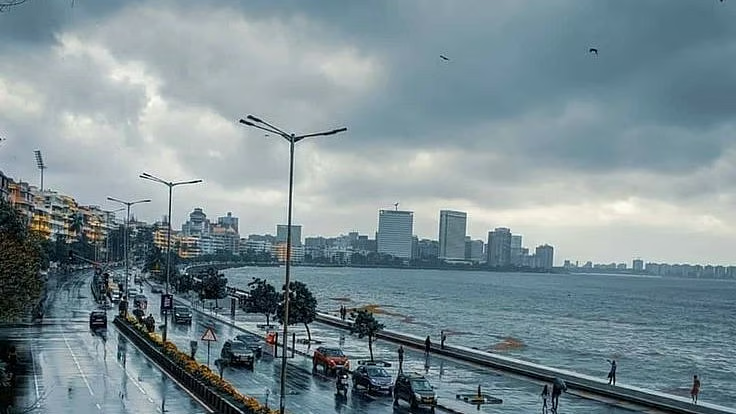
The concrete cracks open, releasing a breath held captive since March. It is the smell of survival— baked earth meeting the first dark arrow of water.
No warning sirens sound, just the sudden, heavy drumming on corrugated tin roofs, the sky bruising into shades of slate and indigo over the Arabian Sea.
At Marine Drive, the tetra-pods break the spray, blurring the boundary between ocean and air. The local trains click-clack through a new, silver world, tracks slicked with the grease of a long summer.
Nobody runs for cover. Instead, umbrellas remain folded like sleeping birds. Faces turn upward, letting the cool torrent wash away the salt of sweat, the grime of the local, the memory of the heatwaves.
A city of twenty million stops, just for a heartbeat, to listen to the rhythm of its own washing clean.
CONVERSATIONS WITH MY SHADOW
You are the only one who walks at my exact pace, stretching out across the concrete, mimicking my posture but keeping your secrets. We walk in a synchronised silence, two versions of the same tired anatomy negotiating with the afternoon sun.
"Why do you stay so quiet?" I ask. But you only lengthen, pulling yourself toward the edges of the walls, as if trying to escape the heavy frame of the body that anchors you to the ground. You are my most faithful witness, yet you refuse to testify.
When the light dies, you dissolve first, leaving me alone in the dark room to wonder which of us is the real entity and which of us is just the displacement of light. You have no voice, no friction, just a quiet, stretching mimicry that reminds me I am never entirely alone, even when I am completely forgotten.
WAITING FOR A GHOST
The ordinary world is too well-mapped, trapped in the flat geometry of the routine, where every hour arrives exactly on schedule, devoid of friction, stripped of mystery. We scrub the static from our television screens and pave over the wild, irregular earth, until the mind begins to starve for the impossible— the sudden, terrifying tilt of the axis.
So I sit in the drafty dark of the attic, listening to the house settle into its bones, actively inviting a presence I cannot explain. I do not crave the safety of a clean answer; I want the cold draft that defies the thermometer, the floorboard that creaks without a footstep, the sudden, rogue drop in atmospheric pressure that proves the veil is thinner than we think.
To wait for a ghost is to reject the sterile grid, demanding a life that leaks beyond the margins. We need the shock of the unverified frequency, the beautiful distortion of a world interrupted, to remind us that we are more than biological clocks ticking down in empty rooms— we are participants in a dark, magnificent theatre longing for the curtain to rip in two.
HAVE WE REALLY SCRAPED THE SKIES?
We built them high to pierce the blue, a cold, reflective, glass array, to show the clouds what we could do, and scrape the boring sky away.
We poured the aggregate and steel to give our pride a vertical spine, and made the old horizon kneel before a corporate boundary line.
But look up at the ninety-fourth: a broker spills his lukewarm tea, and tracks the market going north, while suffocating in the breeze.
The smog is thick, the air is dead, we trapped the wind inside a shaft; we bought a penthouse overhead but lost the sky to overdraft.
We haven't touched a single star, nor made the heavy cosmos blink; we only built a higher bar to sit inside the dark and drink.
The skyscrapers are standing tall, a monument of concrete grey, but we just built a thicker wall to keep the actual sky away.
Akil Contractor is a prominent Indian poet based in Mumbai. He was one of the founding members of Mumbai’s historic Poetry Circle in 1986. Contractor writes across diverse linguistic traditions; his published English titles include After Kalinga and Other Poems (1986), Spirit Song (1986), and Rhyming Verses (2023). Under the pen name Talabgaar, he has also authored two celebrated volumes of Urdu Shayari. His latest English manuscript is Going Nowhere to a Place.
.
PLEASE NOTE: ARTICLES CAN ONLY BE REPRODUCED IN OTHER SITES WITH DUE ACKNOWLEDGEMENT TO BORDERLESS JOURNAL
There is a cartographic trick that India plays on the careless observer. Place a finger on Goa, cradled in the lap of the Western Ghats where the Mandovi meets the Arabian Sea. Now drag that finger clean across the peninsula — past the Deccan plateau, past the red laterite and the black cotton soil — until it arrives at Odisha, where the Mahanadi fans into the Bay of Bengal. The distance is vast. The terrain changes several times over. And yet, when you finally arrive, you feel, inexplicably, that you have not travelled at all. You have merely walked from one room of the same house into another.
Goa and Odisha are India’s fraternal twins, stationed like sentinels on opposite coasts, facing outward toward different oceans but turning inward toward an almost identical soul. They share no border, no common neighbour, no obvious historical corridor. And yet their resemblances are so startling, so layered, that they make a quiet mockery of the assumption that east and west shall never meet. In this country, at least, they have been meeting all along.
The Plate That Speaks First
Begin where all honest cultural inquiry must begin — at the table. In both Goa and Odisha, the grammar of a meal is written in two words: rice and fish. The xitt-kodi of a Goan Catholic household — rice with fish curry — is a mirror image of the bhata-machha that anchors every Odia thali. The curry leaves may change, the tamarind may yield to kokum, but the fundamental covenant between grain and sea remains unbroken.
Both states worship the coconut with equal fervour. It thickens their gravies, sweetens their desserts, oils their hair, and thatches their roofs. And in both places, the humble samosa — that deep-fried triangle of spiced potato — enjoys a curious and disproportionate celebrity, sold at every bus stand, every temple gate, every rain-drenched evening stall, as if it were the official snack of the coastline itself.
Weavers of Light
If food is the first language, cloth is the second. Odisha’s handloom tradition is among the most sophisticated in the world. The Sambalpuri ikat, with its geometric precision born of a tie-and-dye technique older than memory, is a textile that calculates like mathematics and sings like poetry. The Bomkai of Ganjam, the Kotpad of Koraput — each weave carries a district’s autobiography in its warp and weft.
Goa’s handloom heritage is no less poignant. The Kunbi saree, woven by the indigenous Kunbi community in checks of red and maroon, is a garment of earthy defiance — a refusal to vanish beneath the weight of colonial and commercial textile culture. In both states, the handloom is not an industry. It is an act of inheritance.
The handicraft traditions run parallel with uncanny symmetry. Odisha’s Pattachitra — those luminous scroll paintings rendered on cloth with pigments drawn from stone, earth, and lamp-black — find a philosophical cousin in Goa’s azulejos-inspired tile art and the painted terracotta work of its hinterlands. Odisha’s silver filigree from Cuttack, those impossibly intricate webs of metal that seem to have been spun by patient spiders, speak the same aesthetic dialect as the filigree and brass work of Goan artisans.
Temples, Tides, and the Slow Pulse
Both states are drenched in divinity. Odisha shelters the Jagannath Temple of Puri, whose Rath Yatra rolls through the world’s imagination every year, and the Konark Sun Temple, a stone chariot frozen mid-gallop toward the dawn. The Lingaraj Temple of Bhubaneswar presides over a city that was once a forest of a thousand shrines. Goa, often misread as merely a beach destination, guards some of the oldest Hindu temples in western India — the Mangeshi Temple, the Shanta Durga Temple, the Mahalasa Narayani, the Tambdi Surla — alongside the Basilica of Bom Jesus, where the remains of St. Francis Xavier lie in baroque silence. In both states, the sacred is not a Sunday affair. It is the air.
And then there is the pace. Both Goa and Odisha move at a tempo that the hyperventilating metros of India find baffling. The Goan susegad — that philosophy of contented ease — is a first cousin of the unhurried dignity with which Odisha conducts its daily life. Long before the global “slow living” movement became a wellness-industry buzzword, these two states had been practising it for centuries, not as aspiration but as instinct.
Songs in Different Scales
The musical traditions reveal yet another layer of kinship. Odisha gave the world Odissi — both the dance and the music — a classical tradition of astonishing fluidity, shaped by poets like Jayadeva, whose Gita Govinda remains one of the supreme lyric achievements in any language. The folk traditions — Dalkhai, Gotipua, the tribal Dhemsa — pulse with a rhythmic vitality that no concert hall can contain.
Goa’s musical soul lives in the Mando, a slow, swaying ballad of love and longing born from the encounter between Konkani sensibility and Portuguese fado. The Dulpod, faster and more festive, is its playful sibling. And beneath the tourist-facing trance and EDM, Goa’s folk traditions — Fugdi, Dhalo, Dekhni — carry the same rooted, communal energy that Odisha’s village squares have known for generations.
Goa’s Tiatr and Odisha’s Jatra are born of the same impulse — raucous, deeply local theatre traditions that turn village squares into stages, blend music with social satire, and have for generations served as the people’s newspaper, courtroom, and concert hall rolled into one.
The Literary Mirror
The literary parallels are quietly profound. Fakir Mohan Senapati, the father of modern Odia literature, wrote Chha Mana Atha Guntha — a searing, ironic novella about land, power, and peasant dispossession — in the 1890s. Across the map, Goa’s literary tradition in Konkani, shaped by figures like Bakibab Borkar (the poet-laureate of Konkani verse), Ravindra Kelekar, and Damodar Mauzo, has grappled with similar themes of identity, colonial memory, and the tension between tradition and modernity. Odisha’s Pratibha Ray and Goa’s Mauzo — both Jnanpith laureates — wrote in languages the literary mainstream often overlooks, yet carved from Odia and Konkani respectively a body of work so luminous that the nation’s highest literary honour had no choice but to find its way to their doors. Both literatures are enormous in depth and criminally under-read outside their states.
Even the economies rhyme. Both states sit on vast mineral wealth — iron ore in Goa, iron ore, bauxite and coal in Odisha — and both have built significant chapters of their economic story on extraction. Mining has been, for decades, a genuine engine of revenue and employment. But prosperity extracted from the earth exacts its own price. Both states have watched hills reshaped and rivers thickened with slurry, and both have grappled with the same difficult question that every resource-rich society must eventually face: where does sustainable use end and irreversible damage begin? The Dongria Kondh resistance in Odisha’s Niyamgiri hills and Goa’s prolonged civic movement against unregulated mining are stories of communities recognising that the wealth beneath their feet should not come at the cost of the world above it. In both states, the mandate is the same: to mine responsibly, restore what can be restored, and find an economic imagination that honours both the ledger and the landscape.
Stone, Laterite, and the Architecture of Belonging
The buildings of Goa and Odisha could not, at first glance, look more different. Odisha’s architectural glory resides in the Kalinga style of temple building — a tradition that flowered between the sixth and thirteenth centuries and produced some of the most breathtaking sacred structures on the subcontinent. The Rekha Deula, with its curvilinear tower soaring heavenward, the Pidha Deula, with its stepped pyramid, and the barrel-vaulted Khakhara Deula — each is a masterclass in proportion, carved from sandstone and laterite without a drop of mortar, held together by iron dowels and the sheer precision of stone cut to stone. The Lingaraj Temple rises a hundred and eighty feet; the Sun Temple at Konark was conceived as a stone chariot for Surya himself.
Goa’s architectural signature, meanwhile, is the Indo-Portuguese house — the balcão-fronted villa with its oyster-shell windows, its Baroque churches, its colour-washed facades in ochre and cerulean and terracotta. Where Odisha built upward in devotion, Goa built outward in conviviality.
And yet the kinship runs deeper than surface style. Both traditions are rooted in laterite — that rust-red, iron-rich stone quarried from the earth itself — and in an instinctive dialogue between structure and climate. Goan houses, whether Hindu or Catholic, were designed around the monsoon: thick laterite walls to absorb the heat, sloping roofs of Mangalore tile to shed the deluge, courtyards to channel light and air. The traditional Hindu house in Goa, with its rajangan (courtyard) and its Tulasi Vrindavan (holy basil) at its centre, is an inward-looking sanctuary not unlike the courtyard homes of rural Odisha, where domestic life orbits an open-air heart and thatched or tiled roofs slope against the same seasonal fury. In both states, the house is not merely shelter. It is a cosmology — oriented by Vastu[1], shaped by rain, and built from the very ground on which it stands.
The Sacred as Daily Bread
Spirituality in Goa and Odisha is not a compartment of life; it is the wallpaper. In Odisha, they say Bara Masa re Tera Parba — thirteen festivals in twelve months — and this is not hyperbole but arithmetic. From Rath Yatra to Raja Parba, from Nuakhai to Kumar Purnima, the Odia calendar is a procession of devotion, agriculture, and communal joy so tightly woven that one cannot tell where worship ends and daily life begins. The festivals are tied to the rice cycle — seeding, sowing, harvesting — so that the act of farming itself becomes a prayer. Odisha is a land where Hinduism, Buddhism, and Jainism have coexisted and cross-pollinated for millennia, leaving behind the cave monasteries of Udayagiri and Khandagiri, the Buddhist stupas of Ratnagiri and Lalitgiri, and the Shakti temples that dot the landscape like exclamation marks of feminine divinity.
Goa answers with its own brand of sacred pluralism. Here, Hindus light candles at the Basilica of Bom Jesus, and Catholics offer prayers at the Shantadurga temple at Fatorpa. The feast of Our Lady of Miracles gathers both communities under the same roof, exchanging oil and candles between church and temple as naturally as neighbours exchange sugar. The Zagor celebrations and the Shigmo festival are not Hindu events attended by Christians out of politeness; they are Goan events, full stop. In both states, religion is not a doctrine to be debated but a rhythm to be lived — embedded in the morning’s first lamp, the evening’s last bell, and every meal served between.
The Farmer and the Monsoon
Rice is not merely the staple food of Goa and Odisha; it is the organising principle of their rural civilisations. In Odisha, paddy covers nearly seventy per cent of cultivated land, and the entire social calendar revolves around its seasons — Akshaya Tritiya marks the seeding, Raja Sankranti the completion of sowing, Nuakhai the first tasting of the new harvest. The traditional beushening method — broadcasting seed and then tilling post-emergence — speaks of a farming intelligence shaped by centuries of reading the monsoon, the soil, and the floodplain.
In Goa, the ingenuity takes another form: the Khazan system, an ancient network of bunds and sluice gates that reclaim low-lying coastal land from the tides, allowing farmers to cultivate salt-tolerant rice varieties and rear fish and prawns in the same fields. It is an act of ecological engineering so elegant that modern agronomists study it as a model of sustainable land use.
Both states grow coconut, cashew, and areca nut alongside their paddy. Both rely overwhelmingly on the monsoon — Odisha’s irrigation covers barely a third of its cultivable land, and much of Goa’s paddy is rainfed. Both are lands of small and marginal farmers, where the average holding is modest and the relationship between cultivator and earth is intimate, personal, and unmediated by large-scale mechanisation. And in both states, a quiet revolution is underway: Odisha’s Millets Mission and Goa’s growing organic farming movement are attempts to reclaim indigenous crop diversity from the grip of high-yield monoculture — to remember that the land, like the people, thrives best when it is allowed its full vocabulary.
The Playing Field
In a nation drunk on cricket, Goa and Odisha are the two states that have had the audacity to fall in love with other sports. Goa is India’s football heartland. The game arrived with an Irish priest in 1883 and never left. Clubs like Salgaocar, Dempo, and Churchill Brothers have won national titles; six Goans have captained the Indian football team. During the FIFA World Cup, Goan streets erupt into a carnival of flags and giant screens, and the village tournament — barefoot boys on a laterite pitch — remains as sacred as Sunday Mass. Football in Goa is not a sport. It is an identity.
Odisha’s sporting soul beats to a different drum — the hockey stick. The state has produced legends like Dilip Tirkey, Amit Rohidas, Sunita Lakra, and Deep Grace Ekka, and became the first state government in India to sponsor the national hockey team. The Birsa Munda International Hockey Stadium in Rourkela, which hosted the 2023 World Cup, is a monument to Odisha’s commitment. But what unites both states is not the particular sport but the underlying defiance: a refusal to accept cricket’s monopoly on the Indian sporting imagination.
Both states also share a love for traditional and community games — Kho Kho and Kabaddi[2] are played at village festivals in both, and both have ISL football franchises (FC Goa and Odisha FC) that draw passionate, roaring crowds. The playing field, it turns out, is yet another room in the same house.
Rivers, Mangroves, and the Shared Ecology
The ecological parallels between these two states are no less striking. Both are coastal, riverine, and monsoon-fed. Both shelter significant mangrove ecosystems — the Khazan mangroves along Goa’s estuaries and the Bhitarkanika mangrove forests of Odisha, one of the largest in India. Both are biodiversity hotspots: Goa’s Western Ghats forests are a UNESCO heritage site, while Odisha’s Simlipal and Satkosia reserves harbour tiger, elephant, and crocodile populations of national importance. The Olive Ridley sea turtles that nest on Odisha’s Gahirmatha beach have cousins that occasionally visit Goa’s Morjim. Both states understand, in their bones, that the sea is not merely a border but a livelihood, a deity, and a defining force — and that the mangrove, the estuary, and the fishing village are not the periphery of civilisation but its very foundation.
And then there is the matter of diaspora. Both Goa and Odisha are states whose people have scattered across the world yet remain fiercely tethered to home. The Goan communities of Bombay, the Gulf, the UK and Lisbon mirror the Odia communities of US, Europe, Surat, Hyderabad, and beyond. In both cases, the expatriate carries the cuisine, the festival calendar, and the mother tongue like a portable homeland — and returns, without fail, for the annual feast or the harvest celebration, as though the umbilical cord to the village were made not of flesh but of something altogether more durable.
Goa and Odisha do not need a bridge between them. They already are the bridge — two ends of a single cultural arc that bends across the Indian landmass, proving that civilisational kinship does not require geographical proximity. They are proof that identity in India is not merely a function of latitude and longitude but of something deeper: a shared covenant with the sea, with rice, with the loom, with the slow and sacred act of living.
If India is a house with many rooms, these two states are the twin balconies — one facing the sunset, the other the sunrise — built from the same stone, painted in the same light, listening to the same tide.
East and West do not merely meet here. They embrace.
[1] science of architecture in alignment with natural forces
Time flows at an indolent pace. The mind floats in an empty space. Into that vast void, images drift. Over many eons, many have flit To the distant past. Arrogant conquerors sped fast. Pathans rode to satiate their greed. Then, Mughals wheeled Victories, whipping dust-storms, Flying flags for their throngs. These empires have left no trace On the vast void at which I gaze. Through ages, the serene sky Is with sunset and sunrise dyed. Now the might of Britons holds sway Penetrating new pathways With the power of steam And vehicles of fiery steel. With vigour, they spread Their dominions across the land’s breadth. I know their regime will also pass. Their empire will crumble at last. On the astral plane, despite their strength, Their army will not leave a single indent.
When I look around the Earth, An ocean ripples along its girth Heaving huge waves of humanity Through myriad paths, in myriad coveys, Over centuries as their daily needs are met In life and in death. Forever, they row, With their rudders tow, Work in fields, plant seeds, Their harvests reap. They work all the time, In towns or in wilds. Empires decline silencing bugles of war. People forget histories of battles fought. Stories of glory, angst and gore, Stay concealed in children’s lore. They struggle to work hard, In Punjab, Bombay and Gujarat, In Bengal, in Kalinga, all over the land, By the coastline and the riverbank. These stories of daily life hum Reverberating like drums; Joys, sorrows, day and night Resonate as hymns to our lives. Empires are ruined to ashes. Over eons, they toil as masses.
This poem has been translated by Mitali Chakravarty with editorial input by Sohana Manzoor
.
PLEASE NOTE: ARTICLES CAN ONLY BE REPRODUCED IN OTHER SITES WITH DUE ACKNOWLEDGEMENT TO BORDERLESS JOURNAL
While we celebrate the life and works of Jayanta Mahapatra, we are reminded that his poetry transcends time and place. It invites us to contemplate our own existence, our relationships, and our place in the world. Through his words, he has left an indelible mark on the world of literature, demonstrating that poetry has the power to illuminate the soul and bridge the gaps that separate us.
In the realm of Indian English poetry, few names shimmer as brightly as Jayanta Mahapatra’s. With his pen as his brush and words as his palette, Mahapatra has painted a rich tapestry of emotions, existential contemplations, and cultural explorations across his entire oeuvre. His poetic journey is a testament to the transformative power of words, a journey that has touched the hearts and minds of readers across the globe. Born in Cuttack, Odisha, in 1928, Jayanta Mahapatra emerged as a prominent figure in Indian English poetry during the latter half of the 20th century. His literary contributions are marked by an intricate interplay between his Odia heritage and a universal sensibility, transcending geographical and linguistic boundaries. His poetry resonates with the human soul, delving into the complexities of existence and the nuances of human emotions.
Mahapatra’s poetry is characterised by its profound introspection. He peers into the innermost recesses of the human psyche, unearthing the facets of identity, memory, love, and loss. His verses serve as mirrors, reflecting not only his own experiences but also inviting readers to confront their own inner landscapes. This journey of self-discovery is a central theme in much of his work. A Rain of Rites(1976), marked his debut in the world of poetry. In this collection, Mahapatra’s poetic voice emerges with striking clarity. He grapples with the isolation of the individual in a complex world, where traditions and rituals rain down upon us like a deluge. His poems often evoke a sense of longing and the search for self-identity, themes that resonate with many who grapple with the modern human condition. Some of his most celebrated poems like “Five Indian Songs”, “Samsara”, “The Whorehouse in a Calcutta Street”, “Hunger”, and “Dawn at Puri” are featured in this collection.
Mahapatra’s deep connection to his homeland, Odisha, infuses his poetry with a unique sense of place and culture. His verses are filled with vivid depictions of Odisha’s landscapes, its people, and its age-old traditions. The collections Shadow Space (1997), Life Signs (1983) and Waiting (1979) stand as testaments to this connection. Through his words, he transports readers to the shores of Puri, the temples of Konark, and the chaotic streets of Cuttack in poems at the same time intertwining them with stark social evils such as rape, poverty, widowhood and casteism. Mahapatra often juxtaposes moments of exquisite beauty with stark desolation in his poems. This interplay between the beautiful and the unsettling creates a sense of dissonance that challenges conventional notions of aesthetics and forces readers to grapple with the coexistence of contrasting elements in life.
In “Relationship” (1980), the book that fetched him the Sahitya Akademi Award, Mahapatra delves into the intricate web of human connections of his personal life. Briefly, “Relationship” is a single poem that deals with the diverse relationships the poet shares with the Konark temple, Kalinga war, friends, parents, anxieties, scruples, suffering, and glory and decay of Odisha. In his words, the poem “was a romance with my own land and with my innermost self”. He explores the complexities of relationships, both personal and societal, with a keen and compassionate eye. Many of his poems resonate with readers on a universal level, as they ponder the nature of love, the fragility of bonds, and the ever-shifting dynamics of human interaction.
Mahapatra’s poetry often treads the fine line between the spiritual and the worldly. In Temple (1987), he dives deep into the realm of faith and spirituality. His verses serve as a bridge between the sacred and the profane, inviting readers to reflect on the profound interplay between the material and the divine. These poems are an exploration of the human quest for transcendence, a theme that has been a consistent thread in his work. In his collections such as Hesitant Light (2016), Land (2013), Random Descent (2005) The False Start (2001), Mahapatra continued to delve into existential questions with unwavering honesty. A number of his poems serve as a mirror to the complexities of life, urging readers to confront the transient nature of existence, the ever-elusive pursuit of meaning, and the relentless passage of time. Throughout his career, Jayanta Mahapatra has exhibited a strong sense of social consciousness. He uses his poetry as a medium to address issues of poverty, inequality, and human suffering. His empathetic voice bears witness to the world’s injustices, serving as a reminder of the poet’s responsibility to shed light on society’s darker corners. His poetry challenges us to confront uncomfortable truths and advocate for change through the power of words in poems such as “Crossing the River”, “Village Mythology”, “Progress”, “Bazaar Scene”, “These Women”, “Blind Singer in a Train”, “Hunger” and many others.
Jayanta Mahapatra’s literary journey has been paved with accolades and awards that reflect his enduring impact on literature. He was honoured with the Sahitya Akademi Award in 1981, the Commonwealth Poetry Prize in 1987, and the Padma Shri, one of India’s highest civilian honours, in 2009. These accolades acknowledge not only his literary prowess but also his ability to touch the hearts of readers with his profound insights and evocative verses.
Jayanta Mahapatra’s legacy is not confined to his words on paper; it lives on in the hearts and minds of those who have been touched by his verses. His poetry is a timeless gift to humanity, a profound reflection on the human experience, and an enduring testament to the power of the written word. It becomes a powerful catalyst for introspection and reflection. A deeper understanding of both the self and the world challenges readers to confront uncomfortable truths, inviting them to embark on a journey of self-discovery and intellectual engagement. His work not only unsettles but also deeply enriches and provokes us to think. We are reminded that his legacy will continue to inspire and resonate and Jayanta Mahapatra’s name will forever remain etched in the annals of literature, a testament to the enduring power of the poet’s voice.
.
Dikshya Samantarai is a PhD Research Scholar from the Department of English, School of Humanities, IGNOU. Working on the representation of body politics in Jayanta Mahapatra’s poetry, her research contributes to the ambit of critical discourses in Indian English.
PLEASE NOTE: ARTICLES CAN ONLY BE REPRODUCED IN OTHER SITES WITH DUE ACKNOWLEDGEMENT TO BORDERLESS JOURNAL
Title:Ashoka and the Maurya Dynasty: The History and Legacy of Ancient India’s Greatest Empire
Author: Colleen Taylor Sen
Publisher:Speaking Tiger Books
In The Outline of History, H. G. Wells wrote of Ashoka: “In the history of the world, there have been thousands of kings and emperors who called themselves their highnesses, their majesties their exalted majesties and so on. They shone for a brief moment, and as quickly disappeared. But Ashoka shines and shines brightly like a bright star, even unto this day.”
Ashoka and The Maurya Dynasty: The History and Legacy of Ancient India’s Greatest Empire by Colleen Taylor Sen is a refreshingly ravishing account of the Mauryan empire. Two things stand out prominently in the book: flawless and wide-ranging. Sen has done something extraordinary in dealing with the most powerful empire in India – the amount of material she has used to write the book.
Says the blurb: “At its peak in 250 BCE the Maurya Empire was the wealthiest and largest empire in the world, extending across much of modern India, except a small area in the far south, Pakistan, and parts of Afghanistan up to the Iranian border. The Maurya capital, Pataliputra, was one of the largest cities of antiquity. India (although it was not yet called by that name) was a global power that traded and maintained peaceful diplomatic relations with its neighbors, as far afield as Greece and Egypt.”
Chicago-based, Dr. Colleen Taylor Sen is a culinary historian – having authored several books on food from across continents. A widely translated author, this book does full justice to the subject.
Says the book: “[O]f the seven or eight Maurya emperors, two are remembered today as among India’s greatest leaders: Chandragupta Maurya and his grandson Ashoka. Chandragupta, the founder of the Maurya dynasty, created his empire through both war and peaceful means. He was the first Indian leader known to have signed an international treaty (with the Greeks in the northwest). His grandson Ashoka, after conquering Kalinga in a bloody war in 261 BCE, renounced violence. He then spent the rest of his life advocating and propagating a policy of religious tolerance, kindness to all creatures, and peaceful coexistence in a multicultural society—a policy he called Dhamma.”
Sen discusses Emperor Ashoka’s life, achievements, and his legacy in her book. It also explores the legacy and influence of the Mauryas in politics throughout Southeast Asia, China, and India, as well as in contemporary popular culture. That makes the book broad-based.
An anecdotal reference to the book is in order. While searching for food histories in India, Sen found herself intrigued by Ashoka and began exploring more about him. After conquering Kalinga in a bloody war in 261 BCE, Ashoka renounced violence. He spent the rest of his life propagating religious tolerance and peaceful coexistence in a multicultural society.
In a book of about two hundred sixty adrenaline-charged pages, Sen deals with the rise, the highest point it reached, and the fall of the dynasty. She focuses on the accomplishments of Ashoka. In addition to a truthful account, she discusses Buddhist legends, the legacy of the Mauryas, and colonial South Asia. A captivating add-on tells the story of the rediscovery of the long-forgotten historical Mauryas in the 19th and 20th centuries. The intricacies of Mauryan historiography do not take her away from storytelling and she tells it rather profoundly. The result is a glowing record of one of the world’s most remarkable political eras.
The appendix to the book is as fascinating as it is inquisitive. She does a thorough analysis of how several historians unearthed the Mauryas and what led to those explorations. In her view, the post-Independent Indian historians took a ‘patriotic line’ and presented Ashoka as a ruler free of foreign influences. India’s first Prime Minister, Jawaharlal Nehru, saw in Ashoka the embodiment of a secular role. The Marxist historian, DD Kosambi, wrote that the Ashoka edicts were the first bill of rights for citizens. Then she says, despite extensive scholarship, many questions about the Mauryan empire remain unanswered. For example, what did the city of Pataliputra look like, and will it ever be excavated?
The book is a brilliant addition to the existing literature on Ashoka and the Mauryan Empire. A must-read for history professionals and general book lovers.
.
Bhaskar Parichha is a journalist and author of Unbiased, No Strings Attached: Writings on Odisha and Biju Patnaik – A Political Biography. He lives in Bhubaneswar and writes bilingually. Besides writing for newspapers, he also reviews books on various media platforms.
PLEASE NOTE: ARTICLES CAN ONLY BE REPRODUCED IN OTHER SITES WITH DUE ACKNOWLEDGEMENT TO BORDERLESS JOURNAL