A conversation with the author,Afsar Mohammed, and a brief introduction to his latest book, Remaking History: 1948 Police Action and the Muslims of Hyderabad. Click hereto read.
A conversation with Meenakshi Malhotra over The Gendered Body: Negotiation, Resistance, Struggle, edited by Meenakshi Malhotra, Krishna Menon and Rachana Johri and a brief introduction to the book. Click hereto read.
In His Unstable Shape, Rhys Hughes explores the narratives around a favourite nursery rhyme character with a pinch of pedantic(?) humour. Click here to read.
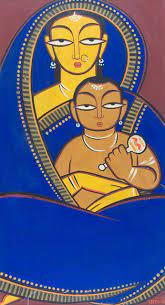
Mother & Child by Jamini Roy (1887-1972)Mother and Child by Picasso (1881-1973)
‘Victory to Man, the newborn, the ever-living.’ They kneel down, the king and the beggar, the saint and the sinner, the wise and the fool, and cry: ‘Victory to Man, the newborn, the ever-living.’
This is the month— the last of a conflict-ridden year— when we celebrate the birth of a messiah who spoke of divine love, kindness, forgiveness and values that make for a better world. The child, Jesus, has even been celebrated by Tagore in one of his rarer poems in English. While we all gather amidst our loved ones to celebrate the joy generated by the divine birth, perhaps, we will pause to shed a tear over the children who lost their lives in wars this year. Reportedly, it’s a larger number than ever before. And the wars don’t end. Nor the killing. Children who survive in war-torn zones lose their homes or families or both. For all the countries at war, refugees escape to look for refuge in lands that are often hostile to foreigners. And yet, this is the season of loving and giving, of helping one’s neighbours, of sharing goodwill, love and peace. On Christmas this year, will the wars cease? Will there be a respite from bombardments and annihilation?
We dedicate this bumper year-end issue to children around the world. We start with special tributes to love and peace with an excerpt from Tagore’s long poem, ‘The Child‘, written originally in English in 1930 and a rendition of the life of the philosopher and change-maker, Vivekananda, by none other than well-known historical fiction writer, Aruna Chakravarti. The poem has been excerpted from Indian Christmas: Essays, Memoirs, Hymns, an anthology edited by Jerry Pinto and Madhulika Liddle, a book that has been reviewed by Somdatta Mandal and praised for its portrayal of the myriad colours and flavours of Christmas in India. Christ suffered for the sins of humankind and then was resurrected, goes the legend. Healing is a part of our humanness. Suffering and healing from trauma has been brought to the fore by Christopher Marks’ perspective on Veronica Eley’s The Blue Dragonfly: healing through poetry. Basudhara Roy has also written about healing in her take of Kuhu Joshi’s My Body Didn’t Come Before Me.Bhaskar Parichha has reviewed a book that talks of healing a larger issue — the crises that humanity is facing now, Permacrisis: A Plan to Fix a Fractured World, by ex-British Prime Minister Gordon Brown, Nobel Laureate Michael Spence, Mohamed El-Erian and Reid Lidow. Parichha tells us that it suggests solutions to resolve the chaos the world is facing — perhaps a book that the world leadership would do well to read. After all, the authors are of their ilk! Our book excerpts from Dr Ratna Magotra’s Whispers of the Heart – Not Just A Surgeon: An Autobiographyand Manjima Misra’s The Ocean is Her Titleare tinged with healing and growth too, though in a different sense.
The theme of the need for acceptance, love and synchronicity flows into our conversations with Afsar Mohammad, who has recently authored Remaking History: 1948 Police Action and the Muslims of Hyderabad. He shows us that Hyderabadi tehzeeb or culture ascends the narrow bounds set by caged concepts of faith and nationalism, reaffirming his premise with voices of common people through extensive interviews. In search of a better world, Meenakshi Malhotra talks to us about how feminism in its recent manifestation includes masculinities and gender studies while discussing The Gendered Body: Negotiation, Resistance, Struggle, edited by her, Krishna Menon and Rachana Johri. Here too, one sees a trend to blend academia with non-academic writers to bring focus on the commonalities of suffering and healing while transcending national boundaries to cover more of South Asia.
That like Hyderabadi tehzeeb, Bengali culture in the times of Tagore and Nazrul dwelled in commonality of lore is brought to the fore when in response to the Nobel laureate’s futuristic ‘1400 Saal’ (‘The year 1993’), his younger friend responds with a poem that bears not only the same title but acknowledges the older man as an “emperor” among versifiers. Professor Fakrul Alam has not only translated Nazrul’s response, named ‘1400Saal’ aswell, but also brought to us the voice of another modern poet, Quazi Johirul Islam. We have a self-translation of a poem by Ihlwha Choi from Korean and a short story by S Ramakrishnan in Tamil translated by T Santhanam.
Our short stories travel with migrant lore by Farouk Gulsara to Malaysia, from UK to Thailand with Paul Mirabile while chasing an errant son into the mysterious reaches of wilderness, with Neeman Sobhan to Rome, UK and Bangladesh, reflecting on the Birangonas (rape victims) of the 1971 Bangladesh Liberation war, an issue that has been taken up in Malhotra’s book too. Sobhan’s story is set against the backdrop of a war which was fought against linguistic hegemony and from which we see victims heal. Sohana Manzoor this time has not only given us fabulous artwork but also a fantasy hovering between light and dark, life and death — an imaginative fiction that makes a compelling read and questions the concept of paradise, a construct that perhaps needs to be found on Earth, rather than after death.
The unusual paradigms of life and choices made by all of us is brought into play in an interesting non-fiction by Nitya Amlean, a young Sri Lankan who lives in UK. We travel to Kyoto with Suzanne Kamata, to Beijing with Keith Lyons, to Wayanad with Mohul Bhowmick and to Langkawi with Ravi Shankar. Wendy Jones Nakanishi argues in favour of borders with benevolent leadership. Tongue-in-cheek humour is exuded by Devraj Singh Kalsi as he writes of his attempts at using visiting cards as it is by Rhys Hughes in his exploration of the truth about the origins of the creature called Humpty Dumpty of nursery rhyme fame.
Poetry again has humour from Hughes. A migrant himself, Jee Leong Koh, brings in migrant stories from Singaporeans in US. We have poems of myriad colours from Ryan Quinn Flanagan, Patricia Walsh, John Grey, Kumar Bhatt, Ron Pickett, Prithvijeet Sinha, Sutputra Radheye, George Freek and many more. Papia Sengupta ends her poem with lines that look for laughter among children and a ‘life without borders’ drawn by human constructs in contrast to Jones Nakanishi’s need for walls with sound leadership. The conversation and dialogues continue as we look for a way forward, perhaps with Gordon Brown’s visionary book or with Tagore’s world view of lighting the inner flame in each human. We can hope that a way will be found. Is it that tough to influence the world using words? We can wish — may there be no need for any more Greta Thunbergs to rise in protest for a world fragmented and destroyed by greed and lack of vision. We hope for peace and love that will create a better world for our children.
As usual, we have more content than mentioned here. All our pieces can be accessed on the contents’ page. Do pause by and take a look. This bumper issue would not have been possible without the contribution of all the writers and our fabulous team from Borderless. Huge thanks to them all and to our wonderful readers who continue to encourage us with their comments and input.
Here’s wishing you all wonderful new adventures in the New Year that will be born as this month ends!
Rabindranath Tagore (1861-1941) Kazi Nazrul Islam (1899-1976)
1400 SAAL OR The YEAR 1993

A hundred years ago
O poet, you had thought of us
              With such immense affection,
A hundred years ago!

Mystical one; child of mystery,
Taking off the cloak covering your eyes,
When did you arrive from some far-off haven?
Heading from the south and opening a window of our house,
          O secret stroller into our dreams,
                 You came with the fragrance wafted by the spring breeze,
To where a hundred years later I was reading your poem
                                                At nighttime.
An absent-minded butterfly, you saw us with pain-brightened and moist eyes—
With silent wings,
Fluttering casually, you went languidly away.
And we, a hundred years later,
Keep reading your poem, dyed in the tenderness of youth,
                             With rapt attention, affectionately.
In a reverie, and sleepy, with eyes drooping,
My beloved listens to your prophetic song
                             With tear-moistened eyes.

Alas, to this day,
              The shut southern window
                      Opens again and again.
The restless spring breeze cries out in pent up pain.
          In minds and forests and in murmuring blossoms,
Moist flowers shed from their braided beds,
                             Again and again.

The dark eyelids of the blossoms keep fluttering softly.
The female bee snatches honey from the beak of her mate.

      The dark-eyed buds flutter in the gentle breeze.
Drenched in pollen, bees drink honey-sweetness fully.
      The she-dove loses herself at the warbling of her mate.
The forest bride has decked herself in crimson robes of youthfulness.
		Every now and then earth’s heart gasps
		At the breeze’s passionate outbursts.

Immersed in the depth of your being, a hundred years later,
Oh sun-suffused one, I have been reading your poem,
	With immense adoration.
At your gesture I wake up to your music,
O artful one, I’ve grasped your artfulness!
			Stealthily you tiptoe
		To our far away youthful beings,
		In poetry, songs and in lush tones and colourful dreams.
		All flowers that have bloomed today—all birdsongs,
					All crimson hues,
		Caressed by you, O ever-youthful poet,
					Have become livelier!
			In the morning hours of this spring festival,
		You’ve become the song in our youthful festivities.
		 	Once a darling child and now immortal in a bower
		All of us youthful men and women await your nuptial hour.
			Sing O dear one, sing again and again
The songs you would sing amidst blooming flowers,
Songs my beloved and I sing on our own or together,
Songs at whose end I slide into sleep, only to hear
	In a dream appearing in a midnight hour,
	My beloved weep, “Dearest poet, friend and wise one—“
	Till my dream ends suddenly
	And I view my beloved’s eyes moisten
			Until tears trickle down her eyes.

	I remember now, how a hundred years ago
     You had stirred—and others too had awakened
In some far away cloistered state.
At your gesture a sad tune had spread its wings and flown.
	Glancing back from the window momentarily,
		It had caressed the tears lining your eyelids.
		It had bent the curling tresses of flower buds.
	And then vanished—leaving you sitting silently.
Moistened by the dewdrop of your eyes,
Your messages blossomed; some bloomed,
	Some even resonated instantly,
And then were tucked away inside our dreams.

		All of a sudden a door opened
In the spring morning your greeting came through.
The envoy of spring you’d sent a hundred years ago
Filled us youthful ones with intense yearnings.

O Emperor of all poets, though we haven’t seen you,
			The Taj Mahal you created,
Sparkling like sandalwood on the forehead of time
		Entrances us and we behold it breathlessly.
We curse our youth— “Why did it have to be a hundred years later?”
				Alas, in this day and age,
We’ve never been able to glimpse Mumtaz and behold the Taj!

A thousand years later—O emperor of poets,
New poets keep coming to sing your praise
		From sunrise to sunset songs celebrate your feats
			And the tune that wandered away from you
Fill groves and forest shades with your message anew.

				And in our time
A hundred tunes keep sounding from veenas in our homes
	And yet the heart remains unfulfilled and the soul keeps yearning
Traversing a hundred years your song drifts into our dreams
			Then it occurs to me our poet
You have settled in our horizon to light it up forever—
			Our very own and eternal sun!

A hundred years ago,
You had greeted us -- young ones -- warmly,
			Vibrantly and affectionately.
The same greeting is being sent to you this day
		As a floral wreath to decorate your feet.

O perfect poet, it seems you’ve appeared in imperfect guise
				Amidst us, softly, silently!
And with a trembling voice imperfect being that I am,
I sing your spring song in your spring bower
And send it to you a hundred years later!

(First published in Kazi Nazrul Islam: Selections 1, edited by Niaz Zaman, Dhaka: writers.ink, 2020)
Clickhere to read Tagore’s 1400 Saal, the poem that inspired this beautiful response from one of the greatest poetic voices of all times.
A rendition of Nazrul’s poem in response to Tagore’s 1400 Saal in Bengali
Born in united Bengal, long before the Partition, Kazi Nazrul Islam(1899-1976) was known as the Bidrohi Kobi, or “rebel poet”. Nazrul is now regarded as the national poet of Bangladesh though he continues a revered name in the Indian subcontinent. In addition to his prose and poetry, Nazrul wrote about 4000 songs.
Just as George Orwell (1903-1950) envisioned a bleak future in his novel, 1984, Tagore left his optimistic vision filled with hope for posterity – a vision which has also been borne true. Written in the Phalgun or spring of the Bengali year 1302 (1895), ‘1400Saal‘ or ‘The Year 1993’, was first published in Tagore’s collection called Chitra (Picture) in 1895.
Art by Sohana Manzoor
   1400 SAAL or The YEAR 1993

   A hundred years from today…
  Who are you reading my poetry
     With eager curiosity?
   A hundred years from today.
   I won’t be able to give you
   Even a small fragment of the
 Exuberance of this spring morning —
    A blossom or a birdsong,
        The passions that
             Drench us.
    A hundred years from today…

Still, once, open your Southern door,
        Sit by the window,
   Gaze at the distant horizon,
           And imagine —
  One day, a hundred years before,
A lively, euphoric cluster wafted from
Heaven into the heart of the universe,
   Like a new-born Phalgun day —
Free of ties, ecstatic and restless,
  Adrift with the scent of flowers.
      The Southern breeze
    Rushed to colour the Earth
      With a youthful glow,
   One hundred years before you.
On that day, the soul of a poet soared
      With a song-soaked heart —
      To find words which bloom
      With an abundance of love,
       One hundred years ago.

   A hundred years from today
   Which new poet will strum
    Lyrics in your hearths?
 I felicitate the poet with delight
     In your joyous spring —
     But let my vernal songs,
 Find echoes in your hearts for a while,
   Like the buzz of bees,
  Like the murmur of leaves...
  One hundred years from today...
About 32 years down the line, Nazrul responded to this poem of Tagore’s with a rejoinder, which is from the standpoint of a young poet and depicts his adulation for the older one and his poetry. Nazrul’s poem in Bengali is also called 1400 Saal and has been translated by Professor Fakrul Alam. The translation can be read by clicking here.
This poem was also discussed and translations read in 1993, the Gregorian calendar year for 1400 in the Bengali calendar, in a function jointly organised by the Nehru Centre of the High Commission of India in London and the Tagore Centre of London and held in the premises of the Nehru Centre. The translations included a rendition of Tagore’s own rather brief and ‘loosely translated’ version, according to the keynote speaker and scholar, Brian A. Hatcher, published in the poet’s collection called, The Gardener and reprinted in The Collected Poems and Plays of Rabindranath Tagore (New York, 1966).
Tagore’s own vision of his songs being remembered after one hundred years has been not only borne true but also his hope that poets and poetry will continue to impact our lives, stirring hope and love in our hearts. The role of a poet as seen by Tagore, perhaps, is what Uma Dasgupta’s research on Sriniketan reinforces — as that of a visionary and not merely a recorder of events.
Tagore reciting his ‘1400 Saal‘ in Bangla
This poem has been translated by Mitali Chakravarty with editorial input by Sohana Manzoor and research by Sohana and Mitali on behalf of Borderless Journal
.
PLEASE NOTE: ARTICLES CAN ONLY BE REPRODUCED IN OTHER SITES WITH DUE ACKNOWLEDGEMENT TO BORDERLESS JOURNAL
Look around you and expand your heart.
Petty sorrows are insignificant.
Fill your vacant life with love for humanity.
The Universe reverberates with celestial ecstasy.
— Anondodhhara Bohichche Bhubone(The Universe reverberates with celestial ecstasy), Tagore, 1894
Some of the most beautiful colours in this universe are blended shades— colours that are born out of unusual combinations. Perhaps that is why we love auroras, sunrises and sunsets. Yet, we espouse clear cut structures for comprehension. As we define constructs created by our kind, we tend to overlook the myriads of colours that hover in the gloaming, the brilliant play of lights and the vibrancy of tints that could bring joy if acknowledged. That ignoring the new-born shades or half-shades and creating absolute structures or constructs lead to wars, hatred, unhappiness and intolerance has been borne true not only historically but also by the current turn of events around the globe. While battles are never fought by the colours or beliefs themselves, they can harm — sometimes annihilate — rigid believers who are victimised for being led to accept their way as the only one and hate another. Perhaps, this has echoes of the battle between the Big Endians and Little Endians over the right way to break eggs in Jonathan Swift’s Gulliver’s Travels (1726). As the book is mere fiction, we can admire, agree and laugh at the content. However, in real life, watching newsreels has become a torture with destruction and violence being the main highlights. These detract from life as we knew it.
Writing or literary inputs seem to have become a luxury. But is it really hedonistic to play with words? Words used effectively over a period of time can impact readers to think peace, acceptance and love and also help people heal from the ensuing violence. That can be a possibility only if we self-reflect. While we look for peace, love and acceptance in others, we could start by being the change-makers and bridge builders ourselves. That is the kind of writing we have managed to gather for our November issue.
Building such bridges across humanity, we have poems on the latest Middle Eastern conflict by Stuart McFarlane and David Mellor, which explore the pain of the victims and not the politics of constructs that encourage wars, destruction of humanity, the flora, the fauna and our home, the Earth. Michael Burch writes against wars. Prithvijeet Sinha and Ahana Bhattacharjee write about refugees and the underprivileged. Reflecting colours of the world are poems from Ryan Quinn Flanagan, Suzayn AH, Radhika Soni, Ron Pickett, George Freek and many more. Rhys Hughes has brought lighter shades into his poetry by trying a new technique while reflecting on yetis and mermaids. His column tries to make a parody of a non-existing parody, using TS Eliot’s century old poem, ‘Wasteland’, with amazing results!
Our translations are all poetry too this time. Professor Fakrul Alam has translated a poem discussing human aspirations by Quazi Johirul Islam from Bengali. Another Balochi poem of hope by Bashir Baidar has been brought to us in English by Fazal Baloch bringing into play the moonlight.
For the first time, we are privileged to carry poetry from a language that has almost till now has eluded majority of Anglophone readers, Maithili. Vidyanand Jha, a Maithili poet, has translated his poetry for all of us as has Korean poet, Ihlwha Choi. Winding up translations are Tagore’s ultimate words for us to introspect and find the flame within ourselves in the darkest of times – echoing perhaps, in an uncanny way, the needs of our times.
Our conversation this month brings to us a poet who comes from a minority group in India, Banjara or gypsies, Ramesh Karthik Nayak. In his attempt to reach out to the larger world, he worries that he will lose his past. But does the past not flow into the future and is it not better for traditions to evolve? Otherwise, we could all well be living in caves… But what Nayak has done — and in a major way — is that he has brought his culture closer to our hearts. His debut poetry book in English, Chakmak (flintstones), brings to us Banjara traditions, lives and culture, which are fast getting eroded and he also visits the judgemental attitude of the majoritarian world. To give you a flavour of his poetry, we bring to you an excerpt from his book, livened beautifully with Banjara art and an essay by Surya Dhananjay that contextualises the poetry for us. Our excerpts also have a focus on poetry for we are privileged to have a few poems from Mamang Dai’s The White Shirts of Summer: New and Selected Poems. Mamang Dai is a well-known name from the North-eastern state of Arunachal Pradesh for both her journalistic and poetic prowess.
We are happy to host Ranu Uniyal’s beautiful review of I am Not the Gardener: Selected Poems by Raj Bisaria. Bisaria among other his distinctions, was named “Father of the modern theatre in North India” by the Press Trust of India. The other reviews are all of prose. Somdatta Mandal has written of Ali Akbar Natiq’s Naulakhi Kothi, a fictional saga of gigantic proportions. Anita Balakrishnan has reviewed Lakshmi Kannan’s short story collection, Guilt Trip. The book that gives hope for a green future, Akshat Rathi’s Climate Capitalism: Winning the Global Race to Zero Emissionshas been reviewed by Bhaskar Parichha. Parichha contends: “Through stories that bring people, policy and technology together, Rathi reveals how the green economy is possible, but profitable. This inspiring blend of business, science, and history provides the framework for ensuring that future generations can live in prosperity.”
The anti-thesis to the theme for a welfarist approach towards Earth can be found in Koushiki Dasgupta Chaudhari’s poignant musing titled, “The Theft of a River”. Meredith Stephen’s travel to California and Sai Abhinay Penna’s narrative about Chikmagalur have overtones of climate friendliness. Ravi Shankar writes further of his travels in Peru and Peruvian coffee. Keith Lyons takes us peeking at Beijing and the Great Wall. Gayatri Devi adds to the variety by introducing us to the starry universe of South Indian cinema while Devraj Singh Kalsi brings in the much-needed humour with his narrative about his “Crush on Bottles“. Suzanne Kamata has also given a tongue-in-cheek narrative about the mystique of addresses and finding homes in Japan. We have fiction from Paul Mirabile located in England and Kalsi’s located in India. Pause by our contents page to view more gems that have not been mentioned here.
Huge thanks to our team at Borderless Journal, especially Sohana Manzoor for her fabulous artwork. This journal would not have been as it is of now without each and every one of them and our wonderful contributors and readers. Thank you all.
Wish you all a wonderful month as we head towards the end of a rather tumultuous year.
Tomar Kachhe Shanti Chabo Na(I Will Not Pray to You for Peace) by Tagore is a part Gitimalaya (A Garland of Songs) published in 1914.
           I Will Not Pray to You for Peace

           I will not pray to you for peace.
           Let me stay with my feeling of grief.
Amidst this wave of conflict,
In the haze of the games you script,
            I will swing towards my own dream.

            Let the breeze blow off the lamplight,
            Let storms thunder in the sky —
Every moment in my heart,
I can sense your footfall.
             In darkness, I strive to find my stream.
You can listen to the song performed in Bengali by well-known artiste Swagatalakshmi here.
This poem has been translated by Mitali Chakravarty with editorial input by Sohana Manzoor on behalf of Borderless Journal
.
PLEASE NOTE: ARTICLES CAN ONLY BE REPRODUCED IN OTHER SITES WITH DUE ACKNOWLEDGEMENT TO BORDERLESS JOURNAL
Light of mine, O light, the universe is filled with your effulgence,
My heart is yours; my eyes drown in your refulgence.
….
The sky awakens, the breeze flits, the Earth laughs.
As luminous currents surge, thousands of butterflies take flight.

— Aalo Amar Aalo (Light, My Light), Bichitra, 1911, Rabindranath Tagore
There was a time when lights were a part of joy and celebrations as in Tagore’s poem above. Lighting lamps, people welcomed home their beloved prince Rama on Deepavali, who returned after a fourteen year exile, and during his banishment, killed the demonic Ravana. On the same day in Bengal, lamps were lit to ward off evil and celebrate the victory of Kali, (the dark woman goddess wooed by Tantrics) over the rakshasa, Raktabeeja. In the Southern part of India, lamps were lit to celebrate the victory of Krishna over Narakasura. The reasons could be many but lights and fireworks were lit to celebrate the victory of good over evil during the festival of lights.
In the current world with lines blurred between good and evil, while climate crises seeks smoke free, coal free energy, flames of fire or fireworks are often frowned upon. In these times, we can only hope to light the lamp of love — so that differences can be settled amicably without killing the helpless and innocent, infact without violence, greed, peacefully and with kindness, keeping in mind the safety of our species and our home, the Earth. We invite you to partake of our content, writings that light the lamp of love —
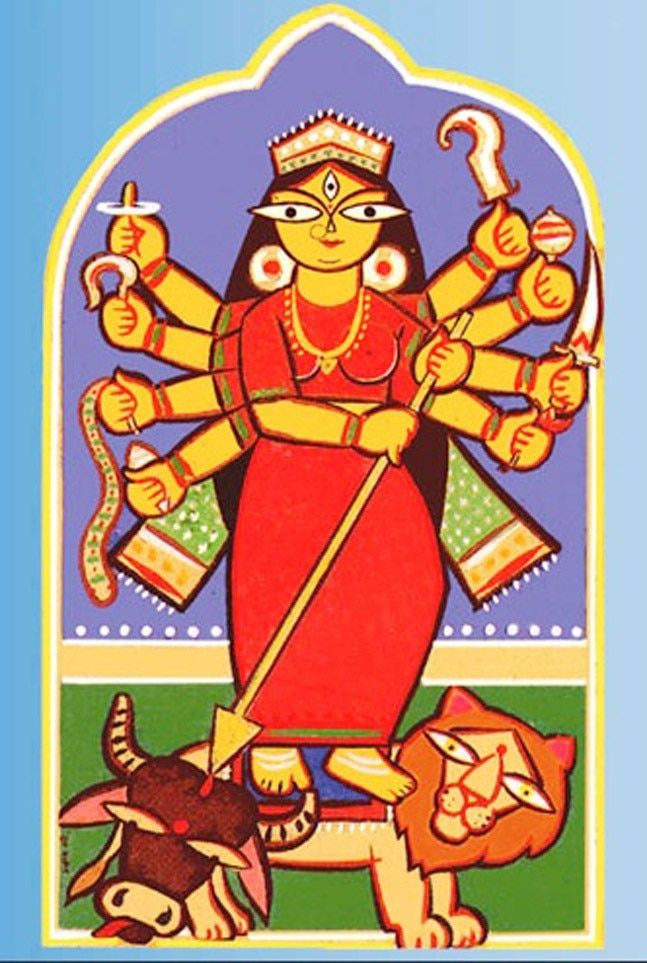
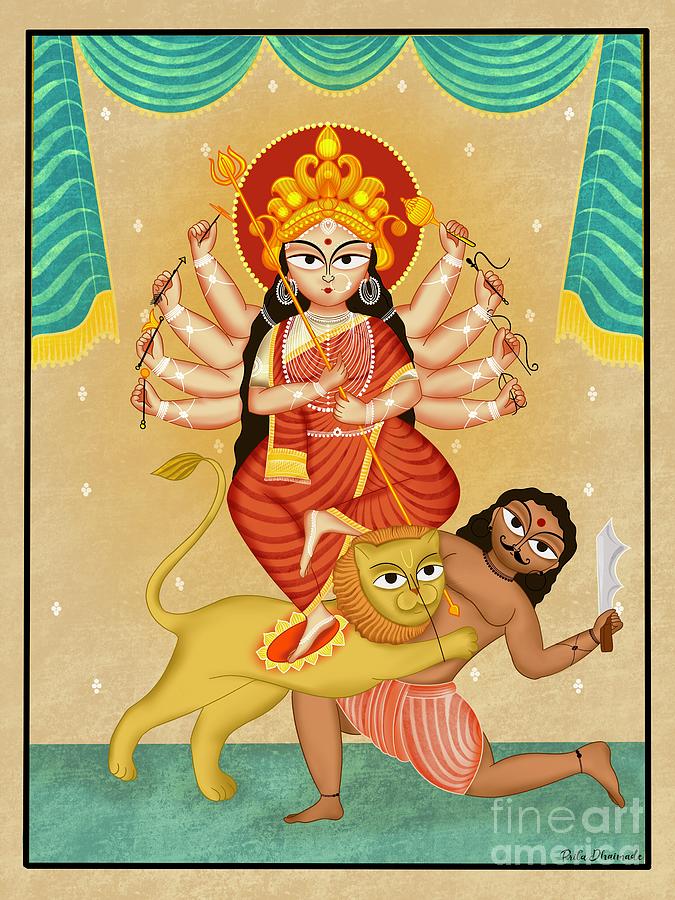
Durga Puja, a community- based festival. Courtesy: Creative Commons
Long ago as children, we looked forward to the autumnal festival of Durga Puja. For those who lived outside Bengal, there was no holiday but it was still a break, a season filled with joie de vivre, when family and friends would gather to celebrate the community-based festival, Durga Puja. Parallelly, many from diverse Indian cultures celebrated Navratri — also to do with Durga. On the last day of the Durga Puja, when the Goddess is said to head home, North Indians and Nepalese and some in Myanmar celebrate Dusshera or Dashain, marking the victory of Rama over Ravana, a victory he achieved by praying to the same Goddess. Perhaps, myriads of festivals bloom in this season as grains would have been harvested and people would have had the leisure to celebrate.
Over time, Durga Puja continues as important as Christmas for Bengalis worldwide, though it evolved only a few centuries ago. For the diaspora, this festival, declared “Intangible Cultural Heritage of Humanity” by UNESCO, is a source of joy. While devotees welcome the Goddess Durga and her children home, sons and daughters living away would use this event as a reason to visit their parents. Often, special journals featuring writings of greats, like Satyajit Ray, Tagore, Syed Mujtaba Ali, Nazrul would be circulated in the spirit of the festival.
The story around the festival gives out that like an immigrant, the married Goddess who lived with her husband, Shiva, would visit her parent’s home for five days. Her advent was called Agomoni. Aruna Chakravarti contends in her essay, Durga’s Agomoni “is an expression, pure and simple, of the everyday life of women in a rural community –their joys and sorrows; hopes and fears”. While some war and kill in the name of religion, as in the recent Middle Eastern conflict, Chakravarti, has given us an essay which shows how folk festivities in Bengal revelled in syncretism. Their origins were more primal than defined by the tenets of organised religion. And people celebrated the occasion together despite differences in beliefs, enjoying — sometimes even traveling. In that spirit, Somdatta Mandal has brought us travel writings by Tagore laced with humour. The spirit continues to be rekindled by writings of Tagore’s student, Syed Mujtaba Ali, and an interview with his translator, Nazes Afroz.
We start this special edition with translations of two writers who continue to be part of the syncretic celebrations beyond their lives, Tagore and Nazrul. Professor Fakrul Alam brings to us the theme of homecoming explored by Nazrul and Tagore describes the spirit that colours this mellow season of Autumn
Poetry
Nazrul’s Kon KuleAaj Bhirlo Tori ( On which shore has my boat moored today?), translated from Bengali by ProfessorFakrul Alam, explores the theme of spiritual homecoming . Click here to read.
Tagore’sAmra Bedhechhi Kasher Guchho (We have Tied Bunches of Kash), translated from Bengali by Mitali Chakravarty, is a hymn to the spirit of autumn which heralds the festival of Durga Puja. Click here to read.
Somdatta Mandal translates from Bengali Travels & Holidays: Humour from Rabindranath. Both the essay and letters are around travel, a favourite past time among Bengalis, especially during this festival. Click here to read.
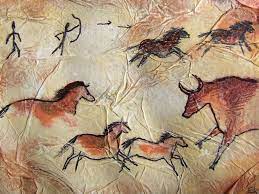
Pre-historic cave painting in France La Tauromaquia. Leap with the Spear by Picasso (1881-1973)Courtesy: Creative Commons
There was a time when there were no boundaries drawn by humans. Our ancestors roamed the Earth like any other fauna — part of nature and the landscape. They tried to explain and appease the changing seasons, the altering landscapes and the elements that affected life and living with rituals that seemed coherent to them. There were probably no major organised structures that laid out rules. From such observances, our festivals evolved to what we celebrate today. These celebrations are not just full of joie de vivre, but also a reminder of our syncretic start that diverged into what currently seems to be irreparable breaches and a lifestyle that is in conflict with the needs of our home planet.
Reflecting on this tradition of syncretism in our folklore and music, while acknowledging the boundaries that wreak havoc, is an essay by Aruna Chakravarti. She expounds on rituals that were developed to appease natural forces spreading diseases and devastation, celebrations that bring joy with harvests and override the narrowness of institutionalised human construct. She concludes with Lalan Fakir’s life as emblematic of the syncretic lore. Lalan, an uneducated man brought to limelight by the Tagore family, swept across religious divides with his immortal lyrics full of wisdom and simplicity. Dyed in similar syncretic lore are the writings of a student and disciple of Tagore from Santiniketan, Syed Mujtaba Ali (1904-1974). His works overriding these artificial constructs have been brought to light, by his translator, former BBC editor, Nazes Afroz. Having translated his earlier book, In a Land Far from Home: A Bengali in Afghanistan, Afroz has now brought to us Syed Mujtaba Ali’s Tales of a Voyager (Jolay Dangay), in which we read of his travels to Egypt almost ninety years ago. In his interview, the translator highlights the current relevance of this remarkable polyglot.
Humming the tunes of Mujtaba Ali’s tutor, Tagore, a translation of Tagore’s song, AmraBeddhechhi Kasher Guchho (We have Tied Bunches of Kash[1]) captures the spirit of autumnal opulence which heralds the advent of Durga Puja. A translation by Fazal Baloch has brought a message of non-violence very aptly in these times from recently deceased eminent Balochi poet, Mubarak Qazi. Professor Fakrul Alam has translated a very contemporary poem by Quazi Johirul Islam on Barnes and Nobles while from Korea, we have a translation of a poem by Ihlwha Choi on the fruit, jujube, which is eaten fresh of the tree in autumn.
A poem which starts with a translation of a Tang dynasty’s poet, Yuan Zhen, inaugurates the first translation we have had from Mandarin — though it’s just two paras by the poet, Rex Tan, who continues writing his response to the Chinese poem in English. Mingling nature and drawing life lessons from it are poems by George Freek,Ryan Quinn Flanagan and Gopal Lahiri. We have poetry which enriches our treasury by its sheer variety from Hawla Riza, Pramod Rastogi, John Zedolik, Avantika Vijay Singh, Tohm Bakelas and more. Michael Burch has brought in a note of festivities with his Halloween poems. And Rhys Hughes has rolled out humour with his observations on the city of Mysore. His column too this time has given us a table and a formula for writing humorous poetry — a tongue-in-cheek piece, just like the book excerpt from The Coffee Rubaiyat. In the original Rubaiyat, Omar Khayyam (1048–1131) had given us wonderful quatrains which Edward Fitzgerald immortalised with his nineteenth century translation from Persian to English and now, Hughes gives us a spoof which would well have you rollicking on the floor, and that too, only because as he tells us he prefers coffee over wine!
Humour tinged with irony is woven into Devraj Singh Kalsi’s narrative on red carpet welcomes in Indian weddings. We have a number of travel stories from Peru to all over the world. Ravi Shankar takes us to Lima and Meredith Stephens to Californian hot springs with photographs and narratives while Sayani De does the same for a Tibetan monastery in Lahaul. Keith Lyons converses with globe trotter Tomaž Serafi, who lives in Ljubljana. And Suzanne Kamata adds colour with a light-veined narrative on robots and baseball in Japan. Syncretic elements are woven by Dr. KPP Nambiar who made the first Japanese-Malyalam Dictionary. He started nearly fifty years ago after finding commonalities between the two cultures dating back to the sixteenth century. Tulip Chowdhury brings in colours of Halloween while discussing ghosts in Bangladesh and America, where she migrated.
The theme of immigration is taken up by Gemini Wahaaj as she reviews South to South: Writing South Asia in the American South edited by Khem K. Aryal. Japan again comes into focus with Aditi Yadav’s Makoto Shinkai’s and Naruki Nagakawa’s She and Her Cat, translated from Japanese by Ginny Tapley Takemori. Somdatta Mandal has also reviewed a translation by no less than Booker winning Daisy Rockwell, who has translated Usha Priyamvada’sWon’t You Stay, Radhika? from Hindi. Our reviews seem full of translations this time as Bhaskar Parichha comments on One Among You: The Autobiography of M.K. Stalin, the current Chief Minister of Tamil Nadu, translated from Tamil by A S Panneerselvan. In fiction, we have stories that add different flavours from Paul Mirabile, Neera Kashyap, Nirmala Pillai and more.
“One of the children gave it [the bunch of bananas] to the child sitting in front. An emaciated girl and a little boy were seated next to me. I told them to pass on the fruit to everyone in the back and keep one each for themselves. The girl looked curiously at the bunch as she turned it around in her hands. Then she looked at the other children.

“‘I’ve never seen an onion like this one,’ she said.

“Her little companion also touched the fruit gingerly and innocently added, ‘Yes, this is not even a potato.’

“I was speechless to say the least. These children had never seen anything apart from onions and potatoes. They had definitely never chanced upon bananas…”
Heart-wrenching but true! Maybe, we can all do our bit by reaching out to some outside our comfort or social zone to close such alarming gaps… Uma Dasgupta’s book tells us that Tagore had hoped many would start institutions like Sriniketan all over the country to bridge gaps between the underprivileged and the privileged. People like Satyarthi are doing amazing work in today’s context, but more like him are needed in our world.
We have more writings than I could mention here, and each is chosen with much care. Please do pause by our contents page and take a look. Much effort has gone into creating a space for you to relish different perspectives that congeal in our journal, a space for all of you. For this, we have the team at Borderlessto thank– without their participation, the journal would not be as it is. Sohana Manzoor with her vibrant artwork gives the finishing touch to each of our monthly issues. And lastly, I cannot but express my gratefulness to our contributors and readers for continuing to be with us through our journey. Heartfelt thanks to all of you.
Agomoni (1878–1883), Metropolitan Museum of Art, Kolkata
Bengal — and here I refer to undivided Bengal — with her plurality of religions, cultures and sub-cultures and her numerous linguistic forms and dialects, provides a wonderful kaleidoscope of thoughts and ideas through her oral utterances. Multiple streams of expressions provide a fascinating study for the researcher. This cultural heritage is deeply enmeshed in the life of a Bengali enfolding Hindu and Muslim alike. In the present scenario of divisive identity politics, it is imperative that we draw upon this common heritage constantly and consistently.
In this essay, we will highlight practices in which there was equal participation of Hindus and Muslims, with each community infusing and enriching the traditions of poetry, music, narrative and ritual. What is observed is a readiness to dissolve religious differences in a common cultural pool of assimilated identities.
A large body of the oral literature of Bengal is rooted in the worship of demonic powers. As is to be expected in a tropical region and a primitive, rural society, certain deities are seen as holding human lives in thrall by their control of natural calamities, animal attacks and epidemics. Though Islam sanctions worship of none other than Allah, the Muslims of Bengal are equal participants in the propitiation of these deities. Interestingly, most of these are female deities, indicating that Bengalis have seen the powers of destruction and preservation as vested in women from time immemorial.
Olai Chandi
Let us begin with the Saat Bibir Upakhyan, the legend of the seven sisters who hold in their hands the power to unleash and contain some of the deadly diseases that strike rural Bengal from time to time. The eldest and most feared is Ola Bibi or Bibi Ma –the goddess of cholera or olautha –ola, in the rustic dialect meaning diarheoa and utha –vomiting. When the two symptoms appear together the villagers see it as Ola Bibi’s curse and rush to offer prayers and sacrifices. So great is their awe and terror of this deity that they invest her with the most flattering attributes. Worshipped by both Hindus and Muslims alike, she is represented as a woman of surpassing beauty, striking personality and noble mien. The Hindu version of the idol, Olai Chandi, has a bright yellow complexion and long slanting eyes. She wears a blue sari, has open hair and is adorned with the jewellery wealthy Hindu women wear – bangles, necklaces, armlets and a nose hoop. The Muslims visualize her as a high-born Muslim maiden in Islamic attire – loose pyjamas, shirt, cap, veil and nagras[1] on her feet.
The worship of Ola Bibi continues vibrantly into the present in Nadiya, Bankura, Birbhum, Bardhman and even Kolkata, sometimes singly, sometimes along with her other six sisters –Jhola Bibi, Ajgai Bibi, Chand Bibi, Bahurh Bibi, Jhentuni Bibi and Asan Bibi. Her puja is performed out in the open under the trees or by the river. But some places are earmarked as Saat Bibir thaan or Ola Bibir thaan –thaan being a corruption of the word sthaan meaning place. The rituals, even when the devotees are Brahmins, are performed by Muslims or drawn from the lowest rung of the caste ladder –the Hadis or Doms.
The second sister Jhola is the goddess of pustules – the full range from the harmless measles to the killer smallpox. But at least one of the seven sisters is a benevolent deity. The youngest, Asan Bibi, makes things easy for women who invoke her aid.
Asan Bibir brata katha[2] tells the story of Shireen, the first brati or invoker of the deity’s aid. Shireen’s father Sultan Isa Khan ordered his daughter to be killed at birth to save her from falling into the hands of the pirates of Arakan who descended on his kingdom, periodically, to loot, plunder and rape. But his purpose was foiled by his eldest son Chand, who escaped with his sister into the forest, far away from the civilised world and its cruelties to women. When Chand was forced to go out to seek a livelihood, he gave his sister seven munia[3] birds and charged her solemnly to give them their gram and water everyday and keep them alive, for his life was bound up in theirs. Young Shireen, in a playful mood, forgot her duty one day and was shocked to find that the birds had died. She set up a wail hearing which Asan Bibi appeared before her. Commanding Shireen to find seven married women and make them sit around the birds and listen to her story, Asan Bibi brought the birds and Chand back to life.
This was the first Asan Bibir puja[4]. Isa Khan’s cruelty to his daughter, with all its implications of female infanticide and honour killing being foiled by his rebel son –an enlightened man and champion of women’s rights — is as relevant today as it was then. Asan Bibi is not only a deity. She is the manifestation of woman power. The seven bratis symbolise the bonding and coming together of women in a bid to protect each other from masculine cruelty and domination.
Asan Bibi is a Muslim deity but, as part of an appropriation and assimilation that has gone on for centuries and is typical of Bengalis, the legend of Asan Bibi is enacted, to this day, by Hindu women not only in Bengal but all over India. The offerings are gram and water and the birds are represented by clods of earth
The rituals of this puja display a fascinating blend of Hindu and Muslim practices. The square of red silk on which the pot of water is placed, the silence observed when the tale is being told and the prasad being eaten out of the pallus[5] of the women’s saris, are pure Muslim. But the water in the pot is Gangajal[6], the pot is adorned with a swastika and the clods of earth have to be taken from the base of a tulsi bush[7]. Sindoor, alta and paan[8] with which the chief brati or pledger greets the other six women are the other Hindu elements of the puja.
Another women’s brata[9] is centred around Bhadu — a folk deity worshipped extensively in Rarh and its surrounding districts. Bhadu puja is performed throughout the month of Bhadra, that is the middle of August to the middle of September. The main component of the puja is the community singing by women in which the tale of young Princess Bhadreswari of Manbhum and her tragic, untimely death is told. Bhadu gaan or the ballad of Bhadu expresses the hopes and aspirations of young maidens in ordinary, everyday village life. This puja has no religious basis. No mantras are required and no priests to conduct the rituals. The devotees, like in the Asan Bibir brata, are all women. But despite the non-Aryan nature of the puja and the absence of mantras, there are references to Kali and Krishna in the ballad. The drums announce the coming of Bhadu from Brindaban but, at some point, in her journey she must have stopped at Kailash for her hands are covered with blood red sandal paste, like Kali’s, and a garland of hibiscus hangs around her neck.
Thus, Vaishnav and Shaivaite ideologies are mixed and mingled in the worship of Bhadu, and Shyam and Shyama come together. Yet Bhadu is human – a young girl. She is petted and pampered by her devotees and called Bhadu Rani and Bhadu Dhan[10]. Young girls form eternal friendships with her using the tradition of Soi patano – the exchange of symbolic names with special girl friends. In the song that follows a devotee makes Bhadu her soi picking phul (flower) as a name for her. But what is she to give Bhadu as a gift? Flowers and garlands, of course.
To go back to the deities who hold the key to human suffering and happiness we have Ghentu – the patron deity of skin ailments like sores, itches, scabies and carbuncles. Like Jhola Bibi of the pustular menace, Ghentu appears in spring which, though a season of sweet breezes and mellow sunshine, is particularly conducive to skin afflictions. But Ghentu is not accorded the same respect as Jhola. Though feared, like her, he is also hated and held in contempt. This, perhaps, is owing to the fact that he is only capable of causing minor irritations. He doesn’t have the power to kill or wreak serious damage.
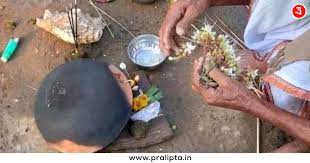
Ghentu Puja is performed by women, mainly mothers, in the twenty-four parganas and the Bardhaman / Bankura belt through the month of Chaitra[11]. There are no temples to Ghentu and no images. A well-worn household pot of black clay is placed on a broken winnowing tray. A pat of cowdung on the pot forms the face and two cowrie shells the eyes of the god. He is made to look bizarre and ugly because Ghentu, though a Deb Kumar[12], had to take birth among the ghouls following a curse by Vishnu. The offerings denote the contempt the idol is held in. Ghentu phul (a foul-smelling flower) parboiled rice (also foul-smelling) and masur dal[13] which is considered unholy for some reason (caste Hindu widows are not allowed to eat it) are placed before the pot with the left hand and not the right. There are no mantras but some verses, insulting and derogatory, and meant to drive him away, are chanted.
Ghentu puja
On the last day of the puja the clay pot is beaten with sticks and kicked to pieces by an excited crowd. This extraordinary humanising of deities and the concept of irreverence as a form of worship is admissible only in Hinduism and never better expressed than in Ghentu puja.
Agrarian societies are almost totally dependent on the whims of nature. Droughts, floods, storms and pests might bring to naught months of hard labour in the fields. Thus, fear and uncertainty dog the lives of peasants and they can breathe easy only after the harvest is reaped and safely stowed away in their paddy bins.
The harvest festival of Bengal starts on Makar Sankranti or the Winter Solstice when the crops begin to ripen. In some districts this festival is known as Tush Tushulir Brata and in others Tushu. Tushu is neither a goddess nor a human like Bhadu. Tush or the husk that protects the precious grain for the whole period of ripening is the object of worship here.
The puja is performed by women irrespective of age or status. Young girls, married women, matrons and widows are all allowed to participate in the rituals which go on for three days. An earthen plate filled with husk is placed in a room where the women of the household assemble chanting verses in praise of Tushu. On the third day one of them carries the plate on her head to the pond and sets it afloat. The rituals vary from region to region but the practice of bauri bandha is prevalent in most parts of Bengal. The outer surface of a clay saucer is smeared with rice paste then filled with water and placed on the fire. As the rice paste bakes and hardens and gets stuck to the pot women chant and sing for joy, for the ritual of bauri bandha symbolises the binding of the grain. It is now firmly in the household and cannot escape. It is only on the conclusion of this ritual that the preparing of peethe puli – an array of sweets made from new rice, coconut and mollases –can commence.
The emotions that spark off the festival of Tushu are relief and gratitude for being spared the prospect of starvation for another season. What better way to express these feelings than in song? Song which liberates the mind and relieves fears and anxieties? Tushu gaan[14]is similar to Bhadu gaan in many ways but whereas the latter focuses on the dreams and aspirations of young maidens Tushu expresses the hopes and fears of an entire community and is represented as a rustic lass celebrating a bountiful harvest with her friends –boys as well as girls.
The literature of rural Bengal is studded with references to these deities. Brata katha and katha katha, stories with a moral lesson at the end, were told by professional narrators or kathak thakurs at religious gatherings from as early as the 5th or 6th century AD. The practice continues vibrantly into the present. At some point down the years they were given a structured form called panchali, a story chanted in verses. Still later, they were textualised by erudite versifiers or pada kartas in a form called Mangal Kabya[15].
The worship of Satyanarayan or Satyapir is performed by both Hindus and Muslims. The rituals are identical, but the deity is called by different names –Satyanarayan by Hindus and Satyapir by Muslims. The offering is identical too – a thick gruel like substance made of flour, milk, mashed bananas and mollases called shirni, which seems to be a corrupted form of the Persian word phirni. Satyanarayan puja in Hindu households is performed by Brahmin priests learned in the Shastras. A Shalagram Shila[16](symbol of Vishnu) is placed on a square of carpet called an asan. Five small plates surround it each containing a betel leaf, a supari[17], a banana, a batasha[18] and a coin. These are called mokams. A metal object, usually a knife or blade, is placed next to the Shalagram Shila.
There is some debate on what came first – the Islamisation of Satyanarayan or the Sanskritising of Satyapir. The latter seems to come nearest to the truth for the following reasons:
The presence of a metal object on the asan of the Shalagram Shila is totally alien to any form of worship sanctioned by the Shastras.
2. The words Satya and mokam are Arabic in origin.
3 Shirni, as an offering, is not seen in the worship of any other Hindu deity.
The truth probably is that someone called Satyapir actually existed at some point of time and was subsequently raised to the status of a deity by his followers. Since Islamic shariat does not sanction worship of any other than Allah, Satyapir remained on the fringes till caste Hindus, ever eager to swell the ranks of their pantheon, appropriated him and made him their own. The rituals remained the same. The only thing they added was the concept that Satyapir was an incarnation of Vishnu in Kaliyug[19]. Hence the Shalagram Shila.
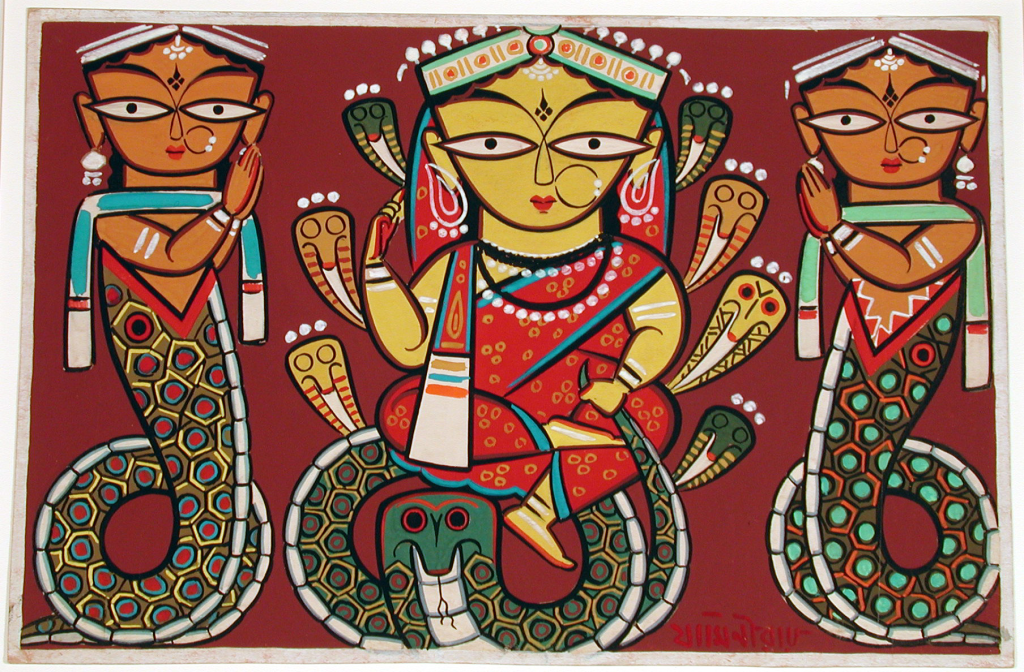
Several eminent pada kartas have written of the exploits of Manasa, the daughter of Shiva and Ganga, another name for whom is Bishhari (conqueror of poison). Of these the most popular version is the one by Ketakadas Khemananda and is still performed by theatrical troupes in the small towns and villages of Bengal.
Manasa Devi (1920) by Jamini Ray (1887-1972)
Manasa worship is said to have emanated from that of the goddess of snakes Manacha Amma of Karnataka — the ch sound having changed to sh in provincial Bengali. There are several versions of how the concept arrived from South India to Bengal of which the most reliable one is that it was brought by bands of Bedeys –nomadic snake charmers who wandered from place to place exhibiting their skills in taming snakes and making them dance to the trilling of their pipes. Bedeys — a community that still exists in Bengal, though Muslim, are fervent worshippers of Manasa.
Manasa puja is traditionally performed at the base of a phani manasa bush – a wild plant with thick, spiky leaves edged with thorns. The bush is supposed to be the protector of snakes and hence their favourite haunt. Though a pre-Aryan deity, Manasa puja is performed by Brahmin priests in accordance with Vedic rites. The goddess is offered flowers, paddy, incense and sindoor. But the bhog – a meal of rice, dal and vegetables– has to be cooked the previous night and offered stale. Manasa puja is also performed in Bangladesh, often by Namazi Muslims who see no contradiction between their worship of Allah and this indigenous deity.
ManasaMangal or Manasar Bhashan is a long-drawn-out narrative set to music. The versification is rudimentary – composed of octosyllabic couplets interspersed with occasional quatrains. The story line is simple and the tunes primary and repetitive. The ballad tells the story of the complete humiliation and defeat of the merchant Chand Saudagar at the hands of the snake goddess Manasa. Puffed up with pride at his wealth, his seven sons and his fleet of ships that carry expensive cargo from one port to another Chand Saudagar refuses to pay Manasa the homage due to her. Manasa decides to teach him a lesson. His seven sons die of snake bite. Seven of his ships, in some versions it is fourteen, are lost at sea. But the youngest son Lakhinder’s wife, the great sati[20], Behula, saves her father-in-law from Manasa’s wrath. She refuses to cremate her husband or don widow’s weeds. Making a raft of banana trunks, she sets herself afloat on the Ganga with her husband’s head on her lap. The river takes her to the abode of the gods where she wins Manasa over with her devotion and humility. Manasa forgives Chand Saudagar and all ends well with Chand acknowledging Manasa’s divinity and Manasa returning to him all she had taken.
The story of Behula predates Brahminical Hinduism and established caste structures. The names—Behula, Sonoka and Lakhinder serve as evidence to the fact. Yet the moral is rooted in patriarchy. A woman’s chastity and steadfast loyalty to her husband, as integral to the welfare of family and community, has been valorised in ‘Manasa Mangal‘ and to this day Behula’s chastity is seen to be on par with that of the great satis of the epics, Sita and Savitri.
Agomoni, verses sung in preparation for Durga’s coming by itinerant minstrels, both Hindu and Muslim, got its first structured form in the songs of the sage Ramprasad who, along with Horu Thakur, Ramnidhi Gupta and other pada kartas from the Twenty-four parganas, Bardhaman, Bankura and Murshidabad, imbued the form with extraordinary sensitivity and human feelings.
At the end of the monsoons when the first clear light of Autumn suffuses the skies, when the lotus blooms and the waving kaash is reflected in the waters of ponds and rivers, Bengal villages come alive with the singing of Agomoni, the legend dear to Bengali hearts, of the coming of Uma. For the great goddess, the ten-armed Mahashakti and the vanquisher of Mahishasur, comes to her earth mother’s lap in the form of her little Uma. The emotional Bengalis, ever ready to humanise their deities and form relationships with them, rejoice at her coming.
Agomoni song by former folk artiste, Amar Pal (1922-2019)Giri Ebar Uma Ele… Kaaro Katha Manbo Na (Giri, when Uma comes, I will not listen to anyone), A song composed by Ramprasad Sen (1718 or 1723 -1775)
Agomoni is an expression, pure and simple, of the everyday life of women in a rural community –their joys and sorrows; hopes and fears. Agomoni opens with Menaka’s grief at the plight of her daughter Uma married, by a careless, indifferent father, to the wayward, half crazed beggar Shiva who covers his nakedness with ash, gets stoned with bhang and consorts with ghosts and spirits. Maneka’s impassioned plea to her husband Giri Raj to bring her darling to her, if only for a few days, echo the yearning of all mothers for a daughter married far away from home.
Giri Raj, like most men, likes to believe what suits him. Convinced that his daughter is perfectly happy in her husband’s home, he dismisses his wife’s fears and tries to placate her with vague promises. But Menaka won’t let him off so lightly. She tells him that she won’t send Uma back to her husband’s house when she comes next. She’ll turn a deaf ear to what people say and, if Shiva insists on taking her back, she and her daughter together will give her son-in-law the tongue lashing he deserves. This song, composed by Ramprasad Sen in the eighteenth century, touches a chord in every mother’s heart for all women, including Menaka, know that this show of rebellion is worth nothing and will be quelled by Giri Raj before he has even heard her out.
Uma comes but Menaka has to reckon not only with her husband but with a daughter whose other name is Sati and who smiles away her mother’s suggestion of keeping her permanently with her. The three days of Uma’s visit pass quickly, too quickly. A desperate Menaka changes her tune. She appeals to her daughter to persuade her husband to come to his father-in-law’s house and stay a few days. Dropping her aggressive stance, she promises to pamper him and give him everything he wants including his favourite bhang.
But that, of course, is not to be. Shiva, incensed with Giri Raj for past insults, won’t even step across the threshold. Nabami[21] night comes. Only a few hours to dawn and Uma will go back. Menaka breaks down and weeps. Alas, her desperate plea to the night of the ninth moon to embrace eternity and never see the face of dawn remains unheard and unanswered.
From the complex compound of anxiety, nostalgia and hope that is Agomoni, we move to another area of cultural memory—the legend of Kerbela. Through the month of Muharrum the Muslims of rural Bengal enact the legend of the battle of Kerbela and the massacre of the prophet’s grandsons Hassan and Hussain. The tale is sung in verse known as jaari gaan—the word jaari, derived from Persian, denoting mourning. It is accompanied by the playing of musical instruments like drums and cymbals and body movements like leaping and dancing. About twenty young men, with gamchhas[22] on their shoulders and ghungroos[23] on their feet, make up a jaari troupe. They go from door to door, the lead singer telling the tale—the others singing the refrain.
Jaari is presumed to have originated in the 16th century with its roots in the Muharrum legend. But the form evolved and came to incorporate other tragic legends—not all of them Muslim. For instance, a very popular Jaari theme is that of Chandidas and his ill-fated love for the washer woman Rami. And, over the years, Jaari has moved on bringing every form of human suffering within its ambit. While retaining old myths and legends in its repertoire, present day Jaari explores and foregrounds the adversities and afflictions of common folk – the fears and terrors that make up their day-to-day existence – poverty, sickness, failed harvests and natural disasters. A famous Jaari gaan reflects this transition. It begins with a heart-rending account of the trials and tribulations suffered by the adherents of Allah after losing the battle of Kerbela—the miles of walking in the desert under a white-hot sun, feet on fire against the burning sand, chests crackling with thirst.
Allah Megh De: Pani De (God give cloud, give water): Jaari song by legendary folk singer Abbasuddin Ahmed (1901-1959)
But soon the focus moves from the plight of the faithful in distant Arabia to the plight of the ryot in rural Bengal. From a song of worship it becomes a song of livelihood. Peasants, who live by the soil, in the grip of the whims of Nature, look up at a drought hit sky and call upon to Allah to send rain.
Music runs in the Bengali blood, particularly in that of the rural masses. Work and song are so closely inter-woven that every livelihood is expressed in song. All working people whether potters or weavers, cowherds or blacksmiths, peasants or palanquin bearers sing as they work. But being a land of many rivers and waterways and sailing being a way of life here, perhaps some of the most poignant forms of folk music are to be found in the songs sung by the boatmen of Bengal.
Bhatiyali is the song of the lone boatman as he drifts down the river, wide as the sea from monsoon rains, far away from his loved ones, braving storms and tempests, the fear of never reaching his destination in his heart. The boatman pours out his love and longing, dreams and hopes in a melody that is as slow and tranquil as the flow of the water. Of all the folk songs of Bengal, nothing matches the subtle and sensitive blending of word and image, tune and rhythm that characterises Bhatiyali. The boatmen are both Hindu and Muslim and their songs, though reflecting their distinctive lifestyles, throb with the same emotions of nostalgia and despair.
Like Bhatiyali, Saari Gaan is essentially a collection of river songs. But these are sung during regattas when rows of boatmen need to ply their oars in synchrony to attain maximum speed. In fact, whenever a group of men or women try to accomplish a physically demanding task – be it weeding a field, threshing paddy, washing jute or rowing a boat — they tend to chant or sing to give a rhythm to their movements and to relieve the tedium of the work. In that sense all the songs sung collectively by the labouring class comes under the category of Saari Gaan – saari meaning row or line. But Saari Gaan, like Bhatiyali, is linked in the minds of Bengalis primarily with the movement of a boat – quick and rhythmic in Saari; slow and languorous in Bhatiyali. The other, more fundamental difference between the two is that Bhatiyali is sung in a single voice—Saari in a chorus of voices.
Boat races are organised, and Saari Gaan sung, extensively in Rajshahi, Dinajpur, Dhaka, Mymensingh and Barisal, on both Hindu and Muslim festivals such as Sravan Sankranti, Bijoya Doushami, Eid ul fitr and Eid ul zuha. They have a wide range of themes. The songs sung before the starting of the race are usually paens of praise to the deities with the idea of invoking their blessings. After the boats set sail, the singing becomes loud and clamorous and is accompanied by the beating of drums and the clanging of metal plates. These songs are loaded with comic jibes, contempt and invective for the rival group. Sometimes the main singer is seen dancing on the boat to the rhythm of the oars.
On the return journey, the mood changes. The singing becomes somber and pensive; the language thoughtful and imbued with philosophy.
Bhavaiyya is essentially a wonderfully lyrical love song expressing the full range of emotions that sway the heart of a woman in love. Sung mainly in Rangpur, Cooch Bihar Assam and Jalpaiguri, Bhavaiyya describes the rapture of union and surrender and the anguish of parting and loss. But, somewhere down the line, the fate of the abandoned woman is fused with the tragic destiny of the mahout—the dangers he faces as he guides his elephant through impenetrable forests. These songs are also known as Goalparar gaan—after a forest of Assam where, presumably they had their origin.
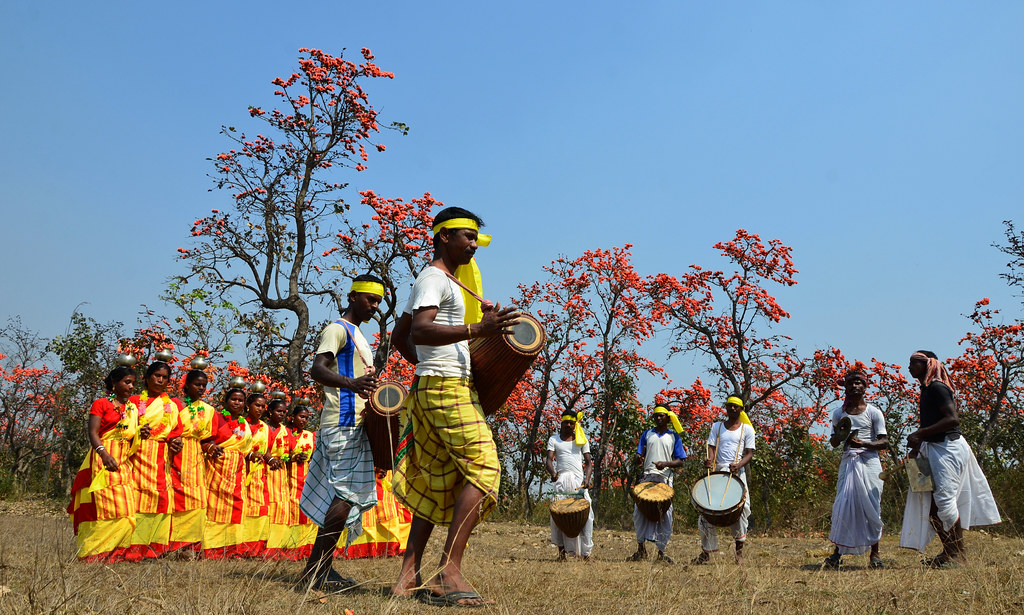
Jhumur is the name given to a style of folk music common to many parts of India such as Bengal, Bihar, Madhya Pradesh and Gujarat. The language differs from region to region, but the tune and style of singing is more or less similar. The bordering areas of all these states, being hilly terrain covered with forests, are inhabited by adivasis of whom the ones in Bengal and Bihar are santhal. Santhali Jhumur having come under the influence of Bengali folk and classical traditions, has evolved into something different in terms of form, tune, language and expression.
Santhali performance in spring
Santhali Jhumur is made up of three-line verses. The singing is accompanied by dancing and the playing of musical instruments like the madol (a kind of drum) and banshi (flute) The themes are mostly those that pertain to everyday adivasi life – such as the agony of a girl whose father, lured by a large bride price, marries her off to a man from a distant village or the aspirations of a vivacious lass who wishes to dress and walk as gracefully and elegantly as the women of the city.
But soon the girl’s flirtatious charm is revealed for what it really is– a thin veneer. Her real self is laid bare in the heart broken lament that follows; of a woman for whom poverty and deprivation are constant companions; whose children die because she cannot feed them.
We now come to the two universally acclaimed traditions of music in Bengal.Keertan and Baul, which while transcending the traditionally religious, and social and community needs and concerns, yet absorb and assimilate them all in the rich fabric of their complex plurality.
Cultural movements such as Bhakti and Sufi, spanning time and territory, entered Bengal in successive waves creating a syncretic culture in which music, poetry and other fine arts were amalgamated. Bhakti and Sufi found their creative expression in several parallel musical forms in Bengal. These forms, though distinct from one another, have some attributes in common. The presence of a mystical fervour which celebrates the unity of God and man and a philosophy of humanism which rejects rigid and stifling religious orthodoxies and stresses the equality of all human beings irrespective of caste, class, race, gender or religion is common inKeertan and Baul.
Keertan, derived from the word keerti or deed, is a form that showcases the attributes and exploits of the gods, humanising them to an extent that makes them part of the everyday lives of ordinary men and women. Keertan is said to have emanated from Sri Chaitanya Mahaprabhu. Vaishnavas believe him to be the eleventh incarnation of Krishna. It is said that Radha wept a hundred years after Krishna’s desertion –- that is his departure from Brindavan to assume the kingship at Mathura. But, as the legend goes, Radha didn’t stop at tears. Her grief and yearning were transmuted into a burning rage in the throes of which she cursed Krishna with another incarnation. He would be born among the common people, she said, bearing his own form but her heart, mind and senses. He would experience for himself the breathless rapture and the excruciating agony of Krishna love. Great God though he was, Krishna could not shake off Radha’s curse. He came down to earth as Nimai of Nadiya. But he didn’t come in his own aspect. The cloud complexioned god took on the hue of a golden lotus, Radha’s hue, becoming Gouranga or He of the Fair Form. The itinerant minstrel sings…
Nimai was Krishna’s natural incarnation in infancy – playfull and mischievous, the bane of his mother Sachi’s life. Then gradually she, whose heart, mind and senses he bore within his body, began asserting herself and he was drawn towards Krishna as a moth is to a flame. In the grip of a divine frenzy that could only be matched by Radha’s for her Madanmohan, Nimai found himself drowning in a sea of Krishna consciousness. He would stop in his tracks whenever he heard the God’s name then, lifting his arms above his head, he would close his eyes and start swaying and pirouetting, chanting …hare Krishna hare Krishna[24]…
This was the origin of Keertan. Naam Keertan (reciting the names of the god) swelled as villagers, both Hindu and Muslim, started veering around Nimai in twos and threes. Then, with the passing years, a large band of devotees was formed and Nimai the wayward and incorrigible was metamorphosed into the great saint and sage Sri Chaitanya Mahaprabhu who preached a religion of humanism and founded the Vaishnava cult.
As the numbers grew, Naam Keertan changed in form and content. Sang Keertan (sang meaning together or in a chorus) added adjectives and descriptive phrases to the names and used drums and cymbals to liven up the singing which became loud and clamorous. The Mahaprabhu often took the lead himself and the rest took up the refrain. Sang Keertan parties moved from village to village in the manner of troubadours disseminating the Mahaprabhu’s message.
From these humble beginnings Keertan passed, by degrees, into the hands of skilled versifiers and came to be known as Padabali Keertan – pad meaning verse. Haridas Thakur, Narottam Thakur, Jnandas Thakur and Raghunandan Thakur were some of the padakartas[25] from whose creative genius Keertan evolved into the intricate, meticulously structured musical form it is today. But though it had its genesis in the Radha Krishna legend, Keertan moved, over the years, towards the Shaivaite tradition imbuing it with its philosophy of humanism and love. Down the river from Nadiya was Halishahar where the great Kali sadhak[26], Ramprasad sang Kali Keertan which humanised the goddess of terror and turned her into a mother whose eyes held oceans of mercy.
Concentrated mostly in Kushthia, Shilaidaha and Sajadpur in East Bengal (now Bangladesh) and Murshidabad and Birbhum in West Bengal, Baul is a folk tradition rooted in the lives of the rural people. Though traces of other influences are seen in Baul gaan its main flow is from two strong sources—Muslim Sufi and Hindu Vaishnav. Hence the equal presence of Hindu and Muslim bauls in the villages of Bengal. Though they dress differently –Muslims wear robes of motley-coloured rags and carry a hookah and chimta[27]and Hindus don saffron and have sandalwood markings on their brows and ektaras[28] in their hands – their message is one and the same. Nurtured by great composers like Lalan Fakir, Duddu Shah, Madan Baul, Gagan Harkara and Fikir chand, Baul songs disseminate a message of harmony between man and man rejecting religious codes like Shariat and Shastras, caste differences, and social conventions and taboos as barriers to a true union with God. But where is one to find God? Gagan Harkara, an unlettered rustic whose livelihood was carrying the post from village to village sang as he went: “Ami kothai pabo tar amar moner manush je re…”[29]
And how does man find this moner manush—the being within himself. Only by freeing himself of all external forms of worship and trusting the flow of his own spirit.
The Baul (the word is derived from bayu –air) moves spontaneously towards God the way air flows in and out of all created things. The term could also be derived from the Arabic bawal meaning mad –in this case, mad with love of God.
Since God is believed to reside within man, the human body is looked upon as the site of the ultimate truth; that which encompasses the entire universe. This tenet of Baul philosophy is known as dehatatwabad—the belief that the soul being pure the body that houses it, together with all its functions, is pure and true. Lalan Fakir expresses this philosophy in a song so complex in idea and image as to be almost abstruse. The body is likened to a cage from which the godhead flits to and fro. The Baul spends a lifetime trying to capture it but the bird remains elusive.
Khachar Bhitor Ochin Pakhi( An unknown Bird in a Cage) Song by Lalan (1772-1890) sung by Kartik Das Baul, a contemporary Baul singer
In such a philosophy there is, one would think, no place for Guruvad[30]. If the godhead you seek resides within you, where is the need for a middleman? Yet, strangely enough, guru, peer, murshid and sain are extolled in Baul lyrics and often take the place of God. Baul philosophy, like a gigantic honeycomb, seems to have a slot for all human needs.
I would like to end this piece, with an account of the life of the greatest of Baul composers Lalan Fakir. Not much is known of him except what has come down to us in the form of anecdotes. Lalan was born in the year 1774 in the village of Bhadara in Nadiya district, to a kayastha family with the surname Kar or, as some academics maintain, Das. He lost his father in infancy and was married while still in his teens. As a young man he went on a pilgrimage to Puri and on the way back was stricken with small-pox. His fellow travellers abandoned him or, as per another account, set his body adrift on the Ganga thinking him dead. He was found, alive but badly pitted and blinded in one eye, by a Muslim woman who nursed him back to health. In this village, he met an itinerant Baul singer named Siraj Sain who became his murshid or mentor. There are frequent references to Siraj Sain in Lalan’s compositions.
Lalon by Jyotindranth Tagore. The poet Tagore and his family brought Lalon’s music to limelight… as much as they could.
At some point Lalan went back to his native village but was not accepted by his family and community because, having lived among Muslims and eaten with them, he had lost caste and was no longer acceptable as a Hindu. Many of Lalan’s songs question this aspect of Hinduism. But Lalan’s rejection is not only of the discriminations practiced by the Hindus. He questions the very basis of the divisive walls created by religion between man and man.
Shocked and hurt by his rejection Lalan renounced his family, community and religion and started keeping company with Siraj Sain. On the latter’s death, Lalan set up an akhra[31]in Chheuria village on the banks of the Gorai River and gradually a band of followers gathered around him. Lalan was an inspired singer and could only sing when the Muse was on him. But being totally illiterate, he could not record what he sang. Thus, many of his songs are lost to us. Later a disciple started writing them down the moment they issued from his lips. And his collection is what we have today. Though he didn’t go through any formal process of conversion or adopt Islamic religious practices, Lalan lived like a Muslim and among Muslims till his death in 1890 at the age of 116. In Lalan’s life and art is seen the confluence of the two greatest religions of this world in its truest and most humane form. He lies buried in Chheuria —a place of pilgrimage for all Bauls of Bengal, Hindu and Muslim.
[21] The fourth day of the five day festival of Durga Puja, the last day of Uma’s stay with her parents and the ninth day of Navratri, the Hindu festival.
[30] A guru is seen as a middleman who will help you reach out to God.
[31] An enclosure where they would live and practice their beliefs
Aruna Chakravartihas been the principal of a prestigious women’s college of Delhi University for ten years. She is also a well-known academic, creative writer and translator with fourteen published books on record. Her novels Jorasanko, Daughters of Jorasanko, The Inheritors, Suralakshmi Villa have sold widely and received rave reviews. The Mendicant Prince and her short story collection, Through a Looking Glass, are her most recent books. She has also received awards such as the Vaitalik Award, Sahitya Akademi Award and Sarat Puraskar for her translations.
.
PLEASE NOTE: ARTICLES CAN ONLY BE REPRODUCED IN OTHER SITES WITH DUE ACKNOWLEDGEMENT TO BORDERLESS JOURNAL









 Borderless