Taal Gaach or The Palmyra Tree was published as part of Shishu Bholanath (Child Bholanath) brought out in 1922. The poem has an inbuilt cadence and rhythm that flows like the sway of palmyra (commonly referred to as taal ) leaves in the breeze.
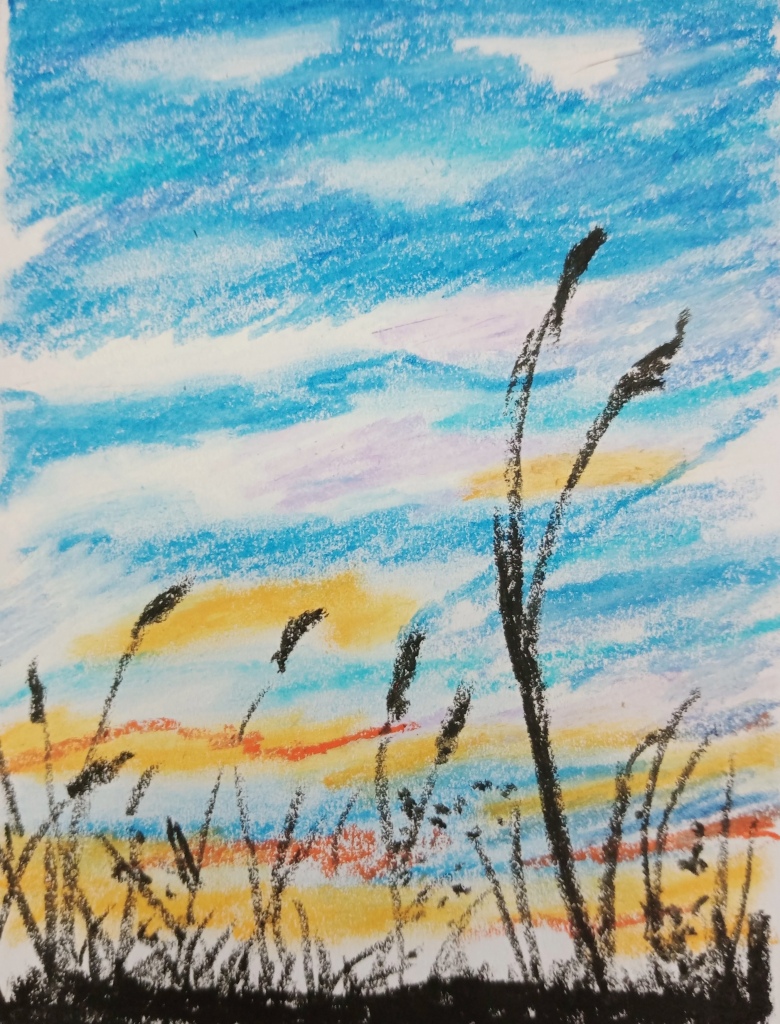
Taal Gaach, painting by Sohana Manzoor
THE PALMYRA TREE

The palmyra towers over all trees
Standing on one foot, it peeps
Into the sky.
It yearns to fly,
Piercing through dark clouds nigh
But where will it find wings?
That is why, it thinks —
Leaves circling its crown
Are wings to float around.
To soar unhindered, free,
Leaving its home, it flees.
The whole day, the foliage rustles,
Murmurs, susurrates and bustles.
The tree imagines its flight,
Drifting past stars in the sky,
Towards a destination up high.
Then the breeze stalls.
The swish of leaves halts.
When it regards the loam
As its mother, its hearth.
It loves again its home,
The nook on Earth.
(This poem has been translated for Borderless Journal by Mitali Chakravarty with editorial comments from Sohana Manzoor and Anasuya Bhar.)
.
PLEASE NOTE: ARTICLES CAN ONLY BE REPRODUCED IN OTHER SITES WITH DUE ACKNOWLEDGEMENT TO BORDERLESS JOURNAL
Jibananda Das’s All Afternoon Long, translated from Bengali by Fakrul Alam. Click here to read.
The Colour of Time, Korean poetry composed and translated by Ihlwha Choi. Click here to read.
The Ordeal of Fame, a humorous skit by Rabindranath, translated by Somdatta Mandal. Click here to read.
Fazal Baloch translates a retold folktale from Balochi, The Precious Pearl. Click here to read.
Tagores’ Lukochurihas been translated from Bengali as Hide and Seek by Mitali Chakravarty. Click here to read.
Pandies’ Corner
These narratives are written by youngsters from the Nithari village who transcended childhood trauma and deprivation. The Story of Rajesh has been written by Yogesh Uniyal in a mix of English and Hindi, and translated fully to Hindi by Nirbhay Bhogal. Clickhere to read.
Rhys Hughes shares why he put together an anthology of humorous poetry with seventeen writers, Wuxing Lyrical. Is his logic funny or sane? Click here to find out.
In An Encounter with the Monet on Naoshima, Suzanne Kamata writes of snacking on Claude Monet’s hundred year old recipes while savouring his art and that of the famed artist who makes bold art with polka-dots, Yayoi Kusama. Click here to read.
An excerpt from Upamanyu Chatterjee’s Villainy. Click here to read.
An excerpt from Ramy Al-Asheq’sEver Since I Did Not Die, translated from Arabic by Isis Nusair, edited by Levi Thompson. The author was born in a refugee camp. Click here to read.
Book Reviews
Rakhi Dalal revisits Tagore’s The Post Office, translated from Bengali in 1912 by Devabrata Mukherjee. Click here to read.
Indrashish Banerjee reviews Upamanyu Chatterjee’s Villainy. Click here to read.
For when your troubles starting multiplying
And they just might
It's easy to forget them without trying
With just a pocketful of starlight

Catch a falling star and put it in your pocket
Never let it fade away (never let it fade away)
Catch a falling star and put it in your pocket
Save it for a rainy day

'Catch a Falling Star' by Paul Vance and Lee Pockriss
Perhaps, it is time to find that fallen star popularised by pop singer Perry Como is 1957. Optimism glimmers faintly, sometimes even conceals itself, in a world passing through a dark phase in history. For instance, few of us would know that we might find more answers to tackle climate change as dinosaur fossils (from the time an asteroid hit the planet) have been unearthed recently. That sounds like solutions can be had to what was perceived as inevitable doom.
Another bit of news that perhaps will cheer some is the first anthology of Borderless Journal will soon be available in market. It has been accepted by a publisher, an old, trusted and reputed name from India, Om Books International. They have bookshops splattered all over — should make it easy for buyers to access the book. Hopefully, you can target the anthology for your Diwali or Christmas gift hampers. Om Books has one of the most iconic editors-in chief, Shantanu Ray Chaudhuri. A multiple award-winning editor, he has worked in Penguin and Harper Collins and is currently churning out wonderful books from Om with a fabulous production team, working with whom has been a pleasure. Ray Chaudhuri is an outstanding film writer and poet. He is part of a group that is creating a film archive online. To know more about him or his views on publishing, you can read our online conversation with him.
The energy one gets from optimism like starlight from a fallen star, lightens the darker shadows that create gloom with the war leading to rise in prices and threats of recession in a post pandemic scenario. Lesya Bakun, the refugee from Ukraine whose story we carried last month, finds her starlight by sharing updates of her story. She added to her narrative with the news that her cousin has been taken as a prisoner of war by Russia from the besieged factory in Ukraine. Though sharing does not alleviate suffering, Bakun’s ability to cling to hope and imagine a future where she gets her dream highlights the strength of her convictions. The other thing that is revealed by her narrative and media coverage is exclusivity and boxes of ideology split humankind, erase families, cities, countries, lives and sanity. The war can appease only the lust of warlords. Against this desolation caused by the devastation, what could be the starlight that would lead to a happier future?
Laughter. Unleashing the ability to laugh at oneself is as potent as laughter that generates relief and lightens our mood, so that we can view differences as whimsical, treat them with tolerance and compassion and not destroy the diversities that add colours to the world. Perhaps, that is why Tagore took to humour too. Somdatta Mandal has translated a series of humorous skits by Tagore. We are featuring one of these called the ‘Ordeal of Fame’. Yet another translation or transcreation of a poem called ‘Lukochuri’ or ‘Hide and Seek’ reflects the playful in Tagore’s oeuvre. These, along with Rhys Hughes humour on the pandemic in poetry and prose, bring good cheer into our journal. Hughes has also used his column to tell us why he curated a new humorous anthology of verses by seventeen poets called Wuxing Lyrical. I wonder if he is serious or joking!
As we trot around the globe, Suzanne Kamata tells us about a Monet museum in Japan where she ate madeleines made with the artist’s recipe! Meredith Stephens sails to Tasmania with her camera and gives us a glimpse of nature’s plenty. Ravi Shankar relates his trekking adventures among the Himalayas in Nepal, with awesome photographs of these mountains, while Kenny Peavy who lives in Indonesia dwells on the value of falling down and getting up in a light humorous vein against the backdrop of nature – though metaphorically perhaps the world needs to do that. We have G Venkatesh’s story about his stay in Johannesburg where he discovers that skin tones do not matter.
Ratnottama Sengupta makes the whole world look like a home with the story of a legendary screenwriter, Jean Claude Carriere, who wrote the script of Mahabharata for Peter Brook’s play (1985) of the same name and the subsequent film (1989) — with characters drawn from all over the world. Candice gives us an overview of the pandemic, with more focus on US where she lives.
Mike Smith travels back to another time when an ailment called World War II raged and has revived a writer from the past, HE Bates (1905-1974). We have another essay by Dan Meloche on a legendary book which turned 100 this year — Herman Hesse’s Siddhartha. Rakhi Dalal revisits more than a century old translation by Devabrata Mukherjee of Tagore’s The Post Office which bears relevance to the present day as it shows how the human spirit endures over even the darkness of death.
Bhaskar Parichha has reviewed Radhika Gupta’s Limitless: The Power of Unlocking Your True Potential, by his assessment a book that inspires youngsters to take charge of their future. On the other hand, there are books that explore the darkest in humans. Basudhara Roy has reviewed a collection short stories by Sunil Sharma called Burn the Library & Other Fiction. Indrashish Banerjee reviews Upamanyu Chatterjee’s latest novel based on modern day crimes, Villainy, from which we are carrying a book excerpt too. The other excerpt is from a narrative written from a refugee’s perspective, Ramy Al-Asheq’s Ever Since I Did Not Die, translated by Isis Nusair from Arabic. Born in a refugee camp in Damascus, this Syrian-Palestinian poet defies all genres to touch hearts with brutal honesty. No less sincere is Michael Burch’s poetry on summer that ushers in the season as much as Sohana’s beautiful painting that we are using as our cover photo. We have poetry from not just Shantanu Ray Chaudhuri but also by George Freek, S. Srinivas, Tohm Bakelas, Abin Chakraborty, Marianne Tefft and many more. As usual, I have not mentioned all the treats in store for you. Delve into our contents page and browse to find out more.
Before winding up, I would want to extend my thanks not only to our team and contributors, but also to our publisher who is willing to republish our content with some tweaking. Thanks to our readers who, I hope, will be excited to have selected content between their palms as a hardcopy anthology with 49 of our most iconic pieces. We have more than a thousand published works. This anthology will be an iconic sample that you can carry anywhere with you even if there is no internet – that would include Mars and Moon!
I wish you happy reading, happy dreaming and hope… plenty of it.
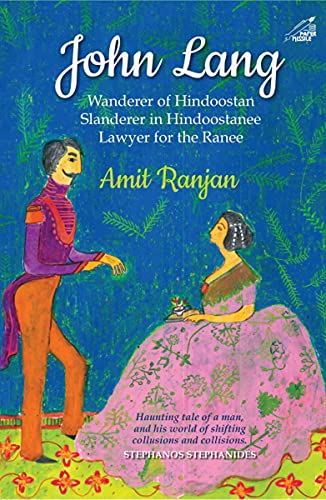
A stranger than fiction book that starts with a limerick and ends with a rhyme, supposed to be a scholarly and playful work on perhaps the first Australian novelist-cum-lawyer-cum-journalist who sold cheap paperbacks for women readers traveling by train in India in the nineteenth century — probably British readership — fought a case for Rani of Jhansi – wrote for Charles Dickens’s Household Words – This can be the description of Amit Ranjan’s John Lang the Wanderer of Hindoostan, Slanderer in Hindoostanee, Lawyer for the Ranee (Niyogi Books). Why would one do a book on a maverick like this Australian journalist-cum-writer of the nineteenth century who opposed the British? What led to such a book? The quest for a ghostly ‘Alice Richman’ who lived in Pune in the 1800s, says Ranjan. And the author’s quest continues…spanning the shores of Australia, ‘Hindoostan’ and America…
The other most interesting thing about this book is the way the story is told – Ranjan says he is deeply influenced by the genre of magic realism and this, perhaps, reflects in his writing. While the research input is awesome, the style is non-academic and even flamboyant at times. It is a book that brings a smile to your face with its obvious cheekiness. But this is also the kind of book you keep on your bookshelf and pull out when you have time to mull over a discussion on historic links and syncretism – for that is the sap that flows through the book concealed behind a laid-back narrative style of a nineteenth-century writer. Who is this Ranjan who has tried to re-invent pedantry and scholarship, treat the serious business of research and academia with such friskiness?
Ranjan is a Visiting Fellow at UNSW [University of New South Wales], Sydney; and a Fulbright Scholar-in- Residence at Miami, an assistant Professor at NCERT [National Council of Educational Research and Training, India] — with eye to the sky, and ear to the ocean. His poetry collection, Find Me Leonard Cohen, I’mAlmost Thirty, came out two years ago, and his biography of Dara Shukoh is due out soon. His poetry collection came out 4 years ago, and a new collection of poems The Knot of Juggernaut was just released in Miami in March. Without more ado, as John Lang would have it, we present to you Amit Ranjan –
What was it that made you map your journey of unearthing Lang in the form of his writings instead of writing about his life directly? You have used the forms of limerick, poetry and the epistolary technique along with essays and Lang’s own writing to build your case. An amazing amalgam — Why? It is rather an unusual form of storytelling.
This is an interesting question, or a set of questions. I think poetry is a powerful medium. At a certain time, it was supposed to regale and break tedium; now it seems to create tedium – the trajectory of human taste is interesting indeed. So, unable to write a book in verse (Vikram Seth debuted with a novel[1] in verse a little more than three decades ago, with elan), the least I could do (and generally do with prose) is having poetic invocations at the beginning and the end. I’ve also tried to maintain a certain poeticity through the book – it does add some funk and spunk, I believe.
About the form of writing – what was available to me was writings about Lang, and writings by Lang. Lang’s own voice is richer and wittier than his contemporaries and commentators, and therefore it came naturally to speak about his voice, rather than speak about what has been spoken about his voice. Unfortunately, the personal papers and artefacts of Lang have all been lost – it would certainly have been a riot to peruse his letters. And since letters by him are missing, I decided to write a letter to him (which is the first chapter) much in the way he’d have liked to write or receive a letter.
Also, about the form of writing – history writing and academic writing is caught in its self-referential niche writing – and needs to be freed from that cage, or that page in the history of stylistics of writing. Much influenced by the Latin American novelists, as also the frame narratives like Bocaccio’s Decameron and Alif Laila[2] – I thought it would be an interesting to approach non-fiction and/or history like a novel of the “lo real maravilloso[3]” genre (well, almost). So one could call it creative non-fiction (this work is completely and heavily annotated, so there’s nothing ‘fictitious’ in the work – just to add that disclaimer). I think these experiments are exciting, much like ficto-criticism as a foil of this form.
You have an interesting tone of narration which is half flippant, but it delves deep into research. Tell us a bit about your research.
The tone is what one makes of it. It is also very Victorian in its language, to keep in sync with Lang’s age. The alleged flippancy is a deliberate device I guess – as a tribute to Lang’s own voice that is playful and yet serious, as also to demonstrate that playful writing can be effective and serious.
Telling a “bit” about this research will occupy a bit of space, for dwelling in the haunt of 19th century is a bit of a habit with me now. Those puns aside, the road of this research has been thrilling across space and time. On the home turf, it took me to Meerut, Mussoorie, Agra and Calcutta. We, being good recyclers of papers, the works by or about Lang barely survive here. The copies of his newspaper, The Mofussilite, published from the above-mentioned cities (minus Mussoorie) weren’t available anywhere except London, Canberra, Chicago – and interestingly Islamabad. And so, I went to UNSW at Sydney for my PhD research, courtesy of Endeavour and Inlaks fellowships. There I met a very interesting 86-year-old gentleman, Mr Victor Crittenden, who was a retired librarian, and who had a very keen interest in John Lang. He had republished a lot of Lang’s work, and it was amazing to have conversations with him. The only little problem was that he was such a hopeless Romantic that he had ascribed several anonymous or pseudonymous works to Lang. This, then, became a daunting task, to research about each of these works and see if they could actually be Lang’s. And of course, it also resulted in funny arguments. Meanwhile, I relaxed the scope and the methodology, made it broad and unorthodox, to see where I could get. I met descendants of Lang’s half-brothers; a rabbi in Melbourne who believed Lang was Jewish; a member of Italian nobility in Paris, bitter about the politics in that family, and so on. At one point I emailed one Motee Persaud in hope that he’s a descendant of Jotee Persaud – only to cause him anxiety, for there was some court against him, and he thought my email was a subterfuge for a bigger design! When I returned from Sydney, I lost a pen drive with scans of Lang’s newspaper, for it was in a pretty UNSW backpack that someone took fancy to. I think I met the purloiner for a fleeting minute a few months later! The bit can go on, but I think this bit should be contained before I write a short story about it here.
Was the journey of discovery as interesting as your discovery of Lang?
Oh yes indeed! I think some of that has been revealed in the previous answer. It’s still an open book, an ongoing journey, I am still working with The Mofussilite. In my three fellowships to Miami (none about Lang), I purloined time to peruse Lang’s journal. The journey has been a thriller all through, I would like to believe – including my not being able to find Lang’s grave ever. Once, my friends and I rolled down Mussoorie hills into Camel’s Back Cemetery and the eight of us hunted for Lang at the haunted forest on a rainy afternoon. No luck, and never after in my subsequent visits, though the directions are fairly easy.
One of the most fun discoveries was that a picture of Lala Jotee Persaud, a client of Lang’s, was printed in The Illustrated London News as Nana Sahib’s! I was thrilled to receive that picture from ILN.
Ruskin Bond, a writer many of us deeply admire, found Lang in the Camel Back cemetery in Mussoorie in 1964. Then an Australian scholar investigated him. Lang finally found a way to instigate your pen to take up his cause. What moved you to research and write on him?
I met Mr Bond in 2009 I think, and my friends and I had a great fan moment. His father had some Lang novels, and that is what interested in him. Almost simultaneous, John Earnshaw was interested Lang’s life in Australia, and he wrote a short 30-page account detailing his timeline. And then the interest was lost for 40 years, when Victor Crittenden and Rory Medcalf of Australian High Commission reinvigorated interest in the matter.
All this, unbeknown to me, I was hunting for Alice’s history. Alice Richman, a girl who died at 26 in 1882, is buried in Alice Garden, Pune University, surrounded by a forest and many urban legends. Not knowing how to go about finding anything about her – I followed the Hanuman methodology – pick up the whole mountain if you can’t identify the herb. In reading about Australians in India in 19th century, I stumbled upon Lang, and since then, there’s been no looking back.
So, Alice the ghost sparked your interest in him from her very presence in Pune, what was it about Lang that attracted you to take a decade long journey into his adventures? Tell us a bit about how Alice pushed you to it.
In the pursuit of Alice, I read about the interesting Australian women missionaries in India (they were brought to India to be ‘tamed’); camels and camel drivers that went from India; and several such fascinating stories. The pursuit of Alice prepared my reading list, and that is how I found Lang. A white man fighting a white empire, with a nuanced understanding of India, and with an infective invective – seemed like a natural resonance to me. It is beyond the scope of this interview to get into the thrilling details of discovering things about Alice’s life too throughout this decade you’ve mentioned. Suffice it to say that it is actually the pursuit of Alice I have been on, and she keeps rewarding with some Lang legend and legacy every now and then.
Did you feel there was a need to bring out Lang to the fore? Is he relevant for our times?
Absolutely so. He was the man who took on Lord Hardinge in his newspaper on a daily basis, to the point where the Governor General summoned him. Lang merely said that he made more profit by writing against him, than he could ever by singing paeans to him. He was a rebel, and witty. Today’s journalists across the world from the age of democracy can take a lesson or two from a man from the time of the Empire.
To understand where we are, we need to look at where we come from. The tedious legal system; the workings and trappings of army; racism; casteism; evolution of sciences and belief in pseudosciences – are explained in detail with wit, rigour and humour in Lang’s writings. To understand our postcolonial ontology, it is very important to understand how deeply colonialism affects us.
Please introduce the most interesting fact about the ‘Wanderer of Hindoostan’ to our readers. Tell us a bit about him concisely, especially as we are told in your preface: “Suddenly, there was an interesting piece of news doing rounds: that the Indian PM gifted his Australian counterpart with John Lang documents to demonstrate how far back the relations between the two countries went. I was not acknowledged. However, it was also a backhanded compliment. Lang had finally found an afterlife.”
Lang died in 1864; his name and works survived until. About 1910. For the afterlife of a writer, critics are important. Shakespeare, for example, was resurrected by the Romantics in the 19th century. After 19th century, Lang was lost until John Earnshaw’s minor interest in the 1960s; and then Victor – as already stated. My research was awarded as a PhD thesis in 2012. Interestingly, in 2014 he was showcased in this prime ministerial meeting. The rest you have told in your question – sometimes one has to take backhanded compliments with high spirits! Of course, it was an anxious time for me, for the cat was out of the bag, and I had to hunt for a publisher fast. However, as stated in the book – Stories forgotten or lying in the cold, find their own time to be told – and therefore finally a book, half in size of the original, in 2021. The advantage of including Lang is of course pushing India-Australia ties to mid-19th century, an idea which has never really been thought of.
Was the John Charnock you mentioned in your book related to Job Charnock, the founder of Calcutta? Was Lang related to him and did that impact his choices? Job Charnock was after all a rebel too in a manner of speaking.
That’s a difficult connection to figure out, which I will try to, on some idle day when curiosity gets the better of me. Job Charnock, the alleged founder of Calcutta, died in 1693; and the reference in the Lang book about John Charnock is from 1843 (p362). Lucy, wife of John Lang, had a sister, Mary, a poet who was married to John Henry Charnock. Mary’s book Legendary Rhymes (1843) was published posthumously, and her husband wrote a preface to this book. This Charnock was Lang’s brother-in-law, so they would have known each other well. John Charnock himself was an agriculturalist and a drainage expert and wrote books on this matter. To answer the last part of the question, in my opinion, Job Charnock and John Lang are as different as chalk and cheese – the former being a thorough imperialist and the latter, the opposite.
In the start of a chapter, you have said: “Lang had foreseen Google.” Elucidate.
Oh, that’s a joke to complement and compliment one of Lang jokes. The novel Ex-Wife revolves around the predicament of a Eva Merrydale, divorced by her husband for “criminal familiarity with another man.” (p370) Eva’s brother tells that this case has been mentioned 114,227 times in the media, with 107 times in the Times alone. These kind of figures are something one would see in a google search result – 114,227 results for “Eva Merrydale divorce”
That is Lang lampooning the British media for its obsessing over a poor divorcee through the exaggerated figures. However, one wonders, if there were people employed to keep track of a particular news appearing in the media.
As a digression to this essay, Lang indeed was looking into the future of journalism – sensational headlines, scandals and so on. In one lead article about the Gorham case, which had been talked about to death, Lang just wrote –‘Damn the Gorham Case!’ – and captured the public sentiment!
What was the purpose of this book? What kind of readership did you expect?
I guess the purpose of a prose book, fiction or non-fiction, is to tell a good story. However, my purpose was to fulfil a calling – I had at hand, the figure of a character lost for a century. It then becomes one’s responsibility to resurrect the figure as one has been entrusted by destiny, too. And of the course, the more general idea holds – the keys to the present lie in the past, as has already been discussed.
In terms of readership, I was looking at anyone who is interested in an interesting story of a maverick figure. This is why the language is jargon free, the stylistics are that of a novel. However, of course, one is also looking at the countries Lang is lost to – India, Australia and UK – and to have them remember an important critic and figure of their past. I expect students of literature and colonial/ postcolonial histories to pick this work up; but I’d love it much more that it appeals to the general reader of fiction and non-fiction.
John Lang had encounters with Dickens, Rani of Jhansi — a very wide range of historic personalities and influenced, you have claimed even George Bernard Shaw. Yet, all these personalities lived on while he faded to obscurity. Why do you think that happened?
Lang fought the British imperial sword with his pen, was declared a “hospital bed novelist” by the critics and buried to the British posterity. He wrote in Australia with convicts as heroes, which of course, didn’t go down well with the convict settlement. For Indians, who he had so much adulation for, he still got lost to history. Probably his interest in wine and women did not go down well with Indian historians too; or he was difficult to slot, being an interloper.
One of the things that does come across is Lang faded to obscurity as no one knew of him. Do you feel the role of historians and critics critical to the survival of an author? Or do you feel the colonials he often wrote against were happy to bury his writings?
Both aspects are at work. As already pointed out, the colonial press gave him bad reviews all the time. Subsequent critics were not kind either. This goes on to suggest how deeply ideological and long drawn out the colonial project was.
How was Lang a rebel in his times? Do you feel your own journey has been a rebellion against pedagogical practices of the current times? After all, can a book based on this much research start with a limerick and end with a tongue-in-cheek rhyme?
Two leitmotifs would suffice to settle the matter about being a rebel. It is said, in Lang’s multiple novels, about the white British protagonists – “India he loved, England he despised.” The second motif is strong women characters, some of them very deliberately parodying Victorian women and Victorian novels.
If my writing is considered rebellious to the current conventions, I would take it as a compliment, and not a back handed one. I wish I wrote the entire book in verse. I hope to pull off that trick successfully someday.
Maybe you will – an upcoming one – Alice’s story…Do you have an upcoming book? What about a novel on the ghostly Alice?
A new poetry book titled The Knot of Juggernaut, Or The Mystery of (Miami Mambo) Vexuality was just released, a day before I left Miami to come back to Delhi. It will be out here soon, too, in a month. This collection has poems written about journeys between the Bay of Bengal and the Bay of Biscayne. The title was suggested by The Right Honourable KB Con, Ducktor Albatross.
A biography of Dara Shukoh is scheduled for the year end.
The Alice book – definitely, whenever Alice wills it!
First published in Shishu (Children) in 1909, Lucko Churi (Hide and Seek) is also a part of Tagore’s collection called Sanchayita. It captures the endearing, playful relationship between a mother and her son as well as the innocence of the child.
          HIDE AND SEEK
In a playful mood, if I were to
      Bloom as a champa flower on a tree,
At dawn, O mother, I would frolic
       Amidst the branches of young leaves.
I would win in this game of hide-and-seek.
         Would you have recognised me?
You would call out, “Khoka, where are you? “
       I would only laugh silently.

When you do your household chores
         I would watch from high above.
After a bath, with your wet hair spread on your shoulder,
          When you would walk under the tree
To go to the prayer room
         While inhaling the perfume of the blooms —
You would wonder how
          Your Khoka’s scent mingles with the breeze!

In the afternoon, after everyone has lunched
            When you relax with a Mahabharat,
The shade of the tree by the windowsill
            Would fall on your back and lap.
My tiny shadow would sway
           On the words of your book.
But you would not know the shadow
      Of your darling wafts before your eyes.

In the evening, after lighting a lamp,
       When you go to the cowshed,
I would finish my game
       And drop down from the tree.
Again, I would be your Khoka.
        I would say,”Tell me a story.”
And you would ask,”Naughty! Where were you?”
      I would reply, “I will not tell you my secret.”
Was he a poet? A writer? A humorist? A social reformer…
Paintings by Rabindranath Tagore. Courtesy: Creative Commons
At an intellectual plane, we could keep arguing about labelling Tagore. He was truly a polymath. But, the most important thing is he touched our hearts with his words and used that to earn and pour into projects that benefitted the underprivileged. This year, on his 161st birth anniversary, we will explore some lesser known aspects of the maestro: Rabindranath, the social reformer and the humorist weaving both the Gregorian calendar (7th May) and the Bengali calendar (9th May) dates into our celebrations.
Tagore, the Humorist
Many of us from Bengal grew up reading light pieces by Tagore embracing his creations as a much-loved part of our hearts. We present translations by Fakrul Alam and Somdatta Mandal of Tagore’s humour — a light poem about a giraffe and playlets by the maestro.
Giraffe’s Dad by Tagore: Giraffer Baba (Giraffe’s Dad), a short humorous poem by Tagore, has been translated from Bengali by Professor Fakrul Alam. Click here to read.
Playlets byRabindranath Tagore: Two skits that reveal the lighter side of the poet. They have been translated from Bengali by Somdatta Mandal. Click here to read.
Tagore, the Social Reformer
Tagore thought his “life work” lay in developing villages and bridging gaps. A recent book by Uma Dasgupta brought this to light. We have an interview and review of her book, A History of Sriniketan:Rabindranath Tagore’s Pioneering work in Rural ReconstructionAlong with that we have some translations of his poetry focussing on his call to bridge gaps — one of them by Fakrul Alam and another that has been mentioned in Dasgupta’s book as a description of his mindset that led to the Sriniketan project. Meenakshi Malhotra’s review of Radha Chakravarty’s translation of Mahasweta Devi’s Our Santiniketan and an interview with translator Somdatta Mandal, an ex-professor of Visva Bharati shifts the focus to Santiniketan. However, the icing on Tagore’s birthday cake is yet another excerpt from Radha Chakravarty’s latest translation of Char Adhyay or Four Chapters, his last and thirteenth novel which takes up issues of nationalism, gender, gaps in upbringing against the setting of a budding romance. The heroine is truly modern in her outlook and passionate about service to humanity.
Sriniketan: Tagore’s “Life Work” :In Conversation with Professor Uma Das Gupta, Tagore scholar, author of A History of Sriniketan, where can be glimpsed what Tagore considered his ‘life’s work’ as an NGO. Click here to read. (Review & Interview).
Oikotan(Harmonising) has been translated by Professor Fakrul Alam and published specially to commemorate Tagore’s Birth Anniversary. Click here to read.
Ebar Phirao More(Take me Back) a poem that calls for bridging gaps between the rich and poor translated by Mitali Chakravarty … Click here to read.
Rabindranath Tagore Four Chapters: An excerpt from a brilliant new translation by Radha Chakravarty of Tagore’s controversial last novel Char Adhyay. Click here to read.
Ananto Prem(Endless Love) by Tagore, translated from Bengali by Professor Fakrul Alam. Click here to read.
Playlets byRabindranath Tagorereveal the lighter side of the poet. They have been translated from Bengali by Somdatta Mandal. Click here to read.
The Faithful Wife, a folktale translated from Balochi by Fazal Baloch. Click hereto read.
Leafless Trees, poetry and translation from Korean by Ihlwha Choi. Click here to read.
Ebar Phirao More(Take me Back) by Tagore, translated from Bengali by Mitali Chakravarty. Click here to read.
Pandies’ Corner
These narratives are written by youngsters from the Nithari village who transcended childhood trauma and deprivation. Will to be Human is based on a real life story by Sachin Sharma, translated from Hindustani by Diksha Lamba. Click here to read.
InStudies in Blue and White, PennyWilkes gives us a feast of bird and ocean photography along with poetry. Clickhere to read and savour the photographs.
G. Venkatesh looks at the ability to find silver linings in dark clouds through the medium of his experiences as a cricketeer and more. Click here to write.
What can be more scary and life-threatening than the risk of getting Covid-19? Keith Lyons finds how his daily joy has menacing dangers. Click hereto read.
Musings of the Copywriter
In When Books have Wings, Devraj Singh Kalsi talks of books that disappear from one book shelf to reappear in someone’s else’s shelf. Click here to read.
Notes from Japan
InOwls in Ginza, Suzanne Kamata takes us to visit an Owl Cafe. Clickhere to read.
Mission Earth
In No Adults Allowed!, Kenny Peavy gives a light hearted rendition in praise boredom and interaction with nature. Click hereto read.
P Ravi Shankar takes us on a trek to the Himalayas in Nepal and a viewing of Annapurna peak with a narrative dipped in history and photographs of his lived experience. Click here to read.
The Observant Immigrant
In A Bouquet of Retorts, Candice Louisa Daquin discusses the impact of changes in linguistic expressions. Click here to read.
Book Excerpts
An excerpt from a fast-paced novel set in Mumbai, Half-Blood by Pronoti Datta. Click here to read.
Tagore empathised with the suffering of humankind. Out of it was born Sriniketan, a project that hoped to initiate a slow merger of differences and reduce human suffering. Ebar Phirao More (Take me back) was a poem he wrote in 1894 on the plight of villagers steeped in poverty, servitude and ignorance. Tagore regarded his ‘life work’ as that of restoring the dignity and the economy of villages, deftly showcased in Professor Uma Das Gupta’s A History of Sriniketan, Rabindranath Tagore’s Pioneering work in Rural Reconstruction. Here, we present to you a transcreation/ translation of the poem.
Gateway to the Srijani Shilpagram, SriniketanSurul: A village under the Sriniketan projectCourtesy: Creative Commons
TAKE ME BACK

While the world moves busily
You play the flute, like a truant boy,
Leaning under a shady tree in a field with
The fragrance of the forest floating on
A tired breeze. O, arise — there is a fire!
Who plays the conch to awaken
The world? Whose cries resound in space?
What dark shackles imprison the orphan
Asking for support? The burden of insults
heaped on the shoulders of the helpless
sup of their blood. The self-centred

Mock unjustly. Oppressed, scared slaves
Hide in disguise. There they stand with
Heads bowed, silent — centuries of pitiful
Exploitation written on their pallid faces.
As their shoulders are plied with growing
burdens, they move slowly till their last breath—
Then, their progeny inherit generations of this load.
They are not invisible, have no memory of criticism.
They do not blame humans, nor do they have pride.
They only look for a few grains of food to survive.
When their food is snatched away, when they are
Exploited, they do not know where to go for justice.
They call out to the God of the poverty stricken, then
Die silently. These silent souls need to be given a
Voice — their suffering souls have to be roused
With hope — a clarion call has to be given —
As of now, raise your heads, unite. The person
Who you fear is more of a coward than you.
When you awake to confront him, he will flee.
When you stand up to him, he will be terrified
To retreat, like a stray dog. In God’s court,
He will have no support as swollen with
False pride, he will know only contempt
In his heart.

   Poet, come forward — if you have only life,
Then get that with you, and dedicate that today.
With immense pain, sorrow, the deprived
Suffer hardships, weakness, death and darkness.
They need food to live, light to find the breeze of freedom.
They need strength, health, a bright happy future
Courage, guts. Amidst this poverty, O poet,
Inspire a vision of trust that creates a heaven.
Imagination, I bid your colours to take me back
To the edge of civilisation. Do not distract me with
The soft breeze, the waves and alluring illusions.
Do not let me stay steeped in lonely depression
In the shade of a bower. Day ends. Dusk sets in.
The direction is lost in darkness. The woods
Cry In hopeless despair. I step out
To be under the open skies, on the grey road that
Leads to the common man. Where do you go?
O traveler, I do not know you. Turn and look at me.
Tell me your name. Do not distrust me.
I have lived alone in this strange world
For many days and nights. That is why my
Garb is amazing. I am different — my eyes
Dream, my heart is hungry. When I returned to this world,
Why did you, o mother, give me this playful flute?
Over long days and long nights, mesmerised by
My own tunes, I have wandered far from the
Limitations imposed by civilisation. If the tunes that
I have learnt can inspire with exultation the
Music-less exhausted, if even for a moment, my
Music can instil life—giving hope in the lives of the
Hapless, if touched by the manna from heaven
they voice their sadness, the sleeping thirst is
Roused from deep within — then my song will be
Blessed, my dissatisfaction appeased to find nirvana.

What is sung or heard? Happiness are lies.
Sorrows are lies. A self-centred individual
has not learnt to live in a larger world.
With Truth as the guiding star, run fearlessly,
Dancing in unison with the waves of cosmic life.
There is no fear of death. The tears of poverty
Will rain on my head — in the midst of that,
I will go for a tryst with the person to whom
I dedicate my life forever. Who is that? I do not know —
I only know this— that he is the wayfarer through ages
Trudging in the darkness of the the night, amidst
Thunder and lightening, carrying a flickering lamp.
I only know he has heard the invocation and fearlessly
Come to help the needy, rejecting civilisation’s dictates,
He has embraced the cries of the tortured to his heart
Like a favourite tune. Burnt by flames,
Pierced by spears, pieced by an axe, he has
Gathered all his belongings and
Sacrificed all his desires through his life —
He has shredded his heart as an offering
With devotion for the repayment of his birth.
He has given up his life to serve the masses.
Influenced by him, the prince wears rags,
Disgusted with his wealth, akin to a beggar.
The great soul tolerates all tortures and derisions.
The intellectuals sneer in disbelief.
Loved ones mock at him. Close acquaintances are
Contemptuous while he silently forgives them all
with his merciful eyes. He is incomparable and

Beautiful. For him, the proud have forsaken
Their pride, the rich their wealth, the brave
Their lives. For his ideals, the poet has written
Poetry and spread it across the globe. I know
Praise for him is whispered by the breeze,
The seas. Paeans sung by dear ones soar
Across the land and the vibrant blue skies
To celebrate his victory, perfection, love
And kindness. I just know that he will
Sacrifice his own petty needs for the love of
Humankind. He will transcend all insults.
He will stand with his progressive head held high.
Fearlessness is inscribed across his forehead.
The dust of slavery has not contaminated him.
Internalise him. Move forward alone
On the thorny path of life, wipe away precious
Tears, face sorrows with patience,
Work relentlessly to please. When weary,
Worn with exhaustion at the end of the long
Journey of life, there will be an abode of
Peace and contentment. The celestial will
Smile and garland the devotee. At this abode,
There will be peace, relief from all grief,
All misfortune. Tears will cleanse all
Past anguishes. Embroidering hope,
Plead for mercy for life’s disabilities.
Maybe, the despondencies will dwindle and
Eternal love will quench life’s thirsts for ever.
(The poem has been translated for Borderless Journal by Mitali Chakravarty with editorial comments from Anasuya Bhar.)
.
PLEASE NOTE: ARTICLES CAN ONLY BE REPRODUCED IN OTHER SITES WITH DUE ACKNOWLEDGEMENT TO BORDERLESS JOURNAL
Strider Marcus Jones wrote these lines about an idyllic utopia that was named Lothlorien by JRR Tolkien in Lord of the Rings. Jones writes beautiful poetry that touches the heart with its music and lyricality and recreates a world that hums with peace, beauty, acceptance and tolerance – values that have become more precious than gems in the current world of war, strife and distress. He has created his own Lothlorien in the form of a journal which he has named after the elfin utopia of Tolkien. An avid reader and connoisseur of arts, for him all his appreciation congeals in the form of poetry which draws from music, art and he says, perhaps even his legal training! Let us stride into his poetic universe to uncover more about a man who seems to be reclusive and shy about facing fame and says he learns from not just greats but every poet he publishes.
What started you out as a writer? What got your muse going and when?
In my childhood, I sought ways to escape the poverty of the slums in Salford. My escape, while gathering floorboards from condemned houses every winter and carrying them through back entries in crunching snow to our flat, above two shops for my dad to chop up and burn on the fire was to live in my imagination. I was an explorer and archaeologist discovering lost civilisations and portals to new dimensions our mind’s had lost the ability to see and travel between since the time of the druids. Indoors I devoured books on ancient history, artists, and poetry from the library. I was fascinated by the works of Picasso, Gauguin, Bruegel and many others and sketched some of their paintings. Then one day, my pencil stopped sketching and started to compose words into lines that became “raw” poems. My first mentor was Anne Ryan, who taught me English Literature at High School when I was fourteen. Before this, I had never told anyone I was writing poetry. My parents, siblings and friends only found out when I was in my twenties and comfortable in myself with being a ranger, a maverick in reality and imagination.
When I read your poetry, I am left wondering… Do you see yourself in the tradition of a gypsy/mendicant singing verses or more as a courtly troubadour or something else?
I don’t have the legs to be a courtly troubadour in tights and my voice sounds like a blacksmith pounding a lump of metal on his anvil.
I feel and relate to being gypsy and am proud of my Celtic roots passed down to me from my Irish Gypsy grandmother on my Father’s side who read the tea leaves, keys, rings, and other items telling people’s fortunes for years with scary accuracy. I seem to have inherited some of her seer abilities for premonition.
Like my evening single malt whiskey, age has matured the idealism of my youth and hardened my resolve to give something back to the world and society for giving me this longevity in it. The knocks from the rough and tumble of life have hardened my edges, but my inner core still glows like Aragorn’s calm courage and determination in the quest to bring about a more just and fairer world that protects its innocent people and polluted environment. Since Woody Guthrie, Tom Waits and Bukowski are influences I identify with deeply, I suppose I am a mendicant in some of my poetry but a romantic and revolutionary too, influenced by Neruda, Rumi, Byron, and Shelley shielded by The Tree of Life in Tolkien’s Lothlorien:
THE HEAD IN HIS FEDORA HAT
a lonely man,
cigarette,
rain
and music
in a strange wind blowing
moving,
not knowing,
a gypsy caravan
whose journey doesn't expect
to go back
and explain
why everyone's ruts have the same
blood and vein.
the head in his fedora hat
bows to no one's grip
brim tilted inwards
concealing his vineyards
of lyrical prose
in a chaos composed
to be exposed,
go, git
awed
and jawed
perfect and flawed,
songs from the borderless
plain
where no one has domain
and his outlaw wit
must confess
to remain
a storyteller
that hobo fella
a listening barfly
for a while,
the word-winged butterfly
whose style
they can't close the shutters on
or stop talking about
when he walks out
and is gone.
whiskey and tequila
with a woman who can feel ya
inside her, and know she's not Ophelia
as ya move as one,
to a closer and simplistic,
unmaterialistic
tribal Babylon,
becomes so,
when she stands, spread
all arms and legs
in her Eskimo
Galadriel glow,
sharing mithril breath,
no more suburban settlements
and tortured tenements
of death,
just a fenceless forest
and mountain quests
with a place to rest
on her suckled breasts,
hanging high, swinging slow.
war clouds HARP
through stripped leaves and bark,
where bodies sleeping in houseboat bones
reflect and creak in cobbled stones:
smokey sparks from smoked cigars
drop like meteorites from streetlight stars,
as cordons crush civil rights
under Faust's fascist Fahrenheit’s.
one more whiskey for the road.
another story lived and told
under that
fedora hat
inhaling smoke
as he sang and spoke
stranger fella
storyteller.
You seem to have a fascination for JRR Tolkien. You have a poem and a journal by the name of Lothlorien. Why this fascination? Do you think that JRR Tolkien is relevant in the current context? We are after all, reverting to a situation similar to a hundred years ago.
Yes, on all counts. Tolkien and his Lord of The Rings trilogy have been part of my life since I first read one summer when I was twelve years old. My young mind, starved of adventure and elevenses in Salford’s slums, willingly absorbed the myths and magic, lore’s and legends beguiling me to enter the ‘Age of Man’. This living in a time of relative peace alongside other, more ancient races with musical-poetic languages reflected part of my own reality in living through the Cold War decades under the impending doom of nuclear annihilation where daily life often felt the shadows cast by the Cuban Missile Crisis, war in Vietnam, Pol Pot’s Cambodia, and famine in Biafra.
Sauron’s evil eye and invading armies echo an outgoing President Eisenhower’s ominous warning to curtail the influence and corruption of the banking-military-industrial-complex. Instead, Martin Luther King and President John F Kennedy were assassinated and a surveillance state and gilded slavery ideology is being imposed globally using artificial intelligence. Ancient civilisations in Iraq and Libya have been destroyed for control of oil and to maintain global Petro dollar power. Tolkien and The Lord of the Rings is just as relevant today in Ukraine, Yemen, and Syria and as it was through the slaughters of Verdun, the Somme and Flanders Fields. It is a warning that good must prevail over evil and this burden is borne by those with courage and conviction who cannot be corrupted.
What is your Lothlorien? What does poetry mean to you and your existence?
My Lothlorien is a more peaceful world, with more tolerance of other individuals and cultures. Not perfect by any stretch but a place where people laugh, have their neighbours back and work with each other. A place of social justice and equality, music, poetry and art. It is no place for racism, sexism, ageism, corruption, or war. A kind of homestead with birdsong, forest, mountains and rivers, preferably in the French Pyrenees or Alaskan Bush. A place of words composed into poems and stories read and spoken, passed down and added to by each inspired generation in the Native American tradition. Poetry is all about communication and community in my existence. We are caretakers of our words and the world.
You have used Orwell, Gaugin and many more references in your poetry. Which are the writers and artists that influence you the most? What do you find fascinating about them?
Individuality of expression through fiction, poetry, art and music fascinates me. Now, at 62 years of age so many have influenced my poetry with or without me knowing or realising it. These include:
From the past – Chaucer, Tennyson, Shelley, Keats, Blake, W.B. Yeats, Auden, Langston Hughes, Hart Crane, Sexton, Plath, Kerouac, Heaney, Lorca, Orwell, Dickens, Dylan Thomas, Tolkien, Steinbeck, Heller, Donaldson, P.D. James, Ian Rankin, Vonnegut, Dostoyevsky, Rilke, Rumi, E.E.Cummings, Neruda, Leadbelly, Robert Johnson, Miles Davis, Thelonious Monk, John Coltrane, Dylan, Tom Waits. So many.
From now – They know who they are. I have published their work in Lothlorien Poetry Journal.
You play instruments — saxophone and clarinet? Does that impact your poetry?
Saying I play instruments is a huge stretch of the imagination. I get strange notes out of my saxophone and clarinet that must sound like a hurricane blowing in anyone’s ears. My black Labrador, Mysty, covers her ears with her paws but I enjoy trying to play. I love jazz music, anything from the 1920s to early 70s, but Miles Davis, Monk, Coltrane, Mingus, and Ornette Coleman took jazz music to a level that transcends mortality.
Jazz music continues to be a profound influence in my poetry. I will explain how.
Does any kind of music impact your writing?
In some way, unbeknown to me, jazz music, particularly that of Davis, Monk and Coltrane runs parallel to and interweaves with the rhythms of how I think when I write poetry. It closes my mind to the distractions of the outside world. The sound of those perfect and imperfect notes opens a door in my mind, I close my eyes, float into this dark room and my senses fill with images and words, which hover in the air like musical notes where I conduct them into rhythms and phrases bonded to a theme. Some become poems, others disintegrate into specks of dust, the moment gone. Sometimes, the idea and train of thought sleeps in my subconscious for years. This happened with my poems “Visigoth Rover” and “Life is Flamenco” which come from my sojourns randomly wandering through Spain but were born years later listening to Paco playing Spanish guitar and Flamenco music which is another key influence in my poetry.
VISIGOTH ROVER
i went on the bus to Cordoba,
and tried to find the Moor's
left over
in their excavated floors
and mosaic courtyards,
with hanging flowers brightly chameleon
against whitewashed walls
carrying calls
behind gated iron bars-
but they were gone
leaving mosque arches
and carved stories
to God's doors.
in those ancient streets
where everybody meets-
i saw the old successful men
with their younger women again,
sat in chrome slat chairs,
drinking coffee to cover
their vain love affairs-
and every breast,
was like the crest
of a soft ridge
as i peeped over
the castle wall and Roman bridge
like a Visigoth rover.
soft hand tapping on shoulder,
heavy hair
and beauty older,
the gypsy lady gave her clover
to borrowed breath,
embroidering it for death,
adding more to less
like the colours fading in her dress.
time and tune are too planned
to understand
her Trevi fountain of prediction,
or the dirty Bernini hand
shaping its description.
LIFE IS FLAMENCO
why can't i walk as far
and smoke more tobacco,
or play my Spanish guitar
like Paco,
putting rhythms and feelings
without old ceilings
you've never heard
before in a word.
life is flamenco,
to come and go
high and low
fast and slow-
she loves him,
he loves her
and their shades within
caress and spur
in a ride and dance
of tempestuous romance.
outback, in Andalucian ease,
i embrace you, like melted breeze
amongst ripe olive trees-
dark and different,
all manly scent
and mind unkempt.
like i do,
Picasso knew
everything about you
when he drew
your elongated arms and legs
around me, in this perpetual bed
of emotion
and motion
for these soft geometric angles
in my finger strokes
and exhaled smokes
of rhythmic bangles
to circle colour your Celtic skin
with primitive phthalo blue
pigment in wiccan tattoo
before entering
vibrating wings
through thrumming strings
of wild lucid moments
in eternal components.
i can walk as far
and smoke more tobacco,
and play my Spanish guitar
like Paco.
Tell us about how music and language weaves into your poetry — “i’m come home again” — there is no effort at punctuation — and yet the poem is clear and lyrical. I really love this poem – Lothlorien. Can you tell me how you handle the basic tool of words and grammar in your poetry?
In my mind, music is poetry through sound instead of words. Like words, the combinations of notes and pauses have intricate rhythms and phrases. In many of my poems like “Lothlorien” and those above, I weave the rhythms and phrases of jazz music or Spanish guitar and words together with run on lines so there is no need for punctuation. This gives these poems, and many others a spontaneity and energy which feels more natural and real and has a potent, more immediate impact on the senses and emotions when combined with images and happenings. This whole process feels natural to me. It began in my early twenties, when I was listening to old Blues and the likes of Leadbelly and Robert Johnson alongside Dylan, Led Zeppelin, Tom Waits and Neil Young. These are the raw underbelly notes of my pain and anger at the world. Jazz is the mellow top notes. I hope this makes sense. It is hard to explain something that is natural to and part of who I am, so forgive any lack of clarity.
Sometimes, I just like to add a moment of mischievous fun to a serious poem as in these two:
REJECTING OVID
the fabulous beauty of your face-
so esoteric,
not always in this place-
beguiles me.
it's late, mesmeric
smile is but a base,
a film to interface
with the movements of the mind behind it.
my smile, me-
like Thomas O'Malley
the alley
cat reclining on a tin bin lid
with fishy whiskers-
turns the ink in the valley
of your quills
into script,
while i sit
and sip
your syllables
with fresh red sepals of hibiscus,
rejecting Ovid
and his Amores
for your stories.
OLD CAFE
a rest, from swinging bar
and animals in the abattoir-
to smoke in mental thinks
spoken holding cooling drinks.
counting out old coppers to be fed
in the set squares of blue and red
plastic tablecloth-
just enough to break up bread in thick barley broth.
Jesus is late
after saying he was coming
back to share the wealth and real estate
of capitalist cunning.
maybe. just maybe.
put another song on the jukebox baby:
no more heroes anymore.
what are we fighting for --
he's hiding in hymns and chants,
in those Monty Python underpants,
from this coalition of new McCarthy's
and it's institutions of Moriarty's.
some shepherds’ sheep will do this dance
in hypothermic trance,
for one pound an hour
like a shamed flower,
watched by sinister sentinels-
while scratched tubular bells,
summon all to Sunday service
where invisible myths exist-
to a shamed flower
with supernatural power
come the hour.
How do you compose a poem? Is it spontaneous or is it something you do? Do you hear the lines or voices or is it in some other way?
Most poems come from life’s experiences and observations of people, places, nature, and events. These can be from the past, or present and sometimes premonitions of the future which often overlap depending on the theme/s and where I want it to go.
When it comes to composing a poem, I am not robotic, and neither is my Muse. I have no set time and never write for the sake of writing something each day which I find disrupts my subconscious process. A poem can begin at any time of day or night, but my preferred time to think and write is mid-evening going through to witching hour and beyond. I put some music on low, pour myself a slow whiskey and sit down in my favourite chair with pen and folded paper. I never try to force a poem. The urge to write just occurs. I don’t know how, or why. It just happens. My subconscious finds the thread, thinks it through and the poem begins to unravel on the page. I care about the poems since they care about the world and the people in it. So, I often agonise for days and in some cases years, over lines and words and structure, crossing out words and whole lines until they feel right. Editing, and redrafting is a crucial part of the writing process and requires courage and discipline. Butchering your own work feels barbaric in the moment but enhances your poetic voice and strengthens the impact of a poem on the reader.
You are a lawyer and in the Civil Service in UK. How does law blend with poetry?
I am a law graduate and retired legal adviser to the magistrates’ courts/civil servant who retired early. I have never practiced as a lawyer.
I never think about law when I write, but I am sure the discipline brings organisation to the orderly chaos of Spinoza’s universe that resembles the space inside my head.
Tell us about your journal. When and how did you start it?
I started Lothlorien Poetry Journal in January 2021. I publish the online rolling blog of poetry and fiction and printed book volumes — currently standing at eight issues featuring established and emerging poets and fiction writers published on the LPJ blog.
We are a friendly literary journal featuring free verse/rhyming/experimental poetry, short stories, flash fiction, and occasional interviews with poets.
We love poems about enchantment, fantasy, fairy tale, folklore, dreams, dystopian, flora and fauna, magical realism, romance, and anything hiding deep in-between the cracks.
I publish Lothlorien Poetry Journal periodically, 4-6 issues every year. Contributors to each issue (selected from the best work published on the Journal’s Blog) are notified prior to publication and receive a free PDF copy of the issue that features their work.
We nominate for the Pushcart Prize and Best of the Net.
What do you look for in a poet as a publisher?
I look for a poet or writer’s distinct voice, that spark of originality in their theme/s, the rhythm and musicality in their language and phrasing. I have no boundaries as to style, form, or subject – prose, rhyming, free verse, sonnets, haiku, experimental or mavericks who break the rules and write about the darker underbelly of society – if it is good and not offensive, racist or sexist Lothlorien Poetry Journal could be the natural home for your work. The best way to find out is to come to Lothlorien, have a read, and decide to submit.
LOTHLORIEN
i'm come home again
in your Lothlorien
to marinate my mind
in your words,
and stand behind
good tribes grown blind,
trapped in old absurd
regressive reasons
and selfish treasons.
in this cast of strife
the Tree of Life
embraces innocent ghosts,
slain by Sauron's hosts-
and their falling cries
make us wise
enough to rise
up in a fellowship of friends
to oppose Mordor's ends
and smote this evil stronger
and longer
for each one of us that dies.
i'm come home again
in your Lothlorien,
persuading
yellow snapdragons
to take wing
and un-fang serpent krakens-
while i bring
all the races
to resume
their bloom
as equals in equal spaces
by removing
and muting
the chorus of crickets
who cheat them from chambered thickets,
hiding corruptions older than long grass
that still fag for favours asked.
i'm come home again
in your Lothlorien
where corporate warfare
and workfare
on health
and welfare
infests our tribal bodies
and separate self
in political lobbies
so conscience can't care
or share
worth and wealth-
to rally drones
of walking bones,
too tired
and uninspired
to think things through
and the powerless who see it true.
red unites, blue divides,
which one are you
and what will you do
when reason decides.
IN THE TALK OF MY TOBACCO SMOKE
i have disconnected self
from the wire of the world
retreated to this unmade croft
of wild grass and savage stone
moored mountains
set in sea
blue black green grey
dyed all the colours of my mood
and liquid language-
to climb rocks
instead of rungs
living with them
moving around their settlements
of revolutionary random place
for simple solitary glory.
i am reduced again
to elements and matter
that barter her body for food
teasing and turning
her flesh to take words and plough.
rapid rain
slaps the skin
on honest hands
strongly gentle
while sowing seeds
the way i touch my lover
in the talk of my tobacco smoke:
now she knows
she tastes
like all the drops
of my dreams
falling on the forest
of our Lothlorien.
Thanks for your lovely poetry and time.
(This is an online interview conducted by Mitali Chakravarty.)
PLEASE NOTE: ARTICLES CAN ONLY BE REPRODUCED IN OTHER SITES WITH DUE ACKNOWLEDGEMENT TO BORDERLESS JOURNAL
And as imagination bodies forth
The forms of things unknown, the poet's pen
Turns them to shapes and gives to airy nothing
A local habitation and a name.

-- Midsummer Night's Dream (premiered 1605)by William Shakespeare
Imagine… if words could weave a world in harmony! Perhaps… then as Shakespeare declared and more recently John Lennon wrote in his song ‘Imagine’ (1971), we might have constructed a new world…
In hope of the same perhaps, Nazrul had published his poem, ‘Bidrohi‘ or the rebel a hundred years ago, a few months before TS Eliot published Wasteland, again a poem raising humane concerns and reinforcing values post the First World War. More recently Akbar Barakzai who has passed on at the start of this month, wrote about a better world in his poem, ‘We are all Human‘. And yet we have a war …
In response to the war, we have modern voices that ring out in harmony, including the voice of a Ukranian refugee. In reaffirmation of a world that can transcend divisions created by human constructs and soar in a virtual world, we also present to you interviews of half-a-dozen poets.
From the Treasury
Rebel or ‘Bidrohi’: Nazrul’s signature poem from 1922, ‘Bidrohi‘, translated by Professor Fakrul Alam. Click here to read.
A Special Tribute
We are All Humanby Akbar Barkzai, translated by Fazal Baloch, has been published as not only a tribute to the poet who left us forever on 7/3/2022, but also as his paean to humanity to rise about differences which lead to war and horror, to unite us as one humankind. Clickhere to read.
War, Peace and Poetry
Poetry from across the world in support of peace and voicing concerns over the humanitarian crisis in Ukraine, we have Ukranian Lesya Bakun give us poetry as a war victim, a refugee. Rhys Hughes, Ron Pickett, Michael R Burch, Kirpal Singh, Malachi Edwin Vethamani, Suzanne Kamata, Mini Babu, Sybil Pretious and Mitali Chakravarty have contributed poetry written for the Ukraine crisis. Click here to read.
Poets across Borders
Half-a-dozen poets from different continents tell us about their poetry. The poets include Ryan Quinn Flanagan, George Freek, Luis Cuauhtémoc Berriozabal, Ihlwha Choi, Sutputra Radheye, Anusuya Bhar. Click here to read.








 Borderless