Categories
Review

A Case for the Body: Kuhu Joshi’s My Body Didn’t Come Before Me

Book Review by Basudhara Roy

Title: My Body Didn’t Come Before Me
Author: Kuhu Joshi
Publisher: Speaking Tiger Books

The body is a text, writing and written on. As much of this text is ‘given’ as it is ‘fashioned’, its meaning continually negotiated at the intersections of self, society, and culture. Thoroughly personal, the body cannot, at the same time, escape from being spectacularly public because in its corporeality, it constantly responds to the material and metaphysical dimensions of the world around it. A body is being, becoming, possession, as also performance. It is, at the same time, uncertainty, liability, incarceration, and an alibi against everything that we might wish it to be.

In Kuhu Joshi’s slim collection of thirty-five poems titled My Body Didn’t Come Before Me (Speaking Tiger, 2023), the problematic of the body is placed at the centre of poetic inquiry. The crisp and categorical title catches the readers’ attention first and in many ways, the cover offers a brilliant paratext to the ideas in this book as it evocatively underlines a conversation between girlhood, body, nature, and form.

We are never merely inhabitants of our bodies but also bear responsibility for our embodiment. The question of identity is, to a great extent, framed by questions of embodiment, and the conformity of the body to established cultural codes. Such conformity, however, is a sheer travesty of nature. Kuhu Joshi’s poems chart the development and growth of selfhood through severe scoliosis or spinal deformity and the experience of alienation that gathers around it led by societal conventions of normalcy.

Central to these poems is a conflict between embodiment and selfhood, and the numerous ways in which socio-cultural codes of accomplishment, lifestyle, and beauty dictate the need for possessing the ‘perfect’ body. Often, ideas of romance and scripts of love and longing also reiterate the same narrative, rendering desire and its fulfilment both difficult and transgressive. This book is an ardent statement of such experiences of otherness and an activist desire to dismiss them into the idea of individuality or selfhood.

Joshi’s poems delineate subtle contradictions between the body-as-construct and the body-as-experience with insight, freshness, and candour. There is little sentimentality in these pages, almost no lamentations of victimhood, and hardly any regret for life as it has been or is. But in their abrupt matter-of-factness and remarkable economy of expression, these poems manage to communicate a startling range of emotions – pain, fear, shame, depression, self-loathing, forbearance, and self-confidence.

The collection, interestingly, begins with ‘I tell myself I am beautiful’, a poem that on the page curves itself like a scoliotic spine: “…And I tell myself/ I am beautiful/ so I do not feel the need/ to be normal. I tell myself/ I am beautiful/ so I do not feel the need/ to be something I am not.” The poem offers a convergence of several themes that will underlie the book – embodiment, normalcy, beauty, de/form/ity, narrativisation, and selfhood.

Despite the grand diversity of bodies that inhabit this world and the  numerous modes of embodiment, stereotypes of normalcy rule our everyday lives to such an extent that even the slightest deviation from the norm sparks reactions that inject within us feelings of otherness. Such narratives of otherness can only be combated through self-fashioned narratives of beauty, experience, identification and identity.

The body at the centre of these poems is a body consistently othered by medical discourse. But it is also, and with equal tenacity, a female body that through its girlhood, adolescence, pubescence and growth, must bear the implications of this otherness in more ways than one with the result that everyday narratives of friendship, safety, love, and desire are complicated in their enunciation. In ‘The girl with a rod’, one of the most tender poems in the collection, the subtle yet dramatic inter-gender confrontation between two adolescents raises several questions on normalcy, vulnerability, and comfort in social spaces – here, the seemingly innocuous space of a school bus.

And yet, the speaker in these poems acknowledges that when it comes to another scoliotic body, her own gaze is marked by the same curiosity that borders on the invasion of privacy and the transgression of personal space. In ‘A girl. Scoliotic’, she begins with the confession “I don’t remember her name./ I remember her Instagram handle. sco.lio/-something. I remember clicking on her/ to compare her/ curves to mine. ” In this virtual encounter, the social media profile representing the individual becomes the object of the speaker’s scrutiny and realisation that ‘my curve/ was never that curvy’, she offers a mirror-reaction to socio-cultural perceptions of her own identity.

The cold professionalism of medical procedures and the seeming detachment or unconcern of medical practitioners that work together to objectify the dis-eased body, establish themselves strongly in these poems – “I think a lot about the cold, wet plaster./ And the hands of the doctor/ moulding it around my waist.” (‘In this one you win’) In ‘The day of the fitting’, the doctor at the Spinal Injuries Hospital who ‘does not look at me. He says namaste to Mom’ is, paradoxically, also the one whose hands ‘messing’ with plaster across her torso intimately gather “the skeleton of my body. In his hands/ the silence of my spine, white and hollow. ”

In the two poems ‘What your doctor will not tell you:’ and ‘What your doctor will tell you:’, Joshi compresses with remarkable skill and deftness the two sides of the experience of embodiment – the private and the public, the subjective and the objective, the circular and the linear, and most importantly, the marginal and the mainstream. The doctor’s “Kuch nahin hota hai” and “Lacheeli” (with regard to the spine), find their alternative truths in the speaker’s “Hard-back chairs will hurt no matter what. ” and “Do not listen to ‘Sexy Back’”.

A hint of the Father as Patriarch lurks decisively in this collection in the speaker’s equivocal relationship to male figures of reverence and in her repeated seeking for comfort among women. There is the father who, because he is absent in ‘Nani’s house[1]’, the children are “free to dream”. In ‘The protector of life’, Joshi writes:

…The protector of life
is a man, and I
am not surprised. Neither are you.
I assure you. God
was a man too. This is what we
were given, you and I, Eves weeded out
of the garden of life. 

In ‘Enter a garden in new delhi’, she contrasts the injunctions placed on the female body with the careless freedom of male bodies that manage to remain beyond cultural surveillance– “all around you there are/men/spread/men spread out/spread all around/legsflopping backssprawling/handscratching bodiesrelaxing” In ‘Five stages’, the speaker asks “Is it odd to extend responsibility/ for my body?” and the unarticulated answer is ‘no’ since our bodies are continually being transformed and redefined both physically and psychologically by our personal and social encounters.

With its articulate language, assertive voice, and sharp images, Kuhu Joshi’s My Body Didn’t Come Before Me makes a potent debut, emphasising subjective embodiment as a form of resistance, and offering an alternate cultural site to reimagine normativity.

*Note: Kuhu Joshi has recovered from scoliosis or spinal deformity and is currently based in New York City where she is a professor of creative writing and English composition. She has been the recipient of the Jane Cooper Poetry Fellowship and was awarded an honourable mention for the Academy of American Poets’ University Prize in 2021. She is the co-author of the chapbook Private Maps (Human/Kind Press, 2020) and founder of the poetry workshop ‘The Terrible Joy of Poetry’.

[1] Maternal grandmother’s house

Basudhara Roy teaches English at Karim City College affiliated to Kolhan University, Chaibasa. Author of three collections of poems, her latest work has been featured in EPW, The Pine Cone Review, Live Wire, Lucy Writers Platform, Setu and The Aleph Review among others. 

.

PLEASE NOTE: ARTICLES CAN ONLY BE REPRODUCED IN OTHER SITES WITH DUE ACKNOWLEDGEMENT TO BORDERLESS JOURNAL

Click here to access the Borderless anthology, Monalisa No Longer Smiles

Click here to access Monalisa No Longer Smiles on Kindle Amazon International

Categories
Contents

Borderless September 2023

Art by Sohana Manzoor

Editorial

What do They Whisper?… Click here to read.

Conversations

Shantanu Ray Chaudhuri in conversation with M.S. Viraraghavan and Girija Viraraghavan ( grand daughter of President Sarvepalli Radhakrishnan) on their new book, Roses in the Fire of Spring: Better Roses for a Warming World and Other Garden Adventures. Click here to read.

In conversation with Isa Kamari, a celebrated writer from Singapore, with focus on his latest book, Maladies of the Soul. Click here to read.

Translations

A Hunger for Stories, a poem by Quazi Johirul Islam, has been translated by Professor Fakrul Alam. Click here to read.

A Hand Mill, a story by Ammina Srinivasaraju, has been translated from Telugu by Johny Takkedasila. Click here to read.

Kiyya and Sadu, a part of this long ballad on the legendary lovers from Balochistan, has been translated from Balochi by Fazal Baloch. Click here to read.

The Time for the Janitor to Pass by, poetry written in Korean and translated by Ilhwah Choi. Click here to read.

Sharat or Autumn, a poem by Tagore, has been translated from Bengali by Mitali Chakravarty. Click here to read.

Poetry

Click on the names to read the poems

Jared Carter, Rhys Hughes, Santosh Bakaya, Luis Cuauhtémoc Berriozábal, Sagar Mal Gupta, Nirmala Pillai, George Freek, Pramod Rastogi, Peter Devonald, Afshan Aqil, Hela Tekali, Swarnendu Ghosh, Alpana, Michael Burch

Poets, Poetry & Rhys Hughes

In Tintin in India, Rhys Hughes traces the allusions to India in these iconic creations of Hergé while commenting on Tintin’s popularity in the subcontinent. Click here to read.

Musings/Slices from Life

Black Pines and Red Trucks

Meredith Stephens shares the response of some of the Californian community to healing after the 2020 forest fires with a narrative and photographs. Click here to read.

Remembering Jayanta Mahapatra

KV Raghupathi travels down nostalgia with his memories of interactions with the recently deceased poet and his works. Click here to read.

The Toughness of Kangaroo Island 

Vela Noble draws solace and lessons from nature around her with her art and narrative. Click here to read.

Where is Your Home?

Madhulika Vajjhala explores her concept of home. Click here to read.

A Homecoming like No Other

Saumya Dwivedi gives a heartwarming anecdote from life. Click here to read.

Musings of a Copywriter

In Hair or There: Party on My Head, Devraj Singh Kalsi explores political leanings and hair art. Click here to read.

Notes from Japan

In Against Invisibility, Suzanne Kamata challenges traditions that render a woman invisible with a ‘sparkling’ outcome. Click here to read.

Essays

Jayanta Mahapatra: A Tribute to a Poetic Luminary

Dikshya Samantrai pays tribute to a poet who touched hearts across the world with his poetry. Click here to read.

Celebrating the novel… Where have all the Women Writers Gone?

G Venkatesh writes about a book from 1946. Click here to read.

Chandigarh: A City with Spaces

Ravi Shankar travels back to Chandigarh of 1990s. Click here to read.

The Observant Immigrant

In Climate Change: Are You for Real?, Candice Louisa Daquin explores the issue. Click here to read.

Stories

The Infamous Art Dealer

Paul Mirabile travels through Europe with an art scammer. Click here to read.

Getting Old is like Climbing a Mountain

Saranyan BV explores aging and re-inventing homes. Click here to read.

The Airport

Prakriti Bandhan shares a short, whimsical narrative. Click here to read.

Book Excerpts

An excerpt from Syed Mujtaba Ali’s Tales of a Voyager (Joley Dangay), translated by Nazes Afroz. Click here to read.

An excerpt from Sanket Mhatre’s A City Full of Sirens. Click here to read.

Book Reviews

Somdatta Mandal reviews Begum Hazrat Mahal: Warrior Queen of Awadh by Malathi Ramachandran. Click here to read.

Basudhara Roy reviews Sanket Mhatre’s A City Full of Sirens. Click here to read.

Bhaskar Parichha reviews Samragngi Roy’s The Wizard of Festival Lighting: The Incredible Story of Srid. Click here to read.

.

Click here to access the Borderless anthology, Monalisa No Longer Smiles

Click here to access Monalisa No Longer Smiles on Kindle Amazon International

Categories
Editorial

What do they Whisper?

No, they whisper. You own nothing.
You were a visitor, time after time
climbing the hill, planting the flag, proclaiming.
We never belonged to you.
You never found us.
It was always the other way round.

‘Moment’ by Margaret Atwood

With an unmanned mission reaching the moon — that moon that was chipped off the Earth’s surface when Theia bashed into the newly evolving planet — many feel mankind is en route to finding alternate biomes and perhaps, a solution to its housing needs. Will we also call moon our ‘Homeland’ and plant flags on it as we do on Earth?  Does the Earth — or the moon — really belong to our species. Do we have proprietary rights on these because of lines drawn by powerbrokers who say that the land belongs to them?

These are questions Margaret Atwood addresses in her writings which often fall into a genre called cli-fi. This is gaining in popularity as climate has become uncertain now with changes that are wringing fear in our hearts. Not all fear it. Some refuse to acknowledge it. While this is not a phenomenon that is fully understood by all of us, it’s impact is being experienced by majority of the world — harsh stormy weather, typhoons, warmer temperatures which scorch life and rising water levels that will eventually swallow lands that some regard as their homeland. Despite all these prognostications, wars continue to pollute the air as much as do human practices, including conflicts using weapons. Did ‘climbing a hill’ and ‘planting the flag’ as Atwood suggests, ever give us the rights over land, nature or climate? Do we have a right to pollute it with our lifestyle, trade or wars — all three being human constructs?

In a recent essay Tom Engelhardt, a writer and an editor, contended, “Vladimir Putin’s greatest crime wasn’t simply against the Ukrainians, but against humanity. It was another way to ensure that the global war of terror would grow fiercer and that the Lahainas of the future would burn more intensely.” And that is true of any war… Chemical and biological weapons impacted the environment in Europe and parts of Afghanistan. Atom bombs polluted not only the cities they were dropped in, but they also wreaked such havoc so that the second generation’s well-being continues impacted by events that took place more than seven decades ago. Yet another nuclear war would destroy the Earth, our planet that is already reeling under the impact of human-induced climate change. Flooding, forest fires and global warming are just the first indications that tell us not only do we need to adapt to living in changed times but also, we need to change our lifestyles, perhaps even turn pacifist to survive in a world evolving into an altered one.

This month some of our content showcase how to survive despite changes in norms. Suggesting how to retain our flora in a warming world is a book, Roses in the Fire of Spring: Better Roses for a Warming World and Other Garden Adventures, by M.S. Viraraghavanand Girija Viraraghavan, the grandson-in-law and granddaughter of the second President of India, Sarvepalli Radhakrishnan (1888-1975). They have been in conversation with Shantanu Ray Chaudhuri to explain how they have adapted plants to create hybrids that survive changing climes. Would it be wishful to think that we can find solutions for our own survival as was done for the flora?

Critiquing the darker trends in our species which leads to disasters is a book by an eminent Singaporean writer, Isa Kamari, called Maladies of the Soul. He too looks for panacea in a world where the basic needs of humans have been satiated and they have moved on towards overindulgence that can lead to redundancy. In a conversation, he tells us how he hopes his writings can help towards making a more hopeful future.

This hope is echoed in the palliative poems of Sanket Mhatre from his book, A City full of Sirens, excerpted and reviewed by Basudhara Roy. Bhaskar Parichha’s review of Samragngi Roy’s The Wizard of Festival Lighting: The Incredible Story of Srid, is a tribute also from a granddaughter to her grandfather celebrating human achievements. Somdatta Mandal’s discussion of fiction based on history, Begum Hazrat Mahal: Warrior Queen of Awadh by Malathi Ramachandran not only reflects the tenacity of a woman’s courage but also explores the historicity of the events. Exploring bits of history and the past with a soupcon of humour is our book excerpt from Syed Mujtaba Ali’s Tales of a Voyager (Joley Dangay[1]), translated from Bengali by Nazes Afroz. Though the narrative of the translation is set about ninety years ago, a little after the times of Hazrat Mahal (1820 –1879), the excerpt is an brilliant introduction to the persona of Tagore’s student, Syed Mujtaba Ali (1904-1974), by a translator who describes him almost with the maestro’s unique style. Perhaps, Afroz’s writing bears these traces as he had earlier translated a legendary work by the same writer, In a Land Far from Home: A Bengali in Afghanistan. Afroz starts with a startling question: “What will you call someone who puts down his profession as ‘quitting job regularly’ while applying for his passport?”

Other than a semi-humorous take on Mujtaba Ali, we have Rhys Hughes writing poetry in a funny vein and Santosh Bakaya giving us verses that makes us laugh. Michael Burch brings in strands of climate change with his poems as Jared Carter weaves in nature as we know it. George Freek reflects on autumn. We have more poetry by Luis Cuauhtémoc Berriozábal, Pramod Rastogi, Peter Devonald, Afshan Aqil, Hela Tekali and many more, adding to the variety of colours that enhance the vivacity of conversations that run through the journal. Adding more vibrancy to this assortment, we have fiction by Paul Mirabile, Saranyan BV and Prakriti Bandhan.

In non-fiction, we have Devraj Singh Kalsi’s funny retelling of his adventures with a barber while Hughes‘ essay on the hugely popular Tintin makes us smile. The patriarchal past is reflected in an essay by G Venkatesh, whereas Suzanne Kamata from Japan talks of women attempting to move out of invisibility. Meredith Stephens and Candice Louisa Daquin both carry on the conversation on climate change. Stephens explores the impact of Californian forest fires with photographs and first-hand narrative. Vela Noble draws solace and strength from nature in Kangaroo Island and shares a beautiful painting with us. Madhulika Vajjhala and Saumya Dwivedi discuss concepts of home.

Two touching tributes along with a poem to recently deceased poet, Jayanta Mahapatra, add to the richness of our oeuvre. Dikshya Samantrai, a researcher on the poet, has bid a touching adieu to him stating, “his legacy will continue to inspire and resonate and Jayanta Mahapatra’s name will forever remain etched in the annals of literature, a testament to the enduring power of the poet’s voice.”

Our translations this time reflect a diverse collection of mainly poetry with one short story by Telugu writer, Ammina Srinivasaraju, translated by Johny Takkedasila. Professor Fakrul Alam has introduced us to an upcoming voice in Bengali poetry, Quazi Johirul Islam. Ihlwha Choi has translated his own poetry from Korean and brought to us a fragment of his own culture. Fazal Baloch has familiarised us with a Balochi ballad based on a love story that is well known in his region, Kiyya and Sadu. Our Tagore translation has attempted to bring to you the poet’s description of early autumn or Sharat in Bengal, a season that starts in September. Sohana Manzoor has painted the scene depicted by Tagore for all of us to visualise. Huge thanks to her for her wonderful artwork, which invariably livens our journal.

Profound thanks to the whole team at Borderless for their support and especially to Hughes and Parichha for helping us source wonderful writings… some of which have not been mentioned here. Pause by our content’s page to savour all of it. And we remain forever beholden to our wonderful contributors without who the journal would not exist and our loyal readers who make our existence relevant. Thank you all.

Wish you all a wonderful month.

Mitali Chakravarty

borderlessjournal.com

[1] Translated literally, it means Water & Land

.

.

Visit the September edition’s content page by clicking here

READ THE LATEST UPDATES ON THE FIRST BORDERLESS ANTHOLOGY, MONALISA NO LONGER SMILES, BY CLICKING ON THIS LINK.

Categories
Review

Poetry as Palliative

Book Review by Basudhara Roy

Title: A City Full of Sirens

Author: Sanket Mhatre

Publishers: Hawakal Publishers

I wait
weighing words against memories
memories against poetry
poetry against noise
noise against feeling
feeling against time
only to arrive
at the deepest homecoming of words 
-	‘Homecoming’

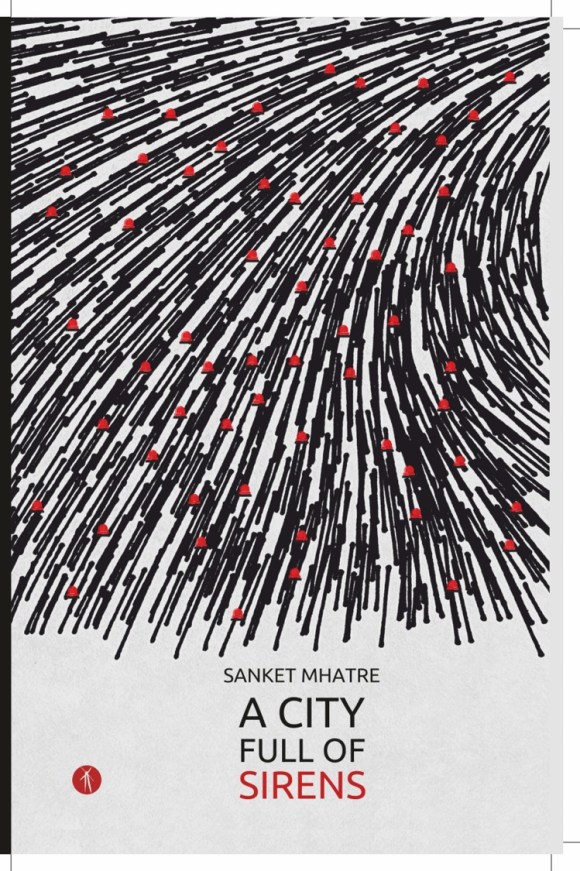
Something irreplaceably urgent yet inconsolably fragile commands the readers’ attention in Sanket Mhatre’s A City Full of Sirens. There is, to begin with, the orderly chaos of the book cover that with its startling depiction of noise and alarm, summons us to a danger that is as neurological as it is existential, as concretely physical as it is metaphysical, and as identifiable as it is, ultimately, anonymous.

Darkness asphyxiates
shifting the axis of your soul
madness froths
bubbles of hurt
shadows of shards
inserting lost files of remembrance
pulse rising –
raising a question at boiling point

Here is an understanding of the city as both protagonist and witness, as conquistador and vanquished, as healer and diseased. Mhatre is mostly talking about Mumbai (“Andheri East doesn’t realize/ that it is sleeping in a belly of void/ It is only a matter of time/ until all the lights go out”) but his city could be “the broken arteries of Kolkata” (‘Mid-flight’) or precisely any cityscape where life routinely unravels amidst disillusionment, betrayal, threat and hope, every poem to it being “a wound or a flower or a piece of sunshine” “written on the threshold of vulnerability and despair” as “a letter trying to find its own footprint on the shifting axis of time and circumstance” (‘Introduction’)

Tortuous and tortured, Mhatre’s city is a site of bereavement, uncertainty, imperilment, disease, derangement and more, its inhabitants choiceless in their compulsion to wear its frayed fabric upon their skin. But this is not all. Lurking within these poems is also the decisive realisation of the city as a human construct, a mirror that reflects rather than distorts or imposes human irresponsibility and disorder. In the title poem of the collection, for instance, the city is a patient incapable of being saved by its nonchalant dwellers:

the city has been suddenly diagnosed with Stage 3C
and all of us who matter to her:
slum dwellers, middle class, uber rich
upper caste, sub-middle-sub-lower, lower,
converts, casteless, outcasts, pimps and city planners
were late by a minimum of ten months in pre-empting this disease

Mhatre’s cities emit steady sirens of disaster – biological, ecological, technological, moral and aesthetic. But redemption, too, is to be found here alone (“Clay hands in a relentless prayer to -/ everything the earth stands for/ and everything that rises upwards from it.” – ‘A Kiss of Cotton’) for only what hurts has the ability to effectively transform – “anything that doesn’t change our body can never change us”. (‘Culture of Transience’) What, chiefly, reconciles the city as wound to the city as mirror, is the imperative of language and its expressive potential for love and poetry. (“A verse could be an open road” – ‘These Years with Her’)

A City Full of Sirens is a dense interrogation of the city, its sirens of overpopulation, congestion, capitalism and climate change, and an exploration of the fullness or plenitude of language that can somehow soften all of this and make it more bearable for life and time. Firmly rooting this collection is a momentous faith in the capacity of words to resist postmodern fragmentation by building bridges across emotions, cultures, and epistemologies. Mhatre’s imagination in poetry is luxuriantly metaphorical. In almost every poem, words defy ordinary appearances to transform into winged images in deep conversation with a reality tangential to the page. In ‘Anuvaad[1]’, as the poet says, all languages are born “from the same birdsong”. In ‘The Concept of Distance’, every stanza offers a new perspective into distance – “The space of pain between two alphabets, now divorced,/ looking on either side of a sentence”. In ‘Morphing into Everything’, the beloved and the city coalesce into one:

my fortresses crumble
dissolve mid-sea
rebirth as an archipelago
sink into her navel
populate her mind
germinate on her dermis
disintegrate into a thousand birds
taking early flight 

In each of the fifty-six poems in the collection, is a seamless interweaving of self and space. Most of Mhatre’s sirens are symbolic, conjured through the weight and immediacy of metaphor. In each poem is this sense of something that must be overcome — a lurking claustrophobia, an unnamed distrust, a haunting faithlessness, a constant suggestion of order tipping into anarchy.

An acute precariousness, marked by a vital need to thresh out feeling on the floor of language, is the signature of this collection.

Very significantly, many of these poems are about poetry itself —  its genesis, composition, structure, and its relentless shapeshifting ability to weld disparate worlds and subjectivities into a coherent experiential whole. Unravelling within this book’s narrative arc is an empathetic journey of the body and spirit, its goal being to discover “the completeness of existence…Time. Tide. Man. Woman. Humanity. Age. Difference. Distance”. (‘Rain Being’) Passion configures these poems in various ways and not least through the erotic of language. In the best poems here, love, poetry, woman and city become indistinguishable from one another, permeating ontological and aesthetic boundaries and accomplishing a spiritual surrealism that marks the distinctness of this collection.

A City Full of Sirens is, thus, about cities that are both germane and antithetical to poetry, about a “confabulated planet” and mutating geographies “stretching/ through thick mesh of bones and arteries/ pulp synchronized to our heartbeats/ birdsong to a breath/ while ink sprawls/ on a dream of half-slept pages”. (‘Vertical Forests’) It is equally about the inhabitants of the cityscape, the reconciliation of their numerous fragments and roles – “a new you added everyday/ an old you subtracted”. (‘The Queue’), intending “to geolocate/ the fulcrum of our absolute feeling/ outliving erasures”. (‘Synthesis’)

The collection remains remarkable for its obsession with language, its authentic emotional inflections, its charged candour, and its oscillations across a wide thematic range of existence, estrangement, erosion, and redemption. Annihilation, disease and death watermark these poems in undeniable ways but the energy of the book lies in its refusal to be contained within scripts of hopelessness or pain. Summoning optimism to thought and agency to action,  A City Full of Sirens makes a palliative of poetry and crafts an entourage of life’s resilience to learn from every setback –

I was never the rain.
Until you cloud-burst me with words.
You gave me the first drop.
It’s my turn to take you in. 
--‘Rain Being’

Click here to read the excerpt

[1] Translation, Hindi

Basudhara Roy teaches English at Karim City College affiliated to Kolhan University, Chaibasa. Author of three collections of poems, her latest work has been featured in EPW, The Pine Cone Review, Live Wire, Lucy Writers Platform, Setu and The Aleph Review among others. 

.

PLEASE NOTE: ARTICLES CAN ONLY BE REPRODUCED IN OTHER SITES WITH DUE ACKNOWLEDGEMENT TO BORDERLESS JOURNAL

Click here to access the Borderless anthology, Monalisa No Longer Smiles

Click here to access Monalisa No Longer Smiles on Kindle Amazon International

Categories
Editorial

Other Echoes in the Garden…

“Other echoes
Inhabit the garden. Shall we follow?
Quick, said the bird, find them, find them…”

— TS Eliot, ‘Four Quartets: Burnt Norton’(1936)

Humans have always been dreamers, ideators and adventurers.

Otherwise, could we have come this far? From trees to caves to complex countries and now perhaps, an attempt to reach out towards outer space for an alternative biome as exploring water, in light of the recent disaster of the Titan, is likely to be tougher than we imagined. In our attempt to survive, to live well by creating imagined constructs, some fabrications backfired. Possibly because, as George Orwell observed with such precision in Animal Farm, some perceived themselves as “more equal”. Of course, his was an animal allegory and we are humans. How different are we from our brethren species on this beautiful planet, which can survive even without us? But can humanity survive without Earth? In science fiction, we have even explored that possibility and found home among stars with the Earth becoming uninhabitable for man. However, humanity as it stands of now, continues to need Earth. To live amicably on the planet in harmony with nature and all the species, including our own, we need to reimagine certain constructs which worked for us in the past but seem to have become divisive and destructive at this point.

Ujjal Dosanjh, former Minister in the Canadian cabinet and former Premier of British Columbia, in his autobiography, Journey After Midnight – A Punjabi Life: From India to Canada, talks of regionalism as an alternative to narrow divisive constructs that terrorise and hurt others. He writes in his book: “If humanity isn’t going to drown in the chaos of its own creation, the leading nations of the world will have to create a new world order, which may involve fewer international boundaries.” We have a candid conversation with him about his beliefs and also a powerful excerpt from his autobiography.

An interview with Professor Fakrul Alam takes us into Tagore’s imagined world. He discussed his new book of Tagore translations, Gitabitan: Selected Song-Lyrics of Rabindranath Tagore. He has brought out a collection of 300 songs translated to English. In a bid to emphasise an inclusive world, we also have a translation of Tagore’s ‘Musalmanir Galpa’ (A Muslim Woman’s Story) by Aruna Chakravarti. A transcreation of his poem, called ‘Proshno or Questions’ poses difficult challenges for humanity to move towards a more inclusive world. Our translation by Ihlwha Choi of his own Korean poem to English also touches on his visit to the polymath’s construct in the real world, Santiniketan. All of these centring around Tagore go to commemorate the month in which he breathed his last, August. Professor Alam has also translated a poem from Bengali by Masud Khan that has futuristic overtones and builds on our imagined constructs. From Fazal Baloch we have a Balochi translation of a beautiful, almost a surrealistic poem by Munir Momin.

The poetry selections start with a poem on ‘Wyvern’, an imagined dragon, by Jared Carter. And moves on to the plight of refugees by Michael Burch, A Jessie Michael, and on migrants by Malachi Edwin Vethamani. Ryan Quinn Flanagan has poetry that suggests the plight of refugees at a metaphorical level. Vibrant sprays of colours are brought into this section by Luis Cuauhtémoc Berriozábal, Saranyan BV, Jahnavi Gogoi, George Freek and many more. Rhys Hughes brings in a spot of humour with his mountainous poetry (literally) and a lot of laughter with his or rather Google’s attempt at automatic translation of a poem. Devraj Singh Kalsi has shared a tongue in cheek story about an ‘amateur professional’ — rather a dichotomy.

We travel to Andaman with Mohul Bhowmick and further into Sierra with Meredith Stephens. Ravi Shankar travels back in nostalgia to his hostel and Kathleen Burkinshaw dives into the past — discussing and responding to the media presentation of an event that left her family scarred for life, the atomic holocaust of 1945 in Japan. This was a global event more than seven decades ago that created refugees among the survivors whose homes had been permanently destroyed. Perhaps, their stories are horrific, and heart wrenching like the ones told by those who suffered from the Partition of India and Pakistan, a divide that is celebrated by Independence Days for the two nations based on a legacy of rifts created by the colonials and perpetrated to this day by powerbrokers. Aysha Baqir has written of the wounds suffered by the people with the governance gone awry. Some of the people she writes of would have been refugees and migrants too.

A poignant narrative about refugees who flock to the Greek island of Lesbos by Timothy Jay Smith with photographs by Michael Honegger, both of whom served at the shelters homing the displaced persons, cries out to halt wars and conflicts that displace them. We have multiple narratives of migrants in this issue, with powerful autobiographical stories told by Asad Latif and Suzanne Kamata. Paul Mirabile touches on how humans have adopted islands by borrowing them from seas… rather an unusual approach to migrations. We have an essay on Jane Austen by Deepa Onkar and a centenary tribute to Chittaranjan Das by Bhaskar Parichha.

The theme of migrants is echoed in stories by Farouk Gulsara and Shivani Shrivastav. Young Nandani has given an autobiographical story, translated from Hindustani to English by Janees, in which a migration out of various homes has shredded her family to bits — a narrative tucked in Pandies Corner.  Strange twists of the supernatural are woven into fiction by Khayma Balakrishnan and Reeti Jamil.

In reviews, Parichha has explored Arunava Sinha’s The Greatest Indian Stories Ever Told: Fifty Masterpieces from the Nineteenth Century to the Present. Somdatta Mandal’s review of Amitav Ghosh’s Smoke and Ashes: A Writer’s Journey Through Opium’s Hidden Histories seems to be an expose on how historical facts can be rewritten to suit different perceptions and Basudhara Roy has discussed the Greening the Earth: A Global Anthology of Poetry, edited by K. Satchidanandan and Nishi Chawla.

There is more wonderful content. Pop by our August’s bumper edition to take a look.

I would like to give my grateful thanks to our wonderful team at Borderless, especially to Sohana Manzoor for her fabulous artwork. Huge thanks to all our gifted contributors and our loyal readers. Borderless exists today because of all of you are making an attempt to bringing narratives that build bridges, bringing to mind Lennon’s visionary lyrics:

You may say I'm a dreamer
But I'm not the only one
I hope someday you'll join us
And the world will live as one

Thank you for joining us at Borderless Journal.

Have a wonderful month!

Mitali Chakravarty

borderlessjournal.com

.

Visit the August edition’s content page by clicking here

READ THE LATEST UPDATES ON THE FIRST BORDERLESS ANTHOLOGY, MONALISA NO LONGER SMILES, BY CLICKING ON THIS LINK.

Categories
Review

Anthem of Hope

Review by Basudhara Roy

Title: Greening the Earth: A Global Anthology of Poetry

Editors: K. Satchidanandan and Nishi Chawla

Publisher: Penguin Random House

At a time when apocalyptic unease about the precarity of our home on this planet grips us as a civilisation and is concomitantly coupled with the irremediable apathy that governs our everyday mundanity, a collection of poems on the subject by some of the finest poets from around the world writing in our times, is both an existential alarm of urgency and a spiritual balm that soothes our despondency enough to spur us to action. Greening the Earth: A Global Anthology of Poetry edited by K. Satchidanandan and Nishi Chawla, and recently brought out by Penguin Random House is, as its editors point out, an act of “responsible activism”.

A tonal sequel to Singing in the Dark, their first co-edited anthology of poems around the pandemic which had already foregrounded nature’s clear vengeance against human greed, this collection attempts to grapple with the more sinister and nemetic darkness of environmental crises by establishing a dialogic space for the affirmation of ecological citizenry through poetry and “the articulation of a new aesthetic of survival”.

Poetry has, always and undeniably, been at the forefront of every revolution and the reasons for this are not hard to seek. Out of the circuit of formal epistemology, poetry has mostly been free to encode and perform alternative knowledges. The language of poetry, being generically unanswerable to established patterns of syntax and semantics, has been, historically, at liberty to pursue and present its own ensemble of meaning. Again, just as poetry, dispensing with literacy and formal training, has offered little resistance or discouragement to potential creators, it has also always been widely accessible to the general public owing to its capacity for oral dissemination and circulation in minor media such as notes, letters, greeting cards, placards and advertisements.

But poetry’s chief merit, most significantly, lies in its ability to accomplish a multifaceted and compound expression encompassing reality and possibility, facticity and vision, statistics and emotions. To declare in editorial essays or news reports that the world is coming to an end is one thing, to express its consequences in poetry is something else. Ecological poetry or ecopoetry has been on the scene for a considerable period of time now. An extension or intensification of the genre of nature poetry, ecological poetry evinces a keen political and activist consciousness geared to fight back the environmental crisis through determined human effort. Integrating perspective, observation, information, emotion, vision and testimony, ecopoetry attempts to establish a deeply personal relationship between man and nature underlining, thereby, their indispensability to each other’s survival.

Greening the Earth with its staggering set of around a hundred and eighty-five poets and poems from across the world, offers us an essentially global anthem of hope. The planet cannot be greened by afforestation alone. Greening the planet requires a systemic reconstruction of our relationship with it that envisages love, responsibility and sustainability. It is a recognition of  nature’s intrinsic worth beyond her instrumental value and the fierce acknowledgement of the inextricability of the two.

A walk through the anthology is an immensely moving and personal tour through innumerable poetic moods and ecotopes, our teeming biodiversity, and our shared vulnerability as inhabitants of the cosmos. At the heart of each of these astonishingly diverse and beautiful poems is a sense of kinship to a wider and infinitely unknown world, an awareness of the mutability of life-forms within the unmapped continuity of time, a strong condemnation of human selfishness and myopia, and a more-than strong suspicion of the imminent end of humanity.

At the same time, here is also the urgent and extraordinary tenderness that arrives only with the knowledge of transience and the prophecy of loss. If life and the world are to be lost to us as a species, there will never be time enough to dwell on all that we love. Each of these poems is, therefore, also about love – love not merely for the natural world but for every little thing that holds up our lives and which we have been taught to discount as inessential or marginal in our daily drive to build a living.

Greening the Earth, thus, advocates a different ontological ethics – one that calls for wide inclusiveness, greater mindfulness, minute attention, and an adjustment to the flow of time around us instead of attempting to govern this flow. It embodies an intense desire to reverse the cycle of alienated technological growth and to revert to an era of deep feeling and conscious interconnectedness. Here is joy, agony, grief, fear, beauty, despair, isolation, and community but most significantly, here is the possibility of building both ourselves and the world anew through searching self-analysis.

In ‘Signs and Wonders’, Paul Hoover sketches a barren civilization which can be revived only when “a child will write them back into existence,/one branch at a time”. Toi Derricotte’s ‘Unburying the Bird’, similarly, is a deeply moving poem about bird deaths “because of too much/ something” and yet, the poem’s onus is on resurrection rather than on accusation:

Feed her from the tip of your finger.
Teach her the cup of your hand.
You breathe on her.
One day,
you open up your hand
and show her sky.

The recognition of the human as one insignificant dot within the immensity of the universe marks many of these poems. Sarah Key’s ‘Ode to the Scarce Yellow Sally Stonefly’ is one among several poems where humans are treated as textual equals with other species. The poem pays tribute to a critically endangered variety of the stonefly that was rediscovered in the United Kingdom after a period of twenty-two years owing to the efforts of conservation biologists like John Davy-Bowker. After eight stanzas of describing the stonefly, its disappearance, and its rediscovery, the poem in its final stanza, deftly but unassumingly, turns to the larger and logical picture – the extinction of homo sapiens from the planet:

Tell me, flighty friends, will there be
A Mr. Davy-Bowker for me?
Will some AI god come along, algorithm my scent,
go where my species has gone?

Rochelle Potkar’s ‘Confluence’ raises concern regarding the legal personhood and rights of our natural environment. Embodying the spirit of the ‘Rights of Nature’ movement that believes in the right of every ecosystem to flourish without victimisation by humans, the poem makes a strong case for the rights of water bodies which are relentlessly drained, contaminated, and exploited by human activities, its opening line being highly potent in its irony:

Waters when they evaporate, meet…
at a global conference, to speak of fish dropouts,
obscura of clouds, near-deaths, hydrological dynamics,
monocultures, and metals:
nickel, lead, chromium, at their beds.

The constant awareness of despair and inertia runs in a large number of poems as in Michael Cope’s ‘We Watch the Signs’ where the awareness of danger leads to numbness rather than action, the first and third lines of this first stanza being a constant refrain throughout the poem:

We watch the signs in numbness and regret.
Midwinter summer, chaos in the year,
And still our money’s on the outside bet.

David Ebenbach’s ‘Viaduct Greene’ eloquently traces the possibilities of companionship in a posthuman world – a date through “this expanse of soda bottles and human waste” when “a subway dies and you make it a garden.” In Meg Eden’s ‘Scene of a Dismantled Village outside Pripyat’, “The forest has become/ a radioactive living room.” Humans are absent from this scene altogether, their “heirloom china,/ covering the forest floor!” Animals have taken over:

Inside one cup, a chipmunk
makes its home. Inside another,
a spider breeds. Soon, her eggs
will hatch and from where
there was one body, there will be
thousands. Think about that –
something still lives after all of this. 

‘Lakeside Walks’ by Arvind Krishna Mehrotra is, entirely, an exercise in mindful perception, the poetic consciousness establishing itself as intimately one with its immediate environment. Here rain, squirrel, friend, four-lane highway, letter, piebald cow, pinwheel flower, poem, face mask, mynah and park bench are all emotive equals drawing the poet’s attention “aimlessly, which is the same as purposefully”, articulating thereby an intense ecopoetic vision of connection and harmony. 

What makes the book a trifle inconvenient to handle is the absence of a table of contents so that attempting to look up a specific poem in this anthology becomes entirely a matter of labour, memory, and chance. Its Preface, however, constitutes a comprehensive and well-researched essay on ecological consciousness in literature and will be an appreciable resource for readers in general and those with special interest in ecocriticism. What is also valuable about this anthology is its inclusion of poems in translation from a wide variety of global languages.

With a memorable green cover showcasing an opulent spread of maple leaves, here is a body of poems intended to woo us to an earth-centric view of life and the world, and as Rainer Maria Gassen writes here in his poem ‘To Nature – Three Sonnets’, “should this poem fail to win you over/ there’ll be hundreds if not thousands more of them.”

Basudhara Roy teaches English at Karim City College affiliated to Kolhan University, Chaibasa. Author of three collections of poems, her latest work has been featured in EPW, The Pine Cone Review, Live Wire, Lucy Writers Platform, Setu and The Aleph Review among others. 

.

PLEASE NOTE: ARTICLES CAN ONLY BE REPRODUCED IN OTHER SITES WITH DUE ACKNOWLEDGEMENT TO BORDERLESS JOURNAL

Click here to access the Borderless anthology, Monalisa No Longer Smiles

Click here to access Monalisa No Longer Smiles on Kindle Amazon International
Categories
Contents

Borderless June 2023

Art by Sohana Manzoor

Editorial

Where have All the People Gone? … Click here to read.

Translations

Hena, a short story by Nazrul, has been translated from Bengali by Sohana Manzoor. Click here to read.

Mohammad Ali’s Signature, a short story by S Ramakrishnan, has been translated from Tamil by Dr B Chandramouli. Click here to read.

Three poems by Masud Khan have been translated from Bengali by Professor Fakrul Alam. Click here to read.

Shadows, a poem in Korean, has been translated by the poet himself, Ihlwha Choi. Click here to read.

Pran or Life by Tagore has been translated from Bengali by Mitali Chakravarty. Click here to read.

Conversations

Shantanu Ray Chaudhuri converses with Vinta Nanda about the Shout, a documentary by Vinta Nanda that documents the position of women in Indian society against the backdrop of the #MeToo movement and centuries of oppression and injustice. Click here to read.

In Conversation with Advait Kottary about his debut historic fiction, Siddhartha: The Boy Who Became the Buddha. Click here to read.

Poetry

Click on the names to read the poems

Michael Burch, Ananya Sarkar, George Freek, Smitha Sehgal, Rachel Jayan, Michael Lee Johnson, Sayantan Sur, Ron Pickett, Saranyan BV, Jason Ryberg, Priya Narayanan, Ryan Quinn Flanagan, Evangeline Zarpas, Ramesh Karthik Nayak, Rhys Hughes

Poets, Poetry & Rhys Hughes

In Ghee-Wizz, Rhys Hughes talks of the benefits of Indian sweets while wooing Yetis. Click here to read.

Musings/Slices from Life

Humbled by a Pig

Farouk Gulsara meets a wild pig while out one early morning and muses on the ‘meeting’. Click here to read.

Spring Surprise in the Sierra

Meredith Stephens takes us hiking in Sierra Nevada. Click here to read.

Lemon Pickle without Oil

Raka Banerjee indulges in nostalgia as she tries her hand at her grandmother’s recipe. Click here to read.

Apples & Apricots in Alchi

Shivani Shrivastav bikes down to Alchi Ladakh to find serenity and natural beauty. Click here to read.

Musings of a Copywriter

In Trees from my Childhood, Devraj Singh Kalsi muses on his symbiotic responses to trees that grew in their home. Click here to read.

Notes from Japan

In Superhero Sunday in Osaka, Suzanne Kamata writes of her experience at the Osaka Comic Convention with her daughter. Click here to read.

Stories

The Trial of Veg Biryani

Anagha Narasimha gives us a social satire. Click here to read.

Am I enough?

Sarpreet Kaur explores social issues in an unusual format. Click here to read.

Arthur’s Subterranean Adventure

Paul Mirabile journeys towards the centre of the Earth with his protagonist. Click here to read.

Essays

No Bucket Lists, No Regrets

Keith Lyons muses on choices we make while living. Click here to read.

In Search of the Perfect Dosa

Ravi Shankar trots around the world in quest of the perfect dosa — from South India to Aruba and West Indies. Click here to read.

“Bookshops don’t fail. Bookshops run by lazy booksellers fail.”

Shantanu Ray Chaudhuri takes us for a tour of the Kunzum bookstore in New Delhi. Click here to read.

Book Excerpts

An excerpt from Greening the Earth: A Global Anthology of Poetry, edited by K. Sachitanandan and Nishi Chawla. Click here to read.

An excerpt from Advait Kottary’s Siddhartha: The Boy Who Became the Buddha. Click here to read.

Book Reviews

Somdatta Mandal reviews Behind Latticed Marble: Inner Worlds of Women by Jyotirmoyee Devi Sen, translated from Bengali by Apala G. Egan. Click here to read.

Rakhi Dalal reviews Rhys Hughes’ The Wistful Wanderings of Perceval Pitthelm. Click here to read.

Basudhara Roy reviews Prerna Gill’s Meanwhile. Click here to read.

Bhaskar Parichha reviews Zac O’Yeah’s Digesting India: A Travel Writer’s Sub-Continental Adventures With The Tummy (A Memoir À La Carte). Click here to read.

.

PLEASE NOTE: ARTICLES CAN ONLY BE REPRODUCED IN OTHER SITES WITH DUE ACKNOWLEDGEMENT TO BORDERLESS JOURNAL

Click here to access the Borderless anthology, Monalisa No Longer Smiles

Click here to access Monalisa No Longer Smiles on Kindle Amazon International
Categories
Editorial

Where have All the People Gone?

Courtesy: Creative Commons

Can humankind ever stop warring and find peace?

Perhaps, most sceptics will say it is against human nature to stop fighting and fanning differences. The first recorded war was fought more than 13,000 years ago in what is now a desert but was green long ago. Nature changed its face. Continents altered over time. And now again, we are faced with strange shifts in climate that could redefine not just the dimensions of the surface area available to humankind but also our very physical existence. Can we absorb these changes as a species when we cannot change our nature to self-destruct for concepts that with a little redefining could move towards a world without wars leading to famines, starvation, destruction of beautiful edifices of nature and those built by humankind? That we could feed all of humans — a theory that won economist Abhijit Banerjee his Nobel Prize in 2019 so coveted by all humanity — almost seems to have taken a backseat. This confuses — as lemmings self-destruct…do humans too? I would have thought that all humanity would have moved towards resolving hunger and facing the climate crises post-2019 and post-pandemic, instead of killing each other for retaining constructs created by powerbrokers.

In the timeless lyrics of ‘Imagine’, John Lennon found peace by suggesting we do away with manmade constructs which breed war, anger and divisions and share the world as one. Wilfred Owen and many writers involved in the World Wars wrote to showcase the desolation and the heartfelt darkness that is brought on by such acts. Nazrul also created a story based on his experience in the First World War, ‘Hena’, translated for us by Sohana Manzoor. Showcasing the downside of another kind of conflict, a struggle to survive, is a story with a distinctive and yet light touch from S Ramakrishnan translated from Tamil by B Chandramouli. And yet in a conflict-ridden world, humans still yearn to survive, as is evident from Tagore’s poem Pran or ‘Life’. Reflecting it is the conditioning that we go through from our birth that makes us act as we do are translations by Professor Fakrul Alam of Masud Khan’s poetry and from Korean by Ihlwha Choi.

A figure who questioned his own conditioning and founded a new path towards survival; propounded living by need, and not greed; renounced violence and founded a creed that has survived more than 2500 years, is the man who rose to be the Buddha. Born as Prince Siddhartha, he redefined the norms with messages of love and peace. Reiterating the story of this legendary human is debutante author, Advait Kottary with his compelling Siddhartha: The Boy Who Became the Buddha, a book that has been featured in our excerpts too. In an interview, Kottary tells us more of what went into the making of the book which perhaps is the best survivor’s guide for humanity — not that we need to all become Buddhas but more that we need to relook at our own beliefs, choices and ways of life.

Another thinker-cum-film maker interviewed in this edition is Vinta Nanda for her film Shout, which highlights and seeks resolutions for another kind of crisis faced by one half of the world population today. She has been interviewed and her documentary reviewed by Shantanu Ray Chaudhuri. Chaudhuri has also given us an essay on a bookshop called Kunzum which continues to expand and go against the belief we have of shrinking hardcopy markets.

The bookshop has set out to redefine norms as have some of the books featured in our reviews this time, such as Rhys Hughes’ latest The Wistful Wanderings of Perceval Pitthelm. The reviewed by Rakhi Dalal contends that the subtitle is especially relevant as it explores what it says — “The Absurdity of Existence and The Futility of Human Desire” to arrive at what a person really needs. Prerna Gill’s Meanwhile reviewed by Basudhara Roy and poetry excerpted from Greening the Earth: A Global Anthology of Poetry, edited by K. Satchidanandan and Nishi Chawla, also make for relooking at the world through different lenses. Somdatta Mandal has written about Behind Latticed Marble: Inner Worlds of Women by Jyotirmoyee Devi Sen, translated by Apala G. Egan and Bhaskar Parichha has taken us on a gastronomic tour with Zac O’Yeah’s Digesting India: A Travel Writer’s Sub-Continental Adventures with the Tummy (A Memoir À La Carte).

Gastronomical adventures seem to be another concurrent theme in this edition. Rhys Hughes has written of the Indian sweets with gulab jamun as the ultimate life saver from Yetis while trekking in the Himalayas! A musing on lemon pickle by Raka Banerjee and Ravi Shankar’s quest for the ultimate dosa around the world — from India, to Malaysia, to Aruba, Nepal and more… tickle our palate and make us wonder at the role of food in our lives as does the story about biryani battles by Anagaha Narasimha.

Talk of war, perhaps, conjures up gastronomic dreams as often scarcity of food and resources, even potable water and electricity is a reality of war or conflict. Michael Burch brings to us poignant poetry about war as Ramesh Karthik Nayak has a poem on a weapon used in wars. Ryan Quinn Flanagan has brought another kind of ongoing conflict to our focus with his poetry centring on the National Day (May 5th) in Canada for Vigils for Missing and Murdered Indigenous Women by hanging red clothes from trees, an issue that perhaps has echoes of Vinta Nanda’s Shout and Suzanne Kamata’s poetry for her friend who went missing decades ago as opposed to Rachel Jayen’s defiant poetry where she asserts her womanhood. Ron Pickett, George Freek and Sayantan Sur have given us introspective perspectives in verse. We have more poetry asking for a relook at societal norms with tongue-in -cheek humour by Jason Ryberg and of course, Rhys Hughes with his heartfelt poem on raiders in deserts.

The piece that really brought a smile to the lips this time was Farouk Gulsara’s ‘Humbled by a Pig’, a humorous recount of man’s struggles with nature after he has disrupted it. Keith Lyons has taken a look at the concept of bucket lists, another strange construct, in a light vein. Devraj Singh Kalsi has given a poignant and empathetic piece about trees with a self-reflective and ironic twist. We have narratives from around the world with Suzanne Kamata taking us to Osaka Comic Convention, Meredith Stephens to Sierra Nevada and Shivani Shrivastav to Ladakh. Paul Mirabile has travelled to the subterranean world with his fiction, in the footsteps perhaps of Jules Verne but not quite.

We are grateful to all our wonderful contributors some of whom have not been mentioned here but their works were selected because they truly enriched our June edition. Do visit our contents page to meet and greet all our wonderful authors. I would like to thank the team at Borderless without whose efforts and encouragement our journal would not exist and Sohana Manzoor especially for her fantastic artwork as well. Thank you all.

Wish you another lovely month of interesting reads!

Mitali Chakravarty

borderlessjournal.com

.

READ THE LATEST UPDATES ON THE FIRST BORDERLESS ANTHOLOGY, MONALISA NO LONGER SMILES, BY CLICKING ON THIS LINK.

Categories
Review

The Seduction of Words

Book Review by Basudhara Roy

Title: Meanwhile

Author: Prerna Gill

Publisher: HarperCollins India

There are many places that poetry comes from — desire, death, dream, memory, sharp sensuous apprehension, the wrist-grip of language’s freedom and magic, the joys and fractures of the world that we engage in everyday, the necessity to commit to paper (or to posterity) what weighs upon the heart or head, the existential imperative to express, or the naïve hope of making the world a better place.

In general, the act of poetic creation draws its sap simultaneously from several of these sources. Many a time, however, one of these inspirations is bound to tower over all the rest. In the case of Prerna Gill’s Meanwhile (HarperCollins, 2023), the mysterious seduction of words combined with an urge to dress the world in impenetrable veils of meaning by conscientiously shuffling the charted signifiers and signifieds of language, seem to offer the veritable will-to-poetry.

One is drawn to the studied casualness of the title which, with its quiet, meditated understatement, purports poetry to be a by-the-way affair, a random afterthought. Nothing could be farther from the truth. In the title as well as in the book as a whole, there is a skilled juxtaposition of two contiguous temporal frames — the physical and the psychic. The physical frame is the one in which the seemingly significant events of life take place. The psychic frame constitutes the ‘meanwhile’ of poetry.

This ‘meanwhile’ is not to be treated lightly for it is in these pockets of found time that the actual business of confronting the self for survival takes place. Here is a drawn-out negotiation with history, experience, emotions, pain, and trauma, and a poignant reconciliation with each of them. The psychological explorations of the ‘meanwhile’ in this collection are all-absorbing and have the potency to completely obstruct, offset and vanquish the eventful flow of physical time — “it’s always hungry in here” (‘An Hour Stays’). Nevertheless, this is not allowed to happen and both frames persist together, their density often overlapping.

If one pays sufficient aural attention, there is to be heard a silent ticking within Prerna’s poems, a tense balance between the physical or material and the psychic or mental, that threatens at any moment to collapse – “I sink through deep green waters/ To a cement floor buried/ Under boxes, old chairs, a pantheon in a funk” (‘Visit’). The fifty-nine poems in Meanwhile, then, manifest themselves as an acknowledgement of this essential fragility of time, balance, and life — a realisation that if the mind’s playhouse is affected or darkened, the lights in life’s theatre will inevitably be extinguished.

In the author’s words, the book is “an attempt to understand the less-than-shiny things that I can’t quite ignore any longer. The everyday things. The things that let the shadows in.” The paradoxical nature of time, emotional spontaneity and polyphony, the weaving/unweaving of the self, its fragile alignment/dealignment with the world, and the conglomeration of being constitute the thematic canvas of these poems. The cover image of a huge butterfly replacing the forehead and eyes of a human (woman’s) face looms to significance here. The symbolic suggestion of an alternative (inward or non-human) vision is hard to rule out (for animals occupy an enviable space in many poems of this collection) even as one is brought to mind of the butterfly effect of causation that operates, perhaps, most relentlessly in the headspace.

The acuteness of experience, the intensity of its processing, and its configuration through terse but often abrupt and abstruse images constitute the three essential prismatic walls of Meanwhile. Here is a carefully constructed theatre of the mind where lights and sounds radically transform in meaning through connotative and symbolic suggestions. In much of Prerna’s poetry is a semantic and narrative inscrutability that seems to operate as conscious poetic strategy. In the noumenon of these poems is both illumination and construction. Language is both torch and subterfuge, revelation and concealment, statement and retraction so that travelling through these poems is to traverse an experiential space that is deliberately half-lit.

In ‘Unmasked’, the poet writes:

Glaucous moon shivering inches of glass 
She cuts her shape, cuts at it in echo 
Grows it asking after her sons and rent 
The possibility of rain and grandchildren 
And if they glimpsed her first body 
In birthmark, headline, running stitch 

Here, as in many of her pieces, the real and the surreal walk together, undistinguished. In ‘Chedipe’, for instance – “Never could tell if she first saw him/ From behind green bottles or tall grass” – the atmosphere often turns disturbing and sometimes, singularly acherontic. In ‘Tributary’, the witnessing of the phenomenon of death opens a startling avenue of perception:

Until his splintering close enough to see 
How easily a tributary is made: 
A young man slipping from the course of the day 
His hours held close as cards

In these poems’ handling of the self as subject, one finds little narcissism. The mind that is sculpted by particularity of experience, memory and upheaval of feeling is, to be sure, intensely subjective and yet, the distillation of these experiences in poetry makes way for a rich reading. What animates these poems and renders them more than abstract musings of an idiosyncratic mind is their keen and devout understanding of life’s complexity, its essential sense of injustice, and its brief but significant redemptions – “days pressed to currants between/ Pages folded for the edge of winter/And winters still” (‘Ant, Grasshopper’) or “Things of a hard blue sky yearn/ For the only light they do not share” (‘Before This Summer’) The use of short, clipped, often dramatic sentences; the frequent avoidance of punctuation; a polished, urban vocabulary; and an essential belief in the lability of time chisel these poems into pieces reflective of a deeper and highly nuanced reality of the mind as of the world.

The collection has several memorable poems. ‘Bucketsful’, for instance, brilliantly conjures childhood memory, loss, diminishing, and incommunicability through the bulbous image of frogs “Leaping to the rim/ Like it knew a boiling hurry” and ends with words that “balloon my throat and the only ones who would understand them/ Have long skipped town”. In ‘Trees’, the “verdant announcements” of foliage are capable of sustaining life despite its monotony – “Allergies, dry cleaning, soup” so that “in one glance/ The world becomes/ Leaves”. ‘Autopsy’ builds itself around a single cinematic image – “The naked bulb above the table/ Flickered too much” and as a verb, can symbolically extend itself from a person to a situation to life itself. ‘The Dollmaker’, one of those poems that makes the act of reading this collection inseparable from the recognition of the author’s experiences as a woman in the world, skilfully builds up the automated rhythms of a woman’s being in a sexist universe.

Meanwhile, thus, offers a whole new world for our absorption, intriguing in its opacity, and plumbing a depth that is accessible only to those who are prepared to lose themselves in the sharp silhouettes of its images. Here is the gradual but steady eclipsing of material geography to throw light upon the imperialism of the psyche and in this, there is a fine and fluid celluloid effect at work. On the wide screen of language, Prerna’s images travel with a terse celluloid confidence – aware, both, of being and non-being, of leading the reader through a range of signification that can never be pinned down to conclusion, of living a lie and yet upholding the truth.

As a debut collection of poems, Meanwhile stands out for its innovative experimentation with language which borders, often, on the existential, as if sanity and survival depended upon these elaborate linguistic disguises — the trickery of words, the enticement as well as the connotative distance of images, and the impossibility of locating a referential kernel to crack. In the measured pace of Prerna’s poems is a chromatic adventure that navigates the complex terrain of human emotions via a symbolism of shape, feeling and colour illuminating the little-known multiverse of the subconscious – “Square fingers running a pen/ Over prescription or continent” (‘Maps’) or “You, with nights under your fingernails/ Tell no one how it happened” (‘Black’).

In the excavated or found space of ‘meanwhile’ flows a continuous and consistent dialogue between the various selves – the past and the present, the mentor and the mentee, the seeing and the knowing, the forgetful and the cautious, and so on and so forth. When this space transforms itself into the intersubjective bond of poetry it becomes therapeutic, healing both the speaker and the listener from a pain that is deeply shared as inhabitants of a difficult world — “Some mornings I think of a rabbit with orchid ears/ The stray toms left her in a pit in my stomach/ Filled with lettuce and sweet straw (‘Keeping’) or “In this way, we are brittle femur/ And like this, we are sky” (‘White’).

The world will, perhaps, continue to be what it is. Meanwhile, here is a book that promises to be a friend.

Basudhara Roy teaches English at Karim City College affiliated to Kolhan University, Chaibasa. Author of three collections of poems, her latest work has been featured in EPW, The Pine Cone Review, Live Wire, Lucy Writers Platform, Setu and The Aleph Review among others. 

.

PLEASE NOTE: ARTICLES CAN ONLY BE REPRODUCED IN OTHER SITES WITH DUE ACKNOWLEDGEMENT TO BORDERLESS JOURNAL

Click here to access the Borderless anthology, Monalisa No Longer Smiles

Click here to access Monalisa No Longer Smiles on Kindle Amazon International

Categories
Editorial

Can Love Change the World?

The night has nearly come to an end.
The old year is almost past.
Under this dust, it will lay down
Its worn-out life at last.
Whether friend or foe,      wherever you go,
Old wrongs cast
Away. On this auspicious day,
Old grievances shed as the old year parts.

— Nobo Borshe or on New Year by Tagore

Art by Sohana Manzoor

Mid-April, Thailand celebrates Songkran and Cambodia, Thingyan — water festivals like Holi. These coincide with the celebration of multiple New Years across Asia. Sikhs celebrate Baisakhi. Kerala celebrates Bishu and Tamil Nadu, Puthandu. Nepal celebrates Nava Varsha and Bengal Nobo Borsho or Poila Boisakh. A translation of Tagore’s poem on the Bengali New Year in spirit asks us to dispense with our past angst and open our hearts to the new day — perhaps an attitude that might bring in changes that are so needed in a world torn with conflicts, hatred and anger. The poet goes on to say, “I want to tie all lives with love” but do we do that in our lives? Can we? Masud Khan’s poems on love translated by Professor Fakrul Alam explore this from a modern context. From Korea, Ihlwha Choi tells us in his translation, “Loving birds is like loving stars”. But the translation that really dwells on love bringing in changes is Nabendu Ghosh’s ‘Gandhiji’, translated by Ratnottama Sengupta, his daughter. The short story by Ghosh highlights the transformation of a murderous villain to a defender of a victim of communal violence, towering above divides drawn by politics of religion.

Another daughter who has been translating her father’s works is Amna Ali, daughter of award-winning Punjabi writer, Nadir Ali. In ‘Khaira, the Blind‘, the father-daughter duo have brought to Anglophone readers a lighter narrative highlighting the erasure of divides and inclusivity. A folktale from Balochistan, translated by Fazal Baloch, echoes in the footsteps of ‘Emperor’s New Clothes’ — a story that can found in the Andersen’s Fairy Tales published in the nineteenth century. I wonder which narrative had come first? And how did it cross cultures retaining the original ideas and yet giving it a local colour? Was it with traders or immigrants?

That such narratives or thoughts are a global phenomenon is brought to the fore by a conversation between Keith Lyons and Asian Australian poet Adam Aitken. Aitken has discussed his cross-cultural identity, the challenges of travel, writing, and belonging. Belonging is perhaps also associated with acceptance. How much do we accept a person, a writer or his works? How much do we empathise with it — is that what makes for popularity?

Cross cultural interactions are always interesting as Rhys Hughes tells us in his essay titled ‘My Love for RK Narayan’. He writes: “Narayan is able to do two contradictory things simultaneously, namely (1) show that we are all the same throughout the world, and (2) show how cultures and people around the world differ from each other.” The underlying emotions that tie us together in a bond of empathy and commonality are compassion and love, something that many great writers have found it necessary to emphasise.

Mitra Phukan’s What Will People say?: A Novel is built around such feelings of love, compassion and patience that can gently change narrow norms which draw terrifying borders of hate and unacceptance. We carry an excerpt this time from her ‘Prologue’. Somdatta Mandal has reviewed Chitra Banerjee Divakurni’s latest , Independence. Starting from around the time of the Indian Independence too is Song of the Golden Sparrow – A Novel History of Free India by Nilanjan P. Choudhary, which has been discussed by Rakhi Dalal. The Partition seems to colour narratives often as does the Holocaust. Sometimes, one wonders if humanity will ever get over the negative emotions set into play in the last century.

Closer to our times, when mingling of diverse cultures is becoming more acceptable in arts, Basudhara Roy introduces us to Bina Sarkar Ellias’s Ukiyo-e Days…Haiku Moments, a book that links poetry to a Japanese art-form. While a non-fiction that highlights the suffering of workers by enforcing unacceptable work ethics, Japanese Management, Indian Resistance: The Struggles of the Maruti Suzuki Workers by Anjali Deshpande and Nandita Haksar has been reviewed by Bhaskar Parichha. The narrative, he writes, “tells the story of the biggest car manufacturer in India through the voices of the workers, interviewed over three years. They give us an understanding that the Maruti Suzuki revolution wasn’t the unmitigated success it was touted to be when they tell us about their resistance to being turned into robots by uncompromising management.” That lack of human touch creates distress in people’s hearts, even if we have an efficient system of management and mass production is well elucidated in the review.

To lighten the mood, we have humour in verses from Rhys Hughes and Richard Stevenson’s tongue-in-cheek dino poems. Michael Burch’s poetry explores nuances of love and, yet, changes wrought in love has become the subject of poetry by Malachi Edwin Vethamani and Anasuya Bhar with more wistful lines by George Freek highlighting evanescence.  Sutputra Radheye and Jim Landwehr bring darker nuances into poetry while Scott Thomas Outlar mingles nature with philosophical meanderings. We have more poetry by Ryan Quinn Flanagan, Abdul Jamil Urfi and many more exploring various facets of changes in our lives.

These changes are reflected in our musings too. Sengupta has written on how change is wrought on a murderous villain by the charisma of Gandhi in her father’s fiction, as well as this world leader’s impact on Ghosh and her. Devraj Singh Kalsi addresses food fads with a pinch of sarcasm. From Japan, Suzanne Kamata has written of a little island with Greek influences, a result of cultural ties brought in by the emperor Hirohito. Ravi Shankar takes us to Pokhara, Nepal, and Meredith Stephen expresses surprise on meeting a shipload of people from Colorado in the far reaches of the Southern Hemisphere while on her sailing adventures with beautiful photographs. Stories by moderns reflect diverse nuances depicting change. While Brindley Hallam Dennis writes of the passing of an era, PG Thomas integrates the past into the present to reflect how they have a symbiotic structure in the scheme of creating or recreating natural movements through changes wrought over time in his story. Paul Mirabile explores the darker recesses of the human existence in his fiction. As if in continuation, the excerpt from Rhys Hughes’ The Wistful Wanderings of Perceval Pitthelm seems to step out of darker facets of humanity with a soupçon of wit at its best.

To create a world that endures, one looks for values that create inclusivity as reflected in these lines from Charles Chaplin’s My Autobiography, “Mother illuminated to me the kindliest light this world has ever known, which has endowed literature and the theatre with their greatest themes: love, pity and humanity.” This quote starts off a wonderful essay from film-buff Nirupama Kotru. Her narrative carries the tenor of Chaplin’s ‘themes’ to highlight not only her visit to the actor’s last home in Switzerland but also glances at his philosophy and his contributions to cinema across borders.

Our issue rotates around changes and the need for love and compassion to rise in a choral crescendo whirling with the voices of Tagore, Charles Chaplin as well as that of twenty-first century writers. Perhaps this new year, we can move towards a world – at least an imagined world — where love will wipe away weapons and war, where love will take us towards a future filled with the acceptance of myriad colours, where events like the Partition and the Holocaust will be history, just like dinosaurs.

Huge thanks to all our readers and contributors, some of whom may not have been mentioned here but are an integral and necessary part of the issue. Do pause by our April edition. I would also like to give my thanks to our indefatigable team whose efforts breathe life into our journal every month. Sohana Manzoor needs a special mention for her lovely artwork.

Thank you all and wish you a wonderful April.

Mitali Chakravarty

borderlessjournal.com

.

Read reviews and learn more about Monalisa No Longer Smiles: An Anthology of Writings from across the World by clicking here