Categories
Interview Review

To Egypt with Syed Mujtaba Ali and Nazes Afroz

A discussion with Nazes Afroz along with a brief introduction to his new translation of Syed Mujtaba Ali’s Tales of a Voyager (Joley Dangay), brought out by Speaking Tiger Books.

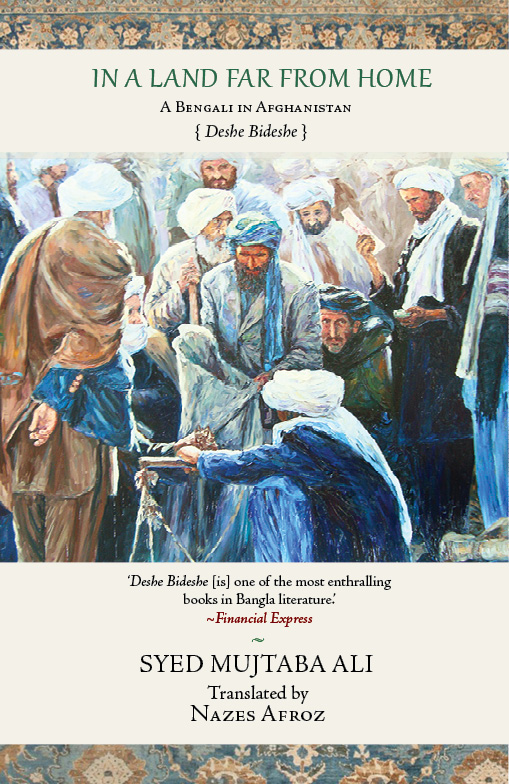
Translations bridge borders, bring diverse cultures to our doorstep. But here is a translation of a man, who congealed diversity into his very being — Syed Mujtaba Ali (1904-1974), a student of Tagore, who lived by his convictions and wit. Like his guru, Mujtaba Ali, was a well-travelled polyglot, who till a few years ago was popular only among Bengali readers with his wide plethora of literary gems that can never be boxed into genres precisely. People were wary of translating his witty but touching renditions of various aspects of life, including travel and history from a refreshing perspective, till Nazes Afroz, a former BBC editor, took it up. His debut translation Mujtaba Ali’s Deshe Bideshe as In a Land Far from Home: A Bengali in Afghanistan in 2015 was outstanding enough to be nominated for the Crossword Prize. Recently, he has translated another book by Mujtaba Ali, Tales of a Voyager (Joley Dangay[1]), a book that takes us back a hundred years in time — a travelogue about a sea voyage to Egypt and travel within.

This narrative almost evokes a flavour of Egypt as depicted by Agatha Christie’s Death on the Nile (1937) or The Mummy (film, set in 1932), simply because it is set around the same time period. Afroz in his introduction sets the date of Mujtaba Ali’s travels translated here between 1935 and 1939. The book was published in 1955. This book is a treasure not only because it gives a slice of historic perspective but also weaves together diverse cultures with syncretism.

Mujtaba Ali has two young travel companions, Percy and Paul, who despite being British (one of them is on the way to study in Oxford) seem to have a fair knowledge of Indian lore and there is the inimitable Abul Asfia Noor Uddin Muhammad Abdul Karim Siddiqi, who almost misses a train while trying to argue about the discrepancies shown in the time between his Swiss watch and the clock at Cairo. The description is sprinkled with tongue-in-cheek humour.

The voyage starts at Sri Lanka and sails through the Arabian Sea to Africa, where the ship pauses at Djibouti. Here, Mujtaba Ali expands his entourage with the addition of the long-named Abul Asfia, well-described in the blurb as a man who “carried toffees, a gold cigarette case, and other sundry items in his capacious overcoat pocket and who had the answer to all problems though he barely spoke a word ever.” Afroz himself has given an excellent introduction to the writer and the book — almost in the style of Mujtaba Ali himself. This is a necessary addition as it highlights Mujtaba Ali’s perspectives and gives his background to contextualise the relevance of this translation.

Mujtaba Ali’s style is poetic and humorous. It demystifies erudition and touches the heart simultaneously. His ability to laugh at himself is inimitable. He tells us a story about how the giraffe from Africa was introduced to China by a king from Bengal. At the end, he and his companions reflect about the tallness of this tale!

Mujtaba Ali contends: “‘…One of my friends is learning Chinese in order to read Buddhist scriptures in that language. Possibly you know that many of our ancient scriptures were destroyed with the decline of Buddhism in India. But they are still available in Chinese translations. My friend came across this story while searching for Buddhist scriptures. He had it translated and published in Bengali with the copy of the painting in a newspaper. Or else Bengalis would never have known of this because there is no mention of it in our history books or documents in the archives in Bengal.’”

The irony is not lost that Buddha is of Indian origin and yet an Indian has to learn Chinese to read the scriptures. The narrative continues with more dialogues:

“Percy said, ‘But sir, it didn’t sound like history. It [the giraffe’s story] exceeds fiction.’

“I [Mujtaba Ali] replied, ‘Why, brother? There is the saying in your language, ‘Truth is stranger than fiction.’

“And my personal opinion was that if the narrative of an event could not rouse interest in someone more than fiction, then that event had no historical value. Or I would say that the narrator was not a true historian. In our land, most of our historians are such dry bores.”

As Mujtaba Ali’s renditions are colourful – is he a ‘true historian’ by his own definition? Such narratives dot the travelogue, generating curiosity about major issues in a light vein and linking ancient cultures with the commonality of human needs, creating bridges, taking us to another time, finding parallels and making learned, hard concepts comprehensible by the simplicity of his observations.

Similarly, he says of the rose: “The Mughal-Pathan era of India ended a long time ago, but can we say for how long the roses brought by them will continue to give us fragrance?”

Some of his renditions are poetic and beautiful. Mujtaba Ali watches the sunrise by the pyramids and describes it: “Streaks of light were gradually lighting up the liquid darkness. The white parting in the middle of black hair was becoming visible. There was a light daubing of vermillion on that.”

Borrowing from diverse cultures, Mujtaba Ali skilfully weaves the commonality of cultures, customs and countries into his narrative under the umbrella of humanity. Afroz with his journalistic background and a traveller himself, is perhaps the best person to translate this narrative of another traveller from the past. The depth of erudition simplified with humour has been well captured in this translation too. In this interview, Afroz discusses more about the author, his new translation and the relevance of the book in the present context.

Nazes Afroz

You have translated two books by Mujtaba Ali. Is he essentially an essayist? Were there many essayists and travel writers at that point, especially from within Bengal? Where would you place him as a writer in the annals of Bengali literature?

I don’t think that ‘essentially an essayist’ is the right description of Mujtaba Ali. Of course he wrote many essays but his repertoire included novels, short stories, funny anecdotal pieces based on his experiences (in Bangla they are called romyorochona) and stories from his travels, his encounters with extremely interesting people across the globe. He was deeply interested in culinary experiences. So he wrote a lot about food habits, multitude of cuisine and also gave recipes. Hence, it is difficult to box him into one genre of writing. With the publication of his first book, Deshe Bideshe, (serialised in 1948 in Bangla literary magazine Desh and as a book in 1949) he instantly occupied a significant place in Bengali literature.

Syed Mujtaba Ali

His Bangla prose, steeped in effortless and seamless multilingual and multicultural references, swept the discerning readers of Bangla literature off their feet. It was not only the prose that he created but the breadth and depth of subjects his pen touched was unparalleled. No author in Bangla language has been able to write on such a wide range of topics till date.

Coming to the other part of the question about travel writers and essayist in Bengal in early part of the twentieth century: the short answer is, yes there were many. Travel writing has been an important genre in Bangla literature. Bengalis had been travelling – for pilgrimage, for rest and recuperation following illnesses, or just for pleasure since the middle of the nineteenth century, which was the time of Bengal renaissance. Writers who undertook such journeys, wrote about their travels too. So Mujtaba Ali is no exception in that regard. He followed in the footsteps of his predecessors and also his peers.

You have called the book ‘Tales’ of the Voyager — would you say that some of the stories are like tall tales here — perhaps tales to convey an idea or a thought which in itself would be larger than history in explaining the truth of a civilisation, like the tale of the giraffe? Would you see this as a comment on the gap between popular and documented narratives in history and on the different interpretations of history? 

Ali was an excellent raconteur. He was also gifted with an almost eidetic memory. This allowed him to learn a dozen languages – some with native proficiency. He was a voracious reader too. So, not only did he read tomes on history and philosophy in many languages across cultures but also he gathered fascinating tales from many corners of the world as he loved storytelling. Whenever opportunities came, he masterfully wove those stories into his writing. Thus the tale of the giraffe’s journey from Africa to China via Bengal found its way in this book as he was narrating stories from the east coast of Africa. There is another thing that makes Ali’s writing attractive. He weaves in fascinating quirky funny stories while discussing something apparently dense and dry. I have not come across many writers who have done that. I don’t know whether to name it as his comment on bridging the gap between popular and documented history. There’s no evidence to prove that he was trying to achieve that as he never mentioned it. We could only conclude that it was a style that he invented and mastered in an effort to engage with his readers.

A writer that came to mind while reading this book of Mujtaba Ali is, one who is really more entertaining than accurate –Marco Polo. We know he lived five centuries before Mujtaba Ali. Mujtaba Ali of course is erudite, a scholar, but he seems to have a similar fire within him, a wanderlust. Do you think he would have been impacted by the writings of Marco Polo? Was wanderlust not a very typical phenomenon that was part of the culture that had evolved in Bengal post the Tagorean renaissance? Did Mujtaba Ali also travel for wanderlust? 

Reading Ali’s books, one may think that he had wanderlust in the true sense. It will be correct to assume that he was fidgety; he refused to settle down; he moved jobs; he moved cities and even continents. But to be  truly smitten by wanderlust, one has to enjoy the travel, which wasn’t possibly the case for Ali. His son told me that even though he travelled extensively, Ali didn’t enjoy travelling much. There had been many, of his time, who were really smitten by wanderlust — like Rahul Sankrityayan (1893-1963, walked to Tibet twice and wrote only in Hindi), Bimal Mukherjee (1903-1996, a true globetrotter who cycled to London from Kolkata), Umaprasad Mukhopadhyay (1902-1997, who crisscrossed the Himalayas from one end to another), Probodh Kumar Sanyal (1905-1983, his travelogues of the Himalayas), Premankur Atorthi (1890-1964, author of Mahasthobir Jatok) — to name a few. While these authors were inherently bohemian and were drawn towards travelling only for the sake of it, Ali was more of an unsettled soul who travelled with a particular purpose and wrote about his experiences as he had picked up fascinating stories and observed connections between cultures. Because he loved to tell stories and also because he was infused with the idea of internationalism that he inculcated from Tagore, there was no way he could escape but narrating the stories and cultural experienced from his travels.

Tales of a Voyager takes us on a sea voyage to Egypt. Did you travel to Egypt while translating the book? Would you say that the Egypt of those times still resonates in the present day — especially after the 2011 uprising?

Even before his one night stopover in Cairo that he narrated in Tales of a Voyager, Ali had previous experience of Cairo where he spent a year as a post-doctoral scholar in 1933-34 at the Al-Azhar University. So there are many short pieces on Cairo and Egypt by him in his other books. He raved about the café-culture of Cairo and came to the conclusion that Egyptians surpassed the Bengali in terms of adda—hours of the purposeless sessions of chitchat and chinwag. I have been to Cairo at least half a dozen times and realised how acute his observation was. I witnessed in person why Ali mentioned that this was a city that never slept. The cafes and shops were open all night and the streets were full of people with families including children until well past midnight.

Late night, a cafe in Cairo. Photo Courtesy: Nazes Afroz

As expected, the political landscape that you mention in the question, would be completely different between Ali’s time in the 1930s and in 2010 when I started visiting Cairo. When Ali first went to Cairo in 1933, Cairo had just gained full independence from the forty years of British occupation (not as an annexed state but more of a protectorate). So there are some references of the political figures like Sa’ad Zaghloul Pasha[2] in his various writings but the main focus was on its cultures.

When I started travelling to Cairo from 2010, I witnessed some similarities in the cultural traits as elaborated by Ali. But politically by then, Egypt had moved far from where it was in the 1930. It had become an architect of the Non-Aligned Movement in the 1950s. It was the most prosperous country in North Africa and an important leader among the Arab nations. But it was also reeling under the oppression of one party rule and the youth were bubbling to break away from that. This is something we witnessed unfolding from 2011.

What were the challenges you faced while translating this book? Was it easier to handle as it was the second book by the same author? 

The main challenge of translating Mujtaba Ali is transposing his unique language steeped in multi-lingual references into English. Also to get his oblique sense of wit and puns from Bangla into another language, which at times, may not have the right words for them. Translating the second book of the same author doesn’t make it easier as the challenges I just mentioned remain for every book.

Tell us what spurs you on to continue translating Mujtaba Ali. Please elaborate.

Syed Mujtaba Ali’s writing had a huge influence on me from my young age. His writing shaped my worldview, planted the seeds of curiosity about many societies, taught me how to make friends in distant lands and start making connections between cultures. So what I’m today is largely due to his writing. As an avid reader of his texts, I felt that it was my duty to introduce him to a wider readership. That’s the motivation of my taking up the translation of Ali. It is also a tribute to a writer who had such an impact on me.

In your introduction you have written of Mujtaba Ali and his writing. What had he written to be put on the Pakistani watchlist in 1950s? 

He had penned an essay opposing the imposition of Urdu as Pakistan’s national language on the Bengalis who were in majority in the newly created East Pakistan. He even predicted how the Bengalis would rebel against such a policy, which came true in 1952 in the form of the Language Movement. He wrote this when he was the principal of a government college in Bogura. So he drew wrath of the Pakistani leaders and an arrest warrant was issued against him. That was the time when he left Pakistan and returned to India in 1949.

There also the other difficult personal situation. His wife (married in 1951) who was from Dhaka and was working in the education ministry, continued to live in East Pakistan with their two sons while he lived in India working for the Indian Government. So Pakistanis always thought he was an Indian spy while he was under suspicion in India that he was on the side of Pakistan!

Did Mujtaba Ali participate in the political upheaval between Pakistan and Bangladesh? Please elaborate if possible. 

Ali was hugely affected in 1971 because of his personal situation as I just mentioned. I don’t know how deeply he was involved with the liberation war in Bangladesh but he wrote a novel, Tulonaheena (his last novel), against that backdrop – based in Kolkata, Shillong and Agartala and told through the story of a lover couple – Shipra and Kirti. So it is likely that he was involved in some capacity with the war efforts.

Mujtaba Ali studied in Santiniketan — that would have been in the early days of the university. Would he have been influenced by Tagore himself and the other luminaries who were in Santiniketan at that time? Can you tell us how? And did that impact his work and outlook? 

The simple answer is: it was huge. Tagore was the polar star for Mujtaba Ali, which he acknowledged every now and then in his writing. This experience also decided his life’s journey. He imbibed humanism and internationalism as a direct student of Tagore in Santiniketan. He also developed deep apathy towards all sorts of bigotry. So it was not surprising that he would find it very difficult to accept a country that was created on the basis of religion.

Do you find him relevant in the present-day context? Is your writing influenced or inspired by his style?

I feel that his relevance will never fade. His ability to create cultural connection from different corners of the world will continue to fascinate readers for generations. Yes, in this globalised world when information from around the world are at our finger tips with the click of a button but one also needs to learn how to look at those information beyond mere facts and go deep underneath to make a sense. Apart from being fun and entertaining read, I feel his writing is one such training tool to learn how to make cultural connections. This way, if one wants, one can truly become a global citizen.

As for me, my outlook towards the world is massively influenced by Ali’s writing but not my writing style. It’s simply because I’m not a polyglot like him! I’ll not be able to come anywhere close to his style even if I try.

Well, that is for the reader to judge I guess! You have books on Afghanistan. But you do travel with your camera often. Will you write of your own travels at some point — like Mujtaba Ali but in English?

I have only one book on Afghanistan – a cultural guide book that I co-authored with an Afghan friend. I was working on my own book on Afghanistan, which would have capture one decade of Afghan history and interspersed with my own direct experiences of the country between 2002 and 2015. But the research got stalled for lack of funding. I hope to revive it at some point. And, yes I would like to do my own writing from my travels. That’s there in the wish list.

What are your future plans as a journalist, writer and photographer? 

Travel more, see the world more, make more friends and photograph more!

Thanks a lot for giving us your time and the wonderful translation.

[1] Literal translation from Bengali, In Water and On Land

[2] 1857-1957, Egyptian revolutionary and statesman

Read the excerpt from Tales of a Voyager by clicking here


(The online interview has been conducted through emails by Mitali Chakravarty)

PLEASE NOTE: ARTICLES CAN ONLY BE REPRODUCED IN OTHER SITES WITH DUE ACKNOWLEDGEMENT TO BORDERLESS JOURNAL. 

Click here to access the Borderless anthology, Monalisa No Longer Smiles

Click here to access Monalisa No Longer Smiles on Kindle Amazon International

Categories
Contents

Borderless September 2023

Art by Sohana Manzoor

Editorial

What do They Whisper?… Click here to read.

Conversations

Shantanu Ray Chaudhuri in conversation with M.S. Viraraghavan and Girija Viraraghavan ( grand daughter of President Sarvepalli Radhakrishnan) on their new book, Roses in the Fire of Spring: Better Roses for a Warming World and Other Garden Adventures. Click here to read.

In conversation with Isa Kamari, a celebrated writer from Singapore, with focus on his latest book, Maladies of the Soul. Click here to read.

Translations

A Hunger for Stories, a poem by Quazi Johirul Islam, has been translated by Professor Fakrul Alam. Click here to read.

A Hand Mill, a story by Ammina Srinivasaraju, has been translated from Telugu by Johny Takkedasila. Click here to read.

Kiyya and Sadu, a part of this long ballad on the legendary lovers from Balochistan, has been translated from Balochi by Fazal Baloch. Click here to read.

The Time for the Janitor to Pass by, poetry written in Korean and translated by Ilhwah Choi. Click here to read.

Sharat or Autumn, a poem by Tagore, has been translated from Bengali by Mitali Chakravarty. Click here to read.

Poetry

Click on the names to read the poems

Jared Carter, Rhys Hughes, Santosh Bakaya, Luis Cuauhtémoc Berriozábal, Sagar Mal Gupta, Nirmala Pillai, George Freek, Pramod Rastogi, Peter Devonald, Afshan Aqil, Hela Tekali, Swarnendu Ghosh, Alpana, Michael Burch

Poets, Poetry & Rhys Hughes

In Tintin in India, Rhys Hughes traces the allusions to India in these iconic creations of Hergé while commenting on Tintin’s popularity in the subcontinent. Click here to read.

Musings/Slices from Life

Black Pines and Red Trucks

Meredith Stephens shares the response of some of the Californian community to healing after the 2020 forest fires with a narrative and photographs. Click here to read.

Remembering Jayanta Mahapatra

KV Raghupathi travels down nostalgia with his memories of interactions with the recently deceased poet and his works. Click here to read.

The Toughness of Kangaroo Island 

Vela Noble draws solace and lessons from nature around her with her art and narrative. Click here to read.

Where is Your Home?

Madhulika Vajjhala explores her concept of home. Click here to read.

A Homecoming like No Other

Saumya Dwivedi gives a heartwarming anecdote from life. Click here to read.

Musings of a Copywriter

In Hair or There: Party on My Head, Devraj Singh Kalsi explores political leanings and hair art. Click here to read.

Notes from Japan

In Against Invisibility, Suzanne Kamata challenges traditions that render a woman invisible with a ‘sparkling’ outcome. Click here to read.

Essays

Jayanta Mahapatra: A Tribute to a Poetic Luminary

Dikshya Samantrai pays tribute to a poet who touched hearts across the world with his poetry. Click here to read.

Celebrating the novel… Where have all the Women Writers Gone?

G Venkatesh writes about a book from 1946. Click here to read.

Chandigarh: A City with Spaces

Ravi Shankar travels back to Chandigarh of 1990s. Click here to read.

The Observant Immigrant

In Climate Change: Are You for Real?, Candice Louisa Daquin explores the issue. Click here to read.

Stories

The Infamous Art Dealer

Paul Mirabile travels through Europe with an art scammer. Click here to read.

Getting Old is like Climbing a Mountain

Saranyan BV explores aging and re-inventing homes. Click here to read.

The Airport

Prakriti Bandhan shares a short, whimsical narrative. Click here to read.

Book Excerpts

An excerpt from Syed Mujtaba Ali’s Tales of a Voyager (Joley Dangay), translated by Nazes Afroz. Click here to read.

An excerpt from Sanket Mhatre’s A City Full of Sirens. Click here to read.

Book Reviews

Somdatta Mandal reviews Begum Hazrat Mahal: Warrior Queen of Awadh by Malathi Ramachandran. Click here to read.

Basudhara Roy reviews Sanket Mhatre’s A City Full of Sirens. Click here to read.

Bhaskar Parichha reviews Samragngi Roy’s The Wizard of Festival Lighting: The Incredible Story of Srid. Click here to read.

.

Click here to access the Borderless anthology, Monalisa No Longer Smiles

Click here to access Monalisa No Longer Smiles on Kindle Amazon International

Categories
Editorial

What do they Whisper?

No, they whisper. You own nothing.
You were a visitor, time after time
climbing the hill, planting the flag, proclaiming.
We never belonged to you.
You never found us.
It was always the other way round.

‘Moment’ by Margaret Atwood

With an unmanned mission reaching the moon — that moon that was chipped off the Earth’s surface when Theia bashed into the newly evolving planet — many feel mankind is en route to finding alternate biomes and perhaps, a solution to its housing needs. Will we also call moon our ‘Homeland’ and plant flags on it as we do on Earth?  Does the Earth — or the moon — really belong to our species. Do we have proprietary rights on these because of lines drawn by powerbrokers who say that the land belongs to them?

These are questions Margaret Atwood addresses in her writings which often fall into a genre called cli-fi. This is gaining in popularity as climate has become uncertain now with changes that are wringing fear in our hearts. Not all fear it. Some refuse to acknowledge it. While this is not a phenomenon that is fully understood by all of us, it’s impact is being experienced by majority of the world — harsh stormy weather, typhoons, warmer temperatures which scorch life and rising water levels that will eventually swallow lands that some regard as their homeland. Despite all these prognostications, wars continue to pollute the air as much as do human practices, including conflicts using weapons. Did ‘climbing a hill’ and ‘planting the flag’ as Atwood suggests, ever give us the rights over land, nature or climate? Do we have a right to pollute it with our lifestyle, trade or wars — all three being human constructs?

In a recent essay Tom Engelhardt, a writer and an editor, contended, “Vladimir Putin’s greatest crime wasn’t simply against the Ukrainians, but against humanity. It was another way to ensure that the global war of terror would grow fiercer and that the Lahainas of the future would burn more intensely.” And that is true of any war… Chemical and biological weapons impacted the environment in Europe and parts of Afghanistan. Atom bombs polluted not only the cities they were dropped in, but they also wreaked such havoc so that the second generation’s well-being continues impacted by events that took place more than seven decades ago. Yet another nuclear war would destroy the Earth, our planet that is already reeling under the impact of human-induced climate change. Flooding, forest fires and global warming are just the first indications that tell us not only do we need to adapt to living in changed times but also, we need to change our lifestyles, perhaps even turn pacifist to survive in a world evolving into an altered one.

This month some of our content showcase how to survive despite changes in norms. Suggesting how to retain our flora in a warming world is a book, Roses in the Fire of Spring: Better Roses for a Warming World and Other Garden Adventures, by M.S. Viraraghavanand Girija Viraraghavan, the grandson-in-law and granddaughter of the second President of India, Sarvepalli Radhakrishnan (1888-1975). They have been in conversation with Shantanu Ray Chaudhuri to explain how they have adapted plants to create hybrids that survive changing climes. Would it be wishful to think that we can find solutions for our own survival as was done for the flora?

Critiquing the darker trends in our species which leads to disasters is a book by an eminent Singaporean writer, Isa Kamari, called Maladies of the Soul. He too looks for panacea in a world where the basic needs of humans have been satiated and they have moved on towards overindulgence that can lead to redundancy. In a conversation, he tells us how he hopes his writings can help towards making a more hopeful future.

This hope is echoed in the palliative poems of Sanket Mhatre from his book, A City full of Sirens, excerpted and reviewed by Basudhara Roy. Bhaskar Parichha’s review of Samragngi Roy’s The Wizard of Festival Lighting: The Incredible Story of Srid, is a tribute also from a granddaughter to her grandfather celebrating human achievements. Somdatta Mandal’s discussion of fiction based on history, Begum Hazrat Mahal: Warrior Queen of Awadh by Malathi Ramachandran not only reflects the tenacity of a woman’s courage but also explores the historicity of the events. Exploring bits of history and the past with a soupcon of humour is our book excerpt from Syed Mujtaba Ali’s Tales of a Voyager (Joley Dangay[1]), translated from Bengali by Nazes Afroz. Though the narrative of the translation is set about ninety years ago, a little after the times of Hazrat Mahal (1820 –1879), the excerpt is an brilliant introduction to the persona of Tagore’s student, Syed Mujtaba Ali (1904-1974), by a translator who describes him almost with the maestro’s unique style. Perhaps, Afroz’s writing bears these traces as he had earlier translated a legendary work by the same writer, In a Land Far from Home: A Bengali in Afghanistan. Afroz starts with a startling question: “What will you call someone who puts down his profession as ‘quitting job regularly’ while applying for his passport?”

Other than a semi-humorous take on Mujtaba Ali, we have Rhys Hughes writing poetry in a funny vein and Santosh Bakaya giving us verses that makes us laugh. Michael Burch brings in strands of climate change with his poems as Jared Carter weaves in nature as we know it. George Freek reflects on autumn. We have more poetry by Luis Cuauhtémoc Berriozábal, Pramod Rastogi, Peter Devonald, Afshan Aqil, Hela Tekali and many more, adding to the variety of colours that enhance the vivacity of conversations that run through the journal. Adding more vibrancy to this assortment, we have fiction by Paul Mirabile, Saranyan BV and Prakriti Bandhan.

In non-fiction, we have Devraj Singh Kalsi’s funny retelling of his adventures with a barber while Hughes‘ essay on the hugely popular Tintin makes us smile. The patriarchal past is reflected in an essay by G Venkatesh, whereas Suzanne Kamata from Japan talks of women attempting to move out of invisibility. Meredith Stephens and Candice Louisa Daquin both carry on the conversation on climate change. Stephens explores the impact of Californian forest fires with photographs and first-hand narrative. Vela Noble draws solace and strength from nature in Kangaroo Island and shares a beautiful painting with us. Madhulika Vajjhala and Saumya Dwivedi discuss concepts of home.

Two touching tributes along with a poem to recently deceased poet, Jayanta Mahapatra, add to the richness of our oeuvre. Dikshya Samantrai, a researcher on the poet, has bid a touching adieu to him stating, “his legacy will continue to inspire and resonate and Jayanta Mahapatra’s name will forever remain etched in the annals of literature, a testament to the enduring power of the poet’s voice.”

Our translations this time reflect a diverse collection of mainly poetry with one short story by Telugu writer, Ammina Srinivasaraju, translated by Johny Takkedasila. Professor Fakrul Alam has introduced us to an upcoming voice in Bengali poetry, Quazi Johirul Islam. Ihlwha Choi has translated his own poetry from Korean and brought to us a fragment of his own culture. Fazal Baloch has familiarised us with a Balochi ballad based on a love story that is well known in his region, Kiyya and Sadu. Our Tagore translation has attempted to bring to you the poet’s description of early autumn or Sharat in Bengal, a season that starts in September. Sohana Manzoor has painted the scene depicted by Tagore for all of us to visualise. Huge thanks to her for her wonderful artwork, which invariably livens our journal.

Profound thanks to the whole team at Borderless for their support and especially to Hughes and Parichha for helping us source wonderful writings… some of which have not been mentioned here. Pause by our content’s page to savour all of it. And we remain forever beholden to our wonderful contributors without who the journal would not exist and our loyal readers who make our existence relevant. Thank you all.

Wish you all a wonderful month.

Mitali Chakravarty

borderlessjournal.com

[1] Translated literally, it means Water & Land

.

.

Visit the September edition’s content page by clicking here

READ THE LATEST UPDATES ON THE FIRST BORDERLESS ANTHOLOGY, MONALISA NO LONGER SMILES, BY CLICKING ON THIS LINK.

Categories
War & Peace

Cry, Our Beloved…

The fakir sings a love song
for peace in times of war.

Can peace be the voice of dissent?

-- Mitali Chakravarty, A Love Song for Peace

With an openly-declared call for nuclear alert blaring in the headlines of newspapers, we bring to you reminders from the past of what hatred and war, nuclear holocausts can do to humanity. Recalling the need for peace and for solidarity with all of the human race, we have here a selection of writing from different parts of the world — people who have been writing for peace even without the war that now darkens our own Earth and further impacts humans, living conditions and the climate.

Here is what climate experts said way back in 2017: “The climatic consequences would be catastrophic: global average temperatures would drop as much as 12 degrees Fahrenheit (7 degrees Celsius) for up to several years — temperatures last seen during the great ice ages. Meanwhile, smoke and dust circulating in the stratosphere would darken the atmosphere enough to inhibit photosynthesis, causing disastrous crop failures, widespread famine and massive ecological disruption.

“The effect would be similar to that of the giant meteor believed to be responsible for the extinction of the dinosaurs. This time, we would be the dinosaurs.” How much worse will it be now, five years later while we are already impacted by rising water levels and climate change?

We start our presentation with the past impact of a nuclear blast on humans and nature.

Nuclear Holocaust

Surviving Hiroshima : Kathleen Burkinshaw is the daughter of a woman who survived the Hiroshima blast. Burkinshaw suffers neural damage herself from the impact of the bomb that her parent faced. She has written a book called The Last Cherry Blossom recounting her mother’s first hand experiences. Her novel has been taken up by the United Nations as a part of its peacekeeping effort. She has been actively participating in efforts to ban nuclear weapons, including presenting with Nobel Laureates. Click here to read the interview.

Commemorating Hiroshima: Poetry by Suzanne Kamata that brings to life August 6th and the impact of the bombing on the victims and the devastation around them. Click here to read.

Oh Orimen! A poem in Nepalese about a victim of the blast written by a sculptor, Manjul Miteri, who while working on the largest Asian statue of the Buddha in Japan visited the museum dedicated to the impact of the blast. The poem has been translated to English by Hem Bishwakarma. Click here to read.

Mushroom Clouds: Poetry by Michael Burch that reflects on Enola Gay and the Bikini atoll. Click here to read

Surviving More Wars

Our Children poetry by Bijan Najdi, translated from Persian by Davood Jalili. Click here to read.

How Will They Know by Sybil Pretious commemorates the Remembrance Day that mark the end of the first world war. Click here to read.

Soldiers & Missives Poetry by Prithvijeet Sinha. Click here to read.

In a Land Far From Home: A Bengali in Afghanistan, an excerpt from an account by Syed Mujataba Ali, translated from Bengali by Nazes Afroz. Click here to read.

Unveiling Afghanistan: In Conversation with Nazes Afroz, former editor of BBC and translator of a book on Afghanistan which reflects on the present day crisis. Click here to read.

Bundu, Consoler of the Rich is a story based on memories of the Partition by Nadir Ali, translated from Punjabi by Amna Ali. Click here to read.

Categories
Greetings from Borderless

For Auld Lang Syne

Painting by Sohana Manzoor

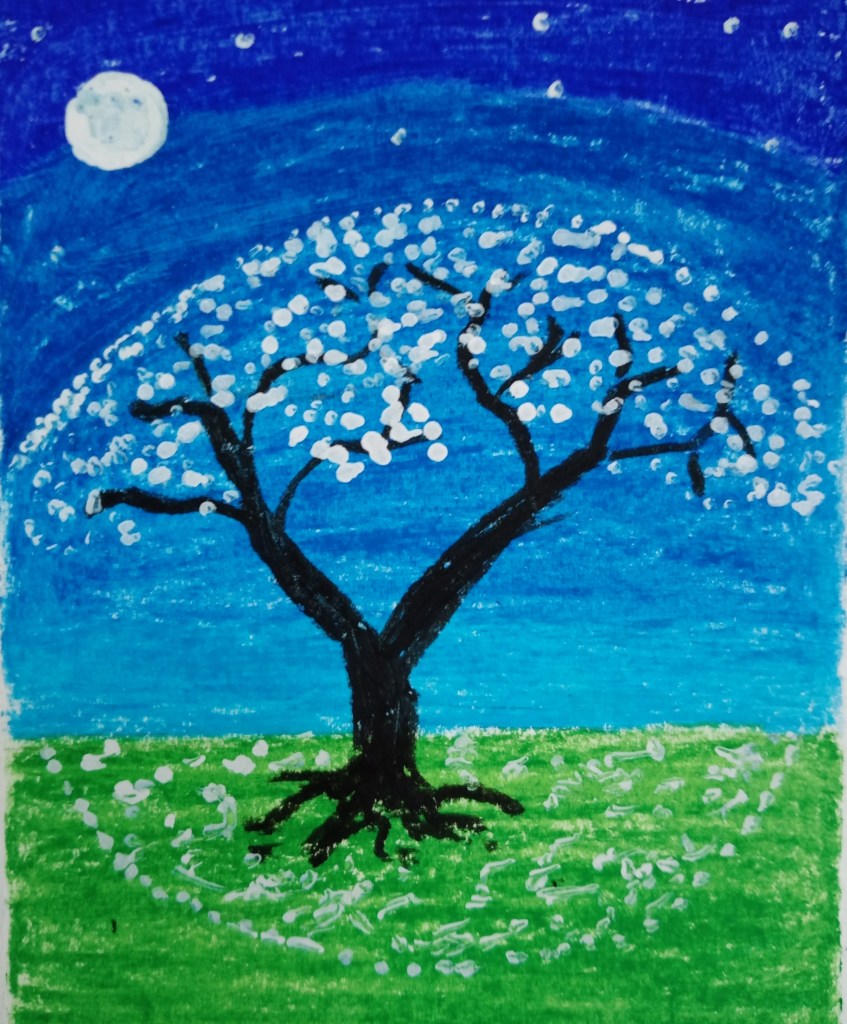
What will the New Year bring? Will it connect us all like a tree that has its roots deep in the Earth but reaches out to the sky with its branches rearing high? Its blooms seem like stars on the planet, connecting all life and non-living in its embrace. We hope as global consciousness grows for living in harmony with nature and science, love and kindness, may we all move towards a better more connected world. We, at Borderless Journal, wish you all a happy start to a wonderful New Year!

Our oeuvre this time brings to you a selection from the year 2021 that showcases the change makers we met, and writing that with their values connect us or ring with goodwill and look forward to a better future.

Meet & Greet

These are people you can meet on our pages — people who impact the world in a way that touches lives.

Goutam Ghose, who finds colouring the world with syncretic lore as the best alternative to sectarian violence. Click here to read.

Anvita Abbi, an empathetic linguist who builds bridges to create a seamless world, accepting and co-existing with different ways of life as colours of a rainbow. Click here to read.

Nazes Afroz translated a book on Afghanistan by Tagore’s disciple, Syed Mujtaba Ali, a memoir that shows the roots of the current crises go deep. Also, a senior BBC editor of South Asia, Afroz takes us through the situation with compassion. Click here to read.

Jessica Mudditt travelled to Myanmar and wrote a book, which is an eye-opener about the current situation. She was brought to focus by Keith Lyons who interviewed her for us. Click here to read.

Sanjay Kumar founded Pandies, an activist theatre group that educates, bridging gaps between the divides of University educated and the less fortunate who people slums or terror zones. Click here to read.

 Sybil Pretious, a teacher who has taught in six countries to impact children, starting her career in Africa and living through and beyond Apartheid. Click here to read.

Poetry

Robert Burns & Tagore in Harmony : A transcreation of Tagore’s song, Purano Sei Diner Kotha, based on Robert Burn’s poem associated with new year’s revelries. Click here to read.

Snowball Earth: A long poem by Rhys Hughes in the spirit of a modern man’s Auld Lang Syne, touching on our climate debacle. Click here to read.

Gathering Blossoms: Poetry by Michael R Burch that lingers in the heart. Click here to read.

Humour

Travels & Holidays: Humour from Rabindranath: Translated from the original Bengali by Somdatta Mandal, these are Tagore’s essays and letters laced with humour. Click here to read.

Surviving to Tell a Pony-tale: Devraj Singh Kalsi journeys up a hill on a pony and gives a sedately hilarious account. Click here to read.

 Trouser Hermits: Rhys Hughes muses over men’s attire and the lack of them. Click here to read.

Prose

Temples and Mosques: Kazi Nazrul Islam’s fiery essay on the need for a syncretic lore translated by Sohana Manzoor. Click here to read.

To Infinity & Beyond!: Candice Louisa Daquin explores the magic of space travel. Click here to read.

Near the River Chenab and Under The trees: Sunil Sharma in a poignant telling takes us on a journey to the banks of a river where life, love and death sheathed in terrorism cumulate to a peak. Click here to read.

Richard Hughes: The Reporter Who Inspired Ian Fleming: Bhaskar Parichha showcases a journalist who wrote globally, spicing it up with humour. Click here to read.

The Lords of Lights: With photographs and a story, Penny Wilkes makes an interesting new legend. Click here to read.

Categories
Tribute

In Memory of Peace

My friend, you would not tell with such high zest
To children ardent for some desperate glory,
The old Lie: Dulce et decorum est
Pro patria mori*.
-- Dulce et Decorum Est, Wilfred Owen (1893-1918)

*Translated: "It is sweet and fitting to die for the homeland."

On 11th November, we remember the men who gave up their lives to win wars for those in power. Remembrance Day started as an annual event after the First World War (28th July, 1914- 11the November, 1918) more than a hundred years ago, in memory of soldiers — some of who were lost in the battle grounds, whose remains never got back to their families. Some of these men who fought were from countries that were subservient to colonial powers who started the war and some, like the soldier-poet, Wilfred Owen, were from conquering nations.

This was much before atom bombs were dropped on Hiroshima and Nagasaki. Eventually, a nuclear armistice was declared. Mahatma Gandhi (1869-1948), an internationally acknowledged apostle of peace, had an opinion on this: “‘The very frightfulness of the atom bomb will not force non-violence on the world? If all nations are armed with the atom bomb, they will refrain from using it as it will mean absolute destruction for all concerned?’ I am of the opinion that it will not.” Has this nuclear armistice made the world more peaceful? And if so, what is the quality of peace that has been wrought by drumming fears of annihilation in human hearts? Could the ‘fakir…striding half-naked up the steps of the viceregal palace’ be right after all?

Here we have collected a few stories and poems around ongoing conflicts and wars which stretch to the present day, some old and some new… some even written by men who faced battle…

Poetry

A poem and art by Sybil Pretious in memory of soldiers who died in the World War I.

Soldiers & Missives by Prithvijeet Sinha … Click here to read.

Our Children by Bijan Najdi, translated from Persian by Davood Jalili. Click here to read.

Prose

Line of Control by Paresh Tiwari, a story about the life of soldiers set in the Indo-Pak border… Click here to read.

I am a Coward with Priorities by Tejaswinee Roychowdhury, a story from a soldier’s perspective. Click here to read.

From the Pages of a Soldier’s Diary… by Mike Smith takes you on a journey through the pages of a colonial diary and muses on choices he has made. Click here to read.

Bundu, Consoler of the Rich is a story based on memories of the Partition by Nadir Ali, translated from Punjabi by Amna Ali. Click here to read.

In a Land Far From Home: A Bengali in Afghanistan, an excerpt from an account by Syed Mujataba Ali, translated from Bengali by Nazes Afroz. Click here to read.

Categories
Contents

Borderless, October 2021

An Ode to Autumn: Painting by Sohana Manzoor.

Editorial

Making a Grecian Urn… Click here to read.

Interviews

Unveiling Afghanistan: In Conversation with Nazes Afroz, former editor of BBC and translator of a book on Afghanistan which reflects on the present day crisis. Click here to read.

The Traveller in Time: An interview with Sybil Pretious who has lived through history in six countries and travelled to forty — she has participated in the first democratic elections in an apartheid-worn South Africa and is from a time when Rhodesia was the name for Zimbabwe. Click here to read.

Translations

Travels & Holidays: Humour from Rabindranath

Translated from the original Bengali by Somdatta Mandal, these are Tagore’s essays and letters laced with humour. Click here to read.

The Quest for Home

Nazrul’s Kon Kule Aaj Bhirlo Tori translated from Bengali by Professor Fakrul Alam. Click here to read.

Mysteries of the Universe

Akbar Barakzai’s poetry in Balochi, translated by Fazal Baloch. Click here to read.

Gandhi & Robot

A poem reflecting the state of Gandhi’s ideology written in Manipuri by Thangjam Ibopishak and translated from the Manipuri by Robin S Ngangom. Click here to read.

Sorrows Left Alone

A poem in Korean, written & translated by Ihlwha Choi. Click here to read.

The Song of Advent by Tagore

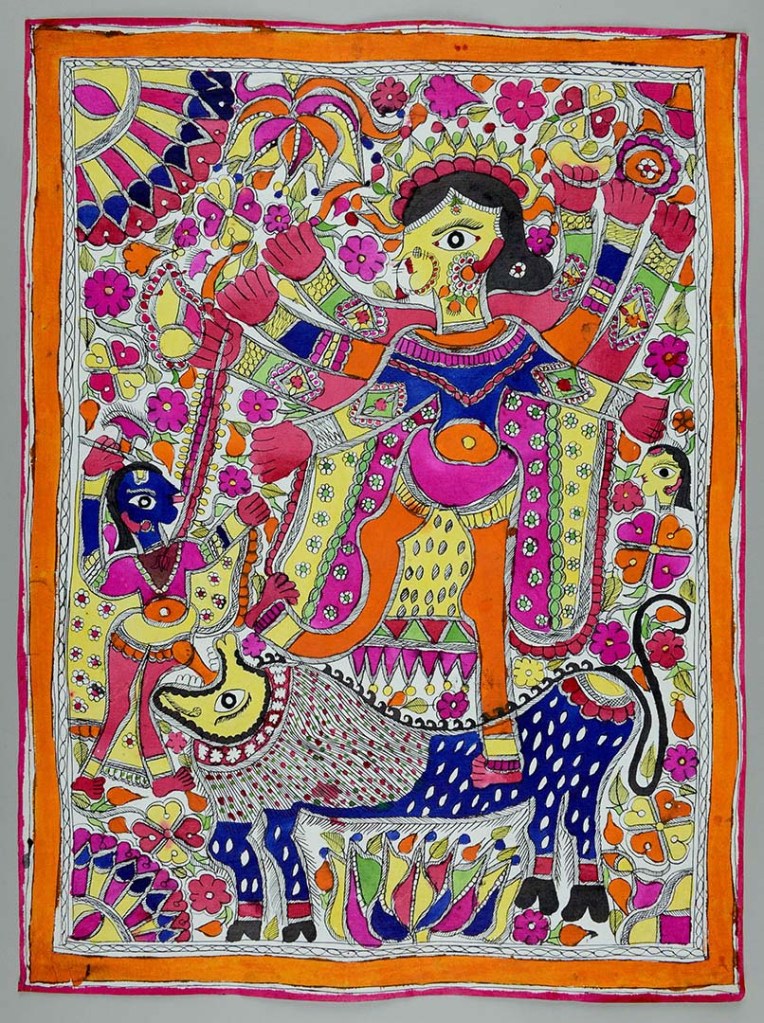
Written by Tagore in 1908, Amaar Nayano Bhulano Ele describes early autumn when the festival of Durga Puja is celebrated. It has been translated from Bengali by Mitali Chakravarty. Click here to read.

Poetry

Click on the names to read

Michael R Burch, A Jessie Michael, John Grey, Rupali Gupta Mukherjee, Mike Smith, Saranyan BV, Tony Brewer, Baisali Chatterjee Dutt, Jay Nicholls, Beni S Yanthan, Luis Cuauhtémoc Berriozábal, Pramod Rastogi, Jason Ryberg, Michael Lee Johnson, Oormila Vijayakrishnan Prahlad, Rhys Hughes

Animal Limericks by Michael R Burch. Click here to read.

Nature’s Musings

In The Lords of Lights, with photographs and a story, Penny Wilkes makes an interesting new legend. Click here to read.

Poets, Poetry & Rhys Hughes

In Pessoa and Cavafy: What’s in a Name?, Rhys Hughes comically plays with the identity of these two poets. Click here to read.

Musings/ Slices From Life

At the Doctor’s

In this lighthearted narration, Farouk Gulsara uses humour to comment on darker themes. Click here to read.

Taking an unexpected turn

Nitya Pandey talks of a virtual friendship that bloomed across borders of countries during the pandemic. Click here to read.

Travel in the Time of Pandemics: Select Diary Entries of an Urban Nomad

Sunil Sharma gives us a slice from his travels with vibrant photographs, changing continents and homes during the pandemic. Click here to read.

Musings of a Copywriter

In Surviving to Tell a Pony-taleDevraj Singh Kalsi journeys up a hill on a pony and gives a sedately hilarious account. Click here to read.

Essays

A Season of Magical Mellow Wistfulness

Meenakshi Malhotra through folk songs that are associated with Durga Puja explores the theme of homecoming. Click here to read.

What Gandhi Teaches Me

Candice Louisa Daquin applies Gandhiism to her own lived experiences. Click here to read.

How Women’s Education Flourished in Aligarh Muslim University

Sameer Arshad Khatlani dwells on the tradition of education among Muslim women from early twentieth century, naming notables like Ismat Chughtai and Rashid Jahan. Click here to read.

Once Upon a Time in Burma: Of Friendships & Farewells

John Herlihy takes us through more of Myanmar with his companion, Peter, in the third part of his travelogue through this land of mystic pagodas. Click here to read.

When Needles Became Canons…

Ratnottama Sengupta, who has edited an encyclopaedia on culture and is a renowned arts journalist, gives us the role ‘kanthas’ (hand-embroidered mats, made of old rags) played in India’s freedom struggle. Click here to read.

Stories

Lunch with Baba Rinpoche in Kathmandu

Steve Davidson takes us for a fictitious interview with a Tibetan guru in Nepal. Click here to read.

The Tree of Life

An unusual flash fiction by Parnil Yodha about a Tibetan monk. Click here to read.

Odysseus & Me: A Quest for Home

A short fiction from Bangladesh by Marzia Rahman on immigrants. Click here to read.

Dawn in Calicut

Krishna Sruthi Srivalsan writes of a past that created the present. Click here to read.

I am a Coward with Priorities

Tejaswinee Roychowdhury tells a story from a soldier’s perspective. Click here to read.

The Literary Fictionist

In Bapu, Denied, Sunil Sharma explores the fate of Gandhiism in a world where his values have been forgotten. Click here to read.

Book Excerpts

An excerpt of In a Land Far From Home: A Bengali in Afghanistan by Syed Mujtaba Ali, translated by Nazes Afroz. Click here to read.

An excerpt from letters written by Tagore from Kobi & Rani, translated by Somdatta Mandal. Click here to read.

Book Reviews

Aruna Chakravarti reviews Golden Bangladesh at 50: Contemporary Stories & Poems edited by Shazia Omar. Click here to read.

Somdatta Mandal reviews Wooden Cow by T. Janakiraman, translated from Tamil by Lakshmi Kannan. Click here to read.

Gracy Samjetsabam reviews Suzanne Kamata’s The Baseball Widow. Click here to read.

Bhaskar Parichha reviews Mohona Kanjilal’s A Taste of Time: A Food History of Calcutta. Click here to read.


Categories
Editorial

Making a Grecian Urn

“Beauty is truth, truth beauty — that is all
                Ye know on earth, and all ye need to know.”  
  
John Keats (1795-1821), Ode to a Grecian Urn
‘Beauty is Truth’ : The Potato Eaters(1885) by Vincent van Gogh (1853-1890). Courtesy: Creative Commons

What makes for great literature? To me, great literature states the truth — the truth that touches your heart with its poignancy, preciseness, sadness, gentleness, vibrancy, or humour.  If Khayyam, Rumi, Keats, Tagore, Frost or Whitman had no truths to state, their poetry would have failed to mesmerise time and woo readers across ages. Their truths – which can be seen as eternal ones — touch all human hearts with empathetic beauty. Lalon Fakir rose from an uneducated illiterate mendicant to a poet because he had the courage to sing the truth about mankind — to put social norms and barriers aside and versify his truth, which was ours and still is. This can be applied to all genres. Short stories by Saki, O’ Henry or plays and essays by Bernard Shaw — what typifies them? The truth they speak with perhaps a sprinkle of humour. Alan Paton spoke the truth about violence and its arbitrariness while writing of South Africa — made the characters so empathetic that Cry, My Beloved Country (1948) is to me one of the best fictions describing divides in the world, and the same divides persist today. The truth is eternal as in George Orwell’s 1984 (1949) or Suskind’s Perfume (1985). We love laughter from Gerald Durrell or PG Wodehouse too because they reflect larger truths that touch mankind as does the sentimentality of Dickens or the poignancy of Hardy or the societal questioning of the Bronte sisters, George Eliot, and Jane Austen. The list of greats in this tradition would be a very long one.

 Our focus this time is on a fearless essayist in a similar tradition, one who unveiled truths rising above the mundane, lacing them with humour to make them easily digestible for laymen – a writer and a polyglot who knew fourteen languages by the name of Syed Mujtaba Ali (1904-1974). He was Tagore’s student, a Humboldt scholar who lived across six countries, including Afghanistan and spoke of the things he saw around him. Cherished as a celebrated writer among Bengali readers, he wrote for journals and published more than two dozen books that remained untranslated because his witticisms were so entrenched by cultural traditions that no translator dared pick up their pen. Many decades down the line, while in Afghanistan, a BBC editor for South and Central Asia, Nazes Afroz, translated bits of Mujtaba Ali’s non-fiction for his curious friends till he had completed the whole of the travelogue.

The translation named In a Land Far from Home: A Bengali in Afghanistan was published and nominated for the Crossword Awards. This month, we not only run an excerpt from the translated essays but also have an interview with the former BBC journalist, Afroz, who tells us not only about the book but also of the current situation in ravaged Afghanistan based on his own first-hand experiences. Nazes himself has travelled to forty countries, much like our other interviewee, Sybil Pretious, who has travelled to forty and lived in six. She had been writing for us till she left to complete her memoirs — which would cover much of history from currently non-existent country Rhodesia to apartheid and the first democratic election in South Africa. These would be valuable records shared with the world from a personal account of a pacifist who loves humanity.

We have more on travel — an essay by Tagore describing with wry humour vacations in company of his niece and nephew and letters written by the maestro during his trips, some laced with hilarity and the more serious ones excerpted from Kobi and Rani, all translated by Somdatta Mandal. We have also indulged our taste for Tagore’s poetry by translating a song heralding the start of the Durga Puja season. Durga Puja is an autumnal festival celebrated in India. An essay by Meenakshi Malhotra explains the songs of homecoming during this festival. It is interesting that the songs express the mother’s views as highlighted by Malhotra, but one notices, never that of the Goddess, who, mythology has it, gave up her life when the husband of her own choosing, Shiva, was perceived by her family as ‘uncouth’ and was insulted in her parent’s home.

In spirit of this festival highlighting women power and on the other hand her role in society, we have a review by Somdatta of T. Janakiraman’s Wooden Cow, translated from Tamil by Lakshmi Kannan, where the protagonist upends all traditional values ascribed to women. Another book which is flavourful with food and would be a real fit on every festive occasion is Mohana Kanjilal’s A Taste of Time: A Food History of Calcutta. Bhaskar Parichha tells us in his review, “In the thriving universe of Indian food books, this clearly stands out.”

Aruna Chakravarti’s review of Shazia Omar’s Golden Bangladesh at Fifty also stands out embracing the colours of Bengal. It traces the title back to history and their national anthem — a Tagore song called ‘Amaar Sonar Bangla – My Golden Bengal’. Gracy Samjetsabam’s review of Suzanne Kamata’s The Baseball Widow, a cross cultural novel with an unusual ending that shuttles between America and Japan, winds up our review section this time.

As Kamata’s book travels across two continents in a pre-covid world, Sunil Sharma in reality moved home from one continent to another crossing multiple national borders during the pandemic. He has written an eye-opening account of his move along with his amazing short story on Gandhi. Another unusual story creating a new legend with wonderful photographs and the narrative woven around them can be relished in Nature’s Musings by Penny Wilkes. This time we have fiction from India, Malaysia, Bangladesh and America. Steve Davidson has given a story based partly on Tibetan lore and has said much in a light-hearted fashion, especially as the Llama resumes his travels at the end of the story. Keeping in step with light humour and travel is Devraj Singh Kalsi’s account of a pony ride up a hill, except it made me laugh more.

The tone of Rhys Hughes cogitations about the identity of two poets across borders in ‘Pessoa and Cavafy: What’s in a Name?’ reminds me of Puck  or Narada! Of course, he has given humour in verses with a funny story poem which again — I am not quite sure — has a Welsh king who resisted Roman invasion or is it someone else? Michael Burch has limericks on animals, along with his moving poem on Martin Luther King Junior. We have much poetry crossing borders, including a translation of Akbar Barakzai’s fabulous Balochi poetry by Fazal Baloch and Sahitya Akademi winning Manipuri poet, Thangjam Ibopishak, translated by Robin S Ngangom. A Nazrul song which quests for a spiritual home has been translated from Bengali by no less than Professor Fakrul Alam, a winner of both the SAARC award and Bangla Academy Literary Award.

Former Arts Editor of Times of India, Ratnottama Sengupta, has shared an essay on how kantha (hand embroidered rug) became a tool to pass on information during the struggle against colonial occupation. The piece reminded me of the narrative of passing messages through mooncakes among Chinese. During the fourteenth century, the filling was of messages to organise a rebellion which replaced the Yuan dynasty (1271-1368) with the Ming (1368-1644). Now the filling is delicious lotus paste, chocolates or other edible delicacies. Women were heavily involved in all these movements. Sameer Arshad Khatlani has highlighted how women writers of the early twentieth century writing in Urdu, like Ismat Chughtai, created revolutionary literature and inspired even legendary writers, like Simone de Beauvoir. There is much more in our content — not all of which has been discussed here for again this time we have spilled over to near fifty pieces.

We have another delightful surprise for our readers – a cover photo of a painting by Sohana Manzoor depicting the season titled ‘Ode to Autumn’. Do pause by and take a look at this month’s issue. We thank our writers and readers for their continued support. And I would personally like to give a huge thanks to the team which makes it possible for me to put these delectable offerings before the world. Thank you all.

Wish you a wonderful month full of festivities!

Mitali Chakravarty,

Borderless Journal

Categories
celebrations

Homecoming Festivals

As the year stretches towards the next one, festivals welcome the delights of autumn. Though our celebrations have been restricted by the ongoing pandemic, human spirit continues to revel with music, words and more. Festivals are a part of this jubilation — a refulgent celebration of our existence across the globe. Some of these occasions jubilate the commencement of our journey home and some of the arrival of Gods and Goddesses, who other than killing demons, are shown to like being with their families too. For those who abstain from worshipping forms, a festival could be just visiting and meeting with families to express their thanks. Autumn is a time when tradition had many headed home to celebrate these events with their near and dear ones.

During Durga Puja, a festival which celebrates the home coming of the Goddess along with that of her devotees, we had a cultural splurge — music, dancing, theatre and special magazines featuring writing that moves to unite people in the spirit of love and harmony. Concerts of songs by bauls or traveling minstrels, Kazi Nazrul Islam and Tagore — both of who believed differently from Hindus — are a part of the celebrations. Writings by many, irrespective of their religious preferences, featured in the special editions of journals around literary and non-literary issues. Often these issues were coveted for being exquisite melanges, showcasing the most flavourful writers.

The cultural mingling despite being attached to a religious observance transcended narrow barriers imposed on faith. It continued inclusive in its celebrations, with food and embracing all cultures. Anyone could attend the festivities, even the British in colonial India. Taking a page off that, Borderless celebrates with writings across all boundaries.

Poetry

The Quest for Home

Nazrul’s Kon Kule Aaj Bhirlo Tori translated from Bengali by Professor Fakrul Alam explores the theme of spiritual homecoming . Click here to read.

The Song of Advent by Tagore

Tagore’s Amaar Nayano Bhulano Ele describes early autumn when the advent of the Goddess, translated from Bengali by Mitali Chakravarty. Click here to read.

Prose

An excerpt from Shakti Ghoshal’s The Chronicler of the Hooghly & Other Stories describes the historic evolution of the Durga Puja around the eighteenth century as a social occasion where the colonials and the nabobs mingled. Click here to read.

Meenakshi Malhotra through autumnal folk songs around Durga Puja explores homecoming in Season of Magical Mellow Wistfulness. Click here to read.

Somdatta Mandal translates from Bengali Travels & Holidays: Humour from Rabindranath. Both the essay and letters are around travel, a favourite past time among Bengalis, especially during this festival. Click here to read.

An excerpt of In a Land Far From Home: A Bengali in Afghanistan by Syed Mujtaba Ali, translated from Bengali by Nazes Afroz. Syed Mujtaba Ali was a popular writer who often featured in such journals. Click here to read.

Bhaskar Parichha reviews Mohona Kanjilal’s A Taste of Time: A Food History of Calcutta. Exploring food has always been a part of festivities. Hope you find some good hints here. Click here to read.

Aruna Chakravarti reviews Golden Bangladesh at 50: Contemporary Stories & Poems edited by Shazia Omar. Click here to read.


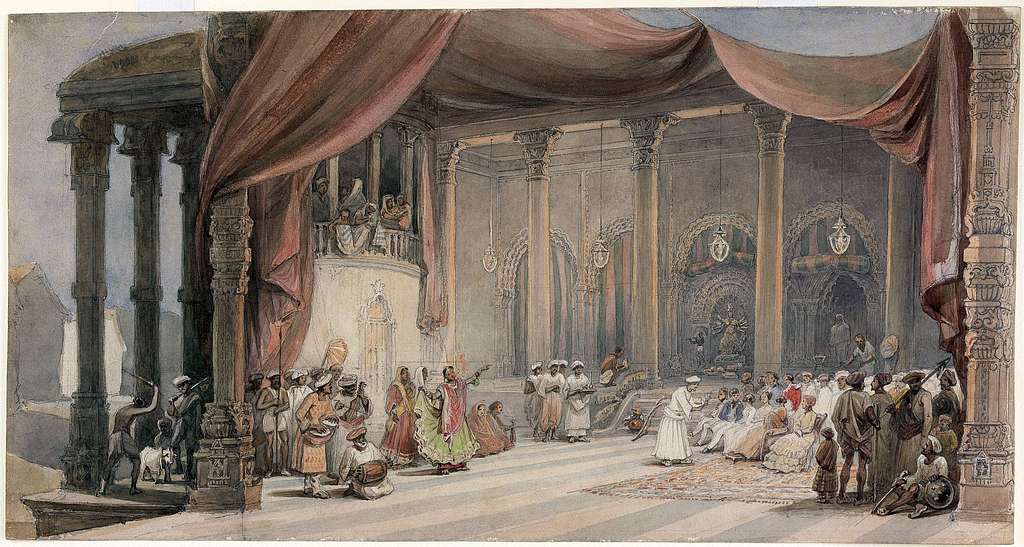
A depiction of celebrations inside a house during Durga Puja in  Calcutta (around 1830-40), West Bengal, India, where Europeans are being entertained, water colour by William Prinsep(1794–1874), a merchant with the Calcutta firm of Palmer & Company. Courtesy: Creative Commons
Categories
Excerpt

In a Land Far From Home: A Bengali in Afghanistan

Title: In a Land Far From Home: A Bengali in Afghanistan

Author: Syed Mujtaba Ali

Translator: Nazes Afroz

Publisher: Speaking Tiger Books

Over the noise, you could hear the shout that ‘Bacha-e- Saqao is coming, Bacha-e-Saqao has arrived.’ Then we heard the bang of a rifle and the crowd lost all sense of reason. Throwing aside everything they were carrying, people started running for their lives, some landed in the roadside ditch, some slipped time and again while trying to run over the ice on the Kabul river. The blind beggar who used to sit by the road, stood up trying to find his way with his hands in the air.

I somehow managed to leave the road, crossed the ditch and stood on the front porch of a shop. I decided that I would rather die from the bullet on which my name was written rather than be trampled by mad horses or in the stampede of the crowd.

Within a minute another man appeared and stood next to me. An Italian colonello or colonel, aged about sixty, with a long corrugated beard.

He was the first person whom I could ask something cogently. I said to him, ‘I heard that the bandit leader Bacha-e-Saqao was coming to fight for Amanullah. But what is really happening?’

The colonello said, ‘Seems like wrong news. He’s coming to take over the city.’

If that was the case, then why were Amanullah’s soldiers not going to the north of the city to fight him? How did Bacha-e-Saqao arrive in Kabul so suddenly? How many men did he have? Were they carrying only rifles or did they have cannons? The colonello could not answer these questions; he only kept saying, ‘What an odd experience!’

I said, ‘I can understand why the ordinary Kabulis are afraid, but why have the foreigners joined them? Where are they going?’

The colonello replied, ‘To their own embassies or legations—for shelter.’

The sound of rifle shots was drawing closer. By then the crowd was moving in waves rather than in a stream. In between two such waves I told the colonello, ‘Let’s go home.’ He said he would not leave without seeing the last act. Military whim—there was no point in arguing.

Abdur Rahman was waiting for me at the door. His worries disappeared at the sight of me. As soon as I entered the house, he closed the door and started to fortify it with heavy rocks. Intelligent man. He had made all the arrangements for fortification when I was out. I asked, ‘Where is Benoit?’ Abdur Rahman informed me that Benoit had left for the French Legation in a tonga carrying only one suitcase.

By that time the sound of the gunfire had been overpowered by the heavy sound of machine guns. Abdur Rahman brought tea. Listening to the sounds carefully, he said, ‘The king’s soldiers have now attacked. From where would Bacha have gotten hold of machine guns?’

I asked him, ‘The king’s soldiers are facing Bacha this late? How could he reach Kabul so easily?’

Abdur Rahman said, ‘I asked many people while waiting for you at the door, but nobody could say anything clearly. It seems he has arrived without any resistance. He comes from the north of the country; my place is also in the north—Panjshir. I would have got some news of troop mobilisation in that region from my fellow Panjshiris in the bazaar, but there was none. The king’s troops have gone to the east under the command of Ali Ahmad Khan to fight the Shinwaris.’

The exchange of fire continued. Abdur Rahman served me dinner early that evening and then he sat down to tend to the fire in the fireplace. From our chat I could make out that he was worried about my well-being in case Bacha won, which would be followed by anarchy and looting. But clearly he was highly excited and curious—much like a small child when the circus came to town.

But who was this Bacha-e-Saqao? I did not have to ask Abdur Rahman, he told me many stories about him of his own accord. I realised that Abdur Rahman had many qualities—a jeweller of snow, a doctor of frostbite, chef-decuisine—but he certainly was no Boswell. You could have constructed an image of a Robin Hood from what he said about Bacha, but much of it was certainly a figment of imagination and myth.

After filtering through all the stories carefully, I had a glimpse of the life of Bacha; he was the leader of a gang of about three hundred bandits; lived in Kohistan, north of Kabul; he looted the rich and distributed a portion of his booty to the poor. When Amanullah was away in Europe, he became so powerful that he started to collect tax from the traders of Kohistan. After coming back, Amanullah proclaimed a price on his head, ‘Five hundred rupees reward on the head of bandit Bacha-e-Saqao.’ Bacha removed all the posters and put up his own proclamation, ‘One thousand rupees reward on the head of Kafir Amanullah.’

Abdur Rahman asked me, ‘But Sahib, help me solve a riddle. The colonel’s son asked me, if I cut off Bacha’s head and my brother cuts off Amanullah’s, then how much money would we make together? I said, one and a half thousand. He nearly rolled on the floor with laughter; he said, “You won’t get a penny.” Please Sahib, explain why wouldn’t we get any money?’

I consoled him, ‘Because neither of them will be alive to give you the rewards. But you can tell the colonel’s son that the throne of Afghanistan will then be bestowed upon your family.’

I had also heard that only a few days earlier Bacha suddenly turned up in front of some high-ranking officials and swore his allegiance to the king in the fights against the Shinwaris by touching the Koran. By doing so he managed to get hold of about a hundred rifles and then disappeared.

Did he turn those rifles against Amanullah?

About the Book

An intrepid traveller and a true cosmopolitan, the legendary Bengali writer Syed Mujtaba Ali from Sylhet (in erstwhile East Bengal, now Bangladesh) spent a year and a half teaching in Kabul from 1927 to 1929. Drawing on this experience, he later wrote Deshe Bideshe which was published in 1948. Ali’s young mind was curious to explore the Afghan society of the time and, with his impressive language skills, he had access to a cross-section of Kabul’s population, whose ideas and experiences he chronicles with a keen eye and a wicked sense of humour. His account provides a fascinating first-hand insight into events at a critical point in Afghanistan’s history, when the reformist King Amanullah tried to steer his country towards modernity by encouraging education for girls and giving them the choice of removing the burqa. Branded a ‘kafir’, Amanullah was overthrown by the bandit leader Bacha-e-Saqao. Deshe Bideshe is the only published eyewitness account of that tumultuous period by a non-Afghan, brought to life by the contact that Ali enjoyed with a colourful cast of characters at all levels of society—from the garrulous Pathan Dost Muhammed and the gentle Russian giant Bolshov, to his servant, Abdur Rahman and his partner in tennis, the Crown Prince Enayatullah.

About the Author

Born in 1904, Syed Mujtaba Ali was a prominent literary figure in Bengali literature. A polyglot, a scholar of Islamic studies and a traveller, Mujtaba Ali taught in Baroda and at Visva-Bharati University in Shantiniketan. Deshe Bideshe was his first published book (1948). By the time he died in 1974, he had more than two dozen books—fiction and non-fiction—to his credit.

About the Translator

A journalist for over three decades, Nazes Afroz has worked in both print and broadcasting in Kolkata and in London. He joined the BBC in London in 1998 and spent close to fifteen years with the organisation. As a senior editor in the BBC, Nazes was in charge of South and Central Asia for a number of years. He has visited Afghanistan, Central Asia and West Asia regularly for over a decade. A passionate photographer and a compulsive traveller, Nazes quit his job in the BBC and moved back to India in 2013 where he is based in Delhi. Currently he writes in English and Bengali for various newspapers and magazines and is working on a few photography projects.

(Excerpted from In a Land Far From Home: A Bengali in Afghanistan by Syed Mujtaba Ali, translated by Nazes Afroz. Published by Speaking Tiger Books)

Click here to read the review / interview with the translator

.

PLEASE NOTE: ARTICLES CAN ONLY BE REPRODUCED IN OTHER SITES WITH DUE ACKNOWLEDGEMENT TO BORDERLESS JOURNAL