PANDEMIC PANIC

Pandemic panic.
Influenza bonanza.
I make a mask from an old shoe
and wear it out.
Is this what I am
required to do? I suppose so.

The smell is worse
than the curse
of the virus. I feel like a badly
sung note in an old
song, but one irony
is certain and it cheers me up:

Zorro also
wore his mask wrong
.
Rhys Hughes has lived in many countries. He graduated as an engineer but currently works as a tutor of mathematics. Since his first book was published in 1995 he has had fifty other books published and his work has been translated into ten languages.
PLEASE NOTE: ARTICLES CAN ONLY BE REPRODUCED IN OTHER SITES WITH DUE ACKNOWLEDGEMENT TO BORDERLESS JOURNAL
Ananto Prem(Endless Love) by Tagore, translated from Bengali by Professor Fakrul Alam. Click here to read.
Playlets byRabindranath Tagorereveal the lighter side of the poet. They have been translated from Bengali by Somdatta Mandal. Click here to read.
The Faithful Wife, a folktale translated from Balochi by Fazal Baloch. Click hereto read.
Leafless Trees, poetry and translation from Korean by Ihlwha Choi. Click here to read.
Ebar Phirao More(Take me Back) by Tagore, translated from Bengali by Mitali Chakravarty. Click here to read.
Pandies’ Corner
These narratives are written by youngsters from the Nithari village who transcended childhood trauma and deprivation. Will to be Human is based on a real life story by Sachin Sharma, translated from Hindustani by Diksha Lamba. Click here to read.
InStudies in Blue and White, PennyWilkes gives us a feast of bird and ocean photography along with poetry. Clickhere to read and savour the photographs.
G. Venkatesh looks at the ability to find silver linings in dark clouds through the medium of his experiences as a cricketeer and more. Click here to write.
What can be more scary and life-threatening than the risk of getting Covid-19? Keith Lyons finds how his daily joy has menacing dangers. Click hereto read.
Musings of the Copywriter
In When Books have Wings, Devraj Singh Kalsi talks of books that disappear from one book shelf to reappear in someone’s else’s shelf. Click here to read.
Notes from Japan
InOwls in Ginza, Suzanne Kamata takes us to visit an Owl Cafe. Clickhere to read.
Mission Earth
In No Adults Allowed!, Kenny Peavy gives a light hearted rendition in praise boredom and interaction with nature. Click hereto read.
P Ravi Shankar takes us on a trek to the Himalayas in Nepal and a viewing of Annapurna peak with a narrative dipped in history and photographs of his lived experience. Click here to read.
The Observant Immigrant
In A Bouquet of Retorts, Candice Louisa Daquin discusses the impact of changes in linguistic expressions. Click here to read.
Book Excerpts
An excerpt from a fast-paced novel set in Mumbai, Half-Blood by Pronoti Datta. Click here to read.
"I wish you survival,
Health
And the closed sky above you."

— Refugee in my own Country/I am Ukraine, Lesya Bakun
Despite this being the season of multiple new years around Asia, we cannot close our eyes to the skies that connect all the world like a blue dome. Though celebrations and humour continue to lighten the darkness of war, while Ukraine is being wrecked, can we turn our faces towards only festivities?
I had an interesting anecdote about how before the onset of the Gregorian calendar, new years in the world were celebrated around March and in some places in September. The Earth would turn fecund and green with spring, a beautiful season sprinkled with love and nostalgia as Michael R Burch tells us in his poetry. However, despite all the opulence of nature, it is hard to watch a country being bombed and families splintered to man a war that supposedly guards a human construct called ideology and blocs. Ukranian refugee, Lesya Bakun, in an interview says: “It is not a clash of ideologies. It is a fight for our country and nation to exist.” Listening to Lesya’s stories makes one amazed at the bravery of the Ukrainians battling what seems to be cultural hegemony. It reminds of the war in Bangladesh in 1971. Though incredibly courageous in voicing her experiences, Lesya is traumatised and has a psychosomatic cough as she sends her voice and text messages from her mobile through Telegram. There were times when she was just weeping or angry for the questions asked, and justifiably so, as her home in Kharkiv, where she lived was under attack, and the town of Mariupol, where she was born, has been wrecked by the war.
The refrain of the pain of a refugee continues to reverberate in a book reviewed by Rakhi Dalal, Ramy Al-Asheq’s Ever Since I Did Not Die, written originally in Arabic and translated by Isis Nusair. The Syrian-Palestinian poet refused to clarify whether his writing was prose or poetry — perhaps these borders and boxes drawn by humankind are breaking down in reality. Perhaps, this new year, the time is ripe to look forward to a new world that transcends these borders. This is also the first time we have had the privilege of carrying reviews of translations from Arabic and also from Turkish. Gracy Samjetsabam has reviewed a translation of a Turkish novel by Iskendar Pala called The Tulip of Istanbul, translated by Ruth Whitehouse. Bhaskar Parichha has reviewed a book by Kiran Manral, Rising: 30 Women Who Changed India while Candice Louisa Daquin has drawn our focus on a poetry collection by Marjorie Maddox, Begin with a Question, where the perceived divisions do not matter while the poet questions the larger issue of faith in quest of answers.
Is it the same kind of quest that has led Strider Marcus Jones to create the Lothlorien Journal, named reminiscently after Tolkien’s elvish ‘Lothlorien’ in Lord of the Rings? Find out Jones’s views and flow with his fluid poetry in the featured interview. Keith Lyons has been in conversation with Ivy Ngeow, an upcoming writer and the editor of a recent anthology of Asian writing where she has retained different styles of English across the world in a single book. While this could be beneficial to writers, would readers be comfortable reading stories with different styles or dialects of English without a glossary?
Our book excerpts are from more Asian books. The Year of the Rat and Other Poemsedited by Malachi Edwin Vethamani has an interesting title poem which has been shared in the excerpt. The other excerpt is from a fast-paced novel, Half-Blood, by Pronoti Datta. We also have a fast-paced story by a writer from France called Paul Mirabile set in Portugal; two that verge on the bizarre from Keiran Martin and Amjad Ali Malik; a poignant story from Sutputra Radheye and another that shows the positive side of voicing a protest against wrongs by Devraj Singh Kalsi. Kalsi has also given us a tongue in cheek musing called When Books have Wings.
On the lighter vein are travel essays by Ravi Shankar and Meredith Stephens. They take us to the Himalayas in Nepal and to Tasmania! Suzanne Kamata has taken us to an owl cafe in Japan! At the end of her column, one feels sad for the owls as opposed to Erwin Coombs’ narrative that evokes laughter with his much-loved pet cat’s antics.
Humour is evoked by G. Venkatesh who with an ability to find silver linings in dark clouds talks of cricket and lessons learnt from missing his school bus. Adnan Zaidi has also analysed his poetic abilities with tongue-in-cheek comments. Kenny Peavy gives a lighthearted rendition in praise of boredom and interactions with nature. It is good to have laughter to combat the darkness of the current times, to give us energy to transcend our grief. Keith Lyons hovers on the track between humour and non-humour with his cycling adventures. Rhys Hughes seems to talk of both his favourite poem and the war in a lighter shades, in no way insensitive but his observations make us wonder at the sanity of war. We have much of war poetry by a number of writers, poetry on varied issues by Luis Cuauhtémoc Berriozabal, George Freek, Sybil Pretious, Kisholoy Roy, J.D. Koikoibo and many more.
Candice Louisa Daquin has taken on the onus of bringing to our notice how language can impact us in the long run while Ratnottama Sengupta has explored beggary in films, fiction and fact. The Nithari column runs a real-life story of a young boy narrated by his brother, Sachin Sharma. It has been translated from Hindustani by Diksha Lamba. The trauma faced in 2006 is strangely not discussed in the story though it hovers in the backdrop between the lines. We also have a translation of a Balochi folk story by Fazal Baloch and a Korean poem by Ihlwha Choi. Translations from Tagore by Fakrul Alam and Somdatta Mandal have honoured our pages again. Mandal has sent us fun-filled skits by Tagore. But are they just fun or is there something more? We also have a translation of a long poem that explores a different aspect of Tagore, his empathy for the downtrodden which led him to create Sriniketan and regard it as his ‘life work’.
We have a bumper issue this time again — especially for the Asian new years; Thai, Nepalese, Bangladeshi, multiple Indian and more…
We would like to thank Sohana Manzoor for our cover painting and Gita Viswanath for her artwork. I would like to thank our wonderful team who with their contributions make this journal a reality. All the contributors deserve a huge thanks as do our loyal readers.
I wish you all a wonderful start to a non-Gregorian new year and hope that peace prevails over parts torn by wars and dissensions.
"Against the assault of Laughter, nothing can stand." -- Mark Twain, The Mysterious Stranger
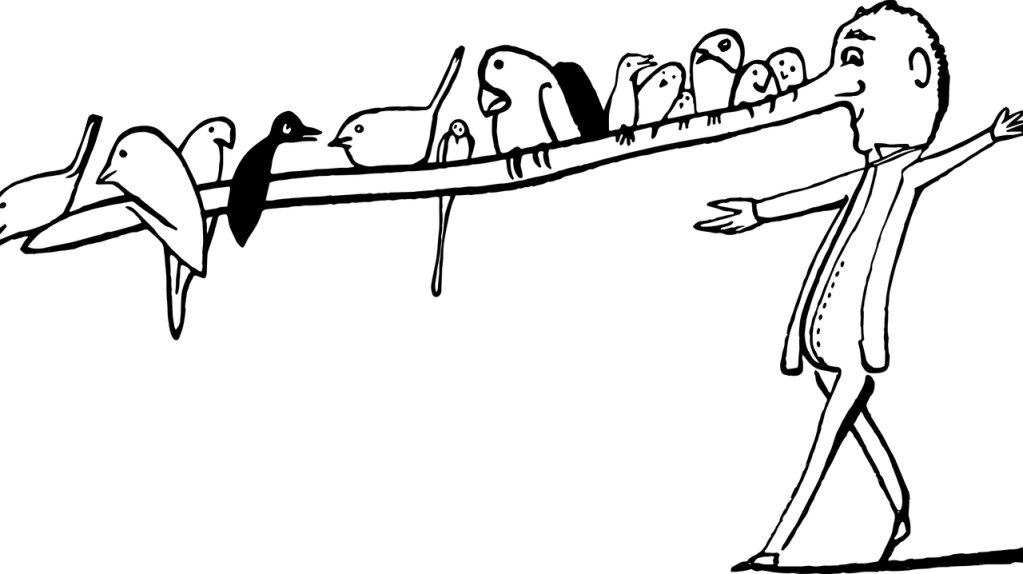
A sketch by Edward Lear: Courtesy: Creative Commons
Imagine… if there were a world where laughter could help collapse the human construct of war! If only leaders of opposing factions could meet in a match of laughter and resolve their differences with guffaws instead of weapons that kill, maim destroy…
Imagine… if each cannon chortled with hilarity, shooting absurd images to evoke fun instead of destroying buildings, nature and fauna, the concept of war could be annihilated. To build a new world based on love and harmony, old harmful constructs need to be erased — and battles, weapons and war are exactly that. Hundred years ago, Nazrul wrote about destroying walls and differences in his famous poem ‘Rebel or Bidrohi’ to create new civilisation based on love and acceptance.
For a world we dream of building with love, peace and hope, here is a deluge of laughter from our treasure chests to help heal gloom, doom and hate, often the tools of warlords. Let us step into the realm of the fantastic where with a dash of humour the pen creates Pirate Blacktarn who sails the Lemon seas to meet strange creatures, mermaids and Gods and battles pollution with catfish! Let us laugh while we battle Gretchums, go on pony rides or drives and pay a tribute to the great Lear who created limericks. On April 1st, 2022, let us with a pinch of humour and lot of laughter thaw warmongers and wall builders by making them snigger away their grouches with the aid of the tickle imp so that battles collapse into peaceful resolutions. Let us cheer war victims and recreate a beautiful imaginary world. To that end, we have the humorous writing of Tagore to start us out on our cheerful voyage towards a beautiful world…
Prose
Humour from Rabindranath: Translated from the original Bengali by Somdatta Mandal, these are Tagore’s essays and letters laced with humour. Clickhere to read.
Surviving to Tell a Pony-tale: Devraj Singh Kalsi journeys up a hill on a pony and gives a sedately hilarious account. Click here to read.
Driving with Murad: Sohana Manzoor unfolds her experiences while learning to drive with a dash of humour. Click hereto read.
Lear And Far: Rhys Hughes on Edward Lear who wrote fabulous humorous verses to laugh away our fears and founded the popular genre of limericks. Click here to read.
Poetry
Pirate Blacktarn poems … Wander into the fantastical world of Pirate Blacktarn, terror of the Lemon seas with twelve story poems by Jay Nicholls. Click here to read.
Walking Gretchums… Saptarshi Bhattacharya takes us into a land of the fantastical… Do such creatures exist and can we battle them? Click here to read.
Animal Limericks… Michael Burch introduces the absurd in the format created by Lear. Click here to read.
The Tickle Imp… Rhys Hughes introduces us to an imp who tickles… a most powerful weapon. Click here to read.
A LAUGHING LIMERICK
(With Due Apologies to the Maker of Prufock)

Let us go there you and I...
Where laughter etches out against the sky
To a fun-tastical world of the absurd —
Fun-loving creatures, animals and birds.
Let us replace gloom with laughter. Let us do, you and I...

-- Mitali Chakravarty
And as imagination bodies forth
The forms of things unknown, the poet's pen
Turns them to shapes and gives to airy nothing
A local habitation and a name.

-- Midsummer Night's Dream (premiered 1605)by William Shakespeare
Imagine… if words could weave a world in harmony! Perhaps… then as Shakespeare declared and more recently John Lennon wrote in his song ‘Imagine’ (1971), we might have constructed a new world…
In hope of the same perhaps, Nazrul had published his poem, ‘Bidrohi‘ or the rebel a hundred years ago, a few months before TS Eliot published Wasteland, again a poem raising humane concerns and reinforcing values post the First World War. More recently Akbar Barakzai who has passed on at the start of this month, wrote about a better world in his poem, ‘We are all Human‘. And yet we have a war …
In response to the war, we have modern voices that ring out in harmony, including the voice of a Ukranian refugee. In reaffirmation of a world that can transcend divisions created by human constructs and soar in a virtual world, we also present to you interviews of half-a-dozen poets.
From the Treasury
Rebel or ‘Bidrohi’: Nazrul’s signature poem from 1922, ‘Bidrohi‘, translated by Professor Fakrul Alam. Click here to read.
A Special Tribute
We are All Humanby Akbar Barkzai, translated by Fazal Baloch, has been published as not only a tribute to the poet who left us forever on 7/3/2022, but also as his paean to humanity to rise about differences which lead to war and horror, to unite us as one humankind. Clickhere to read.
War, Peace and Poetry
Poetry from across the world in support of peace and voicing concerns over the humanitarian crisis in Ukraine, we have Ukranian Lesya Bakun give us poetry as a war victim, a refugee. Rhys Hughes, Ron Pickett, Michael R Burch, Kirpal Singh, Malachi Edwin Vethamani, Suzanne Kamata, Mini Babu, Sybil Pretious and Mitali Chakravarty have contributed poetry written for the Ukraine crisis. Click here to read.
Poets across Borders
Half-a-dozen poets from different continents tell us about their poetry. The poets include Ryan Quinn Flanagan, George Freek, Luis Cuauhtémoc Berriozabal, Ihlwha Choi, Sutputra Radheye, Anusuya Bhar. Click here to read.
Featuring poetry by Lesya Bakun, Rhys Hughes, Ron Pickett, Michael R Burch, Kirpal Singh, Suzanne Kamata, Mini Babu, Malachi Edwin Vethamani, Sybil Pretious and Mitali Chakravarty
These fragments I have shored against my ruins
…
Datta. Dayadhvam. Damyata.
 Shantih shantih shantih

-- Wasteland (1922) by TS Eliot
These lines from a hundred year old poem by TS Eliot continue to cry out to be part of our civilisation’s ethos as do the lyrics of Bob Dylan’s pacifist song, ‘Blowin’ in the Wind‘ which wonders : “Yes, and how many times must the cannonballs fly/Before they’re forever banned?” The world continues to war destroying nature, lives and a common human’s need to exist in peace and go about his daily tasks, secure that the family will meet in their home for dinner and a good night’s rest. Cries of humanity in crisis from the battle grounds of Ukraine take precedence as Ukrainian Lesya Bakun writes about the plight of the people within the country stalked by violence and death.
REFUGEE IN MY OWN COUNTRY/ I AM UKRAINEBy Lesya Bakun (07.03.2022, Ukraine)
I am Kharkiv.
I am Volnovakha.
I am Kyiv.
I am the blocked Mariupol on the verge of humanitarian catastrophe.
I am the completely destroyed
City of Shchastia --
That is literally translated as "happiness" --
Where people have to sit in the bomb shelters,
Because nothing else is preserved.
The Russian troops are not letting them out.
I am Ukraine.
I am a fighter.
I am a refugee
In my own country.
What's in the minds of Russians?
Nine years ago, I was in Strasbourg, France.
Seven years ago, I was in Dublin, Ireland.
Two years ago, I was in Istanbul, Turkey.
Today, I am
In an internally displaced people’s centre --
In a city that I cannot even publicly disclose
For the security of too many families
Who are fleeing to remain safe.
"The Ukrainian IT company N has left the markets of Russia and Belarus forever".
We should have done it eight years ago.
We should have done it thirty-one years ago.
A lot of my friends are switching from Russian to Ukrainian.
We should have done that thirty-one years ago
So that no one comes to "protect us".
I am the gasoline
that NATO sent us
Instead of closing the sky --
Apparently so that we can burn
The Budapest Memorandum
We have seen the real face of Russians
Again
They negotiated green corridors
And started shelling from the heavy weaponry.
Evacuation is cancelled.
"I wish you survival,
Health
And the closed sky above you."
As the battle rages and razes, some react to what we have gleaned from media reports, some of which move hearts with stories of bravery and the spirit of the people battling the invaders who kill and destroy what they cannot possess… But can freedom of thought and resilience ever be destroyed?
THEY SHALL NOT PASSBy Rhys Hughes
They shall not pass
we cried as we held the pass
against the enemy.
And our sleepy student
days in sunlight
suddenly seemed long gone
and very far away
though it was only
a few weeks since war began.
Would such times
ever return? We had no idea.
Now the conflict is over
and the years pass
with increasing velocity
and right here
in the rebuilt city I am young
no longer. I am
the teacher: it is my turn.
And as I watch my students
dozing in sunlight
instead of revising for exams
an old refrain fills
my head: They shall not pass.
ADVANTAGE INTRUDERBy Ron Pickett
The sun edges over the cluttered horizon.
The cell towers, eucalyptus and large water tank are comforting.
The sun slowly fills the dark.
Life is safe and warm and good – for now.
The sun slides below the western horizon in Kyiv and darkness returns.
The dark brings its special unseen terrors.
The rumble and rattle of distant rockets and bombs.
The roar of jets and the throb of helicopters.
Flashes of light fill the night sky but there are no storms in the distance.
The earth trembles: the people quiver.
Daylight is ten long hours away, we who have been there remember, and shudder.
There are patches of dirty snow on the ground.
On trees and shrubs and the Peoples Friendship Arch.
And under the rubble of bombed buildings.
The snow is marked by the black stains of explosions and the red stains.
The snow will melt with the coming of spring, but the stains will remain.
The stains are physical and psychological and deep.
Dark is the province of the predator.
Dark is a comforting cover for the aggressor.
Dark is the source of fear and anguish for the weak.
This predator is man who can see in the dark.
To see at night is a huge advantage.
Advantage intruder.
FRAIL ENVELOPE OF FLESHBy Michael R Burch
for the mothers and children of Ukraine
Frail envelope of flesh,
lying cold on the surgeon’s table
with anguished eyes
like your mother’s eyes
and a heartbeat weak, unstable ...
Frail crucible of dust,
brief flower come to this—
your tiny hand
in your mother’s hand
for a last bewildered kiss ...
Brief mayfly of a child,
to live two artless years!
Now your mother’s lips
seal up your lips
from the Deluge of her tears ...
FOR A UKRANIAN CHILD WITH BUTTERFLIESBy Michael R Burch
Where does the butterfly go ...
when lightning rails ...
when thunder howls ...
when hailstones scream ...
when winter scowls ...
when nights compound dark frosts with snow ...
where does the butterfly go?
Where does the rose hide its bloom
when night descends oblique and chill,
beyond the capacity of moonlight to fill?
When the only relief’s a banked fire’s glow,
where does the butterfly go?
And where shall the spirit flee
when life is harsh, too harsh to face,
and hope is lost without a trace?
Oh, when the light of life runs low,
where does the butterfly go?
THE TIMES, THE MORALSBy Kirpal Singh
(After Ee Tiang Hong)
Testy times
Tempers flake, bruise
Blood swells veins
As memories burn.
Times were
When reason prevailed
And men talked --
Eyes glittering.
Now it’s tit for tat
No relenting
Frayed nerves
Know no restraint.
We pray n plead
For sanity’s return
As pall bearers
Carry another dead.
When will all this horror, violence and sorrow end? Will there be peace anytime soon… many voices across the globe join in quest of harmony.
Mt Fuji: Photo Courtesy: Suzanne Kamata
A VIEW OF MT. FUJI (March 3, 2022)
By Suzanne Kamata

On the third day
of the third month
of the fourth year of
Beautiful Harmony (Reiwa)
which followed the era of
Heiwa (Peaceful Harmony)
my husband, son, and I traveled to Gotemba.
We checked into our mostly vacant hotel
wandered the grounds amongst
oaks and bamboo and volcanic rocks
gazed upon the majestic mountain
symbol of Japan.
Mt. Fuji stood
calm and dormant and frilled by cloud
spotlit by late afternoon sun.

As we stared in wonder and awe
   BOOM!
an explosion resounded.
A black helicopter
like the ones over Kyiv
flew into view.
I recalled the military vehicles
we’d passed on the highway
those young men driving to
practice for self-defence.

When will there be peace in Ukraine?
When will there be peace in the world?

RUSSIA AND UKRAINE
By Mini Babu

After the war,
the repose of the dead,
settles over the nations.
The leaders will smile,
shake hands and
interchange the bodies
of the dead, maimed,
captives and,
each will dust
that which belongs to
the other, wash
their hands and
walk away.

Children hold on
expecting their fathers,
unknowing that
fathers never come back
after war.

And I, the ordinary,
instruct my children
how historic these names
are for examination.
Putin and Zelensky.

PEACE TALKS IN THE FOREST
By Sybil Pretious

I breathe
I sit on the hard cushion of root, foundation of growth
Peace talks to me  in the forest
Leaning against the rough trunk  bark,  feeling of strength
Peace talks to me in the forest
Above the leaves, cover me with a protective shade
Peace talks to me in the forest
Flowers flutter giving a splash of colour
Peace talks to me in the forest
Seeds heralding new life hang, dispersed on the wind
Peace talks to me in the forest
And I wonder
Why do warring nations not meet in forests
For peace talks
 where peace talks.


PRICE OF PEACE
By Malachi Edwin Vethamani

(I)

Peace is
a gentle brook,
natural and real.

Peace is
not things to come,
not imagined.

We arrive as beings of peace.
One with all around us,
same flesh, same blood.

Then labels are thrust upon us.
baptised into communities,
branded as nations.

Essentialist labels
bind us and blind us.
We shed our individual beings,
stitched into communities.

If you are not with us
You are against us, they say.
Taking a stand
comes with a price.

The price is often peace.


(II)

This is yet another call to stop a war.
A new plea for peace.
A shout out for prayers.

The callers change
with each new
war cry.

This too will pass.
How much will remain?
How much decimated?

Then these cries will be repeated.
What is lost?
Is anything ever gained?

We will smell
the stink of death
and see the rubble of destruction.

All the display of human unkindness
we inflict on our fellow beings.


(III)

What new enterprise,
what profiteering,
has brought on this new war?
Surely, no noble cause
can condone this waste of lives.

Whose monuments will we pull down now?
What new statues will we raise for self-proclaimed heroes?

What of the spouses who lost their partners?
What of the parents who lost their children?
Children and citizenry
casualties all.
Crushed and broken.


WASTELAND REVISITED AFTER A CENTURY
By Mitali Chakravarty

The river flowed with debris, with bodies
of the dead. When the waters reddened
with corpses crossing borders on a train,
nightmares haunted myriads of lives.

The undead cried till infecting more, the
anger, the hatred spread. That was more than
seven decades ago. History repeats itself.
Will it ever stop? This hatred? This war?

Does killing, destroying ever help? Does
it dissolve the buried hate, the anger, the
deaths? Swigging blood like vodka, the madmen
brew war with oil, weapons, the threat of nukes
to annihilate all lives — make barren the Earth.

Cosmic clouds gather to thunder,
‘Da, datta, dayadham, damyata’ till peace
comes with love songs that echo through the
Universe. A Brahmic vision of kalpas like waves
ebb and flow, calming the cries of tortured souls.

Oh God! Help us learn Mercy. When will the
white horse ride to our rescue? Or was that all
a myth? Kalki? Does the white horse ride out of each
soul to form a lightening that dispels mushroom clouds?

Peace be unto you.
Om Shantih, Shantih, Shantih!
PLEASE NOTE: ARTICLES CAN ONLY BE REPRODUCED IN OTHER SITES WITH DUE ACKNOWLEDGEMENT TO BORDERLESS JOURNAL
Only when the cries of the wretched of the earth will stop renting the skies,
Only when the oppressor’s bloody sword will cease smearing battlefields,
			A rebel, weary of war,
			Only then I won’t stir.
…
I’m the ever-rebellious hero--
	Soaring over the world, all alone, head forever held high!

--  Rebel or 'Bidrohi' (1922) by Nazrul, translated by Fakrul Alam
Borderless: Digital Art by Ayaan Ghoshal
These fragments I have shored against my ruins
…
Datta. Dayadhvam. Damyata.
 Shantih shantih shantih

-- Wasteland (1922) by TS Eliot
These lines reiterate values we would do well to live by in a war-torn, dissension-worn world where the need for a rebel to recreate a humane society that lives with values such as peace, generosity, acceptance, tolerance, compassion and restraint — is a felt need. The two great poems made history by remaining as popular a hundred years after they were written — ‘The Rebel’ by Nazrul and TS Eliot’s ‘Wasteland’. Nazrul defined a rebel as an iconoclast who breaks norms to find peace, justice and love for all, to move towards the creation of an ideal world. TS Eliot quoted from the Upanishads and ended with redemption coming with giving (giver perhaps denoted generosity), compassion and restraint. Despite the wisdom of these great poets and seers, war still continues a reality. The values remain neglected not just in as we see in conflicts, like the one in Ukraine that destroys lives, property and nature with intolerance towards differences, but also in our personal lives. Tagore also reiterated the same need for stepping out of personal, social, economic and political insularity. We carry a translation of a song that echoed this need while inviting participation in his ecstasy. He wrote:
Why do you sit in isolation,
Dwelling on self-centred issues?
Tagore had not only written of the negative impact of isolation from the world but he led by example, building institutions that could lead the world towards pacifism with acceptance of diversity and inclusiveness. Sriniketan and Santiniketan were created to move towards these ideals. Many of the people he influenced or who studied in Santiniketan made history, like Prime Minister Indira Gandhi, Satyajit Ray; many added to the sense of inclusiveness, like Mahasweta Devi, who other than her enormous work to integrate different cultures, also wrote a memoir about Santiniketan in Bengali. Radha Chakravarty, nominated for the Crossword Translation Award (2004) for In the Name of the Mother by Mahasweta Devi, has translated this memoir, a narrative which brings us close to Tagore’s ideals of the whole world being a family. How wonderful it would be if the world were open to such ideals and would behave like a global family and not go to war! Mahasweta Devi, Our Santiniketan, which has been reviewed by Meenakshi Malhotra, reiterates Tagore’s vision of a planet living in harmony with the flora and fauna.
Bhaskar Parichha has reviewed another non-fiction by Ashok Kumar Pandey, Why They Killed Gandhi; Unmasking the Ideology and the Conspiracy. Parichha writes: “The finest point about this book is its storytelling…” The book review brings to mind in the midst of a war and violence that Gandhi had tried to erase this mindless destruction of lives, nature and cities with Ahimsa or non-violence. Will we ever rise up to it? Perhaps… We see strains of recognising the negative impact of insular outlook in writings like that of Temsula Ao, a Sahitya Akademi Award winner, according to Indrashish Banerjee who has reviewed her new book,The Tombstone in My Garden: Stories from Nagaland. Keith Lyons has reviewed Asian Anthology: New Writing Vol. 1: Stories by Writers from Around the World, edited by Ivy Ngeow, an exotic medley of Asian stories, one of which has been excerpted as well.
We are privileged to carry another excerpt from Ruskin Bond’s Friends in Wild Places: Birds, Beasts and Other Companions, a hilarious story about a pet tiger adopted by the legendary writer’s grandfather. What is amazing about Ruskin Bond’s writing is the love and compassions for all creatures great and small that colours the tongue-in-cheek humour he rolls out to his readers. If only we could think like Bond, there would be no wars. His writing, I feel, transcends political borders or ‘isms’, and laces with love and compassion tales of menageries of monkeys, snakes, mongoose, humans of different denominations. This excerpt is a treat we are giving Borderless Journal as the journal completes two years of its existence. We are truly grateful to Speaking Tiger for sharing this excerpt with us. But our celebrations this time are sombre as the war rages with incoherence accompanied by heart-breaking ravages.
The refrain from Ukraine has been taken up by Ratnottama Sengupta as she takes us through the past and present experiences of the devastated country, bringing in the views of the legendary folk singer and pacifist, Pete Seeger (1919-2014), who she had interviewed over a span of four days. The writer of ‘Where have all the Flowers Gone?’, a song based on an Ukrainian folk song, Seeger said, “The point is not to ask for yourself alone — one has to ask for everybody: Either we all are going to make it over the rainbow or nobody is going to make it.” Candice Louisa Daquin has also pondered on the justification of war, contextualising it with the current one along with her essay on the paradox of modern linguistic communication.
We have an exhaustive essay on the legendary Satyajit Ray’s creations by Anasuya Bhar. Malhotra has pondered at exclusivity reinforcing divisions, margins and borders to plague humankind, against the backdrop of the Women’s Month, March. Highlighting women in writing, we have interviewed two female writers, one from Nepal and another from Bangladesh. Sangita Swechcha lives in UK but her writing, till now largely in Nepali, often pines for her home embedded in the Himalayas whereas, an expat, Neeman Sobhan, shuttles between Bangladesh and Italy with the affluence and assurance of a privileged background.
Finding a way to override lack of privileges, deprivation and violence, are the youngsters of Nithari on the outskirts of Delhi where less than two decades ago other than poverty, savage criminality devastated the local populace. These youngsters transcended the suffering over time with help from volunteering NGOs to create narratives that amaze with their inventiveness and confidence. Tanveer Hussain from Nithari, self-motivated and self-made from a young age, asks questions that would be relevant for all humankind in a letter to God. It has been translated from Hindustani by Vritika Thareja of pandies’. This edition’s translations include Professor Fakrul Alam’s mellifluous rendition of Jibanananda Das’s poetry from Bengali to English, Ihlwha Choi’s Korean poetry and a Balochi poem by Munir Momin rendered in English by Fazal Baloch. Baloch had earlier translated poems by Akbar Barakzai, a great poet who departed on 7th March, depriving the world of yet another powerful writer who imbibed hope of a better future in his poetry. We are privileged to have hosted the translations of some of his poems and his last interview.
Another well-known poetic voice from Singapore, Kirpal Singh, has given us poignant poetry that can be applied to the situation that is leading to the wreck of Ukraine. Anasuya Bhar has poetry, one of which despite being in the ilk of Nazrul’s great poem, ‘Rebel or Bidrohi’, questions gently mainly social constructs that obstruct the flow of harmony. Ryan Quinn Flanagan has pondered on the acceptance of a changed world. We have humour from Rhys Hughes in poetry and wonderful poems by Michael R Burch on spring. Jay Nicholls shares the last of her dozen Pirate poems as Blacktarn sails the lemon seas to fight pollution. Luis Cuauhtémoc Berriozábal, George Freek, Sutputra Radheye, Mike Smith, Shaza Khan and many more have contributed a wealth of beautiful lines. Penny Wilkes has captured storms and seas with photographs and text and Rhys has surprised us with some strange, bizarre tales in his column.
Suzanne Kamata continues writing on Japan as she introduces us to an Australian film maker who is making films in Japan and in Japanese, called Felicity Tillack. Cultures are perhaps truly crossing borders as we can see Kenny Peavy, an environmentalist who moved from US to Indonesia start a new column with us called ‘Mission Earth’. We hope, like Tagore or Rousseau, he will help to revive our felt need to live with nature, acknowledge the nurture that we get from the planet to live in harmony with it and on it.
At the end of twenty-four months of existence – that sounds better than a mere two years— we are happy to host a melange of writers from across the borders and be the meeting grounds of writers and readers from across continents. I am truly thankful to all of you for helping concretise an ideal. Huge thanks to all the writers, artists, photographers and the readers for the contribution of their time, effort and love. And thanks to our fabulous team who continue to support the journal unwaveringly. I would also like to thank Sohana for the lovely visuals she generously shares with us. A special thanks also to young Ayaan Ghoshal for his digital art where hands reach out to support a truly borderless world.
As usual, all the content has not been covered here, I invite you all to enjoy our March edition of Borderless Journal.
At the start of the third year of our existence, let us march onwards towards renewed hope – maybe the Ukraine experience will take us closer to a war-free world with an awakening of a felt need for peace and compassion in a planet without borders.
In quest of a peaceful, humane world, I invite you all to continue being part of this journey.
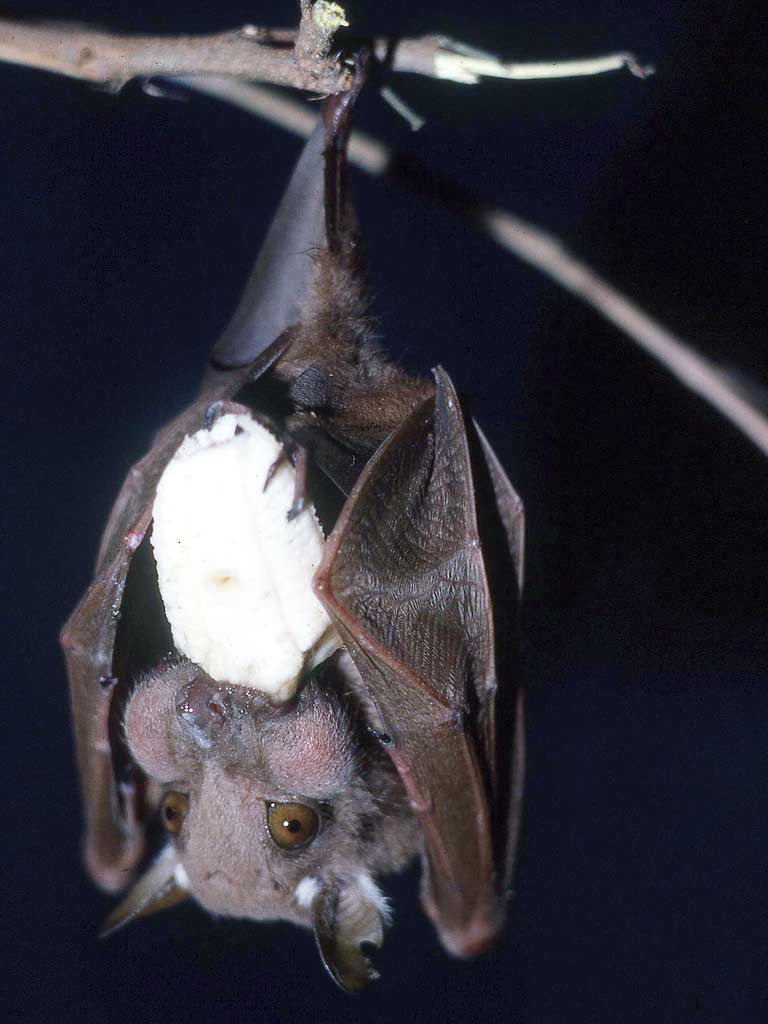
He left the pavilion and strode onto the pitch holding a gigantic banana. We were surprised and frowned as he took his place before the wickets. Most of the spectators fell silent but one of us who had travelled the world muttered that this banana was a totem of the monkey god, Zumboo, and that he hadn’t seen such a thing since exploring Borneo. I wondered what was left to explore on an island that had been inhabited for tens of thousands of years. The very densest jungle, was the unspoken answer. The bowler remained calm, took a slow run up, let loose a ball with a wildly erratic spin, but the banana connected with an audible squelch and the ball flew over the pavilion for a score of six runs. We settled back in our seats confident of a very entertaining innings but before the bowler could launch a second ball, the banana suddenly grew wings and flew out of the batsman’s grasp. We gasped. The umpire insisted that the match be abandoned immediately. We all went home. I am no cricket historian, nor an explorer. I am not even a zoologist. But I knew I had just seen a very unusual thing that fateful afternoon. The rarest species of fruit bat.
There was a king who feared invasion of his lands and defeat but he feared assassination even more. To guard himself from these dangers he moved his throne to the centre of an island in the middle of a large lake. But this lake lay at the centre of a larger island that reared from the waters of a bigger lake. Needless to say, this bigger lake was located at the centre of an island that was the size of a small country and this island could be found in the middle of a lake that was like a small sea. The king believed he had chosen the most secure place in the world and he relaxed just a little but he never slumped on his throne. He remained rigid, peering with his keen eyes in every direction, knowing that any invader or assassin would have to cross many bodies of water alternating with rough terrain in order to reach him, giving him plenty of time to prepare his defences. He had a rifle with an extremely long barrel and a tripod to rest it on and he was able to cover any approach with deadly fire. This is how he passed his days. But at night the moon rose slowly over the horizon and standing on the surface of that celestial object was the true enemy, a giant archer who lurked in the shelter of a crater and drew back his bowstring. The heavy arrow was nocked and he was carefully aiming at his obvious but oblivious target, the king who never looked up but who, sitting there, was a perfect bullseye at the dead centre of a series of concentric circles.
The Milk Truck
Travelling in a taxi from our small apartment in Bangalore to the airport, we hurtled along the highway, our driver weaving through the traffic with skill. We passed a stationary vehicle and at first I thought it had broken down on the side of the road. It was a large lorry, a cylindrical container on wheels. The words Milk Truck were written on the side in blue letters and then I saw an old woman on a stool near the rear of it. She was leaning forward, her gnarled hands reaching for the underside of the huge machine. It was just a glimpse, the merest flash, but I had the impression she was milking the truck’s udders into a bucket. How ludicrous! Sitting in the back of that taxi, I exchanged glances with my partner and I saw in her eyes that she shared my thoughts. We had both seen it. Metallic udders! I turned my head to look back but the truck already was out of sight, obscured by other vehicles. Our driver continued and it was impossible for us to know if he had noticed it too, or whether he would care even if he had. This is all the story, nothing else happened. We reached the airport early and had coffee while we waited but it was black coffee, which is both safer and saner.
Rhys Hughes has lived in many countries. He graduated as an engineer but currently works as a tutor of mathematics. Since his first book was published in 1995 he has had fifty other books published and his work has been translated into ten languages.
.
PLEASE NOTE: ARTICLES CAN ONLY BE REPRODUCED IN OTHER SITES WITH DUE ACKNOWLEDGEMENT TO BORDERLESS JOURNAL
WILLIAM TELL

It’s hell
to be a fussy
William Tell.
He refuses to aim
his crossbow
at the apple
unless it’s peeled.
   But how does one
       peel a crossbow?


ROBIN HOOD

Robin Hood
has a slightly strange quirk.
He could rob a bank
instead of travellers
if he chose to
and many would thank
him for that.
Yet banks didn’t exist
back then:
he would have to
establish one himself
in order to raid it
but he’s afraid of paperwork.


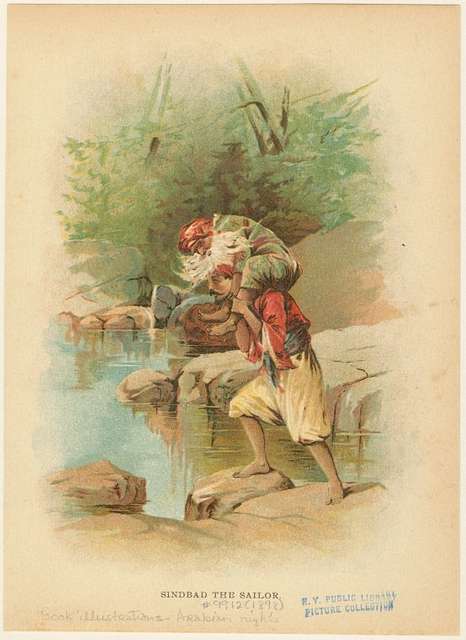
SINDABAD THE SAILOR

His tailor was a failure
and it drove Sinbad mad
that the colourful robes
he ordered to be made
tended to fade when exposed
to just a little salt spray.
“How can I have adventures
in pastel clothes? I want
to wear bolder shades
when I go looking for gold
and gems!” he muttered.
His tailor only smiled in reply
but when Sinbad’s back
was turned, he returned to his
original shape. He was a
gigantic genial green genie.


NED KELLY

Suits of armour
rather do chafe
but they keep you safe
from the bullets
of the Law. If you are poor
and truly believe you need
to rob banks to feed
yourself then taking precautions
is a lot less awful than
being shot into small portions.


DANIEL BOONE

Daniel Boone needed more room
so he went westward
until he came to Kentucky
where he was lucky
to survive all the various dangers.
Easily bored and
a man of few words
he rarely spoke to his friends
but often said howdy to strangers.


HONG GILDONG

He had magic powers
but no pockets on his trousers
So he kept his keys
strapped to his knees with a bowstring.
That was a clever thing
to do because if he was attacked
he simply bent a leg
and shot one of those iron objects
with serrated teeth
into the locks of their shocked looks.
Sometimes a key
ended up in an assassin’s mouth
and unfastened his tongue
and it wasn’t much fun
for that very bad man.

MARTÍN FIERRO

On the pampas
he was hampered
by fate when
he filled a hamper
with picnic foods
but forgot to bring a knife
to cut the bread
and cheese. Sitting
down with a deep frown
and trying to tease
meaning from political
debates while chewing
vast sandwiches
with the local cowboys.
   Gaucho Marx!


JESSE JAMES

He was a bushwhacker
in his youth and the bushes
plotted to whack him back
eventually. And they did
but not with a literal club
when he hid in thorny scrub
one prickly dangerous day.


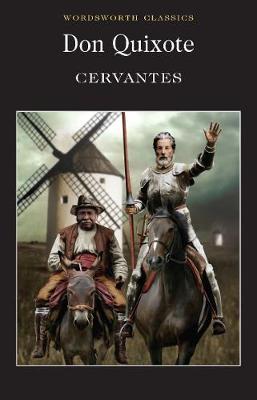
DON QUIXOTE

His beard is a goatee.
His horse is a bag of bones.
He has no home.
His servant, Sancho Panza,
acts like a panda,
slow and plodding, chewing
often. While he,
chivalrous in a haphazard
frivolous manner,
never clamours for dinner
but only demands
noble and gallant repartee.


TWM SIÔN CATI

A cunning thief and trickster
he once took a leaf
out of his own book and refused
to give it back. Into a sack
of looted treasure it went
while he went into hiding
in the hills near Rhandirmwyn.
Those cursed heights!
Whether or not he read
the words on that stolen page
or not matters not a jot.
Our concise advice is the worst.


HENRY MORGAN

Why is that pirate yawning?
Doesn’t he know
that the golden age
of salty rogues is dawning?
He will do well
come hell or high water
and never give quarter
if he wakes up
in parallel with the zeitgeist,
ropes all spliced
so his sails won’t fail
but billow large and not nice
like a poltergeist
wrapped in the sheets
of a foamy sea. Wait and see!


RASPUTIN

I don’t want these cakes!
I don’t want this wine!
You might say I’m fussy
but I know my own mind.
I won’t dispute in this room
that Rasputin is doomed
but right now I feel fine.
It’s not time to become
just a footnote of mystery
in the annals of history.
No cakes, no wine for me!

DICK TURPIN

The highwayman is hurting
because of a pin
that was concealed within
the bag of coins
offered to him by the hand
of his victim
through the curtain
of a stagecoach window. His
thumb is bleeding
and the carriage is receding
down the rutted road.
He is annoyed
and will take no joy
from the successful robbery
because he is fussy
about injuries at work
and only respects big ones.
That’s his rule
        of ruddy thumb.


PANCHO VILLA

It’s time to retire
from revolutionary thrills
and live in the hills
in a cottage or bungalow.
But just in case
you don’t know
fussy Pancho declines
to dwell in any abode
less swell than a villa
in classical mode
well-stocked with wines.


GERONIMO

Geronimo is learning
to parachute
from one of the newly
invented aircraft
on the off chance
it will help his cause.
Paratroopers
will surely be effective
in future wars.
That’s what he thinks.
But he refuses to jump
out of the plane
unless he is given
a memorable name
to shout as he does so.
Rhys Hughes has lived in many countries. He graduated as an engineer but currently works as a tutor of mathematics. Since his first book was published in 1995 he has had fifty other books published and his work has been translated into ten languages.
.
PLEASE NOTE: ARTICLES CAN ONLY BE REPRODUCED IN OTHER SITES WITH DUE ACKNOWLEDGEMENT TO BORDERLESS JOURNAL
PIRATE BLACKTARN FIGHTS POLLUTION


Pirate Blacktarn, Terror of the Lemon Seas
Stopped eating his dinner of green, mushy peas.
“I’m tired of this, I want some fish,”
He complained to the cook, waving his dish.

“There aren’t any fish,” said Big Bob the Cook,
“Just go up on deck and take a good look.”
The crew dangled their nets far over the side,
But no fish came to bite and the hungry group sighed.

“Why is the sea the colour of murk?”
“Well if you ask me, it’s pollution at work,”
Said Bosun Mick, who knew about things.
He pointed to a bird with sticky black wings.
“There’s some nasty poison dumped in the sea,
Killing all the fish and it could kill you and me.
The Lemon Seas are in a gruesome mess,
I don’t know what we can do unless…”

“What?” asked Blacktarn, thinking of his dinner.

“Unless we can catch the no-good sinner
Who’s dropping the poison and spoiling the water
And causing all this harm and slaughter.”

“Er, that’s a bit much,” muttered Blacktarn in fear.
“Yes, yes,” yelled the crew, “what a great idea.”

So away they sailed, with a brisk wind behind them,
Hunting for polluters and all set to find them.
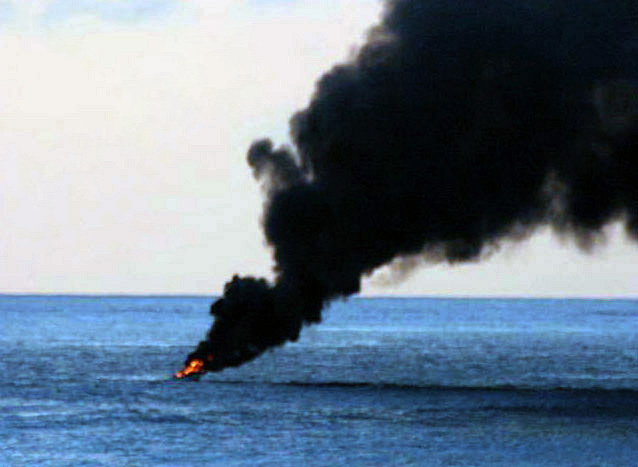
They hadn’t sailed far when they saw dark smoke
And sniffed a whiff that made them choke.
Then a dirty old ship came close into view
With a mean and moody and miserable crew.
Stacked on the deck stood barrels of gunge
All lined in a row and ready for the plunge
Into the sad Lemon Sea, all grimy and greasy.

But Pirate Blacktarn was feeling uneasy.
“That ship’s got guns,” he said as he stared.
“Come on Captain, we’re not scared,”
His crew all called, “STOP YOUR POLLUTION,
You’ll have to find a better solution.”

“STOP  STOP  STOP  STOP!”

BANG!  Went the dirty ship’s guns in reply,
BANG! BANG!  And fiery flames shot high.

Blacktarn quavered, “I think we’d better go.”

“No,” said Stowaway Fay, “no, no, no.”
“No,” said the crew, “are you a wimp or what?”
“A wimp, me? Nonsense of course not.
But what shall we do? You tell me that.”

“Perhaps it’s time we had a little chat,”
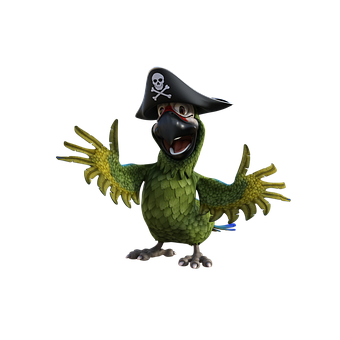
Said Parrot Tim and away he flew.
“What on earth is he going to do?”
Wondered Bosun Mick as he flew ever higher,
Weaving and swerving to avoid the gunfire.

Tim reached the dirty ship and perched on the mainstay.
“I think you’d better listen to what I have to say
Or a horrible harm might come your way.
You must take those barrels of poison away.”

The dirty crew laughed, “Let’s shoot that bird,
In case it thinks we haven’t heard.”
“Your last chance,” said Tim with a warning squawk.
“Huh,” jeered the crew, “this is just parrot talk.”

“Right,” said Tim and he began to sing.
Now a parrot song is not a nice thing.
The dirty crew groaned and covered their ears.
“Shoot this parrot, it’s reducing us to tears.”

But as he sang, the sea seemed to bubble.
The dirty crew were worried, “Is this trouble?”
For a monstrous shadow loomed beneath the waves.
“Get ready,” called Tim, “for your grisly graves.”

Down in the deeps a strange thing stirred.
Slowly, slowly, to the surface it whirred,
And a hideous head burst above the seas.
The dirty crew trembled, weak at the knees.
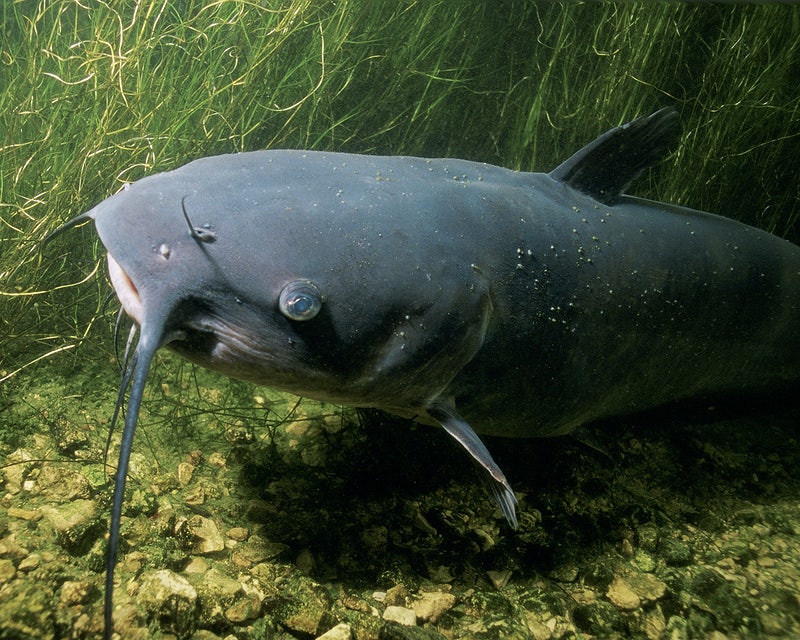
They saw a massive catfish, bigger than the ship,
All whiskers and fins, from tail to tip.
All scaly and bumpy
And ugly and lumpy
And grimy and grumpy.
Its big fat lips sucked like a vacuum.
“Help,” cried the crew, “is this our doom?”

For the mighty catfish scavenges the seas
And eats all the dirt to clear the water of disease.
It opened its great big mouth very wide
And the dirty crew screamed, all terrified.
WHOOSH! SLURP! The crew vanished inside
The monster’s mouth. “Ow,  help!” they cried
As they slithered down its throat.
But the great fish swallowed them and their boat,
Then began to suck all the sludge from the water,
Till the filth was gone from every quarter.

His big belly grew and swelled until
The mighty catfish had chomped its fill.
Then with a gentle belch and a sigh
And a slow, slow wink of his muddy brown eye
He started to sink back down to the seabed
To digest his dinner and rest his head.
And there he would stay until trouble arose
But he is there to this day, as Tim Parrot knows,
To make sure the Lemon Seas are clean and clear
And poison and dirt never reappear.

“Wow!” said Blacktarn, most amazed.
“Well done Tim,” the crew all praised.
“What luck that we had a catfish to help us
And mop up pollution before it got worse.”

“Yes, poisonous dirt gets dumped every day
And in other seas there’s nothing to clean it away,”
Said Rakesh the mate, looking very upset.
“Soon all the oceans will be black as jet.”

“Well at least we can sail on our clean Lemon Sea
And I needn’t eat one more green mushy pea,
Come, let’s get sailing,” said Blacktarn joyfully.
Courtesy: Creative Commons
Note: The ‘Pirate Blacktarn’ poems were written in the early 1990s but were never submitted anywhere or shown to anyone. By lucky chance they were recently rescued from a floppy disc that had lain in the bottom of a box for almost thirty years. There are twelve poems in the series but no indication as to what order they were written in and the author no longer remembers. However, they seem to work well when read in any order. They all feature the same cast of characters, the eponymous pirate and his crew, including a stowaway and an intelligent parrot. The stories told by the poems are set on a fictional body of water named the Lemon Sea. (Dug up by Rhys Hughes from the bottom of an abandoned treasure chest).
Jay Nicholls was born in England and graduated with a degree in English Literature. She has worked in academia for many years in various student support roles, including counselling and careers. She has written poetry most of her life but has rarely submitted it for publication.







 Borderless