Five poems by Pravasini Mahakudahave been translated to English from Odia by Snehaprava Das. Click here to read.
A Poet in Exileby Dmitry Blizniuk has been translated from Ukranian by Sergey Gerasimov. Click hereto read.
Kalponik or Imaginedby Tagore has been translated from Bengali by Mitali Chakravarty. Click hereto read.
Pandies Corner
Songs of Freedom: The Seven Mysteries of Sumona’s Life is an autobiographical narrative by Sumona (pseudonym), translated from Hindustani by Grace M Sukanya. These stories highlight the ongoing struggle against debilitating rigid boundaries drawn by societal norms, with the support from organisations like Shaktishalini and Pandies. Click here to read.
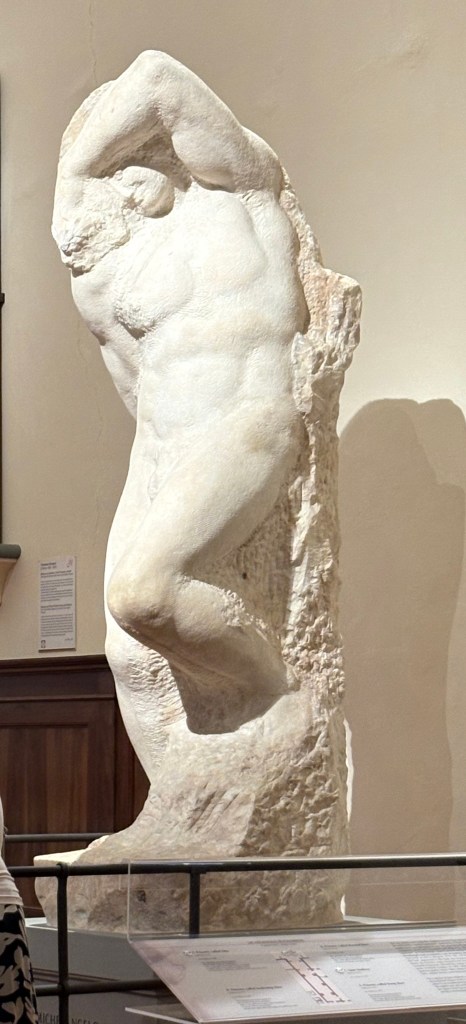
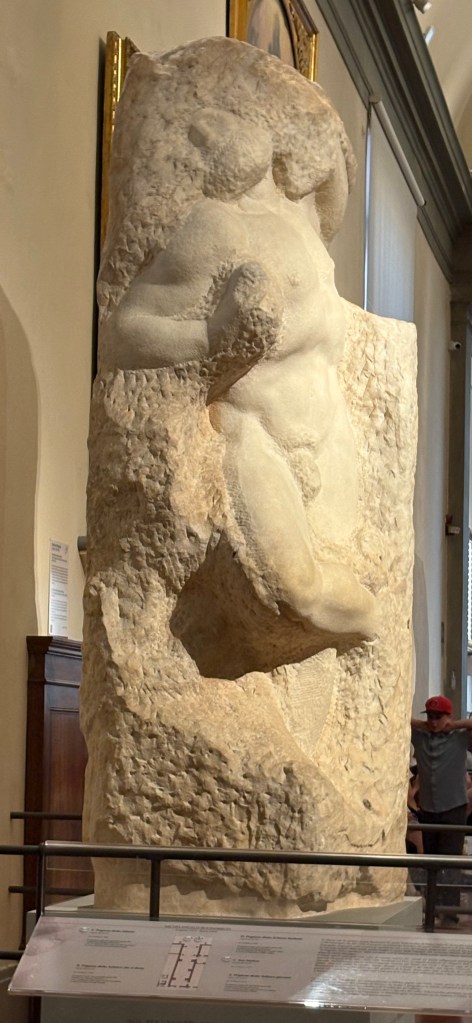
Incomplete statues of Michelangelo in Accademia Gallery, Florence
In the Accademia Gallery, Florence, are housed incomplete statues by Michelangelo that were supposed to accompany his sculpture of Moses on the grand tomb of Pope Julius II. The sculptures despite being unfinished, incomplete and therefore imperfect, evoke a sense of power. They seem to be wresting forcefully with the uncarved marble to free their own forms — much like humanity struggling to lead their own lives. Life now is comparable to atonal notes of modern compositions that refuse to fall in line with more formal, conventional melodies. The new year continues with residues of unending wars, violence, hate and chaos. Yet amidst all this darkness, we still live, laugh and enjoy small successes. The smaller things in our imperfect existence bring us hope, the necessary ingredient that helps us survive under all circumstances.
Imperfections, like Michelangelo’s Non-finito statues in Florence, or modern atonal notes, go on to create vibrant, relatable art. There is also a belief that when suffering is greatest, arts flourish. Beauty and hope are born of pain. Will great art or literature rise out of the chaos we are living in now? One wonders if ancient art too was born of humanity’s struggle to survive in a comparatively younger world where they did not understand natural forces and whose history we try to piece together with objects from posterity. Starting on a journey of bringing ancient art from her part of the world, Ratnottama Sengupta shares a new column with us from this January.
Drenched in struggles of the past is also Showkat Ali’s The Struggle: A Novel, translated from Bengali by V. Ramaswamy and Mohiuddin Jahangir. It has been reviewed by Somdatta Mandal who sees it a socio-economic presentation of the times. We also carry an excerpt from the book as we do for Anuradha Marwah’s The Higher Education of Geetika Mehendiratta. Marwha’s novel has been reviewed by Meenakshi Malhotra who sees it as a bildungsroman and a daring book. Bhaskar Parichha has brought to us a discussion on colonial history about Rakesh Dwivedi’s Colonization Crusade and Freedom of India: A Saga of Monstrous British Barbarianism around the Globe. Udita Banerjee has also delved into history with her exploration of Angshuman Kar’s The Lost Pendant, a collection of poems written by poets who lived through the horrors of Partition and translated from Bengali by multiple poets. One of the translators, Rajorshi Patranabis, has also discussed his own book of supernatural encounters, Whereabouts of the Anonymous: Exploration of the Invisible. A Wiccan by choice, Patranbis claims to have met with residual energies or what we in common parlance call ghosts and spoken to many of them. He not only clicked these ethereal beings — and has kindly shared his photos in this feature — but also has written a whole book about his encounters, including with the malevolent spirits of India’s most haunted monument, the Bhangarh Fort.
Bringing us an essay on a book that had spooky encounters is Farouk Gulsara, showing how Dickens’ A Christmas Carolrevived a festival that might have got written off. We have a narrative revoking the past from Larry Su, who writes of his childhood in the China of the 1970s and beyond. He dwells on resilience — one of the themes we love in Borderless Journal. Karen Beatty also invokes ghosts from her past while sharing her memoir. Rick Bailey brings in a feeling of mortality in his musing while Keith Lyons, writes in quest of his friend who mysteriously went missing in Bali. Let’s hope he finds out more about him.
Charudutta Panigrahi writes a lighthearted piece on barbers of yore, some of whom can still be found plying their trade under trees in India. Randriamamonjisoa Sylvie Valencia dwells on her favourite place which continues to rejuvenate and excite while Prithvijeet Sinha writes about haunts he is passionate about, the ancient monuments of Lucknow. Gulsara has woven contemporary lores into his satirical piece, involving Messi, the footballer. Bringing compassionate humour with his animal interactions is Devraj Singh Kalsi, who is visited daily by not just a bovine visitor, but cats, monkeys, birds and more — and he feeds them all. Suzanne Kamata takes us to Kishi, brought to us by both her narrative and pictures, including one of a feline stationmaster!
We've run away from the simmering house
like milk that is boiling over. Now I'm single again.
The sun hangs behind a ruffled up shed,
like a bloody yolk on a cold frying pan
until the nightfall dumps it in the garbage…

('A Poet in Exile', by Dmitry Blizniuk, translated from Ukranian by Sergey Gerasimov)
In translations, we have Professor Fakrul Alam’s rendition of Nazrul’s mellifluous lyrics from Bengali. Isa Kamari has shared four more of his Malay poems in English bringing us flavours of his culture. Snehaparava Das has similarly given us flavours of Odisha with her translation of Pravasini Mahakuda’s Odia poetry. A taste of Balochistan comes to us from Fazal Baloch’s rendition of Sayad Hashumi’s Balochi quatrains in English. Tagore’s poem ‘Kalponik’ (Imagined) has been rendered in English. This was a poem that was set to music by his niece, Sarala Devi.
After a long hiatus, we are delighted to finally revive Pandies Corner with a story by Sumona translated from Hindustani by Grace M Sukanya. Her story highlights the ongoing struggle against debilitating rigid boundaries drawn by societal norms. Sumana has assumed a pen name as her story is true and could be a security risk for her. She is eager to narrate her story — do pause by and take a look.
In fiction, we have a poignant narrative about befriending a tramp by Ross Salvage, and macabre and dark one by Mary Ellen Campagna, written with a light touch. It almost makes one think of Eugene Ionesco. Jonathan B. Ferrini shares a heartfelt story about used Steinway pianos and growing up in Latino Los Angeles. Rajendra Kumar Roul weaves a narrative around compassion and expectations. Naramsetti Umamaheswararao gives a beautiful fable around roses and bees.
With that, we come to the end of a bumper issue with more than fifty peices. Huge thanks to all our fabulous contributors, some of whom have not just written but shared photographs to illustrate the content. Do pause by our contents page and take a look. My heartfelt thanks to our fabulous team for their output and support, especially Sohana Manzoor who does our cover art. And most of all huge thanks to readers whose numbers keep growing, making it worth our while to offer our fare. Thank you all.
Here’s wishing all of you better prospects for the newborn year and may we move towards peace and sanity in a world that seems to have gone amuck!
A real life narrative by Sumona (pseudonym), translated from Hindustani by Grace M Sukanya
Songs of Freedom bring stories from women — certainly not victims, not even survivors but fighters against the patriarchal status quo with support from the organisation Shaktishalini.[1]
–Sanjay Kumar (1961-2025), founder of pandies’
What I Don’t Know
If I had to choose a moment that changed everything, it would be when the police rang the bell at Nakul’s house. Or perhaps, when I found out that I was pregnant. But both happened within a few hours of each other so… maybe it was that whole day.
Or maybe it was when I was finally rid of the brothels? I am so glad to be out of it and it was Nakul who helped me do that, no matter what he did otherwise. I am grateful for that.
Or maybe when I found out that Sanjay was married. I didn’t believe it for the longest time. And I lost the only family that had ever cared about me because of that…
The First Mystery: Maybe sometimes it can be an accident?
My older brother was sick. They said someone gave him drugs, mixed in with some chicken, and he became an addict. The drugs ate away at him.
Even when I was a child – he was very sick. And he was the most important person to me in the world; my mother had died, my stepmother drank, and my father did bad things to me at night. (I don’t know whether he did it on purpose or accidentally… maybe he didn’t know what he was doing because he used to be quite drunk too?)
So, I had to save my brother somehow… I asked a pastor in my village to help me find work. He knew a couple in Sikkim, he said, who needed help taking care of their two children. I decided to go.
I was very young then. I hadn’t even started my periods. For the first couple of years, things were okay. I even came back home at the end of those two years, to meet my brother. He was still unwell and my employers had told me they’d send my earnings home as soon as I went back to work.
But when I did go back — the man started abusing me. And not like my father – he knew what he was doing because he told me to keep quiet about it or he’d kill me.
I used to believe him too. Of course, he could me kill me – and no one would know. Or even care. Even if I told anyone, who would believe me? His wife would obviously be on his side. And the pastor would scold me. I was ashamed, and I was scared. So, I kept quiet.
I also needed the money. I asked him to send it to my parents, so my brother could get treated. After a few days he said he had done it. Therefore, I kept quiet.
He used to do things to me so frequently that I was not able to complete my chores. His wife started getting annoyed with me. She started burning me with things. Once she did it with a hot pressure cooker. The burn festered and became large and infected.
It was he who took care of me then… He scolded her on my behalf, told her if something happened to me, they would be held responsible. And I don’t know how but he got the wound to heal faster somehow.
I escaped back to my village soon after that.
I came back and found out that my brother was still sick, despite the Rs. 12,000 [2] my employers had sent to my home for the two years of work I had done in their house. I went and asked the doctor why he had not been treated yet. He told me he had never received any payment for the treatment. Then I found out from others that my step mother had used the money to buy alcohol. I had to look for work again…
I finally told the pastor the truth about the couple. He was angry with them, and at first, I was relieved. But then he decided to call and confront the family, and tell them off. The lady told him that they were on their way to speak to me, and that I should not say anything to anyone else until they met with me.
Sikkim was 3 hours away from my village by car (there were no buses plying on this route) and I was terrified of meeting them.
I ran away from home a second time.
The Second Mystery: Can I have a home in city I don’t know?
There was a girl called Rekha in my village, my age, or maybe slightly older than me. She worked in Delhi and earned fairly well. I asked her if she would help me find work in the city too. I told her I had experience working as a maid and a nanny. She said that I could go to Delhi with her.
So when the pastor told me that my former employers from Sikkim were on their way, I hightailed it out of the village with her.
We reached Delhi around 11 am in the morning. Rekha took me to a building that had a lot of small, independent rooms on a floor. In one room were some young men who did some work with computers. One room had a family with some children. And in one room were some young girls just like us. I thought I was to live with the girls and look after the family.
Within 5-10 minutes of reaching, Rekha told me that we had to go shopping. She took me to a large bazaar — it was bigger than any village market I had been to. There, she bought me a bunch of clothes: a lot of short dresses and skirts, the kind I had never worn before. I was happy to be starting this new phase of my life, and I couldn’t believe someone was buying clothes for me. It made me very happy.
We went back to The Home That Wasn’t. Rekha told me to get ready. As I was tired, I asked her why I was getting ready in the evening? Why could I not start working next morning? She told me I had to get ready right then in the new clothes I’d bought. I didn’t understand then what was about to happen.
I got “ready” in my new clothes, and Rekha took me to a hotel. Some men joined us, drinks were passed around, and then I was sent off with one of them to a room.
I was shocked. I didn’t know what to think or even feel about it. I said nothing.
The next morning, Rekha took me back to The House That Wasn’t and told me to pack my bags. I put all my new clothes in a bag and walked out of there. This time she took me to a tall, narrow building in a congested, crowded street. On the 4th floor of The Tower was a very small, very dirty room, not big enough for even a bed. I was told to get in.
I still didn’t understand what was happening.
There was a man there, Nishant. Rekha spoke to him for some time, then left. When I asked what was happening, he told me that she had left me there to work for him. I still didn’t know what to think (I was 11).
Soon after, an old man came to my room. He was as old as my father. He started forcing me to do things, taking advantage of me. This is when I first had the thought that maybe what was happening to me was wrong…
But it was too late. I was never let out of that room. The door was always locked. There was some space between the bottom of the door and the floor – it was used to slide in food. I don’t know how many years I spent in that room.
I used to dream of the things I would do once I got out. I kept trying to figure out how to get out. But I knew nothing at all – I didn’t know this city, or where I was located, or even the language. How would I ever get out?
Soon, they started sending me out to men’s places. The men were supposed to come pick me up and then drop me back. I didn’t know how to run away and they knew that: my captivity was complete.
The Third Mystery: If my work pays someone else, what am I?
There were always other people who got the money I earned.
After a few years in the city, I was sometimes allowed to visit The Home That Wasn’t. Nishant knew that it was the only place I “knew” (except for the The Tower). If I was sent to work from there, Meera got the money. If I was sent to work from The Tower then Nishant got the money. Rekha I never heard from again (she ran away with all the commission she had earned on my work in The Tower, while I was still locked up in the small dirty room).
One day, I was feeling unwell so I went to The Home That Wasn’t.
They had a frequent customer, Nakul. All the girls there had already been to his place. He insisted on someone “new”. So Meera sent me to him.
He was young, maybe about 25 or 26 years old. He was in the police, I don’t know what post. He was married, he told me, but it had been against his will so he was unhappy and therefore sleeping with other women.
That first day he met me, he asked me whether I was doing this out of my own free will or whether I was being coerced. I told him the truth. He said he would help me. I didn’t trust his offer of help – men often asked me whether I was being coerced, and then offered their help; but no one ever actually did anything to help me.
Nevertheless, I was hurt when Nakul proceeded to take advantage of me – I kept telling him no but he did bad things to me anyway. I was hurt that I had told him the truth about my life and he still treated me badly, like everyone else had.
One day he called his friends over and introduced me to them. They were all drinking and encouraged me to have a cold drink too. But they’d put something in it, and I passed out. When I came to, I knew that his friends had done things to me– and I knew it had been planned and he was in on it. I hated that but I didn’t say anything because he had also promised to save me.
Meera and Nishant called him about 2-3 days after he took me to his place, asking when he’d be bringing me back. I told him to say that I had run away and was no longer with him. They threatened to report him to the police. But he was fearless – he told her that he would them report them for forcing me into prostitution. They backed off after that.
And that is how I became free. Nakul helped me get free. So, I started living with him.
The Fourth Mystery: If my “friend” stands between the whole world and me, am I free?
About a week into staying at his place, he bought me an enormous bundle of clothes and so many shoes!
The shoes were all the wrong size though… he said he would go back and exchange them for the right size.
Two days later, he took me out on a drive at night with three other men, two of whom I knew.
We stopped after some time, and everyone was asked to put their phones in a small polybag. I didn’t understand what was happening. At this point, another man was called to the car. All the four men I had arrived with started beating this man up. Gunshots rang out. I don’t know who fired them. A crowd had gathered. We heard the police siren. Nakul shouted at me to get into the trunk of the car. I jumped in, and I saw him get into the car as well. I could see everything from a crack in the cover.
The police chased us through many streets. The car was being driven very fast and recklessly to lose them. I was starting to feel sick and suffocated; I kept banging around inside the trunk and I was hurt. Eventually, after several hours, the car stopped. I was asked to get out. Only one man was left – the one I didn’t know. He asked me to get into the front seat. He’d managed to lose the police.
I finally felt like I could breathe again. We drove some distance. Dawn was breaking. The man stopped the car and started trying to do things to me. But I had had enough. I felt sick and angry. I did everything I could to stop him. Finally, when I had scratched his face, he stopped and agreed to send me to Nakul’s.
Luckily, we also found Nakul’s phone in the car, maybe he had dropped it by mistake. My phone had disappeared with the polybag. I identified Nakul’s friends’ numbers by their profile pictures on Whatsapp. The man tried these numbers one by one and finally got through to Nakul. He took the address down and booked me a cab home.
I arrived back at Nakul’s place around 7 am. The two other men who had been in the car with us were there, as was a woman I didn’t know.
I shouted at Nakul then about what he had put me through. I knew he didn’t treat me well; I knew he slept with other women; I knew he pimped me out – but I also felt like I had a right over him, that I could shout at him and he would listen to him. Not that he gave me any explanations… I still don’t know what exactly happened that night.
Eventually, the two men left for their homes. Nakul also left with the woman, saying he had to drop her off. By 11:30 am, I was alone in the house.
My brain wasn’t working. I had shouted at Nakul. But I had failed to process anything anybody had said that morning. I felt like I kept swimming in and out of consciousness – not literally… but I couldn’t hear people, I couldn’t process what I was hearing… I felt like my brain had shut down.
That was the state I was in when the bell rang at 11:30 pm that night. I was still alone at home. When I went to open the door, it was the police along with the two men who had been there at the house that morning. No sign of Nakul.
The Fifth Mystery: It is my decision
The police took me to the thana[3] with them and questioned me till about 2-3 am that night. Eventually they understood that I had no idea about what these men had been up to. And also, that I had been taken advantage of. Early in the morning they took me to a hospital. I was tested and I (along with everyone else) found out I was pregnant.
At this, my brain shut down even further. I was taken to court. As a minor, I was put under the protection of the state and assigned a hostel. The police asked me if I wanted an abortion – they even urged me to get one. They told me I was still a child, I would not be able to take care of a baby of my own, that I would find it difficult to lead a life of my own, or move on from everything that had happened if I were to become a mother, that it would be best for my future if I aborted the foetus… But there were also people who told me that the baby had a life too, that if I aborted, I would be killing a life and did I want to be a murderer?
For a long time, I could not think for myself at all. But the police did tell me they’d support whatever decision I made… To be honest, I found them very helpful. It took me over a month to come to a decision. I thought about all the things I would be able to do if I didn’t have a child – get educated, get a job, earn money, maybe fall in love again and get married.
I also thought about what life with my kid would be like and all the things I would do for him / her that weren’t done for me. These dreams also made me happy – but I realised I had no means to fulfill them. How would I feed the kid without a job? How would I educate him / her? Some people kept telling me I could give my child up for adoption but that thought filled me with sadness too… So finally, I decided to get an abortion.
The police, as promised, helped me get it done. It was done at a state hospital. I was four months pregnant. The whole thing took almost a month. Then I needed two more months to recover. I wasn’t getting proper food at the hostel I was in, so at my request, my case supervisor had me transferred to another hostel. And this is where a new life began for me.
The Sixth Mystery: How unconditional is the love of a “family”?
I was sent to another hostel in Delhi NCR, which was quite large.
Sometime after the move, my stepmother turned up at the gates and asked me to leave the facility to spend some time with her. Since I was still under state protection, the hostel had to take clearance from them. When they were called, a woman at the institution told them not to let me out at any cost as my life was in danger: Nakul had managed to break out of prison and would try to kill me to stop me from testifying against him. So, I wasn’t let out to see my stepmother.
Years later, when I asked her how she had found the money to come all the way to Delhi to see me, she admitted that some man had bribed her to lure me out of the hostel…
In the 3 years I was there, my father and older brother passed away. My father was an old drunk so it wasn’t a shock. But my brother – he died terribly. By the end, he had TB, cancer, paralyses. He couldn’t move. And with both of them gone, I had no home to go back to anymore…
The hostel warden and other staff had become my new family. Here, I finally felt accepted and taken care of. After I turned 18, they even made me floor-in-charge for one of the floors of the hostel (since I could not be a resident anymore). They were the only people I felt I could depend on.
Until I fell in love with the wrong man.
Sanjay was significantly older than me – perhaps, by about 15 years, definitely more than 10. He was a shopkeeper near the hostel. I used to go to his shop sometimes to buy some groceries. I never noticed him but he started flirting with me one day.
I didn’t respond to it for some time but he was relentless. Every day, he would propose that we start up with something. Eventually I started talking to him. We exchanged numbers. We started talking all day. I’d even write letters to him.
The hostel people found out and they didn’t approve of the age difference. But I said I was in love with Sanjay and that I intended to marry him. I convinced them that I was serious about it and so was he. Therefore, they went off to talk to his family about the relationship.
They came back and told me something I never expected to hear: it turned out that the man I was in love with had been married for three years; he had one child, and another one was on the way.
I couldn’t believe this. For a long time, I didn’t believe it. Then one day, his wife called me. She had found one of my letters to him. She screamed at me a lot on the phone. And then I could no longer deny the truth of the situation…
All this turned my new family against me. I was asked to leave, and that is how I ended up here at Shakti Shalini. Or maybe it was because you can’t stay in the hostel past the age of 19… But they no longer speak to me.
If I could change one thing in life, it would be this. I wish they’d talk to me once again. I miss them all very much.
The Seventh Mystery: The First Revelation: This is Me
I don’t know why I still find it difficult to let go of the feelings I have for Sanjay when I know that everything he ever said to me was a lie…Or why I always love like it’s a drug… Maybe it’s about finally feeling like I belong somewhere. With Sanjay, I had imagined a whole life together. It’s very painful to accept that this’ll never happen.
And there’s so much more I have learnt about myself in all this time…
I know I can take care of myself. I know I can stand up for myself. I know now when someone’s touch feels wrong. For a long time, I didn’t know how to feel or think about these things… I used to be so shut down. I had no control over what I would eat or drink… I could not make any decisions at all.
But now I can fight for myself and others.
I am grateful I am out of the brothel. I am grateful Nakul got me out of it even if he tried to kill me later. I am grateful I got to experience care at the hostel, even if they don’t speak to me anymore.
And I know now what makes me happy:
Making fried rice and momos for myself and everyone else
Travelling to new places — I went to Jim Corbett with the hostel people and loved it!
Meeting new people, making new friends — like at my new workplace!
Earning my own money — I hope to buy myself a phone soon.
Wearing nice clothes and accessorising how I please — I love matching clothes to jewellery.
Listening to songs – this always makes me smile, and I love the feeling.
Dancing – I dance quite well, and I like learning new steps and choreography.
The way my life keeps changing and moving, no matter what happens; people leave, yes, but new people also keep arriving and isn’t that the best part?
From Public Domain
Sumona (pseudonym) is 19 years old and hails from Darjeeling in West Bengal. Currently she working as a Child Caregiver with a family based out of Delhi. Sumona loves her piping hot momos with spicy chutney and finds peace and solace when she spends time with children.
[1] “pandies and Shaktishalini – different in terms of the work they do but firmly aligned in terms of ideological beliefs and where they stand and speak from. It goes back to 1996 when members of the theatre group went to the Shaktishalini office to research on (Dayan Hatya) witch burning for a production and got the chance to learn from the iconic leaders of Shaktishalini, Apa Shahjahan and Satya Rani Chadha. And collaborative theatre and theatre therapy goes back there. It is a mutual learning space that has survived over 25 years. Collaborative and interactive, this space creates anti-patriarchal and anti-communal street and proscenium performances and provides engaging workshop theatre with survivors of domestic and societal patriarchal violence. Many times we have sat together till late night, in small or large groups debating what constitutes violence? Or what would be gender equality in practical, real terms? These and many such questions will be raised in the stories that follow.” — Sanjay Kumar
Grace M Sukanya, the translator, has facilitated workshops with Shaktishalini through 2020 and 2025, and been associated with pandies’ theatre since 2020 in various capacities.
.
PLEASE NOTE: ARTICLES CAN ONLY BE REPRODUCED IN OTHER SITES WITH DUE ACKNOWLEDGEMENT TO BORDERLESS JOURNAL
Tagore’s Mono Mor Megher Shongi (‘The Clouds, My Friends‘)has been translated by Professor Fakrul Alam. Click here to read.
The Welcome, a skit by Tagore, has been translated by Somdatta Mandal. Click here to read.
The Bus Conductor, a short storyby Dalip Kaur Tiwana has been translated from Punjabi by C. Christine Fair. Click here to read.
Hasan Sol: A Balochi Folktale from Geedi Kessah-4(Folktales Vol: 4) compiled and retold by Gulzar Khan Mari, has been translated by Fazal Baloch from Balochi. Click here to read.
Cry of the Sunflower written in Korean and translated to English by Ihlwha Choi, a poem for Ukraine. Click here to read.
This narrative is written by a youngster from the Nithari village who transcended childhood trauma and deprivation. Lockdown had been written in Hindustani by Jishan and translated to English by Grace M Sukanya. Click here to read.
InThe Anthology in my Mind, Rhys Hughes talks of a make believe anthology. Clickhere to read and find out what he imagines.
Conversations
Eminent film journalist, Ratnottama Sengupta, converses with legendary actress, Deepti Naval, on her literary aspirations at the Simla Literary festival, Unmesh, in June 2022. Click hereto read.
Keith Lyons interviews Steve Carr, a writer who has written 500 short stories and has founded the Sweetycat Press. Click here to read.
Meenakshi Malhotra reviews Tagore’sGleanings of the Roadtranslated by Somdatta Mandal. Click here to read.
Rakhi Dalal reviews Geetanjali Shree’s Mai, Silently Mother, a Sahitya Akademi winning translation of the Hindi novel by Nita Kumar. Click hereto read.
When the mountains and grass
had life, stones whispered
how the world came to be…

'Stonehenge', Daily Star
And as the world came to be, there was war — war that seems to rage in some part of the world or other. The British Museum has an exhibit which states the first battle was staged 13,000 years ago… in what is now Sudan, long before the advent of written history. This was even before the advent of people who built the ancient Stonehenge which was constructed around 3000-2000 BCE. And battles still continue to rage. The Jebel Sahaba casualties in Sudan 13000 years ago were less than 100. But the current conflicts claim in terms of tens of thousands which prolonged could stretch to millions. The last world war (1939-1945) which lasted for six years had a total of 75-80 million persons who perished. Ukraine-Russia conflict has within five months had a casualty count of more than 14000. And yet weapons and nuclear arms continue to proliferate decimating humanity, nature and towns, destroying homes, erasing ruthlessly and creating more refugees. The only need for such battles seem to be to satiate the hunger of the warlords secure in their impenetrable fortresses while tens of thousands are annihilated and natural or nurtured landscapes lie emaciated, mutilated and polluted.
What would be a good way of ending such wars?
Tagore sought the development of better instincts in humankind as an antidote. He wrote in the last century: “Any teaching concerning man must have human nature for its chief element. How far it will harmonise with human nature is a matter of time.”
With wars getting deadlier and more horrific, we can only try to awaken, as Tagore suggests, the better nature in man to move towards a peaceful world. What would be a more effective way of doing it than writing with the hope of a kinder and accepting future?
For that let us start with translations of the maestro Tagore himself. We have a song about the season — monsoon, ‘Monomor Megher Songi (My Friends, the Clouds)’, translated by Professor Fakrul Alam, a painting by Sohana Manzoor interpreting the lyrics and a transcreation of ‘Nababarsha or New Rains’ was shrunken into a popular Rabindra Sangeet and reduced to twenty lines in English by Tagore himself. The connect with nature is an important aspect that enables humans to transcend petty concerns leading to dissensions of different kinds as evidenced in the maestro’s humorous feline skit, translated by Somdatta Mandal. A translation of Dalip Kaur Tiwana’s ‘The Bus Conductor’ from Punjabi by C. Christine Fair adds zest to this section. Fazal Baloch has translated a folktale from Balochistan involving the supernatural and Ihlwha Choi has taken on the cry for peace on behalf of Ukraine while translating his own poem in Korean. The Nithari column has a story by Jishan in Hindustani, translated to English by Grace M Sukanya, showcasing the struggle of a youngster during the pandemic – rather a sad narrative, which though fictitious has its roots in reality.
Our short story section has echoes of humour around felines by Manzoor, somewhat in tune with the mind frame seen in Tagore’s skit on this issue. Humour rings tinged with an apparition in Erwin Coombs’s narrative – should one call it dark humour or is it just his style? Paul Mirabile goes for gothic darkness in his meanderings around Italy.
Strangely, we seem to have a focus on short stories this time. Keith Lyons has interviewed Steve Carr, a journalist, a publisher and writer of 500 short stories who is questing to create a ‘perfect short story’. Reading out excerpts from her short story at a literary festival in Simla, Bollywood celebrity, Deepti Naval, was in conversation with eminent film journalist, Ratnottama Sengupta. She spoke of her literary aspirations while unveiling her autobiography in verse, A Country Called Childhood. This conversation has been shared by Sengupta with Borderless. It is interesting to see how Naval’s reactions to social malaise contrasts with that of the film director, cinematographer and actor, Goutam Ghose, who was present during the unveiling of her book. He had responded to communal violence by making a film on Lalan Fakir extolling virtues of love and kindness, called Moner Manush (2010) and then made a book on the film called, The Quest (2013) which has beautiful translations of Lalan Fakir’s lyrics by Sankar Sen.
Our non-fiction sections seem to be hosting multiple travel stories across UK by Mike Smith, along the Australian coastline by Meredith Stephens, on the Himalayas with Ravi Shankar and an unusual visit by Hema Ravi to a farm in US where animals that had been used in Disney films in the past are homed. Our environmental columnist, Kenny Peavy, actually wrote about his cycling trip from Thailand to Indonesia on a bamboo cycle made by a Singaporean! And from Japan, Suzanne Kamata explored a museum in the neighbouring town of Mure. The museum on a hill hosts the art of American Japanese Artists, Isamu Noguchi.
We do have non-fiction that moves away from travel: noir humour by Devraj Singh Kalsi and an essay by Candice Louisa Daquin on a very interesting subject – ‘Is it Okay to be Ordinary?’ Is it? Dan Meloche has written a literary essay on Canadian novelist Andre Alexis’s award-winning novel, Fifteen Dogs: An Apologue(2015). While Meloche spoke of how the novel departed from Orwell’s Animal Farm, his narrative brought to my mind a novel closer to our times set in England by Jasper Fforde called Constant Rabbit (2020) – this a science fiction while Alexis’s was an apologue or an animal fable. Fforde did use the rabbits rather well to highlight the current times.
We have book excerpts of two recent books that I would call really outstanding. One of them is Aruna Chakravarti’s The Mendicant Prince, which is being released this week, and is based on the evergreen contentious case of the prince of Bhawal that has even been explored even in cinema. The other, Dadamoni: The Life and Times of Ashok Kumarby Nabendu Ghosh, has been published posthumously and is not a translation from Bengali but written in English originally by this trilingual writer.
Called ‘Dadamoni’ affectionately, iconic actor Ashok Kumar is regarded as “the one personality who symbolises Indian cinema’s journey from Bombay Talkies to Bollywood”. This book has been reviewed by Indrashish Banerjee, who calls it ‘a reflection on the Hindi film industry’ as well as a biography. Rakhi Dalal has reviewed Booker winner Geetanjali Shree’s Mai, Silently Mother, a Sahitya Akademi winning translation of her Hindi novel by Nita Kumar, reiterating the dialogue that had been kindled on motherhood last month by Rinki Roy Bhattacharya and Maithili Rao’s The Oldest Love Story (2022). Bhaskar Parichha has reviewed Prosanta Chakrabarty’s Explaining Life Through Evolutionplotting how life evolved on earth. Parichha tells us: “Meaningful, wide-ranging and argumentative, this is a must-read book. It will propel us to imagine and reimagine life around us.” Another book that sounds like a must-read has been reviewed by Meenakshi Malhotra, Tagore’s Gleanings of the Road, translated by Mandal. She tells us: “ ‘Gleanings’ represents the quintessential Tagore…Ably introduced and translated by Somdatta Mandal, a renowned Tagore scholar, the translation captures the iridescent and luminous quality of Tagore’s prose and its chiaroscuro effects.”
There is more to tempt. Please stop by on our contents page and take a look.
We would like to hugely thank all our contributors and readers for being with us and helping us grow. I would like to thank my team, who despite hurdles they face, always lend a helping hand and wonderful words from their pens or computers to get Borderless on its feet. I apologise for the delay and thank you all for your patience. Special thanks to Sohana Manzoor for her fabulous artwork.
I wish you all a wonderful July and peace in a war-torn world. We are all affected by the ongoing conflicts. Let us hope for peaceful and just resolutions.
Written by Jishan in Hindustani, translated by Grace M Sukanya
Jishan is a 23-year-old final year student of B.A Political Science, working as a receptionist at a dental clinic to support himself and his family. A curious person, he likes travelling, and football. He is a fan of the Liverpool Football Club. He has been associated with pandies’ for 12 years. Having participated in Nithari productions, he seeks pandies’ to further train himself as an actor and a facilitator of workshop theatre.
Lockdown
I was a 24-year-old happy-go-lucky guy, always searching for the silver lining. Because of the poor financial condition of my family and admittedly, also a lack of interest, I could not finish school. A lot of people from my village were working in the city. I decided to join them and try my luck. One of my uncles found me a job in an export factory.
Everyone at the factory was quite friendly, so I did not miss my family too much. The salary was okay too; I was able to rent a small room, and even after spending on food, I managed to save a little money to send home. My daily routine was fixed: I woke up early, made rotis to pack for lunch, and then got ready quickly to reach the factory on time.
That day, the sun felt a bit harsh in the sky. It was Holi[1] a few days ago and people say the weather does get a little warmer after that.
I packed my lunch, got ready and left for work as usual. Many people had started wearing masks. There are some masked people in the bus too. Apparently, there is some new disease called ‘corona’ and this mask helped defend us from it.
When I reached work, everyone was talking about corona. I didn’t know much about it, so I asked my friend Rohit, “Brother, what is this corona everyone keeps talking about?”
“Haven’t you seen the news on your phone? In China, people walking down the street are suddenly just dropping dead from it. It’s very dangerous, and now they are saying that it may have entered our country too,” he told me.
“You know I only use my phone to listen to songs and watch films, I don’t use it to keep up with the news,” I responded.
“Okay but be careful from now on. To protect yourself from this disease, don’t go to crowded places, wash your hands frequently and well, and generally keep yourself and your surroundings clean,” he said.
I found this disconcerting, but I got back to my work quietly.
*
Talk about the disease had been increasing daily.
I had never before been as scared as I was by the thought of this new disease.
One evening, while still at work, I found out that the government could announce a lockdown to deal with this illness. Rohit said that in case of lockdown, we would not be able to leave our houses or even come to work.
The company informed us that since it would have to close and work would get stalled, our salaries would also be reduced.
I told myself it would soon be fine. It would only last a few days, and everything would go back to normal. And I would have enough money saved to afford food for a few days without work.
After work that day, I returned home and quickly went to the grocery to get rations. I didn’t know if the shops would be open during lockdown in case it happened. While making dinner that night, I started thinking: “If the lockdown happens, how will I survive alone in this tiny room all by myself, for 8 – 10 days?”
That night, the government ordered a complete lockdown for three weeks.
*
It’s the first morning of the lockdown. I woke up late because I don’t have to go work. The weather was pleasant – not too hot, not too cold. But everything felt deserted and empty. There was no one to be seen outside, none of the usual sounds.
I had tea and biscuits for breakfast, washed my clothes and did some chores around the house.
*
It had been 7-8 days since the lockdown was announced, but they were saying in the news that the number of infections were still increasing. I heard that even the lockdown may be extended by a few more days.
On top of that, my landlord and neighbours thought I was part of a religious sect that was being held responsible for the spread of the disease. My landlord told me the other day, “It’s because of people like you that this disease has taken root in our country. Clear out of this room as soon as you can and leave!”
My neighbours also looked at me with suspicion. But I had never been a part of any religious sect. If this lockdown went on for a few more days, where would I stay, how would I eat?
The ration I had would last only another 3-4 days. The government said they would be providing ration for everyone but when I went to the government run ration shop, they asked for my ration card, which I didn’t have.
I was feeling very alone. I want to return home. But how would I go? Train, bus — all transportation had shut down.
Some people had started off for their villages on foot. But my village was so far, how would I walk to it? And I saw on the news that many people who were walking couldn’t even make it to their homes – they died of hunger on the way or were crushed to death by the overloaded trucks.
I could not walk back home.
*
I had spoken to a few people from my village on the phone. They too were in the city. They said they were planning to cycle back home, and I could accompany them. But I didn’t have a cycle.
There was a tailor who lived nearby, I used to go to his place quite often. He was a kind person. Maybe I could ask if I could borrow his cycle…
*
The tailor gave me his cycle for half its price, and I told him I wold pay him the other half when I returned.
Now that I had figured out how to go home, I bought snacks for the road, and gave my leftover ration to someone else. I had only three or four hundred rupees left and a couple days of ration. I might or might not have died of this disease, but I would definitely have died of hunger if I had to stay on in this city.
I was leaving with Ali, one of the other men from my village who worked in the city. He told me to be ready by 7 pm.
It was almost evening. My bags were packed. I was feeling much better now that I knew I was going back to my village and would soon be meeting my parents.
*
At 7 pm, all of us had gathered at the meeting point on the main road. Including Ali and me, there were four of us leaving together, and each had his own cycle. Night was looming, and all the roads looked abandoned as we started off.
We had been riding for some 20-25 km, slowly going towards the highway, when a police car approached us and asked us to stop.
We show them our IDs. They too started accusing us of being part of the religious sect that everyone was blaming for the spread of the disease.
You know the reputation of the police in India; you give a little money and they let you off… So, we said to him, “Brother, tell us what we can do for you, and let us go?”
He said, “No way, brother, I don’t want any part of your corona.”
We plead with him to let us go, because we had no more ration left to survive in the city but he said, “If I let you go, you will spread corona in your villages too. You’re going there to spread this disease only, no? Hunger may or may not kill you, but we definitely will.”
*
You can imagine what else happened to that poor boy. This was not my story — this was the story of all of us from challenged backgrounds who suffered during the lockdown.
Thank you.
Grace M Sukanya is a 28-year-old filmmaker based in Delhi, India. She is interested in creating arts-based educational interventions for children that respond to socio-political issues. She has been associated with pandies’ theatre since 2020. This is her second translation in the series.
Sriniketan: Tagore’s “Life Work”: In Conversation with Professor Uma Das Gupta, Tagore scholar, author of A History of Sriniketan, where can be glimpsed what Tagore considered his ‘life’s work’ as an NGO smoothening divides between villagers and the educated. Click here to read.
Akbar: The Man who was King: In conversation with eminent journalist and author, Shazi Zaman, author of Akbar, A Novel of History. Click here to read.
Translations
One Day in the Fog, written by Jibananda Das and translated from Bengali by Professor Fakrul Alam. Click here to read.
Mahnu, a poem by Atta Shad, translated from Balochi by Fazal Baloch. Click hereto read.
Eyes of the Python, a short story by S.Ramakrishnan, translated from Tamil by Dr.B.Chandramouli. Click here to read.
Raatri Eshe Jethay Meshe by Tagore has been translated from Bengali as Where the Night comes to Mingleby Mitali Chakravarty. Click hereto read.
Pandies’ Corner
These stories are written by youngsters from the Nithari village who transcended childhood trauma and deprivation. The column starts with a story, Stranger than Fiction from Sharad Kumar in Hindustani, translated to English by Grace M Sukanya. Click here to read.
Ratnottama Sengupta sings her own paean in which a chorus of voices across the world join her to pay a tribute to a legend called LataMangeshkar. Click here to read.
P Ravi Shankar takes us through a breakfast feast around the world. Click here to read.
Musings of a Copywriter
In Life without a Pet, Devraj Singh Kalsi gives a humorous take on why he does not keep a pet. Clickhere to read.
Notes from Japan
In Bridging Cultures through Music, author Suzanne Kamata introduces us to Masaki Nakagawa, a YouTuber who loves Lativia and has made it big, playing for the President of Lativia at the Japanese coronation. Click here to read.
A tribute by Keith Lyons to the first New Zealand Booker Prize winner, Keri Hulme, recalling his non-literary encounters with the sequestered author. Click here to read.
Ratnottama Sengupta writes of a time a palace called Bardhaman House became the centre of a unique tryst against cultural hegemony. The Language Movement of 1952 that started in Dhaka led to the birth of Bangladesh in 1971. In 1999, UNESCO recognised February 21 as the Mother Language Day. Click here to read.
The Observant Immigrant
In To Be or Not to Be, Candice Louisa Daquin takes a close look at death and suicide. Click here to read.
‘Why does education in love not feature in today’s curriculum?’
— Mahasweta Devi, Our Santiniketan(Translated by Radha Chakravarty, 2022, Seagull Books)
As the world celebrates Valentine’s Day, one pauses to think how far commercialisation has seeped in over time that the very concept of a tender emotion was questioned by Tina Turner in a song called, “What’s love got to do with it” nearly four decades ago.
This was written even before Mahasweta Devi (1926-2016) published a nostalgic memoir of 1930’s Santiniketan in Bengali in 2001. She raised her pen to ask the very pertinent question that is quoted above. Why is education in love not a part of our curriculum anymore? She was reminiscing about her days in Santiniketan where children were brought up with rigorous academics while discipline was coloured with love and affection. They nurtured a love for nature in students too. This has become a rarity for many and perhaps needs to be revived as the Earth struggles to continue habitable for humankind. In the process of educating students to love and give, Santiniketan threw up many greats like the writer herself. We are delighted to host an excerpt from the start of Our Santiniketan translated beautifully by Radha Chakravarty.
Santiniketan was only the very visible part of a huge project taken on by Tagore (1861-1941). The other part now united with Santiniketan under the banner of Visva Bharati University is Sriniketan, a group of villages where Tagore experimented with raising consciousness and standards of villagers to integrate them into a larger world. He brought in new techniques in agriculture and crafts into the villages under this programme involving many prominent scientists, artists and humanists. And the project has blossomed. Did you know Tagore thought of himself as an NGO and his ‘life work’ he felt was developing villages (Sriniketan) and educating young minds to build a world where borders of knowledge, poverty and ignorance could be smoothened?
He wrote: “I alone cannot take responsibility for the whole of India. But even if two or three villages can be freed from the shackles of helplessness and ignorance, an ideal for the whole of India would be established.
“Fulfill this ideal in a few villages only, and I will say that these few villages are my India. And only if that is done, will India be truly ours.”
All this can be found in a book called A History of Sriniketan (Niyogi Books), written by Uma Das Gupta, a major authority on Tagore who moved from Oxford to Santiniketan and made Tagore’s work in these two institutions her own life’s work. We have featured her and her book in our interview/review section.
Raised out of such ashes of poverty that Tagore sought to dispel, are youngsters from the village of Nithari, where ceaseless efforts by volunteers of organisations like Saksham and pandies’ has given a new lease for life to those who have been exposed to violations, violence, divides, poverty and deprivation. One of them, Sharad Kumar, now studying to be an engineer, kicks off our new section called Pandies’ Corner with his story in Hindustani translated by a volunteer, Grace M Sukanya. His story learns from history and shows rather than tells.
A similar approach to view the present through lenses focussed on the past at a much grander scale has been taken by Shazi Zaman, an author and journalist, who has stepped into the Anglophone world with the transcreation of his own novel from Hindi to English, Akbar, A Novel of History (Speaking Tiger Books). He has brought to the fore how in days when sectarian violence based on religions killed, Akbar (1542-1605) tried to create a new path that would lead to peace so that he could rule over an empire united by administration and not broken by contentious religious animosities which often led to wars. In his interview, he tells us of the relevance of the Great Mughal in a period of history that was torn by divides, divisions so deep that they continue to smoulder to this day and date. That history repeats itself is evident though our living standards seem to improve over time. Bhaskar Parichha’s review of Growing up Jewish in India: Synagogues, Customs, and Communities from the Bene Israel to the Art of Siona Benjamin, edited by Ori Z. Soltes, also reinforces these divides and amalgamations in the modern context. The other books that have been reviewed include The Best of Travel Writing of Dom Moraes: Under Something of a Cloudby Indrashish Banerjee, and Gracy Samjetsabam has introduced us to an intriguing murder mystery in Masala and Murder by Patrick Lyons.
Translations have thrown up interesting colours this time with a Tamil story by a Sahitya Akademi winning writer, S Ramakrishnan, translated on our pages by B Chandramouli, one from Korean by Ihlwha Choi and of course a transcreation of Tagore’s songs where he sings of the meeting of horizons. A beautiful poem by eminent Balochi poet Atta Shad (1939-1997) has been translated by Fazal Baloch. We are again privileged to host an original translation of Jibananda Das(1899-1954) by Professor Fakrul Alam. We also managed to get permission to share some of Professor Alam’s fabulous translations of Jibananada Das from UPL (United Press Limited) and are starting it out by excerpting two of his poems on Banalata Sen, which were till now restricted to readership who only had access to the hardcopy. Rakibul Hasan Khan has given us an essay on these translations. An interesting essay on Satyajit Ray (1921-1992) by Rebanata Gupta and personalised tribute to the first Booker Prize winner from New Zealand, Keri Hulme (1947-2021), by Keith Lyons, who had many non-literary encounters with the sequestered author, add to the richness of our oeuvre.
Ratnottama Sengupta has also paid a moving tribute to the music legend, Lata Mangeshkar, who died at the age of 92 on 6th February, 2022. The choral symphony of multiple voices that hums through the paean recreating the larger than life presence of Lata reinforces that her lilting voice will stay embedded in many hearts and lives forever. Her perfect honing of musical skills delivered with the right emotions make her an epitome of human excellence. She gave the best of herself to the world.
Wrapped in more dry humour is Devraj Singh Kalsinarrative on why he does not want pets. Meredith Stephens, on the contrary loves pets and sails the seas of West Australia with her camera, words, seals and dolphins. Luke PG Draper also speaks for animals — for the intrusion of pollutants that harm creatures like whales in his short story. Hop all over the world with Ravi Shankar breaking nightly fasts with food from different cultures. More colour is brought in by Suzanne Kamata who starts a new column, Notes from Japan — introducing us to Japanese sensation, Masaki Nakagawa, who has sung his way to hearts with Lativian songs that he loves, so much so that he got to perform at the Japanese coronation and has pictures with the Latvian President.
The time has come to let you discover the mysterious pieces that have not been mentioned here in the February edition — and there are many.
Before I wind up till the next month, I would like to thank our fabulous team who make this journal possible. Keith Lyons has now become part of that team and has graciously joined our editorial board. Sohana Manzoor and Sybil Pretious deserve a special kudos for their fabulous artwork. Our grateful, heartfelt thanks to all our wonderful contributors and readers who keep the journal alive.
These are stories written by youngsters from the Nithari village. They transcended childhood trauma and deprivation for many decades. The column starts with a story by Sharad Kumar in Hindustani, translated for us by Grace M Sukanya
Sharad Kumar is a 22-year-old engineer / artist from Nithari, Delhi, currently in the final year of his B. Tech in Information Technology. He has also performed as an actor and singer for various college productions. He has been associated with pandies’ theatre group since 2010. His performance at the American Center, Delhi, with 40 more children from the school Saksham, Nithari, was the audience’s pick. Working with younger children in Nithari, teaching them Physics, Maths and also, how to perform on stage, he hopes to be able to give back to the community he comes from. His desire: quality education and opportunities to children from under-served backgrounds.
Stranger than Fiction
When it had begun, it had seemed it would just be for a short while and would get over quickly. But it had now been three months since the lockdown had been announced.
Mumbai’s streets were so quiet that it seemed the multitudes had been anaesthetised. Only the sound of dogs continued to disrupt the silence of the alleyways. Even the air felt cleaner.
But there was still one pollutant left: the virus.
The corona warriors worked away at their jobs as though this was the battle of Mahabharat. Excepting a few people, everyone was busy waging a personal war.
On national television, people initially behaved admirably. But now they too showed symptoms of being infected by the virus of television rating points.
Mritunjay, an ordinary hawaldar, took time out of his busy schedule to lay out his gamchha and rest on it, as he did every day, and started knitting a dream from the past — his grandfather’s memories.
He traveled back in time to an era when the British Empire extended to almost all parts of the world.
*
Somewhere far away from the Indian sub-continent, Mritunjay’s grandfather, Dirghayu, was a soldier in the British Indian Army. Due to the circumstances of that time, Dirghayu and his compatriots were beholden to do the British’s bidding, waging war in trenches, pits, and holes for their colonial masters.
Meagre rations, living in squalor with rats, snakes, and other parasites, were all part of their war time trials. Standing every day in the cold water and the wet mud of waterlogged trenches had started taking its toll. With each passing day, Dirghayu’s legs were becoming more painful.
Then, one day the commander’s voice had announced the beginning of war, and everywhere cartridges, canons, and weapons poured forth rivers of blood. Perhaps, because of his name, Dirghayu, meaning the long-lived one, the hawaldar’s ancestor had been blessed with good luck and courage. He survived the enemy gunfire, the terrible living conditions, the horror of warfare, and managed to win the British their victory. The Commander was happy with his performance and decided to send him back to his homeland.
Back in the Indian subcontinent, the Jallianwala Bagh massacre had just taken place. General Dyer’s order to fire at point blank range on a peaceful prayer meet had shocked the empire to its core. The cruelty of the British Raj had been increasing since Gandhiji’s successful Champaran Satyagrah. Some political parties had taken to violence and arms, challenging the British to a direct conflict.
The Spanish Flu too, was at its peak. Millions of people had lost their lives. The death count was rising every day. Some scientists had estimated the death toll at as much as 5% of India’s entire population.
Economy and communications had collapsed. The rulers, in an attempt to veil their incompetent handling of the pandemic, had busied themselves in passing a variety of bills and ordinances. The only relief forthcoming from them was a lockdown.
The people in the Indian subcontinent were faced with starvation, unemployment, lack of education, and an utter lack of services.
Seeing the country in this state, Dirghayu realised there were three more battles that he had to face: (i) to provide for the comforts and security of his family; (ii) to take precautions against the spread of the Spanish Flu; (iii) and, to continue to work honestly for the British government without compromising his principles.
One day, Dirghayu’s son asks him, “Why is the Spanish Flu known as the Spanish Flu?”
Dirghayu, who has had a little education, and had gleaned some information from the company of the British officers he served, told him: “It is because the Spanish were the first to report it, but people’s mind-set is such that they started calling it the Spanish Flu.”
Then his son suddenly changed the topic and asked him, “Why are you opposed to Gandhiji and the other freedom fighters?”
Dirghayu, shocked, attempted to circumvent the issue by proffering a false excuse: “Gandhiji has gotten the flu, and he must not be allowed to spread it to other people through these huge public gatherings. This is why I am opposed to them. In any case, my priority is the safety of you people. I have to earn money so I can look after you!”
“So, if you had been there at Jallianwallah Bagh, would you too have fired at the crowd?”
At this, Dirghayu was upset. He scolded his son, telling him to focus on his studies instead of asking unnecessary questions.
A few months later, however, Dirghayu faced a challenge that could lead to his losing all the three battles of his life simultaneously.
Dirghayu was summoned by the senior officials of the British Army. They told him that they had been informed by their secret services that some university students were involved in a massive conspiracy against the Rowlatt Act passed in 1919 to allow indefinite incarceration without a proper trial.
They gave him two options: He could either give up his post in the army and be dismissed in disgrace, losing his right to a pension, or he could arrest the mastermind of the conspiracy: his own son.
Keeping his priorities in mind, Dirghayu chose to give up his post in the army even though he knew he would not be able to support his household without that money. Without the army pension, his fight against the Spanish Flu would also slow down, and he would have to face the problems that the many had to face in the subcontinent.
However, he gave his son some money, and managed to send him to a safe place.
He was brought in for questioning by his own colleagues. They cajoled him, coaxed him, threatened him, even tortured him — but he refused to give up his son’s location. Eventually, the authorities gave up and let him go.
After his wife’s death, he was left alone but he has managed to conquer at least two of the battles he had set forth for himself.
Night and day, like a Spanish Flu warrior, he was engaged in helping people, getting them medicines, arranging food for the poor, encouraging the sufferers to live, and helping them out in any way required as he fought against the devastation wrought by the disease.
But perhaps he could not win this last battle. His name had protected him so far, but he met his end at the hands of the Spanish Flu.
*
Suddenly, Mrityunjay was woken up by the voices of his colleagues.
They were asking him: “What are you dreaming? You seem to be lost in your dreams.”
He said: “Perhaps this is not a dream, but the reality. After all these years, things are still exactly the same.”
Grace M Sukanya is a 28-year-old filmmaker based in Delhi, India. She is interested in creating arts-based educational interventions for children that respond to socio-political issues. She has been associated with pandies’ theatre since 2020.
.
PLEASE NOTE: ARTICLES CAN ONLY BE REPRODUCED IN OTHER SITES WITH DUE ACKNOWLEDGEMENT TO BORDERLESS JOURNAL





 Borderless