Meenakshi Malhotra writes of the diverse ways histories can be viewed, reflecting on the perspective from the point of view of water, climate, migrations or women. Click here to read.
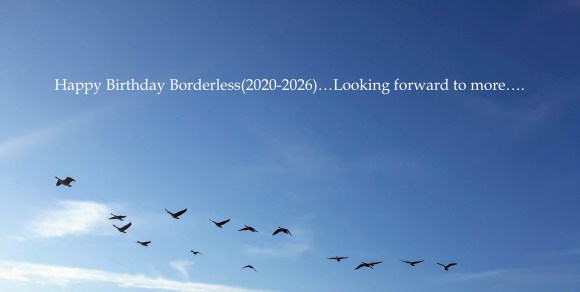
Sometimes, we have an idea, a thought and then it takes form and becomes a reality. That is how the Borderless Journal came to be six years ago while the pandemic raged. The pandemic got over and takeovers and wars started. We continued to exist because all of you continue to pitch in, ignoring the differences created by certain human constructs. We meet with the commonality of felt emotions and aesthetics to create a space for all those who believe in looking beyond margins. We try to erase margins or borders that lead to hatred, anger, violence and war. Learning from the natural world, we believe we can be like the colours of the rainbow that seem to grow out of each other or the grass that is allowed to grow freely beyond manmade borders. If nature gives us lessons through its processes, is it not to our advantage to conserve what nurtures us, and in the process, we save our home planet, the Earth? We could all be together in peace, enjoying nature and nurture, living in harmony in the Universe if only we could overlook differences and revel in similarities.
A young poet Nma Dhahir says it all in her poem that is a part of our journal this month —
This is how we stay human together: by refusing the easy damage, by carrying each other without calling it sacrifice, by believing that what we protect in one another eventually protects the world.
Translations has more poetry with Professor Fakrul Alam bringing us Nazrul’s Bengali lyrics in English and Fazal Baloch familiarising us with beautiful Balochi poetry of the late Majeed Ajez, a young poet who left us too soon. Isa Kamari translates his own poems from Malay, capturing the colours of the community in Singapore to blend it with a larger whole. And of course, we have a Tagore poem rendered into English from Bengali. This time it’s a poem called ‘Jatra (Journey)’ which reflects not only on social gaps but also on politics through aeons.
Christine C Fair has translated a story from Punjabi by Lakhvinder Virk, a story that reflects resilience in women who face the dark end of social trends, a theme that reverberates in Flanagan’s poetry and Meenakshi Malhotra’s essay, which while reflecting on the need of different perspectives in histories – like water and nomads — peeks into the need to recall women’s history aswell. This is important not just because March hosts the International Women’s Day (IWD) but because one wonders if women in Afghanistan are better off now than the suffragettes who initiated the idea of such a day more than a century ago?
This time our non-fiction froths over with scrumptious writings from across continents. Tamara-Lee Brereton-Karabetsos muses on looking at numbers and beyond to enjoy the essence of nature. Farouk Gulsara ideates about living on in posterity through deeds and ideas. Gower Bhat shares how he learns story writing skills from watching movies. Meredith Stephens talks of her experience of a fire in the Australian summer. Bhaskar Parichha writes with passion about his region, Odisha. We have a heartfelt tribute to Mark Tully, who transcended borders, from Bhowmick. And an essay on Arundhati Roy’s memoir, Mother Mary Comes to Me, from Somdatta Mandal, which explores not just the book but also the covers which change with continents. Prithvijeet Sinha travels beyond Lucknow and Suzanne Kamata brings to us stories about her trip to Phnom Penh.
Keith Lyons draws from the current crises and writes about changing times, suggesting: “Changes aren’t endings, but thresholds.” Perhaps, if we see them as ‘thresholds of change’, the current events are emphasising the need to accept that human constructs can be redefined. I am sure a Neolithic or an Australopithecus would have been equally scared of evolving out of their system to one we would deem ‘superior’. Life in certain ways can only evolve towards the future, even if currently certain changes seem to be retrogressive. We can never correctly predict the future… but can only imagine it. And Devraj Singh Kalsi imagines it with a dollop of humour where tails become a trend among humans again!
Humour and absurdity are woven into a series of short fables by Hughes while Naramsetti Umamaheswarao weaves a fable around acceptanceof differences. In fiction, we have stories of resilience from Jonathon B Ferrini and Terry Sanville. Bhat gives us a story set in Kashmir and Sohana Manzoor gives us one set in Dhaka, a narrative that reminds one of Jane Austen… and perhaps even an abbreviated version of the 2001 film, Monsoon Wedding.
In reviews we have, Mohammad Asim Siddiqui discussing Anisur Rahman’s The Essential Ghalib. Rituparna Khan has written on Malashri Lal’s poetry collection reflecting on women, Signing in the Air. And Bhaskar Parichha has reviewed Deepta Roy Chakraverti’s Daktarin Jamini Sen: The Life of British India’s First Woman Doctor, a book that reflects on the resilience that makes great women. Thus, weaving in flavours of the IWD, which applauds women who are resilient while urging humans for equal rights for one half of the world population.
While we ponder on larger realities, Borderless Journal looks forward to a future with more writings centred around humanity, climate change, our planet and all creatures great and small. This year has not only seen a rise in readership and contributors — and the numbers rose further after our unsolicited Duotrope listing in October 2025 — but has also attracted writers from more challenged parts of the world, like Ukraine, Iran, Tunisia and Kurdistan. We are delighted to home writing from all those who attempt to transcend borders and be a part of the larger race of humanity. I would like to quote Margaret Atwood to explain what I mean. “I hope that people will finally come to realize that there is only one ‘race’—the human race—and that we are all members of it.” And I would like to extend her view to find solidarity with all living beings. I hope that there will be a point in time when we will realise there’s not much difference between, a lizard, a fly, a human or a tree… All these lifeforms are necessary for our existence.
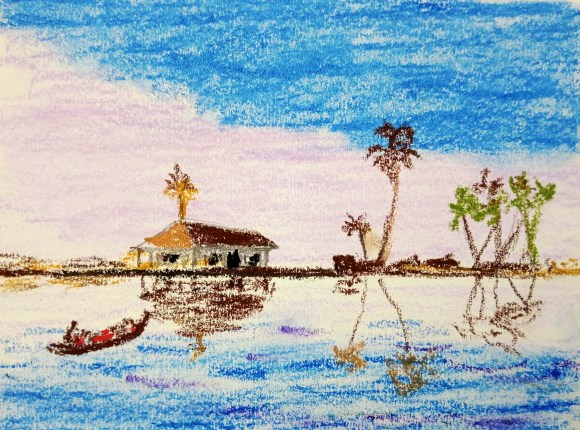
I would want to hugely thank all our team for stretching out and making this a special issue for our sixth anniversary and Manzoor for her fabulous artwork. Huge thanks to all our contributors and readers for being with us through our journey. Let’s change the world with peace, love and friendship!
It was a sombre occasion. The only sounds audible were the occasional sniffles and a quiet hum of a mantra in the background. The crowd arrived in an orderly manner, circled the casket, paused at her feet, touched them, and raised their hands in reverence. They stopped near the son; some offered a consolatory handshake while others embraced. Afterwards, they found a safe corner to watch the world go on, lost in thought. They wonder if they should slow down, take a step back, and smell the roses. They understand that every passing day brings them closer to the day when they will be the main focus at such an event.
Many who knew her well will remember her 87 years of life and the challenges she faced. Coming to Malaysia as a young, match-made bride from India, she must have encountered difficulties adapting to her new country. Widowed for more than half her life, her children were her constant companions. The recent sudden death of her eldest son took a heavy toll on this octogenarian. It said that the biggest burden that a parent carries is to bury their own child.
The mourners who were there at the funeral were there to pay respect to the soul that had endured all the challenges that life threw at her. Amid those hurdles, she managed to bring forth offspring who helped make the world a better place. The kids, in their own ways, contributed to society and the nation. It is like a 21-gun salute to a fallen hero, minus the military regalia. That is all.
It was an act of gratitude. The rituals symbolised the completion of a book; an immersive one. The covers were closed, but the memory of its contents would linger in readers’ minds for a long time, especially if it was well written. What is a good book in the story of life? That would start the debate about the purpose of life. Why are we here? Is it a reward to be born into a species with higher senses, after enduring millions of births before which were not so glamorous? Is it a test bed for other births to come?
Are we here just to engage in the dizzyingly indulgent experience of being alive? Are we sent here to make some indelible change or leave a legacy?
These questions popped up again after his funeral as I was watching a reel sent to me on social media.
It was one of those rare, civilised discourses on Tamil Nadu TV about the younger generation and their outlook on marriage and having kids. On one side of the auditorium, Baby Boomers and Gen-X’ers[1] were complaining that Gen-Zs were delaying their marriages and even postponing the time they embarked on having children. Their bone of contention was that this was bad for society at large. Society’s in a constant flux, needing new innovations and people with unabashed energy to stay afloat. Only young minds can do this. Delaying this process could be a disservice to mankind, they say.
In defence, the Gen-Zs asserted that we are given just one life. Within that span of a lifetime, we are expected to learn, save, serve, experience and enjoy. There isn’t much time. Bringing a child into the world is a big commitment and a strain on their time and finances. There is no guarantee that they would do as good a job as the generation before them. They went on to say that the world is a dangerous place with predators and with global degradation on the rise, every living day draws earthlings a day closer to annihilation. The fear of passing on harmful genes was also mentioned.
In rebuttal, they were told that no one comes with a cookbook for surviving. Everyone tends to learn on the job, savouring every moment of it, the ups and downs, and leaves the world with nothing but memories. If that is our purpose in life in the first place, this was it.
Then again, the same thought came into my conscience around the time when Renée Good was shot dead by ICE (Immigration and Customs Enforcement) officers in Minnesota. If Renée were not shot, the world would probably not be reading her award-winning poem, ‘On Learning to Dissect Fetal Pigs‘. As if by a stroke of serendipitous and synergistic coincidence, her poem also explores the interplay of faith and scientific reason in our day-to-day lives. The logical mind tells us something is either white or black. Further exploration may reveal various shades of white, off-white, beige, ivory, and more. There is a confusing line that separates the analytical mind, which complicates understanding, from the spiritual awe that prompts one into submission. In that poem, Renée probably conceives of life as a chance meeting of an ovum and a sperm. Is there a higher meaning for this chance meeting?
To quote George Orwell, “The trouble is every generation imagines itself to be more intelligent than the one that went before it, and wiser than the one that comes after it.” In the late 18th century, economist Thomas Malthus postulated that population would outstrip food production, leading the world to starve into oblivion. Subsequent generations, through science, proved him utterly wrong, and we are now afflicted with malnutrition of abundance.
We should not underestimate the next generation to find answers to questions we cannot answer.
Every generation is still searching for the ultimate secret of life. What we are given instead are the red pill of the sciences and the blue pill of unquestionable social traditions[2].
Propagating the race with our progeny may not be the only reason for existence. If such is the case, the world would not remember literary doyens like Jane Austen and Virginia Woolf. Neither would spiritual figures, like Swami Vivekananda and Adi Shankara, who left without children, remain in people’s minds. They left us with chests full of wisdom to help us think.
A perfect life need not be complemented with children. Legacies may be handed down by other means, through passing of wisdom, art or impact.
[2] The Red Pill / Blue Pill concept was introduced in the 1999 movie, ‘The Matrix’. The Red Pill reveals the harsh truth about the world, and the Blue Pill lets him stay in comfortable ignorance.
Farouk Gulsara is a daytime healer and a writer by night. After developing his left side of his brain almost half his lifetime, this johnny-come-lately decided to stimulate the non-dominant part of his remaining half. An author of two non-fiction books, Inside the twisted mind of Rifle Range Boy and Real Lessons from Reel Life, he writes regularly in his blog, Rifle Range Boy.
PLEASE NOTE: ARTICLES CAN ONLY BE REPRODUCED IN OTHER SITES WITH DUE ACKNOWLEDGEMENT TO BORDERLESS JOURNAL
Six years ago, a few of us got together to bring out the first issue of Borderless Journal. We started as a daily blog and then congealed into a monthly journal offering content that transcends artificial borders to meet with the commonality of felt emotions, celebrating humanity and the Universe. Today as we complete six years of our existence in the clouds, we would like to celebrate with all writers and readers who made our existence a reality. We invite you to savour writings collected over the years that reflect and revel in transcending borders, touching hearts and some even make us laugh while exploring norms.
In this special issue. we can only offer a small sample of writings but you can access many more like these ones at our site…Without further ado, let us harmonise with words. We invite you to lose yourselves in a borderless world in these trying times.
Rebel or ‘Bidrohi’, Nazrul’s signature poem, ‘Bidrohi‘, translated by Professor Fakrul Alam. Click here to read.
Manish Ghatak’s Aagun taader Praan (Fire is their Life) has been translated from Bengali by Indrayudh Sinha. Click here to read.
Tagore’s poem, Tomar Shonkho Dhulay Porey (your conch lies in the dust), has been translated from Bengali by Mitali Chakravarty as ‘The Conch Calls’. Click here to read.
Ihlwha Choi spent some time in Santiniketan and here are poems he wrote in reaction to his observations near the ‘home of R.Tagore’, as he names Santiniketan and the Kobiguru. Click here to read Nandini.
Rituals in the Garden: Marcelo Medone discusses motherhood, aging and loss in this poignant flash fiction from Argentina. Click here to read.
Navigational Error: Luke P.G. Draper explores the impact of pollution with a short compelling narrative. Click here to read.
Henrik’s Journey: Farah Ghuznavi follows a conglomerate of people on board a flight to address issues ranging from Rohingyas to race bias. Click hereto read.
The Magic Staff , a poignant short story about a Rohingya child by Shaheen Akhtar, translated from Bengali by Arifa Ghani Rahman. Click here to read.
A Cat Story : Sohana Manzoor leaves one wondering if the story is about felines or… Clickhere to read.
When West Meets East & Greatness Blooms: Debraj Mookerjee reflects on how syncretism impacts greats like Tagore,Tolstoy, Emerson, Martin Luther King Jr, Gandhi and many more. Click here to read.
The Day Michael Jackson Died: A tribute by Julian Matthews to the great talented star who died amidst ignominy and controversy. Click here to read.
Potable Water Crisis & the Sunderbans: Camellia Biswas, a visitor to Sunderbans during the cyclone Alia, turns environmentalist and writes about the potable water issue faced by locals. Click here to read.
My Love for RK Narayan, Rhys Hughes discusses the novels by ths legendary writer from India. Click here to read.
Travels ofDebendranath Tagore: These are travel narratives by Debendranath Tagore, father of Rabindranath Tagore, translated from Bengali by Somdatta Mandal. Click here to read.
Baraf Pora (Snowfall): This narrative gives a glimpse of Tagore’s first experience of snowfall in Brighton and published in the Tagore family journal, Balak (Children), has been translated by Somdatta Mandal . Clickhere to read.
The Day of Annihilation: An essay on climate change by Kazi Nazrul Islam has been translated from Bengali by Radha Chakravarty. Clickhereto read.
Reminiscences from a Gallery: The Other Ray: Dolly Narang muses on Satyajit Ray’s world beyond films and shares a note by the maestro and an essay on his art by the eminent artist, Paritosh Sen. Click here to read.
The Bauls of Bengal: Aruna Chakravarti writes of wandering minstrels called bauls and the impact they had on Tagore. Click here to read.
Most people like you and me connect with the commonality of felt emotions and needs. We feel hungry, happy, sad, loved or unloved and express a larger plethora of feelings through art, theatre, music, painting, photography and words… With these, we tend to connect. And yet, larger structures created over time to offer security and governance to the masses—of which you and I are a part — have grown divisive, and, by the looks of it, the fences nurtured over time seem insurmountable. To retain these structures that were meant to keep us safe, wars are being fought and many are getting killed, losing homes and going hungry. We showcase such stories, poems and non-fiction to create an awareness among those who are lucky enough to remain untouched. But is there a way out, so that all of us can live peacefully, without war, without hunger and with love and a vision towards surviving climate change which (like it or not) is upon us?
Creating an awareness of hunger and destruction wreaked by war is a heartrending story set in Gaza by JK Miller. While Snigdha Agrawal’s narrative gives a sense of hope, recounting a small kindness by a common person, Sayan Sarkar shares a more personal saga of friendship and disillusionment — where people have choice. But does war leave us a choice as it annihilates friendships, cities, homes and families? Naramsetti Umamaheswararao’s story reiterates the belief in the family – peace being an accepted unit. Vela Noble’s fantastical fiction and art comes like a respite– though there is a darker side to it — with a touch of fun. Perhaps, a bit of fantasy and humour opens the mind to deal with the more sombre notes of existence.
The translation section hosts a story by Hamiruddin Middya, who grew up as a farmer’s son in Bengal. Steeped in local colours, it has been rendered into English by V Ramaswamy. Nazrul’s song revelling in the colours of spring has been translated from Bengali by Professor Fakrul Alam. Atta Shad’s pensive Balochi lines have been brought to us in English by Fazal Baloch. Isa Kamari continues to bring the flavours of an older, more laid-back Singapore with translations of his own Malay poems. A couple of Persian verses have been rendered into English by the poet, Akram Yazdani, herself. Questing for harmony, Tagore’s translated poem while reflecting on a child’s life, urges us to have the courage to be like a child — open, innocent and willing to imagine a world laced with trust and hope. If we were all to do that, do you think we’d still have wars, violence and walls built on hate and intolerance?
Mario Fenech takes a look at the idea of time. Amir Zadnemat writes of how memory is impacted by both science and humanities while Andriy Nivchuk brings to us snippets from Herodotus’s and Pericles’s lives that still read relevant. Ravi Varmman K Kanniappan gives the journey of chickpeas across space and time, asserting: “The chickpea does not care about your ideology, your portfolio, or your meticulously curated identity. It will grow, fix nitrogen, feed someone, and move on without a press release.” It has survived over aeons in a borderless state!
In book excerpts, we have a book that transcends borders as it’s a translation from Assamese by Ranjita Biswas of Arupa Kalita Patangia’s Moonlight Saga. Any translation is an attempt to integrate the margins into the mainstream of literature, and this is no less. The other excerpt is from Natalie Turner’s The Red Silk Dress. Keith Lyons has interviewed Turner about her novel which crosses multiple cultures too while on a personal quest.
Holding on to that idea, we invite you to savour the contents of our February issue.
Huge thanks to all our contributors and readers for making this issue possible. Heartfelt thanks to our wonderful team, especially Sohana Manzoor for her fabulous artwork.
Enjoy the reads!
Let’s look forward to the spring… May it bring new ideas to help us all move towards more amicable times.
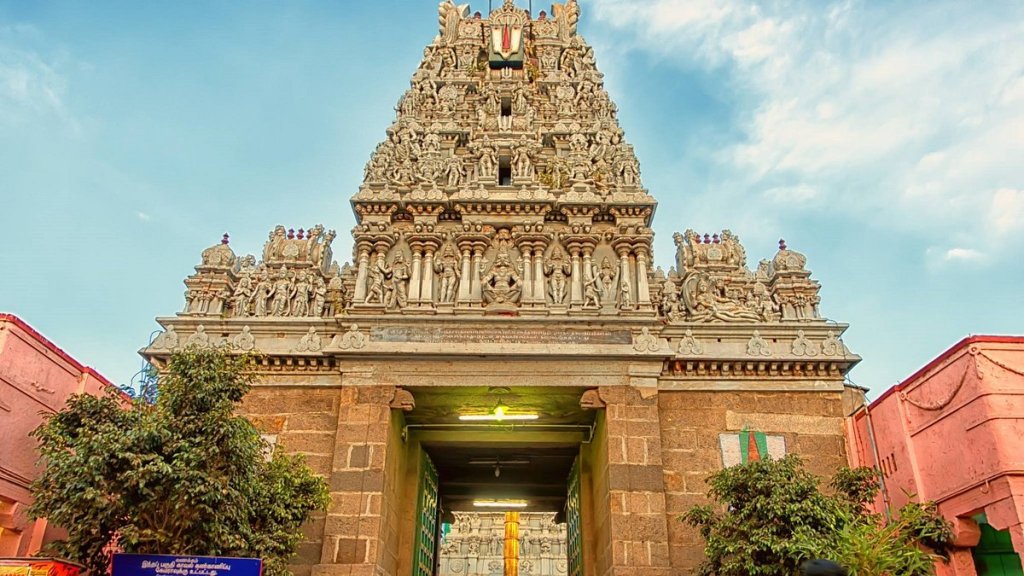
“Which part of India did your people come from?” asked the Tamil tour guide during our last trip to Chennai.
“I know my forefathers came from Tamil Nadu, but, sorry can’t tell you which part of Tamil Nadu or village they came from,” I told him in Tamil. “I am a third generation Malaysian Indian. We lost touch with all the relatives back home.”
“Your Tamil is very good for someone out of this country. Judging from way you speak, you could pass off for someone from Thanjavur!” he went on.
“People from Malaysia have mostly left their original accent and have developed new ones with Malay and Chinese words in theirs, so you cannot pigeonhole them to any region in India anymore.” I replied.
In a philosophical tone, he paused, then said, “I am here in Chennai, and you are there in Malaysia, and the only thing that connects us is the Tamil language.”
Of course, there is the DNA that unites us, but the bond that draws us to India is independent of the language spoken or written.
Our little conversation reminded me of the 1980s music video ‘Down Under’ by the Australian rock band, Men at Work. In that scene, the singer goes around the world, and everyone recognises him with his characteristic Aussie mannerisms. “Do you come from a land Down Under?” is their first response.
My grandparents and parents believed that, despite moving away from their homeland due to increasingly hostile living conditions, it was necessary to pass down their culture and language. Perhaps it was the only language they knew. They did not turn their backs on Tamil Nadu, nor let their offspring immerse themselves solely in the local culture. They had no anger towards their country. They did not turn their backs on her. They understood their motherland was going through difficult times and that tides would eventually change. Maybe they thought that one day their descendants would return and boast about how their princes of the soil had succeeded in a distant land, even while still holding onto their ancestral roots – the mother tongue.
It looks like the sun has risen, and the country has awakened from her long slumber, continuing to pursue what she stopped in her glorious past. Even her children, who have spread across all corners of the Earth, have made her proud.
For the rest of my trip, I conversed in Tamil, checked into a four-star hotel, and even conducted transactions at a bank counter. At first glance, I am sure they could tell I was not local, with liberal use of the word ‘lah’[1] in my sentences and the distinctive sing-song manner Malaysians use when speaking Tamil, it seems. The Malaysians are also described as extremely courteous, unlike the locals there.
[1]Lah is a phrase used by Malaysians and Singaporeans in local parlance
.
Farouk Gulsara is a daytime healer and a writer by night. After developing his left side of his brain almost half his lifetime, this johnny-come-lately decided to stimulate the non-dominant part of his remaining half. An author of two non-fiction books, Inside the twisted mind of Rifle Range Boy and Real Lessons from Reel Life, he writes regularly in his blog, Rifle Range Boy.
PLEASE NOTE: ARTICLES CAN ONLY BE REPRODUCED IN OTHER SITES WITH DUE ACKNOWLEDGEMENT TO BORDERLESS JOURNAL
Five poems by Pravasini Mahakudahave been translated to English from Odia by Snehaprava Das. Click here to read.
A Poet in Exileby Dmitry Blizniuk has been translated from Ukranian by Sergey Gerasimov. Click hereto read.
Kalponik or Imaginedby Tagore has been translated from Bengali by Mitali Chakravarty. Click hereto read.
Pandies Corner
Songs of Freedom: The Seven Mysteries of Sumona’s Life is an autobiographical narrative by Sumona (pseudonym), translated from Hindustani by Grace M Sukanya. These stories highlight the ongoing struggle against debilitating rigid boundaries drawn by societal norms, with the support from organisations like Shaktishalini and Pandies. Click here to read.
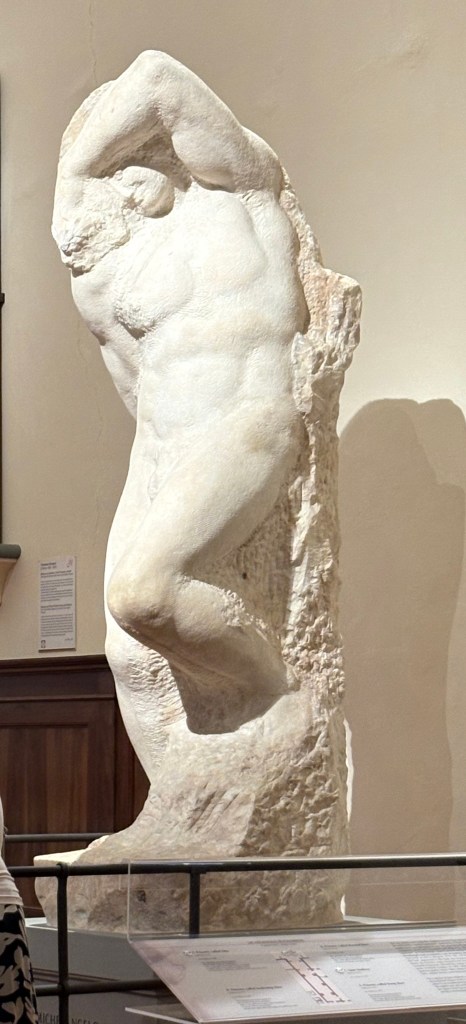
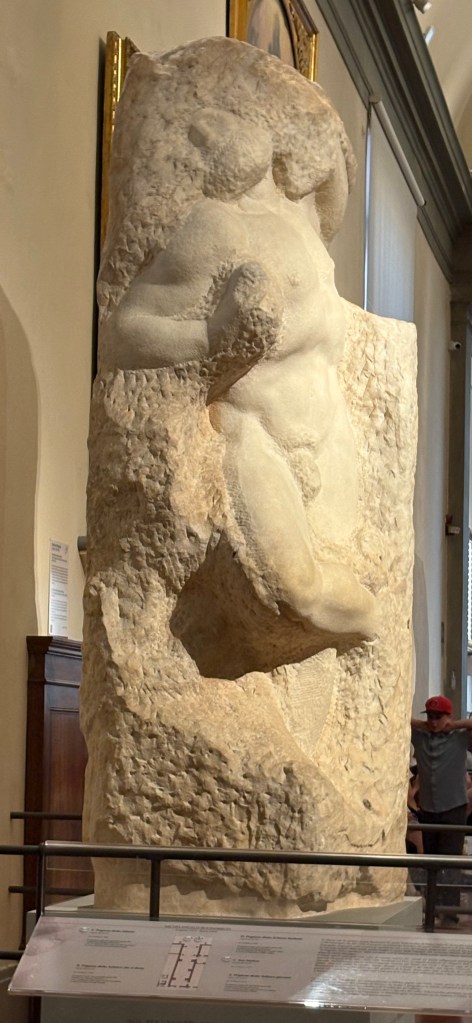
Incomplete statues of Michelangelo in Accademia Gallery, Florence
In the Accademia Gallery, Florence, are housed incomplete statues by Michelangelo that were supposed to accompany his sculpture of Moses on the grand tomb of Pope Julius II. The sculptures despite being unfinished, incomplete and therefore imperfect, evoke a sense of power. They seem to be wresting forcefully with the uncarved marble to free their own forms — much like humanity struggling to lead their own lives. Life now is comparable to atonal notes of modern compositions that refuse to fall in line with more formal, conventional melodies. The new year continues with residues of unending wars, violence, hate and chaos. Yet amidst all this darkness, we still live, laugh and enjoy small successes. The smaller things in our imperfect existence bring us hope, the necessary ingredient that helps us survive under all circumstances.
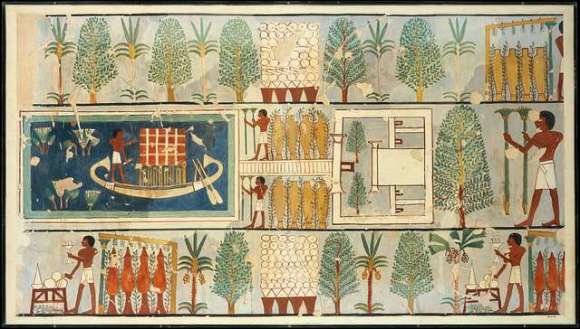
Imperfections, like Michelangelo’s Non-finito statues in Florence, or modern atonal notes, go on to create vibrant, relatable art. There is also a belief that when suffering is greatest, arts flourish. Beauty and hope are born of pain. Will great art or literature rise out of the chaos we are living in now? One wonders if ancient art too was born of humanity’s struggle to survive in a comparatively younger world where they did not understand natural forces and whose history we try to piece together with objects from posterity. Starting on a journey of bringing ancient art from her part of the world, Ratnottama Sengupta shares a new column with us from this January.
Drenched in struggles of the past is also Showkat Ali’s The Struggle: A Novel, translated from Bengali by V. Ramaswamy and Mohiuddin Jahangir. It has been reviewed by Somdatta Mandal who sees it a socio-economic presentation of the times. We also carry an excerpt from the book as we do for Anuradha Marwah’s The Higher Education of Geetika Mehendiratta. Marwha’s novel has been reviewed by Meenakshi Malhotra who sees it as a bildungsroman and a daring book. Bhaskar Parichha has brought to us a discussion on colonial history about Rakesh Dwivedi’s Colonization Crusade and Freedom of India: A Saga of Monstrous British Barbarianism around the Globe. Udita Banerjee has also delved into history with her exploration of Angshuman Kar’s The Lost Pendant, a collection of poems written by poets who lived through the horrors of Partition and translated from Bengali by multiple poets. One of the translators, Rajorshi Patranabis, has also discussed his own book of supernatural encounters, Whereabouts of the Anonymous: Exploration of the Invisible. A Wiccan by choice, Patranbis claims to have met with residual energies or what we in common parlance call ghosts and spoken to many of them. He not only clicked these ethereal beings — and has kindly shared his photos in this feature — but also has written a whole book about his encounters, including with the malevolent spirits of India’s most haunted monument, the Bhangarh Fort.
Bringing us an essay on a book that had spooky encounters is Farouk Gulsara, showing how Dickens’ A Christmas Carolrevived a festival that might have got written off. We have a narrative revoking the past from Larry Su, who writes of his childhood in the China of the 1970s and beyond. He dwells on resilience — one of the themes we love in Borderless Journal. Karen Beatty also invokes ghosts from her past while sharing her memoir. Rick Bailey brings in a feeling of mortality in his musing while Keith Lyons, writes in quest of his friend who mysteriously went missing in Bali. Let’s hope he finds out more about him.
Charudutta Panigrahi writes a lighthearted piece on barbers of yore, some of whom can still be found plying their trade under trees in India. Randriamamonjisoa Sylvie Valencia dwells on her favourite place which continues to rejuvenate and excite while Prithvijeet Sinha writes about haunts he is passionate about, the ancient monuments of Lucknow. Gulsara has woven contemporary lores into his satirical piece, involving Messi, the footballer. Bringing compassionate humour with his animal interactions is Devraj Singh Kalsi, who is visited daily by not just a bovine visitor, but cats, monkeys, birds and more — and he feeds them all. Suzanne Kamata takes us to Kishi, brought to us by both her narrative and pictures, including one of a feline stationmaster!
We've run away from the simmering house
like milk that is boiling over. Now I'm single again.
The sun hangs behind a ruffled up shed,
like a bloody yolk on a cold frying pan
until the nightfall dumps it in the garbage…

('A Poet in Exile', by Dmitry Blizniuk, translated from Ukranian by Sergey Gerasimov)
In translations, we have Professor Fakrul Alam’s rendition of Nazrul’s mellifluous lyrics from Bengali. Isa Kamari has shared four more of his Malay poems in English bringing us flavours of his culture. Snehaparava Das has similarly given us flavours of Odisha with her translation of Pravasini Mahakuda’s Odia poetry. A taste of Balochistan comes to us from Fazal Baloch’s rendition of Sayad Hashumi’s Balochi quatrains in English. Tagore’s poem ‘Kalponik’ (Imagined) has been rendered in English. This was a poem that was set to music by his niece, Sarala Devi.
After a long hiatus, we are delighted to finally revive Pandies Corner with a story by Sumona translated from Hindustani by Grace M Sukanya. Her story highlights the ongoing struggle against debilitating rigid boundaries drawn by societal norms. Sumana has assumed a pen name as her story is true and could be a security risk for her. She is eager to narrate her story — do pause by and take a look.
In fiction, we have a poignant narrative about befriending a tramp by Ross Salvage, and macabre and dark one by Mary Ellen Campagna, written with a light touch. It almost makes one think of Eugene Ionesco. Jonathan B. Ferrini shares a heartfelt story about used Steinway pianos and growing up in Latino Los Angeles. Rajendra Kumar Roul weaves a narrative around compassion and expectations. Naramsetti Umamaheswararao gives a beautiful fable around roses and bees.
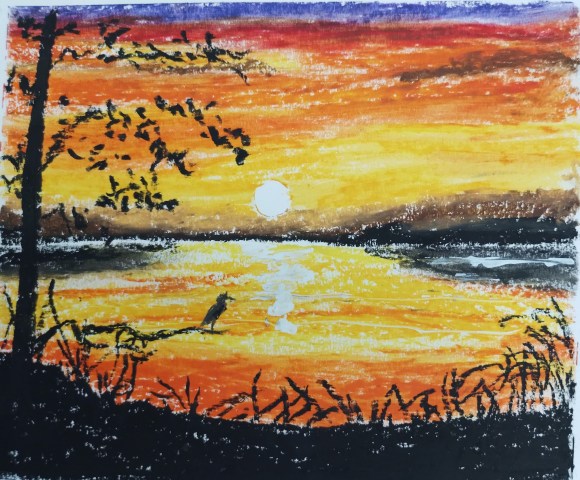
With that, we come to the end of a bumper issue with more than fifty peices. Huge thanks to all our fabulous contributors, some of whom have not just written but shared photographs to illustrate the content. Do pause by our contents page and take a look. My heartfelt thanks to our fabulous team for their output and support, especially Sohana Manzoor who does our cover art. And most of all huge thanks to readers whose numbers keep growing, making it worth our while to offer our fare. Thank you all.
Here’s wishing all of you better prospects for the newborn year and may we move towards peace and sanity in a world that seems to have gone amuck!
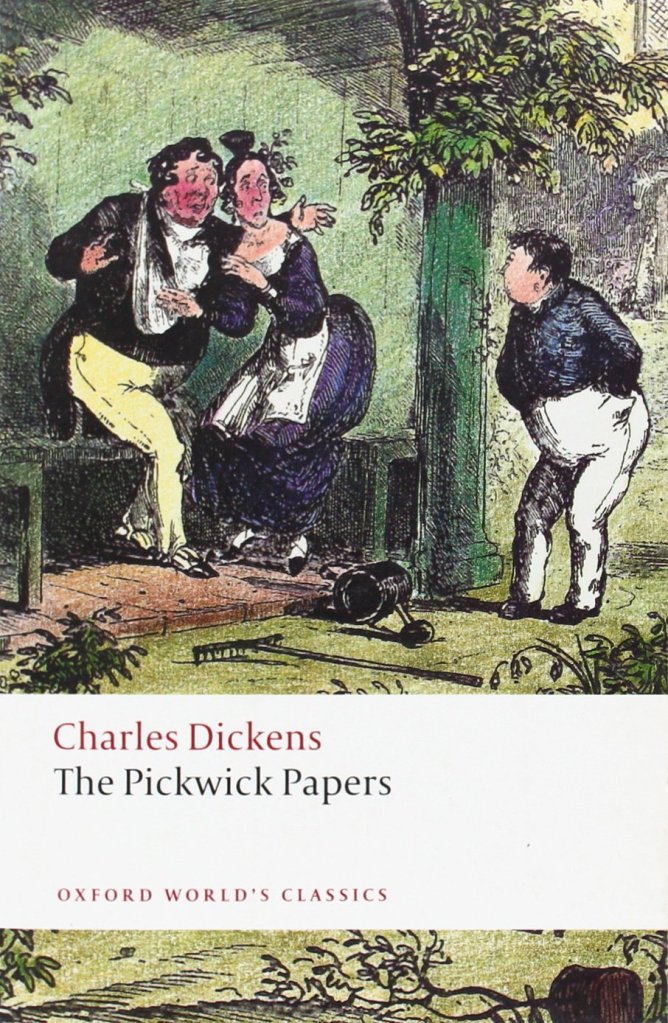
Charles Dickens was flying high by 1842. His books, Pickwick Papers and Oliver Twist, and periodicals were selling like hot cakes on both sides of the Atlantic. With so many fans over in America, he decided to pay them a visit. What he saw in the second-largest fan base upset him for two reasons. Firstly, there was the issue of royalty. Publishers in America were printing his work left, right and centre. He received none of the returns due to him. Secondly, he was upset with the level of racism and their cavalier attitude towards slavery, even amongst the northern states.
Dickens could not stomach the dehumanisation of the black Americans. The vocal and expressive writer, who drew his readers to his craft in the first place, wrote in one of his later articles about his trip to America. He did not twist his words when he wrote verbatim in his American travelogues of slaveowners’ advertisements about their runaway slaves. In one of these advertisements, it read, “Ran away, a negro woman and two children; a few days before she went off, I burnt her with a hot iron, on the left side of her face. I tried to make the letter M.”
A few years earlier, Britain had outlawed slavery, so the British felt a bit of moral superiority over the Americans.
The Americans did not take to this kindly. Dickens’ following few publications fared poorly.
Meanwhile, Britain was also changing.
It was industrialising as its Empire ventured far and wide to exotic lands. With that came the increasing gap between the poor and the rich. The poor remained short of money and short of education opportunities. With the development of science, religious belief took a back seat. Catholicism lost its favour. The Puritans were disillusioned with the material world.
The idea of Christmas and family togetherness was losing out. Work took up most of the time. There were no documented Christmas holidays. The ancient midwinter culture of Europeans had lost its lustre. Many of the Christmas iconographies were viewed as pagan in the UK and the US. The Puritans viewed life as hard, and having joy and fun was scorned. A small proportion of people still wanted to revive the spirit of Christmas.
Against this background, Dickens returned home. His following two books received a poor reception from readers. He resumed his social work, helping the marginalised. At that time, the prevailing view in the UK was that poverty was self-inflicted. The society felt that providing aid to the poor was counterproductive; it made them lazy. People deserved to go hungry for producing so many children, and the Malthusian theory that food demand would outstrip supply seemed to be coming true. The 1840s were known as the “hungry 40s.” Famine was looming.
Yet another layer of population, the reformists, took it upon themselves to help the downtrodden. Dickens was one of those souls. In Manchester, after giving an emotional lecture at a fundraiser to feed and educate poor children, he went for one of his famous long walks.
As he walked the streets, an idea struck him. He visualised a man who had lost all his compassion and had to be jolted back into a complete sense of his humanity. The story helped rebuild Christmas and the compassion that had been lost over the years. The rest, as they say, is history. A Christmas Carol reformed Victorian Britain.
Photo provided by Farouk Gulsara
Reference:
From Journey Through Time: 59. A Christmas Carol: The Book That Brought Back Christmas (Ep 1), 25 Dec 2025. Podcast
Farouk Gulsara is a daytime healer and a writer by night. After developing his left side of his brain almost half his lifetime, this johnny-come-lately decided to stimulate the non-dominant part of his remaining half. An author of two non-fiction books, Inside the twisted mind of Rifle Range Boy and Real Lessons from Reel Life, he writes regularly in his blog, Rifle Range Boy.
PLEASE NOTE: ARTICLES CAN ONLY BE REPRODUCED IN OTHER SITES WITH DUE ACKNOWLEDGEMENT TO BORDERLESS JOURNAL
With the amount of information I am bombarded with daily, I often wonder, as one usually does, how all these changes will change society. Are we all going to be empowered, aware, and demanding what is due to us? Will our minds be so open that we can accept that there is more than one way to skin a cat? On the contrary, will we become more aware of the many ways we can be taken for a ride, and so paranoid that we cannot even breathe a breath of fresh air? What if it is contaminated with toxic effluents?
Three recent video clips steered my mind towards this end.
In the first instance, a group of spectators in a stadium in Kolkata went amok. They were seen tearing fences and wrecking stadium chairs and equipment. They had come to see their favourite world-famous footballer, Lionel Messi, interact with fans. Perhaps the organisers had noble intentions that by having these types of exhibitions, more youngsters in India would take up the sport.
Unfortunately, the events of that day were quite different. It became a façade, with Messi surrounded by multiple VIPs and their entourages, all eager to take selfies from every angle.
The crowd was furious that the star was interacting only with VIPs, their children, politicians, and their kin. Messi was seen being passed around like a soccer ball to capture that perfect picture that would one day adorn their study. The ordinary spectators were left drooling, unable to get close enough to see Messi’s scoring actions. Messi was then seen joking around with the exclusive group of kids, kicking a few balls before departing.
The spectators paid good money not to see their hero paraded as a selfie model. They came expecting some action. A show promised to last two hours, but it ended after just half-an-hour when politicians and officials hijacked the event. One trigger, and chaos erupted.
What happened? Were the people in the stadium offended because they felt duped after paying a lot of money to catch glimpses of the hero posing with others and their children, not with them? They believed his appearance was too brief to matter. They thought the wealthy had used the ticket sales for their own pleasures.
Has Messi’s overexposure in the media led ordinary people to claim ownership of Messi? They believe they have a legitimate right to him. Watching others possess their hero while he is kept outside was too much for them to bear. Meanwhile, they overlook that their own football hero, Sunil Chhetri, reportedly the world’s third-highest goal scorer after Ronaldo and Messi, is ignored. Some Indians do not even know who Chhetri is.
Another reel that reached me showed stranded Indigo passengers having a field day berating the frontliners verbally as thousands of flights were cancelled because the airline could not comply with the new aviation regulations. The reel commentator scolded the passengers for their unruly behaviour. People of a certain stature, well-travelled and well-informed, should not be behaving as they did—loud, abusive, threatening, and insulting the ground staff. The recipients were merely lowly-paid messengers who had no control over operations, yet they bore the brunt of every customer’s insult.
The message further criticises the stranded passengers for losing their composure. They should have behaved with more dignity. In their view, flying is a privilege enjoyed by the educated; hence the need to act ‘cultured’ rather than resort to theatrics. The demonstration exemplified the deep-rooted middle-class mentality that seemed to prevail amongst the nouveau riche.
It is too simplistic to assume this. The rot runs deeper. On one hand, there is a feeling that passengers are being taken for fools. Airlines have recently been cutting corners due to the sharp increase in air travel. With so many new destinations, more flights, and affordability, the airline industry has never been more profitable. Making hay while the sun shines is the airlines’ motto. By squeezing pilots, crew members, and ground staff, the owners have had a field day. Recognising this, those in power tightened regulations to ensure air safety. Sufficient time was given to industry players to make amends. Indigo, holding the lion’s share of India’s air travel market, believed it was above the law. They procrastinated defiantly. That, in short, led to this fiasco.
So, were the passengers justified in their behaviour? Some were attending job interviews, some were about to get married, while others were taking part in equally important, life-changing events. All of it was for nothing because profiteers turned into vultures. There must surely be some etiquette in the business. They should have a minimum level of responsibility to follow the law and ensure safety. Instead, they failed. They killed the golden goose.
The failure of public relations to provide practical solutions, leaving customers in limbo about how events would unfold, is a recipe for disaster. And it happened.
In Malaysia, nearly every time after a fatal motor vehicle accident, the public is informed that the driver involved in causing death was driving without a valid driving licence, road tax, or had 30 or 40 unpaid summonses. Each time a suspect sustains fatal wounds during car chases, interrogations, or while in custody, the Malaysian public raises concerns. In defence, the police often mention possession of machetes and criminal records related to the deceased, as if their demise is justified and question why the public should mourn a hardened criminal.
This time, it was different. Police allegedly engaged in a highway car chase and shot three suspects. They soon announced their list of criminal records and provided a summary of the weapons found and the sequence of events. What the police did not know was that the spouse of one of the deceased had recorded her conversation with her partner, and the phone recording continued until after the trigger was pulled.
A day after the incident, the recording surfaced. The gunshot did not resemble a typical shootout but rather an execution. The postmortem report complicated matters further. The bullet entered the nose and pierced the heart, execution style.
For so long, the Malaysian public had been told to believe the various narratives about these kinds of deaths. For the first time, telecommunications tools may reveal what actually happens during police chases in the dead of night. Amnesty International has been warning us that our police custodial death rates are alarmingly high. The police have been dragging their feet on the public appeal to set up an Independent Police Complaints and Misconduct Commission and to equip their officers with body cameras.
Is the damning evidence produced by modern devices a turning point in how policing is done in Malaysia?
Modern life has changed many of our priorities. If, a century ago, the average man was content with decent square meals, enough garments to keep himself and cover the essentials, had a roof over his head and was able to provide for his family, the modern man needs more than that. The world’s modern economy, on the one hand, makes him quite aware of his surroundings. He is cognisant of different ways in which others live their life. On the downside, he has become a little self-centred and hedonistic. Travel to a foreign land has become an essential pastime. His obsession with famous media icons makes him mindlessly parrot his hero. He dresses like them, mimics their mannerisms and worships the Earth they stand on. Not all this work is for the betterment of society.
The fence that separates the elite and the plebeians is crumbling. Certain privileged information was kept from the general public, deemed necessary to ensure peace. Disinformation and uncertainty worked very well to maintain law and order. As information became more widely accessible, we found it helpful to curb abuses of the system. That, however, did not assure peace of mind. As in all things in life, there are two sides to the coin. Even though they may present opposing views, they are actually part of the same coin. The analogy is the same. Humans must learn to accept that everything is a work in progress. Not a single item that Man created has stood the test of time; it has needed constant twirling and re-modelling.
.
Farouk Gulsara is a daytime healer and a writer by night. After developing his left side of his brain almost half his lifetime, this johnny-come-lately decided to stimulate the non-dominant part of his remaining half. An author of two non-fiction books, Inside the twisted mind of Rifle Range Boy and Real Lessons from Reel Life, he writes regularly in his blog, Rifle Range Boy.
PLEASE NOTE: ARTICLES CAN ONLY BE REPRODUCED IN OTHER SITES WITH DUE ACKNOWLEDGEMENT TO BORDERLESS JOURNAL








 Borderless