Categories
Editorial

As Imagination Bodies Forth…

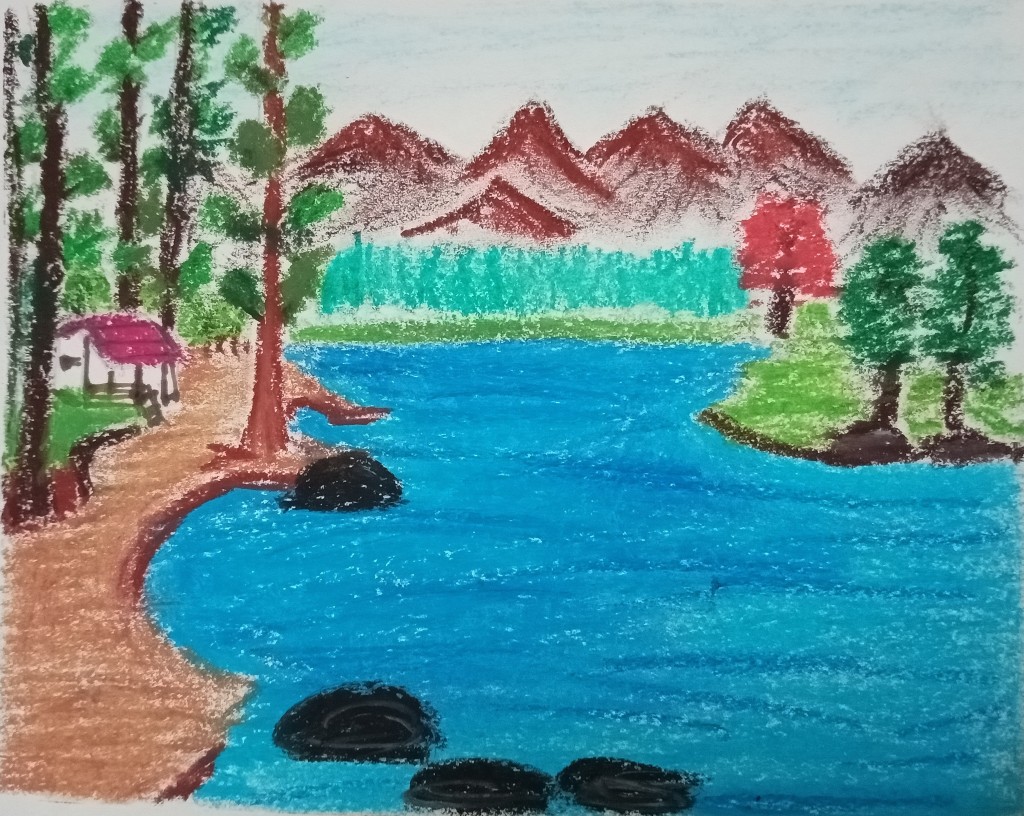
Painting by Sybil Pretious
And as imagination bodies forth
The forms of things unknown, the poet's pen
Turns them to shapes and gives to airy nothing
A local habitation and a name

 A Midsummer Night's Dream (1595) by William Shakespeare

Famous lines by Shakespeare that reflect on one of the most unique qualities in not only poets — as he states — but also in all humans, imagination, which helps us create our own constructs, build walls, draw boundaries as well as create wonderful paintings, invent planes, fly to the moon and write beautiful poetry. I wonder if animals or plants have the same ability? Then, there are some who, react to the impact of imagined constructs that hurt humanity. They write fabulous poetry or lyrics protesting war as well as dream of a world without war. Could we in times such as these imagine a world at peace, and — even more unusually — filled with consideration, kindness, love and brotherhood as suggested by Lennon’s lyrics in ‘Imagine’ – “Imagine all the people/ Livin’ life in peace…”. These are ideas that have been wafting in the world since times immemorial. And yet, they seem to be drifting in a breeze that caresses but continues to elude our grasp.

Under such circumstances, what can be more alluring than reflective Sufi poetry by an empathetic soul. Featuring an interview and poetry by such a poet, Afsar Mohammad, we bring to you his journey from a “small rural setting” in Telangana to University of Pennsylvania, where he teaches South Asian Studies. He is bilingual and has brought out many books, including one with his translated poetry. Translations this time start with Bankim Chandra Chattopadhyay’s advice to new writers in Bengali, introduced and brought to us by Abdullah-Al-Musayeb. Tagore’s seasonal poem, ‘Megh or Cloud’, has been transcreated to harmonise with the onset of monsoons. However, this year with the El Nino and as the impact of climate change sets in, the monsoons have turned awry and are flooding the world. At a spiritual plane, the maestro’s lines in this poem do reflect on the transience of nature (and life). Professor Fakrul Alam’s translation of Masud Khan’s heartfelt poetry on rain brings to the fore the discontent of the age while conveying the migrant’s dilemma of being divided between two lands. Fazal Baloch has brought us a powerful Balochi poet from the 1960s in translation, Bashir Baidar. His poetry cries out with compassion yet overpowers with its brutality. Sangita Swechcha’s Nepali poem celebrating a girl child has been translated by Hem Bishwakarma while Ihlwha Choi has brought his own Korean poem to readers in English.

An imagined but divided world has been explored by Michael Burch with his powerful poetry. Heath Brougher has shared with us lines that discomfit, convey with vehemence and is deeply reflective of the world we live in. Masha Hassan is a voice that dwells on such an imagined divide that ripped many parts of the world — division that history dubs as the Partition. Don Webb upends Heraclitus’s wisdom: “War is the Father of All, / War is the King of All.” War, as we all know, is entirely a human-made construct and destroys humanity and one cannot but agree with Webb’s conclusion.  We have more from Kirpal Singh, Ryan Quinn Flanagan, Nivedita N, John Grey, Carol D’Souza, Vernon Daim, George Freek, Saranyan BV, Samantha Underhill and among the many others, of course Rhys Hughes, who has given us poetry with a unique alphabetical rhyme scheme invented by him and it’s funny too… much like his perceptions on ‘Productivity’, where laziness accounts for an increase in output!

Keith Lyons has mused on attitudes too, though with a more candid outlook as has Devraj Singh Kalsi with a touch of nostalgia. Ramona Sen has brought in humour to the non-fiction section with her tasteful palate. Meredith Stephens takes us on a picturesque adventure to Sierra Nevada Mountains with her camera and narrative while Ravi Shankar journeys through museums in Kuala Lumpur. We travel to Japan with Suzanne Kamata and, through fiction, to different parts of the Earth as the narratives hail from Bangladesh, France and Singapore.

Ratnottama Sengupta takes us back to how imagined differences can rip humanity by sharing a letter from her brother stationed in Bosnia during the war that broke Yugoslavia (1992-1995). He writes: “It is hard to be surrounded by so much tragedy and not be repulsed by war and the people who lead nations into them.” This tone flows into our book excerpts section with Red Sky Over Kabul: A Memoir of a Father and Son in Afghanistan by Baryalai Popalzai and Kevin McLean. Popalzai was affected by the Russian invasion of Afghanistan in 1980 and had to flee. A different kind of battle can be found in the other excerpt from The Blue Dragonfly – healing through poetry by Veronica Eley – a spiritual battle to heal from experiences that break.

In our reviews section, KPP Nambiar reviews The Stolen Necklace: A Small Crime in a Small Town by Shevlin Sebastian and VK Thajudheen, a book that retells a true story. Sangeetha G’s novel, Drop of the Last Cloud, we are told by Rakhi Dalal, explores the matrilineal heritage of Kerala, that changed to patriarchal over time. Bhaskar Parichha reviews Burning Pyres, Mass Graves and A State That Failed Its People: India’s Covid Tragedy by Harsh Mander. Parichha emphasises the need never to forget the past: “It is a powerful book and sometimes it is even shattering. The narrative is a live remembrance of a national tragedy that too many of us wish to forget when we should, instead, etch it in our minds so that we can prevent another national tragedy like this one from recurring in the future.”  While we need to learn from the past as Parichha suggests, Somdatta Mandal has given a review that makes us want to read Ujjal Dosanjh’s book, The Past is Never Dead: A Novel. She concludes that it “pays tribute to the courage and tenacity of the human spirit and its capacity for hope despite all odds.”

We have more content than mentioned here… all of it enhances the texture of our journal. Do pause by our July issue to savour all the writings. Huge thanks to all our contributors, artists, all our readers and our wonderful team. Without each one of you, this edition would not have been what it is.

Thank you all.

Have a wonderful month!

Mitali Chakravarty

borderlessjournal.com

.

Visit the July edition’s content page by clicking here

READ THE LATEST UPDATES ON THE FIRST BORDERLESS ANTHOLOGY, MONALISA NO LONGER SMILES, BY CLICKING ON THIS LINK.

Categories
Poetry

Poetry on Rain by Masud Khan

Translated from Bengali by Professor Fakrul Alam

Courtesy: Creative Commons
RAIN - 1 

It’s raining abroad now, in countries close by or far away. 
Occasionally a cold wind from some other land blows this way 
This summer evening brings with it sadness and beauty 
Blowing this way from some distant land!
 
A cold, cold wind keeps blowing
Slowly stirring desire, fomenting longing
For alien rituals on such an evening.
 
In the distance, in a riverbank ruled by beauty
In another land, wonderfully wet in the rain,
Lightning flashes time and again
Stirring desire for one’s lover steadily
Inevitably, on such an evening!
 
Towards my homeland
The cold wind keeps blowing
O my alien lover
Where could you be staying?

RAIN - 2
 
It’s raining
Over distant lands
Over Brahma’s world,
Over Rangpur and Bogra’s vast expanse
In alluvial plains,
The rain veils Burma’s evening fields
And keeps streaming down.
 
And below these lightning flashes,
At the rain-formed night’s third quarter
Radiant races
Spring up at home or abroad
Like hyperactive frogs leaping
Into the unknown.
 
Provoked by thunder and lightning’s violent outbursts, 
Allured by their promises,
In the thick veil 
And swirling stream,
In the darkness of the wet wind, 
In the eastern expanse, 
Underneath the sky
In vast and empty fields
Under the vast spread-out arum fields of the east, 
Incredibly, unformed new nations emerge --
Innumerable unsteady chaotic nations,
Restless, perturbed, incapable of standing up, 
Lending themselves to grotesque maps,
Forming unstable, quivering, permeable boundaries
Governed by ill-defined laws and dwarf impotent ombudsmen 
And armies marching past unimpressively,
They spring for no good reason
And seem destined to be doomed.
 
The night draws to a close. The rain too appears spent. 
When day’s first light breaks out,
Those nations that would thrive and grow
And glow with innumerable rituals and fast-spreading religions 
Feel their bodies disintegrating and disappearing
Under the vast spread-out arum fields of the east.
 
*Rangpur, Bogra— Two small cities in the northern part of Bangladesh

Masud Khan (b. 1959) is a Bengali poet and writer. He has, authored nine volumes of poetry and three volumes of prose and fiction. His poems and fictions (in translation) have appeared in journals including Asiatic, Contemporary Literary Horizon, Six Seasons Review, Kaurab, 3c World Fiction, Ragazine.cc, Nebo: A literary Journal, Last Bench, Urhalpul, Tower Journal, Muse Poetry, Word Machine, and anthologies including Language for a New Century: Contemporary Poetry from the Middle East, Asia, and Beyond (W.W. Norton & Co., NY/London); Contemporary Literary Horizon Anthology,Bucharest; Intercontinental Anthology of Poetry on Universal Peace (Global Fraternity of Poets); and Padma Meghna Jamuna: Modern Poetry from Bangladesh(Foundation of SAARC Writers and Literature, New Delhi). Two volumes of his poems have been published as translations, Poems of Masud Khan(English), Antivirus Publications, UK, and Carnival Time and Other Poems (English and Spanish), Bibliotheca Universalis, Romania.  Born and brought up in Bangladesh, Masud Khan lives in Canada and teaches at a college in Toronto.

Fakrul Alam is an academic, translator and writer from Bangladesh. He has translated works of Jibonananda Das and Rabindranath Tagore into English and is the recipient of Bangla Academy Literary Award (2012) for translation and SAARC Literary Award (2012).

PLEASE NOTE: ARTICLES CAN ONLY BE REPRODUCED IN OTHER SITES WITH DUE ACKNOWLEDGEMENT TO BORDERLESS JOURNAL

Click here to access the Borderless anthology, Monalisa No Longer Smiles

Click here to access Monalisa No Longer Smiles on Kindle Amazon International

Categories
Contents

Borderless June 2023

Art by Sohana Manzoor

Editorial

Where have All the People Gone? … Click here to read.

Translations

Hena, a short story by Nazrul, has been translated from Bengali by Sohana Manzoor. Click here to read.

Mohammad Ali’s Signature, a short story by S Ramakrishnan, has been translated from Tamil by Dr B Chandramouli. Click here to read.

Three poems by Masud Khan have been translated from Bengali by Professor Fakrul Alam. Click here to read.

Shadows, a poem in Korean, has been translated by the poet himself, Ihlwha Choi. Click here to read.

Pran or Life by Tagore has been translated from Bengali by Mitali Chakravarty. Click here to read.

Conversations

Shantanu Ray Chaudhuri converses with Vinta Nanda about the Shout, a documentary by Vinta Nanda that documents the position of women in Indian society against the backdrop of the #MeToo movement and centuries of oppression and injustice. Click here to read.

In Conversation with Advait Kottary about his debut historic fiction, Siddhartha: The Boy Who Became the Buddha. Click here to read.

Poetry

Click on the names to read the poems

Michael Burch, Ananya Sarkar, George Freek, Smitha Sehgal, Rachel Jayan, Michael Lee Johnson, Sayantan Sur, Ron Pickett, Saranyan BV, Jason Ryberg, Priya Narayanan, Ryan Quinn Flanagan, Evangeline Zarpas, Ramesh Karthik Nayak, Rhys Hughes

Poets, Poetry & Rhys Hughes

In Ghee-Wizz, Rhys Hughes talks of the benefits of Indian sweets while wooing Yetis. Click here to read.

Musings/Slices from Life

Humbled by a Pig

Farouk Gulsara meets a wild pig while out one early morning and muses on the ‘meeting’. Click here to read.

Spring Surprise in the Sierra

Meredith Stephens takes us hiking in Sierra Nevada. Click here to read.

Lemon Pickle without Oil

Raka Banerjee indulges in nostalgia as she tries her hand at her grandmother’s recipe. Click here to read.

Apples & Apricots in Alchi

Shivani Shrivastav bikes down to Alchi Ladakh to find serenity and natural beauty. Click here to read.

Musings of a Copywriter

In Trees from my Childhood, Devraj Singh Kalsi muses on his symbiotic responses to trees that grew in their home. Click here to read.

Notes from Japan

In Superhero Sunday in Osaka, Suzanne Kamata writes of her experience at the Osaka Comic Convention with her daughter. Click here to read.

Stories

The Trial of Veg Biryani

Anagha Narasimha gives us a social satire. Click here to read.

Am I enough?

Sarpreet Kaur explores social issues in an unusual format. Click here to read.

Arthur’s Subterranean Adventure

Paul Mirabile journeys towards the centre of the Earth with his protagonist. Click here to read.

Essays

No Bucket Lists, No Regrets

Keith Lyons muses on choices we make while living. Click here to read.

In Search of the Perfect Dosa

Ravi Shankar trots around the world in quest of the perfect dosa — from South India to Aruba and West Indies. Click here to read.

“Bookshops don’t fail. Bookshops run by lazy booksellers fail.”

Shantanu Ray Chaudhuri takes us for a tour of the Kunzum bookstore in New Delhi. Click here to read.

Book Excerpts

An excerpt from Greening the Earth: A Global Anthology of Poetry, edited by K. Sachitanandan and Nishi Chawla. Click here to read.

An excerpt from Advait Kottary’s Siddhartha: The Boy Who Became the Buddha. Click here to read.

Book Reviews

Somdatta Mandal reviews Behind Latticed Marble: Inner Worlds of Women by Jyotirmoyee Devi Sen, translated from Bengali by Apala G. Egan. Click here to read.

Rakhi Dalal reviews Rhys Hughes’ The Wistful Wanderings of Perceval Pitthelm. Click here to read.

Basudhara Roy reviews Prerna Gill’s Meanwhile. Click here to read.

Bhaskar Parichha reviews Zac O’Yeah’s Digesting India: A Travel Writer’s Sub-Continental Adventures With The Tummy (A Memoir À La Carte). Click here to read.

.

PLEASE NOTE: ARTICLES CAN ONLY BE REPRODUCED IN OTHER SITES WITH DUE ACKNOWLEDGEMENT TO BORDERLESS JOURNAL

Click here to access the Borderless anthology, Monalisa No Longer Smiles

Click here to access Monalisa No Longer Smiles on Kindle Amazon International

Categories
Editorial

Where have All the People Gone?

Courtesy: Creative Commons

Can humankind ever stop warring and find peace?

Perhaps, most sceptics will say it is against human nature to stop fighting and fanning differences. The first recorded war was fought more than 13,000 years ago in what is now a desert but was green long ago. Nature changed its face. Continents altered over time. And now again, we are faced with strange shifts in climate that could redefine not just the dimensions of the surface area available to humankind but also our very physical existence. Can we absorb these changes as a species when we cannot change our nature to self-destruct for concepts that with a little redefining could move towards a world without wars leading to famines, starvation, destruction of beautiful edifices of nature and those built by humankind? That we could feed all of humans — a theory that won economist Abhijit Banerjee his Nobel Prize in 2019 so coveted by all humanity — almost seems to have taken a backseat. This confuses — as lemmings self-destruct…do humans too? I would have thought that all humanity would have moved towards resolving hunger and facing the climate crises post-2019 and post-pandemic, instead of killing each other for retaining constructs created by powerbrokers.

In the timeless lyrics of ‘Imagine’, John Lennon found peace by suggesting we do away with manmade constructs which breed war, anger and divisions and share the world as one. Wilfred Owen and many writers involved in the World Wars wrote to showcase the desolation and the heartfelt darkness that is brought on by such acts. Nazrul also created a story based on his experience in the First World War, ‘Hena’, translated for us by Sohana Manzoor. Showcasing the downside of another kind of conflict, a struggle to survive, is a story with a distinctive and yet light touch from S Ramakrishnan translated from Tamil by B Chandramouli. And yet in a conflict-ridden world, humans still yearn to survive, as is evident from Tagore’s poem Pran or ‘Life’. Reflecting it is the conditioning that we go through from our birth that makes us act as we do are translations by Professor Fakrul Alam of Masud Khan’s poetry and from Korean by Ihlwha Choi.

A figure who questioned his own conditioning and founded a new path towards survival; propounded living by need, and not greed; renounced violence and founded a creed that has survived more than 2500 years, is the man who rose to be the Buddha. Born as Prince Siddhartha, he redefined the norms with messages of love and peace. Reiterating the story of this legendary human is debutante author, Advait Kottary with his compelling Siddhartha: The Boy Who Became the Buddha, a book that has been featured in our excerpts too. In an interview, Kottary tells us more of what went into the making of the book which perhaps is the best survivor’s guide for humanity — not that we need to all become Buddhas but more that we need to relook at our own beliefs, choices and ways of life.

Another thinker-cum-film maker interviewed in this edition is Vinta Nanda for her film Shout, which highlights and seeks resolutions for another kind of crisis faced by one half of the world population today. She has been interviewed and her documentary reviewed by Shantanu Ray Chaudhuri. Chaudhuri has also given us an essay on a bookshop called Kunzum which continues to expand and go against the belief we have of shrinking hardcopy markets.

The bookshop has set out to redefine norms as have some of the books featured in our reviews this time, such as Rhys Hughes’ latest The Wistful Wanderings of Perceval Pitthelm. The reviewed by Rakhi Dalal contends that the subtitle is especially relevant as it explores what it says — “The Absurdity of Existence and The Futility of Human Desire” to arrive at what a person really needs. Prerna Gill’s Meanwhile reviewed by Basudhara Roy and poetry excerpted from Greening the Earth: A Global Anthology of Poetry, edited by K. Satchidanandan and Nishi Chawla, also make for relooking at the world through different lenses. Somdatta Mandal has written about Behind Latticed Marble: Inner Worlds of Women by Jyotirmoyee Devi Sen, translated by Apala G. Egan and Bhaskar Parichha has taken us on a gastronomic tour with Zac O’Yeah’s Digesting India: A Travel Writer’s Sub-Continental Adventures with the Tummy (A Memoir À La Carte).

Gastronomical adventures seem to be another concurrent theme in this edition. Rhys Hughes has written of the Indian sweets with gulab jamun as the ultimate life saver from Yetis while trekking in the Himalayas! A musing on lemon pickle by Raka Banerjee and Ravi Shankar’s quest for the ultimate dosa around the world — from India, to Malaysia, to Aruba, Nepal and more… tickle our palate and make us wonder at the role of food in our lives as does the story about biryani battles by Anagaha Narasimha.

Talk of war, perhaps, conjures up gastronomic dreams as often scarcity of food and resources, even potable water and electricity is a reality of war or conflict. Michael Burch brings to us poignant poetry about war as Ramesh Karthik Nayak has a poem on a weapon used in wars. Ryan Quinn Flanagan has brought another kind of ongoing conflict to our focus with his poetry centring on the National Day (May 5th) in Canada for Vigils for Missing and Murdered Indigenous Women by hanging red clothes from trees, an issue that perhaps has echoes of Vinta Nanda’s Shout and Suzanne Kamata’s poetry for her friend who went missing decades ago as opposed to Rachel Jayen’s defiant poetry where she asserts her womanhood. Ron Pickett, George Freek and Sayantan Sur have given us introspective perspectives in verse. We have more poetry asking for a relook at societal norms with tongue-in -cheek humour by Jason Ryberg and of course, Rhys Hughes with his heartfelt poem on raiders in deserts.

The piece that really brought a smile to the lips this time was Farouk Gulsara’s ‘Humbled by a Pig’, a humorous recount of man’s struggles with nature after he has disrupted it. Keith Lyons has taken a look at the concept of bucket lists, another strange construct, in a light vein. Devraj Singh Kalsi has given a poignant and empathetic piece about trees with a self-reflective and ironic twist. We have narratives from around the world with Suzanne Kamata taking us to Osaka Comic Convention, Meredith Stephens to Sierra Nevada and Shivani Shrivastav to Ladakh. Paul Mirabile has travelled to the subterranean world with his fiction, in the footsteps perhaps of Jules Verne but not quite.

We are grateful to all our wonderful contributors some of whom have not been mentioned here but their works were selected because they truly enriched our June edition. Do visit our contents page to meet and greet all our wonderful authors. I would like to thank the team at Borderless without whose efforts and encouragement our journal would not exist and Sohana Manzoor especially for her fantastic artwork as well. Thank you all.

Wish you another lovely month of interesting reads!

Mitali Chakravarty

borderlessjournal.com

.

READ THE LATEST UPDATES ON THE FIRST BORDERLESS ANTHOLOGY, MONALISA NO LONGER SMILES, BY CLICKING ON THIS LINK.

Categories
Poetry

Masud Khan in Translation by Fakrul Alam

Homa-birds are mythical birds of Iranian origin
HOMA-BIRD 
 
Once I fall, how much must I drop down before I can rise up again? 
 
As this thought crosses my mind, I am reminded of the Homa-bird found high in the sky. It even lays its eggs there. The eggs then fall down. But because the bird lives so high in the sky its eggs take ages to fall. Its chicks hatch even as the eggs descend. And then it’s time for the chicks to fall. As they begin to fall the chicks sprout eyes and feathers and wings. And one day they discover that they are falling down and down. It is then that they begin to fly to their mothers high up in the sky. They fly so high now that they emerge as specks scattered all along the spread-out body of the sky
 
We are of the breed of these birds. We procreate, raise children; we drop down and rise up again!
 
[Homapakhi; Translated by Fakrul Alam]          

GONE WHO KNOWS WHERE 

An unending queue of children flowed forward
Going who knows where?
 
With great difficulty, I spotted my own child there.
But when I tried kissing him 
I ended up kissing someone else’s child!
 
And then I lost him— lost him forever! 
Dazed, distressed— I seem doomed to a lifetime of waiting.
 
[Aggato Uddesh; Translated by Fakrul Alam]


REJECTION
 
Abruptly today a baby is expelled from its mother’s breasts.
Though it keeps gravitating towards her— hopefully— 
It continues to be rejected. Startled, it still keeps trying.... 
   
How can the innocent baby make sense of such evictions? 
It can comprehend nothing— neither the implications 
Nor the reasons behind its mother’s bizarre actions. 
All it can do is wonder— is mother playing with it? 
Or is she just being cruel, suddenly unmotherly, 
Distracted by the sudden heat wave of the season? 
  
The baby broods, all alone, helpless. And then once again 
It turns towards its mother, only for another round of rejection... 
  
Now inconsolable, it breaks out into tears, feeling hurt     
And rejected, sobbing endlessly till sleep silences it... 
  
Only its craving for love keeps striking one’s ears 
Its magnitude scattering here, there, everywhere! 
      
[Protyakhyan; Translated by Fakrul Alam]          

Masud Khan (b. 1959) is a Bengali poet and writer. He has, authored nine volumes of poetry and three volumes of prose and fiction. His poems and fictions (in translation) have appeared in journals including Asiatic, Contemporary Literary Horizon, Six Seasons Review, Kaurab, 3c World Fiction, Ragazine.cc, Nebo: A literary Journal, Last Bench, Urhalpul, Tower Journal, Muse Poetry, Word Machine, and anthologies including Language for a New Century: Contemporary Poetry from the Middle East, Asia, and Beyond (W.W. Norton & Co., NY/London); Contemporary Literary Horizon Anthology,Bucharest; Intercontinental Anthology of Poetry on Universal Peace (Global Fraternity of Poets); and Padma Meghna Jamuna: Modern Poetry from Bangladesh(Foundation of SAARC Writers and Literature, New Delhi). Two volumes of his poems have been published as translations, Poems of Masud Khan(English), Antivirus Publications, UK, and Carnival Time and Other Poems (English and Spanish), Bibliotheca Universalis, Romania.  Born and brought up in Bangladesh, Masud Khan lives in Canada and teaches at a college in Toronto.

Fakrul Alam is an academic, translator and writer from Bangladesh. He has translated works of Jibonananda Das and Rabindranath Tagore into English and is the recipient of Bangla Academy Literary Award (2012) for translation and SAARC Literary Award (2012).

PLEASE NOTE: ARTICLES CAN ONLY BE REPRODUCED IN OTHER SITES WITH DUE ACKNOWLEDGEMENT TO BORDERLESS JOURNAL

Click here to access the Borderless anthology, Monalisa No Longer Smiles

Click here to access Monalisa No Longer Smiles on Kindle Amazon International

Categories
Contents

Borderless, May 2023

Art by Sohana Manzoor

Editorial

Dancing in May? … Click here to read.

Translations

Aparichita by Tagore has been translated from Bengali as The Stranger by Aruna Chakravarti. Click here to read.

The Kabbadi Player, a short story by the late Nadir Ali, has been translated from Punjabi by Amna Ali. Click here to read.

Carnival Time by Masud Khan has been translated from the Bengali poem by Fakrul Alam. Click here to read.

Desolation, a poem by Munir Momin, has been translated from Balochi by Fazal Baloch. Click here to read.

Loneliness, a poem, has been translated from Korean to English by the poet himself, Ihlwha Choi. Click here to read

Jonmodiner Gaan or Birthday Song by Tagore has been translated by Mitali Chakravarty. Click here to read.

Conversations

A conversation with Mitra Phukan about her latest novel, What Will People Say? A Novel along with a brief introduction to the book. Click here to read.

Shantanu Ray Chaudhuri converses with Prerna Gill on her poetry and her new book of poetry, Meanwhile. Click here to read.

Poetry

Click on the names to read the poems

Michael Burch, Lakshmi Kannan, Ryan Quinn Flanagan, Shahriyer Hossain Shetu, Peter Cashorali, K.V. Raghupathi, Wilda Morris, Ashok Suri, William Miller, Khayma Balakrishnan, Md Mujib Ullah, Urmi Chakravorty, Sreekanth Kopuri, Rhys Hughes

Poets, Poetry & Rhys Hughes

In What I Thought I Knew About India When I was Young, Rhys Hughes travels back to his childhood with a soupçon of humour. Click here to read.

Musings/Slices from Life

A Towering Inferno, A Girl-next-door & the Big City

Ratnottama Sengupta writes of actress Jaya Bachchan recounting her first day on the sets of Satyajit Ray’s Mahanagar. Click here to read.

Kissed on Kangaroo Island

Meredith Stephens travels with her camera and her narrative to capture the flora and fauna of the island. Click here to read.

Musings of a Copywriter

In The Reader, Devraj Singh Kalsi revisits his experiences at school. Click here to read.

Notes from Japan

In Making Chop Suey in South Carolina, Suzanne Kamata recaptures a flavour from her past. Click here to read.

Essays

Rabindranath’s Monsoonal Music

Professor Fakrul Alam brings to us Tagore songs in translation and in discussion on the season that follows the scorching heat of summer months. Click here to read.

A Night Hike in Nepal

Ravi Shankar hikes uphill in Nepal on a wet and rainy night along with leeches and water buffaloes. Click here to read.

Moving Images of Tagore

Ratnottama Sengupta talks of Tagore and cinema. Click here to read.

Stories

Threads

Julian Gallo explores addiction. Click here to read.

The Whirlpool

Abdullah Rayhan takes us back to a village in Bangladesh to give a poignant story about a young boy who dreamt of hunting. Click here to read.

Look but with Love

Sreelekha Chatterjee writes a story set in the world of media. Click here to read.

The Mysterious Murder of Adamov Plut

A globe-trotting murder mystery by Paul Mirabile, a sequel to his last month’s story, ‘The Book Hunter’. Click here to read.

Book Excerpts

An excerpt from Aruna Chakravarti’s Daughter’s of Jorasanko describing the last birthday celebration of Tagore. Click here to read.

An excerpt from Bhubaneswar@75 – Perspectives, edited by Bhaskar Parichha/ Charudutta Panigrahi. Click here to read.

Book Reviews

Meenakshi Malhotra revisits Tagore’s Farewell Song, translated from Bengali by Radha Chakravarty. Click here to read.

Somdatta Mandal reviews KR Meera’s Jezebel translated from Malayalam by Abhirami Girija Sriram and K. S. Bijukumar. Click here to read.

Lakshmi Kannan has reviewed Jaydeep Sarangi’s collection of poems, letters in lower case. Click here to read.

Bhaskar Parichha reviews Journey After Midnight – A Punjabi Life: From India to Canada by Ujjal Dosanjh. Click here to read.

PLEASE NOTE: ARTICLES CAN ONLY BE REPRODUCED IN OTHER SITES WITH DUE ACKNOWLEDGEMENT TO BORDERLESS JOURNAL

Click here to access the Borderless anthology, Monalisa No Longer Smiles

Click here to access Monalisa No Longer Smiles on Kindle Amazon International

Categories
Editorial

Dancing in May?

Courtesy: Creative Commons
“May is pretty, May is mild,
Dances like a happy child…”

Annette Wynne (Early twentieth century)

Each month is expressed in a different form by nature in various parts of the world. In the tropics, May is sweltering and hot — peak summer. In the Southern hemisphere, it is cold. However, with climate change setting in, the patterns are changing, and the temperatures are swinging to extremes. Sometimes, one wonders if this is a reflection of human minds, which seem to swing like pendulums to create dissensions and conflicts in the current world. Nothing seems constant and the winds of change have taken on a menacing appearance. If we go by Nazrul’s outlook, destruction is a part of creating a new way of life as he contends in his poem, ‘Ring Bells of Victory’ — “Why fear destruction? It’s the gateway to creation!” Is this how we will move towards ‘dancing like a happy child’?

Mitra Phukan addresses this need for change in her novel, What Will People Say — not with intensity of Nazrul nor in poetry but with a light feathery wand, more in the tradition of Jane Austen. Her narrative reflects on change at various levels to explore the destruction of old customs giving way to new that are more accepting and kinder to inclusivity, addressing issues like widow remarriage in conservative Hindu frameworks, female fellowship and ageing as Phukan tells us in her interview. Upcoming voice, Prerna Gill, lauded by names like Arundhathi Subramaniam and Chitra Divakaruni, has also been in conversation with Shantanu Ray Choudhuri on her book of verses, Meanwhile. She has refreshing perspectives on life and literature.

Poetry in Borderless means variety and diaspora. Peter Cashorali’s poem addresses changes that quite literally upend the sky and the Earth! Michael Burch reflects on a change that continues to evolve – climate change. Ryan Quinn Flanagan explores societal irritants with irony. Seasons are explored by KV Raghupathi and Ashok Suri. Wilda Morris brings in humour with universal truths. William Miller explores crime and punishment. Lakshmi Kannan and Shahriyer Hossain Shetu weave words around mythical lore. We have passionate poetry from Md Mujib Ullah and Urmi Chakravorty. It is difficult to go into each poem with their diverse colours but Rhys Hughes has brought in wry humour with his long poem on eighteen goblins… or is the count nineteen? In his column, Hughes has dwelt on tall tales he heard about India during his childhood in a light tone, stories that sound truly fantastic…

Devraj Singh Kalsi has written a nostalgic piece that hovers between irony and perhaps, a reformatory urge… I am not quite sure, but it is as enjoyable and compelling as Meredith Stephen’s narrative on her conservation efforts in Kangaroo Island in the Southern hemisphere and fantastic animals she meets, livened further by her photography. Ravi Shankar talks of his night hikes in the Northern hemisphere, more accurately, in the Himalayas. While trekking at night seems a risky task, trying to recreate dishes from the past is no less daunting, as Suzanne Kamata tells us in her Notes from Japan.

May hosts the birthday of a number of greats, including Tagore and Satyajit Ray. Ratnottama Sengupta’s piece on Ray’s birth anniversary celebrations with actress Jaya Bachchan recounting her experience while working for Ray in Mahanagar (Big City), a film that has been restored and was part of celebrations for the filmmaker’s 102nd Birth anniversary captures the nostalgia of a famous actress on the greatest filmmakers of our times. She has also given us an essay on Tagore and cinema in memory of the great soul, who was just sixty years older to Ray and impacted the filmmaker too. Ray had a year-long sojourn in Santiniketan during his youth.

Eulogising Rabindrasangeet and its lyrics is an essay by Professor Fakrul Alam on Tagore. Professor Alam has translated number of his songs for the essay as he has, a powerful poem from Bengali by Masud Khan. A transcreation of Tagore’s first birthday poem , a wonderful translation of Balochi poetry by Fazal Baloch of Munir Momin’s verses, another one from Korean by Ihlwha Choi rounds up the translated poetry in this edition. Stories that reach out with their poignant telling include Nadir Ali’s narrative, translated from Punjabi by his daughter, Amna Ali, and Aruna Chakravarti’s translation of a short story by Tagore. We have more stories from around the world with Julian Gallo exploring addiction, Abdullah Rayhan with a poignant narrative from Bangladesh, Sreelekha Chatterjee with a short funny tale and Paul Mirabile exploring the supernatural and horror, a sequel to ‘The Book Hunter‘, published in the April issue.

All the genres we host seem to be topped with a sprinkling of pieces on Tagore as this is his birth month. A book excerpt from Chakravarti’s Daughters of Jorasanko narrates her well-researched version of Tagore’s last birthday celebration and carries her translation of the last birthday song by the giant of Bengali literature. The other book excerpt is from Bhubaneswar@75 – Perspectives, edited by Bhaskar Parichha/ Charudutta Panigrahi. Parichha has also reviewed Journey After Midnight – A Punjabi Life: From India to Canada by Ujjal Dosanjh, a book that starts in pre-independent India and travels with the writer to Canada via UK. Again to commemorate the maestro’s birth anniversary, Meenakshi Malhotra has revisited Radha Chakravarty’s translation of Tagore’s Farewell Song. Somdatta Mandal has critiqued KR Meera’s Jezebeltranslated from Malayalam by Abhirami Girija Sriram and K. S. Bijukuma. Lakshmi Kannan has introduced to us Jaydeep Sarangi’s collection of poems, letters in lower case.

There are pieces that still reach out to be mentioned. Do visit our content page for May. I would like to thank Sohana Manzoor for her fantastic artwork and continued editorial support for the Tagore translations and the whole team for helping me put together this issue. Thank you. A huge thanks to our loyal readers and contributors who continue to bring in vibrant content, photography and artwork. Without you all, we would not be where we are today.

Wish you a lovely month.

Mitali Chakravarty

borderlessjournal.com

Categories
Poetry

Carnival Time

Poetry by Masud Khan, translated from the Bengali poem, ‘Aj Ullash Diba’ by Fakrul Alam

Courtesy: Creative Commons
It’s carnival time today.
Serfs and plebeians pour into streets.
Behold the giggling, decked up undertaker’s wife, 
That man over there, completely soused, is her spouse! 
He holds his pay tight in his fists and grins grotesquely, 
See the sweeper there, lips reddened by betel leaf!

There he is— the constable— sporting a shiny wristband. 
And look at that rotund young eunuch—
All merry, like dusky Abyssinians or Afghan revellers in the rain. 

Today it’s time to collect wages and bonuses and forget files. 
Today superiors have trade place with subordinates

And mandarins have transformed themselves into mere clerks.

The roly-poly slave and Kishorimohon Das
Sleep fitfully next to each other near the town reservoir, 
Stirred again and again by the mayor’s snores,

The hapless water bearer gets completely wet. 
The woman over there is a streetwalker,
Visiting town for the first time with her snotty-nosed brother. 
That man there trades in lead, and there is the perfume seller, 
He is the accountant, and he, the treasurer,
And next to him on this day of intermittent rain 
Is the petty thief’s no-good brother.
And there— leaning, bent by the weight of his imagination, 
As if in a trance, is the poet, the king of poets!

This day all have spilled out into the streets and stroll there 
Endlessly — intransitive
Wrapped in newly spun silk.


Masud Khan (b. 1959) is a Bengali poet and writer. He has, authored nine volumes of poetry and three volumes of prose and fiction. His poems and fictions (in translation) have appeared in journals including Asiatic, Contemporary Literary Horizon, Six Seasons Review, Kaurab, 3c World Fiction, Ragazine.cc, Nebo: A literary Journal, Last Bench, Urhalpul, Tower Journal, Muse Poetry, Word Machine, and anthologies including Language for a New Century: Contemporary Poetry from the Middle East, Asia, and Beyond (W.W. Norton & Co., NY/London); Contemporary Literary Horizon Anthology,Bucharest; Intercontinental Anthology of Poetry on Universal Peace (Global Fraternity of Poets); and Padma Meghna Jamuna: Modern Poetry from Bangladesh(Foundation of SAARC Writers and Literature, New Delhi). Two volumes of his poems have been published as translations, Poems of Masud Khan(English), Antivirus Publications, UK, and Carnival Time and Other Poems (English and Spanish), Bibliotheca Universalis, Romania.  Born and brought up in Bangladesh, Masud Khan lives in Canada and teaches at a college in Toronto.

Fakrul Alam is an academic, translator and writer from Bangladesh. He has translated works of Jibonananda Das and Rabindranath Tagore into English and is the recipient of Bangla Academy Literary Award (2012) for translation and SAARC Literary Award (2012).

PLEASE NOTE: ARTICLES CAN ONLY BE REPRODUCED IN OTHER SITES WITH DUE ACKNOWLEDGEMENT TO BORDERLESS JOURNAL

Click here to access the Borderless anthology, Monalisa No Longer Smiles

Click here to access Monalisa No Longer Smiles on Kindle Amazon International

Categories
A Special Tribute

A Glimpse into Tagore’s Imagined World

There is no bar to losing myself in an imaginary world.
I can soar high on the wings of a song in my mind. 

-- Tagore, Losing Myself
Painting of Rabindranath Tagore (7th May 1861- 7th August 1941) by his nephew, Gaganendranath Tagore (1867-1938). Courtesy: Creative Commons

Soaring on imaginary wings, on Rabindranath Tagore’s 162nd birth anniversary, we explore his vision for a better world while trying to recreate in English the first poem the maestro wrote for his own birthday which was later made into a song, his last birthday celebration as imagined by Aruna Chakravarti in her historical novel, Daughters of Jorsanko, and also the translation of the last song he wrote for the occasion.

As a change-maker, the maestro tried to close gaps by both his actions— Santiniketan and Sriniketan — and by his writings. The translations of the birthday songs written by the maestro himself brings to the fore what he looked forward to and prayed for. The fiction explored here creates fantastically independent women Tagore visualised, breaking the boundaries of social conventions. The characterisations can be seen both in the short story translated by Aruna Chakravarti especially for this issue  and also in the novel Farewell Song, translated by Radha Chakravarty. This has been brought to attention in Meenakshi Malhotra’s review of the novel. Both the short story and the novel show the emergence of the new independent woman of Tagore’s imagined world. A hundred years later, are we able to accept women as independent as visualised by Tagore? As progressive? 

And to round up our section is Professor Fakrul Alam’s musing on seasonal songs of Tagore as he translates the lyrics and discusses their relevance. These also reflect on the maestro’s need to close social gaps as Alam translates in one of the songs:

Rain streams down incessantly
Alas wayfarer; alas disabled, homeless ones!
The wind moans on and on.

Pause by our issue and explore— 

Bhoy hote tobo, the first Birthday Song by Tagore, a poem written in 1899, has been translated by Mitali Chakravarty. Click here to read.

Tagore’s Last Birthday Celebration excerpted from Aruna Chakravarti’s Daughters of Jorasanko, has her translation of the last birthday song he wrote in 1941 a few months before he died. Click here to read 

Aparichita by Tagore has been translated as The Stranger by Aruna Chakravarti. Click here to read. 

In Farewell Song: Revisiting Tagore’s Vision of Modern Love, Meenakshi Malhotra revisits Tagore’s Shesher Kobita, translated by Radha Chakravarty and reflects on the modern woman and romance as shown by Tagore by bringing in a brief comparison between the women leads of Aparichita and the novel. Click here to read. 

In Rabindranath’s Monsoonal Music, Professor Fakrul Alam brings to us Tagore songs in translation and in discussion on the season that follows the scorching heat of summer months. Click here to read.

Bird Fantastic by Tagore. Courtesy: Creative Commons
Categories
Essay

Rabindranath’s Monsoonal Music

Professor Fakrul Alam brings to us a discussion on and translations of Tagore songs on the season that follows the scorching heat of summer months

Art by Sohana Manzoor

A rough count of the songs collected in Gitabitan in the section titled “Prakriti” or “Nature” reveals that Rabindranath Tagore composed about sixteen songs of summer, more than 100 monsoonal ones, 33 songs of Sharat or early autumn, five of Hemonto or late autumn, and a dozen or so songs of winter. In addition, he has left us around 93 songs of spring. For many decades, I kept wondering how Rabindranath managed to end up with such a lopsided list as far as his songs of the six Bengali seasons are concerned. After all, late autumn and winter are enjoyable seasons when Bengal is blissfully heat-free and the weather quite mild and bearable; why, then, did he show such fondness for the wet monsoonal months and the rapidly warming and (at its end quite unbearably hot) springtime? But I am puzzled no longer by his preference for our Borsha, for it now seems clear to me that he had good reasons to prefer the monsoonal months over all else. In recent decades, now that I fancy I have something of what Wordsworth calls the “philosophic mind” (and in this age of global warming as well!), I can appreciate fully why the monsoonal months stimulated Rabindranath so continuously into songs.

Think of the summer months. From mid-April till the second week of June, the weather torments us all over Bangladesh with stifling heat and unbearable humidity. Who in these weeks of scorching sun, steadily frying dampness and seemingly immobile and incredibly muggy air does not yearned for an ever-increasing cloud cover leading to sudden bursts of showers and rainy conditions? Isn’t the monsoon a huge relief after the summer months, despite the flaming krishnachuras [flame of the forest] and the seemingly endless stream of summer fruits that arrive in our market then?  Don’t we all look forward to the pitter patter of raindrops, even if accompanied by thunder and lightning, when hot and dry ourselves? And isn’t the fresh green look of nature after a burst of rain so very soothing?

As in his devotional and love poems, Rabindranath captures feelingly in his monsoonal song-lyrics a variety of moods.  One such mood is the longing for relief from an oppressive presence. Registering the cruel heat and humidity of our late spring and summer, his songs often exult in the respite that the monsoons afford us. Hear him thus dramatise the excitement all life forms feel just before, during and after the coming of the monsoons, in the opening two stanzas of the song-lyric ‘Oi Ashe Oi Oti Bhairob Horoshe’[i] [The Clouds Arrive Amidst Joy]

There, there they come — monsoonal clouds—
Exhilarating, awesome, moisture-laden,
Fragrant, earth-soaked, dense, rejuvenated
Dark-hued, somber, glorious— ready to burst!

Their deep rumblings quiver dark-blue forests
Tense peacocks out on strolls cry out,
The whole world is thrilled, overwhelmed. 
Intense, amazing—monsoon is on its way!

Indeed, song after song of Gitabitan record Rabindranath’s fascinated melodic outburst after a dramatic monsoonal outburst. Here is another example, ‘Prochondo Gorjone Ashile Eki Durdeen’, [Amidst Thunder comes a Dreaded Day].

Such a dreadful day, so full of rolling, thundering sounds
Disquieting cloud buildups, ominous endless outbursts!
Such a thick cloud cover; serpentine lightning, scarring night
Making the sky stream tears despite its totally blinded eyes!
But abandon all your fears; stir O scared and slothful ones.
Cheerfully, build up within yourself ample strength
To behold with resolute and wide open eyes His serene presence 
Behold Him seating superbly on his throne –defying death, fearless!

Completely committed to the notion of a Supreme Being in his works, Rabindranath conveys his wonder at the monsoonal drama of clouds, thunder, and lightning and rain in many a song, inspired by scenes that he sees in the last analysis as embodying the power and inspirational presence of the deity.

A sizeable number of Rabindranath’s song-lyrics are in this religious vein, but not all. In other monsoonal song-lyrics Rabindranath presents to us not only the awe-inspiring/ sacramental signs of the deity embodied in such seasonal storms, but also the frightening and intimidating aspects of our rainy season. He is well aware of the deep unease the monsoonal storm’s power and intemperate outbursts can cause, and the way it can scare all things in nature and make them aquiver. The foreboding created by the approach of an overwhelming and apocalyptic force is thus apparent in the concluding lines of the song ‘Hridaye Mondrilo Domoru Guru Guru’ (A Drum Rumbles in the Heart): 

The night is full of thunder and lightning;
The clouds are intense, startling.
Jasmine creepers tremble and rustle in melancholy notes
Woodlands fill with insects chirping in alarm!

In fact, Rabindranath is acutely aware of how the monsoon can disrupt lives, particularly those of people out in the open or men and women who have to travel in inclement weather despite the thunder, lightning, rain and flash floods that the monsoons invariably bring. His concern for such vulnerable people and concern at such intemperate weather comes out clearly in Jhoro Jhoro Boreshe Baridhara [The Rain Streams Incessantly]:

Rain streams down incessantly
Alas wayfarer; alas disabled, homeless ones!
The wind moans on and on.
Who is it calling out to in this immense, deserted, dismal landscape?
The night is pitch dark,
Jamuna restless; its waves agitated, endless; its shores have disappeared!
Dense dark rain clouds hover in the horizon, rumbling continuously.
Lightning darts restlessly, dazzlingly—no moon or stars in sight! 

On the other hand, the monsoons are also seasonal visitations for Rabindranath that induce in him desire for romance or romantic cravings that need to be fulfilled.  Note how intensely the yearning of a lover anxious to impart his feelings to his beloved in a rain-stirred mood is articulated in Emono Dine Tara Bola Jai [On Such a Day, They Say]:

On such a day she could be told
On such a dense, dark, wet day!
On such a day to her I could my mind unfold,
On such a cloudy, thunderous, showery day
		On just such a sunless, dense, dismal day!

I’d tell her what no one else would know
	Silence would us probably surround,
We’d face each other, each sobered by a deep wound.
	Incessant rain would from the sky flow; 
	Surely, no one then would be around.

	Societal and family life would feel unreal
	The hullabaloo of life too would feel surreal
What would only matter are eyes feeding on each other
	And two hearts savouring one another;
	All else would merge with darkness.
If in a corner of the house on such a rainy day,
	I had then a thing or two to tell her 
Why would anyone have anything to say?

	The wind blows with great force today;
	Lightning keeps flashing away
What I’ve been storing in my mind till this day
	Is something that I’d like to tell her today—
	On just such a dense, dark, wet day!

Not a few of the song lyrics collected in the ‘Borsha’ [Monsoon] part of Gitabitan depict such brooding and passionate thoughts and the intense yearning for the beloved brought on by the turbulence of the monsoonal breeze. Here is another such song, Mor Bhabonere Ki Haowa [What wind is it lilting my thoughts so amazingly]:

What wind is it lilting my thoughts so amazingly?
Its caress swings, swings my mind unaccountably.
In my heart’s horizon moist dense new clouds swarm,
			Stirring a shower of emotions.	
I don’t see her—don’t see her at all
Only occasionally in my mind I recall
Almost indiscernible footsteps sounding
And ankle bells tinkling, oh so tunefully!

A secret dreamscape spreads
Across the wet wind-swept sky—
A new and ethereal azure shawl!
Shadowy unfurled tresses fly,
Filling me with such intense disquiet
On this far-off ketoki-perfumed wet night.

All in all, Rabindranath’s inspired lyrical responses to the monsoons remind one that he is in some ways a poet following in the footsteps of William Wordsworth. One remembers, in this context, the English romantic poet’s lines in Book I of The Prelude where he conveys his ardent and positive response to the coming of the English spring after the English winter’s life-shrinking barrenness. Wordsworth sees the English spring ushering in a “correspondent breeze” that gives rise to poetry. To make the point somewhat differently, just as the spring breeze is Wordsworth’s metaphor for the muse, Rabindranath finds in the monsoons endless inspiration for composing song-lyrics and poetry. Here is a translation of one of his most popular ones Mono Mor Meghero Shongi [ My Friend, the Cloud]:

My mind is the clouds’ companion,
Soaring to the limits of the horizon
And crossing wide open spaces to sravan’s music 
Of rain falling pitter patter, pitter patter!
	My mind soars on crane-like wings
	To startling, streaking, lightning flashes,
	And rumbling, terrifying,
	Tumultuous, deafening sounds
	Responding to apocalyptic summons!
The wind blows from some eastern sea
Surging, rippling waves crest endlessly
	My mind is fascinated by their frantic motion
	By palm-fringed, dark-tamal tree forests
	And to branches fluttering frenziedly!

Space will not permit any more long extracts, but on the subject of inspiration I can’t resist including the concluding stanza of the much loved song lyric, ‘Hriday Amar Nachere’ (My Heart Dances):

Like a peacock dancing, my heart dances this day.
Showers stream down on newly sprouted branches,
Cricket songs stir forests,
The rampaging river roars over banks and floods villages,
Like a peacock dancing, my heart dances this day!  
 

No wonder then this monsoon-stirred poet has articulated for all Bengalis so melodically the many-sides and wonders of the season as no other writer has; no other writer from our part of the world has been so mesmerised by our rainy season and so stirred into unforgettable songs and poems by it!

[i] All translations from the Bengali song-lyrics are that of Professor Fakrul Alam.

(First published in Daily Star, 2019)

Fakrul Alam is an academic, translator and writer from Bangladesh. He has translated works of Jibonananda Das and Rabindranath Tagore into English and is the recipient of Bangla Academy Literary Award (2012) for translation and SAARC Literary Award (2012).

PLEASE NOTE: ARTICLES CAN ONLY BE REPRODUCED IN OTHER SITES WITH DUE ACKNOWLEDGEMENT TO BORDERLESS JOURNAL

Click here to access the Borderless anthology, Monalisa No Longer Smiles

Click here to access Monalisa No Longer Smiles on Kindle Amazon International